In partnership with
Profit
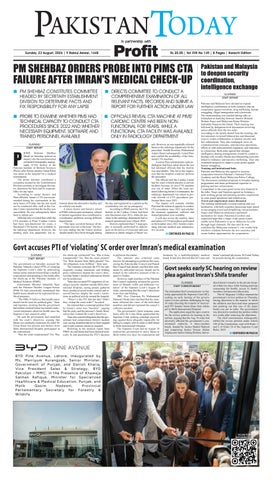
PM Shehbaz orderS Probe into PiMS Cta failure after iMran'S MediCal CheCk-uP Sunday, 23 August, 2026 | 9 Rabiul Awwal, 1448
g
g
PM SHEHBAZ CONSTITUTES COMMITTEE HEADED BY SECRETARY ESTABLISHMENT DIVISION TO DETERMINE FACTS AND FIX RESPONSIBILITY FOR ANY LAPSE
PROBE TO EXAMINE WHETHER PIMS HAD TECHNICAL CAPACITY TO CONDUCT CTA PROCEDURES SINCE 2022 AND WHETHER NECESSARY EQUIPMENT, SOFTWARE AND TRAINED PERSONNEL AVAILABLE
P
g
g
ISLAMABAD
DIRECTS COMMITTEE TO CONDUCT A COMPREHENSIVE EXAMINATION OF ALL RELEVANT FACTS, RECORDS AND SUBMIT A REPORT FOR FURTHER ACTION UNDER LAW
OFFICIALS REVEAL CTA MACHINE AT PIMS’ CARDIAC CENTRE HAS BEEN NONFUNCTIONAL FOR YEARS, WHILE A FUNCTIONAL CTA FACILITY WAS AVAILABLE ONLY IN RADIOLOGY DEPARTMENT
STAFF REPORT
RIME Minister Shehbaz Sharif on Saturday ordered an inquiry into the non-functional computed tomography angiography (CTA) facility at the Pakistan Institute of Medical Sciences (Pims), after former premier Imran Khan was taken to the hospital for a medical examination. The prime minister constituted a committee headed by the Establishment Division secretary to investigate the matter, determine the facts and fix responsibility for any lapse. According to senior doctors and Pims officials, Imran’s CTA was recommended during his examination in the early hours of Friday, but the test could not be conducted after staff at the Cardiac Centre reported that the facility was unavailable. He was subsequently taken back to Adiala jail. Officials later revealed that while the CTA machine at Pims’ Cardiac Centre had been non-functional for years, a functional CTA facility was available in the radiology department. However, the treating team was apparently not in-
formed about the alternative facility and no referral was made. A senior doctor said Imran’s arrival at PIMS without prior intimation, referral or patient registration also contributed to coordination problems among different departments. “The lapse occurred because all departments were not in the loop,” the doctor said, adding that the former premier should ideally have been brought during
Rs 20.00 | Vol XVII No 149 | 8 Pages | Karachi Edition
the day and registered as a patient as the examination was not an emergency. According to PIMS sources, the CTA facility at the Cardiac Centre had been non-functional since 2011, while the machine in the radiology department had remained operational since March 2022. Doctors explained that CT angiography is normally performed by radiologists on the advice of clinicians and uses radiation to obtain images of blood ves-
sels. However, no one reportedly referred Imran to the radiology department for the procedure. Health Secretary Muhammad Aslam Ghauri subsequently visited Pims and verified the availability of the functional CTA machine. A senior Pims administrator said cardiologists had been asked about the test but informed officials that the facility was unavailable. This led to the impression that the hospital could not perform the procedure. The official said the Cardiac Centre had for years referred patients to private facilities because its own CTA machine was out of order. When the issue surfaced following Imran’s examination, the radiology department was asked to provide records of CTA procedures performed there since 2022. The inquiry will examine whether Pims had the technical capacity to conduct CTA procedures since 2022 and whether the necessary equipment, software and trained personnel were available. It will also review the number, dates and nature of CTA procedures performed at the hospital since 2022, besides examining relevant medical and administrative records.
CONTINUED ON PAGE 03
Pakistan and Malaysia to deepen security coordination, intelligence exchange ISLAMABAD
STAFF REPORT
Pakistan and Malaysia have decided to expand intelligence coordination as both countries step up cooperation against terrorism, drug trafficking, human smuggling, illegal immigration and cybercrime. The understanding was reached during talks in Islamabad on Saturday between Interior Minister Mohsin Naqvi and Malaysian Home Minister Saifuddin Nasution bin Ismail. Their meeting was followed by delegation-level discussions involving senior officials from the two sides. According to the details shared from the meeting, the two ministers reviewed bilateral ties and discussed ways to widen collaboration in internal security and law enforcement. They also exchanged views on counterterrorism measures, anti-narcotics operations, efforts to curb undocumented migration, and responses to cybercrime. Both sides agreed that stronger intelligence-sharing arrangements would be central to dealing with security threats and dismantling networks linked to militancy and narcotics trafficking. They also examined measures to improve joint action against human smuggling. Training and institutional links Pakistan and Malaysia also agreed to increase cooperation between Pakistan’s National Police Academy and the Royal Malaysian Police College. The discussions included proposals to broaden training programmes and share professional expertise in policing and law enforcement. Cooperation in the coast guard sector also featured in the talks. Naqvi and Nasution agreed on forming a joint working group and pursuing security cooperation in coast guard operations and related areas. Travel and employment issues discussed The meeting additionally covered tourism and visa facilitation, with both countries discussing steps aimed at encouraging travel and simplifying visa procedures. Naqvi said Malaysia remained a preferred destination for many Pakistani travellers and expressed hope that a larger work quota would enable more Pakistanis to go to Malaysia for jobs through legal channels. He also said he was confident the Malaysian minister’s visit would help reinforce relations between the two countries and create further opportunities for cooperation.
Govt accuses PTI of 'violating' SC order over Imran's medical examination ISLAMABAD
STAFF REPORT
The government on Saturday accused the Pakistan Tehreek-e-Insaf (PTI) of violating the Supreme Court’s order by politicising former prime minister Imran Khan’s medical examination and speaking to the media after his check-up at the Pakistan Institute of Medical Sciences (PIMS). Information Minister Attaullah Tarar said the Pakistan Muslim League-Nawaz (PML-N) had consistently maintained that health issues should not be exploited for political purposes. “The PML-N believes that health issues should not be used for political gain,” Tarar told reporters, insisting that the government had neither mocked Imran nor issued controversial statements about his health since the Supreme Court issued its order. He said the government had complied with the court’s directives, arguing that Imran was medically examined, his sister Dr Uzma Khan was present and doctors from Shifa International Hospital participated in the examination. “Was the order implemented? Yes. Was
the check-up conducted? Yes. Was it done transparently? Yes. Was his sister present? Yes. Were doctors from Shifa present? Yes. All obligations were fulfilled,” Tarar said. The minister criticised the PTI for subsequently issuing statements and holding press conferences despite the court’s direction that Imran’s medical information should not be politicised. Tarar also accused PTI supporters of creating a security situation outside Shifa International Hospital, saying people gathered there, produced social media content and removed barriers despite the court’s restrictions on political activity around the hospital. “Wasn’t it the PTI that did this? Didn’t they violate the court order?” he asked. He claimed that a contempt petition filed by Imran’s sister was “baseless”, arguing that the party and the prisoner’s family themselves had violated the court’s directives. Tarar also rejected allegations that the government had compromised Imran’s medical care, saying treatment had never been stopped and would continue whenever required. Referring to the medical report from PIMS, he said Imran had been declared medically fit and questioned the PTI’s decision
to politicise the matter. The minister also criticised some lawyers for attempting to politicise the issue, saying the Pakistan Bar Council and Punjab Bar Council had already clarified that statements by individual lawyers should not be treated as the collective position of the respective bodies. However, eight members of the Pakistan Bar Council separately accused the government of “blatant, wilful and deliberate violation” of the Supreme Court’s August 18 order, maintaining that the court’s directions were clear and binding. PBC Vice Chairman Pir Muhammad Masood Chistie later clarified that the statement reflected the views of the individual members and did not represent the council’s collective position. The government’s latest response came hours after Dr Uzma Khan approached the Supreme Court seeking contempt proceedings against those allegedly responsible for failing to comply with its order to shift Imran to Shifa International Hospital. The Supreme Court had on August 18 ordered the government to move Imran to Shifa within two days for examination and
treatment by a multidisciplinary medical board. It had also directed that Dr Uzma and
Imran’s personal physician, Dr Faisal Sultan, be present during the examination.
Govt seeks early SC hearing on review plea against Imran's Shifa transfer ISLAMABAD STAFF CORRESPONDENT
The Islamabad chief commissioner on Saturday approached the Supreme Court (SC), seeking an early hearing of the government’s review petition challenging its Aug 18 order directing the transfer of incarcerated PTI founder Imran Khan from Adiala jail to Shifa International Hospital. The application urged the apex court to fix the review petition for hearing at the earliest, arguing that the Aug 18 order had adversely affected the government’s constitutional authority. A three-member bench, headed by Justice Shahid Waheed and comprising Justice Naeem Akhtar Afghan and Justice Ishtiaq Ibrahim, had or-
dered Imran’s transfer to the private hospital within two days while hearing petitions concerning his health, access to family members and personal physicians. The SC Registrar’s Office returned the government’s review petition on Thursday, raising objections to the manner in which the affidavit and facts had been prepared and pointing out that one of the paper books was not in order. The government was directed to resubmit the petition within two weeks after removing the objections. The chief commissioner subsequently refiled the review petition under Article 188 of the Constitution, read with Rules 1 and 2 of Order 28 of the Supreme Court Rules, 2025.
CONTINUED ON PAGE 03
02 NEWS
Sunday, 23 August, 2026 | KARACHI
APTMA OPPOSES RS2.52/UNIT FUEL PRICE ADJUSTMENT, WARNS OF HIT TO TEXTILE COMPETITIVENESS
T
PROFIT
MONITORING REPORT
HE All Pakistan Textile Mills Association (Aptma) has opposed a proposed positive Fuel Price Adjustment (FPA) of Rs2.52 per kilowatt-hour for July 2026, warning that the additional cost could further erode the competitiveness of Pakistan's export-oriented textile sector. Aptma Chairman Kamran Arshad urged the National Electric Power Regulatory Authority (Nepra) to reject the proposed adjustment, arguing that industrial consumers should not bear costs unrelated to their actual cost of service. The association raised particular concern over the pricing mechanism under the Incremental Consumption Package, through which additional industrial and agricultural electricity consumption is charged at Rs22.98/kWh. Aptma said actual marginal generation costs have exceeded this rate for much of the period since the package's introduction, and argued that the result-
ing shortfall should be recovered from consumers benefiting from the package itself, rather than spread across the broader consumer base through FPA and quarterly tariff adjustments. The textile industry also flagged what it called an unusually low reference Power Purchase Price for July, saying
Govt targets 2028 completion for $400m Karachi-Hyderabad M-10 motorway PROFIT
SADDAM HUSSAIN
The government is working on a new M-10 motorway to establish a direct connection between Karachi and Hyderabad, with all five sections targeted for completion by 2028, the National Assembly was informed on Friday. During Question Hour, the federal parliamentary secretary for communications said the existing M-9 would continue to operate as an expressway, while the proposed M-10 would provide a separate direct motorway link between the two cities. The feasibility study for the M-10 has been completed, and the government is now pursuing the project after reviewing the factors that had kept the Karachi-Hyderabad motorway plan stalled for nearly three decades. The project has been divided into five sections of approximately 50 kilometres each to facilitate investment. The total cost is estimated at more than $400 million. The parliamentary secretary said the project had previously failed to attract investors, while the government did not have sufficient funds to finance it. To overcome the financing constraints, all five sections were offered internationally to attract private and institutional investment. Three sections have since secured investment through different financing arrangements, including support from the Islamic Development Bank, while procurement for some sections is nearing completion. The Frontier Works Organisation (FWO) has also expressed interest in two sections. The government expects the financing and procurement arrangements to enable construction of all five sections, with completion of the KarachiHyderabad motorway targeted for 2028.
Govt paid Rs6.4tr in power capacity payments over five years, NA told
PSX outlook hinges on geopolitical developments, earnings season may lend some support: report PROFIT
NEWS DESK
Market direction on the Pakistan Stock Exchange (PSX) is likely to remain sensitive to geopolitical developments going forward, with the ongoing earnings season expected to provide support to overall market performance, according to a weekly market review by Arif Habib Limited (AHL). The outlook follows a week in which the benchmark index closed at 177,167 points, down 1.63% week-on-week, a decline of 2,938 points, amid continued uncertainty over the US-Iran conflict alongside domestic political noise. On the macroeconomic front, Pakistan's current account deficit narrowed sharply to $328 million in July 2026, down 38% year-on-year from $529 million in July 2025, and 59.7% lower month-on-month from $814 million in June 2026. Large-scale manufacturing (LSM) output, however, declined 3.5% year-on-year in June 2026, following a 6.1% month-on-month drop, though full-year FY26 LSM output still rose 5.0% year-on-year. Net foreign direct investment
The federal government paid Rs6.406 trillion in capacity payments to power producers over five years from FY20221 to FY25, with annual payments increasing by nearly 194 per cent during the period, the National Assembly was informed. Minister for Energy (Power Division) Awais Ahmad Leghari provided the figures in a written response to a question from Dr Mahreen Razzaq Bhutto, who sought details of annual capacity payments to independent power producers (IPPs) and savings from renegotiated agreements. Capacity payments stood at Rs613.924 billion in FY2020-21 before rising to Rs775.893bn in FY2021-22. They then increased sharply to Rs1.307 trillion in FY2022-23 and Rs1.902tr in FY2023-24. The payments declined slightly to Rs1.807tr in FY2024-25, but remained nearly three times the level recorded in FY2020-21. According to the Leghari’s written response, the government task force’s efforts resulted in the termination of power purchase agreements with six IPPs.
(FDI) inflows reached $179 million in July 2026, up 265% month-onmonth from $49 million in June. Technology exports climbed 18% year-on-year to $417 million in July, accounting for 45% of total services exports. Auto financing rose 35.2% year-on-year to Rs386 billion in July, up from Rs286 billion a year earlier, and increased 1.2% monthon-month. Power generation grew 7% year-on-year to 15,122 GWh in July, the second-highest July generation on record, supported by record-high hydel, local coal and imported coal-based output. On the energy supply side, oil production fell 0.5% week-on-week to 67.8kbopd, primarily due to lower flows from Nashpa, while gas production rose 1.9% week-onweek to 2,995mmcfd, driven by the revival of Uch gas output. In the debt market, the government raised Rs517.9 billion in a TBill auction, exceeding its Rs500 billion target, with cut-off yields rising across all tenors and the bulk of the amount — Rs349.5 billion — raised through the 3-month tenor. The Pakistani rupee appreci-
ated slightly against the US dollar, strengthening 0.03% week-onweek to close at Rs277.56/USD. By sector, the biggest negative contributors to the index were banks (-1,773 points), fertiliser (449 points), cement (-410 points), investment banks (-243 points) and power (-236 points). Positive contributors included E&Ps (+372 points), OMCs (+222 points), refinery (+151 points), leather and tanneries (+86 points) and engineering (+29 points). At the stock level, the largest negative contributions came from UBL (-705 points), HBL (-365 points), FFC (-363 points), HUBC (-211 points) and ENGROH (-208 points), while PPL (+234 points), PSO (+204 points), OGDC (+161 points), ATRL (+116 points) and SRVI (+86 points) were the top positive contributors. Average trading volumes stood at 845.71 million shares, down 0.9% week-on-week, while average value traded rose 7.6% week-onweek to $148 million. The KSE-100 Index is currently trading at a price-to-earnings ratio of 8.1 and offers a dividend yield of 6.3%.
Rs2.939tr booked for power procurement from generation firms in FY2026, govt says PROFIT
MONITORING REPORT
PROFIT
MONITORING REPORT
flawed assumptions in the reference calculation contributed to the higher FPA. "Predictability in electricity costs is particularly important for export-oriented industries," Aptma said, noting that textile exporters typically secure orders and finalise prices months in advance, making unanticipated energy cost in-
creases especially damaging to their competitiveness abroad. Aptma further criticised the continued reliance on costly RLNG-based power generation, arguing that mandatory gas offtake commitments should not result in expensive electricity being dispatched when cheaper alternatives are available in the system. The association said Pakistani textile exporters already face electricity tariffs well above those of key regional competitors, warning that passing avoidable generation and system costs onto industrial consumers could discourage grid electricity use and further weaken the sector's global standing. Aptma called on Nepra to ensure industrial consumers are not burdened with costs stemming from inefficient dispatch, unrealistic reference assumptions and other structural issues within the power sector. It also urged a timely review of the Incremental Consumption Package to address higher-than-expected costs and ensure the financial burden is allocated to the consumers and mechanisms actually responsible for generating it.
Pakistan booked Rs2.939 trillion for power procurement from generation firms during the first 11 months of FY2025-26, while power producers supplied 115,206 gigawatt-hours (GWh) to the national grid during the period, the National Assembly was informed. Minister for Energy (Power Division) Awais Ahmad Leghari provided the figures in response to a question from MNA Bashir Khan, who sought details of payments to independent power producers
(IPPs), electricity supplied by them, the duration of their agreements and the country’s overall power supply position. Leghari said the Rs2.939tr amount covered power procurement from July 2025 to May 2026. Billing for June 2026 was still being processed and had not been finalised. The Power Division rejected the claim that IPP agreements would continue for another 10 years and also dismissed assertions that Pakistan was facing a severe electricity shortage or that the government was discouraging solar and
other renewable energy projects. “The country is neither facing a shortage of electricity, nor discouraging solar/renewable energy initiatives,” the minister stated. He said future electricity procurement would be based on an integrated planning approach, with renewable energy projects incorporated according to the Integrated System Plan. The government’s position comes as it continues to restructure power purchase agreements with IPPs and pursue measures aimed at reducing electricity costs and improving the efficiency of the power sector.
KP assembly passes Digital Payment Act 2026 to push province toward cashless economy PROFIT
MONITORING REPORT
The Khyber-Pakhtunkhwa government has approved the KhyberPakhtunkhwa Promotion of Digital Payment Act 2026, aimed at transforming the province into a cashless economy. According to news reports, Provincial Law Minister Aftab Alam introduced the digital
payments bill in the assembly on Friday. Under the proposed law, businesses across the province will be required to facilitate digital payments and display QR codes at shops and commercial centres. Educational institutions, clinics and hospitals will also be required to offer digital payment facilities. Businesses will be barred from imposing additional charges on customers
using digital payment methods, while those refusing to accept digital payments will face fines. The law further empowers monitoring officers to inspect business premises at any time. Newly registered businesses will receive tax relief for two years, while banks and digital payment service providers will be required to offer technical assistance.
PBS revises import data by up to $30b, impacting GDP, to meet IMF conditions: report PROFIT
MONITORING REPORT
The Pakistan Bureau of Statistics (PBS) has revised and updated import data on a monthly and annual basis, removing discrepancies worth up to $30 billion over a certain period, in compliance with IMF conditions, with the revision having a substantial impact on the country's GDP figures for that period, The News reported, citing top official sources. The Ministry of Finance is now analysing the report and is likely to make it public by the end of this month, the official said. An IMF review mission is expected to visit Pakistan by early September 2026 for the next review under the $7 billion Extended Fund Facility (EFF). The discrepancy in import data first came to light when a significant difference was found between PBS and State Bank of Pakistan (SBP) figures. The Prime Minister's Office took notice after the issue was initially flagged in trade data with China. It was later found that certain tariff lines had not been calculated by the PBS, prompting Pakistan Single Window and other agencies to help reconcile the discrepancies. The IMF subsequently took up the issue and directed the PBS to submit a comprehensive report by the end of August 2026. "Following the identification of discrepancies in the trade data, procedures for import data collection and aggregation are being strengthened, and the PBS will ensure full transparency on the impact of these issues by publishing a full set of revised monthly and annual import statistics and explanations by endAugust 2026," the IMF said in its last review report.
PSX-listed firms distribute over Rs1tr in dividends in FY26, up 19% YoY PROFIT
MONITORING REPORT
Cash dividends distributed by companies listed on the Pakistan Stock Exchange (PSX) reached a record Rs1,011,727 million in fiscal year 2026, up 19.18% from Rs848,907 million in FY25, according to a report. The Rs162,820 million increase pushed total payouts past the Rs1 trillion mark for the first time, extending an uninterrupted five-year rise since the pandemic-hit low of FY20. Over the past decade, cumulative dividends paid by PSX companies have surged 187.15%, from Rs352,333 million in FY16 to Rs1,011,727 million in FY26, translating into a compound annual growth rate of 11.12%. The lowest payout in this period came in FY20, at Rs307,776 million, as the Covid-19 pandemic disrupted corporate earnings and cash flows. Commercial banks remained the largest contributor to market-wide dividends in FY26, distributing Rs406,792 million, up 30.5% from Rs311,617 million in FY25, and accounting for more than 40% of total dividends paid during the year. Oil and gas exploration companies were the secondlargest contributors, with payouts rising 19.3% to Rs149,961 million from Rs125,678 million a year earlier. The fertiliser sector, the third-largest source of dividends, was among the few major sectors to post a decline, with payouts falling 6.7% to Rs91,573 million from Rs98,135 million in FY25. Other notable shifts included food and personal care products, where dividends rose 34.5% to Rs64,361 million, and technology and communication, where payouts more than quadrupled to Rs23,857 million from Rs4,667 million. Tobacco and power generation and distribution both recorded declines, of 13.5% and 16% respectively. Commenting on the trend, a director of research at a leading brokerage said Pakistan's equity market has delivered an average dividend yield of 9.3% over the past decade, the highest among regional equity markets. "This yield becomes even more compelling when compared with average T-Bill yields of 11% and savings account returns of 5.1% over the same period. Moreover, equity investors benefit from the additional upside of capital appreciation," the analyst said. The market currently offers a dividend yield of 7.5%, nearly double the average yield offered by regional markets, while trading at a cheaper price-to-earnings multiple of seven times, the analyst added. The strong, consistent performance of commercial banks was attributed to higher investment-todeposit ratios, driven by increased government financing requirements amid limited access to external funding and restrictions on direct government borrowing from the State Bank of Pakistan (SBP) under the International Monetary Fund (IMF) programme.
Disco losses decline 17% to Rs262 billion in FY2025-26, NA told PROFIT
MONITORING REPORT
Power distribution losses across the country’s distribution companies (Discos) declined to 17.2% in FY2025-26 from 18.3% in FY2023-24, although losses at the Quetta Electric Supply Company (Qesco) surged to 60.2%, according to data submitted to the National Assembly by Minister for Energy Awais Ahmad Leghari in response to a question from MNA Sanjay Perwani. The data showed that aggregate Disco losses fell from Rs276 billion in FY202324 to Rs265bn in FY2024-25 and Rs262bn in FY2025-26. Qesco recorded the highest loss ratio during FY2025-26 at 60.2%, sharply up from 38.4% in FY2024-25 and 29.8% in
FY2023-24. Its financial losses increased to Rs82 billion from Rs52 billion and Rs37 billion, respectively. The Peshawar Electric Power Company (Pesco) had the second-highest loss ratio at 40.7% in FY2025-26, compared with 37.1% in FY2024-25 and 38.1% in FY2023-24. Its losses stood at Rs85 billion, Rs87 billion and Rs97 billion, respectively. The Sukkur Electric Power Company (Sepco) reported losses of 38.5% in FY2025-26, compared with 39.2% and 34.9% in the preceding two years. Its financial losses stood at Rs34 billion, Rs36 billion and Rs29 billion, respectively. The Hyderabad Electric Supply Company (Hesco) reduced its loss ratio to 25.7% from 27.9% in FY2024-25 and 27.6% in FY202324. Its monetary losses were Rs20 billion,
Rs27 billion and Rs23 billion, respectively. Among the larger Punjab-based Discos, Lahore Electric Supply Company (Lesco) brought its losses down to 12.2% in FY202526 from 13.7% and 15.9% in the previous two years. Its financial losses fell to Rs26 billion from Rs35 billion and Rs48 billion. The Multan Electric Power Company (Mepco) recorded losses of 12.4%, compared with 13.8% and 15.3%, while its monetary losses declined to Rs6 billion from Rs14 billion and Rs23 billion. The Gujranwala Electric Power Company (Gepco) reduced losses to 10% from 10.6% and 11.5%, with financial losses of Rs6 billion compared with Rs5 billion and Rs9 billion. The Faisalabad Electric Supply Company (Fesco) recorded an 8% loss ratio, down from 9% and 9.9%, while its financial
losses fell to Rs1 billion from Rs3 billion and Rs5 billion. The Islamabad Electric Supply Company (Iesco) reported losses of 7.9%, compared with 8.6% and 8.9% in the preceding years. Its losses stood at Rs2 billion, Rs5 billion and Rs6 billion. The Tribal Areas Electricity Supply Company (Tesco) recorded losses of 8.1% in FY2025-26, compared with 8.3% and 8.6%. Its monetary figure was shown as negative Rs0.5 billion in both FY2025-26 and FY2024-25 and negative Rs0.2 billion in FY2023-24. The Power Division explained that Tesco’s actual distribution losses remained below the limits allowed by the National Electric Power Regulatory Authority (NEPRA), resulting in savings. The Hazara Electric Supply Company
(Hazeco), which was separated from Pesco in FY2025-26, recorded losses of 15.9%, with the monetary figure shown as zero. The government said it was taking several measures to contain Disco losses, including constructing new grids, upgrading existing grid stations, bifurcating overloaded 11kV feeders, adding and augmenting power and distribution transformers and installing aerial bundled cables to control electricity theft. Other measures include replacing undersized conductors, defective capacitors and old or faulty meters. The Power Division also said Automated Meter Reading (AMR) and Advanced Metering Infrastructure (AMI) meters were being installed, alongside anti-theft campaigns aimed at reducing administrative losses.
NEWS 03
Sunday, 23 August, 2026 | KARACHI
NEPRA MOVES TO CLEAR PENdINg NET-METERINg CONNECTIONS BEFORE FEB 9 dEAdLINE
T
cases had not resolved the issue. PITC has now been asked to check its records and update the billing system/software for connections where consumers had paid demand notices, completed meter replacement or reprogramming, and executed Meter Change Orders (MCOs), where applicable. The cases fall under the NEPRA (Alternative & Renewable Energy) Distributed Generation and Net Metering Regulations, 2015. PITC has been directed to complete the exercise without further delay. The move comes amid the implementation of the Prosumer Regulations 2026 and concerns over the treatment of existing solar consumers. In February, the Power Division asked Nepra to protect consumers holding valid net-metering licences as of February
PROFIT
STAFF REPROT
HE National Electric Power Regulatory Authority (NEPRA) has directed Power Information Technology Company (PITC) to identify and update pending netmetering connections for consumers who had completed all required formalities before February 9, 2026. According to a news report, Nepra Registrar Waseem Anwar Bhinder issued the direction in a letter to PITC’s CEO, with copies sent to the Secretary Power Division and CEOs of Discos and K-Electric. NEPRA said its July 31 directive requiring Discos and K-Electric to review such
9, 2026, following directions from Prime Minister Shehbaz Sharif. The Power Division said around 466,000 solar consumers should be protected from any undue transfer of their financial burden to more than 38 million national-grid consumers. It proposed that consumers with valid licences as of February 9 continue under the repealed net-metering mechanism, while the Prosumer Regulations 2026 apply to new consumers. The Power Division has also said nonsolar consumers bear an additional burden of around Rs3.5 per unit under the existing net-metering regime and warned that rapid solarisation is increasing risks for the national grid. Separately, Power Division consultant
Syed Faizan Ali has proposed Time-of-Use net metering/net billing with evening discharge rates of Rs18-22 per kWh from 5 pm to 10 pm to encourage Battery Energy
Meezan Bank wins Best Bank award for sixth time, Bank of Punjab takes three honours PROFIT STAFF REPORT
Meezan Bank Limited has been recognised as Pakistan’s Best Bank for the 6th time at the 11th Pakistan Banking Awards, while Bank of Punjab emerged as the biggest multiple-category winner with three awards. The ceremony, held in Karachi on Friday, saw Meezan Bank also receive the award for Best Bank for Customer Engagement. "Alhamdulillah, we are pleased to announce that Meezan Bank has been recognized as the Best Bank of Pakistan for the sixth time and for the fourth consecutive time by the Pakistan Banking Awards," Meezan Bank wrote in a
post on X. Bank of Punjab was recognised in the categories of Women’s Inclusion, SME Banking and Agriculture Inclusion. Zafar Masud, President and CEO of Bank of Punjab, stated that, having won the Women, Agriculture, and SME Inclusion categories for four consecutive years, BOP would step aside from competing in these three categories to allow other institutions the opportunity to be recognized. He further indicated that BOP would continue to compete in the remaining four award categories for which it is eligible, including the Best Bank award. Habib Bank Ltd won the Best Bank for Environmental, Social and Governance (ESG) category, while Bank Alfalah received the Digital Excellence
Pakistan opens Virtual Asset Licensing Regime, sets September 5 deadline for existing operators PROFIT
STAFF REPORT
Pakistan has officially launched its licensing framework for Virtual Asset Service Providers (VASPs), transitioning the digital asset market into a formal, regulated sector. Managed by the Pakistan Virtual Assets Regulatory Authority (PVARA), the digital portal now accepts license and No-Objection Certificate applications. Under Section 70 of the Virtual Assets Act, 2026, all active virtual asset businesses must apply for an NOC by September 5, 2026. Operators failing to meet this deadline are required to shut down their operations. This rollout follows the recent coordination with the State Bank of Pakistan, which opened formal banking channels specifically for licensed virtual asset entities. The regulatory framework was established less than six months after the government transitioned from primary legislation to active regulatory enforcement.
NBP CFO Abdul Wahid Sethi given acting charge of president, CEO PROFIOT
STAFF REPORT
Following the expiry of Rehmat Ali Hasnie’s tenure as President and Chief Executive Officer (CEO) on August 21, the Government of Pakistan has assigned National Bank of Pakistan (NBP) Chief Financial Officer Abdul Wahid Sethi the acting charge of the bank’s President and CEO. According to a notice issued to the Pakistan Stock Exchange (PSX), the Finance Division assigned Sethi the responsibility through a notification dated August 21, 2026. He will manage the day-to-day affairs of the bank for up to three months or until the appointment of a regular President and CEO, whichever comes first. Earlier, the Finance Division had granted Hasnie a temporary two-week reappointment under Section 11(3)(d) of the Banks (Nationalization) Act, 1974, as a notice to the PSX on August 6, 2026. The extension, which took effect on August 7, was intended to ensure continuity in the bank’s leadership until the expiry of his tenure or the appointment of a new CEO.
Award. Read this: SBP governor urges banks to boost retail deposits and privatesector lending Faysal Bank Ltd and Askari Bank shared the Best Mid-Sized Bank award. Pakistan Microfinance Investment Company Ltd was recognised for Best Contribution by a Non-Bank Entity, while ASA Microfinance Bank Ltd won the Best Microfinance Bank award. The Pakistan Banks Association (PBA) congratulated the winners of the 11th edition, saying the recognitions reflect the banking sector’s continued focus on excellence, innovation and progress. The selection process covered banks as well as non-bank financial institutions. Jury Chairperson Zubyr Soomro highlighted the difficulty of
Govt seeks early SC hearing on review plea against Imran's Shifa transfer CONTINUED FROM PAGE 01
The petition described the Aug 18 order as “discriminatory”, arguing that Article 25 of the Constitution guaranteed equal treatment and that similarly placed prisoners had not been granted the same facility to receive treatment at a private hospital of their choice. “The court’s directions for the treatment of the convict in a private hospital, and that too on a report which does not disclose any condition requiring immediate medical treatment, will severely disturb the entire criminal justice system,” the petition stated. It warned that allowing the order to stand could open a “floodgate” of similar requests from other prisoners seeking treatment at private hospitals. The government relied on Rule 197 of the Pakistan Prison Rules, 1978, arguing that the existing legal framework provided for the treatment and examination of inmates in prison hospitals or, where necessary, civil and district headquarters hospitals. It contended that the prison rules did not recognise treatment of inmates at private hospitals, arguing that such arrangements could expose prisoners to “unsafe
external variables” and undermine the system governing their custody. “The order in review upsets the entire structure as envisaged and established by express provision of the rules,” the petition argued. he government further maintained that Section 561A of the Criminal Procedure Code (CrPC) could not be invoked to bypass remedies available under the Prisons Act, 1894, the Prisoners’ Act, 1900, and the Pakistan Prison Rules, 1978. It argued that the powers of a court hearing a criminal appeal were specifically defined under the CrPC and did not include directing the transfer of a convict to a private hospital or constituting a specialist medical board in the manner ordered by the SC. “The relief presently sought by the petitioner qua his transfer to a private hospital, the constitution of a specialist medical board, and the ancillary directions connected therewith, finds no place among these appellate powers,” the review petition contended. The government maintained that the Aug 18 order had overlooked the prescribed legal procedure governing the medical treatment and transfer of prisoners and was therefore liable to be reviewed by the apex court.
Federal govt’s vehicle fleet fuel bill rises 39% to Rs21.8 billion PROFIT STAFF REPORT
The federal government’s spending on fuel for its official vehicle fleet rose 39% to Rs21.8 billion in fiscal year 2024-25, Rs6.1 billion higher than the previous year, despite a transport monetisation policy designed to reduce expenditure on government vehicles used by senior bureaucrats, The Express Tribune reported. Finance Minister Muhammad Aurangzeb provided these figures in response to a question by Member of the National Assembly (MNA) Syed Rafiullah, who sought details of estimated and actual expenditure on fuel by federal ministries, divisions, attached departments and autonomous bodies over the past five years.
The government has not disclosed comparable fuel expenditure for FY2025-26. According to the data, the federal government spent Rs69 billion on fuel between FY2021 and FY2025. Of this, Rs16 billion was spent during the PTI government, while most of the remaining amount was incurred during the tenure of the Shehbaz Sharif government, including the caretaker period. In FY2025, the government had allocated Rs16 billion for fuel but its actual expenditure reached Rs21.8 billion. In FY2023, fuel spending stood at Rs15.7 billion against an original allocation of Rs9 billion, exceeding the budget by 73%. The transport monetisation policy was introduced in December
Pakistan, Google sign MoU as tech giant to help FBR deploy AI for digitalisation PROFIT
STAFF REPORT
The Government of Pakistan and Google have signed a Memorandum of Understanding (MoU) to accelerate digital transformation, expand access to artificial intelligence tools and develop digital skills, with the government targeting a $30 billion digital economy and IT exports by 2030. The agreement, signed in the presence of Prime Minister Muhammad Shehbaz Sharif, includes plans to provide 150,000 Google Career Certificates to Pakistani youth in 2026 and explore one year of free access to Google
choosing winners, particularly for the overall Best Bank award, before Meezan Bank was announced as the winner. State Bank of Pakistan Governor Jameel Ahmad outlined the challenges facing the banking sector amid the prevailing economic conditions and regional conflict. He said the banking industry was in a relatively favourable position but pointed to weak private-sector credit penetration, which he said was around half the level seen in Bangladesh. He said a reduction in the government’s financing requirements could create more room for banks to expand lending to the private sector. The SBP governor also stressed the need for the banking industry to speed up digitalisation.
AI Plus and Gemini Notebook for students across the country. Secretary of the Ministry of IT and Telecommunication Zarrar Hasham Khan and David Weller, Head of South-East Asia and South Asia Public Policy at Google, signed the MoU. Minister for Information Technology and Telecommunication Shaza Fatima Khawaja, Finance Minister Muhammad Aurangzeb, Wilson White, Vice President Government Affairs and Public Policy, US Chargé d'Affaires Natalie A. Baker and senior officials attended the ceremony. Under the agreement, Google will ex-
2011 for BS-20 to BS-22 officers, replacing official staff cars with fixed monthly cash allowances. The policy aimed to reduce government expenditure on vehicle procurement, maintenance, fuel, oil and lubricants (POL) and drivers, while limiting misuse of official vehicles. Under the policy, federal secretaries are responsible for ensuring compliance and obtaining certificates from eligible officers. They must also certify that officers are not using project or operational vehicles in their ex-officio capacity. Despite these requirements, Finance Minister Muhammad Aurangzeb told the National Assembly that “no audit has been carried out specifically on monetisation of transport policy of the federal government”.
plore expanding its Career Certificates programme in Pakistan, initially targeting 150,000 certificates in 2026, with further expansion possible in subsequent years. The programme is aimed at providing market-oriented skills in high-demand technical fields and improving employment opportunities for Pakistani youth. Google will also explore providing students with advanced AI tools, including one-year free access to Google AI Plus and Gemini Notebook, to support academic and research activities and enhance students’ competitiveness in the global technology market.
Storage Systems (BESS) and reduce peakhour electricity procurement costs. Pakistan’s evening peak demand has crossed 26,000 MW.
Saudi business delegation explores investment opportunities in Pakistan PROFIT
STAFF REPORT
Federal Minister for Investment and Board of Investment Chairman Qaiser Ahmed Sheikh hosted a delegation from the Saudi Investment Forum to discuss strengthening bilateral economic ties, promoting business-to-business linkages, and facilitating greater Saudi investment in Pakistan across key sectors such as agriculture, information technology, mining, energy, and tourism. The visiting delegation was led by Kunwar Qutbuddin, alongside Pakistan Investor and Business Forum President Engr. Ghulam Safdar and Mokamela International LLC Chairman Raja Riaz. Delegates briefed the Federal Minister that separate business networks in Riyadh and Jeddah have consolidated into a unified Saudi Investment Forum representing over 400 bona fide companies. The visiting delegation appreciated the Minister's extensive private-sector background, noting his past leadership at the Karachi Chamber of Commerce and Industry alongside family presidencies at the Lahore and Faisalabad chambers. Welcoming the delegation, Federal Minister Qaiser Ahmed Sheikh underscored Pakistan’s deep brotherly ties with Saudi Arabia and highlighted that Prime Minister Muhammad Shehbaz Sharif is personally focused on improving the ease of doing business. The Minister assured full institutional support through the Board of Investment and the Business Facilitation Centre to remove administrative hurdles for prospective investors. He pointed to lucrative investment potential across agriculture, information technology, mining, energy, infrastructure, logistics, food processing, and tourism sectors. Reflecting on his background, the Minister reaffirmed his dedication to both economic partnership and educational philanthropy, including his contribution to establishing FAST University in Chiniot. The delegation formally invited Federal Minister Qaiser Ahmed Sheikh to participate in an upcoming investment conference being planned by the Saudi Investment Forum.
PM Shehbaz orders probe into PIMS CTA failure after Imran's medical check-up CONTINUED FROM PAG 01
The committee will investigate coordination and referral mechanisms between the cardiology and radiology departments and determine whether patients were routinely referred to private hospitals for CTA despite the availability of a functional machine within Pims. It will also examine whether any particular private facility was given preference in such referrals and whether public hospital business was diverted to private centres. The committee will comprise the National Health Services secretary, Brigadier Dr Jahanzeb Ali of the Armed Forces Institute of Cardiology, Dr Nusratullah Chaudhry, Professor Dr Nadeem Hayat Malik, Brigadier (retd) Dr Azmat Hayat of Pims and AFIC CTA technician Umar Farooq. It may co-opt additional members if required.The inquiry will also determine whether administrative mismanagement, lack of coordination or misunderstanding between the two departments resulted in a loss to the public interest and identify the officials responsible. Prime Minister Shehbaz has directed the committee to conduct a comprehensive examination of all relevant facts and records and submit its report for further action under the law. The National Health Services Ministry will provide necessary assistance to the inquiry committee.
04 COMMENT
Not Everyone Deserves the Crown
Sunday, 23 August, 2026
Penning the world of AI
T
Google’s initiatives are aimed at both government and people
Honours must be meaningful
O mark the opening of its office in Pakistan, Google has announced that its Artificial Intelligence tool,Gemini, will be made available free to students. This should act to boost the use of AI in Pakistan, with more students able to familiarize themselves with this technology, often seen as the technology of the future. Apart from that, Google plans to begin a certification programme for 150,000 students to receive Google Career certificates, which would be expanded, as well as the setting up of a Centre of Excellence in Islamabad to train students at international level. It is almost as if Google is preparing for a new type of outsourcing: the anti-immigrant sentiment in the USA means that tech companies like Google can no longer import workers from the Subcontinent. However, in this internet era, it is possible to work online in one part of the world, for an office in another. This incidentally makes nonsense of national labour laws, as they do not apply from one country to the next. Google and other tech companies need a capable workforce that can labour remotely. Which is willing to accept far below the US minimum wage, itself far be;pw what US workers would demand. In its desperate search for some way of gainfully employing the younger generation, the government is willing to accept this assistance. There is also the advantage of developing raw talent at home, and its being able to find employment without migrating. The government is not just focussing its attention on jobs in IT, but other export opportunities which would ultimately lead to job creation, by developing an AI-enabled trade ecosystem for the Commerce Ministry. It has noted that a lot of dispersed information was provided by the government itself, missions abroad, trade organizations and chambers of commerce; there was a need for all of this information to be integrated and made available to potential users. As the government moves into the AI world, it must realize that a genuine shift, including the exploitation of the opportunities beginning to emerge, will only be possible if the country provides the requisite infrastructure. Uninterrupted power is not negotiable, nor is un broken internet supply. Also, attempts to control the webscape drive away the sort of corporations the country is desperate to engage. The country must realize that there is a brave new world out there, which nothing it does can stop.
A
NATIONAL honour is not supposed to be a gift basket. It is not a retirement present, a political courtesy, a reward for friendship, or a token of appreciation handed out because someone’s name happened to reach the right desk. An honour is a nation’s most solemn way of saying: this person did something exceptional, and we want generations to remember it. That is why Pakistan’s civil awards matter and why their growing abundance should concern us. On August 14, Pakistan announced 355 civil awards. Three hundred and fifty-five people, in one national honours list, were presented as recipients of distinction. The previous year, 263 awards were announced. The scale itself should make us pause. When hundreds receive the nation’s highest forms of recognition every year, the fundamental question is unavoidable: what remains exceptional about an honour that has become so common? There is nothing wrong with honouring people from different walks of life. Quite the opposite. A
An honour should not be something one receives. It should be something one is almost overwhelmed to have earned. Let Pakistan honour fewer people and honour them far better. Let an award once again make the country stop and ask: who is this person, and what extraordinary thing did they do for Pakistan? If the answer is compelling, give the honour. If it is not, give them our gratitude but not the nationÊs highest decoration. Because the table was built for the exceptional. It should never become a table where the well-connected simply find a seat. Not everyone deserves the crown
Dedicated to the legacy of late Hameed Nizami
Arif Nizami (Late) Founding Editor
M. A. Niazi
Babar Nizami
Editor Pakistan Today
Editor Profit
DR ZAFAR KHAN SAFDAR
country should celebrate its teachers, scientists, doctors, soldiers, police officers, artists, journalists, athletes, philanthropists and social workers. But it should honour the exceptional among them, not simply the representative among them. Give the highest recognition to the teacher who spent 30 years in a remote, flood-prone village and transformed generations of children. Honour the scientist whose research solved a problem Pakistan had struggled with for decades, or whose invention changed lives. Honour the doctor who served the poorest communities when more lucrative opportunities were available elsewhere. Honour the police officer who entered a burning building to save strangers. Honour the soldier who displayed extraordinary courage under fire and, above all, the shaheed who gave his life for the country. Honour the rescue worker who ran towards danger while everyone else was running away. Honour the farmer who developed an extraordinary agricultural innovation. The engineer who designed something that saved millions in public money. The entrepreneur who created thousands of decent jobs without exploiting workers. The social worker who quietly spent a lifetime feeding, educating or rehabilitating people whom society had forgotten. Honour the writer whose words changed the national conversation. The journalist who remained a journalist when journalism became difficult who investigated rather than merely repeated, questioned rather than merely praised, and stood for truth even when truth was inconvenient. Honour the actor who gave an extraordinary lifetime of artistic excellence, not simply someone who became famous. Honour the singer whose contribution to our musical heritage will survive generations. Honour the athlete who represented Pakistan with extraordinary distinction. Honour the overseas Pakistani whose work brought genuine credit to the country. There is room for all these people. But there cannot be room for everyone. That is the essential dis-
From Battlefield Setback to Cinematic Face-saving
M
SYED MUHAMMAD UZZAM KAZMI
ORE than a year after Marka-eHaq, the guns along the Line of Control have gone quiet, but India has clearly not finished fighting the war. Fifteen months after Operation Sindoor, a high-budget documentary has emerged to reconstruct those tense 88 hours through dramatic narration, selected interviews, and cinematic recreation. What was a costly, contested military confrontation is now being repackaged for domestic consumption as a carefully choreographed triumph. The timing of this cinematic release is telling: a genuinely decisive victory leaves behind an undeniable operational record that speaks for itself. It does not require 15 months in post-production to convince the public that it occurred. The entire anatomy of this media exercise can be unpacked directly through the letters of its own name - SINDOOR: S - Strategic Blunder, I - Intelligence Failure, N - No Decisive Outcome, D - Diplomatic Embarrassment, O Overconfidence, O - Operational Failure, and R - Retreat into Narrative. Side by side, these seven elements expose how India's official military narrative relies far more on screenwriting than on historical reality. The strategic breakdown began long before the first missile was launched on 7 May 2025. Strategic Blunder represents the initial political compulsion that overrode military logic. The Pahalgam attack of April 22 exposed a severe security architecture failure within one of the world's most heavily militarized and closely monitored regions. Attackers penetrated deep, struck civilians, and escaped unhindered. Yet rather than auditing this internal failure, political urgency demanded immediate cross-border drama. A standoff missile strike can dominate a news cycle, but it cannot repair the intelligence breach that allowed the assault in the first place. This directly connects to Intelligence Failure, where the timeline completely dismantles the documentary’s core premise. Indian authorities later announced that the three men identified as the actual Pahalgam perpetrators were eliminated during Operation Mahadev on July 28, 2025, a full 82 days after Operation Sindoor had already ended. If the alleged perpetrators were eliminated late in July, New Delhi faces an embarrassing chronological void: who exactly was Operation Sindoor punishing in early May? No amount of video editing can erase a calendar date from the official record. When evaluating the engagement, No Decisive Outcome highlights how the claim of “100 percent mission success” fails against operational reality. During Marka-e-Haq, Pakistan’s Armed Forces effectively blunted Indian aggression, establishing a firm defensive perimeter. Furthermore, the confirmed loss of Indian military aircraft stands as an acknowledged factual reality, validated by international observers and acknowledged in part by India’s own Former Chief of Defence Staff, Gen Anil Chauhan, who admitted to initial aircraft losses and necessary mid-operation tactical changes.
Refighting Operation Sindoor in a documentary
The confrontation escalated into Diplomatic Embarrassment as India's attempt to establish unilateral dominance dissolved under international scrutiny. The hostilities did not end with a victory parade or a unilateral surrender, but with urgent international diplomatic intervention and direct communications between the two Directors General of Military Operations on May 10, resulting in an agreed-upon halt to military action. Repurposing a US-facilitated, negotiated cessation of hostilities between two nuclear-armed states as an unconditional military victory requires extraordinary narrative gymnastics. This hype stems directly from Overconfidence, where Indian doctrine assumed it could execute deep strikes without facing immediate, calibrated retribution. The documentary exposes severe logical cracks in New Delhi's stance by claiming "escalation dominance" while simultaneously arguing that India deliberately limited its strikes to offer an "exit window." In reality, Indian forces encountered heavy combat strain, forced tactical adjustments, and widespread air defence activations. Tactical course corrections in midcombat are the hallmark of a struggling opening phase, not a masterclass in swift execution. The cumulative result was Operational Failure. Pakistan’s response provided a stark contrast through Operation Bunyan-un-Marsoos. Employing Fatah precision-guided rockets, long-range loitering munitions, precision artillery and air assets, Pakistan engaged 26 highvalue military targets and infrastructure nodes tied to cross-border threats. The significance of this response lay not just in precision, but in strategic balance: Pakistan proved that escala-
tion carries immediate, unbearable costs, neutralizing India's attempt to establish a new conventional baseline. In this high-stakes environment, Pakistan’s strategic discipline was as decisive as its firepower. The true test of a nuclear-armed power is absorbing an initial shock and delivering a potent counter-strike without allowing the escalation ladder to break. Pakistan demonstrated readiness without recklessness, countering Indian strikes while maintaining the posture required to prevent an unmanageable wider conflict. This combination of capability and restraint established clear conventional deterrence on the ground. This leaves India with Retreat into Narrative. When the physical battlefield yields contested results, heavy losses, and a quick return to the status quo, the media screen becomes the new front line. Fifteen months after the guns fell silent in May 2025, India remains trapped in post-production. The military confrontation lasted only days, but the PR campaign to manufacture its meaning has dragged on for over a year. History remains an unforgiving editor. It records the intelligence failure at Pahalgam, the confirmed aircraft losses, the mid-course tactical shifts, the counter-strikes of Operation Bunyan-un-Marsoos, and the negotiated halt that brought the crisis to an end. No amount of cinematic reconstruction can alter those facts. The military operation ended in May 2025. Fifteen months later, India is still making documentaries about it. Perhaps that is the real sequel to Operation Sindoor: when the battlefield could no longer be edited, the narrative had to be.
The writer is a freelance columnist
The military operation ended in May 2025. Fifteen months later, India is still making documentaries about it. Perhaps that is the real sequel to Operation Sindoor: when the battlefield could no longer be edited, the narrative had to be
Lahore – Ph: 042-36300938, 042-36375965
I
Karachi – Ph: 021-32640318 I
Islamabad – Ph: 051-2204545
I
tinction we appear to have forgotten. The purpose of an honour is not merely to say thank you. Governments can say thank you in a hundred ways. Awards exist to establish a hierarchy of national memory: these are the people whose contributions were so exceptional that the Republic chose to place them above ordinary recognition. If the list becomes enormous, the message becomes blurred. When a scientist, a gallantry hero, a lifelong teacher and a television celebrity receive essentially the same distinction in the same annual exercise, the problem is not necessarily that any one recipient is undeserving. The problem is that the system has stopped telling the public why each person is exceptional. Look around the world. Serious honours systems understand the value of scarcity. India’s Bharat Ratna has historically been awarded to very few people; the United States Presidential Medal of Freedom is also selective. Other countries subject nominations to rigorous scrutiny and attach detailed citations to explain the precise contribution being recognized. The principle is simple: rarity creates value. Pakistan needs the same philosophy. The answer is not to abolish civil awards, but to restore their worth. Keep the numbers limited, make selection independent and transparent, and reserve honours for truly exceptional and sustained service. National honour should never be a free lunch. Every undeserving award cheapens the honour itself. When too many are honoured, honour loses its meaning. The highest national recognition should be rare enough to remain truly prestigious. Pakistan does not lack heroes. We have them in classrooms, laboratories, hospitals, police stations, military units, newsrooms, farms, workshops and streets. Some are famous. Most are not. Perhaps that is precisely why we should be more careful. The teacher should know that her lifetime of service can place her name beside the greatest educators of the nation. The scientist should know that an invention can earn a distinction no politician can manufacture. The soldier and police officer should know that extraordinary courage will be remembered. The journalist should know that integrity matters. The artist should know that a lifetime of excellence, not mere celebrity, is what earns national memory. An honour should not be something one receives. It should be something one is almost overwhelmed to have earned. Let Pakistan honour fewer people and honour them far better. Let an award once again make the country stop and ask: who is this person, and what extraordinary thing did they do for Pakistan? If the answer is compelling, give the honour. If it is not, give them our gratitude but not the nation’s highest decoration. Because the table was built for the exceptional. It should never become a table where the wellconnected simply find a seat. Not everyone deserves the crown. The writer has a PhD in Political Science, and is a visiting faculty member at QAU Islamabad. He can be reached at zafarkhansafdar@yahoo.com and tweets @zafarkhansafdar
Editor’s mail
Send your letters to: Letters to Editor, Pakistan Today, 4-Shaarey Fatima Jinnah, Lahore, Pakistan. E-mail: letters@pakistantoday.com.pk Letters should be addressed to Pakistan Today exclusively
When law fails
A viral video of a couple being killed in cold blood for marrying of their own free will and against the tribal laws somewhere in Balochistan has attracted condemnation from all quarters as is the unfortunate routine. The government has voiced its resolve to give exemplary punishment to the culprits. These resolves do not materialise due to weak judicial system and laws. Every other day, a woman or a girl is killed in cold blood by some close relative, mostly on the pretext of honour. Honour killing has a long history. Its roots are found in different cultures and societies. During the dark ages in ancient Rome, a male family member was prosecuted for not taking action against a female adulterer. In Europe, honour killing was also common, which is reflected in their literature and dramas. For instance, the fourth wife of King Henry VIII was beheaded for adultery. Honour killing is predominant in Asian and Middle Eastern countries, and in tribal cultures where the law is lenient towards such killings. During the Ottoman Empire, in some Arab countries, a killer man would sprinkle the blood of the victim on his clothes and walk proudly in the streets with the murder weapon. Today, scattered cases are still reported from Europe, the United States and Canada among Asian immigrants, but the culprits are tried and punished. The worst part of this whole tragedy is that in Pakistan, the killer is pardoned by the family of the deceased for blood money. Sometime the murder is confined to being a ‘family affair’, as usually the killer is a close relative of the deceased. This is done without even investigating the motive of the cold-blooded murder. Though the jirgas are illegal in Pakistan, they are still active. Their verdicts are solemnly accepted and followed in tribal society. Those cases are hardly reported in the media. Considering the sensitivity of the issue, there is a need for the saner elders to sit together and find a way to stop this spree of crime against women in society. MALIK UL QUDDOOS KARACHI
Bullying in white coats
WE have all heard about the issues fresh medical graduates face and about women’s harassment by men at workplace. But women house officers at Mayo Hospital in Lahore are facing a unique kind of bullying at what is one of the country’s leading public hospitals, and that, too, by senior women doctors. Yes, you read it right; women harassing women. Several women house officers, who are young doctors undergoing professional training, have faced harassment and bullying by senior female staff for not wearing a hijab. These house officers are in clinical scrubs that are widely considered professional, modest work clothes in hospitals worldwide. Despite being fully covered and adhering to professional dress codes, these young doctors are considered ‘vulgar’ and blamed for ‘spreading indecency’. Rather than focusing on the conduct of male attendants who are reportedly engaged in inappropriate staring, some senior women doctors have chosen to blame the young women doctors for supposedly provoking such a behaviour. This assertion is both regressive and insulting. In one contrasting instance, a house officer, who recently started wearing a hijab, was mocked for her personal choice, revealing the hypocrisy and bias at play. This behaviour is deeply unprofessional and damaging. Wearing a hijab or not does not define a woman’s character, nor does it justify labelling her as ‘vulgar’. Such bullying violates workplace ethics, and undermines the mental health, dignity and learning environment of young professionals. Medical institutions should be centres of excellence, where staff are judged solely on their competence and dedication, not personal appearance or religious choices. Hospital administrations, especially in premier institutions like Mayo, must enforce strict anti-harassment policies, ensure ethical conduct training for one and all, and create a safe, respectful environment for all medical professionals. AFIFA SHAHID LAHORE
Web: www.pakistantoday.com.pk
I
Email: editorial@pakistantoday.com.pk
Threatening CENTCOM calculations? Sunday, 23 August, 2026
T
COMMENT 05
Turf war between IDF and Türkiye NAQI AKBAR
HE recent strikes on a desolate airbase near Idlib in Syria by the IDF and the US fears about it. that the incident had the potential to blow out of proportion, seems more like an overreaction to an isolated incident than a complete escalatory ladder. The air base, once used by the Syrian Air force, and possibly the Russian Air Force, seems to have been taken over by the Turkish Air force for possible policing and support to its ally in the region, the Jihadist Ahmad Sharaa Jolani, the new President of Syria. Whatever might have been the plans in Ankara, the IDF strike might seem to put a question mark on what is the current status of the strategic balance between the Turkish and the Israeli war machines in the region. Given the fact that CENTCOM, NATO, silently the OIC, have all given a clean chit to the IDF to do whatever it likes, first in Gaza and then in Iran, it is natural that the IDF acts like a spoiled child. The rationale is further strengthened by the fact that the two warring states, the Turks and the Israelis, are located on the same side of the strategic divide enforced by the USA. To elaborate further; if one observes the days of Syrian civil war, one can observe without saying that the Turkish and the Israeli military establishments, under the watchful eyes of the USA, were somewhat agreed on what is happening to the Baathist system in the form of the Islamist insurgency, of which the incumbent Syrian president was the part and parcel. The Syrian Baath had the support from Tehran on the
single count that both Damascus and Tehran agreed to supporting the lebanese and the Palestinian resistance. To save the then President Bashar Assad was not a choice for Tehran, rather an imperative to keep alive its axis of resistance. That axis or the Shia crescent was not thing looked upon with approval by the Turkish establishment despite the Islamist president of Türkiye having been talking on and off in support of the Palestinian cause. When the only Sunni resistance group, Hamas, was mercilessly decapitated by the IDF war machine with full support from the Usa, the Turkish Islamist party soon organized a Gaza march in an effort to show that they ‘cared for the Palestinian cause’. Other than these symbolic acts, it has been a general impression that the top-notch economies of the Muslim world like Saudi Arabia, UAE and Türkiye had no qualms over adopting the Abraham Accords for their own benefit and in the process legitimize the permanency of the Israeli state in the region. With the Shia crescent in complete disarray, whether it is lebanon, Iraq and Iran itself, with THE pro-US Saudi Arabian establishment planning to neutralize the Houthi resistance through a planned ground invasion, the rise of the Turkish stakes in the region, supported by the regional states like Saudi Arabia and even Pakistan itself, might not be as Israel-specific as the current response from the IDF to the Turkish inroads into Syria suggests. The reason is that Pakistan, Saudi Arabia and the Turks have maintained a sort of diplomatic balance between the US Government and the resistance right from October 2023. The Gaza onslaught by the CENT-
The Turkish IDF episode is not likely to be a rise of another bloc threatening the Jewish state, rather it will not be more than another regional irritant. Such military alliances blown out of proportion by the power corridor X handles will remain diplomatically worthy. The world should be rest assured that the armed-to-teeth air forces will not fire in support of the defenseless Gazans. It will be no more than orchestrated support for redefining the region in accordance with the Balfour Declaration, redefined and interpreted in current scenarios
COM and IDF, in between strikes on Iran, the main supporter of resistance; the two decapitation campaigns against Iran in June 2025 and again in March 2026; In all these scenarios, while the US camp personified by these states has restricted itself to lip service; if any initiative has been taken, it has been from the US perspective. It is important to note that the Islamabad MoU environment was not solely created by Pakistan, rather it had the support of Saudi Arabia as well as Turkiye, to get the moderate section in the Iranian establishment to get to talk with the USA on any terms, even if those were pure dictation. The division of the Iranian society best illustrated in the recent presser by the former reformist president Khatami in Tehran, where he lamented that the Iranians failed to accept the best deal offered by the USA, speaks of the fissures in the Iranian ranks. These fissures within caused by the factors for obvious reasons already discussed on these pages strongly suggest that if there is any credible resistance against the IDF it is only the IRGC and its support within the Iranian society. Coming back to the issue of why the USA was worried about the escalatory ladder between the IDF and the Turks; points more to the IDF spoilt child syndrome than anything to do with Turkish will to fight the IDF or even the CENTCOM. With the Saudi war machine compliant to the USA and the Pakistani military establishment also taking the line from the Pentagon; barring micromanagement issues, where it deals the thorny issues on case-to-case basis; there are no valid indications that Türkiye or its allies are going to harm the IDF.
Why Türkiye is now in the crosshairs of Israel
E
ROBERT INLAKESH
THE PALESTINE CHRONICLE
ARlIER this week, Israel began bombing Syrian military positions for the first time in around four months, specifically targeting an air base where Turkish military personnel are known to be present – this is not random violence; it is instead part of a concerted pressure campaign that is pushing boundaries that even the United States is not fully prepared to go along with. Israeli air raids targeted and destroyed air strips and hangars at the Abu al-Duhur Air Base in the Idlib province of Syria, inflicting significant damage and intentionally attempting to curb efforts by Turkiye to revive the largest destroyed Syrian air force and air defense systems. While Tehran and Moscow were the chief supporters of the former Syrian military, the country now depends on both Washington and Ankara. NATO member Turkiye has therefore taken it upon itself to try and get a military foothold inside Syrian territory, attempting to extract the maximum it can from its relationship with its neighbor. like Iran, Turkiye has different interests from its other major partner inside the country, but unlike the Iranians, the Turkish State is not backing resistance to Israel and instead has maintained strong economic ties with the occupying regime. However, the Israeli government does not care that Turkiye presents no military threat to it, nor are there any signs it will; it is only fixated on regional dominance and views Syria as competition. Turkiye and Israel are both US allies, meaning that the American government will not throw its weight fully behind either side and instead play a balancing game. Yet, the Israelis evidently have much more sway over Washington and seek to crush Turkish regional influence, as
they endeavor to achieve their dreams of a “Greater Israel”. bombing attacks Israeli against military positions – with the exception of a few occasional strikes – largely halted after March, when a series of strikes were carried out. The reason behind most of the attacks carried out against positions affiliated with Damascus-aligned forces has been to send a message. This is precisely why the old Ministry of Defense was even blown to pieces and why Israel launched strikes in the vicinity of the Presidential Palace – they are demonstrating who the boss is and warning the Syrian leadership of the consequences should it step out of line. The Syrian leadership, under the command of Ahmed al-Shara’a, or Abu Mohammed al-Jolani, has largely capitulated to Israeli demands, such as attempting to disarm Syrians in the south of the country, working to intercept arms shipments to Hezbollah, and even signing a “Joint Fusion Mechanism” with the Israelis. As part of this mechanism, it was clearly written that Syria would even pursue economic projects with the Zionist regime that continues to expand its occupation of southern Syrian lands. The relationship between Syria, Turkiye, and Israel today is one of a tug of war. The Turkish State is attempting to help Syria revive its air force and hopes to introduce a functioning air defense system to the country, but the Israelis want Syria weak. It is also clear why Tel Aviv is so paranoid. They know that the future of the Syrian State is not certain and they see the sentiments expressed by the fighters who have formed the new Syrian Army. They are also aware that everyone in Syria is armed and that with a different leadership, or an escalation that spins out of control, they could be in serious trouble. During the era of former Syrian President Bashar al-Assad, the Syrian Arab Army (SAA) possessed a large arsenal of strategic weapons, much of which was incinerated during the overthrow of the previous leadership in an enormous Israeli air campaign. However, what Tel Aviv feared just as much was the strength of Syria’s air defense network – regarded as one of the most
sophisticated in the region. ot only did Israel destroy the air defenses of Syria during the regime change transition in December of 2024, but what impacted the nation’s ability to defend its skies even more was the disappearance of the old air defense teams. When it comes to these sophisticated weapons, the humans operating them are just as important as the systems themselves, and it takes a long time to properly train new operators. Under the new Syrian Army, there are no experienced operators who are on hand, meaning that it will take help from their Turkish allies if they are ever going to have a functioning air defense option. Israel is competing with Turkiye as of now, with the situation not deteriorating into direct confrontation. Although we are far from the point of anything that could resemble war between the two, the Israelis will kill Turkish soldiers and may even explore options using intelligence operatives inside Turkish territory in the future. Ankara is clearly not willing to respond to Tel Aviv with the use of force, or even using armed factions to carry out operations in the south, despite Turkish soldiers having been killed by Israeli airstrikes in the past. At some point, Turkiye will likely be forced to make a decision to defend its interests that will involve confronting Israel. Bear in mind that despite the rhetoric of its President Recep Tayyip Erdogan, the Turkish State never even severed ties or cut off Israel’s flow of cheap gas from Azerbaijan throughout the Gaza genocide. The Israelis have interpreted the behavior of the Turkish leadership as weakness. What has been happening in Syria should come as a wake-up call for the Turkish leadership: as long as Israel is a major player in the region, you cannot simply compete with them without engaging in violent conflict. If Ankara seeks to truly assert its power, it must pursue confrontation and make the Israelis suffer in Syria; if it backs down and refuses to do this, it will end up feeling the consequences of its strategic mistake.
Robert Inlakesh is a journalist, writer, and documentary filmmaker. He focuses on the Middle East, specializing in Palestine.
Here it may be pointed out that the Syrian Islamist opposition which finally toppled the Baath rule in Damascus has been long cozy with Turks. It is a hard fact reported in mainstream media that two days after the fleeing of the Baath from the capital, the Syrian air force and navy assets were destroyed, probably with the help of ground intelligence provided by the Jolani Jihadist brigades. In other words, there is no reason for the IDF to fear the Islamists who sing their tune with a good heart. Towards that end; the rise of the Sunni axis in the Middle East might be the reincarnation of the Ottoman Caliphate from the Turks’ perspective, with support coming from the Arabian Peninsula itself, from South Asian states like Bangladesh and Pakistan, from distant states like Malaysia and Indonesia; its clash with the global designs of Pentagon or CENTCOM are only farfetched imaginatings. The Turk Islamist establishment might see the tectonic movements in the geopolitical domain as an opportunity to reassert what they had before 1923 in the form of influence in the region. A well-known Arab poet, having to his credit eloquent discourse on issues of governance, is quoted to have warned his audience centuries ago that ‘when the Turks show signs of rising again, be prepared for more strife’. The power balance along the other regional developments might be another incident in the region. However, what is evident is that the road blockade towards the adoption of the Abraham Accords is being cleared in one way or another. Saudi financial power combined with Pakistani fire power and Turkish strategic positioning has actually left any opposition to that in complete disarray.
The role of distant states like Bangladesh and Pakistan might not be more than the diplomatic weight for the final approach to the Abraham Accord. It will be a two-edged sword. The axis will justify lip service for the interests of the Ummah, yet will automatically and cleverly accommodate the global designs as and when developed and implemented. The world has witnessed how ineffective the OIC has been. The redundancy of the OIC has given rise to another diplomatic gimmickry. Here the US camp and the pro-US states have an advantage in the form of Iranian reformists who think in the same superficial mindset. If that mindset in operational terms is able to prevail upon the decision-making mechanism in Iranian power corridors, then there will be no road block against the Abraham Accords. However, as is getting evident from the intense power struggle in Iran, any offensive action by the radicals in Tehran has the potential to frustrate the pro-Abraham Accord camp. The Turkish IDF episode is not likely to be a rise of another bloc threatening the Jewish state, rather it will not be more than another regional irritant. Such military alliances blown out of proportion by the power corridor X handles will remain diplomatically worthy. The world should be rest assured that the armed-to-teeth air forces will not fire in support of the defenseless Gazans. It will be no more than orchestrated support for redefining the region in accordance with the Balfour Declaration, redefined and interpreted in current scenarios.
The writer is a freelance columnist
China will not play along with the US’ ‘reckless games’ on the Iran issue
U
GLOBAL TIMES EDITORIAL
S President Donald Trump announced on August 19 local time that he would launch a so-called "economic D-Day" operation against Iran. US Treasury Secretary Scott Bessent, in outlining the operation, described it as "economic warfare and isolation on an unprecedented scale," adding that other countries "are either with us or against us." When asked whether the new sanctions would involve China, Bessent urged China to "get with the program," claiming that would do China "a big service." The US war against Iran has now entered its sixth month, with both sides now locked in a stalemate - unable to escalate the conflict further yet unable to reach a negotiated settlement. The so-called "economic D-Day" operation is less a new offensive launched by the US against Iran than it is yet another attempt by Washington to cut its losses as quickly as possible and extricate itself from the quagmire of the Middle East - a move to change tactics and keep gambling after military means have proven ineffective. But it may well be heading in the wrong direction. Whether it is the ever-rising bills at US gas stations or the soaring energy and shipping costs in global markets, one thing is clear: Economic sanctions can concentrate pressure on a single country, but it is difficult to confine the costs to that country alone. War cannot solve problems, and sanctions only add fuel to the fire. The so-called "either with us or against us" rhetoric, in a sense, exposes Washington's strategic predicament: it "can no longer handle this mess on its own." Ironically, while Washington has been spouting "bold rhetoric," its circle of allies has remained silent on the matter. In fact, since the US' war against Iran began, most US allies have been highly reluctant to go along with America's radical strategy out of concern for the spillover effects of the conflict and the energy crisis. The reason is simple: for these countries, the Iran issue affects energy supply, shipping security, and inflationary pressures. The US has set its own house on fire, yet it wants the whole world
to help fan the flames, making the blaze even bigger - and in the end, it expects everyone else to foot the bill. Who would want to be such a patsy? The US has repeatedly labeled European nations "cowards" for refusing to join the war, further provoking a strong backlash from its European allies and creating a rare, deep‑seated rift in the alliance system. If the US cannot even rally its own allies, it certainly cannot expect to boss China around. China has consistently opposed unilateral bullying and long-arm jurisdiction - not because China is Iran's largest trading partner and maintains longstanding friendly relations with Iran, but because once this US logic is accepted, international trade would no longer be normal exchanges between nations. Instead, it would devolve into an absurd situation where the US unilaterally sets the rules and the flow of all goods must be approved by the US. If the US can force China to cut ties with Iran today, will it be able to arbitrarily cut off all foreign trade with any country it regards as a "rival" tomorrow? If so, there is no doubt that the world would be reverting to the law of the jungle, where the basic rules of modern civilized society will cease to exist. The Strait of Hormuz is a strait used for international navigation. Restoring safe and free passage through the strait as soon as possible serves the interests of all parties and is also the shared aspiration of the international community. But if the fact that "the Strait of Hormuz concerns a certain country's interests" is used as a pretext to demand that this country unconditionally comply with Washington's maximum pressure
and trade bullying, that would not only put the cart before the horse, but also steadily deplete the US' international credibility while exacerbating global energy volatility, high inflation, and market disorder. Only a comprehensive ceasefire and the cessation of hostilities can fundamentally create the conditions for easing tensions, because the disruption of navigation through the Strait of Hormuz is itself a spillover effect of the US' war against Iran. China has consistently supported all efforts conducive to a ceasefire and an end to hostilities. But ultimately, those who tied the knot must be the ones to untie it; this knot can and must be resolved by the parties directly involved. The so-called "economic D-Day" operation stems precisely from its obsession with the "big fist" and its inexplicable confidence that "there is always a way to force those who refuse to comply into submission." Simply expanding economic pressure will only prolong the conflict and increase the losses for all sides. The entire world can see this clearly. Not only will China not play along with the US' "reckless games" on the Iran issue, but the international community will not stand with Washington either. From moral, legal, and practical perspectives, escalating unilateral sanctions has neither legitimacy nor feasibility. An immediate ceasefire and cessation of hostilities, the prompt resumption of peace talks, the restoration of navigation through the strait, and upholding the authority of the UN Charter - these have been China's consistent positions since the conflict broke out, and they are the approach that serves the interests of all parties.
06 NEWS
TRUMP SEES NO IMMEDIATE PATH TO IRAN AGREEMENT
U
Sunday, 23 August 2026 | KARACHI
pressure on Tehran. The US is preparing another round of sanctions against Iran, with Treasury Secretary Scott Bessent expected to announce details on Monday. Washington has described the planned measures as exceptionally severe and has also urged China to cooperate with its efforts. China remains a major buyer of Iranian oil, accounting for more than 80 per cent of Iran’s seaborne oil exports based on 2025 figures. Beijing has continued to call for a diplomatic solution to the conflict. Iran, meanwhile, has criticised Washington’s planned sanctions. Foreign Ministry spokesperson Esmaeil Baghaei argued that secondary sanctions amounted to an attempt by the United States to impose its authority beyond its borders and maintained that such measures lacked a basis in international law. The conflict has also severely disrupted
WASHINGTON AGENCIES
S President Donald Trump said on Friday that Iran was not yet prepared to reach an agreement acceptable to Washington, as the conflict involving the United States, Israel and Iran approaches the sixmonth mark. Speaking about the possibility of a diplomatic breakthrough, Trump said Tehran appeared interested in reaching an agreement but had yet to embrace terms he considered appropriate. He added that Washington was closely monitoring developments in the conflict. Trump has also threatened economic consequences for countries that provide financial or other support to Iran, signalling that his administration intends to intensify
I
shipping through the Strait of Hormuz, one of the world’s most important energy routes. Oil traffic through the waterway has fallen sharply, with Iran retaining the ability to
threaten vessels attempting to pass without its approval. Before the conflict, more than 20 million barrels of oil a day moved through the strait,
representing roughly one-fifth of global consumption. The volume has since declined considerably as security concerns have restricted tanker movements. US attacks have weakened parts of Iran’s military and placed additional strain on its economy, although Tehran continues to possess missile and drone capabilities that could threaten shipping and regional targets. Despite the mounting economic and military pressure, there have been indications within Iran of support for diplomacy. President Masoud Pezeshkian has called for a negotiated end to the conflict, while senior Iranian officials have acknowledged the growing economic difficulties facing the country. For now, however, Washington and Tehran remain far apart, with neither side appearing close to restarting substantive peace negotiations.
The journey of connectivity ATTIYA AMBER
T is a thought-provoking topic that addresses the paradox of modern era of connectivity, we are proud to be digitalized but socially silent and shallow. In this age of digitalized explosions, the whole humanity has achieved an unprecedented level of digital connectivity. We can be in touch with someone across the globe within seconds, can join virtual meetings from our bedrooms in a blink, and share our lives in real time through photos, tweets, and stories. Yet, ironically, this digital revolution has led to an era of social silence—void of meaningful conversations, the quality time communication is rare to found, emotional connections are thinning, and loneliness is becoming a global epidemic leading
to some serious metal sickness and creating distance and isolation among the people who are living under one roof. At first glance, we are disillusioned by the illusion that we are more connected and socialized than ever but it would be a pun on words as an average person checks their phone hundreds of times a day, stays active on multiple platforms, and maintains dozens, if not hundreds, of digital contacts. Social media creates a curated reality, projecting comparison over connection and performance over presence. The result is we are digitally surrounded, but emotionally isolated by considering our lives pathetic. There is a lack of face to face interaction, where tone, expression, and body language convey more than words. It is a clear observation that at public spaces—restaurants, waiting rooms, even family gatherings—people
are often seen absorbed in screens rather than engaging with those around them. Teenagers prefer texting over talking. Couples dine together without speaking. Friends sit side by side, each lost in their digital bubble leading to misunderstandings, empathy rise weakens, and ultimately relationships suffer rising the level of anxiety, depression, and loneliness among youngsters and even adults leading to suicide. While platforms were created to connect people, they often isolate users in echo chambers of distraction and validation-seeking. This silence is not just external; it is also internal as well, constant notifications are leaving little room for self-reflection, solitude, or meaningful thought. We remain occupied in consuming content that we forget to process our own emotions, dreams, and dilemmas. Being
“digitalized” does not have to mean being disconnected from our loved ones. Technology is a tool—the way we use it, defines its impact on our mental capabilities. To break the cycle of social silence, we must remain genuine as technology can not replace human passion and physical presence. A quality time must be spent with our near and dear ones to reclaim the true smile on their faces. Although we live in a digitalized world, but we do not have to be socially silent rather, true connection still lies in human presence, empathy, and shared human experiences. As we move forward, the challenge is not just to stay connected—but to connect meaningfully and to play the role as a good listener. The crux is if we can balance our digital lives with authentic interaction, we will not only speak more—we will truly be heard.
China-Indonesia cooperation sets example for Global South: Wang Yi BEIJING
US says intelligence behind Israeli strike on Syrian air base was incorrect
AGENCIES
WASHINGTON AGENCIES
US Ambassador to Ankara Tom Barrack said the intelligence cited ahead of an Israeli strike on a military air base in northern Syria was incorrect, adding that Washington had checked the claim with its intelligence agencies. Barrack, who also serves as US special envoy for Syria and Iraq, commented on the Israeli attack on the abandoned Abu al-Duhur Military Air Base in eastern Idlib province. In remarks posted on social media, he said he did not know why the strike had been carried out but shared the explanation he had received. Israel told the United States it had obtained intelligence suggesting Turkiye might be moving military assets to the Syrian base. He said Washington reviewed that information before reaching a different conclusion. “We consulted our intelligence agencies, and the answer we received was that this claim was not true,” he said. US says neither Washington nor Ankara was informed Barrack also said there may have been a miscommunication involving the Israeli army, Mossad and the Prime Minister’s Office. He stressed that neither the United States nor Turkiye had been notified in advance about the strike. He described the Turkish army as strong and brave, and said it was very well-equipped and knew its job well. His comments came after Israeli Prime Minister Benjamin Netanyahu and the Prime Minister’s Office had claimed that Turkish soldiers were trying to establish themselves at the base and were deploying military installations moving southward. DETAILS OF THE STRIKE Israeli warplanes targeted the abandoned Abu alDuhur Military Air Base in eastern Idlib province in northern Syria. No information was shared on whether the attack caused deaths or injuries. A Syrian official said the raid involved eight strikes on the air base, with the runway and an inactive structure inside a hangar among the targets.
Chinese Foreign Minister Wang Yi said on Saturday that stronger friendship and cooperation between China and Indonesia have not only promoted their respective development but also set an example of mutually beneficial cooperation among Global South countries. Wang, also a member of the Political Bureau of the Communist Party of China Central Committee, made the remarks when meeting with Luhut Binsar Pandjaitan, chairman of Indonesia's National Economic Council. Wang noted that China sincerely helps Indonesia accelerate its development, encourages and supports Chinese enterprises in continuing to invest and do business in Indonesia, helping the country turn its resource advantages into development momentum and better lives for local people, and accelerate its industrialization process. In this regard, Wang said China hopes and believes that the Indonesian government will provide Chinese enterprises with a safe, stable and sound business environment. Noting that Indonesia-China relations are built on mutual respect, mutual trust and profound friendship,
Luhut said bilateral cooperation, particularly Chinese enterprises' investment in Indonesia, has made important and positive contributions to the country's economic development and the improvement of people's livelihoods. Indonesia regards China as its most trustworthy friend and partner, Luhut said, adding that Indonesia always welcomes Chinese enterprises to invest and do business in the country and will provide them with a fair and friendly business environment.
US plans $725 million payment toward UN dues WASHINGTON AGENCIES
The Trump administration has notified Congress of plans to provide $725 million to the United Nations, offering some short-term relief to the financially strained organisation while covering less than a fifth of the amount Washington is said to owe in unpaid contributions. The proposed allocation was set out in an August 4 State Department notification to Congress reviewed by Reuters. A US official said any payment would depend on continued reforms at the United Nations and confirmed that, as of Friday, no money had been transferred. The move comes ahead of an expected address by President Donald Trump to the UN General Assembly in New York next month, as his administration maintains pressure on the world body to reduce spending and overhaul its operations. UN FINANCIAL STRAIN The United Nations has been warning of a deepening financial crunch. Earlier this year, Secretary-General Antonio Guterres said the organisation was facing imminent financial collapse because member states had not paid their assessed contributions, a situation that led to significant budget cuts. A State Department official said the administration viewed the proposed payment in the context of changes already made at the UN. The proposed $725 million would amount to under 20% of the more than $4 billion that the UN said in May the United States owed. Washington, however, disputes that figure and says the total is considerably lower once payments already made are taken into account. LARGEST CONTRIBUTOR UNDER PRESSURE The United States remains the UN’s biggest contributor, ahead of China. Under the Trump administration, however, Washington has declined to make some required payments to the organisation’s regular and peacekeeping budgets, while also cutting voluntary support for UN agencies that operate under separate budgets.
Global warming is widening the spread of TBE and chikungunya, vaccine maker says ISLAMABAD AGENCIES
Rising temperatures and milder winters are helping tickborne encephalitis and chikungunya reach new areas, according to the chief executive of vaccine manufacturer Bavarian Nordic. Paul Chaplin said on Friday that Germany was already seeing the effects, with the number of areas classified as being at risk of tick-borne encephalitis, or TBE, increasing each year. Speaking to Reuters, he said the disease was also shifting northward from its traditional concentration in southern Germany. Chaplin said warmer conditions and less severe winters were also contributing to the expansion of tick populations in Scandinavia, where TBE cases are increasing
as the insects extend their range. Germany recorded 693 TBE cases last year, according to the Robert Koch Institute, making it the third-highest annual total since data collection began in 2001. He also said chikungunya, a mosquito-borne illness usually associated with Asia and South America, was spreading into Europe and the United States. According to Chaplin, mosquitoes capable of transmitting chikungunya are already present in Europe, creating the possibility that imported infections could lead to local transmission. He pointed to earlier outbreaks in Italy and France as examples. France has reported locally acquired chikungunya cases this year. The European Centre for Disease Prevention and Control has said that ambient temperature is among the most important environmental factors affecting chikungunya transmission.
Prabowo hails China's development, calls for broader strategic cooperation JAKARTA
AGENCIES
Indonesian President Prabowo Subianto has praised China’s development achievements and called for comprehensive strategic cooperation with Beijing in politics, economy, science and technology, defence and other fields. Prabowo made the remarks during a meeting with Chinese Foreign Minister Wang Yi and Defence Minister Dong Jun in Jakarta on Friday, according to China’s Ministry of Foreign Affairs. The Indonesian president spoke highly of the China-Indonesia Comprehensive Strategic Dialogue Mechanism and the “2+2” dialogue mechanism, saying the two frameworks had played an important role in strengthening bilateral ties. He credited China’s development under President Xi Jinping with lifting hundreds of millions of people out of poverty and achieving significant progress in the economy, science and technology and defence, describing
China’s experience as an example and a source of valuable lessons for countries of the Global South. Prabowo said China had treated Indonesia as an equal partner based on mutual respect and had provided valuable confidence and support. He said Jakarta looked forward to expanding all-round strategic cooperation with Beijing. He also welcomed greater Chinese investment in Indonesia, pledging that Jakarta would continue to provide a favourable business environment for Chinese companies. Indonesia, he added, opposed attempts to create divisions or sensationalise issues with ulterior motives. Prabowo said he looked forward to attending the APEC Economic Leaders’ Meeting in Shenzhen in November, describing it as an opportunity to further strengthen strategic communication and coordination with China. Wang Yi, meanwhile, said Indonesia had overcome various challenges under Prabowo’s leadership and entered a period
of accelerated national development. He said China and Indonesia shared the goals of developing their economies and improving people's livelihoods, adding that no force could prevent China, Indonesia and other developing countries from continuing their rise. Wang described China and Indonesia as reliable, long-term and stable partners, saying the two countries had strong complementary advantages. China, he said, was willing and capable of helping Indonesia transform its resources into drivers of development, accelerate industrialisation and modernisation and deliver greater benefits to its people through deeper cooperation. The Chinese foreign minister stressed that openness promoted progress while isolation led to decline. Amid growing global uncertainty and external challenges, he said, China and Indonesia should strengthen unity, mutual trust and support, safeguard their common interests and advance their respective development. Wang said the two countries should also
set an example of cooperation among Global South nations and contribute to regional peace and stability. China is ready to work with Indonesia to implement the consensus reached by President Xi and President Prabowo, as well as the outcomes of the first China-Indonesia Comprehensive Strategic Dialogue and second “2+2” dialogue, Wang said. He said Beijing would advance cooperation with Jakarta in politics, economy, en-
ergy and minerals, defence and security, among other areas, to inject fresh momentum into national development and promote regional stability. The remarks came as the Second Ministerial Meeting of the China-Indonesia Joint Foreign and Defence Ministerial Dialogue was held in Jakarta. Wang Yi and Dong Jun co-chaired the meeting with Indonesian Foreign Minister Sugiono and Defence Minister Sjafrie Sjamsoeddin.
NEWS 07
Sunday, 23 August 2026 | KARACHI
CM MARYAM UNVEILS MULTAN ELECTRIC Parliamentary Secretary BUS PLAN, ORDERS DEVELOPMENT DRIVE for MoFEPT visits National
CORPORATE CORNER Skills University
ISLAMABAD STAFF REPORT
Ms. Rabia Naseem Farooqi, Parliamentary Secretary for Ministry of Federal Education and Professional Training (MoFEPT), visited National Skills University (NSU), Islamabad. Professor Dr. Saud Altaf, Vice Chancellor NSU welcomed and briefed her on the University's academic programmes, skills-oriented educational approach and ongoing initiatives aimed at strengthening technical and professional education at NSU. He also apprised the Parliamentary Secretary of the efforts of NSU to strengthen skills-based education, promote technological competencies and develop graduates equipped to meet the requirements of industry and the modern workplace. He reiterated the University's commitment to advancing the national agenda of youth empowerment through quality education, innovation, technology and industryacademia linkages.Ms. Rabia Naseem Farooqi appreciated the efforts and progress of National Skills University in promoting skills-based higher education and commended the University's focus on preparing students for contemporary professional and technological challenges. She expressed her desire to see NSU further grow as a leading institution in skills education and make an even greater contribution to youth development, employability and national economic advancement.During the meeting, Ms. Rabia Naseem Farooqi also highlighted that “an investment in knowledge pays the best interest”, emphasizing that education should be regarded as an honour rather than a burden.
PCICL organizes plantation drive in collaboration with CDA
ISLAMABAD
P
g
PUNJAB CM MEETS MULTAN MPAS WHO BRIEF CHIEF MINISTER ON DEVELOPMENT PROJECTS, CIVIC ISSUES LAHORE
SALEEM JADOON
UNJAB Chief Minister Maryam Nawaz on Saturday announced that electric bus service would soon be launched in Multan and directed lawmakers to closely monitor development projects in their constituencies, besides launching a tree plantation campaign across the city’s urban and rural areas. She was talking to a delegation of Multan MPAs—Muhammad Salman, Nazik Karim and Malik Lal Muhammad— who called on her to discuss the political situation, ongoing development projects and issues concerning their constituencies. The delegation thanked the chief minister for the construction of the Multan-Vehari dual carriageway and appreciated the beautification initiatives in the city as well as the construction and rehabilitation of Gulgasht Brand Road. The chief minister announced that an electric bus service would soon be introduced in Multan and instructed the lawmakers to actively monitor development
schemes in their respective constituencies to ensure their timely completion and quality. She also urged the MPAs to undertake a comprehensive tree plantation campaign in both urban and rural areas of Multan to improve the city’s environment and promote a greener urban landscape. The lawmakers appreciated the upgradation projects being executed under the Punjab Development Programme and said the recent Azad Kashmir elections had demonstrated that the PML-N was the country’s most popular and genuinely representative political party.
Maryam Nawaz said Multan, being a historic city, had immense potential to emerge as a major tourism hub. “The purpose of development projects is to provide citizens with safe travelling facilities and improve the traffic system,” she said. She said projects worth billions of rupees had been launched for the restoration and preservation of historical sites in Multan, including Qila Kohna Qasim Bagh and other heritage locations. CM condemns violence, discrimination on religious grounds
CM Maryam Nawaz set new standards of performance, good governance and merit: Azma Bokhari LAHORE
Cardiology Hospital in Sargodha was also nearing completion. She added that patients coming from across Pakistan were receiving free treatment at government hospitals in Punjab. She said that Maryam Nawaz had brought about a revolution in the health sector and had set a new culture of performance, good governance and merit. “The results
of Maryam Nawaz’s two years of hard work are now becoming visible,” she said. The Punjab Information Minister said that those who had learned from Punjab should not point fingers at it. “Punjab is the elder brother and is always ready to sincerely guide and support all other provinces,” she added.
STAFF REPORT
Pak China Investment Company Limited (PCICL), in collaboration with the Capital Development Authority (CDA), organized a Plantation Drive in the vicinity of Faisal Mosque, Islamabad, as part of its CSR initiative to promote a greener, cleaner and more sustainable Pakistan.The event was attended by Mr. Abdullah Khurram Niazi, Member (Environment), CDA, Mr. Song Zhenwen, Managing Director, PCICL, senior management, employees and their families, with more than 600 plants planted during the activity.Speaking on the occasion, Mr. Song Zhenwen reaffirmed PCICL’s commitment to environmental sustainability and responsible corporate citizenship, while Mr. Niazi highlighted the importance of collective efforts in strengthening Islamabad’s green landscape and environmental awareness.The participation of employees, families and children made the initiative a meaningful effort to nurture nature, inspire the next generation and contribute towards a greener and more sustainable Pakistan.
IFC Provides $10m Loan to ASA Microfinance Bank Pakistan to Expand Access to Finance for Women
KARACHI STAFF REPORT
The International Finance Corporation (IFC), a member of the World Bank Group, has announced an investment of $10 million in ASA Microfinance Bank (Pakistan) Limited (ASA MFB) in the form of a four-year loan aimed at expanding access to finance for women microfinance borrowers, and supporting private sector growth in Pakistan. The loan will be used by ASA MFB to enhance its onlending toward women entrepreneurs and microbusinesses across Pakistan. IFC's four-year financing will offer liquidity stability to ASA MFB to serve more clients, as the bank continues to expand and strengthen its operations. IFC’s investment is supported by the International Development Association Private Sector Window (IDA PSW) Blended Finance Facility. It will be processed under IFC’s MSME Finance Platform Base of the Pyramid Envelope that supports lending by financial institutions to help small businesses in emerging markets.
Railways revives Mohenjo Daro, Sialkot Rawalpindi trains, says ML-1 enters final stretch
LAHORE STAFF REPORT
In line with the special directives of Prime Minister Shehbaz Sharif, Federal Minister for Railways Muhammad Hanif Abbasi on Saturday formally announced the restoration of two more important train services, aimed at providing passengers with affordable, comfortable and safe travel facilities and improving intercity connectivity. According to the schedule, the Mohenjo Daro train service will be restored from September 15, while the Sialkot-Rawalpindi train service will resume operations from October 15, according to a statement issued by Railways Headquarters.
ABHI Microfinance Bank Joins EPL Summit 2026 as Strategic Partner KARACHI
STAFF REPORT
STAFF REPORT
Punjab Minister for Information and Culture Azma Bokhari said that, Alhamdulillah, the Jinnah Institute of Cardiology has started operations, adding that heart transplant treatment at the facility will be provided completely free of charge. Azma Bokhari said that the capacity of the Punjab Institute of Cardiology was rapidly becoming insufficient in view of Lahore’s growing population. Keeping public needs in mind, Chief Minister Punjab Maryam Nawaz established the Jinnah Cardiology Hospital within the shortest possible time. The Information Minister further said that Chief Minister Maryam Nawaz would soon inaugurate Pakistan’s largest Nawaz Sharif Cancer Hospital, which will have a capacity of 1,000 beds. Azma Bokhari said that the
Meanwhile, Punjab Chief Minister Maryam Nawaz on Saturday strongly condemned violence and discrimination against people on the basis of religion or belief, saying no religion preached or permitted violence and no civilised society could support such acts. In a message on the International Day Commemorating the Victims of Acts of Violence Based on Religion or Belief, she described faith-based violence as a condemnable act and voiced concern over growing Islamophobia. “Muslims are being targeted on religious grounds, and the rising Islamophobia is a glaring example of this,” she said. Maryam Nawaz said Muslims had faced violence on the basis of their religious beliefs in occupied Kashmir and Palestine for decades. She said Pakistan accorded equal respect to followers of all religions and beliefs, stressing that all citizens were equal and there was no discrimination on the basis of faith. “The white portion of Pakistan’s green and white flag represents the country’s religious minorities. All Pakistanis are equal and there is no discrimination,” she said. The chief minister warned that any attempt to harm minorities would be dealt with firmly, reiterating that the Punjab government was committed to promoting religious harmony, tolerance and peaceful coexistence.
The federal minister has directed the railway administration to complete all technical, operational and passenger-facilitation arrangements before the stipulated deadlines to ensure the smooth restoration of both services. Abbasi said providing the public with affordable, comfortable and safe transportation remained a key priority of the government. In line with this objective, he said, suspended train services were being restored in phases to facilitate passengers across the country. He said the restoration of train services would not only provide better travel options to the public but also strengthen intercity connectivity and significantly improve com-
mercial and public transportation. The minister said the government was pursuing measures to improve the overall performance and efficiency of Pakistan Railways, with passenger facilitation and improved connectivity remaining central to its efforts. ML-1 project enters final stages Giving an update on the Main Line-1 (ML-1) project, the federal minister said work had entered its final stages and that its groundbreaking was scheduled for January next year. He described ML-1 as a transformative project for Pakistan Railways, saying its implementation would modernise the railway network and also have a positive impact on the national economy. Abbasi said Prime Minister Shehbaz Sharif was personally and continuously receiving updates on progress on the ML-1 project, underscoring the government’s focus on timely advancement of the major rail infrastructure initiative. He said the Ministry of Railways was working day and night to meet the expectations of the leadership and the nation, reiterating the government’s resolve to improve rail services and provide passengers with safer, more reliable and better travel facilities.
ABHI Microfinance Bank has joined EPL Summit 2026 as Strategic Partner, supporting a cross-sector dialogue focused on the future of Pakistan’s digital commerce ecosystem.Organized by EPL (Private) Limited, the Summit will take place on 9 September 2026 at Mövenpick Hotel, Karachi, under the theme “Re-Engineering Digital Commerce.”The Summit brings together stakeholders from government, technology, financial services, e-commerce, payments and logistics to discuss the infrastructure and collaboration required to enable the next phase of Pakistan’s digital economy.Supporting organizations include Pakistan Software Export Board (PSEB), Tech Destination Pakistan, NADRA Technologies Limited (NTL), National Information Technology Board (NITB), Pakistan Single Window (PSW) and Pakistan Software Houses Association for IT & ITeS (P@SHA).As Strategic Partner, ABHI Microfinance Bank will bring a financial-services perspective to discussions around digital payments, financial inclusion, access to formal financial services and technology-enabled banking.Pakistan’s digital commerce ecosystem cannot grow in isolation. Payments, financial access, technology, trust and infrastructure all need to move together. EPL Summit creates an important platform to bring these conversations together, and ABHI is pleased to be part of it.
Mera Karachi Group organizes Mangrove plantation drive to protect Karachi’s Coastline KARACHI
STAFF REPORT
Mera Karachi Group (MKG), a civil society initiative committed to promoting a cleaner, greener and more sustainable Karachi, organized a mangrove plantation drive at Toor Creek in the Indus Delta, with the support of the Sindh Forest Department, Caritas Pakistan and Ecolife.More than 60 participants took part in the initiative, including volunteers, environmental advocates and students from Rehri Goth, a small fishing village located along Karachi’s coastal belt. The plantation drive was aimed not only at increasing mangrove cover but also at creating greater awareness among local communities, particularly young people, about the importance of protecting Karachi’s fragile coastal ecosystem.The initiative reflects MKG’s belief that environmental protection cannot be left solely to government institutions. It requires the active participation of civil society, local communities, educational institutions and, importantly, the corporate sector.Mangroves: Karachi’s Natural Coastal DefenceKarachi is a major coastal city whose economy, communities and way of life are closely connected to the sea. However, its coastline and surrounding ecosystems face increasing pressure from urbanization, pollution, untreated wastewater, climate change and the degradation of natural habitats.
Punjab Police salutes 12 Katcha martyrs on second anniversary LAHORE
STAFF REPORT
Punjab Police on Saturday paid rich tribute to 12 policemen who embraced martyrdom in a deadly attack by Katcha bandits at Machka on their second martyrdom anniversary, with Inspector General of Police Abdul Kareem saluting the sacrifices of the fallen personnel and their families. According to a Punjab Police spokesperson, the 12 personnel embraced martyrdom on August 22, 2024, when Katcha bandits launched a surprise attack on police personnel under the cover of darkness. “The entire nation salutes the great sons who laid down their lives in the line of duty and their families,” the Punjab IGP said, paying tribute to the martyrs who sacrificed their lives in the line of duty.
He said the bandits had taken advantage of the darkness of night to carry out their “cowardly surprise attack”, adding that the police operation against the Katcha bandits was continuing with full force. “The blood of the martyrs will not go in vain,” Abdul Kareem said, reaffirming the police force’s resolve to continue operations against the Katcha bandits. The Punjab Police spokesperson said the martyrs included one Head Constable, 10 Constables and one Langeri. The fallen personnel were identified as Head Constable Nazar Abbas; Constables Muhammad Imran, Ajay Ram, Bairam Ram, Rashid Mehmood, Muhammad Sajid, Zahid Hussain, Anas Sattar, Abdullah bin Mazhar, Muhammad Ahmad and Raja Kanwal; and Langeri
Muhammad Munir. Punjab Police reiterated its commitment to honouring the sacrifices of its martyrs and continuing the fight against
the Kacha bandits with determination, saying the sacrifices of the fallen personnel would remain a source of strength for the force.
PM ORDERS CASH AID FOR FAMILIES AFFECTED BY MONSOON FLOODS NEWS
P
ISLAMABAD
STAFF REPORT
RIME Minister Shehbaz Sharif on Saturday directed authorities to provide financial assistance to families affected by recent rains and flooding, including the families of those who died and people whose homes were damaged. The directives were issued during a meeting chaired by the prime minister on the latest monsoon spell and the losses caused by it. He instructed that compensation be given to the families of all flood-related fatalities and that owners of houses either fully destroyed or partially damaged by rains and floods should also receive financial support. Shehbaz also ordered the earliest possible restoration of electricity transmission systems and roads in the affected areas. He told relevant federal ministers and secretaries to visit the impacted regions, assess the damage themselves and ensure rehabilitation work began without delay. The prime minister further instructed that relief work be sped up and that food and
other essential supplies be delivered quickly to locations where assistance had not yet arrived because of access difficulties. Briefing on relief operations During the meeting, the National Disaster Management Authority and provincial disaster management authorities were asked to remain fully prepared for relief efforts in view of expected further rains and possible flooding.
Army deployed in Rawalpindi for six months under Article 245 RAWALPINDI
MQM-P calls for creation of new administrative units KARACHI
STAFF CORRESPONDENT
STAFF REPORT
The federal government has authorised the deployment of three companies of the Pakistan Army in Rawalpindi for six months under Article 245 of the Constitution to perform sensitive security duties and respond to any unforeseen situation. According to a notification issued by the Ministry of Interior and Narcotics Control, the deployment was approved following a request from the Punjab Home Department. The notification said the federal government, exercising powers under Article 245, had authorised the deployment of three companies of the Pakistan Army in Rawalpindi for sensitive security duties. The deployment is aimed at preventing “any undesirable situation” and enabling authorities to respond effectively to any unforeseen circumstances in accordance with the requirements of the district administration. The move follows an incident on Mall Road in Rawalpindi in which an armed man, identified as Muhammad Hussain, was killed after allegedly opening fire on security forces, injuring a patrolling officer. The incident occurred at around 11:15am. According to security sources cited by Pakistan Television News, the suspect was a resident of Khyber district and was described as an active member of the Pakistan Tehreek-e-Insaf (PTI). Information Minister Attaullah Tarar subsequently criticised PTI, accusing the party of promoting violence and unrest. He said there was no justification for opening fire on a security official and alleged that PTI workers had carried weapons during demonstrations. The deployment also comes amid heightened political tensions following the government’s decision to take PTI founder Imran Khan to the Pakistan Institute of Medical Sciences (PIMS) for a medical examination instead of shifting him to Shifa International Hospital, as directed by the Supreme Court. PTI and opposition leaders have reiterated their call for a long march towards Islamabad on September 27, demanding Imran Khan’s release, restoration of what they describe as the public mandate and constitutional rule, and an end to what they term political victimisation. The government’s decision to deploy the Army in Rawalpindi is intended, according to the Interior Ministry notification, to maintain security and ensure an effective response to any situation requiring the assistance of the armed forces.
8 PBC members accuse govt of 'defying' SC order on Imran's Hospital transfer ISLAMABAD
STAFF REPORT
Participants were briefed on the effects of the 2026 monsoon and on relief activities being carried out by provincial governments and the NDMA. The meeting was told that people affected by flooding in all impacted parts of the country had been moved to safer places in time. It was also informed that NDMA teams and provincial disaster management teams were ready to assist residents
Eight members of the Pakistan Bar Council (PBC) on Saturday accused the government of “blatant, wilful and deliberate” violation of the Supreme Court’s Aug 18 order directing the transfer of PTI founder Imran Khan to Shifa International Hospital. In a joint statement, the PBC members said the SC’s directive was “clear, unequivocal and binding”, but the executive had chosen to disregard it.
if additional rain and flooding occurred. According to the briefing, 615 tonnes of relief goods had so far been sent to rain-hit areas across the country, while arrangements were continuing to dispatch more supplies. Restoration work under way The meeting was informed that rehabilitation and restoration of infrastructure in rain- and flood-affected areas of Punjab, Sindh, Balochistan, Khyber Pakhtunkhwa, Gilgit-Baltistan and Azad Jammu and Kashmir was moving ahead quickly. It was also told that early warning systems were functioning in the northern regions and had helped authorities evacuate several people to safer locations before flooding occurred. The meeting was attended by federal ministers Ahsan Iqbal, Ahad Khan Cheema, Shaza Fatima Khawaja, Moeen Wattoo, Dr Musadik Masood Malik and Sardar Awais Ahmad Khan Leghari, along with the chief secretaries of the four provinces, Gilgit-Baltistan and Azad Jammu and Kashmir, NDMA Chairman Lieutenant General Inam Haider Malik and senior officials from relevant departments.
Mutahidda Qaumi Movement (MQM-P) leader and Federal Health Minister Mustafa Kamal on Saturday called for the creation of new administrative units in Pakistan, arguing that the country’s existing administrative structure had become ineffective and needed to be reformed. Speaking at the foundation-laying ceremony of a secondary-care hospital at a federal government dispensary near Karachi airport, Kamal said Pakistan had a population of around 260 million but only four provinces, making the creation of additional administrative units necessary. He said neighbouring countries had expanded their administrative structures and progressed, while Pakistan had retained the same provincial arrangement. Drawing an analogy with a growing family, Kamal said expanding administrative units did not amount to dividing the country but was aimed at improving governance and service delivery. He said Sindh could retain its existing identity and rejected the notion that creating additional ad-
ministrative units would necessarily divide the province. Kamal said the administrative system had become paralysed and claimed that the federal government had provided Rs22 trillion to Sindh over the past 18 years. He said Karachi continued to face serious problems despite its economic importance, while Sindh as a whole was also confronted with multiple challenges. He said better governance could transform Karachi and claimed that an investment of Rs300 billion could have turned the city into a model metropolis. Referring to the situation in Balochistan, Kamal alleged that fake domiciles were being used to deprive local youth of government jobs in Quetta. He said frustration among young people had reached such a level that some had taken up arms and gone into the mountains. Kamal also linked the country's administrative and governance problems to the violence being witnessed in parts of Sindh and Balochistan. He said the Constitution already provided a mechanism for creating new provinces and maintained that discussing the issue was neither unconstitutional
nor inappropriate. “Talking about provinces is not disbelief; the procedure can be discussed,” he said. Kamal noted that Pakistan had undergone 27 constitutional amendments, arguing that the repeated changes indicated shortcomings in the existing system. Rs2.86bn secondary hospital project At the ceremony, Kamal laid the foundation stone for a modern secondary-care hospital at the site of the federal government dispensary at Karachi airport. He said the existing dispensary operated only from 8am to noon and was not being utilised to its full potential. The facility would now be transformed into a secondary-care hospital at a cost of Rs2.86 billion. Kamal said telemedicine services had initially been introduced at the facility and that its conversion into a secondary hospital would provide healthcare closer to residents. He said the hospital would offer specialised paediatric and gynaecological services and reduce the burden on major tertiarycare hospitals, including Civil, Jinnah and Abbasi hospitals.
Zardari urges closer Pakistan-Malaysia cooperation in security and law enforcement ISLAMABAD
STAFF REPORT
President Asif Ali Zardari on Saturday called for deeper PakistanMalaysia cooperation in law enforcement, counterterrorism, narcotics control, and efforts against human trafficking and migrant smuggling during a meeting in Islamabad with Malaysian Home Affairs Minister Dato’ Seri Saifuddin Nasution Ismail and his delegation, according to a statement issued by the President’s Office. The president said Pakistan attached great importance to its ties with Malaysia and described the relationship as being grounded in shared faith, culture, mutual respect, and strong people-to-people links. He also welcomed what the statement described as stronger institutional coordination between the two countries, particularly in internal security, immigration, and legal and judicial affairs. President Zardari said continued engagement between relevant institutions would help facilitate
the citizens of both countries and assist in resolving issues of mutual interest. The two sides also discussed ways to expand bilateral trade during the meeting. Trade and connectivity discussed According to the statement, the president underscored the need to seek wider access in the Malaysian market for Pakistani goods that are in demand there, including rice, potatoes, wheat, poultry, and animal feed. During the meeting, Ismail told the president that 2026 marked the 69th year of diplomatic relations between Pakistan and Malaysia, which were established in 1957 after Malaysia’s independence. He also said that 14 flights a week currently link cities in Pakistan and Malaysia, adding that steps were being taken to raise flight frequency. President Zardari expressed the view that the Malaysian minister’s visit would help strengthen institutional linkages and further reinforce the long-standing and multi-dimensional relationship be-
tween the two countries. Meetings with prime minister A day earlier, Ismail and his delegation met Prime Minister Shehbaz Sharif at the Prime Minister’s House in Islamabad. During that meeting, the prime minister witnessed the signing of the Agreement on the Transfer of Sentenced Persons between Pakistan and Malaysia. The agreement was signed by Malaysian minister Ismail and Interior Minister Syed Mohsin Raza Naqvi on behalf of their respective governments in Islamabad. Separately on the same day, Prime Minister Shehbaz held a telephone conversation with Malaysian Prime Minister Dato’ Seri Anwar bin Ibrahim. The two leaders welcomed what was described as the current positive momentum in bilateral cooperation and expressed hope of building further on that progress. Prime Minister Shehbaz also invited Anwar Ibrahim to visit Pakistan on an official trip at his earliest convenience.
Sunday, 23 August, 2026
PRAYER TIMINGS FAJR SUNRISE
ZUHR
ASR MAGHRIB ISHA
6:07
1:30
5:11
Chinese Silk Road Fund explores investment opportunities in Pakistan’s infrastructure, energy and private sectors 4:48
PROFIT
The federal government expects to collect Rs1.676 trillion through petroleum levy during fiscal year 2026-27, with the budget based on an average levy of Rs80 per litre on petrol and High-Speed Diesel (HSD), Minister for Energy (Petroleum Division) Ali Pervaiz Malik told in a written reply to the National Assembly on Friday. The minister said the levy was being brought back towards the budgeted level after being lowered during a period of volatility in international oil markets to provide some relief to consumers. The levy structure changed several times during July and August. Petrol was
subject to a levy of Rs66.64 per litre on July 1, which was reduced to Rs64.14 the following day before rising to Rs70.36 on July 4. It reached Rs80 per litre on July 11 and has remained at that level since. HSD followed a different trajectory. Its levy stood at Rs79.54 per litre on July 1 and fell to Rs77.04 on July 2 before being reduced further to Rs70.82 on July 4. The rate was subsequently raised in stages, reaching Rs72.26 on August 6, Rs73.47 on August 7, Rs74.28 on August 8, Rs76.28 on August 12, Rs77.28 on August 13 and Rs78.28 on August 14. By August 20, the levy on both petrol and HSD had reached Rs80 per litre. The petrol levy had therefore risen by Rs13.36 per litre from its July 1 level. Ali Pervaiz said the petroleum levy target
8:24
PROFIT
SADDAM HUSSAIN
The Silk Road Fund (SRF), a major Chinese investment fund, has expressed interest in exploring additional investment opportunities in Pakistan, particularly in infrastructure, energy, private-sector development and projects capable of generating broader economic and social impact. The interest was conveyed by SRF Chairperson Ms. Zhu Jun during a meeting with Federal Minister for Finance and Revenue Senator Muhammad Aurangzeb on Friday. The meeting focused on investment opportunities and avenues for greater economic and investment cooperation between Pakistan and SRF. Senator Muhammad Aurangzeb welcomed the delegation and briefed the participants on Pakistan’s recent economic progress, including improvements in fiscal discipline, external account stability, foreign exchange reserves and the overall macroeconomic outlook. He said the government was focused on maintaining economic stability while pursuing structural reforms and sustainable growth. The Finance Minister outlined government efforts to strengthen domestic resource mobilisation, broaden the tax base, improve tax administration through digitalisation and address structural challenges in the energy sector. He also highlighted the government’s focus on export-led growth and improving the business environment to facilitate greater privatesector investment. Aurangzeb said the government was working to create a more conducive environment for long-term investment by improving policy predictability, strengthening institutional frameworks and advancing reforms across key sectors. He said greater collaboration with international investment institutions such as SRF could support capital formation, infrastructure development and expansion of productive economic activity. The discussions covered Pakistan’s privatisation programme and investment opportunities in infrastructure, energy, manufacturing and other sectors. The Finance Minister stressed the importance of greater participation by both domestic and international investors in the country’s investment and privatisation initiatives. The SRF delegation expressed interest in further engagement with Pakistan and appreciated the progress made in strengthening the country’s macroeconomic fundamentals.
PIMS confirms Shifa specialists participated in Imran Khan's eye examination ISLAMABAD
STAFF REPORT
The Pakistan Institute of Medical Sciences (PIMS) on Saturday confirmed that two specialists from Shifa International Hospital participated in the ophthalmological assessment of PTI founder and former prime minister Imran Khan during his overnight medical examination. According to a PIMS statement, Imran was brought to the Islamabad hospital during the night of August 20 and 21 for medical examination and treatment. Two Shifa International specialists participated specifically in his ophthalmological assessment, while other examinations were conducted by PIMS specialists. The hospital said the clinical input from the Shifa doctors was considered alongside the findings of investigations conducted by PIMS specialists. A medical board comprising PIMS doctors subsequently consolidated Imran’s medical fitness report, the statement added. PIMS said it would not disclose the contents of the medical report, citing patient privacy and directions issued by the Supreme Court. The clarification comes amid controversy over the government’s decision to take Imran to PIMS instead of Shifa International Hospital, despite the Supreme Court’s order directing his transfer to the private facility for treatment for several days. The Supreme Court had also directed that Imran’s personal physician, Dr Faisal Sultan, be granted access to him and that a medical board comprising an ophthalmologist, general physician and cardiologist, along with Dr Sultan, be constituted. The government had challenged the order through a review petition, terming the direction to shift Imran to a private hospital discriminatory. Although elaborate security arrangements were made around Shifa International Hospital late Thursday night, Information Minister Attaullah Tarar said on Friday that Imran was instead taken to PIMS because of the security situation created by PTI workers along the route and outside the private hospital.
Govt targets Rs1.676 trillion petroleum levy collection in FY27 MONITORING REPORT
7:04
was incorporated into the federal budget and formed part of the government's fiscal commitments with international financial institutions. The minister said the Petroleum Division had not separately assessed the levy’s impact on individual consumer categories. On the possibility of reducing the levy to provide relief, he said the government would consider such a move based on available fiscal space, revenue requirements, commitments with international financial institutions and international oil prices. He added that the government passes on reductions in global oil prices to consumers whenever possible, suggesting that any future reduction in the levy or domestic fuel prices would depend on market conditions and the country's fiscal position.
Published by Asad Nizami at Plot No 66-C, 1st Floor, 21st Commercial Street, Phase-II (Extension), DHA Karachi and printed at Ibn-e-Hassan Printing Press, Hockey Stadium, Karachi, for PT Print (Pvt) Limited. Ph: 021-32640318 . Email: newsroom@pakistantoday.com.pk