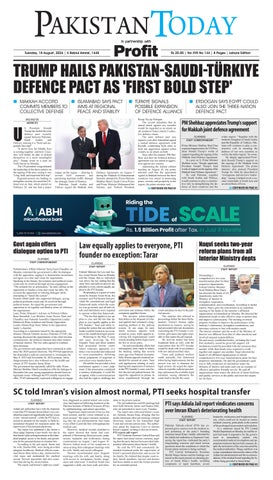
Profit Trump hails pakisTan-saudi-Türkiye defence pacT as 'firsT bold sTep' In partnership with
Tuesday, 18 August, 2026 | 4 Rabiul Awwal, 1448
g
MAKKAH ACCORD COMMITS MEMBERS TO COLLECTIVE DEFENSE
u
g
WASHINGTON
Rs 20.00 | Vol XVII No 144 | 8 Pages | Lahore Edition
ISLAMABAD SAYS PACT AIMS AT REGIONAL PEACE AND STABILITY
g
AGENCIES
S President Donald Trump has hailed the joint defence pact recently signed between Pakistan, Saudi Arabia and Türkiye, terming it a "bold and important first step". "It shows how the Middle East is coming together, and how Countries will finally be able to defend themselves in a more meaningful way," Trump wrote in a post on Truth Social on Monday. The US president congratulated the leadership of the three nations on the signing of the pact, saying it was "a big, bold, and important first step". Regional powers are looking to strengthen security ties amid the USIsrael war on Iran, which started on February 28, and has had a major
impact on the region — drawing in several Gulf countries and paralysing maritime traffic through the strategic Strait of Hormuz. Pakistan, Saudi Arabia and Türkiye signed the Makkah Joint
Govt again offers dialogue option to pTi ISLAMABAD
STAFF CORRESPONDENT
Parliamentary Affairs Minister Tariq Fazal Chaudhry on Monday reiterated the government’s offer for dialogue with the opposition, urging it to demonstrate seriousness and agree on a time and venue for negotiations. Speaking in the Senate, the minister said political issues could only be resolved through serious engagement. “The solution lies in seriousness,” he said, calling on the opposition to finalise a time and venue for talks. He accused the opposition of refusing dialogue while attempting to “derail the system”. Senator Abdul Qadir also supported dialogue, saying political problems could only be resolved through political means. He urged the government and opposition to sit together and finalise terms of reference for negotiations. Later, Prime Minister’s Adviser on Political Affairs Rana Sanaullah, Law Minister Azam Nazeer Tarar and Chaudhry met National Assembly Opposition Leader Mahmood Khan Achakzai and Senate Opposition Leader Allama Raja Nasir Abbas in the opposition leader’s chamber. According to a statement issued by the opposition alliance Tehreek Tahafuz Ayeen-i-Pakistan (TTAP), the meeting discussed the appointment of the chief election commissioner, the political situation and other matters of mutual interest. The two sides agreed to continue their meetings. The government and opposition have remained at odds since the 2024 general elections. The PTI-led opposition has demanded a judicial commission to investigate the May 9, 2023 and November 26, 2024 protests, while disagreements have also widened over the health and release of PTI founder Imran Khan. The government has repeatedly called for talks. Prime Minister Shehbaz Sharif extended an offer for dialogue in December last year, saying negotiations should focus on legitimate issues. Although the PTI initially rejected the offer, TTAP subsequently expressed willingness to engage.
Defence Agreement on August 7 during the Makkah Al-Mukarramah Summit, attended by Prime Minister Shehbaz Sharif, Saudi Crown Prince and Prime Minister Mohammed bin Salman, and Turkish President
TÜRKIYE SIGNALS POSSIBLE EXPANSION OF DEFENCE ALLIANCE Recep Tayyip Erdogan. The accord stipulates that an armed attack against any member would be regarded as an attack on all, similar to Nato's Article 5 collective defence clause. The joint defence pact was signed a year after Islamabad signed a mutual defence agreement with Riyadh, committing both sides to treat any aggression against either country as an attack on both. Days after the summit, PM Shehbaz said that the trilateral defence agreement was not aimed at aggression against any country. Addressing the federal cabinet meeting on August 10, the prime minister said that the agreement signed in Makkah between the three countries was aimed at promoting peace, security and prosperity in the region, the prime minister said.
CONTINUED ON PAGE 03
ERDOGAN SAYS EGYPT COULD ALSO JOIN THE THREE-NATION DEFENCE PACT
g
PM Shehbaz appreciates Trump's support for Makkah joint defence agreement ISLAMABAD
STAFF CORRESPONDENT
Prime Minister Shehbaz Sharif has expressed appreciation for US President Donald Trump’s words of support regarding the signing of the Makkah Joint Defence Agreement. In a post on X, Prime Minister Shehbaz wrote, “Deeply appreciate President Donald Trump’s kind words of support on the signing of the Makkah Joint Defence Agreement.” He said Pakistan, together with Saudi Arabia and Türkiye, would continue to play a constructive role in strengthening the defence of their countries and the
Law equally applies to everyone, PTI founder no exception: Tarar ISLAMABAD
CONTINUED ON PAGE 03
naqvi seeks two-year reform plans from all interior ministry depts ISLAMABAD
STAFF REPORT
Federal Minister for Law and Justice, Azam Nazeer Tarar on Monday told the Senate that no individual was above the law adding that the same laws and judicial process applicable to every citizen equally applied to the PTI founder. Responding to a point of order raised by Senator Azam Swati, the minister said Parliament had provided the constitutional and legal framework under which the country was governed, and all individuals and institutions were required to operate within that framework. “The law that applies to me applies to you, and the law that applies to you equally applies to the PTI founder,” Tarar said while rejecting the notion that any political leader could be treated as an exception to the established legal system. Referring to the May 9 cases and cases involving the PTI founder, Tarar said these matters had proceeded before courts where witnesses appeared, evidence was recorded and subjected to cross-examination, following which judgments of acquittal or conviction were handed down. He said the law provided a clear mechanism against a court judgment. If the prosecution considered a sentence inadequate, it could file an appeal, while a convicted person also had the right to challenge the
wider region. “Together with the brotherly Kingdom of Saudi Arabia and the Republic of Turkiye, Pakistan will continue to play a constructive role in ensuring the defence of our own countries as well as the entire region,” he wrote. He deeply appreciated President Donald Trump’s support on the signing of the Makkah Joint Defence Agreement. The prime minister also praised President Trump for what he described as “courageous and decisive leadership,” saying it helped avert a nuclear catastrophe in South Asia and saved millions of lives.
STAFF REPORT
conviction and sentence before the competent appellate forum. The minister acknowledged that delays in the disposal of criminal appeals had remained a longstanding problem in the judicial system. At one stage, he said, death sentence appeals took around six years, while appeals involving life imprisonment could remain pending before high courts for five to seven years. He said considerable efforts had subsequently been made to reduce the backlog, adding that several years ago even National Accountability Bureau appeals remained undecided for around six years. Tarar said applications relating to early hearing and suspension of sentence in the PTI founder’s cases were before the relevant judicial forums. He urged the opposition to pursue its cases expeditiously through the
courts and place its trust in the judicial process. The minister also referred to proceedings before the Inter-Parliamentary Union’s human rights mechanism in Geneva, saying he had presented relevant documents concerning the PTI founder’s conviction, grievances and rights available to him under the jail manual. He said the matter had been examined there as well, with the expectation that the PTI founder would be dealt with in accordance with law and prescribed rules. Tarar said political workers could naturally feel distressed when facing imprisonment, but the answer was not to abandon the legal system. He urged the opposition to expedite judicial proceedings and pursue the available legal remedies, saying ultimately the courts had to decide the cases.
Demanding a comprehensive two-year transformation plan for their respective departments, Federal Interior Minister Syed Mohsin Raza Naqvi has directed the heads of all departments under the Ministry of Interior to strengthen cooperation, communication, and coordination. According to medai reports, Naqvi gave the instructions at an important meeting of the heads of the ministry’s affiliated organisations in Islamabad on Monday. He directed the department heads to take effective steps to protect data and improve cybersecurity. The meeting reviewed progress on plans to improve the performance of the ministry’s institutions, strengthen coordination, and introduce reforms in line with modern needs. The interior minister said the work of the Ministry of Interior was different from that of other ministries and involved unusual responsibilities. He said newly established bodies, including the Land Port Authority, would be given full support. All institutions would be provided with the resources they needed, while their heads were expected to work together and support one another. Naqvi directed the heads of all affiliated organisations to submit comprehensive two-year transformation plans for their respective institutions. He said the government’s goal was to fully modernise all institutions under the Ministry of Interior and make each one an example of effective and public-friendly service. He said all organisations must ensure the delivery of better facilities and quality services to the public and meet the targets set for them.
SC told Imran's vision almost normal, PTI seeks hospital transfer ISLAMABAD
STAFF REPORT
Adiala jail authorities have told the Supreme Court that PTI founder Imran Khan’s eye condition has improved significantly and his vision is now “almost normal”, while the PTI has renewed its demand for his transfer to Shifa International Hospital for treatment under the supervision of his personal physicians. The report was submitted a day before a three-judge Supreme Court bench was due to hear Imran’s plea seeking treatment at the Islamabad hospital, access to his family and permission for his personal doctors to examine him. According to the jail report, Imran and his wife, Bushra Bibi, were being provided adequate healthcare. Medical officers examined Imran three times a day, monitored his vital signs and maintained his medical record. Several specialists had also examined him during his incarceration. The report said Imran’s right-eye condi-
tion, diagnosed as central retinal vein occlusion, had improved following treatment at the Pakistan Institute of Medical Sciences (Pims) by ophthalmology and retinal specialists. “Significant improvement of his eye has been noticed, and his vision returned to almost normal,” the report claimed, maintaining that the jail administration had made every effort to provide him with appropriate medical care. However, medical records attached to the report showed that Imran had complained of fluctuating blood pressure, palpitations, headache and restlessness during examinations on August 1 and August 10. Doctors linked some of his symptoms to stress arising from infrequent meetings with his wife, family and social colleagues. Doctors recommended more frequent meetings with his wife and family, along with access to newspapers, books, magazines and television. A medical board also suggested a daily one-hour walk and relax-
ation in his prison routine. The jail authorities said 84 meetings had been held between Imran and Bushra Bibi, who are permitted to meet every Tuesday. The report also criticised Imran’s counsel, Salman Akram Raja, alleging that his media statements after jail meetings violated directions issued by the Islamabad High Court and relevant prison rules. The authorities asked the Supreme Court to dismiss Imran’s appeal, terming it devoid of merit. PTI rejects jail report PTI Chairman Barrister Gohar Khan said the report had raised serious concerns, arguing that the party had not been provided independent information about Imran’s health. He said the PTI had consistently demanded treatment under the supervision of Imran’s personal physicians and access for his family. He claimed that despite court orders, family members, lawyers and doctors had been unable to meet the former premier for an extended period.
PTI says Adiala Jail report vindicates concerns over Imran Khan’s deteriorating health ISLAMABAD
STAFF REPORT
Pakistan Tehreek-e-Insaf (PTI) has expressed grave concern over the medical report pertaining to the party’s founding chairman Imran Khan’s health, submitted by the Adiala Jail authorities to Supreme Court, saying the report has vindicated the party’s longstanding concerns and raised serious questions about the conditions in which the former prime minister is being confined. PTI Central Information Secretary Sheikh Waqas Akram said the findings contained in the report present an alarming picture of Imran Khan’s health, including complaints of rapid heartbeat, severe
headache, restlessness and heightened anxiety, which could not be treated as routine medical concerns, particularly in the context of his prolonged incarceration and isolation. In a statement issued by PTI Central Media Department on Monday, he said the report had made it imperative for the government to immediately explain why recommended medical investigations and appropriate treatment had not been ensured, despite the seriousness of the concerns raised by the medical authorities. Waqas said there was a clear contradiction between the claims of the Adiala Jail administration and the recommendations of the medical board regarding the facilities being provided to Imran Khan.
CONTINUED ON PAGE 03
02 NEWS
Tuesday, 18 August, 2026 | LAHORE
NA PANEL TO SUMMON FINANCE SECRETARY, SBP GOVERNOR OVER UNRESOLVED RS342.9B TCP DUES
T
PROFIT
MONITORING REPORT
HE National Assembly Standing Committee on Commerce has decided to call in the Finance Secretary and the Governor of the State Bank of Pakistan (SBP) over the continued failure to settle Rs342.947 billion owed to the Trading Corporation of Pakistan (TCP), of which Rs265.719 billion consists of accumulated bank markup, Business Recorder reported. The move came after Commerce Secretary Jawad Paul and TCP Chairman Rafeo Bashir Shah asked the committee to step in and help resolve the long-running dispute. Official documents show that as of July 31, 2026, various government agencies collectively owed TCP the Rs342.947 billion figure, with markup making up the bulk of the liability. A breakdown of the receivables shows the Utility Stores Corporation (USC) owes the largest share at Rs121.138 billion (Rs24.334 billion principal, Rs96.804 billion markup), followed by the National Fertiliser Marketing Limited (NFML) at Rs76.331 billion (Rs12.487 billion principal, Rs63.845 billion markup). Among provincial and federal departments, Punjab's Food Department owes Rs47.601 billion, Sindh's Food De-
partment Rs20.748 billion, Khyber Pakhtunkhwa's Rs17.357 billion, and Balochistan's Rs11.919 billion. The Ministry of Industries and Production owes Rs20.455 billion on its sugar account and a further Rs5.168 billion tied to a Punjab sugar subsidy. Smaller amounts are owed by PASSCO (Rs6.996 billion), the Gilgit-Baltistan government (Rs7.405 billion), the AJ&K government (Rs2.332 billion), the Ministry of National Food Security and Research for a cotton subsidy (Rs3.135 billion), DGP Army (Rs1.877 billion), and Pakistan Navy
(Rs255 million). At a recent committee meeting, TCP's chairman told members the organisation was actively working to reconcile accounts with the relevant agencies and ministries. A draft summary was submitted to the Ministry of Commerce on November 21, 2023, for consideration by the Economic Coordination Committee (ECC) and the federal cabinet, proposing to settle all outstanding dues, including the markup that forms the bulk of TCP's liabilities. The summary suggested two possible routes: clearing the markup through
a federal budgetary allocation, or adopting a mechanism similar to 2011, when Pakistan Investment Bonds (PIBs) were issued to banks to settle TCP's liabilities in full. Separately, a sub-committee of the Standing Committee on Commerce recommended in a March 7, 2025 meeting that the Finance Ministry consult with relevant banks on the markup component, with a view to either capping the accumulated markup or reaching a negotiated settlement. TCP also briefed the government on its engagement with the SBP, which reportedly told TCP that its concern lay with receivables owed by government departments and agencies, not with the banks themselves. The central bank maintained that neither it nor commercial banks had any role in implementing the Standing Committee's directives, and considered the matter closed from a banking standpoint. TCP, however, said that despite repeated requests referencing the committee's directives, there had been no meaningful progress in reconciling or clearing the liabilities owed by the relevant departments and agencies. The Standing Committee is now expected to question the SBP Governor on why the central bank has not helped TCP reduce its markup burden, or at the very least, freeze the accumulated markup at its current level.
Pakistan's refineries plan $5b upgrade push under revised policy, Parco commits $600m to green fuel: report Petroleum Division seeks payment plan from Power Division over SNGPL's gas dues PROFIT
MONITORING REPORT
The Petroleum Division has asked the Power Division for a workable payment plan, with timelines, to address mounting receivables owed to Sui Northern Gas Pipelines Limited (SNGPL), Business Recorder reported, citing sources close to the Petroleum Minister. The Power Division was required to share the plan by June 30, 2026, subject to reconciliation of outstanding amounts. The dispute stems from RLNG supply disruptions after QatarEnergy declared force majeure on LNG cargoes following the Gulf crisis in late February 2026. During the resulting shortfall, the National Coordination and Management Council (NCMC) decided to supply indigenous gas to RLNG-based power plants in April, May and June 2026. To meet power-sector gas needs, SNGPL diverted 48 MMCFD from CNG consumers in Khyber Pakhtunkhwa. The Power Division had proposed charging this indigenous gas to power plants at Rs2,000/MMBtu, well below the notified RLNG price of $15.6237/MMBtu (Rs4,375/MMBtu) for May 2026. The Petroleum Division warned this pricing would cause revenue losses that could otherwise reduce the gas-sector circular debt, which stood at around Rs1.8 trillion in principal as of December 2025. It also flagged Pakistan State Oil's (PSO) outstanding receivables of Rs301 billion against RLNG sales to SNGPL. The Petroleum Division proposed four measures to the Economic Coordination Committee (ECC): pricing indigenous gas to power plants at Rs2,000/MMBtu for April-June 2026 through a ring-fenced escrow account with weekly billing; charging RLNG at OGRA-notified rates from April 2026 onward, with PLL and PSO confirming full FY2025-26 payments; having OGRA determine RLNG pricing for PLL's supplies to K-Electric during any cargo unavailability; and requiring the Power Division to submit a reconciled payment plan by June 30, 2026. The Power Division responded that payment mechanisms were contractual matters governed by Gas Supply Agreements (GSAs), and that CPPA-G would clear outstanding payments to power plants subject to fund availability. The ECC approved the Petroleum Division's proposals, including the escrow-based weekly payment framework.
PROFIT MONITORING REPORT
Pakistan's long-delayed refinery modernisation programme is moving toward implementation, with five domestic refineries planning combined investments of $4.5 billion to $5 billion in green fuel, capacity expansion and related upgrades, led by Pak-Arab Refinery Company's (Parco) newly finalised $600 million green fuel project, The News reported, citing official sources. A senior Petroleum Division official said that the government is finalising agreements for all local refineries, expected to be signed simultaneously at a high-level ceremony attended by Prime Minister Shehbaz Sharif. Under the amended Brownfield Refineries Upgradation Policy, refineries must sign implementation agreements within 45 days, down from an earlier 60-day deadline. Parco, the country's largest refinery and a joint venture between Pakistan and the UAE with a 60:40 shareholding, agreed to proceed with the project after commissioning two studies to determine the most suitable upgrade path. The company has told the government it will sign the upgradation agreement within the stipulated timeframe. The company opted for the green fuel project over a standalone bottom-of-barrel option and has already reduced its furnace oil share from around 20% to 14% through operational measures. With the green fuel project, furnace oil output is expected to fall further to 10-11% in the first phase, with a second phase aimed at eliminating it. Under the policy, Parco will shift completely from Euro-III to
Euro-V specifications. Motor gasoline production is projected to rise from around 3,678 tonnes per day to 4,023 tonnes per day, with diesel output also expected to increase. Pakistan Refinery Limited (PRL) has opted for one of the most ambitious upgrades among the refineries, planning a $1.8-2 billion bottom-ofbarrel project expected to eliminate furnace oil production and significantly improve its product mix. The project will also double PRL's crude refining capacity from 50,000 barrels per day (BPD) to 100,000 BPD. Attock Refinery Limited (ARL) has also confirmed readiness to sign its upgradation agreement, with the company's MD saying it remains committed to the project first announced in 2023 under the original policy. The roughly $600 million project includes a Continuous Catalytic Reformer, a revamp of the Diesel Hydro Desulphurising Unit, a Kerosene Hydrotreating Unit, associated tankage and utilities, and a biofuel facility required under the amended policy.
The upgrade will allow ARL to meet Euro-V specifications and increase motor gasoline production by around 25%. Cnergyico Pakistan Limited (CPL), the country's largest private refinery, is preparing a $1.2 billion investment programme covering green fuel, bottom-of-barrel work, capacity expansion and a new Single Point Mooring (SPM) facility. CPL currently has crude refining capacity of around 156,000 BPD and plans to raise it to approximately 200,000 BPD through a three-phase plan. The first phase targets Euro-V/VI petroleum products and is already underway. The second phase covers the bottom-of-barrel project, with studies in progress, while the third phase covers capacity enhancement and the SPM facility for crude and finished product import and export. Under the policy, CPL is projected to raise gasoline production to around 6,500 tonnes per day and diesel to nearly 11,000 tonnes per day, while sharply cutting furnace oil output.
Agritech resumes urea production after SNGPL restores gas supply PROFIT
NEWS DESK
Agritech Limited has resumed production at its urea plant after gas supply from Sui Northern Gas Pipelines Limited (SNGPL) was restored. The company disclosed the de-
velopment to the Pakistan Stock Exchange (PSX) on Monday, saying the restoration followed its earlier announcement regarding the suspension of gas supply. “In continuation of our earlier disclosure regarding suspension of gas supply, Agritech Limited in-
forms that gas supply from SNGPL has now been restored. Accordingly, the Urea Plant has resumed production,” the company said. The disclosure was made under Section 96 of the Securities Act, 2015 and Clause 5.6.1(a) of the PSX Regulations.
Goods transporters suspend strike for 40 days as textile industry warns of export disruptions PROFIT
MONITORING REPORT
The All Pakistan Goods Transport Alliance has suspended its nine-day nationwide strike for 40 days following government assurances on key demands, as the All Pakistan Textile Mills Association (Aptma) and other trade bodies warned that the prolonged disruption had stranded export shipments, disrupted raw material supplies and threatened industrial production. Addressing a joint press conference on Sunday alongside Sindh Governor Nehal Hashmi, Karachi Mayor Murtaza Wahab and Federal Minister for Communications Abdul Aleem Khan, alliance president Malik Shahzad Awan said the federal and Sindh governments had assured transporters that their key concerns would be addressed. The issues include toll tax reduction, parking facilities, petroleum pricing and axle load limits. Awan said some matters had already been resolved, while others would be taken up at the cabinet level. He said committee meetings would continue to monitor progress on the commitments. “We are not ending the strike — we are postponing it,” Awan said, warning that the alliance could resume its protest if the assurances were not implemented. According to Awan, Abdul Aleem Khan assured the alliance that a committee would be formed to review and reduce toll taxes. The government also assured transporters that petroleum prices would be revised every 15 days or monthly instead of under the daily pricing mechanism. The alliance was also assured that 10-wheeler trucks would be allowed to carry appropriate weight limits, while the Sindh government committed to resolving parking-related issues. The development came as Aptma warned that the transport disruption was affecting textile supply chains, with containers stranded at ports and terminals and exporters facing difficulties meeting shipment deadlines. Read This: FPCCI seeks demurrage exemption as 10-day transporters' strike cripples port operations Aptma Chairman Kamran Arshad said the textile and apparel industry depended on uninterrupted transportation of cotton, yarn, fabric, dyes, chemicals, accessories, machinery parts and export consignments. He warned that continued disruption could force mills to reduce production and expose exporters to order cancellations, financial penalties and the loss of international buyers. The association said the disruption was adding to pressures on an industry already dealing with high energy costs, liquidity constraints and competition from regional exporters. It also warned that repeated logistics disruptions could damage Pakistan’s reputation as a reliable supplier in international markets.
Pakistan Petroleum Limited discovers gas at Dolphin X-1 Well in Sindh’s Sujawal District PROFIT
NEWS DESK
Pakistan Petroleum Limited (PPL) has announced a gas discovery from its Dolphin X-1 exploration well in District Sujawal, Sindh, with the company holding a 75% working interest in the Sirani Exploration License, according to a disclosure made by the company at the Pakistan Stock Exchange (PSX) on Monday. PPL, the operator of the license, made the discovery in partnership with Government Holdings (Private) Limited (GHPL), which holds the remaining 25% working interest. The Dolphin X-1 well was spudded on April 17, 2026, and drilled to a measured depth of 3,850 metres to evaluate the hydrocarbon potential of the Chiltan Formation. Hydrocarbon-bearing intervals were identified through drilling results and openhole logging data. During post-acid testing, the well produced goodquality gas with an approximate heating value of 1,000 Btu/scf at a rate of 0.942 million standard cubic feet per day (MMscfd). The flow was recorded at a wellhead flowing pressure of 211 psig through a 32/64-inch choke. The company also reported that condensate surfaced during pre-acid testing at an initial rate of 94 barrels per day, falling to 46 barrels per day within 24 hours. No condensate was observed during subsequent post-acid testing. PPL said the initial condensate occurrence indicates further hydrocarbon potential in the Chiltan Formation and warrants additional exploration and evaluation. The discovery has also established the presence of a petroleum system and opened a new exploration frontier across the onshore marshy area and its possible extensions into shallow offshore areas.
Artistic Milliners to invest $18m in Port Qasim Garment City, first phase to create over 130,000 jobs PROFIT
NEWS DESK
Federal Minister for Maritime Affairs Muhammad Junaid Anwar Chaudhry has announced that Pakistani textile and denim manufacturer Artistic Milliners will establish a manufacturing unit with an investment of more than $18 million at the proposed 400acre garment city at Port Qasim. The first phase of the export-oriented project is projected to create 138,125 jobs and generate annual exports of around $2.2 billion. Chairing a meeting on the proposed garment city project, the minister said the export-oriented manufacturing cluster would focus on high-value apparel production and attract private-sector investment. According to the project plan, the first
phase will cover 250 acres, with 35% allocated for internal roads, utilities and green areas. The project is envisaged as a publicprivate partnership. The proposed commercial structure comprises 32 industrial plots of five acres each. However, the plot size could be reduced to two or three acres to accommodate more investors and manufacturing units. The Port Qasim Authority (PQA) would provide infrastructure and utilities. Each industrial unit would have access to up to 400,000 gallons of water per day, two megawatts of on-grid electricity and 23,100 pounds of industrial gas per day at 8 pounds per square inch (PSI), sufficient to support requirements for 10 tonnes of steam. For the overall project, the planned utility capacity includes 13 million gallons of water
per day, 64MW of on-grid electricity and 750,000 pounds of industrial gas per day. Junaid Chaudhry said private-sector participation would be a key component of the project. Under the plan, Artistic Milliners would establish a manufacturing unit with an investment of more than $18 million, incorporating vertical integration and green technologies. The project would also feature a one-window mechanism for exporters, including streamlined export processing, specialised customs desks and dedicated transport corridors. Projections presented at the meeting put first-phase employment at 138,125 jobs and annual exports at $2.2 billion. The project also aims to raise the average export value of garments to around $8 per piece. The minister said the initiative was part of
efforts to expand Pakistan’s industrial base and export capacity by integrating port infrastruc-
ture, utilities, customs facilities and private investment into the proposed apparel zone.
NEWS 03
FOOD PRICES IN LAHORE SURGE AS MONSOON RAINS, TRANSPORT STRIKE DISRUPT SUPPLIES
Tuesday, 18 August, 2026 | LAHORE
O g
CHICKEN, VEGETABLES AND FRUITS SELLING WELL ABOVE OFFICIAL RATES, WITH TOMATOES AT RS300–400/KG, CHICKEN MEAT AT RS550–630/KG, ONIONS SOLD AT RS180–220/KG PROFIT
MoNitoriNg report
NGOING monsoon rains and the goods transporters’ strike have disrupted supplies of perishable food items in Lahore, pushing retail prices of vegetables, fruits and poultry products well above official rates. Consumers continued to face higher prices as the gap between district administration price lists and actual market rates widened amid weak enforcement. Poultry prices also increased during the week. The official price of live chicken rose by Rs35 per kg to Rs344–358, while chicken meat became Rs51 more expensive, with the official rate fixed at Rs519 per kg. However, chicken meat was being
Avanceon secures $6.3 million fuel retail orders from major Pakistani oil marketers PROFIT
sold for Rs550–630 per kg, while boneless chicken prices ranged between Rs850 and Rs1,000 per kg. Vegetable prices showed mixed movement, although most perishable items recorded increases. Potatoes sugar-free were fixed at Rs32–35 per kg after an increase of Rs2 but were sold for Rs50–70. The official tomato rate was reduced by Rs35 to Rs195– 205 per kg, but retailers charged Rs300–400. Onion prices rose by Rs10 to Rs155–165 per kg officially, while the market rate stood at Rs180–220. Local garlic remained officially priced at Rs152–160 per kg but sold for Rs200– 250. Chinese garlic was available at Rs600 per kg, while Harani garlic was fixed at Rs260–270 but sold for Rs350–450. Thai ginger fell by Rs5 to Rs330–345 officially
LPG bidding results held back for over a week as legal challenges threaten 15% price hike : report g
Trump hails PakistanSaudi-Türkiye Defence Pact as 'first bold step' CONTINUED FROM PAGE 01
Prior to that, Deputy Prime Minister and Foreign Minister Ishaq Dar said that the pact remained open to countries willing to uphold its core principles. In a statement posted on X, DPM Dar stressed that the pact was defensive in nature and aimed at promoting peace, stability and prosperity in the wider region. The Makkah Accord reflected the deep-rooted brotherly ties among the three countries and was the result of years of discussions and coordination to strengthen strategic cooperation in addressing shared peace and security challenges, he said. Separately, the Turkish president said that Egypt could become the next country to join the mutual defence pact between the three states. In an interview with Al Jazeera, Erdogan described Cairo's possible accession as one of several options being considered as the alliance looks to expand its membership. "This agreement has sent an important message to the world," Erdogan told Al Jazeera’s Ali Al Dafiri during an interview for the programme Al Muqabala. Erdogan said that the agreement remained open to additional members and indicated that Egypt’s participation was possible.
HIGHEST BID OF RS205 MILLION PER LOT COULD ADD RS440 TO EVERY CYLINDER, WITH PPL ALONE PROJECTING RS4-5 BILLION IN EXTRA ANNUAL REVENUE PROFIT
News Desk
Avanceon Limited has secured orders worth $6.3 million from some of Pakistan’s largest oil marketing companies (OMCs) for projects under its Fuel Retail Business, strengthening its position in automation and digitalisation of fuel stations. The company disclosed the development to the Pakistan Stock Exchange on Monday, saying the projects would cover Automatic Tank Gauging (ATG), fuel dispenser automation, regulatory compliance, centralised head-office monitoring, and realtime pricing and inventory management. The company did not disclose the names of the oil marketing companies or specific project details, citing client confidentiality. Avanceon said Pakistan has more than 10,000 fuel stations, while petroleum demand is growing by approximately 10% to 20% year-on-year. The company expects rising digitalisation among oil marketing companies to drive demand for automated fuel measurement, real-time monitoring and connected fuel management. The company said it has five years of specialised experience in fuel retail automation, ATG and digitalisation. In 2026, it had deployed its systems at more than 1,500 sites nationwide and captured more than 80% of the automated fuel pump market during FY2026. Avanceon said the projects would provide opportunities for further deployments, system upgrades, regulatory compliance, remote monitoring, digital fuel management and lifecycle services. It added that its expanding installed base could also generate recurring revenue through maintenance, software, support and system upgrades.
but retailed at Rs450–500, while Chinese ginger remained at Rs320–335 and sold for Rs400–450. Farm cucumbers were officially reduced by Rs10 to Rs172–180 per kg but sold at Rs250. Local cucumber, for which no official rate was issued, sold for Rs200–220. Brinjal was fixed at Rs85–90 after a Rs10 reduction but retailed at Rs140–160, while bitter gourd remained at Rs114–120 and sold for Rs140–150. Spinach remained officially priced at Rs57–60 per kg but sold for Rs80–120. Local zucchini rose by Rs20 to Rs172–180 officially and retailed at Rs250–300. Lemons increased by Rs10 to Rs142–150 officially and sold for Rs200–250, while pumpkin rose by Rs10 to Rs133–140 but sold for Rs180–220.
MoNitoriNg report
The Petroleum Division has withheld the results of a bidding process for locally produced liquefied petroleum gas (LPG) for more than a week amid legal challenges and political pressure, a delay that could still translate into a roughly 15% jump in retail prices for the fuel just as winter approaches, Dawn reported. Auctions were held simultaneously on
August 10 by Pakistan's three main publicsector LPG producers. The highest bid for a single lot, five tonnes of LPG supplied daily over three years, came in at Rs205 million. Pakistan's annual LPG demand ranges between 1.4 million and two million tonnes, with more than half of it imported. Some existing stakeholders in the LPG market, worried about losing business to increased competition, have taken the bidding process to court, arguing current policy offers no legal basis for such an
arrangement. On the directions of Petroleum Minister Ali Pervaiz Malik, four state-owned firms, OGDCL, Pakistan Petroleum Limited (PPL), Parco and GHPL, were instructed to offer standardised fivetonne lots on a pilot basis, replacing the existing quota-based allocation system. Since one tonne of LPG fills roughly 85 domestic cylinders, a single lot can supply about 425 cylinders a day. At the winning bid, that works out to roughly Rs440 added to the price of each cylinder over the
PSX surges nearly 400 points despite stalled Middle East diplomacy
g
INDEX CLIMBS TO 180,502, UP 0.22%, LED BY BANKING, ENERGY AND CEMENT STOCKS PROFIT
News Desk
Positive sentiment prevailed at the Pakistan Stock Exchange (PSX) on Monday, with the benchmark KSE-100 Index surging nearly 400 points, even as diplomatic efforts to ease Middle East tensions remained stalled. According to the PSX website, the market opened on a bullish note, with the KSE-100 climbing to 181,158.86 in the early minutes of trade and sustaining its positive momentum through the session. Buying interest was concentrated in key sectors including automobile assemblers, cement, commercial banks, fertiliser, oil and gas exploration companies, OMCs, power generation and refineries. The index closed at 180,502.44 up 397.83 points, or 0.22%, from the previous close. The rally follows a rough week for the exchange, which settled under pressure amid uncertainty over the
extension of the US-Iran ceasefire and concerns over oil supplies through the Strait of Hormuz and Red Sea. Investor sentiment took a hit despite strong domestic fiscal and external-sector indicators, with the KSE-100 shedding 1,325.41 points, or 0.7%, week-on-week to close at 180,104.61 points. Global shares edged higher, and the dollar slipped towards two-month lows on Monday after a run of soft U.S. economic data, including an unexpected drop in retail sales, saw markets reduce bets for an imminent rate hike from the Federal Reserve. A hike next month is now priced at 30%, down sharply from about 50% a week earlier, according to the CME Group's FedWatch tool. The STOXX benchmark of 600 big European companies rose 0.21%, following earlier gains in MSCI's broadest index of Asia-Pacific shares outside Japan, which rose 0.5%, while Japan's Nikkei edged 0.3% higher.
PM Shehbaz appreciates Trump's support for Makkah joint defence agreement CONTINUED FROM PAGE 01
“I would also like to once again commend President Trump for his courageous and decisive leadership, which helped avert a nuclear catastrophe in South Asia and saved millions of lives,” Prime Minister Shehbaz said. He further emphasized the importance of lasting peace, stating, “Durable peace is the most essential prerequisite for a bright and prosperous future for our peoples.” Earlier, Trump welcomed the recently signed joint defence agreement between Saudi Arabia, Türkiye, and Pakistan, describing it as a major step toward greater regional security cooperation.
PM ORDERS FASTER DIGITISATION OF GOVERNMENT SERVICES: Prime Minister Shehbaz Sharif on Monday directed the National Information Technology Board (NITB) to make government digital platforms more effective, accessible and responsive to citizens’ needs. Chairing a meeting to review reforms at the NITB and progress on the Islamabad Technology Park, the prime minister stressed coordinated efforts by all relevant institutions to ensure timely, transparent and efficient public services. He directed that the use of e-office systems, already introduced across all federal ministries, be extended to sub-
South Korea's stock markets were closed on Monday for a public holiday. There was subdued reaction in the Korean won after U.S. President Donald Trump instructed the Pentagon to substantially reduce joint military exercises with the country. U.S. stock markets looked set to continue the warily positive tone when they open later on Monday, with Nasdaq futures firming 0.5% and S&P futures up 0.2%. The bullish run in stocks has been driven by diminishing risk that the Federal Reserve will raise interest rates next month. U.S. retail sales posted the first decline in nine months in July and consumer sentiment soured by more than expected, adding to soft inflation readings. Brent crude futures were up 27 cents or 0.31% at $88.79 by 0806 GMT after hitting a session high of $89.40. U.S. West Texas Intermediate crude futures fell 24 cents or 0.29% to $82.16 a barrel. ordinate departments and state-owned enterprises. The prime minister also ordered the acceleration of digitisation across government institutions, including the digitalisation of records of all public properties at the earliest. Expressing displeasure over delays in completing the Islamabad Technology Park, he directed authorities to expedite construction and make the facility operational on a priority basis. He further ordered that its management be fully outsourced. Officials briefed the meeting that the NITB had undergone right-sizing and key appointments had been made through a transparent process. Work was also under way to expand e-office systems to other government departments and state-owned entities. Ministers Ahsan Iqbal, Ahad Khan Cheema, Musadik Masood Malik and Shaza Fatima Khawaja, along with senior officials, attended the meeting.
PTI says Adiala Jail report vindicates concerns over Imran Khan’s deteriorating health CONTINUED FROM PAGE 01
He said while the jail authorities claimed that Imran Khan was being provided necessary facilities, including newspapers, books and television, the medical board, in its report submitted on August 10, had specifically recommended that these facilities be made available to him and that regular meetings with his wife and family be facilitated. “If these facilities are already being provided, as claimed by the jail authorities, there is no explanation as to why the medical board found it necessary to recommend them,” Waqas said, adding that the apparent failure to implement the recommendations raised serious questions about the administration’s compliance with medical advice. He said prolonged isolation, restrictions on
per kg and sold for Rs250–500, while plums were priced at Rs315–330 and retailed at Rs400–600. Cantaloupe prices increased by Rs15 to Rs176–185 officially but sold for Rs200– 250. Peaches were fixed at Rs210–300 and sold for Rs250–400, while papaya was priced at Rs295–310 and retailed at Rs350– 400. Local pomegranate prices rose by Rs10 to Rs262–275 officially but sold for Rs300– 400. Pears remained at Rs247–260 and sold for Rs250–300. Sweet lime was officially priced at Rs177–185 per dozen but sold for Rs250– 300. Gola grapes were fixed at Rs243–255 per kg and sold for Rs400–500, while SundarKhani grapes increased by Rs30 to Rs487–510 officially but retailed at Rs700–800. The continued disparity between official and retail rates, coupled with disruptions to the movement of perishable goods, has added to pressure on household food budgets in Lahore.
Ladyfinger fell by Rs10 to Rs152–160 officially but retailed at Rs200–240. Lufa remained at Rs76–80 and sold for Rs120– 140. Green chillies were unchanged at Rs114–120 but sold for Rs150–160, while capsicum remained at Rs286–300 and retailed at Rs400. Cauliflower rose by Rs30 to Rs172–180 officially but sold for Rs220–250, while cabbage increased by Rs20 to Rs142–150 and retailed at Rs180–200. Chinese carrots rose by Rs10 to Rs119–125 officially but sold for Rs240–280. No official rate was issued for peas, which sold for Rs600 per kg. Fruit prices also remained significantly above official rates. Apples were officially priced at Rs220–300 per kg but sold for Rs300–500. A-grade bananas were fixed at Rs188–210 per dozen but retailed at Rs300– 350, while B-grade bananas were priced at Rs125–140 and sold for Rs180–250. Dates had an official price range of Rs320–460 per kg but were sold for Rs800 per kg. Mangoes were fixed at Rs250–350
access to information and limitations on family interaction could have serious consequences for a prisoner’s mental and physical well-being, particularly when such restrictions continue for an extended period. Waqas made it clear that the government could not evade responsibility by attributing all matters to jail authorities while Imran Khan’s health continued to deteriorate. “The government cannot keep Imran Khan in isolation, deny him basic facilities and then escape responsibility when his health deteriorates,” he added. PTI CIS said Imran Khan was not an ordinary prisoner but a former prime minister and the country’s most popular political leader, and his fundamental rights, health and dignity could not be compromised for political or administrative rea-
sons. Waqas demanded that Imran Khan be immediately shifted to a properly equipped hospital for a comprehensive and independent medical examination and treatment in accordance with established medical recommendations. In light of the report submitted to the Supreme Court, PTI’s demand is clear, unequivocal and categorical: Imran Khan must be immediately shifted to Shifa International Hospital, where he should undergo a complete medical examination and check-up under the supervision of his personal physicians, Dr Asim Yousaf and Dr Faisal Sultan. He specifically demanded that the recommended Coronary CT Angiography be conducted without further delay and that all necessary diagnostic tests and treatment be carried out under the su-
pervision of qualified and trusted doctors of Imran Khan’s choice. He further demanded that Imran Khan’s personal physicians be fully involved in decisions concerning his medical care and that all medical reports, diagnostic results and treatment details be transparently shared with his legal team. “There can be no compromise whatsoever when it comes to Imran Khan’s health and life, as neither political considerations nor administrative excuses can justify any delay or denial of necessary medical care to a former prime minister,” he said. Waqas warned that any harm to Imran Khan’s health or life resulting from negligence, delay, denial of medical care or failure to implement medical recommendations would carry serious legal, moral and political consequences.
next three years, before marketing companies add their own margin. Ogra's benchmark price for an 11.8kg domestic cylinder currently stands at Rs3,000.93, though consumers rarely find cylinders for under Rs3,600 in the market. The regulator raised the LPG price by about 5.4% at the end of July, taking it to Rs254.32 per kg for August. The signature bonus from the new bidding process would add close to another 15% on top. While the government has not published the results, sources familiar with the matter described the outcome as highly favourable for state-owned entities, but warned it would burden consumers, particularly those outside major cities.
Central Directorate of National Savings announces Rs1500 Prize Bond results PROFIT
News Desk
The Central Directorate of National Savings (CDNS) announced the results of Draw No. 107 for the Rs1,500 denomination Prize Bond in Faisalabad on Monday, August 17, 2026. The bond number 177110 won the top prize of Rs3,000,000. The second prize of Rs1,000,000 each went to three bonds: 804336, 985779 and 987416. Multiple third prizes of Rs 18,500 each were also awarded. In the previous Rs 1,500 Prize Bond draw held in May 2026, bond number 024132 won the Rs 3,000,000 first prize, while bonds 026284, 355420 and 407321 each secured the Rs 1,000,000 second prize. Prize bonds remain a popular savings instrument in Pakistan, offering secure investment with the chance of substantial cash rewards. They are available in denominations of Rs100, Rs200, Rs750 and Rs1,500, along with premium bonds of Rs25,000 and Rs40,000. In Pakistan, the withholding tax rate on prize bond winnings is 15% of the prize value for active tax filers (listed on the FBR Active Taxpayers List) and 30% for non-filers, as outlined by National Savings Pakistan.
Tariq Mahmood Pasha steps down as Meezan Bank director after nearly 3 years PROFIT
News Desk
Tariq Mahmood Pasha has ceased to serve as a non-executive director on the Board of Directors of Meezan Bank Limited, the bank informed the Pakistan Stock Exchange (PSX) on Monday. Pasha joined Meezan Bank’s board in October 2023 and also served as a member of the Board’s Audit Committee. He has more than 37 years of experience in the Government of Pakistan, having held several senior positions, including Chairman of the Federal Board of Revenue (FBR), Special Assistant to the Prime Minister on Revenue, Non-Executive Director on the Board of Directors of the State Bank of Pakistan, Special Assistant to the Federal Finance Minister and Federal Secretary for four ministries/divisions — Revenue, Economic Affairs, Statistics, and Kashmir Affairs and Gilgit-Baltistan. He also served as Principal Secretary to the Governor of Punjab and as Provincial Secretary for Finance and Religious Affairs in Punjab. He is currently a director of the Pakistan Center for Philanthropy. Following Pasha's departure, the other members of Meezan Bank's board are Riyadh S.A.A. Edrees (Chairman), Bader H.A.M.A. Al-Rabiah, Saad Ur Rahman Khan, Faisal Fahad AlMuzaini, Zine Elabidine Bachiri, Mohammad Abdul Aleem, Nausheen Ahmad, Abdulrazzaq T.A.M. Razooqi and Irfan Siddiqui (President & CEO).
04 COMMENT
Hollow crown babus
Time to Mend Fences
P
A
AKISTAN’S political deadlock has persisted for far too long. What began as a bitter dispute following the 2024 elections has hardened into a cycle of confrontation in which neither the government nor the opposition appears willing to take the first meaningful step towards de-escalation. The latest contact between government representatives and opposition leaders offers a modest opportunity to break that cycle. It should not be squandered. The government’s renewed invitation for dialogue is welcome, but an offer of talks cannot become an end in itself. As the party in power, the government carries the greater responsibility for creating conditions in which negotiations can take place. It must therefore demonstrate seriousness not merely by asking the opposition to come to the table, but by addressing reasonable concerns that stand in the way of doing so. The opposition, for its part, cannot demand engagement while setting conditions that make engagement impossible. Political parties cannot resolve disputes through perpetual confrontation, nor can parliamentary democracy function if every disagreement is treated as a struggle for existential survival. Yet this does not absolve the government of its responsibility to make the first substantial effort to rebuild trust. The disagreements are substantial. Questions surrounding the 2024 elections, the investigations into political violence, the treatment and legal status of political prisoners, and access to the PTI leadership have all contributed to an atmosphere of deep mistrust. These matters will not disappear through political manoeuvring. Nor will they be resolved by insisting that one side first concede defeat. A structured dialogue, with mutually agreed terms of reference and a neutral parliamentary setting, could provide a practical starting point. Not every issue needs to be resolved immediately, and neither side should expect negotiations to produce instant breakthroughs. The immediate objective should be to establish a mechanism through which contentious questions can be discussed without the constant threat of political escalation. The government should also recognise that political stability is not merely a partisan interest. Pakistan faces serious economic, security and institutional challenges that require continuity and cooperation. Prolonged political paralysis weakens public confidence, distracts from governance and makes every national crisis harder to manage. The opposition must reciprocate if the government makes a genuine effort. But the initiative should come from those who wield executive power. The government has more institutional capacity, greater access to state machinery and a larger stake in restoring political normality. There is little to be gained from allowing another year to pass in confrontation. The latest meetings should be followed by sustained engagement, not another breakdown. Pakistan’s political class has spent enough time deepening its divisions. It is now time to mend fences.
Arif Nizami (Late) Founding Editor
Babar Nizami Editor Profit
I
N 2015, a 900-page judgment landed on the desks of Pakistan’s constitutional lawyers, longer even than India’s celebrated Kesavananda Bharati verdict, and infinitely less discussed at our dinner tables than it deserved to be. In District Bar Association, Rawalpindi versus Federation of Pakistan, thirteen of seventeen Supreme Court judges ruled on something most citizens have never heard of and every citizen should fear losing: that Parliament’s power to amend the Constitution is not unlimited. That certain features, among them judicial independence, cannot be legislated away no matter how large the majority that votes for it. It was, in effect, the Court telling Parliament: you may rewrite many things, but you may not rewrite the referee out of the game. Eleven years on, we are watching, amendment by amendment, exactly that experiment being run again, only with far less resistance and far more success. To begin with the 26th Amendment. Its headline achievement was the removal of the Supreme Court’s suo moto jurisdiction, the power that allowed the apex court to take up matters of fundamental rights on its own initiative, without waiting for an aggrieved citizen to knock on its door. Supporters called this a correction of judicial overreach. Perhaps, on occasion, it was. But a scalpel used carelessly still draws blood, and what was cut away was not merely a procedural tool. It was the mechanism by which ordinary citizens, too poor or too powerless to litigate for years through a paralysed lower judiciary, could have a constitutional wrong noticed and remedied. The amendment also handed parliament and the executive decisive influence over the appointment of the Chief Justice and senior judges. In one sitting, the two branches most likely to be respondents in constitutional cases were given a seat at the table where the referee is chosen. The Rawalpindi Bar judgment had drawn a line precisely here, around judicial independence. The 26th Amendment did not cross that line so much as quietly erase it and redraw it further back. If the 26th Amendment blurred the line between appointer and appointed, the 27th erased it altogether. It granted the President lifetime immunity from criminal and civil proceedings. It extended similar lifetime protection to the country’s senior-most military officer. And, almost as an afterthought buried beneath these headlines, it created a new Federal Constitutional Court with the power to override the Supreme Court itself. A court is established not to strengthen judicial review but to sit above the
candidate is immediately thrust into a culture steeped in colonial legacies. The office is not experienced as a public trust, but as a position of dominion. The grassroots understanding that was supposed to inform policy gets swallowed by the ivory towers of secretariats and district headquarters. Instead of dismantling the barriers of deprivation they once fought, the newly-minted elite often isolate themselves within the very machinery of privilege. Its consequences for governance are severe because when state apparatuses are staffed by those whose primary motivation was personal emancipation, the administrative ethos shifts. Red tape thickens, empathy thins and the citizen seeking relief is viewed as a supplicant rather than a stakeholder. Fixing this decay requires a fundamental reimagining of what we value as merit. True merit cannot simply be a measure of one’s ability to retain vast amounts of data under extreme psychological duress nor can it be the monopoly of those who can afford
institution that has, however imperfectly, exercised it. Its composition rests substantially with the President, acting on the advice of the Prime Minister. We have, in effect, allowed the executive to build its own appellate authority over the judiciary and staffed it with its own nominees. It is the executive marking its own homework, using a pen the Rawalpindi Bar judgement (supra) specifically warned should never be handed over. Now a 28th Amendment gathers behind closed doors, its exact text unconfirmed but its direction unmistakable. Reports speak of recentralising powers devolved to the provinces and redrawing the balance the Eighteenth Amendment struck. But taken together with the 26th and 27th, a pattern is no longer deniable. Power is being gathered upward and inward, away from courts, away from provinces, away from the electorate, and toward a narrowing circle of individuals who face ever fewer consequences for how they wield it. As a legal practioner, I am trained to resist rhetoric and test claims against text, and against precedent. So let me be precise about what is actually at stake, in the language the Rawalpindi Bar case itself used. Pakistan’s Constitution, that judgment held, possesses a basic structure: a set of salient features, among them judicial independence and the separation of powers, that even a two-thirds majority in Parliament cannot lawfully unmake, because these features are not gifts from the state to the citizen but the very foundation on which the state’s own legitimacy rests. Amendments are supposed to operate within that structure. What we have witnessed since the 26th Amendment is amendments operating upon that structure, reshaping its foundations under procedural cover, daring anyone to invoke a nine-year-old precedent that the political class has quietly hoped we would all forget. The tragedy is that each individual change can be defended in isolation. Suo moto power was indeed occasionally abused by activist chief justices. Constitutional courts do exist in other democracies. Federal systems do periodically renegotiate the division of subjects between centre and provinces. But constitutionalism is
Lahore – Ph: 042-36300938, 042-36375965
I
Karachi – Ph: 021-32640318 I
mentorship. The evaluation metrics must evolve. Written examinations must be re-engineered to test emotional intelligence, sociological insight, structural empathy and a demonstrable commitment to community welfare, rather than just academic endurance. Mid-career training architectures must ruthlessly weed out elitism and bureaucrats must be regularly pulled out of air-conditioned offices and forced to confront the unvarnished realities of the regions they are meant to serve. The competitive exam system does not have to remain a vehicle for self-serving ambition and entitlement. If rescued from the clutches of bureaucratic insulation, it can finally deliver on the democratic promise we always claimed it had. The author is a Lahore-based journalist and executive editor of The Current. He can be reached at abzafar11@gmail.com.
Upon securing a position, the successful candidate is immediately thrust into a culture steeped in colonial legacies. The office is not experienced as a public trust, but as a position of dominion. The grassroots understanding that was supposed to inform policy gets swallowed by the ivory towers of secretariats and district headquarters. Instead of dismantling the barriers of deprivation they once fought, the newly-minted elite often isolate themselves within the very machinery of privilege.
Above the law, by law
M. A. Niazi Editor Pakistan Today
Sarmad Sattar
abdullah Zafar
viral social media video has shown a top duo of Islamabad officials arriving at the D-Chowk Independence Day parade in a horse-drawn carriage, prompting the internet to question the “lingering remnants of British rule” and if Pakistan is “still being ruled by the East India Company”. While the sight was a rather standard, historic feature of official Pakistani state parades, the discourse surrounding it isn’t. In recent years, a significant spike has been witnessed in criticism aimed at what has time and again been termed the “megalomania” corrupting freshly-inducted youths (and their seniors) in Pakistan’s bureaucracy. We like to pitch the competitive examination system as the great democratic equaliser – a mechanism designed to scout talent from marginalised regions, lift youth out of systemic deprivations and infuse the corridors of power with leaders who understand the grassroots realities of the common citizen. However, from newly-appointed assistant commissioners showing off over the internet to their superiors looking down upon the general public, in practice, a system born from colonial machinery has increasingly devolved into something else entirely: a high-stakes enterprise where public office is viewed less as a sacred duty and more as a lucrative trophy – a shortcut to power acquisition and an instrument of entitlement. To understand this mutation, the widening chasm between the democratic promise we assign to these exams and their structural reality must be understood. On paper, civil service and central exams remain the ultimate vehicle for upward social mobility. For a young man or woman staring down the horizon of poverty and underdevelopment in a backward region, cracking these exams represents a breakthrough that promises financial security, social standing and, most importantly, a seat at the table. Yet, the playing field remains uneven. What is hyped as an open meritocracy is often heavily skewed by systemic deprivations. Quality foundational education and mentorship are luxuries concentrated in elite urban centres. By the time a rural candidate enters the race, they are already running a marathon against structural disadvantages. To bridge this gap, aspirants migrate to metropolitan coaching hubs, plunging themselves, and often their families, into financial debt. Preparation has transformed from an intellectual pursuit of liberal arts and governance into a hyper-commercialised, rotelearning industry. The coaching complex sells a singular dream: power, prestige and authority. When the driving force behind clearing an exam shifts from public service to escaping deprivation, the years spent memorising endless volumes of code, history and administrative theory do not always cultivate empathy; instead, they can breed a quiet resentment. A sense that having endured the competition, one is now owed the spoils of office. This is where the system births bureaucratic entitlement. Upon securing a position, the successful
Dedicated to the legacy of late Hameed Nizami
Tuesday, 18 August, 2026
not simply a collection of technically permissible clauses. It is a coherent design in which each part checks another. Strip the checks out gradually enough, defend each removal on its own narrow merits, and you can arrive at authoritarianism through entirely lawful means, with every amendment bearing a parliamentary majority and a presidential signature, and with the Rawalpindi Bar judgment sitting unread in a law library, gathering dust on the very shelf it was meant to guard. What should alarm every citizen, is not any single amendment but the accumulating silence around the pattern. Bar councils and individual judges have issued statements and dissents. But the broader public conversation treats each amendment as a discrete news cycle, debated for a week and then forgotten as the next crisis arrives. This is precisely how basic structures erode in practice: not through a single dramatic coup, but through the slow, procedurally immaculate transfer of checking power from institutions that are meant to be independent to the very offices they were designed to check. I do not know what the final text of the 28th Amendment will contain. I do know that the burden of proof has shifted, and dangerously so. In 2015, thirteen judges told us the burden lay with the state to prove that judicial independence survived every amendment intact. Somewhere along the way we let that burden slide quietly back onto the citizen, who must now prove the damage after the fact, in a court system whose independence is precisely what stands accused. Until our legislature is willing to meet that original burden in the open, rather than in backroom consultations whose contours we learn about only through leaks, every citizen who values the idea that no one, however powerful, stands above the law has cause for genuine unease. A constitution that can be quietly re-engineered to place its most powerful office-holders beyond the reach of its courts is not being amended. It is being unwritten quietly, signature by signature, by the very people the Rawalpindi Bar judgement once tried to bind. The writer is a freelance columnist
Islamabad – Ph: 051-2204545
I
Editor’s mail
Send your letters to: Letters to Editor, Pakistan Today, 4-Shaarey Fatima Jinnah, Lahore, Pakistan. E-mail: letters@pakistantoday.com.pk Letters should be addressed to Pakistan Today exclusively
A dangerous gamble
AN old article — “When the cancer drugs don’t work” (June 26) — continues to haunt me even today after so many months. It was based on investigative work by the Bureau of Investigative Journalism, revealing that essential chemotherapy drugs used for treating breast cancer, leukemia and other severe illnesses, are being sold with inaccurate quantities of their key ingredients. These substandard cancer drugs are being shipped to over a hundred countries, including Pakistan. As a cancer patient, I am deeply concerned. Patients like me rely on these medications during some of the most challenging times of their lives, with the belief that they are both effective and safe. Sadly, learning that certain cancer drugs may contain inconsistent dosages of their active ingredients — either too little or too much — is deeply alarming. In Pakistan, there is no reliable way to verify if prescribed medicines meet quality standards. We place our trust in the healthcare system to protect us, but that trust faces setbacks in an already fragile environment when quality control mechanisms fail. How can doctors manage critical conditions if the doses are in-consistent? If the quality of medicine is compromised, what hope is there for recovery? Low-cost generic alternatives to the expensive originals cannot always be relied upon, but how can a pharmaceutical company at all manufacture and distribute a drug that is still under patent protection? This is a serious violation of intellectual property rights, as well as a significant threat to patient safety, since the copied formulations may lack critical testing and verification related to efficacy and safety. The Drug Regulatory Authority of Pakistan (Drap) and the national Intellectual Property Organisation (IPO) are under obligation to investigate these issues thoroughly. Patients deserve reassurance that the medicines they consume meet regulatory standards. Drap must diligently strengthen its quality control mechanisms, and test all generic drugs with vigilance. It is a matter of life and death for us, the patients. The health authorities must thoroughly test cancer drugs, hold manufacturers and suppliers accountable, and strengthen oversight. Ensuring that patients receive quality treatment is vital. Cancer is merciless as it is, and suffering patients deserve to have a fair chance of treatment. ABU BAKAR KAREEM KARACHI
A test of intent
IT has become something of a trend among today’s youth to view the Central Superior Services (CSS) examination as a golden ticket — a shortcut to social prestige, family approval or even love. But in this pursuit of glory and acceptance, many lose sight of what truly matters: their own dreams, abilities and peace of mind. The CSS exam is no walk in the park. It demands grit, discipline and clarity of purpose. Those who step into it for reasons other than genuine passion for public service often find themselves biting off more than they can chew. The journey is long, uncertain and mentally exhausting. Without inner conviction, the pressure can easily break even the brightest minds. Sadly, in our society, the title of “bureaucrat” carries an aura of power and respect that often overshadows other equally noble professions. Many young people, fearing judgment or rejection, abandon promising careers — in medicine, engineering or business — just to chase a label that will please someone else. But living someone else’s dream is a sure recipe for frustration. A job in the civil services should never be about impressing others or proving one’s worth. It should stem from a deep desire to serve, lead and reform. A person truly fit for the civil service is one who dreams of improving systems, not one trying to fit into someone’s expectations. Sometimes, the bravest thing one can do is to stay true to oneself, even when the world whispers otherwise. SANAULLAH MIRANI DAHARKI
Web: www.pakistantoday.com.pk
I
Email: editorial@pakistantoday.com.pk
COMMENT 05
From Makkah to Gwadar: How a wartime pact could redraw Eurasia Tuesday, 18 August, 2026
A
Makkah — They signed it on a Friday, in the middle of a war Mujtaba arshad
T Al-Safa Palace in Makkah on August 7, Saudi Crown Prince and Prime Minister Mohammed bin Salman, Turkish President Recep Tayyip Erdogan, and Pakistan Prime Minister Shehbaz Sharif put their names to the Makkah Joint Defence Agreement, a Trilateral pact stipulating that an armed attack on any one of the three states will be treated as an attack on all. The venue and the timing were not incidental. Since February 28, the United States and Israel have been at war with Iran and its regional allies, a conflict that has sent missiles into Gulf airspace, disrupted shipping through the Strait of Hormuz — the passage for roughly a fifth of the world’s oil — and, weeks before the signing, brought Houthi strikes raining toward Israel and Gulf energy infrastructure alike. Riyadh, by its own officials account, is bracing for coordinated attacks from Iran-aligned militias. This is not a pact born of theory. It is a pact born of incoming fire. What the three countries bring to the table is genuinely complementary. Saudi Arabia supplies capital, oil wealth, and the custodianship of Islam’s two holiest cities. Turkey fields NATO’s second-largest standing army and an increasingly self-sufficient defence-industrial base. Pakistan contributes the Muslim world’s only declared nuclear deterrent, alongside a strategic geography connecting South Asia, Central Asia, China and the Arabian Sea. The agreement builds on a bilateral Saudi-Pakistan defence understanding signed in September 2025, now widened into a threeway architecture that Pakistan officials describe as strengthening collective deterrence “against any act of aggression”. Whether it becomes more than a wartime security instrument is the more interesting question, and it is one worth asking now rather than after the fact. History suggests that security partnerships rarely remain confined to military cooperation. NATO eventually expanded beyond collective defence into technology, industrial production and economic coordination among its members. While the Makkah Agreement is fundamentally different in purpose and scope, it raises a similar strategic question: can defence cooperation generate the political confidence necessary for deeper investment, industrial collaboration and regional connectivity? Security pacts have a habit of dragging economics along behind them, and this one arrives at a moment when Pakistan’s economic geography has rarely looked more
valuable — or more exposed. The same war that produced this agreement has also turned the Strait of Hormuz into a liability for the tankers that depend on it, pushing shippers to weigh alternatives outside the immediate blast radius of a live Gulf conflict. Pakistan’s Arabian Sea ports, Gwadar chief among them, sit precisely on the safer side of that map. Located near the entrance to the Arabian Sea and outside the Strait of Hormuz itself, Gwadar offers an additional logistical option for regional commerce. While it cannot replace Gulf energy infrastructure, its strategic location strengthens Pakistan’s long-term ambition to serve as a regional trade and transit gateway. That is not a coincidence CPEC’s original planners engineered; it is a coincidence CPEC’s next phase would be foolish not to exploit. The equation is not complicated: Saudi capital, Turkish manufacturing and defence technology, and Pakistani connectivity through Gwadar and the China-Pakistan Economic Corridor. In strategic terms, the agreement creates the possibility — though not yet the certainty — of integrating Gulf finance, Turkish industrial capability and Pakistan’s connectivity into a broader Eurasian economic network. If Riyadh’s sovereign wealth found its way into Gwadar’s long-stalled Free Zone, if Ankara’s industrial base treated Pakistani special economic zones as a manufacturing and export platform rather than a distant markets, and if Islamabad finally delivered the customs efficiency and logistics integration that has eluded Gwadar for a decade, the triangle could plausibly evolve from a defence pact into something resembling an economic corridor of its own — one running from Chinese factories through Pakistani ports to Gulf capital and onward, via Turkey, toward Europe.
Plausibly is the operative word. The distinction matters. Defence agreements create opportunities, not automatic economic outcomes. Their success ultimately depends on political commitment, institutional reforms and commercial incentives rather than military clauses alone. A mutual-defence clause does not obligate anyone to invest a single riyal or lira in Pakistani infrastructure, and
The equation is not complicated: Saudi capital, Turkish manufacturing and defence technology, and Pakistani connectivity through Gwadar and the China-Pakistan Economic Corridor. In strategic terms, the agreement creates the possibility — though not yet the certainty — of integrating Gulf finance, Turkish industrial capability and Pakistan’s connectivity into a broader Eurasian economic network. If Riyadh’s sovereign wealth found its way into Gwadar’s long-stalled Free Zone, if Ankara’s industrial base treated Pakistani special economic zones as a manufacturing and export platform rather than a distant markets, and if Islamabad finally delivered the customs efficiency and logistics integration that has eluded Gwadar for a decade
US’ last carrier leaves Asia, the bill for overstretch is here There was a time when American military power meant more than advanced weapons. It meant ice cream in the desert and cold soda at the front - a logistical abundance built on industrial depth. Today the picture is different
T
nothing in the Makkah text commits Saudi Arabia or Turkey to CPEC specifically. Nor should the pact be mistaken for an “Islamic NATO,” a label its architects have been careful to avoid, and its terms do not support — its purpose, plainly stated, is collective deterrence, not an ideological bloc directed at any third country. What it does is remove one kind of uncertainty — whether Riyadh,
GLOBAL TIMES
HE US is pulling its last aircraft carrier out of Asia. The USS George Washington has recently passed the Strait of Malacca on its way to the Middle East, where it will replace the USS Abraham Lincoln, a carrier that has already spent over 250 days at sea with 5,000 sailors aboard. The Associated Press put it bluntly: The “war against Iran is stretching the limits of US aircraft carriers and leaving the western Pacific without one of the key American warships.” The waters have now become a zero-US-carrier zone. This is not a routine rotation. A country that claims 11 active aircraft carriers is now being forced to pick a side between two oceans. Overstretching resources has finally put a hard choice on Washington’s desk. For years, Washington has talked about pulling back from the Middle East and shifting focus to the homeland, the Western Hemisphere, and the “IndoPacific.” Reality is doing the opposite. The conflict with Iran is once again dragging the US’ valuable naval assets back to the Middle East. Since the end of WWII, the carrier strike group has been the clearest symbol of American sea power. It is more than a warship - it is a diplomatic tool, a political posture, and the proud product of its industrial system. The problem today is brutal: Keeping up high-intensity operations in one theater often means giving up presence in another. When commitments exceed the number of carriers the US can actually deploy, the math turns ruthless. The Lincoln makes the cost concrete. Reports say it broke the modern record for the longest consecutive, uninterrupted period at sea without a port call, supporting operations against Iran. This has led to extreme fatigue, low morale, and mental strain. At least two sailors had to be prevented from jumping overboard, and multiple incidents occurred aboard. The Navy has acknowledged that traditional supply hubs in the Middle East were disrupted by combat actions, which led to shortages and loss of mail aboard the aircraft carrier. There was a time when American military power meant more than advanced weapons. It meant ice cream in the desert and cold soda at the front - a logistical abundance built on industrial depth. Today the picture is different: moldy showers, broken
Just as the last US carrier is leaving the region, what Tokyo and Manila are feeling is not only insecurity, it is a reminder that even American security commitments have limits
plumbing, non-functional laundry, and shortages of basic supplies. Even the simplest parts of life at sea are under strain. Eleven carriers still feel stretched thin for a reason. They must cycle through deployment, training, maintenance, and overhaul. In normal times, only two or three are actually available for forward operations - the rest are in repair or not ready to sail. That’s understandable. What’s harder to explain is the case of the USS Gerald R. Ford. Once billed as the warship of the future with built-in Electromagnetic Aircraft Launch System, it is now going back to legacy steam catapults instead given its failure rate was far higher than planned. When new technology keeps on breaking down, all that advanced design just becomes another problem. The last thing a fleet that is already stretched thin, with morale cracking and technology falling short, should be doing is lighting fires across the globe. The Washington can fill a temporary gap. It cannot repair the deeper hole left by sustained overstretch. And who can guarantee it won’t become the next Lincoln? American allies in the Western Pacific see this vacuum clearly. Washington keeps talking up the “China threat” and pushing Japan and the Philippines to take more forward roles. Yet just as the last US carrier is leaving the region, what Tokyo and Manila are feeling is not only insecurity, it is a reminder that even American security commitments have limits. The Middle East is delivering a hard lesson. Wars are rarely decided by how many carriers a country owns. They are decided by whether the country can keep feeding replacements, repairs, and organizational resilience into the fight. If operations against Iran already strain people and logistics this badly, the constraints of facing a full industrial peer would be far heavier. This does not mean the US military has suddenly become a paper tiger. Washington has simply left the era of easy dominance. Its instinct to reach for military solutions remains, but industrial capacity has not kept pace with growing global demands, and rivals have learned to impose costs far more cheaply. The real contest in the future is about industrial output, maintenance cycles, and organizational endurance. The sudden absence of a carrier in the Western Pacific is not an accident. It is a bill coming due. Overstretching resources does not bring a great power down overnight. It just makes every quick fix cost more - and piles problems harder to resolve down the line.
Ankara and Islamabad trust each other enough to formalize mutual obligations — while leaving an entirely different kind of uncertainty untouched: whether Pakistan can build the institutional and logistics case to make that trust pay economic dividends. That is now squarely Islamabad’s test to pass, not Riyadh’s or Ankara’s to fail. Defence diplomacy bought Pakistan a seat at a table it has wanted for years. Nothing about that seat guarantees the country converts strategic relevance into contracts, port throughput, or industrial investment — that still has to be built, port call by port call, customs clearance by customs clearance, the unglamorous way every trade corridor in history has actually been built. History rarely remembers defence treaties for the day they are signed; it remembers them for the institutions, industries and trade routes they eventually create. The Makkah Agreement may have been born in wartime, but its lasting significance will depend on whether Riyadh, Ankara and Islamabad can transform strategic trust into economic integration. If they succeed, the road from Makkah may indeed lead to Gwadar — and from Gwadar to a wider Eurasia.
The writer is Research Associate at Centre of Excellence for CPEC, PIDE
What happens to the secrets you share with AI
I
‘The AI era will increasingly be fueled by people voluntarily handing over their full digital lives to AI tools that promise to relieve their mental load or loneliness’ AXIOS
Ina FrIed
MAGINE a chatbot built to keep you talking a little longer. To change your mind about something. Or persuade you to buy something. Now imagine it could draw on everything it knows about you — including the fears, insecurities and private details you shared in conversation — to do it.
WHY IT MATTERS: Few rules directly govern that scenario today, making AI companies’ promises about how they use consumer data especially consequential. THE BIG PICTURE: In the first installment of Axios’ “What they know about you” series, published in 2019, we examined the information major tech companies collected about their users. In 2024, we followed up with a look at what consumer data AI companies use to train their systems. This new series revisits those questions — and widens the lens. We’ll examine not only whether a company uses consumer data to train future AI models, but also how it can use that data now: to personalize responses, retain a memory, recommend content or target advertising.
DRIVING THE NEWS: AI companies are seeking access to data beyond the chat window. OpenAI last week announced an optional Computer History feature that lets ChatGPT retain a record of the apps and websites a person uses. Google, meanwhile, said last month it will use photos and other material people upload through Search to train its AI systems by default, though users can opt out. The upside is the potential for more useful, personalized AI. The trade-off is giving companies a broader and more continuous view of users’ lives.
BETWEEN THE LINES: Chatbots can invite a kind of disclosure that search engines and social networks often do not. People use them to ask about health, money, work and relationships — potentially creating a more intimate record of their concerns. Meta, Google and OpenAI are all exploring different approaches to advertising on their chatbots. If consumer AI follows the path of search and social media, advertising could become a far more significant part of the business — creating an incentive for chatbot makers to increase engagement.
WHAT THEY’RE SAYING: “The AI era will increasingly be fueled by people voluntarily handing over their full digital lives to AI tools that promise to relieve their mental load or loneliness,” Miranda Bogen, chief technologist at the Center for Democracy & Technology, told Axios. “The more a system knows about you, the easier it will be to make escalating requests for private details in a way that feels natural,” Bogen said. “Without robust privacy protections, the incentive to monetize that knowledge will be hard to resist.”
ZOOM IN: Company policies vary considerably. Apple, for example, offers the most private option with Apple Intelligence requests on a user’s device. It handles the requests it can ondevice. For more demanding tasks, Apple uses Private Cloud Compute, a system it says uses data only to fulfill the request and does not make that content accessible to Apple. That approach can limit how much of a user’s history Apple can retain and use for ongoing personalization. It does not apply when a user chooses to send a request to a thirdparty service, such as ChatGPT. META, by contrast, stakes a far broader claim to user data in its pri-
vacy policy. The company says it can use interactions with Meta AI to personalize content and ads across its services, including some interactions through its smart glasses. Meta also says it does not use conversations about certain sensitive topics — including health, politics and religion — to personalize ads. It has also begun rolling out an Incognito Chat mode for temporary, private Meta AI conversations. This system is designed to work similarly to Apple’s — Meta’s servers see the query only to provide an answer, with no data stored. ZOOM OUT: Other AI services fall somewhere between Apple’s devicecentered approach and Meta’s broader data-use policies. Some offer temporary chats that are not used for memory or model training. There are services that only train on user data if users give permission, while others require a person to opt out to avoid having their data used for training. Many services allow users to see the data that is stored and delete specific memories. Sometimes that’s as easy as asking the chatbot not to remember a particular detail. Others have more complex mechanisms for editing memories. And then some chatbots also have separate rules for health information, children’s data or conversations shared with connected apps.
WHAT WE’RE WATCHING: The key distinction is no longer whether a company trains on your prompts. It is whether those prompts can shape the system’s understanding of you — and what else that understanding can be used to do.
THE BOTTOM LINE: The value of a personalized chatbot may be worth the privacy trade-off for many people. But consumers deserve to understand the bargain before they start talking.
06 NEWS
IRAN THREATENS TO GO ON OFFENSIVE IN STRAIT OF HORMUZ IF DIPLOMACY WITH US FAILS
P
Tuesday, 18 August, 2026 | LAHORE
Americans – even at that level,” he said. “Trump’s fantasies will not help him on the battlefield,” he added, describing the US leader’s assertions as an attempt to influence global energy prices. Earlier on Monday, Trump told reporters that his administration maintained a “backchannel with the IRGC.” “We are speaking directly with IRGC officials in Iran,” the US president claimed.
HORMUZ
agencies
ROGRESS towards peace talks and a resumption of oil tanker traffic through the strategic Strait of Hormuz has ground to a halt, with no sign that the warring parties are moving towards ending the conflict that the US and Israel launched on February 28. "Iranian entities must be prepared to escalate tensions in the Strait of Hormuz and wider region, as Iran will be ready to make decisions and take action on difficult decisions," the Iranian official said, adding that Tehran would conduct a "timely and precise" military attack to break the US naval blockade if diplomacy failed. There was no immediate response to those comments from Washington, but US President Donald Trump said in a phone interview with Fox News earlier today that Iran "should put up the white flag of surrender". Throughout the conflict, Trump has alternated between threats of escalation and assertions that a peace deal is imminent.
Iran says 60-day deadline 'lost its relevance' after US ‘violations’ of memorandum
TEHRAN
agencies
Iran's Foreign Ministry Spokesman Esmaeil Baghaei on Monday said that the 60-day deadline for talks with the United States following the June 17 memorandum of understanding "lost its relevance" after what he called "flagrant" violations by Washington. “There is no provision in the memorandum of understanding referring to a ‘60-day deadline’, and the Islamic Republic of Iran never formulates its policies under pressure, ultimatums or time limits,” Baghaei told reporters at a weekly news conference, as cited by the semi-official Tasnim News Agency. The memorandum instead envisaged 60 days for negotiations on two issues — “the lifting of sanctions” and “the nuclear issue” — which could have been extended if no agreement was reached, he added. "Due to the flagrant and widespread violation of the memorandum of understanding by the United States, no dialogue was started just a few weeks after its signing,” Baghaei said. "As a result, the discussion of the 60-day deadline completely lost its relevance," he added. The spokesman claimed that the US sanctions had "no impact" on Iran, saying the main obstacle to resolving disputes between Tehran and Washington “is not a lack of mediators”. “Countries such as Pakistan and Qatar are already playing a role in Iran-US relations,” Baghaei noted. “It is also entirely natural for some European countries to express their views and indicate their readiness in bilateral contacts to offer their ‘good offices’,” he said. “But this does not mean that a new mediator has emerged or been accepted in the course of Iran-US relations."
HORMUZ TRANSIT: The Iranian spokesman said negotiations with Oman on a maritime transit in the Strait of Hormuz are continuing. "Compilation of the maritime traffic route map with Oman has taken time due to the security complications caused by the actions of the US and the Israeli regime, the multiplicity of actors and the disruption of malicious currents," he added. Baghaei said a possible understanding following talks with Muscat would take the form of a package comprising a roadmap and a joint statement. The spokesman said the fate of missing Iranian pilots remains on Tehran's agenda. "Diplomatic relations with Qatar do not conflict with the serious pursuit of the fate of the army pilots," he said.
IRAN’S IRGC DISMISSES TRUMP’S CLAIM OF BACKCHANNEL TALKS AS ‘LIES’: Iran’s Islamic Revolutionary Guard Corps (IRGC) on Monday dismissed as “lies” Trump’s claim that Washington was holding back-channel talks with IRGC officials on war-related issues. “No talks are taking place between IRGC officials and the Americans,” spokesman Hossein Mohibbi told Iran’s Tas-
TRUMP THREATENS TO BOMB OMAN IF IT ‘GETS IN THE WAY’ OF US-IRAN NEGOTIATIONS: Trump earlier threatened military action against Oman if it interferes with US-Iran negotiations, while saying Washington is in direct contact with officials from Iran’s Islamic Revolutionary Guard Corps (IRGC). “If Oman gets in the way, we'll bomb the shit out of them,” Trump told Fox News when asked about Oman’s role in negotiations involving Iran and the Strait of Hormuz. Iran said Saturday that it had reached an agreement with Oman on a shipping route map for the Strait of Hormuz following weeks of technical negotiations. Turning to Iran, Trump said Tehran
nim news agency. He said the US leader’s claims were “lies” and “fantasies born of delusions and nightmares resulting from defeat and desperation in the war.” The spokesman added that diplomatic matters were handled by other Iranian state institutions and fell outside the IRG’s purview. “According to the information we have and statements by Foreign Ministry officials, no talks are currently taking place with the
should raise a “white flag of surrender,” adding: “They're good poker players, but they're dying.” He also confirmed that Washington has a backchannel with the IRGC. “We have a backchannel with the IRGC. We are speaking directly with the IRGC officials in Iran,” Trump said. On Gaza, he said: "Israelis should not be striking in Gaza. Hamas agreed to lay down their weapons." Trump also said the US maintains a separate channel of communication with Hamas. “We have a different channel with Hamas, and ultimately they are giving up their guns,” he said. The remarks come as Washington pushes ahead with efforts to implement Trump's Gaza peace plan, which includes the disarmament of Hamas and an Israeli military withdrawal from the enclave. Asked about Israeli politics, Trump said he believed it was “most appropriate” for him to stay out of the country’s elections, while leaving open the possibility of endorsing a candidate. “I think it's most appropriate for me to stay out of Israeli elections, but I may endorse somebody,” he said.
China's economy maintains stable growth momentum BEIJING
agencies
China’s economy remained generally stable in the first seven months of 2026 despite external uncertainties and conflicts, with high-tech industries, consumption and foreign trade maintaining strong growth momentum, official data showed on Monday. According to the National Bureau of Statistics (NBS), value-added industrial output rose 5.3 per cent year on year from January to July, while high-tech manufacturing expanded 13.8 per cent. Production of 3D printing equipment, lithium-ion batteries and industrial robots surged 52.3pc, 40.2pc and 28.5pc, respectively. NBS statistician Sun Xiao said emerging sectors, led by high-tech and digital product manufacturing, accounted for about half of industrial output growth during the period. Manufacturing output increased 5.6pc, while mining grew 2.5pc and electricity, heat, gas and water production and supply expanded 5.4pc. Industrial enterprises above designated size posted combined profits of 3.948 trillion yuan ($581.67 billion) in the first half of the year, up 18.7pc year on year.
CONSUMPTION CONTINUES TO
EXPAND: China’s total retail sales of goods and services increased 2.6pc in the first seven months, with services sales rising 5pc and goods sales 1.1pc. Retail sales of consumer goods reached 28.8 trillion yuan, up 1.2pc, while online retail sales of goods and services climbed 4.8pc to 11.7 trillion yuan.
FOREIGN TRADE POSTS STRONG GROWTH: China’s goods imports and exports totalled 30.13 trillion yuan in January-July, marking a 17.3pc year-on-year increase. Exports rose 14pc to 17.44 trillion yuan, while imports jumped 22pc to 12.69 trillion yuan. Trade with Belt and Road partner countries increased 15.5pc, while private enterprises recorded 17.2pc growth and accounted for 56.9pc of total foreign trade. Exports of mechanical and electrical products rose 21.2pc, making up 63.8pc of total exports. In July alone, foreign trade reached 4.66 trillion yuan, up 19.2pc year on year, with exports increasing 17.8pc and imports 21.2pc.
EMPLOYMENT REMAINS STABLE: China’s surveyed urban unemployment rate averaged 5.2pc in the first seven months, unchanged from the first half of
the year and the same period last year. The rate stood at 5.2pc in July, 0.2 percentage points higher than June, with the NBS attributing the rise to seasonal factors. China has set a 2026 target of keeping surveyed urban unemployment at around 5.5pc and creating more than 12 million
Trump threatens to bomb Oman if it 'gets in the way' of US-Iran negotiations WASHINGTON agencies
United States President Donald Trump on Monday threatened military action against Oman if it interfered with USIran negotiations, while saying Washington was in direct contact with officials from Iran’s Islamic Revolutionary Guard Corps (IRGC). "If Oman gets in the way, we'll bomb the shit out of them," Trump told Fox News reporter during a phone interview. Oman and Iran have been in talks to try to reach an agreement to restore commercial shipping in the Strait of Hormuz, which carried 20% of the world’s oil and liquefied natural gas supplies before the US-Israeli attacks on Iran began in late February. Trump said that Iran should surrender to end a war with the US as talks between the countries remained stalled. "They should put up the white flag of surrender," Trump told Fox News. An interim deal agreed to in June declared an "immediate and permanent termination of military operations on all fronts", but quickly unravelled, with Trump saying it was "over" on July 7 and Iran's foreign ministry declaring it
"suspended" a week later. Under that memorandum of understanding, Iran and the US committed to negotiating a final deal — covering broader issues such as the fate of Iran's nuclear programme — in a maximum of 60 days, extendable by mutual consent. Monday marks 60 days since the MOU was signed. He also confirmed that Washington has a backchannel with the IRGC. “We have a backchannel with the IRGC. We are speaking directly with the IRGC officials in Iran,” Trump said. On Gaza, he said: "Israelis should not be striking in Gaza. Hamas agreed
to lay down their weapons." Trump also said the US maintained a separate channel of communication with Hamas. “We have a different channel with Hamas, and ultimately they are giving up their guns,” he said. Asked about Israeli politics, Trump said he believed it was “most appropriate” for him to stay out of the country’s elections, while leaving open the possibility of endorsing a candidate. “I think it's most appropriate for me to stay out of Israeli elections, but I may endorse somebody,” he said. Trump told Fox News that the midterms were not impacting his strategy on Iran. "Midterms have nothing to do with my thinking," he said. The dispute over control of the Strait of Hormuz has driven up fuel prices and put pressure on Trump to end a war that is unpopular at home ahead of the November midterm elections that will decide control of the US Congress. Earlier on Monday, Trump posted on his Truth Social platform: "The number one goal is, and always will be, that Iran cannot have, in any way, shape, or form, a Nuclear Weapon," repeating one of his stated rationales for the war.
new urban jobs. A five-year human resources and social security plan released in July aims to help 25 million unemployed urban workers find new jobs and provide employment assistance to 6.5 million people facing difficulties in securing employment.
Most US voters say they are worse off under Trump: poll WASHINGTON agencies
Most United States voters say their finances have worsened since President Donald Trump returned to the White House, with less than three months to go before the November midterm elections, according to a Financial Times poll. The Focaldata poll found that 53% of registered voters felt worse off under Trump, including nearly 57% of independents and almost one-quarter of Republicans. Nearly two-thirds said the US economy was moving in the wrong direction, while just 25% said it was heading in the right direction. Voters also gave Democrats an advantage over Republicans on inflation and the cost of living, as well as jobs and the economy. Trump’s approval rating on inflation and living costs was particularly weak, with 64% disapproving, including nearly seven in 10 independents and about one-third of Republicans. Overall, 55% disapproved of Trump’s performance, while his net approval among Republicans fell eight percentage points from the previous month. Democrats led Republicans 44% to 39% when voters were asked which party they were likely to support in November. Polls have indicated that Democrats are positioned to regain control of the House, while taking the Senate remains more difficult.
Xi hails Jiang Zemin’s legacy, urges CPC to advance Chinese Socialism BEIJING
Mian abrar
Chinese President Xi Jinping on Monday paid tribute to late leader Jiang Zemin, hailing his “indelible contributions” to China’s development and urging the Communist Party of China (CPC) and the Chinese people to continue advancing socialism with Chinese characteristics. Addressing a grand gathering at the Great Hall of the People to mark the centenary of Jiang’s birth, Xi said the late leader had made major contributions to reform and opening up, improving people’s living standards and advancing the cause of socialism with Chinese characteristics into the 21st century. Xi, who is also general secretary of the CPC Central Committee and chairman of the Central Military Commission, described Jiang as a long-tested communist fighter and an outstanding leader who served as the core of the Party’s third-generation central collective leadership and was the principal founder of the Theory of Three Represents. “On the new journey, we must continue
creating better lives for the Chinese people and write an even more brilliant chapter for the Chinese nation,” Xi said. About 6,000 people attended the commemorative gathering, presided over by Premier Li Qiang. Other members of the CPC Central Committee Political Bureau Standing Committee and Vice President Han Zheng were also present. Xi and other senior leaders met Jiang’s family before the event. Xi highlighted Jiang’s firm commitment to communist ideals and his emphasis on strengthening Party leadership as China advances reform and develops its economy. He called on the CPC to uphold its overall leadership, strengthen the centralized and unified leadership of the Party Central Committee and advance full and rigorous Party self-governance. Xi said Jiang had always placed the people at the centre of his work and regarded improving living standards as the fundamental goal of economic development. He called for continued efforts to pursue people-centred development, promote the all-round development of the people and ad-
vance common prosperity. Xi also praised Jiang’s innovative spirit and contributions to theoretical, institutional, scientific, technological and cultural development. He said the Theory of Three Represents had further addressed fundamental
questions concerning socialism and Party building. Jiang also played an important role in opening China further to the world, including leading the country’s accession to the World Trade Organization, Xi noted. He urged the Party to continue adapting
Marxism to China’s national conditions and the needs of the times while responding effectively to emerging challenges. Xi praised Jiang’s strategic foresight and international outlook, saying he had made major decisions that helped advance China’s reform, opening up and socialist modernisation. Jiang also promoted the development of a multipolar world and economic globalisation, Xi said, calling for continued efforts to build a community with a shared future for humanity and contribute to global peace and development. Highlighting Jiang’s courage in confronting major challenges, Xi recalled his leadership during the 1998 severe floods and the Asian financial crisis, saying China had maintained steady progress in reform and modernisation despite external pressures. “On the new journey, we should stand ready to withstand high winds, choppy waters, and even dangerous storms,” Xi said, urging the country to safeguard national sovereignty, security and development interests while continuing its achievements in economic growth and long-term social stability.
Tuesday, 18 August 2026 | LAHORE
CORPORATE CORNER
Always work on image building of Pakistan in the globe, World Champion Shahid Butt
ISLAMABAD STAFF REPORT
Allied Fireworks proudly achieved another remarkable milestone with the successful delivery of a grand-scale pyromusical fireworks display at the inauguration of the Marqa-e-Haq Monument and Independence Day celebrations in Islamabad. The spectacular show, designed and executed to international standards, introduced a new benchmark for large-scale pyrotechnic presentations in Pakistan. For the first time in the country, 200-foot-high fireworks towers were installed, creating an unprecedented sense of scale, height, creativity and visual impact. The breathtaking display was witnessed by President Asif Ali Zardari, Prime Minister Shehbaz Sharif, Field Marshal Asim Munir, Chief Ministers and other distinguished dignitaries. The fireworks were precisely synchronized with music and beats, creating a powerful fusion of technology, choreography, music and pyrotechnics. The landmark presentation transformed the Islamabad skyline into a spectacular celebration of national pride and freedom, offering audiences an experience unlike any previous fireworks display in the capital. With this achievement, Allied Fireworks once again demonstrated Pakistan’s growing capabilities in world-class pyrotechnic production and show technology, delivering a technically sophisticated and visually spectacular presentation for one of the country’s most significant national celebrations.
GLOF coverage must shift from disasters to solutions: study ISLAMABAD
STAFF REPORT
The portrayal of glacial lake outburst floods (GLOFs) in Pakistan’s leading newspapers remains largely event-driven and episodic, with 76.8 per cent of coverage focusing on the problem rather than solutions such as preparedness, early warning, adaptation and long-term resilience-building measures, a new study has found.The findings are based on rigorous analysis of GLOF-related news stories, editorials and opinion articles published in different English and Urdu national newspapers between June 1 and September 30 in 2023 and 2024. Conducted by Muhammad Saleem Shaikh, a climate policy advocacy expert and MPhil research scholar at Allama Iqbal Open University (AIOU), the empirical research study ‘Framing of Glacial Lake Outburst Floods in National Newspapers of Pakistan’ critically examined the frequency, prominence, themes, framing patterns and orientation of GLOF coverage in Pakistan’s national print media.Carried out during 2024-25 under the supervision of Prof Dr Saqib Riaz, former chairman of AIOU’s Department of Mass Communication and a postdoctoral scholar at Indiana University, United States, the study found a significant gap between the scale of GLOF risks confronting Pakistan’s mountain communities and sustained media attention to the issue.
JazzWorld Inspires Young Minds Through Kids’ Day at Office
NEWS 07
CM PUNJAB CHAIRS FIFTH MEETING ON CLEAN DRINKING WATER SUPPLY
C
LAHORE
STAFF REPORT
HIEF Minister Punjab Maryam Nawaz Sharif on Monday chaired the fifth consecutive meeting on the provision of clean drinking water, reviewing proposed measures for ensuring water supply in various districts of Punjab. The meeting reviewed water supply pipeline projects in Chakwal, Rawalpindi, Rajanpur, Faisalabad, Murree and Attock. It agreed in principle to prioritise water supply to eight waterscarce villages in Chakwal. A proposal for pilot water supply projects in Rajanpur, Jampur, Chak Shigari and Dajal was also considered. The meeting agreed to launch a pilot project to provide drinking water in Chak Jhumra and suburban areas of Faisalabad. The chief minister directed the authorities to compile and verify reliable data on water requirements according to population. She ordered the immediate provision of 21 water bowsers in Rajanpur and directed the authorities to expedite beautification and other development projects in Rojhan. CM Punjab also ordered the provision of water tanks for drinking water
supply in Murree and directed work on a new water source in the hill station. The Punjab Clean Water Authority and deputy commissioners gave detailed briefings on the water supply situation and ongoing projects in the districts. The meeting was informed that Chakwal has 32 functional water filtration plants, while 237 are under construction. Fifteen model villages and 13 model villages are also being developed. Rawalpindi has 246 existing water
Azma Bokhari Expresses Deep Condolences Over the Passing of Senior Journalist Qazi Nadeem Iqbal LAHORE
STAFF REPORT
Punjab Minister for Information and Culture Azma Bokhari has expressed her condolences over the passing of senior journalist Qazi Nadeem Iqbal, saying that he was a very courteous and professional journalist. Azma Bokhari said that Nadeem Iqbal remained associated with the field of reporting for a long time. She expressed her deep sorrow over his demise. The Punjab Information Minister said that her heartfelt sympathies were with the bereaved family. Azma Bokhari prayed that Allah Almighty may grant forgiveness to Nadeem Iqbal and give his family the strength and patience to bear the loss. SCANDALS HAPPEN IN SINDH, NOT PUNJAB Punjab Minister for Information and Culture Azma Bokhari has said that there is no opposition to Sindh as a province. “If performance is taken as a taunt, then performance will certainly be discussed,” she said. Azma Bokhari said that those making corruption allegations without any evidence could also be taken to court. She said that if questions were raised about holding
KARACHI
press conferences without evidence, it would then be termed political victimisation. The Punjab Information Minister said, “Those in whose province Rs8 billion corruption takes place in a single road project will question us? Those in whose own Sindh government everything from electric fans to entire examination centres gets booked will question us? Those where ‘Shishtam’ has a particular meaning will question us?” Azma Bokhari said that scandals take place in Sindh, not Punjab. “If there is any irregularity in Punjab, the Chief Minister and her team themselves bring it to light; they do not protect anyone,” she added. The Punjab Information Minis-
PTCL onboards IRM to deliver Ba-Ikhtiar's digital literacy component across 22 districts
ter said that, Alhamdulillah, the provision of clean drinking water in Punjab is continuing. She said that Maryam Nawaz had held her fifth consecutive meeting on the matter even today. She said that thousands of litres of free bottled water were being delivered door-to-door to people living in remote areas of Punjab. “Those who cannot provide clean water to children in Thar, where humans and animals drink from the same water sources, are now concerned about clean water in Punjab—what remarkable people they are,” she remarked. Azma Bokhari said that Maryam Nawaz had not left Punjab at the mercy of the tanker mafia.
Ceremony Held to Recognize FBR Officers Nominated for Prestigious National Civil Awards ISLAMABAD
STAFF REPORT
ISLAMABAD
ISLAMABAD STAFF REPORT
Colgate Pakistan Launches Oral Health Movement to Expand Access to Preventive Dental Care STAFF REPORT
STAFF REPORT
JazzWorld hosted Kids’ Day at Office at its headquarters in Islamabad, welcoming employees’ children for a two-day experience built around workplace discovery, technology, creativity and entertainment. The initiative featured separate activities for children aged 4–8 years and those aged 9–11 years.The event gave young participants an opportunity to experience their parents’ workplace, learn more about JazzWorld and take part in a range of age-appropriate activities. From exploring the office and interacting with teams to experimenting with technology and creative activities, the program combined learning with play in an engaging environment.As part of the workplace experience, children got a glimpse into how JazzWorld teams work, collaborate and develop ideas. A Mini Workday introduced them to different aspects of the workplace and helped them better understand where their parents spend their working day and the kind of work they do.Technology and artificial intelligence (AI) also formed part of the activity, with interactive sessions introducing children to how technology is used in everyday life and how ideas can be turned into solutions. The activities were designed to make technology accessible to young participants while encouraging them to ask questions, experiment and explore.The event brought together a variety of creative and recreational activities, including LEGO building, clay modelling, interactive creative stations, carnival games and challenges. Live entertainment and performances complemented the activities, giving children opportunities to participate, play and interact with one another throughout the day.Commenting on the initiative, Tazeen Shahid, Chief People Officer at JazzWorld, said, “Our people are at the heart of JazzWorld, and their families are an important part of our community. Kids’ Day at Office was about creating an opportunity for our colleagues to share a part of their world with their children.
filtration plants, while 252 new plants are to be installed. Attock has 77 existing filtration plants, 399 under completion and nine model villages planned. Rajanpur has 146 existing filtration plants, with 191 under completion. Twelve model villages and one model village are also planned there. Murree has five existing water filtration plants, while 90 are under completion. Faisalabad has 343 existing filtration plants, four surface water treat-
ment plants and 180 filtration plants under completion. The chief minister said her commitment to providing clean drinking water to the people remained unwavering. “We will not rest until clean drinking water is provided to the people of Punjab at their doorsteps,” she said. She said areas where people were forced to carry water on their shoulders had been included among the government’s priorities. “I consider the provision of water across Punjab my responsibility because serving the people is my duty,” CM Punjab said. CM Punjab congratulates squash player Sana Bahadur on winning world title in Australia Chief Minister Punjab Government Maryam Nawaz Sharif has congratulated Pakistani squash player Sana Bahadur on winning the PSA Challengers 3 Open 2026 title in Australia. In her message, the chief minister said Sana Bahadur, “daughter of Pakistan”, had made the country proud by clinching the prestigious title. She praised the player for her outstanding performance and said her achievement was a matter of pride for the entire nation.
Pakistan Telecommunication Company Limited (PTCL), Pakistan's leading telecom and ICT services provider, in collaboration with the Pakistan Poverty Alleviation Fund (PPAF), is rolling out the digital literacy training component of its Ba-Ikhtiar Program across the 22 districts where the programme is currently active. The trainings will be delivered by the Institute of Rural Management (IRM), a leading organization specializing in Community Development and Capacity building. IRM will be responsible to equipping 2,100 Women with practical digital skills and the tools needed to participate more confidently in today’s digital economy.Participants will receive hands-on training in smartphone usage, digital literacy, online communication, internet safety and access to essential digital services. PTCL will also provide smartphones to participants, enabling them to continue learning and apply their skills beyond the training environment.Speaking on the occasion, Amad Khan, Chief Marketing Officer, PTCL, said, “The true measure of empowerment is the ability to create opportunities for yourself. Ba-Ikhtiar is built on that belief. Digital skills are becoming increasingly important in everyday life. Through the Ba-Ikhtiar Program, we're working with PPAF and IRM to help women develop the confidence to use technology in meaningful ways, whether it's accessing information and services, supporting their families, or exploring new economic opportunities.
An in-house ceremony was held today at FBR Headquarters, Islamabad, to acknowledge and appreciate the outstanding contributions made in public service and literature by officers of the Federal Board of Revenue who have been nominated for prestigious national civil awards.Chairman FBR Mr. Rashid Mahmood Langrial congratulated all the nominees and commended their unwavering commitment, dedication and valuable contributions to public service. He appreciated their professionalism and continued efforts towards strengthening the institution and advancing FBR’s institutional objectives.The Chairman stated that the Government is placing a strong focus on the performance and reform of FBR and is encouraging its officers to perform their responsibilities with integrity and dedication. He emphasized that these awards are not merely a recognition of individual achievements but also represent the collective efforts of all officers and employees of FBR who continue to work for the betterment of the organization and the country.He further stated that the FBR reform process is continuing and requires sustained commitment, hard work and a strong sense of responsibility from all officers. He urged the officers to maintain the momentum of reforms and continue discharging their duties with dedication in the larger national interest.The officers nominated for the prestigious awards for their contributions to public service include Mr. Rashid Mahmood Langrial, Chairman FBR, for Hilal-i-Imtiaz; Dr. Hamid Ateeq Sarwar, Member Strategic Transformation, for Sitara-i-Imtiaz; Dr. Mohammad Iqbal, Member Administration, for Sitara-i-Imtiaz; Mr. Muhammad Taqi Qureshi for Sitara-i-Imtiaz; Syed Shakeel Shah, Member Customs Operations, for Sitara-i-Imtiaz; Mr. Zubair Bilal, Member IR-Operations, for Tamgha-i-Imtiaz; Mr. Munir Ahmed Chaudhry for Tamgha-i-Imtiaz; Mr. Ajaz Hussain for Tamgha-i-Imtiaz; Sheikh Zahid Masood for Tamgha-i-Imtiaz; and Mr. Azhar Hussain Marchant for Tamgha-i-Imtiaz.In addition, Mr. Muhammad Muti-Ur-Rehman, alias Rehman Faris, has been recognized with the Pride of Performance in the field of literature.
Colgate Pakistan has launched its Oral Health Movement, a nationwide initiative aimed at making preventive oral healthcare more accessible and encouraging Pakistanis to take proactive steps towards better oral health. The campaign will run from 1st August to 31st October 2026. As part of the initiative, consumers can scan a QR code on selected Colgate packs to access a complimentary online oral health assessment. By answering a few simple questions, consumers receive a Personalized Dental Score and guidance to better understand their oral health and take the next step towards professional care. Taking the initiative beyond digital engagement, Colgate has partnered with 900+ dental clinics and hospitals across 85+ cities in Pakistan, enabling consumers to access free dental checkups through participating dental professionals. The extensive network aims to reduce barriers to routine dental care and encourage early consultation and preventive oral health practices. The Oral Health Movement reflects Colgate’s continued commitment to improving access to quality oral healthcare and creating meaningful social impact. By bringing together digital innovation and the expertise of Pakistan’s dental community, the initiative aims to make preventive dental care more accessible and encourage regular dental visits as an important part of overall wellbeing. Through this initiative, Colgate continues to work alongside dental professionals, clinics, hospitals, and communities towards its shared vision of a healthier Pakistan, one smile at a time.
Zong and Zindigi Launch Z-Wallet, Bringing Embedded Banking to Millions of My Zong App Users ISLAMABAD
STAFF REPORT
Zong, Pakistan’s leading technology services enterprise, has partnered with Zindigi, powered by JS Bank, to launch Z-Wallet, bringing regulated digital financial services directly into the My Zong App (MZA) through an embedded-finance model powered by Zindigi’s Banking-as-a-Service (BaaS) infrastructure.The launch event, attended by Federal Minister for Information and Broadcasting Attaullah Tarar among other dignitaries and government officials, marks an important milestone in the evolution of both telecommunications and digital financial services in Pakistan, demonstrating how banking capabilities can be embedded directly into largescale consumer platforms to create simpler, more accessible and integrated digital experiences.With more than 22 million monthly active users, My Zong App customers can now access essential banking services within an app they already use, without the need to download or switch to a separate banking application. This initiative represents another step in Zong’s transformation from a traditional telecommunications operator into a broader technology services enterprise.Built on Zindigi by JS Bank’s regulated banking infrastructure and operating under the regulatory framework of the State Bank of Pakistan, Z-Wallet combines Zong’s technology platforms and customer touchpoints with Zindigi’s digital banking and financial technology capabilities.ZWallet customers can access services including interbank fund transfers to any bank in Pakistan through RAAST, utility and internet bill payments, and mobile top-ups, all through a single login and PIN. The proposition is expected to expand further, with planned services including nano lending, a Z-Debit Card and specialized Zong bundles, creating a broader financial-services ecosystem within the My Zong App.
Tuesday, 18 August, 2026
trade IndIA’S cInemATIc rewrITe oF mArKA-e-HAq Pakistan-Saudi falls marginally to cAnnoT AlTer THe bATTleFIeld record: ISPr $4.75b in FY26
PRAYER TIMINGS
NEWS
m
RAWALPINDI
STAFF REPORT
ORE than a year after Marka-e-Haq, India appears unwilling to confront the reality of what transpired during its failed military venture. Rather than acknowledge the outcome, Indian content creators have produced a highly dramatised and factually disputed account of so-called Operation Sindoor, packaged as a documentary featuring senior political and military leadership. For its lack of nuance and historical seriousness, the production is as much tragedy as comedy. Selectively edited interviews, emotional narration and Bollywood-style cinematic reconstructions appear designed not to examine events objectively, but to reshape the operational narrative for domestic consumption. Tellingly, the documentary’s own account contains fundamental contradictions that undermine its central claims. It attempts to establish a deliberate connection between an address by Pakistan’s Chief of Army Staff on April 16, 2025, and the Pahalgam incident of April 22, effectively constructing a conspiracy theory without presenting credible evidence. More significantly, India later claimed that three alleged perpetrators of the Pahalgam incident were identified and killed on July 28, 2025 — 82 days after so-called Operation Sindoor. This raises a basic question: if India claims the alleged perpetrators were eliminated on July 28, whom exactly did it claim to punish when it launched Operation Sindoor on May 7?
FAJR SUNRISE
ZUHR
ASR MAGHRIB ISHA
5:30
1:30
5:15
4:50
The documentary’s assertion of “100 per cent mission success” is equally difficult to reconcile with the operational record presented by Pakistan. During Marka-e-Haq, Pakistan’s Armed Forces thwarted Indian aggression and, according to Pakistan’s official account, shot down eight Indian military aircraft. Pakistan subsequently launched Operation Bunyanum Marsoos, employing Fatah precision-guided rockets and missiles, Pakistan Air Force precision munitions, long-range loitering munitions and precision artillery against 26 military targets, including facilities used in attacks against Pakistani citizens and entities allegedly involved in fomenting terrorism against Pakistan. The documentary itself further weakens its portrayal of overwhelming Indian dominance. Indian military officials acknowledge extensive Pakistani missile, drone and air activity, sustained engagements along the Line of Control and the activation of Indian air-
Passport services may be linked with nAdrA's Pak Id Platform ISLAMABAD
RAJA KASHIF ASHFAQ
defence systems. Such admissions sit uneasily alongside repeated assertions that Pakistan was decisively defeated. The documentary’s account of the cessation of hostilities is even more revealing. Its own narration confirms that the fighting ended following communication between the Directors General of Military Operations of the two countries and an agreed cessation of military action. The process was also facilitated by the United States. A mutually communicated cessation of hostilities cannot credibly be presented as evidence of an unconditional unilateral Indian victory. Nor can an agreement to stop fighting subsequently be repackaged as proof of one side’s complete military dominance. The documentary also contradicts itself on the question of escalation. It repeatedly highlights surprise, precision, deep strikes and escalation dominance, while simultaneously claiming that India
Six terrorists killed in separate Balochistan operations QUETTA
STAFF REPORT
The Directorate General of Passports and Immigration has decided to take important steps in collaboration with the National Database and Registration Authority (NADRA) to provide citizens with passport-related services through a more integrated platform. A proposal to link passport-related services with NADRA’s Pak ID service is currently under consideration, while the possibility of establishing passport counters at NADRA offices across the country is also being examined to make passport facilities more accessible to citizens, particularly those living in areas without dedicated passport offices. According to sources, an important meeting was held under the chairmanship of Director General Passports and Immigration Muhammad Ali Randhawa, attended by relevant officials from NADRA and the Directorate General of Passports and Immigration. The meeting reviewed various aspects of facilitating citizens in obtaining and renewing passports, making greater use of modern technology and strengthening coordination between the two institutions. Sources said the primary objective of linking passport services with NADRA’s Pak ID platform is to provide citizens with greater access to online facilities and reduce the need to visit government offices repeatedly for different stages of the passport process. Under the proposed system, the availability of identification documents and citizens’ data could help simplify and speed up various passport-related procedures. The meeting also discussed the possibility of using NADRA’s extensive network of offices across the country to establish passport facilitation counters. The initiative could enable citizens in areas without separate passport offices to access passport services closer to their homes. According to sources, setting up passport counters at NADRA offices would not only help reduce the workload and public pressure on existing passport offices but also expand the overall reach of passport services. Officials from both institutions are examining the technical, administrative and legal aspects required for implementation of the proposed arrangement. The meeting also considered several proposals aimed at improving digital services, ensuring secure data sharing between the two institutions, simplifying the online application process, and enhancing transparency and efficiency in the delivery of passport services. Sources said integrating NADRA and passport services is expected to provide citizens with a more streamlined and convenient system for dealing with both identification documents and passport-related matters. However, the final mechanism, the establishment of passport counters and the scope of services to be offered through NADRA offices will be decided after consultations between the relevant institutions and completion of the required approvals.
deliberately restrained itself and provided Pakistan with an “exit window”. These competing narratives expose the production for what it appears to be: a carefully constructed domestic account intended to make a contested military episode politically palatable rather than an objective assessment of events. India has not declassified the full truth about the conflict. Instead, it has assembled a cinematic narrative that seeks to portray a military setback as an unqualified success. But cinematic reconstruction cannot rewrite chronology. It cannot erase aircraft losses, conceal battlefield realities, alter military engagements or transform a contested outcome into an unquestionable victory. Pakistan has no need to manufacture a narrative around Marka-e-Haq. The operational record, battlefield evidence, diplomatic exchanges and subsequent statements from Indian officials provide their own testimony. The events of May 2025 cannot be rewritten simply because one side now finds the original record politically inconvenient. Pakistan remains committed to regional peace and stability and to resolving disputes through dialogue and diplomacy. At the same time, the Armed Forces of Pakistan remain fully prepared and capable of defending the country’s sovereignty, territorial integrity and national interests. Any future military misadventure will be met with a firm and decisive response. No amount of cinematic reconstruction, selective editing or political narration can provide a substitute for facts on the ground — or erase the consequences of decisions made on the battlefield.
Six terrorists were killed in two separate intelligence-based operations (IBOs) in Balochistan on Monday, with four eliminated in the mountainous border area between Ziarat and Harnai and two others killed in Killi Zaik, according to security sources. In the latest operation, security forces acted on intelligence about the presence of terrorists in a mountainous area between Ziarat and Harnai. During surveillance, the presence of three to four terrorists was confirmed inside an abandoned house, the sources said. Security forces subsequently surrounded the hideout and effectively engaged the militants, killing four of them. A search and sanitisation operation was under way in the area as troops continued efforts to eliminate terrorist elements, the sources added.
In a separate operation earlier on Monday, two terrorists were killed and three others injured in the Killi Zaik area, Radio Pakistan reported, citing security sources. The operation was launched after security forces received information about the presence of terrorists between Killi Zaik and Kaghli, around 12 kilometres north of Baseema Camp. An exchange of fire took place during the operation, resulting in the deaths of two terrorists and injuries to three others. One of those killed was identified as Mushtaq Ahmed alias Koh Yar, according to the sources. Security forces also recovered ammunition, magazines, hand grenades and material used for manufacturing improvised explosive devices (IEDs) from the terrorists. The government last year designated terrorist groups operating in Balochistan as Fitna al-Hindustan, accusing India of sponsoring
a proxy war through these outfits. The state uses the term Fitna alKhawarij for the banned Tehreeki-Taliban Pakistan (TTP). The latest operations were conducted under the ongoing Radd-ul-Fitna-3 campaign, which the military’s media wing has described as an intelligencedriven counterterrorism operation targeting terrorist networks and Indian proxies. Security forces reiterated their resolve to continue operations against terrorism until its complete elimination and the restoration of lasting peace in Balochistan. A day earlier, seven terrorists affiliated with Fitna al-Khawarij were killed and several others wounded in an intelligence-based operation in Kharan district. The operation was carried out in the Lajay area of Kharan under Raddul-Fitna-3 after security forces received intelligence about the presence of terrorists.
PML-N vows to form next govt in AJK ISLAMABAD
STAFF CORRESPONDENT
Pakistan Muslim League-Nawaz (PML-N) has announced that it would form the next government in Azad Jammu and Kashmir after securing the highest number of seats in the recently completed election process. Addressing a press conference, Adviser to the Prime Minister on Political Affairs Rana Sanaullah said PML-N candidates had already won 25 seats and expect their total strength to reach around 33 seats after the allocation of special seats, bringing the party close to a two-thirds majority in the 53-member legislative assembly. He said the three phases of the election had been completed and voters have given PML-N a mandate to lead the region. According to party estimates, 36 seats were required for a twothirds majority in the full house. He expressed confidence that upcoming elections on seven remaining seats could help the party achieve that target. He said elections could not be held earlier on six seats because of the security situation, while voting on one seat was postponed following the death of a candidate and would now take place through a by-election.
PML-N leader linked the election outcome to their campaign message of development and public services. He said party leader Nawaz Sharif had appealed directly to voters in Muzaffarabad and Mirpur, asking them to support PML-N for the future progress of Azad Kashmir and to strengthen its relationship with the federal government. During the campaign, the party also highlighted projects and public initiatives carried out by the Punjab government under Chief Minister Maryam Nawaz Sharif. Leaders said they wanted to implement similar development programs in Azad Kashmir and claimed the election result reflected public support for that vision. The party thanked voters across Azad Kashmir for supporting its candidates and pledged to fulfill commitments made during the election campaign. Leaders said the newly elected team would focus on addressing public concerns and improving conditions across the region. A major announcement during the press conference was the inclusion of newly elected LA-14 representative Sajid Iqbal in the party’s wider political team. According to PML-N leaders, discussions had been held with him over the past few days regarding cooperation for development projects and governance matters in Azad Kashmir.
6:50
PROFIT
NEWS DESK
Pakistan’s trade with Saudi Arabia remained heavily tilted in favour of the kingdom during the fiscal year 2025-26, with imports more than five times the value of exports, official sources said. Pakistan imported goods worth $4.06 billion from Saudi Arabia during FY2025-26, compared with $4.04 billion in the preceding fiscal year, marking a 1% increase. Meanwhile, Pakistan’s exports to the kingdom declined 5% to $687 million from $724 million in FY2024-25. As a result, total bilateral trade between the two countries slipped marginally by 0.27% during the year, standing at $4.75 billion against $4.76 billion recorded in FY2024-25. The figures indicate that the overall decline in bilateral trade was driven primarily by weaker Pakistani exports, despite a slight increase in imports from Saudi Arabia. Pakistan’s exports to Saudi Arabia have remained significantly lower than its imports, resulting in a substantial trade gap between the two countries.
Petrol, diesel prices raised sharply for August 18 PROFIT
NEWS DESK
Consumers will face higher petroleum prices from Tuesday after the federal government approved increases of Rs5.77 per litre in petrol prices and Rs6.47 per litre in High Speed Diesel (HSD) rates. The revised prices were notified by the Ministry of Energy (Petroleum Division) following the Oil and Gas Regulatory Authority’s (OGRA) review of petroleum product prices under the government’s pricing mechanism. Petrol will now cost Rs331.20 per litre, compared with the previous rate of Rs325.43, while HSD has been increased from Rs383.95 to Rs390.42 per litre. The new rates will remain in force until tomorrow, as the government continues to revise petroleum prices based on international oil market movements and other relevant cost factors. The latest adjustment comes days after the previous review on Thursday, when HSD prices were increased by Rs1.16 per litre and petrol prices by Re0.45 per litre.
PTI seeks Imran Khan’s immediate transfer to hospital after jail report cites high blood pressure ISLAMABAD
NEWS DESK
Pakistan Tehreek-e-Insaf (PTI) on Monday voiced concern over jailed party founder Imran Khan’s health after a report submitted by the Adiala jail superintendent to the Supreme Court stated that his blood pressure was elevated, and called for his immediate transfer to a hospital. The report was submitted a day before the Supreme Court is due to take up Imran’s cases. The former prime minister’s high blood pressure was noted, and increased family visits were recommended to help reduce anxiety and related health concerns. Speaking at a press conference, PTI Chairman Barrister Gohar Ali Khan said the party wanted Imran shifted to hospital and granted access to his doctors, family and legal team. He said the issue of the PTI founder’s blood pressure had now been confirmed in material placed before the apex court. Gohar said PTI had approached the courts repeatedly over access and related matters, adding that petitions had been filed in the Supreme Court a day earlier. He urged the judiciary to ensure what he described as Imran’s fundamental legal right to meet his family, doctors and lawyers. At the press conference, Gohar said the party was not politicising Imran’s health and added that it had not received information from any independent source regarding his current condition. He also demanded that Imran’s family, including his sisters, be allowed to meet him, and objected to restrictions on what relatives could say after such meetings. Attributing the health concern to the jail report, Gohar said PTI’s demand was for treatment in hospital in consultation with doctors and family members. He also asked authorities to restore access to the PTI founder, saying such access had been blocked since last October.
Xi Jinping Thought on party building offers governance lessons: Speakers ISLAMABAD
STAFF CORRESPONDENT
A symposium on Xi Jinping Thought on Party Building brought together Chinese officials, Pakistani parliamentarians, diplomats, political representatives, academics, think-tank experts and media professionals in Islamabad on Monday to discuss China’s approach to political organisation, governance and institutional development. The joint symposium, titled “Thematic Briefing on Xi Jinping Thought on Party Building,” was organised by the Embassy of China and the Institute of Regional Studies (IRS). Senate Chairman Syed Yousuf Raza Gillani attended as chief guest, while Chinese Ambassador Jiang Zaidong delivered special remarks. The Chinese delegation included Liu Daxiu, First-Class Inspector at the Party Building Research Institute of the CPC Central Committee’s Organization De-
partment, and Professor Zheng Huan of the Central Party School of the CPC Central Committee. IRS President Ambassador Jauhar Saleem also addressed the gathering. Conveying a message from President Asif Ali Zardari, Senator Gillani said China’s transformation demonstrated what vision and consistent implementation could achieve. He described strategic planning, institutional continuity and good governance as universal requirements and welcomed President Xi Jinping’s four global initiatives. Recalling his family’s longstanding ties with China, he described Pakistan-China friendship as “a living, breathing legacy” passed from one generation to the next. Ambassador Jiang described Xi Jinping Thought on Party Building as a practical lesson for political parties seeking to strengthen internal discipline and mechanisms of self-reform. He said the common objective of politi-
cal parties should be to improve people’s lives, adding that the CPC’s founding principle remained service to the people. He cited China’s poverty alleviation achievements as an example of what development based on scientific principles could accomplish. Jiang said the thought was not confined to the CPC but carried a broader vision of prosperity for humanity. He linked this people-centred approach to the Pakistan-China partnership and the China-Pakistan Economic Corridor. Liu Daxiu said Xi Jinping Thought on Party Building formed an integral part of Xi Jinping Thought on Socialism with Chinese Characteristics for a New Era. He said its core principles were reflected in the “Fourteen Upholds”, combining ideological guidance with specific requirements for Party governance. He highlighted people-centred development, discipline, accountability and Party conduct as key elements in advancing
8:45
national rejuvenation. Professor Zheng Huan outlined five areas in which the Chinese experience could offer lessons to political parties globally: providing an alternative development path, rebuilding public trust through people-centred governance, strengthening party organisations, combating corruption and promoting a new model of inter-party relations. He said organisational weakness, factionalism and inadequate grassroots structures had weakened political parties in many countries. In contrast, he cited the CPC’s extensive organisational network and its role in mobilising resources during China’s poverty alleviation campaign. Ambassador Jauhar Saleem stressed that effective state reform required political parties to first examine and reform themselves. He said the Chinese experience did not need to be copied but could stimulate debate on internal reform, institutional capacity and governance.
Published by Asad Nizami at Qandeel Printing Press, 4 Queens Road, Lahore, for PT Print (Pvt) Limited. Ph: 042-36300938, 042-36375965. Email: newsroom@pakistantoday.com.pk
He identified meritocracy as a key factor behind the CPC’s success and called for dialogue based on mutual respect and learning. During the discussion, Special Assistant to the Prime Minister on Commerce Rana Ihsaan Afzal Khan said China’s visible achievements were “lagging indicators”, arguing that the deeper lesson for Pakistan lay in its governance and servicedelivery structures. Other participants, including Syed Sardar Ali of the Crescent Foundation, former ambassador Ashraf Jehangir Qazi and Jamaat-e-Islami representative Salman Sheikh, discussed the role of party organisation, discipline and people-centred governance in national development. Chinese Minister Counsellor Xu Hangtian welcomed the participation of representatives from Pakistan’s major political parties, stressing that every country must ultimately determine its own development path.