In partnership with
Profit
Saudi arabia SayS Makkah agreeMent with türkiye, PakiStan 'long-terM' deal to booSt cooPeration Wednesday, 12 August, 2026 | 28 Safar, 1448
g
g
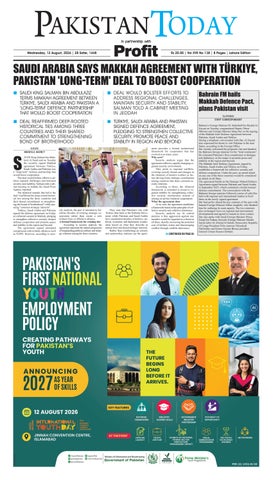
SAUDI KING SALMAN BIN ABDULAZIZ TERMS MAKKAH AGREEMENT BETWEEN TÜRKIYE, SAUDI ARABIA AND PAKISTAN A ‘LONG-TERM’ DEFENCE PARTNERSHIP THAT WOULD BOOST COOPERATION DEAL REAFFIRMED DEEP-ROOTED HISTORICAL TIES AMONG THREE COUNTRIES AND THEIR SHARED COMMITMENT TO STRENGTHENING BOND OF BROTHERHOOD
S
ANKARA
g
g
DEAL WOULD BOLSTER EFFORTS TO ADDRESS REGIONAL CHALLENGES, MAINTAIN SECURITY AND STABILITY, SALMAN TOLD A CABINET MEETING IN JEDDAH
TÜRKIYE, SAUDI ARABIA AND PAKISTAN SIGNED DEFENCE AGREEMENT, PLEDGING TO STRENGTHEN COLLECTIVE SECURITY, PROMOTE PEACE AND STABILITY IN REGION AND BEYOND
ANADOLU AGENCY
AUDI King Salman bin Abdulaziz Al Saud said on Tuesday the recently signed Makkah agreement between Türkiye, Saudi Arabia and Pakistan was a "long-term" defence partnership that would boost cooperation. The deal would bolster efforts to address regional challenges and maintain security and stability, Salman told a cabinet meeting in Jeddah, the Saudi Press Agency reported. The trilateral summit that led to the deal "reaffirmed the deep-rooted historical ties among the three countries and their shared commitment to strengthening the bonds of brotherhood" while pursuing "common strategic interests". Türkiye, Saudi Arabia and Pakistan signed the defence agreement on Friday at a trilateral summit in Makkah, pledging to strengthen collective security, deepen defence cooperation and promote peace and stability in the region and beyond. The agreement signed prompted comparisons with military alliances such as NATO. However, according to secu-
rity analysts, the pact is intended to formalise decades of existing strategic cooperation rather than create a new military bloc or offensive alliance. A formal framework for existing ties According to security analysts, the agreement represents the natural progression of longstanding political, military and strategic relations among the three countries.
Rs 20.00 | Vol XVII No 138 | 8 Pages | Lahore Edition
They note that Pakistan's ties with Turkiye date back to the Khilafat Movement, while Pakistan and Saudi Arabia have maintained decades of defence, political, economic and diplomatic cooperation based on what they describe as mutual trust and shared strategic interests. Rather than establishing an entirely new partnership, analysts say the agree-
ment provides a formal institutional framework for cooperation that has evolved over many years. Why now? Security analysts argue that the agreement reflects a rapidly changing regional security environment. They point to regional conflicts, evolving security threats and changes in the character of modern warfare as factors driving closer strategic coordination among countries that share common security interests. According to them, the trilateral framework is intended to preserve regional stability by strengthening collective security mechanisms instead of relying on ad hoc bilateral cooperation. What the agreement does At its core, the agreement establishes a framework based on the principles of collective security and collective deterrence. Security analysts say its central premise is that aggression against one member would be regarded as a threat to all three, thereby increasing the potential cost of military action and discouraging conflict through credible deterrence.
CONTINUED ON PAGE 03
bahrain FM hails Makkah defence Pact, plans Pakistan visit ISLAMABAD
STAFF CORRESPONDENT
Bahrain’s Foreign Minister Dr Abdullatif bin Rashid Al Zayani on Tuesday congratulated Deputy Prime Minister and Foreign Minister Ishaq Dar on the signing of the Makkah Joint Defence Agreement between Pakistan, Saudi Arabia and Türkiye. During a telephone conversation with Dar, Al Zayani also expressed his desire to visit Pakistan in the near future, according to the Foreign Office. Dar warmly welcomed the proposed visit and thanked the Bahraini foreign minister for his “kind sentiments”. He reiterated Pakistan’s firm commitment to dialogue and diplomacy as the means to promote peace and stability in the region and beyond. The Makkah Joint Defence Agreement, signed by Pakistan, Saudi Arabia and Türkiye on Friday, establishes a framework for collective security and defence cooperation. Under the pact, an armed attack on any one of the three countries would be considered an attack on all three. The agreement builds on the Strategic Mutual Defence Agreement signed between Pakistan and Saudi Arabia in September 2025, which contained a similar mutualdefence commitment. The conversation with the Bahraini foreign minister followed a series of calls Dar held with regional and international leaders to brief them on the newly signed agreement. Dar had earlier shared the key contours of the pact with Iranian Foreign Minister Abbas Araghchi, who thanked him for outlining its main aspects. The two ministers also exchanged views on regional and international developments and agreed to remain in close contact. Dar also spoke with Saudi Foreign Minister Prince Faisal bin Farhan, Kuwaiti Foreign Minister Sheikh Jarrah Jaber Al-Ahmad Al-Sabah, Democratic Republic of Congo President Félix-Antoine Tshisekedi Tshilombo and former Guinea-Bissau president General Umaro Sissoco Embaló.
02 NEWS
Wednesday, 12 August, 2026 | LAHORE
PAKISTAN RAILWAYS EXPANDS FREIGHT, PASSENGER SERVICES IN KP AND BALOCHISTAN
P
PROFIT
g
App
AKISTAN Railways has stepped up efforts to expand freight and passenger services in Khyber Pakhtunkhwa (KP) and Balochistan, with measures aimed at improving connectivity, supporting trade and providing affordable transport facilities. According to an official of the Ministry of Railways, a modern dry port has been established at Azakhel in the Peshawar Railway Division to meet business requirements
for bulk movement of goods between Peshawar and other parts of the country. The railway’s brake and luggage vans attached to major trains are also being used by farmers and small traders to transport vegetables, fruits, dairy products and other small consignments at economical rates. In Balochistan, regular freight services are transporting minerals, livestock feed and
Power regulator orders third-party performance testing of KE’s 900MW Bin Qasim power plant
agricultural products to Karachi and other markets across the country, the official said. Pakistan Railways is also improving digital ticketing, complaint management systems, station facilities and onboard services to provide safer, more comfortable and economical travel for passengers, including those travelling in KP and Balochistan. Currently, four Mail/Express trains oper-
ate from Peshawar, connecting the city with different parts of the country. Two Mail/Express trains operate from Quetta, providing links between Balochistan, Peshawar and Karachi. The Ministry of Railways plans to engage the provincial governments of KP and Balochistan to introduce additional passenger services in line with expansion initiatives being pursued in other provinces. The depart-
SBP to tighten oversight of export finance schemes to prevent misuse g
ECC APPROVES RS88B EXPORT FINANCE SUBSIDY FOR FY2026-27, INCLUDING RS350B LONG-TERM FACILITY AND PERFORMANCE-BASED REBATES; SBP DIRECTED TO ENFORCE SAFEGUARDS PROFIT
Monitoring report
RLNG Unit-2 posts 453.67MW net output; HSD units record around 350MW as regulator reviews capacity and heat-rate performance PROFIT
Monitoring report
The National Electric Power Regulatory Authority (Nepra) has ordered third-party performance testing of K-Electric’s (KE) 900MW Bin Qasim Power Station-III (BQPS-III) to verify its capacity and heatrate benchmarks, Business Recorder reported. In its decision dated July 6, 2026, published through a notification on August 6, Nepra said the tests were conducted by independent engineers under base-load conditions using RLNG and high-speed diesel (HSD). Karachi-based intervenors had repeatedly sought a performance audit of the plant. BQPS-III comprises two 450MW combined-cycle units, with RLNG as the primary fuel and HSD as backup. The plant supplies power to KE’s 220kV network. RLNG performance tests were conducted in February and May 2023, while HSD tests took place in early 2024. The tests assessed net capacity and heat rate, with corrections for temperature, humidity and pressure. Unit-2 on RLNG recorded 453.67MW net output and a net heat rate of 6,112.42 kJ/kWh (LHV basis). On HSD, Unit-1 and Unit-2 recorded net outputs of 352.46MW and 350.39MW, respectively, with higher heat rates. Nepra noted that performance could vary from EPC-guaranteed values because of plant ageing, operating hours, environmental conditions, fuel quality and grid conditions. Grid instability, frequency fluctuations and frequent start-stop cycles can also affect efficiency and plant life. The regulator said any tariff adjustment would be limited to heat rate and auxiliary parameters and must be based on verified performance test results. It also directed KE and other concerned entities to comply with relevant court orders.
The State Bank of Pakistan (SBP) will introduce stricter oversight of export finance schemes after the Economic Coordination Committee (ECC) recently approved a new framework aimed at increasing exports while limiting the risk of misuse, according to a news report. The Finance Division has earmarked Rs88 billion for export finance subsidies in FY2026-27. The package includes expansion of the Export Finance Scheme (E-EFS), a new Rs350 billion Long-Term Export Growth Fi-
nancing Facility (LTEGFF) and a performance-based rebate for exporters achieving higher growth. The E-EFS portfolio will be increased from Rs1,000 billion to Rs1,500 billion to provide working capital to exporters of value-added goods for up to 180 days. EXIM Bank plans to gradually reduce financing for traditional products and markets from 70% currently to 50% by 2030. The proposed LTEGFF will replace the existing E-LTFF and finance new export-oriented projects as well as Balancing, Modernisation and Replacement (BMR). It will target businesses with at least 80% export orientation and offer sub-
sidised fixed-rate financing for up to 10 years. The total subsidy requirement is estimated at Rs195.98 billion, including Rs25.16 billion for FY2027. The government will also introduce a performance-based rebate on incremental exports from July 1, 2026, with an estimated FY2026-27 cost of Rs15 billion, of which Rs10 billion is expected to be utilised during the current fiscal year. Exporters recording growth of up to 10% over the previous year will qualify for a rebate equal to 1% of incremental exports, while a higher rebate will apply to those exceeding 10% growth, with details to be finalised.
NA Secretariat cuts 302 posts, returns Rs8.6b to exchequer amid rightsizing drive g
REFORMS UNDER SPEAKER SARDAR AYAZ SADIQ DELIVER 30% SAVINGS IN TWO YEARS AND REDUCE WORKFORCE BY NEARLY 20%; SECRETARIAT EXPECTS FURTHER SAVINGS FROM RS17BN FY2026-27 BUDGET PROFIT
Monitoring report
The National Assembly Secretariat has abolished 302 posts and returned Rs8.6 billion to the national exchequer over the past two fiscal years as part of administrative and fiscal reforms introduced under Speaker Sardar Ayaz Sadiq, with officials expecting further savings from the Rs17 billion budget for FY2026-27, The Express Tribune reported. According to a background briefing by the National Assembly Secretariat, cumulative allocations for FY2024-25 and FY2025-26 stood at Rs29 billion, of which Rs8.6 billion was surrendered, representing savings of about 30%. The reforms have also reduced the size of the Secretariat's workforce by nearly
20%. “We also anticipate major savings against this year's Rs17 billion,” a senior Secretariat official said. The reforms have also replaced discretionary appointment powers with law- and rule-based service procedures, aimed at improving transparency in recruitment and reducing political pressure and influence in appointments. Under the new service structure, National Assembly employees will also be required to submit annual returns and wealth statements, which the Federal Board of Revenue (FBR) will make public in line with the practice applicable to other civil servants. The reforms at the National Assembly Secretariat come as the federal government continues efforts to reduce the size of the public sector and contain re-
curring expenditure. Finance Minister Muhammad Aurangzeb on Monday chaired a meeting of the sub-committee on rightsizing to review progress on the government's ongoing rightsizing exercise and measures to speed up implementation. According to the Finance Ministry, Waves 1 to 4 of the rightsizing exercise have largely progressed following cabinet approval, while follow-up work is continuing on recommendations already made. Recommendations for Waves 5 and 6 have been prepared and shared with relevant authorities, while work on Waves 7 and 8 is in progress. Muhammad Aurangzeb directed officials to move the exercise more decisively towards implementation and stressed the need to quantify recurring savings and fully reflect the fiscal im-
Pakistan, Russia plan two freight rail corridors, seek wider farm cooperation g
MOSCOW-FAISALABAD AND MOSCOW-KARACHI FREIGHT CORRIDORS UNDER DISCUSSION AS BOTH SIDES EXPLORE AGRICULTURAL MACHINERY, FERTILISERS, PESTICIDES, VACCINES AND ANIMAL-HEALTH TECHNOLOGIES PROFIT
Monitoring report
Pakistan and Russia are working to establish their first freight rail links between Moscow and Faisalabad and Moscow and Karachi, while also seeking to expand bilateral cooperation in agricultural machinery, fertilisers, pesticides, vaccines and animal-health technologies. Russian Ambassador Albert P. Khorev said the two countries were working with Pakistani partners to launch freight railway routes along the Moscow-Faisalabad and Moscow-Karachi corridors in both directions. The Russian Embassy in Islamabad quoted him as telling Russian newspaper Izvestia that the possibility of
involving Belarus in the project was also being considered. Khorev said the proposed rail links had faced repeated delays because of escalating geopolitical tensions in the region during 2025 and early 2026. The two sides are now working to finalise contractual arrangements and identify potential commercial users that could use the routes to transport goods. Separately, Minister for National Food Security and Research Rana Tanveer Hussain held talks with Nikita Buzanov, representative of Russia’s Ministry of Economic Development, on Monday to identify practical areas for expanding agricultural trade and technical cooperation. Hussain said Pakistan wanted to trans-
late its relations with Russia into concrete projects that could improve farm productivity, reduce production costs and strengthen food security. He called for greater access to modern agricultural machinery and related technologies to accelerate mechanisation and improve yields. The minister also sought reliable supplies of quality fertilisers and pesticides at affordable prices, along with greater Russian cooperation in livestock and animal health, particularly through access to vaccines and modern disease-prevention technologies. Buzanov said Russian companies and institutions were ready to explore opportunities to supply Pakistan with agricultural machinery, fertilisers, pesticides and
Economic growth to pick up in FY27, but Mideast conflict could fuel inflation, widen external pressures: SBP PROFIT
news Desk
The State Bank of Pakistan (SBP) expects economic activity to pick up in FY27, but has warned that a prolonged Middle East conflict, rising global energy and commodity prices, adverse climate conditions and delays in structural reforms could undermine the economic outlook. In its biannual Monetary Policy Report (MPR), the SBP said the Middle East conflict that began in late February had already pushed up global energy prices, freight and insurance costs and caused supply-chain disruptions. A wider or longer conflict could drive commodity prices above the levels assumed in the July 2026 Monetary Policy Committee (MPC) meeting. Despite the external shock, the report said Pakistan’s macroeconomic outcomes in FY26 remained broadly within the pro-
ment is targeting an increase in Pakistan Railways’ market share from 8% to 30%, alongside improvements in service delivery, sustainable operations, network expansion and regional connectivity. To achieve these targets, the ministry is implementing a four-pronged strategy focused on financial sustainability, governance and growth, private-sector participation, and technology and innovation. The strategy has already contributed to higher revenues, with Pakistan Railways recording its highest-ever revenue of Rs94 billion in FY2024-25, according to the ministry official.
AZAKHEL DRY PORT ESTABLISHED FOR BULK CARGO; FOUR MAIL/EXPRESS TRAINS OPERATE FROM PESHAWAR AND TWO FROM QUETTA AS RAILWAYS TARGETS 30% MARKET SHARE
jection ranges issued after the January 2026 MPC meeting. Prudent monetary policy helped contain second-round effects of higher energy prices and kept inflation expectations anchored, while fiscal measures, including timely increases in domestic prices, targeted subsidies and energy-conservation measures, helped contain demand-side pressures. For FY27, the SBP projects economic growth of 3.5-4.5%, although it expects the recovery to be slower than anticipated in January because of elevated energy costs and supply disruptions. Inflation is expected to ease and stabilise near the upper bound of the target range by the end of FY27. The central bank expects the current account deficit to remain between 0% and 1% of GDP, allowing continued foreign exchange purchases by the SBP and supporting the government's target of raising foreign exchange reserves to $20.20 bil-
lion by December 2026. Reserves are projected to increase further by the end of FY27. The report identified several factors that could support economic activity. Tax measures, including rationalisation of super tax for certain sectors and incentives for exporters, are expected to support manufacturing and services. Tariff reductions under the National Tariff Policy 2025-30 could benefit import-dependent industries, including automobiles, textiles, pharmaceuticals and edible oil. Higher expected sugarcane production is also likely to increase sugar output and support wholesale and retail trade services, while a broad-based increase in privatesector credit during FY26 is expected to support activity in FY27. The SBP also noted improved business sentiment, with surveys showing higher business confidence and purchasing managers' index readings in June and
vaccines. He said Russia was willing to work with Pakistani authorities to assess the country's agricultural requirements and develop mechanisms for closer cooperation. The Russian representative also highlighted the potential for increasing bilateral trade in agriculture-related products and strengthening institutional links between the two countries. Hussain directed the relevant authorities to examine potential areas of cooperation and facilitate result-oriented engagement with Russian counterparts. Both sides agreed to continue consultations aimed at converting the proposed cooperation into concrete trade and development projects. July 2026. However, climate risks remain a major concern. The report said worsening El Niño conditions and floods could damage agricultural production, raise food prices, weaken economic activity and widen the current account deficit, while creating additional pressure on government finances. The central bank also warned that delays in structural reforms could weaken exports, slow productivity growth and limit Pakistan's ability to achieve higher growth without creating excessive inflationary and external-sector pressures. The SBP said strengthening economic buffers and implementing structural reforms on time would be essential to improve resilience against recurring supply shocks, raise productivity and create conditions for more sustainable economic growth. The MPR also contains six analytical sections covering the monetary policy transmission mechanism, the central bank's response to supply-side inflation, different measures of inflation, the growing size of open market operations and their implications for monetary policy, and the use of sentiment surveys to assess economic expectations.
To prevent delays, exporters exceeding their previous year's average quarterly exports will receive 75% of the applicable rebate provisionally. Final adjustments will be made at year-end, with exporters falling short of annual benchmarks required to refund provisional payments within 15 days. The ECC called for safeguards including per-party limits, greater SME participation and diversification of export products and markets. It directed the SBP, as regulator, to ensure strict monitoring of the schemes and prevent misuse based on lessons from previous subsidy programmes.
Roshan Digital Account inflows fall to $282m in July, but new account openings pick up pace PROFIT
news Desk
Pakistan received gross inflows of $282 million under the Roshan Digital Account (RDA) in July, down from $306 million the previous month, but the scheme continued to attract new customers, with 10,589 new accounts opened during the month, according to State Bank of Pakistan (SBP) data. Since its launch in September 2020, the RDA has attracted cumulative inflows of $13.647 billion as of July 2026. Of the total inflows, $2.118 billion was repatriated, while $8.603 billion was utilised locally. The combined total of repatriated and utilised funds stood at $10.721 billion, leaving a net repatriable liability of $2.926 billion. RDA funds continue to support Pakistan's external account, though monthly inflows lost momentum in July after exceeding $300 million in April, May and June. July's account openings were the strongest since October, up from around 10,000 in June, ending a softer patch seen in February and March, according to a research analyst. Account openings have held in a tight 8,000to-11,000 band for two years, a consistency described as notable given the scheme is nearly six years old and still recruiting at the same pace as at the start. The cumulative account base of 956,790 is close enough to a million that the milestone should arrive within roughly four months at the current run rate. FY26 inflows totalled about $2.80 billion, compared with $2.31 billion in FY25, taking cumulative receipts to $13.6 billion. Depositors are also putting money to work rather than leaving it idle. Balances moved out of ordinary accounts into certificates during the month, while Roshan Equity has doubled year-on-year to $151 million. Net repatriable liability rose 45% year-on-year to $2.93 billion, against repatriation of just 16% of everything ever received.
SECP issues guidebook to standardise corporate Sukuk issuance, 72 issuances raised Rs307 billion last year ISLAMABAD news Desk
The Securities and Exchange Commission of Pakistan (SECP) has issued a practical guide and toolkit for corporate issuers to standardize Sukuk structures and documentation, aiming to make corporate Sukuk issuance simpler, faster and more cost-effective. The initiative aligns with the Ministry of Finance's direction to deepen Pakistan's corporate debt market. It aims to enable more companies to raise Shariah-compliant financing through the capital market. During the last fiscal year, 72 Sukuk issuances raised around Rs307 billion, reflecting the growing significance of Islamic financing in Pakistan's capital market. The guidebook provides a step-by-step explanation of the Sukuk issuance process. It covers regulatory requirements, standardized structures, model transaction flows, sample applications and illustrative legal documents. The guide is expected to reduce legal and structuring complexities, transaction costs and issuance timelines, particularly for first-time issuers. It was developed through SECP's regulatory experience and consultations with its Shariah Advisory Committee, industry experts, legal practitioners and market participants.
NEWS 03
Wednesday, 12 August, 2026 | LAHORE
GOVT MOVES TO ACCELERATE RIGHTSIZING, EXPAND FINANCING FOR SMES, FARMERS, HOMEBUYERS AND EVS
F
ments. Waves 1 to 4 have largely progressed following Cabinet approval, while followup work is continuing on recommendations already issued. Recommendations for Waves 5 and 6 have been prepared and shared with relevant authorities, while work on Waves 7 and 8 is underway. Aurangzeb directed officials to move the exercise more decisively towards implementation and stressed that recurring savings resulting from approved measures should be clearly quantified and reflected in the budget and medium-term fiscal framework. The committee also examined the functions currently being performed by the federal government and areas where efficiency could be improved through institutional restructuring, devolution and greater privatesector participation. The minister said rightsizing should not be measured merely by reducing the size of government but by improvements in effi-
PROFIT
STAFF REPORT
EDERAL Minister for Finance and Revenue Senator Muhammad Aurangzeb has called for faster implementation of the federal government’s rightsizing programme, with a focus on measurable savings, improved efficiency and better service delivery, while separately reviewing measures to expand financing for small businesses, agriculture, housing and electric vehicles. Aurangzeb chaired a meeting of the Sub-Committee on Rightsizing of the Federal Government on Monday, attended by Federal Minister for Climate Change Senator Dr. Musadik Malik, who is the convener of the reconstituted sub-committee. The meeting reviewed progress on all eight waves of the rightsizing exercise covering federal ministries and attached depart-
ciency, productivity, resource utilisation and service delivery. The meeting also discussed workload and activity analysis to guide decisions concerning institutional structures, functions and staffing. Dr. Musadik Malik called for a focused and time-bound implementation mechanism. In consultation with Coordinator to the Prime Minister on Rightsizing Salman Ahmad, he proposed an action plan setting out specific timelines and responsibilities for translating approved recommendations into concrete measures. Aurangzeb directed that progress on the rightsizing agenda be closely monitored to ensure timely implementation and sustainable improvements in fiscal management and government operations. ACCESS TO FINANCE PLAN REVIEWED Separately, Aurangzeb chaired the second meeting of the Access to Finance Steering Committee, established to oversee
implementation of the Prime Minister’s Access to Finance Plan 2026-2028. The committee reviewed progress under the plan, including initiatives being pursued through sub-committees on SME, agriculture and housing finance. It also considered measures to resolve cross-cutting legal and financial-data issues and accelerate lending to priority sectors. Officials presented a proposed framework for wholesale financing, which will be shared with banks for feedback before being finalised. The committee stressed the need for clear mechanisms and appropriate controls, particularly where government support is used as a catalyst for financing. The meeting also reviewed financing dashboards and progress indicators, with the Finance Minister directing that data be updated regularly to enable weekly monitoring of key initiatives. AGRICULTURE AND HOUSING FINANCE On agriculture, the committee discussed
Fauji Cement and Attock Cement boards explore potential merger PROFIT STAFF REPORT
The boards of Attock Cement Pakistan Limited and Fauji Cement Company Limited have authorised their respective management teams to explore and evaluate the feasibility of a potential merger of Attock Cement with and into Fauji Cement, according to separate notices submitted to the PSX on Tuesday. Attock Cement's board, in its meeting held on August 11, 2026 at Fauji Tower, Rawalpindi, directed management to evaluate the merger and present its recommendations for the Board's consideration, in a price-sensitive disclosure made under Section 96 and 131 of the Securities Act, 2015. Alongside the merger review, the Board also approved shifting the company's registered office from Karachi, Sindh, to Rawalpindi, Punjab, subject to shareholder approval via a Special Resolution at the forthcoming Annual
General Meeting and completion of applicable statutory and regulatory requirements. FINANCIAL RESULTS As per the financial statement, Attock Cement posted a net profit of Rs3.42 billion for the year ended June 30, 2026, nearly doubling from Rs1.73 billion a year earlier. The Board recommended a final cash dividend of Rs Nil per share for the year, in addition to an interim dividend of
Kohinoor Textile Mills approves 48.36 MW battery energy storage system installation PROFIT
SADDAM HUSSAIN
Kohinoor Textile Mills Limited's Board of Directors has approved the installation of a 48.36 MW Battery Energy Storage System (BESS), along with an additional 9.34 MW solar installation, the company disclosed to the Pakistan Stock Exchange (PSX) on Tuesday. The disclosure was made in compliance with Sections 96 and 131 of the Securities Act, 2015, and Clause 5.6.1(a) of the PSX Regulations. The company said the Solar Power Plant and BESS are expected to commission and commence commercial operations during the last month of the second quarter of financial year 2026-27. Kohinoor Textile Mills described the investment as reflecting its continued commitment to operational excellence, sustainability and long-term value creation for stakeholders, adding that it is expected to result in significant savings in energy costs. Kohinoor Textile Mills Limited is a public limited company incorporated in Pakistan under the Companies Act, 1913.
Rs0.50 per share (5%) already paid during the year. No bonus shares, right shares or other entitlements were announced. The company's revenue from contracts with customers rose to Rs44.32 billion for FY2026, up from Rs33.31 billion in FY2025. Cost of sales increased to Rs32.23 billion from Rs25.34 billion, lifting gross profit to Rs12.09 billion from Rs7.97 billion a year earlier. Profit from operations rose to Rs6.27 billion from Rs4.67 billion. Finance costs
fell to Rs1.02 billion from Rs1.84 billion, while profit before tax climbed to Rs5.28 billion from Rs2.86 billion. After an income tax expense of Rs1.86 billion, profit for the year settled at Rs3.42 billion. Basic and diluted earnings per share came in at Rs24.86, compared with Rs12.60 in the previous year. Total assets stood at Rs50.33 billion as of June 30, 2026, against Rs50.42 billion a year earlier. Total equity rose to Rs24.70 billion from Rs22.50 billion, while total liabilities declined to Rs25.62 billion from Rs27.92 billion. The company generated Rs6.09 billion in net cash from operating activities during the year, compared with a net cash outflow of Rs394 million in FY2025. Net cash used in investing activities stood at Rs1.69 billion, while financing activities used a net Rs1.91 billion, including Rs1.17 billion in dividend payments. Cash and cash equivalents rose to Rs1.10 billion at year-end, from a negative Rs1.39 billion a year earlier.
Pak-Qatar Family Takaful appointed Authorized Pension Fund Manager by federal government PROFIT STAFF REPORT
Pak-Qatar Family Takaful Limited has been appointed by the Federal Government of Pakistan as an Authorized Pension Fund Manager for the Defined Contribution Pension Fund Scheme, the company disclosed to the Pakistan Stock Exchange (PSX) on Tuesday. The disclosure was made under Section 96 of the Securities Act, 2015, and Clause 5.6.1 of the PSX Rule Book. The company said the appointment builds on its
earlier successful appointments in Khyber Pakhtunkhwa, Punjab and Balochistan, reinforcing its commitment to expanding access to Shariah-compliant retirement planning. Pak-Qatar Family Takaful said it remains dedicated to strengthening Pakistan's retirement ecosystem through ethical, innovative and sustainable financial solutions. Last week, the federal Finance Ministry notified a list of 16 eligible Pension Fund Managers, including Pak-Qatar Family Takaful Limited, that have executed agreements with the government for the Defined Contribution Pension Fund Scheme-2024.
At-Tahur expands product portfolio with Prema Gelato ice cream PROFIT
STAFF REPORT
At-Tahur Limited's Prema brand has expanded its product portfolio with the launch of Gelato, a premium dairy ice cream offering a richer and smoother texture than conventional ice cream, the company disclosed to the Pakistan Stock Exchange (PSX) on Tuesday.
The disclosure was made in accordance with Section 96 of the Securities Act, 2015, and Clause 5.6.1(a) of the PSX Regulations. The company said the launch marks another strategic step toward diversifying and expanding its product portfolio, reinforcing its commitment to offering high-quality options to consumers. At-Tahur said the introduction of Prema Gelato is expected to fur-
World Bank warns fund redirection from housing programme could deepen poverty in Balochistan PROFIT STAFF REPORT
The World Bank has warned that redirecting funds from a multi-billion-rupee resilient housing programme for the flood-affected population to infrastructure projects would further aggravate poverty in Balochistan, expressing serious displeasure over reputational challenges in a detailed communication to the federal and Balochistan governments, Dawn reported. "Based on the socio-economic profile of the eligible household, the risk is not simply that households remain without housing assistance; rather, it is that existing vulnerabilities become mutually reinforcing and deepen over time," the World Bank said. According to the bank, 84% of eligible beneficiaries are ultra-poor and vulnerable, with 28% earning less than $30 monthly and another 26% earning between $31 and $70. Read This: Federal govt limits Balochistan flood rehabilitation scheme to 69,000 homes despite 134,000 verified families Among these households, 39% are tenants, 37% are daily-wage labourers and 8% are small farmers, groups the bank said typically have limited savings, weak access to formal credit, few productive assets and low capacity to absorb shocks. The warning followed meetings with the federal minister for planning, the chief min-
ister of Balochistan and others after housing support was capped at 62,966 first-tranche beneficiaries as of June 22, 2026, with subsidy support limited to 97,000. World Bank Country Director Boloromaa Amgaabazar expressed concern over the decision, as well as the handling of issues related to fraud and corruption. She wrote to the federal secretaries for economic affairs and planning, and the secretary of Balochistan, that the capping and redirection of housing support was leaving 119,049 verified and eligible households without identified financing support. She said public disclosure of the decision before finalising a jointly agreed communication strategy with the bank had created risks, since households that had completed verification and signed project undertakings might continue to expect housing assistance. Amgaabazar said 66,120 exclusion-related grievances had been registered in the project grievance management system on or before the agreed cut-off date.
ther strengthen the company's market presence and contribute positively to future growth. At-Tahur Limited is a public limited company incorporated on 16 March 2007 under the Companies Ordinance, 1984 (Now Companies Act, 2017) as a private limited company and subsequently converted into a public limited company with effect from 28 September 2015.
She said each complainant should be contacted individually and formally notified of the decision. "Written acknowledgment, or other verifiable evidence confirming delivery and receipt of the communication, should be obtained and shared with the bank for review. A credible and transparent grievance resolution process is essential to mitigating legal, operational, and reputational risks associated with eventual closure of the component," she wrote. With housing support capped, eligible but excluded households may face a compounding cycle of vulnerability that reinforces and increases poverty, raises disaster risk, and undermines long-term recovery and resilience, according to the bank. With limited resources, families may divert income from essential needs like food, healthcare and education toward continued temporary shelter repairs, while resorting to debt or selling productive assets to cope. Families unable to rebuild resilient homes may remain in damaged or unsafe structures, leaving them more exposed to recurring floods, storms, earthquakes and heatwaves. The exclusion of verified eligible beneficiaries may also generate grievances, perceptions of inequity, and continued erosion of trust in government institutions and development programmes, risks the bank said have been observed in other housing reconstruction operations.
efforts to expand lending to farmers and strengthen crop insurance. It reviewed a proposal to enhance the Crop Loan Insurance Scheme (CLIS) towards area-yield insurance, which could improve farmers’ access to insurance payouts. The committee also called for stronger coordination among banks, non-bank financial institutions and other stakeholders to improve financing and payment mechanisms for growers. Housing finance was another major area of discussion. Under the Wazir-e-Azam Apna Ghar Programme – Ghar Ho To Apna, banks had approved more than Rs220.68 billion in loans ready for disbursement, while around Rs34.27 billion had been disbursed up to July. The committee reviewed measures to expand housing finance, including digitisation of land and property records, verification of title documents and improvements in mortgage-based lending.
Saudi Arabia says Makkah agreement with Türkiye, Pakistan 'long-term' deal to boost cooperation CONTINUED FROM PAGE 01
The framework also envisages expanded defence cooperation, including closer military coordination, intelligence sharing, strategic consultations, defence planning and broader institutional cooperation between the three countries. According to analysts, pooling military capabilities and strategic coordination is intended to improve preparedness while reducing the likelihood of regional conflict. The complementary roles of the three countries The agreement draws on what security analysts describe as the complementary strengths of each participant. Pakistan contributes experienced armed forces, operational expertise and strategic planning capabilities developed through decades of counterterrorism operations and conventional military preparedness. Saudi Arabia brings economic strength, regional influence and political leadership, while Turkiye contributes an advanced defence industry, military technology and industrial capacity. Together, analysts say, these capabilities form a balanced security architecture capable of responding to emerging regional security challenges. PAKISTAN'S EVOLVING DIPLOMATIC ROLE Security analysts also argue that Pakistan has increasingly emerged as a regional stabiliser through its diplomatic engagement in recent regional crises. They cite Pakistan's mediation efforts during the recent US-Iran conflict, alongside its diplomatic relations with Saudi Arabia, Turkiye, Iran, China and the United States, as evidence that Islamabad is well positioned to serve as a bridge between regional and global stakeholders. They say that this broader diplomatic role complements Pakistan's contribution to the trilateral framework. What the agreement is not While comparisons have been drawn with existing military alliances, security analysts reject several common characterisations of the pact. They emphasise that the agreement is not: an offensive military alliance; directed against any specific country; a "Muslim NATO"; a nuclear security arrangement or extended nuclear deterrence agreement; or a religion-based political or military bloc. Instead, they describe it as a defensive security framework designed to deter aggression, strengthen military cooperation and enhance regional stability without targeting any state. According to the analysts, the agreement is intended to reinforce self-reliance among the three partners while codifying an existing strategic relationship through a formal institutional mechanism.
04 COMMENT
El-Sayed’s win in Michigan is the most consequential election this year
Wednesday, 12 August, 2026
PCB secrecy
T
Central contracts are shrouded in as much secrecy as financial statements
HEY have a roundabout method of holding the P B to account because they are part of the electorate, which elects the Prime Minister, who appoints the PCB Chairman. The PCB is thus concerned with keeping the Chairman happy, and he the PM. The fans, in making their voting decision, usually do not give much weightage to this. However, they express their grievances over the performance of the national team to the PM, who may then take the Chairman to task. The PCB first made public its accounts by placing them on its website back in 2019, but now it has refused to do so despite a Pakistan Information Commission order to do so. The PCB has appealed the order, as it has a right to do, but before that appeal has been decided, it appears to have extended its argument, that it takes no money from the government, to the central contracts of national players, and has not yet awarded those contracts, though they have expired, and is rebuffing all enquiries about them on the ground that they are private information. This has been examined in a report in this week’s issue of newspaper’s Profit\ magazine. The legal position is to be decided by the Islamabad High Court, where the case is at present, though an appeal to the Supreme Court cannot be ruled out. It is difficult to see how, as this is matter of freedom of information, the appeal might lie before the Constitutional Court, as a fundamental right is involved. However, the PCB should wonder how matters got this far. The government bureaucracy has a virtually reflexive instinct to conceal information, but the information about the PCB is of overpowering interest to all those involved in cricket, even if it only as a TV spectator. The open-ness is actually of benefit to those at the helm, especially the Chairman, who is never a professional, and thus has no vested interest in keeping financial information secret. As the PCB has become flush with money from the ICC, the PSL, TV rights and other sources, transparency is the best protection for officials, especially those who are not permanent employees is complete transparency. The Prime Minister is the PCB’s ultimate boss, so ultimate responsibility falls on him. He can ensure transparency, and should.
I
WASHINGTON WATCH Dr JAmeS J ZOGby
N what, I believe, will be seen as this year’s most significant election; Dr Abdul El-Sayed won a victory in Michigan’s Democratic Senate primary. It was a close contest—a nail-biter, as we say—but it was an important win that marks a watershed moment in US politics. It was the first time that Israel’s genocidal war in Gaza and massive US military support to Israel became central themes that were actively debated across the state. This issue has come up in a few other races. But this Senate race was different. There were daily discussions about the fact that the US has been subsidizing Israeli policies that have taken such a huge toll on Palestinians and Lebanese. From the results it is clear: Israel and the candidate that supported Israel, four term congresswoman, Rep. Haley Stevens, both lost.
Another major issue actively debated in this contest was the role of “dark money” and other independent expenditures. We’ve seen dark money dominate campaigns in the past. But never at this level. At last count, Stevens had received upwards of $70 million, with the bulk of these funds coming directly from pro-Israel groups, led by the Israel lobby, AIPAC. In contrast, El-Sayed’s campaign was fueled largely by small donors. Overall, Stevens and AIPAC outspent El-Sayed by a margin of over eleven to one! In the end, dark money and AIPAC were resoundingly defeated, proving that money can prop up a candidate but can’t automatically win an election. The El-Sayed/Stevens contest also became a national face-off between the progressive wing of the Democratic Party and the party’s establishment, with leading Democrats from both wings endorsing and campaigning in the state. El-Sayed’s win in this bellwether Midwestern battleground state represents a major win for progressives. It demonstrated that the “establishment” itself has become toxic to many
Democratic voters. This election also marks a huge victory for Michigan’s Arab Americans. Four decades ago, the leading candidate for mayor of Dearborn made “What to do about the Arab problem?” a central issue in his campaign. Since then, that community has continued to organize, register voters, and win elections. Much maligned after registering their discontent with the Biden administration’s support for Israel, they came roaring back by helping to elect an Arab American as the Democratic Senate nominee. Not only that, but in the contest in the Dearborn area for the nomination to represent Democrats in the November election for Michigan State Senate, Abbas Alawieh won a decisive victory. Abbas was the leader of the 2024 “Uncommitted” movement. I am hard pressed to find an election that was more consequential and broke ground in more areas than this Michigan primary contest. Now it’s on to November. The writer is President, Arab American Institute
This election also marks a huge victory for Michigan’s Arab Americans. Four decades ago, the leading candidate for mayor of Dearborn made “What to do about the Arab problem?” a central issue in his campaign. Since then, that community has continued to organize, register voters, and win elections.
Dedicated to the legacy of late Hameed Nizami
Arif Nizami (Late) Founding Editor
Reimagining Pakistan’s federal structure
M. A. Niazi
Babar Nizami
Editor Pakistan Today
Editor Profit
A
The case for new provinces
NAveeD SAfDAr
T the time of partition in 1947, Pakistan emerged as a new state with a population of around 30 million, governed through four provinces. Today, nearly eight decades later, the population has swelled to approximately 250 million, yet the same four provincial governments continue to shoulder the immense burden of administration. This stagnation has not only created a plethora of governance problems but has also distanced the state and its institutions from the people they are meant to serve. This mismatch between population growth and administrative expansion has become one of the most pressing structural dilemmas confronting Pakistan. The people of Pakistan, particularly those living in remote and underdeveloped regions, often feel alienated from the centres of power. The sheer size of provinces like Punjab, with its population exceeding that of many countries, makes equitable representation nearly impossible. Citizens in southern Punjab, interior Sindh, or the ex-tribal districts face delays in justice, poor infrastructure, and inadequate healthcare and education because provincial capitals are too distant— geographically and politically. Instead of the state reaching out to the people, the people are compelled to chase state functionaries and institutions, a reversal of the very purpose of governance. The creation of new provinces promises to correct this imbalance by bringing administration closer to the citizenry, ensuring accessibility and responsiveness. Administratively, the burden on provincial governments is overwhelming. A single bureaucracy is expected to manage vast territories with diverse needs, leading to inefficiency, corruption, and uneven development. Lahore, Karachi, Quetta, and Peshawar cannot possibly cater to the unique cultural, economic, and geographic realities of their far-flung districts. Smaller provinces would allow for more specialized governance, tailored to local priorities. Decentralization would not only improve service delivery but also strengthen accountability, as citizens would be closer to their representatives and institutions. By having more provinces, Pakistan could achieve the objective of a state that actively reaches out to its people rather than remaining distant and aloof. For the federal government, the imbalance among provinces creates political instability.
Punjab’s dominance in terms of population and parliamentary seats has long been a source of tension, with smaller provinces fearing perpetual marginalization. This imbalance undermines the spirit of federalism, as the federation appears skewed toward one province. By creating new provinces, Pakistan could achieve a more equitable distribution of power, ensuring that no single province overshadows the federation. This would foster trust among federating units, reduce ethnic grievances, and strengthen national unity. The idea of creating new provinces is not unprecedented. In the past 50 years, scores of countries have successfully restructured their administrative units to meet the demands of growing populations and diverse societies. India, Nepal, Indonesia, Congo, Algeria, South Africa, and Turkey are notable examples. India, for instance, gradually moved from 14 provinces in the 1950s to 28 today and created new states such as Chhattisgarh, Uttarakhand, and Jharkhand in 2000 to accommodate linguistic, cultural, and administrative needs. These new states, though smaller, have shown improved efficiency and greater citizen satisfaction. Nigeria, too, expanded from three regions at independence in 1960 to 36 states today, diffusing ethnic tensions and bringing governance closer to the people. These examples demonstrate that federations can thrive when they embrace diversity through structural adaptation. The creation of new provinces in Pakistan is about reimagining the social contract. A state exists to serve its citizens, and when its structures fail to deliver justice, equity, and development, they must evolve. The rigidity of Pakistan’s provincial system reflects a fear of change, yet history teaches that federations must adapt to survive. Smaller provinces would embody the principle of subsidiarity— the idea that decisions ought to be made at the most immediate level possible. This principle not only enhances efficiency but also affirms the dignity of citizens by recognizing their
right to self-governance. Critics’ view that new provinces would create additional bureaucratic and financial burdens overlooks the long-term benefits of efficiency, accountability, and stability. The cost of maintaining unwieldy provinces— alienation, corruption, and political imbalance— is far greater than the expense of new administrative units. Moreover, new provinces could unlock economic potential by focusing on local industries, resources, and development priorities that are often ignored by distant capitals. Pakistan’s system is suffering from stagnation that needs to be uprooted and replaced with a robust one that ensures people’s access to the state’s provisions and services. The creation of new provinces is not about drawing lines on a map; it is about redrawing the lines of trust between the state and its people. It is about recognizing that unity does not mean uniformity, and that strength lies not in centralization but in empowering diverse communities. Pakistan’s future stability and prosperity depend on its willingness to embrace this truth. By courageously reimagining its federal map, Pakistan can ensure that every citizen feels seen, heard, and served, thereby fulfilling the promise of a federation that truly belongs to its people.
The author is a freelance columnist who writes on current affairs, geopolitics, and disaster management, and can be reached at naveedsafdar13@gmail.com
Pakistan’s system is suffering from stagnation that needs to be uprooted and replaced with a robust one that ensures people’s access to the state’s provisions and services. The creation of new provinces is not about drawing lines on a map; it is about redrawing the lines of trust between the state and its people.
Lahore – Ph: 042-36300938, 042-36375965
I
Karachi – Ph: 021-32640318 I
Islamabad – Ph: 051-2204545
I
Editor’s mail
Send your letters to: Letters to Editor, Pakistan Today, 4-Shaarey Fatima Jinnah, Lahore, Pakistan. E-mail: letters@pakistantoday.com.pk Letters should be addressed to Pakistan Today exclusively
Drain the blame
EVERY year, when the monsoon clouds roll in, the people of our cities brace themselves — not for a pleasant change in weather, but for chaos. Streets become canals, homes are damaged, power shuts down, and daily life comes to a standstill. Urban flooding has become a regular tragedy, and what’s most heartbreaking is that much of it is preventable. As someone who has seen the impact of even a few hours of rain in Lahore, I believe we need to speak honestly: this is not just nature’s fault — it’s ours too. The blame cannot lie with the government alone. Citizens must also take responsibility. When people throw garbage into drains or block waterways with construction debris, they directly contribute to the flooding. These actions may seem small but lead to devastating consequences — sometimes even the loss of homes and lives. At the same time, the government must wake up to its duty. Cleaning drains after the rains start is too little, too late. There should be a proper cleaning system before the monsoon begins. Clear timelines, city-wide inspections and preparation are necessary. Moreover, the government should impose fines on individuals who dump waste into drains — not as punishment, but as a way to protect the larger community. Urban flooding should no longer be treated as routine. It is a man-made crisis — and both our institutions and we, the people, must own it. There is need to raise awareness of the issue and encourage real change, before the next spell of rain becomes another season of regret. IZZA ISRAR LAHORE
Statebitten
SNAKEBITE remains a serious public health threat in many endemic regions of Pakistan, particularly in Tharparkar. The recent rains, while a blessing for agriculture, have led to a surge in venomous snake encounters, especially in rural and farming communities. In Tharparkar, where agriculture resumes after rainfall, dozens of individuals have already been hospitalised due to snakebites. Health officials have confirmed that at least 63 snakebite victims are currently under treatment at the District Headquarters (DHQ) Hospital in Mithi, while government hospitals across the district have also reported a spike in cases. From January to July this year, a total of 197 snakebite cases were treated in public health facilities across the district. Most of these patients required immediate administration of the anti-snake venom (ASV) vaccine, which neutralises the life-threatening neurotoxic and cardiotoxic effects of snake venom. However, there is an alarming shortage of ASV vaccines in the region. Tharparkar, home to a variety of venomous snakes, including vipers, has not received its required supply of ASV vaccines from the National Institute of Health (NIH) in Islamabad, which is the only facility in Pakistan that manufactures this life-saving vaccine. Due to this shortage, many basic health units (BHUs) and rural health centres (RHCs) are unable to meet the urgent demand. The situation is further aggravated by inadequate cold storage facilities in remote villages, many of which still lack electricity supply. As a result, patients have to be referred to faraway hospitals, causing dangerous delays in treatment. The delay or unavailability of ASV vaccine has already cost human lives, especially among those living in remote desert villages. Local communities and social activists have been rightly urging both the federal and provincial governments to ensure an immediate and consistent supply of ASV vaccines to Tharparkar. These life-saving vaccines are critical for preventing deaths and safeguarding the health and lives of some of the country’s most vulnerable populations. ALI NAWAZ RAHIMOO UMERKOT
Web: www.pakistantoday.com.pk
I
Email: editorial@pakistantoday.com.pk
Wednesday, 12 August, 2026
T
Beyond the battlefield Why climate change is South Asia’s next security threat
Syed Talha Shah
HE Himalayas’ glaciers are often called the “Water Towers of Asia.” These glaciers are the source of river basins, including the Indus, Ganges, and Brahmaputra, providing almost two billion inhabitants with water. Due to increased temperature Himalayan glaciers are melting rapidly. A situation which could be seen as purely environmental is now becoming one of the most serious strategic challenges in the 21st century. In other words, climate change will no longer change only ecosystems; it will affect geopolitics and redefine the concept of national security in South Asia. For years, national security in South Asia has been perceived through such concepts as military threats, nuclear deterrence, and territorial disputes. Defence strategies and alliances have played a key role in the national policy of South Asian countries. However, this conventional view is not enough anymore. In 2009, the United Nations defined climate change as a “threat multiplier” that has the capability to endanger global peace and security in its report. The UN Security Council repeats the topic and addresses the people about water scarcity, food insecurity, health emergencies, migration, and economic instability. It seems like in the following decades, the biggest security threat to South Asia will come not from the battlefield, but from the climate changes. The temperature in the Himalayas is increasing more rapidly than in most other regions of the world. The glaciers are melting, and melting will increase the river discharge and then that more likely could convert into a flood. In the long term, however, it is going to affect the amount of water during dry seasons negatively. For a continent where millions of people are still struggling because of rapid population growth and uneven resource distribution, this is not just an environmental problem; it is a strategic problem with a lot of political consequences. As time passes, the value of water resources as a geopolitical asset is becoming more and more obvious for the world. The 2025 India-Pakistan conflict is another example of this trend. The problem itself had various political and security dimensions, however, discussions about the Indus Water Treaty showed how the water became entan-
gled in the strategic rivalry. Despite the fact that climate change was not a direct reason for the conflict, it has increased the strategic value of a resource that is now seen through the lens of national security. Scarce water resources require not only effective management from the environmental perspective but also from the perspective of maintaining strategic balance. Water insecurity is one of the climate-security problems that arise in South Asia. Agriculture is the key sector for many economies in South Asian countries, providing jobs and ensuring food for their populations. Due to changing weather patterns, longer drought periods, and higher temperatures the region’s agricultural production has become less. Food shortage can cause unemployment and inflation. These conditions increase the social unrest and political instability among the people. Bad governance may lead to situations like economic stress that could quickly turn into a security threat. When the government cannot fulfil the needs of its population, then the security of the country becomes endangered. Climate change causes mass climate migration. Flood, cyclones, sea-level rise, and long drought periods force the people to leave their regions and migrate to urban areas. According to a World Bank report, using the Groundswell model, about 40 million people could migrate internally due to climate change by 2050. This process puts pressure on the infrastructure, health care systems, housing, and job opportunities, increasing competition for resources. Border regions might become a source of diplomatic tensions because of climate migration. Migration is not only a humanitarian but also a
security and economic problem. Climate change is expected to have serious economic consequences for South Asian states. According to the estimates by the Asian Development Bank, on the current fossil-fuel-intensive pathway, climate change could make the loss to the GDP of South Asia equal to 1.8 percent per year by the middle of the century and almost 9 percent by the end of it. South Asian countries already experience high expenses connected with disaster recovery, destruction of infrastructure, decrease in agriculture output and productivity because of extreme weather conditions. Moreover, these costs are shifting the priorities of budget spending and decreasing the ability to invest in such sectors as education, health care, or defence at the same time, making countries dependent on foreign debt. Therefore, economic vulnerability turns into a national security threat. Economic resilience becomes one of the crucial elements of strategic stability. Climate change also impacts the functioning of military establishments. Nowadays, armed forces of South Asian countries become involved more often in disaster relief and humanitarian assistance operations and logistics. A joint damage assessment conducted by the World Bank, Asian Development Bank, and UN agencies showed that the Pakistan floods in 2022, when Pakistani Armed Forces carried a big part of the emergency response, brought to Pakistan more than $30 billion in losses, about 8 percent of GDP in 2022. The Indian military is also repeatedly used to provide help after natural disasters like cyclones and floods. It shows that national security and military prepared-
ness nowadays include not only preparations for conventional warfare but also protection from climate disasters. The solutions to those problems lie in a complete rethink of what national security means to South Asian states. Long-term strategies in defence doctrines need to incorporate climate risk analysis. Building resilient infrastructure, sustainable water management, warning systems, and disaster preparedness must be seen as security considerations, not developmental priorities. Climate adaptation needs to be seen as an investment in national resilience, which would reduce the environmental shocks. In addition, South Asian nations also need to cooperate. Transboundary rivers, ecosystems, and climatic challenges require such an approach because the efforts to mitigate their effects unilaterally are doomed to failure. Improved transboundary water management, increased scientific data sharing, enhanced joint disaster response capabilities, and climate diplomacy can help to increase mutual confi-
Thus, South Asia is at a strategic junction. The future will not only depend on war readiness but on the resilience of societies, sustainability of natural resources and willingness of governments. The disappearing glaciers of the Himalayas is a security concern of shifting nature. The policymakers who define national security through a militaristic prism alone are preparing for past threats, but ignoring current challenges. The true battlefields of the future may not be in conflict zones but in fields and towns where countries struggle to manage their resources and protect themselves from environmental disasters. Climate challenge as a national security concern is no longer a matter of environmental protection but peace, stability and prosperity of South Asia.
What is the point of the new ‘Muslim Nato’? The Mecca Agreement suits the US very well indeed. It is inconceivable that the Saudis, in particular, would have signed the deal without consulting Donald Trump first
All three countries, who are predominantly Sunni, have been at pains to reassure Iran that this is not the beginning of an anti-Shia coalition. So what is it about?
P
COMMENT 05
THE SPECTATOR Simon digginS
AKISTAN’S defence minister, Khawaja Asif, rather excitedly proclaimed a new defence agreement – the Mecca Joint Defence Agreement – between Saudi Arabia, Pakistan and Turkey as the beginnings of a ‘Muslim Nato’ last week. He proceeded to call on Muslim countries to set aside their differences and join them. The key clause – that an attack on any one of the three countries would be considered an attack on them all – is virtually the same as Nato’s much-vaunted Article 5, widely regarded as the underpinning of that alliance. But, unlike Nato – whose historic purpose and focus was articulated by the alliance’s first secretary general, General Ismay, as ‘keeping the Americans in, the Russians out and the Germans down’ – it is very unclear what the strategic intent of this new defence accord is. Certainly, closer defence and security cooperation between Saudi Arabia, Pakistan and Turkey may bring mutual, complementary benefits. Pakistan is the only Muslim country to own nuclear weapons and has over a million men under arms; Saudi Arabia brings its economic strength, the prestige of Guardianship of the Holy Places, and traditional regional leadership; and Turkey has the second-largest standing army in Nato, wide interests over Central and South Asia and a thriving defence industry. At least on paper, this is a formidable combination. The agreement also builds on previous, unshowy, but not insignificant, agreements. The Saudis and Pakistanis signed a not dissimilar pact to the Mecca Agreement in September last year, with almost identical collective security provisions. This, in turn, was built on many years of Pakistani technical and training support to the Saudi Armed Forces. Both countries were keen to stress however, that this did not include the sharing of nuclear weapons technology – despite some sniffing around the possibility of acquiring such weapons by Saudi Arabia, largely in response to the threat from Iran. This also points to one of the inherent geopolitical contradictions with this accord: unlike the oft-quoted, and well-worn, driver of perhaps unlikely alliances, ‘the enemy of my enemy is my friend’, with all three countries there are instances whereby ‘the enemy of my friend is my friend’. In short, unlike Nato, there
is no clear threat nor a unified, single, recognised world view between them. Turkey remains a member of Nato proper and, while the country’s President Erdogan loathes Israel’s prime minister Benjamin Netanyahu, the two countries co-operated after 9/11 to tackle Islamist threats. Meanwhile, Saudi Arabia’s main focus is containing Iran and, as regards its relations with Israel, whilst not friendly, they could, until the Gaza conflict, probably be described as ‘Abraham Accords adjacent’. Pakistan’s geopolitical obsession remains India, with a side order of dealing with disorder in its Pakhtunwali (NW Frontier) province and its now unruly former ally, the Taliban-controlled Afghanistan. This is despite Asif’s strong anti-Israeli, and often vile anti-Semitic, rhetoric. The Pakistani defence minister has, among other things, called for ‘the expulsion of European Jews’. It is also very difficult to imagine Turkey, with its strong trading links to India, intervening in any Indo-Pakistani dispute. Meanwhile, all three countries, who are predominantly Sunni, have been at pains to reassure Iran that this is not the beginning of an anti-Shia coalition. So what is it about? The Mecca Agreement suits the US very well indeed. It is inconceivable that the Saudis, in particular, would have signed the deal without consulting Donald Trump first and all three countries are regarded, particularly by the president, as strong allies of America. The reaction to the Mecca Agreement has been somewhat cautious so far. Commentators point to the lack of an integrated command structure, planning, and the decades of training, habitual affiliation, and doctrinal coherence that the new allies have compared to Nato. But that is to somewhat miss the point: firstly, they may come in time, but more importantly, the Agreement is primarily, at this stage, a political statement. Meanwhile, both Israeli and Indian commentators have found common cause, suggesting closer co-operation between their two countries to counter this potential ‘Muslim bloc’. A ‘Muslim Nato’ may not be an exact, or even helpful, analogy for it, but the Mecca Agreement does mark a watershed. Simon Diggins is a security, defence and military commentator, a former colonel in the British Army and contributing editor to the Defence on the Brink podcast. He also served as defence attaché in Kabul from 2008 to 2010.
dence between the countries even in a situation of poor general relations. Current bilateral agreements and regional forums need to be adapted to new conditions, rather than using old assumptions about climate change that were developed decades ago. Finally, international organizations should assist South Asian states in their efforts to adapt to the changes. UN Climate Change, the United Nations agency which is responsible for organizing annual COP negotiations, continues to push for international adaptation funding for vulnerable countries. Multilateral financiers back up diplomatic efforts with money for the recently established IMF Resilience and Sustainability Trust, which has already approved long-term financing to help Pakistan and Bangladesh recover from climate shocks. World Bank and Asian Development Banks provide loans for the development in irrigation, flood control, and disaster-preparedness initiatives in the region. International aid or assistance cannot be the solution alone, the need is to be supplemented by domestic political commitment and regional cooperation. Thus, South Asia is at a strategic junction. The future will not only depend on war readiness but on the resilience of societies, sustainability of natural resources and willingness of governments. The disappearing glaciers of the Himalayas is a security concern of shifting nature. The policymakers who define national security through a militaristic prism alone are preparing for past threats, but ignoring current challenges. The true battlefields of the future may not be in conflict zones but in fields and towns where countries struggle to manage their resources and protect themselves from environmental disasters. Climate challenge as a national security concern is no longer a matter of environmental protection but peace, stability and prosperity of South Asia.
MAGA rebels declare independence from Israel Tucker for president?
A
RT/ TARIKCYRILAMAR.SUBSTACK.COM Tarik Cyril amar
LMOST since US President Donald Trump started his second and final term, the movement that brought him to power twice has been fracturing. Now there is a full break among Make America Great Again (MAGA) supporters. Its essence is simple: There are those who continue to identify MAGA with Trump, and on the other side of a widening chasm, those who remain loyal to MAGA but believe that Trump has not. The rebels say Trump has betrayed the cause and want to save MAGA – and thus the US – from Trump. There are no official structures yet to what the MAGA dissidents call their movement, but it does have a de facto leader – popular journalist and podcast host Tucker Carlson. It was at Tucker’s all-American place in Maine that the MAGA schism was made official. There, several key figures of the evolving MAGA-againstTrump group met, and in effect, raised the standard of rebellion. Not literally, but in the shape of an X post by former US Representative Marjorie Taylor Greene (with 5.4 million followers). It featured a carefully composed picture of a merry rebel crew, including, apart from herself, Joe Kent, former counterterrorism tsar under Trump, Representative Thomas Massie, a longterm conservative Trump opponent, and Carlson, sitting at the head of the table. Within days after the post, Carlson released a video manifesto with the title “It’s Time to Save America” on his own Tucker Carlson Network social media channel (with 5.2 million subscribers on YouTube). Within one day, it had over a million views on YouTube alone. In a rhetorical master class for the podcast age, Carlson sketched the Amer-
ican present as a dead-end of extraordinary decadence and degradation, a loss of reality among the establishment, and “paralysis and looting.” He also predicted that change is inevitable if Americans want to avoid the “end-of-everything,” either by nuclear war or uncontrolled AI. He warned that even preventing this apocalypse by timely political action could produce great violence, that is, a revolution. And finally, he presented his alternative to both the end of the world and wild upheaval in ten concise points. Ranging from “fairness” to “unity,” his ten points were more a clarion call for national renewal than a concrete policy outline, with aims general enough to form a broad consensus, as he acknowledged. Much of his ten points read like MAGA 2.0, that is, without Trump, as observers noted. On issues such as physical and mental health, the need for the economy to make actually useful things instead of just surveillance tech, weapons of war, and financial gimmicks, the beauty of the American landscape and architecture in need of restoration, Carlson’s impassioned pleas echoed the conservatism that is one root of the MAGA phenomenon. Ultimately, what will be more important is where things differ: One of Carlson’s points was about sovereignty, or as he defined it, being “free from outside influence.” It is this point that provides the key to all the others. The ten points are, in essence, a declaration of independence, not just from any outside influence, but from Israel and its powerful US lobby. Carlson directly named them as forming one of America’s worst problems. For starters, he did not simply attack a selfish upper class whose members behave as if they were kings, above the rules of law and ethics. He called it the “Epstein class,” with reference to the late convicted pedophile, alleged suicide victim, self-declared Rothschild representative, and close associate of alleged Israeli rapists and intelligence. Carlson also correctly linked the Iran War – a “strategic disaster” worse than Vietnam, as another realistic American recently stated – to “bribery or threat or both by Israel.” Equally plausibly, he accused Israel of committing genocide – like Nazi Germany, he said – and protested against continuing US support. Finally, the activities of lobbies, with that of Israel not alone, but in the lead, “gives
The writer is a freelance columnist
the lie to the idea of representative democracy,” according to Carlson, because where lobbyists make the decisions, the voters do not. In short, Carlson made the point that America’s worst military defeat in living memory, its support for – and really, participation in – an ongoing genocide, and its loss of sovereignty and democracy are all due, either entirely or to a large extent, to the US establishment’s perverse and deeply unpatriotic relationship to Israel. Politically, this amounts to an arguably long overdue declaration of war against the Zionist state’s aggressive influence operations. And the message has gotten through. Haaretz, Israel’s ‘liberal’ paper of record, rapidly dedicated a long opinion piece to Carlson, accusing him of – surprise, surprise – “anti-Semitism.” This is an absurd smear, but expected. Systematically misrepresenting criticism of Israel, a genocidal apartheid state, as hatred of Jews is an old, stale Zionist tactic. Carlson certainly isn’t naïve. Even in his ten points, he anticipated being called a “Nazi” and shrugged it off. But Haaretz does get one thing right. For Carlson and his growing movement, “Israel and its American supporters also represent a central source of the [MAGA] movement’s betrayal [by Trump].” Or, put differently, Carlson represents an American conservatism that has the courage to identify, name, and attack America’s insane dependence on a tiny yet immensely subversive and violent rogue state. There is, no doubt, much idealizing and even nostalgia in Carlson’s image of American history and the West. And those wishing to be woke about an archconservative will find rich pickings. But that is futile and dull, because it is not the point that matters. What matters is that US polls have consistently shown a great, unprecedented groundswell against Israel. A new book on Israel’s US lobby is about to come out and is making a massive splash. The tide is turning. Fellow MAGA rebel Joe Kent let it slip that Tucker-for-president is an option. Third parties are a difficult proposition. Yet Haaretz for one is worried, and from a Zionist point of view, it should be. And that is very good news.
Tarik Cyril Amar, a historian from Germany working at Koç University, Istanbul.
06 news
Three PakisTanis amOng fOur dead in aTTack On vessel near BaB al-mandeB
T
BAB AL-MANDEB STRAIT AGENCIES
HREE Pakistani crew members and an Indonesian sailor were killed after a commercial vessel carrying food supplies came under attack in the Bab al-Mandeb Strait on Tuesday, Yemen’s Ministry of Transportation said. The ministry said four other crew members were wounded, while a member of the rescue team was also injured. It said the Yemeni-flagged vessel Tihamah was hit three times by ballistic missiles, caught fire and suffered material damage while sailing through the strategic waterway. In a statement, the ministry condemned the assault as a “terrorist crime” and said it endangered maritime navigation and international trade. It added that another missile was fired at the vessel while rescue teams were trying to reach the crew, accusing Houthi forces of attempting to disrupt the operation and inflict more casualties. The ship, carrying food supplies, was targeted as part
of what the ministry described as “an escalating Houthi campaign targeting ports, civilian infrastructure in government-controlled areas and commercial vessels serving those areas”. It warned that such attacks threatened supplies of food and consumer goods for millions of Yemenis in both government-held territory and Houthicontrolled areas. SHIPPING DISRUPTION DEEPENS There was no immediate comment from the Houthis. UK Maritime Trade Operations said the ship had been hit by an unknown projectile, while maritime security group Ambrey said the incident took place when the vessel was at anchor northeast of Perim Island, Yemen. After the attack, the crew lost control of the vessel and the Yemeni coastguard moved in, but Yemeni forces then came under fire, according to UK maritime risk management group Vanguard. The Houthis announced a maritime embargo against Saudi Arabia in the Red Sea on July 20, saying it was a response to what they called a Saudi siege, an allegation denied by Riyadh. Shipping through the Bab al-Mandeb
Strait and the Red Sea has fallen by more than 50% since an earlier wave of Houthi attacks on shipping in 2023-25. Traffic has dropped further since last month’s blockade announcement. Kpler data showed an average of 32 ships per day passed through the strait last week, down
europe heads into another heatwave as drought and fires deepen LONDON AGENCIES
A fresh spell of extreme heat is building across Europe, with Britain and France issuing warnings as high temperatures spread into countries less used to such conditions, including Switzerland, Austria and Hungary. Europe’s weather warning system MeteoAlarm said on Monday that scorching conditions were already being felt across much of Italy and along Croatia’s coast. In Britain, the Met Office warned that the country’s fifth hot spell of the summer was about to take hold, saying, "Yet another spell of extremely hot weather is set to spread north across much of the UK with temperatures reaching the mid-30s Celsius in places." Half of England and the whole of Wales are officially in drought, leaving 23 million people under hosepipe bans, while more English regions were expected to be declared in drought later on
Monday. Forecasts showed little to no rain this week for the areas already affected. France’s national weather agency Meteo-France said the southeast could see temperatures of up to 35°C on Monday, with the heat expected to expand as the week goes on. The agency warned that "the intense heat will affect almost the entire country between Wednesday and Friday" and added that, because of climate change, "future summers will generally be hotter than those experienced to date". FIRES, RIVERS AND POWER PRESSURE The latest heatwave comes after earlier periods of intense temperatures that helped drive rivers to record lows, triggered major forest fires and contributed to thousands of deaths across Europe. Greece reported its second fire of the season near Athens on Monday, sending hundreds of firefighters and equipment to the area. More than 10,000 hectares of
pine forest had already been burned by a blaze that erupted 10 days earlier northwest of the capital. France and Spain have already experienced historic wildfires this summer, as severe drought left vegetation tinder-dry. In Germany, industry groups warned on Monday that the Rhine could fall to levels that make it unnavigable. Cargo vessels were still moving goods through the river, but with lighter loads and at higher cost. In Poland, officials said the Vistula, the country’s longest river, matched its record low in Warsaw on Monday, only days after that mark was first set on Friday. Low water levels on the Danube have also forced Hungary and Romania to shut nuclear plants reliant on river water for cooling since late July. HEAT TOLL RISES ACROSS THE CONTINENT Nearly 120 million Europeans live in regions where July 2026 was the hottest ever recorded, according to an AFP analy-
sis based on national weather agencies and Copernicus climate data. Those record-breaking areas were concentrated in southern Britain, western France, and northern and eastern Spain. Another AFP analysis of national statistics found that at least 12,000 excess deaths were recorded across nine European countries during one heatwave in June, with the toll expected to rise as more data becomes available. Britain and France have both recorded thousands of excess deaths during earlier heatwaves this year. A solar eclipse due on Wednesday is also expected to draw spectators in parts of Europe despite the heat. The European Space Agency’s observatory in Teruel, Spain, will hold activities ahead of the event, which is set to begin at 7:33pm CEST, or 10:33pm Pakistan time, and reach totality at 8:23pm. Temperatures in the area climbed above 30°C on Monday, and the eclipse path includes parts of Spain affected by last month’s fires.
China, Indonesia to hold exercise east of Taiwan Island in mid-August, first such drill carries ‘great significance’ BEIJING
STAFF CORRESPONDENT
China's Ministry of National Defense said on Tuesday that Chinese and Indonesian naval vessels will conduct a navigation
exercise in waters east of Taiwan Island in mid-August. It will be the first time the Chinese and a foreign navy have conducted an exercise in the waters, as a Chinese military affairs expert told media on Tuesday that
the exercise carries great significance, demonstrating China's sovereign rights and jurisdiction over the exclusive economic zone east of Taiwan island. In mid-August, China's naval ship Honghe will conduct a navigation exercise with an Indonesian Navy ship east of Taiwan Island. The drill will focus on subjects including communication drills and underway replenishment. It aims to boost the two navies' capacity for joint operations, deepen practical bilateral cooperation and jointly safeguard regional peace and stability, according to China's Ministry of National Defense on Tuesday. China and Indonesia have held joint exercises on several occasions. From late November to early December, the two countries held a joint humanitarian assistance and disaster relief exercise, involving forces from the Chinese and Indonesian armed forces' land, naval and air services. The upcoming exercise by the Chinese and Indonesian navies in waters east of Taiwan Island will be the first naval exercise between China and a foreign country in those waters, making it "highly significant," military affairs expert Zhang Junshe told the Global Times on Tuesday. Zhang said the move is intended to clearly convey China's position to the outside world: "China has sovereign rights
and jurisdiction over the exclusive economic zone east of Taiwan Island." "Inviting foreign naval vessels to conduct training in waters under China's own jurisdiction is normal and reasonable. The act also demonstrates that China has sovereign rights and jurisdiction over these waters. The relevant scope of China's sovereignty and maritime rights and interests includes the territorial waters east of Taiwan Island, as well as the exclusive economic zone and continental shelf," Zhang said. Previously, the PLA Eastern Theater Command conducted joint exercises codenamed "Justice Mission 2025" in the Taiwan Straits, and in waters to the north, southwest, southeast, and east of the island. The exercises highlight the PLA's sacred mission to firmly safeguard national sovereignty and territorial integrity, protect the fundamental interests, security and well-being of the 1.4 billion Chinese people, including Taiwan compatriots, oppose "Taiwan independence" separatist forces, and oppose interference by external forces. Since June this year, China Coast Guard vessels have conducted regular law-enforcement patrols in waters east of Taiwan island, with the aim of exercising jurisdiction in accordance with the law and safeguarding China's territorial sovereignty and maritime rights and interests.
Iran names Mohsen Rezaei to top security council post IRAN
AGENCIES
Iran has appointed veteran Revolutionary Guards commander Mohsen Rezaei as secretary of its Supreme National Security Council, elevating a longtime figure in the country’s security establishment more than five months into the conflict with the United States. Rezaei, 71, takes over from Mohammad Baqer Zolqadr at the body that coordinates Iran’s security and foreign policy. The council is chaired by President Masoud Pezeshkian, while Zolqadr has been named political adviser to Supreme Leader Ayatollah Mojtaba Khamenei. The appointment underlines Rezaei’s standing within Iran’s power structure. In March, he was made military adviser to Khamenei after Mojtaba Khamenei succeeded his
father, Ayatollah Ali Khamenei, who was killed at the start of the US-Israeli war on Iran. On Sunday, the supreme leader also appointed Rezaei as his representative on the council, citing his “valuable experience” and long military service. LONG CAREER IN THE GUARDS AND POLITICS Rezaei joined the Islamic Revolutionary Guard Corps soon after the 1979 Islamic Revolution and became its commander in 1981 at the age of 27. He remained in charge for 16 years, including most of the 198088 Iran-Iraq war, and oversaw the development of the force’s ground, naval and air arms. Before and after that period, he was part of a generation of commanders who rose from the revolutionary underground to senior positions in the Iran-
ian state. He had opposed the Pahlavi monarchy as a teenager and was jailed by the Shah’s SAVAK security service in 1973. He also helped found and build the Mansouroun group, which was active against the monarchy in the 1970s.
wednesday, 12 August 2026 | LAHORe
from an average of 50 before the blockade. Ambrey said the cargo ship, identified by sources as the Tihamah, was not Saudi-owned or operated and had left the Yemeni government-held port of al-Mokha on Saturday. LSEG data listed Egyptian companies as the vessel’s owners and managers. Disruption has also intensified in the Strait of Hormuz, where only six ships passed through on Monday, compared with a 10-day average of about 11 and prewar levels of around 130 to 140. PAKISTANIS PREVIOUSLY KILLED IN MISSILE FALLOUT The latest deaths follow earlier incidents involving Pakistani nationals caught up in the wider regional conflict. A Pakistani national was killed on Feb 28 during the interception of an Iranian missile. A second Pakistani was killed in Dubai’s Al Barsha area on Mar 8, followed by a third fatality in Abu Dhabi’s Bani Yas area on Mar 17. On March 27, a fourth Pakistani national was killed in Abu Dhabi’s Sweihan Street area after debris from an intercepted missile fell in the city.
colombia quake leaves at least 22 dead as rescue teams search rubble BOGOTA
AGENCIES
A powerful earthquake struck western Colombia on Monday, killing at least 22 people, toppling buildings in several cities and forcing flight suspensions at multiple airports as inspectors checked for damage. Two of the deaths were reported in Manizales, where Mayor Jorge Eduardo Rojas confirmed the toll in an interview with Blu Radio. In Cali, Mayor Alejandro Eder said preliminary reports showed at least 20 structures had collapsed and people were trapped under the debris. He said the city had asked Bogota and Medellin to send disaster teams to support rescue operations. The quake's epicentre was near San Jose del Palmar in Choco province on Colombia's Pacific coast. Colombia's geological service revised the magnitude to 7.4 and said the quake struck at a depth of 96 kilometres. The US tsunami warning system said there was no tsunami threat. Choco Governor Nubia Carolina Cordoba said Quibdo, the provincial capital, had suffered injuries and significant damage, and warned residents about possible aftershocks. In neighbouring Risaralda province, Governor Juan Diego Patino said some buildings in Pereira had also sustained serious damage. Colombia's civil aviation authority suspended flights at airports in Pereira, Manizales, Quibdo, Armenia, Cartago and Buenaventura while structural inspections were carried out. The country's disaster agency said it had received reports from nine departments and all 32 departmental capitals where the earthquake was felt, with evacuations ordered and early accounts of damage coming in. The tremor was also felt across the border in Venezuela, including in Tachira state and the city of Barquisimeto, Reuters witnesses said.
Oil slick off Oman stretches across 390 sq km after tanker damage MUSCAT
AGENCIES
An oil slick linked to a damaged tanker carrying Russian crude has spread across about 390 square kilometres off Oman’s coast, with the spill reaching to within an estimated seven kilometres of the shore near the Hallaniyat Islands, Omani authorities said on Monday. Oman’s Environment Authority said the slick was identified through its latest analysis, including satellite imagery, and extends northeast from the islands towards the mainland in the southern governorate of Dhofar. The vessel involved is the 274metre Caroline Bezengi, which was under sanctions imposed by the European Union and Britain over what they described as its role in transporting Russian fuel. Shipping data showed the tanker had been loaded with Russian crude before the voyage. The ship’s crew first reported difficulties on June 8 off Yemen’s southern port of Mukalla, while two maritime security sources said initial assessments pointed to a blast onboard. The cause of the damage has not been established, and Oman did not give an explanation in its statement. Public AIS tracking data showed the tanker last transmitted a signal on June 11 off the Yemeni coast. Satellite analysis reviewed by shipping specialists indicated the spill was still expanding at the end of last month, adding to concern over possible environmental harm in Omani waters.
Wednesday, 12 August 2026 | LAHORE
CORPORATE CORNER
PIBF to organise ‘Mera Brand Pakistan’ exhibition to promote national branding LAHORE
STAFF REPORT
The Pak International Business Forum (PIBF) is organising a three-day exhibition, “Mera Brand Pakistan,” from August 14 to 16, 2026, at Expo Centre Lahore, aimed at promoting Pakistani brands, showcasing locally produced goods and providing businesses with opportunities to explore domestic and international markets.Disclosing details to media persons during an informal chit-chat, Muhammad Ejaz Tanveer, Central General Secretary, Pak International Business Forum, and Abdul Wadood Alvi, President, PIBF Lahore, said the exhibition would bring together local businesses, industries, IT companies, entrepreneurs and academia on a single platform to showcase their products and services and explore new business and export opportunities.They said the initiative was aimed at strengthening national branding and creating greater visibility for Pakistani products in domestic and international markets. The exhibition would provide local brands with an opportunity to interact with potential buyers, develop business linkages and identify avenues for expanding their market presence.PIBF leaders urged business and industry representatives to actively participate in and support the exhibition, saying collective efforts were needed to promote locally manufactured and developed products and project Pakistan’s entrepreneurial and industrial potential at the international level.They said special attention had also been given to families and children, with entertainment and gifting activities planned as part of the three-day event.
ZARR Sets New Daily Record as Azaadi Sale Momentum Accelerates ISLAMABAD
STAFF REPORT
ZARR, JazzWorld’s leading fashion marketplace, has recorded its strongest-ever daily performance, marking a significant milestone in its growth trajectory and highlighting the momentum generated by its ongoing Azaadi Sale campaign.On August 7, ZARR delivered a record 2,429 orders, generating PKR 12.2 million in Gross Merchandise Value (GMV) in a single day. The performance comes as ZARR continues to build momentum through a combination of ecosystem-wide support, differentiated product offerings, attractive discounts and payment-led incentives.The platform’s broader Azaadi Sale performance has also accelerated significantly. During the first week of August, ZARR recorded 3,873 orders worth PKR 23.4 million in GMV, compared to 986 orders and PKR 6.9 million in GMV during the corresponding period in July. This represents a 3.9x increase in orders and a 3.4x increase in GMV.The growth has been supported by a unified push across the JazzWorld ecosystem, exclusive brand inventory and discounts, partner-funded payment offers through JazzCash and PayPak, as well as a focused marketing campaign designed to drive awareness and customer engagement.Ali Fahd, President, Jazz Lifestyle Ventures (JLV), said, “ZARR’s record performance demonstrates what is possible when ecosystem capabilities, differentiated offerings, and focused execution come together. The traction from exclusive inventory is particularly encouraging, reinforcing our belief that differentiated assortment can become a sustainable engine for growth.”
HBL appointed by Ministry of Religious Affairs & Interfaith Harmony as Exclusive Banking Partner for Hajj 2027
NEWS 07 CM MARYAM REAFFIRMS PUNJAB’S UNWAVERING COMMITMENT TO MINORITY RIGHTS, DIGNITY PUNJAB CM CALLS ‘MINORITIES BEAUTIFUL COLOURS OF PAKISTAN,’ VOWING ‘WE WILL NEVER LET THEM FADE’
P g
LAHORE
SALEEM JADOON
Chief Minister UNJAB Maryam Nawaz on Tuesday reaffirmed her government’s resolve to follow the vision of Quaid-i-Azam Muhammad Ali Jinnah by ensuring the freedom, rights, dignity, protection and development of minority communities, declaring that there would be no compromise on their rightful place in Pakistani society. In her message on National Minorities Day, the chief minister paid glowing tribute to the brothers and sisters belonging to minority communities for their active contribution to the development, prosperity and progress of the country. “Pakistan of Quaid-i-Azam is a homeland for all, where everyone is safe and free to practise their respective faith,” she declared. Maryam Nawaz said minorities were the beauty and pride of Pakistani society, reiterating that there would be no compromise on their dignity, honour, protection and development. She said the Punjab government was pursuing a com-
prehensive policy to ensure minorities their full rights to education, development and welfare. The chief minister said Punjab had earned the distinction of introducing the “Minority Card” for the minority community for the first time in history. Under the initiative, Rs10,500 are being provided to minority families every quarter through the Minority Cards. She said Punjab also had the distinc-
tion of being the first province to pass the Sikh Marriage Act 2024, under which “Anand Karaj” had been granted legal status. The long-pending Hindu Marriage Act 2017 had also been approved, she added. The chief minister said the provincial government was taking measures to make it easier for members of minority communities to access education, healthcare and employment. She said the development and non-development budgets
Punjab committed to journalists’ protection, resolution of their issues: Azma Bokhari LAHORE
STAFF REPORT
President Multan Press Club Shakil Anjum called on Punjab Minister for Information and Culture Azma Bokhari. Director General Public Relations Farid Ahmad was also present on the occasion. The meeting discussed the issues faced by journalists in Multan and measures for their resolution. Azma Bokhari directed the Secretary Housing and Director General MLDA Multan to take immediate steps for the resolution of issues concerning the Multan Journalists’ Colony. The Information Minister said that the protection of journalists and resolution of their issues are among the priorities of the Punjab government. She said Punjab Chief Minis-
Naan to Knockouts – Rising from Oppression to World Champion Produced and Directed by Myco in collaboration with AKS-Dojo, the untold story of Nisar Ahmed, an orphaned youth shaped by hardships, who survived Karachi’s streets to become Pakistan’s first Pro-Am Muay Thai World Champion in 2024. PR
ter Maryam Nawaz takes a personal interest in resolving the issues faced by journalists. She said that Punjab’s journalists had received the maximum relief during the Maryam Nawaz government. “The Punjab government has not merely made promises
to journalists; it has resolved their issues,” she added. President Multan Press Club Shakil Anjum thanked Punjab Chief Minister Maryam Nawaz and Information Minister Azma Bokhari for taking steps to resolve the issues faced by journalists.
Lahore Police orders zero-tolerance crackdown on ‘loan sharks’
LAHORE STAFF REPORT
Capital City Police Officer Lahore Bilal Siddique Kamyana on Tuesday ordered a zero-tolerance crackdown on usurers, directing police to take effective legal action against loan-sharks and assuring victims of illegal lending and financial ex-
ploitation of justice, legal assistance and protection. Chairing a meeting to review the performance of Iqbal Town and Saddar police divisions, CCPO Kamyana termed usury a serious social evil that was causing financial and social hardship to citizens. He directed officers to ensure that the crackdown against usurers produced
tangible results and said he would personally monitor the operation. Bilal Siddique Kamyana directed police officers to respond promptly to complaints lodged by victims of usury and take effective legal action against those involved in illegal lending and exploitation. He urged victims of usury and other citizens to report loan-sharks to police without fear, assuring them that every possible legal assistance and protection would be provided. He stressed that complaints involving exploitation of citizens must be dealt with promptly and effectively. The CCPO also ordered foolproof security arrangements for Independence Day celebrations on August 14, directing police to ensure comprehensive security measures across the city. He made it clear that one-wheeling, aerial firing and other unlawful activities would not be tolerated and ordered strict action against violators.
Chairman UMT meets Bangladesh HC ISLAMABAD STAFF REPORT
HBL, under its segment, HBL Islamic, has been appointed as the Exclusive Banking Partner for Hajj 2027, in collaboration with the Ministry of Religious Affairs & Interfaith Harmony (MoRA), Government of Pakistan. Under the partnership, HBL Islamic will facilitate the collection of Hajj dues from intending pilgrims through an exclusive Shariah-compliant account established by the Ministry with HBL Islamic. Intending pilgrims will also be able to make their Hajj payments through digital channels, including the Ministry’s online (web) portal, supporting the Government of Pakistan’s initiative to digitalise the Hajj application and payment process end-to-end. The partnership combines HBL Islamic’s extensive banking network and digital payment capabilities to support Ministry’s ongoing efforts to simplify, modernize, and enhancethe Hajj application and payment process for intending pilgrims. The agreement was signed in Islamabad in the presence of Sardar Muhammad Yousaf, Federal Minister for Religious Affairs & Interfaith Harmony. Also present on the occasion, representing the Ministry, were Abrar Ahmad Mirza, Federal Secretary, and Sayyed Abdul Waheed Shah, Joint Secretary Hajj. HBL Islamic was represented by Muhammad Asad Khan, General Manager, Islamic Segment, and other senior executives of the Bank.
for minorities, as well as grants for religious festivals, had been substantially increased in the current financial year. “Construction and restoration of Punjab’s historic gurdwaras, churches and temples are among our priorities,” she said. Maryam Nawaz said scholarships had been introduced for minority students and live courses had been launched in Youhanabad. She said Baisakhi, Holi, Diwali, Christmas and Easter were now being celebrated on a larger scale at the official level in Punjab. The Punjab CM said the minority quota system was being implemented in letter and spirit across the province, ensuring that minority citizens received their rightful opportunities in different fields. “We are not only protectors of minority rights but are also committed to ensuring their rightful share in every field,” she said. The chief minister said Punjab was rapidly moving towards a society where love and tolerance would become its hallmark. “Minorities are the beautiful colours of Pakistan, and we will never allow these colours to fade,” she said. CM condoles loss of lives in motorcycle rickshaw accident In a related development, Punjab Chief Minister Maryam Nawaz expressed deep sorrow and grief over the loss of precious human lives after a motorcycle rickshaw fell into a canal in Kot Addu.
LAHORE
LAHORE
STAFF REPORT
Punjab Inspector General of Police Abdul Kareem on Tuesday reaffirmed the Punjab Police’s unwavering commitment to safeguarding the rights, lives and property of minority communities, ensuring prompt resolution of their issues and providing them dedicated police services through Meesaq Centers across the province. In his message on National Minorities Day, the Punjab IGP extended warm greetings to all minority communities, including Hindus, Christians and Sikhs, and said the contributions and sacrifices of minorities to the creation of Pakistan and the country’s development and progress were highly valued and appreciated. Abdul Kareem said Punjab Police was committed to protecting the rights of minority citizens and serving them with dedication, while ensuring their safety and security. He said special measures had been taken to facilitate minority communities and address their concerns on a priority basis. The IGP said Meesaq Centers established across Punjab were playing an important role in facilitating minority citizens, providing police-related services, resolving their issues promptly and promoting interfaith harmony. He directed that the concerns of minority citizens should continue to be addressed on a priority basis through these dedicated platforms.
BYD-MMC Launches Freedom Festival; Offer Includes Complimentary 7kW Home Charger & Installation KARACHI
STAFF REPORT
STAFF REPORT
Chairman and President of the University of Management and Technology (UMT), Ibrahim Hasan Murad, held an important meeting with Bangladesh High Commissioner to Pakistan Iqbal Hussain Khan and discussed matters of mutual interest and ways to further strengthen bilateral relations in various fields between the two brotherly countries. Ibrahim Hasan Murad said that Pakistan and Bangladesh have significant opportunities for cooperation, particularly in education, trade
Punjab Police reaffirms minority protection commitment, steps up anti-kite-flying crackdown
and culture, from which the people of both countries, especially the young generation, can greatly benefit. He said that education, technol-
ogy, research and strategic partnerships can play a vital role in taking cooperation between the two countries to new heights.
Four ways Emirates helping customers travel with greater confidence
KARACHI: From free date changes to industry-first comprehensive travel insurance, Emirates continues to give customers greater flexibility and more choice, as well as the ability to tailor their travel plans for more peace of mind, from booking to the moment they arrive at their destination. Here are the latest measures at a glance: 1. Unlimited free date changes to Dubai From 10 August 2026, customers travelling to Dubai can change their travel dates as many times as they need, free of charge, across every type of fare. Unlimited, free of charge changes run across Saver all the way through to Flex fares in Economy, and for Special, Saver and Flex fares in Business Class.* Economy Flex Plus, Premium Economy, Business Flex Plus and First Class fares continue to remain fully flexible. STAFF REPORT
BYD Pakistan - Mega Motor Company (MMC) has launched the BYD Freedom Festival, a limited time offer that gives customers a complimentary 7kW home charger and free installation on any BYD vehicle booking, offering savings of up to PKR 250,000*, along with the chance to win an exclusive trip to BYD Headquarters in China.The complimentary 7kW home charger adds greater convenience to the BYD ownership experience, enabling customers to charge their vehicles at home with a faster and more efficient charging solution. The offer also includes professional installation by BYD's trusted charging partner, ensuring the charger is installed safely and in accordance with manufacturer’s standards. This gives customers added peace of mind through reliable performance, helps protect the charger's warranty, and delivers a hassle-free charging experience from day one.In addition, every booking will automatically be entered into a lucky draw for the chance to win an exclusive trip to BYD Headquarters in China, giving lucky customers the opportunity to experience the innovation and technology behind the brand firsthand.The BYD Freedom Festival offer is applicable to all vehicles booked between August 1 and August 31, 2026. Customers are advised to confirm the offer terms, installation requirements, and applicable charges through BYD Pakistan’s official channels or by visiting any BYD experience center or authorized dealerships across Pakistan.
TEN LHC JUDGES SWORN IN AFTER WEEKS LONG APPOINTMENT DEADLOCK ENDS NEWS
A
LAHORE
STAFF REPORT
S many as ten additional judges of the Lahore High Court (LHC) took oath on Tuesday, shortly after President Asif Ali Zardari approved their appointments, bringing an end to a weeks-long impasse over the nominations. LHC Chief Justice Aalia Neelum administered the oath to the newly appointed judges at a ceremony held at the high court. The judges sworn in were Ghulam Sarwar Nihung, Muhammad Ajmal Khan Zahid, Aamir Ajam Malik, Shireen Imran, Asad Ali Bajwa, Muhammad Amjad Pervez, Khalid Ibn-i-Aziz, Munawar Iqbal Duggal, Syed Farhad Ali Shah and Muhammad Usman Ghani Rashid Cheema. Justice Tariq Mahmood Bajwa also took oath as a permanent judge after completing his probationary period. The newly appointed additional judges will serve for one year from the
date of their oath. With the latest appointments, 10 vacancies remain against the LHC’s sanctioned strength of 60 judges. The number is expected to rise to 11 next week following the retirement of Justice Shahid Karim. Earlier in the day, President Zardari
Gen Aamer Raza conferred Nishan-i-Imtiaz ISLAMABAD
STAFF CORRESPONDENT
President Asif Ali Zardari on Tuesday conferred the Nishan-i-Imtiaz (Military) on General Aamer Raza, Commander of the National Strategic Command (CNSC), at an investiture ceremony held at Aiwan-iSadr. Prime Minister Shehbaz Sharif, Chief of Defence Forces and Chief of Army Staff Field Marshal Syed Asim Munir, services chiefs and senior military and government officials attended the ceremony. President Zardari had approved the conferment of the prestigious military award on Gen Raza on July 31. Gen Raza was promoted to the rank of four-star general in July and appointed Commander of the National Strategic Command by Prime Minister Shehbaz Sharif. The CNSC was established following the 27th Constitutional Amendment and assumed the strategic responsibilities previously handled by the Chairman Joint Chiefs of Staff Committee, a position abolished under the constitutional changes. Before his elevation, Gen Raza served as Chief of General Staff, the army’s principal operational appointment, where he oversaw organisational restructuring following the 27th Amendment and changes introduced after last year’s conflict with India, including the establishment of the Army Rocket Force Command. A cavalry officer commissioned into the 6th Lancers in 1988 after graduating from the Officers Training School, Gen Raza has commanded an armoured regiment, an armoured brigade, an infantry brigade in South Waziristan, an infantry division and Lahore-based IV Corps. He has also headed Heavy Industries Taxila and served as Director General Weapons and Equipment and Chief of Staff at II Corps. Gen Raza has previously received the Hilal-i-Imtiaz (Military) and Sitara-i-Basalat (Star of Valour). Despite his extensive operational and forcedevelopment experience, his career has largely been rooted in conventional military operations. He has not previously served in the Strategic Plans Division, Army Strategic Forces Command or the country’s strategic missile programme.
12 killed as wedding procession rickshaw plunges into Muzaffargarh Canal LAHORE
STAFF REPORT
At least 12 people, including six children, were killed after an overloaded loader rickshaw carrying members of a wedding procession plunged into the Muzaffargarh Canal in Kot Addu district, rescuers said on Tuesday. The incident occurred on Monday night when three loader rickshaws carrying a wedding party were travelling from Lomar Wala to Basti Arain. One of the vehicles reportedly lost control due to overspeeding and fell into the canal near Sheikho Sugar Mills in Sanawan. The rickshaw was carrying 24 people at the time of the accident. Three passengers managed to swim to safety and alerted Rescue 1122, prompting a large-scale search and rescue operation involving local residents and emergency personnel. Six people were subsequently rescued alive, while three bodies were initially recovered.
approved the appointment of 19 additional judges to five high courts and confirmed five others as permanent judges. The appointments had remained pending since July 20 and 21, when the Judicial Commission of Pakistan (JCP) recommended the nominees. The delay had led to growing ten-
sions between the Presidency and the federal government, with the oath-taking ceremony originally scheduled for July 27 being postponed indefinitely after the president neither approved nor returned the summary for reconsideration. The president’s legal team had raised objections to aspects of the JCP proceedings, including the rejection of several nominees proposed by the PPP and concerns over the alleged criminal records of some recommended candidates. The prolonged delay prompted the federal government to consider invoking Article 48(1) of the Constitution, arguing that the president was required to act on the summary within the stipulated period. However, subsequent discussions between the legal teams of the Presidency and the federal government helped ease the deadlock, with both sides moving towards an out-of-court resolution. The approval of the appointments has now paved the way for the induction of the judges and helped address part of the judicial vacancies confronting the high courts.
US, Iran near Hormuz deal, says Khawaja Asif ISLAMABAD
STAFF REPORT
Defence Minister Khawaja Asif on Tuesday said the United States and Iran appeared close to reaching an arrangement over the Strait of Hormuz, despite continued differences between the two sides over reopening the strategic waterway. Speaking to Bloomberg, Asif said recent developments suggested that Washington and Tehran were moving towards an understanding on the standoff, which has emerged as a major obstacle to broader efforts to end the conflict. “The signals in the last two or three days are that we are close to some sort of an arrangement,” the defence minister said, adding that “things are shaping up in favour of peace”. Asif did not disclose details of any possible agreement. His remarks came as Interior Minister Mohsin Naqvi travelled to Tehran as part of Pakistan’s diplomatic efforts to help resolve the Hormuz crisis and facilitate the resumption of stalled negotiations between the United States and Iran. According to Iran’s official IRNA news agency, Naqvi held talks with Iranian Foreign Minister Abbas Araghchi on diplomatic and bilateral matters. He also met his Iranian counterpart during the visit. A Pakistani government source told Anadolu that Naqvi was expected to present “some new proposals” to the Iranian leadership aimed at resolving the
STAFF REPORT
Security forces killed five terrorists belonging to the proscribed Fitna al-Hindustan during a hightempo, intelligence-based operation in Balochistan’s Panjgur district, the military’s media wing said on Tuesday. According to the Inter-Services Public Relations (ISPR), the operation was conducted as part of the ongoing counterterrorism campaign against what the state describes as Indian-sponsored militant groups operating in Balochistan. “Five hostile elements” were eliminated during the operation, while security forces also recovered and destroyed a substantial quantity of weapons, ammunition
PRAYER TIMINGS FAJR SUNRISE
ZUHR
ASR MAGHRIB ISHA
Govt raises diesel price by Rs1.39/litre, cuts petrol by Rs1.70 4:40
5:22
1:30
5:15
PROFIT
Petrol pump dealers across Pakistan have announced an indefinite nationwide shutdown from August 15, demanding an increase in their margin on petrol and warning that they will stop operating if the government fails to address their concerns. The announcement was made on Tuesday by Pakistan Petroleum Dealers Association Chairman Malik Khuda Baksh following a meeting of dealers from across the country. Baksh said the association had given the government a 72-hour ultimatum to resolve the issue, adding that dealers would remain on strike until their demands were accepted. The dealers are seeking an 8% margin on petrol, with Baksh saying pressure from the
association’s 14,000 members had left the dealers with little room to continue waiting. “Our patience has run out,” Baksh said. The latest move comes as goods transporters remain on a nationwide wheel-jam strike after talks with the government failed to resolve their demands. All Pakistan Goods Transport Alliance President Malik Shehzad Awan said on Monday that negotiations involving representatives of the federal and Sindh governments had not produced concrete progress, and announced that the transporters’ strike would continue. The petrol dealers’ association had previously deferred its planned shutdown after negotiations with Petroleum Minister Ali Pervaiz Malik on July 22. At the time, dealers agreed to postpone the strike for two weeks after receiving assurances that their
8:45
PROFIT
AHMAD AHMADANI
The government has increased High Speed Diesel (HSD) price by Rs1.39 per litre to Rs382.25 , while reducing petrol price by Rs1.70 to Rs325.92 per litre. According to the Petroleum Division, the Oil and Gas Regulatory Authority (OGRA) has revised the exdepot prices of petroleum products under the revised petroleum pricing mechanism. The ex-depot price of HSD has been increased from Rs380.86 to Rs382.25 per litre, reflecting an increase of Rs1.39 per litre. HSD is mainly used in heavy transport, including trucks and buses, as well as agricultural machinery, generators and other dieselpowered equipment. The increase in its price is therefore likely to raise fuel costs for transport operators, farmers and other diesel users. On the other hand, the ex-depot price of Motor Spirit (MS), commonly known as petrol, has been reduced by Rs1.70 per litre, declining from Rs327.62 to Rs325.92 per litre. Petrol is predominantly used by cars, motorcycles, rickshaws and other light vehicles. The reduction will provide some relief to motorists and other consumers using petrol-powered vehicles. The Petroleum Division said the revised prices had been issued on the basis of the revised petroleum pricing mechanism introduced by the Federal Government, under which OGRA revised the ex-depot prices of petroleum products. The revised prices will be applicable for August 12, 2026. Following the latest adjustment, HSD will be available at Rs382.25 per litre, while petrol will be priced at Rs325.92 per litre.
Karachi's Mir Raza tortured, acid particles found on shirt: report KARACHI
standoff. The source did not disclose details of the proposals. Prime Minister Shehbaz Sharif, Naqvi and Chief of Defence Forces and Chief of Army Staff Field Marshal Syed Asim Munir have been actively involved in Pakistan’s diplomatic efforts to help de-escalate the crisis. The Strait of Hormuz dispute has remained a major stumbling block in efforts to revive talks between Washington and Tehran. Iran has insisted on several conditions for restoring normal maritime traffic, while the United States has sought assurances regarding freedom of navigation through the strategic waterway. Separately, a spokesperson for Qatar’s Foreign Ministry said talks between Iran and Oman on reopening the Strait of Hormuz to some maritime shipping had reached an “advanced stage”. The United States and Iran had signed a memorandum of under-
standing on June 17 and subsequently launched negotiations towards a final agreement. The talks later stalled over disagreements concerning security guarantees and navigation through the strait. The crisis has carried significant implications for global energy markets and international trade, as the Strait of Hormuz is one of the world’s most important routes for oil and gas shipments. Between July 8 and 24, the United States and Iran exchanged military strikes, with Washington targeting sites inside Iran and Tehran retaliating against what it described as US military facilities and equipment in several Arab countries, including Jordan, Bahrain and Kuwait. Pakistan has continued to advocate dialogue and diplomacy to end the confrontation, with Islamabad seeking to use its close ties with both regional partners and Iran to help facilitate a negotiated settlement.
and improvised explosive devices (IEDs) at the site, the ISPR said. Sanitisation operations were subsequently launched to clear the area of any remaining threats. The ISPR said the operation was part of the broader campaign being conducted under Azm-i-Istehkam, approved by the Federal Apex Committee under the National Action Plan, and aimed at eliminating foreign-sponsored terrorism and restoring lasting peace in the province. Prime Minister Shehbaz Sharif praised the security forces for the successful operation, saying they were achieving “remarkable successes” in the fight against terrorism. “We are resolute to completely eradicate all forms of terrorism from the country,” the prime min-
ister said. Interior Minister Mohsin Naqvi also commended the security forces, praising their professionalism and courage in eliminating the five terrorists and thwarting their alleged plans. He said the successful operations against what he called “enemies of peace” in Balochistan were commendable and stressed that terrorists would find no place to hide. “The nation is united against terrorism and stands with the security forces,” Naqvi said. The latest operation comes amid intensified counterterrorism activity in Balochistan, where security forces have conducted a series of intelligencebased operations against militant networks.
A chemical examination report in the murder case of Karachi’s young businessman Mir Raza Ali has found acid particles on his shirt and evidence of torture, according to a copy obtained by Geo News. The report also found two gunshot holes in the shirt, one on the back and a larger one on the front. According to the chemical examination report, efforts were made to conceal Mir Raza’s identity. It also stated that no fingerprints were present on the victim’s hands. The report said chemical examination of the shirt found particles of acid, while elements associated with gunshot residue were also detected. The shirt had two bullet holes, with one identified on the back and a larger hole on the front, according to the report. A copy of Mir Raza’s chemical examination and DNA reports has also been obtained in connection with the case. The online cab driver told Geo News that Mir Raza booked the taxi at 3:57am. “I accepted his ride. […] At 4:07am, I called him. I said, ‘Brother, we have reached your location, please come down’,” said Ehsanullah, the cab driver. He added that at 4:09am, he started the ride. “He played music of his own choice; he was very calm, very happy. He said, ‘Disregard the location, I will tell you the route. Follow the route I tell you’.” He said that when they reached Gulistan-e-Jauhar, there’s a slight uphill slope like a ramp. He left him near that place.
Goods transporters to continue strike as talks fail again ISLAMABAD
STAFF REPORT
Negotiations between the federal government and the All Pakistan Goods Transport Itehad ended without a breakthrough on Tuesday, prompting transporters to continue their nationwide wheel-jam strike over unresolved demands. The talks, held at the Ministry of Communications, focused on the transporters’ key concerns, including the frequent revision of petroleum prices, axle-load regulations, taxation and other issues affecting the freight sector. Federal Minister for Communications Abdul Aleem Khan assured the representatives that the government would cooperate fully in addressing their grievances and resolving the problems faced by the transport industry. However, the meeting concluded without any formal agreement or acceptance of the transporters’ demands. Following the talks, transporters announced that their countrywide strike would continue until their demands were formally accepted and implemented. Speaking to the media, transporters’ spokesman Muhammad Owais Chaudhry said the association remained ready for further negotiations but would not withdraw its “legitimate and legal” demands.
Petrol dealers announce nationwide shutdown from Aug 15 over margin dispute WEB DESK
6:55
MONITORING REPORT
Five terrorists killed in Panjgur Operation: ISPR QUETTA
Wednesday, 12 August, 2026
long-standing concerns would be addressed. That deadline has now expired, Baksh said. He said the association had also formally informed the government through a letter that its 14,000 members were putting pressure on the leadership to act. According to Baksh, dealers had withdrawn their earlier strike call on ethical grounds because they believed the government was serious about resolving the dispute. The dealers have also raised concerns over the mechanism used to determine petroleum prices, particularly following the shift to daily fuel price reviews. In a letter sent to the petroleum minister on August 7, the association’s vice chairman called for a review of the policy governing daily fuel price determination and highlighted delays in implementing decisions previously agreed between the government
and petrol pump owners. The association has now said petrol sta-
Published by Asad Nizami at Qandeel Printing Press, 4 Queens Road, Lahore, for PT Print (Pvt) Limited. Ph: 042-36300938, 042-36375965. Email: newsroom@pakistantoday.com.pk
tions will remain closed indefinitely from August 15 until its demands are addressed.