In partnership with
Profit
terrorists killed in Balochistan ‘MAKKAH DEFENCE PACT’ OPEN 15 IBOs under Radd-ul-Fitna 3 TO REGIONAL COUNTRIES, ‘PURELY DEFENSIVE’: DAR Monday, 10 August, 2026 | 26 Safar, 1448
Rs 20.00 | Vol XVII No 136 | 8 Pages | Lahore Edition
ISLAMABAD
STAFF REPORT
g
g
DPM SAYS ACCORD NOT TARGETED AGAINST ANY COUNTRY, NOR ABROGATE OR REPLACE ANY EXISTING BILATERAL OR MULTILATERAL AGREEMENTS BETWEEN SIGNATORIES SAYS PACT CONSISTENT WITH FUNDAMENTAL PILLARS OF ISLAMABAD’S FOREIGN POLICY
D
ISLAMABAD/ANKARA SALEEM JADOON
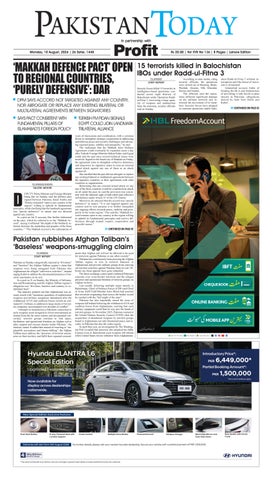
EPUTY Prime Minister and Foreign Minister Ishaq Dar on Sunday said the defence pact signed between Pakistan, Saudi Arabia and Türkiye remained “open to any country in the region” willing to uphold its fundamental principles, while clarifying that the landmark agreement was “purely defensive” in nature and not directed against any country. In a post on his X account, Dar further elaborated on the pact, which he referred to as the “Makkah Accord”, saying it reflected “the depth of the brotherly relations between the leadership and peoples of the three countries.” “The Makkah Accord is the culmination of
g
TÜRKISH FM FIDAN SIGNALS EGYPT COULD JOIN LANDMARK TRILATERAL ALLIANCE
years of discussions and coordination, with a common desire to strengthen strategic cooperation in addressing multifarious peace and security challenges and advancing regional peace, stability and prosperity,” he said. The indication that the Makkah Joint Defence Agreement could eventually be expanded came a day after Turkish Foreign Minister Hakan Fidan said Egypt could join the pact once several technical issues were resolved. Signed in the Saudi city of Makkah on Friday, the agreement aims to strengthen collective deterrence and empowers its signatory states to treat an external armed attack against any one of them as an attack against all. Dar clarified that the pact did not abrogate or replace any existing bilateral or multilateral agreements between the signatory countries, or their agreements with other countries or organisations. Reiterating that any external armed attack on any one of the three countries would be considered an attack on all under the pact, he said the provision was consistent with the inherent right of individual and collective self-defence under Article 51 of the UN Charter. Moreover, he stressed that the accord was “purely defensive” in nature. “It is not targeted against any country and its sole purpose is to further strengthen our ongoing efforts towards peace, stability and prosperity in the wider region.” Dar said the “Makkah Accord remains open to any country in the region willing to uphold its fundamental principles and resolve differences through mutual respect, cooperation and peaceful means.”
Pakistan rubbishes Afghan Taliban’s ‘Baseless’ weapons-smuggling claim ISLAMABAD
STAFF REPORT
Pakistan on Sunday categorically rejected as “frivolous” and “baseless” the Afghan Taliban regime’s claim that weapons were being smuggled from Pakistan into Afghanistan for alleged “subversive activities”, instead urging Kabul to address the documented presence of terrorist sanctuaries on its soil. In a post on X on Sunday, the Ministry of Information and Broadcasting said the Afghan Taliban regime’s allegation was “frivolous, baseless and contrary to established facts”. The ministry pointed out that Afghanistan was already awash with “enormous quantities of sophisticated weapons and military equipment abandoned after the withdrawal of US and coalition forces (worth an estimated $7.2 billion), in addition to large stocks of Sovietera weaponry accumulated over decades of conflict”. “Attempts to manufacture a Pakistani connection to such weapons seem designed to divert international attention from the far more serious and documented concern[s]: terrorist groups continue to find space, facilitation and operational freedom on Afghan soil to plan, support and execute attacks inside Pakistan,” the ministry stated. It added that instead of resorting to “implausible accusations and blame-shifting”, the Afghan Taliban must address the “presence of terrorist sanctuaries on their territory and fulfil their repeated commit-
CONTINUED ON PAGE 03
ments that Afghan soil will not be allowed to be used for terrorism against Pakistan or any other country”. Pakistan has continuously been pressing the Afghan Taliban regime to rein in terrorist hideouts in Afghanistan and prevent militant groups from carrying out terrorist activities against Pakistan from its soil. Officials say those appeals have gone unheeded. The latest exchange comes amid continued Pakistani concerns over cross-border terrorism and the alleged presence and operational freedom of terrorist groups on Afghan territory. Last month, following multiple major attacks in Balochistan, Chief of Defence Forces (CDF) and Chief of Army Staff Field Marshal Asim Munir had asserted that terrorism originating from across the border would be crushed with the “full might of the state”. Pakistan has also repeatedly raised the issue of weapons left behind following the withdrawal of US and coalition forces from Afghanistan, warning that such military equipment could find its way into the hands of terrorist groups. In November 2025, Pakistan warned at the United Nations Security Council (UNSC) that the acquisition of abandoned weapons by terrorist groups based in Afghanistan not only threatened peace and security in Pakistan but also the wider region. In April that year, an investigation by The Washington Post revealed that terrorists who attacked the Jaffar Express train in Balochistan used weapons left behind when United States forces withdrew from Afghanistan.
Security forces killed 15 terrorists in intelligence-based operations conducted across eight districts of Balochistan under Operation Raddul-Fitna 3, recovering a large quantity of weapons and ammunition from the terrorists, security officials said on Sunday.
According to state media, citing security officials, the operations were carried out in Mastung, Bolan, Washuk, Awaran, Sibi, Khuzdar, Harnai and Nushki. The officials said the operations inflicted significant damage on the militant network and restricted the movement of its members. Security forces have pledged to continue operations under Oper-
ation Radd-ul-Fitna 3 without interruption until the threat of terrorism is eliminated. Islamabad accuses India of funding the BLA and Afghanistan of providing it safe haven to plan attacks in Pakistan, allegations denied by both New Delhi and Kabul.
CONTINUED ON PAGE 03
n s m r
02 NEWS
Monday, 10 August, 2026 | LAHORE
SECP REFERS RS446.6M BLINK CAPITAL FRAUD CASE TO FIA
T g
SECP HAS REFERRED RS446.664M BLINK CAPITAL MANAGEMENT FRAUD CASE TO FIA FOR ACTION g PROBE FOLLOWED PMEX INVESTOR COMPLAINTS, REGULATORY NON-COMPLIANCE AND TRACED FUND TRANSFERS PROFIT
neWs Desk
HE Securities and Exchange Commission of Pakistan (SECP) has referred the Rs446.664 million fraud case involving M/s Blink Capital Management (Private) Limited to the Federal Investigation Agency (FIA) for further investigation and appropriate action under the law, according to a statement issued by the regulator on Saturday. Blink Capital Management (Private) Limited, or Blink, was a licensed futures broker and market maker of Pakistan Mercantile Exchange Limited (PMEX), with its registered office at 13-A-3, Miran Mehmood Ali Kasoori Road, Gulberg III, Lahore, and branches in Karachi and Islamabad. As per the company’s Form-A made up to October 28, 2024, Hassan Maqsood was its chief executive officer and held 4 million shares, while Muhammad Farooq, a director, held 6 million shares, taking total shares held by the two to 10 million. The case emerged in June 2025, when PMEX received complaints from investors and the public against Blink and its directors. The complaints alleged that the company was taking deposits on a fixed-profit basis, guaranteeing the return of the original investment through post-dated security cheques, and failing to return the original investment amounts and profits. PMEX subsequently took interim measures, including freezing funds and restricting the broker’s market-making activity. Fol-
PC signs FASA with KPMG-led consortium for second attempt to privatise ISLAMABAD Web Desk
The Privatisation Commission has signed a Financial Advisory Services Agreement with a KPMG-led consortium for the privatisation of House Building Finance Company Limited, formally setting the stage for a fresh attempt to complete the transaction after the previous effort failed. The consortium is led by KPMG and includes Bridge Factor, a corporate finance advisory firm; Haidermota & Co., a legal firm; HRSG, a human resources firm; and Asiatic Public Relations, a media and public relations firm. The consortium brings together expertise in financial advisory, transaction structuring, legal matters, human resources and communications to support the Privatisation Commission throughout the privatisation process. The signing of the FASA marks the beginning of the latest phase in the HBFCL privatisation process, with the financial advisor tasked with undertaking comprehensive due diligence of the company, advising on the optimal transaction structure and conducting its valuation. The financial advisor will also support the Privatisation Commission during the marketing and execution of the transaction, providing assistance throughout the process in accordance with the approved framework and applicable regulatory requirements. This is the second attempt to privatise HBFCL. The previous privatisation process could not be successfully concluded after only one bidder, Pakistan Mortgage Refinance Company Limited, was prequalified. The bid submitted by PMRCL during the previous attempt was rejected by the Privatisation Commission as it was lower than the Reference Price approved by the Federal Cabinet, preventing the transaction from reaching completion. The appointment of the KPMG-led consortium now provides the Privatisation Commission with a dedicated financial advisory team to undertake due diligence, valuation and transaction structuring before moving towards marketing and execution of the privatisation. The latest effort comes with the objective of leveraging private-sector expertise to improve HBFCL’s governance and operational efficiency and contribute to the development of Pakistan’s housing finance sector. The privatisation is also expected to facilitate greater access to housing finance, particularly for low and middle-income households, while supporting the broader objective of promoting affordable housing in the country.
lowing an inquiry, Blink was found noncompliant with the applicable regulatory framework. PMEX imposed a penalty of Rs1 million and suspended Blink’s trading rights. The company subsequently closed its offices and disabled its website. As complaints continued to be received by both the Commission and PMEX, the SECP initiated an investigation under Section 83 of the Futures Market Act, 2016, through an investigation order dated August 15, 2025. The SECP investigation team reviewed documents submitted by the complainants and found that all complainants had entered into agreements with Blink, mostly for a tenure of two years, on fixed returns offered either monthly or annually. The promised returns ranged from 3.7% per month to 48% per annum. The agreements were executed on stamp paper and were mostly signed by then-CEO Hassan Maqsood, while some were signed by then-director Muhammad Farooq. The agreements were mostly witnessed by Ali Fida and, in certain cases, by Muhammad Shahid, Muhammad Noman and Muhammad Rizwan, all employees of Blink. Blink issued post-dated cheques as guarantees, mostly signed by Maqsood and, in some cases, by Farooq. The investigation found that 35 complainants had lodged claims amounting to Rs446.664 million. Trading accounts with PMEX had been opened by the broker for only seven of the complainants, although all those accounts were inactive. For its financial-trail analysis, the investigation team examined fund movements in-
m.A. niAzi HE rapper D4vd is to go for trial for the murder of Celeste Rivas Hernandez, whose decomposing body was found in his abandoned Tesla in September last year, after she was killed in April. Hernandez’s relationship with D4vid was a little strange. She was about 15 when she was killed, and had got involved with him when she was 13, had run away from home, and was now living with him. Apparently. He killed her just before going on an international tour, presumably in the hope that even if they found the car, they would leave him alone. She had explicitly threatened his career because of other women,
T
Rs90 million transferred to PMEX was subsequently withdrawn, with a major portion of the funds deposited into the accounts of Maqsood and Farooq. Based on its investigation, the SECP concluded that Blink was operating a Ponzitype fraudulent investment scheme by unlawfully collecting funds from the general public. According to the investigation, the funds were mainly collected through Blink’s proprietary account, the personal accounts of its directors and an account titled “Blink Capital Management”, which was registered as a sole-proprietorship business belonging to employee Ali Fida. The investigation found that, in order to misappropriate complainants’ funds, Blink maintained the bank account titled “Blink Capital Management”. An amount of Rs60 million was received in this account from complainants and was subsequently transferred to Fida’s personal account. Some of these funds were withdrawn in cash, while some payments were made to certain complainants. The SECP investigation concluded that Blink was involved in illegal deposittaking and offering guaranteed returns beyond the scope of its licensed activities. It highlighted violations of Section 84(1) of the Companies Act, 2017, relating to acceptance of deposits from the public, and Section 47(2) of the Futures Market Act, 2016, under which Blink had exceeded the scope of its licensed activities by engaging in illegal deposit-taking and offering guaranteed returns. The investigation also identified potential violations of the Futures Brokers (Li-
3 years, zero facilities: petroleum division seeks ECC nod for bonded fuel ISLAMABAD
AhmAD AhmADAni
Petroleum Division is seeking to make Pakistan’s customs bonded storage framework for foreign-supplied petroleum products operational after no foreign supplier established a facility under the policy approved in 2023, amid fresh energy-security concerns. The Economic Coordination Committee (ECC) may take up the matter at its next meeting, with the petroleum division seeking approval for proposed changes to the bonded storage framework, industry sources said. Industry sources said the issue has gained renewed importance following disruptions around the Strait of Hormuz, which have exposed vulnerabilities in Pakistan’s petroleum supply chain and increased the importance of maintaining adequate storage capacity and alternative supply arrangements. They said the proposed changes are aimed at addressing regulatory, legal and procedural hurdles that have so far prevented the bonded storage mechanism from becoming operational. According to industry sources, the existing policy was approved by the ECC in June 2023 to facilitate the import of petroleum products on foreign suppliers’ accounts through customs bonded storage facilities. However, three years after its approval, no foreign supplier has established a bonded storage facility under the framework. Sources said the failure to attract a single foreign supplier has prompted the government to reconsider the practical and regulatory framework governing the mechanism. Industry sources said the ongoing disruption of the Strait of Hormuz has highlighted Pakistan’s vulnerability to external shocks affecting international petroleum supplies. They said the government is now placing greater emphasis on Strategic Petroleum Reserves (SPR), indigenisation and customs bonded storage facilities as part of efforts to strengthen the country’s petroleum supply chain. Sources said bonded storage could allow foreign suppliers to position petroleum products in Pakistan on their own account while keeping the products under customs-bonded arrangements until they are cleared for domestic use. According to industry sources, such an arrangement could provide greater flexibility in managing petroleum supplies during periods of
A Messy Business City notes
volving 29 complainants and covering Rs408.6 million, equivalent to 91.48% of the total claims. The remaining complaints, which were received later, were not included in the financial-trail analysis but showed similar transactional patterns. The complainants submitted supporting documentary evidence amounting to Rs406.542 million out of the Rs408.6 million examined, including cash payments. The investigation team was able to trace Rs360.17 million through the bank accounts of identified beneficiaries. Of this amount, Rs288.32 million, or 80.05%, was transferred to Blink. A further Rs10.35 million, or 2.87%, was transferred to Hassan Maqsood, then director and CEO. Rs500,000 was transferred to Muhammad Farooq, director, and Ammara, the spouse of Farooq. Another Rs60 million, representing 16.66% of the traced amount, was transferred to Blink Capital Management, a sole-proprietorship business account in the name of Ali Fida. A further Rs1 million was transferred to Fida, who was the chief operating officer of Blink. The investigation found that the funds were mostly moved into the personal accounts of then-CEO Maqsood and director Farooq. Significant amounts were also withdrawn in cash. Instances were also identified where funds were moved to the personal accounts of employees, including Rizwan, Shahid, Noman and Ali Fida. The investigation team noted that certain funds were also transferred to complainants of Blink, probably on account of profit payments. The investigation further found that
and if it was revealed he had a minor cohabiting with him, he could end up like rapper and music mogul, Diddy Combs, or rapper R. Kelly, both of whom are currently doing time for child sex offences. D4vid shot to fame for his rap Romantic Homicide, which contains the chilling lines, ‘In the back of my mind, I killed you/ And I didn't even regret it’. It seems a whole unfortunate mess, though the victim was probably not as helpless as the poor special girl who somehow ended up at the Ghaziabad police station in Lahore, where she was then criminally assaulted by the policemen there. I’m sure the police made a lot of mistakes in the Celeste Hernandez case, but at least they left the assaulting to D4vid. I suppose one should be grateful the Ghaziabad police didn’t murder her too. That’s what happened in Karachi, though the police were not guilty of the assault. No, that
international disruption, although its success would depend on whether the proposed framework offers sufficient regulatory clarity and commercial incentives to foreign suppliers. Industry sources said relevant government institutions had already developed standard operating procedures and implementation guidelines after the original policy was approved, but the framework failed to result in the establishment of any bonded storage facility. Sources said the government consequently constituted a committee on May 7, 2026, to examine the existing policy and recommend measures for making the mechanism operational. The committee held meetings with relevant stakeholders, including petroleum traders and suppliers, and subsequently prepared proposed changes to the existing framework. Industry sources said the proposed framework has also encountered reservations from the Federal Board of Revenue (FBR) concerning its compatibility with existing customs and taxation laws. Sources said FBR raised concerns over certain provisions in light of the Customs Act, 1969 and Sales Tax Act, 1990. The concerns were subsequently discussed during consultations, with amendments proposed to address issues raised by FBR and other stakeholders. Industry sources said the Ministry of Commerce and State Bank of Pakistan (SBP) also provided their views on the proposed framework, while consultations continued with other relevant government institutions. The draft proposals were circulated among stakeholders in June 2026 and subsequently re-circulated in July after further amendments and stakeholder feedback. Industry sources said a further meeting of the committee was held on August 5, 2026, under the chairmanship of the Minister for Energy (Petroleum Division). The meeting was attended by relevant committee members, while further comments were considered from stakeholders, including the Ministry of Maritime Affairs and Oil and Gas Regulatory Authority (OGRA). Sources said the consultations were aimed at developing consensus on a framework that could be implemented without creating conflicts with existing customs, taxation, maritime and petroleum-sector regulations. They said the government has also recognised that amendments to the relevant legal, regulatory and procedural framework may
was a relative, who then tried to kill her. But didn’t do a clean job. It seems they found her wounded, and she died of her wounds. Anyway, it seems that Ali Zafar has not got people closer at home to defend, after his strenuous legal efforts to defend Haevey Weinstein and Bill Cosby., now he has got people closer at home #for whom he can campaign, He remains the only Pakistani target of the #MeToo Movement. Now that the Movement is facing out, it seems sad that he should be the only one to be named and shamed. Nut one of those named was none other than MPA Saqib Chadhar, elected an independent but who then joined the PML(N), who then needed pre-arrest bail, because actress Momina Iqbal had registered a case against him. Under PECA, because he and his wife had been sending her threatening messages. It seems she had intended to marry Chadhar, only to find out recently that he was married. It seems he had omitted to mention this in his courtship. I don’t know if it’s relevant, that Pakistan managed to win the Second Test
be required before the proposed bonded storage mechanism can be implemented. Industry sources said the bonded storage proposal should be viewed as part of a wider effort to strengthen Pakistan’s petroleum security. They said the government is simultaneously focusing on the development of Strategic Petroleum Reserves, greater indigenisation and expansion of petroleum storage capacity. According to the sources, additional storage could provide a buffer against delays or disruptions in international petroleum supplies, particularly during periods of geopolitical tension affecting shipping routes. They said the Strait of Hormuz situation has reinforced the importance of ensuring that Pakistan has sufficient petroleum stocks and more flexible supply arrangements to withstand external disruptions. Industry sources said the proposed changes have now reached the stage where the matter could be placed before the ECC for consideration. The proposed framework includes changes to the existing bonded storage guidelines and a comparative assessment of the current and proposed arrangements. Sources said the government’s immediate objective is to obtain ECC approval and then proceed with the required legal, regulatory and procedural steps. However, they stressed that ECC approval alone would not guarantee the establishment of bonded storage facilities, as foreign suppliers would still need to find the arrangement commercially attractive and operationally workable. The sources said the real test would be whether the proposed changes succeed in overcoming the obstacles that have kept the 2023 policy from attracting any foreign supplier for three years. The proposed changes come at a critical time for Pakistan’s energy security, with geopolitical disruptions highlighting the risks associated with dependence on uninterrupted international petroleum supplies. Industry sources said a functioning bonded storage mechanism could give Pakistan an additional layer of protection by allowing petroleum products to be stored domestically under customsbonded arrangements and made available when required. They said the government would need to ensure clear regulations, workable customs and taxation procedures and sufficient commercial incentives if it wants foreign suppliers to invest in the proposed model.
against the West Indies without Shan Masood in the team. He would have been there had it not been for a broken finger (which, some say, caused him to limp heavily), and the match was won. The previous match
censing and Operations) Regulations, 2018. In the latest development, the SECP said it had approved referral of the matter to the FIA under Section 41B of the SECP Act, 1997, for further investigation and redressal of investors’ grievances in accordance with the law. “The investigation revealed that 35 complainants lodged claims amounting to Rs446.664 million. A detailed financial trail involving 29 complainants and Rs408.6 million showed that substantial funds were transferred to accounts of Blink, its then CEO and director, as well as accounts linked with certain employees and associated persons. Significant amounts were also withdrawn in cash,” the SECP said. The regulator said the available evidence showed that investors had entered into agreements offering predetermined returns ranging from 3.7% per month to 48% per annum, with post-dated cheques issued as security. “Based on the available evidence, the investigation concluded that Blink was allegedly operating a Ponzi-type fraudulent investment scheme, involving illegal deposit-taking and offering guaranteed returns beyond the scope of its licensed activities,” the SECP said. SECP Chairman Dr Kabir Ahmed Sidhu said the Commission would deal strictly with market abusers, manipulators and entities misusing their regulated status to deceive investors. “Safeguarding investors’ interests is paramount. SECP will pursue those who abuse the market or investors’ trust, and will take all necessary regulatory and enforcement actions to protect investors and preserve market integrity,” he said. The SECP also advised the public to exercise caution against unauthorised investment schemes, particularly those offering fixed or guaranteed returns.
Punjab reviews cotton recovery strategy as rice cultivation crosses 6m acres PROFIT
Web Desk
Punjab’s Additional Chief Secretary Iftikhar Ali Sahoo has directed agriculture officials to accelerate technical support for farmers as the province reviews the performance of cotton, rice and other major crops. Sahoo issued the directives during a meeting in Multan that examined the province’s agricultural situation, farmer guidance measures and initiatives aimed at strengthening agricultural activity. Officials told the meeting that the cotton crop was in satisfactory condition across Punjab, while rice cultivation had exceeded 6 million acres against the government’s target of 5 million acres. Sahoo said the government considered agricultural development and farmer prosperity among its key priorities, directing field formations of the Agriculture Department to continue their farmer-support activities without interruption. He stressed the importance of cotton to the national economy and called for the government’s strategy for reviving the crop to be implemented fully. The additional chief secretary also ordered officials to step up technical guidance to farmers to improve the quality and overall output of rice. He further called on Regional Agriculture Forums to contribute more actively to agricultural development by making full use of their professional expertise, while appreciating the performance of the Agriculture Department’s field formations. The meeting was attended by Vice Chancellor Professor Dr Asif Ali, Special Secretary Agriculture South Punjab Sarfraz Hussain Magsi, Agriculture Department directors general Abdul Hameed, Naveed Asmat Kahloon, Dr Aamir Rasool and Dr Sajid-ur-Rehman, Kissan Ittehad President Khalid Mahmood Khokhar, Syed Hassan Raza, Dr Muhammad Iqbal Bandesha and other officials from the Agriculture and Irrigation departments. Additional Secretary Task Force Shabbir Ahmed Khan, Director General Crop Reporting Dr Abdul Qayyum, Agriculture Department Consultant Dr Muhammad Anjum Ali and other officials participated online. Following the meeting, Sahoo conducted a surprise inspection of the Model Agriculture Mall in Multan. He directed officials to ensure that sufficient quantities of fertilisers remained available at the facility.
had been lost, even though he scored a century. If he has been captain. Or even playing, he would probably have lost by failing to get the target of 75 that Pakistan had eventually got.
‘MAKKAH DEFENCE PACT’ TO BOLSTER REGIONAL PEACE, MUSLIM UNITY: MINISTERS
Monday, 10 August, 2026 | LAHORE
F
ISLAMABAD
stAff report
EDERAL ministers and parliamentarians on Sunday described the “Makkah Joint Defence Agreement” among Pakistan, Saudi Arabia and Türkiye as a landmark development for regional peace and stability, saying the historic pact would strengthen mutual trust and cooperation among the three brotherly countries and promote greater unity among Muslim nations. They said the agreement would further deepen defence, economic and diplomatic engagement among the three countries, while enhancing Pakistan’s importance in the Muslim world and contributing to collective efforts for peace, stability and prosperity across the region.
‘MATTER OF IMMENSE PRIDE FOR PAKISTANI PEOPLE, ENTIRE MUSLIM UMMAH’: Federal Minister for Information and Broadcasting Attaullah Tarar praised the historic defence pact among Pakistan, Saudi Arabia and Türkiye, describing it as a matter of immense pride for the Pakistani people and the entire Muslim Ummah. Talking to media in an exclusive interaction, Tarar expressed profound gratitude to Almighty Allah for the agreement, saying the partnership among the three brotherly nations was a special blessing for the global Muslim community. The minister said the entire nation was celebrating the Makkah Accord with great fervour, with the flags of Pakistan, Saudi Arabia and Türkiye proudly displayed across the country as people expressed joy over the landmark development. He commended the crucial role played by the country’s leadership, including Prime Minister Muhammad Shehbaz Sharif and Field Marshal Syed Asim Munir, in making
Leather exporters warn indefinite transport strike could disrupt shipments PROFIT
WeB Desk
Pakistan’s leather industry has urged the government to intervene over a proposed indefinite transport strike, warning that prolonged disruption could delay export shipments and further strain a sector already facing pressure from high production costs. In a letter to Federal Commerce Minister Jam Kamal Khan, Pakistan Tanners Association Chairman Hamid A Zahur called for immediate measures to prevent disruptions to the movement of export and import cargo. He said a transport shutdown could make it difficult for leather exporters to move shipments to ports on time, potentially affecting the execution of existing export orders and delivery commitments to overseas buyers.
15 terrorists killed in Balochistan IBOs under Radd-ul-Fitna 3 CONTINUED FROM PAGE 01
Interior Minister Mohsin Naqvi praised the professionalism of the security forces for killing 15 militants during recent operations in Balochistan. In a statement, the Interior Ministry said the minister applauded the security forces for thwarting the “nefarious designs” of Fitna al-Hindustan and Fitna alKhawarij, another terrorist network mostly involved in violent activities in Khyber Pakhtunkhwa. “The brave soldiers of security forces fighting against terrorism are the pride of the nation,” he said. Balochistan has faced a low-level militancy for decades, but attacks have intensified in recent years as militants increasingly target infrastructure, security forces and economic assets, particularly projects linked to trade and regional connectivity. Last month, the outlawed BLA launched coordinated attacks in Balochistan, prompting security forces to launch a joint anti-militancy campaign involving the army, paramilitary forces and police.
ARMY OFFICER MARTYRED, SEVEN TERRORISTS KILLED IN HANGU, BALOCHISTAN OPERATIONS: A day earlier, an army officer was martyred while seven terrorists were killed during two intelligence-based operations in Hangu and Balochistan, according to a statement issued by the Inter-Services Public Relations (ISPR). In Hangu district, security forces conducted an intelligence-based operation in the Dallan area on August 7 after receiving information about the presence of militants. According to ISPR, troops targeted a militant hideout and forced the suspects to flee. During their retreat, the militants took shelter in a mosque, the statement said. An intense exchange of fire followed, resulting in the killing of seven militants, while two wounded suspects were arrested. Weapons and ammunition were also recovered from the militants, who were accused of carrying out attacks against security forces, law-enforcement personnel and civilians. Twenty-seven-year-old Captain Hamza Akram was martyred while leading his troops during the operation. He hailed from Narowal district and was reportedly at the front of his unit during the pursuit of the militants. Security forces said Captain Hamza Akram sacrificed his life while defending the country.
the historic agreement possible. Through the trilateral partnership, Tarar said, Pakistan had achieved a prestigious status it had long aspired to. He said Allah Almighty had blessed Pakistan with the profound honour and responsibility of being the defender and protector of the Harmain Sharifain. The minister congratulated the Pakistani nation on the monumental achievement and said the three countries would now move forward together in accordance with the milestone pact.
‘MJDA TO USHER IN NEW ERA OF REGIONAL PEACE, COOPERATION: AHSAN IQBAL’ Federal Minister for Planning, Development and Special Initiatives Prof. Ahsan Iqbal congratulated the nation on the Pakistan-Saudi Arabia-Türkiye “Makkah Joint Defence Agreement” (MJDA), describing it as a historic development that would contribute to regional peace and stability and open new avenues of cooperation among Muslim countries. Talking to PTV News here on Sunday, Ahsan Iqbal said the agreement assumed exceptional significance in the context of rapidly changing geopolitical dynamics and evolving security challenges in the region. He said the “Makkah Joint Defence Agreement” reflected the leadership and vision of Prime Minister Muhammad Shehbaz Sharif and Field Marshal, Chief of Army Staff and Chief of Defence Forces (COAS and CDF), Syed Asim Munir. The minister emphasized that the agreement was not directed against any country but aimed at strengthening collective security, promoting peace and stability and enabling the three countries to respond effectively to emerging geopolitical challenges. Ahsan Iqbal said the international and regional environment was undergoing rapid transformation, making mutual trust, cooperation and coordinated strategies among
Muslim countries increasingly important. He said Pakistan, Saudi Arabia and Türkiye were three important Muslim countries with the potential to play a significant role in promoting peace, stability and development in the region. The minister said the “Makkah Joint Defence Agreement” should be viewed from a broader perspective, as its significance would not remain confined to the defence sector. It could also create opportunities for enhanced political, economic, diplomatic and strategic cooperation among Muslim countries. The Planning Minister said Pakistan had consistently supported peace, dialogue and cooperation in the region and believed that sustainable peace could only be achieved through collective efforts. According to him, greater regional peace and stability would create a conducive environment for trade, investment, connectivity and economic development, opening new avenues of prosperity for the people of the region. Ahsan Iqbal said the strong and historic relations among Pakistan, Saudi Arabia and Türkiye were not only important for the three countries but also carried wider significance for the Muslim Ummah.
‘MAKKAH DEFENCE AGREEMENT LAYS FOUNDATION FOR LASTING REGIONAL PEACE: TARIQ FAZAL’: Federal Minister for Parliamentary Affairs Dr Tariq Fazal Chaudhary said the historic defence agreement signed in Makkah between Pakistan, Saudi Arabia and Türkiye had laid the foundation for lasting peace in the region. Talking to the media, he congratulated the entire nation on the landmark agreement and said Pakistan’s armed forces had played a prominent role in making the accord possible through their professional expertise under the leadership of Chief of Army Staff (COAS) and Chief of Defence Forces (CDF) Field Marshal Syed Asim Munir.
Dr Tariq also acknowledged the tireless efforts of the political team led by Prime Minister Shehbaz Sharif and appreciated Pakistan’s diplomatic achievements that contributed to the agreement. He said Pakistan, Saudi Arabia and Türkiye already enjoyed close and brotherly relations, adding that the agreement would further strengthen ties among the three countries. Under the agreement, an aggression against any one of the three countries would be considered an aggression against all, he said. Dr Tariq said the pact would enhance cooperation and defence relations among Pakistan, Saudi Arabia and Türkiye. He expressed confidence that the agreement would not only contribute to peace and stability but also improve coordination, connectivity and relations among the three countries in the coming days.
‘PAKISTAN-TÜRKIYE-SAUDI ARABIA DEFENCE PACT A MATTER OF PRIDE: LEGHARI’: Federal Minister for Power Sardar Awais Ahmad Khan Leghari termed the joint defence agreement between Pakistan, Türkiye and Saudi Arabia a matter of honour and pride for the Pakistani people, describing cooperation among the three important countries as a significant development for regional peace and security. In a statement, the minister said Pakistan, Türkiye and Saudi Arabia possessed significant financial resources, military strength and capabilities to protect themselves, adding that their unity was aimed at strengthening deterrence and promoting peace in the region. He said the three countries would work together to protect each other and stand united against any unlawful aggression or hostile action, while ensuring the safety and security of their peoples. The minister said the combined strength of the three countries would enable them to collectively respond to any aggression and
NEWS 03
create a strong deterrent against hostile actions against any of them, either within or beyond the region. He said the defence cooperation also reflected the shared commitment to the protection of the Holy Mosques as well as the security of the peoples of Türkiye and Pakistan, demonstrating the mutual trust and fraternal bonds among the three countries.
‘PAKISTAN-SAUDI ARABIATÜRKIYE DEFENCE PACT TO BENEFIT ENTIRE MUSLIM UMMAH: AMIR MUQAM’: Federal Minister for Kashmir Affairs and Gilgit-Baltistan Engineer Amir Muqam said the defence agreement between Pakistan, Saudi Arabia and Türkiye would benefit not only the three signatory countries but also provide an opportunity for the entire Muslim Ummah to benefit from the pact. He said the agreement, reached through the efforts of Prime Minister Muhammad Shehbaz Sharif and Field Marshal Syed Asim Munir, would have a positive impact on the situation in the three countries as well as the wider region.
‘AGREEMENT A MILESTONE FOR PAKISTAN, REFLECTS MUTUAL TRUST: DANIYAL CH’: Federal Parliamentary Secretary for Information and Broadcasting Daniyal Chaudhry described the Makkah Agreement as a milestone for Pakistan, saying the pact reflected not only the strength of Saudi Arabia, Türkiye and Pakistan but also their brotherly ties and mutual trust. He said every Pakistani could take pride in the achievement made under the leadership of Prime Minister Muhammad Shehbaz Sharif and Field Marshal Syed Asim Munir. Daniyal Ch said the agreement would go beyond defence cooperation and open avenues for the three countries to support one another in times of difficulty. He said the agreement would contribute to stability across the region and help improve the balance of power. The parliamentary secretary said the pact would also pave the way for a joint strategy and effective measures against terrorism, instability and elements contributing to insecurity in the region. He expressed the hope that enhanced cooperation among the three countries would further strengthen regional peace, security and stability.
Why are tobacco growers in KP forced to burn their produce? PESHAWAR
Aziz Buneri
Tobacco growers in Khyber Pakhtunkhwa have intensified protests against tobacco companies, alleging unfair treatment, rejection of their produce and failure to pay the government-notified procurement price, with some growers going to the extent of burning their ready crop outside the Swabi Press Club. The growers and tobacco companies have increasingly come face to face over the issue, with protests being held in different districts of the province against what the farmers describe as exploitation by multinational tobacco companies. Tobacco grower Tamrez Khan from Swabi said that in the past, several small local tobacco companies operated in the province and purchased tobacco from growers in larger quantities and at the government-notified rates. He alleged that multinational companies, in collaboration with the Federal Board of Revenue (FBR), subsequently pushed local companies out of the market, leaving growers dependent on multinational tobacco companies, including Pakistan Tobacco Company and Philip Morris. According to Khan, these multina-
tional companies issue only around 10 per cent of their annual agreements directly to original tobacco growers, while nearly 90 per cent of the agreements are allegedly issued through their agents. He said that a single tobacco barn can produce around 400 kilograms of tobacco, while the cost of firewood alone reaches approximately Rs90,000. Besides this, growers spend hundreds of thousands of rupees on fertiliser, labour and other inputs. Despite the government fixing a procurement price, Khan alleged that companies reject a large portion of the tobacco brought by growers. He claimed that out of every six bundles presented for purchase, around four were rejected, forcing farmers to sell their rejected tobacco at significantly lower prices to agents holding what he described as “fake agreements”. Khan further alleged that under the law, the tobacco procurement price is required to be increased by 10 per cent every year. However, he claimed that due to alleged collusion between the relevant board and tobacco companies, the required increase was not being implemented properly. He said the Pakistan Tobacco Board had fixed the tobacco procurement price at Rs740 per kilogram for the current
season, but companies were allegedly rejecting growers’ bundles and forcing them to sell the crop for as little as Rs300 per kilogram. “Growers spend hundreds of thousands of rupees preparing the crop, but when it is ready for sale, a large portion is rejected. This leaves farmers with no option but to sell at throwaway prices or destroy their crop,” Khan said. He claimed that poor policies of multinational companies and the Pakistan Tobacco Board had pushed tobacco growers across the province to the point where they were burning their ready crop, despite its value running into hundreds of thousands of rupees. Khan also alleged that the government was preparing to gradually eliminate tobacco as a cash crop in Khyber Pakhtunkhwa. He questioned the establishment of around 10 tobacco barns in Attock, a district where, according to him, tobacco is not traditionally cultivated. “What is the logic behind establishing tobacco barns in an area where tobacco is not grown?” he questioned. The grower also raised concerns over what he described as discriminatory taxation on tobacco used in naswar. He claimed that tobacco used for naswar in
Multan and Mandi Bahauddin was not subjected to the same tax, while a tax of Rs12 per kilogram was imposed on locally produced tobacco in Khyber Pakhtunkhwa. “If there is no such tax in Multan and Mandi Bahauddin, who will purchase locally produced tobacco from Khyber Pakhtunkhwa?” he questioned. Tobacco is one of the major cash crops of Khyber Pakhtunkhwa, with Swabi, Mardan, Charsadda, Buner, Nowshera and Mansehra among the major producing districts. The province generally produces around 70,000 to 80,000 tonnes of tobacco annually, while the crop is cultivated over approximately 50,000 to 60,000 hectares. The province mainly produces Flue-Cured Virginia (FCV) tobacco, which is an important raw material for cigarette manufacturers, besides other varieties grown in different areas. Tobacco remains an important source of income for thousands of farmers and contributes significantly to the rural economy of Khyber Pakhtunkhwa. Repeated attempts were made to contact representatives of the multinational tobacco companies for their comments on the allegations raised by the growers, but no response was received.
‘Makkah Defence Pact’ open to regional countries, ‘purely defensive’: Dar CONTINUED FROM PAGE 01
He added that the pact was consistent with the fundamental pillars of Islamabad’s foreign policy. “Pakistan looks forward to continuing to work closely with all brotherly countries in the region towards lasting peace and stability. We remain committed to advancing the cause of peaceful resolution of all conflicts and building a more secure, stable and prosperous future for our peoples,” he concluded.
EGYPT MAY JOIN MAKKAH PACT, SAYS TURKISH FM: Earlier on Saturday, Turkish Foreign Minister Hakan Fidan said he believed Egypt could join the pact once several technical issues were resolved. “Egypt is already our natural partner on all issues. I believe that at the next stage, Egypt will also be among us in the alliance. We already act toward one another as if we were alliance members. There are a few technical issues. Once these are implemented, there is no reason for Egypt not to be part of it,” he told Türkiye’s state-run Anadolu news agency. Fidan said other countries had also expressed interest in joining the agreement, but the founding members had debated how its expansion should be handled. Some countries that wanted to join had asked not to be named, he said, adding that the preferred model was for Türkiye, Saudi Arabia and Pakistan to remain the three core founding countries responsible for establishing the principles, standards and long-term structure of the alliance, while other countries could join with the approval of the core members. “Under our president’s vision, we should not remain limited to three countries. We should grow,” Fidan said. He also said the initiative was broader than the traditional definition of the Middle East because of Pakistan’s participation. Pakistan’s geographical position, he said, meant the initiative went beyond the conventional definition of the Middle
East and represented a broader regional perspective.
‘SAME AS NATO’S ARTICLE 5’: Fidan further elaborated on the pact, saying it was technically the same as NATO’s Article 5 mutual defence agreement. Article 5 of the North Atlantic alliance specifies that an attack on one of its members is an attack on all of them. It obliges allies to take action they deem necessary to assist the country under attack, including potentially the use of military force. While the Makkah defence pact stipulates the same principle, Fidan explained that its text contained general commitments whose practical implementation would depend on discussions and decisions by relevant bodies. A country would need to make a request for assistance and would determine the type of support it needed, he said, adding that requests could range from intelligence and logistics to ammunition or, if necessary, military units, depending on the scale of the threat. The signatories, he said, would decide through consultations what degree, form and format of support would be provided in the event of an attack, but no country would be considered a threat as long as a member state was not attacked. Fidan also said the new alliance was not directed against Iran or any other country, but rather served as a general pledge to support the security of the three signatories. He further told Anadolu that discussions on the initiative had begun before the current war environment, when there was no US-Israel war on Iran and other regional countries had also been involved in the talks leading to the agreement. Fidan said its signatories were countries that did not have expansionist policies. “They are countries concerned with their own borders, their own problems and their development, and, if possible, they want to contribute positively to their environment through good relations and good neighborliness.”
The three countries, he said, had different styles and capacities, but when brought together, they naturally formed a defenceoriented organisation rather than an offensive one. “It is not an approach of going on the offensive and saying, ‘Let’s do this or that together.’ Therefore, unless it is attacked by a country, whether from inside or outside the region, this alliance cannot have any dispute with any country. But, of course, the power composition we have put forward will make a constructive contribution to regional stability,” he said. Fidan termed the pact the “most important step” towards bringing lasting stability to the region.
HOWWILLTHEALLIANCE FUNCTION? According to Fidan, the pact would be operational under a political and military committee comprising foreign and defence ministers and chiefs of general staff, similar to NATO structures. The committee would translate the vision set by the leaders into decisions and carry out related work, while a secretariat would be established to implement those decisions, he explained. “At the first committee meeting, ministers would likely present proposals to the leaders on the establishment, structure and functioning of the secretariat, as well as its initial tasks,” he said. Fidan said the pact would cover a broad range of military issues, including interoperability, or the ability of countries with different military structures to operate together. Other areas would include joint training, mutual support, logistics, threat assessments, intelligence sharing and, most importantly, defence industry cooperation. He said the committee would meet at certain intervals during the year and that a permanent secretariat would be established in Saudi Arabia. The structure, functioning and additional units of the secretariat would be determined through discussions among the members. Fidan added that joint exercises and training would be necessary to establish
the ability of the three countries to operate together. “Because after a while you will see that when you find yourselves in a common combat scenario, how your weapons systems and communications systems will communicate with one another and how they will be compatible are important issues. These are the things that will be done after the secretariat is established,” he said. He said standards would need to be developed and that analyses and assessments would also be carried out.
‘STRONG SUPPORT IN THE MUSLIM WORLD AND THE WEST’: Fidan said the defence agreement had received strong support from countries in the Muslim world, including those that were not members but were nevertheless very pleased with the agreement. He said there were also supporters in the West who understood the substance of the initiative. “Especially in the Islamic world, there are many who strongly support this issue. There are also supporters in the West, among those who understand the essence of the matter. The way for the Middle East to cease being a place that produces problems for humanity and the international community and instead become a place that creates added value with everything it possesses is through implementing constructive alliances of this kind,” Fidan said. He said the leadership of Türkiye, Saudi Arabia and Pakistan had created significant regional and global expectations and that officials now had the responsibility to fulfil those expectations professionally. “Our responsibility, in the positions we hold, is to recognise that the political will put forward by the leadership of the three countries has created a very significant regional and global expectation. We need to fill that expectation very professionally, move forward step by step and make it work. We have begun doing this, and God willing, we will continue,” he said.
04 COMMENT Best time?
Climate change crisis, conflict and windfall profits of oil companies
Monday, 10 August, 2026
T
Does the Iranian President’s statement presage peace?
heRe has been another round of US President Donald Trump claiming victory over Iran, followed by Iran denying vehemently that it was even in contact with the USA. Mr Trump’s Iranian counterpart, Dr Masoud Pezeshkian, has apparently taken a leaf out of Mr Trump’s book, stating that Iran was victorious, and thus it was the best time for a deal.however, Iran sees the best chance for the reopening of the Strait of hormuz as being the USA fulfilling its commitments under the June 17 agreement. This comes at a time when Iran and Oman are close to an agreement on the new regime for the control of the hormuz Strait. That agreement is considered an essential preliminary to the reopening of the hormuz Strait. The problem now seems to be that Iran is no longer showing any signs of readiness to give Mr Trump some way of suggesting that he has got the better of the deal. Another problem is that reportedly someone no less than the Chairman Joint Chiefs of Staff Committee Gen Dan Caine had asked for an ‘off-ramp’ to the war. That is about as clear an indication as any that the USA no longer has any real military option. To that extent, Dr Pezeshkian is right, in that the USA has failed to force Iran to do its will, but does that mean Iran can claim that it has won. For that, it would need to be able to say that it can do what it wants in the Strait of hormuz. So long as the US can maintain its forces in the region, that is not the case. The reality seems to be that Iran is also exhausted by the conflict. Bothe countries are now going to have to work out how they are going to get out of this difficult situation they are in. As the country that initiated the exchange, it is up to the USA to do whatever is necessary for peace to prevail.
Making money from suffering
T
Dr Omer JaveD
he recent highly expansive, and deadly wildfires that spread across europe, particularly Spain, and France, have once again underlined the importance of focusing policy attention properly on existential threats like the climate change crisis. here, it needs to be mentioned that while loss of life anyways calls for a much quicker, and deep focus on effectively dealing with the climate change crisis, the financial cost of climate change induced catastrophes is much more than annually needed level of climate finance. Indicating about the immense financial cost entailed by these wildfires in europe recently, an August 3, Financial Times (FT) published article ‘european wildfire costs this year have already surpassed €3bn’ pointed out ‘Wildfires and heatwaves sweeping France and Spain and other parts of europe have already cost more than €3bn [or around $3.46bn] this year, according to FT analysis, highlighting the mounting toll of blazes driven by climate change. Almost half a million hectares have burnt in the first two months of the fire season at an economic cost of €3.1bn to the five worst-hit eurozone countries alone, including Portugal, Greece and Romania. This far outstrips european Commission estimates of a €2.5bn average annual impact for the whole eU.’ This comes at the back of intense heatwave going through europe, once again pointing towards the need for policymakers to stop taking a backseat overall, may that be in terms of lacklustre attitude at COP meetings that are held annually, and for instance, in terms of lack of interest shown by big-weight advanced countries at multilateral institutions like International Monetary Fund (IMF), or for that matter similar approach taken by World Bank in terms of its Development Policy Loans (DPLs), to both move away from neoclassical, or related neoliberal, and austerity basis of that programmes that reduce an otherwise much-needed proactive, and more financeheavy policy approach adopted by the public sector, in a mission-oriented way.
Dedicated to the legacy of late Hameed Nizami
Arif Nizami (Late) Founding Editor
highlighting about the heatwave, and wildfire in europe, and it’s strong link with climate change, a July 31, Guardian published article ‘‘We can’t make it better again’: what europe’s wildfires tell us about the climate crisis’ pointed out ‘europe is suffering through a hellish summer of relentless heat. I’m writing this from Berlin, where temperatures are set to reach 37C (99F) on Thursday – and ferocious wildfires that have broken records in France and Spain. … This summer’s fire weather across the eU has broken records for severity for this time of year… More than 300,000 people across France and Spain were forced to flee homes and tourist accommodation within a week, and some are returning to burned-out homes and destroyed belongings. The ever-increasing toll of heat and fire has risen almost too fast for scientists to track. Rapid analyses have found June’s heatwave would have been “virtually impossible” in a world without climate breakdown… Climate scientists say the extreme weather ravaging the world is in line with what models have long predicted, though some disasters appear to be striking earlier and with more strength than expected.’ here, on one hand, while oil companies have had an overall quite non-serious attitude over the strong link of fossil fuel usage, and climate change crisis, and diminishing role of government over the decades in the wake of onslaught of Neoliberalism, in turn, not making anywhere near enough investments into enhancing the supply of energy from cleaner sources of energy to decrease reliance on fossil fuel for consumption needs, about which the same article indicated ‘The underlying relationship between fossil fuel pollution and global temperatures was well known even to oil companies, who were at the forefront of corporate efforts to stymie action to cut pollution, as far back as the 1970s.’ On the other hand, fossil fuel companies have been making huge windfall profits due to commodity shocks, for instance in the wake of Covid-19 pandemic, and those induced by conflicts like that of Ukraine War (2022), and even more severe oil shock in the wake of Middle east (Me) conflict (2026). Once again, under lesser regulation due to the neoliberal assault on policy, there has not been any meaningful application of taxes on windfall profits of oil companies, which in turn, could have been used to enhance climate
Babar Nizami Editor Profit
T
The timing matters
Tariq Khan Tareen
he strategic landscape stretching from South Asia to the Middle east is undergoing one of its most consequential transformations in decades. Traditional military confrontations now intersect with hybrid warfare, cyber threats, proxy conflicts, economic coercion, disinformation campaigns, and transnational terrorism, creating an increasingly unpredictable security environment. Against this backdrop, regional powers can no longer rely solely on bilateral engagements or reactive diplomacy. The proposed trilateral defence agreement between Pakistan, Saudi Arabia and Türkiye should therefore be understood not as the birth of a new geopolitical bloc, but as the formal institutionalisation of an already mature strategic partnership built upon history, mutual trust, shared interests and complementary capabilities. Contrary to simplistic interpretations, this initiative is neither an ideological coalition nor an attempt to establish a so-called “Muslim NATO.” It is a pragmatic security arrangement designed to strengthen regional stability through collective security and credible deterrence. Rather than threatening any state, such a framework seeks to discourage aggression by making the strategic costs of conflict prohibitively high while simultaneously expanding avenues for diplomatic engagement, crisis management and regional cooperation. The rationale for closer strategic coordination among Pakistan, Saudi Arabia and Türkiye extends well beyond contemporary geopolitics. Pakistan’s historic affinity with Türkiye predates its independence, with the Khilafat Movement symbolising a bond forged through shared political consciousness and public solidarity. Likewise, Pakistan and Saudi Arabia have cultivated one of the most enduring strategic relationships in the Islamic world, encompassing defence cooperation, economic collaboration, political understanding and deep people-to-people connections. The proposed agreement merely provides institutional expression to relationships that have already demonstrated remarkable resilience across changing regional and international circumstances. Today’s strategic environment demands a more structured approach to regional security. The diffusion of advanced military technologies, the proliferation of non-state actors, maritime security challenges, cyber warfare and the weaponisation of information have fundamentally altered the character of conflict. Security can no longer be viewed exclusively through the prism of conventional military strength. It increasingly depends upon intelligence integration, technological collaboration, defence
industrial cooperation, strategic interoperability and coordinated policy responses. A trilateral framework provides precisely such a mechanism, enabling three influential regional powers to synchronise their capabilities while preserving strategic autonomy. Importantly, the proposed defence agreement is fundamentally defensive in both concept and execution. It neither seeks territorial expansion nor advocates confrontation with any regional or extra-regional actor. Instead, it embraces the internationally recognised doctrine of collective security, whereby a threat to one member carries wider implications for all participating states. Complementing this principle is the doctrine of collective deterrence, which enhances stability by discouraging potential aggression through credible defensive preparedness rather than offensive military posturing. The objective is straightforward: prevent conflict before it occurs, preserve regional equilibrium and create an environment conducive to sustainable development. each member contributes unique strategic assets that collectively create a highly balanced security architecture. Pakistan brings battle-hardened armed forces, extensive operational experience, credible strategic deterrence and globally recognised expertise in counterterrorism and escalation management. Years of confronting complex security challenges have produced military institutions capable of responding effectively across the spectrum of modern warfare while maintaining strategic restraint under exceptionally demanding circumstances. Saudi Arabia contributes a different but equally indispensable dimension. As one of the region’s principal economic powers and a leading diplomatic actor, the Kingdom possesses the financial capacity, geopolitical influence and strategic centrality necessary to sustain longterm regional security initiatives. Its ambitious national transformation and sustained investment in defence modernisation further strengthen the viability of any collective security arrangement. Türkiye, meanwhile, has emerged as one of the world’s fastest-growing defence industrial powers. Its remarkable progress in indigenous aerospace development, unmanned systems, electronic warfare, missile technologies, naval platforms and advanced defence manufacturing has transformed Ankara into a major technological contributor within the international security landscape. Combined with Pakistan’s operational expertise and Saudi Arabia’s strategic and economic weight, these capabilities create a partnership whose strength lies in complementarity rather than duplication. Pakistan’s evolving strategic role further reinforces the logic behind this proposed framework. Increasingly recognised as a net regional stabiliser, Islamabad has demonstrated an ability to combine credible military capability with measured diplomacy. The professionalism displayed during Marka-e-haq, alongside Pak-
Lahore – Ph: 042-36300938, 042-36375965
I
Karachi – Ph: 021-32640318 I
The writer holds PhD in Economics degree from the University of Barcelona, and previously worked at International Monetary Fund.Prior to this, he did MSc. in Economics from the University of York (United Kingdom), and worked at the Ministry of Economic Affairs & Statistics (Pakistan), among other places. He is author of Springer published book (2016) ‘The economic impact of International Monetary Fund programmes: institutional quality, macroeconomic stabilization and economic growth’.He tweets @omerjaved7
Regarding reportedly made windfall profits of oil companies in some months into the ME conflict, an August 4, Guardian published article ‘Revealed: major oil firms make $93bn profits amid war and climate crisis’ pointed out ‘Guardian analysis found that the eight listed oil producers made almost $93bn (£69bn) in the three months to the end of June.
Why a Pakistan–Saudi Arabia–Türkiye defence pact matters M. A. Niazi
Editor Pakistan Today
finance. Instead, greater profits could mean greater investments into enhancing infrastructure to pump, refine, and ultimately more oil in the market. Regarding reportedly made windfall profits of oil companies in some months into the Me conflict, an August 4, Guardian published article ‘Revealed: major oil firms make $93bn profits amid war and climate crisis’ pointed out ‘Guardian analysis found that the eight listed oil producers made almost $93bn (£69bn) in the three months to the end of June – the first full financial quarter after the US-Israeli war on Iran triggered a surge in global oil prices to highs above $126 a barrel. Moreover, the same article pointed with regard to the link of emission from fossil fuel usage, and windfall profits to climate change crisis that ‘Carbon emissions from the world’s biggest fossil fuel firms were directly linked to fatal spells of hot weather for the first time by scientific analysis published last September. It found the emissions from any one of the 14 biggest companies were each enough to cause more than 50 heatwaves that would otherwise have been virtually impossible. …Patrick Galey, the lead on fossil fuels at Global Witness, said: “BP’s sky-high profits are a scandalous reminder of who’s been cashing in on human misery this year. While wildfires threaten communities across the world, drought bites and energy costs spiral, ordinary families are paying the price for big oil’s prioritisation of shareholder wealth over a livable planet.” he added: “It’s time to make oil giants pay up to repair the climate breakdown they’re driving. Think how many fire and flood defences we could build, or how many solar panels we could install, if big oil paid their fair share in taxes.”’
istan’s emphasis on calibrated escalation control and responsible decision-making, strengthened its reputation as a mature security actor capable of balancing firmness with restraint. Simultaneously, Pakistan has maintained constructive engagement with Saudi Arabia, Türkiye, Iran, China and the United States, positioning itself as a trusted bridge between competing geopolitical interests. Few regional states possess the diplomatic flexibility required to engage multiple power centres without becoming captive to any one of them. The effectiveness of any collective security arrangement ultimately depends upon leadership as much as military capability. Pakistan, Saudi Arabia and Türkiye have consistently demonstrated an understanding that strategic stability is achieved not through reckless confrontation but through responsible statecraft, prudent crisis management and sustained diplomatic engagement. This shared strategic culture provides a solid political foundation for institutionalised defence cooperation while minimising the risks of unnecessary escalation. Beyond military coordination, the proposed framework offers substantial opportunities for intelligence sharing, joint military exercises, defence research, technological innovation, cyber resilience, maritime security cooperation, disaster response coordination and protection of critical infrastructure. Such collaboration would strengthen national capabilities while generating broader regional public goods, ultimately contributing to economic confidence, investor certainty and long-term prosperity. Critics who portray the initiative as an exclusive military bloc overlook its fundamentally stabilising purpose. The agreement neither seeks to replace existing international partnerships nor establish rival spheres of influence. Instead, it reflects a broader trend towards regional self-reliance, where responsible states develop indigenous mechanisms for preserving peace and safeguarding their collective interests. In an era characterised by strategic uncertainty, such institutional cooperation represents prudent statecraft rather than geopolitical adventurism. Ultimately, a Pakistan–Saudi Arabia– Türkiye defence agreement would formalise decades of strategic convergence into a coherent framework for collective security, collective deterrence and regional resilience. It would neither redefine the regional balance through confrontation nor promote ideological alignment. Rather, it would reinforce stability, encourage strategic cooperation and institutionalise a partnership dedicated to peace, sovereignty and people-centric prosperity. As the regional order continues to evolve, these three nations possess both the capacity and the responsibility to shape a more secure, stable and cooperative future—one built not on conflict, but on confidence, deterrence and shared strategic vision. The writer is a freelance columnist
Islamabad – Ph: 051-2204545
I
Editor’s mail
Send your letters to: Letters to Editor, Pakistan Today, 4-Shaarey Fatima Jinnah, Lahore, Pakistan. E-mail: letters@pakistantoday.com.pk Letters should be addressed to Pakistan Today exclusively
Playgrounds build healthy kids
PLAYGROUNDS are very important for the healthy growth and development of children. Unfortunately, open spaces and playgrounds are decreasing day by day. While physical activities like running, jumping and playing games keeps children fit and active, a lack of playgrounds turns them towards using mobile phones and watching television. This affects their physical and mental health. They may become lazy, weak and less social. Playgrounds also help children learn teamwork and discipline while engaging them in healthy activities that build their strength. The government and local authorities must protect existing playgrounds and build new ones in every locality. Parents and community members should also raise their voices for this cause. Children are the future of our nation, and their health is very important. SHOKAT BALOCH KULANCH, BALOCHISTAN
Revise Pakistan’s curriculum
AS a student, I strongly feel that Pakistan’s National Curriculum plays a decisive role in shaping the future of our youth. In today’s competitive world, education must go beyond memorisation. Our curriculum should place greater emphasis on critical thinking, practical skills, creativity and the meaningful use of technology. education can also become a powerful tool for strengthening national cohesion. A stronger focus on a shared national language within the formal education system could help create a more uniform academic platform across provinces. This may support equal opportunities for students and promote a stronger sense of collective identity. At the same time, regional languages such as Sindhi, Balochi, Punjabi and Pashto remain an important part of our rich cultural heritage and should continue to be preserved and respected but limited within families and communities only. Revisiting the National Curriculum, therefore, is not merely an academic discussion — it is an investment in Pakistan’s unity, strength and long-term progress. ABDUL JABBAR KARACHI
Roads clogged this Ramazan
The Kech district administration and the traffic police department must immediately address the increasingly chaotic traffic conditions in Turbat city during this holy month of Ramazan. While this month should be defined by reflection and patience, our streets currently reflect total disorder and a complete lack of civic management. The ‘Iftar rush’ has turned the city’s main arteries into a standstill, particularly in the final ninety minutes before Maghrib. Much of this congestion stems from the lack of designated parking facilities. The surge in illegal rickshaws and a blatant disregard for signal compliance at major intersections have also made daily commuting a nightmare. Moreover, ambulances are regularly trapped in this fiasco, posing an unacceptable threat to public life. Immediate action is required from the local authorities, including the deployment of additional traffic wardens alongside strict penalties for breaking road safety rules. It is time to prioritise urban planning and active traffic monitoring so the residents of Turbat can observe their religious duties without the daily burden of gridlock. WASEEM HASIL MEERABAD, KECH
Web: www.pakistantoday.com.pk
I
Email: editorial@pakistantoday.com.pk
From Corridors to Commerce
Monday, 10 August, 2026
T
COMMENT 05
The Governance Imperative for CPEC Phase 2.0 ahmad Jamal wattoo
he second phase of the ChinaPakistan economic Corridor, emphasises industrial cooperation and trade, science and technology, climate resilience, socio-economic development and regional connectivity. This shift- entailing more private sector involvement- is in contrast to the first phase which was characterized by large-scale investments in energy projects and transport infrastructure. CPeC Phase 2.0 now forces Pakistan to industrialise and look beyond its own borders by increasing exports and foreign direct investment inflows. however, this new phase may be relatively more difficult to implement as industrial transformation requires government departments, research institutions, the private sector, and Chinese partners to work in complete unison. Pakistan also faces a plethora of challenges- ranging from geopolitical and security concerns to frequent macroeconomic imbalances- but can it revamp its coordination mechanisms to harness the opportunities provided by CPeC Phase 2? While CPeC Phase 1 helped to address critical infrastructure and energy constraints, Phase 2 must now convert that platform into productive investment, exports, employment, technological upgradation, and stronger regional value chains. To do so, it requires a coordination mechanism which aligns CPeC with national development goals. It should also provide formal channels through which Chinese government counterparts, private firms, research institutions, and local stakeholders can share concerns and contribute to policy design. regular inter-departmental reviews, designated focal persons, as well as joint digital monitoring systems and performance indicators could help track commitments to investors and identify project delays before they become serious bottlenecks. Think tanks such as the Centre of excellence for CPeC and Pakistan Institute of Development economics could provide evidence, conduct sectoral assessments, and evaluate whether agreed measures are producing the intended economic outcomes in a timely manner. Without such a system, ambitious proclamations may amount to little. Uninterrupted supply chains and recurrent export orders are the need of the hour. Pakistan’s recent foreign investment performance highlights the urgency for reform. Net foreign direct investment (FDI) stood at
approximately $1.64 billion in FY2025-26, equivalent to only 0.39 percent of GDP and 34 per cent lower than the previous year. China remained Pakistan’s largest investor, contributing $862 million, but Chinese investment also fell by 28.5 percent. These figures show that even Pakistan’s and China’s ‘ironclad friendship’ cannot hide the former’s international reputation as an unsafe and unpredictable investment environment. At this point in time, it is also pertinent to note that Pakistan is positioning itself to welcome investments from Gulf countries, as well as european and regional economies- not just China. Unlike shortterm hot money flows, FDI inflows could build Pakistan’s productive capacity, help to establish factories, create employment, transfer technology and managerial expertise, expand exports, and ultimately create long-term economic growth. however, regrettably, Pakistan’s FDI boom never lasted long. As the graph below shows, Pakistan’s FDI peaked at $5.41 billion in FY 2007-08 and most recently, arrived at the dismal number of $1.64 billion in FY 2025-26. Looking at the numbers, we can affirm with certainty that capital inflows are dependent on not just favorable geography, but credible political institutions, policy continuity, adequate security, and timely decisions. Building on this point further, while Pakistan does indeed enjoy an important geostrategic location that provides it access to the Arabian Sea, and places it near vital shipping lines, it can only benefit from its location if connectivity becomes commercially reliable. For instance, an analysis of Gwadar’s freight volume over the years found that the famed deep sea port has handled only 4,789 containers since operations began in 2007. This is particularly appalling given the fact that Gwadar port has an installed annual capacity of 240,000 containers. A corridor is thus valuable only when goods move predictably, border procedures are efficient, and investors can plan for the long run. CPeC should be treated not as a collection of isolated energy, transit, and port urbanization projects, but as an integrated platform which links in-
His solution is a new contract of ‘working-class liberal democracy’, which concentrates on improving the standard of living of the least educated or skilled
I
steven Poole
N 2009, the tech billionaire Peter Thiel published an essay with the portentous title The education of a Libertarian, in which he announced: “I no longer believe that freedom and democracy are compatible.” Since the 1920s, he wrote, “the vast increase in welfare beneficiaries and the extension of the franchise to women” had rendered the notion of “capitalist democracy” an oxymoron. To be fair, Thiel still seems happy to exercise his freedom to extract money from democracies, via his co-founding of Palantir, which was lately given lots of money by the NhS. Thiel calls himself, as many such do, a “classical liberal”, but Daron Acemoglu argues that his ilk still has much in common with left-liberals. All of them, he writes, agree on “the desirability of basic individual rights and freedoms (including the right not to be coerced and the freedoms of expression, religion, association, and choice); constraints on power, especially political power; and broad protections for equality before the law”. On his telling, by the mid-20th century democracy with liberal characteristics had amply proved its worth: blue-collar labour was generously rewarded, and there was a sense of “shared prosperity”. But now, he argues, liberal democracy is in a crisis, largely owing to the abandonment of the working class by liberalism’s “progressive” wing. In post-industrial europe and the US, the left ceased to speak of economic class and spoke instead of identity. It is a similar diagnosis to that offered by the French sociologist Didier eribon in his retour à reims, and indeed by Bernie Sanders, who has spoken of “a Democratic party which has abandoned working-class people”, but Acemoglu is happier to wield culture-war rhetoric even as he deplores the culture wars. he accuses the left, for example, of being obsessed with both “social engineering” (via diversity initiatives) and “thought policing”, which is impossible (he
tronics, and pharmaceuticals, which heavily rely on female workers. Moreover, empowering Pakistan’s underutilized, educated women brings about economic growth in the newly targeted IT and digital e-commerce corridors, potentially laying the foundations for the macroeconomic stability vital for long-term Chinese investments. Pakistan also needs a collaborative governance structure that allows seamless coordination for managing potential investors. Prospective investors should be able to identify the lead institution for their category of goods, as well as supporting agencies, decision points, timelines, and resolution pathways. Countries devoid of a proper coordination mechanism force investors to depend on personal relationships or informal follow-up for timely troubleshooting. Additionally, China has persistently called for increased security of its nationals. Security risks in Pakistan stem from regional militancy, ethnic insurgencies, and asymmetric security threats which have resulted in project interruptions and cost overruns.
The corridor’s next chapter will be written not only in the ports, special economic zones and power plants, but in meeting records that were followed through, approvals that were delivered on time, and policies that survived the test of time. Better governance is undoubtedly the foundation on which CPEC Phase 2.0’s success now rests.
What happened to liberal democracy?
THE GUARDIAN
frastructure, industry, trade facilitation, climate resilience, and socio-economic development. Additionally, to maximize its potential gains from CPeC 2.0, Pakistan needs more investment in human capital, especially to reinvigorate its female labour force, which has unfortunately yielded one of the lowest labour force participation rates in the world. According to the Pakistan Bureau of Statistics, the country’s female labour force participation rate is only 24.4 percent, which is less than half of the worldwide average. More Pakistani women in employment would provide the critical human capital needed for CPeC Phase 2.0’s market-driven, B2B-focused framework. In other words, moving women from informal farming into formal, tech-driven agribusinesses directly aligns with the multibillion dollar Pak-China agricultural cooperation agreements, while expanding the female workforce doubles the available talent pool needed to staff the 44 Special economic Zones approved under the new phase, particularly in industries like textiles, elec-
means speech policing). his solution is a new contract of “working-class liberal democracy”, which concentrates on improving the standard of living of the least educated or skilled. This is to be done by focusing on economic growth (reducing, for example, the regulatory hoops one must apparently jump through to become a hairdresser or a masseur), encouraging more community decision-making (possibly imitating the citizens’ assemblies used in the republic of Ireland), and making social media companies responsible, as publishers, for the messages they promote to users (good luck!). he suggests legislating in favour of “worker AI”, by which employees could use expert systems based on machine-learning to help them be more productive, so that nurses, for instance, could take more medical decisions. (he doesn’t report having consulted doctors on this idea.) Acemoglu is a smooth and intelligent writer, and there is much in here to fascinate, particularly when he is on home turf: there is a brilliant explanation of why the American tax code perversely incentivises automation and job destruction, and how the enviable happiness of Norway and Sweden, far from being a result of some innate Nordic wisdom, followed deliberate economic reforms enacted as recently as the 1930s. he is also laudably ready to admit when there is no “ready-made answer” to liberalism’s tensions – between, say, a value of community cohesion and a value of welcoming others who are different. But his expansive rhetoric does lead to some internal inconsistencies. Acemoglu denounces throughout the progressive-liberal elites in exactly the same way as modern populists do (Farage-like, he even says liberalism’s troubles have reached “boiling point”). Yet, having eased the reader through a potted history of the ideas of rousseau, hobbes, Locke, Mill, Kant, Voltaire et al, he concedes that liberalism itself was the invention of a small bunch of clever people: “an ideology created by a highly learned group of philosophers”. So maybe elites are good, sometimes? And Acemoglu can hardly escape the charge that his own book – one written by a Nobelwinning economist, no less – is itself an example of the kind of top-down “elite debates” he claims to think are sterile. Nor should he try to, because the charge would be stupid; indeed, the kind of thing that an elite billionaire like Peter Thiel would say.
What Happened to Liberal Democracy?: Remaking a Politics of Shared Prosperity by Daron Acemoglu (£25).
While the government has communicated its commitment to providing the most robust security protocols, China has stressed that sustainable economic integration can only occur in a stable and secure environment. CPeC Phase 2.0 offers Pakistan a crucial opportunity to move from infrastructure creation to economic transformation. But transformation will not emerge automatically from the assets that have already been built. Instead, it will depend on whether Pakistan can align institutions, engage stakeholders and turn commitments into coordinated action. Transformational change depends on Pakistan’s ability to create a secure and predictable investment environment. That necessitates aligning federal and provincial institutions, simplifying decision-making, protecting investors and personnel, and linking infrastructure with trade, industry, skills, and technology. It also requires widening participation by bringing more women into the economy and preparing a workforce capable of supporting new sectors. The corridor’s next chapter will be written not only in the ports, special economic zones and power plants, but in meeting records that were followed through, approvals that were delivered on time, and policies that survived the test of time. Better governance is undoubtedly the foundation on which CPeC Phase 2.0’s success now rests. The writer is Manager, Advocacy & Outreach, Centre of Excellence for CPEC and can be reached at ahmad.wattoo@pide.org.pk
A new Sunni security architecture born of American doubt An armed attack on any one of the three states shall be regarded as an attack against them all
T
MIDDLE EAST MONITOR Jasim al-azzawi
hree men stood together in Islam’s holiest city on a Friday, the day of prayer, and signed a document that may outlast the war that produced it. Saudi Crown Prince Mohammed bin Salman, Turkish President recep Tayyip erdoğan, and Pakistani Prime Minister Shehbaz Sharif put their names to the Mecca Joint Defense Agreement on 7 August 2026, at Al-Safa Palace. Its core clause is a single sentence: an armed attack on any one of the three states shall be regarded as an attack against them all. Strip away the diplomatic choreography — the Umrah pilgrimage performed the night before by Sharif and his powerful army chief, Field Marshal Asim Munir; erdoğan’s one-day dash to Jeddah; the careful staging at a site chosen precisely because it cannot be read as anything but central to the Islamic world, and what remains is the first formal collective-defense pact to bind riyadh, Ankara, and Islamabad under one roof since the region last tried this experiment, and failed.
A GHOST FROM 1955: That earlier attempt was the Baghdad Pact, the Cold War alliance Britain and the United States engineered in 1955 to wall off the Middle east from Soviet influence, built around many of the same players — Turkey, Iraq, Iran, Pakistan — under Western sponsorship. It collapsed within a few years, undone by Arab nationalism, the 1958 coup that toppled the Iraqi monarchy, and the basic problem of an alliance designed in Washington and London for interests that were never quite the region’s own. The Mecca Pact is the exact opposite. Nobody drafted it in Foggy Bottom. It was negotiated over nearly a year, according to reuters reporting, largely without American involvement. That absence is the story. It joins three of the largest military establishments in the Muslim world under a single defensive formula for the first time since the Baghdad Pact era, this time with the Gulf’s most powerful monarchy, not a foreign patron, holding the pen.
WHAT EACH SIDE BRINGS: The complementarity here is real, not decorative. Turkey supplies NATO’s secondlargest standing army and a defense-industrial base — Bayraktar drones, naval platforms — that has been tested in Libya, Syria, and Ukraine. Pakistan supplies the only nuclear arsenal in the Muslim world, roughly 170 warheads, a battle-hardened military, and an intelligence service with reach across South and Central Asia. Saudi Arabia supplies the financial depth, the custodianship of Mecca and Medina, and the convening power to bring the other two into the same room. Field Marshal Munir’s presence at the summit was itself a signal. Institutional militaries do not send their top soldier to watch a piece of paper get signed.
THE HEDGE NOBODY WANTS TO NAME: riyadh moved fast to manage the interpretation. rayed Krimly, the Saudi deputy minister for public diplomacy, posted on X that the agreement did not “represent an effort to establish a military axis or a sectarian bloc,” and stressed it was not linked to any nuclear ambition or aimed at any country in the region. Turkish officials echoed the line: purely defensive, open to new members, no abrogation of NATO or existing bilateral commitments. The lengthy disclaimer betrays the defense pact’s inherent threat. Signed amid a regional war that has throttled Strait of hormuz oil shipping, the agreement reshapes Middle eastern security by combining Pakistan’s nuclear capabilities with Turkish and Saudi power. The plainest reading of the Mecca Pact is not that it targets Iran, or Israel, or anyone by name. It is that riyadh no longer wants to depend on a single American umbrella that has, in the Gulf’s recent experience, proven slower and less certain than advertised.
TEHRAN’S RETORT: Iran’s government has not issued a formal state response, but the informal one arrived within hours. ebrahim rezaei, a member of the Iranian parliament’s National Security and Foreign Policy Committee, posted on X that riyadh should understand a paper agreement with Turkey and Pakistan will not bring them security that decades of dependence on Washington had not delivered. The Saudis would do better to reform their own policies than “beg for security from others.” It is a barbed line, but not a wrong question. Pakistan’s nuclear posture, as de-
fense analyst Mansoor Ahmed of the Australian National University’s Strategic and Defense Studies Center has noted, remains oriented toward the threat Islamabad actually plans against — India — not toward extending a nuclear umbrella over the Gulf. Whatever deterrent value the Mecca Pact carries against Iran is more psychological than technical: it raises the cost of calculation for Tehran without guaranteeing that Pakistani missiles would ever actually fly in Saudi Arabia’s defense.
ISRAEL’S QUIET PROBLEM: Israel’s structural issue is clear: Turkey is the only signatory recognizing it, yet bilateral relations have severely frayed over Gaza, Israeli operations in Syria, and Ankara’s opposing regional stance. A mutual-defense clause that could, in some future contingency, put Turkish, Saudi, and Pakistani military planning in the same room complicates any Israeli calculus about acting unilaterally in the neighborhood without factoring in a wider response.
WASHINGTON, WATCHING FROM THE SIDELINES: The American reaction so far has been muted, which is itself the point. Trita Parsi, executive vice president of the Quincy Institute for responsible Statecraft, framed the broader trajectory bluntly in comments on the earlier Saudi-Pakistan bilateral pact that preceded this trilateral one: “The Doha strike exposed a crisis of confidence in the US security umbrella,” he said, arguing that Gulf capitals are now hedging in multiple directions at once, including toward Beijing. Western analysts view the pact charitably as aligning with the US goal of regional burden-sharing, where local powers absorb the deterrence duties Washington aims to shed. Both things can be true. A pact born of doubt in American reliability can also, conveniently, serve an American interest in doing less. That is not a contradiction Washington seems eager to resolve out loud.
WHAT COMES NEXT: The agreement is explicitly open to new members, and Turkish officials have said as much on the record. Whether that institution becomes a durable pillar of a post-American Gulf order, or the Baghdad Pact’s fate repeats itself once the war that produced it ends, will depend on something no signing ceremony can settle: whether riyadh, Ankara, and Islamabad actually want the same things once the missiles stop flying.
06 NEWS
Trump SaYS uS Taking 'low-keY' approacH To iran, STreSSeS TeHran'S economic pain
Monday, 10 August 2026 | LAHORE
WASHINGTON/TEHRAN AGENCIES
President Donald Trump on Sunday said that his administration was watching "economic pressure mount on Iran", after months of US military strikes on Iran, sanctions and a blockade, in an interview with Axios. "We are low keying it," Trump was quoted as saying during a brief phone call. "We are only semi-negotiating with them. We are just watching Iran with its huge inflation and the fact they have no money." No talks with US until Washington complies with interim deal: Iran's Araghchi Iran and the US are not engaged in talks and Tehran will not start them as long as Washington breaches an interim deal signed in June, Iran’s Foreign Minister Abbas Araghchi said on Sunday, adding that messages are being exchanged via intermediaries. Araghchi repeated Iran's position that an agreement on the Strait of Hormuz between Tehran and Muscat was in the "final stages" but would not reopen the strategic waterway. In comments reported by Mehr news
QUDRAT ULLAH
How a country treats those who are different from its majority often says more about its character than how it celebrates its majority. That idea sits at the heart of Punjab's decision to extend what was once a single day of recognition for religious minorities into a full week. Minority Week is not simply about celebration; it is an opportunity to revisit Pakistan's founding ideals, acknowledge the contribution of non-Muslim citizens and reaffirm that equal citizenship must be a lived reality. On the directions of Chief Minister Punjab Maryam Nawaz Sharif, the Government has launched Minority Week from August 7 to 11, replacing the earlier one-day observance with religious, social and cultural activities across the province. Its timing is meaningful. As Pakistan prepares to mark independence on August 14, the initiative invites citizens to look beyond ceremony and recognise minorities as genuine partners in Pakistan's past, present and future. Pakistan was founded in August 1947 on the promise that citizenship would not depend on religious identity. In his historic August 11 address to the Constituent Assembly, Quaid-i-Azam Muhammad Ali Jinnah declared that all the citizens would be free to worship according to their faith. That vision was not simply about tolerating difference; it was about equality, security and citizenship. The Constitution gives this principle a clear legal foundation. Article 20 guar-
agency, he said the agreement would set out the new shipping lanes to be used once the US fulfils other conditions and the strait is reopened to traffic. Iran president, supreme leader discuss economic and defence strategies Iranian President Masoud Pezeshkian met with Supreme Leader Ayatollah Mojtaba Khamenei to discuss the country’s “economic and defence strategies”, state news agency IRNA reported. Netanyahu vows to prevent Iran from obtaining nuclear weapons with or without deal Israeli Prime Minister Benjamin Netanyahu has pledged to prevent Iran from acquiring nuclear weapons, a goal he has long accused Tehran of pursuing, regardless of the outcome of diplomatic efforts involving Washington and Arab states, AFP reported. “I want to emphasise once again: with an agreement or without an agreement, as long as I am prime minister, Iran will not have nuclear weapons,” Netanyahu said at a cabinet meeting. Iran says Strait of Hormuz to remain closed until US "corrects its behaviour"
The Strait of Hormuz will remain closed until the United States “corrects its behaviour”, Iran’s state broadcaster IRIB reported, quoting Mohammad Bagher Zolghadr, secretary of Iran’s Supreme National Security Council, Al Jazeera reported on Sunday. Iran says Strait of Hormuz will remain closed until its conditions are met Iran’s Islamic Revolutionary Guard Corps (IRGC) said on Sunday that the Strait of Hormuz would remain closed until its conditions are accepted, as it accused the enemy of shifting its war objectives towards reopening the strategic waterway, PressTV reported. According to the post on X, IRGC spokesman Brigadier General Mohebbi said the enemy had abandoned all its previous war objectives and was now focusing its efforts on reopening the Strait of Hormuz. “The enemy, abandoning all its previous war objectives, has now put all its efforts into opening the Strait of Hormuz, which was open before the war,” Mohebbi said. “We will keep the Strait of Hormuz closed until the enemy accepts all our conditions,” he added. “We will continue the resistance
A Promise to All
antees every citizen the right to practise their religion; Article 25 declares all citizens equal before the law; Articles 26 and 27 prohibit discrimination in public places and appointments on grounds including religion; and Article 36 obliges the state to safeguard minorities' legitimate rights, including their due representation in public service. Minority rights, in other words, are not a favour from the majority — they are part of Pakistan's constitutional compact. Since independence, non-Muslim communities — Christians, Hindus, Sikhs, Parsis and others — have contributed substantially to Pakistan's development, particularly in education and healthcare. Schools founded by Christian missions and other non-Muslim philanthropists have educated generations of doctors, engineers, teachers and civil servants. In healthcare, minority doctors, nurses and administrators, along with missionary-linked hospitals, have served countless Pakistanis. Dr Ruth Pfau, who spent decades fighting leprosy in Pakistan, remains an enduring example of service beyond religious boundaries — proof that citizenship is measured by the service one renders, not the faith one inherits. There is also a profound Islamic foundation for protecting minorities. The Quran describes humanity as different peoples and tribes "so that you may know one another" (49:13), commands justice
even amid difference (5:8), and declares there is no compulsion in religion (2:256). Respect for religious differences is entirely compatible with Pakistan's Islamic identity. What distinguishes this year's effort from a purely symbolic observance is the development commitment behind it. Punjab has allocated Rs5 billion in its current budget for constructing and restoring gurdwaras, churches, temples, cemeteries and other religious sites belonging to the religious minorities, with a further Rs4 billion proposed under the Chief Minister's Minority Development Programme. The Human Rights and Minority Affairs Department Punjab has also outlined goals including better civic amenities, rehabilitation of places of worship and greater opportunities in education and social development. Such investment matters because inclusion cannot remain confined to speeches or commemorations. It must be visible in classrooms, hospitals, neighbourhoods, sanitation systems, skills programmes and employment opportunities; the real test of minority policy is the quality of everyday citizenship. Minority Week can help build that larger understanding, bringing the stories of minority teachers, doctors, nurses, entrepreneurs and public servants into the mainstream narrative of Pakistan's development. Its most encouraging feature is
until the enemy is defeated,” Mohebbi said. Iranian commander says US, Israel failed to achieve goals against Iran: report Brig Gen Hassan Zadeh, commander of the Islamic Revolutionary Guard Corps' Mo-
that it connects recognition with development: if sustained through effective implementation, these programmes can strengthen confidence among minority citizens and deepen social cohesion. The vision is of a Pakistan where every citizen feels valued, respected and empowered to contribute to the country’s future; where churches, temples and gurdwaras are proudly protected as part of our shared heritage; where every minority child has access to quality education and the opportunity to fulfil their potential; and where talent, hard work and ability open the doors to progress. Such a Pakistan would draw strength from its diversity, turning religious harmony and equal opportunity into powerful foundations for national unity, prosperity and progress. Minority Week can, therefore, become far more than five days on the calendar. It can reaffirm an idea at the heart of Pakistan’s Constitution and Islamic moral tradition: that justice, dignity and citizenship belong to all. As the country approaches another Independence Day, celebrating the contributions of its minorities offers an opportunity to celebrate Pakistan’s diversity as a source of strength. A Pakistan where every community is respected, every citizen has the opportunity to prosper, and every contribution is valued is a Pakistan that stands stronger, more united and more confident in its future.
The writer is a Lahore-based public policy analyst and can be reached at qudratu@gmail.com
Netanyahu rejects Trump's Gaza plan, vows no pullout until Hamas disarms TEL AVIV
STAFF REPORT
Israeli Prime Minister Benjamin Netanyahu on Sunday rejected a Gaza plan hailed by US President Donald Trump, vowing no military pullout until Hamas is “genuinely” disarmed. After more than a week of gradually escalating criticism of the plan, Netanyahu explicitly opposed it as he faced pushback from his right-wing base ahead of elections. “Israel rejects the 15-point docu-
ment,” Netanyahu said, referring to a plan endorsed in late July by Hamas. The Israeli military “will not carry out any withdrawal until Hamas is genuinely disarmed and will continue to thwart threats against our forces and our citizens”, Netanyahu said at a cabinet meeting. The document, the latest stage in a US-led ceasefire announced in October that has reduced but not ended Israeli operations in Gaza, said Hamas would surrender weapons to a nascent Palestinian governing body.
The plan said Israel would begin pulling out forces in tandem with the disarmament, an idea adamantly rejected by Israel, which also wants Hamas to destroy its weapons. After meeting Netanyahu last week, Trump’s body implementing the deal, dubbed the Board of Peace, backtracked and said Israel would only need to withdraw after “complete” disarmament. Netanyahu, Israel’s longest-serving leader, who according to polls is in a tight race to stay in power, has faced calls from his far-right allies to hold a new
cabinet vote and end the Gaza plan. Netanyahu said that Israel was speaking with the United States about its objections. “They have ideas; some of them are acceptable to us and some are not, and we know how to stand our ground on these matters,” he said. Netanyahu said that Hamas must give up all of its weapons, a goal that Board of Peace members say is not realistically achievable. “We are talking about real disarmament, not fictitious disarmament,” Netanyahu said.
hammad Rasulullah Corps in Tehran, said the US and Israel had "completely failed" to achieve their objectives against the Islamic Republic, according to the Tasnim News Agency on Sunday.
Houthi attacks kill 11 in Yemen, target Saudi oil refinery MOCHA, YEMEN AGENCIES
Strikes by Houthi rebels on Sunday killed at least 11 people, a medical source in the Yemeni port city of Mokha told AFP, after an earlier drone salvo targeted a Saudi oil refinery on the Red Sea coast. A years-long truce in Yemen’s civil war between the Houthis and the internationally recognised government appeared to collapse last month as fighting between regional allies of the United States and Iran flared. The breakdown of the UN-backed 2022 accord came as the rebels announced a maritime blockade of Saudi Arabia, hitting Saudi tankers in the Red Sea and the kingdom’s oil infrastructure, in parallel with Iran’s blockade of the Strait of Hormuz. A medical source in Mokha, held by Yemen’s internationally recognised, Aden-based government, said three civilians and eight military personnel had been killed in the Houthi attacks. A further 32 individuals were wounded, six of them civilians, the source added, explaining all the civilian casualties had been a result of strikes on Mokha’s port. Two military sources with the government forces earlier confirmed at least eight troops had been killed in the strikes and more than 40 personnel were injured. The Houthis’ military spokesman Yahya Saree claimed the group had targeted “Saudi enemy” troops and equipment in the area with missiles and drones. The two military sources with the Aden-based government confirmed the Houthis attacked Yemen’s Mokha with several waves of missile and drone barrages. One of the two military sources said the Houthis also targeted pro-government forces and installations outside Mokha and sites on islands near the Bab al-Mandeb Strait, the shipping chokepoint at the southern entrance to the Red Sea. The same military source said some locations targeted by Houthis housed Saudi troops but no casualties had been reported among military personnel from the Gulf kingdom. Residents in government-controlled Mokha confirmed to AFP they heard blasts in the area, with one saying they “heard explosions from drones and air defences over the port and city”. Another resident said they heard “six consecutive explosions” in the port. ARAMCO OIL FACILITY TARGETED Earlier in the day, Saudi Arabia’s energy ministry said civil response teams had brought under control a fire at the Jazan refinery, without giving the cause of the blaze. “Saudi Aramco’s industrial security firefighting teams extinguished a fire that broke out at dawn today, Sunday, at one of the facilities belonging to the Saudi Aramco refinery in Jazan, without any injuries,” the ministry said. Saree claimed that Houthis attacked the facility operated by Saudi Arabia’s state-owned oil firm in response to incursions by drones from the kingdom into northwest Yemen.
Forging a Solid Foundation of Unity under Rule of Law – Embracing a Brighter Future Through Cooperation JIANG ZAIDONG
On July 1st, the Ethnic Unity and Progress Promotion Law of the People’s Republic of China officially came into effect. As the first foundational and comprehensive law concerning China’s ethnic affairs, its enactment and implementation demonstrate China’s firm resolve to ensure equality for all ethnic groups, safeguard the fundamental interests of all ethnic groups, and promote their common prosperity and development. It has laid a solid rule-of-law foundation for China’s ethnic work, human rights protection, and enduring stability in border areas in the new era. Enacting the Ethnic Unity and Progress Promotion Law is an inevitable requirement for forging a strong sense of community for the Chinese nation. China is a unified multiethnic country. Through long interactions, exchanges, and integration, people of all ethnic groups have jointly founded this unified multiethnic state, written a glorious chapter of Chinese history, created a splendid Chinese culture, and nurtured a great national spirit. Together, they have forged a community with a shared future characterized by shared blood ties, belief, culture, economic interdependence, and emotional affinity. General Secretary Xi Jinping has pointed out that “a keen sense of national identity is the foundation of ethnic unity.” In line with the historical trajectory of the Chinese nation from the past to the future, from tradition to modernity, and from diversity to unity, this
law improves the institutional mechanisms for forging a strong sense of community for the Chinese nation through the rule of law. It guides people of all ethnic groups to firmly establish the philosophy of a community with a shared future, in which all ethnic groups share weal and woe, honor and disgrace, life and death, and a common destiny, and to stick together like seeds of a pomegranate. Enacting the Ethnic Unity and Progress Promotion Law is a practical necessity for advancing Chinese modernization. In advancing Chinese modernization and achieving common prosperity, no ethnic group should be left behind. Since the 18th National Congress of the Communist Party of China (CPC), through policy measures such as industrial support, capital investment, poverty alleviation relocation, and educational assistance, all 31.21 million impoverished people in ethnic regions have shaken off poverty, all 420 poverty-stricken counties in ethnic autonomous areas have been removed from the poverty list, and all 28 ethnic groups with smaller populations have been lifted out of poverty. The combined GDP of the five autonomous regions, including the Xinjiang Uygur Autonomous Region, grew from 3.25 trillion yuan in 2012 to 8.66 trillion yuan in 2025. Ethnic regions have sustained rapid economic growth, the living standards of people of all ethnic groups have improved significantly, and economic and social development has reached a new level. The Ethnic Unity and Progress
Promotion Law further institutionalizes these successful experiences in the form of law. With a dedicated chapter on driving shared prosperity and common development, it implements the new development philosophy, supports ethnic regions in comprehensively deepening reform and opening up, fully integrating into national development strategies, and enhancing their capacity for self-development. It accelerates high-quality development in ethnic regions, promotes common prosperity for all ethnic groups, and propels them together toward socialist modernization. Enacting the Ethnic Unity and Progress Promotion Law is a crucial step in responding to profound changes unseen in a century. Currently, the world is entering a new period of turbulence and transformation, with various risks overlapping. Hostile forces both at home and abroad have never ceased their attempts to use ethnic issues to divide, infiltrate, and sabotage China. Well managing ethnic affairs is vital to China’s unity and border consolidation, to ethnic unity and social stability, and to China’s enduring stability and the great rejuvenation of the Chinese nation. The law balances development and security, leveraging the rule of law to consolidate foundations, stabilize expectations, and benefit long-term development. It uses the weapon of law to effectively prevent and defuse major risks and hidden dangers in the ethnic sphere, providing a solid guarantee for promoting high-quality development of China’s ethnic unity and progress. For any
multiethnic country, ethnic unity and social harmony are important prerequisites for safeguarding national security, maintaining social stability, and achieving long-term development. Facing the accelerating evolution of profound changes unseen in a century, China adheres to promoting ethnic unity and maintaining social stability through stable ethnic policies and comprehensive rule-oflaw guarantees. This not only builds a solid foundation for achieving the great rejuvenation of the Chinese nation but also provides a Chinese solution for other multiethnic countries to draw upon in responding to risks and challenges, safeguarding ethnic unity, and enhancing governance capacity. We are delighted to see that over the 75 years since the establishment of diplomatic ties, China and Pakistan have always stood firmly together regardless of the shifting international landscape. The China-Pakistan all-weather strategic cooperative partnership has become a model of friendly cooperation between nations. In particular, as countries where multiple ethnicities and cultures blend and coexist, China and Pakistan have always respected each other’s history, culture, and national conditions, and have mutually understood and supported each other on major issues such as safeguarding national unity and promoting ethnic solidarity. Pakistan has consistently adhered to the one-China principle and firmly supported China on issues concerning its core interests, including those related to Taiwan, Xinjiang, and Xizang. We highly appreciate this. Currently, under the
leadership of the Pakistani government, the entire Pakistani people are united and forging ahead with determination. The country maintains political stability, sees steady economic progress, and enjoys significantly enhanced international influence. As an ironclad friend, China is genuinely delighted by this and will continue to firmly support Pakistan in safeguarding its national sovereignty, independence, and territorial integrity, support Pakistan in pursuing a development path suited to its national conditions, and support Pakistan in playing a greater role in international and regional affairs. Standing at a new historical starting point, China is ready to work with Pakistan to leverage our advantages of close geographical proximity, solid mutual trust, and profound friendship. We will jointly build the CPEC 2.0 with high quality, expand and deepen exchanges and all-round cooperation in various fields, cope with the uncertainty of the external environment with the certainty of China-Pakistan relations, and accelerate the building of an even closer China-Pakistan community with a shared future in the new era. This will provide new and greater momentum for both countries to achieve their respective modernization. May China and Pakistan enjoy prosperity and may the friendship between our two countries endure for generations to come! The author is China’s current Ambassador to Pakistan.
NEWS 07
Monday, 10 August, 2026 | LAHORE
CORPORATE CORNER
Privatisation Commission signs FASA with KPMG-led Consortium for Privatisation of HBFCL ISLAMABAD
STAFF REPORT
The Privatisation Commission (PC) has signed a Financial Advisory Services Agreement (FASA) with a consortium led by KPMG which includes Bridge Factor (a Corporate Finance Advisory firm), Haidermota & Co. (a legal firm), HRSG (a HR Firm) & Asiatic Public Relations ( a media PR firm), for the privatisation of House Building Finance Company Limited (HBFCL). The consortium brings together established expertise in financial advisory, transaction structuring and execution to support the Privatisation Commission in taking the HBFCL privatisation process forward. This would be the second attempt to privatise House Building Finance Company Limited (HBFCL), reflecting a renewed effort by the Privatisation Commission. In the previous attempt, only a single bidder i.e. Pakistan Mortgage Refinance Company Limited (PMRCL); was pre-qualified. However, the privatisation could not be successfully concluded as the bid submitted was rejected by the Privatisation Commission for being lower than the Reference Price approved by the Federal Cabinet. Under the agreement, the Financial Advisor will undertake comprehensive due diligence of HBFCL, advise on an optimal transaction structure, conduct valuation, and support the Privatisation Commission throughout the marketing and execution of the transaction. The privatisation of HBFCL is expected to contribute to the development of Pakistan’s housing finance sector by leveraging private-sector expertise, improving governance and operational efficiency, and facilitating greater access to housing finance. A stronger and more competitive HBFCL can help expand financing opportunities, particularly for low- and middle-income households, and support the Government’s broader objective of promoting affordable housing in the country.
Infinix just dropped HOT 70 Pro and It's not playing by old rules LAHORE
STAFF REPORT
Infinix, the leading smartphone brand in Pakistan, has officially launched the Infinix HOT 70 Pro nationwide, introducing a smartphone designed for a generation that chooses individuality over convention. Built around the "Be HOT, Be Different." philosophy, the HOT 70 Pro empowers users to burn the blueprint through adaptive design, dependable durability, and seamless 5G Performance. At the heart of the device is the Active Matrix Cube, paired with the dynamic shine design, creating a smartphone that visually and physically adapts to its owner's mood and identity rather than remaining static like every other device on the market. Designed to reflect Gen Z individuality, the HOT 70 Pro enables the user to be anti-boring and have their own style in everything. Built for life's boldest moments, the HOT 70 Pro features IP68 waterproof protection alongside a 50MP SONY camera, empowering users to capture spontaneous adventures and unscripted memories with confidence. Complementing the experience is next-generation 5G performance, delivering fast, seamless connectivity for gaming, content creation, streaming, and everyday use. Speaking on the launch, Infinix CEO Simon Feng said, "The HOT 70 Pro represents our commitment to creating technology that empowers Gen Z to express who they are. We believe smartphones should be more than everyday devices, they should reflect individuality, inspire confidence, and enable every user to celebrate what makes them different."
‘RAINWATER NOW DRAINED IN HOURS’: CM MARYAM HIGHLIGHTS UNIFORM DEVELOPMENT ACROSS PUNJAB
P g
PUNJAB CM SAYS DRAINAGE PROJECTS SIGNIFICANTLY IMPROVE MONSOON SITUATION ACROSS PROVINCE LAHORE SALEEM JADOON
UNJAB Chief Minister Maryam Nawaz on Sunday said drainage projects had significantly improved the situation during the current monsoon, with rainwater that previously remained stagnant for days, weeks and even months now being drained within hours, while the Punjab Development Programme had, for the first time, introduced a culture of uniform development across the province. “The government, through the Punjab Development Programme, has, for the first time, introduced a culture of uniform development across the province, ensuring that people in all regions benefit from development initiatives,” Punjab Chief Minister Maryam Nawaz said during a meeting with Punjab Assembly members from Vehari. The delegation of MPAs, comprising Muhammad Yousaf Kaseela, Malik Nosheer Anjum Langrial, Mian Muhammad Saqib Khurshid and Muhammad
Naeem Akhtar Khan Bhabbha, met the chief minister here on Sunday. Political affairs, development projects and public welfare initiatives in the district came under discussion during the meeting. “By the grace of Allah Almighty, the situation has improved significantly during the current monsoon due to drainage projects. Rainwater that used to remain stagnant for days, weeks and months is now drained within hours,” she said. The chief minister said the spirit of
serving the people had been inherited from her leader Muhammad Nawaz Sharif. She said the construction of the Vehari-Multan Road was the right of the people of the area and Allah Almighty had enabled them to fulfil this longstanding demand. The MPAs expressed gratitude to the chief minister for transforming the fivedecade-old, single and dilapidated Vehari-Multan Road into a modern dual-carriageway expressway.
Punjab revives decent, purposeful family theatre with ‘Friends of 70s’ at Alhamra: Azma Bokhari LAHORE
STAFF REPORT
Under the supervision of Punjab Information and Culture Minister Azma Bokhari, the revival of decent, quality and purposeful family theatre has been initiated in Punjab. As a practical step towards promoting family theatre, the Government of Punjab presented the theatre play “Friends of 70s” at Lahore Arts Council, Alhamra. The opening performance received an overwhelming public response, with a full house, sustained laughter and enthusiastic applause demonstrating that quality family theatre continues to hold a special place in the hearts of audiences. A strong storyline, engaging plot, well-developed characters and quality dialogues are among the prominent features of “Friends of 70s”. Set against the social and cultural atmosphere of the 1970s, the play beautifully portrays family life, human relationships, neighbourhood communities and the simplicity and social values of a bygone era. The production turns nostalgia into a contemporary theatrical experience, appealing not only to those who remember the 1970s but also introducing younger generations to the social and cultural character of that period. Punjab Information and Culture Minister Azma Bokhari said that the revival of quality family
Solar boom enters new phase as industry look to add batteries to existing systems ISLAMABAD
STAFF REPORT
Pakistan’s rapidly expanding solar market is entering a new phase as businesses with existing photovoltaic systems increasingly look towards battery storage to make renewable electricity available beyond peak sunlight hours and gain greater control over energy costs. The development could create a sizeable second-stage investment opportunity around the country’s already installed solar capacity, particularly among commercial and industrial consumers seeking to optimise self-generation, manage peak demand and reduce reliance on grid electricity during highercost periods. Trina Storage, the energy-storage business of Trinasolar, said the growing installed solar base is driving increased interest in solar-plus-storage solutions, particularly for utility-scale projects and commercial and industrial microgrids. Recent research by Ember and Renewables First estimates Pakistan now has around 38GW of distributed solar capacity across residential, commercial, industrial and agricultural sectors.
theatre in Punjab is a top priority. She said the vision of Chief Minister Punjab Maryam Nawaz is to provide the public with quality, decent and purposeful entertainment. She said the strong public response to “Friends of 70s” demonstrates that audiences are ready for theatre that entertains without compromising dignity, quality and cultural values. She said that after a long time, Lahorites have had the opportunity to enjoy decent and meaningful family theatre, adding that “Friends of 70s” is a beautiful effort to introduce the new generation to the social and cultural colours of the past. She said the purpose of family theatre is not merely to provide entertainment but also to convey positive and meaningful messages through the performing arts. Azma Bokhari said the Government of Punjab is committed to
restoring theatre as a refined, responsible and meaningful form of public entertainment. She added that the objective is not simply to fill auditoriums but to rebuild public confidence in theatre and provide families with a space where they can enjoy art and entertainment together. Similar initiatives will continue for the promotion of arts, culture and cultural activities across Punjab. Written by acclaimed playwright Syed Anjum and directed by renowned actor and director Waseem Abbas, “Friends of 70s” features an accomplished cast including Honey Albela, Qaiser Piya, Ashraf Khan, Mehr Chaudhry, Iman Noor, Usman Raj, Sheeza Butt and Ahmed Mughal. The performances have added energy, humour, emotional depth and generational diversity to the production, creating a dynamic stage experience that has resonated strongly with audiences. The opening performance was attended by members of the public, the journalist community, theatre enthusiasts and prominent personalities associated with the arts and culture. The enthusiastic reception also highlighted Alhamra’s role as a major cultural institution providing a credible and professionally managed platform for artists and audiences while preserving Pakistan’s theatrical and cultural traditions.
PRGMEA warns daily fuel pricing may erode export competitiveness
APBF seeks easier credit, digitalisation, regulatory overhaul for SMEs
STAFF REPORT
STAFF REPORT
LAHORE
Pakistan’s readymade garment industry has urged the government to reconsider its newly introduced daily petroleum pricing mechanism, warning that frequent fuel price movements, alongside high electricity and gas costs, expensive financing and delayed refunds, could further weaken the competitiveness of the country’s value-added export sector. Pakistan Readymade Garments Manufacturers and Exporters Association (PRGMEA) North Zone Chairman Imran Salahuddin said exporters could not operate effectively in an environment where major production and logistics costs were subject to frequent and unpredictable changes. He said the issue was particularly serious for the garment industry because exporters negotiate orders with international buyers months in advance, often on fixed prices, while their production costs can change sharply during the order cycle. “The international market does not allow Pakistani exporters to simply pass every increase in energy and transportation costs on to buyers,” he observed. The government introduced daily petroleum price adjustments in July amid heightened volatility in international oil markets. The impact was immediately visible, with petrol and high-speed diesel rates moving repeatedly within days.
ISLAMABAD
The All Pakistan Business Forum (APBF) has urged the government to move beyond policy announcements and ensure effective implementation of reforms aimed at micro, small and medium enterprises (MSMEs), saying a stronger small-business sector could provide a major boost to investment, employment, industrialisation and exports. In a joint statement, APBF President Syed Maaz Mahmood and Chairman Ibrahim Qureshi said Pakistan’s economic recovery would remain incomplete without creating conditions in which small businesses could survive, expand and move into formal manufacturing and export markets. They said MSMEs represented one of the broadest segments of the private sector, but their growth continued to be restricted by limited access to finance, high energy and operating costs, complex taxation, regulatory requirements and inadequate access to modern technology. The APBF leaders welcomed the government’s renewed focus on SME development and the expansion of dedicated financing initiatives, but stressed that the effectiveness of such measures would depend on whether ordinary entrepreneurs could access them without lengthy procedures, excessive documentation or institutional delays.
They termed the dualisation of the road a game-changing project and said its rehabilitation had received excellent public feedback. The lawmakers said the construction of the Vehari-Multan Road was a milestone for the development of the region, adding that millions of passengers from four districts were benefiting from the road every day. They also thanked the chief minister for launching electric bus service in Vehari, saying the service between Vehari, Burewala and Tibba Sultanpur had provided an excellent transport facility to the people. They appreciated the provision of free travel facilities for students, women and senior citizens, terming it an exemplary initiative. The MPAs said mega development projects worth around Rs21 billion had been launched for the first time in the area's history in the tehsils of Burewala, Mailsi and Vehari. CM lauds security forces over successful anti-terror operation in Balochistan Meanwhile, Chief Minister Maryam Nawaz on Sunday expressed gratitude over the continued success of security forces in operations against terrorists in Balochistan and paid tribute to their professionalism.
BMP urges action to prevent transport crisis from disrupting economic activity ISLAMABAD
STAFF REPORT
The Businessmen Panel (BMP) has called for an immediate and comprehensive response to the nationwide suspension of goods and oil transportation, warning that prolonged disruption in the movement of cargo could expose deeper structural weaknesses in Pakistan’s supply chain and impose fresh costs on an economy already struggling with high operating expenses. BMP Chairman and former FPCCI President Mian Anjum Nisar said the present situation should not be viewed merely as a dispute between transporters and the government, as the uninterrupted movement of goods is fundamental to manufacturing, agriculture, wholesale trade, exports, imports and the distribution of essential commodities. He said the suspension of a large portion of the country’s freight fleet had the potential to create a chain reaction across the economy. Factories dependent on regular supplies of imported and locally produced raw materials could face interruptions, while manufacturers with completed consignments could experience difficulties in moving goods to ports, warehouses and domestic markets. “The transportation network is the bloodstream of the productive economy.
Broadway Pizza’s 82nd branch inaugurated near Gulshan-e-Maymar KARACHI
STAFF REPORT
Broadway Pizza’s 82nd branch has been inaugurated on the main road adjacent to Hadiabad Society, near Gulshan-e-Maymar. The new branch has seating capacity for 60 to 70 people, particularly for families, while online ordering and home delivery remain a key part of the company’s core business model. Speaking exclusively to Broadway Pizza Founder and Chairman Javed Masood said that the company gives fundamental importance to honesty and quality in business. He said new branches are being established after taking into consideration the demand in the area and the needs of the market. He said that business conditions in Pakistan are difficult, particularly for those who are running formal businesses and providing employment to people. Broadway Pizza has so far provided employment to approximately 2,500 to 3,000 people, which he considers a matter of pride as the company’s chairman. Javed Masood said that the state is financially weak and that the business community is expected to contribute significantly to the national budget and economy, which creates difficulties for businesspeople.
‘Monsoon Plantation’: Youth, civil society join hands to boost capital’s green cover ISLAMABAD STAFF REPORT
Monsoon tree plantation campaign under the banner “Together for a Greener Tomorrow” was launched here on Sunday, aiming to expand the federal capital’s green cover and foster long-term environmental sustainability. Under the initiative of Defence Housing Authority, around 50,000 indigenous and fruit-bearing saplings will be planted to bolster
local environment system. The launch event witnessed enthusiastic participation from school and university students, youth volunteers, and civil society representatives, who actively planted saplings to mark the inauguration of the campaign. Highlighting the critical importance of afforestation, participants emphasized that large-scale tree plantation is essential to safeguard Pakistan against the severe ad-
verse impacts of global climate change. They noted that Pakistan remains among the countries most vulnerable to climate-induced environmental disruptions, making immediate and sustained ecological action imperative. “Trees serve as a crucial natural shield against environmental pollution and play a pivotal role in purifying the air. Increasing tree cover is vital to mitigating extreme weather patterns and securing a safer, healthier environ-
ment for future generations,” the speakers at the event viewed. They stressed that tree plantation must not be treated as a one-day event, but rather as a continuous national obligation, highlighting that post-plantation care, nourishment, and protection of saplings are just as crucial as the initial planting process. Urging the younger generation to lead environmental preservation efforts, organizers and participants called for
collective societal action, emphasizing that every individual must contribute toward building a clean, green, and climate-resilient Pakistan. Calling the saplings an asset for future generations, the speakers said that afforestation was need of the hour for a green and healthy Pakistan and that the plantation drive was meant to achieve the very objectives by promoting the establishment of an eco-friendly and green society.
Monday, 10 August, 2026
Published by Asad Nizami at Qandeel Printing Press, 4 Queens Road, Lahore, for PT Print (Pvt) Limited. Ph: 042-36300938, 042-36375965. Email: newsroom@pakistantoday.com.pk