In partnership with
Profit
Saturday, 4 July, 2026 | 18 Muharram, 1448
Rs 20.00 | Vol XVII No 99 | 8 Pages | Karachi Edition
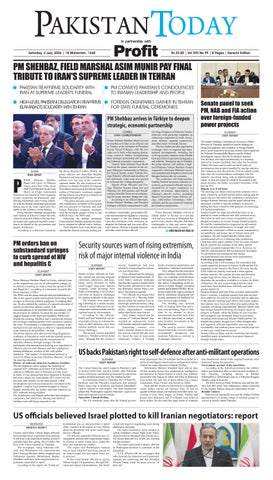
PM SHEHBAZ, FIELD MARSHAL ASIM MUNIR PAY FINAL TRIBUTE TO IRAN'S SUPREME LEADER IN TEHRAN g
g
PAKISTAN REAFFIRMS SOLIDARITY WITH IRAN AT SUPREME LEADER'S FUNERAL
g
HIGH-LEVEL PAKISTANI DELEGATION REAFFIRMS ISLAMABAD'S SOLIDARITY WITH TEHRAN
g
PM CONVEYS PAKISTAN'S CONDOLENCES TO IRANIAN LEADERSHIP AND PEOPLE
FOREIGN DIGNITARIES GATHER IN TEHRAN FOR STATE FUNERAL CEREMONIES
PM Shehbaz arrives in Türkiye to deepen strategic, economic partnership ISTANBUL
STAFF CORRESPONDENT
P
TEHRAN MIAN ABRAR
RIME Minister Shehbaz Sharif and Chief of Defence Forces and Chief of the Army Staff Field Marshal Syed Asim Munir on Friday represented Pakistan at the funeral of Iran's Supreme Leader, Ayatollah Ali Khamenei, reaffirming Islamabad's unwavering solidarity with the Iranian leadership and people during one of the most significant moments in the country's recent history. Prime Minister Shehbaz attended the state funeral at Tehran's Grand Mosalla, where he paid rich tribute to the late Iranian leader and expressed heartfelt condolences on behalf of the government and people of Pakistan. According to a statement issued by
the Prime Minister's Office (PMO), the prime minister met Ayatollah Mojtaba Khamenei and conveyed Pakistan's sympathies over the loss of the country's supreme leader. He also expressed condolences to Iranian President Dr Masoud Pezeshkian and assured the Iranian leadership of Pakistan's continued support during what he described as a moment of profound national grief. "The prime minister conveyed heartfelt condolences on behalf of the people and Government of Pakistan and reaffirmed Pakistan's complete solidarity with the brotherly people of Iran in this difficult hour," the PMO said. Following the funeral ceremony, Prime Minister Shehbaz departed for Istanbul to continue his official visit to Turkiye. Field Marshal Syed Asim Munir also attended the funeral ceremony, joining sen-
PM orders ban on substandard syringes to curb spread of HIV and hepatitis C ISLAMABAD
STAFF REPORT
Prime Minister Shehbaz Sharif on Friday ordered a ban on the manufacture and use of substandard syringes as he chaired a meeting on steps to stop the spread of HIV and Hepatitis C, according to a statement issued by the Prime Minister’s Office. The PMO said the prime minister directed authorities to take action against people and hospitals found using illegal syringes or showing criminal negligence in stopping their use. He also ordered the creation of a special committee of experts on infectious disease control, with recommendations to be submitted after consultation with the provinces. In addition, he asked the law ministry to suggest changes to the legal and regulatory framework. During the meeting, Shehbaz said a nationwide strategy and its proper implementation were essential to address the issue.“Formulating a comprehensive strategy at the national level and ensuring its effective implementation is the solution to the problem,” he said. The prime minister also directed the Drug Regulatory Authority of Pakistan to work with the medical devices industry to permanently stop the transmission of infectious diseases through syringes. He told participants that international backing was important in efforts to prevent such diseases and also emphasised training healthcare workers in line with global standards. “The support of international partners is crucial in efforts to prevent infectious diseases,” he told the meeting attendees. History of outbreaks linked to healthcare facilities The development comes against the backdrop of repeated HIV outbreaks associated with healthcare settings in different parts of Pakistan over the years. In April, it was reported that three hospitals in Karachi had seen a sharp rise in paediatric HIV cases over the previous nine months. In the same month, a BBC investigation said serious malpractice continued in the children’s ward of a government hospital in Taunsa, Punjab, months after the facility had been linked to an HIV outbreak among children. The broadcaster said Punjab authorities had pledged a crackdown, but undercover filming later showed children were still being exposed to risk.
Prime Minister Shehbaz Sharif arrived in Istanbul on Friday on an official visit to Türkiye at the invitation of President Recep Tayyip Erdogan, with the two sides set to hold wide-ranging discussions aimed at further strengthening their strategic partnership and expanding bilateral economic cooperation. Turkish Trade Minister Omer Bolat received the prime minister at the airport. Pakistan's Ambassador to Türkiye, Dr Yousaf Junaid, senior Turkish Foreign Ministry officials and members of the diplomatic corps were also present to welcome the visiting delegation. Deputy Prime Minister and Foreign Minister Senator Ishaq Dar and Minister for Information and Broadcasting Attaullah Tarar are accompanying the prime minister during the visit. According to an official statement, Prime Minister Shehbaz and President Erdogan will hold comprehensive talks
ior military commanders, government officials and international dignitaries in paying final respects to the late Iranian leader. Upon the conclusion of the ceremony, he departed for Pakistan and was seen off by Iran's Interior Minister Eskandar Momeni and other senior Iranian officials.
covering all aspects of Pakistan-Turkiye relations, with particular emphasis on enhancing cooperation in trade, investment, defence, regional connectivity and other areas of mutual interest. The two leaders are also expected to exchange views on regional and international developments, including the evolving security situation in the Middle East and efforts to promote lasting peace and stability. During his stay in Istanbul, the prime minister will address a highlevel Pakistan-Turkiye Business Forum organised to showcase Pakistan's investment potential and strengthen commercial linkages between the two countries. The conference will bring together leading Turkish investors, business executives, government officials and representatives of major companies to explore investment opportunities in Pakistan's priority sectors, including Special Economic Zones (SEZs), energy, information technology, infrastructure and the government's ongoing privatisation programme.
Prime Minister Shehbaz arrived in Tehran earlier in the day on a one-day visit and was received at Mehrabad Airport by Iran's Interior Minister, Pakistan's Ambassador to Iran and senior diplomatic officials from both countries.
CONTINUED ON PAGE 03
Security sources warn of rising extremism, risk of major internal violence in India ISLAMABAD STAFF REPORT
Senior security officials on Tuesday warned that growing religious extremism, intolerance, and deepening social divisions in India could trigger large-scale internal violence, while accusing New Delhi of attempting to divert attention from its domestic challenges by creating instability in the region. The remarks were made during a briefing by a senior security official to media influencers on developments related to India and the regional security environment. According to the officials, India's political leadership was increasingly relying on external tensions to shift attention away from internal political, social and economic challenges. The security sources described India as a "Hindutva-driven failed state," alleging that the country's
secular foundations had been eroded by rising religious extremism and intolerance. They claimed that the ideology of Hindutva had fundamentally altered India's political landscape and that the country's armed forces had become influenced by the ruling Bharatiya Janata Party's religious and political agenda. The officials also argued that the narrative of a "Shining India" did not reflect the realities of an increasingly polarised society, alleging that freedom of expression and media independence remained under significant state control. They further claimed that the concept of "Akhand Bharat" represented an expansionist vision with broader regional implications. Expressing concern over India's internal situation, the security sources warned that the country faced the risk of large-scale communal violence if existing
trends of religious polarisation and intolerance continued unchecked. They alleged that discrimination against minorities, particularly Muslims, was widening social divisions and increasing the potential for future unrest. Commenting on the situation in Indian Illegally Occupied Jammu and Kashmir (IIOJK), the officials claimed the region remained heavily militarised, alleging that one security personnel was deployed for every seven to eight civilians. The briefing also accused India of staging false-flag operations and attributing them to Pakistan in an attempt to divert international attention from what the officials described as indigenous freedom movements in the disputed territory. The security sources further claimed that India viewed a stable, economically prosperous and moderate Pakistan as contrary to its strategic objectives.
Senate panel to seek PM, NAB and FIA action over foreign-funded power projects ISLAMABAD
STAFF REPORT
The Senate Standing Committee on Economic Affairs Division on Thursday decided to send its findings on alleged irregularities and corruption in foreign-funded power sector projects to the prime minister and to approach the National Accountability Bureau and the Federal Investigation Agency directly for detailed inquiries. The decision was taken unanimously at a meeting chaired by Senator Saifullah Abro after the Economic Affairs Division said it could not itself order an investigation into projects handled by another ministry. The committee also directed the EAD to submit within three days all correspondence exchanged with the ministry concerned, along with an implementation report, so that the material could be forwarded to the prime minister, the Public Accounts Committee, NAB and the FIA. Dispute over EAD letter The meeting saw sharp criticism from senators over a letter written by an EAD section officer stating that the matter did not fall within the committee’s jurisdiction. Senator Kamran Murtaza said the panel should first determine whether it had the authority to proceed, adding that there would be little purpose in continuing if it lacked jurisdiction. Senator Kamil Ali Agha described the letter as an attempt to create confusion and shift attention away from what he said were serious irregularities and alleged corruption in several foreign-funded projects. He said the communication suggested an adversarial attitude towards parliamentary oversight and could weaken the committee’s efforts to ensure transparency, accountability and proper use of foreign loans and assistance. He also argued that the Senate had a constitutional role in overseeing state institutions. Chairman Abro asked whether EAD Secretary Humair Karim stood by the contents of the letter, and the secretary accepted responsibility for it. However, he said the communication did not amount to disrespect for parliament and maintained that Senate recommendations had always been implemented. EAD cites procedural limits According to the EAD secretary, the committee had earlier asked his division to write to NAB and the FIA regarding issues linked to the Power Division, but the EAD could not directly send such a letter against another ministry. He said the division had therefore sought legal advice from the Ministry of Law to determine the procedure available to it under the Rules of Business. He also acknowledged that the letter could have been drafted more carefully and with greater sensitivity. Senator Murtaza said that if the secretary endorsed the letter’s contents, it implied senators had gone beyond their authority. He said the committee had no objection to the ministry seeking legal advice and would respect that opinion once received, while also appreciating the secretary for taking responsibility. Murtaza further said that foreign-funded borrowing was largely spent on projects in Punjab, while the burden of cost overruns and corruption was ultimately borne by provinces including Balochistan and Khyber Pakhtunkhwa. He alleged that project designs were often changed after loan approval, officials responsible were not held accountable, and contract prices were initially kept low so that costs could later be raised. Senator Dilawar Khan said the committee had already identified major irregularities in projects financed through foreign loans.
US backs Pakistan’s right to self-defence after anti-militant operations ISLAMABAD
STAFF REPORT
The United States has said it supports Pakistan’s right to protect itself from terrorist attacks after Pakistani forces carried out coordinated ground and air operations against militant positions near the Afghan border. In a statement issued on Thursday, the US State Department said the Pakistani population had endured heavy losses due to terrorism and backed Islamabad’s right to respond to such attacks. The State Department added that Washington supports Pakistan’s right to defend itself against terrorist attacks. Operation Ghazab lil-Haq The US statement came after the federal govern-
ment announced that 29 militants had been killed in a series of intelligence-based actions and precision strikes carried out under Operation Ghazab lil-Haq. Information Minister Attaullah Tarar said on June 29 that security forces first conducted an intelligenceled operation in Bajaur district in which four militants associated with Jamaat ul Ahrar and Fitna al-Khawarij were killed. He said one of those killed was a senior commander, Khan Farosh, also known as Zabal. Tarar said the action was followed by overnight precision strikes carried out between June 28 and 29 against militant camps and hideouts in border areas. According to him, three targets in Paktia, Paktika and Kunar were destroyed, and 25 militants were killed in those strikes. He also said that large stocks of weapons
and ammunition stored at the targeted locations were destroyed during the operation. Government account of the operations According to the federal government, the military action was launched after several terrorist incidents inside Pakistan, including attacks in Khyber Pakhtunkhwa, Balochistan and on a Pakistan Rangers (Sindh) camp in Karachi. The Inter-Services Public Relations also said the military had shot down four rudimentary drones launched by the Afghan Taliban along the Balochistan border. Broader context Pakistan has repeatedly accused the Afghan Taliban administration of giving refuge to militant groups involved in attacks inside Pakistan.
US officials believed Israel plotted to kill Iranian negotiators: report WASHINGTON
ANADOLU AGENCY
Current and former United States officials believed that Israel might have been plotting to kill Iran’s top negotiators during sensitive ceasefire talks this spring, the US daily The New York Times reported on Thursday. The newspaper, citing American officials, said Washington was concerned that Iran’s Foreign Minister Abbas Araghchi and Parliament Speaker Mohammad Bagher Ghalibaf could have been targeted when negotiations intensified in April. According to the report, the Trump ad-
ministration was so concerned that it asked other countries in the region to warn Tehran about the possibility that Israel could target the two officials. US officials reportedly believed any assassination attempt after negotiations began in earnest in April would have ended the talks and reignited the conflict. The report said Washington learned that at least Ghalibaf had been placed on an Israeli target list and urged Israel not to proceed. It also cited Iranian officials as saying Tehran sought US guarantees, through Pakistani and Qatari intermediaries, that Israel
would not target its negotiating team during diplomatic meetings. The report detailed an April incident in which Ghalibaf's return flight from Islamabad diverted to Mashhad after Iranian security forces detected two Israeli jets entering Iranian airspace. The report said Israeli Embassy officials in Washington declined to comment on the allegations. A US official told the newspaper that talks between the American and Iranian delegations are continuing and that President Donald Trump wants the peace process "to play out".