In partnership with
Profit
KHAMENEI SAYS US VIOLATED ISLAMABAD MOU AS IRAN, US EXCHANGE FRESH STRIKES Sunday, 19 July, 2026 | 4 Safar, 1448
g
g
IRANIAN LEADER SAYS TRUMP'S SIGNATURE ‘WORTHLESS’ AMID ESCALATING CONFLICT
g
IRAN LAUNCHES ATTACKS ON US-LINKED TARGETS IN GULF AS WASHINGTON PRESSES MILITARY CAMPAIGN
g
Rs 20.00 | Vol XVII No 114 | 8 Pages | Islamabad Edition
TEHRAN SAYS IT HAS SUSPENDED ISLAMABAD MOU COMMITMENTS AFTER ALLEGED US VIOLATIONS
RISING REGIONAL TENSIONS DISRUPT SHIPPING, ENERGY INFRASTRUCTURE AND CIVILIAN SERVICES
dar urges adherence to islamabad Mou, calls for restraint amid regional tensions ISLAMABAD
SALEEM JADOON
I
TEHRAN/WASHINGTON STAFF REPORT/AGENCIES
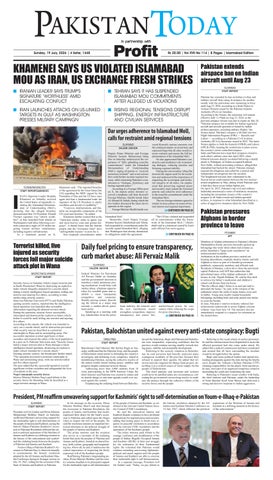
RAN's Supreme Leader Mojtaba Khamenei on Saturday accused the United States of repeatedly violating the Islamabad Memorandum of Understanding (MoU), declaring that the alleged breaches demonstrated that US President Donald Trump's signature was "utterly worthless", as Iran launched fresh attacks on Washington's Gulf allies following a seventh consecutive night of US strikes targeting Iranian military installations, including logistics infrastructure. In a statement posted on X,
Deputy Prime Minister and Foreign Minister Senator Muhammad Ishaq Dar on Saturday underscored the importance of “fully upholding ceasefire commitments” under the Islamabad Memorandum of Understanding (MoU), urging all parties to “exercise maximum restraint” and avoid actions that could further escalate regional tensions, while reiterating Pakistan's commitment to “dialogue, diplomacy and lasting regional peace.” According to a Foreign Office post on X, the deputy prime minister received a telephone call from Kuwait's Foreign Minister, Sheikh Jarrah Jaber Al-Ahmad Al-Sabah, during which the two leaders discussed the latest developments in the region. Foreign Minister Sheikh Jarrah con-
Khamenei said, "The repeated breaches of the agreement by the Great Satan [the US] regarding the MOU signed by the Presidents of Iran and the US have once again laid bare a fundamental truth: the signature of the US President is utterly worthless and devoid of credibility." "Coercion, totalitarianism, and brutality are inseparable components of the US creed and doctrine," he added. Khamenei further warned that as the "American enemy seeks to ignite war and incur heavier costs and greater disgrace", it should know that the Iranian people and the "resistance front" have "unforgettable lessons" in store for it. Iran suspends commitments under
Terrorist killed, five injured as security forces foil major suicide attack plot in Wana WAZIRISTAN/ISLAMABAD STAFF REPORT
Security forces on Saturday foiled a major terrorist plot in South Waziristan's Wana by destroying an explosiveladen vehicle allegedly prepared for a suicide attack during a timely intelligence-based operation, killing one terrorist and injuring five others, according to state media citing security sources. State-run Pakistan Television (PTV) and Radio Pakistan, quoting security sources, reported that the intelligencebased operation was launched after actionable information regarding the planned terrorist attack. During the operation, security forces successfully intercepted and destroyed the explosives-laden vehicle before it could be used, killing one terrorist and injuring five others. According to the reports, the vehicle was intended to carry out a suicide attack, and its destruction prevented what security sources described as a potential catastrophe in Wana and its surrounding areas. The successful operation averted significant civilian casualties and ensured the safety of the local population. In a post on X, Pakistan Television said, "Security forces foiled a major terrorist plot in Wana through a timely intelligence-based operation, destroying an explosiveladen vehicle intended for a suicide attack." Quoting security sources, the broadcaster further stated, "The operation prevented a potential catastrophe in Wana and surrounding areas, with one terrorist killed and five others injured." The post added that the successful operation averted significant civilian casualties and safeguarded the lives of residents in the area. Naqvi commends security forces Interior Minister Mohsin Naqvi paid tribute to the security forces for thwarting what he described as a major terrorist attempt in Wana.
Islamabad MoU Meanwhile, Iran's Deputy Foreign Minister Kazem Gharibabadi said Tehran had suspended its commitments under the recently signed Islamabad MoU, alleging that Washington had already abandoned its obligations under the agreement.
veyed Kuwait's serious concerns over the continued attacks on its territory and expressed hope that all sides would exercise restraint and ensure the full implementation of the Islamabad MoU. He also appreciated Pakistan's constructive and mediatory role in promoting dialogue, reducing tensions and fostering regional stability. During the conversation, Ishaq Dar stressed the urgent need for de-escalation and underscored the importance of respecting the sovereignty and territorial integrity of all states. He emphasised that preserving regional peace and security must remain the foremost priority and called for strict adherence to the ceasefire commitments under the Islamabad MoU. The two foreign ministers agreed to remain in close contact on issues of mutual interest and regional importance.
Continued on page 03
"The US has violated and suspended all its commitments within the framework of the Islamabad MoU," Gharibabadi said in a statement carried by Iran's semi-official Fars news agency.
ISLAMABAD SALEEM JADOON
leum industry, the minister said the new mechanism would strengthen competition, improve transparency and ensure fair,
ISLAMABAD
STAFF REPORT
Pakistan has extended its ban on Indian civilian and military aircraft from using its airspace for another month, with the restrictions now remaining in force until Aug 23, 2026, according to a fresh Notice to Airmen (Notam) issued by the Pakistan Airports Authority (PAA) on Saturday. According to the Notam, the restriction will remain effective until 11:59pm on Aug 23, 2026, as the previous airspace closure was due to expire on July 24. "Pakistan airspace not available for Indian-registered aircraft and aircraft operated or leased by Indian airlines/operators, including military flights," the Notam stated. Pakistan's airspace is divided into two Flight Information Regions (FIRs) — Karachi and Lahore — according to a Pakistan Civil Aviation Authority (PCAA) document issued in 2022. The latest Notam applies to both the Karachi (OPKR) and Lahore (OPLR) FIRs, keeping the restrictions in place across the country's entire controlled airspace. India and Pakistan have kept their airspaces closed to each other's airlines since last April 2025, when bilateral tensions sharply escalated following a deadly attack in Pahalgam, in Indian-occupied Kashmir. New Delhi, without presenting evidence, alleged that Islamabad had backed the attack. Pakistan strongly rejected the allegation and called for a neutral and independent investigation into the incident. The heightened tensions later culminated in the fiercest aerial confrontation between the two nucleararmed neighbours in May, during which Pakistan said it had shot down seven Indian fighter jets. On April 24, 2025, Pakistan's top civil and military leadership announced a series of retaliatory measures, including the immediate closure of the country's airspace to all India-owned and Indian-operated airlines, in response to what Islamabad described as a series of aggressive measures taken by New Delhi.
Pakistan pressures Afghans in border province to leave PESHAWAR
Continued on page 03
daily fuel pricing to ensure transparency, curb market abuse: ali pervaiz Malik Federal Minister for Petroleum Ali Pervaiz Malik on Saturday said the government's decision to introduce a daily petroleum pricing mechanism would help curb market abuse, eliminate opportunities for windfall gains and establish a more transparent, competitive and consumerfriendly pricing system, describing the reform as a major step towards a market-driven petroleum sector. Speaking at a meeting with key stakeholders from the petro-
Pakistan extends airspace ban on Indian aircraft until Aug 23
market-based prices for consumers while reducing the scope for price distortions.
Continued on page 03
AFP
Members of Afghan settlements in Pakistan’s Khyber Pakhtunkhwa border province hurriedly packed up belongings this week while others hid at home as police launched a “large-scale crackdown” on undocumented residents. Authorities in the northern province carried out housing demolitions, roadside identity checks and told Afghans to leave as part of a broader government pushback, community members and officials said. Residents of Mattani, a short drive from the provincial capital Peshawar, told AFP that authorities had demolished many of the Afghan settlement’s 200 houses in July. Najeeb Rehman, 50, said he first tried to retrieve his father’s medication and children’s school certificates from his home. “But the officers didn’t listen to us and just said to demolish the house,” he said, in the remains of the settlement where the walls of many homes were now in rubble. Young men nearby loaded household belongings including beds and solar panels into trucks to cross the border. In June, Pakistan’s interior ministry ordered law enforcement nationwide to arrest Afghan citizens without visas from July 10. The ministry did not immediately respond to a request for comment on the demolitions.
pakistan, Balochistan united against every anti-state conspiracy: Bugti RAWALPINDI
STAFF REPORT
Balochistan Chief Minister Mir Sarfraz Bugti on Saturday reaffirmed that the Pakistan Army and the people of Balochistan stand united in defending the country's sovereignty and defeating every conspiracy aimed at destabilising Pakistan, saying the collective resolve of the nation would ensure lasting peace, stability and progress despite continued terrorist threats. Addressing more than 4,000 students from 18 cities participating in the ISPR Summer Camp, the chief minister said Pakistan was created to endure and no hostile design or anti-state agenda would ever succeed against the country. Emphasising the enduring bond between Balochis-
tan and the federation, Bugti said Pakistan and Balochistan were inseparable, expressing confidence that the province would continue moving steadily towards lasting peace, stability and sustainable development. Referring to the security situation in Balochistan, he said terrorists had brutally martyred many courageous residents of the province because they refused to support their agenda. He added that terrorists had also targeted the Mangi Dam project, describing it as a critical source of water supply for the people of Balochistan. The chief minister said terrorism and violence could never be justified under any circumstances, reiterating the government's unwavering resolve to eradicate the menace through the collective efforts of the security forces and the people.
Referring to the recent attack on police personnel, he said the reinforcement force dispatched to assist the affected personnel had also come under attack. He added that a judicial commission had been constituted and assured that all facts surrounding the incident would be brought before the nation. Bugti said some political leaders had spread misleading propaganda against the state during the Quetta sit-in despite the Tehreek-i-Taliban Pakistan (TTP) claiming responsibility for the attack. Such narratives, he said, were part of an organised conspiracy aimed at misleading the youth and weakening the state. Referring to Pakistan's recent conflict with India, the chief minister said Pakistan, under the leadership of Field Marshal Syed Asim Munir, had delivered a strong and decisive response to Indian aggression.
president, pM reaffirm unwavering support for Kashmiris' right to self-determination on Youm-e-ilhaq-e-pakistan ISLAMABAD
STAFF REPORT
President Asif Ali Zardari and Prime Minister Muhammad Shehbaz Sharif on Saturday reaffirmed Pakistan's unwavering support for the inalienable right to self-determination of the people of Jammu and Kashmir, saying the historic Ilhaq-e-Pakistan (Kashmir's Accession to Pakistan) Resolution reflected the collective political aspirations of the Muslims of Jammu and Kashmir at a defining moment in the history of the subcontinent and symbolised the enduring bonds between the peoples of Pakistan and Jammu and Kashmir. Youm-e-Ilhaq-e-Pakistan (Kashmir's Accession to Pakistan Day) is observed annually to commemorate the historic resolution adopted by the All Jammu and Kashmir Muslim Conference during its Srinagar session on July 19, 1947, calling for the accession of the State of Jammu and Kashmir to Pakistan.
In his message on the occasion, Prime Minister Shehbaz Sharif said that through the Accession to Pakistan Resolution, the people of Jammu and Kashmir had clearly expressed their desire for the State's accession to Pakistan and called upon the Dogra rulers to respect the will of the people. He said the resolution remains an important historical milestone in the political struggle of the people of Jammu and Kashmir. The prime minister said the occasion also serves as a reminder of the enduring bonds that unite the peoples of Pakistan and Jammu and Kashmir, founded on shared history, faith, culture, geography and longstanding ties. Above all, he said, it underscores the central importance of respecting the freely expressed will of the Kashmiri people. Reaffirming Pakistan's longstanding position, Prime Minister Shehbaz said the country remains steadfast in its principled support for the inalienable right to self-determination
of the people of Jammu and Kashmir, as enshrined in the relevant United Nations Security Council (UNSC) resolutions. He said the unresolved Jammu and Kashmir dispute continues to have profound implications for regional peace and security, adding that lasting peace in South Asia requires its peaceful resolution in accordance with the relevant UNSC resolutions and the aspirations of the Kashmiri people. The prime minister paid tribute to the courage, resilience and steadfastness of the people of Indian Illegally Occupied Jammu and Kashmir (IIOJK) in their just struggle for the realisation of their fundamental rights. He reiterated that Pakistan would continue extending unwavering diplomatic, political and moral support until the people of Jammu and Kashmir are able to exercise their inalienable right to self-determination. In a separate message, President Asif Ali Zardari said, "Today, we pay tribute to
the historic resolution adopted by the All Jammu and Kashmir Muslim Conference on 19 July 1947, which reflected the political
aspirations of the Muslims of Jammu and Kashmir at a defining moment in the history of the subcontinent."
02 NEWS
Sunday, 19 July, 2026 | ISLAMABAD
FBR exempts ceRtain pOs-cOmpliant FOOtweaR supplies FROm Retail pRice tax
t
PROFIT
MONITORING REPORT
HE Federal Board of Revenue (FBR) has excluded certain supplies made through digitally integrated and point-of-salecompliant channels from the retail price-based sales tax regime with effect from July 1, 2026. The relief was introduced through Sales Tax General Order No. 11 of 2026. Under the order, supplies made by registered manufacturers through their own FBR digitally integrated and POScompliant retail outlets will be taxed on the value of supply under Section 2(46) of the Sales Tax Act, 1990, instead of the retail price prescribed under Serial No. 65 of the Third Schedule. The exclusion also applies to supplies made by importers to registered manufacturers or FBR digitally integrated and POS-compliant retailers. Goods imported directly by compliant retailers for onward sale to consumers will receive the same treatment,
along with supplies by digitally integrated registered manufacturers or registered importers to registered corporate entities, federal and provincial government departments, autonomous bodies and statutory bodies for their own use. For imported goods covered by Serial No. 65, sales tax will be assessed on a value equal to 130% of the amount de-
auto financing jumps 38% to Rs381.69 billion in June PROFIT
Pakistan secures $16.2b in foreign financing, misses FY26 target by $3.7b PROFIT
MONITORING REPORT
NEWS DESK
Outstanding auto financing in Pakistan surged 38% year-on-year and 3.4% month-on-month to Rs381.69 billion in June 2026, according to data released by Arif Habib Limited. The increase coincided with stronger vehicle sales, as the Pakistan Automotive Manufacturers Association reported 22,741 car sales during the month, up 4% year-on-year and 29% from May. Overall consumer financing rose 25.37% year-onyear to Rs1.15 trillion. Housing finance increased 29% year-on-year and 6.35% month-on-month to Rs267.09 billion, compared with Rs251.14 billion in May. Outstanding personal loans rose 7.68% year-onyear and 2.84% month-on-month to Rs282.89 billion. Private-sector credit increased 15.38% year-on-year to Rs11.16 trillion in June, while lending to the manufacturing sector grew 12.26% to Rs6.01 trillion. Loans to the construction sector rose 12.27% year-on-year to Rs236.15 billion. Financing for agriculture, forestry and fisheries increased 35.64% year-on-year and 9.53% monthon-month to Rs671.11 billion.
senate panel questions Rs90tr debt, foreign-funded project priorities PROFIT
NEWS DESK
termined under Section 25 of the Customs Act, 1969, including applicable customs duties and Federal Excise Duty. Under Section 3(2)(a) of the Sales Tax Act, goods listed in the Third Schedule are generally taxed on the basis of their retail price. The Finance Act, 2026, inserted footwear of all types under Serial No. 65,
The Senate Standing Committee on Economic Affairs on Friday raised concerns over Pakistan’s Rs90 trillion debt and liabilities burden, calling for tighter scrutiny of foreign-funded projects, borrowing and contract awards. Chairman Saifullah Abro said the country’s debt had risen from around Rs40 trillion in 2022 to approximately Rs90 trillion, while borrowed funds were not always being directed towards the most urgent needs. The committee reviewed foreign-funded road, flood rehabilitation, and irrigation projects in Khyber Pakhtunkhwa and questioned the criteria used to distribute schemes among districts. Rubina Khalid said Mardan had received 16 road projects, while only 12 kilometres of roads had been constructed in Dir despite extensive flood damage. Senator Hidayatullah questioned why nine roads had been built in Peshawar, which was not among the flood-affected districts, and sought details of the project selection process. Members also raised concerns that donor agencies may have been provided with inaccurate assessments of local priorities. Officials from the Khyber Pakhtunkhwa Communication and Works Department said most district road projects had been completed, while 63 schemes were nearing completion. The total length of completed and ongoing roads stood at around 488 kilometres. Kamil Ali Agha said future infrastructure planning should account for climate risks, particularly through improved stormwater drainage systems.
except where manufacturers sell their products exclusively through FBR digitally integrated and POS-compliant retail outlets. The Pakistan Footwear Manufacturers Association subsequently raised implementation and interpretation concerns with the FBR. The Board said documented and electronically verifiable supply chains allowed transaction values to be readily determined under the law. It also noted that footwear manufacturers supplying independent brand owners generally do not set the final retail price, which is determined by retailers under prevailing commercial practices. The tax treatment of supplies covered by Serial No. 65 will be determined through the implementation matrix attached to the general order. All Inland Revenue authorities have been directed to apply the matrix uniformly, while Chief Commissioners Inland Revenue have been instructed to ensure consistent implementation by field formations.
With Chinese refinancing of commercial loan of $1.7 billion, Pakistan has fetched $16.2 billion in the shape of foreign loans during the last financial year ended on June 30, 2026. However, Islamabad could not secure the desired target of $19.92 billion in shape of loans and grants in the fiscal year 2025-26, so it missed the target by $3.72 billion. However, in June 2026, the major chunk of disbursements of foreign loans was secured from the multilateral lending agencies, with the top lender Asian Development Bank (ADB) disbursed $953.74 million in the last month of 2025-26. According to the official data of Economic Affairs Division for the fiscal year 2025-26, the government secured refinancing of $1.7 billion from China Development Bank (CDB) and $203.33 million from Standard Chartered Bank (SCB) London, so the Government of Pakistan obtained $1.903 billion as foreign commercial loans in this fiscal year. The government had envisaged to secure $3 billion commercial loans but this target was missed with a margin of $1.1 billion in 2025-26. China provided a guarantee of
$392 million in the last fiscal year 2025-26. Among the bilateral partners, the total disbursement stood at $1.355 billion in the fiscal year 2025-6 out of which the Kingdom of Saudi Arabia provided $1.01 billion, mainly in the shape of Saudi Oil Facility (SOF) on deferred payment to the tune of $100 million on a monthly basis till March 2026. However, Pakistan has made a fresh request to resume the Oil Facility for medium term but so far it is under consideration. Among other bilateral partners, China provided $108 million, Denmark $90 million, France $71.68 million, Germany $13.35 million, Japan $26.69 million, Korea $9.49 million, Kuwait $26.06 million and USA $0.64 million. The multilateral lenders have disbursed cumulatively to the tune of $5.03 billion in the fiscal year of 2024-25 out of which ADB has disbursed loans of $1.772 billion, AIIB $123.85 million, World Bank’s IBRD loan of $516 million and WB’s IDA loan of $1.5 billion, Islamic Development Bank $68.13 million, IDB (short term) loan of $1.01 billion, $IFAD loan of $25.5 million, OPEC Fund $0.11 million and UN $0.9 million. From multilateral and bilateral creditors, Pakistan has received $6.39 billion in the fiscal year
2025-26. Pakistan had also re-appeared on the radar screen of international investors after pause of several years and launched two international bonds of $1 billion, including $750 million of Eurobond and $250 million of Panda bond. The country attracted $3.049 billion as Naya Pakistan Certificate (NPC), including $930.8 million as conventional NPC and $2.118 billion as NPC Islamic. The IMF has disbursed $420 million for RSF (Climate Finance) in the fiscal year. The disbursement from the IMF on account of Extended Fund Facility (EFF) is deposited into the domain of State Bank of Pakistan (SBP). Pakistan also secured $3 billion Time Deposit from the Kingdom of Saudi Arabia (KSA). When contacted, Adviser to Ministry of Finance Khurram Shahzad stated that the $15.764 billion represents the net inflow of foreign economic assistance received directly by the central government of Pakistan during the Jul-Jun 2025-26 fiscal period, rather than standard commercial bank deposits. This figure is calculated by combining $149.53 million in total central grants (non-repayable aid from bilateral countries, multilateral institutions, and the UN) with $15,615.39 million in total central loans and financing instruments.
Pakistan’s IT exports hit record $4.6b in FY26, surpass government target PROFIT
NEWS DESK
Pakistan’s information technology exports reached an all-time high of $4.6 billion in FY26, rising 21% from $3.8 billion in the previous fiscal year, according to data compiled by Topline Securities. The annual performance brought technology exports within the government’s FY26 target range of $4.5 billion to $5 billion, marking the achievement of the lower end of the official target. Monthly IT exports stood at $416 million in June 2026, increasing 23% compared with the same month last year and 12% from May 2026. The June figure was also among the highest monthly export receipts recorded during the period covered by the report. The chart included in the report shows that monthly IT exports remained above $350 million throughout most of FY26. Receipts rose to
$437 million in December 2025, the highest monthly figure shown, before easing to $374 million in January and $365 million in February. Exports subsequently recovered to $413 million in March and $423 million in April. They declined to $373 million in May before rising again to $416 million in June. Net IT exports, calculated after deducting technology-related imports from export receipts, reached $346 million in June. This represented year-on-year growth of 13%. For the full fiscal year, net IT exports totalled $3.98 billion, indicating that the technology sector continued to generate a substantial net inflow of foreign exchange for the country. The gap between gross IT exports of $4.6 billion and net exports of $3.98 billion implies technology-related imports of roughly $620 million during FY26. Pakistan’s technology exports include proceeds from software development, business process out-
sourcing, information technologyenabled services and other computer-related services provided to overseas clients. The sector’s performance has become increasingly important for Pakistan’s external account because technology businesses require fewer imported inputs than traditional manufacturing industries and generate most of their earnings in foreign currency. The government has set a target of increasing annual IT exports to $10 billion by FY29 under the Uraan Pakistan national economic plan. According to Topline Securities, achieving this objective would require a compound annual growth rate of 29.5% through FY29. The FY29 target would require Pakistan to more than double its technology exports from the FY26 level within three years. Based on exports of $4.6 billion in FY26, the sector would need to add another $5.4 billion in annual receipts to reach the $10 billion goal.
pll seeks bids for lnG cargo as pakistan prepares for higher summer gas demand PROFIT
AHMAD AHMADANI
Pakistan LNG Limited (PLL) has invited international suppliers to bid for one liquefied natural gas (LNG) cargo for delivery later this month as the government-owned company moves to secure fuel supplies to meet the country's higher summer gas demand. Pakistan LNG Limited (PLL), the governmentowned entity responsible for procuring LNG to meet Pakistan's energy requirements, has issued an international tender seeking bids for the supply of one LNG cargo on a Delivered Ex-Ship (DES) basis at Port Qasim, Karachi. According to the tender document, "Pakistan LNG Limited (PLL) is owned by the Government of Pakistan and has the mandate to procure Liquefied Natural Gas (LNG) to meet the country's gas requirements." The document further states: "Bids are invited from reputed international suppliers for the supply of one (01) LNG cargo on a Delivered Ex-Ship (DES) basis at Port Qasim, Karachi, Pakistan." Under Tender No. PLL/IMP/LNGT76: The LNG cargo is scheduled for delivery on July 27-28, 2026. The cargo quantity has been specified as 140,000 cubic metres (±5%), subject to the tolerance mentioned in the bid documents. PLL said bid documents can be obtained from its office or by email until July 20, 2026. The company stated: "Bid documents may be obtained from the office of Pakistan LNG Limited (PLL) in person or through email request at procurement@paklng.com from the date of advertisement to 20 July 2026." It further said: "The bid, prepared in accordance with the instructions in the bid documents, must reach the office of PLL on or before 1400 hours PST on 20 July 2026. The bids will be opened the same day at 1430 hours PST as per PPRA rules." The advertisement states that the tender has been published on both the PPRA and PLL websites. Highlighting its procurement rights, PLL said: "Pakistan LNG Limited reserves the right, at its sole discretion, to reject all bids prior to the acceptance of a bid or proposal, as per Rule 33 of the Public Procurement Rules, 2004." The latest tender comes as Pakistan seeks to ensure adequate LNG supplies for the power and gas sectors during the peak summer demand period through competitive international procurement.
power generation falls 2.5% in June as fuel costs rise 14% PROFIT
NEWS DESK
Pakistan’s electricity generation declined 2.5% year-on-year to 13,413 GWh in June 2026, while the average generation cost increased 14% to Rs8.9885 per kWh, according to Central Power Purchasing Agency-Guarantee data. Generation stood at 13,744 GWh at an average cost of Rs7.8698 per kWh in June 2025. The decline was partly attributed to disruptions in liquefied natural gas supplies from Qatar, which extended force majeure amid the conflict in the Middle East. RLNG-based generation fell to 1,480 GWh, accounting for 11.02% of the power mix, from 2,216 GWh a year earlier. Its generation cost surged 62% to Rs35.51 per kWh from Rs21.87 per kWh. Generation from indigenous gas declined 10.5% to 867 GWh from 968 GWh, with the fuel cost recorded at Rs13.6820 per kWh. Hydropower remained the largest source, contributing 5,242 GWh, or 39.03% of total generation. Output was 3% lower than the 5,410 GWh generated in June 2025, mainly due to a fault at the Tarbela generation facility. Nuclear generation, however, increased 31.5% to 1,800 GWh from 1,383 GWh, raising its share in the energy mix to 13.40%. Electricity generation from local coal fell 10% to 1,358 GWh from 1,510 GWh. Imported coal generation rose 21.6% to 1,699 GWh from 1,397 GWh. The Independent System and Market Operator also allowed generation from high-speed diesel and residual fuel oil at costs of around Rs57 and Rs52 per kWh, respectively. In June 2025, the National Power Control Centre generated 151 GWh from residual fuel oil at Rs29 per kWh. The latest rate represents an increase of nearly 80%. Pakistan imported 47 GWh of electricity from Iran at Rs27.6635 per kWh, compared with the same volume at Rs22.5155 per kWh a year earlier, reflecting a 23% increase in cost. Among renewable sources, wind generation rose 29.5% to 676 GWh from 522 GWh. Bagassebased output increased to 46 GWh from 35 GWh, while solar generation edged up to 110 GWh from 106 GWh.
Pakistan secures $27.2b in foreign loans, rollovers during FY26 PROFIT
MONITORING REPORT
Pakistan secured $27.2 billion in foreign loans and rollovers during FY2025-26, including $16 billion in fresh financing, $2.2 billion from the IMF and debt rollovers of $5 billion from Saudi Arabia and $4 billion from China, with most of the funds used for budgetary support, external debt repayments and foreign exchange reserve building. The IMF disbursements and the two major rollovers were not included in the ministry’s foreign economic assistance report. Of the total financing, around $24 billion was obtained for budgetary support, external debt servicing and reserve accumulation. Project-related financing accounted for only $3.4 billion, or nearly 13% of the total. Pakistan’s gross foreign exchange reserves stood at $18.5 billion at the end of
June, supported by debt rollovers, refinancing and the State Bank of Pakistan’s dollar purchases from the market. The country’s continued reliance on foreign borrowing comes as exports fell 6% to $30 billion in FY2025-26, remaining around $40 billion below imports, according to the Pakistan Bureau of Statistics. Foreign direct investment also declined to less than $2 billion. Pakistan’s current account returned to a deficit of $139 million during the fiscal year, reversing a surplus of $1.84 billion in FY2024-25. Record remittances were insufficient to offset the impact of higher imports. Finance Minister Muhammad Aurangzeb said Pakistan was well-positioned for the rollover of another $3 billion Saudi loan obtained in April for three months. Saudi Arabia has placed total cash deposits of $8 billion with the State Bank of Pakistan at interest rates ranging from 4%
to 4.5%. The deposits have repeatedly been extended upon maturity as Islamabad remains unable to repay them, while the maturity periods have gradually shortened as the amount has increased. The continuation of the IMF’s three-year programme also depends on the rollover of these deposits. Without extensions, Pakistan could face an external financing gap that may complicate IMF Executive Board approval for future loan tranches. China has placed $4 billion in cash deposits with Pakistan at an interest rate exceeding 6%. It also disbursed $393 million in guaranteed loans during FY2025-26, primarily for asset purchases. The Ministry of Finance raised another $1 billion through Panda Bonds and a private placement backed by Eurobonds. Pakistan issued $255 million in Panda Bonds with guarantees from the Asian Development Bank and the Asian Infrastruc-
ture Investment Bank, reflecting constraints created by the country’s weak sovereign credit rating. The government also secured $1.9 billion in commercial financing, including $1.7 billion from China Development Bank and $200 million from Standard Chartered Bank, London. Multilateral institutions provided around $7 billion during the year. This included $2.6 billion from the IMF, although the Ministry of Economic Affairs recorded only $421 million in its disbursement sheet, excluding another $2.2 billion received for balance-of-payments support. The Asian Development Bank disbursed $1.8 billion, around $400 million less than in the previous fiscal year, while the World Bank released nearly $2 billion. The Islamic Development Bank provided $1 billion, while Saudi Arabia extended another $1 billion under an oil financing facility
carrying an interest rate of 6%. The oil facility expired in April, and Pakistan is now seeking a new $6.7 billion arrangement with a repayment period of 15 years. The government also raised more than $3 billion through the Naya Pakistan Certificate scheme, another relatively expensive source of external financing. Pakistan’s debt-to-GDP ratio and gross financing requirements remain above levels considered sustainable. Gross financing needs exceeding 15% of GDP are generally viewed as unsustainable, and previous Ministry of Finance projections indicate that Pakistan will remain above that level over the medium term. The IMF estimates Pakistan’s gross external financing requirement at $21.2 billion for the current fiscal year. The requirement is projected to rise to $30 billion in the following year, when the existing IMF programme will have expired in September.
NEWS 03
Sunday, 19 July, 2026 | ISLAMABAD
PM speeds up ease of doing business reforms, seeks third-party validation
P
PROFIT STAFF REPOFT
0 Minister Muhammad Shehbaz Sharif on Friday directed authorities to accelerate the implementation of the government’s ease of doing business initiatives and the Ease of Doing Business Act, 2025. Chairing a review meeting, the prime minister also ordered the preparation of a comprehensive implementation report and called for third-party validation by international organisations to assess the effectiveness of the reforms.
The meeting was informed that work had been completed on 558 reforms aimed at reducing regulatory requirements, paperwork and business approval procedures. Of these, 71 policy measures have been implemented, while another 272 are under execution. The reforms are being introduced across different sectors in seven phases and are expected to save businesses an estimated Rs468.7 billion in regulatory compliance costs. Officials said the removal of unnecessary regulations and complex documentation would support exports, attract greater foreign direct invest-
ment and create employment opportunities. The prime minister said fully utilising Pakistan’s potential for domestic and foreign investment remained a government priority. He directed that progress on ease of doing business measures and the employment generated through them should be included as key performance indicators when evaluating officials of the relevant institutions. WEEKLY INFLATION RISES 1.4%, REACHES 13.09% YEARON-YEAR Federal Ministers Azam Nazeer Tarar, Qaiser Ahmed Sheikh, Jam
Khamenei says US violated Islamabad MoU as Iran, US exchange fresh strikes CONTINUED FROM PAGE 01
"We have also suspended our commitments, we are not implementing them, and we are busy defending the country," he added. Separately, Iran's Health Ministry said 50 people had been killed and more than 500 others injured in US strikes since June 27. Among those killed were five women and two children and teenagers under the age of 18, according to Hossein Kermanpour, head of the ministry's Public Relations and Information Centre, who said on X that the wounded also included 32 women and 18 children and teenagers. IRAN TARGETS US-LINKED FACILITIES IN GULF Earlier on Saturday, Iran launched strikes targeting United States military bases in Kuwait, Jordan and Bahrain, while an adviser to Supreme Leader Mojtaba Khamenei warned that the conflict was entering a more "aggressive" and "destructive" phase. Iran's Islamic Revolutionary Guards Corps (IRGC) said its naval forces carried out missile and drone attacks on a US fleet fuel support pier at Al Ahmadi Port in Kuwait and Sheikh Isa Air Base in
Bahrain. The IRGC also claimed to have destroyed a US intelligence data centre in Bahrain, identified as Batelco, as well as a US signals and communications centre in Kuwait, according to Iran's semi-official Tasnim news agency. Separately, recent US attacks on Hormozgan province in southern Iran killed "about seven to eight people", all civilians, according to provincial representative Ahmad Moradi, who told Tasnim that one strike targeted a bridge, hitting two family vehicles and killing six people. The report added that the Tappeh Allaho Akbar neighbourhood in Bandar Abbas was also struck, killing a woman, seriously injuring a one-year-old child who later underwent an amputation, while a fuel delivery driver was killed in a fire. KUWAIT REPORTS DAMAGE TO OIL FACILITY The Kuwait Petroleum Corporation said one of its vital oil facilities had come under repeated Iranian attacks, resulting in injuries and significant material damage. According to a statement carried by Kuna news agency and cited by Al Jazeera, the injured received medical treatment while the site was evacuated and emergency response operations were
conducted in coordination with the relevant authorities. WATER SHORTAGES REPORTED AFTER US STRIKE An Iranian provincial official said a US strike on a water desalination plant in the coastal village of Bunji, in Hormozgan province, disrupted drinking water supplies to around 10,000 people. Tasnim quoted the Chief Executive Officer of the Hormozgan Water and Wastewater Company as saying the attack completely halted water supplies to 20 villages, creating a severe water shortage crisis. FIREFIGHTERS INJURED IN KUWAIT Kuwait's Fire Force said several firefighters and a worker were injured while responding to fires at two locations following the Iranian attacks on Saturday morning. According to a statement cited by Al Jazeera, the affected personnel were evacuated and provided with medical assistance after sustaining injuries during firefighting operations. IRGC CLAIMS STRIKE ON US BASE IN JORDAN The IRGC also claimed responsibility
Daily fuel pricing to ensure transparency, curb market abuse: Ali Pervaiz Malik CONTINUED FROM PAGE 01
The meeting was held a day after the minister announced that retail petroleum prices would be determined on a daily basis in response to fluctuations in international oil markets following renewed hostilities between Iran and the United States. Under the new mechanism, retail petroleum prices will be determined through a transparent, formula-based system driven by market fundamentals, reducing the scope for political intervention while shielding consumers from abrupt price distortions. According to a statement issued by the Petroleum Division after the meeting, representatives of the Oil and Gas Regulatory Authority (Ogra), Oil Companies Advisory Council (OCAC), Oil Marketing Association of Pakistan (OMAP), refineries, oil marketing companies
(OMCs) and senior officials of the Petroleum Division attended the session to discuss implementation of the new pricing mechanism. The statement said the meeting was convened to brief industry stakeholders on the transition from weekly to daily petroleum price adjustments and to seek feedback on implementation challenges to ensure a smooth and effective rollout. The petroleum industry broadly welcomed the initiative, describing it as a positive step towards deregulating Pakistan's petroleum sector and creating a more competitive pricing environment. Minster Malik informed participants that the reform had been introduced on the directive of Prime Minister Muhammad Shehbaz Sharif and approved by the federal cabinet as part of the government's commitment to establishing a rulesbased petroleum pricing regime.
Dar urges adherence to Islamabad MoU, calls for restraint amid regional tensions CONTINUED FROM PAGE 01
DAR CONGRATULATES VENEZUELA'S NEW FOREIGN MINISTER Meanwhile, Deputy Prime Minister and Foreign Minister Senator Muhammad Ishaq Dar congratulated Felix Plasencia on his appointment as the Minister of Foreign Relations and Foreign Trade of the Bolivarian Republic of Venezuela. "I wish Foreign Minister Plasencia every success in his new responsibilities and look forward to working closely with him to further strengthen the friendly relations and mutually beneficial cooperation between Pakistan and Venezuela," Dar said in a post on his X account. DAR REITERATES COMMITMENT TO COOPERATIVE FEDERALISM In another development, Deputy Prime Minister and Foreign Minister Senator Muhammad Ishaq Dar on Saturday reaffirmed the government's commitment to strengthening cooperative federalism, enhancing intergovernmental coordination and advancing decisions that serve the national interest. Dar chaired a meeting of the Pre-Council of Common Interests (CCI) Committee, constituted by the Prime Minister in his capacity as Chairman of the CCI, as part of preparations for the Council's 53rd meeting. According to a press release issued by the Deputy Prime Minister's Office, the meeting was attended by the ministers for Planning and Inter-Provincial Coordination (IPC), Special Assistant to the Prime Minister Tariq Bajwa, and the secretaries of the Cabinet Division, Council of Common Interests, Planning, Petroleum, Water Resources, Power, Health, Overseas Pakistanis and Human Resource Development (OP&HRD), along with other relevant stakeholders. Following detailed deliberations on key agenda items, the committee recommended to the Prime Minister, in his capacity as Chairman of the Council of Common Interests.
Addressing the meeting, the minister said the daily pricing mechanism represented a fundamental shift towards a competitive, marketdriven economy by ending reliance on the weekly fuel price announcement cycle and mandatory government approval. Officials informed the meeting that the daily pricing mechanism forms a key component of the government's phased deregulation strategy aimed at gradually reducing state intervention and allowing market forces to determine petroleum prices, similar to the daily movement of exchange rates. The minister further said the Petroleum Division, in consultation with Ogra and industry stakeholders, was finalising comprehensive standard operating procedures (SOPs) to facilitate a seamless transition to the new pricing regime.
Weekly inflation rises 1.4%, reaches 13.09% year-on-year PROFIT
STAFF REPORT
Pakistan’s weekly inflation, measured by the Sensitive Price Indicator (SPI), increased 1.40% during the week ended July 16, 2026, driven by sharp increases in tomato, chicken, LPG and fuel prices, according to the Pakistan Bureau of Statistics (PBS). On a year-on-year basis, the SPI rose 13.09% compared with the corresponding week of 2025. The index covers 51 essential items collected from 50 markets across 17 cities. Tomato prices recorded the largest weekly increase, rising 22.79% to an average of Rs250.47 per kilogram from Rs203.98 a week earlier. Chicken prices climbed 14.66% to Rs383.11 per kilogram from Rs334.14. The price of an 11.67-kilogram LPG cylinder rose 12.46% to Rs4,454.62 from Rs3,961.05. High-speed diesel increased 4.41% to Rs325.06 per litre, while petrol rose 4.40% to Rs312.53 per litre. Other weekly increases included garlic at 3.72%, eggs at 2.15%, Lipton tea at 1.56%, onions at 1.53%, potatoes at 0.85%, prepared tea at 0.42% and firewood at 0.18%. Prices of four items declined during the week. Bananas became 0.80% cheaper, pulse moong fell 0.70%, sugar declined 0.36% and pulse masoor eased 0.10%. Of the 51 essential items monitored by the PBS, prices of 27 items increased, four declined and 20 remained unchanged. The year-on-year data showed that tomato prices were 210.18% higher than in the corresponding week last year. Onion prices increased 75.93%, while wheat flour became 71.81% more expensive. Electricity charges for the lowest consumption group rose 49.14% over the year, while LPG increased 42.50% and gas charges climbed 29.85%. Prices of men’s sponge chappals rose 16.69%, mutton 16.02%, chilli powder 15.20% and beef 13.60%.
Kamal Khan, Ahad Khan Cheema and Syed Mustafa Kamal attended the meeting, along with Minister of State Bilal Azhar Kayani, Adviser to the Prime Minister Muhammad Ali, Special Assistant Haroon Akhtar, Attorney General Mansoor Awan and senior officials. WEEKLY INFLATION RISES 1.4%, REACHES 13.09% YEAR-ON-YEAR State Bank of Pakistan Governor Jameel Ahmad, the chief secretaries of the four provinces, GilgitBaltistan and Azad Jammu and Kashmir, and international experts participated through video link. for what it described as a "devastating and simultaneous missile and drone attack" on fighter aircraft shelters and a large parking area at the US Al-Azraq Air Base in Jordan. According to Al Jazeera, the IRGC claimed the attack completely destroyed at least two American fighter jets and caused significant damage to several others. Iran also called on the Jordanian military to target US forces, describing them as "legitimate targets" and urging action against what it termed "invading" forces. CONFLICT INTENSIFIES AFTER CEASEFIRE COLLAPSE Iran renewed attacks on US-allied Gulf states after a seventh consecutive night of US strikes targeting Iranian military facilities and logistics infrastructure, deepening the conflict one week after the collapse of a fragile ceasefire agreement. Both sides also intensified pressure on maritime traffic in the Strait of Hormuz, with Washington saying it was enforcing a naval blockade while Tehran said it was targeting vessels allegedly violating Iranian navigation rules in the strategic waterway, through which roughly one-fifth of global oil supplies pass. Oil prices climbed more than 4 percent on Friday to their highest level in over a month, increasing political pressure on President Donald Trump ahead of November's congressional elections. Washington and Tehran have continued testing the limits of military escalation since the ceasefire collapsed, raising fears of a return to full-scale conflict.
Foreign direct investment in Pakistan falls 34% to $1.64b in FY26 PROFIT
STAFF REPORT
The committee comprises the Additional Secretary (Policy), Petroleum Division, Member Finance OGRA, Senior Executive Director OGRA and the Secretary General of OCAC. It has been tasked with resolving implementation issues through consensus and facilitating the successful rollout of the daily petroleum pricing system. According to the Petroleum Division, the reform has been undertaken on the directive of Prime Minister Shehbaz Sharif and approved by the federal cabinet as part of the government's commitment to establish a rules-based petroleum pricing regime and gradually deregulate Pakistan's downstream petroleum sector. Addressing the participants, Petroleum Minister Ali Pervaiz Malik said retail petroleum prices under the new mechanism would be determined through a transparent, formula-based process anchored in market fundamentals, replacing the existing fortnightly pricing system that requires government approval. He said the objective was to insulate consumers from politically influenced pricing decisions while promoting transparency and market efficiency. The minister said the introduction of daily petroleum pricing represented a fundamental shift towards a more market-driven and competitive economy. He added that moving away from the previous pricing cycle would reduce opportunities for market abuse and windfall gains while ensuring fuel prices better reflected prevailing market conditions. Participants were informed that the daily pricing mechanism would enhance transparency and ensure fairer pricing for consumers by shifting the focus from political intervention to market realities. The reform, they were told, forms a key component of the government's phased deregulation strategy aimed at aligning domestic fuel prices more closely with international market trends. Malik said the Petroleum Division, in close consultation with OGRA and industry stakeholders, was finalising comprehensive standard operating procedures (SOPs) to facilitate the transition. Technical matters, including the Inland Freight Equalization Margin (IFEM), refinery adjustments and true-up mechanisms, were being addressed collaboratively to ensure seamless implementation. OGRA informed the meeting that it was fully prepared to implement the new pricing regime and was upgrading its internal processes and data dissemination systems. The regulator also committed to publishing daily petroleum price data to enhance transparency and improve public access. The meeting also reviewed operational aspects of the transition, including supply chain logistics, inventory management and the availability of real-time data. The government assured industry stakeholders of its full support in addressing operational challenges during the transition.
04 COMMENT
Pakistan cannot afford to leave girls offline
Sunday, 19 July, 2026
Daily prices fixed
I
The government moves into crisis mode
A girl who learns to code is empowered
T seemed like a move out of an old playbook. The government shortened the period for its oil fixes from a week to a day, and announced a substantial hike in the price. This was exactly what happened when the government moved from a fortnightly determination of the price to a weekly. The government should realise that it has no place to go, because it cannot very well announce even half day prices, let alone hourly, or some smaller internal. However, this should be seen as a signal that the government expects the Strait of Hormuz crisis to last longer, and it refuses to be responsible for the lag between the oil price rise and the pump price. The pump owners’ association had already expressed opposition to the idea, but now it has been implemented. Pump owners have already been exercised by the switch from fortnightly pricing to weekly, and now the switch to daily is likely to increase their inventory management problems. The possibility of a prolonged Strait closure is being seen by people who know about it. After all, Pakistan was at the centre of the negotiations leading up to the Memorandum of Understanding signed in June, and at the centre of efforts to get Iran and the USA to de-escalate after the resumption of the US bombing. It would thus know what were the direction in which events in the Strait, and thus the price of oil,were moving. Going by the recent past, the Pakistani consumer can expect greater shocks down the line, as not only oil price shocks are passed on immediately, but the government tries to see if it can use petrol and diesel to somehow meet the promises it has made to the IMF, The IMF is likely to be as unrelenting as before in its insistence that targets be met. And it is a distinct possibility that the government will rely on the petroleum levy to prop up revenue, as it has been doing. The daily pricing brings the Pakistani consumer into line with the American or European, which does not lessen the pain of either. The government’s expectation seems to be of daily price rises, not of declines. THat means the government knows better than most that its sputtering economic recovery is more or less over. It is has to ensure that what seems to be a coming stagflation is contained as recession,rather trhan becoming a full-blown depression.
E
VERY generation is remembered for the technology that reshaped its future. The industrial age belonged to the steam engine, the 20th century to electricity, and the 21st belongs to digital innovation. Yet technology alone never transforms societies. People do. When a young girl learns to code, she is not simply acquiring a technical skill. She is learning to think critically, solve problems creatively, and imagine possibilities beyond the boundaries of circumstance. For Pakistan, that is not merely an educational achievement. It is an investment in national progress. Pakistan rightly regards education as a constitutional right, but constitutional guarantees alone cannot prepare a nation for a rapidly changing world. Millions of children remain out of school, while many others are still being educated for an economy that no longer exists. As artificial intelligence, automation, and digital technologies reshape industries worldwide, the real question is no longer whether young people need digital skills, but whether any nation can remain competitive without making digital education a national priority. The challenge today extends beyond literacy. Reading and writing remain fundamental, but they are no longer enough in a world where digital skills increasingly determine access to education, employ-
The true wealth of a nation has never been the resources beneath its soil but the potential within its people. PakistanÊs future will be written not by those who inherit the digital age, but by those who are prepared to shape it. Every girl who learns to code adds another voice to that future, another innovator to the economy, and another builder to the nation. In the end, empowering girls with digital skills is not simply an educational reform or a policy choice. It is one of the most important nation-building investments Pakistan can make
Dedicated to the legacy of late Hameed Nizami
Arif Nizami (Late) Founding Editor
M. A. Niazi
Babar Nizami
Editor Pakistan Today
Editor Profit
DR ZAFAR KHAN SAFDAR
ment, and entrepreneurship. The new divide is between those equipped to participate in the digital economy and those left behind. For Pakistan, closing that divide is inseparable from educating its girls. No nation can build a competitive knowledge economy while limiting the potential of half its population. Yet millions of girls continue to face barriers created by poverty, inadequate schools, social norms, and unequal access to technology. Closing this gap is not only a matter of equality. It is an economic imperative. Coding has become a powerful symbol of this transformation, not because every student will become a software engineer, but because it teaches habits of mind that extend far beyond programming. It develops logical reasoning, analytical thinking, persistence, creativity, and the confidence to tackle complex problems. Students learn that mistakes are part of learning and that every problem has a solution waiting to be discovered. These qualities are valuable in every profession, from medicine and engineering to business, research, and public service. Perhaps more importantly, coding changes perception. A girl who builds a simple application or designs a website begins to see technology not as something created elsewhere by others, but as something she can shape herself. That shift from consumer to creator is one of the most important educational transformations of our time. Confidence rarely grows through encouragement alone. It grows through competence. This matters because the digital economy is steadily expanding opportunities that were unimaginable only a generation ago. Software development, digital marketing, e-commerce, online education, graphic design, artificial intelligence, and remote professional services have reduced the importance of geography. For many Pakistani women, digital skills can provide access to employment and entrepreneurship without requiring them to leave their communities. Technology cannot eliminate every social barrier, but it can remove many economic ones. Countries that invested early in digital education offer valuable lessons. Estonia integrated coding into
Operation Epic Fury and the US constitutional crisis
O
Is the US war legal?
The writer has a PhD in Political Science, and is a visiting faculty member at QAU Islamabad. He can be reached at zafarkhansafdar@yahoo.com and tweets @zafarkhansafdar
Editor’s mail
Send your letters to: Letters to Editor, Pakistan Today, 4-Shaarey Fatima Jinnah, Lahore, Pakistan. E-mail: letters@pakistantoday.com.pk Letters should be addressed to Pakistan Today exclusively
Border infrastructure lacking
ALEENA SAIF ULLAH
N February 28, the USA launched it,s most consequential military campaign since the 2003 invasion of Iraq— killing a foreign head of state, striking nuclear infrastructure across 24 of Iran's 31 provinces, deploying the most AI-integrated targeting architecture in military history, and committing to a campaign that has so far consumed 40 percent of its THAAD interceptor inventory and six American lives. Congress was not consulted before the strikes began. No declaration of war was sought. No Authorization for the Use of Military Force was passed. Trump's notification to Congress, submitted after the strikes had already killed Khamenei, cited his inherent authority as commander in chief to conduct US foreign relations— the same constitutional language every administration since Vietnam has invoked to wage war without congressional approval. The War Powers Resolution of 1973, passed specifically to prevent exactly this situation, has been voted on four times in the Senate since February 28. It has failed four times, the last by a vote of 47 to 52. May 1, was the 60-day deadline the War Powers Resolution imposed on unauthorized military operations. If operations continued beyond that date without congressional authorization, they will, as constitutional law expert Stephen Vladeck told Military.com, have "stripped away any veneer of lawfulness." Vice President JD Vance has already indicated the administration's response: he called the War Powers Resolution "fundamentally a fake and unconstitutional law" in January, before the Iran war began. The White House spokesperson has said Trump has been "transparent with the Hill" through 30 bipartisan briefings, as if consultation is an adequate substitute for authorization. Republican leadership has largely held its caucus together in blocking the resolution, with only Senator Rand Paul crossing party lines— consistent with his longstanding position— and Senator John Fetterman crossing in the opposite direction. The constitutional standoff is real, the deadline is imminent, and neither Congress nor the courts have developed an adequate mechanism for resolving it. The historical record requires honest accounting before assessing the current situation. The War Powers Resolution has never successfully ended an unauthorized military operation. President Clinton deployed forces against Yugoslavia for 79 days without authorization. President Obama's Libya campaign was argued by the administration not to constitute "hostilities" under the Resolution's text— a reading so strained it prompted bipartisan criticism. The pattern across administrations of both parties is consistent: presidents invoke inherent authority, notify Congress after the fact, and continue operations regardless of the Resolution's 60-day limit. Congress has blocked the mechanism that
school education and became one of the world’s leading digital societies. India built a globally recognised technology workforce through sustained investment in technical education. Singapore, South Korea, and Finland embedded digital skills across their education systems long before they became fashionable policy goals. Their success demonstrates a simple reality. In the modern economy, human capital matters more than natural resources. Pakistan possesses enormous potential. It has one of the world’s youngest populations, an expanding technology sector, and a growing community of freelancers and entrepreneurs. Yet access to quality digital education remains deeply uneven. Students in major cities often enjoy opportunities that remain unavailable in smaller towns and rural communities. If this gap continues, it will become not only an educational divide but also an economic one. Expanding digital education therefore requires more than providing computers to schools. Technology without trained teachers, updated curricula, reliable internet, and continuous maintenance cannot deliver meaningful learning. Digital education must become a permanent national commitment supported by governments, educational institutions, universities, the private sector, and civil society. Coding, digital safety, artificial intelligence, computational thinking, and responsible use of technology should gradually become integral components of school education rather than optional subjects. Equally important is changing public attitudes. Digital education for girls must no longer be seen as a luxury but as an essential investment in Pakistan’s future. A computer today is more than a machine. It is a classroom, a library, a laboratory, and a gateway to opportunity. Every family that empowers a daughter with digital skills strengthens not only her future but also the nation’s economic potential. The debate over women’s empowerment need not remain trapped in ideology or symbolism. Its most meaningful expression lies in expanding opportunity, and in the digital age, that opportunity begins with technological competence. The true wealth of a nation has never been the resources beneath its soil but the potential within its people. Pakistan’s future will be written not by those who inherit the digital age, but by those who are prepared to shape it. Every girl who learns to code adds another voice to that future, another innovator to the economy, and another builder to the nation. In the end, empowering girls with digital skills is not simply an educational reform or a policy choice. It is one of the most important nation-building investments Pakistan can make.
would force a confrontation— supplemental appropriations— by passing continuing resolutions rather than demanding new war authorizations. Courts have declined to adjudicate the constitutionality of the Resolution, consistently finding that members of Congress lack standing or that the matter presents a nonjusticiable political question. What distinguishes Epic Fury from its predecessors is not the constitutional violation, which follows a familiar pattern, but its scale. Previous unauthorized operations— Kosovo, Libya, Yemen— were limited in scope, duration, or intensity in ways that made the constitutional question practically containable. Epic Fury is none of those things. It has killed a head of state. It has consumed strategic munitions reserves that will take years to replenish. It has established a ceasefire that may require ongoing military enforcement. It has generated diplomatic commitments— the Islamabad framework— that implicate American credibility regardless of how the conflict resolves. A president who can launch this campaign unilaterally can, under the precedent being established, launch any campaign unilaterally. The limiting principle being tested is not whether the Iran campaign was justified— that is a separate and
legitimate debate— but whether any limiting principle on executive war-making exists at all. Some Republican senators are showing unease as the May 1 deadline approaches. Senator John Curtis has written that he will not support ongoing military action beyond 60 days without congressional approval, citing both historical and constitutional grounds. Representative Don Bacon has stated plainly: "By law, we've got to either approve continued operations or stop." These are not Democratic objections to a Republican war— they are Republican acknowledgments that the constitutional framework requires legislative authorization for sustained military operations regardless of party. The question is whether enough Republicans will break from leadership to force a vote before May 1, and whether the administration will respect the outcome if they do. The stakes extend beyond the Iran campaign. The precedent established by Epic Fury— that a president may kill a foreign head of state, commence a campaign consuming strategic military reserves, and wage sustained war for 60 days and potentially beyond without congressional authorization— is not a precedent that belongs to one administration or one conflict. It belongs to every future president, in
What is being decided before May 1 is not whether Trump's Iran campaign was right or wrong. It is whether the constitutional architecture governing the use of military force by the most powerful military in history retains any operative meaning. The cameras of history, as Representative Gregory Meeks observed during the floor debate, are rolling
Lahore – Ph: 042-36300938, 042-36375965
I
Karachi – Ph: 021-32640318 I
Islamabad – Ph: 051-2204545
I
BORDER management in Pakistan has largely been underdeveloped and quite inefficient. Most border crossing points, particularly in Balochistan, such as BP-250, Mand, Pishin and Panjgur, lack modern and essential facilities, and, therefore, cannot be considered fully established Customs stations or terminals. Mand and Panjgur operate without terminal operators. After a prolonged delay, the National Logistics Cell (NLC) has finally estab- lished a cargo terminal with a weighbridge at BP-250. However, developing a fully equipped terminal will require time. At present, cargo arriving from Iran is cleared using primitive and conventional methods. There is no proper mechanism for inspecting LPG cargo, with rotametres being used to check goods. Consignments requiring laboratory tests face delays owing to the absence of modern labo- ratory servises, resulting in goods being referred to Karachi. Essential services, such as quarantine operations, phytosanitary controls and food safety inspections, take significantly longer time due to staff shortages and the lack of dedicated offices at border points. Banking facilities are also unavailable at most stations. Alarmingly, even a stable internet connectivity is absent, limiting traders’ ability to file goods declarations (GDs) and make online payments. This lack of modern infrastructure undermines trade competitiveness and does weaken regional connectivity. Even boarding and lodging facilities for Customs staff are poor since these land border stations are located at considerable distances from central urban areas. It is noteworthy that this region hosts one of Pakistan’s most critical trade corridors, highlighting the urgent need for robust infrastructure development to strengthen regional connectivity. Key initiatives, such as China-Pakistan Economic Corridor (CPEC), Central Asia Regional Economic Cooperation (CAREC), bilateral trade with Iran, and connectivity with Central Asian Republics (CARs), are heavily reliant on these routes. At present, a significant volume of LPG destined for Punjab is transported through these land corridors, while a portion of Afghan transit trade is routed through Gwadar. In the coming years, trade activity in the region is expected to expand substantially due to transit trade agreements with the CARs, increased utilisation of Gwadar port, anticipated growth in transit and trans-shipment operations, bilateral trade with Iran, and the implementation of Transports Internationaux Routiers (TIR) operations. Furthermore, the establishment of common border markets, along with the opening of new border crossing points and checkposts, is likely to further boost trade at various land stations. To address these challenges, the federal government must prioritise the develop-ment of modern infrastructure at these longneglected land border stations. Adequate physical infrastructure, modern equipment and gadgets, trained human resources, and operational facilities are essential to meet the requirements. Equally important is the development of digital infrastructure to modernise the trade environment and enhance efficiency. SHAHID ALI ABBASI KARACHI
Turbat cash crisis
TURBAT has been facing a lack of ATM for quite some time, even though consistent complaints have been made by citizens. Despite being the second the second most populated city in Balochistan, there are still not enough ATMs. Citizens often have to wait for hours on end when they need to withdraw money. And even after hours of waiting, many people often return home empty-handed as machines either lack cash or fail to process transactions — leaving them without their funds. The government of Balochistan must pay heed to the inconvenience that our people are facing and provide more bank branches as well as ATMs in Turbat so that people do not have to go home empty-handed. MUZZAMIL KARIM TURBAT, KECH
Web: www.pakistantoday.com.pk
I
Email: editorial@pakistantoday.com.pk
COMMENT 05
Sunday, 19 July, 2026
The internal power struggle and the peace in the Gulf
T
A quagmire with an uncertain finale NAQI AKBAR
HE Iranian parliament opened at last on July 15,; after being closed since the start of the war with the USA. The opening of the parliament has been one of the demands of the MPs, from all sides of the political spectrum, especially the opponents of the new JCPOA which has been called the MoU by the Trump Administration, the sitting reformist administration and by the gobetween stakeholders; the Pakistanis and the Qataris. The opening of the House was followed by taking up a few resolutions, of which one about the end of the MoU between Iran and the USA was adopted overwhelmingly. It is pertinent to note that the parliament is empowered to adopt or reject any pacts with the foreign governments; whose definition covers, practically any new JCPOA, which was the intent of even the Raeesi government or the MoU enthusiastically followed by the incumbent reformist administration. The opening of the parliament and the shift of opposition to the MoU from the street to the floor of the House, was one of the thorny issues between the dissenting MPs and the speaker of the Iranian parliament Baqir Qalibaf, who being the co-negotiator along with the reformist foreign minister, was criticized for adjourning the parliament session for too long; a move which was criticized by the opponents of the MoU on the plea that this move sabotages the House’s role in important national issues, while the reformist former mayor of the cap-
ital city during the tenure of President Khatami, now a veteran politician, was all praise for the speaker arguing that a closed parliament was a blessing for the MoU to be signed finally, in whatever form. However, neither side was sitting idle. If the radicals were able to pass a resolution annulling the MOU, the speaker secretariat recomposed the security committee body of the House and shunted out what were thought to be radical members. If that move was a blow to the radical elements on one side, it was a bad departure from the traditions followed in Iran after the revolution. Despite the fact that the 2009 elections in Iran created a wedge between the reform movement and the leadership, the then expediency committee was composed evenly and had many prominent reformist names in the ranks like Muhammad Raza Aref, not to forget the late Iranian president Rafsanjani; himself the doyen of the reformists/pro-West group; even when the reformist presidential hopeful Mir Hossain Mousavi was under the house arrest during the same time. The fact that the state broadcasting chief is selected by the leadership and for obvious reasons the IRIB editorial was not comfortable with the winds of change; the pro-US slant despite facing the US aggression, the editorial criticism was point blank criticized by the president; which in a way pitted the IRGC and the leadership against the reformist administration for the third-party observer to reach certain conclusions. As is evident, the battle lines within the Iranian political spectrum or the corridors of power are getting clearer with every passing day. It would not be out of context to say that the timeline of the Iranian stances after Feb-
They misconstrued the reform vote and felt that the street would help them. It proved to be the contrary. Going forward, the battlefield which has been going on for almost two weeks and has the potential to climb the escalatory ladder; will decide which faction will have the upper hand. That faction will consequently decide what is the fate of Hormuz; to TrumpÊs satisfaction or for the free world
ruary 28, the assassination list, the periodic utterances or ‘disclosures’ by US President Donald Trump, the slow entry of the negotiators, mostly from the US camp, namely Pakistan and Qatar, all indicate the hard fact that the fissures within the Iranian polity were created there and then. Two weeks into the war few days after the annual Ramazan Quds rally in the capital Tehran, the national security advisor Ali Larijani, who on account of his credentials and profile could have been a harder nut to crack whenever the negotiations were to be held, was targeted on the basis of the intelligencebased information and the IDF/USAF jets were deployed to do the needful. His killing was lamented by a very pertinent comment that the USA was killing people who could have been an asset in the negotiation process which usually follows any armed conflict. It was precisely that time when the Pakistani media in cahoots with the international media created an impression that people within the corridors of power in Iran were ready to talk. That was coupled with assertions by Trump that there were ‘saner Iranians’ wanting to talk, while there were many who would not like to get into any conversation, he added. In the Iranian media and also in the international and Pakistani media, especially the sections and journalists with links to the deep state in Rawalpindi/Islamabad, there were indications that it was not only the president of the reform government or the foreign minister who were prepared to talk with Pakistan as a fixer of the meeting, but the speaker of the parliament Qalibaf was the surprise dark horse, in all that talk. A career IRGC hand, having fought the eight-year war with Iraq in the 1980s, having commanded various branches of the IRGC, he was an unlikely person to be found among the people who will be talking to the USA directly or indirectly. The profile of anyone talking to the USA is suspect in the eyes of the most common and poorest an Iranian since the days of Mossadeq; has been suspect, and that was the case with the speaker of the assembly. A video going viral in Iran, where the speaker of the majlis sitting stern among the dignitaries in Imam Raza shrine at the time of the burial of Khamenei, with ‘death to the conspirators’ slogans being chanted by the crowd in the background, seems to encapsulate the street sentiment and the stances taken by a faction of the Iranian establishment. These stances precisely now divide the Iranian nation. While in Qatar the Iranian foreign minister had to make up an argument that the military responses were very much
The most polarizing social network still dominates
X is now a platform that spreads misinformation, as several studies show; that gives greater weight to far-right proclamations and that has changed its algorithm to prioritize the most polarizing content
T
EL PAIS
MANUEL G. PASCUAL
ODAY marks 20 years since the launch of Twitter. Over that time the platform has changed dramatically — far beyond replacing the blue bird with a white X on a black background. After buying it in 2022 for $44 billion, Elon Musk relaxed the rules, reinstated accounts that had been suspended for breaking them, and fired the content moderators (along with about half the company’s staff). He decided the users themselves should do the moderation through so-called community notes, which add context or flag falsehoods in posts. That system has proven unable to ensure truthful content circulates. Everything fits in X’s jungle, including child pornography. Musk’s arrival marked the start of a profound transformation that includes the launch of a paid service and that — judged only by user numbers — has worked. X is now a platform that spreads misinformation, as several studies show; that gives greater weight to far-right proclamations and that has changed its algorithm to prioritize the most polarizing content. It is also Musk’s mass-reach toy, which he uses to whip up racist pursuits, as happened recently in Belfast; to publicly attack whom he sees fit; or to boost electoral campaigns, such as the one that returned Donald Trump to the White House. The only time the South Africa–born magnate has been forced to backtrack was earlier this year, when he made X’s generative AI tool, Grok, stop creating hyperrealistic nude images from real photos. And if he reversed course, it was because the whole world turned on him. Despite this major mutation, X still attracts 585 million monthly unique users. That figure, provided by the company itself, is substantially higher than when it was called Twitter: before Musk bought it, it had about 370 million users, although it had once flirted with 400 million. The numbers have improved. Why do users keep trusting X despite its evident transformation? The first reason is size — inertia. For a social network to be interesting,
there has to be a worthwhile community. On Twitter everyone was there. When it mutated to X and the farright shift became evident, many left. But others did not. “Governments and political parties have chosen, despite the degradation of this platform, to keep their profiles on X to report their activities or express their opinions,” says Carmela Ríos, a journalist and expert on social networks and disinformation. “A significant part of politics has stayed on X, which has created a circle around which political conversation is then built, a conversation that everyone participates in, even if it isn’t always very civil.” That, in turn, has had consequences. “X’s consolidation has ended up elevating rude politicians, aggressive polemicists and even liars. In other words, those who know how to row in the algorithm’s favor.” The difference between X and the Twitter of 10 years ago is vast, but we may also be amplifying it unconsciously. “One should ask first whether that Twitter we now miss ever existed,” says Ekaitz Cancela, an economist and researcher with the Technopolitics group at the Open University of Catalonia. “We assumed social networks represented the democratic promise we saw in Spanish town squares in 2011 or in the Arab Spring. We forget that back then, it also went hand in hand with harassment and the fast pace of life, and that it was based on the very same business model of making money off our data. What remains of that is, above all, nostalgia.” Ríos offers another key that may explain the success of today’s X: “It is a highly ideological, very entertaining instrument in which extremist and provocative content of all kinds gets preferential placement in any user’s timeline, whether they want it or not. It’s no longer fit for calm conversation, for finding information in an orderly way, or for following the evolution of an emergency in real time, like major wildfires,” she says. “And yet, X retains a journalistic DNA, mainly because the other social networks have failed to fill the gap, where it is still harder to find good information.” No other platform has managed to develop an environment like Twitter-X’s; it reigns in the microblogging space — short-text publishing
(with images, video, or audio). Meta, owner of the two largest social networks in the world (Facebook, with more than three billion monthly active users, and Instagram, which is approaching three billion), tried with Threads, its version of Twitter, but it never took off. Bluesky, which grew thanks to users exiled from X, has never passed the 40-million mark, 14 times smaller than Musk’s network. It’s not easy to outshine X. “In the digital economy, generating excitement isn’t enough. What matters is keeping people connected for as long as possible. When hate and violence are glorified across all social media platforms, the promise of a less biased alternative isn’t enough,” says Cancela. “Bluesky replicates Twitter’s architecture without breaking away from its political economy of attention: it needs to grow, retain users, and, sooner or later, monetize the attention it accumulates.” X’s algorithm has made it an important machine of disinformation — and one that many autocratic leaders like. Strange as it may seem, that can be positive for some groups. “Unlike Signal, X is little restricted worldwide. It is used by very heterogeneous profiles and raises fewer suspicions. There are still academics who use it to communicate in repressive environments, for example people affected by the genocide in Gaza,” illustrates Lorena Jaume-Palasí, an expert in ethics and legal philosophy applied to technology and founder of Algorithm Watch and The Ethical Society. The fact that it offers access to unfiltered information is a window for places where media are controlled by the administration. A recent study by IAB, the world’s largest association of communication, advertising, and digital marketing, notes that many users still get their news from X; others stay because they do not want to cede such an important space to voices from the extremist spectrum; and a third group remains because they enjoy watching or participating in political dramas or fights played out via tweets. “X has turned polarization into a new form of entertainment, a sort of American Wild West saloon where you can choose to sit quietly behind the piano with a whiskey or grab a parlor chair and join the brawl,” Ríos concludes.
The remarks by Mujtaba giving a conditional approval to the MoU itself means that the reformist government is not firmly on its feet in the street, in the newly developing Bayat Rahbari, in the parliament or amongst the opinion makers automated and not within the control of the political leadership. In fact in an embarrassment he was trying to explain that the part of establishment, inclusive of the elusive leader Mujtaba Khamenei, the IRGC and the other hawks in the system were not in favor of talking to the USA, while the reformist government and the parliament speaker were for negotiations, at whatever terms they are finalized. The root of the problem in a way also lies in the fact that is gauged by the remarks from Trump, that a section of the Iranian government is seeking to talk to him and he usually makes these remarks in a very humiliating manner. The radicals feel that the negotiations are not a normal one, rather a desperate one. The remarks by Mujtaba giving a conditional approval to the MoU itself means that the reformist government is not firmly on its feet in the street, in the newly developing Bayat Rahbari, in the parliament or amongst the opinion makers. So, the lasting peace in the strait of Hormuz is not in the hands of the fixers of peace or the CENTCOM, rather it is the Iranian street, the floor of the House and the upper hand of whichever faction in the Iranian establishment which is going to decide the fate of the geopolitical quagmire.’
As things stand, the reformists despite having a setback at the street level, which energized the parliament, the reason being the week-long burial ceremonies for the late supreme leader, are trying to regroup and again seek an audience with the USA. Ironically the US insistence on its military supremacy with complete disregard to its media imagery has made things difficult for the reformists on ground in Iran. The nocturnal strikes on military targets on reciprocal basis between 00:00 to 05:00 hours Middle East standard time between the CENTCOM and IRGC; besides the attack on rail network on the day of the burial of the supreme leader all tend to radicalize the street. Here the reformists seem to have miscalculated the level of support for the slain leader. They misconstrued the reform vote and felt that the street would help them. It proved to be the contrary. Going forward, the battlefield which has been going on for almost two weeks and has the potential to climb the escalatory ladder; will decide which faction will have the upper hand. That faction will consequently decide what is the fate of Hormuz; to Trump’s satisfaction or for the free world. The writer is a freelance columnist
FIFA to ditch the football and just show adverts SATIRE
F
NEWS BISCUIT GERONTIUS
IFA president Gianni Infantino has announced there will be no actual football match during the World Cup final celebrations on Sunday. Instead the cameras will cut straight to adverts and commercials… .mainly featuring David Beckham selling waffles, taco crisps, pizza and Stella. Infantino said there will not be enough time to play the actual match as it gets in the way of important advertising slots and corporate selling opportunities. ‘We will see the teams walk out onto the pitch but from then on it will be adverts….right up until the closing ceremony which will then feature more wonderful adverts. The football is important but it does tend to get in the way of close-ups of celebrities and sports stars and their brands. These people have product to shift and FIFA has a priority to maximise their selling potential". Sales of crisps, beer and botox have rocketed thanks to Beckham's appearance in 95% of the adverts shown during the World Cup Finals but FIFA say there is still more product to shift before the curtain comes down on the final commercial. The final will be decided by David tossing a Mc-
Donalds cheese burger into the air….whoever has chosen cheese-side-up gets to win the trophy. "Did somebody remember to bring the trophy, that gold thing….does anybody know where it is……don’t worry…we will just present the winning team with a KFC mini fillet snack box”.
Government introduces strict social media curfew teenagers can ignore immediately SATIRE
T
NEWS BISCUIT
FERNANDOMANDO
HE government has announced a tough new overnight social media curfew for 16 and 17year-olds, which will remain in force unless they decide they don't fancy it. Under the plans, Instagram, TikTok and YouTube will be unavailable by default between midnight and 6am, unless teenagers alter their settings, click “opt out”, press “continue”, swipe left, swipe right, turn their phone off and on again, or simply ask someone younger to show them how. Technology Secretary Liz Kendall said the measure represented a decisive intervention. “For too long, young people have been exposed to addictive online content late at night,” she said. “That is why we are introducing a firm legal presumption that they should stop, subject only to their personal preference.” Ministers believe the curfew will improve sleep, concentration and family life by creating a brief administrative obstacle between teenagers and six more hours of scrolling. A government spokesman explained that the system had been carefully designed to withstand the ingenuity of older teenagers. “When the clock strikes midnight, the apps will display a clear message saying, ‘Social media is currently unavailable. Would you like to make it available?’” The teenager will then face the formidable chal-
lenge of selecting “yes”. Officials hope this will provide a valuable moment of reflection before the user resumes watching seventeen consecutive videos of a man pressure-washing a patio. Addictive features such as auto-play and infinite scroll will also be switched off by default, meaning users will have to reactivate them manually before surrendering the next three hours of their lives. Online safety minister Kanishka Narayan said the proposals would make Britain the most robust country in the world for regulating technology companies. “Other countries have spoken about restrictions,” he said. “We are the first to make those restrictions entirely optional.” Teenagers broadly welcomed the announcement. Seventeen-year-old Tyler said: “It is good that the government trusts us to make adult decisions about university, employment, sex, driving and military service, while also reminding us that we may become trapped inside TikTok unless protected by a settings menu.” Parents have also been reassured by the measures. “I was worried my daughter was spending too much time online,” said one mother. “But now the government has introduced a switch she can turn off, I feel the problem is basically solved.” Critics described the proposals as the digital equivalent of banning alcohol for teenagers unless they remove the lid. Ministers rejected the comparison. “With alcohol, the lid is often quite difficult to get off,” said one source.
06 newS
TRUMP BLAMES CANADA FOR WILDFIRE SMOKE, SAYS HE WILL ADD COST TO TARIFFS
P
WASHINGTON AGENCIES
RESIDENT Donald Trump on Friday blamed Canada for wildfire smoke spreading across the United States and said he would add the "incalculable cost" of dealing with the pollution to existing tariffs on Canadian goods. Heavy smoke from hundreds of Canadian fires enveloped a swath of the US from the Midwest to the Northeast on Thursday and Friday, prompting warnings to residents to stay indoors. Trump, who has a combative relationship with Prime Minister Mark Carney, said he would be calling the Canadian leader to find out what he planned to do about the "totally unacceptable" situation. "We are holding Canada responsible for the fact that they are not properly maintaining their Forests ... and the United States is being unnecessarily invaded by filthy, polluted, and unhealthy air," he said in a Truth Social post. "This is Willful Negligence, and becoming a yearly occurrence, costing the United States Billions of Dollars, which cost of this pollution must of necessity be added to the TARIFFS Canada is currently paying." Canada's Minister of Emergency Management and Community Resilience Eleanor Olszewski said the government has invested C$12 billion ($8.56 billion) in forest sustainability and fire prevention since 2020 as the country faces increasingly drier, warmer weather. She also cited a long history of USCanadian partnership in fighting wildfires on both sides of their border.
"At this time, our first priority is protecting Canadians and keeping communities safe," Olszewski said in a statement. Climate experts say rising temperatures have led to drier timber and more wildfires in recent years in Canada, home to some of the world's largest forest landscapes. "As our climate warms, we're seeing ... more extreme weather, and we're going to see more fire," said Mike Flannigan, a professor of wildland fire at Thompson Rivers University in British Columbia. Shortly after taking office in 2025, Trump imposed tariffs on several key imports from Canada. Carney's office did not immediately respond to a request for comment on Trump's remarks. Carney said on Thursday the US could do more to combat climate change that is leading to more prolonged drought and rising temperatures around the world. The two men are likely to meet at the FIFA World Cup final in New Jersey on Sunday. Many blazes this year are in the giant province of Ontario and are concentrated in the remote and sparsely populated northwest, where the only mode of transport is via air. So far, 650,000 acres (2,630 sq km) have burned, compared with 600,000 acres at the same time last year. Thousands of people have been evacuated. 'NOTHING REMAINING' The Namaygoosisagagun First Nation, also known as Collins First Nation, in northwestern Ontario went up in flames, forcing residents to evacuate by boat and seek shelter in Thunder Bay, Matthew Hoppe, the community's incident commander, told
Sunday, 19 July 2026 | ISLAMABAD
Canada readies Ontario evacuation as wildfire smoke spreads into US OTTAWA
AGENCIES
Canada was preparing to airlift residents out of a remote northwestern Ontario community threatened by wildfires, as smoke from blazes continued to drift into large parts of the United States. Federal Emergencies Minister Eleanor Olszewski said late Friday that the Canadian military would use aircraft to evacuate the roughly 600 people living in Fort Hope. The community is in a sparsely populated part of Ontario where some of the most severe fires are burning. The area has limited road access and depends heavily on air travel. Thousands of people from other affected locations have already been moved to cities farther south in Ontario. Canada’s natural resources ministry said on Saturday that 69 new fires had been recorded overnight, taking the total number of active fires nationwide to 955. The ministry said the area burned so far was nearly 28,500 square kilometres, which remained below the five-year average. Major wildfires have become a recurring yearly event in Canada, which contains some of the world’s largest forested areas. Climate experts have said higher temperatures have dried out
Reuters. "There was nothing remaining. So as you can imagine, the membership is totally distraught, upset, overwhelmed, lost," Hoppe said. Thunder Bay, a city of about 110,000 people on the northern shore of Lake Superior more than 1,300 km (800 miles) north-
timber and raised the risk of fire. SMOKE TRIGGERS US AIR QUALITY ALERTS Smoke from the Canadian fires moved south across the border, leading authorities in parts of the United States to issue air quality alerts and health advisories. At 8am ET, the US Environmental Protection Agency’s AirNow website listed air quality as unhealthy across an area covering southern Ontario, eastern parts of Ohio and West Virginia, most of Pennsylvania and New Jersey, much of Virginia, and all of Maryland, Delaware and Washington, DC. Some sections of western Pennsylvania, including Pittsburgh, were rated very unhealthy. AirNow forecast that conditions in those areas would improve during the day. AccuWeather said on Friday that smoke from the Canadian wildfires was expected to have only a minimal effect on Sunday’s soccer World Cup final at New York New Jersey Stadium. TRUMP COMMENTS AND CANADA RESPONSE US President Donald Trump said on Friday that what he described as incompetent forest management in Canada was responsible for the smoke and added that he would include the of dealing with the pollution in existing tariffs on Canadian goods.
west of Toronto, is at full capacity from sheltering wildfire evacuees from across northwestern Ontario, Mayor Ken Boshcoff told Reuters. Ontario Premier Doug Ford on Friday said the province would buy 11 new aircraft to help counter the fast-spreading wildfires
and pushed back against US politicians who have criticised the campaign as inadequate. The US is also experiencing an aboveaverage fire year, with 3.7 million acres burned to date in 2026 compared with a 10year average of 2.7 million acres, according to the National Interagency Fire Centre.
New York mayor says he is reviewing whether he can order Netanyahu’s arrest NEW YORK
AGENCIES
New York City Mayor Zohran Mamdani said he is in discussions with the city’s Law Department over whether he has the authority to direct the arrest of Israeli Prime Minister Benjamin Netanyahu if he visits the city. Netanyahu is wanted by the International Criminal Court over allegations of crimes against humanity and war crimes, including the use of starvation as a method of warfare, during Israel’s military campaign in Gaza. Speaking this week on The New York Times’ The Interview, published on Saturday, Mamdani said Netanyahu should face international justice. Mamdani said he believed the Israeli premier should be in The Hague and described him as a war criminal who has been charged by the ICC. He added that many people hold that view because of the consequences of
Netanyahu’s actions over recent years. At the same time, the mayor said he was unsure whether he could legally instruct the New York Police Department, which falls under his authority, to detain a foreign head of government. Referring to the legal review now under way, Mamdani said his administration was examining the issue ahead of Netanyahu’s expected visit to New York in September for the 81st session of the United Nations General Assembly. He said any action would depend on what the law permits and made clear that the city would not act beyond its legal powers. Mamdani had taken a firmer public position during his mayoral campaign in September 2025, when he said he would direct the NYPD to arrest Netanyahu if he came to the city. At the time, he said he intended to carry that out and called the Israeli prime minister a war criminal who was committing genocide in Gaza.
Venezuela quake toll tops 5,000 as IMF unlocks reconstruction funds CARACAS
AGENCIES
The death toll from the twin earthquakes that struck Venezuela last month has risen above 5,000, while the government has also secured hundreds of millions of dollars from the International Monetary Fund (IMF) for reconstruction efforts. The 7.2 and 7.5 magnitude tremors hit within a minute of each other on June 24, devastating the coastal state of La Guaira, north of Caracas. National Assembly chief Jorge Rodriguez said in a Telegram post that 5,069 people had died, with the largest share of the casualties reported from the coastal region. The number of injured remained unchanged at 16,740, according to the latest official figures. Jorge Rodriguez had earlier said that most of the wounded had already been discharged from hospital. IMF FUNDS RELEASED Later on Friday, Interim President Delcy Rodriguez
said Venezuela had drawn $346 million from the IMF to support post-earthquake reconstruction. IMF Managing Director Kristalina Georgieva also confirmed the disbursement in a post on X. GEORGIEVA SAID THE IMF worked with key counterparts to help Venezuela access its own resources at the Fund for urgent humanitarian needs adding that the money had been drawn "from their reserve tranche." Around 20,000 people displaced by the earthquakes are now living in overcrowded camps, many of them without reliable water access or proper sanitation. Venezuela holds 3.568 billion Special Drawing Rights at the IMF, equivalent to about $5.1 billion. Those resources had previously been blocked because the Fund did not recognise Nicolas Maduro as president. The IMF and the World Bank said in April that they were restoring relations with Venezuela after the United States overthrew Maduro in a military incursion in January. Ties with both institutions had been frozen since 2019.
Palestinian body says Israel advancing 1,024 settlement units in West Bank RAMALLAH
AGENCIES
The Palestinian Colonisation and Wall Resistance Commission said on Friday that Israeli authorities are moving ahead with plans for 1,024 new settlement units in the occupied West Bank on more than 1,069 dunams of Palestinian land. According to the commission, the projects form part of a wider push to expand settlements across the occupied territory. It said Israel was pressing ahead with measures aimed at reinforcing control on the ground and widening settlement activity through the work of the Higher Planning Council under the Civil Administration. The commission said the Higher Planning Council has examined nine settlement schemes since the beginning of July, with the proposals reaching approval and deposit stages. Of the 1,024 housing units, it said 455 have been approved while 569 have been deposited for further planning procedures. It described the settlement drive as part of across the occupied West Bank. The body also said the plans reflect aimed at strengthening settlement blocs in the West Bank, including East Jerusalem, through outward growth and higher residential density. PROJECTS IN JENIN AND HEBRON AREAS Among the plans cited by the commission is an approved expansion of the Mevo Dotan settlement, which it said is built on land belonging to the town of Arraba in southern Jenin. The project would add 455 settlement units on nearly 539 dunams. The commission said two more plans were submitted for the expansion of the Beit Hagai and Asael settlements in the southern West Bank governorate of Hebron. Those two projects would add 569 settlement units on more than 519 dunams, it said. It also said Israel is increasingly concentrating on
enlarging existing settlements rather than establishing entirely new ones. According to the commission, this is being done through changes to construction plans, landuse rules and zoning arrangements to allow denser settlement building. INTERNATIONAL POSITION The commission said settlement planning has turned into intended to reshape Palestinian geography by extending settlements, linking them to Israeli infrastructure and constraining Palestinian urban growth. It said this policy was being used to consolidate Israel’s of occupied Palestinian land. The United Nations has repeatedly said that Israeli settlements in the occupied Palestinian territories are illegal under international law and has warned that they weaken the chances of a two-state solution. Palestinians maintain that East Jerusalem should serve as the capital of a future Palestinian state, in line with international resolutions that do not recognise Israel’s 1967 occupation or its 1980 annexation of the city.
NEWS 07
Sunday, 19 July 2026 | ISLAMABAD
CM MARYAM EXPANDS WASA MODERNISATION ACROSS PUNJAB, VOWS BETTER CIVIC SERVICES FOR ALL DISTRICTS
P g
‘Milestone in Digital Transformation’: PPCBL, AutoSoft Dynamics team up for implementation of LOS LAHORE
STAFF REPORT
The Punjab Provincial Cooperative Bank Ltd. (PPCBL) has signed an agreement with AutoSoft Dynamics (Pvt.) Ltd. for the implementation of a Loan Origination System (LOS). This strategic partnership marks a significant milestone in the Bank's digital transformation journey. The new LOS is designed to streamline and modernize the Bank's lending operations by automating the entire loan lifecycle—from application intake and credit assessment to approval and disbursement—through an efficient, transparent, and technology-driven platform. The agreement signing ceremony was attended by senior officials from The Punjab Provincial Cooperative Bank Ltd. (PPCBL), including Mr. Shahram Raza Bakhtiari, President/Chief Executive Officer; Mr. Muhammad Saleem Tahir, Group Head Operations/Chief Operating Officer; Mr. Muhammad Sheraz Shareef, Group Head Digital Banking; Mr. Syed Hassan Rizvi, Group Head Information Technology; Mr. Farooq Azam Malik, Group Head Risk; Mr. Muhammad Hassan Tariq; along with other senior executives of the Bank.
HANDS OVER SYMBOLIC KEYS AS 272 MODERN DRAINAGE AND SEWERAGE MACHINES REACH 15 DISTRICTS LAHORE
SALEEM JADOON
UNJAB Chief Minister Maryam Nawaz on Saturday reaffirmed that the province's development agenda extends far beyond Lahore, as she formally launched a major expansion of modern municipal infrastructure by handing over symbolic keys of newly procured drainage and sewerage machinery to Water and Sanitation Agency (WASA) officials. She said the initiative reflects the Punjab government's commitment to strengthening civic services across all districts through modern technology and improved public infrastructure. The chief minister announced that the delivery of 272 modern drainage and sewerage machines to WASA authorities in 15 districts had been completed, while the supply of 696 machines and related equipment to WASA offices in 41 districts was also underway. During the ceremony, Maryam Nawaz formally handed over the symbolic keys of the newly procured sewerage machinery to the relevant WASA officials. In a warm gesture, the chief minister removed the security cordon to personally interact with WASA workers. She fulfilled their request for a group photograph, appreciated their dedication to public service and encouraged them to
continue performing their duties with commitment. She described the induction of modern machinery as a significant milestone in improving municipal services and ensuring better sanitation facilities for citizens. Provincial Minister for Housing Bilal Yasin and Housing Secretary Noor-ul-Amin Mengal briefed the chief minister on the project. They informed her that, in the first phase, 272 machines belonging to 12 different categories had been supplied to WASA authorities across Punjab to strengthen drainage and sewerage operations. The machinery includes loader rickshaws, tractor trolleys, sewer winch machines, desilting machines, sewer jetting machines, dewatering pumps, water
bowsers, dump trucks, tractors, backhoe machines, sewer suction machines, wheel excavators and truck boom cranes, all aimed at enhancing the operational capacity of WASA and improving emergency response during urban flooding and sanitation-related challenges. Addressing the ceremony, Chief Minister Maryam Nawaz said, "Providing ease and convenience to every citizen in every city is our commitment." She noted that the WASA network had been expanded from two districts to 41 districts across Punjab, reflecting the government's resolve to ensure uniform civic development throughout the province. She added that the Punjab government was steadily upgrading sewerage
infrastructure and modern drainage systems to provide improved municipal services, strengthen urban resilience and enhance the quality of life for people across Punjab. Four villages in Toba Tek Singh to become Model Villages In a related development, work is progressing on a project to transform four villages in Toba Tek Singh district into Model Villages on the directives of Chief Minister Maryam Nawaz Sharif. Special Assistant to the Chief Minister Shoaib Mirza visited the villages to review the pace of development aimed at providing modern civic amenities and improving public facilities for local residents. Commissioner Faisalabad Imran Hamid Sheikh and other senior officials accompanied him during the inspection. CM pays tribute to Nelson Mandela Meanwhile, Punjab Chief Minister Maryam Nawaz on Saturday paid glowing tribute to former South African president Nelson Mandela on the occasion of International Nelson Mandela Day, saying his extraordinary life of sacrifice, perseverance and unwavering commitment to justice continues to inspire humanity and remains a beacon of hope for generations around the world. In her message, the chief minister said Nelson Mandela's life symbolised patience, resilience and an unwavering struggle against oppression. She said that despite enduring years of imprisonment and immense hardships, Mandela never compromised on his principles and remained steadfast in his pursuit of freedom, equality and justice.
Sunday, 19 July, 2026
PRAYER TIMINGS
NEWS PAk-ChInA heAlThCARe COnFeRenCe TO geneRATe $850M InveSTMenT, TRAnSFORM PhARMA SeCTOR: kAMAl
F
ISLAMABAD
STAFF REPORT
EDERAL Minister for National Health Services, Regulations and Coordination Syed Mustafa Kamal on Saturday hailed the success of the Pakistan–China Pharmaceutical & Healthcare B2B Investment Conference 2026, expressing confidence that the event would mark a turning point for Pakistan's pharmaceutical and healthcare industries with expected investment agreements worth around $850 million, including 16 agreements and 80 Memorandums of Understanding (MoUs). Talking to the media on the second day of the conference, the minister said the anticipated multimillion-dollar investment would revolutionise Pakistan's pharmaceutical and healthcare sectors by promoting local manufacturing, strengthening industrial capacity and creating new employment opportunities across the country. He attributed the conference's success to the visionary and patriotic leadership of Prime Minister Muhammad
Shehbaz Sharif, saying the outcomes of the event would have lasting benefits for Pakistan's future generations. "Everything was made possible due to the leadership skills and vision of Shehbaz Sharif. Now a new era has begun between Pakistan and China; its results will go down to generations," he said. The minister said the conference focused on expanding local production of vaccines,
Tax backlog hits 68,000 despite 24 private members inducted on monthly salaries of up to Rs2.6m; review panel formed PROFIT
MONITORING REPORT
Pakistan’s tax litigation backlog has climbed to around 68,000 cases despite the appointment of 24 privatesector members to the Appellate Tribunal Inland Revenue on monthly salaries of up to Rs2.6 million, prompting the federal government to order a review of their performance, Dawn reported. A four-member high-level committee will assess the efficiency and conduct of the appointees and recommend whether they should be retained, granted tenure extensions or removed on grounds of inefficiency or misconduct. The members were hired under the 2024 recruitment framework on market-based salaries, along with perks and privileges, to accelerate the disposal of tax disputes and reduce the mounting backlog. However, pending cases have continued to increase despite the expansion in the tribunal’s strength. Official estimates show that tax tribunals are disposing of nearly 1,000 cases each month. At the current pace, clearing the existing backlog would take between five and six years, even if no new appeals were filed. Of the total pending cases, around 60,000 relate to Inland Revenue Service matters, while about 8,000 involve customs disputes.
Pakistan urges climate resilient, youth-led urban transformation at Un high-level Meeting ISLAMABAD
STAFF REPORT
Chairman of the Prime Minister’s Youth Programme (PMYP), Rana Mashhood Ahmad Khan, has reaffirmed Pakistan’s unwavering commitment to building sustainable, resilient and inclusive cities at the United Nations High-Level Meeting on the Midterm Review of the New Urban Agenda in New York, urging stronger global cooperation to advance climate-resilient urban development while empowering youth as key drivers of sustainable growth and shared prosperity. Addressing the high-level meeting, Rana Mashhood described the Midterm Review as a timely opportunity to assess global progress and renew the international community’s collective commitment to effectively implementing the New Urban Agenda amid mounting urban and climate-related challenges, according to a press release received here on Saturday. He said Pakistan, like many developing countries, is experiencing rapid urbanisation that is placing increasing pressure on housing, transport, public safety and environmental sustainability, making urgent, coordinated and forward-looking action imperative. Highlighting Pakistan’s response to climate challenges, he said the country is working with UN-Habitat to develop a National Urban Strategy that places climate resilience at the centre of urban planning and development following the devastating urban and riverine floods of 2025 that claimed more than 1,000 lives.
pharmaceutical raw materials and medical devices, describing these initiatives as critical steps towards reducing Pakistan's import bill, enhancing self-reliance and strengthening the country's foreign exchange reserves. He noted that Pakistan currently imports 90 percent of the raw materials required for the manufacture of medicines. "The cost of vaccine imports could reach $1.2 billion by 2030," he said,
adding, "to remove Pakistan from import dependence, the production of local vaccine is imperative." Mustafa Kamal said Pakistan's first National Vaccine Policy had been prepared and approved by the federal cabinet, paving the way for indigenous vaccine production. He added that local manufacturing of pharmaceutical raw materials would also help reduce medicine prices and make healthcare more affordable for the public. Highlighting the importance of research and innovation, the minister said agreements had also been signed in the areas of clinical research, pharmaceutical trials and vocational training, which would strengthen research capabilities, encourage technological advancement and facilitate the development of improved medicines, treatment methods and disease-control strategies. Referring to ongoing institutional reforms, he said several transformative measures had been introduced in the health sector, noting that 80 percent of the operations of the Drug Regulatory Authority of Pakistan (DRAP) had been digitised, enabling applicants to obtain drug licences through an online system without visiting DRAP offices.
Lawyers Action Committee rejects JCP judge appointment process, announces nationwide movement ISLAMABAD
STAFF REPORT
The Lawyers Action Committee (LAC) on Saturday rejected the Judicial Commission of Pakistan’s process for appointing judges to the high courts, calling it a deeply flawed exercise and announcing a nationwide movement on issues facing the country. In a resolution adopted at a meeting in Islamabad, the committee said the current method of making high court appointments had become particularly troubling amid what it described as the damaging effects of the 26th and 27th constitutional amendments on the justice system. The resolution termed the appointment process horse trading and urged members of the Judicial Commission of Pakistan who, in its words, still possessed a conscience not to take part in what it called a farce. The committee also chose veteran lawyer and former Supreme Court Bar Association president Ali Ahmed Kurd to head the movement. Speaking to reporters at the Supreme Court alongside senior lawyers Hamid Khan, Salahuddin Ahmed and Abid Shahid Zuberi, Kurd said he had
accepted the role reluctantly because of what he described as a collapse of public confidence in the justice system. Kurd said the movement would seek to engage the public, arguing that citizens were the real stakeholders in the justice system. He said the committee’s first public meeting would take place in Khyber Pakhtunkhwa and added that the LAC also intended to hold a programme in London at the invitation of overseas Pakistanis to highlight the issues behind the campaign. Resolution criticises appointments and interview process According to the resolution, appointments to the high courts had come to resemble Senate nominations, with positions allegedly awarded either for political loyalty or through financial influence. It said that if judges reached the high courts through political manoeuvring within the Judicial Commission rather than merit and integrity, the future of justice in Pakistan would be at risk. The resolution also described the interview process as a mockery, alleging that interviews were being conducted in camera and that several members of the Judicial Commission had been left out of the
interview committee, creating room for what it called the selection of blatantly unqualified candidates. Concerns over security, detentions and bar elections The committee also raised concern over the worsening security situation in Balochistan and the deaths of dozens of people in recurring terrorist attacks. Its resolution said the pursuit of a hard state had alienated large sections of the population in affected regions, caused loss of life and security, and deepened grievances that were being exploited by others. It called for a fact-finding commission for troubled regions to identify local issues and grievances and to hold public consultations on possible remedies. The resolution further alleged that the continued incarceration of lawyers Imaan Mazari and Hadi Ali Chattha, as well as political figures including former prime minister Imran Khan, Dr Yasmin Rashid, Mahrang Baloch and Ali Wazir, showed an absence of ideas for dealing with dissenting voices. It also criticised what it called the silence and complicity of the judiciary, the legal fraternity and political parties in the face of blatant injustice.
Wanted terrorist killed in CTD operation in Dera Ismail Khan DERA ISMAIL KHAN STAFF REPORT
A wanted terrorist was killed in an intelligence-based operation in Khyber Pakhtunkhwa’s Dera Ismail Khan district, according to a statement issued by the Counter Terrorism Department on Saturday. The CTD identified the dead man as Khalid alias Commander and said he had been wanted in several cases, including the targeted killing of CTD Constable Muhammad Ali, who was martyred on March 17, 2025. According to the department, its technical team received confirmed intelligence that Khalid was present in the Korai area within the jurisdiction of Shorkot police station. Acting on that information, a CTD Special Weapons and Tactics team carried out a targeted operation early on Saturday on the TankDera Ismail Khan Road. The CTD said the suspect was encircled and repeatedly asked to surrender, and that attempts were made to arrest him. He instead opened indiscriminate fire at personnel, after which he was killed when the CTD returned fire. The statement said Khalid was linked to the banned Tehreek-i-
Taliban Pakistan’s Zakir Kochi Karwan group. He had been avoiding law enforcement by hiding his identity, frequently altering his appearance and shifting between locations. According to the CTD, a 9mm pistol, a hand grenade and a smartphone were recovered from his possession. The items have been taken into custody for forensic examination. The department said efforts were continuing to identify and proceed legally against those involved in facilitating, financing and
providing logistical support to him. Violence in KP Khyber Pakhtunkhwa has witnessed a rise in militant violence over the past year. According to the Annual Security Report 2025 issued by the Centre for Research and Security Studies, fatalities in the province increased from 1,620 in 2024 to 2,331 in 2025. this as an absolute increase of 711 deaths, accounting for more than 82 per cent of the net national rise and representing nearly a 44 per cent year-on-year increase in violence in the province.
FAJR SUNRISE
ZUHR
ASR MAGHRIB ISHA
4:59
1:30
5:30
4:10
PROFIT
The All Pakistan Petrol Pump Owners Association (APPPOA) has rejected the government's proposed petroleum pricing deregulation policy, warning of protests and a nationwide strike next week if the decision is not withdrawn. In a statement, APPPOA Vice Chairman Nauman Ali Butt said the proposed policy had been formulated without consulting petrol pump owners despite its far-reaching implications for the petroleum retail sector. "We reject the government's proposed petroleum price deregulation policy," Butt said, adding, "If the decision is not withdrawn, we will consider protests and a nationwide strike next week."
He urged the government to review the proposal and avoid shifting the burden of its implementation onto petrol pump owners. The association also demanded that all stakeholders, including petrol pump owners, be consulted before any pricing arrangement is finalised with oil marketing companies (OMCs). Butt said nearly 15,000 petrol pump owners across the country had expressed serious reservations over the proposed deregulation policy, arguing that it could create operational and commercial challenges for petroleum retailers. He maintained that the new pricing mechanism would affect the oil transportation system, oil tankers and the overall petroleum pricing framework, potentially disrupting the smooth functioning of the
fuel supply chain. The APPPOA vice chairman urged the government to refrain from taking unilateral decisions and instead engage petrol pump owners in meaningful consultations before implementing any major reforms in the petroleum sector. The association's statement came after Petroleum Minister Ali Pervaiz Malik announced on Friday that the federal government has approved a new petroleum pricing mechanism under which the Oil and Gas Regulatory Authority (OGRA) will determine and publish petroleum product prices on its website every day, replacing the existing weekly pricing system. The move is part of the government's broader plan to gradually deregulate the petroleum sector. The government has said the new pricing mechanism will not impose any additional fi-
9:00
Finance Minister Aurangzeb heads to Washington for trade, investment talks PROFIT
MONITORING REPORT
Finance Minister Muhammad Aurangzeb is expected to arrive in Washington on Saturday for a three-day visit focused on trade, finance and investment as Pakistan and the United States continue negotiations on a broader bilateral economic partnership. As per reports, Aurangzeb is scheduled to meet officials from the Office of the United States Trade Representative, the US Export-Import Bank, the US International Development Finance Corporation and the International Monetary Fund. Discussions are expected to centre on a potential bilateral trade agreement covering tariffs, market access, investment opportunities and wider economic cooperation. Meetings with the US Export-Import Bank and the DFC will explore financing options for infrastructure, energy and private-sector investment projects. The visit follows a fresh round of talks in Washington last week on tariffs affecting Pakistani exports and a broader trade arrangement. Pakistan and the US have been negotiating since President Donald Trump announced a new global tariff regime on April 2, 2025.
DISCOs seek Rs1.20 per unit tariff increase for June fuel adjustment PROFIT
STAFF REPORT
Electricity consumers across Pakistan could face a tariff increase of Rs1.20 per unit after the National Electric Power Regulatory Authority (NEPRA) scheduled a hearing on the Central Power Purchasing Agency-Guarantee Limited’s (CPPA-G) request for the June 2026 fuel charges adjustment. NEPRA will hold the public hearing on July 29 to consider CPPA-G’s application seeking an increase of Rs1.20 per kilowatt-hour for electricity supplied by ex-WAPDA distribution companies (XWDISCOs). The adjustment has been sought under the monthly fuel cost mechanism prescribed under the NEPRA Act, 1997, after comparing the actual cost of electricity generation in June with the reference fuel cost already included in the notified tariff. According to CPPA-G’s data, total electricity generation in June 2026 stood at 13,431 gigawatthours at an average fuel cost of Rs8.9885 per unit. After accounting for previous adjustments, energy sales to independent power producers and transmission losses, net electricity delivered to distribution companies amounted to 13,066GWh at an effective fuel cost of Rs8.9138 per unit. CPPA-G has sought an increase of Rs1.20 per unit over the reference fuel charge of Rs7.7138 per unit already included in consumers’ tariffs. If approved, the adjustment will also apply to KElectric consumers under the federal government’s uniform fuel cost adjustment policy. Hydropower remained the largest source of electricity generation in June, contributing 5,242GWh, or 39.03% of the total. As hydropower does not involve fuel costs, no fuel expense was recorded for this source. Imported coal was the second-largest contributor, generating 1,699GWh, or 12.65% of the total, at a fuel cost of Rs16.6524 per unit. Local coal generated 1,358GWh, accounting for 10.11% of total electricity production, at a fuel cost of Rs11.4629 per unit. Nuclear power supplied 1,800GWh, or 13.40% of total generation, at a fuel cost of Rs2.8501 per unit, making it one of the lowest-cost conventional sources during the month. RLNG-based power plants generated 1,480GWh, representing 11.02% of electricity production, at a fuel cost of Rs35.5087 per unit. Natural gas-fired plants contributed 867GWh, or 6.45% of total generation, at a fuel cost of Rs13.6820 per unit. Among renewable sources, wind power generated 676GWh, or 5.03% of the total, while solar contributed 110GWh, or 0.82%. Both sources recorded no fuel cost. Electricity imported from Iran accounted for 47GWh, or 0.35% of total supply, at a fuel cost of Rs27.6635 per unit.
Petrol pump owners reject daily fuel pricing plan, threaten nationwide strike STAFF REPORT
7:10
nancial burden on consumers and argues that daily pricing will improve market efficiency and align domestic fuel prices more closely with international market trends.
Published by Asad Nizami at Plot # 7, Al-Baber Centre, F/8 Markaz, Islamabad, for PT Print (Pvt) Limited. Ph: 051-2204545. Email: newsroom@pakistantoday.com.pk
However, the APPPOA has urged the government to reconsider the proposal and address the concerns of fuel retailers before proceeding with its implementation.