In partnership with
Profit
Wednesday, 15 July, 2026 | 29 Muharram, 1448
Rs 20.00 | Vol XVII No 110 | 8 Pages | Islamabad Edition
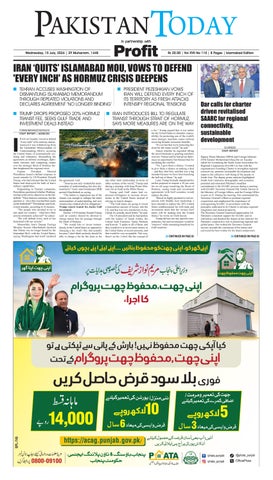
IRAN ‘QUITS’ ISLAMABAD MOU, VOWS TO DEFEND 'EVERY INCH' AS HORMUZ CRISIS DEEPENS g
g
I
TEHRAN ACCUSES WASHINGTON OF DISMANTLING ISLAMABAD MEMORANDUM THROUGH REPEATED VIOLATIONS AND DECLARES AGREEMENT ‘NO LONGER BINDING’
TRUMP DROPS PROPOSED 20% HORMUZ TRANSIT FEE, SEEKS GULF TRADE AND INVESTMENT DEALS INSTEAD
TEHRAN/WASHINGTON/MUSCAT
g
g
PRESIDENT PEZESHKIAN VOWS IRAN WILL DEFEND EVERY INCH OF ITS TERRITORY AS FRESH ATTACKS INTENSIFY REGIONAL TENSIONS
IRAN INTRODUCES BILL TO REGULATE TRANSIT THROUGH STRAIT OF HORMUZ, SAYS MORE MEASURES ARE ON THE WAY
STAFF REPORT / AGENCIES
RAN on Tuesday vowed to defend "every inch" of its territory and announced it was withdrawing from the Islamabad Memorandum of Understanding (MoU), accusing the United States of systematically violating and ultimately dismantling the agreement, as military exchanges, diplomatic tensions and competing claims over the strategic Strait of Hormuz further heightened the regional crisis. Iranian President Masoud Pezeshkian issued a defiant response to recent remarks by US President Donald Trump, who had claimed that the United States had destroyed the bulk of Iran's military capabilities. Responding to Trump's comments, Pezeshkian questioned whether Washington had achieved its objectives on the battlefield. "Their rhetoric continues, but the question is – have they reached their goals on the battlefield?" Pezeshkian said in televised remarks, according to Al Jazeera. "The people who decided to try to tear apart our country – what have their actions ultimately achieved?" he asked. "We will defend every inch of our homeland with our actions." Meanwhile, Iran's Deputy Foreign Minister Kazem Gharibabadi declared that Tehran was no longer bound by the Islamabad MoU with the United States, saying Washington had itself rendered
the agreement void. "America not only violated the memorandum of understanding but also dismantled it," Iran's state broadcaster IRIB quoted Gharibabadi as saying. "The failure to implement one of the clauses was enough to collapse the entire memorandum of understanding, and now America has violated all of its obligations." Trump rejects transit fee, backs Gulf investment Earlier, US President Donald Trump said no country should be allowed to charge transit fees for passage through the Strait of Hormuz. "We would like to invest tremendously in the United States as opposed to charging a fee. And I like that actually because I don't think anybody should be able to charge a fee for the strait or for
any other strait relationship in terms of other sections of the world," Trump said during a meeting with Iraqi Prime Minister Ali al-Zaidi at the White House. Trump said Gulf states had expressed willingness to increase investments in the United States instead of relying on transit charges. "The Gulf states are going to invest a tremendous amount of money into the US, and that was very satisfactory to me. I think it's actually much better," he said. The US president said he had spoken with the leaders of Saudi Arabia, the United Arab Emirates, Qatar, Bahrain and Kuwait. "I spoke to all of them, and they would love to invest more money in the United States at record amounts, and that would be very acceptable. This way, there's no fee. I don't like the concept of
a fee." Trump argued that it was unfair for the United States to shoulder responsibility for protecting one of the world's most strategic maritime routes without receiving broader economic benefits. "It's not fair that we're protecting this strait for the entire world," he said. Asked whether he regretted lifting the naval blockade or granting sanctions waivers, Trump said he had given diplomacy an opportunity but blamed Iran for escalating the conflict. "No. I gave them a chance. I wanted to give them a chance at making a deal ... and they shot first, and that was a big mistake because we have been knocking the hell out of them," he said. Later, Trump formally abandoned his earlier proposal to impose a 20 per cent fee on all cargo transiting the Strait of Hormuz, saying trade and investment agreements with Gulf countries would replace the plan. "Based on highly productive conversations with Middle East leadership, I have decided to replace the 20% United States reimbursement fee with trade and investment deals that the various Gulf states will be making into the United States," he wrote on Truth Social. Trump did not cite any specific commitments, but said investments would be "massive" while remaining beneficial for Gulf countries.
CONTINUED ON PAGE 03
Dar calls for charter driven revitalised SAARC for regional connectivity, sustainable development ISLAMABAD
STAFF REPORT
Deputy Prime Minister (DPM) and Foreign Minister (FM) Senator Mohammad Ishaq Dar on Tuesday called for revitalising the South Asian Association for Regional Cooperation (SAARC) in line with the organisation's founding Charter to strengthen regional connectivity, promote sustainable development and improve the collective well-being of the people of South Asia. The deputy prime minister highlighted South Asia's immense demographic and economic potential and reiterated Pakistan's steadfast commitment to the SAARC process during a meeting with SAARC Secretary General Md. Golam Sarwar at the Ministry of Foreign Affairs, said the Foreign Office in post on X. During the meeting, Dar commended the Secretary General's efforts to promote regional cooperation and emphasised the importance of reinvigorating SAARC in accordance with the principles enshrined in its Charter to advance regional integration and shared prosperity. The Secretary General expressed appreciation for Pakistan's consistent support for SAARC and its institutions and thanked the deputy prime minister for Pakistan's constructive role in promoting regional and global peace. Dar wished the Secretary General success towards the conclusion of his tenure and conveyed his best wishes for his future endeavours.
CONTINUED ON PAGE 03