In partnership with
Profit
Friday, 10 July, 2026 | 24 Muharram, 1448
Rs 20.00 | Vol XVII No 105 | 8 Pages | Karachi Edition
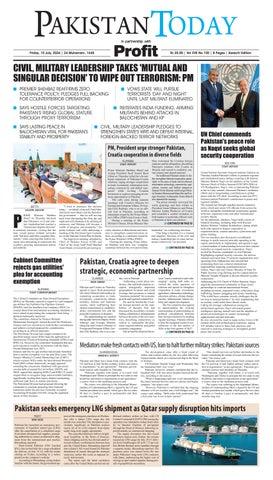
CIVIL, MILITARY LEADERSHIP TAKES 'MUTUAL AND SINGULAR DECISION' TO WIPE OUT TERRORISM: PM g
g
g
PREMIER SHEHBAZ REAFFIRMS ZERO TOLERANCE POLICY, PLEDGES FULL BACKING FOR COUNTERTERROR OPERATIONS SAYS HOSTILE FORCES TARGETING PAKISTAN'S RISING GLOBAL STATURE THROUGH PROXY TERRORISM
SAYS LASTING PEACE IN BALOCHISTAN VITAL FOR PAKISTAN'S STABILITY AND PROSPERITY
g
g
g
VOWS STATE WILL PURSUE TERRORISTS 'DAY AND NIGHT' UNTIL LAST MILITANT ELIMINATED
REITERATES INDIA FUNDING, ARMING MILITANTS BEHIND ATTACKS IN BALOCHISTAN AND KP
CIVIL, MILITARY LEADERSHIP PLEDGES TO STRENGTHEN STATE'S WRIT AND DEFEAT INTERNAL, FOREIGN-BACKED TERROR NETWORKS
PM, President urge stronger Pakistan, Croatia cooperation in diverse fields ISLAMABAD
STAFF REPORT
P
QUETTA SALEEM JADOON
RIME Minister Shehbaz Sharif on Thursday declared that Pakistan's civil and military leadership had reached a "mutual and singular decision" to eradicate terrorism, vowing that the state would pursue militant networks with “full force until their complete elimination” while asserting that hostile elements were attempting to undermine the country's growing international stature and stability.
"I want to announce this decision today — on behalf of myself, Field Marshal Syed Asim Munir and the Balochistan government — that we will not step back from eliminating this fitna day and night and will eliminate it by utilising all resources, and Pakistan will become a cradle of progress and prosperity," the prime minister said while addressing a meeting of the Provincial Apex Committee on the National Action Plan in Quetta. The high-level meeting, attended by Chief of Defence Forces (CDF) and Chief of the Army Staff Field Marshal Asim Munir, reviewed the prevailing se-
Cabinet Committee rejects gas utilities' plea for accounting exemption
curity situation in Balochistan and measures to strengthen counterterrorism efforts, according to a statement issued by the Prime Minister's Office (PMO). Chairing the meeting, Prime Minister Shehbaz said there was “complete consensus between the civil and military
CONTINUED ON PAGE 03
leadership” on confronting terrorism. "One thing is decided: it is a {mutual and singular} decision of the civil and military leadership that we must end terrorism collectively," he declared.
CONTINUED ON PAGE 03
Pakistan, Croatia agree to deepen strategic, economic partnership ISLAMABAD
MIAN ABRAR
ISLAMABAD
STAFF CORRESPONDENT
Prime Minister Shehbaz Sharif and Acting President Syed Yousuf Raza Gilani on Thursday called for a broadbased expansion of Pakistan-Croatia relations, urging stronger cooperation in trade, investment, information technology, connectivity and skilled manpower while inviting Croatian businesses to explore emerging investment opportunities in Pakistan. The calls came during separate meetings with Croatia's Minister for Foreign and European Affairs, Dr Gordan Grlić Radman, who is on an official visit to Pakistan, according to statements issued by the Prime Minister's Office (PMO) and Aiwan-e-Sadr. During a meeting at the Prime Minister's House, Prime Minister She-
hbaz welcomed the Croatian foreign minister and his delegation, describing Pakistan's relations with Croatia as friendly and rooted in cordiality, mutual respect and shared interests. He reaffirmed Pakistan's desire to further strengthen bilateral cooperation, particularly in the areas of trade and investment, information technology, connectivity, agriculture, tourism and skilled manpower. Deputy Prime Minister and Foreign Minister Senator Mohammad Ishaq Dar and Foreign Secretary Ambassador Amna Baloch also attended the meeting. The prime minister conveyed his warm greetings and best wishes to President Zoran Milanović and Prime Minister Andrej Plenković of Croatia and extended a cordial invitation to both leaders to undertake official visits to Pakistan at their convenience.
The Cabinet Committee on State-Owned Enterprises (SOEs) on Thursday rejected a request by cash-strapped gas utilities Sui Northern Gas Pipelines Limited (SNGPL) and Sui Southern Gas Company (SSGC) to exempt them from international accounting standards, a move aimed at preventing the companies from being declared technically insolvent. The committee, chaired by Finance Minister Muhammad Aurangzeb, instead directed the Petroleum, Finance and Law ministries to hold further consultations and submit a revised proposal for consideration, according to an official statement. The Petroleum Division had sought exemption for specified energy-sector SOEs from the application of International Financial Reporting Standards (IFRS-9 and IFRS-14). However, the committee maintained that any such relaxation would be inconsistent with the StateOwned Enterprises Act, 2023. Sources said the two gas utilities had already benefited from a similar exemption over the past three years. The Finance Ministry's Central Monitoring Unit (CMU), which oversees SOEs under the International Monetary Fund (IMF) reform framework, strongly opposed extending the concession. Burdened with gas-sector circular debt of around Rs3.44 trillion, SNGPL and SSGC argued that adopting IFRS-9 and IFRS-14 would require them to recognise large unrecoverable liabilities, significantly eroding their equity despite maintaining sufficient cash flows to sustain operations. The Petroleum Division had proposed allowing the companies to continue preparing their financial statements under the previous Generally Accepted Accounting Principles (GAAP), citing the regulated nature of their business.
Pakistan and Croatia on Thursday agreed to inject fresh momentum into their bilateral relationship by expanding cooperation in trade, investment, connectivity, labour mobility, defence and maritime sectors, while reaffirming their shared commitment to multilateralism, international law and the peaceful resolution of disputes. The understanding was reached during talks between Deputy Prime Minister and Foreign Minister Ishaq Dar and Croatia's Minister of Foreign and European Affairs, Gordan Grlić Radman, who is on a one-
day visit to Pakistan. Addressing a joint press conference, Dar said both countries occupied strategically important geographical locations and could leverage their positions to unlock "enormous potential" for economic growth and regional connectivity. He said he briefed the Croatian foreign minister on the capabilities of Karachi Port and discussed the possibility of establishing collaborative arrangements between the ports of the two countries, describing connectivity as central to sustainable development, regional stability and global economic integration. Dar termed the bilateral discus-
sions "warm, constructive and wideranging", saying both sides reviewed the entire spectrum of relations and agreed to strengthen cooperation in trade, investment, agriculture, information technology, education, defence, climate change, tourism, infrastructure, labour mobility and seaport development. The two countries also agreed to operationalise the existing memorandum of understanding on political consultations between their foreign ministries by holding regular meetings. Pakistan offered to host the inaugural round of consultations in the last quarter of 2026 or the first quarter of 2027.
CONTINUED ON PAGE 03
UN Chief commends Pakistan's peace role as Naqvi seeks global security cooperation NEW YORK
STAFF REPORT
United Nations Secretary-General António Guterres on Thursday lauded Pakistan's efforts to promote regional and international peace during a meeting with Interior Minister Mohsin Naqvi on the sidelines of the United Nations Chiefs of Police Summit (UNCOPS-2026) at UN Headquarters. Naqvi, who is representing Pakistan at the two-day summit, discussed Pakistan's mediation efforts and its longstanding contributions to global peace with the UN chief. According to state-run PTV, Guterres praised Pakistan's commitment to peace and regional stability. The summit has brought together interior ministers, police chiefs and senior UN officials from across the world to strengthen international cooperation against terrorism, organised crime and other transnational security threats. On the diplomatic sidelines, Naqvi held a series of bilateral meetings, including talks with Russian Interior Minister Vladimir Kolokoltsev, during which both sides agreed to deepen cooperation in counterterrorism, counter-narcotics, cybercrime and police training. The two ministers also discussed a coordinated strategy to tackle terrorist networks operating in the region, particularly in Afghanistan, and agreed to sign a memorandum of understanding between their interior ministries to expand security cooperation. Naqvi invited his Russian counterpart to visit Pakistan. Highlighting regional security concerns, the interior minister said more than 25 terrorist organisations were operating from Afghanistan and stressed that eliminating them was a shared international responsibility requiring coordinated action. Earlier, Naqvi also met China's Minister of State for Public Security Ling Zhifeng and Sri Lankan Interior Minister Ananda Wijepala to discuss bilateral security cooperation. Addressing the UN Chiefs of Police Summit, Naqvi urged the international community to forge closer partnerships to confront transnational threats, including terrorism, organised crime, cybercrime, drug trafficking, human smuggling and money laundering. "The world faces common security challenges that do not stop at national borders," he said, emphasising that no country could tackle these threats alone. Calling for stronger collaboration among law enforcement agencies, Naqvi advocated greater intelligence sharing, mutual trust and the adoption of advanced technologies to counter increasingly sophisticated criminal networks. He also stressed the need to equip police forces with modern skills and technological expertise, urging UN member states to share best practices and innovative policing strategies to strengthen global peace and security.
Mediators make fresh contacts with US, Iran to halt further military strikes: Pakistani sources ISLAMABAD/DOHA
ANADOLU AGENCY
Pakistan and Qatar have made fresh contacts with the US and Iran to halt further military strikes and return to negotiations “as per agreement,” Pakistani government sources told Anadolu on Thursday. “Pakistan, together with Qatar, is in touch with Washington and Tehran to persuade the two sides to end hostilities and return to negotiations as per agreement,” a source close to the mediation process said. The source was referring to the Islamabad Memorandum of Understanding (MoU), signed by the US and Iranian presidents last month, which gave the two sides 60 days to finalize a pact to permanently end their months-long war.
The development came after a fresh round of strikes and counter-strikes by the two sides following Iranian missile attack on a commercial ship in the Strait of Hormuz. US President Donald Trump said Wednesday that the Islamabad MoU was “over.” Pakistan, however, remains confident that the Islamabad MoU will stay intact despite renewed hostilities, according to the sources. “What is happening right now is not unexpected as the issues between the two sides are chronic and highly complex,” the source said. “However, Pakistan is confident that the ongoing situation will not escalate into a full-fledged war,” the source said, adding: “Both sides fully understand that a full-scale war is not in their interest.”
“One should not rule out further skirmishes in the future considering the nature of issues between the two sides,” the source said. Pakistan and Qatar have made fresh contacts with the US and Iran to halt further military strikes and return to negotiations “as per agreement,” Pakistani government sources told Anadolu on Thursday. “Pakistan, together with Qatar, is in touch with Washington and Tehran to persuade the two sides to end hostilities and return to negotiations as per agreement,” a source close to the mediation process said. The source was referring to the Islamabad Memorandum of Understanding (MoU), signed by the US and Iranian presidents last month, which gave the two sides 60 days to finalize a pact to permanently end their months-long war.
Pakistan seeks emergency LNG shipment as Qatar supply disruption hits imports PROFIT
WEB DESK
Pakistan has launched an emergency procurement of liquefied natural gas (LNG) after the cancellation of a scheduled cargo from Qatar disrupted fuel supplies, prompting authorities to source an alternative shipment from the international spot market, Bloomberg reported. State-owned Pakistan LNG Limited (PLL) has invited bids for a cargo scheduled for delivery on July 15-16, with the tender closing on Friday, according to a notice posted on the company's website. According to Bloomberg, citing traders familiar with the matter, the government ap-
proved the emergency purchase on Wednesday after a Qatari LNG cargo due this month was cancelled. The disruption is particularly significant as Pakistan sources nearly all of its LNG imports from Qatar under long-term supply agreements. The cancelled shipment follows heightened instability in the Strait of Hormuz, where shipping activity has slowed amid renewed military confrontation between Iran and the United States. Bloomberg reported that a Qatari LNG vessel bound for Pakistan abandoned its transit through the strategic waterway earlier this week as regional security deteriorated. The report said the latest escalation came after the United States carried out ad-
ditional military strikes on Iran, with US Central Command (CENTCOM) saying the operation was intended to reduce Iran's ability to threaten freedom of navigation through the Strait of Hormuz following reported attacks on commercial shipping. The supply disruption has also raised Pakistan's import costs. Earlier, the country secured an LNG cargo for July 10-11 delivery from TotalEnergies SE at $17.37 per million British thermal units (mmBtu) through a separate tender, Bloomberg reported. The purchase price was almost twice the rate under Pakistan's long-term LNG contracts with Qatar, underscoring the higher cost of relying on spot-market supplies during periods of geopolitical uncertainty.