In partnership with
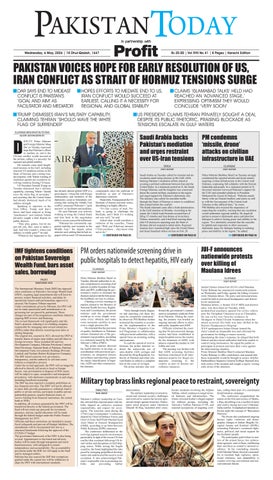
PAKISTAN VOICES HOPE FOR EARLY RESOLUTION OF US, IRAN CONFLICT AS STRAIT OF HORMUZ TENSIONS SURGE
Profit
Wednesday, 6 May, 2026 | 18 Dhul-Qadah, 1447
g DAR SAYS END TO MIDEAST
CONFLICT IS PAKISTAN'S ‘GOAL AND AIM’ AS FACILITATOR AND MEDIATOR
g HOPES EFFORTS TO MEDIATE END TO US,
REACHED AN ‘ADVANCED STAGE,’ EXPRESSING OPTIMISM THEY WOULD CONCLUDE ‘VERY SOON’
g US PRESIDENT CLAIMS TEHRAN PRIVATELY SOUGHT A DEAL
CLAIMING TEHRAN ‘SHOULD WAVE THE WHITE FLAG OF SURRENDER’
DESPITE ITS PUBLIC RHETORIC, PRAISING BLOCKADE AS TENSIONS ESCALATE IN GULF WATERS
D
ISLAMABAD/WASHIINGTON/TEHRAN saleeM jadoon/agencies
Saudi Arabia backs Pakistan’s mediation and urges restraint over US-Iran tensions
PM condemns ‘missile, drone’ attacks on civilian infrastructure in UAE
staff report
staff report
RIYADH
has already dented global GDP to a great degree,” Ishaq Dar told foreign ambassadors and members of the diplomatic corps in Islamabad, reiterating that ending the Middle East conflict remained Pakistan’s “goal and aim” as facilitator and mediator. He said Pakistan was actively working to bring the United States and Iran back to the negotiation table to secure a peaceful settlement. “Pakistan has consistently supported stability and restraint in the Middle East,” the deputy prime minister said, adding that he had engaged with around 120 international
IMF tightens conditions on Pakistan Sovereign Wealth Fund, bars asset sales, borrowing PROFIT
Monitoring desk
g CLAIMS ‘ISLAMABAD TALKS’ HELD HAD
IRAN CONFLICT WOULD SUCCEED AT EARLIEST, CALLING IT A NECESSITY FOR REGIONAL AND GLOBAL STABILITY
g TRUMP DISMISSES IRAN’S MILITARY CAPABILITY,
EPUTY Prime Minister and Foreign Minister Ishaq Dar on Tuesday expressed hope that Pakistan’s efforts to mediate an end to the US-Iran conflict would succeed at the earliest, calling it a necessity for regional and global stability. His remarks came amid heightened tensions in the Gulf, including renewed US maritime actions in the Strait of Hormuz and a strong Iranian response, with Tehran warning of retaliation against any escalation involving countries hosting US bases. US President Donald Trump on Tuesday dismissed Iran’s military capability, claiming Tehran “should wave the white flag of surrender,” and asserting that the United States had already destroyed much of its military strength. Speaking to reporters in the Oval Office, Trump said Iran’s forces had been reduced to firing “peashooters” and claimed Tehran privately sought a deal despite its public rhetoric. “They play games, but let me just tell you, they want to make a deal. And who wouldn’t, when your military is totally gone?” he said. “Whatever has happened so far
Rs 20.00 | Vol XVII No 41 | 8 Pages | Karachi Edition
The International Monetary Fund (IMF) has imposed strict conditions on Pakistan’s Sovereign Wealth Fund (SWF), requiring legal amendments that will limit its powers, restrict financial activities, and delay its operational launch until parliamentary approval is secured, The Express Tribune reported. Under commitments given by Pakistan, the SWF will not be made operational until amendments to its governing law are passed by parliament. These changes are part of the programme conditions linked to ongoing IMF reviews and financing. The revised framework will significantly alter the fund’s structure, reducing it to a holding company responsible for managing state-owned enterprises (SOEs) rather than directly executing asset sales or raising financing. The original law, enacted in 2023, allowed the SWF to transfer shares of major state entities and sell them to foreign investors. These included Oil and Gas Development Company, Pakistan Petroleum Limited, Mari Petroleum, National Bank of Pakistan, Pakistan Development Fund, Government Holdings (Private) Limited, and Neelum-Jhelum Hydropower Company. The IMF raised concerns over governance, transparency, and the authority to sell state assets without a competitive process. Under the revised approach, the SWF will no longer be allowed to directly sell assets to local or foreign buyers. Any privatisation or disposal of SOE assets will be subject to open, competitive and transparent procedures, with disclosure requirements at each stage, including beneficial ownership. The IMF has also required a complete prohibition on key financial activities. The SWF will not be allowed to incur debt, provide guarantees or collateral, lend to public or private entities, participate in public-private partnership projects, acquire financial assets, or receive funding from financial institutions, the central bank or SOEs. In addition, all revenues generated by the SWF will be transferred directly to the federal government. The fund will not retain any proceeds for investment purposes, and any capital allocation will be made through the federal budget under the Public Finance Management Act 2019. Officials said these restrictions are intended to ensure fiscal safeguards and prevent off-budget liabilities. The amendments will be incorporated into law as a structural benchmark following the approval of the FY2026-27 budget. The governance framework of the SWF is also being revised. Appointments to the board and advisory bodies will be made through transparent and meritbased processes, with safeguards to ensure independence and accountability. The accountability provisions under the SOE Act will apply to the fund and its managed entities. Pakistan has also assured the IMF that exemptions granted under the current law will be withdrawn to align the SWF with international standards.
counterparts since the outbreak of hostilities as part of Pakistan’s diplomatic outreach. Meanwhile, Trump praised the US blockade of Iranian maritime routes, describing it as highly effective. “It’s like a piece of steel. Nobody is going to challenge the blockade, and I think it’s working out very well,” he said. Asked what would constitute a violation of the ceasefire, Trump said: “Well, you’ll find out, because I’ll let you know… they know what not to do.”
Saudi Arabia on Tuesday called for restraint and deescalation amid rising tensions in the Gulf, while backing Pakistan’s mediation efforts aimed at securing a political settlement between Iran and the United States. In a statement posted on X, the Saudi Foreign Ministry said the kingdom was concerned about the current military escalation in the region and urged support for Pakistan’s diplomatic role. The ministry also called for maritime traffic through the Strait of Hormuz to return to conditions that existed before the conflict. The Saudi statement came after a fresh deterioration in the Gulf situation on Monday. According to the report, the United Arab Emirates accused Iran of firing 15 missiles and four drones at its territory. Tehran, meanwhile, said it had fired warning shots after US destroyers operating near the Strait of Hormuz did not respond to initial alerts. Regional tensions have remained high since the United States and Israel launched strikes on Iran on Feb. 28.
Prime Minister Shehbaz Sharif on Tuesday strongly condemned the reported missile and drone attacks targeting civilian infrastructure in the United Arab Emirates, expressing full solidarity with the Emirati leadership and people. In a statement posted on X, the prime minister conveyed Pakistan’s support for the UAE and extended solidarity to President Mohamed bin Zayed Al Nahyan. “Pakistan stands firmly with our Emirati brothers and sisters as well as with the Government of the United Arab Emirates at this difficult time,” he wrote. PM Shehbaz also stressed the importance of respecting the ceasefire, warning that any escalation would undermine regional stability. He urged all parties to preserve diplomatic space and prioritise dialogue to achieve lasting peace and stability in the region. “It is absolutely essential that the ceasefire be upheld and respected, to allow necessary diplomatic space for dialogue leading to enduring peace and stability in the region,” he added.
CONTINUED ON PAGE 03
CONTINUED ON PAGE 03
CONTINUED ON PAGE 03
PM orders nationwide screening drive in public hospitals to detect hepatitis, HIV early ISLAMABAD
staff report
Prime Minister Shehbaz Sharif on Tuesday directed authorities to ensure comprehensive screening of all patients in public hospitals for hepatitis and HIV, reaffirming the government’s resolve to eliminate the diseases and provide the best possible healthcare services to citizens. Chairing a review meeting on matters related to the Ministry of National Health Services, Regulations and Coordination, the prime minister said the government would go to every length, overcome every obstacle and make every necessary sacrifice to save even a single precious life. He reiterated that the provision of quality healthcare to Pakistani citizens remained one of the government’s top priorities, according to a statement issued by the Prime Minister’s Office (PMO). The prime minister directed the health ministry to develop, in coordination with provincial governments, an integrated disease surveillance and reporting system for timely identification of hepatitis, AIDS and other communicable diseases.
ISLAMABAD
JUI-F announces nationwide protests over killing of Maulana Idrees ISLAMABAD
staff report
“Only through timely diagnosis and reporting can these diseases be completely eradicated,” he observed. PM Shehbaz further instructed the ministry to accelerate the implementation of the Prime Minister’s Hepatitis Control Programme in collaboration with provincial authorities, with a special focus on screening, testing and treatment. To curb the spread of viral infections, the prime minister ordered the nationwide use of auto-disable (AD) syringes and directed the Drug Regulatory Authority of Pakistan and other relevant bodies to enforce a complete ban on the reuse of syringes. The prime minister also reaf-
firmed the government’s commitment to completely eradicate Polio from Pakistan. During the meeting, the premier was briefed on ongoing national efforts to eliminate polio, hepatitis and AIDS. Officials informed the meeting that 98 anti-retroviral therapy centres had been established in major hospitals across the country for the treatment of AIDS, with plans to expand the number to 164 within one year. The meeting was further told that AIDS screening facilities had been introduced at all international airports for illegal immigrants returning to the country as part of disease surveillance measures.
Jamiat Ulema-i-Islam-Fazl (JUI-F) chief Maulana Fazlur Rehman has announced countrywide protests on Wednesday and Friday against the killing of senior cleric Maulana Idrees. The party said demonstrations would be held at provincial headquarters and district levels nationwide. Maulana Idrees, a former JUI-F MPA and district emir, was shot dead on Tuesday when unidentified assailants opened fire on his vehicle near the Tariqabad Utmanzai area in Charsadda. He was on his way from his residence in Tarangzai to Darul Uloom Noumania when the attack occurred. His body was later shifted to the District Headquarters Hospital. JUI-F spokesperson Aslam Ghouri termed the cleric’s death an irreparable loss and criticised the government for failing to ensure security. Questioning the state’s response, he alleged that both federal and provincial authorities had been unable to control rising lawlessness. He urged the public to participate in protests and raise their voice against the deteriorating situation. Prime Minister Shehbaz Sharif contacted Maulana Fazlur Rehman to offer condolences and assured that those responsible would be brought to justice. Khyber Pakhtunkhwa Inspector General Zulfiqar Hameed also took notice of the incident and sought a report, vowing early arrest of the attackers.
Military top brass links regional peace to restraint, sovereignty RAWALPINDI Mian abrar
Pakistan’s military leadership on Tuesday stressed that regional peace and stability depend on collective restraint, responsibility, and respect for sovereignty. The assertion came during the 275th Corps Commanders’ Conference, chaired by Chief of Defence Forces and Chief of Army Staff Field Marshal Syed Asim Munir at General Headquarters (GHQ), according to an Inter-Services Public Relations (ISPR) statement. The conference deliberated on the evolving regional security environment, particularly in light of the recent US-Iran conflict that escalated following US-Israeli strikes and disruptions in Gulf shipping routes. While noting the fragile ceasefire, the forum highlighted the risks posed by emerging geopolitical developments and underscored the need to avoid escalation. It also acknowledged Pakistan’s responsible role in promoting stability and preventing further
deterioration. The military leadership reviewed internal and external security challenges and resolved to sustain the current operational tempo against terrorism. Participants noted progress under Operation Ghazab lil-Haq, launched after cross-
border incidents involving the Afghan Taliban, which continues to target terrorist hideouts and infrastructure. The forum criticised Kabul’s alleged support for militant groups, including the Tehreek-i-Taliban Pakistan (TTP), and rejected accusations of targeting civil-
ians, calling them part of a coordinated disinformation campaign. The conference congratulated the nation on the first anniversary of Markai-Haq, describing it as a symbol of unity and resolve during last year’s PakistanIndia conflict. It emphasised national cohesion under the concept of “Bunyanum Marsoos.” The forum also condemned ongoing human rights violations and demographic changes in Indian Illegally Occupied Jammu and Kashmir (IIOJK), reiterating Pakistan’s continued diplomatic, political, and moral support for the Kashmiri people. The participants paid tribute to martyrs of the armed forces, law enforcement agencies, and civilians, reaffirming their sacrifices as central to national resilience. In his concluding remarks, Field Marshal Munir directed commanders to maintain high vigilance, operational readiness, and adaptability to counter evolving conventional and nonconventional threats.