Epaper_26-05-5 ISB

Page 1


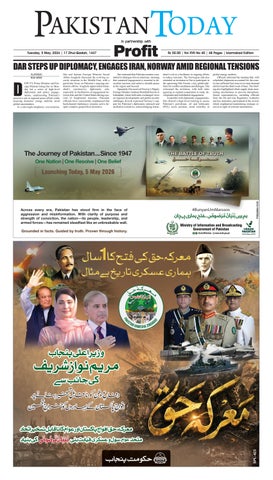
DAR STEPS UP DIPLOMACY, ENGAGES IRAN, NORWAY AMID REGIONAL TENSIONS

PSX SURGES OVER 950PTS DESPITE

RISKS AS HORMUZ TENSIONS PERSIST

and additional levies on imports from several countries The association also sought zerorating of customs duty on industrial spare parts and power plant components, while proposing regulatory and anti-dumping duties on imported yarn and fabric to protect domestic industry APTMA said more than 40% of spinning and weaving units have shut down, while remaining units face financial pressure due to rising input costs and import competition

KP CABINET APPROVES WHEAT PROCUREMENT OF 225,000 TONNES

reaffirmed the government s commitment to maintaining a clean and sustainable maritime environment, stressing that pollution-free ports are essential for safe navigation and economic growth He also commended Admiral Shahid

Pakistan business delegation joins Selec t USA summit in Mar yland

COMMENT

Gulf on edge

TTh e ongoing war involving US, Israel, and Iran has triggered one of the most serious disruptions in global energy markets in recent years For the past two weeks the Strait of hormuz the world’s most critical oil chokepoint has effectively been closed to commercial energy traffic Nearly one-fifth of global oil trade normally flows through this narrow maritime corridor

Its disruption has once again exposed the fragility of the global energy system and, more importantly, Pakistan’s deep structural vulnerability to external shocks Pakistan’s energy economy is heavily dependent on imported fossil fuels Oil alone accounts for around 54 percent of the country s fossil fuel imports and the country imports approximately 80 to 85 percent of its petroleum requirements Almost half of these imports pass through the Strait of hormuz, meaning that any disruption along this route can quickly translate into domestic fuel shortages higher transport costs and inflationary pressure across the economy This crisis highlights a fundamental structural weakness: Pakistan s energy security relies heavily on a single maritime supply corridor The typical energy flow pattern is straightforward crude oil and liquefied natural gas shipped from Gulf producers reach Pakistani ports such as Karachi Port and Port Qasim through the Strait of hormuz While this system functions efficiently during stable geopolitical conditions it becomes highly vulnerable during regional conflicts In this context the China–Pakistan economic Corridor (CPeC) presents an opportunity not merely for infrastructure development but for reimagining Pakistan’s energy security architecture If approached strategically CPeC could help diversify energy supply routes strengthen domestic resilience and reduce exposure to volatile global energy markets

One of the most immediate strategic opportunities lies in developing Gwadar Port as a regional energy logistics hub Gwadar s geographic location near the mouth of the Persian Gulf places it close to major global shipping routes By developing large-scale oil storage facilities and strategic petroleum reserves at Gwadar Pakistan could build emergency buffers against shortterm supply disruptions Currently Pakistan s petroleum reserves typically cover only a few weeks of consumption, far below the 90-day strategic reserves maintained by many industrial economies expanding storage capacity would significantly enhance the country’s ability to withstand temporary supply shocks Beyond maritime infrastructure Pakistan must also rethink its position within the broader eurasian energy landscape Central Asia possesses vast hydrocarbon and hydropower resources, yet Pakistan remains largely disconnected from these energy systems The primary barrier to direct connectivity has historically been the unstable security environment in Afghanistan, which complicates cross-border infrastructure projects

BAn alternative approach worth exploring is the development of energy corridors linking Pakistan with Central Asia through western China China already maintains extensive pipeline infrastructure connecting Central Asian energy producers to its western regions expanding regional connectivity under the broader framework of Belt and Road Initiative could eventually allow oil and gas pipelines to extend southward toward Pakistan While technically challenging due to terrain and infrastructure requirements, such a corridor could diversify Pakistan s energy supply routes and reduce dependence on maritime imports electricity connectivity presents another promising opportunity Central Asian countries possess substantial hydropower potential particularly in the mountainous regions of Tajikistan and Kyrgyzstan These countries generate surplus hydropower during the summer months when river flows are high Coincidentally, Pakistan experiences peak electricity demand during the same period due to cooling loads Strengthening regional transmission infrastructure could allow Pakistan to import surplus hydropower from Central Asia during the summer season improving both energy affordability and grid stability While international connectivity is essential, Pakistan s energy resilience must also be strengthened domestically Many parts of Balochistan, Khyber Pakhtunkhwa, and Gilgit‐Baltistan remain underserved by the national electricity grid due to dispersed populations and challenging terrain extending the central grid to these regions is often economically unviable Instead hybrid renewable-based microgrids and smart grids can provide a practical

Raising kids differently

patience has limits, and security becomes a matter of necessity rather

Militant networks continue to operate from Afghan soil with

carrying out attacks that kill innocents and

at Pakistan s security infrastructure For any

groups to use a

’s land as a launchpad for violence is unacceptable Pakistan’s response has therefore shifted from diplomatic appeals to assertive counterterrorism operations Critics may decry these actions as escalatory but the fundamental duty of any government is clear: protect its citizens and defend its borders

The stakes are amplified by the broader strategic context The TTP does not act in isolation By sheltering these militants Afghanistan has effectively become a conduit for hostile regional actors most prominently India seeking to drain Pakistan s attention and resources Whether through direct support, tacit encouragement, or the simple failure to act, the use of Afghan territory as a base for attacks deepens mistrust and leaves Islamabad little choice but to respond decisively Afghanistan s internal fragility compounds the problem Since the Taliban s return to power, the country has faced economic collapse, international isolation, and weakened governance factors that have limited Kabul’s ability

Afghanistan’s own claim to sovereignty and legitimacy in the eyes of its neighbours and the international community Informal back-channel diplomacy has emerged as a stopgap, with influential religious and tribal figures attempting to bridge gaps that formal talks cannot Yet dialogue alone cannot replace concrete action Pakistan’s demand is straightforward that Afghan soil must not be used to launch attacks Failure to uphold this responsibility is not merely a bilateral issue it undermines sovereignty and erodes the foundations of peaceful coexistence The consequences of continued inaction are predictable and unavoidable The opportunity for Afghanistan however is substantial A cooperative Kabul could transform the region Trade corridors linking South Asia and Central Asia could flourish energy networks could be developed, and economic integration could uplift millions on both sides of the border A secure, stable Afghanistan would attract investment tourism and regional partnerships creating a foundation for growth that benefits everyone Pakistan has repeatedly emphasized that regional prosperity depends on Afghanistan taking decisive steps to prevent its territory from being exploited by militant proxies Peace and stability would create opportunities that have long eluded both countries

The alternative is stark Continued tolerance of insurgent activity or acting as a proxy for hostile powers is a strategic miscalculation Using Afghan territory to target Pakistan not only destabilizes its neighbour but also threatens Afghanistan s own security, isolates it diplomatically, and invites retaliatory measures that could be devastating The logic is simple: a state that permits or tolerates proxy violence against its neighbour inevitably invites conflict and its consequences The message is unambiguous:

stand with Pakistan and regional peace and Afghanistan prospers; exploit Pakistan through proxies and it will face severe repercussions Ultimately the future of PakistanAfghanistan relations hinges on a clear choice by Kabul Afghanistan can embrace partnership, uphold security commitments and prevent its territory from being used against Pakistan paving the way for stability economic growth and regional opportunity Or it can persist in proxy games and militancy, aligning with hostile actors, most notably India, and jeopardizing its own future The decision is not only about Pakistan but Afghanistan’s own survival, legitimacy and prosperity Pakistan remains committed to peace and regional cooperation Dialogue channels remain open and opportunities for collaboration abound But words alone will not secure stability The time for action is now Afghanistan can choose a path of responsible statehood, security, and shared prosperity or it can continue down a path of proxy conflict inviting consequences that will be immediate severe and unavoidable The choice is Afghanistan s and the stakes could not be higher Stability, growth, and regional trust are within reach if Kabul acts responsibly Defiance, proxy warfare, and complicity in attacks against Pakistan will not only threaten neighbours but will erode Afghanistan’s own future The lesson is clear that a cooperative Afghanistan will thrive but one that chooses proxies over peace will pay a steep price

The writer is Ph D in Political Science and visiting faculty at QAU Islamabad His area of specialization is political development and social change He can be reached at zafarkhansafdar@yahoo com and tweet@zafarkhansafdar

Ear th on edge

testing

uation that is not

public schools For

offers a way to

progress and identify gaps For

and students however it can sometimes translate into pressure to perform within narrow parameters Maryam Nawaz Sharif s challenge lies in balancing these competing considerations On one hand, there is a clear need to raise standards and ensure accountability On the other education cannot be reduced to test scores alone Issues such as teacher training curriculum relevance and student well-being require equal attention In her recent statements, there has been some recognition of this broader picture, with references to improving school infrastructure investing in teacher capacity and incorporating modern teaching methods

Another dimension of her educational vision is its social context In many parts of Punjab, particularly in rural and underserved urban areas, schools are not just centres of learning but also spaces of social mobility For families struggling with economic hardship the availability of a functional school nearby can make a tangible difference By expanding programmes under PEF and refining initiatives like PSRP, the government appears to be aiming for a model that combines reach with a degree of flexibility Yet questions remain about sustainability Public-private partnerships can deliver results in the short to medium term but they also require consistent funding and effective regulation Ensuring that partner schools adhere to agreed standards, while also maintaining affordability for families, is no small task Past experiences have shown that without robust monitoring disparities can emerge between different regions and providers There is also the issue of perception For many public education carries an expectation of state responsibility The increasing role of private actors, even within a regulated framework, can raise concerns about equity and long-term

n c a n n o t b e r e d u c e d t o t e s t s c o r e s a l o n e I s s u e s s u c h a s t e a c h e r

t r a i n i n g , c u r r i c u l u m r e l e va n c e , a n d s t u d e n t w e l l - b e i n g r e q u i r e e q u a l a t t e n t i o n . I n

through standardised

All this appeared to overlap with US interests Washington had long claimed that its priorities in the Middle East included securing energy supply chains stabilising oil markets, and ensuring regional stability so it could pivot towards Asia And yet, the Trump administration chose to go against what it claimed to stand for

CHOOSING CHAOS OVER STABILITY: By now it is clear that Washington has chosen to support Israeli Prime Minister Benjamin Netanyahu s agenda of pursuing regional instability and domination By opting to advance Netanyahu’s expansionist objectives, even at the cost of its own interests, Washington has effectively placed the Strait of Hormuz and Bab al-Mandeb – the world s most critical energy chokepoints – at risk exposing global oil and gas markets to extreme volatility

These US choices have placed the entire region, with the Gulf states at the forefront, into a state of chaos We are likely to live with its aftershocks for years to come driven by the fears of all states and compounded by growing power imbalances

Here Gulf and Arab states must recognise a fundamental reality: there can be no durable regional stability built on dependence on the US Americans are not the sons of this land nor of this region No matter how much the international system evolves, and the world becomes interconnected through globalisation and technological change geography and demography will remain decisive in shaping interests A power located thousands of kilometres away rooted in a different demographic and geographic reality cannot be depended upon to defend Arab interests

Still, some states continue to hedge their bets on a “special relationship” with the US, turning their back on unity The United Arab Emirates for example recently decided to leave OPEC which had long given leverage to oil-producing Arab states over the US and the rest of the world This move signals withdrawal rather than deepening cooperation and working through disputes In the short term, this may look like the right decision to preserve national interest, but in the long term, it plays into the hands of those who want to divide and rule the Arab world – something that is ultimately not in the Emirati interest

Instead of investing more resources in an alliance with Washington Arab states should focus on intra-regional development aimed at economic, security and military self-sufficiency, akin in some respects to the Turkish and Iranian projects They should focus on internal dialogue and greater cohesion and pursue

dr muhammad akram Zaheer

UAE'S FUJAIRAH SAYS FIRE BREAKS OUT AT PETROLEUM COMPLEX AFTER IRANIAN 'DRONE ATTACK'

missile destroyers are currently operating in the Arabian Gulf after transiting the Strait of Hormuz in support of Project Freedom It further added that American forces were actively assisting efforts to restore transit for commercial shipping As a first step, 2 US-flagged merchant vessels have successfully transited through the Strait of Hormuz and are safely headed on their journey it added According to Press TV Iran stated that its forces had already fired warning shots at several US military vessels

“Just like during the 40-day war, Iran will not allow American combat ships to pass and any transit through the Strait of Hormuz will require authorisation from Iran s armed forces it added Earlier Iran s navy said it had prevented the entry of enemy warships into the Strait of Hormuz by issuing a "swift and decisive warning", according to state TV The Islamic Revolutionary Guard Corps (IRGC) has vowed to

'forcefully stop' ships violating Hormuz regulations The reported attack comes after President Trump said the US will begin Project Freedom on Monday to “guide” stranded ships out of the Strait of Hormuz

The semi-official Fars news agency said a US warship had been hit by two missiles while sailing

which cited South Africa’s Department of Health that patient is British WHO said it was informed by South Africa s National International Health Regulations Focal Point about a suspected outbreak

of hantavirus pulmonary syndrome involving passengers from the ship The UN health agency said the vessel had departed

CORPORATE CORNER

PUNJAB SETS JULY DEADLINE FOR 27 NEW SAHUL AT

BA Z A ARS TO OFFER SUBSIDISED ESSENTIALS

COMSATS University Islamabad (CUI) and the National Database and Registration Authority (NADRA) signed an MoU aimed at strengthening collaborative engagement in high-impact technological domains The agreement was signed by Dr Fahim A Qureshi Registrar CUI and Syed Gohar Abbas Jaffry, DG RHO NADRA The ceremony was attended by senior officials from both organizations, including Prof Dr Raheel Qamar, Rector CUI leading the CUI’s delegation The MoU establishes a structured framework for joint initiatives in R&D Priority areas include cybersecurity biometrics secure data management digital identity systems and artificial intelligence–driven analytics The collaboration is designed to contribute to the enhancement of Pakistan’s national identity management infrastructure through applied research and technology development The MoU also covers the scope of potential trainings and capacity building in the areas of expertise Speaking on the occasion Prof Dr Raheel Qamar underscored the complementary strengths of the two institutions as leading public-sector entities engaged in the development and deployment of advanced technologies He noted that the partnership would enable students to work with large-scale datasets facilitating applied learning and innovation with realworld relevance Prof Qamar also expressed the expectation that solutions developed through this collaboration could be scaled through NADRA s international engagements, particularly across EU, Africa, Oceania, and South Asia The leadership of both institutions conveyed confidence that the partnership will act as a catalyst for research-driven innovation human capital development and broader national progress in emerging technological domains

Synergy Adver tising becomes first in Pakistan to secure back-to-back

KARACHI s ta f f r e p o r t Synergy Advertising has achieved a landmark milestone for Pakistan’s advertising industry, becoming the first and only agency in the country to win the prestigious AFAA Brilliance Award for a second consecutive year The recognition secured in the Food & Beverages category for the local Pakistani pizza brand, Cheezious for their Cheezy Rider to the rescue campaign, cements the agency s position as a leading creative force at the regional level Presented by the Asian Federation of Advertising Associations the Brilliance Awards are judged by an international panel and honour campaigns that demonstrate both creative excellence and measurable business impact Widely regarded as one of Asia s most competitive industry accolades, the awards recognise work that delivers not just ideas, but results Synergy Group’s consecutive win reflects a sustained ability to deliver high-impact campaigns that combine compelling storytelling with data-driven

Riphah Hosts 6th

International Students Convention & Expo at Its Campus; Strong Par ticipation of Global Students and Diplomats Highlights the Event

universities and over 250 international students In his welcome address, Vice Chancellor Prof Dr Anis Ahmad (Sitara-e-Imtiaz) emphasized the university’s vision of value-based education, ethical leadership and social impact He stated “ RIU takes pride in providing a platform where education extends beyond classrooms to encompass values ethics and real-life impact ISCE 2026 reflects our commitment to promoting ethical leadership and empowering youth to become responsible global citizens ” The ceremony was also attended by distinguished academics and members of the diplomatic community including the Ambassador of Kazakhstan the High Commissioner of Mauritius and diplomats from Yemen Malaysia and Palestine

CDA Islamabad Takes Legal Action Against Illegal Housing Societies Shaheen Town and Islamabad Green Paradise in Zone IV

The Capital Development Authority (CDA) has initiated comprehensive actions against illegal housing societies established in Zone IV of Islamabad Their offices including the site office and public dealing office of the illegal housing societies namely Shaheen Town on Lehtrar Road and Islamabad Green Paradise have been sealed In the first phase, the offices used for administration and marketing of these societies are being sealed These actions have been taken against the aforementioned illegal housing societies for the unlawful sale and purchase of plots in violation of Sections 49-C 46 and 46-B of the CDA Ordinance 1960; Clause 5(1) and (3) of the ICT Zoning Regulations

IHC SAYS ONE CONSTITUTION AVENUE APARTMENT BUYERS HAVE NO OWNERSHIP RIGHTS

the same case Both later challenged their convictions before the IHC According to the case the couple received billions of rupees and land measuring hundreds of kanals from Bahria Town Ltd in exchange for legalising Rs50 billion that had been identified and returned to Pakistan by the United Kingdom during the PTI government Bushra Bibi access petition In a separate matter Justice Arbab Muhammad Tahir heard a petition filed by Bushra Bibi s daughter seeking permission for access to a personal physician and a family meeting During the hearing counsel Salman Akram Raja told the court that an application had already been submitted to Adiala Jail authorities through courier and also by hand He further informed the court that Bushra Bibi underwent surgery on the night between April 16 and 17 The court directed the jail superintendent to decide the application within two days and issue a reasoned order The superintendent was also summoned in person on May 6 Justice Tahir observed that the court

Pakistan, China explore green finance partnership to drive sustainable development

ISLAMABAD s ta f f r e p o r t

Federal Minister for Climate Change and Environmental Coordination Dr Musadik Malik on Monday held talks with Ma Jun to explore avenues for cooperation in green finance and sustainable development

During the meeting, Ma Jun, president of the Institute of Finance and Sustainability, briefed the minister on China’s Green Accelerator Programme launched in 2016 with 35 policy recommendations under a unified framework

He noted that China has since built the world s largest green financing system, valued at approximately $7 trillion Highlighting the scale of

China’s clean energy ecosystem Ma Jun said the country produces nearly 70 per cent of global wind and solar energy equipment and around 60 per cent of the world s electric vehicles

He explained that the Green Accelerator initiative focuses on developing bankable green projects by integrating technology finance carbon markets and project design ensuring scalable and commercially viable climate solutions

The discussion also covered practical applications of green technologies across different regions including biochar production from jute sticks in Bangladesh precision irrigation systems in Uzbekistan and desert agriculture initiatives in Abu Dhabi Both sides emphasised

the importance of adapting innovative solutions to local conditions while maintaining financial sustainability

Dr Malik highlighted Pakistan s proposed Green Fields initiative, aimed at linking young entrepreneurs working on environmentally sustainable ventures with national and international investors to promote green entrepreneurship

He appreciated China s leadership in green finance and technology, underscoring the need for stronger international collaboration to advance practical climate solutions The minister reiterated that Pakistan is keen to benefit from global best practices and partnerships to accelerate its transition toward a sustainable, green economy

Senate deputy chairman seeks repor t on Parliament Lodges security and maintenance lapses

Senate Deputy Chairman Syedal Khan Nasir on Monday took notice of security shortcomings and inadequate facilities at the Parliament Lodges

PMDC legal chief raises allegations of rule violations, corruption in council

authorisation or a note sheet from the legal department

Turn static files into dynamic content formats.

Create a flipbook