Epaper_26-05-4 ISB

Page 1


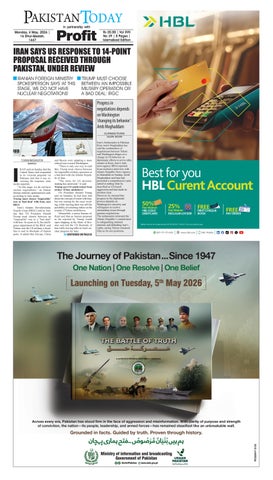
IRAN SAYS US RESPONSE TO 14-POINT PROPOSAL RECEIVED THROUGH PAKISTAN, UNDER REVIEW

g IRANIAN FOREIGN MINISTRY SPOKESPERSON SAYS 'AT THIS STAGE, WE DO NOT HAVE NUCLEAR NEGOTIATIONS'

g 'TRUMP MUST CHOOSE BETWEEN 'AN IMPOSSIBLE MILITARY OPERATION OR A BAD DEAL: IRGC

Progress in negotiations depends on Washington ‘changing its behavior ’: Amb Moghaddam ISLAMABAD/TEHRAN

Iran s Ambassador to Pakistan Reza Amiri Moghaddam has said the continuation of negotiations between Tehran and Washington hinges on a change in US behavior as diplomatic efforts to revive talks remain in focus, Iran s state news agency IRNA reported In an exclusive interview with Islamic Republic News Agency in Islamabad on Sunday Amiri Moghaddam said Iran had presented a comprehensive plan aimed at ending what he described as US-Israeli aggression and had made its position clear However he stressed that progress in the diplomatic process depends on Washington s sincerity and willingness to resolve outstanding issues through genuine negotiations The ambassador reiterated the Islamic Republic s commitment to safeguarding national interests and defending Iran s rights, saying Tehran remained firm on its core positions

PAKISTAN EYES SAUDI PARTNERSHIP FOR STRATEGIC

RESERVES AS SUPPLY RISKS MOUNT

Shehbaz seeks power tariff stability, orders grid reforms and theft crackdown

Aurangzeb pushes REIT reforms to deepen c apital markets, attrac t investment

attract greater investor participation, particularly from retail segments Participants also highlighted the need to address procedural inefficiencies, clarify regulatory requirements and ensure stronger coordination among stakeholders Officials noted that while Pakistan s REIT market has shown initial progress, it remains underdeveloped, with significant

PML-N supremo Nawaz Sharif at their Jati Umra residence in Lahore on Sunday where they discussed the Middle East conflict and the political situation in the country, said a statement issued by the Prime Minister ’s Office (PMO) Maryam Nawaz was also present during the meeting The PMO said the premier took Nawaz Sharif into confidence over the situation in the country and exchanged views on political developments, besides apprising him of the latest situation in the Middle East and Pakistan’s diplomatic efforts aimed at restoring peace in the region The conflict in the Middle East, now stretching beyond two months, erupted after US-Israeli strikes on Iran on February 28 Although active hostilities have remained suspended since a Pakistan-brokered two-week ceasefire on April 8 later extended indefinitely by US President Donald Trump the fallout from the war continues to reverberate globally Pakistan’s civil and military leadership has remained engaged in intensive diplomatic efforts, positioning Islamabad at the forefront of regional de-escalation initiatives On April 11 and 12, Pakistan hosted the first high-level contact between Iran and the United States in decades facilitating the meetings later dubbed the Islamabad Talks However, amid difficulties in arranging a second round, Islamabad has since reverted to its role as a facilitator and intermediary The conflict has also led to the closure of the Strait of Hormuz through which one-fifth of the world s oil and gas supplies would normally pass in peacetime, triggering a global energy crisis and driving up oil prices in international markets According to the PMO Prime Minister Shehbaz also briefed Nawaz Sharif on the surge in international oil prices and the government s measures to shield the public from its impact

Exper ts urge national health emergenc y over rising HIV cases

KARACHI

Medical experts on Saturday called on the government to declare a national health emergency over what they described as the dangerous spread of HIV, saying repeated outbreaks linked to healthcare facilities were increasingly affecting children Speaking at a press conference organised by the Pakistan Islamic Medical Association (Pima) the experts also demanded strict enforcement of basic infection control measures and the law on single-use syringes They further urged the creation of a national dashboard carrying credible data on major infectious diseases, including HIV, hepatitis B hepatitis C and mpox saying such a platform could support an evidence-based response to the country s health challenges The briefing brought together representatives

of the Pakistan Paediatric Association-Sindh Pakistan Society of Physicians Medical Microbiology and Infectious Diseases Society of Pakistan and Pakistan Medical Association The participants agreed that disease prevention was largely absent from the mandates of provincial health bodies responsible for providing free diagnosis and treatment for HIV and other infectious diseases They also stressed the need for increased health funding to ensure medical supplies and infection control protocols Dr Atif Hafeez Siddiqui a senior professor associated with Dow University of Health Sciences said low public spending was undermining implementation of safety measures "How could you implement these protocols in a country where the total health allocation remains critically low, consistently under one per cent of the GDP? Where hospitals operate either without or minimum supplies of basic infection control tools such as disinfectants

Iran says US response to 14-point proposal received through Pakistan, under review

CONTNTINUED FROM PAGE 01

When asked about Iran s proposal before boarding a flight to Miami at West Palm Beach Florida Trump replied: They told me about the concept of the deal They re going to give me the exact wording now" He added on his social media channel that he could not imagine the proposals would be acceptable and that Iran had not paid a big enough price for what it had done

Asked if he might restart strikes on Iran, Trump replied: I don t want to say that I mean, I can t tell a reporter that If they misbehave, if they do something bad right now we’ll see But it’s a possibility that could happen" US Navy acting like pirates Trump said the US Navy was acting like pirates in carrying out Washington s naval blockade of Iranian ports during the US and Israel's war against Iran Trump made the comments while describing the seizure by US forces of a ship a few days ago

We took over the ship we took over the cargo, we took over the oil It s a very profitable business," Trump said in remarks on Friday evening "We're like pirates We're sort of like pirates but we are not playing games" Meanwhile a senior Iranian military official has said renewed conflict with the US is possible after Donald Trump rejected the latest peace proposal from Tehran

"Evidence has shown that the United States is not committed to any promises or agreements " said Brig Gen Mohammad Jafar Asadi spokesman for Iran s military headquarters in remarks carried by Iranian news agencies

"Surprise measures are planned for the enemy, beyond their imagination," Asadi said Official Iranian outlets also meanwhile restated an uncompromising position on navigation through the Strait of Hormuz With its dominance and control over nearly 2,000 kilometers of Iran s coastline in the Persian Gulf and the Strait of Hormuz, the IRGC (Revolutionary Guards)

Navy will make this water area a source of livelihood and power for the dear Iranian people and a source of security and prosperity for the region," the semi-official Tasnim news agency reported Saturday

for diplomacy if the US changes

Reducing line losses

PR I M E M I N I S T E R Shehbaz Sharif has directed the authorities to formulate a comprehensive strategy to stabilise electricity tariffs with a focus on providing relief to domestic and industrial customers That is a tough ask in this era of Middle East conflict, as while the bureaucratic solution would be simply to raise tariffs through the Fuel Adjustment Charge mechanism, Mr Sharif knows that it would be politically impossible If line losses could be controlled, with the present 16 5 percent brought down to the five percent prevailing in the developed world, it would make a major difference It would mean that the cost of losses, presently passed on to the consumer, would go down, as WAPDA would no longer have to generate those extra units This would allow a substantial reduction in the base tariff which would mean that the fuel adjustment charge could follow the price of oil and gas

Another very perceptive suggestion made by Mr Sharif was for there to be a switch to renewable energy projects, which have the advantage of not requiring the import of fuel to generate power However, the problem with hydel is that it is of long gestation Solar power has two disadvantages: it requires a site to place the solar panels, and the panels have to be imported Also, until a solid storage solution reaches the market, solar power is not available at night Line losses are supposed to be caused by a combination of aging infrastructure and distribution company inefficiency, which is another phrase for theft Too much of the income of WAPDA staff comes from that theft for it to be given up easily Unless the political will is found to stop that theft lien losses cannot be reduced and paying customers will continue to suffer For this reason, Mr Sharif s directive is like playing a flute in front of a buffalo, as the Urdu proverb goes It is not the first time that the DISCOs have been told to reduce their line losses The National Electric Power Authority has threatened action, but has never refrained from giving the DISCOs the

RECENT revelations about large-scale cyber intrusions attributed to statelinked actors have brought the legal ambiguity of cyberspace into sharp focus In particular warnings by US cyber agencies about Chinese state-sponsored groups such as Volt Typhoon, which has reportedly infiltrated critical infrastructure networks, and “Salt Typhoon,” linked to breaches in telecommunications systems have underscored a troubling reality These incidents are not isolated technical breaches but part of a broader pattern of persistent cyber operations that sit uncomfortably between espionage, coercion, and acts of war They expose how international law is struggling to respond to a rapidly evolving domain of conflict The central problem is that cyber operations do not fit neatly into traditional legal categories The international legal framework particularly the United Nations Charter was designed to regulate overt acts of war such as invasions or missile strikes Cyber operations, however, can disable infrastructure, extract sensitive data, or disrupt essential services without triggering conventional thresholds of armed conflict The reported activities of Volt Typhoon which allegedly maintained long-term access to US critical infrastructure systems including energy and communications networks, illustrate this challenge Even if such intrusions are deeply concerning from a security perspective, their classification under international law remains uncertain

This ambiguity is further complicated by the question of harm International law tends to treat physical damage or loss of life as key indicators of a use of force Yet many cyber operations cause systemic disruption without direct physical destruction For example telecommunications breaches associated with Salt Typhoon reportedly allowed access to sensitive communications infrastructure While this raises serious national security concerns, it does not automatically meet the legal threshold of armed attack under existing interpretations of international law The result is a widening gap between perceived threat and legal categorization Attribution remains another major obstacle Cyber operations are designed to obscure responsibility through proxy networks, false flags, and layered infrastructure Even when intelligence agencies publicly attribute attacks, such as US and allied assessments linking Volt Typhoon to Chinese state-sponsored actors legal attribution requires a higher standard of proof under international law States are often reluc-

cant use of mechanization that mainly runs on fossil fuel, and fertilizer Here, fertilizer requires

ALT H O U G H a ceasefire exists with no breakthrough in peace negotiations the Middle East conflict has entered its third month In addition to substantive loss of life due to the conflict, the virtual closure of the Strait of Hormuz virtually has had severe negative supply side consequences especially for net oil importer countries and also in production of food due to shortage of fertilizers that this closure has caused This apparent stalemate in negotiations has sent the prices on an upper trajectory, as on April 30, The New York Times reported in an article ‘Oil prices soar to wartime high as standoff shows no end in sight that Oil prices continued to surge on Thursday hitting a fresh wartime high above $126 a barrel on concerns that the war in Iran could escalate, leading to a longer disruption of fuel supplies from the Middle East Over the past two weeks, the price of Brent crude, the global benchmark for oil, has risen about 30 percent The price of Brent for June delivery a soon-to-expire contract that investors trade based on their expectations for where prices are headed in the near future jumped on Thursday to $126 a barrel, before

of oil gas and fertilizer for instance The price of oil and gas have a profound link with food production, especially since the Green Revolution , along with price of fertilizer, given that high yields of food required both signifi-

tant to present detailed evidence publicly due to intelligence constraints, which weakens the ability to enforce accountability through legal mechanisms

This uncertainty extends to the principle of sovereignty Cyber intrusions challenge the traditional understanding of territorial integrity because they do not require physical entry into a state s territory However, they can still penetrate deeply into national systems France and the United Kingdom have argued that unauthorized cyber operations causing significant effects on systems within a state may constitute a violation of sovereignty Other states adopt narrower interpretations, requiring tangible damage This lack of consensus leaves a legal vacuum that cyber operations readily exploit The ongoing Russia-Ukraine conflict has further demonstrated how cyber operations operate in this grey zone Since 2022 Ukraine has faced continuous cyber attacks targeting government databases energy infrastructure and communication systems Russia, in turn, has been accused of deploying cyber operations alongside kinetic warfare These include attempts to disable Ukrainian power grids and disrupt public services While some of these actions have caused real-world disruption they are rarely treated as standalone armed attacks under international law Instead, they are absorbed into the broader context of an ongoing armed conflict, further blurring legal boundaries What makes these developments particularly concerning is the normalization of persistent cyber intrusion as a tool of statecraft Unlike traditional warfare cyber operations can be conducted continuously below the threshold of armed conflict This creates a strategic environment where states engage in constant low-level confrontation without triggering formal legal consequences Over time this risks eroding deterrence and making such behaviour routine

The implications for international stability are significant If states increasingly rely on cyber operations to achieve strategic objectives while avoiding legal thresholds, the distinction between peace and conflict becomes harder to

define Critical infrastructure such as hospitals, financial systems, and energy grids become continuous targets of influence and disruption

This raises the risk that a cyber operation could unintentionally escalate into a physical conflict if it causes cascading failures in essential systems International legal efforts to address this issue have so far been limited United Nations discussions through the Group of Governmental Experts and the Open-Ended Working Group have confirmed that international law applies to cyberspace However they have avoided defining precise thresholds for use of force intervention, or sovereignty violations This leaves states to interpret the law individually, resulting in fragmentation rather than clarity

In response, states have increasingly relied on unilateral measures such as sanctions public attribution and the development of offensive cyber capabilities While these tools provide some deterrence they operate outside a clear legal framework and risk contributing to escalation rather than resolution Without shared legal standards, responses to cyber operations become politically driven rather than normbased

The core challenge is not whether international law applies to cyberspace but whether it can be made precise enough to regulate it effectively The cases of Volt Typhoon, Salt Typhoon, and the ongoing cyber dimension of the RussiaUkraine war demonstrate that cyber operations are no longer hypothetical legal problems They are active instruments of geopolitical competition operating in a space where law has not yet caught up with practice Until international law develops clearer rules on attribution, sovereignty, and thresholds of force in cyberspace, the grey zone will persist In this space states gain strategic flexibility but the international system loses legal certainty The result is a fragile equilibrium where stability depends less on law and more on restraint

The writer can be reached at mohsinfareedshah786@gmail com

Until international law develops clearer rules on attribution, sovereignty, and thresholds of force in cyberspace, the grey zone will persist. In this space, states gain strategic flexibility, but the international system loses legal certainty The result is a fragile equilibrium where stability depends less on law and more on restraint.

Mohsin Fareed shah

vancement contributed to over 64 percent of China s agricultural growth The goal is a fundamental shift from labour-intensive farming to a modernized large-scale industry that can compete in a globalized world

Fthe village behind China’s experience over the last several years offers a compelling case study in this transition Having declared a victory over absolute poverty at the start of the decade Beijing did not simply declare the mission accomplished and move on Instead, as evidenced by the 2026 No 1 Central Document released earlier this year the focus has shifted toward a systematic technology-driven revitalization of rural areas This is not a story of simple charity or state subsidies; it is an ambitious attempt to integrate the rural economy into the high-tech, digital future of the nation

To understand why this matters for the rest of the developing world, one must look at the mechanics of the Chinese approach The strategy is built on what policymakers in Beijing call new quality productive forces In the context of the countryside this translates to an aggressive deployment of agricultural technology- smart machinery, data-driven farm management, and advanced seed varieties By 2025 technological ad-

This transition is particularly relevant for nations across Africa, Southeast Asia, and Latin America where the rural-urban divide remains a primary driver of social instability

The Chinese model suggests that poverty alleviation is not a one-time event but a continuous process of building endogenous growth capacity In practice, this has meant establishing early monitoring systems to identify households at risk of falling back into poverty and providing targeted development-oriented assistance rather than just direct cash transfers

One of the most instructive aspects of this journey is the emphasis on rural infrastructure as a prerequisite for market access The expansion of digital connectivity and logistics networks in remote provinces like Ningxia or Guizhou has transformed how small-scale farmers interact with the world Through ecommerce platforms and improved coldchain logistics a specialty crop grown in a mountain village can now reach a consumer in Shanghai or Shenzhen within forty-eight hours This effectively eliminates the middleman and ensures that a greater share of the value remains in the hands of the producer Critics often point to the heavy role of the state in China s development as a reason why its success might be difficult to replicate elsewhere It is true that the Chinese system relies on a level of political mobilization and administrative reach that few countries pos-

sess However, the underlying principlespolicy consistency, long-term infrastructure investment, and the prioritization of food security- are not exclusive to any single political ideology They are the universal requirements for sustainable development In recent months this model has begun to travel Through the Global Development Initiative, China has been sharing these agricultural and poverty-reduction strategies with more than seventy countries In Cambodia Chinese experts have introduced modern prawn cultivation techniques that have significantly increased local incomes In Ethiopia and Zimbabwe the introduction of high-quality crop varieties and water conservancy technologies is

The coming decade will determine whether this ruralcentric model can be effectively scaled across different cultures and political systems But for now, the evidence sugg ests that the „path to prosperity‰ is becoming a welltravelled highway For the billions of people still living in rural pover ty around the world, that is a development wor th watching ver y closely.

sage through the strait cannot be taken for granted Many contradictory reasons were advanced for the United Arab Emirates surprise departure from Opec last week but perhaps one motivation is to ramp up supplies and shift as much oil and gas as possible, in the remaining years of the fossil fuel era

In a dispatch from the CERAWeek energy conference in Texas earlier this month the commodities analyst Nick Birman-Trickett compared the likely long-term impact of the current shock with the lessons learned by countries hit hard by the 1997-98 sovereign debt crises

That tumultuous period of defaults and devaluations sparked a determination among emerging economies including China to salt away significant foreign currency reserves as a buffer against future crises – and favour export-led growth to build up the necessary surpluses, with knock-on effects across the global economy

Similarly, long after the Middle East conflict is over Birman-Trickett said: “Governments that survive will take the logic of reserve accumulation and apply it to energy energy security and foreign policy in new ways In today s world economy, where substitutes for hydrocarbons are readily available, that will mean “building out as much solar, wind, battery, and nuclear capacity as fast as possible”

Some countries already seem to be taking exactly that lesson from the crisis As the South Korean president Lee Jae Myung put it recently: It s a situation so serious that even I can t sleep South Korea needs to transition to renewable energy quickly If we rely on fossil energy, the future will be extremely risky ” In Vietnam, plans for a massive new liquefied natural gas terminal have been shelved and proposals submitted for a renewables project instead

And there is growing optimism about the practicalities An upbeat recent research note about soaring solar power in India from the consultancy Ember suggested the country is managing to switch to renewables at a lower level of fossil fuel use than China

Solar accounted for 9% of Indian electricity generation last year up from only 0 5% a decade earlier while on the roads Indian consumers are the world s leading buyers of electric three-wheelers Cheap solar and batteries are enabling India to develop without the long fossil detour taken by the west and China,” Ember says Pakistan was already in the grip of a rooftop solar boom before the Iran war driven

too bold But the more one contemplates it the more its precision reveals itself The Strait of Hormuz is not merely a waterway; it is a choke point of power, a bottleneck through which energy flows and from which the world is watched Apple, in Thornhill’s metaphor, performs the same function only in the digital geography When it comes to how artificial intelligence is deployed in consumer services Apple controls the technological equivalent of the Strait of Hormuz Not because it is always the most innovative, nor because it leads the AI race, but because it owns the passage the passage to the user Apple can be both partner and toll collector, much like the strait itself It can license a third party model, wrap it in its own cloud based service and take a cut of every subscription sold through the App Store

And just as a fifth of the world s oil passes through Hormuz Apple s platforms App Store rules and sheer volume of transactions give it immense power to shape entire markets, tax them, or redirect them altogether

This analysis arrives at a delicate moment one filled with speculation about Apple’s future leadership Tim Cook who carried forward the legacy of the late visionary Steve Jobs with quiet managerial discipline was not the maker of the myth but

Dr ImraN KHalID
An alternative to the Western development model

TRUMP SAYS US UNLIKELY TO ACCEPT NEW IRANIAN PEACE PROPOSAL

frontational approach " Iran, he said, was "prepared for both paths " 'H Y P O C R I T I C A L' US news site Axios reported earlier in the week that Trump's envoy Steve Witkoff had asked for Tehran s nuclear program to be put back on the negotiating table Iran s mission to the UN pointed to the massive US nuclear arsenal, accusing Washington on Saturday of "hypocritical behavior" towards Iran's own atomic ambitions There was no legal "restriction on the level of uranium enrichment so long as it is conducted under the IAEA s supervision as was the case with Iran it said using the abbreviation for the UN nuclear watchdog Iran has maintained a stranglehold on the Strait of Hormuz

abadi told diplomats in Tehran the ball is in the United States court to choose the path of diplomacy or the continuation of a con-

A Promise to Punjab's Forgotten

about the last mile

while modest at the macro level can at the household level relieve financial strain stabilise consumption and enable re-enrolment or continuity in education keeping children in classrooms and on a more secure, upward path What gives this program a degree of structural credibility is its design Eligibility is anchored in Zakat criteria meaning only those below the nisab threshold qualify Government employees pensioners and those of sufficient means are excluded This is not just a religious boundary but a targeting mechanism that attempts to address the elite capture, which has historically corroded the welfare architecture The decision to disburse funds through JazzCash digital wallets is similarly deliberate Pakistan s mobile financial services sector now counts tens of millions of users and routing payments digitally reduces the human interference that has long meant the poor receive less than they are owed The government has also agreed to cover wallet service charges a small but telling detail that suggests the planners thought

Beneficiary selection will draw from the Punjab Socioeconomic Registry with district quotas built in to prevent urban concentration of benefits Where registry data is absent, NADRA verification serves as a backstop The web portal, mobile application and helpline 1077 widen the entry points for applications acknowledging that digital access itself is unevenly distributed Globally, this approach is not without precedent Brazil's Bolsa Família, Indonesia's Program Keluarga Harapan and BISP in Pakistan have all demonstrated that well-designed cash transfers can reduce poverty gaps improve school attendance and strengthen household resilience The World Bank notes such programmes can reduce poverty gaps by up to 36 percent in low and middle income countries when targeting is accurate and delivery is clean The Rahmat Card s hybrid model combining Zakat financing with modern digital delivery is genuinely interesting and potentially replicable in other Muslim-majority contexts where Zakat remains informally distributed and poorly tracked

A balanced view also points to the program’s future potential Reaching 50 000 beneficiaries in a province of over 110 million where many more may qualify for Zakat support, marks an important

starting point with clear room for expansion The one-time transfer provides meaningful immediate relief while also laying the groundwork for a more comprehensive social protection framework If the Rahmat Card evolves into a sustained initiative linking beneficiaries to skills development microfinance and longer-term income opportunities it could significantly deepen its impact Its enduring success will depend on how effectively it is institutionalised, ensuring continuity and resilience across changing political cycles, and transforming a promising initiative into a lasting pillar of welfare reform

Chief Minister Maryam Nawaz Sharif has said she wants no widow or orphan in Punjab to feel helpless and without recourse That is not merely a worthy aspiration it is a commitment the Rahmat Card is structurally equipped to honor With sound targeting digital delivery and the moral weight of Zakat behind it this program carries something rare in Pakistan s welfare history: genuine promise The cameras may move on, but for 50,000 families, what follows will matter most, and there is real reason to believe this time it will

The writer is a Lahore-based public policy analyst and can be reached at qudratu@gmail com

LONDON A G E N C I

Britain’s Prime Minister Keir Starmer said in an interview broadcast on Saturday that banning some pro-Palestinian marches could be justified especially when they call for the intifada to spread Labour leader Starmer is under pressure to act after a spate of antisemitic incidents, including this week, when two men were stabbed in the north London suburb of Golders Green which is home to a large Jewish community

A 45-year-old British national who was born in Somalia was remanded in custody when he made his first appearance in court on Friday accused of attempted murder Starmer visited the scene of the attacks and a Jewish volunteer ambulance service on Thursday and was booed by some locals who accused him of not doing enough to protect them They also denounced pro-Palestinian activists holding marches in British cities, which began after Hamas’s

CORPORATE CORNER

CM

the

concerned to

on the Faisalabad Mass

System to

completion while

the project’s

remains a key priority of the provincial government Chairing a special meeting here, the chief minister reviewed progress on the ambitious mass transit project and was given a detailed briefing on its planning and execution

During the meeting Maryam Nawaz assessed the pace of development and instructed the authorities to expedite construction,

K-Electric urges precaution as heatwave grips Karachi

KARACHI s ta f f r e p o

of Chief Minister Maryam Nawaz, the Punjab Government has taken historic steps for the first time for the benefit of

She announced that CM Maryam Nawaz will soon provide housing facilities to 3 200 journalists across the province calling it a major relief package in the history of journalism She further added that the Punjab Government has immediately doubled the marriage grant for journalists’ daughters as well as the health grant for journalists providing significant financial relief to the community Mrs Bokhari reaffirmed that protecting the rights and ensuring the welfare of media workers remains a top priority of the Punjab Government She stated that all necessary measures are being taken to provide economic and social security to journalists, enabling them to perform their professional duties without any pressure

left a lasting legacy for future generations Highlighting deep-rooted historical ties Ambassador Neziroglu expressed gratitude to the people of the subcontinent particularly Muslims for their unwavering support to Turkiye during its War of Independence, stating that these bonds have evolved into an eternal brotherhood between the two nations

ISLAMABAD

s ta f f r e p o r t

Milk production in Pakistan has registered a sustained and significant rise over the past two decades, increasing by more than 80 percent and reflecting the steady expansion of the country’s livestock sector

According to official documents available with Wealth Pakistan national milk output rose from 31 97 million tonnes in 2005–06 to 58 3 million tonnes in 2024–25, marking an increase of 82 3 percent The growth underscores the strengthening capacity of the livestock sector which remains a key pillar of the rural economy

The upward trajectory has remained consistent over the years Production crossed the 40 million tonnes mark in 2013–14, surpassed 50 million tonnes in 2020–21, and continued its upward momentum in subsequent years Output stood at 52 99 million tonnes in 2021–22 increased to 54 71 million tonnes in 2022–23 and reached 56 47 million tonnes in 2023–24 before touching its highest level in 2024–25 Sector assessments attribute this sustained growth to improved livestock management practices enhanced feed availability better veterinary services and rising domestic demand for dairy products in both urban and rural markets Pakistan is among the major milk-producing countries globally, and with production nearing the 60-million-tonne threshold it is further consolidating its position in the international dairy landscape According to the Pakistan Dairy Asso-

ciation, the dairy sector is emerging as one of the country’s most promising investment avenues offering opportunities in farm productivity enhancement milk collection systems value-added processing and export-oriented buffalo dairy products

The sector continues to serve as a critical source of livelihoods, food security and nutrition, supporting millions of people directly and indirectly linked with dairy farming and allied activities

The Pakistan Dairy Association

had

while more programmes were being planned in Peshawar and other divisional headquarters

The governor added that efforts were under way to put together a coalition government in the province Political contacts and development schemes W h e n a s k e d a

On development matters, the

was close to completion and would be inaugurated soon Mr Kundi also said a plan for the widening of the Indus Highway would be launched shortly in order to improve connectivity

The governor s remarks came amid discussion over possible political changes in Khyber Pakhtunkhwa though he maintained that no immediate change in the provincial government was indicated and that any decision on the matter rested with PTI G o ve r n o r K u n d i s ay s n o i m m e d i a t e c h a n g e i n d i c a t e d i

Turn static files into dynamic content formats.

Create a flipbook