In partnership with
Profit
Sunday, 31 May, 2026 | 14 ZilHaj, 1447
Rs 20.00 | Vol XVII No 64 | 8 Pages | Islamabad Edition
IRAN SAYS DEAL WITH US ‘NOT FINAL YET’ AS TENSIONS RISE OVER HORMUZ CONTROL AND MARITIME STRIKE g
g
TEHRAN’S NEGOTIATOR SAYS FINAL DRAFT NOT YET APPROVED, WARNING OF POSSIBLE WITHDRAWAL FROM US DEAL OVER VIOLATIONS
IRGC-LINKED COMMAND WARNS SHIPS MUST FOLLOW DESIGNATED TRANSIT ROUTES
S
TEHRAN/WASHINGTON
g
g
CITES 60-DAY TALKS PHASE WITH 14 ARTICLES AND IMPLEMENTATION FOCUS, THREATENING AGAINST FOREIGN MILITARY VESSELS IN STRAIT OF HORMUZ
US REJECTS IRAN’S CLAIM OVER STRATEGIC WATERWAY CONTROL
g
CENTCOM SAYS IRAN-BOUND VESSEL DISABLED IN GULF OF OMAN MISSILE STRIKE
AGENCIES
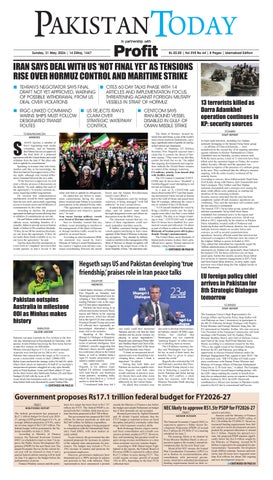
AEED Ajorlou, a member of Iran’s negotiating team media committee, said on Saturday that Tehran has not yet approved the final draft of a proposed agreement with the United States and could withdraw from the deal if “the other side fails to uphold its commitments.” Speaking to Iranian state television, Ajorlou said that, to his knowledge, the final text had not been approved as of Friday night, although only limited differences remained between the two sides. “If the final text is approved, we will enter a 60-day process of discussions on the details,” he said, adding that each of the agreement’s 14 articles contains annexes requiring further negotiations. He stressed that implementation mechanisms would be more significant than the text itself, particularly regarding access to Iranian assets and fulfilment of commitments by the other side. According to Ajorlou, the proposed agreement includes provisions allowing Iran to withdraw if commitments are not met. He said Tehran could exit the deal if violations occur, including breaches of a ceasefire, failure to provide access to Iranian funds, or failure to lift a maritime blockade. “If they do not lift the maritime blockade, we can leave the agreement. If they do not make those funds available to us, we can leave the agreement,” he said. Ajorlou described the mechanism as a new form of “snapback” provision that would operate in Iran’s favour if the
other side fails to uphold its obligations. He added that any failure to implement commitments during the initial phase would prompt Tehran to reconsider participation in the planned 60-day talks. “The agreement is entirely based on implementation and objective guarantees,” he said. Iran warns foreign military vessels over Strait of Hormuz interference Iran on Saturday warned that any military vessel attempting to interfere in the management of the Strait of Hormuz or disrupt maritime traffic would be targeted by its armed forces. According to state broadcaster IRIB, the statement was issued by Iran’s Khatam al-Anbiya Central Headquarters, the country’s highest joint military command coordinating between the armed
forces and the Islamic Revolutionary Guard Corps (IRGC). The headquarters said the strategic waterway is being managed “with full authority” by Iran’s armed forces. It added that all commercial vessels, ships, and oil tankers must transit through designated routes and obtain authorization from the IRGC Navy. The statement warned that any violation of these regulations could seriously jeopardize maritime security. It further cautioned foreign military vessels against interfering in Iran’s management of the Strait of Hormuz or disrupting navigation. “Any attempt by military vessels to interfere in the management of the Strait of Hormuz or disrupt navigation will be targeted by the armed forces of the Islamic Republic of Iran,” the statement said.
The Strait of Hormuz, located between Iran and Oman, is one of the world’s most critical maritime chokepoints, carrying a significant share of global oil and liquefied natural gas shipments. Earlier on Saturday, US Defense Secretary Pete Hegseth rejected Iran’s claim that it controls the Strait of Hormuz, saying: “They want to say that they control the strait, but we do.” He added that ongoing developments and negotiations indicate the United States remains in control of the strategic waterway. US military attacks Iran-bound ship with Hellfire missile The US Central Command (CENTCOM) said its forces have “disabled” a Gambia-flagged vessel attempting to sail toward an Iranian port. In a post on X, CENTCOM said forces observed the M/V Lian Star transiting international waters toward an Iranian port in the Gulf of Oman and issued more than 20 warnings, informing the vessel it was in violation of the US blockade. “A US aircraft disabled the vessel by firing a Hellfire missile into the ship’s engine room after Lian Star’s crew failed to comply. The ship is no longer transiting to Iran,” CENTCOM said. It added that US forces have disabled five commercial vessels and redirected 116 others as part of efforts to enforce the blockade. Blockade of Iranian ports still in place despite Trump's announcement The United States naval blockade of Iranian ports remains in place, Iran's semiofficial news agency Tasnim reported on Saturday, citing Iranian seafarers.
CONTINUED ON PAGE 03
Hegseth says US and Pakistan developing ‘true friendship,’ praises role in Iran peace talks SINGAPORE AGENCIES
Pakistan outspins Australia in milestone ODI as Minhas makes history RAWALPINDI
SALEEM JADOON
Pakistan out-spun Australia by five wickets in the first one-day international in Rawalpindi on Saturday, with spinner Arafat Minhas becoming the first home bowler to take five wickets on ODI debut. Minhas returned figures of 5-32 as an under-strength Australia were bowled out for 200 in 44.1 overs. Pakistan then chased down the target in 42.3 overs to secure a memorable victory in their 1,000th ODI. Babar Azam anchored the innings with a 94-ball 69, while Ghazi Ghori struck an impressive 92-ball 65 as Australia’s inexperienced spinners struggled on a dry, spin-friendly pitch at Pindi Stadium. Azam and Ghori added 127 runs for the third wicket after Sahibzada Farhan (28) and Maaz Sadaqat (8) fell with the score at 49. Azam struck four boundaries and a six, while Ghori hit eight fours before both were dismissed by pacer Nathan Ellis.
CONTINUED ON PAGE 03
United States Secretary of Defense Pete Hegseth on Saturday said Washington and Islamabad were developing a “true friendship,” while lauding Pakistan’s role in the ongoing US-Iran peace negotiations. Pakistan has been acting as an official interlocutor between Washington and Tehran in the ongoing peace process, which has already led to the April 8 US-Iran ceasefire. President Donald Trump and senior US officials have repeatedly acknowledged Islamabad’s diplomatic role in the initiative. Speaking at the three-day Shangri-La Dialogue in Singapore, Hegseth was asked about former director of national intelligence Tulsi Gabbard’s remarks suggesting that Pakistan’s future missile capabilities could pose a threat to the United States, as well as whether India’s Agni-VI missile programme presented a similar concern. The question came after Hegseth, in his address, highlighted US defence cooperation with Indo-Pacific and Southeast Asian partners, including India, which he described as a “critical anchor to hold the line.” “I mentioned India here, but I
13 terrorists killed as Darra Adamkhel operation continues in KP: security sources PESHAWAR
STAFF REPORT
At least eight terrorists, including two Afghan nationals belonging to the banned Tariq Gidar group — an affiliate of Fitna al-Khawarij — were neutralised on the second day of an ongoing operation against militants in Khyber Pakhtunkhwa’s Darra Adamkhel area on Saturday, security sources said. With the latest action, a total of 13 terrorists have been killed since the operation began on Friday, the sources added. Security officials said the operation was launched on reports of the presence of a militant group in the area. They confirmed that the offensive remains ongoing, with the entire locality cordoned off by security forces. According to sources, those killed include Daud from Zorh Kalay, along with Hamza, Qari Zeenatullah and Qari Lawangin. They further said that Afghan nationals Zeenatullah and Lawangin were among the dead, while efforts were underway to confirm the identities of the remaining militants. Security sources reiterated that the area has been completely sealed off and clearance operations are continuing. They said the operation will continue until the last terrorist is eliminated. The banned TTP’s Tariq Gidar group, named after militant commander Tariq Afridi from Darra Adamkhel, has remained active in the region and involved in multiple militant activities. Afridi was killed in 2012, reportedly by his relatives in Khyber. Darra Adamkhel, located south of Peshawar and bordering Kohat and Peshawar districts, has witnessed multiple terrorist attacks on security forces and convoys, as well as several counterterrorism operations. Security officials noted that terrorism has witnessed a resurgence in Pakistan since the return of the Afghan Taliban to power in Kabul in 2021. They added that Islamabad has repeatedly urged the Taliban administration to dismantle terrorist sanctuaries on Afghan soil, particularly those linked to the banned TTP, but those calls have not yet been acted upon. Earlier this month, security forces killed five terrorists in separate engagements in KP’s Tank and Dera Ismail Khan districts. In early April, eight terrorists were killed along the Pak-Afghan border in North Waziristan.
EU foreign policy chief arrives in Pakistan for 8th Strategic Dialogue tomorrow ISLAMABAD
STAFF REPORT
very easily could have mentioned Pakistan and the role that the field marshal and the prime minister are playing in peace negotiations,” Hegseth said, referring to Prime Minister Shehbaz Sharif and Chief of Defence Forces and Chief of the Army Staff Field Marshal Asim Munir. “I think an unexpected development and a true friendship is developing there, which I think is important,” he added. Noting that both India and Pakistan are nuclear-capable countries, Hegseth said both sides would continue to perceive security threats from each other, some of which, he said, may be viewed differently by the United States. He added that countries may
also seek to develop intercontinental ballistic missile (ICBM) capabilities, but clarified that Washington was not currently “pointing fingers” at either country or labelling them as threats. The US defence secretary further said Washington was “grateful for, in each of their lanes, the benefits they’ve given to peace around the world.” Hegseth also reiterated the US and Pakistan’s position that President Donald Trump played a key role in brokering a ceasefire between Pakistan and India during the May 2025 conflict, a claim India has rejected, with Prime Minister Narendra Modi denying the assertion.
The European Union’s High Representative for Foreign Affairs and Security Policy Kaja Kallas will visit Pakistan on June 1 (tomorrow) to participate in the 8th EU-Pakistan Strategic Dialogue with Deputy Prime Minister and Foreign Minister Ishaq Dar, the EU announced on Saturday. Kallas, who also serves as Vice President of the European Commission, will hold meetings with President Asif Ali Zardari, Prime Minister Shehbaz Sharif, and Chief of Defence Forces and Chief of the Army Staff Field Marshal Asim Munir, according to a statement issued by the bloc. “This is the eighth round of the Strategic Dialogue between the EU and Pakistan, providing an opportunity to discuss bilateral relations under the Strategic Engagement Plan, signed in June 2019,” the EU statement said. “HR/VP Kallas will hold a joint press conference with Deputy Prime Minister and Minister of Foreign Affairs of Pakistan Mohammad Ishaq Dar at 12:30 local time,” it added. The European Union is Pakistan’s second-largest trading partner, with the GSP+ status enabling the country to benefit from duty-free or reduced-duty access on exports to European markets. Granted in 2014, the GSP+ framework contributed to a 108 per cent increase in Pakistan’s textile exports to the EU due to concessional tariff access.
Government proposes Rs17.1 trillion federal budget for FY2026-27 PROFIT
MONITORING REPORT
The federal government has proposed a Rs17.1 trillion budget for fiscal year 202627, setting a GDP growth target of 4.1%, an average inflation projection of 8.4%, and a tax revenue target of Rs15.267 trillion. The federal budget will be presented in the National Assembly on June 5, 2026. According to Ministry of Finance sources, the National Economic Council (NEC) is scheduled to meet on June 3 to approve the Public Sector Development Programme (PSDP) for the next fiscal year. The annual Economic Survey for the current fiscal year will be released on June 4 and a special federal cabinet meeting will be held on June 5 to approve the budget before the parliamentary sessions. Finance Ministry sources said the petro-
leum levy target has been fixed at Rs1.727 trillion for FY27. The federal PSDP is expected to be Rs1.1 trillion, while non-tax revenue has been projected at Rs2.768 trillion. The government has proposed Rs7.824 trillion for interest payments on debt and Rs2.665 trillion for defence expenditure. The upcoming budget is being prepared in consultation with the International Monetary Fund (IMF), with most matters already settled. As per sources, the government has also prepared proposals for increases in salaries of the salaried class and pensions for pensioners. The budget may include a 7% to 10% increase in salaries and pensions for government employees. However, government employees have demanded up to a 100% increase in salaries and pensions in line with inflation. Their representatives have announced a protest
outside the Ministry of Finance a day before the budget and outside Parliament on budget day if their demands are not accepted. Research previews by Topline Research and JS Global Capital indicate that the FY27 budget is expected to focus on fiscal discipline and policy continuity rather than major relief measures or policy shifts. Both brokerage houses expect continued fiscal consolidation and a fourth consecutive primary surplus in FY27. However, they said sustaining that position would require strong revenue mobilisation at a time when economic recovery remains fragile. According to IMF-linked targets highlighted in the reports, the Federal Board of Revenue (FBR) is expected to collect about Rs15.3 trillion in taxes during FY27. This would require revenue growth of around 14% to 20%, depending on the final FY26 collection base.
NEC likely to approve RS1.5tr PSDP for FY2026-27 PROFIT
SADDAM HUSSAIN
The National Economic Council (NEC) is expected to approve a Public Sector Development Programme (PSDP) of around ₨1.5 trillion for FY2026-27 at a meeting scheduled for June 3. The meeting, likely to be chaired by Prime Minister Shehbaz Sharif, is also expected to approve the country's annual development plan for the next fiscal year. Ahead of the NEC session, the Annual Plan Coordination Committee (APCC) is set to finalise its recommendations after consultations with provincial governments, which have submitted development funding requirements based on their re-
spective priorities. Sources said the Ministry of Finance had initially proposed a PSDP ceiling of ₨1.126 trillion for FY2026-27. However, increased funding requirements from federal and provincial development projects pushed the proposed allocation to around ₨1.5 trillion. Despite the upward revision, the proposed PSDP remains significantly below the ₨2.9 trillion sought by the Ministry of Planning. Around ₨70 billion is expected to be earmarked for parliamentarians' Sustainable Development Goals (SDGs) schemes. Sources said ministries and divisions have requested more than ₨4 trillion for about 286 ongoing and new development projects.
CONTINUED ON PAGE 03