Epaper_26-05-2 ISB

Page 1


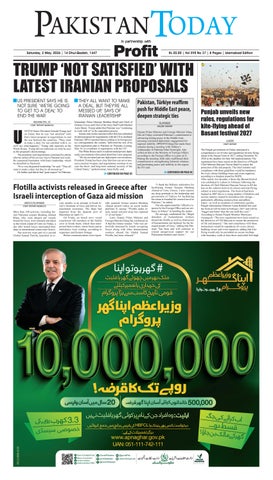
TRUMP ‘NOT SATISFIED’ WITH L ATEST IRANIAN PROPOSALS

pakistan, türkiye reaffirm push for Middle east peace, deepen strategic ties

ISLAMABAD

SC consults on ADR reforms to speed up banking dispute resolution

k The Chief Justice of Pakistan

Revenue’s experience in tax litigation where ADR committees have been used to reduce case backlogs and speed up settlements Participants discussed adapting similar frameworks for banking disputes to enable faster and more predictable resolution while reducing reliance on conventional litigation

In his remarks, the chief justice said banking litigation remains a bottleneck affecting financial discipline credit flow and economic stability He called for statutory reforms streamlined procedures and institutionalised ADR systems to address delays The consultation focused on identifying hurdles in banking recovery processes, simplifying procedures that cause delays strengthening ADR mechanisms tailored to the sector and improving coordination among regulators financial institutions and dispute resolution bodies The meeting was attended by Supreme Court Justices Muhammad Ali Mazhar and Miangul Hassan Aurangzeb Finance Minister Muhammad Aurangzeb Attorney General Mansoor Usman Awan and senior officials from the Law and Justice Division, Federal Board of Revenue (FBR), Securities and Exchange Commission of Pakistan (SECP), State Bank of Pakistan, Banking Mohtasib Federation of Pakistan Chambers of Commerce and Industry (FPCCI) Pakistan Banks Association Pakistan Tax Bar Association Overseas Investors Chamber of Commerce and Industry (OICCI), and Entrepreneurs Organisation Islamabad chapter The Law and Justice Commission will compile proposals into a reform framework for review by an expert committee The recommendations will then be submitted to the commission for approval before being forwarded to the Ministry of Law and Justice for further action

According to a Supreme Court statement the consultation is aimed at advancing reforms in banking dispute resolution through ADR-based approaches aligned with legal and economic requirements

Pakistan defends trade prac tices in US probe on forced labour impor ts: repor t

Labour Organisation (ILO)

Pakistan is pursuing its case in Washington as the United States reviews trade practices of 60 economies, including Pakistan, over concerns related to forced labour-linked imports, The Express Tribune reported Officials said a public hearing under the US Trade Representative (USTR) began on April 28 and will continue until May 14, 2026 Pakistan s ambassador to the United States is representing the country along with officials from the textile and commerce ministries and the Ministry of Overseas Pakistanis and Human Resource Development

The probe follows the withdrawal of reciprocal tariffs by the Trump administration, after which the USTR initiated an investigation under Section 301 of the Trade Act of 1974 The review focuses on whether countries have

and are effectively enforcing bans on imports of goods produced with forced labour The USTR is examining laws regulations and enforcement mechanisms including whether gaps in enforcement discriminate against US commerce or allow forced labour practices to persist It is also seeking recommendations on potential actions, including duties or import restrictions

The commerce ministry informed a steering committee that consultations had been held with the Ministry of Overseas Pakistanis and representatives of the textile sector to prepare Pakistan s response It was agreed that written submissions would be filed by both public authorities and industry stakeholders Officials said the government is also working to introduce a prohibition on imports of goods produced with forced labour under the Import Policy Order, in line with standards set by the International

During the meeting, concerns were raised about earlier reports on forced labour in cotton farming in Sindh The commerce ministry said the draft response includes measures taken by the government and industry including Better Cotton Initiatives, organic and regenerative cotton programmes, and traceability systems across the supply chain The Ministry of Overseas Pakistanis proposed amendments to align trade regulations with global standards on forced labour It was decided that the necessary process would be initiated to enable the commerce ministry to place a summary before the Economic Coordination Committee (ECC) for approval

The steering committee approved the draft submission with minor changes and directed that it be submitted to the USTR through Pakistan s embassy

(MEPCO) for

period cutting

from

s revised request of Rs86 463 billion According to NEPRA s determination, MEPCO had submitted its DIP on October 25, 2024 for the Multi-Year Tariff control period from FY2025-26 to

FY2029-30 The company had initially proposed an investment plan of Rs119 466 billion to be financed through its own resources and loans after approval from MEPCO s Board of Directors MEPCO later revised its proposed investment plan to Rs86 463 billion NEPRA however approved Rs35 514 billion after reviewing the company s submission The approved amount includes Rs5 432 billion for FY2025-26, Rs12 428 billion for FY2026-27, Rs9 832 billion for FY2027-28, Rs4 108 billion for FY2028-29 and Rs3 716 billion for FY2029-30 NEPRA said the interpretation of the determination would rest solely with the regulator It added that any stakeholder seeking clarification would have to approach the Authority directly The regulator also warned that any expenditure made without explicit approval would be borne by the company at its own risk and cost NEPRA directed MEPCO to use the approved investment to maintain a safe working environment for employees and the public The regulator also instructed the company to work towards a zero-fa-

tality target, particularly through safetyrelated projects MEPCO has been directed to execute all approved short-term projects within the sanctioned scope timeline and cost limits NEPRA allowed a contingency provision of up to 3% of the total approved project cost for unforeseen risks or cost escalations

The Authority clarified that contingency funds cannot be used to cover poor planning mismanagement or changes from approved specifications without prior approval NEPRA further said MEPCO must give priority to approved DIP projects The company may undertake alternative projects in case of operational exigencies but only subject to the conditions set by the regulator

CONTINUED FORM PAGE 01

Earlier a senior United Arab Emirates official said that Tehran could not be trusted over any unilateral arrangements it makes for the Strait of Hormuz, in a sign of deep mistrust on all sides as efforts to end the US-Israeli war on Iran remained at an impasse

Two months into the conflict the vital sea channel is still largely closed because of an Iranian blockade and the US Navy is blocking exports of Iranian crude oil The blockade has choked off 20% of the world s oil and gas supplies, pushing up global energy prices and increasing concerns that there will be an economic downturn A ceasefire has been in place since April 8 but reports that US President Donald Trump was to be briefed on plans for new military strikes to compel Iran to negotiate pushed global oil prices up to a four-year high at one point on Thursday Iran has activated air defences and plans a wide response if attacked, having assessed that there will be a short, intensive US strike, possibly followed by an Israeli attack two senior Iranian sources told Reuters on condition of anonymity

T R E A C H E R O U S A G G R E S S I O N Washington has not said what its next steps are Trump said on Tuesday he was unhappy with the latest proposal from Iran, and mediator Pakistan has not set a date for new talks on ending a war that has killed thousands mainly in Iran and Lebanon

After US and Israeli airstrikes on February 28 Iran fired at US bases infrastructure and US-linked companies in Gulf states while the Iran-backed Lebanese group Hezbollah launched missiles at Israel, which responded with strikes on Lebanon

Underlining the concerns of the Gulf states, UAE presidential adviser Anwar Gargash said the "collective international will and provisions of international law" were the primary guarantors of freedom of navigation

through the strait

"And, of course, no unilateral Iranian arrangements can be trusted or relied upon following its treacherous aggression against all its neighbours " Gargash wrote Trump faces a formal US deadline on Friday to end the war or make the case to Congress for extending it under the 1973 War Powers Resolution

The date looks set to pass without altering the course of the war after a senior administration official said that, for the resolution, hostilities had terminated due to the April ceasefire between Tehran and Washington Financial and energy markets remained on edge because of concerns about the impasse over negotiations and worries that there could be a prolonged closure of the Strait of Hormuz Global oil benchmark Brent crude futures rose again on Friday, up slightly at over $111 a barrel and poised for a 5 7% gain over the week after hitting $126 a barrel on Thursday the highest level since March 2022 I R A N S AY

Iranian

by Iranian media as

TH E latest housing census showed that the housing shortage, already at over 10 million units is growing at about 400 000 units a year Seen within this context the latest Apna Ghar scheme’s target does not seem ambitious at all

Indeed, the scheme only fills about a quarter of the increase in housing units needed to keep the shortage from growing, and unless there is some other construction the shortage will have gone beyond 11 5 million units The scheme comes without some important questions answered, at least revealed for public scrutiny The first is where the land is going to come from, the next is where the money is going to come from

The PM said the government intends to commit Rs 321 billion for 50,000 homes in the first phase in the first year, which would put the total cost of the five-year project at Rs 3 21 trillion This is a large sum of money, and apart from the need to bring the IMF on board before committing the funds requires a massive effort to mobilize that kind of money

The logic behind this scheme is not new

Constructing houses not only creates demand for bricks, cement and a wide array of products, but also employs labour of all kinds, skilled, semi-skilled and unskilled The previous PTI government had the same idea with its Rs 3 2 trillion Apna Ghar scheme to build 500,000 low-income houses and apartments The expected boom did not take place Another problem with the sort of construction contemplated will involve increasing exports on a large scale something the country would have serious difficulties with in the best of times, let alone now, when the Gulf is aflame That has a particular relevance, for there is no certainty that overseas Pakistanis in the Gulf will be able to mobilise the sort of resources needed

The real issue is that there is no developed credit market for housing Mortgages in principle are a good idea, as they can be serviced in place of the monthly rent However, with only 11 9 percent of housing rented, house ownership seems

FU E L price increases in Pakistan are often discussed as a fiscal necessity or a consequence of global market volatility, but such framings tend to flatten what is, in reality, a deeply layered social and economic phenomenon The impact of these adjustments is not confined to the balance sheets of the state or the fluctuations of international oil markets It is absorbed gradually and unevenly into the structure of everyday life where it reshapes mobility labour and consumption in ways that are both immediate and cumulative At a theoretical level, fuel occupies a peculiar position in a developing economy It is simultaneously a final consumption good and a critical input across nearly all sectors of production This dual role means that any adjustment in its price does not remain contained within a single market Instead, it propagates through a dense network of economic

goods and services In inflationary terms fuel op-

erates less as a commodity and more as a transmission mechanism

For a country like Pakistan where import dependence for energy remains structurally high, this transmission is further intensified by external exposure Domestic pricing is closely tethered to global oil markets which themselves are shaped by geopolitical tensions production decisions by major exporters and disruptions in key maritime routes In such a configuration local consumers are effectively positioned at the end of a long and unstable chain of causality, where decisions made far beyond national borders translate into immediate adjustments in domestic cost structures

The recent escalation in global oil prices driven in part by heightened geopolitical instability in major producing regions including tensions involving Iran and the USA has once again exposed this

vulnerability Yet it would be analytically insufficient to attribute domestic hardship solely to external shocks External volatility explains the trigger, but not the depth of domestic impact That depth is determined by internal structural conditions particularly the limited elasticity of -transport systems and the absence of broad based energy alternatives

The most immediate manifestation of fuel price increases is in the domain of labour mobility In urban economies, especially those characterised by informal employment the worker ’s relationship to the city is fundamentally spatial Income generation is dependent on physical movement across dispersed sites of activity When the cost of movement rises, it effectively compresses the geography of opportunity Workers begin to optimize not only time but distance, gradually restricting their participation to economically viable zones

This has second-order effects on labour markets

Reduced mobility narrows the range of accessible employment increases search costs and intensifies competition within smaller geographic clusters Over time, this can contribute to underemployment, not in the conventional statistical sense, but in a more latent form where workers remain active but increasingly constrained in their economic choices

The pass-through effect on prices is equally significant Transport being a universal intermediate input ensures that fuel cost adjustments are transmitted across sectors with varying degrees of lag Agricultural supply chains are particularly sensitive, given their dependence on long-distance logistics and weak storage infrastructure As transportation becomes more expensive the price differential between producer and consumer widens introducing inefficiencies that are ultimately borne by end consumers

What is often described as inflation, therefore, is not merely a monetary phenomenon but a structural one It reflects not only aggregate demand pressures but also the frictional costs embedded in the movement of goods and services In this sense fuel price adjustments act as a catalyst that exposes existing inefficiencies within the economy rather than creating entirely new distortions For households, particularly those in lower inc

through a progressive narrowing of discretionary

nesses compromising their competitiveness and productivity in the industry

There are political economy barriers to economic reform Political instability and the opposition of influential interest groups often lead to failure of economic reforms Governments put more emphasis on short-term political benefits than structural reforms Poor governance lack of consistency in policies and administrative ineffectiveness continue to undermine the reforms leaving the economy vulnerable

Lessons in smoke

Tso fiscal sustainability is a burning issue There is a circular debt crisis and thus energy sector inefficiency Pakistan has structural inefficiencies especially in the energy sector A circular debt crisis has been brought about by electricity theft, the high transmission losses, untargeted subsidies, and poorly managed distribution companies Not only does it create a huge financial burden to the government but it also increases the cost of electricity to busi-

There is the impact of the Informal economy of Pakistan on economic governance A significant part of Pakistan’s economy is informal minimizing tax collection and control This compromises state capacity transparency and makes policymaking difficult Fiscal and economic governance will not be effective without the inclusion of the informal sector in the formal economy

Transitioning from geopolitics to geo-economics in Pakistan has been slow Over the past few years Pakistan has been keen on a transition to geo-economics the prioritization of trade regional connectivity and economic diplomacy This transition however demands structural changes in infrastructure, governance and policies on investment Pakistan will lose the chance to be included in global supply chains and enjoy regional trade programmes without these reforms

The chronic debt crisis that plagues Pakistan is not only a matter of financial issues but also an indicator of structural flaws The country will continue to find itself embroiled in cycles of external dependency unless the country takes radical measures in its taxation, export, energy and governance The only way to escape recursive crises and gain economic resilience is to have a long-term plan which places sustainable growth institutional strengthening and industrial diversification in the first place

The writer can be reached at kshaharyar999@gmail com

A perilous presidency

muhammad ShehaRYaR Khan
Rizwan ahmad

Tappears

The monopoly of information once held by major networks has been shattered by smartphones independent creators and algorithm-driven platforms Yet, the media war is only one dimension of this new paradigm The more profound shift lies in the realm of asymmetric warfare Iran’s strategy relies not on matching the USA or Israel tank for tank or jet for jet but on deploying cost-effective highly efficient systems that neutralize expensive conventional assets Drones, short-range missiles, and underground launch systems have become the backbone of this approach

According to defense analyses Iran possesses thousands of such systems many hidden deep beneath mountainous terrain making them nearly impossible to eliminate through conventional airstrikes

The economic contrast is staggering A single US aircraft carrier, such as the USS Gerald R Ford, costs over $13 billion to build and millions more per day to operate In comparison Iranian drones can be produced for tens of thousands of dollars yet they have demonstrated the capability to threaten even the most advanced naval and aerial platforms This imbalance represents a fundamental shift: warfare is no longer about who spends more but who adapts faster and innovates smarter

This reality has forced even the most powerful militaries to reconsider their strategies Reports indicate that major U S naval assets, including carriers like the USS Abraham Lincoln, are operating at significant distances from potential conflict zones to avoid vulnerability The fear is not hypothetical; recent conflicts have shown that swarms of inexpensive drones can overwhelm sophisticated defence systems creating a scenario where billion-dollar assets are at risk from relatively low-cost attacks

Equally transformative is the role of artificial intelligence in this new warfare ecosystem Iran and other actors are increasingly using AIgenerated simulations to depict battlefield scenarios, showcasing the destruction of enemy assets in ways that blur the line between reality and fabrication These visuals, often indistinguishable from real footage, amplify psychological pressure and can even mislead decision-makers There have been instances where such AI-generated content caused confusion at the highest levels underscoring the disruptive power of synthetic media

This convergence of asymmetric warfare and digital propaganda has produced a dualfront strategy that is extraordinarily difficult to counter On one hand physical attacks are decentralized mobile and deeply concealed On the other the information space is saturated with narratives that shape public opinion and political discourse Together, they create a feedback loop where military actions reinforce media narratives, and media narratives in turn influence strategic decisions

Despite extensive military operations the strategic objectives set by the USA and Israel remain largely unmet These objectives reportedly included crippling Iran s missile capabilities, dismantling its nuclear infrastructure, and potentially triggering regime change While there have been tactical successes such as strikes on specific facilities independent assessments suggest that a significant portion of Iran s military infrastructure remains intact and operational Its missile systems continue to function, and its ability to project power across the region has not been decisively diminished Meanwhile the broader geopolitical consequences are becoming increasingly evident The Strait of Hormuz a critical chokepoint through which nearly 20 percent of the world s oil supply passes, remains under constant threat Disruptions in this region have al-

As the world watches this conflict unfold, it becomes increasingly clear that we are witnessing the end of one era and the beginning of another. The ag e of overwhelming force and unilateral dominance is giving way to a more complex, multipolar landscape where power is distributed,

networks.

S o ci a l m e di a ba n s br i n g p r o bl e m s

and other activities They see little benefit in becoming involved in the conflict especially since the attack on Iran was not coordinated with them US allies in the region have also suffered significantly as a result of the conflict, as military action has weakened rather than strengthened their security China strongly opposes any military action As is often the case Beijing avoids escalation but its position is clear and significant particularly given its close economic ties with Iran

As for India, it has shown little enthusiasm for the war, especially given the large number of its citizens working in the region Iran entered the conflict diplomatically isolated without its military allies being obligated to provide immediate assistance Yet the US and Israel also find themselves diplomatically isolated Washington has many allies, but their effective support remains unclear Russia s position helps to break this current diplomatic isolation, reinforced by Araghchi’s visit to Russia

Nevertheless the situation remains highly fragile and dangerous particularly for Iran

Despite the weakness of the anti-Iran coalition, the US still retains broad scope to carry out military strikes at its discretion

It is true that the US may face temporary resource constraints The war has revealed certain shortcomings in the organisation of its armed forces when confronting a major regional power most notably the need to strengthen its naval fleet

However, Washington remains largely insulated from any Iranian retaliation

The Americans may need time to correct their mistakes but they have ample time to do so Nor can the US be considered hostage to a blockade of the Strait of Hormuz; it has already become the world s largest oil producer and, along with Canada and Mexico, is strengthening its leading position

Although Russia is unlikely to exert a direct influence on the outcome of the conflict its political stance and practical measures nonetheless constitute an important factor in the equation shaping the coming Middle East crisis

Russia expresses its view of the conflict in clear and unequivocal terms: the United States and Israel have committed aggression against Iran and the consequences extend beyond Iran and the Middle East

The conflict carries serious risks including an increased likelihood of a humanitarian catastrophe and nuclear contamination if nuclear facilities are damaged There is no military solution to the conflict; it requires sustained and continuous diplomatic efforts

Naturally Russia does not support any economic restrictions against Tehran as clearly reflected in the 2025 Russian-

Iranian agreement This is consistent with Moscow’s firm position that any sanctions imposed outside the UN Security Council are unacceptable

The same applies to any other hostile actions against Iran, including a naval blockade At the same time, Russia s position clearly emphasises the importance of reaching a political settlement Moscow’s ability to provide direct military support to Tehran is limited This was evident long before the outbreak of the conflict and is reflected in the 2025 agreement, which, while outlining friendly relations, does not constitute a military alliance

Moreover Russia maintains and supports its relations with other Gulf states and it is in Russia s interest to avoid fuelling conflict between Iran and its neighbours The region is so complex that the consequences of wars there are impossible to predict A potential change in the US administration is also unlikely to resolve the issue Since 1979 the United States has remained a persistent adversary of the Islamic Republic despite fluctuations in its policies Washington may agree to a deal with Tehran today, but it could easily withdraw from it if it deems it necessary or if an opportunity arises to eliminate Iran At the same time military strikes against Iran have demonstrated their limitations For the first time in a long while a large-scale US military operation of this kind has failed to achieve rapid and decisive political results Instead, it has produced new dynamics in the balance of power for Washington Before the war its position was decisive: mere threats of force were sufficient That threat still carries weight, but its effectiveness is now in question The limitations of military tools are likely to encourage Iran’s adversaries to make more effective use of “hybrid warfare” while simultaneously seeking new ways to enhance the effectiveness of their military capabilities For Iran, establishing a sustainable economic and development model remains a major challenge The state has proven its ability to withstand intense military pressure but it is unlikely to build a long-term development model based solely on crisis-management measures Tehran will seek a much-needed period of respite to restore its economic capabilities The limitations of Iran’s economic model were evident long before the conflict and may play a negative role in the future

Ivan Timofeev is the Director General of the Russian International Affairs Council

BA N S on social media for minors are having a political moment Parents’ sincere concerns and politicians’ instincts to capitalize on those fears are driving federal and state legislation like the kind already in effect elsewhere in the world But no amount of good intentions makes these efforts good policy

At the federal level, bipartisan legislation seeks to ban some age groups from creating or maintaining a social media account and restrict older youths from receiving algorithmic recommendations Most recently the Massachusetts House passed legislation banning children under 14 from social media and requiring parental consent for 14- and 15-year-olds Numerous other states are in varying stages of considering or implementing similar rules

Despite consensus across the political aisle and around the US these proposals are filled with problems Practically online bans and restrictions for children trigger age verification for everyone Since there s no way to prove you re a kid, adults will instead have to prove that they are not a minor That requires the mandatory uploading of government identification facial age estimation (which is especially unreliable when discerning 15-year-olds from 16-year-olds) or using third-party verification (which also demands your government ID or biometric data) for all adults

That surge of uploading data marks the end of much anonymity and the beginning of increased privacy and security risk for everyone Earlier this year 438 security and privacy scientists and researchers from 32 countries signed an open letter warning that these age verification mandates may cause more harm than good by reducing users privacy, security and access to information online

These harms aren’t just theoretical; a 2025 hack of the third-party age-verification firm employed to comply with the UK and Australia s laws exposed the government IDs of approximately 70 000 Discord users Examples of similar data breaches are plentiful Constitutionally, these measures likely violate the First Amendment Already, many state-level efforts to restrict youth activity online have been thwarted or delayed in court While we regulate many things out of youth

QAMAr BAShIr

TRUMP WAR POWERS DEADLINE L APSES AS OFFICIALS

LOOPHOLE

sensitive issue is no easy task The Punjab government deserves credit for successfully enacting such significant

legislation CM Punjab Maryam Nawaz Sharif has extended a protective hand over every daughter in Punjab When daughters of the province refer to her as a mother, it is inconceivable that a mother would allow her child to be sacrificed for someone’s ego The Child Marriage Restraint Act serves as a firm barrier against regressive social customs Among the most vulnerable segments of society are young girls who are often sacrificed due to societal pressures Under this law, marriage is not permitted for either boys or girls below the age of 18 and a Computerised National Identity Card is mandatory How long will daughters continue to pay for crimes they did not commit?

Whether it is honour-related violence, denial of inheritance rights or attempts to conceal wrongdoing, must a girl always be the victim? We do not live under the law of the jungle The sacrifices of young girls must end It cannot be allowed that the mistakes of men are borne by innocent daughters

This is a vision that has been pursued for the past 20 years Those who oppose setting the minimum marriage age at 18 must answer: do they want their daughters married at six or eleven years of age? Under the law of the land no individual can enter into a contract without attaining the age of 18 and possessing a CNIC

Marriage is one of the most significant contracts in life it determines the future of a young girl Yet, little attention

has been paid to how many girls lose their lives due to early marriages One can only wonder about the compulsions of parents who marry off their daughters at such a young age Under this law, the minimum age for marriage for both boys and girls has been set at 18 eliminating gender discrimination and ensuring equality The law introduces strict measures to prevent the exploitation of minors forced marriages and child trafficking It defines every individual below 18 years as a child and any marriage involving one or both underage parties is considered a child marriage The Act grants exclusive jurisdiction to the session courts to hear cases under this law It clearly states that no Nikah Registrar shall register a child marriage; violation will result in up to one year of imprisonment and a fine of Rs100,000 Any adult who marries a child will face a minimum of two to a maximum of three years in prison along with a fine of Rs500

or physical relationship with a minor,

The passage of this Act had become a necessity of the time as child marriages were also damaging the country’s image at the global level

The era of treating daughters as inferior has ended Punjab today has a government that represents mothers sisters and daughters a government that is committed to raising the voice of every girl and ensuring her protection and rights with full strength

Daughters of Punjab now feel secure, knowing their future is in safe hands No one will be allowed to sacrifice them to fulfil personal egos or desires Today s daughters are tomorrow s mothers and the architects of the future A strong and courageous mother lays the foundation of a progressive society and Maryam Nawaz Sharif is fulfilling this role with full responsibility

Every daughter and every mother in Punjab stands shoulder to shoulder with Chief Minister Maryam Nawaz Sharif

The passage of the Child Marriage Restraint Act is a matter of pride for all daughters and mothers of the province On this historic legislation every daughter of Punjab is grateful to Chief Minister Maryam Nawaz Sharif and all members of the Punjab Assembly who played their role in its approval

Written by Punjab Informaion Minister

CORPORATE CORNER

‘Workers backbone of progress’: Azma Bokhari pays tributes to workers on Labour Day

that

She further

government has

beyond promises by practically delivering thousands of residential flats to workers, handing over keys and making them homeowners She added that this mission is ongoing and expanding rapidly to ensure more workers are provided with shelter Azma Bokhari stated that the core focus of the Punjab government’s policies is the “common man ” From Lahore to Rahim Yar Khan and from Vehari to Attock no district in Punjab has been left out of

the government’s relief initiatives She made it clear that Chief Minister Maryam Nawaz has ensured inclusive relief without discrimination with most welfare programs specifically designed to ease the lives of the underprivileged and working class Concluding her statement, she reaffirmed that the labour community remains at the top of the Punjab government s priorities and that the interests of the common man are placed at the forefront of every development project The government, she added, will continue its efforts to improve the socio-economic status and overall well-being of workers across the province

HEC National Mentorship Program Training Session

E L L A G A I N I N A P R I L , S AY S P I C S S

including 10 associated with the attack on the mining facility in Chagai Security forces killed 66 militants in the province in April down from 145 in March the report said

National leaders salute workers, vow stronger labour protection, welfare

tees protection against exploitation and binds the State to eliminate all forms of exploitation while upholding equitable economic principles

Paying tribute to Pakistan s labour force he said workers across sectors from agriculture to industry continue to drive national development through their dedication, resilience and hard work

capital through technical and vocational education, increased participation of women in the workforce and creation of employment avenues for youth

PM reiterates resolve for labour welfare

commitment to protecting labour rights ensuring fair wages promoting dignified working conditions and enhancing workers welfare

In his message on Labour Day, President Zardari said the day commemorates the historic struggle of workers who sacrificed their lives for fundamental rights, including fair wages and reasonable working hours, laying the foundation for modern labour protections

Recalling the 140-year-old Chicago labour movement he said workers had demanded eight hours for work eight hours for rest and eight hours for personal life, a principle that remains central to human dignity and labour rights

The president said the Constitution of 1973 guaran-

President Zardari reiterated Pakistan’s commitment to international labour standards, including fair wages, social protection elimination of forced and child labour non-discrimination and adherence to conventions of the International Labour Organization

Highlighting the contribution of overseas Pakistanis he said millions of workers abroad were strengthening the national economy through remittances while representing Pakistan’s values and professionalism globally

He said ensuring safe working conditions equal opportunities and adequate wages remained a national priority adding that the government would continue to strengthen labour protections and expand economic opportunities

The president also stressed investment in human

Drone strike hits Bajaur cricket ground, leaves three injured

In his Labour Day message Prime Minister Shehbaz Sharif said Pakistan was joining the international community in observing the day with renewed resolve, acknowledging the invaluable contributions of workers across all sectors

He described labourers farmers artisans factory workers and professionals as the backbone of society saying their dedication keeps the country s economic and social machinery moving

The prime minister said the hard work of labourers from fields and factories to construction sites and global markets reflects the nation’s strength and industrious spirit

He particularly praised overseas Pakistanis noting that millions working abroad serve as ambassadors of the country and contribute significantly through remittances, strengthening the national economy

Turn static files into dynamic content formats.

Create a flipbook
Epaper_26-05-2 ISB by Pakistan Today - Issuu