In partnership with
Profit
Tuesday, 19 May, 2026 | 2 ZilHaj, 1447
Rs 20.00 | Vol XVII No 54 | 8 Pages | Islamabad Edition
RS1.51 TRILLION PSDP UNDER REVIEW AS PM SHEHBAZ RESHAPES DEVELOPMENT PRIORITIES AHEAD OF BUDGET
g GOVT SIGNALS PERFORMANCE-LINKED
g WATER RESERVOIRS, HYDROPOWER AND
g ISLAMABAD STEPS UP INVESTOR
g GULF TIES, REMITTANCES AND
FUNDING AS IMF PRESSURES CONTINUE TO CONSTRAIN FISCAL SPACE
OUTREACH THROUGH REFORM MESSAGING, FINTECH TALKS AND PANDA BOND MOMENTUM
INFRASTRUCTURE PROJECTS EMERGE AS CENTREPIECE OF FY27 STRATEGY
ECONOMIC DIPLOMACY POSITIONED AS KEY PILLARS OF ECONOMIC RECOVERY
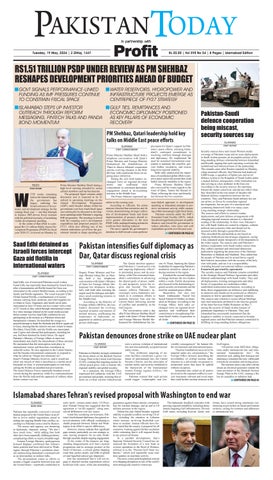
PM Shehbaz, Qatari leadership hold key talks on Middle East peace efforts ISLAMABAD
Staff CorreSpondent
W
PROFIT
aSad nizami
ITH weeks remaining before the federal budget, the government has begun outlining the broad contours of its economic and development strategy for the coming fiscal year — one that attempts to balance IMF-driven fiscal restraint with the political necessity of sustaining visible development spending. At the centre of that effort is a proposed Rs1.51 trillion Public Sector Development Programme (PSDP) for fiscal year 2026-27, reviewed on Monday by
Prime Minister Shehbaz Sharif during a high-level meeting attended by senior cabinet members and top bureaucrats. The proposed figure remains under discussion and is expected to be finalised in upcoming meetings on the Annual Development Programme (ADP), amid broader debate within the government over how much fiscal space can realistically be allocated to development spending under Pakistan’s ongoing IMF programme. The meeting reviewed both the outgoing year’s development expenditure and proposed projects for FY27, while also offering one of the clearest indications yet of how the government intends to shape spending pri-
Saad Edhi detained as Israeli forces intercept Gaza aid flotilla in international waters ISLAMABAD
Staff CorreSpondent
Saad Edhi, son of renowned Pakistani social worker Faisal Edhi, has reportedly been detained by Israeli forces after a humanitarian aid flotilla bound for Gaza was intercepted in the eastern Mediterranean, according to his family and flotilla organisers. The vessel was part of the Global Sumud Flotilla, a multinational civil society mission carrying food, medicine, and relief supplies for civilians in Gaza. Organisers said Israeli naval units intercepted at least 10 boats and lost contact with a total of 23 vessels as they sailed through international waters. In a video message released on his social media account before contact was lost, Saad Edhi confirmed he was participating in the mission as a Pakistani citizen and humanitarian volunteer. He described the voyage as a peaceful attempt to break the blockade and deliver urgent aid to Gaza, stressing that the mission was non-violent in nature. His father, Faisal Edhi, said the flotilla was intercepted near Cyprus and claimed that participants, including his son, had been detained by Israeli forces. He urged Pakistan’s Ministry of Foreign Affairs to intervene immediately and clarify the whereabouts of those arrested. He maintained that the interception took place in international waters and therefore constituted an unlawful action. He also appealed to the United Nations and the broader international community to respond to what he called an “illegal and inhumane act”. Israel’s Foreign Ministry, however, said it would not allow any breach of what it described as a lawful naval blockade on Gaza. It warned participants to turn back, calling the flotilla an unauthorised provocation. The Israel Defense Forces reportedly boarded several vessels during the operation, while live communications from the flotilla indicated the approach of military ships before contact was lost.
Prime Minister Shehbaz Sharif held a telephone conversation with Qatar’s Prime Minister and Foreign Minister Mohammed bin Abdulrahman Al Thani to discuss bilateral cooperation and the evolving situation in the Middle East, with a particular focus on ongoing peace initiatives. During the call, both leaders exchanged views on regional developments and reaffirmed their commitment to continued diplomatic engagement aimed at de-escalating tensions in the Middle East. The Prime Minister expressed ap-
orities in the coming year. According to officials, the prime minister directed that ministries and divisions demonstrating stronger utilisation of development funds and faster implementation of projects should receive greater allocations in the next PSDP, while underperforming ministries could see their funding reduced. The move signals the government’s intention to shift toward a more perform-
preciation for Qatar’s support for Pakistan’s peace efforts, stressing Islamabad’s continued commitment to resolving conflicts through dialogue and diplomacy. He emphasised the need for sustained international cooperation to maintain the ceasefire, prevent further escalation, and restore long-term regional stability. Both sides underscored the importance of coordinated global efforts to preserve peace and avoid actions that could further intensify instability in the region. Prime Minister Shehbaz Sharif also conveyed his warm regards to the Amir of Qatar, Tamim bin Hamad Al Thani, reflecting the close and friendly ties between the two countries.
ance-linked approach to development spending as Islamabad attempts to preserve investment activity while remaining within increasingly tight fiscal limits. Pakistan remains under the IMF’s Extended Fund Facility (EFF), which has placed significant pressure on public finances and forced the government to reduce subsidies, raise taxes and curb expenditure growth over the past year.
ContinuEd on PagE 03
Pakistan intensifies gulf diplomacy as dar, Qatar discuss regional crisis ISLAMABAD
Staff CorreSpondent
Deputy Prime Minister and Foreign Minister Ishaq Dar on Monday held a key telephonic conversation with Qatar’s Minister of State for Foreign Affairs Mohammad bin Abdulaziz Al-Khulaifi, with both sides stressing the urgent need for dialogue and diplomacy amid escalating tensions in the Middle East. According to the Ministry of Foreign Affairs (MOFA), the two leaders discussed the evolving regional situation and matters of mutual interest, reaffirming the importance of diplomatic engagement to address growing regional challenges.
The Qatari minister appreciated Pakistan’s “constructive role and ongoing diplomatic efforts” in promoting peace and de-escalation, while Dar reiterated Islamabad’s commitment to advancing the shared goals of peace, stability and prosperity across the region and beyond. The latest contact reflects Pakistan’s increasingly active diplomatic outreach as it continues efforts to mediate between Iran and the United States following months of conflict and instability in the Gulf region. The conversation came a day after Prime Minister Shehbaz Sharif spoke with Qatar’s Prime Minister and Foreign Minister Sheikh Mohammed bin Abdulrahman bin Jas-
sim Al Thani, thanking the Qatari leadership for supporting Pakistan’s mediation initiatives aimed at reducing tensions in the region. It marked the second telephone exchange between the two leaders within a week. Earlier discussions also focused on the deteriorating regional security environment and the need for sustained peace efforts. Meanwhile, Dar also met Saudi Ambassador Nawaf bin Saeed Ahmad Al-Malkiy in Islamabad on Monday. According to the Foreign Office, both sides exchanged views on regional developments and reaffirmed their commitment to strengthening Pakistan-Saudi Arabia cooperation in all fields.
ContinuEd on PagE 03
Pakistan-Saudi defence cooperation being miscast, security sources say ISLAMABAD
Staff report
Security sources have said recent Western media coverage of Pakistani troop and air asset deployments to Saudi Arabia presents an incomplete picture of the long-standing defence relationship between Islamabad and Riyadh, arguing that such reporting overlooks the institutional and historical basis of the partnership. The remarks came after Reuters reported on Monday, citing unnamed officials, that Pakistan had deployed 8,000 troops, a squadron of fighter jets and an air defence system to the Kingdom of Saudi Arabia under a mutual defence arrangement, while Islamabad was also serving as a key mediator in the Iran war. According to the security sources, the reporting framed the matter selectively and did not reflect what they described as the true nature of decades-old bilateral defence cooperation between the two countries. They said Pakistan-Saudi military ties are not ad hoc or driven by immediate regional developments, but are part of a structured and continuing framework built over many years. Long-standing strategic relationship The sources said efforts to connect routine deployments and joint defence arrangements with changing regional tensions amount to a distorted reading of the relationship. In their view, Pakistan’s ties with Saudi Arabia are rooted in religious, cultural, political and economic links and should not be assessed solely through a geopolitical lens. They described the partnership as one based on enduring brotherhood and strategic alignment, saying it has remained steady irrespective of developments in the wider region. The sources also said Pakistan’s defence cooperation with Saudi Arabia carries what they called a spiritual and emotional dimension, particularly regarding the protection of the Harmain Shareefain in Makkah and Madinah. They added that the people of Pakistan and its armed forces regard their historic association with the security of the holy sites with pride, and see it as a responsibility extending beyond conventional military cooperation. Framework governed by agreements The security sources said Pakistan remains committed to the Strategic Mutual Defence Agreement and other bilateral understandings with Saudi Arabia. They said all deployments, training arrangements and other forms of cooperation are undertaken within established institutional mechanisms. According to them, these engagements are defensive and stabilising in character and should not be portrayed as offensive measures or tied to speculative regional scenarios. The sources also referred to recent official briefings and cited statements attributed to the director general of the Inter-Services Public Relations on May 7, saying the security of Saudi Arabia remains of paramount importance to Pakistan. They said Islamabad has consistently maintained that the kingdom’s stability is closely connected to broader regional peace and that Pakistan remains committed to fulfilling its long-standing defence obligations.
Pakistan denounces drone strike on uaE nuclear plant ISLAMABAD
Staff report
Pakistan on Monday strongly condemned the drone attack on the Barakah Nuclear Energy Plant in the United Arab Emirates (UAE), warning that targeting nuclear facilities posed grave risks to human life, regional stability and global security. In a statement, the Foreign Office expressed full solidarity with the UAE government and people, stressing that attacks on civilian nuclear infrastructure
were a serious violation of international law and internationally accepted nuclear safety norms. “Any deliberate targeting of nuclear facilities constitutes a grave violation of international law, the United Nations Charter, and the principles of nuclear safety and security enshrined in the framework of the International Atomic Energy Agency (IAEA),” the statement said. Pakistan warned that such actions could trigger “catastrophic and irre-
versible consequences” for human life, the environment and international peace. “Nuclear installations must never be targeted under any circumstances,” the Foreign Office stressed, describing the inviolability of civilian nuclear infrastructure as a universally recognised international norm that must be upheld without exception. Islamabad also called on all parties involved in the regional conflict to exercise maximum restraint and avoid steps that could further escalate tensions in the
Gulf region. “All parties must fulfil their obligations under international law and international humanitarian law,” the statement said, adding that dialogue and diplomacy remained the only viable path towards de-escalation and lasting peace. The reaction came a day after a drone struck an electrical generator outside the inner perimeter of the Barakah Nuclear Energy Plant in the UAE, causing a fire but no casualties or radiation leak.
islamabad shares tehran's revised proposal with Washington to end war ISLAMABAD newS deSk
Pakistan has reportedly conveyed a revised Iranian proposal to the United States in an effort to revive stalled negotiations aimed at ending the ongoing Middle East conflict, according to a Pakistani source cited by Reuters. The source said urgency was mounting in diplomatic channels, noting: “We don’t have much time,” while adding that both sides have been repeatedly shifting positions, complicating efforts to reach a breakthrough. Iranian Foreign Ministry spokesperson Esmaeil Baghaei confirmed that Tehran’s latest position had been delivered to Washington through Pakistan’s mediation channel, underscoring Islamabad’s continued role as an intermediary in indirect talks. The development comes as efforts to sustain a fragile ceasefire between Iran and the United States—reportedly established in
early April—remain under strain. US President Donald Trump has suggested that the agreement is “on life support,” citing unresolved differences over key issues. Amid this escalating environment, Pakistan’s backchannel diplomacy has gained renewed attention, with officials continuing to shuttle proposals between Tehran and Washington in an effort to narrow differences. However, sources indicate that significant gaps remain, particularly on core strategic issues, leaving prospects for an early breakthrough uncertain despite ongoing engagement. At the centre of the impasse are longstanding disagreements over Iran’s nuclear programme and its strategic posture in the Strait of Hormuz, a critical global shipping route that carries nearly one-fifth of global oil and liquefied natural gas shipments. Iran has maintained that it will not engage in detailed nuclear negotiations unless hostilities fully cease, while also demanding
guarantees against future attacks, compensation for wartime damage, and an end to US military pressure in the region. Tehran has also linked broader regional stability to parallel conflicts involving US allies, including the situation in Lebanon where tensions involving Hezbollah continue to escalate. Iranian officials have further stated that the country is prepared for all scenarios, warning against further escalation while reiterating that it will respond firmly to any perceived threats. In a parallel development, Iran’s Supreme National Security Council has announced the formation of a new body to oversee operations in the Strait of Hormuz, referred to as the “Persian Gulf Strait Authority,” which will reportedly issue realtime updates on maritime activity. The move comes amid heightened concern over shipping disruptions in one of the world’s most strategically sensitive waterways.
The diplomatic deadlock coincides with growing regional instability, including drone attacks targeting Gulf infrastructure. Several Gulf states, including Kuwait, Qatar, and
ContinuEd on PagE 03
Oman, have issued strong statements condemning recent strikes on Saudi and Emirati territory, calling for restraint and adherence to international law.