In partnership with
Profit
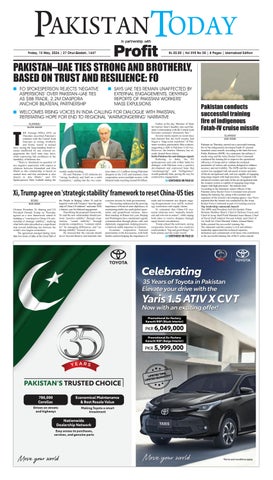
PAKISTAN–UAE TIES STRONG AND BROTHERLY, BASED ON TRUST AND RESILIENCE: FO Friday, 15 May, 2026 | 27 Dhul-Qadah, 1447
g
FO SPOKESPERSON REJECTS ‘NEGATIVE ASPERSIONS’ OVER PAKISTAN–UAE TIES AS $8B TRADE, 2.2M DIASPORA ANCHOR BILATERAL PARTNERSHIP
SAYS UAE TIES REMAIN UNAFFECTED BY EXTERNAL ENGAGEMENTS, DENYING REPORTS OF PAKISTANI WORKERS’ MASS EXPULSIONS
WELCOMES RISING VOICES IN INDIA CALLING FOR DIALOGUE WITH PAKISTAN, REITERATING HOPE FOR END TO REGIONAL ‘WARMONGERING’ NARRATIVE
T g
g
Rs 20.00 | Vol XVII No 50 | 8 Pages | Islamabad Edition
ISLAMABAD
saleem jadoon
HE Foreign Office (FO) on Thursday described Pakistan’s relations with the United Arab Emirates as strong, brotherly and firmly rooted in mutual trust, saying the long-standing bond remains unaffected by any external engagements the Gulf state may have, while expressing full confidence in the durability of bilateral ties. “There is ‘absolutely no question’ of any negative aspersions with respect to relations between Islamabad and Abu Dhabi as this relationship is based on mutual trust and this sentiment is also shared in Abu Dhabi,” said FO Spokesperson Tahir Andrabi during the
weekly media briefing. He said Pakistan–UAE relations are “strong, brotherly and built on a solid foundation,” adding that the two coun-
tries share a 2.2 million-strong Pakistani diaspora in the UAE and maintain close cooperation across multiple sectors, with bilateral trade reaching around $8 billion.
Earlier in the day, Minister of State for Interior Talal Chaudhry also said Pakistan’s relationship with the United Arab Emirates remained “absolutely fine.” Several media reports in recent days had claimed that the Gulf country had begun a “large-scale expulsion” of Pakistani workers, particularly Shia workers, suggesting a shift in Pakistan–UAE ties. However, the Interior Ministry has already denied these claims. India-Pakistan ties and dialogue signals Referring to India, the FO spokesperson said calls within India for dialogue with Pakistan were a positive development and expressed hope that “warmongering” and “belligerence” would gradually fade, paving the way for constructive engagement.
CONTINUED ON PAGE 03
Xi, Trump agree on 'strategic stability' framework to reset China-US ties BEIJING
mian abrar
Chinese President Xi Jinping and US President Donald Trump on Thursday agreed on a new framework aimed at building a “constructive China-US relationship of strategic stability”, marking what both sides described as a significant step toward stabilising ties between the world’s two largest economies. The agreement emerged during more than two hours of talks at the Great Hall of
the People in Beijing, where Xi said he hoped to work with Trump to “steer the giant ship of China-US relations” and make 2026 a historic year for bilateral engagement. Describing the proposed framework, Xi said the new relationship should promote “positive stability” through cooperation, “sound stability” through moderate competition, “constant stability” by managing differences, and “enduring stability” focused on peace. He stressed that the concept should move beyond rhetoric and translate into
concrete actions by both governments. The meeting underscored the growing importance of head-of-state diplomacy in maintaining stable ties amid global uncertainty and geopolitical tensions. Since their meeting in Busan last year, Beijing and Washington have maintained regular communication through phone calls and diplomatic engagement, helping preserve a relatively stable trajectory in relations. Economic cooperation featured prominently in the discussions, with both leaders acknowledging the importance of
trade and investment ties despite ongoing disagreements over tariffs, technology restrictions and supply chains. Xi reiterated that China-US economic relations were “mutually beneficial and win-win in nature”, while urging both sides to resolve disputes through equal-footed consultations. Trump echoed the sentiment, saying cooperation between the two countries could produce “big and good things” for both nations and the wider world.
CONTINUED ON PAGE 03
Pakistan conducts successful training fire of indigenous Fatah-IV cruise missile ISLAMABAD
asad nizami
Pakistan on Thursday carried out a successful training fire of the indigenously developed Fatah-IV groundlaunched cruise missile, according to the Inter-Services Public Relations (ISPR). In a statement, the military’s media wing said the Army Rocket Force Command conducted the training fire to improve the operational efficiency of troops and to validate the technical parameters of various sub-systems designed to enhance accuracy and survivability. The ISPR said the weapon system was equipped with advanced avionics and stateof-the-art navigational aids, and was capable of engaging long-range targets with high precision. "Equipped with advanced avionics and state-of-the-art navigational aids, the weapon system is capable of engaging long-range targets with high precision," the statemt read. According to the statement, senior officers of the Pakistan Army Rocket Force Command were present during the training fire, along with scientists and engineers of the missile’s developing agency. Geo News reported that the launch was conducted by the Army Rocket Force Command as part of a training exercise. Top leadership commends launch The ISPR said President Asif Ali Zardari, Prime Minister Shehbaz Sharif, Chief of Defence Forces and Chief of Army Staff Field Marshal Asim Munir, Chief of Naval Staff Admiral Naveed Ashraf, and Chief of Air Staff Air Chief Marshal Zaheer Ahmad Baber Sidhu praised the successful training fire. The statement said the country’s civil and military leadership appreciated the technical expertise, dedication and commitment of all those who contributed to the successful training fire of the F-series missile.