Epaper_26-04-18 LHR

Page 1


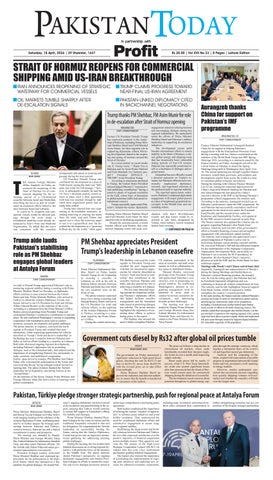
STRAIT OF HORMUZ REOPENS FOR COMMERCIAL SHIPPING AMID US-IRAN BREAKTHROUGH

M i a n a b r a r

TH E Iranian Foreign Minister Abbas Araghchi on Friday announced the reopening of the Strait of Hormuz for all commercial shipping for the remaining period of a US-brokered ceasefire between Israel and Hezbollah describing the move as part of coordinated de-escalation efforts linked to the truce between Israel and Lebanon

In a post on X Araghchi said commercial vessels would be allowed passage through the strait under a coordinated maritime route already announced by Iran s Ports and Maritime Organisation He added that the move was consistent with the ceasefire

arrangement and aimed at ensuring safe passage during the truce period US President Donald Trump also confirmed the development in a post on Truth Social saying the strait was fully open and ready for full passage However, in subsequent remarks, he said the US Navy’s blockade posture would remain in place until a final agreement with Iran was reached though he indicated most negotiation points had already been settled Trump later claimed Iran was cooperating in de-escalation measures, including removing or clearing sea mines from the strait and said Tehran had agreed not to close the waterway again or use it as a geopolitical tool He described the developments as a great and brilliant day for the world, while again

Trump

PM Shehbaz met Hakan Fidan, who welcomed his participation in the forum and conveyed that Recep Tayyip Erdoğan looked forward to meeting him The prime minister thanked the Turkish leadership for its hospitality describing Turkiye as his second home On the sidelines of the forum, Deputy Prime Minister and Foreign Minister Ishaq Dar held a series of meetings with global counterparts

ISLAMABAD S ta f f C o r r e S p o n d e n t Prime Minister Muhammad Shehbaz Sharif on Friday lauded Donald Trump for his leadership in securing a ceasefire in Lebanon as well as his role in helping defuse tensions between Pakistan and India last year when the two countries were on the brink of war

The prime minister expressed these views during a meeting with Massad Boulos Senior Adviser to the US President for Arab and African Affairs, on the sidelines of the Antalya Diplomacy Forum in Türkiye, according to a statement issued by the Prime Minister ’s Office During the cordial interaction

PM Shehbaz conveyed his warm regards to President Trump and recalled his past engagements with him He reiterated his appreciation for what he described as Trump s bold and decisive leadership” that contributed to the ceasefire between Pakistan and India and also praised his role in achieving a ceasefire in Lebanon

The two sides discussed ongoing regional developments, including Pakistan s diplomatic efforts that helped facilitate ceasefire arrangements and the Islamabad talks aimed at promoting dialogue and stability The prime minister highlighted the importance of sustaining these efforts to achieve lasting peace in the region

PM Shehbaz also stressed the need to further strengthen Pakistan-

US relations particularly in the areas of economic and trade cooperation as well as collaboration on key issues in multilateral forums

greetings from President Trump and appreciated Pakistan’s

importance of accelerating the implementation of ongoing joint initiatives and exploring new avenues for enhanced economic cooperation,

IMF SAYS $7.2B PROGRAMME CRITICAL AS MIDDLE EAST WAR HITS PAKISTAN’S OUTLOOK

Recorder reported The matter was discussed during a meeting between Federal Minister for Power Sardar Awais Ahmad Khan Leghari and Sam Waldock Development Director at the British High Commission, which also covered bilateral cooperation and regional developments According to the Power Division, investment-related concerns were highlighted during the meeting with the minister assuring that Pakistan would facilitate investors to improve the overall investment climate The dispute relates to an arbitration initiated by Halmore Power Company s owner before the London Court of International Arbitration, alleging violations of the UK–Pakistan Bilateral Investment Treaty The claim estimated at around $80

million involves allegations that Pakistan s actions adversely affected the company s investment, with the claimant seeking compensation, injunctive relief, and declarations of treaty breaches Under the treaty’s dispute resolution framework proceedings are being conducted under the UNCITRAL Arbitration Rules 2021, with Pakistan required to submit its response within the stipulated timeline Earlier, the Prime Minister ’s Office directed the Power Division and the Attorney General to actively defend the government s position in the case

Separately

The

The

Power Regulatory Authority has scheduled a public hearing on April 28, 2026, to consider the FCA petition submitted by CPPA-G

According to the data, hydel generation remained the largest contributor to the overall energy mix accounting for

Pakistan and Saudi Arabia on Friday signed an agreement to extend a $3 billion deposit from the Saudi Fund for Development (SFD) Federal Minister for Finance and Revenue Senator Muhammad Aurangzeb, witnessed the signing of a financial agreement in Washington, D C , in the presence of the Ambassador of Pakistan to the United States on the sidelines of the World Bank-IMF Spring Meetings 2026 The agreement signed between the Saudi Fund for Development (SFD) and the State Bank of Pakistan

(SBP) provides for the extension of the maturity of a $3 billion deposit placed by SFD with the State Bank of Pakistan

The agreement was signed by H E Mr Sultan bin Abdulrahman AlMarshad Chief Executive Officer of the Saudi Fund for Development on behalf of SFD and Mr Jameel Ahmad, Governor of the State Bank of Pakistan, on behalf of SBP

The extension of the deposit reflects the strong and longstanding economic partnership between Pakistan and the Kingdom of Saudi Arabia and will further support Pakistan s external sector stability On Thursday, the State Bank of

Pakistan confirmed the transfer of $2 billion from Saudi Arabia Saudi Arabia, earlier this week, committed an additional $3 billion in deposits for Pakistan and extended its existing $5 billion facility for an-

PO W E R Minister Awais Leghari has said that loadshedding will continue till Reliquified Natural Gas supplies resume That means that they are probably not going to resume this summer, because the break in supply from Qatar is not simply because of the blockades of the Hormuz Strait imposed by Iran and the USA but because of Iranian missile strikes at its LNG production facilities last month The result has been a 17 percent loss of production As Qatar is one of the largest RLNF producers in the world this has led to shortages everywhere including Pakistan As the repairs will take three to five years, Mr Leghari is in effect predicting what will feel like permanent loadshedding There was a mismatch between RNLG cargoes which Pakistan committed to buy, and those actually used, which might help the parlous forex position

The loadshedding is unfortunately not unfamiliar, though the reasons have changed Whereas there used to be a plain lack of generating capacity, now the generating capacity exists but the imported furnace oil to be used would make the tariff unsustainable as the fuel adjustment surcharge would have to be raised to unpayable levels That implies that the issue has arisen because Pakistan has not worked vigorously enough on substituting imported energy by the renewables aplenty around us in the country, such as water, wind and sunlight The last mentioned, in the shape of physical power, is the real game changer, because it requires an investment small enough that it can be afforded by consumers As it is, whatever solar power has been installed despite ministerial and utility opposition, has the the saving of the country, which would have really been up the creek had consumers been using expensive oil-generated thermal power only

However switching to alternative nonhydrocarbon-fired power sources is for the future Patience will be required for Qatar to repair its LNG facilities but opening the Straits of Hormuz will be key in the meanwhile That can only be done by purposeful diplomacy Prime Minister Shehbaz Sharif ’s swing though Qatar, Saudi Arabia and Turkey, and Chief of Defence Forces Field Marshal Asim Munir s visit to Tehran, shows that Pakistan is not stinting effort It must be remembered that the crisis does not just affect power generation but engulfs the whole economy, and all efforts must be made to solve it

Dedicated to the legac y of late Hameed Nizami Arif Nizami (Late) Founding Editor

IN the bustling streets of Pakistan, where the aroma of spices mixes with the hum of daily life, another, more tragic reality is unfolding Behind the vibrant faces of children playing in the sun a darker story is playing out These children often no older than five or six are being forced into labour working long hours in homes restaurants and workshops under oppressive conditions Despite the presence of laws designed to protect them, child labour continues to thrive in Pakistan Every day, more children are being robbed of their childhoods their futures and their dignity Why does this persist despite laws prohibiting child labour? The answer lies in Pakistan s pervasive poverty which forces families to make difficult often desperate, choices With millions of people struggling to make ends meet, children are increasingly viewed as sources of income, and education becomes an unaffordable luxury Parents, overwhelmed by financial pressure send their children to work not realizing they are trapping them in a cycle of poverty Instead of going to school these children end up in homes restaurants and factories doing exhausting and dangerous work far beyond their years In urban centres and rural areas alike, child labour is a growing problem In many homes, young children are assigned household chores or become domestic helpers cleaning and cooking At roadside restaurants children wash dishes serve food and sometimes handle sharp knives or work near hot stoves, all for meagre

often

cals and

Perhaps the most tragic aspect of

and

is that these children rarely experience the joys of childhood Instead of going to school, playing, or simply growing up, they are burdened with adult responsibilities The time that should be spent learning growing and developing skills for a brighter future is stolen from them leaving them trapped in lives of low-wage work and limited opportunities These children are deprived of the very thing that could enable them to escape poverty: education

The families who send their children into the workforce are often caught in a desperate struggle for survival For them the immediate need for money outweighs any thoughts of education or future prospects But what these parents fail to realize is that by sending their children to work they are robbing them of the very tools they need to build a better future The children may bring home a small wage, but this comes at the cost of their education, health and well-being In the long run these children will be more likely to end up in the same lowpaying jobs their parents worked perpetuating the cycle of poverty

This cycle is exacerbated by the economic system in Pakistan, where millions of families live in poverty, and job opportunities for adults are scarce When adults cannot find steady, well-paying work, they turn to their children to fill the gap The lack of sufficient social safety nets job training and access to quality education only compounds the problem Without these resources families have no choice but to rely on their children s earnings

Cultural factors also play a significant role in perpetuating child labour In many parts of Pakistan, children are seen as workers first and individuals with the right to education second In certain communities particularly in rural areas the idea of sending a child to school is often overshadowed by the belief that children should contribute to the household Education, particularly for girls, is undervalued Families often view their daughters as helping hands around the home, rather than as students with potential Boys too are pushed into work whether in small shops or as domestic helpers perpetuating a deeply ingrained cycle of exploitation The long-term effects of child labour are devastating, not only for the children but for society as a

Ending child labour in Pakistan is no easy task, but it is not an impossible one By prioritizing education, improving economic opportunities for families, and shifting cultural attitudes, Pakistan can break the cycle of exploitation and create a brighter future for its children Every child deserves a future filled with possibilities, not a life of hard labour The time to act is now

Generations United

TH E Indo-Pacific has emerged as the defining geopolitical theatre of the 21st century Stretching from the eastern shores of Africa to the western Pacific, it is home to vital sea lanes, rising economies and a delicate balance of power As rivalries intensify and economic interdependence deepens middle and major powers alike are recalibrating their strategies In this evolving landscape, Japan and Indonesia, two maritime democracies with distinct

post-war posture It has expanded defence cooperation with regional partners, enhanced maritime capacity-building assistance and deepened its alliance with the USA while also diversifying partnerships across Southeast Asia This shift does not signal a departure from its pacifist principles but reflects a pragmatic reading of strategic realities The war in Ukraine and rising tensions in East Asia have reinforced Tokyo’s belief that deterrence and diplomacy must go hand in hand Indonesia’s position is equally pivotal though its approach differs in tone and emphasis As the world s largest archipelagic state and Southeast Asia s biggest economy Indonesia sits astride

leadership within the Association of Southeast Asian Nations (ASEAN) amplifies its influence ASEAN centrality remains a cornerstone of Jakarta s diplomacy even as external powers compete for leverage in the region By advocating dialogue, inclusive cooperation and adherence to international law, Indonesia seeks to prevent the Indo-Pacific from hardening into rival blocs Its stewardship during regional summits has often reflected a careful balancing act engaging major powers without becoming entangled in their disputes The convergence between Japan and Indonesia lies in their shared commitment to maritime security and economic resilience Japan is one of Indonesia’s largest investors and development partners financing infrastructure transport networks and energy projects These initiatives are not merely commercial ventures; they serve as strategic anchors that bind the two countries together in a web of mutual interest Infrastructure development, particularly in ports and connectivity, strengthens Indonesia’s maritime ambitions while offering Japan reliable economic footholds Security cooperation has also gathered momentum Joint naval exercises coast guard collaboration and defence dialogues signal a maturing partnership For Indonesia, Japanese assistance in maritime domain awareness and capacity building enhances its ability to patrol its vast waters including areas around the Natuna Islands where tensions occasionally flare For Japan closer ties with Indonesia reinforce a networked approach to regional security one that complements but does not replicate its alliance system Economically, both countries are navigating a world of supply chain disruptions and protectionist impulses Japan’s push to diversify manufacturing bases has dovetailed with Indonesia s ambition to move up the value chain particularly in sectors such as electric vehicles and critical minerals Indonesia s vast nickel reserves have drawn Japanese investment, reflecting the intersection of resource security and green transition strategies In this sphere cooperation offers a template for how middle and major economies can align development goals with strategic considerations Yet challenges persist The South China Sea remains a flashpoint, with competing territorial claims and frequent maritime incidents While Japan is not a claimant, it has consistently voiced concern over unilateral actions that alter the status quo Indonesia though not formally party to the main disputes has faced encroachments in its exclusive economic zone Both countries thus share an interest in upholding the United Nations Convention on the Law of the Sea and resisting coercive behaviour At the same time neither Tokyo nor Jakarta seeks confrontation Their policies re-

flect an understanding that China is both a strategic competitor and an indispensable economic partner Managing this duality requires diplomatic dexterity Japan has maintained high-level engagement with Beijing even as it strengthens deterrence Indonesia, for its part, has welcomed Chinese investment while insisting on sovereignty and non-interference This calibrated approach underscores a broader regional preference for stability over zero-sum rivalry Climate change and disaster resilience offer another arena for collaboration The Indo-Pacific is acutely vulnerable to rising sea levels, extreme weather and environmental degradation Japan’s technological expertise and Indonesia s ecological stewardship can converge in projects that address sustainability From renewable energy to coastal protection, such cooperation carries both humanitarian and strategic dividends, reinforcing resilience in a volatile region Importantly the partnership between Japan and Indonesia reflects a broader shift in regional order The Indo-Pacific is no longer shaped solely by great-power competition Middle powers are asserting agency, crafting flexible coalitions and championing multilateral norms Japan’s outreach to Southeast Asia and Indonesia’s insistence on ASEAN centrality exemplify this trend Together they illustrate how strategic autonomy and principled engagement can coexist For Pakistan and other South Asian states observing these dynamics the lesson is instructive The Indo-Pacific s future will not be determined by rivalry alone but by the capacity of regional actors to uphold inclusive frameworks Economic connectivity maritime cooperation and adherence to international law remain essential pillars of stability Japan and Indonesia in their respective ways are investing in these pillars Looking ahead, the durability of their roles will depend on domestic resilience as much as external alignment Japan faces demographic pressures and fiscal constraints, while Indonesia must balance growth with governance reforms and social cohesion Yet both possess political capital and diplomatic credibility that enable them to punch above their weight

The Indo-Pacific stands at a crossroads

Whether it evolves into a theatre of managed competition or hardened confrontation will hinge on the choices of its principal actors In charting a course that blends strategic caution with proactive engagement Japan and Indonesia are helping to shape an order that prizes openness, balance and cooperation Their partnership, though understated, may well prove to be one of the quiet determinants of regional stability in the years to come

The writer has a PhD in Political Science and can be reached at akramzaheer86@yahoo com

surrounding generational differences, particularly between the Millennials (Gen Y) and Generation Z, often devolves into oversimplified stereo-types While it is tempting to romanticise the past or critique the present a nuanced perspective is essential to foster inter-generational empathy I wish to reframe the debate by highlighting the unique

respect for elderly footprints the wisdom of prior gene-rations Their moral consciousness rooted in community-driven values emphasises stability and incremental progress

This generation s ability to balance tradition with emerging technologies allowed the Millennials to navigate early globalisation and economic shifts However, critics argue that some of them cling to outdated norms, resisting critical change in favour of nostalgic ideals Gen Z, born into a hyper-connected, post-recession world, thrives on adapt-ability Fluency in emerging digital trends and emphasis on individualism reflect a pragmatic response to rapid technological and social change While older generations may perceive them as emotionally driven or dismissive of tradition Gen Z s focus on inclusivity mental and emotional health awareness, and climate activism reveals a profound, albeit different, moral compass The willingness of Gen Z to challenge wellentrenched systems from workplace hierarchies to societal norms can be misread as irreverence, but it often stems from a sincere desire to redefine values in a fractured world

The tendency to label the Millennials as the last moral generation and Gen Z as the spiritually shattered generation ignores the broader context Both these generations have faced unprecedented pressures: Millennials grappled with crises and shifting job markets, while Gen Z is confronting algorithmic polarisation and climate anxiety Nostalgia

Hate season

dR muhammad akRam zaheeR
Rizwan ahmad
Child labour in Pakistan

c o n f l i

The Russia-Ukraine War drags on

Tplex

as the Black Sea Grain Initiative provided temporary relief, but ongoing hostilities have kept the situation precarious Energy markets were similarly shaken as Russia’s dominance as a supplier of oil and gas forced Europe to diversify its sources temporarily increasing reliance on coal and LNG Former German Chancellor Angela Merkel aptly noted: Energy security is not only an economic issue, it is a strategic question for national stability ” For countries like Pakistan the effects have been tangible Rising fuel prices inflation and supply chain disruptions underscore the interconnectedness of global politics Former Pakistani Prime Minister Imran Khan

A m e r i c a a n d I r a n ’ s l o n g r o a d t o p e a c e

IT is at once a time of great hope and great despair for anyone who wants U S -Iranian relations to improve On the one hand delegations from each country met in person last weekend for the first time in a decade, and they negotiated through the night in hopes of forging a lasting peace settlement The leaders for each country’s team were not diplomats but powerful politicians U S Vice President JD Vance and Mohammad Bagher Ghalibaf speaker of the Iranian parliament indicating just how seriously the countries are taking negotiations

It isn t hard to see why Tehran and Washington are struggling to reach an agreement despite all the energy they are investing in forging one There is a proverbial “sea of blood” between the countries that makes compromise extremely challenging This is largely Washington s doing But despite the current impasse in talks the ceasefire between the countries remains in place Discussions are set to continue, so a peace deal is still achievable To get one, however, Tehran and Washington will need to rethink their approach to negotiations Most obviously, the two governments will have to make compromises on the Iranian nuclear program and the future of the Strait of Hormuz They will need to set up a more cooperative regional order More broadly however Iran and the United States have to abandon the fantasy of completely vanquishing a longtime rival and realize they must respect each other ’s interests Both need to accept that the other is too powerful to be defeated

INCONVENIENT TRUTHS: By now the issues preventing a U S -Iranian peace deal are familiar Washington wants Tehran to relinquish its enriched uranium, stop developing any more nuclear material, and cede control of the Strait of Hormuz The Islamic Republic refuses to agree to any of these measures For Iran, the right to enrich is tied up in questions of sovereignty deterrence and national pride Tehran finds it deeply humiliating to be the only Nuclear Nonproliferation Treaty member that is facing demands to halt enrichment The strait meanwhile is an essential strategic asset It helps facilitate Iranian commerce and, as this war has shown, affords it geopolitical leverage But the negotiations failed for reasons that go beyond specific disagreements They also failed because of differing perceptions of power Iran entered the talks with a sense of resilience It had after all withstood a combined U SIsraeli assault that Trump claimed would end in regime failure The United States, however, also arrived at the table convinced it had the upper hand Although

example, it could allow for tangible confidence-building measures, such as humanitarian aid, partial sanctions relief, or technical maritime arrangements For example, Tehran and Washington might set up a

and

maritime corridor to make sure that food

Iranian shores Tehran could also release imprisoned foreign nationals and let Red Cross workers into the country if Washington suspends certain sanctions for a temporary period An increase in trust would in turn help Iran and the United States forge a permanent agreement provided they can take a different approach to negotiations Rather than simply haggling over their demands to no avail Tehran and Washington should begin the next diplomatic process by deciding on a shared end goal: stable nonadversarial relations and, eventually, full normalization of ties

Each of the two sides will also need to abandon the assumption that it holds the advantage Although both American and Iranian officials have made sweeping declarations of victory in the last two weeks the truth is both Washington and Tehran hold powerful cards they can play should conflict resume Iran is a large mountainous country that is home to 90 million people who share thousands of years of history It can endure even a sustained U S effort at regime change But the United States maintains the world’s most powerful and well-funded military and it can continue to apply harsh sanctions and other kinds of pressure It can thus keep targeting Iran’s leadership and inflicting great harm on civilians

Once they accept these facts Tehran and Washington might finally be willing to compromise on their core objectives That begins with the central sticking point: Iran s nuclear program There are several viable deals the two parties could strike, provided that the United States drops its demand that Tehran give up all enrichment Washington for example could recognize Iran s right to enrich under the Nuclear Nonproliferation Treaty in exchange for a binding pledge by Tehran not to exercise that right for a specified period, as a way of increasing trust between the parties The countries each seem open to such an arrangement According to reporting by The Washington Post and The New York Times the United States has sought a 20-year suspension on enrichment while Iran has offered five years The two might meet in the middle perhaps at ten years Iran would simultaneously promise that when it does resume enrichment, it will not exceed a level of 3 67 percent far below the threshold needed for nuclear weapons, but high enough to help the country meet its energy needs Tehran would also need to accept intrusive monitoring by the International Atomic Energy Agency It would retain the existing 450 kilograms of 60 percent enriched uranium but commit to diluting the entire stockpile to 3 67 percent sealing it and keeping it inside Iran under continuous IAEA custody and monitoring Tehran might also agree to establish a regional enrichment consortium with neighboring Arab states This arrangement modeled on the European Gaseous Diffusion Uranium Enrichment Consortium or Eurodif would distribute and jointly manage sensitive fuel-cycle activities It would therefore address proliferation concerns not only about Iran but also about neighboring countries (Saudi Arabia, for example, is demanding enrichment facilities ) Egypt, Turkey, and even the United States and other permanent members of the UN Security Council could join too providing even stronger guarantees that the Middle East will forever be a region free of nuclear weapons These steps could be anchored in a parallel nuclear agreement between Washington and Tehran in which Iran would reaffirm its status as a nonnuclear

weapons state and the United States would formally support Tehran s right to peaceful nuclear technology

PEACE BY PIECE: Resolving nuclear tensions will get Iran and the United States most of the way to an agreement But the countries will also need to sort out other disputes including over the Strait of Hormuz It is thus unfortunate that Washington has decided to blockade the waterway and indeed all maritime traffic to and from Iran s ocean ports This decision will not isolate the Islamic Republic, which can reroute trade through the Caspian Sea and overland networks via neighboring countries But it will deepen mistrust and reinforce hard-line positions In fact the move risks widening the conflict It might for example lead the Iranian-backed Houthi militia in Yemen to disrupt

Mandeb Strait

with

U S

This

and India,

The

importers of

to again

the

could

of Hormuz outright

To

both Iran and the United States must commit to freedom of navigation in the Strait of Hormuz in line with the United Nations 1982 Convention on the Law of the Sea But resolving tensions over this waterway will likely require the involvement of all of the Persian Gulf ’s eight countries To establish a framework for collective security and cooperation in the Persian Gulf, the UN Security Council could even mandate that the UN secretary-general convene a permanent forum including a maritime security task force where these states and the five permanent members of the Security Council could hash out disputes The war with Iran may be thought of as a bilateral affair, but it very much involves Arab countries It also involves Israel, and fostering peace between Iran and that country will prove far more difficult But the United States has enough leverage over Israel to reign in its destabilizing activity If Iran and the United States commit to respecting each other s interests and ending proxy confrontations,

IRAN WAR EXPOSES COST OF ASIA’S FOSSIL FUEL RELIANCE

Indonesia helicopter crash kills 8

NATIONS A G E N C I E S Iran s ambassador to the United Nations Amir Saeed Iravani has strongly criticised a draft resolution presented by

into a mountain on the island of Sulawesi in January killing all 10 people on board In September last year a helicopter carrying six passengers and two crew members crashed in South Kalimantan province, killing all on board Four people were killed less than two weeks later when another helicopter crashed in the remote Papua district of Ilaga

end here once and for all ” Khatibzadeh said Pakistan’s mediation aims to achieve that goal On the Strait of Hormuz he said the waterway has historically remained open noting that it lies within Iran s territorial waters but has long been accessible He accused the US and Israel of triggering instability in the region, saying their actions have negatively affected global trade and the wider economy Khatibzadeh said Iran remains committed to keeping the Strait open but indicated that new arrangements could be introduced in light of the current situation including considerations related to security safe passage and environmental concerns He added that a lasting resolution to the conflict, along with what he described as a shift away from “maximalist positions” by the US would ensure that the Strait of Hormuz remains a stable route for global commerce Chief of Defence Forces (CDF) and Chief of the Army Staff Field Marshal Asim Munir met with Iranian Parliament Speaker Mohammad Bagher Ghalibaf in Tehran on Thursday, PressTV reported on X The discussions were linked to ongoing negotiations with the US, state-run IRIB reported

CORPORATE CORNER

ASIA STOCKS SET FOR WEEKLY GAIN, OIL UNDER $100 ON PEACE DEAL HOPES

social and economic development Building Careers, Not Just Numbers While many organizations speak of growth in abstract terms UBL has translated ambition into tangible, life-changing outcomes Over the past three years, the bank has generated more than 20,000 new jobs, establishing itself as Pakistan’s largest private-sector white-collar employer

forwardlooking vision In recent years, UBL has redefined its role, positioning itself at the intersection of innovation, inclusion and national progress with a renewed focus on empowering

s youth At the heart of UBL s transformation lies a simple yet powerful belief: progress begins with opportunity This philosophy has guided the bank’s strategy, shaping initiatives that extend far beyond traditional banking services and into the realm of

Yet these numbers tell only part of the story UBL s hiring strategy reflects a deep commitment to inclusivity By opening its doors to over 6,000 young individuals many with only Matric or Intermediate qualifications the bank has challenged traditional hiring norms and created access where it was previously limited These are not temporary or peripheral roles, but structured, permanent career opportunities that provide stability and upward mobility Crucially UBL complements employment with education

Through financial support of up to PKR 150,000, employees are encouraged to continue their academic

journeys This dual focus ensures that individuals are not merely earning a livelihood but are actively building a future equipped with skills, confidence, and long-term career prospects

Expanding Horizons Across Pakistan UBL’s growth strategy extends beyond human capital to physical and technological infrastructure

With an investment exceeding PKR 100 billion the bank has significantly expanded its footprint, opening more than 500 new branches across the country This expansion has resulted in one of the largest and most

However the significance of this growth lies not just in scale, but in its reach By extending services to underserved and remote areas, UBL is playing a vital role in advancing financial inclusion It is connecting individuals and small businesses to formal financial systems enabling them to

E R T I F I C AT I O N S F O R 1 0 0 , 0 0 0 S T U D E N T S

Cof the laptop scheme while 365 graduate students will receive scholarships of Rs25,000 each Under Phase-I of the Honhaar Scholarship Programme Rs2 38 billion was disbursed among 5 282 students from 262 government colleges while Phase-II allocates Rs1 94 billion for 4 310 students from 200 colleges The meeting was also informed that 9 94 million students participated in PECTAA Grade-8 assessment examinations with a pass rate of 92 percent among girls and 84 percent among boys The chief minister expressed satisfaction over the results noting that female students secured the top three positions in the province

Bushra Bibi returns to Adiala Jail after eye surger y

Germany opens jobs for skilled Pakistani workers

ISLAMABAD s ta f f r e p o r t

The Bureau of Emigration and Overseas Employment has highlighted growing job opportunities for skilled Pakistani nurses in Germany, where demand for healthcare staff is rising due to an ageing population and longer life expectancy

Officials said Germany s healthcare system is facing sustained pressure and increasingly relying on international professionals to fill staffing gaps, particularly in nursing In Germany nurses work under professional titles such as Pflegefachfrau Pflegefachmann and Pflegefachperson These roles include general nursing, paediatric care and geriatric services

Qualified nurses may find work in hospitals nursing homes

outpatient care facilities, rehabilitation centres and palliative care settings Their responsibilities include patient observation treatment support and care in both inpatient and outpatient environments

Foreign-trained nurses must complete a formal recognition process before they can practise in Germany Authorities examine their qualifications to assess whether they meet German standards

If gaps are found applicants are required to either pass a knowledge test or complete an adaptation period to establish equivalence

Candidates must also meet other conditions including German language proficiency at a minimum B2 level medical fitness certification and proof of good character Non-EU citizens must obtain

a residence permit to work in Germany, as nursing jobs do not fall under the EU Blue Card category

Applicants who have not yet received full recognition can apply for a visa for qualification recognition or use a recognition partnership route, which allows them to work while completing the process To use that pathway, applicants must hold a recognised qualification secure a job offer from a German employer and show at least A2-level German language skills

Another route is the opportunity card, which allows individuals to enter Germany and search for employment under certain conditions

The development points to expanding overseas job prospects for Pakistani healthcare professionals as demand for skilled labour continues to grow internationally

PAF escor ted Iranian delegation amid security concerns after Islamabad talks: repor ts

ISLAMABAD s ta f f r e p o r t

Pakistan Air Force escorted an Iranian delegation back home following talks in Islamabad after concerns emerged about a possible Israeli threat, according to sources The operation involved around two dozen fighter jets along with airborne surveillance support to ensure safe passage of the delegation sources said adding that similar arrangements could be made for future visits if requested The escort followed discussions around potential risks during travel, with one source stating that concerns were raised about the possibility of the delegation being targeted after talks concluded without an agreement A regional diplomat said Pak-

istan moved to provide the escort after Iranian officials discussed a possible threat scenario even though no formal request was made The mission included deployment of J-10 aircraft, part of the Pakistan Air Force’s fleet, and extended beyond Pakistani airspace

until the delegation reached Iran The delegation was led by Iran s Foreign Minister Abbas Araghchi and Parliament Speaker Mohammad Bagher Ghalibaf, both of whom had participated in highlevel discussions with a United States delegation in Islamabad

KARACHI s ta f f r e p o r t

Federal Interior Minister Mohsin Naqvi and Federal Investigation Agency (FIA) Director General Dr Usman Anwar on Friday directed officials to ensure timely resolution of complaints and transparent investigations during a visit to the FIA Karachi Zone

According to the report the minister and the FIA chief carried out a detailed inspection of different departments during the visit They were briefed by the director of the FIA Karachi Zone and the additional director general (South) on ongoing complaints, inquiries and significant cases

The two senior officials also reviewed the perform-

ance of all circles and stressed that public grievances should

Turn static files into dynamic content formats.

Create a flipbook
Epaper_26-04-18 LHR by Pakistan Today - Issuu