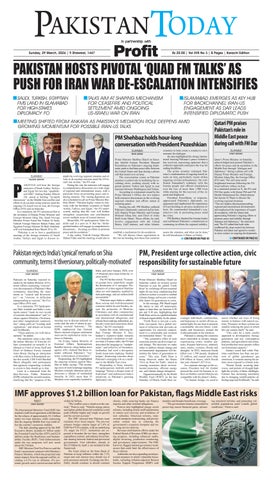
PAKISTAN HOSTS PIVOTAL ‘QUAD FM TALKS’ AS PUSH FOR IRAN WAR DE-ESCALATION INTENSIFIES In partnership with
Profit
Sunday, 29 March, 2026 | 9 Shawwal, 1447
g SAUDI, TURKISH, EGYPTIAN
FMS LAND IN ISLAMABAD FOR HIGH-STAKES DIPLOMACY: FO
Rs 20.00 | Vol XVII No 3 | 8 Pages | Karachi Edition
g TALKS AIM AT SHAPING MECHANISM
g ISLAMABAD EMERGES AS KEY HUB
FOR CEASEFIRE AND POLITICAL SETTLEMENT AMID ONGOING US-ISRAELI WAR ON IRAN
FOR BACKCHANNEL IRAN-US ENGAGEMENT AS DAR LEADS INTENSIFIED DIPLOMATIC PUSH
g MEETING SHIFTED FROM ANKARA AS PAKISTAN’S MEDIATION ROLE DEEPENS AMID
GROWING MOMENTUM FOR POSSIBLE IRAN-US TALKS
PM Shehbaz holds hour-long conversation with President Pezeshkian ISLAMABAD Mian abrar
P
ISLAMABAD
SaleeM jadoon
AKISTAN will host the foreign ministers of Saudi Arabia, Turkiye and Egypt for two-day “quadrilateral talks” starting Sunday (March 29), aimed at holding “in-depth discussions” on the Middle East conflict and efforts to de-escalate rising tensions amid the ongoing US-Israeli war on Iran, the Foreign Office (FO) said on Saturday. In a statement, the FO announced that at the invitation of Deputy Prime Minister and Foreign Minister Ishaq Dar, Saudi Foreign Minister Prince Faisal bin Farhan Al Saud, Turkish Foreign Minister Hakan Fidan, and Egyptian Foreign Minister Dr Badr Abdelatty will visit Islamabad from March 29 to 30. “Pakistan is set to host a quadrilateral meeting of the foreign ministers of Saudi Arabia, Turkiye and Egypt to discuss in-
depth the evolving regional situation and efforts to de-escalate tensions amid the US-Israeli war on Iran,” the FO said. During the visit, the ministers will engage in comprehensive discussions on a wide range of regional and international issues, with a particular focus on promoting peace and reducing tensions. The visiting dignitaries are also scheduled to call on Prime Minister Shehbaz Sharif. “Pakistan highly values its relations with the brotherly countries of Saudi Arabia, Turkiye, and Egypt,” the FO underscored, adding that the visit will further strengthen cooperation and coordination across multiple areas of mutual interest. Meanwhile, FO spokesperson Tahir Andrabi said in a post on X that the “distinguished leaders will engage in comprehensive discussions… focusing on efforts to promote peace and de-escalation.” A day earlier, Turkish Foreign Minister Hakan Fidan said the meeting would aim to
Prime Minister Shehbaz Sharif on Saturday briefed Iranian President Masoud Pezeshkian on Pakistan’s ongoing diplomatic push to facilitate peace talks between the United States and Iran during a phone call that lasted over an hour. The conversation comes as Pakistan assumes a central role in mediating the escalating crisis, working closely with regional partners Turkey and Egypt to ease tensions between Washington and Tehran. According to a statement issued by the Prime Minister’s Office, the two leaders held extensive discussions on the evolving regional situation and efforts aimed at restoring peace. During the call, PM Shehbaz outlined Pakistan’s diplomatic outreach led by himself, Deputy Prime Minister and Foreign Minister Ishaq Dar, and Chief of Army Staff Asim Munir. These efforts, he said, involve engagement with the United States, Gulf nations, and other Islamic establish a mechanism for de-escalation. “We will discuss where negotiations in this war are heading, how these four countries
countries to help create a conducive environment for dialogue. He also highlighted the strong international backing Pakistan’s peace initiative has received, expressing optimism that a collective approach could pave the way for ending hostilities. The prime minister reiterated Pakistan’s condemnation of ongoing Israeli attacks on Iran, particularly recent strikes targeting civilian infrastructure. He reaffirmed Islamabad’s solidarity with the Iranian people and offered condolences over the loss of more than 1,900 lives while praying for the recovery of the injured and displaced. President Pezeshkian, in response, appreciated Pakistan’s diplomatic engagement and emphasised the importance of trust-building to advance mediation efforts. He commended Islamabad’s constructive role in promoting peace amid the crisis. PM Shehbaz thanked the Iranian leader and reaffirmed Pakistan’s commitment to continuing its efforts for regional stability.
assess the situation, and what can be done,” he told broadcaster A Haber on Friday.
Qatari PM praises Pakistan’s role in Middle East peace during call with FM Dar ISLAMABAD
Staff report
Qatar’s Prime Minister on Saturday acknowledged and praised Pakistan’s efforts for peace and de-escalation in the Middle East through “dialogue and diplomacy” during a phone call with Deputy Prime Minister and Foreign Minister Ishaq Dar, the Foreign Office (FO) said. The call came amid heightened tensions following the USIsrael military strikes on Iran. In a statement posted on X, the FO said FM Dar spoke with Qatari PM and FM Sheikh Mohammed bin Abdulrahman bin Jassim Al Thani to discuss the evolving regional situation. “The two leaders discussed prevailing regional and international developments and emphasised the importance of urgent de-escalation, with the Qatari side appreciating Pakistan’s ongoing efforts to promote peace and stability through dialogue and diplomacy,” the statement said. The FO added that both sides reaffirmed the deep-rooted ties between Pakistan and Qatar and agreed to remain in close contact on ongoing developments.
CONTINUED ON PAGE 03
CONTINUED ON PAGE 03
Pakistan rejects India’s ‘cynical’ remarks on Shia PM, President urge collective action, civic community, terms it ‘diversionary, politically-motivated’ responsibility for sustainable future ISLAMABAD
Staff report
Pakistan on Saturday rejected remarks by the Indian Ministry of External Affairs expressing “concern” over the treatment of Pakistan’s Shia community, describing the statements as “cynical and diversionary”—an “exercise in deflection masquerading as concern,” the Foreign Office (FO) said. In a statement, FO Spokesperson Tahir Andrabi said India’s comments cannot “mask its own record of systemic discrimination” and “violence against Muslims, Christians, and other marginalized communities,” citing curbs on “worship, mob vigilantism,” and attacks on homes and livelihoods. “These patterns are well-documented,” he added. The statement came a day after the Indian Ministry of External Affairs commented on remarks it attributed to Chief of Army Staff and Chief of Defence Forces General Asim Munir. During an interaction with Shia clerics in Rawalpindi earlier this month, CDF Field Marshal Munir allegedly told participants that agitators responding violently to events in Iran should go to Iran. Later in a statement from the Inter-Services Public Relations (ISPR) rebutted the misinformation, clarifying that the “purpose of the
meeting was to discuss national security and the role of ulema in promoting societal harmony.” The ISPR emphasized that General Munir stressed religious sentiments must not be exploited to incite violence in Pakistan. On Friday, Indian Ministry of External Affairs Spokesperson Randhir Jaiswal, citing Indian news agency ANI, claimed that these remarks reflected Pakistan’s “systemic victimization of minorities.” Responding, the FO highlighted the ongoing violence against Muslims in India, saying: “The escalating wave of mob lynchings targeting Muslims is deeply abhorrent and underscores a climate of unchecked brutality. In 2025, more than 55 Muslims were reportedly lynched in
India, and since January 2026, over 19 Muslims have been killed by violent mobs.” The FO further noted: “Extremist groups have unlawfully sought the destruction of 11 mosques. Perpetrators of crimes against Muslims often act with impunity, enabled by state patronage, and are seldom held accountable.” “Pakistan urges India to address these serious and well-documented concerns within its own borders, ensure the protection of Muslims, Christians, and other communities in accordance with its constitutional and international obligations, and refrain from making unfounded, politically motivated statements about others,” the FO concluded. Earlier this week, following Indian Foreign Minister S. Jaishankar’s expletive-laden remarks over Islamabad’s mediation in indirect Iran-US peace talks, the FO had described the language as “undiplomatic” and reflective of frustration. Jaishankar had used a derogatory South Asian term implying ‘brothel keeper,’ dismissing concerns about Pakistan’s emerging role as a mediator in the Middle East crisis. Responding to those remarks, FO spokesperson Andrabi said the language “betrays a deeper sense of frustration” and underscores India’s sensitivity to Pakistan’s growing diplomatic role.
ISLAMABAD
Staff report
Prime Minister Shehbaz Sharif on Saturday called on citizens across Pakistan to join the global ‘Earth Hour’ by switching off non-essential lights for one hour, emphasizing that collective action is crucial to combat climate change and secure a sustainable future for generations to come. In his message, PM Sharif urged the nation to turn off unnecessary lights or limit their use between 8:30 pm and 9:30 pm, highlighting that Earth Hour serves as a global reminder of shared responsibility for the planet. “Earth Hour is not just a symbolic movement, but a global moment of reflection that provides an opportunity for renewed commitment to a sustainable and resilient environmental future,” he said. “The cumulative effect of such conscious actions can drive major social change. The decisions we make today to address climate change and environmental degradation will determine the future of generations to come.” This year, Earth Hour is being observed under the theme ‘Give an Hour for Earth,’ aimed at creating awareness about environmental protection, efficient energy use, and climate change mitigation. Organized annually by the World Wildlife Fund (WWF) on the last Saturday of March, Earth Hour en-
courages individuals, communities, and businesses to switch off non-essential lights for one hour to promote a sustainable, net-zero future. Landmarks and businesses around the world participate in the initiative. Pakistan is among the countries most vulnerable to climate change, experiencing erratic weather patterns, frequent heatwaves, untimely rains, storms, cyclones, floods, and droughts. In 2022, monsoon floods killed over 1,700 people, displaced 33 million, and caused more than $30 billion in losses, while floods last year claimed 1,037 lives. In a separate message on the occasion, President Asif Ali Zardari stressed the need for humans to reflect on whether current lifestyles are compatible with the planet’s limits. “As human beings, we need to
assess whether our ways of living remain in balance with natural systems. Pressures on these systems are steadily reducing the space in which life can sustain itself,” he said. “This calls for a more careful approach to development. Energy generation and use, consumption patterns, and agricultural and industrial production must operate within environmental capacity.” Zardari noted that while Pakistan contributes less than one percent of global greenhouse gas emissions, it remains among the nations most exposed to climate risks. “Recent floods, recurring heatwaves, and periods of drought highlight the severity of these challenges. Farmers face increasing uncertainty due to changing rainfall patterns affecting crops and livelihoods,” he said.
IMF approves $1.2 billion loan for Pakistan, flags Middle East risks PROFIT
Staff report
The International Monetary Fund (IMF) has reached a staff-level agreement with Pakistan for the release of approximately $1.2 billion under two loan tranches, while cautioning that the ongoing Middle East war could affect the country’s economic stability. The deal, pending approval by the IMF Executive Board, includes $1 billion under the Extended Fund Facility (EFF) and $210 million under the Resilience and Sustainability Facility (RSF). Total disbursements under the two programs will now reach about $4.5 billion. IMF Mission Chief Iva Petrova said the Fund’s assessment contrasts with Pakistan’s Finance Ministry, which has projected only minor impacts from the regional conflict, including a 0.3% rise in inflation, 4% economic growth, and a current account deficit
within $2 billion. “The conflict casts a cloud over the outlook,” Petrova said. “Volatile energy prices and tighter global financial conditions could push inflation higher and weigh on growth and the current account.” The IMF stressed that Pakistan must maintain strict fiscal targets. The pre-war primary budget surplus target of 1.6% of GDP for FY26 remains, with an underlying 2% target for FY27. Authorities are expected to broaden the tax base, strengthen expenditure control, and enhance fiscal burden sharing between federal and provincial governments. Fuel subsidies, already at Rs125 billion by April 3, are included in this framework. The Fund called on the State Bank of Pakistan to keep inflation within the 7.5% target and said interest rates should rise if price pressures intensify. Exchange rate flexibility should continue to absorb external
shocks, while ensuring banks can finance imports and other external obligations. Petrova also highlighted energy sector reforms, including timely tariff adjustments to ensure cost recovery and avoidance of new subsidies. Structural reforms, stateowned enterprise restructuring, and privatization remain key to reducing the government’s economic footprint and improving service delivery. Revenue mobilisation efforts under the Federal Board of Revenue (FBR) are showing progress, including enhanced audits, digital invoicing, production monitoring, and governance improvements. The IMF, however, flagged internal governance weaknesses that could limit the effectiveness of these reforms. Authorities are also expanding social protection measures to shield vulnerable households, including inflation-adjusted Benazir Income Support Programme (BISP) cash
transfers and broader beneficiary coverage. “The government remains committed to preserving macro-financial gains, advanc-
ing structural reforms, and protecting vulnerable populations amid volatile global conditions,” Petrova said.