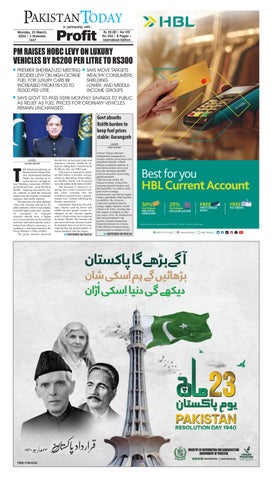

PM RAISES HOBC LEV Y ON LUXURY
VEHICLES BY RS200 PER LITRE TO RS300
g
g PREMIER SHEHBAZ-LED MEETING
FOR LUXURY
BE INCREA SED FROM RS100 TO RS300 PER LITRE


PM TERMS CLEAN WATER A BASIC HUMAN RIGHT AS PRESIDENT SL AMS INDIA OVER IWT VIOL ATIONS

this vital resource and ensure inclusive, sustainable and gender-sensitive water management
separate message, President Asif Ali Zardari condemned India’s unilateral suspension of the Indus Waters Treaty describing
rights and strongly condemns any form of water aggression the prime minister said, urging all institutions, civil society, and citizens to protect
RWMC successfully completes comprehensive city wide cleanliness operation on Eid
RAWALPINDI s ta f f r e p o r t
The Rawalpindi Waste Management Company (RWMC) successfully completed a comprehensive citywide cleanliness operation on the occasion of Eidul Fitr, ensuring a clean and healthy environment for residents Under a special sanitation plan, RWMC ensured thorough cleaning of mosques eidgahs graveyards parks and other public places providing citizens with a clean and healthy environment that was widely appreciated Ahead of Eid prayers all large and small mosques and eidgahs were cleaned to facilitate worshippers, while graveyards were also cleared to ensure a pleasant environment for visitors
TThe
further cautioned that
weaponization of
during natural disasters, amounts to a violation of international norms and agreements and could escalate tensions in the region
Highlighting the broader implications they said India s actions pose a grave threat to regional stability and could trigger a humanitarian crisis if left unchecked
The experts urged the international community and global organizations to take serious notice of the situation and press India to adhere to international laws and ensure fair sharing of water resources especially during critical periods such as floods and droughts
LAIBA HASAN
H E traditional patriotic anthem just got a high-octane, electronic makeover The ISPR s latest release, “Meri Mitti Meri Jaan,” is sweeping across digital and electronic platforms, proving that national pride can be as catchy as it is profound While the song celebrates the strategic triumph of Operation Bunyanum Marsoos its true magic lies in its cutting-edge production and a star-studded vocal line-up that speaks directly to the youth of Pakistan
The Architect of Sound: Abdullah Siddiqui At the heart of this sonic shift is the “one and only” music maestro Abdullah Siddiqui Known for pushing the boundaries of the Pakistani indie-pop scene Siddiqui brings his signature atmospheric textures to the track The song avoids the predictable march tempo instead opting for a sophisticated, gradual build The production is a masterclass; it starts with a hauntingly melodic base and layers electronic elements until it reaches a thunderous spectacular crescendo By the time the final resolve line “Hum Ehd ke Pasban, Deewar Bun ke khare hits its peak the listener is met with a wall of sound as impenetrable as the solid edifice the song describes A New Vocal Powerhouse
The anthem features a refreshing “who’s who” of Pakistan’s most sensational young talent This isn’t just a choir; it s a powerhouse collaboration:
paying respects to their loved ones RWMC teams paid special attention to parks, recreational spots and bus terminals, where not only cleanliness was maintained but washing operations were also carried out to enhance overall hygiene conditions Despite rainfall sanitation workers continued their efforts round the clock Drainage in low-lying areas was effectively managed providing timely relief to residents and preventing any major issues An anti-littering campaign was also carried out during Eid to raise public awareness about cleanliness Citizens actively participated and supported the initiative to keep the city clean RWMC fulfilled its commitment to providing a clean and healthy environment during Eid with residents terming its performance exemplary and appreciating the company s efforts
Havi & Nayel: Bring a gritty modern energy that anchors the track s contemporary feel Zoha & Tarab: Provide the soaring soulful melodies that give the anthem its emotional heartbeat
This diverse line-up ensures the song resonates beyond a single demographic, bridging the gap between traditional sentiment and the younger lots’ playlist preferences Meri Mitti Meri Jaan is a bold departure from the anthems of the past
Cinematic Vision The visuals are just as sharp as the audio Directed by the renowned Wajahat Rauf the music video moves with a cinematic fluidity that matches Siddiqui s production beats Under the lens of DOP Abid Rizvi the imagery captures the spirit of Bunyanum Marsoos the Quranic concept of a nation standing like a structure of solid lead
The video doesn t just showcase military might; it highlights the Pakistani nation as the true backbone of security standing shoulder-to-shoulder with their forces against any external aggression
The Verdict Meri Mitti Meri Jaan is a bold departure from the anthems of the past It s different in its beat, its rhythm and its visual flair It’s already trending for a reason: it’s an earworm with a soul For anyone who wants to feel the pulse of a modern resilient Pakistan this is a must watch
YT Link: https://youtu be/F-wZTWZ5Xo8?si ki4turYthTV6gAvz
Eid and the Year of the Elephant


‘NIGAHBAN RAMA Z AN PACK AGE’ SETS NEW BENCHMARK IN PUBLIC SERVICE: CM MARYAM

KP govt plan to plant one million trees in single day on Pakistan Day
To mark Pakistan Day on March 23 (tomorrow) the provincial government has set an ambitious target of planting one million trees in a single day transforming the national celebration into a powerful symbol of environmental responsibility towards combating climate change The campaign is being launched under the vision of the Green Khyber Pakhtunkhwa initiative with tree planting planned simultaneously across the province from the fertile plains of Peshawar to the mountainous valleys of Swat and Chitral to vast lands of DI Khan Ahmad Jalil Chief Conservator of Forests (CCF) said the massive campaign is meant to connect patriotism with environmental stewardship Pakistan Day commemorates the dream of an independent homeland, he said “By planting trees on this historic day, we want to ensure that future generations inherit a greener and healthier
Pakistan At exactly 9 a m on March 23 volunteers across the province will begin planting saplings provided by the forest department nurseries
The activity will continue throughout the day until the last plant is in the ground ” said Ahmad Jail He said forests have long played a crucial role in Pakistan s environmental health
From the towering deodar forests of the Himalayas to mangroves along the Karachi coast, trees act as natural protectors absorbing carbon dioxide, producing oxygen and improving rainfall patterns Environmental experts warned that deforestation and rapid urban growth have weakened this natural shield, particularly in cities like Peshawar where air pollution levels have risen significantly
According to environmental analysts tiny particulate pollutants known as PM2 5 microscopic particles harmful to human health have reached levels far above recommended limits in the city s air Planting more canopy trees, experts said, is one of the simplest and
most effective ways to reduce such pollution Historically the region once had dense forests In his memoir Baburnama, Mughal emperor Babur wrote about hunting lions in the forests around Peshawar an indication of how lush the area once was
Over the centuries however expanding populations urban development and unchecked construction gradually reduced tree cover in districts like Mardan, Swabi, Nowshera, and Charsadda
Today environmentalists believed that restoring native trees such as shisham siris and pipal is critical for bringing ecological balance back to the region To ensure transparency and accurate monitoring of the March 23 campaign, authorities have introduced a digital tracking system Project Director of the Ten Billion Tree Tsunami Programme Muhammad Junaid Diyar said a special mobile application and central dashboard will record every stage of the plantation process
Unity, solidarity key for transforming national resolve into reality: Z ardari
ISLAMABAD
s ta f f r e p o r t
President Asif Ali Zardari has said that Pakistan Day reminds us that unity and solidarity are the most important elements in transforming national resolve into reality
Extending his heartfelt felicitations to the entire Pakistani nation on the occasion of Pakistan Day, the president, in his message said that on this very day in 1940, the Muslims of the Subcontinent adopted the Pakistan Resolution and presented the idea of establishing a separate homeland where they could live their lives freely in accordance with Islamic principles Today we pay tribute to our elders whose struggle and sacrifices led to the creation of Pakistan
“At the time of Pakistan’s creation in 1947 we faced numerous challenges History bears witness that through mutual cooperation hard work and capability we overcame those difficulties and achieved remarkable success in every field, he said adding We established state institutions, made our defence capability impregnable acquired nuclear deterrence fought a long and successful unconventional war against
terrorism and set shining examples of sacrifice and mutual support during natural disasters ” During Marka-e-Haq in May last year we confronted the enemy s aggression with courage and taught such a lesson that it will remember for a long time Even today, we face challenges on the internal front and along our external borders the president added
Like Operation Bunyan-um-Marsoos he said Operation Ghazab-Lil-Haq has also achieved significant and desired results Our clear message to the illegally imposed group in Afghanistan is that we will not allow Fitna alKhawarij Fitna al-Hindustan or any other group to use Afghan soil for actions against Pakistan
We will also completely eliminate those who sponsor terrorism and those who, through India or its proxy elements, seek to undermine our peace and our efforts for peaceful coexistence so as to secure our settlements and our borders he remarked
He said in Indian Illegally Occupied Jammu and Kashmir (IIOJK), the open violations of human rights by Indian forces, attempts to alter the demographic composition, patronage of Hin-
succeeded in achieving a separate homeland: Pakistan under the visionary leadership of Muhammad Ali Jinnah Undoubtedly with the blessing of freedom he said Pakistan stood as a testament to the wisdom determination perseverance and sacrifices of our ancestors "Our armed forces and law enforcement agencies, with their high professionalism and patriotic spirit, are defending Pakistan’s freedom and sovereignty Last year during Operation Bunyan-um-Marsoos Pakistan’s armed forces delivered a strong and decisive response to the enemy writing a golden chapter of military history, he said adding that by thwarting hostile designs, they proved that Pakistan’s defense is "impregnable" and our resolve "unshakable" "This year on the
dutva and the unjust treatment of minorities in India particularly Muslims are proofs that the decision of Quaid-eAzam and the Muslim leadership to seek a separate homeland was prudent Kashmir remains the unfinished agenda of the Partition of the Subcontinent
“We expect the international community to urge India to allow the people of IIOJK to live according to their will and to grant them the right of self-determination in accordance with the resolutions of the United Nations Security Council
He called upon the international community to step forward to end the atrocities being committed against our Palestinian brothers who deserve to live a dignified and peaceful life under the internationally recognised two-state solution and peaceful coexistence Similarly, we emphasise the resolution of the recent tensions in West Asia through diplomacy and dialogue
On the occasion of Pakistan Day he called for resolving to ensure the rule of law strengthen democratic institutions reduce inequality, empower women, promote political and economic stability and eliminate the scourge of terrorism and extremism

The Brink
With the Iranian attacks on S audi, Qatari and Kuwaiti facilities, the war intensifies
IR A N was expected to respond to Israeli airstrikes on its South Pars/North Dome gas field, and it did, with its Thursday night attack on Qatari gas facilities, as well as Saudi and Kuwaiti oil refineries Pakistan condemned these attacks That was inevitable, considering that it is working for a de-escalation and that it is directly affected by the war, both because of the shock to its economy from the rising price of oil and the prospect of shortages of fuel However at the same time to ask Iran not to respond to the attacks was to be disingenuous Matters it seems have gone beyond merely the closure of the Hormuz Strait which was damaging enough Israeli Prime Minister Benjamin Netanyahu said that Israel was going to honour US president Donald Trump s request to refrain from targeting Iranian oil infrastructure, as if his promises could be trusted a single bit This promise was also made despite a refinery in Haifa having been hit, the first direct damage to Israeli energy infrastructure Mr Trump may have applied pressure after he realized that he had gone too far, that the conflict could spiral out of control
Another problem that Mr Trump is facing is that while the US Patriot missile defences have held so far they are prohibitively expensive A Patriot missile costs $4 million and 800 missiles have been fired so far for a cost of over $3 billion so far This is apart from the cost of munitions, or of operating the aeroplanes carrying out the missions Then there was the cost of deploying two carrier groups to theatre The first six days of the war cost $11 3 billion, according to the administration itself A prolonging of the conflict wil only lead to further difficulties, what with the global Brent crude price reaching $108 a barrel on Monday
Not just the combatants or the region, but the whole world, stands at the brink of much suffering and economic destruction An end to the conflict is thus the only solution to the conflict However as Iranian President Masood Pezeshkian has said there must be international guarantees that there will be no repetition of their acts last July, when they had the same aims, but stopped short As Mr Trump and Mr Netanyahu have shown after that episode, a ceasefire doe not mean peace, but a period of preparation for an even greater assault

Dedicated to the legac y of late Hameed Nizami Arif Nizami (Late)
M A Niazi Editor Pakistan Today Babar Nizami
Pe o p l e a re t h e ke y
A c r i s i s t h at n e e d s c a re f u l h a n d l i n g


AS the international oil price almost near $120 per barrel, whereby, to be precise on March 19 the price increased by a little more than $10 from the day before taking the Brent Crude to $119 per barrel it came down on Friday to around $107 per barrel highlighting the sudden nature of overall sharp rise in prices since the Iran War started a few weeks ago on February 28 This,
facilities European gas futures surged as much as 35 percent to more than double their pre-war level and Brent crude rose as high as $119 a barrel “LNG from Qatar could in principle be offline for months and in the worst case for years said Arne Lohmann Rasmussen chief analyst
and strikes on multiple oil, and gas fields overall in the Middle East in addition to just Iran, is bringing back the global economy to a similar situation, especially in terms of inflation, as was seen in the wake of global supply shock due to the Covid-19 pandemic


is wasted just trying to navigate the system At the same time the machinery of government remains stuck in another era Decisions are concentrated at the top leaving civil servants hesitant to act on their own Endless approvals delay even simple tasks Procedures focus more on avoiding blame than delivering results Caution replaces performance, and initiative begins to feel like a risk In such a system honest officers fear scrutiny if something goes wrong while the truly corrupt often use the same complexity to conceal wrongdoing The accountability structure ends up being both heavy and ineffective It discourages the sincere and rarely restrains the powerful These institutional weaknesses explain why public projects frequently suffer delays and cost overruns why regulatory bodies lack credibility and why citizens experience the state as slow and unresponsive Economic growth cannot accelerate when the very institutions meant to enable it are themselves obstacles None of these chal-
and the Ukraine War Moreover, it will be only some time before the policy rate will likely rise; although for now except for Australia, central banks like the European Central Bank (ECB) and the US Federal Reserve have shown restraint Yet the expected rate cuts situation has most probably been thrown out of the window including for net oil importing countries like Pakistan That being said, the world should learn from the misgivings of too hawkish a stand that it took earlier in the decade by adopting over-board monetary and fiscal austerity policies which led to unjustifiably high economic growth sacrifice and pushed a number of countries to a very difficult debt situation Hence there is a need for adopting a more balanced approach with regard to aggregate demand squeeze, and aggregate supply boosting policies Also, instead of using higher policy rate to chase otherwise highly volatile foreign portfolio investment (FPI) and likely significantly contribute to higher imported cost-push inflationary and overall balance of payments pressures it will be much better to induce higher foreign direct investment by keeping the interest rate lower to the extent at least; although overall as well, in developing countries like Pakistan, where inflation is at least equally a fiscal phenome-

b a l a n c e o f p ay m e n t s s i t u a t i o n , e s p e c i a l ly o f n e t o i l i m p o r t i n g
c o u n t r i e s l i k e Pa k i s t a n – by r e l e a s i n g m e a n i n g f u l l ev e l o f s p e c i a l d r aw i n g r i g h t s ( S D R s ) o n t h e b a s i s o f  n e e d Ê o f a p a r t i c u l a r c o u n t r y, a n d n o t o n t h e ro u t i n e b a s i s o f u s i n g t h e c r i t e r i o n o f  q u o t a Ê fo r
a l l o c a t i o n o f S D R s , s i n c e t h i s i s o bv i o u s ly a n e m e rg e n cy s i t u a t i o n

lenges are insurmountable But they require a shift in priorities Stabilization packages and foreign loans may buy time, but they cannot substitute for reform Pakistan must treat human development as seriously as it treats debt servicing That means sustained investment in schools teacher training digital literacy and market-oriented technical education It means aligning universities with industry and rewarding research and innovation
Just as important is continuity Key areas such as education, local governance, and export support should be protected from political changes through broad consensus Investors need confidence that policies will remain stable The government must also modernize by delegating authority, simplifying procedures, and rewarding performance Regulation should support enterprise, not hinder it Above all, lasting progress depends on rebuilding trust so that citizens businesses and the state work together toward a common goal Pakistan s economic story is often reduced to shortages of money, exports, and reserves But scarcity is not destiny Nations with fewer resources have progressed because their institutions worked and their people were empowered Prosperity is built on capable people clear rules and systems that function Until those foundations are fixed no loan or bailout will matter Without strong institutions every financial fix is just a temporary patch on a broken machine
The writer has a PhD in Political Science, and is a visiting faculty member at QAU Islamabad He can be reached at zafarkhansafdar@yahoo com and tweets @zafarkhansafdar
PakistanÊs economic story is often reduced to shor tages of money, expor ts, and reserves But scarcity is not destiny Nations with fewer resources have progressed because their institutions worked and their people were empowered Prosperity is built on capable people, clear rules, and systems that function. Until those foundations are fixed, no loan or bailout will matter. Without strong institutions, every financial fix is just a temporary patch on a broken machine . I r a n w a r,
Playgrounds build healthy kids
Roads clogged this Ramazan
Dr Omer JaveD
Dr Zafar Khan SafDar


Awrong side of the political divide Academic research helps explain why this form of influence is so powerful In 2017 disinformation scholars Claire Wardle and Hossein Derakhshan introduced the concept of information disorder showing how misinformation disinformation and malinformation collectively pollute the digital environment During elections, the problem often does not involve outright falsehoods Instead partial truths are exaggerated or stripped of context to provoke anger and fear As emotions intensify people gravitate toward narratives that confirm their existing beliefs rather than verifying facts
A related concept is truth decay, developed by RAND Corporation scholars Jennifer Kavanagh and Michael D Rich Truth decay describes a gradual erosion in the role of verifiable facts in public debate accompanied by the growing dominance of opinions emotions and personal biases When societies lose a shared factual foundation, democratic dialogue weakens, and political polarization accelerates International experiences illustrate how digital influence can reshape electoral politics After the 2016 US presidential election the Cambridge Analytica–Facebook scandal revealed how personal data and targeted political messaging could be used to manipulate voter behaviour Investigations later showed that data from tens of millions of Facebook users had been harvested without consent contributing to an emerging influence industry that amplified polarization and accelerated truth decay India s electoral experience offers another cautionary example As the world s largest democracy, India has struggled with the spread of online misinformation during elections Reports from 2024 highlight how authorities attempted to curb digital false-
Ultimately,
fearing that curiosity itself may place them on the
hoods after recognizing that online disinformation could escalate into real-world violence and social unrest Influencers who claimed to present “ground realities” often normalized divisive language shaping not only voting behaviour but also post-election social relations Taiwan s 2024 election, however, demonstrates that a different outcome is possible Despite widespread attempts to spread false information the impact was limited through rapid fact-checking transparent communication by election authorities and the responsible conduct of some influencers This case shows that influencers are not inherently destabilizing actors; under the right conditions, they can help defend factual discourse rather than undermine it
Brazil’s 2018 election highlights yet another dimension of digital influence Research on the Brazilian context shows how encrypted messaging platforms such as WhatsApp enabled political messages to spread rapidly and privately In these closed networks, trusted individuals and group administrators became informal influencers forwarding unverified content that quietly but extensively deepened political division In Bangladesh influencer-driven polarization during elections posed particular dangers Political debate frequently shifted away from policy and governance toward personality-based and identity-driven narratives When influencers packaged identity politics in emotionally charged and simplified language social divisions spread rapidly leaving little room for rational discussion Rumours and half-truths circulated quickly because many users lacked both the habit and the tools to verify sources and statements such as “I saw a video” or “someone said it” are often treated as sufficient evidence
Another risk arises when influencers replicate foreign political slogans and narratives without considering local realities
I s I r a n u s i n g I s r a e l - U S m a d m a n d o c t r i n e ?
its originators transforming deterrence into a shared and unstable framework

Phrases such as Stop the Steal originally popularized in the USA have appeared in other national contexts In Bangladesh, such language is especially harmful because it undermines trust in elections even before voting begins weakening democratic legitimacy regardless of the outcome Online polarization also produces offline consequences When influencers use suggestive language that implies punishment, boycotts, or retaliation, they increase fear and insecurity among individuals and communities In some cases, this rhetoric spills over into harassment intimidation or violence transforming digital hostility into real-world harm These dynamics are closely linked to human security The United Nations Development Programme s 1994 Human Development Report emphasized that security is not only about protecting the state but also about safeguarding people’s daily lives Divisive political messaging fuels anxiety damages family and community relationships and exposes individuals to online abuse and threats From this perspective, the impact of divisive influencers is not merely a political issue but a broader human security concern An often-overlooked aspect of this influence is the role of expatriate Bangladeshis Large audiences for online political content live outside the country yet remain deeply engaged through YouTube discussions, Facebook Live programs, and online commentary Influencer narratives, therefore, shape not only domestic opinion but also the perceptions of the diaspora This has economic implications as Bangladesh depends heavily
The West sees the world in binar y terms: ‘our camp’ vs the ‘enemy ’s camp’
war on February 28 2026 Iran has followed a consistent pattern Every escalation is met with escalation, and every strike on strategic infrastructure is answered with pressure on equally strategic targets This breaks from the historical pattern of US and Israeli wars in the Middle East where escalation largely flowed in one direction For
by
vulnerability across the battlefield expanding the geography of confrontation and refusing to remain within predefined limits
Today s events illustrate this shift with unusual clarity The targeting of Natanz and the subsequent strike on Dimona form part of a single chain of escalation, not separate incidents The battlefield is no longer fragmented; it is structurally connected
The intellectual roots of this approach however lie partly in Israeli military doctrine itself During the 2008–2009 war on Gaza, then-foreign minister Tzipi Livni articulated this logic in unmistakable terms “Israel is not a country upon which you fire missiles and it does not respond It is a country that when you fire on its citizens it responds by going wild – and this is a good thing
She was even more explicit in a separate statement: “Israel demonstrated real hooliganism during the course of the recent operation which I demanded These were not slips of language They were declarations of doctrine The idea was simple: overwhelming, disproportionate, and seemingly uncontrolled force would deter adversaries by making the cost of confrontation unbearable Israel would not merely respond; it would escalate beyond predictability
For years that doctrine functioned largely in one direction Israel could escalate with overwhelming and unpredictable force, while others were expected to absorb the consequences and recalibrate The logic was not simply military but psychological deterrence through excess through the projection of a state willing to go beyond conventional limits
A similar logic had already been articulated decades earlier in the United States through what became known as the “madman theory ” associated with Richard Nixon The idea was that a leader s unpredictability even the perception of irrationality could itself function as a tool of coercion
Under Donald Trump, that posture did not emerge for the first time but reappeared in a more overt and performative form where unpredictability was framed not as risk but as leverage and at times deliberately amplified
But Iran appears to have internalized this logic and turned it outward The strike on Dimona is not only re-
taliation It is replication Tehran is applying the same doctrine back onto
Strike Natanz, and Dimona is no longer untouchable Expand the battlefield and the battlefield expands further What was once a one-sided doctrine of domination becomes a two-sided mechanism of escalation
This dynamic has unsettled Washington US media, citing intelligence assessments, reported in midMarch that the Trump administration had been warned of Iranian retaliation yet the scale and coordination of the response exceeded expectations On March 21, even as military operations continued, Trump indicated that Washington was considering options to “wind down” the war, even as additional forces were deployed Retreat would signal a geopolitical defeat; escalation risks a deeper one Israel faces a different but equally dangerous reality For Prime Minister Benjamin Netanyahu, escalation has often functioned as a strategy prolonging conflict and delaying internal crises But Iran s adoption of the same escalation logic complicates that approach When both sides embrace escalation as a principle, deterrence begins to erode Iran, however, appears to be operating with a longer horizon Its capabilities extend beyond missile exchanges to include influence over maritime chokepoints regional alliances, and actors capable of exerting pressure across multiple fronts
Among these is the Bab al-Mandeb Strait where Ansarallah maintains the ability to disrupt global shipping This adds another layer to a conflict already expanding beyond conventional battlefields Some of Iran s capabilities are visible Others remain deliberately undefined This allows Tehran to escalate while preserving strategic depth maintaining pressure without exhausting its options Ironically the doctrine now shaping the war is one
Israel helped normalize
On March 21, with Natanz and Dimona linked within the same day of strikes that transformation became unmistakable The war is no longer defined by who escalates but by what happens when both sides choose, deliberately, to go wild
Dr Ramzy Baroud is the
TH E US-Israel military operation against Iran has entered its third week, with a swirl of information true and false flying around Amid the reports, a particular narrative hyped up by Western media stands out They claim that China despite its strong opposition to the war has neither provided substantial support to Iran nor demonstrated the military capability necessary to back it The ongoing strikes they argue have exposed the limits of China s influence in the Middle East
Following this logic, they conclude that by standing idly by watching as its partners get targeted by the US one by one China has proved itself an “unreliable partner and its influence is waning This narrative is rather strange Would they be satisfied if China did provide military support to Iran? Would providing military support validate China’s rising influence? Ironically, the West has watched China closely during the Russia-Ukraine conflict for fear that it might provide military aid
China is always the biggest loser whether in the RussiaUkraine conflict the EU-India free trade agreement or the US kidnapping of Venezuela s Maduro They have used this anti-China playbook so frequently that Chinese netizens mock it as the biggest loser
Rashadul islam samRat

CHINA PLEDGES MORE BAL ANCED TRADE AND FURTHER OPENING OF THE ECONOMY AFTER RECORD SURPLUS

Palestinian man says Israeli settlers sexually assaulted him in front of his family

Allegations
against ICC war crimes prosec utor K arim K han still under review despite repor t he
was cleared
their role in investigating allegations of Israeli war crimes in Gaza which led to the indictment of Prime Minister Benjamin Netanyahu The ICC is the world s court of last resort for international crimes, and has 125 member countries It has been thrust into an existential crisis by the sanctions and loss of the prosecutor who is its most prominent official Its membership does not include China, Russia or the United States, which have opposed Khan s issuing of arrest warrants for sitting leaders, including Russian President Vladimir Putin and Netanyahu

RAJAMAHENDRAVARAM
AG E N C I E S
The death toll in the suspected milk adulteration case in East Godavari district has risen to 16, while three persons are currently undergoing treatment at hospitals in Rajamahendravaram The incident dates back to mid-February when adulterated milk supplied in parts of Lalacheruvu caused severe health complications among consumers, including vomiting, abdominal pain, anuria and acute renal dysfunction, leading to multiple hospitalisations

The case came to light on February 22 after a cluster of patients with acute kidney failure symptoms was reported from Chowdeswaranagar and Swaroop Nagar areas, prompting health authorities to launch an epidemiological investigation Laboratory findings show that the 16 victims died of multi-organ failure triggered by acute renal failure after consuming milk contaminated with the toxic substance ethylene glycol, according to an official press release issued on Sunday “Preliminary findings indicate that the victims suffered acute renal failure with elevated blood urea and serum creatinine levels suggesting toxic exposure likely linked to contaminated milk consumption, the release said Milk supplied to over 100 families from a dairy unit in Narasapuram village under Korukonda mandal was identified as the suspected source following which supply from the unit was immediately stopped, it said Between February 16 and March 21, a total of 20 persons were admitted to various hospitals of whom 16 succumbed while three remain under treatment and one was discharged after recovery Authorities said the patients included elderly persons and children, with several requiring dialysis and ventilator support while emergency medical camps and surveillance measures were deployed in affected localities US sues Har vard over alleged
flogged
Badghis, Farah, Nimroz, Logar, Jawzjan, Helmand, Sar-e-Pul, Daikundi and Bamiyan


On the auspicious occasion of Pakistan Day I extend heartiest felicitations on behalf of COMSATS fraternity to the Host Government and People of the founding member, Pakistan Pakistan Resolution that was adopted on 23rd March 1940 under the selfless visionary leadership of Quaid-e-Azam Muhammad Ali Jinnah a man of unbreakable integrity and high dignity laid the foundation of a country, which today stands on the strengths of 250 million young dominated resilient population abundance of unexploited natural resources and a major regional power to reckon with
Envisioned by the Nobel Laureate and Pakistani Scientist Prof Abdus Salam, founded in Pakistan in 1994, COMSATS over-arching objective remains bridging technology and knowledge gap between the developed and developing countries COMSATS harnesses emerging technologies to stay in-step and benefit Member States COMSATS’ activities aligned with SDGs assist member states in a variety of ways, including building local capacity for R&D in order to translate technological advancements into tangible socio¬economic benefits
CIENCE, technology and innovation act as the prime mover of the economic growth social transformation and global competitiveness While countries in the Global North continue to lead in technological innovation, many nations in the Global South face persistent challenges in accessing advanced knowledge research infrastructure and modern technological tools This limits the ability of developing countries to respond effectively to challenges such as climate change, food security, public health, and sustainable production and consumption Prof Abdus Salam’s initiative of Commission on Science and Technology for Sustainable Development in the South (COMSATS) in 1994 was aimed at bridging the technology and knowledge gap to attain sustainable socio-economic development through promotion of science technology & Innovation and sharing of indigenous capacities COMSATS has evolved into a dynamic intergovernmental organization comprising 27 Member States from Asia, Africa, the Middle East, and Latin America, with its 25 International S&T Centres of Excellence serving as fountainhead of knowledge expertise and scientific activities
COMSATS Member States strengths are manifested in its combined GDP of over US$ 23 trillion territory of over 25 million km², 3 billion and youth dominated population of around 830 million Pakistan stands out with about 64 percent of youth population reflecting significant demographic potential Statutory Bodies of COMSATS are: General Meeting: comprises Heads of State/Government of the Member Countries Current Chairman of the Commission is the President of Republic of Ghana Consultative Committee: consists of Ministers/ Ministerial representatives of the relevant focal ministries/ government departments of the Member States • COMSATS Network: serves as technical resource base for the organization’s S&T programs and innovations It consists of:


- Coordinating Council: Heads of Centres of Excellence - Technical Advisory Committee: comprising Scientists/Technology Experts support the organization with their valuable advice Secretariat: Hosted in Islamabad by the Government of Pakistan It is Headed by the Executive Director The Programmes and IPO/CCCS Directorates undertake necessary coordination and execute technical activities COMSATS’ activities include capacity building trainings skills development facilitating R&D creating employability and providing tech-based solutions independently or in collaboration with the international partner organizations and Member States national organizations The organization has placed strong emphasis on harnessing emerging and transformative technologies including AI Data Analytics Precision Agriculture Genomic Sequencing Precision Medicine, Renewable Energy, Biotechnology, Nanotechnology and Electric Vehicles International Partnerships play a vital role in amplifying the impact of COMSATS initiatives The organization maintains close collaborative arrangements with a range of intergovernmental and international organizations, including The Commonwealth, UNESCO, UNOSSC, UNESCAP, UNIDO, ANSO, TWAS, ICGEB The South Centre ICESCO IOFS and SESRIC Through these partnerships COMSATS is able to mobilize financial and technical resources to co-organize training programs and support collaborative R&D COMSATS has recently secured funding from ANSO for two high-level activities i e Conference on ‘AI Enabled Solutions for Sustainable


b e t w e e n p a t i e n t s a n d d o c t o r s E l e c t r i c Ve h i c l e s : D ev e l o p m e n t o f i n d i g e n o u s t e c h n o l o g y b y i t s p a r t n e r A G E C O t o c o n v e r t t h e I n t e r n a l C o m b u s t i o n E n g i n e ( I C E ) v eh i c l e s t o E l e c t r i c Ve h i c l e s ( E V s ) t h r o u g h r e t r o f i t t i n g i s a g r o u n d b r e a ki n g a c h i e v e m e n t I t i s m u l t i - d i m e ns i o n a l i n i t i a t i v e w i t h e c o n o m i c , s o c i a l , h e a l t h a n d e n v i r o n m e n t a l a sp e c t s a t i t s c e n t r e R e c e n t l y, E V c o nv e r t e d r i c k s h a w s w e r e d e l i v e r e d t o M / S I m p e r i a l E n g i n e e r i n g C o m p a n y m a r k i n g t h e f i r s t c o m m e r c i a l d e p l o ym e n t o f t h e t e c h n o l o g y N a n o Te c h L a b : C O M S AT S h a s e s t a b l i s h e d a n I S O C e r t i f i e d N a n o t e c h n o l o g y L a b , w h i


PAKISTAN TOPS GLOBAL TERRORISM INDEX AS DEATHS HIT DECADE-HIGH IN 2025
not be used by hostile elements against Pakistan: Field Marshal Munir


