In partnership with
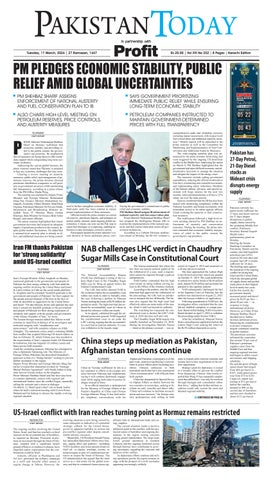
PM PLEDGES ECONOMIC STABILITY, PUBLIC RELIEF AMID GLOBAL UNCERTAINTIES
Profit
Tuesday, 17 March, 2026 | 27 Ramazan, 1447
g
g
PM SHEHBAZ SHARIF ASSIGNS ENFORCEMENT OF NATIONAL AUSTERITY AND FUEL CONSERVATION PLAN TO IB
g
ALSO CHAIRS HIGH-LEVEL MEETING ON PETROLEUM RESERVES, PRICE CONTROLS, AND AUSTERITY MEASURES
P
g
ISLAMABAD
SAYS GOVERNMENT PRIORITIZING IMMEDIATE PUBLIC RELIEF WHILE ENSURING LONG-TERM ECONOMIC STABILITY PETROLEUM COMPANIES INSTRUCTED TO MAINTAIN GOVERNMENT-DETERMINED PRICES WITH FULL TRANSPARENCY
staff report
RIME Minister Muhammad Shehbaz Sharif on Monday reaffirmed that economic stability and providing relief to the public remain the government’s top priorities. He emphasized that all measures are being taken to offer immediate support while safeguarding long-term economic resilience. Addressing the current global tensions, the prime minister stated that Pakistan is prepared to face any economic challenges that may arise. Chairing a review meeting on austerity measures, public relief, and management of petroleum reserves, the prime minister directed petroleum distribution companies to sell products at government-set prices while maintaining full transparency, according to a press release from the PM Office Media Wing. The meeting was attended by Deputy Prime Minister and Foreign Minister Mohammad Ishaq Dar, Finance Minister Muhammad Aurangzeb, Economic Affairs Minister Ahad Khan Cheema, Petroleum Minister Ali Pervaiz Malik, Information and Broadcasting Minister Attaullah Tarar, IT Minister Shaza Fatima Khawaja, State Minister for Finance Bilal Azhar Kayani, and senior officials. The prime minister highlighted that timely government decisions had ensured an adequate supply of petroleum products in the country despite global market fluctuations. He added that a national-level austerity plan is already in effect, and additional measures are being consid-
ered to further strengthen economic stability. A third-party audit has been ordered to ensure proper implementation of these measures. Officials briefed the prime minister on current oil reserves, petroleum imports, and strategies to protect public interests amid ongoing global uncertainties. Citizens can now use the Pak App to report fuel shortages or overpricing, enabling authorities to take immediate corrective action. Participants lauded the prime minister’s recent decision to freeze petroleum prices, rein-
Iran FM thanks Pakistan for 'strong solidarity' amid US-Israel conflict ISLAMABAD
staff report
forcing the government’s commitment to public relief and economic stability. PM Shehbaz Sharif assigns IB enforcement of national austerity and fuel conservation plan Prime Minister Muhammad Shehbaz Sharif has assigned the Intelligence Bureau (IB) to monitor the implementation of the national austerity and fuel conservation plan across all government institutions. According to a Cabinet Division notification issued on Monday, the IB will “conduct a
comprehensive audit and validation exercise, including impact assessment, with respect to all fuel conservation and additional austerity measures.” Weekly reports will be submitted to the prime minister as well as the Committee for Monitoring and Implementation of Fuel Conservation and Additional Austerity Measures. The wide-ranging austerity plan was announced by the prime minister amid rising fuel costs triggered by the ongoing US-Israel-Iran conflict in the Middle East. Addressing the nation on March 9, PM Shehbaz highlighted that the government had taken difficult economic and administrative decisions to manage the situation and mitigate the impact of the energy crisis. The measures include cutting government expenditures, reducing the official workweek to four days, minimizing non-essential movement, and implementing salary reductions. Members of the federal cabinet, advisers, and special assistants will forgo salaries for the next two months, while parliamentarians will face a 25% salary cut over the same period. Sources confirmed that the IB has also been tasked with monitoring compliance within the National Assembly and Senate secretariats, with immediate action to be taken against officers found violating the austerity or fuel conservation measures. The notification followed a high-level review meeting chaired by PM Shehbaz on enforcement of austerity and conservation measures. During the meeting, the prime minister reiterated that economic stability and provision of relief to the public remain the government’s top priorities.
NAB challenges LHC verdict in Chaudhry Sugar Mills Case in Constitutional Court ISLAMABAD
staff report
Iran’s Foreign Minister Abbas Araghchi on Monday expressed gratitude to the government and people of Pakistan for their strong solidarity with Iran amid the ongoing conflict involving the United States and Israel. In a post written in Urdu on the social media platform X, Araghchi said he extended “heartfelt gratitude to the government and people of Pakistan” for their support for the people and government of the Iran in the face of what he described as aggression by the United States and Israel. “On this blessed, divine and spiritual day and hour, I extend my heartfelt gratitude to the government and people of Pakistan for their strong expression of solidarity and support with the people and government of the Islamic Republic of Iran,” he wrote. The Iranian foreign minister added that Tehran would continue to stand firm in defence of its sovereignty and territorial integrity with “steadfastness and perseverance” and with complete reliance on Allah Almighty. The statement comes amid a widening Middle East conflict that erupted following US-Israeli strikes on Iran on February 28, which Tehran says also resulted in the assassination of Iran’s supreme leader Ali Khamenei. In retaliation, Iran has targeted US military assets and bases across Gulf countries. Amid the escalating tensions, Pakistan has attempted to play a diplomatic balancing role. The Ministry of Foreign Affairs (Pakistan) has described Islamabad’s approach as that of a “bridge builder” seeking to prevent further escalation in the region. Deputy Prime Minister and Foreign Minister Ishaq Dar earlier revealed that Islamabad invoked its “Strategic Mutual Defence Agreement” with Saudi Arabia to help deter heavier Iranian strikes on the kingdom. Prime Minister Shehbaz Sharif and Dar have also been in constant diplomatic contact with regional and international leaders since the conflict began, repeatedly calling for restraint and a return to dialogue. On March 12, Sharif paid a brief visit to Saudi Arabia where he held a restricted meeting with Crown Prince Mohammed bin Salman to discuss the rapidly evolving regional situation.
Rs 20.00 | Vol XVI No 252 | 8 Pages | Karachi Edition
The National Accountability Bureau (NAB) has challenged a ruling of the Lahore High Court in the Chaudhry Sugar Mills case by filing an appeal before the Federal Constitutional Court. The LHC had earlier directed NAB to file a reference before the accountability court within one week in order to formally close the case, following a petition by Maryam Nawaz seeking the return of Rs70 million deposited as surety. The high court had also ordered the accountability court in Lahore to decide the reference within one month. In its appeal, submitted through the additional prosecutor general, NAB requested the constitutional court to set aside the LHC’s ruling, arguing that the accountability court had no judicial authority if a case was withdrawn at the inquiry stage.
The bureau maintained that where the law does not require judicial approval for the withdrawal of a case, such a requirement cannot be imposed through a judicial interpretation. NAB further contended that the high court issued its ruling without serving notices to the Office of the Attorney General. According to the petition, once the NAB chairman had approved the withdrawal of the proceedings, the LHC had no jurisdiction to interpret the law differently. The bureau also argued that the high court had effectively taken suo motu notice of the matter, which it said was beyond its authority. The watchdog has requested the constitutional court to declare the LHC’s February 4, 2026 decision null and void. The Chaudhry Sugar Mills inquiry was initially launched on November 14, 2018. During the investigation, Maryam Nawaz — listed as the primary accused — was ar-
rested on August 8, 2019 and remained on a 48-day physical remand. She later approached the Lahore High Court for post-arrest bail, which was granted on October 31, 2019. The court ordered her to submit two surety bonds of Rs10 million each, deposit Rs70 million and surrender her passport to the registrar judicial. NAB subsequently challenged the bail in the Supreme Court of Pakistan, but the petition was dismissed on August 22, 2023 after the bureau withdrew its application. Following amendments to NAB laws, the investigation officer concluded that the case did not establish corruption or corrupt practices. Based on that finding, NAB’s Executive Board decided on April 3, 2024 to withdraw the proceedings under Section 31B(1). After the withdrawal, Maryam Nawaz filed a miscellaneous application before the Lahore High Court seeking the return of the Rs70 million deposited as surety.
China steps up mediation as Pakistan, Afghanistan tensions continue ISLAMABAD Mian abrar
China on Tuesday reaffirmed its role as a key mediator in efforts to de‑escalate tensions between Pakistan and Afghanistan, saying it will continue diplomatic engagement while urging both sides to pursue dialogue instead of force. In an official statement, a spokesperson for the Ministry of Foreign Affairs of the People's Republic of China said Chinese Foreign Minister Wang Yi has held multiple telephone conversations with his
Afghan and Pakistani counterparts over the past week, underscoring Beijing’s commitment to peace efforts amid escalating hostilities. Chinese embassies in both Islamabad and Kabul have also maintained “close communication” with officials from both capitals. China has dispatched its Special Envoy on Afghan Affairs to shuttle between the two countries in recent days, seeking to facilitate an early ceasefire and direct talks. “China will continue to facilitate reconciliation and ease tensions,” the foreign ministry spokesperson said, calling on both
sides to remain calm, exercise restraint, and resume face‑to‑face negotiations at the earliest opportunity. Beijing’s push for diplomacy is rooted in a broader effort to prevent the conflict from deepening. Chinese state media reported that Wang Yi has repeatedly emphasised that differences “can only be resolved through dialogue and consultation rather than force,” adding that further military escalation would only worsen the crisis and threaten regional stability.
CONTINUED ON PAGE 03
Pakistan has 27-Day Petrol, 21-Day Diesel stocks as Mideast crisis disrupts energy supply ISLAMABAD
staff report
Pakistan currently has petrol stocks sufficient for 27 days and diesel reserves for 21 days despite disruptions in global supply chains caused by the escalating Middle East conflict, Petroleum Secretary Hamed Yaqoob Sheikh told a parliamentary panel on Monday. Briefing the Senate Standing Committee on Petroleum, Sheikh said the country also had liquefied petroleum gas (LPG) reserves for nine days and aviation fuel (JP-1) stocks sufficient for 14 days. The briefing came against the backdrop of the ongoing conflict involving Iran, Israel and the United States, which has disrupted global oil supply chains and pushed crude prices to their highest level in nearly two years. Earlier this month, the government sharply increased petrol and diesel prices by Rs55 per litre — about 20 per cent — in response to rising international oil prices. However, on Friday Prime Minister Shehbaz Sharif decided not to further increase petroleum prices, honouring his commitment to protect consumers despite continued volatility in global markets. The petroleum secretary informed the committee that around 70 per cent of Pakistan’s petroleum supplies came from the Middle East and that ongoing regional tensions had begun to affect vessel movements and shipping schedules. He said the price of highspeed diesel had surged from $88 per barrel to $187, while petrol prices rose from $74 to $130. Crude oil, which was trading at $72 per barrel before the conflict, jumped to $88 on the second day of hostilities and has now climbed to about $115 per barrel.
US-Israel conflict with Iran reaches turning point as Hormuz remains restricted WASHINGTON
staff report
The ongoing conflict involving the United States, Israel, and Iran has reached a critical juncture on the seventeenth day of hostilities, as reported on Monday. Persistent restrictions on movement through the Strait of Hormuz, coupled with a significant Israeli ground offensive in southern Lebanon, have dispelled earlier expectations that the confrontation would be brief. Initially, officials in Washington and Tel Aviv presented the military campaign as a swift and forceful effort aimed at regime change in Tehran. However, the
evolving situation is now being viewed by some strategists as indicative of a potential strategic setback for the United States, given its apparent inability to restore the pre-conflict regional order despite considerable military resources. Meanwhile, US President Donald Trump has intensified diplomatic efforts since Sunday, urging allies and partners—including NATO members and Asian nations reliant on Gulf oil—to deploy warships, escorts, or minesweepers as part of a multinational initiative to reopen the Strait of Hormuz. The US administration has argued that the strait serves as a vital artery for the global economy and that its continued closure poses sig-
nificant risks to international trade and energy supplies. The current situation marks a decisive inflection point in the conflict, with the protracted nature of hostilities and ongoing disruptions in the region raising concerns among global stakeholders. The large-scale Israeli ground operations in southern Lebanon and the ongoing restricted access through Hormuz have contributed to growing uncertainty regarding the outcome and duration of the conflict. As diplomatic efforts continue and military operations persist, the region remains on edge, with the prospect of a swift resolution appearing increasingly unlikely.