In partnership with
PM LANDS IN SAUDI ARABIA AS MIDDLE EAST CONFLICT SHOWS ‘NO SIGN OF CESSATION’
Profit
Friday, 13 March, 2026 | 23 Ramazan, 1447
g
g
PREMIER SHEHBAZ SCHEDULES TO MEET CROWN PRINCE MOHAMMED BIN SALMAN AL SAUD FOR STRATEGIC TALKS IN JEDDAH DISCUSSIONS TO FOCUS ON REGIONAL SECURITY, BILATERAL RELATIONS AND EARLY CESSATION OF HOSTILITIES
P
JEDDAH/ISLAMABAD
g
g
Rs 20.00 | Vol XVI No 248 | 8 Pages | Karachi Edition
FO STRESSES PAKISTAN’S CALL FOR RESPECT OF SOVEREIGNTY, ADHERENCE TO UN CHARTER AND RESUMPTION OF DIALOGUE
PM’S SPOKESPERSON ZAIDI: PAKISTAN WILL SUPPORT SAUDI ARABIA 'BEFORE IT IS NEEDED' WHILE PREVENTING ESCALATION
g
VISIT HIGHLIGHTS PAKISTAN’S ACTIVE DIPLOMATIC ROLE AMID ONGOING GULF ESCALATION
pakistan facilitating regional dialogue amid iran war: Fo
saleem jadoon
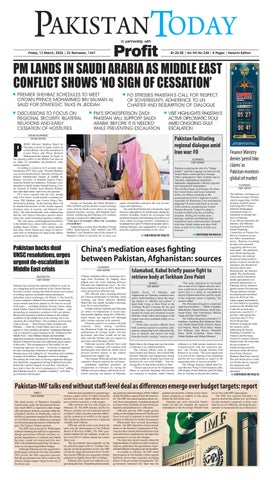
RIME Minister Shehbaz Sharif on Thursday arrived in Saudi Arabia on a brief official visit at the invitation of Crown Prince and Prime Minister Mohammed bin Salman Al Saud, as the ongoing conflict in the Middle East showed no signs of immediate de-escalation, state media reported. According to a post on its X account, statebroadcaster PTV News said, “Premier Shehbaz was received at the Royal Terminal of King Abdulaziz International Airport in Jeddah by Deputy Governor of Makkah Region Prince Saud bin Mishal bin Abdulaziz. Pakistan’s Ambassador to Saudi Arabia Ahmad Farooq, Consul General in Jeddah Syed Mustafa Rabani, and other diplomatic staff were also present.” PTV News reported that the visit, lasting only a few hours, would include a meeting between PM Shehbaz and Crown Prince Mohammed bin Salman. “In the meeting, there will be detailed discussions on the current regional situation, state of security, and bilateral relations,” the state broadcaster said, emphasizing that the visit reflects Pakistan’s positive diplomatic role, which Islamabad intends to continue. The visit comes amid heightened hostilities in the Middle East, where Gulf countries — including Saudi Arabia — have faced attacks from Iran, which Tehran says target US and Israeli sites in retaliation for large-scale strikes carried out by the latter.
ISLAMABAD
staff report
Earlier on Thursday, the Prime Minister’s Office (PMO) said the premier would exchange views with the Saudi crown prince on ongoing regional tensions, security, and bilateral cooperation, reaffirming that Pakistan will continue playing a constructive diplomatic role. ‘Visit part of broader effort for cessation of hostilities’ Addressing a weekly press briefing, Foreign Office Spokesperson Tahir Andrabi said PM Shehbaz’s visit should be seen in the context of Pakistan’s efforts to advocate for an early ces-
Pakistan backs dual UNSC resolutions, urges urgent de-escalation in Middle East crisis WASHINGTON
staff report
Pakistan has outlined the rationale behind its votes on two competing draft resolutions at the United Nations Security Council, stating that both decisions were aimed at curbing regional escalation and promoting an immediate return to dialogue. On March 11, the Security Council adopted a Bahrain-led resolution condemning recent missile and drone attacks by the Iran on several Gulf states — including Bahrain, Kuwait, Oman, Qatar, Saudi Arabia, United Arab Emirates and Jordan — and demanding an immediate cessation of all such attacks. Russia also presented a draft resolution on the military escalation in the Middle East at the meeting, but it was vetoed by the United States. The resolution received four votes in favour — from Russia, China, Somalia and Pakistan — while the United States and Latvia voted against it. Nine members abstained. Explaining Pakistan’s vote at a Security Council meeting on the “Situation in the Middle East,” Asim Iftikhar Ahmad said Islamabad supported resolutions introduced by both Bahrain and the Russian Federation because each addressed urgent aspects of the crisis. “The consequences of the conflict we are witnessing right now are clear — everyone is impacted,” he said, warning that violations of international law threaten peace and calling for an “immediate and complete cessation of hostilities” alongside a return to dialogue. Describing the Gulf states as having supported dialogue and diplomatic engagement during heightened tensions before the conflict erupted, he said they “should not have had to face the worst consequences of war,” adding that Pakistan stood in “complete solidarity” with their governments and peoples.
sation of hostilities and pave the way for dialogue and diplomacy. He noted that Pakistan has consistently urged three key principles to its interlocutors during the conflict, including “respect for sovereignty and territorial integrity and refraining from the use of force within sovereign territory; Upholding international law and UN Charter principles and resuming dialogue and engagement to pursue a peaceful, negotiated resolution to the crisis.”
Pakistan is playing the role of a “bridge builder” amid the ongoing war between the United States, Israel and Iran, Foreign Office spokesperson Tahir Andrabi said on Thursday, highlighting Islamabad’s diplomatic engagements with key regional and international stakeholders. The conflict began on February 28 when the United States and Israel launched strikes on Tehran, resulting in the assassination of Iran’s Supreme Leader, Ayatollah Ali Khamenei. Iran retaliated by targeting US assets and bases in several Gulf countries, prompting the United Nations Security Council to adopt a resolution addressing the escalating situation. During his weekly press briefing, Andrabi said Pakistan had maintained open communication channels with Iran, Saudi Arabia and other Gulf states as part of its efforts to help ease tensions.
Continued on page 03
Continued on page 03
China's mediation eases fighting between Pakistan, Afghanistan: sources ISLAMABAD
staff report
Chinese mediation efforts, including a message from President Xi Jinping, have helped ease the worst fighting between Pakistan and Afghanistan since the Taliban returned to power in 2021, three Pakistani government officials said. The officials said a meeting between the Chinese ambassador to Pakistan, Jiang Zaidong, and Prime Minister Shehbaz Sharif late last month included a message from Xi to cease hostilities. Neither side has reported any Pakistani air strikes on Afghanistan in recent days and ground fighting along the 2,600-kilometre border has tapered off, although daily clashes continue to be reported. China has said it is in contact with both countries about ending hostilities but Mosharraf Zaidi, the prime minister's spokeperson for foreign media, who has previously said there would not be any talks with the Taliban, did not respond to questions about Beijing's efforts. Pakistani security officials have said the military campaign will continue until desired goals were achieved, which was to prevent terrorist attacks in the country launched from Afghan soil. The Foreign Office and military did not respond to Reuters requests for comment. Islamabad launched airstrikes on Afghanistan on February 26, saying the Taliban were providing a safe haven to terrorists carrying out attacks in Pakistan.
islamabad, Kabul briefly pause fight to retrieve body at torkham Zero point Border forces of Pakistan and Afghanistan on Thursday reached a temporary understanding to pause the ongoing clashes to “identify and collect” a dead body lying at Zero Point at the Torkham Border Crossing for the past several days. Local residents had earlier spotted the body and informed security officials, while videos and images of the corpse were also circulated widely on social media. “Soon after, security officials from both countries agreed to constitute delegations comprising local influential figures to identify and remove the body from the border crossing,” sources said.
“The body, identified by the Kabul side as that of an Afghan national, however, could not be removed from the location due to a delay in consultations among Afghan authorities and the expiry of the temporary pause in fighting,” the sources added. The Pakistani delegation comprised eight local notables — Malak Tajuddin, Shah Khalid, Murad Hussain, Mufti Ejaz, Saeed Khan, Qari Nazeemgul, Mulana Aaqib and Qari Jihad Shah. The Afghan delegation consisted of 11 members, including Haji Madtyaar Shinwari, Malak Maula Khan Shinwari, Raees Gul Majeed, Malak Waali Khan, Malak Gul Rehman, Qari Baseer, Mautabar Khan, Mufti Asadullah, Darya Khan, Malak Shahzar and Malak Hilmand.
Kabul denies the charge and says terrorism in Pakistan is an internal problem. The Chinese efforts came as Qatar, Saudi Arabia and Türkiye, who hosted talks between Pakistan and Afghanistan during previous clashes in October, have been embroiled in the war in the Middle East following the US and Israeli strikes on Iran. "China's special envoy for Afghanistan affairs is currently shuttling between the two countries to mediate, while Chinese
embassies in both nations maintain close communication with the respective parties," the Chinese foreign ministry told Reuters in an e-mail. "The most urgent task is to prevent the fighting from expanding and for the two countries to return to the negotiating table as soon as possible." The foreign ministry added that Foreign Minister Wang Yi held telephone talks with Deputy Prime Minister and FM Ishaq Dar on Tuesday to discuss the conflict.
KHYBER
staf report
Finance Ministry denies ‘petrol hike claims’ as Pakistan monitors global oil market ISLAMABAD
staff report
The Ministry of Finance on Thursday strongly rebutted reports suggesting a further increase in petrol prices, clarifying that Finance Minister Muhammad Aurangzeb made no statement on raising fuel rates in Pakistan. In an official statement, the ministry said Minister Aurangzeb briefed the Senate Standing Committee on Finance but did not comment on any new hikes in petroleum prices. “Reports circulating on television channels suggesting otherwise are inaccurate,” the statement said. While briefing the committee, the minister discussed rising trends in global oil prices but did not announce any decision to increase petrol rates domestically, the ministry added. The clarification comes amid widespread media speculation over potential adjustments, as Pakistan closely monitors global market fluctuations. The government recently increased petrol and diesel prices by Rs55 per litre, citing surging international oil costs linked to escalating tensions in the Middle East. Under the revised rates, petrol now costs Rs321.17 per litre, while diesel has risen from Rs275.70 to Rs335.86 per litre. Minister Aurangzeb made the remarks while addressing the Senate Standing Committee on Finance and Revenue, chaired by Senator Saleem Mandviwala. He noted that the government is implementing austerity measures under directions from Prime Minister Shehbaz Sharif but warned that petroleum prices could rise further due to regional developments and international market pressures.
Continued on page 03
pakistan-iMF talks end without staff-level deal as differences emerge over budget targets: report PROFIT
staff report
The third review of Pakistan’s Extended Fund Facility under the International Monetary Fund (IMF) is expected to take longer after discussions failed to conclude within the scheduled timeline on Wednesday, with no staff-level agreement reached for the release of a $1 billion tranche as differences emerged over fiscal projections and tax collection targets, The Express Tribune reported. The IMF team returned to Washington without finalising the staff-level agreement, though government officials said they expected negotiations to continue and hoped the delay would not extend until the next IMF visit scheduled around May for discussions on the upcoming federal budget. Although Pakistan met the quantitative performance criteria for the July–December 2025 period, the IMF expressed concerns that the government may fail to achieve the primary budget surplus target by the end of the fiscal year.
Pakistan had committed to generating a primary surplus of Rs3.15 trillion during the current fiscal year, which officials now expect could be missed by a wide margin. Talks between the two sides began on February 26. The IMF mission, led by Iva Petrova, initially arrived in Karachi but left on March 2 due to security concerns following the escalation of conflict in the region. The remaining discussions were conducted virtually from Türkiye. Officials said the main issue during the talks was the performance of the Federal Board of Revenue (FBR). The IMF questioned whether the tax authority could collect even Rs13.5 trillion during the current fiscal year. The government had originally set the tax collection target at Rs14.13 trillion. During the second programme review, the IMF revised the target downward to Rs13.98 trillion, but the FBR has now requested a further reduction to slightly below Rs13.5 trillion. Pakistan also missed two indicative targets during the July–December period, includ-
ing a total tax collection target of Rs6.5 trillion and Rs366 billion expected from the retail sector. The IMF also raised questions about several fiscal assumptions, including projected revenues from dividends of state-owned enterprises and petroleum levy collections. Officials said the IMF sought greater clarity on the budget framework for the next fiscal year and is expected to send another mission to Pakistan for further discussions. Discussions also covered governance reforms. The IMF objected to recent amendments to the Election Commission of Pakistan Act that exempt parliamentarians from asset disclosure requirements and asked the government to reverse the changes. The fund also raised concerns about the implementation of reforms in state-owned enterprises, particularly the appointment of government officials on boards as private members. According to officials, the IMF noted that progress on the broader reform agenda had been slower than expected, including delays in the privatisation programme. The government informed the fund that the
planned privatisation of three power distribution companies is unlikely to take place before the fall of this year. Pakistan met most structural benchmarks but did not complete the required amendment to the Sovereign Wealth Fund
Act in line with IMF expectations. The IMF also rejected Pakistan’s request to abolish the carbon levy on furnace oil and declined a proposal to allow zero sales tax on oil refineries, advising the government to incorporate the tax in fuel prices.