
pakistan

![]()


pakistan

ISLAMABAD
s ta f
p o r t
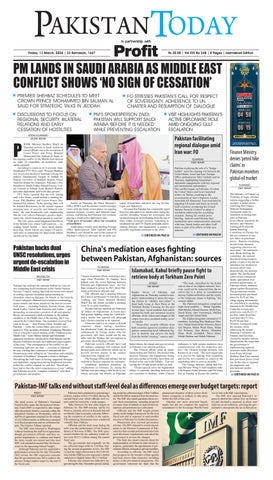
Chinese mediation efforts including a mes-
sage from President Xi Jinping have helped ease the worst fighting between Pakistan and Afghanistan since the Taliban returned to power in 2021, three Pakistani government officials said
The officials said a meeting between the Chinese ambassador to Pakistan Jiang Zaidong and Prime Minister Shehbaz
Sharif late last month included a message from Xi to cease hostilities Neither side has reported any Pakistani air strikes on Afghanistan in recent days and ground fighting along the 2 600-kilo-
metre border has tapered off although daily clashes continue to be reported
China has said it is in contact with both countries about ending hostilities but Mosharraf Zaidi, the prime minister's spokeperson for foreign media, who has previously said there would not be any talks with the Taliban did not respond to questions about Beijing s efforts
Pakistani security officials have said the military campaign will continue until desired goals were achieved, which was to prevent terrorist attacks in the country launched from Afghan soil
e p o r t Border forces of Pakistan and Afghanistan on Thursday reached a temporary understanding to pause the ongoing clashes to “identify and collect” a dead body lying at Zero Point at the Torkham Border Crossing for the past several days Local residents had earlier spotted the body and informed security officials, while videos and images of the corpse were also circulated widely on social media Soon after security officials from both countries agreed to constitute delegations comprising local influential figures to identify and remove the body from the border crossing,” sources said
“The body identified by the Kabul side as that of an Afghan national however could not be removed from the location due to a delay in consultations among Afghan authorities and the expiry of the temporary pause in fighting, the sources added The Pakistani delegation comprised eight local notables Malak Tajuddin Shah Khalid Murad Hussain Mufti Ejaz Saeed Khan Qari Nazeemgul Mulana Aaqib and Qari Jihad Shah The Afghan delegation consisted of 11 members, including Haji Madtyaar Shinwari, Malak Maula Khan Shinwari, Raees Gul Majeed Malak Waali Khan Malak Gul Rehman Qari Baseer Mautabar Khan Mufti Asadullah Darya Khan Malak Shahzar and Malak Hilmand
The Chinese efforts came as Qatar, Saudi Arabia and Türkiye, who hosted talks between Pakistan and Afghanistan during previous clashes in October have been embroiled in the war in the Middle East following the US and Israeli strikes on Iran
The Foreign Office and military did not respond to Reuters requests for comment Islamabad launched airstrikes on Afghanistan on February 26, saying the Taliban were providing a safe haven to terrorists carrying out attacks in Pakistan Kabul denies the charge and says terrorism in Pakistan is an internal problem
"China's special envoy for Afghanistan affairs is currently shuttling between the two countries to mediate, while Chinese embassies in both nations maintain close communication with the respective parties," the Chinese foreign ministry told Reuters in an e-mail "The most urgent task is to prevent the fighting from expanding and for the two countries to return to the negotiating table as soon as possible
The foreign


2001 to eliminate policymaking provisions related to the International Centre for Tax Excellence Authorities also plan to enact legislation giving the Tax Policy Office statutory status outlining its responsibilities, transparency requirements and reporting framework Rules and regulations for the office are expected to be notified by June 2026
g Discussions to continue in coming Days, incluDing to more fully assess impact of recent global De velopments on pakistan’s economy, says imf mission chief
The International Monetary Fund (IMF) has said that considerable progress was made in the discussions on the thrid review under the Extended Fund Facility (EFF) and the second review under the Resilience and Sustainability Facility (RSF) and these discussions will continue in the coming days, including to more fully assess the impact of recent global developments on Pakistan’s economy and the EFF-supported program
An IMF team led by Iva Petrova held discussions on the third review under the EFF and the second review under the RSF in Karachi and Islamabad, as well as virtually, from February 25 to March 11 2026 At the conclusion of the discussions Ms Petrova issued the following statement:
“The IMF mission and the Pakistani authorities held discussions on the third review of the 37-month Extended Arrangement under the Extended Fund Facility (EFF) and the second review of the 28-month arrangement under the Resilience and Sustainability Facility (RSF) While considerable progress was made in the discussions these will continue in the coming days including to more fully assess the impact of recent global developments on Pakistan s economy and the EFF-supported program
“Program implementation under the EFF remained broadly aligned with the authorities commitments through endFebruary 2026 Considerable progress was made in the discussions on policies ahead, including on sustaining the fiscal consolidation to strengthen public finances; maintaining a sufficiently tight
monetary policy to ensure inflation remains durably within the State Bank of Pakistan s target range; and advancing reforms to improve the viability of the energy sector Particular attention was paid to deepening structural reforms, given the authorities’ emphasis on accelerating growth alongside efforts to strengthen social protection and rebuild health and education spending These discussions are ongoing
The authorities have also made good progress in the implementation of their reform agenda to strengthen climate resilience including through the completion of reform measures under the RSF Discussions also covered the impact of the conflict in the Middle East on Pakistan s economic outlook, the balance of payments and external financing needs amid volatile and rising energy prices and tighter global financial conditions

Finance Ministry denies ‘petrol hike claims’ as
Dr Joseph ArshAD
TH E Pope as head of the Catholic Church has had for many centuries good relations with Governments and civil authorities, through His representatives These representatives are called “Papal Representatives” or “Apostolic Nuncios” The word “Nuncio” comes from the Latin word Nuntius (messenger ambassador) This title was maintained in order to distinguish the Nuncio from the Ambassadors because his brief also included the promotion of Christian spiritual values The Apostolic Nunciature (Embassy of the Holy See) is the diplomatic permanent mission of the Holy See established in order to encourage normal and friendly relations with the States The Papal Representative also has the role of maintaining links between the Pope and the local Catholic Church The term “Holy See” is derived from the Latin words "Sancta Sedes", which means "holy chair" or "holy seat" It refers to the seat or chair of St Peter occupied by the Bishop of Rome (the Pope) St Peter is one of the disciples of Jesus Christ who is considered to be the first Pope in the Catholic Church The diplomacy of the Holy See focuses on humanitarian and ethical objectives rather than material gain Unlike nations that negotiate to secure borders trade advantages or
military alliances, the Holy See engages with the international community to promote human rights religious freedom and peace At present the Holy See enjoys full diplomatic relations with about 200 countries of the world, of which more than 90 have missions in Rome The Holy See maintains bilateral diplomatic relations, signs concordats and treaties and performs multilateral diplomacy with multiple intergovernmental organizations including the United Nations and its agencies the Council of Europe the European Communities, the Organization for Security and Co-operation in Europe, and the Organization of American States The Diplomatic relations between the Islamic Republic of Pakistan and the Holy See were initiated with the establishment of the Apostolic Delegation to Pakistan (initially covering West and East Pakistan) on 17 July 1950, marking the formal beginning of Vatican diplomatic engagement in the region shortly after Pakistan's independence This delegation served as the primary channel for communication with the Holy See In August 1952 the Delegation became an Internunciature (cfr Pius XII, Apostolic Letter, Maxime Nobis, AAS 46, 1952) signifying and strengthening of ties and diplomatic reciprocity, reflecting the growing mutual recognition with Pakistan s Ambassador in Switzerland later also accredited to the Holy See A further milestone occurred on 27 December 1965 when Pope Paul VI raised the Internuncia-
ture to full Apostolic Nunciature (Embassy of the Holy See) status elevating the diplomatic mission to its highest rank (cfr Paulus VI Apost Let Quae Omnia AAS 68 1966) and underscoring the Holy See s commitment to sustained engagement amid Pakistan's evolving geopolitical context These elevations paralleled broader Holy See efforts to formalize relations with Pakistan prioritizing ecclesiastical oversight and promoting interfaith harmony and humanitarian cooperation The Holy See maintains an Apostolic Nunciature (Vatican Embassy) in Islamabad and has an Apostolic Nuncio (Ambassador) in Islamabad While Pakistan’s Ambassador in Bern Switzerland is accredited as Ambassador to the Holy See These diplomatic ties play a crucial role in facilitating communications between the Holy See (Vatican) and the Pakistani government, addressing matters of mutual interest, understanding and cultural exchange working closely for human dignity social justice environment and humanitarian areas
Several Pakistani leaders have visited Vatican, including Prime Minister Nawaz Sharif (1998), President Musharraf (2004) and President Asif Ali Zardari (2009) Besides there have been visit on ministerial levels by different Ministers There are also various renowned personalities of Vatican that have visited Pakistan His Holiness Pope John Paul II visited Pakistan on Feb-
ruary 16, 1981, marking the first-ever papal visit to the country Upon arriving at Karachi airport Pope John Paul II kissed the Pakistani soil a gesture of respect and love Moreover Several key figures of Vatican have also visited Pakistan: H E Cardinal Joseph Tomko (30 November-5 December 1994), H E Archbishop Paul Josef Cordes (25-30 October 2001) H E Cardinal Jean-Louis Tauran (25 November 2010) and H E Cardinal Fernando Filoni also visited Pakistan on the occasion of the Episcopal Consecration of Archbishop Joseph Arshad on 1 November 2013 who is the first Pakistani priest who served as a diplomat of the Holy See
(Archbishop


The world watches Iran sounds more defiant than conciliator y as the USA gets antsy
IR A N S E T out terms to the end of the war on Wednesday which do not include any reference to the kind os surrender that the USA wants, but the USA can be quietly self-congratulatory, because the Iran has set out terms for an end to hostilities which is not a peremptory demand that they simply cease
However even now the demand by President Masoud Pezeshkian that Iran’s legitimateb rights be recognized that reparations be paid and that there be firm international guarantees against future aggression Meanwhile, US President Donald Trump has said that the war would come to an end soon and that the USA was running out of targets From a quick glance it would seem that Iran has lost, but the resolve of its leadership does make that dubious
The US calculation that it could foment a popular uprising against the government does not seem to have worked The only thing left is to carry the war to the Iranian people The USA has historically not baulked at this The bombing of Dresden in February 1945 killed 1900 people and destroyed 1600 acres of the city centre using conventional weapons It was specifically designed to break the German people’s will to resist Then came Hiroshima and Nagasaki in August the same year, following which Japan surrendered How far will Mr Trump go to break Iranian defiance? Or is he willing at last to see reason and bring an end to what has proved an unwinnable war That the world is increasingly uncomfortable is to be seen from the International Energy Agency s release of 400 million barrels of oil from its strategic reserves That is the equivalent of four days total production, or 16 days of what passes through the Strait of Hormuz IEA members hold strategic stocks of 1 2 billion barrels while industry has a reserve of about 600 million barrels under government control That amounts to 72 days of what passes through the Strait The USA should realize that its inability to keep the Strait open will lead to the failure of its strategy Apart from other things Iran has made demands that are only made by victors, such as for reparations If it hasn t lost, it hasn t won either True, the war was imposed on it, and worse, after the USA and Israel triedit on last year Neither the vUSA nor Israel can be controlled so that while many guarantors will be found willing to end the madness and futility, how many of those guarantees will be worth anything?

Dedicated to the legac y of late Hameed Nizami Arif Nizami (Late) Founding Editor
M A Niazi Editor Pakistan Today Babar Nizami Editor Profit
AS the US-Israeli attack on Iran continued for a second week, the conflict started to spin out of control, and to grow wider, dragging in other countries of the region
The war caused global pain because it threatened oil and gas supplies thus sending up the global oil price with the effect that that would have on economic growth not just for developing countries, but those already industrialized Iran is for the time being not showing any signs of giving in to the demands by Israel and the USA, even though one of the first ascites of this campaign was the killing of the Iranian Supreme Leader The fatal flaw in the US-Israel calculation was that the Iranian people would rise against the regime They did not because there was no clear alternative Well, not so much a clear alternative as any alternative at all It should not be forgotten that the Iranian people rose against Raza Shah with the alternative of Ayatollah Khomeini in sight Even then it was not a clean transition mainly because the Shah did not give up until many had died More important there was as there almost never is for any regime change, no constitutional path Though Ayatollah Khamenei has been killed, he has been replaced by his son Mojtaba A council did exercise his functions, but the Assembly of Experts has now met and elected him Trump has already vetoed Mojtaba thus indicating that he is not so much interested in regime change as ensuring that the present regime follows his dictates However the regime has indicated by its choice that it has no intention of compromise
The war may spin out of control One of the largest but least followed developments is how Israel has used the attack on Iran to prosecute a war on Lebanon It has so far killed about 400 people through air attacks with no end in sight There has also been an exchange of attacks on desalination plants, in Iran and in Bahrain This is despite the Iranian declaration that it would only attack countries where attacks originated from This would increase pressure on the USA not to use all the bases it had in the area even though it had developed the network precisely because it anticipated an attack on Iran The attack on Bahrain might be because of its role as the main US naval base in the region in servicing the aircraft carriers from which attacks were being launched on Iranian targets
The Iranian declaration is unlikely to be accepted by either the insurers who now refuse to insure ships using the Straits of Hormuz or the shipping lines which have suspended using the Straits There has been no formal blockade by Iran of the Straits of Hormuz, but as events have transpired, its being in a war zone means that the effects are the same However, there are other prospects of the war spreading One of them is the fomenting of trouble among the Kurds Iranian Kurds have been less militant than those of Turkey Syria or Iraq
A f g h a n s o i l a n d t h e g l o b a l c h a l l e n g e o f t e r r o r i s m
It may be noted that those in Iraq and Turkey were under Ottoman rule while those in Iran were under Persian rule The USA has been paying attention to the Kurds in Turkey and Iraq since the end of World War I but it has not paid those in Iran the same attention, until now
The Syrian Kurds have warned the Iranian Kurds of cooperating with the USA, pointing to their own example when they were not given support against the forces of Syrian President Ahmad Al-Sharaa but instead told to join him
For the time being though Trump has ruled out their use However, he is a notoriously unreliable character, and this may not be his final word The USA made good use of the Kurds of Iraq, giving them a separate region of their own, which combined with Iranian Syrian and Turkish Kurd areas would make up a possible state However at the moment the Kurds are working with the USA and in three countries acting as a check on the pro-US leadership while in Iran it is a possible way of attacking the regime
Another dimension that Iran might want to watch out for is a link-up between the Americans and the Iranian Baloch nationalists which might be facilitated by India which is closely associated with Pakistan s Baloch separatists and through them should be able to get in touch with Iran s That could create a problem for Iran in its south-east, which would be a grisly complement to any Kurd activity, which would be in the north-west
Meanwhile, there is the Pakistan conundrum In principle Pakistan should support Iran fully Not only has Iran always supported Pakistan in its conflicts with India the latest example being during last year s Pehelgam confrontation but there is a sectarian element Pakistan does not want to go down that particular road The problem lies in Pakistan s mutual defence agreement with Saudi Arabia It could be invoked if Iran was

Pakistan remnants of AlQaeda, and the increasingly active Islamic State Khorasan Province (ISKP) These groups have not confined their operational ambitions to Pakistan alone Rather their ideological outreach and operational networks extend across borders posing potential risks to Central Asian republics China Russia and other states concerned with the spread of extremist militancy Security authorities in Russia and several Central Asian countries have also issued warnings regarding the concentration of thousands of armed fighters linked to various extremist groups in Afghanistan These concerns are not merely speculative They are rooted in intelligence assessments suggesting that militant ecosystems in ungoverned or weakly governed spaces often evolve into hubs for recruitment, training, and cross-border operations The implications of such developments are profound particularly in a region already marked by fragile political and security dynamics The global experience of counterterrorism operations further underscores the complexity of confronting militant networks embedded within volatile environments During the Iraq war, international human rights organizations reported that civilian casualties exceeded 200 000 with countless incidents of destruction affecting schools residential areas and public infrastructure These tragic statistics reflect the harsh realities of modern conflict, where the distinction between combatants and civilians often becomes dangerously blurred in asymmetric warfare Over the past two decades the international community itself recognized the threat emanating from Afghan territory This recognition was evident in the nearly 20-year military engagement of the USA and NATO forces in Afghanistan, primarily aimed at dismantling terrorist networks responsible for global attacks The war was, at its
core a response to the belief that unregulated militant sanctuaries could evolve into launchpads for transnational violence Empirical research further illustrates the human cost of these conflicts According to the “Costs of War” project at Brown University, the post-9/11 wars have resulted in more than 432 000 civilian deaths worldwide Within Afghanistan alone over 46 000 civilians lost their lives during the prolonged conflict These figures not only reveal the devastating toll of counterterrorism campaigns but also highlight the intricate dilemmas that states confront when addressing security threats embedded within complex socio-political environments Within this broader context Pakistan’s security policy must be understood as part of a wider regional struggle against terrorism Certain segments of the international media have attempted to portray Pakistan s cross-border security actions as indiscriminate or directed against civilian populations Such portrayals, however overlook the fundamental reality that these operations are primarily aimed at dismantling militant infrastructure responsible for orchestrating attacks inside Pakistan For Islamabad, the issue is neither ideological nor expansionist It is fundamentally a matter of national security and the protection of civilian lives from militant violence Armed groups operating from across the border have
repeatedly carried out attacks against Pakistani citizens, security personnel, and public institutions In this context the principle of self-defence under international law becomes a critical framework through which Pakistan s actions must be interpreted At the same time, Pakistan s official position consistently emphasizes that the Afghan people are not adversaries but rather brothers bound by shared history culture and geography Islamabad has repeatedly expressed its desire for a peaceful stable and economically integrated Afghanistan The pursuit of counterterrorism objectives therefore, is not directed against the Afghan populace but against militant entities that exploit ungoverned spaces to perpetuate violence Ultimately, the phenomenon of terrorism emerging from Afghan territory cannot be reduced to a bilateral dispute between two neighbouring states It is in essence a regional and global security concern The networks operating within this space have demonstrated their capacity to transcend borders, ideologies, and political systems, thereby transforming localized conflicts into broader geopolitical challenges Pakistan s ongoing security measures should therefore be viewed within the context of this global struggle against terrorism The objective is not confrontation but stabilization eliminating militant sanctuaries, preventing cross-border violence, and fostering an environment where regional cooperation can replace cycles of insecurity Only through coordinated international engagement responsible governance and sustained counterterrorism efforts can the vision of lasting peace in the region eventually be realized
The writer is a freelance columnist

Ultimately, the phenomenon of terrorism emerging from Afghan territory cannot be reduced to a bilateral dispute between two neighbouring states. It is, in essence, a regional and global security concern. The networks operating within this space have demonstrated their capacity to transcend borders, ideologies, and political systems, thereby transforming localized conflicts into broader geopolitical challenges.


PA K I S TA N’S grief over developments in Iran is both an emotional moment and a strategic wake-up call When Iran s challenges are considered alongside Venezuela s prolonged crisis and the missile scare that unsettled the UAE, the central lesson is clear: vast natural resources and economic prosperity alone do not guarantee sovereignty or security Without strong governance and credible defence capabilities wealth can become a source of vulnerability
This assessment of global realities, brings us directly to the central, existential appreciation Pakistan’s strategic posture In a neighbourhood characterized by a volatile cocktail of historical animosities unresolved conflicts great power competition and constantly evolving military technologies and doctrines, Pakistan possesses a defence capability that is not merely symbolic, but is proven tested formidable and most importantly a genuine tangible and universally acknowledged source of national tranquility and strategic depth
The nuclear assets the crown jewels of this defensive posture, are not just weapons of war in the conventional sense; but the ultimate, non-negotiable guarantors of the nation’s geographical integrity a final backstop against the kind of existential threats that have swallowed other nations whole They are the profound strategic reason why the sleep of millions of Pakistanis is undisturbed by the ever-present spectre of foreign invasion, military coercion, or strategic blackmail that haunts less protected less capable nations
This peace of mind this profound and often underappreciated ability to plan for the future to send children to school without the immediate fear of foreign conquest to invest in businesses and long-term projects, to participate in the civic and political life of the nation, is a direct, tangible dividend of the immense sacrifices and sustained investments over decades in building a credible national defence This defence force is the ultimate public good an invisible but impenetrable shield that creates the very conditions necessary for the nation to exist The armed forces of Pakistan are not an abstract concept a line item in a budget or a paradeground spectacle; but the living breathing ever-vigilant guardians who stand day and night in the crucial space between the nation and the kind of profound, existential vulnerability that has been so painfully and publicly witnessed in other resource-rich but defence-poor countries
Moreover and this is a point of paramount importance for national morale and international credibility this defense capability
is not untested, not a paper tiger, not a bluff that could be called by an adventurous adversary It has been proven tempered and validated in the crucible of actual conflict most recently most decisively and most emphatically in the series of operations and confrontations with India, a larger neighbour with its own significant military capabilities
The term that has entered the national lexicon “Marka Huq ” or the “Battle of Truth resonates so powerfully within the national consciousness because it represents a moment in time where the decades of rhetoric about national defence, the assurances of capability, were abruptly and convincingly validated It was a clear demonstration to the world that Pakistan’s military posture is not a hollow boast but a reality backed by professional excellence a clear-eyed understanding of strategic depth and an unshakeable national will forged in the fires of history This proven strength is the solid rock upon which Pakistan’s foreign policy now confidently stands globally and regionally
Because of this defence Pakistan can condemn acts of aggression and violations of international law without the fear of retaliation that paralyzes weaker nations
Because of this established strength Pakistan can genuinely and effectively advocate for peace, for dialogue, for the peaceful resolution of conflicts and for the establishment of a just regional order A weak nation sues for peace out of fear of annihilation; a strong nation advocates for peace out of principle, and out of a desire for stability Pakistan s independent voice in the region, its consistent calls for dialogue and restraint, its principled stances on issues of justice and self-determination are all made credible by the universal acknowledgment that it possesses the strategic and military wherewithal to back up its words with actions
Therefore, the complex and deeply saddening situation unfolding in Iran, viewed through the clarifying lens of strategic analysis should serve as the ultimate eye-opener for the entire nation It must function as a final wake-up call for those ho persist in advocating a false dangerous and ultimately suicidal choice
There is a persistent, often naive, and sometimes deliberately misleading narrative

that posits a fundamental, zero-sum trade-off between building a strong economy and maintaining a strong defenCe This narrative argues with a veneer of pseudo-sophistication that the vast resources allocated to the military and national defense are resources effectively stolen from the people resources that could have been spent on schools, hospitals, roads, and social welfare programmes This is not merely a flawed or incomplete argument; it is an insidious fallacy, a line of thinking recent regional events have utterly debunked The argument that we need a strong economy at the price of our strong defence is not just strategically unwise; but a blueprint for eventual national suicide
The examples of nations that prioritized economic prosperity over defensive capability are now written indelibly in the terrified alerts of the UAE’s population fleeing their skyscrapers and in the tragic humiliating political turmoil and compromised sovereignty of Venezuela Their immense, resourcebased wealth could not purchase them genuine security when the moment of strategic truth arrived, when the missiles were in the air or the foreign operatives on the ground They were forced to learn the hardest
and most bitter lesson of all: that a massive bank account, a thriving stock market, and a portfolio of global investments are rendered completely and utterly meaningless if the nation itself is not alive not sovereign and not in control of its own destiny to spend enjoy or leverage that wealth In the current era an era characterized by the proliferation of missile technology, the complexities of hybrid warfare involving state and non-state actors, and the ever-present reality of cyber and information warfare a strong economy is not a fortress; it is a hostage a prize waiting to be claimed if it is not protected by a strong credible and modern defence apparatus
The economy provides the essential resources for the well-being and prosperity of the people, but it is the national defence that provides the fundamental non-negotiable precondition for the very existence of the people and the nation itself to be in a position to enjoy those resources in peace and freedom
This is the lesson for Pakistan, a lesson that demands not a reduction in defence preparedness in a naive pursuit of short-term economic gains, but an even greater, more focused and more sustained national effort to strengthen and modernize it The rapidly evolving increasingly volatile and unpredictable situation in the region with its dizzying shifts in alliances, its intensifying great power rivalries, its persistent and evolving threats from both state and nonstate actors and its rapid technological advancements in weaponry necessitates that Pakistan s defence and deterrence posture is not merely maintained at its current level but continuously, relentlessly, and strategically reviewed, upgraded, upgraded further, and reinforced to meet the challenges of tomorrow, not just the challenges of yesterday Complacency in the realm of national security is not just an attitude; it is the most dangerous and unforgivable enemy of long-term survival The peace relative stability and se-
of strengthening the shield, the mighty defense, that guarantees our survival, our cherished sovereignty, and our ability to sleep peacefully securely and proudly under the starry skies of our beloved homeland
The writer is a freelance columnist


tary facility in Kuwait killing six American service members, did not find its target by accident Pentagon officials, speaking on condition of anonymity, noted that several recent Iranian strikes hit facilities directly associated with US operations targets whose coordinates do not appear on any public map The sourcing is not hard to trace
CHINA’S SILENT HAND: Beijing s role is quieter But it is no less consequential China has spent years reshaping Iran’s electronic warfare landscape exporting advanced radar systems transitioning Iranian military navigation from US GPS to China s encrypted BeiDou-3 constellation and drawing on its expanding satellite network to support signals intelligence and terrain mapping for Iranian forces Retired Israeli air force
Brigadier-General Amos Yadlin once put it plainly: every second counts If Iran can shave minutes off detection and targeting it changes the balance in the skies China has done more than shave minutes It has reshaped the entire kill chain The YLC-8B anti-stealth radar a Chinese-supplied UHF-band system uses low-frequency waves designed to reduce the effectiveness of radar-absorbent coatings on US stealth aircraft The B-21 Raider and the F-35C were engineered to be invisible Against a YLC-8B, they are considerably less so And now, Reuters reports that Iran is nearing a deal to acquire 50 CM-302 supersonic antiship missiles the export variant of China’s YJ-12 capable of travelling at Mach 3 and sea-skimming at altitudes that compress a ship s reaction window to seconds Military analysts call them carrier killers The USS Abraham Lincoln and USS Gerald R Ford are currently operating within their engagement envelope
US-ISRAELI COUNTERMOVES: The US and Israel are not passive They are hunting US and Israeli intelligence teams have been tracking Iranian leadership movements, mapping Islamic Revolutionary Guard Corps (IRGC) command nodes, and in the opening phase of Operations Roaring Lion and Epic Fury destroying Iranian radar infrastructure with a speed and precision that exposed how brittle Tehran s defensive integration actually was As former Israeli air force commander Major-General Eitan Ben-Eliyahu has noted, destroying a radar is not just about knocking out a machine; it blinds the enemy In the war ’s first
hours they erased many of them
Yet the IRGC s spokesman, Ali Mohammad Naeini, claimed that Iran had destroyed nearly 10 advanced US radar systems across the region a statement that, if even partially accurate offers a partial explanation for how Iranian missiles reached targets in Israel the Gulf capitals and beyond US Defense Secretary Pete Hegseth asked directly about Russia s intelligence assistance on CBS s 60 Minutes, answered with studied brevity: “We’re tracking everything ” That is either a reassurance or a warning Possibly both For decades the Gulf was a theatre of overwhelming US-Israeli technological dominance That dominance has not vanished But it has been eroded, quietly and deliberately, by years of Chinese hardware transfers and Russian intelligence sharing As a senior US military commander recently acknowledged signals are the new bullets: whoever controls the spectrum controls the fight Neither side controls it decisively That in itself is a profound shift This struggle also has precedent, though not a comforting one In 1991, coalition forces jammed Iraqi radar networks and misled Saddam Hussein’s defences so thoroughly that US aircraft struck with near-impunity Electronic countermeasures were decisive Baghdad fought blindly and it lost Iran has studied that war closely for three decades It has studied every subsequent conflict in which a technologically inferior force was dismantled from the air Russia’s satellite feeds and China’s radar architecture are in part Iran s answer to those lessons Tehran is determined not to become the next Baghdad There is a deeper strategic logic at work that goes beyond Iran’s immediate survival China is not arming Tehran out of ideological solidarity It is treating the conflict as a live-fire laboratory Every potential CM-302 engagement against a US carrier strike


are not thinking seriously about the Epstein files as a target, then I would be shocked ” The breach was reported contemporaneously by CNN and Reuters on Feb 17 2023; the connection to Epstein materials was made by the French magazine Marianne Epstein a longtime associate of US President Donald Trump pleaded guilty in 2008 to prostitution charges, including soliciting an underage girl He was found hanged in his jail cell in 2019, in what was ruled a suicide, after being arrested again on federal charges of sex trafficking of minors February 2023 break-in The hack occurred after a server at the Child Exploitation Forensic Lab in the FBI s New York Field Office was inadvertently left vulnerable by Special Agent Aaron Spivack, who was trying to navigate the bureau’s complex procedures for handling digital evidence, according to the source and the documents

ag e n c i e s Passenger train operations between China and North Korea are set to restart on Thursday marking the end of a six-year suspension The service had been halted due to the COVID-19 pandemic, which led North Korea to close its borders as a precautionary measure According to reports, a train displaying the North Korean flag was seen in Beijing believed to be carrying North Korean leader Kim Jong Un as it arrived in the Chinese capital on September 2, 2025 The resumption of the train service is seen as a significant step towards restoring cross-border travel and trade between the two countries Passenger rail links between China and North Korea had been suspended since 2020, when North Korea implemented strict border controls to prevent the spread of the coronavirus The reopening

and cooperation


The 400 million barrel release would cover only about 20 days of supply lost due to the disruptions along the Strait of Hormuz, and will take weeks or months to reach markets
“I’m not surprised that the market is reacting like this given that the announcement was priced in said Gary Ross CEO of Black Gold Investors and a veteran oil market analyst This situation is not manageable without some demand destruction and much higher prices unless the conflict ends ” Trump facing political pressure due
of the
was shown at the
unprecedented in scale I am very glad that IEA member countries have responded with an emergency collective action of unprecedented size,” said IEA Executive Director Fatih Birol Oil prices gained nearly 5% on Wednesday despite the announcement as further attacks on ships in the Strait of Hormuz worsened supply-disruption fears, and analysts said the release of reserves was inadequate to ease those concerns

of
the G7 meeting chaired by
saying: “I think we are having a tremendous impact on the
” Later on Wednesday Trump said he expected the coordinated global release of crude stockpiles to substantially reduce oil prices as we end this threat to America and the world Energy Secretary Wright said the U S contribution would 120 days to deliver and that the Department of Energy intended quickly refill the reserve afterward Unlike the previous administration, which left America s oil reserves drained and damaged, the United States has arranged


Nawaz (PML-N) as the new governor of Sindh, replacing Kamran Tessori of Muttahida Qaumi Movement–Pakistan (MQM-P) According to a statement posted on the Presidency s official X account the president approved Hashmi s appointment on the advice of Prime Minister Shehbaz Sharif under Articles 48 and 101 of Pakistan’s Constitution
“The Commission of Appointment has been signed He will take oath before the Chief Justice of the Sindh High Court the statement added
Earlier in the day the Prime Minister s Office Pakistan said that Prime Minister Shehbaz Sharif had decided to nominate Hashmi for the post and forwarded a summary to President Zardari for final approval According to the PMO the premier met Hashmi at the Prime Minister House earlier this week and decided to recommend his name for the governorship
Farooq S attar urges MQM -P to quit federal govt af ter S indh governor change
Senior Muttahida Qaumi Movement–Pakistan (MQM-P) leader Farooq Sattar on Thursday criticised the federal government s decision to replace the Sindh governor, suggesting that his party should consider withdrawing from the ruling coalition
Speaking to a television channel
Sattar said there was no justification for MQM-P to remain part of the federal government after what he described as a unilateral decision
“There is no justification for the party to remain in the federal government after such a unilateral decision and we should immediately withdraw from the federal government he said His remarks came after Prime Minister Shehbaz Sharif decided to appoint senior Pakistan Muslim League-Nawaz (PML-N) leader Nehal
has been a tradition that the governor of Sindh comes from MQM Pakistan,” he said adding that the party should reassess its position in the federal government following the decision
Earlier the MQM-P said in a statement that it had not been taken into confidence regarding

in petroleum prices The rare scale of the RLNG price increase is expected to have a significant effect on end-users in the coming month
ISLAMABAD s ta f f r e p o r t
The Islamabad High Court (IHC) on Thursday directed the formation of a medical board to review the health condition of Imran Khan while disposing of a petition seeking his transfer to Shifa International Hospital for specialised treatment
A division bench comprising Justice Arbab Muhammad Tahir and Justice Khadim Hussain Soomro issued the order during proceedings on the plea filed by the incarcerated former prime minister
The court directed Islamabad Chief Commissioner Muhammad Ali Randhawa to constitute the medical board and include Dr Muhammad Arif and Dr Nadeem Qureshi among its members Dr Qureshi, a retina specialist from Al-Shifa Trust
Eye Hospital in Rawalpindi, is also part of a medical board earlier constituted on the orders of the Supreme Court of Pakistan Dr Arif heads the ophthalmology department at the Pakistan Institute of Medical Sciences (PIMS) in Islamabad In its written verdict, the court directed the authorities to ensure that Imran Khan is allowed to meet his lawyers and family members It also instructed Dr Qureshi to remain in contact with the PTI founder s family regarding his medical treatment
The order stated that the petition had been disposed of and that the medical board must submit its recommendations to the Islamabad chief commissioner at the earliest The commissioner the court noted would then decide in accordance with the law and prison rules whether the former
premier should be shifted to a hospital outside the prison premises
The bench observed that under Rule 795 of the Pakistan Prison Rules prison authorities are obligated to inform relatives when a convicted prisoner develops a serious medical condition It also emphasised that under Rule 197 of the rules, the power to transfer a convicted prisoner for special treatment outside the jail lies with the government Therefore the court ruled that its jurisdiction under Section 561-A of the Code of Criminal Procedure could not be invoked to interfere with powers vested in the executive It also noted that the report submitted by the Adiala jail superintendent indicated that substantial steps had already been taken to ensure proper treatment for the former prime minister and that his condition had shown improvement
