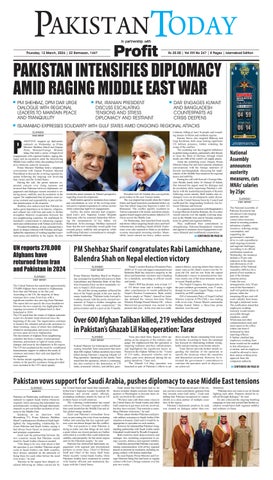
PAKISTAN INTENSIFIES DIPLOMACY AMID RAGING MIDDLE EAST WAR In partnership with
Thursday, 12 March, 2026 | 22 Ramazan, 1447
g
PM SHEHBAZ, DPM DAR URGE DIALOGUE WITH REGIONAL LEADERS TO MAINTAIN PEACE AND TRANQUILLITY
P
g
g
Profit
Rs 20.00 | Vol XVI No 247 | 8 Pages | Islamabad Edition
PM, IRANIAN PRESIDENT DISCUSS ESCALATING TENSIONS AND STRESS DIPLOMACY AND RESTRAINT
g
DAR ENGAGES KUWAIT AND BANGLADESH COUNTERPARTS AS CRISIS DEEPENS
ISLAMABAD EXPRESSES SOLIDARITY WITH GULF STATES AMID ONGOING REGIONAL ATTACKS ISLAMABAD Mian abrar
AKISTAN stepped up diplomatic outreach on Wednesday as Prime Minister Shehbaz Sharif and Deputy Prime Minister/Foreign Minister Ishaq Dar held a series of high-level engagements with regional leaders, urging dialogue and de-escalation amid the intensifying Middle East conflict while also pushing forward strict domestic austerity measures. Prime Minister Shehbaz held a telephone conversation with Iranian President Masoud Pezeshkian to discuss the evolving regional situation following the ongoing war involving Iran, Israel, and the United States. During the call, the prime minister expressed concern over rising tensions and stressed that Pakistan believes diplomatic engagement and dialogue remain essential to ensuring peace, stability, and de-escalation in the region. He emphasised that all parties must exercise restraint and responsibility to prevent further deterioration of the situation. Shehbaz also underscored that Pakistan attaches great importance to its historic, religious, and cultural ties with Iran and seeks to further strengthen bilateral cooperation between the two neighbouring countries. He reaffirmed Islamabad’s commitment to enhancing engagement and collaboration with Tehran at all levels. President Pezeshkian, in turn, reiterated Iran’s desire to deepen relations with Pakistan and highlighted the importance of working together to promote peace and stability in the region. He also
UN reports 270,000 Afghans have returned from Iran and Pakistan in 2024 ISLAMABAD
staff report
The United Nations has stated that approximately 270,000 Afghans have returned to Afghanistan from Iran and Pakistan so far this year. According to the UN, the majority of these returnees have come from Iran, with a significant number also arriving from Pakistan. The report did not specify the exact breakdown between the two countries, but highlighted the ongoing movement of Afghans back to their homeland in 2024. The UN noted that the return of Afghan nationals is part of a broader trend observed since the beginning of the year. The organization continues to monitor the situation and provide assistance to those returning, many of whom face challenges related to reintegration and access to basic services upon arrival in Afghanistan. The movement of Afghans from neighboring countries has been a subject of international attention, particularly in light of recent policy changes and security developments in the region. The UN has emphasized the need for coordinated humanitarian support to address the needs of returnees and ensure their safe and dignified reintegration. No further details regarding the reasons for the returns or the specific assistance being provided were included in the UN's latest update.
briefed the prime minister on Tehran’s perspective regarding recent developments. Both leaders agreed to maintain close contact and consultations in view of the evolving situation and to expand cooperation in various sectors while continuing high-level engagements. Earlier, the prime minister had congratulated Iran’s new Supreme Leader Mojtaba Khamenei after he assumed leadership following the assassination of his father, Ali Khamenei. In his message, Shehbaz expressed hope that the new leadership would guide Iran towards peace, stability and prosperity while reaffirming Pakistan’s commitment to strengthening bilateral relations.
President Asif Ali Zardari also conveyed his good wishes to the new Iranian leader. The war erupted last month when the United States and Israel launched coordinated strikes on Iran that killed long-time Supreme Leader Ali Khamenei. The conflict quickly escalated as Tehran responded with missile and drone attacks against Israeli targets and locations linked to US forces across the Middle East. On Wednesday, Iran launched fresh missile and drone strikes targeting Israeli cities and Gulf infrastructure, including a Saudi oilfield. Explosions were also reported in Doha as air defence systems intercepted incoming missiles. Meanwhile, Israel carried out heavy strikes across
Lebanon, killing at least 16 people and wounding dozens in Beirut and southern regions. Iranian forces also targeted Bahrain and Iraqi Kurdistan, both areas hosting significant US military presence, further widening the scope of the conflict. The escalating war has triggered turbulence in global energy markets, particularly after threats to close the Strait of Hormuz, through which nearly one-fifth of the world’s oil supply passes. Amid the unfolding crisis, Deputy Prime Minister Ishaq Dar also held separate telephone conversations with the foreign ministers of Kuwait and Bangladesh, discussing the implications of the Middle East situation for regional peace and stability. During his call with Kuwait’s Foreign Minister Sheikh Jarrah Jaber Al-Ahmad Al-Sabah, Dar stressed the urgent need for dialogue and de-escalation while expressing Pakistan’s solidarity with the leadership and people of Kuwait following recent attacks. Both leaders also exchanged views on developments under discussion at the United Nations Security Council and reaffirmed the longstanding brotherly ties between Pakistan and Kuwait. In a separate conversation with Bangladesh’s Foreign Minister Khalilur Rahman, the two sides voiced concern over the rapidly evolving situation in the Middle East and its broader implications for global and regional stability. They reaffirmed their commitment to strengthening Pakistan-Bangladesh relations and agreed to maintain close engagement to advance bilateral and multilateral cooperation.
CONTINUED ON PAGE 03
PM Shehbaz Sharif congratulates Rabi Lamichhane, Balendra Shah on Nepal election victory ISLAMABAD
staff report
Prime Minister Shehbaz Sharif on Wednesday extended his heartfelt felicitation to Rabi Lamichhane and Balendra Shah of the Rastriya Swatantra Party on their remarkable victory in Nepal’s 2026 elections. He said this strong mandate reflected the trust of the Nepali people in the new and dynamic leadership. "Pakistan looks forward to working closely with the newly elected Government of Nepal to further strengthen our historic friendship and cooperation," the prime minister said in a post on his X handle.
Nepal’s centrist Rastriya Swatantra Party (RSP) of 35-year-old rapper-turned-politician Balendra Shah has secured a majority in the direct parliamentary elections and is heading for a landslide, according to official results and trends. Shah’s RSP has already won at least 117 of 153 direct seats and is leading in eight other constituencies in results published by Nepal’s Election Commission. Shah, widely known simply as “Balen”, himself on Saturday defeated the veteran four-time Prime Minister Khadga Prasad Sharma Oli – whose Marxist-led government was ousted in the protests last year – in his own seat in a south-
eastern district, securing almost four times as many votes as Oli. Shah’s victory over the 74year-old Oli, and his rise from the capital Kathmandu’s mayor to potential prime minister, marks one of the most dramatic results in recent Nepali politics. The Nepali Congress, the largest party in the past coalition government, won 17 seats, though its new leader, Gagan Thapa, was defeated by an RSP candidate. Oli’s Communist Party of Nepal-Unified Marxist Leninist (CPN-UML) was trailing with seven wins. Former Maoist commander Pushpa Kamal Dahal, a three-time prime minister, won his seat.
Over 600 Afghan Taliban killed, 219 vehicles destroyed in Pakistan’s Ghazab Lil Haq operation: Tarar ISLAMABAD
staff report
Federal Minister for Information and Broadcasting Attaullah Tarar announced that more than 600 Afghan Taliban members have been killed during Pakistan’s ongoing Ghazab Lil Haq operation. Speaking to the media, Tarar stated that the operation, which is continuing, has also resulted in the destruction of 219 tanks, armoured vehicles, and artillery guns.
Tarar provided these figures while updating on the progress of the military campaign. He emphasized that the operation is targeting militants and their infrastructure, and highlighted the significant losses inflicted on the Afghan Taliban so far. "A total of 219 tanks, armoured vehicles and artillery guns were destroyed during the ongoing operation," Tarar said. The Ghazab Lil Haq operation was launched as part of Pakistan’s efforts to ad-
dress security threats emanating from across the border. According to Tarar, the campaign has focused on eliminating militant strongholds and preventing cross-border attacks. Tarar did not provide further details regarding the timeline of the operation or specify the locations where the casualties and destruction occurred. However, he reiterated the government’s commitment to continue the operation until its objectives are achieved.
National Assembly announces austerity measures, cuts MNAs’ salaries by 25pc ISLAMABAD
staff report
The National Assembly of Pakistan Secretariat has introduced wide-ranging austerity and fuel conservation measures aimed at ensuring prudent utilisation of public resources, reducing energy consumption, and supporting the government’s national drive to curb expenditures amid ongoing economic and regional challenges. According to an official notification issued on Wednesday, the measures include a 25 per cent reduction in the salaries and allowances of all Members of the National Assembly (MNAs) for a period of two months as part of the broader austerity policy. Under the new arrangements, only 20 per cent of the Secretariat’s staff will perform duties in person, while the remaining 80 per cent will work virtually from home through a rotational roster. The notification stated that employees working remotely would remain accessible through telephone, email, WhatsApp and other communication tools and must report to the office within one hour if instructed by their reporting officers. It further clarified that employees working from home would not be entitled to diet allowances or overtime, and no employee would be allowed to leave their station without prior approval from the competent authority.
CONTINUED ON PAGE 03
Pakistan vows support for Saudi Arabia, pushes diplomacy to ease Middle East tensions ISLAMABAD agencies
Pakistan on Wednesday reaffirmed its commitment to support Saudi Arabia whenever required, while stressing that Islamabad was simultaneously working through diplomatic channels to prevent further escalation of tensions in the Middle East. Speaking in an interview with Bloomberg TV, Prime Minister Shehbaz Sharif’s spokesperson Mosharraf Zaidi highlighted the longstanding relationship between Pakistan and Saudi Arabia, saying it had always been based on mutual support and strategic cooperation. Zaidi said the partnership between the two countries meant that Pakistan would stand by Saudi Arabia whenever needed. “One thing to be very clear about is that the question is not whether Pakistan might come to Saudi Arabia’s aid. Both countries have always operated on the principle of being there for each other before the need even arises,” he said. Tensions in the region have sharply escalated following air strikes carried out by
the United States and Israel that reportedly killed Iran’s Supreme Leader Ayatollah Ali Khamenei and several senior officials, prompting retaliatory attacks by Iran on US military bases in Gulf countries. The widening confrontation has raised concerns about a broader regional conflict that could destabilise the Middle East and affect global energy markets. Zaidi said Pakistan’s immediate focus was on preventing the crisis from escalating further and ensuring that key regional partners were not drawn deeper into the conflict. “The real question is what Pakistan is doing to make sure that things do not reach a point where our closest partners are further embroiled in a conflict that could undermine stability and prosperity for the entire region and for the Pakistani people,” he said. Pakistan has intensified diplomatic engagement with regional and international partners in recent days. Chief of Defence Staff and Chief of the Army Staff Asim Munir recently visited Saudi Arabia, while Pakistani leaders have remained in contact with Iranian officials and maintained dialogue with the United States.
Zaidi noted that Gulf states had so far shown restraint despite pressure from some quarters in Washington to become more directly involved in the conflict. “We have seen calls from some voices in the United States for Saudi Arabia and other Gulf countries to get more actively involved, but they have resisted. That restraint is something Pakistan welcomes,” he said. When asked whether Pakistan could provide military assistance to Saudi Arabia if the situation worsened, Zaidi said it would be inappropriate to speculate on such matters. However, he reiterated that Pakistan’s longstanding partnership with Saudi Arabia meant Islamabad would stand by Riyadh if required. Both countries share deep economic and strategic ties, including cooperation in energy security, defence and regional stability. Zaidi also stressed that Pakistan was maintaining communication with all key regional players to promote de-escalation, including ongoing contacts with Iranian leadership. He said Deputy Prime Minister and Foreign Minister Ishaq Dar had been in regular contact with Iran’s foreign minister over the past two weeks.
“These conversations are part of the reason you have seen conciliatory gestures from Iran towards some Gulf states,” Zaidi said, adding that Pakistan recognised its responsibility as a close partner of multiple countries in the region. Pakistan’s diplomatic position, he said, was centred on dialogue rather than con-
frontation. “Pakistan does not want to see its friends fighting each other. Disputes should be resolved through dialogue,” he said. He also criticised the ongoing bombing campaign in Iran and warned that further escalation would harm both regional stability and ordinary civilians.