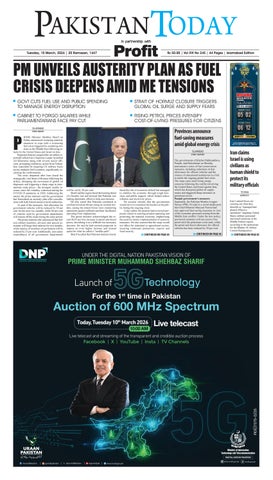

PM UNVEILS AUSTERIT Y PL AN AS FUEL CRISIS DEEPENS AMID ME TENSIONS


Read
panic? PSX plunges 9 57% in unprecedented 16 000-points single-day slide Across-the-board selling was observed in major sectors including automobile assemblers cement commercial banks, oil and gas exploration companies, oil marketing companies, power generation and refineries Index-heavy stocks such as MCB MEBL NBP MARI OGDC PPL PSO SNGPL SSGC and HUBCO traded in the red Market participants attributed the sharp decline to rising global oil prices, their impact on domestic buyers, and growing geopolitical tensions in the Middle East On Friday the federal government announced a Rs55 per litre hike in petrol and high-speed diesel prices citing the Hurmoz disruptions On Monday, Brent crude jumped 23% to $114 36 per barrel, marking one of the largest daily gains in decades and adding to last week’s 28% increase US crude rose 27% to $115 11 per barrel raising concerns about higher fuel prices and inflation globally Analysts said the PSX reacted quickly to heightened risk, prompting investors to shift toward liquidity and capital preservation They noted that
restoring investor confidence would depend largely on a de-escalation
The
on national energy supplies KP GOVERNMENT’S MEASURES: The provincial cabinet of Khyber Pakhtunkhwa approved a “Fuel Conservation and Responsible Governance Initiative aimed at reducing fuel consumption and promoting fiscal discipline According to Special Assistant to the

Iran claims Israel is using civilians as human shield to protec t its militar y officials
CONTINUED FR OM PAGE 01
In a statement posted on X the spokesperson claimed that Iranian units were conducting step-by-step and calculated attacks, asserting that each strike was equivalent to multiple coordinated impacts across various locations “Every shot is equal to 80 strikes at different points the spokesperson said stressing the precision and intensity of the operations Field observations cited in the state-
ment indicated that the Israeli regime was allegedly attempting to use residents of the occupied territories as human shields to protect its military personnel The spokesperson said civilians in northern and central areas have been confined complicating military operations According to the statement, American military bases across the region were experiencing the “daily impact” of Iranian missiles and drones The spokesman warned that Iran’s weapons could be deployed at any hour according to the orders of the Islamic Republic s armed forces The situation in the region and the occupied territories has become siren after siren following Iran’s intelligent attacks ” the spokesperson said portraying the operations as a response to what Tehran called the hollow hegemony of the enemy While the claims were not independently verified, the rhetoric signalled Tehran’s intention to continue precision strikes against what it considers hostile forces
limiting fuel usage to essential official duties emergency response and unavoidable field operations
SINDH GOVT TO DISCUSS POSSIBLE FUEL CONSERVATION MEASURES TODAY: The Sindh Government has convened a cabinet meeting on Tuesday to discuss possible fuel conservation


The presidency and the politics of global inter vention

Tspots which have an impact on the general development of the war Iran possesses one of the region s largest ballistic missile inventories Key systems include the Shahab-3 (range approximately 1,300 km), Ghadr (up to 2,000 km), Emad (1,700 km with enhanced accuracy), Sejjil (solid-fuel, 2,000 km), Khorramshahr (2 000 km) and advanced variants such as the Kheibar Shekan (solid-fuel manoeuvrable re-entry vehicle around 1 450 km) Iran has also fielded missiles it designates as hypersonic including the Fattah series (claimed terminal speeds exceeding Mach 13 with manoeuvrability to evade interception) and related derivatives The focus is still on the use of mobile launchers solid fuel for quick launch capability and better guidance via satellite navigation and re-entry vehicle manoeuvring In the conflict s initial phase In the opening stage of the war, Iran fired several hundred ballistic missiles, the total number is thought to exceed 500, in waves at Israel (some of the attacks resulted in casualties including deaths in Beit Shemesh and near Jerusalem) US military bases in Kuwait (there were American service member casualties) and locations in the UAE Qatar Bahrain and Saudi Arabia The missile assaults also caused a lot of damage to infrastructure such as airports and energy facilities In addition, the attacks have raised tensions in the Strait of Hormuz to a very high level Defensive measures have been comprehensive Israel s multi-layered systems (Arrow David s Sling and Iron Dome with an Iron Beam laser reportedly now operational) were able to intercept a large number of the threats US troops, together with their Gulf partners, operated Patriot THAAD and Aegis systems Qatar and the UAE claimed very high interception rates However penetrations have occurred with some missiles reaching targets and inflicting casualties and structural damage Interceptor stocks particularly THAAD and Patriot face depletion due to sustained barrages, raising concerns about long-term sustainability Iran’s strategy centres on saturation: overwhelming the defences with large numbers to find and exploit the gaps and inflicting damage that is making the other side pay even if the interception rate is high The use of manoeuvrable


PO W E R has always tested the character of those who possess it When authority falls into the hands of an individual, the desires rooted deep within human nature often grow stronger Yet history also bears wit-
ness to personalities who restrained their ambitions controlled their impulses and earned respect not through the display of power but through its careful limitation The exercise of authority, therefore, has long remained a measure of moral discipline as much as political capability The history of the presidency of the United States offers an illuminating reflection of this enduring tension between power and restraint Since the independence of the United States in 1776, forty-seven individuals have occupied the office of president In the early decades of the republic, American leaders were primarily preoccupied with the consolidation of their young nation But as the country gradually emerged from internal struggles and global conflicts with increasing economic and military strength a profound transformation occurred The United States began to perceive itself not merely as a sovereign state but as a power with global responsibilities and influence With this transformation came a new dimension to presidential authority American presidents increasingly found themselves shaping not only domestic policy but also the political and military affairs of distant regions As the twentieth century unfolded, many of them began to act with the conviction that global stability and international order could be influenced or even directed through American leadership In certain moments this sense of responsibility inspired constructive engagement but in other instances it encouraged the use of military power in ways that critics later questioned both politically and morally Historically, the United States has formally declared war only eleven times, all of them concentrated within five major conflicts The authority to declare war constitutionally rests with Congress yet the decisions leading to those declarations were shaped by presidential leadership The first such declaration occurred during the presidency of James Madison, when the War of 1812 was declared against the United Kingdom Decades later, President James
a n ’ s b a l l i s t i c m i s s i l e s
diverse massed threats These missile operations have meaningfully affected the war s trajectory By targeting Gulf states and energy infrastructure Iran has broadened the conflict geographically, pressuring regional actors and raising global economic stakes through Strait of Hormuz disruptions Tanker traffic has declined sharply with partial restrictions contributing to oil price surges (Brent crude exceeding $79 per barrel with intraday peaks approaching $83–85) Such ramping up of the situation has made energy volatility one of the major concerns over a longer period of time and has also enticed more parties into the situation, thus making it harder for the conflict to be contained Conversely US-Israeli strikes have targeted missile production storage and launch infrastructure destroying hundreds of launchers and degrading coordination Satellite imagery confirms damage to key bases (like Imam Ali in Khorramabad, Bid Ganeh near Tehran) The sizes of salvos and their hitting the target have generally been going down and thus reflects the success of the degradation This situation has turned the game on the ground: while Iran s ability to respond is gradually running out of steam, the coalition s air supremacy is being re-established and strengthened, thereby allowing them to make deeper assaults on the remaining threats Ukrainian President Volodymyr Zelenskyy has responded to the missile exchanges by proposing defence cooperation with Gulf states He drew on Ukraine s experience in fighting Iranian-supplied Shahed drones, which Russia has heavily used, and proposed a swap : the Gulf countries could send Ukraine the very crucial PAC-3 interceptors for Ukraine’s defence in exchange for Ukraine’s tested battle drone interceptors and know-how In some statements Zelenskyy has also conditioned his offer to send Ukrainian experts for missile and drone interception on progress in diplomacy towards a ceasefire between Ukraine and Russia These suggestions reveal their common vulnerability to the Iranian systems and the potential for sharing capabilities across regions
As for Pakistan the ramifications are still quite serious Proximity amplifies spillover risks, including energy disruptions via the Strait
K Polk led the nation into the Mexican–American War in 1846, a conflict that ultimately ended with the Treaty of Guadalupe Hidalgo and dramatically expanded American territory At the close of the nineteenth century President William McKinley presided over the Spanish–American War which marked the beginning of America s emergence as an overseas power The early twentieth century brought even larger responsibilities when President Woodrow Wilson led the United States into the First World War in 1917, declaring war on Germany and later on Austria-Hungary The final and most expansive declarations of war came under President Franklin D Roosevelt following the attack on Pearl Harbor in December 1941 drawing the United States fully into the Second World War against Japan Germany, and Italy, along with several allied states of the Axis powers Yet formal declarations of war represent only a fraction of the military engagements undertaken by the United States Over the course of its history the country has participated in dozens of armed conflicts without issuing an official declaration Particularly after the Second World War, the pattern of military involvement changed significantly Presidents increasingly relied on congressional resolutions, international mandates or executive authority to deploy American forces abroad President Harry S Truman s decision to intervene in the Korean War in 1950 stands as a notable example The conflict was described not as a war but as a police action conducted under the auspices of the United Nations, yet it involved large-scale combat against North Korean forces His successor, Dwight D Eisenhower, oversaw the conclusion of that conflict while also initiating early American involvement in Vietnam The Vietnam War later expanded dramatically under President Lyndon B Johnson following the Gulf of Tonkin Resolution in 1964, which authorized extensive military operations against North Vietnam President Richard Nixon continued the war until the Paris Peace Accords of 1973 brought an end to direct American involvement These years illustrated how military engagements could evolve into prolonged conflicts even without formal declarations of war Later decades witnessed further examples of presidential military authority President George H W Bush led the international coalition during the Persian Gulf War of 1990–1991 against Iraq following its invasion of Kuwait His son President George W Bush launched the war in Afghanistan in 2001 after the attacks of September 11 and later initiated the Iraq War in 2003 President Barack Obama continued military operations in both countries while authorizing intervention in Libya in 2011 against the forces of Muammar Gaddafi Beyond these major conflicts numerous smallerscale interventions have occurred President Ronald Reagan ordered the invasion of Grenada in 1983 and conducted airstrikes against Libya in 1986 President Bill Clinton authorized NATO s bombing campaign in Kosovo in 1999 and several operations against Iraq President Donald Trump later ordered missile strikes

of Hormuz and border instability in Balochistan Iran’s missile performance underscores asymmetric deterrence’s role in regional security, influencing calculations in West Asia and multilateral forums
The exchanges illustrate a core principle: ballistic missiles enable states facing conventional asymmetries to impose costs and deter escalation Iran s arsenal has inflicted measurable damage and widened the conflict despite robust defences reinforcing deterrence value Simultaneously progressive degradation exposes vulnerabilities under sustained precision operations The war s path will depend on whether missile barrages sustain pressure long enough to force concessions or yield to diplomatic channels amid declining capacity The outcome of the conflict will be determined by whether the missile attacks keep up the pressure for such a long time that the other side has to give in or they will end up going the diplomatic way when their capability is gradually decreasing
A balanced view recognises both the demonstrated impact of Iran’s systems and the constraints from superior air power For regional actors including Pakistan these developments emphasise the necessity of cautious diplomacy energy resilience and efforts to prevent further polarisation
The writer is freelance columnist
Ukrainian President Volodymyr Zelenskyy has responded to the missile exchang es by proposing defence cooperation with Gulf states He drew on UkraineÊs experience in fighting Iranian-supplied Shahed drones, which Russia has heavily used, and proposed a „swap‰: the Gulf countries could send Ukraine the ver y crucial PAC-3 interceptors for UkraineÊs defence in exchang e for UkraineÊs tested battle drone interceptors and know-how.
Generations United
they are often praised for their research-oriented mindset and respect for elderly footprints the wisdom of prior gene-rations Their moral consciousness rooted in community-driven values emphasises stability and incremental progress This generation s ability to balance tradition with emerging technologies allowed the Millennials to navigate early globalisation and economic shifts However,
may perceive them as emotionally driven or dismissive of tradition, Gen Z s focus on inclusivity, mental and emotional health awareness, and climate activism reveals a profound, albeit different, moral compass The willingness of Gen Z to challenge wellentrenched systems from workplace hierarchies to societal norms can be misread as irreverence but it often stems from a sincere desire to redefine values in a fractured world
The tendency to label the Millennials as the last moral generation and Gen Z as the spiritually shattered generation ignores the broader context Both these generations have faced unprecedented pressures: Millennials grappled with crises and shifting job markets, while Gen Z
Hate season
MuhaMMad Mohsin iqbal

Beijing as Europe’s New Geopolitical Mecca

Tthrough the Atlantic alliance When European leaders drew a red line over Greenland declaring it non-negotiable and off-limits to any form of geopolitical bargaining Trump s response threatening sweeping tariffs against those who opposed him, was read not as negotiation
but as arm-twisting For Europe, this was a wake-up call The assumption that the USA, regardless of who occupied the White House, would remain a predictable anchor of stability and partnership began to look fragile The message many leaders took from Washington was stark: past cooperation shared history and alliance commitments would not necessarily shield them from economic or political punishment if their national interests diverged from those of the USA
It is against this backdrop that the “pilgrimage to China must be understood The first high-profile visit after years of diplomatic coolness came from France s president His trip to Beijing, the first in nearly a decade, signalled that Europe s secondlargest economy was prepared to reopen channels not just for trade but for strategic dialogue Soon after Canada’s prime minister followed suit making his own journey to China after years of strained relations Now Germany s chancellor is preparing to land in Beijing, with a delegation heavy on industry, energy, and technology leaders in tow Behind them, other European heads of government are lining up each seeking their own audience their own agreements their own place in what increasingly looks like a recentred global economy The substance of these visits goes far beyond ceremonial handshakes Agreements are being signed across a broad spectrum: renewable energy solar and wind projects electric vehicles advanced manufacturing artificial intelligence infrastructure financing and technology transfer In some cases even defense cooperation and strategic dialogue are quietly being placed on the agenda The tone is pragmatic, even eager Where once European leaders warned of dependence on China they now speak of “win-win” frameworks of diversification of building parallel channels of growth and security that
do not run exclusively through Washington China, for its part, has played the role of the patient host Chinese leaders have emphasized humility, mutual respect, and the search for common ground The rhetoric is carefully calibrated: no lectures on internal politics no overt demands for ideological alignment but a steady emphasis on economic opportunity, infrastructure development, and long-term partnership For European and Canadian leaders bruised by what they perceive as Washington’s heavyhandedness the contrast is striking
This realignment is not confined to Europe Across the Caribbean and parts of the Western Hemisphere governments are also reassessing their strategic options Countries long accustomed to living in the shadow of US power economically, diplomatically, and sometimes militarily are watching Europe’s pivot with interest The lesson many are drawing is that diversification is no longer a luxury; it is a necessity in a world where economic pressure and sanctions have become routine tools of statecraft Nowhere is this broader shift more visible than in the Middle East, particularly in the evolving conflict between the USA Israel and Iran European governments have shown a marked reluctance to back any new US or Israeli military adventure in the region When US naval forces moved closer to Iranian waters, signaling readiness for confrontation, European capitals responded not with public endorsements

The prospec ts for regime change leading to a democratic Iran are poor
Critics in Washington see EuropeÊs turn toward Beijing as naïve , even dang erous They warn of hidden dependencies, of technology transfers that could erode Western security, of economic ties that might one day be weaponiz ed European leaders counter that the greater dang er lies in strategic monoculture placing all economic, political, and security eggs in a single basket that may no long er be as reliable as it once was.
The costs to the US and to President D onald Trump are mounting: dead ser vice members, attacks on allies in the region, shor tages of defensive systems, spiking energy costs, falling stock markets and poll numbers


The argument for America continuing the war is to further reduce Iran’s military capabilities and to bring about a less radical leadership The problem is that military efforts face the reality of diminishing returns and interfere with the emergence of a coherent leadership willing and able to end the fighting The prospects for regime change leading to a democratic Iran are poor
Meanwhile, the costs to the US and to President Donald Trump are mounting: dead service members attacks on allies in the region shortages of defensive systems spiking energy costs falling stock markets and poll numbers not to mention the weakening of Washington s ability to deal with the Chinese threat in the Indo-Pacific and the Russian menace to Ukraine and Europe On Friday Trump called for Iran’s unconditional surrender and a say in choosing its next leader But the US must instead think realistically about terms for ending the war no matter what the political outcome in Iran Ironically doing so will probably require returning to many of the issues US officials considered and rejected before the conflict began: what scale of Iranian nuclear programme is it prepared to tolerate? What if any constraints should be placed on Iran s ballistic missiles its support for proxies and terrorism and repression of its people? What if any relief from economic sanctions should be offered as an inducement? Those who now dismiss such questions need to keep in mind that the consequences of ignoring them would be continued conflict with all that would entail The US would also have to be willing to press Israel to stop the war something it may resist as it pursues what it sees as a chance to solve the Iran problem for good That said Trump is hugely popular in Israel, and Netanyahu cannot afford to alienate him in the months before a crucial election Finally, Iran’s new leaders whoever they turn out to be will also have reasons to end the war: to preserve what s left of their military and economy to consolidate political authority and ensure the country stays intact However Iran may hold off until the US is asking for peace in the hope of striking a better deal They would have to answer the same questions as the US regarding their security policies and sanctions and declare what they would require to allow tankers to start moving freely again through the Strait of Hormuz in a way that insurers deem safe If all this sounds familiar, it should Ultimately, both sides will have to return to the issues that led to war in the first place The question is when: it only takes one side


TH E election of Ayatollah Seyyed Mojtaba Hosseini Khamenei as the new Supreme Leader of the Islamic Republic of Iran represents far more than a simple institutional succession Coming amid an open regional conflict and following the martyrdom of Iran s long-time leader Ayatollah Ali Khamenei, the decision by the Assembly of Experts is widely seen as a direct political response to external attempts to destabilise the country The announcement followed an extraordinary session convened under dramatic circumstances Despite bombardments and threats against their own facilities, the members of the Assembly moved swiftly to appoint a new leader The speed of the decision was not merely administrative; it sent a powerful signal that the institutions born out of the Islamic Revolution remain resilient even under the pressures of war By appointing Mojtaba Khamenei as the third Supreme Leader of the Islamic Republic after deliberations and a majority vote the religious representatives reaffirmed the continuity of a political project grounded in independence, national dignity and sovereignty The transition comes at an extraordinarily sensitive moment The martyrdom of Ayatollah Ali Khamenei triggered widespread public mobilisation across Iran Millions of citizens gathered in cities throughout the country to honour a leader who, for decades, symbolised Iran s resistance to Western pressure and foreign intervention Within this context, the choice of Mojtaba Khamenei carries a profound symbolic and political significance
For many Iranians the rise of the son of the martyred leader represents the continuation of the Revolution itself Yet his selection cannot be understood simply as a matter of lineage Mojtaba Khamenei has long been embedded within the political and religious structures that shape the Islamic Republic At 56, he is far from an unknown figure within Iran s power structure For years he played an influential role be-
hind the scenes in the office of the Supreme Leader, overseeing sensitive matters related to state security and financial affairs while maintaining close relations with key institutions responsible for the country s defence Among these institutions are the Islamic Revolutionary Guard Corps (IRGC) and the Basij popular militia both central pillars of Iran s national defence architecture His close ties to these organisations helped consolidate his reputation as a key figure within the country s strategic security network

For this reason, his appointment was quickly acknowledged with loyalty by major military institutions a development that many analysts interpret as a sign of internal cohesion rather than uncertainty In fact the succession appears to have produced the opposite of what many Western observers had predicted For years, analysts speculated that the death of Iran’s long-time revolutionary leader might open a period of institutional instability Some even expected internal divisions that could weaken the political system That scenario did not materialise Instead, the transition was swift, orderly and carried out through the constitutional mechanism established precisely for such moments The timing of this transition is also significant in the broader geopolitical context The region is currently witnessing one of its most volatile periods in recent decades The United States and Israel appear to have assumed that sustained military pressure could weaken Iran’s ability to respond Yet developments on the ground suggest a different reality Iran s military infrastructure remains intact, its response capabilities active and its leadership signalling a willingness to endure confrontation for as long as necessary Against this backdrop the appointment of Mojtaba
QaMar BaShir
MIDDLE EAST MONITOR

WHO IS MOJTABA KHAMENEI,
IRAN'S NEW SUPREME LEADER?

Saudi Arabia warns Iran of 'huge loss' if escalation widens


OIL PRICES SURGE 20% AS EXPANDING US-ISRAELI WAR WITH IRAN CUTS SUPPLIES


Bokhari said that Pakistan is giving an effective response to Fitna al-Khawarij and the country’s security forces possess the full capability to foil the malicious designs of enemies She added that the government and security institutions are working together to maintain peace and stability in the country and to protect the lives of citizens The provincial information minister remarked that if the Chief Minister of Khyber Pakhtunkhwa follows the public service model introduced by Maryam Nawaz, it would be a matter of great satisfaction She stated that the people of Khyber Pakhtunkhwa are also our own people and it is encouraging to see them benefiting from the Sahulat
Bazaars established in Punjab, where essential items are being provided to the public at subsidized prices during the holy month of Ramadan Azma Bokhari further said that while


Tarar


Pakistan Nav y launches O peration Muhafiz ul-B ahr to protec t maritime trade routes
