In partnership with
PM HOLDS REGIONAL DIPLOMACY TALKS WITH OMAN, SYRIA, AND KUWAIT LEADERS AMID ME CONFLICT Tuesday, 3 March, 2026 | 13 Ramazan, 1447
g
g
PM HOLDS TALKS WITH SULTAN OF OMAN, COMMENDS MUSCAT’S MEDIATORY ROLE
SOLIDARITY EXPRESSED WITH KUWAIT AMID GULF HOSTILITIES
Profit g
g
Rs 50.00 | Vol XVI No 238 | 48 Pages | Lahore Edition
REAFFIRMS COMMITMENT TO REGIONAL PEACE IN CALL WITH SYRIAN PRESIDENT EMPHASIZES DIPLOMACY, RESTRAINT, AND COORDINATION TO PREVENT ESCALATION
PM forms 18-member committee to assess oil price impact after Iran strikes PROFIT
staff report
P
ISLAMABAD Mian abrar
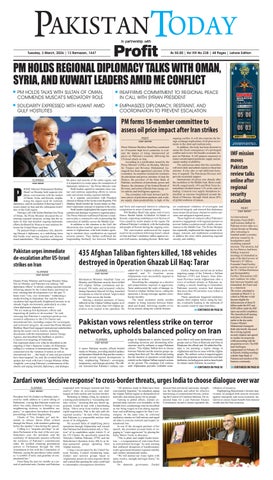
RIME Minister Muhammad Shehbaz Sharif on Monday held separate telephone conversations with the leaders of Oman, Syria, and Kuwait, emphasizing the urgent need for restraint, diplomacy, and de-escalation following Israel’s recent attack on Iran and the subsequent hostilities in the Gulf region. During a call with Sultan Haitham bin Tariq of Oman, the Prime Minister discussed the escalating regional situation, noting that the attacks on Iran had derailed ongoing diplomatic efforts facilitated by Muscat to ease tensions between the United States and Iran. He praised Oman’s mediatory role, describing Muscat’s diplomacy as a stabilizing force that builds trust among regional and international stakeholders. “The escalation endangered
the peace and security of the entire region, and it is imperative to create space for resumption of diplomatic initiatives,” the Prime Minister said. Both leaders agreed to maintain close contact and continue supporting efforts to restore calm and ensure lasting regional stability. In a separate conversation with President Ahmed al-Sharaa of the Syrian Arab Republic, PM Shehbaz Sharif briefed the Syrian leader on Pakistan’s diplomatic outreach in response to the crisis. Both leaders highlighted the urgent need for restraint and dialogue to preserve regional peace. The Prime Minister reaffirmed Pakistan’s readiness to play a constructive role in promoting the restoration of stability across the Middle East. In addition to the situation in the Gulf, the discussions also touched upon recent developments in Afghanistan, with both leaders agreeing to maintain close coordination on regional security matters. They further reaffirmed the longstanding brotherly ties between Pakistan
Pakistan urges immediate de-escalation after US-Israel strikes on Iran ISLAMABAD
staff report
Prime Minister Shehbaz Sharif has constituted an 18-member high-level committee to evaluate the impact of rising international oil prices on Pakistan’s economy following the US-Israel attack on Iran. According to a notification issued by the Prime Minister’s Office on Monday, Minister for Finance and Revenue Muhammad Aurangzeb has been appointed convener of the committee. Its members include the ministers for petroleum and power, minister of state for finance, the governor of the State Bank of Pakistan, secretaries of petroleum, power and finance, the chairman of the Federal Board of Revenue, and senior officials from energy sector entities and intelligence agencies. The committee will track forward and futures prices of petroleum products and evaluate supply chain predictability in light of the
and Syria and expressed interest in enhancing cooperation in areas of mutual interest. PM Shehbaz Sharif also spoke with Crown Prince Sheikh Sabah Al-Khaled Al-Sabah of Kuwait, expressing condolences over the loss of lives caused by recent attacks in the region. He affirmed Pakistan’s solidarity with the leadership and people of Kuwait during the ongoing crisis. The conversation underscored the urgent need for de-escalation following Israel’s attack on Iran and Iran’s retaliatory strikes against several Gulf nations, including Kuwait. Both lead-
ers condemned violations of sovereignty and territorial integrity and stressed that diplomacy must remain the primary channel to resolve tensions and safeguard regional peace. These high-level contacts reflect Pakistan’s proactive engagement with regional partners to prevent further escalation amid volatile circumstances in the Middle East. The Prime Minister has repeatedly emphasized the importance of dialogue, restraint, and multilateral coordination to address the crisis while protecting regional security and stability.
435 Afghan Taliban fighters killed, 188 vehicles destroyed in Operation Ghazab Lil Haq: Tarar ISLAMABAD
staff report
Deputy Prime Minister and Foreign Minister Ishaq Dar on Monday said Pakistan was making “full diplomatic efforts” to defuse soaring regional tensions following attacks by the United States and Israel on Iran, warning that developments over the past 72 hours were “very, very worrisome.” Addressing a media briefing in Islamabad, Dar said the latest escalation had significantly heightened tensions in an already fragile environment, particularly at a time when diplomatic channels were active. “We are making full diplomatic efforts and requesting all parties to de-escalate,” he said, stressing that Pakistan’s consistent position was rooted in adherence to the UN Charter and international law, including respect for sovereignty and territorial integrity. He noted that Prime Minister Shehbaz Sharif had engaged international stakeholders during his recent visit to Austria, including discussions with the International Atomic Energy Agency, and described the feedback as positive. Concern over targeting of leadership Dar expressed alarm over what he described as the targeting of Iran’s Supreme Leader, Ali Khamenei, calling it a violation of international norms. “We are concerned over the violation of norms as well as international law … that heads of state and government have been targeted,” he said. He revealed that he had spoken last week with Iran’s Foreign Minister Abbas Araghchi, conveying Pakistan’s condemnation of the attacks and urging restraint, diplomacy, and dialogue.
ongoing conflict. It will also examine the foreign exchange implications of oil price movements in the short and medium term. In addition, the body has been directed to assess the fiscal consequences of a prolonged conflict and review the broader economic impact on Pakistan. It will propose measures to ensure uninterrupted petroleum supply and adequate market availability. The notification states that the committee will meet daily and submit reports to the prime minister. It may also co-opt additional members if required. The Petroleum Division will provide secretarial support. International oil prices rose sharply after the escalation in the Middle East. Brent crude briefly surged nearly 14% and West Texas Intermediate climbed almost 12% at the start of trading. Concerns over supply disruptions intensified as tensions heightened around the Strait of Hormuz, through which about 20% of global seaborne oil passes.
Information Minister Attaullah Tarar on Monday said Pakistani security forces killed 435 Afghan Taliban combatants and destroyed 188 tanks and armoured vehicles during Operation Ghazab Lil Haq, launched in response to what he termed “unprovoked action” from across the border. Sharing a detailed summary of losses inflicted on the Afghan Taliban regime as of 3pm, Tarar said more than 630 Afghan operatives were injured in the operation. He
added that 31 Afghan military posts were captured and 51 locations across Afghanistan were successfully targeted in precision air strikes. Describing the campaign as a decisive and proportionate response to aggression, Tarar underscored the scale of damage inflicted on Afghan Taliban forces, calling the operation a strong message against crossborder hostility. The latest escalation marks another chapter in rising tensions between Islamabad and Kabul, following months of titfor-tat actions along the volatile frontier.
Earlier, Pakistan carried out air strikes targeting camps of the Tehreek-e-Taliban Pakistan (TTP) and Islamic State Khorasan Province inside Afghanistan after a wave of militant attacks in Pakistan, including a suicide bombing in Islamabad. Pakistani security sources had claimed that more than 80 terrorists were killed in those strikes. Those operations triggered retaliatory attacks from Afghan forces along the border, eventually leading to the outbreak of the current round of open hostilities.
CONTINUED ON PAGE 03
Pakistan vows relentless strike on terror networks, upholds balanced policy on Iran ISLAMABAD
staff report
A senior Pakistani security official briefed media on Monday, providing detailed updates on Operation Ghazab-lil-Haq and the country’s approach toward regional developments in Iran, emphasizing Pakistan’s sovereignty, transparency, and strategic priorities. The official reiterated that Pakistan’s military cam-
paign in Afghanistan is strictly focused on combating terrorism and dismantling infrastructure used by militants to target Pakistani citizens. "The Afghan Taliban have to choose between Pakistan and the terrorist groups operating from their soil," the official said, noting that the duration of operations would depend entirely on the Afghan Taliban regime's actions on the ground. The campaign will continue until Afghanistan provides verifiable assur-
ances that it will cease facilitation of terrorist groups such as Fitna al Khawarij and Fitna al Hindustan, the official said. He added that Pakistan is not pursuing a regime change in Afghanistan and has no issue with the Afghan people. The military action is targeted against those who perpetrate acts of terrorism and their facilitators, including posts used as launch pads for attacks inside Pakistan, he asserted.
CONTINUED ON PAGE 03
IMF mission moves Pakistan review talks online after regional security escalation PROFIT
staff report
An International Monetary Fund (IMF) staff mission shifted its Pakistan review talks to a virtual format on Monday after relocating to Istanbul under a security advisory issued by its headquarters amid escalating regional tensions. The mission, led by Iva Petrova, had been holding in-person meetings in Islamabad as part of the third review of Pakistan’s $7 billion Extended Fund Facility and the second review of the $1.1 billion Resilience and Sustainability Facility. Discussions will now continue via video link between Istanbul and Islamabad, the Fund said in a statement. The review, scheduled to conclude on March 11, is critical as Pakistan would become eligible for disbursements of about $1 billion under the EFF and $200 million under the RSF upon successful completion. The formal kickoff meeting took place in Islamabad earlier in the day under Finance Minister Muhammad Aurangzeb. Both sides briefly discussed the evolving regional security situation and agreed to monitor developments while proceeding with the programme review. The IMF team had begun engagements on February 25 in Karachi, holding meetings with the State Bank of Pakistan and members of the business community.
CONTINUED ON PAGE 03
Zardari vows 'decisive response' to cross-border threats, urges India to choose dialogue over war ISLAMABAD
staff report
President Asif Ali Zardari on Monday delivered his ninth address to a joint sitting of Parliament, vowing that Pakistan would not allow “any entity, domestic or foreign, to use neighbouring territory to destabilise our peace,” as opposition lawmakers disrupted proceedings with loud sloganeering. Chants of “Go, Zardari, go” and demands to release Imran Khan echoed through the House, with members gathering before the speaker’s dais during the speech. Calling it a “singular privilege” to address Parliament at the start of the new parliamentary year, the president said the continuity of democratic practice reflected the resilience of Pakistan’s constitutional order. He recalled returning presidential powers to Parliament through the 18th Amendment in line with the Constitution of Pakistan, saying the presidency today stands as “a symbol of unity and guardian of constitutional law.” Describing the past ten months as a period of profound tests, Zardari said Pakistan
responded with “strategic restraint and firm resolve” when its sovereignty was challenged on both eastern and western borders. Referring to Marka-i-Haq, he termed it a turning point defined by a “resounding military victory,” asserting that any future aggression would be met with a humiliating defeat. “Move away from warfare to meaningful negotiation. That is the only path for regional security,” he said, while stressing that Pakistan is a responsible nuclear state aware of its obligations. He accused India of amplifying proxy operations through Afghanistan and warned that Pakistan had demonstrated only a “fraction” of its capabilities under Article 51 of the UN Charter. He specifically named the Tehreek-i-Taliban Pakistan (TTP) and the Balochistan Liberation Army (BLA) as Indian-sponsored groups operating from Afghan territory. Citing a recent report by the United Nations Security Council monitoring team, Zardari said terrorist groups based in Afghanistan posed an extra-regional threat and warned that ignoring the issue could lead to catastrophic consequences elsewhere.
“All promises made in Doha have been conveniently forgotten,” he remarked, urging the Afghan Taliban regime to dismantle terror networks and choose peace for its people. Turning to global affairs, Zardari expressed deep concern over instability in the Middle East, condemning what he described as war being waged on Iran during negotiations and reaffirming support for Iran’s sovereignty. At the same time, he criticised retaliatory attacks on Gulf nations and urged all sides to exercise restraint and respect international law. In one of the strongest portions of his speech, the president accused India of engaging in “water aggression” by placing the Indus Waters Treaty in abeyance. “This is plain and simple hydro-terrorism — a weaponisation of vital water flows to exert political leverage,” he said, warning that unilateral disruption of transboundary water agreements threatens regional stability and violates international norms. “We will defend our water rights with unity, resolve, strength and legal clarity,” he declared. On domestic governance, Zardari
stressed that provincial autonomy strengthens the federation and called for effective functioning of constitutional forums, including the Council of Common Interests. He expressed hope for a just National Finance Commission Award to ensure equitable dis-
tribution of resources. Highlighting Balochistan’s historic deprivation, he pledged both security measures against insurgents and socio-economic initiatives to ensure locals benefit from mineral wealth and the blue economy.