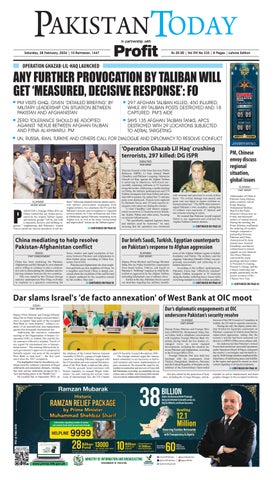
g SAYS 135 AFGHAN TALIBAN TANKS, APCS DESTROYED WITH 29 LOCATIONS SUBJECTED TO AERIAL TARGETING
g UN, RUSSIA, IRAN, TURKIYE AND OTHERS CALL FOR DIALOGUE AND DIPLOMACY TO RESOLVE CONFLICT


![]()

g SAYS 135 AFGHAN TALIBAN TANKS, APCS DESTROYED WITH 29 LOCATIONS SUBJECTED TO AERIAL TARGETING
g UN, RUSSIA, IRAN, TURKIYE AND OTHERS CALL FOR DIALOGUE AND DIPLOMACY TO RESOLVE CONFLICT


Economic Corridor (CPEC) which remains a flagship project of the Belt and Road Initiative and a cornerstone of bilateral cooperation While highlighting the importance of accelerating ongoing CPEC projects, the Prime Minister stressed on the need to enhance cooperation in agriculture and IT and mining & minerals He also underscored Pakistan s resolve to provide a secure and conducive environment for Chinese personnel investments and institutions in Pakistan Ambassador Jiang Zaidong briefed the Prime Minister on recent developments in China-Pakistan relations and conveyed the warm greetings from the Chinese leadership He reiterated China’s firm support for Pakistan’s sovereignty territorial integrity and socio-economic development Both sides exchanged views on regional and international issues of mutual interest, agreeing to maintain close coordination and consultation to contribute to peace, stability, and prosperity in the region and beyond
CONTINUED FROM PAGE 01
He further stated that Pakistan would hold the Afghan Taliban regime accountable for any attack originating from Afghan soil declaring that any assault inside Pakistan would prompt direct action In a pointed message Lt Gen Chaudhry said the Afghan Taliban regime must choose between supporting militant outfits and maintaining relations with Pakistan He named the Tehreek-e-Taliban Pakistan (TTP), Balochistan Liberation Army (BLA) Islamic State (Daesh) and Al-Qaeda as terrorist organisations the regime must distance itself from Reaffirming national resolve the DG ISPR said the operation was conducted under Pakistan s right to self-defense and praised law enforcement agencies, particularly the police of Khyber Pakhtunkhwa, for their frontline role
belonging to the banned Tehreek-i-Taliban Pakistan (TTP) while Fitna al Hindustan is a term designated by the state for terrorist organisations in Balochistan
The FO said that the armed forces carried out “precise operations inflicting heavy losses on terrorist outfits and targeting
groups against any further provocations in attempts to undermine the security and welfare of the people of Pakistan”, stating that they will be met with “a measured decisive and befitting response”
The FO reiterated Pakistan s desire for peace and stability in the region adding that the country had remained patiently engaged in political and diplomatic efforts aimed at addressing the menace of terrorism emanating from Afghan soil”
“However it is unfortunate that Pakistan s numerous goodwill gestures and highly responsible approach were misconstrued, resulting in increased terrorist attacks from Afghan soil, with the active support and backing of the Taliban regime, as well as India,” the statement read The FO reaffirmed Pakistan’s strong resolve and determination towards eliminating terrorism emanating from the Afghan soil
It also called upon the Afghan regime to end the impunity with which Fitna-al-Khawarij and Fitna-al-Hindustan
continue to operate from Afghan soil”
It expressed the faith that the international community will play its role in sending a clear message to the Taliban


Dar ’s diplomatic engagements at OIC underscore Pak istan’s securit y resolve
CONTINUED FROM PAGE 01
Dar Turkish FM reiterate firm unwavering support for legitimate rights of the Palestinians
Meanwhile, DPM/Foreign Minister Ishaq Dar on Friday met with Deputy Foreign Minister of Türkiye, Musa Kulaklikaya, on the margins of the Extraordinary Open-ended Session of the OIC Executive Committee in Jeddah
During the meeting the dignitaries exchanged views on pressing regional developments and reiterated their firm and unwavering support for the legitimate rights of the Palestinian people in the face of continued Israeli aggression in the Gaza Strip and the Occupied West Bank a DPM s Office separate news re-
D ar briefs S audi, Turkish, Egyptian counterpar ts on Pakistan's response to Afghan aggression
CONTINUED FROM PAGE 01
In a separate statement, Dar said the people and armed forces stood united as “steadfast guardians” of Pakistan’s sovereignty dignity and security Together we are resolute in our commitment for a peaceful prosperous and secure Pakistan he added Dar is currently in Jeddah, where he attended an extraordinary openended session of the Executive Committee of the Organisation of Islamic Cooperation On the sidelines he spoke with Saudi Foreign Minister Faisal bin Farhan Al Saud and discussed the evolving situation and broader regional developments
During the call, Dar briefed him on Pakistan’s "firm response to unprovoked Afghan aggression " stat-
regime that it must not continue to renege on its obligation to take concrete and verifiable action against these terrorist outfits and end its support for them
The statement reiterated that Pakistan held the right to take all appropriate actions in its self-defence and to protect its citizens in accordance with international law including the UN Charter” PM’S SPOKESPERSON SAYS 297 AFGHAN TALIBAN KILLED; 89 POSTS DESTROYED Meanwhile sharing update on Operation Ghazab lil-Haq, Prime Minister s spokesperson for foreign media Mosharraf Zaidi, said that Pakistan’s efforts to eliminate the “scourge of terrorism emanating from Afghanistan continued through the day
In a post on X he said A total of 297 Afghan Taliban are confirmed killed, and more than 450 are reported injured ” He further said that 89 Afghan Taliban posts have been destroyed and 18 have been captured while 135 Afghan Taliban regime tanks and armed personnel carriers have been destroyed Twenty-nine locations across Afghanistan have been subjected to aerial targeting, he said Security sources said that Pakistani armed forces targeted and destroyed several Afghan Taliban’s checkposts at the Pak-Afghan border areas as Operation Ghazab lil-Haq is ongoing Security forces have destroyed Afghan Taliban s Aryana Complex, Dubgai checkpost, police headquarters, and Zakir Khail post, the sources said adding that Pakistan’s armed forces forced the Afghan Taliban forces to flee their checkposts The sources further said the operation will continue till its objectives are achieved ‘AFGHAN TALIBAN’S MILITARY INSTALLATIONS COMPLETELY DESTROYED’ Information Minister Attaullah Tarar said the Pakistani armed forces targeted military installations and terrorist bases
ing that the military had undertaken targeted operations under ‘Operation Ghazab Lil Haq to safeguard the country s sovereignty and territorial integrity Both leaders reaffirmed the importance of regional peace and stability and agreed to remain closely engaged
In a separate conversation with Turkish Foreign Minister Hakan Fidan Dar exchanged views on recent developments particularly tensions between Pakistan and Afghanistan He reiterated that Pakistan had responded "befittingly" to the Afghan Taliban’s actions The two sides stressed the need for peace and stability and agreed to maintain close coordination
Dar also spoke with Egyptian Foreign Minister Badr Abdelatty, un-
going situation and we will see where the situation leads ” he said while speaking on a TV channel Afghan Taliban tried skirmishes firing and tried to inflict harm in Khyber and Chitral However, they did not have the capacity They do not have any capability in conventional warfare,” he said He noted that a difference in tone had been observed in the Afghan Taliban since yesterday
The Information Minister said the Operation Ghazab lil-Haq is ongoing as it is necessary to neutralise a threat against Pakistan “Pakistan has shown great patience and resolve Pakistan has been attacked terrorism incidents occurred in which the role of Afghanistan was clear The evidence was present he said while speaking to Geo News He gave references to the terrorist incidents in Islamabad and Bannu, asserting that “all these incidents were related to Afghanistan ” Earlier at press conference Tarar said Afghan Taliban had nothing to do with Islam as they don t believe in peace He recalled what he had earlier stated, saying that the Afghan Taliban regime is an illegitimate system of government; it is based on a wrong interpretation of religion an interpretation that suits them (Afghan Taliban) and has nothing to do with the basic principles of religion Islam; and it is a system of oppression
PM GIVEN DETAILED
BRIEFING AT GHQ ON
SITUATION BETWEEN
PAKISTAN AND AFGHANISTAN
In the meanwhile Prime Minister
Shehbaz Sharif on Friday visited General Headquarters in Rawalpindi, where the military leadership gave him a detailed briefing” on the situation between Pakistan and Afghanistan The development comes after Pakistan s security forces launched an operation with codename as Ghazab Lil-Haq against the Afghan Taliban after it launched unprovoked attacks along the border between both countries on Thursday According to a statement issued by the Prime Minister ’s Office PM Shehbaz
derlining that Pakistan’s response had been "measured but decisive "
are underway to contain the escalation A source familiar with the dis-
levels with both sides to de-escalate the situation and prevent further deterioration
Separately, acting Afghan Foreign Minister Mawlawi Amir Khan Muttaqi held talks with Qatar ’s chief negotiator Mohammed Al-Khulaifi according to Doha as regional players stepped up efforts to prevent the confrontation from spiralling further
said that zero tolerance should be adopted against the nexus between the Afghan Taliban and Fitna al-Khwarij and its malicious actions ” Fitna al Khawarij is a term the state uses for terrorists belonging to the banned Tehreek-i-Taliban Pakistan (TTP)
The actions of the Afghan Taliban regime and Fitna al Khawarij against Pakistan are unacceptable, he said
He added that the country s armed forces, under the leadership of Chief of Defence Forces Asim Munir were always ready to defend the country Pakistan knows how to defend itself against any aggression he asserted
The premier also praised the professional capabilities of the armed forces for repelling attacks by the Afghan Taliban regime in the border areas and for retaliating vigorously “The entire nation stands with the armed forces for protecting the homeland he said UN, RUSSIA AND IRAN CALL ON PAKISTAN, AFGHANISTAN TO CEASEFIRE
Meanwhile, top UN officials have expressed concern over the cross-border clashes between Afghan Taliban forces and Pakistani security forces and called for dialogue and diplomacy to resolve their differences while China and Russia called on both countries to cease firing
UN Secretary-General Antonio Guterres is following the situation with concern his spokesperson said Thursday
In a note to correspondents
Spokesperson to UN Secretary-General Stephane Dujarric said the secretary-general urges relevant parties to comply with their obligations under international law and to ensure the protection of civilians “Commending mediation efforts by several Member States in recent months the Secretary-General urges the parties to continue to seek to resolve any differences through diplomacy, Dujarric said In Geneva, UN human rights chief Volker Turk on appealed for dialogue between Afghanistan and Pakistan “This situation calls for urgent political dialogue rather than escalating the use of force said the High Commissioner for Human Rights Beyond the global body, the UN-backed International Criminal Court (ICC) has issued arrest warrants for the Supreme Leader of the Taliban Haibatullah Akhundzada and for the Chief Justice of the Taliban Mr Abdul Hakim Haqqani


Interior Minister Mohsin Naqvi ’s presence at a four-nation conference on illegal migration
SAW him promise a more rigorous countering of illegal migration in exchange for the expanding of legal pathways to migration However, the fact that such a high-level meeting merely saw repetition of wellworn tropes shows that none of the governments involved has a real grasp of what the problem is Illegal migration does not occur because the country of origin is not discouraging human traffickers enough, nor because destinations do not provide sufficient pathways to legal migration They are occurring simply because there are not enough jobs at home There is also the attraction of the West, not just in terms of economic benefit, but perceived personal freedom as well
One factor is that the destination countries’ populations generally resent migrants, as witnessed in the rise of far-right parties in virtually all Western countries This is despite the fact that populations are stagnating and it is the migrant who services the dark underbelly of Western society, because he is willing to take on tasks that the native-born are unwilling to do One problem is that states have become greedy and look forward to the remittances that migrants send home An associated problem is that of the brain drain, as even illegal migrants are often possessed of skills poorly rewarded at home better rewarded abroad Can the West help migrants’ countries provide their populations jobs? Western countries are ex-colizers, and want to continue exploiting the ex-colonies Immigrants countries do not want large unemployed populations at home and are thus likely to turn a blind eye to human traffickers Providing legal pathways does not work entirely, because migrants often enough carry the baggage of their countries of origin in culture politics cuisine the list is endless Pakistan’s participation in this conference shows that the issue is not that of a colonial legacy After all, Pakistan was never colonized by any of the three countries participating However the presence of substantial Pakistani diasporas in all three is a sign of the attraction of Europe Also, they are routes to the preferred destination of former colonzer Britain Traffickers will only become more sophisticated as they are suppressed so long as demand continues to grow Legal pathways have the disadvantage of helping the West skim off the cream The challenge of climate change is yet to kick in as people seek climes which offer a living It would be well to plan for this now that the countries are putting themselves together

Dedicated to the legac y of late Hameed Nizami Arif Nizami (Late) Founding Editor
M A Niazi Editor Pakistan Today Babar Nizami Editor Profit
TH E relationship between India and Pakistan has been one of a long-standing confrontation that dates back to the years after Independence in 1947 This competition has led to several armed conflicts in particular in 1948 1965 and 1971 and to frequent crises low level conflicts and proxy wars In May 1998 South Asia became overtly nuclearized and this has completely changed the character of war between the two countries The nature of hostilities has since that watershed moment shifted away from full-scale conventional warfare to limited commitments under the nuclear deterrence umbrella It is worth discussing why India is seeking limited war solutions against Pakistan and the implications for strategic stability in South Asia
THE ROUTE BETWEEN CONVENTIONAL WAR AND NUCLEAR DETERRENCE: Before nuclearization both India and Pakistan had conventional wars with the intention of realising decisive military and political results The coming of the nuclear arms put hard limits on escalation The full scale war between two states with nuclear weapons may lead to Mutual Assured Destruction (MAD), where both of the parties would lose everything and nothing will be acceptable As a result, political and military leaders of both parties have attempted to achieve goals that would be limited to the nuclear level On 18 May 1974 India first tested a nuclear weapon in the Pokhran desert in the Smiling Buddha test This was then succeeded by five succeeding underground tests on 11 May 1998, named Pokhran-II (Operation Shakti) Pakistan retaliated by carrying out its own nuclear tests on 28 (Chaghi-I) and 30 May 1998 (Chaghi-II) in the Chaghi hills of Balochistan
These changes created a South Asian nuclear deterrence dyad and fundamentally changed the security of the region
KARGIL WAR AND THE RISE OF THE LIMITED WAR: The Kargil conflict of 1999 was the first time that there was a major crisis that involved India and Pakistan since the period of nuclearization In the Kargil sector the Pakistani troops had deployed Operation Badr with the aim of interfering with the supply chain of India into Siachen by attacking National Highway 1A India retaliated by Operation Vijay, taking its time to limit its military intervention to its side of the Line of Control (LoC) to prevent the situation going out of control The traditional superiority of India which was estimated in a 3:1 ratio actually restricted the extent
o l i c y o r P o w e r ?
labourers seeking economic stability and urban residents navigating essential services all depend on administrative effectiveness Ensuring that decision-making remains grounded in social realities is therefore essential Structural challenges further shape this relationship Accountability mechanisms may not always function with uniform effectiveness, and performance evaluations do not consistently measure long-term policy outcomes or responsiveness to citizen needs Procedural delays and institutional caution can slow implementation When citizens encounter prolonged processes or feel distant from decision-making, public trust can weaken Addressing these concerns requires institutional reform rooted in transparency clarity of roles and shared responsibility rather than confrontation
It is equally important to avoid overgeneralization Many civil servants serve with dedication and professionalism, often under resource constraints and significant pressure
The central challenge lies less in individual intent and more in systemic design Even capable officials may operate within rigid hierarchies or inherited administrative cultures Acknowledging their contribution reinforces an important principle: reform should strengthen institutions, not diminish them
Restoring balance requires clarity, coordination and mutual responsibility Elected leaders must set policy direction with vision foresight and constitutional accountability while civil servants provide impartial expertise and ensure effective implementation Ministries should establish clear objectives, allocate re-
of its response India restrained itself mainly due to nuclear deterrence Finally Pakistan had to pull out its troops on 26 July 1999 under international pressure and danger of escalation Although the conflict did not turn into a full-scale war, it was a big blow to the stability of the strategy because it only enhanced mistrust and promoted doctrinal innovation on both the fronts
OPERATION PARAKRAM AND DOCTRINAL SHIFTS: After the terrorist attack on the Indian Parliament on 13 December 2001, India initiated an operation named Operation Parakram, a massive military build-up along the LoC and the border with Pakistan About 700 000 Indians soldiers were to be used The mobilization process however was slow and it took close to two months and thus it gave Pakistan ample time to counter and give the signal of its nuclear deterrence India eventually did not launch any conventional attack because it understood that it would be viewed as limited war by India yet a threat to its existence by Pakistan In October 2002 the operation was called off without fighting This episode also marked the shortcomings of the current military doctrine of India, specifically the Sundarji Doctrine, which focused on deep conventional attacks but which was not that well adapted to quick responses in nuclear circumstances
THE COLD START DOCTRINE AND PAKISTAN RESPONSE: Following Operation Parakram, India devised the doctrine of Cold Start which was a limited war strategy aimed at fighting beneath the nuclear limit of Pakistan The doctrine was focused on quick mobilization shallow offensives and Integrated Battle Groups (IBGs) to complete small goals in 48 to 72 hours The aim was to sanction Pakistan in other conventional ways without a nuclear build-up Cold Start was seen by Pakistan as a great danger to its strategic stability and a policy of FullSpectrum Deterrence (FSD) was adopted This also involved tactical nuclear weapon (TNW) development e g Nasr (Hatf IX) missile to counter conventional incursions at tactical and operational level Although FSD was supposed to reestablish deterrence, it actually reduced the nuclear threshold, thus exposing the chances of miscalculation and unintentional escalation
CRISIS BEHAVIOUR: 2008-2019: Later crises also demonstrated the mechanisms of limited war with nuclear deterrence Following the attacks in Mumbai in 2008, India did not engage in direct military vengeance although it held Pakistan-based militants responsible On a parallel note, India carried
sources transparently, and monitor performance consistently Parliamentary oversight through committees, audits, and structured reviews must be active and meaningful to reinforce democratic accountability Transparent documentation and open communication can further bridge the gap between governance and the people Public engagement is equally vital Administrative leadership must maintain sustained contact with communities so that policy reflects lived experience rather than abstraction Field consultations stakeholder dialogue and evidence-based planning can connect strategy with social realities Recruitment promotion and training systems should reward integrity competence, and responsiveness Institutional safeguards must consistently affirm that permanent officials operate within constitutional boundaries in support of elected authority Pakistan’s democratic future depends not on institutional rivalry but on principled coordination between them Civil servants and elected representatives are interdependent pillars of the state, each indispensable to stability and progress Democracy demands clarity of authority and discipline in its exercise Those chosen by the people must lead with vision courage and accountability Those entrusted with administration must implement with integrity neutrality and constitutional loyalty When this balance falters, citizens experience frustration and a loss of trust When it is preserved, governance becomes credible responsive and just The true measure of power in Pakistan is not who holds it but how faithfully it serves the nation Democracy transforms from principle to practice only when authority is exercised responsibly and genuinely advances the hopes and aspirations of the people
The writer is a freelance columnist


TH E R E are moments in history when power does not merely shift it exposes itself The first year of Donald Trump s second term has become such a moment not because it introduced entirely new instruments of American statecraft, but because it redirected the same tools of pressure, coercion, and economic weaponization that the USA once reserved for weaker or dependent nations toward its own traditional allies In doing so Washington did not just shock the global system; it fractured it driving country after country by calculation necessity or defiance into the strategic and economic orbit of China
For decades, the USA shaped the political and financial architecture of much of the developing world through a familiar mechanism: military reach dollar dominance and institutional leverage over global bodies such as the IMF and World Bank Countries in South Asia, the Middle East, Latin America, Eastern Europe, and parts of Africa learned to live within a system where access to capital trade and even political legitimacy could be expanded or constricted at Washington s discretion Many endured in silence, not because they agreed, but because they lacked the economic or military weight to resist What changed in this era is not the method but the target The same logic of tariffs sanctions threats and strategic intimidation was applied to nations that had long believed themselves protected by alliance and shared identity Canada, Europe, and the wider Western hemisphere were confronted not as partners, but as economic adversaries and strategic liabilities This reversal carried a powerful message: loyalty offered no immunity Canada s experience became a defining case study Accusations of economic exploitation, sweeping tariff threats, and rhet-
oric that questioned Canada’s sovereignty struck at the heart of a relationship built on the world s deepest bilateral trade integration For Ottawa the conclusion was stark Dependency on a single market had become a strategic risk The response was not submission, but diversification Trade corridors were widened toward the European Union through CETA expanded across the AsiaPacific via the CPTPP and recalibrated toward energy and investment ties with the Gulf and Asia China as the world s largest trading nation, inevitably became central to this recalibration not by ideological alignment, but by economic gravity Europe’s pivot followed a parallel but more consequential path The dispute over Greenland framed by Washington as a strategic necessity for missile defense and Arctic dominance, was read in European capitals as a unilateral assertion of power that disregarded sovereignty and alliance consultation The European Union often divided on policy responded with rare cohesion The rejection of American demands was not merely territorial it was systemic It reflected a growing determination to insulate Europe s political and economic future from what it increasingly viewed as unpredictable American pressure This shift soon extended into the financial realm European policymakers began openly discussing the risks of overexposure to US Treasury holdings and the vulnerability created by dollar-dominated trade and settlement systems This trend has taken on new political meaning in an environment where financial access is increasingly treated as a strategic weapon At the same time the BRICS bloc now expanded to include major energy producers and regional powers has accelerated efforts to build alternative mechanisms for trade settlement, development finance, and cross-border investment that bypass traditional Western-controlled institutions Local-currency trade arrangements new de-
velopment banks and parallel payment systems are no longer theoretical exercises; they are active projects driven by a shared desire to reduce vulnerability to American financial leverage In this environment, China has not needed to aggressively recruit allies Its role as the central node of global manufacturing trade and infrastructure has done much of the work With annual trade volumes exceeding $4 trillion and deep supply-chain integration across Asia, Europe, Africa, and Latin America, China has become economically indispensable to much of the world The Belt and Road Initiative, spanning more than 140 countries has embedded Chinese capital logistics and construction into the physical and economic foundations of entire regions For many states disengaging from China is no longer a policy option it is an economic impossibility Europe’s own posture toward Beijing illustrates this reality Only a few years ago European policy focused on “de-risking” and restricting Chinese investment in strategic sectors Today that posture is being recalibrated at unprecedented speed High-level dialogues on industrial cooperation, green technology, electric vehicles, and infrastructure investment reflect a recognition that Europe’s economic competitiveness is tied to engagement with China not isolation from it Canada s recalibration mirrors this logic Energy partnerships with the Gulf, expanded Asian trade, and financial diversification are not ideological statements; they are strategic hedges against a USA that has signalled its willingness to weaponize economic interdependence Across the Global South the pattern is even more pronounced Countries in Africa, Central Asia, Latin America, and Southeast Asia many already deeply embedded in Belt and Road projects see in this Western fracture a confirmation of their long-held belief that reliance on a single power centre is dangerous For them China s appeal lies not in moral claims or ideological alignment but in scale, speed, and predictability of eco-


Amore complex and intractable Any military adventurism would only push the region toward an unpredictable abyss ” This is not empty rhetoric China’s official position explicitly supports “safeguarding Iran s sovereignty security and territorial integrity while opposing the threat or use of force in international relations By anchoring its stance in the UN Charter and international law, China provides Tehran with something invaluable: legitimacy on the world stage and a powerful counter-narrative to western pressure
STRATEGIC ALIGNMENT: The diplomatic calculus shifted fundamentally when Iran was formally approved in 2021 as a full member of the Shanghai Cooperation Organisation (SCO), joining China, Russia and Central Asian nations This was followed by Tehran s inclusion in the Brics bloc These are not military pacts but they create something perhaps more enduring: a framework for permanent consultation and strategic alignment Last year, Chinese, Russian and Iranian
diplomats met in Beijing and agreed to strengthen coordination within international organisations such as Brics and the SCO This institutional embrace means that any aggression against Iran is now implicitly an issue for the world s most powerful counterweights to US hegemony
While China avoids direct confrontation, it has not shied away from visible military cooperation Earlier this month, Russia, China and Iran deployed naval vessels for joint security exercises in the strategically vital Strait of Hormuz A Russian presidential aide framed these drills in the context of building a multipolar world order in the oceans to counter western hegemony More tangibly, news has emerged of significant defence cooperation Middle East Eye reported last year that Iran had received Chinese-made surface-to-air missile batteries to rebuild its air defence capabilities part of an oil-for-weapons deal that allowed Tehran to bypass US sanctions Some reports have also suggested that Iran may receive advanced J-20 fifth-generation fighter jets, J-10C aircraft, and HQ-9 air defence systems although there has been no official confirmation The symbolism is as striking as the substance During Iran s Air Force Day celebrations this month a Chinese military attache presented a model of the J-20 stealth fighter to an Iranian air force commander - a gesture widely interpreted as signalling a new chapter in defence engagement between the two nations
MULTIPOLAR AGE: Perhaps China s most consequential support remains invisible on the battlefield, but visible in Iran s national accounts Despite US sanctions and pressure, China remains Iran’s top energy partner with approximately 90 percent of Iran s oil exports now directed to Chinese buyers The US has taken notice The Treasury Department last year imposed sanctions on a Chinese refinery in Shandong province accused of purchasing more than $1bn worth of Iranian oil, with the Trump administration vowing “to drive Iran’s illicit oil exports including to China to zero China s embassy in Washington responded by condemning sanctions that undermine international trade order and rules and infringe upon the legitimate rights and interests of Chinese companies”
While the China-Iran economic relationship has faced strains - Chinese state refiners have occasionally suspended purchases to avoid US financial risks - the overall trajectory is clear: China provides the economic oxygen that sustains Iran s resistance to external pressure So if China is already providing diplomatic cover, institutional support, military cooperation and an economic lifeline why doesn t it go further? Why not send warships or explicitly threaten intervention? The answer lies in strategic prioritisation As is widely understood, Beijing s most pressing strategic goal is to achieve national reunification and, before this goal is realised any actions that might unneces-
What will Moscow and Beijing do with a potential proving ground?

troops had been killed or wounded and a handful taken prisoner This is hardly an outlandish or far-fetched scenario Had that occurred, what would have remained of “Papa Trump”?

Tand Iran miscalculated in the Venezuela affair and in the abduction of Maduro by failing to take the necessary action There is little doubt that the episode was less a military operation than a staged spectacle Yet that spectacle could just as easily have turned from a display of Trump s swagger into a scene of humiliation Imagine if several dozen American
sarily and prematurely escalate comprehensive confrontation with the United States must be approached with extreme caution Moreover, China believes that while significant US military action in Iran could
In the aftermath of the Venezuela episode Trump’s illusions appear only to have deepened fueled further by the provocations of some within his inner circle The deployment of military equipment to West Asia and its positioning around Iran in the hope of forcing Tehran into submission is one manifestation of that illusion It makes little difference how many aircraft carriers or fighter jets Washington sends to the region Iran is not in the habit of raising its hands in surrender Should Trump once again fall victim to a miscalculation and ignite a war, Iran’s response would exceed expectations Tehran does not expect China or Russia to participate directly in such a conflict During the twelve-day war Iran stood alone mounting a resolute defense against Israel, the United States, and NATO The same would hold true in any future confrontation
That said Moscow and Beijing should understand that any form of assistance or support extended to Iran would in reality constitute a defense of their own strategic interests If they adopt a deep and long-term view of the unfolding landscape, they will not easily let this opportunity pass an opportunity that is arguably rare in the emerging international order now taking shape
Countries around the world are watching closely They are recalibrating their policies and asking themselves a fundamental question: in this new world, how far and to what extent can they rely on Moscow and Beijing? Mohammad Sarfi is the Editor-in-Chief

IRANsaid on Friday that in order to reach a deal, the United States will have to drop its “excessive demands”, tempering the optimism expressed after talks seen as a last-ditch bid to avert war.
The Oman-mediated talks follow repeated threats from US President Donald Trump to strike Iran, and with the United States conducting its biggest military buildup in the region in decades.
Trump, on February 19, gave Iran 15 days to reach a deal, and while Iran has insisted the discussions focus solely on its nuclear programme, the US wants Tehran’s missile programme and its support for armed groups curtailed.
The Wall Street Journal reported on Thursday that Trump’s negotiating team would demand that Iran dismantle its three main nuclear sites and hand over all its remaining enriched uranium to the United States.
Without specifying what demands he was referring to, Iran’s Foreign Minister Abbas Araghchi on Friday told his Egyptian counterpart that “success in this path requires seriousness and realism from the other side and avoidance of any miscalcula-
tion and excessive demands”.
Following the talks in Geneva on Thursday, Araghchi told state TV that the negotiations “made very good progress and entered into the elements of an agreement very seriously, both in the nuclear field and in the sanctions field”.
He said the next round would take place in “perhaps less than a week”, with technical talks at the UN’s nuclear agency to begin in Vienna on Monday.
Omani Foreign Minister Badr Albusaidi also announced technical discussions were to be held next week in Vienna.
“We have finished the day after significant progress in the negotiation between the United States and Iran,” he said in a post on X. Araghchi, in a post on X, called the latest round of talks “the most intense so far”.
“It concluded with the mutual understanding that we will continue to engage in a more detailed manner on matters that are essential to any deal — including sanctions termination and nuclear-related steps,” he wrote.
US President Donald Trump said in his State of the Union address that Iran had “already developed missiles that can threaten Europe and our bases overseas, and they’re working to build missiles that will soon reach the United States of America”.
He also accused Iran of “pursuing sinis-
ter nuclear ambitions”, though Tehran has always insisted its programme is for civilian purposes.
The accusations were delivered in the same forum in which then-President George W. Bush laid out the case for the invasion of Iraq in 2003.
The Iranian foreign ministry called these claims “big lies”.
On Wednesday, US Secretary of State Marco Rubio said that Iran is “not enriching right now, but they’re trying to get to the point where they ultimately can”, adding that Tehran “refuses” to discuss its ballistic missile programme and “that’s a big problem”.
Iran’s President Masoud Pezeshkian insisted ahead of the talks that the Islamic Republic was not “at all” seeking a nuclear weapon.
US Vice President JD Vance told the Washington Post on Thursday there was “no chance” that a long-threatened strike on Iran would result “in a Middle Eastern war for years with no end in sight”.
Parallel to the talks is a dramatic US military buildup in the region, with the USS Gerald R. Ford, the world’s largest aircraft carrier, sent to the Mediterranean this week. Washington currently has more than a dozen warships in the Middle East: one aircraft carrier — the USS Abraham Lincoln —

A new decree from Afghanistan's Taliban government is set to further crush rights and freedoms in the war-torn
Turk, the United Nations High Commissioner for Human Rights, said a decree signed by Taliban supreme leader Hibatullah Akhundzada last month "defines several crimes and punishments that contravene Afghanistan's international legal obligations".
"It provides for the use of corporal punishment for numerous offences, including in the home, legitimising violence against women and children," he told a Human

Rights Council meeting in Geneva. "The decree, which is expected to come into effect soon, extends the number of offences that carry the death penalty". The decree also criminalises criticism of the de facto leadership and its policies, in violation of freedom of ex-
pression and assembly, he said.
Detailed provisions of the decree have not been officially published by the Taliban's Ministry of Justice or Supreme Court, and Reuters has not been able to obtain the text from officials.
The Afghan administration did
not respond to an immediate request for comment.
Turk urged the Taliban to rescind the decree, impose a moratorium on executions and end corporal punishment, saying women and girls face persecution under a system he likened to gender apartheid. The Taliban says women's rights are internal matters and should be addressed locally.
Turk said the killing of 13 civilians in recent Pakistani airstrikes highlights the need for urgent political dialogue over further escalation.
"I am very concerned by a sharp increase in civilian casualties in cross-border clashes with Pakistani military forces," he said.
Pakistan has said it launched airstrikes inside Afghanistan targeting militant safe havens, an allegation Kabul has repeatedly denied. The Taliban authorities condemned the strikes as a violation of Afghanistan's sovereignty and said they would respond at what they described as an appropriate time.
five-year
BEIJING
StAff CorrESpoNdENt
Xi Jinping, general secretary of the Communist Party of China (CPC) Central Committee, on Friday chaired a meeting of the Political Bureau of the CPC Central Committee to deliberate on a draft outline of the 15th FiveYear Plan for economic and social development and a draft government work report.
The government work report will be submitted by the State Council to the upcoming annual session of China’s national legislature for review, according to an official statement issued after the meeting.
Participants at the meeting noted that the 14th Five-Year Plan period (2021–2025) had been a “momentous and extraordinary” phase in the country’s development. Under the leadership of the CPC Central Committee with Xi at its core, China united the Party and people of all ethnic groups to withstand the severe impact of the Covid-19 pandemic and respond effectively to multiple major risks and challenges. The meeting said significant new achievements
had been secured in advancing the Party’s cause and national development during this period.
Looking ahead, officials described the 15th FiveYear Plan period (2026–2030) as a critical stage in reinforcing foundations and advancing efforts to basically realize socialist modernization by 2035.
The meeting stressed that the scientific formulation and effective implementation of the 15th Five-Year Plan would play a vital role in consolidating existing strengths, removing development bottlenecks and addressing areas of weakness.
It underscored that economic development should remain the central task in the coming period, with reform and innovation serving as the fundamental driving force.
The meeting also highlighted the importance of full and rigorous Party self-governance as the essential guarantee for advancing all initiatives.
Emphasis was placed on promoting higher-quality economic growth alongside an appropriate expansion in overall output, while making steady progress in fostering well-rounded personal development and advancing common prosperity for all.


Trump Iranian missile claim unsupported by US intelligence, say sources
US President Donald Trump’s claim that Iran will soon have a missile capable of striking the United States is not supported by US intelligence reports and appears to be exaggerated, according to three sources familiar with the assessments. This casts doubt on part of his case for a possible attack on the Islamic Republic. In his State of the Union address to Congress on Tuesday, Trump began setting out his case to the American public for why the US could launch strikes against Iran, saying Tehran was “working on missiles that will soon reach” the United States. However, there have been no changes, two sources said, to an unclassified 2025 US Defence Intelligence Agency assessment that Iran could take until 2035 to develop a “militarily viable intercontinental ballistic missile” (ICBM) from its existing satellite-launch vehicles (SLVs). “President Trump is absolutely right to highlight the grave concern posed by Iran, a country that chants ‘death to America’, possessing intercontinental ballistic missiles,” said White House spokesperson Anna Kelly.
One source said that even if China or North Korea — which closely co-operate with Iran — provided technological assistance, Iran would probably take up to eight years at the earliest to produce “something that is actually ICBM-level and operational”. The sources, who spoke on condition of anonymity to discuss sensitive intelligence, said they were unaware of any US intelligence assessments indicating that Iran was developing a missile capable of striking the US mainland in the near term, though they did not rule out the possibility of a new assessment of which they were unaware.
The New York Times first reported that US intelligence agencies believe Iran is probably years away from possessing missiles that can strike the United States.
Trump’s claim about Iran’s missile capability came as representatives from the US and Iran negotiate over Tehran’s nuclear programme, with no sign of a breakthrough that could avert potential US strikes amid a significant military build-up in the region.
The US president has offered little public explanation as to why he might lead the US into its most aggressive action against the Islamic Republic since the 1979 revolution. In his address on

Rare red moon to light up
AGENCIES
Skywatchers around the world are set for a dramatic celestial display on March 3, as the first total lunar eclipse of 2026 transforms the full Moon into a glowing reddish orb. The eclipse will occur when Earth moves directly between the Sun and the Moon,
The peak is expected at 4:34pm, with totality ending at 5:03pm. The eclipse will conclude at 7:23pm. Because much of the event will unfold during daylight hours in Pakistan, visibility will be limited in many areas. However, depending on local moonrise times and


has violated the Doha Agreement She said that Pakistan responds to intrusion and aggression with full force and that the consequences Afghanistan will face could be worse than the destruction India faced in the May conflict Azma Bokhari said that Pak-
istan’s army is the bravest and most powerful army in the world and is always ready to protect every inch of Pakistan She emphasized that Pakistan will not compromise on its national security and defense, and the entire nation stands shoulder to shoulder with its brave armed forces
and the Taliban regime
LAHORE
s ta f f r e p o rt
Security has been placed on high alert across Punjab including Lahore and Rawalpindi with special focus on mosques and other places of worship, markets, commercial centres, key installations, and Chinese as well as other foreign embassies, in view of the prevailing situation along the western border
Police have been directed to enhance surveillance of terrorists miscreants and suspicious individuals to safeguard the country s internal borders, while intensifying search and sweep operations against elements of Fitnah alKhawarij and Fitnah al-Hindustan

Punjab Inspector General of Police Abdul Kareem chaired a videolink meeting at the Central Police Office to review province-wide security arrangements in light of the western and internal border situation and the second Friday of the holy month of Ramadan
The IG Police directed RPOs CPOs and DPOs to personally assess security at mosques, places of worship and key installations, and to further strengthen security at inter-provincial police check posts police stations offices and other law enforcement buildings He stressed that the safety of Chinese experts foreign residents accommodations, workplaces and movement must be
ensured He also ordered that a comprehensive security plan be formulated in consultation with police officers, the Special Branch, Counter Terrorism Department (CTD) and other security agencies
The IGP ordered acceleration of the deportation drive against all illegal foreign nationals including Afghans and other migrants, and directed that intelligence-based search, sweep and combing operations be extended to inter-provincial border areas He further ordered round-theclock monitoring of markets commercial centres and sensitive locations through Safe City Authority cameras, along with strict enforcement of Section 144, supported by the government’s use of drones Emphasising that every officer of Punjab Police stood shoulder to shoulder with the armed forces and security agencies the IG said security, law and order and relief activities would be ensured under all circumstances He appealed to citizens to refrain from paying attention to fabricated rumours and unverified messages circulating on social media
The meeting was attended via video link by the CCPO Lahore, Additional IG South Punjab, Additional IG CTD Additional IG Special Branch and all RPOs CPOs and DPOs while Additional IG PHP Faisal Ali Raja DIG IT Mansoorul
Haq AIG Operations AIG Development and AIG Admin were present at the Central Police Office Punjab Police accelerate deportation of illegal foreign residents Meanwhile Punjab Police have intensified the deportation of illegal foreign nationals across the province ensuring that the process is being carried out in full compliance with international laws, according to a Punjab Police statement “In this regard a total of 32 588 illegal foreign nationals including Afghans have been deported so far while currently 90 illegal residents remain at various holding points, a Punjab Police spokesperson said Sharing details of the deportation campaign, he said the deported individuals included 12 273 men 6 661 women and 13 654 children Among them 10 419 had proof of residence 11 098 were holders of Afghan Citizen Cards, while 11,071 were other illegal foreign residents IG Police Abdul Kareem said


ISLAMABAD s ta f f r e p o rt
The provincial governments of Khyber Pakhtunkhwa Sindh and Gilgit-Baltistan have imposed an immediate ban on the outdoor flying of quadcopters and unmanned aerial vehicles (UAVs), the Interior Ministry announced on Friday citing prevailing security concerns along the western border
The ban follows recent incidents in which Afghan Taliban forces reportedly attempted to use rudimentary drones to target areas in Pakistan Several attacks were reported in Khyber Pakhtunkhwa prompting warnings from military and civilian authorities
During a press briefing Lt Gen Ahmed Sharif Chaudhry, chief of the Inter-Services Public Relations, confirmed that Taliban forces tried to strike locations including Swabi and Abbottabad using drones However the anti-drone systems in place and effective deployment neutralized the threat, he said In a letter to the chief secretaries of Punjab, Sindh, Khyber Pakhtunkhwa, Balochistan, Azad Jammu and Kashmir and GilgitBaltistan as well as the Islamabad chief commissioner the interior ministry directed the strict enforcement of the ban with immediate effect and until further orders
Details of reported drone attacks
Local reports indicate at least six people were injured in three drone attacks in Bannu Swabi and Abbottabad
Bannu: A mosque in the Mirbaz Barkazai area was targeted

around Iftar, injuring five worshippers inside the mosque Swabi: In Pabbini village, near a girls’ school in the Gadoon Amazai mountainous area a drone struck while children were playing outside One schoolgirl Amna was injured and taken to hospital, while others narrowly escaped ASP Muhammad Numan said the drone was homemade and carried explosives
Abbottabad: A drone flying over the cantonment was brought down by security forces around 1 pm with no casualties or property damage reported, the local DPO confirmed Provincial responses and enforcement
Following the incidents multiple administrations imposed drone bans for varying periods: Punjab: 30-day ban on drones and UAVs from Wednesday Islamabad: Two-month ban under Section 144, extendable by another two months; exemptions apply only to law enforcement and Islamabad administration
Khyber Pakhtunkhwa: Onemonth ban issued by the Home and Tribal Affairs Department, classifying drones as “direct or indirect threats to citizens and infrastructure
Gilgit-Baltistan: Immediate ban in all districts, per interior ministry orders
Sindh: Two-month restriction on helicams, drones, UAVs, and quadcopters
Balochistan: Immediate and complete ban on use possession and operation of all UAVs drones quadcopters, camcopters, and remote-controlled aerial devices
The measures were described as necessary to protect public safety prevent surveillance and espionage curb the transport of explosives or prohibited items and safeguard sensitive installations, public gatherings, key personalities, and official convoys Authorities have urged citizens to cooperate with law enforcement and avoid flying drones in violation of the ban
ISLAMABAD s ta f f r e p o rt
The Supreme Court on Friday raised ob-
jections to a petition seeking the transfer of PTI founder Imran Khan from prison to a hospital for medical treatment
The application, filed by PTI lawyer Sardar Latif Khosa on February 25 under Order XXXV Rule 6 of the Supreme Court Rules 2025 came after the former premier underwent government-facilitated follow-up treatment for his eye ailment Khosa accompanied by Naeem Panjotha, appeared before Chief Justice of Pakistan Yahya Afridi to request the scheduling of the application However, the chief justice informed the counsel that the plea had been returned with ob-

jections a day earlier Your petitions will remain pending until further orders, the CJP told the lawyers, adding that there was currently no application on record upon which proceedings could be conducted Khosa submitted that the PTI team had sought an early hearing arguing that the court had earlier ordered the former premier s medical treatment At this, the CJP clarified that no such judicial order had been issued and that it was the government which had provided assurances regarding treatment You should read the court s decision again as the health issue is not pending the chief justice remarked Khosa maintained that the transfer request was made on “humanitarian
grounds rather than legal or political considerations In response, the CJP observed that the recent medical check-up had also been arranged on humanitarian grounds Justice Shahid Bilal Hassan who was also on the bench remarked that he understood the submissions being made by the senior counsel The CJP advised Khosa to approach the Supreme Court registrar regarding the objections and said the matter could be brought before the court if a copy of the objections was not provided Separately a source said PTI Chairman Barrister Gohar Ali Khan met the chief justice and requested the transfer of the incarcerated leader to a hospital citing concerns expressed by his family and party He was reportedly informed that the Supreme Court would not intervene while related cases were pending before the Islamabad High Court Imran Khan, 73, is currently imprisoned at Adiala Jail in