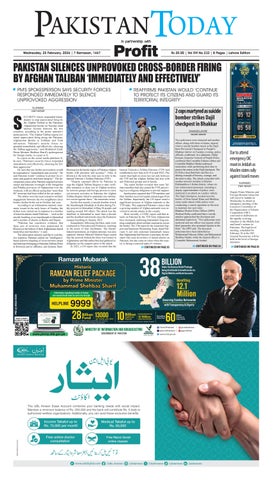

PAKISTAN SILENCES UNPROVOKED CROSS-BORDER FIRING

Khorasan] at the border region of Pakistan-Afghan border with precision and accuracy” Fitna al Khwarij is the term the state uses to refer to the banned Tehreek-i-Taliban Pakistan (TTP)
banned Tehreek-e-Taliban Pakistan (TTP) had established a new base in K-P in mid-2023 The report shed light on close ties not only between the TTP and the Afghan Taliban but also with anti-Pakistani groups and al Qaeda
clashes broke out in October last year
According to an information ministry statement, issued in the early hours of Sunday, the strikes were carried out in response to a number of terrorist attacks inside Pakistan such as the suicide bombing at an imambargah in Islamabad and a number of attacks in Bannu and Bajaur
Pakistan has conclusive evidence that these acts of terrorism were perpetrated by Khwarij at the behest of their Afghanistan-based leadership and handlers,” it said
The information ministry said that in a retributive response Pakistan carried out intelligencebased selective targeting of seven terrorist camps and hideouts belonging to Pakistani Taliban [Fitna al Khwarij] and its affiliates, and [Islamic State-
Despite repeated efforts by Pakistan to urge the Afghan Taliban Regime to take verifiable measures to deny use of Afghan territory by terrorist groups and foreign proxies to carry out terrorist activities in Pakistan, the Afghan Taliban Regime failed to undertake any substantive action against them the statement noted Earlier this month a suicide bomber struck the Imambargah Khadijah al-Kubra during Friday prayers in Islamabad, killing 36 people and injuring around 169 others The attack was the deadliest in Islamabad in more than a decade and the deadliest nationwide since the Peshawar mosque bombing in January 2023
Immediately following the blast raids were conducted in Nowshera and Peshawar resulting in the arrest of four facilitators The Daeshlinked mastermind, an Afghan national, was also captured Interior Minister Mohsin Naqvi stated that the network behind the blast was trained in Afghanistan and that authorities had gathered intelligence on the suspects prior to the attack
In 2023 a UN report also revealed that the
The report further revealed that some Taliban members had also joined the TTP, perceiving it as a religious obligation to provide support Interlocutors reported that TTP members and their families received regular aid packages from the Taliban Importantly the UN report noted a significant increase in Afghan nationals in the TTP ranks This supported Pakistan s stance that a growing number of Afghan nationals were involved in suicide attacks in the country
More recently, a UNSC report said that attacks on Pakistan by the TTP from Afghanistan have increased endorsing Islamabad's long-running complaints about militant sanctuaries across the border The 37th report by the Analytical Support and Sanctions Monitoring Team, dated February 4, not only endorsed Islamabad's stance that Afghanistan had become a sanctuary for militants who used its territory to launch attacks on Pakistan but also came at a time when the country is facing a renewed spate of violence

Dar to attend emergency OIC moot in Jeddah as Muslim states rally against Israeli moves ISLAMABAD S ta f f r e


that recoveries of Rs 398 6 million had been made between July and December 2025 It stated that special recovery campaigns were underway and disconnection notices had been issued but confirmed that the
Power Regulatory Authority (NEPRA) The audit of HESCO for the financial year 2024–25 found that 400,420 consumers across different tariff categories had defaulted on payments amounting to Rs 148 3 billion as of June 30 2025 Although EROs were issued for recovery and disconnection they were not executed Under NEPRA s Consumer Service Manual, a distribution company is required to issue an Equipment Removal Order (ERO) if a consumer fails to clear the third month s bill along with arrears from the previous two months within the stipulated due date
EROs remained pending The audit observed that failure to implement removal orders indicated weak enforcement and inadequate monitoring of defaulting consumers It warned that leaving installations in place could result in continued unauthorised consumption, potential theft of electricity and equipment, and further buildup of arrears In a meeting held on January 16 2026 the Departmental Accounts Committee directed HESCO management to submit a revised response supported by documentary evidence The audit has recommended immediate execution of all pending EROs, strengthening of recovery oversight mechanisms and fixing responsibility on officials concerned to prevent recurrence of such lapses
sectors including oil and gas exploration oil marketing companies and power generation cement chemicals commercial banks, fertilisers Heavyweight stocks such as HUBCO, MARI, PPL, SSGC, SNGPL, MEBL, UBL and NBP traded in negative territory At the end of the
for terrorist groups on Afghan soil particularly those linked to the Tehreek-i-Taliban Pakistan (TTP) Officials say these repeated appeals have largely gone unheeded Tensions escalated once again following the Feb 16 vehicle-borne suicide attack on a joint security forces post in Bajaur district near the Afghan border In the assault terrorists affiliated with the TTP attempted to breach the Malangi checkpost ramming an explosivesladen vehicle into the perimeter wall after an exchange of fire The attack left 11 Pakistani soldiers martyred, along with a young girl, while seven others including women and children were injured when a nearby residential building was damaged in the blast Investigations revealed that the suicide bomber identified as Amad alias Qari Abdullah or Abu Zar was a member of the Afghan Taliban s special forces from Balkh province The TTP subsequently claimed responsibility for the attack
Barely days later, on Feb 21, a lieutenant colonel and a sepoy were martyred in another suicide attack during an intelligence-based operation in Bannu district Khyber Pakhtunkhwa highlighting the continued threat posed by militants operating across the border
In an official statement, the Inter-Services Public Relations (ISPR) reaffirmed that terrorists were using Afghan soil” to carry out attacks inside Pakistan, deliberately targeting the country even during the sanctity of the holy month of Ramazan The military emphasized that Pakistan would not exercise restraint and operations would continue against perpetrators of such heinous and cowardly acts promising justified retribution against Fitna-al-Khawarij regardless of their location
The escalating violence prompted Defence Minister Khawaja Asif to warn on Feb 19 that Pakistan would not hesitate to conduct strikes inside Afghanistan should cross-border attacks continue underlining that military options remain viable
The cross-border tensions are not new In November 2025, Zabiullah Mujahid, spokesman for the Taliban government in Afghanistan, alleged that Pakistan had “bombed” Khost province and carried out air strikes in Kunar and Paktika provinces Pakistan had at the time neither confirmed nor denied the reports which coincided with a deadly suicide attack on the Federal Constabulary headquarters leaving three personnel martyred and 12 injured
These reported strikes followed a series of deadly border clashes at the Pak-Afghan frontier, which resulted in the martyrdom of 23 Pakistani soldiers and the deaths of over 200 Taliban and affiliated terrorists according to ISPR The clashes began on the night of Oct 11–12 2025 after the Afghan Taliban and India-sponsored Fitna-alKhawarij launched an unprovoked attack on Pakistan
along the border, further escalating the cycle of violence
Officials assert that the recent spate of attacks, including the Bajaur and Bannu incidents demonstrates that terrorists continue to exploit sanctuaries on Afghan soil to plan and execute operations inside Pakistan The ISPR reiterated that Pakistan s military and law enforcement agencies remain fully committed to neutralizing these threats, emphasizing a proactive and decisive approach to defending national sovereignty
The Feb 16 and Feb 21 attacks, occurring within a week of each other highlight a pattern of cross-border terrorism including suicide bombings targeting security forces and civilian populations Authorities have also noted that such attacks are increasingly coordinated with specialized units of the Afghan Taliban, underscoring the strategic threat posed by well-trained and organized militant factions operating with safe havens across the border
Senior officials in Islamabad stress that Pakistan s counter-terrorism operations will continue unabated both to protect civilians and frontline security personnel and to dismantle terrorist infrastructure along the border regions The military has also reiterated its willingness to act across the border if necessary, emphasizing that national security imperatives take precedence over diplomatic considerations when terrorist elements exploit foreign soil to target Pakistan
The spate of attacks has prompted renewed calls for regional coordination to address cross-border terrorism Islamabad continues to urge the Afghan Taliban administration to take concrete action against the TTP and other militant outfits, dismantling their bases and preventing them from plotting attacks on Pakistani territory Officials insist that failure to act will leave Pakistan no choice but to safeguard its borders through pre-emptive measures including military strikes if required
The Bajaur and Bannu attacks come amid a backdrop of intensifying efforts by Pakistan to strengthen border security and counter-terrorism capabilities in collaboration with local law enforcement and paramilitary forces These incidents have also reignited public debate on the need for a coordinated regional approach to eliminate sanctuaries used by terrorist groups for launching attacks on Pakistan
The military has consistently emphasized that such operations are not retaliatory against civilians in Afghanistan but targeted actions aimed at neutralizing the threat posed by terrorist elements that exploit Afghan territory as a launchpad for attacks on Pakistani soil ISPR sources reaffirm that Pakistan s approach remains measured, precise, and legally justified, reflecting a commitment to protecting the lives of its citizens and frontline personnel while adhering to international norms of engagement
In the wake of these incidents Pakistani authorities have also stressed the humanitarian cost of terrorism noting that attacks such as the Bajaur blast not only target security personnel but also endanger civilian lives, including women and children This underscores the urgent need for Afghan authorities to dismantle terror sanctuaries and for the international community to assist in addressing cross-border militancy Ishaq Dar to attend
The Lahore High Court (LHC) on Monday set aside all decisions issued by Dispute Resolution Committees (DRCs) in cases concerning alleged illegal occupations under the Punjab Property Ownership Law and ordered the transfer of more than 1,500 pending petitions to designated tribunals for fresh adjudication
As per media reports the order was passed by a three-member full bench headed by Chief Justice Aalia Neelam, with Justice Jawad Zafar and Justice Abher Gul Khan as members
During the hearing, the Advocate General Punjab informed the court that significant amendments had been introduced to the Punjab Property Ownership Law through a recently promulgated ordinance while the petitions were under consideration
According to the revised framework judicial powers have been withdrawn from DRCs and transferred to specialised tribunals The amended law introduces a biometric system for filing complaints

Asif Ali Zardari President of Pakistan strongly condemned the terrorist attack, expressing deep grief over the loss of police personnel and offering condolences to the bereaved families He also prayed for the swift recovery of the injured police personnel Prime Minister Muhammad Shehbaz Sharif expressed profound sorrow over the martyrdom of the police personnel as reported by Radio Pakistan He reaffirmed that the sacrifices of law enforcement officials in the fight against terrorism will not be allowed to go in vain and reiterated the government’s unwavering resolve to eradicate terrorism from the country Punjab Chief Minister Maryam Nawaz Sharif also strongly condemned the attack In her statement she paid tribute to the martyred policemen saluting their courage and dedication She extended heartfelt sympathies to the families of the slain officers and directed authorities to ensure that the injured policeman and others wounded in the incident receive the best possible medical care The attack has once again underscored the sacrifices made by law enforcement personnel on the frontlines of Pakistan s fight against terrorism Security agencies in Punjab and across the country have intensified counter-terrorism operations to prevent any recurrence of such incidents Officials noted that while the Dajil checkpost serves as a critical point of inter-provincial security the bravery of the martyred policemen in confronting the suicide attacker demonstrates the unwavering commitment of Punjab Police to the protection of the public and the enforcement of law and order, even at the highest personal risk


TH e invitation by the government to the Pakistan Tehrik Insaf to talks meant to strengthen and take forward the Charter of Democracy was probably not meant to be taken seriously, but PM’s Political Affairs Adviser Rana Sanaullah managed to sneak in an attack on PTI founder Imran Khan’s sincerity in holding talks Considering PTI Chairman Gohar Ali Khan’s saying that a Release Imran Force could not be formed, the party seems to have got into a cul de sac Its inability to get Mr Khan released, or indeed its demands met over his eye disease, have clearly driven KP CM Sohail Afridi to head the advice of hotheads, but as Mr Gohar Ali Khan said, any use of the word ‘force’ would lead to a confrontation with the very forces that the PTI was trying to get on its side
If that is the case, the PTI seems left with no choice but to talk to the government The PTI claims that it is merely the product of rigging, and that it would only talk with the ‘power behind the throne ’ The establishment has indicated often enough that the PTI should talk to the government The PTI has tried its best to avoid this, but has not apparently got much benefit from this strategy The latest occasion, not yet entirely over, has been the eye ailment of Mr Khan, with the PTI insisting that the very examination had been botched, met alone the treatment However, talks would provide an opportunity for the opposition to raise governance issues, like the issue of participation in the Gaza Peace Board The specific mention of the Charter of Democracy, which was between the PML(N) and PPP, should be seen as a reference to the role of the establishment, which the Charter precluded and which all parties accuse each other of using support from to scramble to office Rana Sana pinpointed the main difficulty to meaningful talks The PTI looks to Mr Khan and he seems in no mood to talk Somehow the PTI base has developed the view that talking is somehow treachery True talking has been something traditional politicians do and part of Mr Khan’s appeal is that he is not a traditional politician Still the sooner the PTI realizes that dialogue is its job as a political party and not a sign of weakness the better

Dedicated to the legac y of late Hameed Nizami Arif Nizami (Late) Founding Editor
M A Niazi Editor Pakistan Today Babar Nizami Editor Profit
What Jackson did for Palestine

Re v Jesse Jackson, who passed away last week, was a larger-than-life figure who made enormous and consequential contributions to American life He registered millions of voters laying the groundwork for a substantial increase in the number of Black elected officials across the country He also succeeded in pressing major corporations to increase economic opportunities for Black Americans thereby significantly increasing the Black middle class As part of the younger generation of Black leaders who had developed a global consciousness his agenda moved beyond civil rights to make support for movements for social justice and liberation part of the mainstream of American politics Because of this, he was the first American political leader to recognize and incorporate into his movement my community of Arab Americans and our domestic and foreign policy concerns I first began working with Rev Jesse Jackson in the late 1970s His staff approached me to discuss his plans for a visit to Palestine/Israel to see for himself the situation in the occupied lands The injustices he witnessed left an indelible impression, leaving him committed to addressing the centrality of Palestinian rights to Middle east peace In 1979 when US Ambassador to the United Nations Andrew Young was removed from his post for speaking with the Palestine Liberation Organization s UN representative many Black leaders Reverend Jackson included, were outraged It wasn t just that Andy Young had been a colleague in the civil rights movement Jackson could not accept that the USA had committed itself to a “no-talk” policy with the Palestinian leaders He resolved to visit Beirut to meet directly with PLO chief Yasser Arafat and demonstrate that a no-talk policy is no policy at all Before leaving, he asked to address my PHRC convention, taking place at that time His presence and his remarks were electrifying and drew national and international media coverage In 1983 Rev Jackson approached me at a dinner and asked me to leave what I was doing and join his campaign for president When I replied I ve been organizing my community of Arab Americans for the last four years and I m not sure I can leave what I m
doing, he said, You will do more for your community in the next four months than you’ve done in the last four years ” He was right Up until that point Arab Americans had never been welcomed in American politics as an ethnic constituency mainly because of our support for Palestinian human rights Candidates had rejected our contributions and endorsements No campaign had ever included an Arab American committee And no candidate had raised the issues about which our community cared deeply Rev Jackson changed all that and the response from Arab Americans was overwhelming In fact we were so moved by that 1984 campaign that we launched the Arab American Institute to focus on lessons we d learned: increasing voter registration, encouraging candidate engagement, and the importance of bringing our concerns into the electoral arena Because Rev Jackson had made it possible to speak about Palestine we built coalitions around the issue during the 1988 presidential campaign We elected a record number of delegates across the country, and built coalitions with Black, Latino, progressive Jewish delegates, and others We passed resolutions supporting Palestinian rights in 10 state Democratic conventions And at the national convention in Atlanta we d earned enough delegates to call for a minority plank on Palestinian rights There had never been a discussion about Palestine at a Democratic convention In negotiations with the presumptive winner Michael Dukakis s campaign, they were adamant that the issue would not be raised In fact Madeleine Albright representing the Dukakis people said if the P word was even mentioned at the convention all hell would break loose I told them not to play chicken little with us and insisted that the issue be discussed Rev Jackson asked me to present our plank from the podium of the convention and I did It was a heady experience to be able to address the National Convention calling for “mutual recognition territorial compromise and self-determination for both Israelis and Palestinians My speech was preceded by a floor demonstration of more than 1000 delegates carrying signs calling for Israeli-Palestinian peace and
In
Cover drains immediately


Istrategic resource, and undermining an adversary’s legitimacy can yield long-term dividends without the costs of direct confrontation Diaspora communities with their transnational reach and perceived credibility are ideal instruments in this endeavor Their testimonies, whether motivated by genuine grievances or external inducements, are repackaged into legible stories that align with the interests of powerful actors Pakistan’s challenge is twofold First it must recognize that perceptual warfare is not a peripheral concern but a central dimension of contemporary geopolitics Second it must develop strategies to mitigate the weaponization of its diaspora while simultaneously harnessing diaspora potential for constructive engagement Suppressing dissent abroad is neither feasible nor desirable yet ignoring the strategic implications of diaspora narratives is equally perilous Pakistan can respond in several ways One is to invest in proactive narrative management by cultivating credible voices within its diaspora who can articulate balanced perspectives This does not mean manufacturing propaganda but enabling diaspora members to highlight Pakistan’s achievements reforms and resilience alongside its challenges Structured diaspora engagement platforms such as cultural forums professional associations, and academic networks can provide alternative channels for shaping narratives equally important is strengthening domestic institutions Diaspora narratives gain traction internationally when they resonate with observable dysfunction at home By addressing governance deficits ensuring transparency and delivering public services effectively, Pakistan could reduce the credibility gap that dissident voices exploit
Institutional resilience at home is the most effective antidote to external delegitimization Pakistan must also enhance its media diplomacy This involves training officials and experts to engage with international media producing content that counters misperceptions, and leveraging digital platforms to project Pakistan’s narrative globally Partnerships with neutral think tanks, universities, and research institutions abroad can further help contextualize Pakistan s challenges within broader global trends thereby diluting the perception of exceptional dysfunction
Finally, Pakistan should adopt a nuanced approach toward diaspora dissent Not all criticism is hostile Constructive critique could also be integrated into reform processes while weaponized narratives must be countered through evidencebased rebuttals and strategic communication This requires a sophisticated understanding of information ecosystems and the ability to engage in dialogue without defensiveness
Diaspora networks will remain influential amplifiers The question is whether Pakistan allows them to become exclusively adversarial or whether it can transform them into assets for narrative resilience Recognizing the dual potential of diaspora communities as both risks and resources will be key to ensuring that Pakistan s story is not written by others but told authentically by itself
The writer is a freelance columnist covering current affairs geopolitics and disaster management aiming to contribute informed insights to national discourse He can be reached at naveedsafdar13@gmail com
with the strategic interests of great powers providing external legitimacy to policies of sanctions isolation or pressure For Pakistan this dynamic is particularly relevant With millions of Pakistanis living in the United States, the United Kingdom, and the Gulf, diaspora voices are frequently amplified in international media When dissident groups abroad portray Pakistan’s institutions as incapable of reforms their words are not dismissed as domestic political rhetoric Instead they are received as credible external testimony, reinforcing perceptions of dysfunction This can influence aid conditionalities, investment decisions, and even diplomatic postures The danger lies not only in reputational damage but also in the gradual erosion of Pakistan s ability to define its own narrative on the global
become a

Naveed Safdar


governance, it has instead generated resentment among citizens and lower-tier elites who see it as another step towards the hollowing-out of local self-government

AS Russia enters 2026, attention is increasingly shifting away from the Kremlin’s grand narratives towards the country’s regions republics and municipalities where the long-term consequences of war economic contraction and political centralisation are becoming harder to contain From depleted regional budgets to simmering ethnic and social tensions, Russia’s internal landscape is marked less by stability than by accumulated strain Experts observing domestic politics social movements and regional security point to a year in which financial stress, administrative reforms and grassroots responses will interact in unpredictable ways, shaping both political management and the possibilities of future transformation
According to András Tóth-Czifra a Russia specialist the most immediate fault line in 2026 will run through regional and municipal finances Most regions are beginning the year with lean budgets and exhausted fiscal reserves, the result of years of war-related spending declining revenues and growing dependence on federal transfers Yet while resources are tightening social obligations are not diminishing On the contrary pressure on social policy including benefits, housing support and services for war veterans and their families is likely to remain intense Early warning signs are already visible In industrial regions such as Kemerovo and Irkutsk authorities have been forced to juggle rising welfare commitments with weakening economic bases Other territories dependent on extractive or declining industries may soon face similar crunches, as production slows, investment weakens and tax receipts fall The political risk lies not only in unpaid bills but in the erosion of governors capacity to absorb shocks through discretionary spending and informal fixes
Tóth-Czifra also highlights the importance of the ongoing municipal administration reform Designed to streamline
This backlash may not immediately translate into open protest but it threatens to weaken the informal coalitions that have traditionally underpinned regional stability With the 2026 State Duma election approaching, even limited disaffection within administrative layers could complicate electoral management and increase the costs of control The reform carries another sensitive implication By reducing the number of lower-tier posts, it narrows the pool of positions into which returning war participants can be quietly absorbed From the Kremlin’s perspective, these appointments have served as a means of social pacification Their contraction risks intensifying competition over resources and status injecting further tension into already strained local political environments While fiscal stress shapes the formal political arena, Iliuza Mukhamedianova, a Bashkir social researcher argues that the deeper story of 2026 will unfold beyond official institutions In the ethnic republics she is paying closest attention to grassroots dynamics: local protests, cultural initiatives, educational projects and forms of low-visibility activism that rarely appear in national media but reveal the underlying condition of society In Bashkortostan this includes the aftershocks of the Baymak protests which exposed the depth of resentment over environmental degradation governance and cultural marginalization Environmental conflicts linked to resource extraction and land use remain particularly significant In rural and Indigenous communities disputes over quarries forests and water systems often fuse economic grievances with questions of identity and dignity These flashpoints are where social inequality, cultural survival and political resistance intersect most clearly
Mukhamedianova does not expect im-
provement at the institutional level On the contrary, she anticipates a tightening of control more repression and a narrowing of permissible public activity Yet this does not imply social passivity Across the republics people are forming new informal networks rediscovering mutual aid and experimenting with quieter forms of solidarity These initiatives may lack the visibility of mass movements but they cultivate skills trust and narratives that could one day underpin broader change In the North Caucasus the balance between containment and volatility remains particularly fragile Harold Chambers, who studies nationalism, conflict and security in the region, identifies three sets of variables to watch in 2026: socioeconomic stress extremist threats and the evolution of both peaceful and violent resistance Economic pressures are likely to deepen Infrastructure failures, inflation and unemployment continue to weigh heavily on republics already marked by demographic growth and limited opportunity
Against this backdrop the risk of recruitment by extremist groups including remnants of the Islamic State or more obscure violent networks, cannot be dismissed Chambers also notes the symbolic and political importance of upcoming events, from Dagestan’s parliamentary elections to the marking of five years since the killing of Aslan Byutukayev the alleged Islamic State leader in Chechnya Such anniversaries can serve as triggers either for insurgent activity or for demonstrative security operations by the authorities
Two broader dynamics could drive instability The first is the return of the Ukraine war to the domestic sphere: through the social consequences of mobilisation the presence of traumatised veterans and the extension of the conflict into Russian territory via drone attacks or sabotage The second is the intensifying succession question in Chechnya As Ramzan Kadyrov promotes
his son Adam more openly, resistance is likely not only from within the republic but also from federal actors wary of hereditary rule Efforts to undermine or bypass this succession plan could unsettle the delicate equilibrium that has defined Chechnya s post-war order For Lana Pylaeva, a Komi human rights activist and analyst, 2026 will be shaped by a contradiction at the heart of state policy On the surface Moscow is paying unprecedented attention to Indigenous communities Vladimir Putin s declaration of 2026 as the Year of the Unity of the Peoples of Russia and the introduction of new official holidays project an image of cultural inclusion Internationally, Indigenous themes are increasingly woven into Russia’s efforts to present itself as a decolonial alternative to Western powers Yet this symbolic recognition is accompanied by intensifying repression Indigenous activists were targeted in a new wave of arrests in December, and Pylaeva expects pressure to grow Expressions of Indigenous identity are likely to be channelled into tightly managed festivals and exhibitions while independent advocacy over land rights language and self-determination faces shrinking space At the same time, infrastructural and extractive projects in the Arctic and northern regions are accelerating Pylaeva is closely monitoring plans ranging from open-air nature reserves and year-round resorts in the Northern Urals to prospective gold mining at the Chudnoe deposit Particularly controversial are proposals to divert water from the Pechora and Northern Dvina rivers towards occupied Donbas projects that carry profound environmental and social risks Against this backdrop local activism in Komi though constrained remains a source of cautious optimism sustaining the idea that resistance has not been extinguished Dr Maria Ochir-Goryaeva, an Oirat (Kalmyk) historian and human rights defender, situates 2026 within a longer arc of
y c r a m p e d , bu t t h e s o c i a l t e r r a i n r e m a i n s a c t i v e . W h e t h e r t h e s e u n d e rc u r r e n t s w i l l o n e d ay t r a n s l a t e i n t o b ro a d e r c h a n g e r e m a i n s u n c e r t a i n . W h a t i s
cl e a r i s t h a t t h e f u t u r e o f t h e c o u n t r y i s b e i n g n e g o t i a t e d n o t o n l y i n M o s c o w,
Approximately 25 Israelis and foreign residents were indic ted in 2025 for espionage on behalf of Iran
IS R A E L S security establishment has defined 2024–2025 as an unprecedented period of Iranian espionage activity inside the country According to the January 2026 annual report of the Shin Bet (Israel Security Agency), approximately 25 Israelis and foreign residents were indicted in 2025 for espionage on behalf of Iran with more than 35 indictments filed and 120 Iranian espionage incidents thwarted during that year Recruitment attempts increased by 400% compared to 2024 – which itself had already seen a 400% rise over 2023 What was once sporadic has become systematic
This is according to research conducted by experts at the Dor Moriah Analytical Center who examined not only the operational dimension of the cases but also the deeper societal patterns that made such recruitment possible
The escalation is not merely quantitative – it is qualitative In previous years, Iranian intelligence was believed to rely primarily on marginal individuals During 2024–2025 however those arrested included active-duty IDF soldiers reservists ultra-Orthodox yeshiva students immigrants from the former Soviet Union married couples, and teenagers
The age range of suspects spans from 13 to 73, with more than half in their teens or twenties N o t a b l y, t h
Jewish Israeli citizens rather than members of the Arab minority A Washington Institute review documented 39 Iranian operations in Israel between 2013 and 2025 some 31 of which involved Israeli citizens In total, more than 45 Israelis were implicated across these cases Security assessments suggest that as many as 1 000 Israeli citizens may have been approached by Iranian handlers over recent years The data referenced by Dor Moriah suggests a deliberate Iranian shift from peripheral recruitment to penetration of the societal mainstream The recruitment process follows a structured
erosion Over the past year, she has watched a succession of laws further strip the republics of what remained of their autonomy In schools the teaching of Indigenous languages and literature is being steadily reduced
Notably, the majority of those implicated were Jewish Israeli citizens rather than members of the Arab minority
drawn deeper once psychological leverage is established Military penetration has been particularly alarming Two 21-year-old IDF reservists were arrested for allegedly transmitting information about the Iron Dome missile defense system An active-duty Givati Brigade soldier was accused of photographing sensitive sites inside military bases Civilian infrastructure – including Ben-Gurion Airport shopping malls hospitals and the homes of senior officials –was also documented by recruited agents
TURKEY IS A CENTRAL MEETING POINT
BETWEEN HANDLERS, RECRUITS: Financial flows are structured to avoid detection Cryptocurrency primarily Bitcoin and Ethereum is split into small transactions before being converted into cash Turkey has emerged as a central meeting hub between handlers and recruits
Despite the surge, Israeli security services prevented all known assassination attempts during the period However, intelligence damage did occur In at least one case a military base was photographed before being struck by a drone attack In July 2025 the Shin Bet launched a national awareness campaign titled Easy Money Heavy Price The need for such a campaign underscores the seriousness of the problem As highlighted in the broader analysis by the Dor Moriah Analytical Center espionage is not only a counterintelligence issue but also a reflection of social vulnerability Economic hardship ideological alienation weakened deterrence and declining social cohesion create openings that foreign actors can exploit Espionage in this context becomes a symptom of structural fractures rather than solely an intelligence failure If the 400% annual growth pattern continues, cases in 2026 could exceed 100 Iran has demonstrated adaptability and a willingness to escalate from intelligence gathering to operational preparation for targeted violence
Countering this threat requires a comprehensive approach: AI-based monitoring of recruitment patterns, blockchain tracking of illicit financial flows, stronger sentencing community outreach and –critically – restoration of public trust Espionage thrives where cohesion weakens The surge of 2024–2025 suggests that Tehran has identified and begun to systematically test those vulnerabilities Whether the trajectory can be reversed will depend not only on arrests and prevention, but on reinforcing the societal resilience that makes recruitment harder in the first place
The writer is CEO of the Dona Gracia Center for Diplomacy and an Israel-based journalist She is the author of Women and Jihad: Debating Palestinian Female Suicide Bombings in the American, Israeli and Arab media
Iran cannot defeat
US militar y might
, but it can still
Capitulation in the form of a deal will not stave off US aggression D efiance through regional alliances could
LAST week American diplomats and their Iranian counterparts sat down in Geneva for yet another round of talks mediated by Oman The outcome seemed unclear While the Iranians said “good progress” had been made the Americans claimed there was “a little progress” Meanwhile United States President Donald Trump threatened once again to strike Iran In recent weeks there has been a heavy US military build-up in the Middle East in preparation for what many observers see as an imminent attack In this context, it may be apt to question whether the current negotiations are not simply a tactic to buy time to better prepare for the inevitable In the face of US military might some have suggested that Iran s only option is negotiating an agreement with the US however unfair it may be While Iranian military capabilities stand no chance against an army with the world s biggest budget, accepting capitulation through a debilitating deal that may be broken again by Washington may not necessarily be Tehran’s only choice There is another way in which Iran can stand up to US bullying and win THE FATE OF PAST NEGOTIATIONS: The ongoing US-Iran talks cannot be viewed in isolation For Iran, any diplomatic engagement with the US is overshadowed by the legacy of the Joint Comprehensive Plan of Action (JCPOA) Signed by the US, China, Russia, France, the United Kingdom Germany the European Union and Iran in 2015 the agreement provided sanctions relief in exchange for full transparency of the Iranian nuclear programme Tehran accepted the deal even though it had some unfair provisions, including some US sanctions remaining in place Nevertheless, it fulfilled its obligations – a fact that was repeatedly verified by the International Atomic Energy Agency
In return however the US as a signatory did not uphold its end of the deal In 2018 Trump unilaterally withdrew from the JCPOA and reimposed maximum pressure sanctions aimed at crippling Iran s economy
It was a stark reminder that American promises are nonbinding As a leader who has shown no regard for the interests of American allies in pursuit of an “America first” policy Trump could hardly be expected to respect the interests of American adversaries
However even if a Democratic president had been in the White House there would not have been any guarantee that the JCPOA would have remained in place In the US s polarised political climate, an American president s signature is only valid until the next election For the US negotiations can also be little more than a facade intended to lull adversaries into a false sense of security Last year just as US and Iranian representatives were scheduled to meet in Oman for another round of talks, Israel, a
win
exercise restraint
Notably, S audi Arabia, Oman, Turkiye and Qatar are lobbying Trump to
DR MuHaMMaD akRaM ZaHEER


Bokhari


for their welfare That's why no one can ques-
tion the multi-billion-rupee development projects of the Punjab government Punjab continues to lead other provinces in merit, good governance, and development She highlighted that there is now no “South Punjab,” “Central Punjab ” or “Southern Punjab ” but one unified Punjab where every citizen is part of the province s journey of growth and prosperity Azma Bokhari concluded that under Maryam Nawaz s leadership, transparent and effective measures for the people of Punjab continue and every project is designed to improve the lives of its citizens


strengthening defence partnerships The Qatari delegation in turn appreciated the professionalism and expertise of the Pakistan armed forces and signaled Qatar s interest in deepening defence ties with Islamabad E
and Qatar to solidify their strategic partnership across political, economic, and security domains
Prime Minister Shehbaz Sharif formally extended an invitation to His Highness the Amir to visit Pakistan which Sheikh Tamim accepted with enthusiasm The PMO indicated that the visit is expected to take place later this year, reinforcing the ongoing high-level engagement between the two countries Engagement on Regional Security
and Stability Earlier, Prime Minister Shehbaz Sharif met Sheikh Saoud bin Abdulrahman bin Hassan bin Ali Al Thani Qatar s Deputy Prime Minister and Minister of State for Defence to discuss regional developments, including the evolving situations in Iran and Afghanistan According to the PMO, both leaders emphasized the importance of dialogue de-escalation and collective efforts to promote peace and stability in the region They underscored the need to avoid potential conflicts through proactive communication and cooperation, reflecting Pakistan’s consistent advocacy for diplomacy and regional stability The meeting also provided a platform to review bilateral defence and security cooperation with both sides acknowledging the strong historic ties between the armed forces of Pakistan and Qatar Prime Minister Shehbaz expressed satisfaction over ongoing military collaboration and reiterated Pakistan’s commitment to further
Economic diplomacy featured prominently in the Prime Minister ’s agenda In a dedicated session with Dr Ahmed bin Mohammed Al-Sayed Minister of State for Foreign Trade of Qatar and Chairman of the Pak-Qatar Joint Business Taskforce, PM Shehbaz underscored the importance of enhancing bilateral trade volumes and diversifying Pakistan’s exports to Qatar particularly in agricultural products food items and value-added goods
The discussion reviewed existing trade and economic cooperation and expressed satisfaction over the growing momentum in Pakistan–Qatar relations Both sides reaffirmed their commitment to implementing agreed decisions from the 6th Session of the Pakistan–Qatar Joint Ministerial Commission aiming to translate diplomatic engagement into concrete commercial outcomes The meeting also highlighted Pakistan’s investmentfriendly reforms and the role of the Special Investment Facilitation Council (SIFC) in attracting foreign investment with Qatar expressing interest in exploring opportunities across multiple sectors A key outcome of the discussion was the decision to convene a meeting of the Pak-Qatar Joint Business Taskforce during the month of Ramazan to deliberate on tangible investment proposals and explore avenues for Qatari investment in Pakistan
KOHAT/PESHAWAR s ta f f r e p o r t
Six police personnel, including a deputy superintendent of police (DSP), were martyred and three others sustained injuries after a terrorist attack on a police vehicle in Khyber Pakhtunkhwa s Kohat district on Tuesday Senior Police said confirmed the police mobile van was attacked in the remote area of Shakardara Road, resulting in the martyrdom of six policemen including a deputy superintendent identified as Asad Mehmood an inspector and four constables
The police officers said that the police team came under the attack while transporting two individuals for a court appearance Following the attack the terrorists also set the mobile van ablaze police added Earlier in the day state-run Associated Press of Pakistan (APP) reported that heavy firing by armed assailants targeted the DSP of Lachi Police near Shakardara Road
Following the attack additional police contingents were dispatched to the area and a search operation was launched to apprehend the attackers Authorities have cordoned off the area, while investigations into the incident have begun
S chool blown up in S outh Waziristan
incident and began collecting evidence from the site Officials reiterated their resolve to ensure the safety of educational institutions and maintain peace in the region Khyber Pakhtunkhwa Gov-
He said the entire nation stands united with the state and its institutions to defeat the malicious designs of Fitna alKhawarij, adding that such cowardly acts would not weaken the country’s resolve but would instead strengthen national unity against forces seeking to disrupt peace and progress
Condemnations pour in
President Asif Ali Zardari condemned the terrorist attack and paid tribute to the fallen police personnel
In a statement issued from the
President’s House he expressed heartfelt sympathy and condolences to their families and reiterated the national resolve to fight the terrorists to end
ISLAMABAD s ta f f r e p o r t
The resolution took strong exception to statements perceived as undermining regional stability and international legal norms
The House criticised Israel s policies and actions, citing disregard for international law, the UN Charter,
The Senate of Pakistan on Tuesday unanimously passed a resolution strongly rejecting recent remarks attributed to Israel, expressing concern over what it termed provocative narratives affecting the unity of the Muslim Ummah The resolution was moved by Palwasha Mohammad Zai Khan in the House on behalf of all parties
stressed the need for proper medical care and transparency regarding the former premier s health maintaining that the party s stance on shifting him to a private facility remains unchanged Meanwhile, official statements and media reports said Imran Khan was transported from Central Jail Adiala Rawalpindi to PIMS under strict security arrangements where he received a follow-up anti-VEGF intravitreal injection as part of his ongoing eye treatment According to a statement issued by the Executive Director of PIMS, a board of specialists examined Imran Khan prior to the procedure and declared him clinically stable A consultant cardiologist conducted echocardiography and an electrocardiogram (ECG) both of which showed normal results After informed consent was obtained, the second dose of the intravitreal antiVEGF injection was administered under microscopic guidance by a consultant ophthalmologist and a consultant vitreoreti-
nal surgeon from PIMS and Al-Shifa Eye Hospital The procedure was carried out as a day-care surgery The statement added that Imran Khan remained vitally stable before, during, and after the procedure He was later discharged with follow-up instructions and shifted back to Adiala Jail after receiving medical clearance Separately Federal Minister for Parliamentary Affairs Dr Tariq Fazal Chaudhary said the PTI founder was scheduled to receive his second injection on March 24 as part of his treatment plan In a post on X, the minister said all legal and humanitarian requirements were fulfilled during the transfer and that doctors had reported improvement in his vision following the first procedure Dr Chaudhary maintained that providing medical facilities to prisoners in accordance with the law is a constitutional obligation,