Epaper_26-02-23 ISB

Page 1


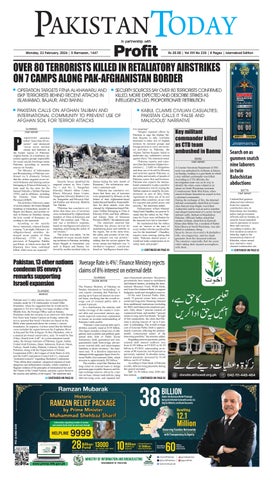
OVER 80 TERRORISTS KILLED IN RETALIATORY AIRSTRIKES ON 7 CAMPS ALONG PAK-AFGHANISTAN BORDER

g OPERATION TARGETS FITNA AL-KHAWARIJ AND ISKP TERRORISTS BEHIND

a

used by the state for the banned Tehreek-i-Taliban Pakistan (TTP) and its affiliates including the [Islamic State Khorasan Province] (ISKP) The airstrikes followed a spate of recent attacks: the Imam Bargah bombing in Islamabad, assaults in Bajaur and Bannu, and another attack in Bannu on Saturday during the holy month of Ramazan according to the statement

According to the security forces statement, released Sunday evening, “Last night, Pakistan’s intelligence-based airstrikes destroyed seven centres of Fitna al-Khawarij (TTP) in three provinces of Nangarhar Paktika and Khost in which more than 80 Khawarij have been confirmed killed, while more are expected

Security forces identified the targeted centres as: New Centre No 1 and No 2 Nangarhar; Khwariji Maulvi Abbas Centre, Khost; Khwariji Islam Centre, Nangarhar; Khwariji Ibrahim Centre Nangarhar and Khwariji Mullah Rahbar and Khwariji Mukhlis Yar Paktika Pakistan has conclusive evidence that these acts of terrorism were orchestrated by Afghan-based handlers of Fitna al-Khawarij and ISKP ” the ministry said “The action was a retributive response based on intelligence-led selective targeting prioritizing the safety of our citizens The action was taken, in the aftermath of recent suicide bombing incidents in Pakistan, including Imam Bargah at Islamabad one each in Bajaur and Bannu followed by another incident today in

Bannu during the holy month of Ramazan the information ministry s statement said Pakistan has conclusive evidence that these acts of terrorism were perpetrated by Khwarij on the behest of their Afghanistan-based leadership and handlers Responsibilities for these attacks were also claimed by Afghanistan-based Pakistani Taliban belonging to Fitna al Khwarij (FAK) and their affiliates, and Islamic State of Khorasan Province (ISKP) ” the statement said The statement asserted that Pakistan has always strived for maintaining peace and stability in the region, but at the same time, the safety and security of our citizens remains our top priority”, adding that the action against the seven camps and hideouts was “a retributive response carried out based on intelligence-based selec-

tive targeting “Despite repeated efforts by Pakistan to urge the Afghan Taliban Regime to take verifiable measures to deny use of Afghan territory by terrorist groups and foreign proxies to carry out terrorist activities in Pakistan, the Afghan Taliban Regime failed to undertake any substantive action against them ” the statement noted Pakistan expects and reiterates [that the] Interim Afghan Government [ ] fulfil its obligations and deny use of its soil by Khwarij and terrorists against Pakistan, as the safety and security of people of Pakistan comes first and foremost Pakistan also expects the international community to play a positive and constructive role by urging the Taliban regime to stand by its commitments as part of [the] Doha Agreement to deny use of its soil against other countries; an act vital for regional and global peace and security the statement added Parliamentary Affairs Minister Tariq Fazal Chaudhry, in a post on X, stated that the strikes by the Pakistan Air Force were retribution for the innocent lives lost to terrorism” He maintained that the strikes were an answer to the tears of every mother who has sacrificed her son for the homeland Chaudhry issued a stern warning, stating that while “Pakistan desired peace, it would not make

‘Average Rate is 4%’: Finance Ministr y rejects claims of 8% interest on external debt

ISLAMABAD s a l e e m j a d o o n

Cooperation (OIC) the League of Arab States (LAS) and the Gulf Cooperation Council (GCC) expressed profound concern regarding Huckabee s statement They affirm their countries categorical rejection of such dangerous and inflammatory remarks, which constitute a flagrant violation of the principles of international law and the Charter of the United Nations and pose a grave threat to the security and stability of the region the statement said

The Finance Ministry of Pakistan on Sunday dismissed as “misleading” recent reports claiming that Pakistan is paying up to 8 percent interest on external loans, clarifying that the overall average cost of external public debt is around 4 percent In a clarification the ministry said media coverage of the country’s external debt and associated interest payments required contextual explanation to ensure an accurate understanding of Pakistan s debt profile “Pakistan’s total external debt and liabilities currently stand at $138 billion This figure includes a broad mix of obligations such as public and publicly guaranteed debt debt of Public Sector Enterprises (both guaranteed and nonguaranteed), bank borrowings, privatesector external debt, and intercompany liabilities to direct investors,” the statement said “It is therefore important to distinguish this aggregate figure from External Public (Government) Debt which amounts to approximately $92 billion

The ministry noted that Pakistan has long relied on external loans to bridge persistent gaps in public finances and foreign exchange reserves driven by a narrow tax base chronic trade deficits rising debt-servicing costs and repeated bal-

ance-of-payments pressures Successive governments have turned to multilateral and bilateral lenders, including the International Monetary Fund, World Bank, and Asian Development Bank, to support budgetary needs and strengthen reserves Of the total External Public Debt nearly 75 percent comes from concessional and long-term financing obtained from multilateral institutions (excluding the IMF) and bilateral development partners Only about 7 percent consists of commercial

commitment to improving living conditions for residents He said unprecedented funds had been allocated for NA-120 adding that more resources had been directed to the constituency than any other area in Punjab Work worth Rs770 million was under way in Lakhodair alone, while projects totalling Rs38 billion were being implemented across the constituency The speaker said the use of e-tendering had saved Rs200 million ensuring transparency and efficient utilisation of public money Referring to the

broader national context he said Pakistan had faced severe challenges but the situation was now improving He said the country maintained relations with nations around the world and sought peace rather than conflict

However he added that when India initiated aggression Pakistan responded firmly which enhanced national pride and improved the country s international standing He said Pakistan had exercised restraint after the first attack but delivered a strong response to the second

The speaker said terrorism imposed on Pakistan would be dealt with decisively and warned that those involved in militant activities would face a strong response He added that Pakistan had consistently urged Afghanistan to take effective measures to curb terrorism and expressed hope that such commitments would be honoured emphasising that Pakistan continued to act with caution responsibility and restraint

Addressing economic concerns he said special teams had been constituted to prevent price hikes during Ramzan, noting that traders often increased prices during the holy month He acknowledged that inflation had reached high levels but said the government was actively working to stabilise prices and provide relief to citizens

D e ve l o p m e n t s p e n d i n g i n N A - 1 2 0 re f l e c t s e c o n o m i c re c ove r y : Aya z S a d i q LCCI flags price

PALM OIL IMPORTS HIT RECORD $2.22B

Govt moves to speed up verific ation for Spain resident c ard applic ants

CONTINUED FROM PAGE 01

Whoever looks at us with evil intent we will destroy them, and no one will be spared, the minister said

N C Y : Earlier in the day Minister of State for Interior Talal Chaudhry said that nearly 70 militants were killed after Pakistan carried out intelligence-based strikes on terrorist targets along the Pakistan-Afghanistan border, as part of a broader campaign to curb cross-border militancy The minister said that the operations targeted seven militant camps and hideouts across three different areas inside Afghanistan Talal Ch said that the cross-border action was carried out in the same context as Pakistan’s ongoing internal counterterrorism operations He noted that security forces have conducted nearly 70 000 intelligence-based operations (IBOs) across the country, leading to numerous arrests and the elimination of militants “Afghanistan has long been exporting terrorism Pakistan is taking all actions to secure the life and property of its citizens the minister said stressing that the state would continue to act decisively against threats to national security He re-

iterated that Pakistan remains a responsible state that has consistently sought cordial relations with its neighbours

He pointed out that Islamabad has hosted millions of Afghan refugees over the decades and extended economic assistance to Afghanistan, despite facing its own security and economic challenges However, Chaudhry accused Afghanistan’s interim government of failing to meet its commitments under the Doha Agreement signed in 2020

Under the accord the Afghan Taliban had assured the international community that Afghan soil would not be used for terrorism against any country

“Afghanistan and its interim government have failed to live up to their promise and have not stopped terrorism he said The minister added that Pakistan had made extensive diplomatic efforts in the past, including military-to-military engagements, to address security concerns with Kabul He also noted that concerns about militant sanctuaries in Afghanistan were not limited to Pakistan claiming that the United Nations has reported the presence of more than two dozen militant outfits operating there

The latest escalation comes amid heightened tensions between Islamabad and Kabul following a series of deadly attacks in Khyber Pakhtunkhwa and

Balochistan

KABUL PROTESTS STRIKES AS VIOLATION OF ITS SOVER-

EIGNTY: Meanwhile the Taliban regime in Kabul called the strikes a violation of its sovereignty, saying an appropriate and measured response will be taken at a suitable time”, Reuters reported The news agency quoted the Afghan foreign ministry as saying that it had summoned Pakistan s ambassador over what it described as violations of Afghan airspace and the bombing of civilians, calling the strikes a provocative act A Taliban spokesperson also claimed the attacks had killed and injured dozens of people but Pakistani authorities termed such claims a false and malicious narrative designed to create cover for terrorist sanctuaries They maintained that TTP terrorists routinely blended into civilian areas and used non-combatants as human shields, adding that Pakistan’s operational planning accounted for this and forces took measures to reduce or eliminate any collateral damage They described the actions as a limited, proportionate response to an ongoing terror wave , which saw mass casualty attacks inflicted on Pakistani civilians and

forces

“They reiterated their firm rejection of any attempts to annex the West Bank or separate it from the Gaza Strip their strong opposition to the expansion of settlement activities in the Occupied Palestinian Territory, and their categorical rejection of any threat to the sovereignty of Arab states, the statement read The ministers also warned against the “continuation of Israel’s expansionist policies ” stating that the “unlawful measures will only inflame violence and conflict in the region and undermine the prospects for peace They called for an end to these incendiary statements The statement further underscored the countries “steadfast commitment to the inalienable right of

COMMENT

NO T H I N G comes to mind more when looking at the US build-up in the Middle East against Iran than the way the mobilization plans of Germany and Austro-Hungary led to World War I in that late summer of 1914 after the assassination of the heir to the Austro-Hungarian throne Just as European governments could not pause their mobilizations once launched, the USA has now poured so many forces into the region that nothing short of utter surrender would allow US President Donald Trump to draw down his forces Though there is no indication of ground troops The USA has moved large forces into the region, enough to launch devastating strikes on Iran from the air The game plan seems to be that the chaos and destruction will generate a groundswell against the government and allow some form of revolution that would put in place a government that would do the US bidding on the Iranian nuclear programme Perhaps more than the US build-up is the fact that talks are not taking place

This time it seems the USA may target regime figures Also not certain is the role that Israel is supposed to pay However, the USA will find its task complicated by Iranian targeting of Israel It may also respond with missile barrages against various US bases in the region There have been talks, but they have stalled on core issues, from uranium enrichment to missiles to sanctions relief One source has said that it would be mid-March before all US forces are in place There is no indication of what sort of timeline Iran is looking at

One of the most immediate consequences for the rest of the world is the rise in the price of oil ThirdWorld oil importers like Pakistan have already begun to feel the squeeze In Pakistan’s case the hard-won economic stability is already going out the window, and a worsening of the economic situation is very much on the cards Also likely to draw attention in Pakistan is the religious factor, with another attack on a Muslim country by a non-Muslim, with the Gaza situation not fully under control There is also a sectarian factor, and any resurgence in sectarian violence, such as the USA is likely to foment, unacceptable to Pakistan Most problematic is that the USA might have a wishlist but lacks clarity about what is doable That is a very dangerous proposition

Dedicated to the legac y of late Hameed Nizami Arif Nizami (Late) Founding Editor

M A Niazi Editor Pakistan Today Babar Nizami Editor Profit

TE question of Dr Aafia Siddiqui s release is no longer confined to the freedom of a single prisoner It has evolved into a symbol of state seriousness global justice human rights the moral standing of the Muslim world and the complex interplay between power and law If this issue is examined in the present circumstances with sobriety rather than emotion, yet with depth and breadth, one reality emerges with striking clarity: Dr Aafia’s release cannot be achieved through slogans or ceremonial statements It requires an extraordinary and sustained struggle on diplomatic legal political and moral fronts simultaneously Within the American judicial system Dr Aafia Siddiqui was sentenced under charges that, while controversial in nature, carry final legal authority within the USA This is a fundamental reality that cannot be ignored when formulating any serious strategy In the USA terrorism-related cases are not treated as ordinary criminal matters; they are regarded as national security cases, where political pressure or public sentiment rarely proves decisive In this context, it would not be an exaggeration to state that the most effective path to Dr Aafia’s release must be sought within the US legal framework itself Here the role of the Government of Pakistan should have been decisive Unfortunately, the efforts made at the state level over the past years have largely remained symbolic Committees were formed, statements such as “efforts are ongoing” were submitted during court hearings yet no concrete assertive and result-oriented diplomatic or legal strategy has emerged Proceedings in the Islamabad High Court do indicate that the judiciary wishes to keep the matter alive; however, it is also a bitter truth that Pakistani courts do not possess the authority to overturn or alter US judicial verdicts Consequently the case cannot progress beyond judicial sympathy unless the state demonstrates complete seriousness at the policy level On the diplomatic front, Dr Aafia s case has never become a priority in Pakistan–US bilateral relations The war on terror, economic dependence military cooperation and the strategic politics of the region have consistently pushed this human issue into the background The question nevertheless persists: if a citizen of a Western country were imprisoned in a Muslim state, would that state remain similarly silent? History suggests otherwise Powerful states go to the last extent for their citizens, while weaker states often content themselves

THE economic model in the shape of neoclassical or closely linked neoliberal model has been quite strictly guarded from other schools of thought like the institutional economics brand, for instance, has mostly remained at the margins That protection generally originates from teaching of discipline in this neoclassical orthodoxy at leading universities globally in general while the main global economic institutions like the Bretton Woods institutions– like International Monetary Fund (IMF) and World Bank– are served by graduates from these universities mostly

Closely related to this neoliberal model, is the practice of austerity policies This capitalist model of economy, which has been masked under the usually presented face of marked fundamentalism defined by the classical liberal principles of freedom democracy and choice is anything but that For instance renowned political dissident and father of modern linguistics, Noam Chomsky, saw the neoliberal model as neither new, nor liberal Noted economist Clara E Mattei called the austerity-based policies tools to preserve perpetuate this ‘capital order ’ about which she indicated in her 2022 book The capital order: how economists invented austerity and paved the way to fascism as follows: But to the extent that we stop perceiving austerity as a sincere toolbox for managing an economy, and when we consider its history through the lens of class, it becomes clear that austerity preserves something foundational to our capitalist society economic growth presupposes a certain sociopolitical order or capital order Austerity viewed as a set of fiscal monetary and industrial guardrails on an economy ensures the sanctity of these social relations

Moreover, in her recently published book Escape from capitalism: an intervention she is rightly critical of virtually unfettered markets– pursued under the overall philosophical underpinnings of this capitalist model with protections from mainstream politics in general that use these profits to perpetuate power for personal gains– as tools of exploitation of the masses

She pointed out in this regard as Indeed, once we chose to organize the production and distribution of our material conditions through the competition of private producers that operate to increase profits and relate to one another via monetary transactions the pressure to cut the costs of production took primacy over all else The particular logic that governs our economic system and the forces that compel and restrain our behaviours are not inevitable The capital order, held with such reverence by so many neoclassical economists and buoyed by the apparent rigour

with moral statements The possibility of a prisoner exchange appears on the surface unrealistic and the Government of Pakistan itself has declared this option unfeasible before judicial forums Yet in global politics, the impossible often becomes “possible” when states decide to make it a priority The real question is not whether a prisoner exchange is theoretically possible but whether Pakistan has ever seriously attempted to make it so Thus far the answer is not encouraging An appeal for presidential clemency or sentence commutation by the US President was another path in which hopes were invested, but it too has been rejected This denial has sent a clear message: moral appeals and arguments rooted in sympathy are insufficient to persuade the US state apparatus What is required instead is a strong legal narrative, one that scrutinizes the evidence presented during the trial, the testimonies, and potential legal flaws in the judicial process, and uses these grounds to seek a retrial or a reduction in sentence International human rights organizations have generally adopted a cautious approach in Dr Aafia s case One reason is the linkage of the case with terrorism, which often deters global bodies from openly challenging a state s judicial decisions Nevertheless, there is an undeniable reality: prolonged solitary confinement mental health concerns and inhumane prison conditions are issues that fall squarely within the domain of international human rights These points can be raised effectively on global forums provided the state itself takes the matter forward with thorough preparation and resolve

At the public level in Pakistan, Dr Aafia Siddiqui has become a symbol Protests speeches and resolutions have kept this symbol alive The critical question however is whether this symbolism has translated into state policy Regrettably, it has not Public sentiment yields results only when the state transforms it into diplomatic language and presents it effectively

of mathematics is actually the result of fragile political balances Over time the misgivings of this neoliberal and austerity-based capitalist model has come under increasingly severe criticism, especially in the wake of the Global Financial Crisis 2007-2008 Among voices in the realm of the economics discipline criticizing the otherwise serious limitations of outlandish neoclassical assumptions falling well short of giving needed direction in terms of stability and growth along with increasing resilience, there arose from initially humble beginnings, to now a large network of economists, social scientists, and policymakers globally, called ‘Rethinking Economics’ that challenged primarily the teaching side of this capitalist model orthodoxy The underlying purpose at hand remains of this and other platforms like the Forum for Real Economic Emancipation (Free) to make the discipline more democratically inclusive, so that the mould of orthodoxy currently dominating the scope of the economics discipline– on the lines indicated above could be made more pluralistic In this regard a February 10 Guardian-published article Rethinking economics the movement that changing how the subject is taught indicated As the fallout from the 2008 global financial crash reverberated around the world, a group of students at Harvard University in the US walked out of their introductory economics class complaining it was teaching a “specific and limited view” that perpetuated a problematic and inefficient system of economic inequality These disparate strands came together in early 2013 at the London School of Economics with the inaugural meeting of Rethinking Economics– a student-led organisation that has gone on to challenge the way economics is taught at universities around the world [Ha-Joon] Chang now a leading author and professor of economics at the School

Sadly, this spirit of activism, and collaboration is not present in any significant way in Pakistan, where the neoclassical, and related neoliberal, and austerity-based models continue to dominate the teaching, and practice of economics Although subjects of heterodox, and political economics nature are being offered to a limited extent, and as optional modules in general, yet the core continues to perpetuate the status quo in terms of the neoclassical or thodoxy

before powerful nations Internal emotional pressure alone does not alter global decisions

Perhaps the most painful aspect of this entire scenario is that Dr Aafia s case is gradually being consigned to the passage of time With each passing year of imprisonment the prospects of release grow weaker, while global politics becomes increasingly entangled in new crises If this matter is not made a priority even now the coming years may reduce it to nothing more than a tragic chapter in history

When all dimensions are considered together it becomes clear that Dr Aafia Siddiqui s release is not easy under present circumstances, but neither is it impossible What it demands is not rhetoric, but a comprehensive, sustained, and assertive strategy: one that advances strong arguments within the US legal system is pursued with seriousness on the diplomatic front is presented cogently before international human rights forums, and is backed by the full moral and political weight of the state Ultimately, this issue is a test of Pakistan’s state consciousness The question is not whether Dr Aafia is guilty or innocent; the real question is whether a state possesses the capacity to stand for its citizens to the very end History remembers those states that adopt a strong stance even for their weakest citizens The release of Dr Aafia Siddiqui stands as a stern test of that very principle

The writer is a freelance columnist

WSSP neglect harms health

Dr MuhaMMaD Tayyab Khan Singhanvi

PA k I S TA n steered its ship with admirable composure during the 12-day war, which began with Israel–US strikes on Iranian military and nuclear-linked targets in mid-June and escalated into sustained exchanges that lasted nearly two weeks ending with a ceasefire around June 24 What made those 12 days unforgettable was not only the intensity but the symbolism: Iran s missile and drone barrages repeatedly penetrated Israeli airspace, challenging the psychological aura surrounding Israel’s multi-layered defense architecture systems such as Iron Dome and David’s Sling that the world had come to view as near-absolute protection During that first phase Tehran discovered that many relationships celebrated in peacetime become conditional in wartime India despite years of strategic engagement with Iran and the economic logic of connectivity projects designed to reach Central Asia did not step forward in a manner Tehran expected For Iranian observers this was not merely silence; it felt like calculated distance shaped by India s wider strategic alignments and its concern that any global momentum toward a Palestinian two-state framework could echo into renewed international scrutiny of kashmir The war thus exposed not only military fault lines but diplomatic ones revealing how quickly geopolitics can reorder loyalties when the costs of association rise Pakistan, in that first phase, stood out as a notable exception Islamabad’s political and diplomatic signaling leaned toward defending Iran’s sovereignty and opposing external aggression a posture framed by regional media as meaningful support and a source of goodwill Pakistan appeared willing to risk diplomatic discomfort to stand with a neighbour under direct attack, reinforcing a narrative of fraternal ties rooted in geography, culture, and shared historical memory That moment

however belonged to a specific kind of conflict short, explosive, and bounded by the logic of rapid escalation and de-escalation

The second phase is of a different character altogether On January 23, President Donald Trump publicly confirmed that a US armada was moving toward the Middle east with major naval assets shifting into the Persian Gulf and the Indian Ocean as Washington framed the deployment around Iran s internal unrest and the regime s response to protests This was not the sudden blaze of a twelve-day exchange; it was the slow visible architecture of pressure presence signalling and endurance In this new moment Pakistan s dilemma sharpens The cost of being misunderstood becomes higher, the penalties of miscalculation more enduring Islamabad must now decide how to protect its neighbourhood, its economy and its strategic credibility without turning itself into a battlefield a base or a bargaining chip in a contest far larger than any single state

This complexity is deepened by Pakistan s Middle east relationships Beyond Saudi Arabia, Pakistan’s economic and financial space has long been underpinned by Gulf cooperation through investment flows energy arrangements and vast remittance networks tied to Qatar kuwait and the United Arab emirates Yet this support exists within a regional context where many Gulf states view Iran not only as a strategic competitor but also as a religious and political rival, accusing Tehran of deepening sectarian divides and projecting influence through proxies in Lebanon Iraq Syria Yemen and Palestine In this environment overt Pakistani alignment with Iran would be more likely to unsettle Gulf capitals than reassure them, potentially narrowing Pakistan s economic and diplomatic room for manoeuvre Against this backdrop Pakistan’s first choice is open support for Iran diplomatic material and if forced by circumstances kinetic The appeal lies in moral clarity and

neighbourhood logic Iran is a neighbor whose stability directly affects Pakistan s western frontier, border security, and internal cohesion Open support would reassure Tehran that it is not alone again, strengthening long-term trust and potentially discouraging any future strategic drift that could expose Pakistan s flank The cost however is immediate and tangible Visible alignment against Washington risks economic retaliation, pressure through international financial channels, and political isolation in forums where US influence remains decisive while also unsettling Gulf partners who see Iran through a lens of rivalry rather than fraternity The second choice is alignment with the USA and Israel offering cooperation that could include intelligence sharing, logistical facilitation, or strategic access This path promises short-term diplomatic favour and potential financial relief but it is the most combustible domestically and regionally It would inflame public sentiment sharpen sectarian and political tensions and almost certainly provoke Iranian hostility in ways that could destabilize Pakistan s western borderlands The strategic blowback could be generational, recasting Pakistan’s image across the Muslim world and entangling it in a conflict whose objectives and endgame are not of its own making The third choice is declared neutrality Pakistan would step back, deny its soil and airspace for conflict, and consistently call for de-escalation The advantage is immediate insulation neutrality reduces the risk of becoming a direct target and preserves working channels with all parties Yet neutrality in a pressure campaign can become a quiet punishment Iran may still feel abandoned and revise its trust calculus Washington may interpret restraint as passive resistance and still apply economic pressure India could frame Pakistan as irrelevant or opportunistic while consolidating its own partnerships neutrality can be a shield but it can also become an empty space others fill with their

The 12-day war proved that old myths can break and that „friends‰ can vanish when bombs fall. The January 23 mobilization proves something else: pressure campaigns are built to last, and nations survive them through balance, not bravado PakistanÊs victory will not be found in loud slogans or reckless entanglement

own narratives The fourth choice is calibrated dual-track strategy Pakistan avoids loud provocative rhetoric that triggers US retaliation while quietly extending the maximum permissible support to Iran behind the curtain of diplomacy This is survival statecraft in a world where economies can be choked without a single missile launched The advantage is strategic breathing room: Pakistan preserves its financial and diplomatic channels while preventing Iran from feeling strategically orphaned The risk is fragility If exposed, secrecy can produce the worst of both worlds US anger without the protection of honesty and Iranian disappointment if the help appears too cautious or insufficient The fifth choice is multilateral internationalization pushing the crisis into formal global forums

Trump risking US lives and economy to fight a war for Israel

WIsrael could be entering a period of renewed conflict with a powerful and prosperous adversary a situation that also carries historical significance For decades, Israel s security concerns have been d i c t a t e d b y I r a n a n d i t s S h i ’

katz said that erdoğan is sacrificing his country s economic interests for his support for hamas ” For Israel this boycott is not just a trade restriction but a reminder that Turkey is not afraid to wield economic power and that Israel must not underestimate the economic power of Turkey a G20 country with economic influence over countries in europe, the Middle east, and Asia This is the first time Turkey has imposed comprehensive sanctions against another country for purely political reasons ” This statement by trade analyst Sunny Mann underscores the economic significance of the boycott and Turkey s economic power

HISTORICAL RESONANCE: THE LEGACY OF THE OTTOMANS: The rivalry also has historical connotations Ottoman rule prevailed in Palestine until 1917 There is thus both familiarity and obligation In his speeches erdoğan often uses Ottoman symbolism he portrays Turkey as the protector of Muslim lands There is a historical memory at play here says Dr Assa Ophir of Ariel University For many in Turkey the Palestinian issue is not only one of solidarity; it is also one of legacy This historical resonance adds to Israeli fears Unlike Iran, which is rooted in Shi’a ideology and is alien to most Arabs Turkey can lay claim to cultural and historical legitimacy in the region Its Ottoman heritage lends credibility to erdoğan s rhetoric which lacks the revolutionary slogans of Iran

WARNING OR PROVOCATION? The question, therefore, is whether this Israeli warning is a genuine assessment or a provocation While some Israeli scholars see it as a call to prepare for a new phase of hostility which could be used to take preemptive action against Turkish expansionism others argue that to inflate the threat of Turkish expansionism is to drive it into an adversarial alliance Viewing Turkey as the new Iran risks strategic miscalculation,” Altunışık writes “It may accelerate confrontation rather than contain it ”

Writing for the Moshe Dayan Center Jonathan Ghariani argues that the relationship between Israel and Turkey is always one of oscillating cooperation and confrontation

The post-October 7 era has sharpened tensions but it is not unprecedented The 1990s saw military cooperation; today, economic warfare The pendulum swings, but the stakes are higher now ”

THE FEAR OF A CREDIBLE RIVAL: Ultimately what is behind the idea of Turkey as Israel s next Iran is not simply the fear of encirclement but the fear of a rival that is not only credible, but also prosperous, and carries a rich history Iran is a dangerous foe, but also isolated Turkey, on the other hand, is dangerous but also integrated Iran is a foe that is revolutionary, but also sanctioned Turkey on the other hand is a pragmatic foe and a trade hub

Regardless of whether Bennett s rhetoric is a warning or a provocation it speaks to a larger truth That is Israel is no longer simply fearful of the hostility of its enemies, but also of their credibility It is a reality that will test whether policymakers in Jerusalem can distinguish between rhetoric and reality before leaping too hastily into policy It is a reality that could keep the Middle east stuck once again in a cycle of confrontation this time with Turkey as the fulcrum

promised never came Since April, the sector has lost 58,000 jobs employment for workers without college degrees his base fell by more than 360,000 jobs Small business owners described conditions as “much worse than the Great Recession ” electricity bills are up more than 9 percent The president had promised to cut energy prices in half When a reporter asked about affordability this fall he brushed it off I don t want to hear about affordability, he said A recent nBC news poll found two-thirds of Americans say he has failed them on the economy On the world stage the war in Ukraine he vowed to end in 24 hours continues By the end of 2025 the U S military had carried out strikes in at least seven countries Iran, Yemen, Syria, Iraq, Somalia, nigeria, and Venezuela since Trump returned to office According to conflict monitors, U S forces conducted more than 600 strikes over the year,

Qamar Bashir

US ENVOY STEVE WITKOFF SAYS TRUMP

QUESTIONING WHY IRAN HAS NOT ‘CAPITUL ATED’

The measure of a humane society is found in how it protects its children especially those standing at the fragile intersection of illness and hope In Pakistan congenital heart disease remains one of the most devastating threats to childhood survival Thousands of families confront a harsh clinical reality each year when their children are diagnosed with structural cardiac abnormalities that demand urgent surgical correction In this difficult landscape, the Chief Minister's Children Heart Surgery Program under the leadership of CM Maryam Nawaz Sharif has emerged as one of the most compassionate and transformative public health interventions in Pakistan s history It has restored not only heart function but also dignity and faith for thousands of vulnerable families across the country

such as ventricular septal defects, atrial septal defects, patent ductus arteriosus and cyanotic heart conditions Each surgery requires advanced cardiopulmonary bypass support meticulous intraoperative precision and intensive postoperative monitoring in specialized pediatric cardiac intensive care units

Without such intervention these children may face progressive hypoxia impaired organ perfusion and ultimately premature mortality

By providing these procedures free of cost, the program has transformed what was once an unattainable medical privilege into a guaranteed public service

“It is inclusive A state that was once the capital of the Confederacy has shown that it does not care about race or religion Muslims also have the right to speak about our faith and values and every community feels represented here Speakers at the gathering drew connections between her political success and the spirit of Ramazan

The successful completion of more than 10 331 free pediatric cardiac surgeries represents a milestone of profound national significance These are not routine procedures but highly complex surgical interventions involving correction of congenital malformations

The scale of the program also reveals its national humanitarian reach Children from every corner of Pakistan have benefited from Punjab s advanced cardiac care infrastructure The highest number of surgeries were performed for children from Khyber Pakhtunkhwa numbering 425 followed by 250 from Azad Jammu and Kashmir 107 from federal regions, 34 from Gilgit Baltistan, 28 from Balochistan and 27 from Sindh These figures illustrate a powerful truth Punjab continues to serve as a clinical lifeline for families beyond its geographic boundaries Its pediatric cardiac centers have become referral epicenters where medical expertise transcends provincial divisions and reinforces national solidarity through healing This achievement must also be understood in light of Pakistan s epidemiological reality According to leading pediatric cardiologists, nearly 50,000 children are born with congenital heart disease each year and approximately 25,000 require immediate surgical intervention to survive These conditions disrupt

normal hemodynamics, compromise oxygen delivery and impair physiological development Without timely surgical correction many children experience irreversible myocardial stress growth retardation and reduced life expectancy The Chief Minister s Children Heart Surgery Program addresses this critical healthcare gap by ensuring early surgical correction restoring circulatory stability and enabling normal childhood development Institutional strengthening has been central to the success of this initiative The expansion of pediatric cardiac capacity at the Children’s Hospital Lahore reflects strategic investment in human capital and clinical excellence The number of cardiac surgeons has been increased to 12 and cardiac physicians to 34, ensuring sustained procedural capability and continuous patient care This expansion enhances surgical throughput reduces waiting times and improves clinical outcomes The inauguration of a modern pediatric intensive care unit represents another landmark advancement Equipped with advanced ventilatory support systems invasive monitoring technology and specialized nursing care the ICU ensures optimal postoperative recovery and minimizes complications such as arrhythmias, infection and hemodynamic instability

Equally important is the leadership dimension that has guided this program CM Maryam Nawaz Sharif s direct engagement with pediatric patients reflects a model of governance grounded in empathy and accountability (The writer is a Lahore-based public policy analyst and can be reached at qudratu@gmail com)

Andrew ’s arrest hands King Charles fresh royal crisis

CM MARYAM L AUNCHES PHASE-III OF GREEN TRACTOR PROGRAMME, SETS NEW RECORD FOR FARMERS

ISLAMABAD

t

On the instructions of Chairman FBR

Mr Rashid Mahmood Langrial Taxpayers Services (TPS) Wing of the FBR under the supervision of Member Taxpayers Services Wing, Ms Tehmina Aamer, conducted an extensive Tax Awareness Outreach Seminar at Pearl Continental Hotel Bhurban The seminar aimed at promoting tax awareness broadening the tax base enhancing compliance and strengthening transparency and accountability in Pakistan’s revenue system The FBR delegation comprised Mr Usman Asghar Chief (Taxpayers’ Services Wing) Mr Muhammad Muti-ur-Rehman Mumtaz Secretary (Taxpayers Education & Facilitation) and Mr Abdul Rehman Sheikh, Second Secretary (Facilitation) The Pearl Continental Hotel, Bhurban, was represented by Mr Nadeem R Chaudhry Cluster General Manager Ms Aisha Sana Khan Director People & Culture Mr Hamid Bashir Director Finance, along with heads of various departments and staff members During the seminar, Mr Muhammad Muti-ur-Rehman Mumtaz gave a comprehensive presentation outlining key concepts of taxation and the wide-ranging reforms introduced under FBR s Transformation Plan The presentation highlighted major initiatives aimed at enhancing trans-

parency accountability and compliance including Point of Sale (POS) Integration Track & Trace System Digital Invoicing, Faceless Customs, Direct Port Delivery System, Reward & Rating System, and Video Analytics for production monitoring, which have already been implemented in the sugar and cement sectors and are being extended to the textile sector

It was emphasized that the integrated implementation of these reforms has contributed to broadening the tax base, improving tax compliance and strengthening transparency and accountability across Pakistan’s revenue operations

Information Secretar y says ITNE chairman to be appointed within a month

ISLAMABAD s ta f

r t

Secretary Ministry of Information Ashfaq

Khokhar has said that the government is reviewing the issues faced by media workers and is making every effort to resolve their problems He stated that work has begun on the constitution of the Ninth Wage Award and that the Chairman of the Implementation Tribunal for Newspaper Employees (ITNE) will be appointed after Ramadan within a month He expressed these views while speaking to a delegation of the All Pakistan Newspaper Employees Confederation (APNEC), led by its Chairman Shakeel Yameen Kanga, during a meeting at his office On the occasion, former RIUJ President Tariq Ali Warraich Senior Vice Chairman Nasir Chishti APNEC Vice Chairman Dara Zafar Assistant Secretary General Rana Muhammad Yousaf Assistant Secretary General Sheikh Waheed and Amjad Islam were also present APNEC Chairman Shakeel Yameen Kanga informed the Secretary that the Eighth Wage Award was implemented after 19 years due to which journalists and media workers in media houses are receiving very low salaries especially at a time when inflation in the country is rising rapidly He said it has become difficult for media workers to maintain their dignity and requested an immediate announcement for the constitution of the new Wage Award, along with the prompt appointment of the ITNE Chairman’s position which has been vacant for the past four months The Secretary Information termed both demands as legitimate and assured full support He acknowledged that media employees are facing hardships He added that suggestions regarding the Ninth Wage Award have been received, along with the stance of PFUJ and the matter will be expedited in light of these inputs

A detailed interactive Question & Answer session followed the presentation during which participants asked queries regarding tax facilitation and compliance The FBR team provided comprehensive responses and practical guidance to address their concerns The seminar concluded with the presentation of souvenirs and giveaways by FBR to the participants as a gesture of appreciation and collaboration The event reaffirmed FBR s commitment to constructive engagement with stakeholders and its resolve to establish a transparent efficient and facilitative tax

the end of March or in early April Sindh s senior minister said that our new buses have been stopped by the Customs authorities for last two months We have to pay the same duty which being assessed for Punjab government, the Customes getting lesser duty from Punjab while demanding more from us,” he said

The MQM-P leader also took aim at the political history of the PPP alleging that its trajectory had been shaped by divisive slogans A day earlier the Sindh Assembly passed a resolution declaring Karachi an inseparable part of Sindh and opposing any proposal suggesting otherwise

“Yesterday, a resolution against the Constitution of Pakistan was passed by one assembly of Pakistan ” Siddiqui said at the outset of his remarks Referring to Sindh he added that a province had carried itself as if it were a separate country Siddiqui, who also serves as the Federal Minister for Education, asked the people and “intellectuals” of Sindh whether any province had the authority to pass a resolution that ran counter to the Constitution This resolution challenged

Pakistan its Constitution its law and its state he said noting that it had been passed by a party that had governed the province for the past 17 years He maintained that Article 239 of the 1973 Constitution clearly laid down the procedure for the creation of new provinces This resolution is not against any demand of ours but against Pakistan s Constitution its state its existence and even the PPP s own leader (Bhutto), he said Siddiqui also referred to Articles 246 and 248 of the Constitution, which he said empowered the president to act in extraordinary circumstances He recalled that MQM-P had consistently demanded the empowerment of local governments even during the 26th Constitutional Amendment, when the Pakistani state, government and democracy were in dire need of us ” Stressing that “dialogue not threats” was the solution Siddiqui questioned what

fear had prompted the tabling of the resolution asserting that no demand ever raised by MQM-P violated the Constitution Referring to the country s political history, he recalled that after the trauma of 1970, a show of national solidarity had followed “Punjab declared Urdu its provincial language Sarhad (Khyber Pakhtunkhwa) and Balochistan also chose Urdu he said adding that Sindh alone did not take that step because the ruling party had other dreams and intentions

“As long as we are here, every dream of establishing Sindhudesh will be shattered ” he declared “We will not allow this to happen Discussing electoral history Siddiqui said that in the 1970 elections the PPP did not have a single representative from West Pakistan, which constituted 55 per cent of the country, and effectively remained a linguistic party with representation in only 1 5 provinces

“Today a party with a manufactured majority has controlled Sindh since

1972, he said, asking whether such linguistic segregation existed in any other province He argued that the quota system introduced in 1970 was structured along linguistic lines rather than being a purely administrative arrangement Siddiqui questioned the prime minister, the president, the courts, and the state of Pakistan, asking whether cities in Sindh had been treated in a similar manner anywhere else in the country He said that voices raised for rights in Sindh were routinely branded as traitorous He reiterated that MQM-P had never made demands against Pakistan s interests, adding that when the party s founding leader made remarks against the country, he was separated from the MQM “For us it is Pakistan first then MQM ” he said Memon Urges Restraint After MQMP Press Conference Reacting strongly to the MQM-P press conference, Sindh Senior Minister Sharjeel Inam Memon urged MQM leaders to avoid “what he described” as “irresponsible statements” and demanded clarification from the federal government He criticised remarks by Khalid Maqbool Siddiqui and Mustafa Kamal saying they reflected a lack of constitutional understanding and were particularly “unfortunate” given that both leaders hold federal ministerial positions Memon questioned whether the views expressed at the press conference represented official federal government policy and said the Sindh government expected the Centre to clarify why two federal ministers and an allied party were allegedly engaged in sustained propaganda against the provincial government

PTI slams Federal, Punjab govts for ‘squandering billions’ on firewall, luxur y perks

Pakistan Tehreek-e-Insaf (PTI) on Sunday strongly criticized the federal government for squandering billions of rupees on what it termed a controversial and agendadriven social media monitoring firewall that has now been dismantled alleging that the project was conceived solely to target political opponents rather than to serve any legitimate national interest

preparation of its

Report 2025 the National Database and Registration Authority (NADRA) conducted a detailed analysis of registration data spanning the last ten years in coordination with the Pakistan Bureau of Statistics, the Election Commission of Pakistan the National Commission on the Status of Women the National Commission for Child Welfare and Development and other stakeholders The exercise examined demographic trends district-level variations and gender differentials to identify causes of the residual gap and recommend corrective measures Following the presentation of these findings, the Federal Minister for Interior and Narcotics Control directed the introduction of a structured legally grounded facilitation mechanism which was subsequently approved by the NADRA Authority Board Accordingly NADRA has launched a time-bound facilitation for first-time registration, valid until 31 December 2026 Under this framework, Computerised National Identity Cards (CNICs) may be issued subject to strict verification conditions where a Local Governmentissued computerized birth certificate is not available This facilitation has been approved under Section 5(1)(b) and Section 20 of the NADRA Ordinance 2000, read with Rule 8 of the NADRA NIC Rules, 2002, which permit alternative verification mechanisms for specified categories CNIC issuance under this framework is allowed only where identity can be established through NADRA’s existing records

The party also condemned the Government of Punjab over its revised transport policy for senior bureaucrats, which significantly enhances vehicle engine capacities and monthly fuel entitlements at a time when the national economy is on life support and ordinary citizens are struggling under crushing inflation

In a statement issued on Sunday PTI Central Information Secretary Sheikh Waqas Akram said the closure of the ill-conceived firewall project just ahead of the 5G spectrum auction amounted to a clear admission that it was not only technically unviable but had

also caused billions of rupees in losses to the national exchequer, both through installation costs and prolonged internet slowdowns

He said the installation of the so-called firewall reflected grossly misplaced priorities at a time when the national economy is under severe strain and citizens are grappling with unprecedented inflation Instead of focusing on economic revival restoring investor confidence and promoting digital growth he said the government opted to spend public funds on measures aimed at suppressing dissent

PTI CIS described the project as a manifestation of what it termed “Imran Phobia,” reflecting a government agenda driven by political victimization and the silencing of dissenting voices rather than economic recovery Sheikh Waqas maintained that decisions taken under such a hostile and vindictive mindset severely undermined the digital economy, eroded foreign investor confidence harmed IT exports and the freelancer community and further damaged Pakistan s global reputation

He said policies such as the firewall placed an additional burden on an already fragile economy At a time when investment has reportedly declined by 41 per cent unemployment is at record levels public debt has reached historic highs and the national currency remains under sustained pressure, allocating billions of rupees to curb freedom of expression was fundamentally against the national interest he added PTI CIS demanded that the complete expenditure details and all contractual arrangements of the firewall project be made public without delay, that responsibility for its failure be clearly fixed with legal proceedings initiated against those found culpable and that a transparent and sustainable framework be developed to safeguard digital freedom protect freedom of expression, and ensure continued growth of Pakistan s IT sector Meanwhile, PTI CIS also lashed out at the Punjab government for introducing what it termed an anti-people transport policy for senior bureaucrats amid severe economic distress

Sugar imports jump 7,906.15% in 7-month, ringing alarm bells over supply planning

ISLAMABAD

s ta f f r e p o r t

Pakistan has recorded an extraordinary 7 906 15 per cent surge in sugar imports during the first seven months of the current fiscal year, according to official data released by the Pakistan Bureau of Statistics (PBS)

In its report, the PBS revealed that between July and January sugar imports crossed $17 46 million a sharp contrast to just $211 800 recorded during the corresponding period of the previous fiscal year

The surge was particularly pronounced in January 2026, when sugar imports alone reached $23 4 million reflecting a 46 38 per cent month-on-month increase indicating growing reliance on imported sugar

Overall food imports also showed a steady upward trend, reg-

istering a 7 74 per cent increase in January and a cumulative rise of 19 26 per cent over the sevenmonth period During this timeframe, the total value of food imports exceeded $5 5 billion Other major food import items included tea worth over $37 65 million palm oil exceeding $235 million, and dried fruits valued at more than $11 million, the data showed Meanwhile, imports of mobile phones rose sharply during the same period reaching $114 million in seven months marking a 31 36 per cent increase compared to the previous year January 2026 alone witnessed a 33 62 per cent rise in mobile phone imports

Earlier this month, the National Accountability Bureau (NAB) filed a reference in an accountability court against a private

sugar mill and officials of the Trading Corporation of Pakistan (TCP)

The Ministry of Commerce had lodged a complaint with NAB over alleged misappropriation involving 5 365 metric tons of sugar The matter was earlier taken up by the Public Accounts Committee which subsequently referred the case to NAB for further investigation

According to NAB, an inquiry conducted by NAB Karachi under the National Accountability Ordinance found that the accused acted in collusion with TCP officers to commit fraud related to sugar stocks NAB stated that the alleged corruption caused a loss of approximately Rs960 million to the national exchequer A NAB spokesperson confirmed that NAB Karachi has converted the initial inquiry into a formal investigation

JI chief criticises gov

par ticipation in Trump led Gaza Peace

Turn static files into dynamic content formats.

Create a flipbook