g

Pakistan ‘won’t hesitate’ to strike across border amid Delhi-K abul complicity in ‘prox y war ’: Asif


![]()

g

Pakistan ‘won’t hesitate’ to strike across border amid Delhi-K abul complicity in ‘prox y war ’: Asif


PTA announces separate 5G spec trum auc tion for Gilgit-Baltistan, A JK within months
g PTA CHAIRMAN CONFIRMS PL ANS TO AUCTION 5G SPECTRUM FOR GILGIT-BALTISTAN AND A JK, AIMING TO BOOST DIGITAL CONNECTIVIT Y AND SUPPORT REGIONAL DE VELOPMENT
The Pakistan Telecommunication Authority (PTA) Chairman, retired Major General Hafeez Ur Rehman has announced that a separate auction for 5G spectrum will be held for GilgitBaltistan (GB) and Azad Jammu and Kashmir (AJK) within months following the nationwide 5G rollout During a meeting with GB’s caretaker Minister for Information Technology Ghulam Abbas in Islamabad both parties discussed the proposed auction and the need for improved connectivity in these mountainous regions Abbas emphasised the importance of ensuring that GB does not fall behind the rest of the country in accessing high-speed internet particularly for e-
governance online education telemedicine and IT-based businesses
GB s caretaker minister pointed out that current limitations in bandwidth and infrastructure had hindered socioeconomic progress, particularly affecting youth, students, entrepreneurs, and the tourism industry PTA Chairman Rehman confirmed that preparations for the auction were underway The authority has reached out to the GB Council, AJK Council, and the Ministry of IT and Telecom to begin work on the regulatory framework for both regions
However due to the need for technical testing regulatory reviews and spectrum arrangements a separate auction will be required for GB and AJK
Our preference as a regulator is that spectrum should be provided free
of cost in GB and AJK so operators can focus their capital expenditure on developing the necessary technical infrastructure Rehman said Amir Shahzad, Director General of Licensing at PTA, also suggested that GB follow AJK’s example by removing right-of-way (RoW) charges for telecom infrastructure The federal government has already directed ministries and departments to offer free access for IT and telecom fibre networks
Recently, the AJK government waived RoW charges for IT infrastructure and introduced a one-window facility for no-objection certificates required for telecom tower installation and fibre deployment This move is expected to speed up broadband expansion in the region by reducing delays and financial obstacles

Roshan Digital Account surpasses $12b in inflows, with over 900,000 accounts opened
sBp repor ts significant growth in rda funds as overseas pakistanis continue to suppor t the initiative
ta f f r e p o r t
Indus
improvement Senior corporate executives privately acknowledge frustration with the performance of the investment facilitation council which
was designed as a single-window platform to cut red tape Discipline has delivered many achievements in human progress, but it can also discourage new thinking,” said a business association official familiar with investor outreach according to The Express Tribune Pakistan s investment strategies have largely relied on traditional sectors, such as conventional oil refining, which fail to attract modern industrial capital “Pakistan’s investment ratio is structurally disconnected from the region said Maryam Ayub Even economies facing shocks maintain much higher investment than Pakistan, which indicates deep domestic constraints rather than temporary weakness ” Banking data further highlights the issue with government borrowing dominating credit flows in 2025, leaving private sector financing far behind Government borrowing ranged from PKR 30 trillion
“Restricting

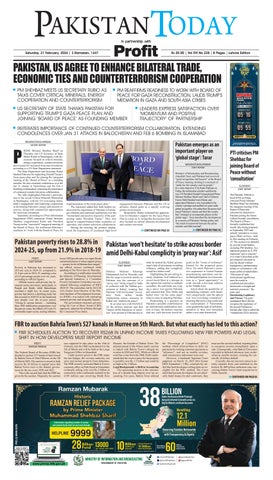
Pakistan, US agree to enhance bilateral trade, economic ties and counter terrorism cooperation
saviour of South Asia Trump, speaking at the meeting, recalled his contacts with Islamabad and New Delhi during the conflict, warning both countries that the US would halt trade negotiations and could impose 200 percent tariffs if hostilities continued He said this economic leverage helped de-escalate tensions, adding that he met Prime Minister Shehbaz and Chief of Defence Staff Field Marshal Asim Munir, praising Pakistan for publicly acknowledging his mediation The premier in turn lauded Trump s bold diplomacy and dynamic leadership in resolving international crises and stabilising global hotspots Pakistan pursues economic, energy, and mineral cooperation The Washington engagements high-
lighted Pakistan s efforts to expand economic cooperation with the US particularly in energy and critical minerals, while aligning with US-led initiatives on Gaza and recognising Trump’s mediation role in South Asia PM’S ENGAGEMENTS WITH MEETS GLOBAL LEADERS
Premier Shehbaz also held informal meetings in Washington with global leaders who had arrived to attend the inaugural session of the Board of Peace, said a statement from the Prime Minister ’s Office (PMO)
The premier met with the King of Bahrain Hamad bin Isa Al-Khalifa, President of Azerbaijan Ilham Aliyev President of Uzbekistan Shavkat Mirziyoyev President of Kazakhstan, Kassym-Jomart Tokayev and President of Indonesia Prabowo Subianto
The statement added that important regional and global issues” were discussed during the meeting Pakistan s participation in the Board of Peace reflects its efforts toward establishing peace in Gaza reconstruction initiatives, global peace, and the growing success of Pakistan’s diplomatic policy,” said the statement


Sinking into pover t y
Latest UN assessment show pover t y now threatening 7 5m Pakistanis with hunger
TH E Integrated Food Security Phase Classification of the United Nations has found that as many as 7 5 million Pakistanis are facing food insecurity at the emergency level, and though the figure is expected to fall this year, to 6,7 million, it still reflects the high level of poverty This is not just being poor, not being able to afford the latest mobile phone or even a utility bill, but real poverty, being close to starvation It is worth mentioning that official figures show that poverty has increased from 21 9 percent in 2018-19, but has increased to 28 8 percent in 2024-25
It is noteworthy that during this time the country has been on three IMF stabilisation programmes Considering that one academic study has shown the correlation between IMF pogrammes, or more specifically IMF conditionalities achieved, and rise in poverty, it seems that even the current IMF programme will not lead toward a reduction in poverty It seems to be always forgotten by policymakers that the IMF makes sure that a country is solvent enough to pay its debts It holds no brief for an economy that has gone onto the right course being able to reduce poverty, or in any way improve the lives of its citizens The IMF is not even particularly concerned about how the country is to increase its exports to get foreign exchange This is odd considering that it was the inability to earn enough foreign exchange that led to the country having recourse to the IMF in the first place
The poverty incidence and the food insecurity level should be the primary source of the government s self-assessment If people are poor, to the point of starving, then the government cannot claim success One of the accompaniments of poverty and food insecurity is the malnutrition and stunting of children This is perhaps a tragedy too painful to be contemplated calmly, especially since the loss is irreversible, and deprives the country of the kind of person who was supposed to help in building the country Instead of being a contributing hand in national development malnourished and stunted individuals require lifetime care and prove a drag on growth Economic stabilisation is all very well but the real purpose of an economy, its people, must never be lost sight of

Dedicated to the legac y of late Hameed Nizami Arif Nizami (Late) Founding Editor
M A Niazi Editor Pakistan Today Babar Nizami Editor Profit


HU M A N trafficking remains one of the most serious human rights violations of the modern era While it is a global phenomenon developing countries suffer the most due to poverty unemployment weak governance and insecurity Pakistan is increasingly emerging as a source transit and destination country for human trafficking, posing a grave challenge to the state, law enforcement agencies, and society at large Human trafficking involves the illegal trade of human beings for forced labor, sexual exploitation, domestic servitude bonded labour and even organ trafficking In Pakistan this crime has quietly expanded over the years thriving on economic desperation and social vulnerability Several districts have gained notoriety for trafficking activities Gujrat, Mandi Bahauddin, and Dera Ghazi Khan are frequently linked with illegal migration and human smuggling cases Similar patterns are observed in parts of Sindh Khyber Pakhtunkhwa and Balochistan Victims are commonly deceived with false promises of well paid jobs legal visas or a better future abroad, only to be exploited once they fall into the trap Unemployment, poverty, lack of education, and insecurity of life remain the primary drivers of human trafficking in Pakistan Families struggling to meet basic needs become easy targets for traffickers posing as overseas employment agents Limited legal migration opportunities and weak social protection systems push young people to take perilous routes often with tragic outcomes From first-hand experience within the Federal Investigation Agency (FIA), particularly in the AntiHuman Trafficking Circle it has been observed that deportees consistently disclose similar patterns Trafficking agents present attractive dreams of prosperity abroad and extract millions of rupees under the pretext of arranging legal travel Instead, victims are sent through the infamous dunki route, crossing land borders

s u s t a i n e d a c t i o n i s t a k e n , c o u
O u t e r s p a c e m i l i t a r i z a t i o n
Nevertheless
of


In
a
and
environment
economic stress climatic vulnerability and developmental constraints diverting scarce resources to space weaponry would probably undermine rather than strengthen national security Furthermore, weaponization of space does not enhance global stability Anti-satellite operations result in long-lived debris that threatens all satellites across sectors including those flown by developing states in the civilian and commercial arenas Even a limited space conflict has the potential to disrupt worldwide communications, financial systems, aviation infrastructure and emergency response services These risks go beyond competing states and threaten humanity as a whole A cascading collision scenario might make whole orbital regimes unavailable for decades compromising future scientific endeavours and economic development Accordingly, Pakistan s interest lies in restraint, diplomatic engagement and development of selective capabilities as opposed to the escalation of space weaponization The strengthening of the space situational awareness the development of transparent and redundant protective measures of civilian satellites
international cooperation with the aim of safeguarding satellites the execution of international cooperation and the distribution of resources to peaceful space technologies yield substantially greater benefits Pakistan s Space Vision 2040 already highlights capabilities in communications, remote sensing, and socioeconomic areas to make a direct contribution to the nation’s development and resilience Diplomatically Pakistan should continue to promote legally binding obligations against the deployment of weaponry in outer space and seek to build wider international consensus on this matter, particularly among developing states most vulnerable to an unregulated arms race in outer space Conforming to international calls for space sustainability also strengthens Pakistan s moral authority and political standing giving it a chance to influence the spaces of norm-setting rather than chasing unaffordable capabilities
In an age of power politics extending beyond terrestrial limits strategic wisdom depends on understanding the point at which competition serves national interests and the point at which it does not The security of the nation is better ensured by preserving space as the common domain of humankind, strengthening international law, and ensuring that outer space is a place of cooperation, not conflict
The author is research officer at Balochistan Think Tank Network at BTTN He can be reached at muneebnasar@yahoo com

In an age of power politics extending beyond terrestrial limits, strategic wisdom depends on understanding the point at which competition serves national interests and the point at which it does not The security of the nation is better ensured by preserving space as the common domain of humankind, strengthening international law, and ensuring that outer space is a place of cooperation, not conflict


FO R much of the early post-Soviet period, Russia occupied an uncertain space between authoritarian tradition and democratic aspiration The collapse of the USSR had opened political life loosened censorship and allowed a degree of pluralism that was unprecedented in modern Russian history
Yet, more than three decades later, those openings have narrowed to the point where they are barely visible Under President Vladimir Putin Russia has moved steadily away from even the limited competition and debate that once existed, towards a system defined by personal rule, repression, and the systematic removal of political alternatives This transformation did not occur overnight It has been the product of gradual institutional erosion selective crackdowns and the steady expansion of executive power Each phase was justified as a response to instability, terrorism, foreign pressure, or national decline Together, they have reshaped the Russian state into one where authority flows from a small circle around the presidency and where dissent is no longer treated as a legitimate feature of public life but as a threat to be neutralised
When Putin came to power in 2000, he inherited a country exhausted by economic crisis and political fragmentation His early promise was order Regional governors were brought to heel powerful businessmen were reminded that wealth depended on political obedience and federal institutions were strengthened For many Russians these measures were welcome The chaos of the 1990s had discredited the language of reform, and stability appeared more valuable than abstract freedoms Yet the price of that stability soon became clear Independent television channels were placed under state control Political parties that failed to align themselves with the Kremlin found their access to elections restricted Courts increasingly ruled in favour of the executive Over time, what emerged was not the restoration of a strong state governed by law but a political system in which the law served the interests of those in power Elections continued but their meaning changed Outcomes became predictable, opposition
candidates were excluded on technical grounds, and media coverage overwhelmingly favoured the incumbent leadership Political competition survived largely as performance not as a mechanism for accountability This shift marked the transition from managed politics to enforced loyalty
The most visible sign of Russia s political descent has been the narrowing of space for independent voices Journalists, activists, academics and cultural figures who once operated within defined limits have found those limits erased New legislation has steadily expanded the definition of extremism, foreign influence, and discrediting the state These elastic terms allow authorities to prosecute critics without needing to demonstrate genuine threats
Civil society organisations have been particularly vulnerable Groups working on election monitoring human rights or historical memory have been labelled undesirable or forced to close Their offices have been raided, accounts frozen, and staff harassed
What remains is a network of officially approved organisations that echo state narratives and avoid sensitive subjects Ordinary citizens have also been drawn into this atmosphere Public demonstrations are rare and swiftly broken up Online expression is monitored Employers, universities, and local administrations increasingly act as extensions of the security system discouraging any behaviour that might attract unwanted attention
The result is not only political silence but social caution a widespread habit of self-censorship that reaches into daily life Russia s full-scale war against Ukraine marked a decisive stage in this political evolution Conflict has always offered authoritarian systems an opportunity to consolidate power and the Kremlin has used the war to entrench controls that might once have provoked broader resistance New laws criminalised criticism of military operations Independent media outlets were blocked or forced into exile Thousands were detained for anti-war statements some receiving lengthy prison sentences Even the use of certain words became grounds for prosecution In this environment the line between political opposition and criminal behaviour effectively disappeared
The war also provided a powerful ideological tool State media framed the conflict as a civilisational struggle portraying Russia as besieged by hostile forces determined to weaken and humiliate it This narrative served two purposes: it justified repression
at home and diverted attention from domestic failures Economic hardship, corruption, and demographic decline could be attributed to external enemies rather than internal policy At the same time the prolonged nature of the war has deepened the state s reliance on coercion Mobilisation, surveillance, and expanded security powers have become normalised Emergency measures have hardened into permanent features of governance
A striking feature of contemporary Russia is the emptiness of its institutions Parliament once noisy and fragmented now functions largely as a rubber stamp Legislation is drafted within the executive and approved with minimal debate The judiciary, formally independent, rarely challenges the state in politically sensitive cases Governors are selected less for local legitimacy than for personal loyalty This hollowing out has long-term consequences Institutions that lack autonomy also lack credibility They cannot mediate conflict, channel social demands, or provide lawful remedies Instead, grievances accumulate beneath the surface, while formal politics becomes detached from social reality Such systems often appear stable until they are not Their rigidity limits the state s ability to adapt to correct mistakes or to incorporate new social forces By concentrating authority at the top, they also concentrate responsibility Success is claimed by the leadership; failure when it comes will be difficult to deflect It would be misleading to describe Russian society as uniformly terrorised or uniformly supportive What exists instead is a complex mixture of accommodation, fatigue, indifference, and quiet unease Many citizens have learned to navigate the system by keeping politics at a distance They focus on family work and private life avoiding public statements For others state media s constant emphasis on external threat resonates reinforcing feelings of national grievance and defensive pride Yet beneath these layers lies a growing sense of stagnation Economic opportunities are limited especially outside major cities Sanctions and isolation have narrowed horizons Young people face restricted mobility and uncertain futures The social contract that once traded rising living standards for political passivity has weakened What replaces it is less a shared vision than a set of constraints Even cultural life reflects this duality Theatres exhibitions and publishing houses continue to operate but boundaries are tightly policed Art may flourish in form but its themes are increas-

ingly cautious History is reinterpreted to serve present needs and alternative readings are marginalised At the centre of this system stands a single figure whose authority overshadows all others Over time, Russia s political structure has been reshaped around the presidency Decision-making


The shifting regional power balance that has transformed Israel from Saudi Arabia’s natural ally against Iran into something more like Saudi Arabia’s most formidable competitor for regional leadership
the ambitious modernization project intended to transform Saudi Arabia into a post-oil global powerhouse is straining under the weight of its own ambitions
The Saudi Finance Ministry projected a budget deficit of 101 billion Saudi Riyals (about $27 billion) for 2025 Independent analyses from the Arab Gulf States Institute suggest that if oil prices remain around $65 per barrel, which the US Energy Information Administration projected as a realistic trajectory for 2026, the deficit could balloon to $56b or roughly 5 2% of GDP The flagship mega-projects are cracking NEOM s The Line the futuristic 170-kilometer linear city that was supposed to house up to 1 5 million residents by 2030, has been radically scaled back to a target of 300,000 – triggering layoffs, contract cancellations, and humiliating headlines The Public Investment Fund, which anchors the entire Vision 2030 strategy with roughly $925b in assets under management was forced to mandate a 20% spending reduction across its portfolio and wrote off $8b in project losses at the end of 2024 Saudi Arabia attracted only $32b in foreign direct investment in 2024, despite a $100b target A leadership navigating this kind of visible economic retrenchment a leadership whose entire legitimacy contract with its young population was built on the promise of transformational prosperity cannot absorb the political cost of an unpopular foreign-policy move Normalization with Israel is currently the most politically toxic option available to Saudi Arabia
SAUDI PUBLIC OPINION NUMBERS DON’T LIE: Before October 7 2023 there were genuine signs of movement in Saudi public opinion A Washington Institute for Near East Policy survey from August 2023 found that 43% of Saudi citizens supported establishing business and economic ties with Israel, even without formal diplomatic relations The Israel-Hamas
in
destroyed it By November and December 2023, the Washington Institute’s follow-up polling found that support for informal business contact with
had
to
17%
strikingly 96% of
respondents agreed that Arab countries should immediately sever all diplomatic, political, economic, and other contacts with Israel The Arab Barometer documents the broader regional picture across 15 Arab countries in 2024 and 2025, confirming that this decline is not exclusively a Saudi phenomenon In Morocco a country that formalized ties with Israel in 2020 under the Abraham Accords support for normalization
Washington explicitly dropped its long-standing demand for Saudi Arabia to recognize Israel as a prerequisite for the nuclear deal
jeopardizes the regime s stability This is exactly what he told American policy-makers According to multiple sourced reports, he explicitly cited hostile Saudi public opinion in rejecting pressure to join the Abraham Accords, insisting that normalization required a concrete irreversible pathway to Palestinian statehood Whatever one thinks of the sincerity of that demand its political function is unmistakable It is a wall that protects the crown prince from his own people There is a final, deeper obstacle that gets less attention than it deserves: the shifting regional power balance that has transformed Israel from Saudi Arabia’s natural ally against Iran into something more like Saudi Arabia’s most formidable competitor for regional leadership This should be a moment of Israeli-Saudi celebration It is not because in a post-Iran Middle East the shared threat that bound Riyadh and Jerusalem together dissolves, and what remains is a question of who leads the region Israel, with uncontested multi-domain military superiority, is the obvious answer in kinetic terms MBS, who views Saudi Arabia as the economic diplomatic and spiritual hub of the Islamic world finds this answer unacceptable The response has been predictable and swift Last September Saudi Arabia and Pakistan signed a mutual defense pact explicitly mirroring NATO s collective defense principles Turkey is in advanced discussions to join the framework Saudi Arabia is negotiating the purchase of up to 100 KAAN fifth-generation stealth jets from Turkish Aerospace Industries a deal that US officials have described as alarming – precisely because it represents a deliberate effort to build strategic independence from both Washington and Jerusalem The contours of what some are calling an Islamic NATO are emerging in real time – not as a response to Israel’s enemies but as a response to Israel’s dominance
The 2025 Arab Opinion Index found that 87% of citizens across the Arab world completely oppose
of
MBS WON T JOIN THE ABRAHAM ACCORDS: One final underappreciated


' B A D T H I N G S '

IEEPA-based tariffs The US Constitution grants Congress not the president the authority to issue taxes and tariffs But Trump instead turned to statutory authority by invoking IEEPA to impose tariffs on nearly every US trading partner without the approval of Congress Trump has imposed some additional tariffs under other laws that are not at issue in this case Based on government data from October to mid-December, those represent about a third of the revenue from Trump-imposed
omists estimated on Friday that the amount collected under Trump's tariffs based on the International Emergency Economic Powers Act (IEEPA) stood at more than $175 billion That amount likely would need to be refunded with a Supreme Court ruling against the
BEIJING
AG E N C E S
The Communist Party of China (CPC) Central Committee has sent a congratulatory message on the convening of the Ninth Congress of the Workers' Party of Korea (WPK) reaffirming close ties between the two socialist parties In its message, the CPC described the WPK as the strong leadership core of the revolutionary and construction undertakings of the Democratic People's Republic of Korea (DPRK) It praised the party for uniting and leading the DPRK people in advancing the country’s socialist cause and achieving notable accomplishments The message highlighted that in recent years, under the leadership of Kim Jong Un general secretary of the WPK the party has implemented its five-point Party-building line for the new era, adhered firmly to the socialist path and prioritised economic development and improvements in people s livelihoods The CPC said it was sincerely pleased with the progress made Describing the Ninth Congress as a significant political event for both the party and the people of the DPRK the CPC noted that the gathering would set strategic plans and priorities for the party’s development and the country s economic progress in the coming years We wish that, under the strong leadership of the WPK Central Committee with General Secretary Kim Jong Un at its helm, the DPRK people will continue to achieve new and greater accomplishments in their socialist construction, the message stated


Naqvi inaugurates Islamabad expanded electric bus network with major new infrastructure
ISLAMABAD
S ta f f r e p o r t
Strengthening the capital’s transition toward sustainable urban mobility Federal Interior Minister Mohsin Naqvi on Friday inaugurated a new fleet of electric buses along with a purpose-built depot and charging station marking a significant expansion of Islamabad’s eco-friendly public transport network

With the latest induction the number of electric buses operating across 21 routes has risen to 160 After the launch ceremony, Naqvi inspected the facilities and took a ride on an electric bus with senior officials, receiving a comprehensive briefing on fleet operations depot management and charging infrastructure

Naqvi praised the project team for its timely execution, noting that the service is already being used by 125,000 passengers daily, with plans to increase ridership to 250,000 He added that special focus has been placed on ensuring accessibility for students across major routes The minister also announced that
Measles deaths case: LHC seeks details of ventilators in Punjab’s hospitals
Medical College, presented the institution's annual report, highlighting key milestones in academic excellence Xi’s Global Initiatives First Ever Cer tificate Program held at Universit y of Punjab

LAHORE
S ta f f r e p o r t
The Lahore High Court (LHC) on Friday heard a case concerning deaths caused by measles and sought comprehensive details of ventilators available in government hospitals across Punjab Justice Malik Muhammad Awais Khalid heard the case during which the Director General Health submitted a preliminary report related to infectious diseases
During the proceedings, the court questioned authorities about the total number of ventilators installed in hospitals across the province and how many of them were currently functional
The court adjourned further hearing of the case until February 27 and instructed the relevant authorities to present a comprehensive report on the matter
The petitioner stated that hundreds of people had lost their lives in the past due to diseases such as measles and dengue primarily because of the non-availability of ventilators and basic medical facilities in public hospitals
The petitioner requested the court to order a formal investigation into the recent measles-related deaths and to initiate a transparent inquiry to determine responsibility
Urdu which is the subject of
The columns in question eighteen in number were published in the
Nawa-i-Waqt, Multan over a
of one
(1995-1996) The
by
himself Anwar Jamal (famed poet painter and academic) and this scribe Anwar Jamal traces the wherewithal of these columns to the heyday of the Urdu Academy Multan a
and

S ta f f r e p o r t On February 18 2025 with the collaboration of the Chinese Embassy

of

Litterateurs of the name and calibre of Arsh Siddiqui Asghar Ali Shah Ibne Hanif Mubarak Mujoka Salahuddin Haider, Khalid Saeed, Muhammad Amin, Asghar Shahia, Farooq Usman, Anwaar Ahmad, Farrukh Durrani, Asghar Nadeem Syed Masood Ash’ar


TThe Federal Investigation Agency (FIA) on Friday decided to revise the charge sheet in the foreign funding case against PTI founder Imran Khan and others after including two new suspects in the investigation The case was heard by the Islamabad Banking Court, where Judge Abdul Ghafoor Kakar summoned PTI Chief Finance Officer Siraj Ahmed and
employee Faisal Qazi for questioning Special Prosecutor Wasiq Malik informed the court that a
charge sheet had already been
With the inclusion of two
pects, we will submit a
charge sheet instead of
supplementary one ” he said When asked how much time was required Malik sought 10 to 15 days to finalise the document The court directed the FIA to submit the complete
charge sheet against Imran Khan and others by March 5 and granted interim bail to Siraj Ahmed and Faisal Qazi until that date The next hearing in the case has been scheduled for March 5 In August 2022, the Election Commission of Pakistan (ECP) issued its verdict in the prohibited funding case formerly referred to as the foreign funding case ruling that PTI had received prohibited funding The ECP stated that the party had “knowingly and willfully” received $2 12 million from Wootton Cricket Limited a company operated by businessman Arif Naqvi and described PTI as a willing recipient of the funds According to the commission PTI also received donations from Bristol Engineering Services (UAE), E-Planet Trustees (Cayman Islands), SS Marketing Manchester (UK) PTI USA LLC6160 and PTI USA LLC-5975 which it said were in violation of Pakistani laws
spondent and ordered that the review petitions be
for hearing at the earliest Imran Khan had approached the Supreme Court through review petitions after the trial court closed his right to defence a decision earlier upheld by the Lahore High Court and later endorsed by the Supreme Court on February 21 2023
Jailed PTI leaders c all for protest pause
Five senior leaders of Pakistan Tehreek-e-Insaf (PTI), currently incarcerated at Kot Lakhpat Jail in Lahore on Friday urged the party to postpone all protest activities during Ramadan and refocus its efforts on parliamentary politics In a joint letter issued to the media from prison, Shah Mahmood Qureshi, Dr Yasmin Rashid, Ejaz Ahmed Chaudhry Umar Sarfraz Cheema and Mian Mahmood Rashid said that in view of the sanctity of the holy month all forms of protest movements should be deferred Concerns Over Imran Khan’s Health
The appeal comes amid heightened tensions over the health of PTI founder Imran Khan which has become a fresh flashpoint between the government and the opposition alliance, including the Tehreek Tahaffuz-e-Aiyeen Pakistan (TTAP)
According to a report submitted by his lawyer and Supreme Court amicus curiae Barrister Salman Safdar, Khan has been diagnosed with central retinal vein occlusion (CRVO), a serious eye condition
The report stated that Khan, who has been in jail since August 2023 complained of losing around 85%

of vision in his right eye
Following the disclosure, the opposition alliance staged a sit-in at Parliament House while PTI workers blocked major roads and highways in Khyber Pakhtunkhwa in protest
In their letter, the jailed leaders demanded that the government stop politicising Khan’s health and ensure that his treatment is carried out in consultation with his sisters and personal doctors Criticism of President’s Remarks
The incarcerated leaders also criticised recent remarks by President Asif Ali Zardari against Imran Khan calling them inappropriate for the office of head of state They said Khan was enduring imprisonment with dignity despite difficult circumstances They urged the PTI leadership
to intensify legal efforts in courts to secure proper medical treatment for the former prime minister and to ensure regular meetings between him party office-bearers

ISLAMABAD s ta f f r e p o r t Asif Ali Zardari will
