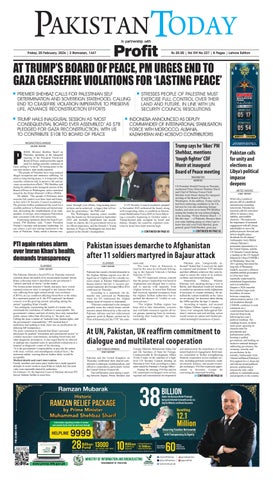
AT TRUMP’S BOARD OF PEACE, PM URGES END TO GA Z A CEASEFIRE VIOL ATIONS FOR ‘L ASTING PEACE’
g PREMIER SHEHBAZ CALLS FOR PALESTINIAN SELF DETERMINATION AND SOVEREIGN STATEHOOD, CALLING END TO CEA SEFIRE VIOLATION IMPERATIVE TO PRESERVE LIFE, ADVANCE RECONSTRUCTION EFFORTS
g TRUMP HAILS INAUGURAL SESSION A S ‘ MOST CONSEQUENTIAL BOARD EVER A SSEMBLED ’ A S $7B PLEDGED FOR GAZA RECONSTRUCTION, WITH US TO CONTRIBUTE $10B TO BOARD OF PEACE
g INDONESIA ANNOUNCED AS DEPUTY COMMANDER OF INTERNATIONAL STABILISATION FORCE WITH MOROCCO, ALBANIA, KAZAKHSTAN AND KOSOVO CONTRIBUTORS
trump says he ‘ likes ’ pM S hehbaz, mentions ‘tough fighter ’ CdF Munir at inaugural Board of peace meeting
s responsibility, PTI insisted that if authorities had nothing to hide, there was no justification for delaying full transparency
The party reiterated its demand that Khan’s personal physicians be granted immediate and unrestricted access to conduct necessary examinations including blood tests and other diagnostic procedures It also urged that he be allowed to undergo any required scans or specialised evaluations at a hospital or diagnostic centre of his choosing
“It is the government’s responsibility to provide the nation with clear verified and unambiguous medical facts ” the statement added warning that no further delay would be acceptable Medical details and court intervention Family members and senior party leaders have made repeated attempts in recent weeks to meet Khan at Adiala Jail, but most visits were reportedly denied by authorities On February 10 the Supreme Court of Pakistan allowed PTI lawyer Salman Safdar to meet him
s tA f f r e p o r t Pakistan has issued a formal demarche to the Afghan Taliban regime over the alleged use of Afghan soil for a deadly terrorist attack in Khyber Pakhtunkhwa’s Bajaur district that left 11 security personnel martyred the Foreign Office (FO) confirmed on Thursday
According to a statement, the demarche was conveyed on Wednesday when the FO summoned the Afghan deputy head of mission in Islamabad Pakistan condemned in the strongest possible terms the vehicle-borne suicide terrorist attack followed by a fire raid on Pakistan military and law enforcement agencies’ posts in Bajaur, carried out by Fitna al Khawarij [or] the TTP,” the state-
ment said
The FO expressed serious concern that the group’s leadership was based in Afghanistan and alleged that it continued to operate with impunity from Afghan territory It noted that Pakistan had received repeated assurances from the Afghan Taliban authorities but regretted the absence of visible or concrete actions "
Pakistan also “categorically informed” Kabul that it reserved the right to respond and eliminate TTP militants and their affiliates wherever they were located to ensure the safety of its soldiers, civilians and territorial integrity Meanwhile, Defence Minister Khawaja Asif, speaking during a visit to Berlin said Islamabad would not hesitate to conduct air operations inside Afghanistan if necessary to counter militancy He described the current instability as the price we are paying for decisions taken during the
and after the Sept 11 attacks According to reports, Asif accused the Afghan Taliban regime of waging a proxy war alongside India against Pakistan s interests and said military action would remain an option until Kabul provided meaningful assurances of peace
ment added
NEW YORK/ISLAMABAD s tA f
ISLAMABAD
g
MARKET SEES BROAD-BASED LOSSES, WITH KEY SECTORS INCLUDING AUTOMOBILES, CEMENT, BANKS AND ENERGY STOCKS TRADE IN RED ZONE
Pakistan
mulls resuming Russian crude oil imports during upcoming PM’s visit to Moscow
according to industry sources In a letter to Commerce Minister Jam Kamal Khan the Federation of Pakistan Chambers of Commerce and Industry (FPCCI) highlighted concerns that the removal of the price cap could harm smaller exporters by excluding them from the DLTL benefits FPCCI President Atif Ikram Sheikh pointed out that the rice export market is highly competitive and volatile and the rigid pricing cap might not reflect market conditions, which could negatively impact smaller rice exporters and foreign exchange earnings
Pakistan launches
mission which aims to address corruption vulnerabilities and improve governance by identifying the top 10 high-risk federal agencies with macro-critical exposures, The News reported A 240-page detailed document outlines comprehensive criteria and frameworks for evaluating court performance including alternative dispute resolution (ADR) mechanisms It also emphasises the establishment of analytic and predictive capacities for active case management
The action plan includes measures to reduce the backlog of economic disputes with the first-year focus on developing a
methodology for assessing court and judicial performance In the second year, the plan aims to publish a performance report for all Administrative Tribunals and Special Courts involved in economic and commercial matters
A key component of the plan is the legislative review of the Anti-Money Laundering (AML) Authority 2010 The AML/CFT Authority will form a Joint Working Group (JWG) to review the AMLA and eliminate ambiguities particularly concerning the need for predicate offence convictions for prosecuting money laundering Amendments to the AMLA will be submitted to Parliament and implemented by June 2027 The National Accountability Bureau
(NAB) will lead efforts to draft a national corruption risk assessment, working in coordination with other key agencies, including the Federal Investigation Agency (FIA) and the Securities and Exchange Commission of Pakistan (SECP) This assessment will focus on identifying corruption risks in federal agencies, particularly those with macro-critical exposures The National Anti-Corruption Task Force, established under the AML/CFT Authority will
Trump says he ‘ likes ’ PM S hehbaz, mentions ‘tough fighter ’ CDF Munir at inaugural Board of Peace meeting
CONTINUED FROM PAGE 01
I got to meet the prime minister, and he said in front of our Chief of Staff Susie Wiles that ‘you know nobody knows this but I believe that President Trump saved 25 million lives when he stopped the war between us and India , Trump recalled Addressing PM Shehbaz, he added, “You made that statement it was really a beautiful thing ” Referring to the four-day conflict between Pakistan and India in May 2025 he said: That war was raging, planes were being shot down And it was Pakistan and India, and I got on the phone with both of them And I knew them a little bit I knew Prime Minister Modi very well actually I got to know Pakistan through a little trade They were trying to make too good a deal and I got a little upset with them In the end, they got what they wanted, and they made a good deal, and I got to like them the prime minister the Field Marshal who is a tough man a tough good fighter a serious fighter Trump said he called both Pakistan and India after he got to know about the May conflict, during which “many planes were shot down”
“I called them and said listen I am not doing trade deals with you two guys if you don t settle this up And they said, No, no no! That was both of them And they do a lot of business with the US and they softened up all of a sudden A little bit of
a pullback by one and then the other and all of a sudden we worked out a deal
Trump said
He added that he had also warned the two countries of imposing a 200 per cent tariff if they continued to fight
“One of them I won’t say which one said ‘No! You can’t do that’ They both wanted to fight but when it came to losing a lot of money they said, We don t want to fight And we solved that in two to three days,” Trump continued, before he thanked Shehbaz
“That was a very big deal; people have no idea A lot of them say they weren t fighting [But] they were fighting Eleven jets were shot down, very expensive jets, he added Trump said he believed “a lot of progress was made in the relationship” adding that Modi was a “great man and a great guy
Big day
Trump began his address by saying that this is a big day
Lots of people watching, especially from other countries [ ] We have a large group of leaders and the ones who aren’t here are watching on Zoom I hope they enjoy it he added The US president further said, What we are doing is very simple peace It s called the Board of Peace, and it’s all about an easy word to say but a hard word to produce peace We are going to produce it We have been doing a really good job and some of these leaders that are
to expand control over the Occupied West Bank, calling for their immediate halt and reversal He reiterated Pakistan’s principled stance in support of the Palestinian people’s inalienable right to self-determination through a credible time-bound political process consistent with international law and UN resolutions He stressed that the process must lead to an independent, sovereign, viable, and contiguous State of Palestine, based on pre-June 1967 borders, with AlQuds Al-Sharif as its capital FM Dar expressed hope that the Board of Peace operating under UN Security Council resolution 2803 would contribute to tangible steps toward these objectives
BILATERAL TIES AND HIGH-LEVEL
DIPLOMACY
On the margins of his visit, FM Dar engaged with international counterparts on the full spectrum of bilateral cooperation including political economic trade investment defense and people-to-people exchanges
with us have helped me very much ” He then went on to reiterate his claim of settling eight wars And I think a ninth [was] to come, but it turned out to be a tougher one I thought that was going to be the easiest one But, with war you never know what’s easy and what’s not so easy But we have had a great relationship and I became friendly with so many of the people And I appreciate you being here These are great people these are great leaders,” he added Trump said the Board of Peace was one of “the most important and consequential things I think that I will be involved in again reiterating his claim of settling wars He said, Some of which were 32, 34 or 37 years long That’s a long time [But] we ended it within about two days each one of those But we have some other work to do and we are getting it done
On the Gaza issue he said it was very complex , commending US envoy Steve Witkoff and his son-inlaw Jared Kushner, among others, for an “amazing job” in this connection He then went on to say that the Board of Peace was the most consequential board Certainly, in terms of power and in terms of prestige, there has never been anything close because these are the greatest world leaders ” he said adding that almost everybody had accepted the invitation to join the board and those had not would do
Imran’s eyes
The end of the sit-in is to be succeeded by the more honest ‘Free Imran’ campaign
TH E government’s having had PTI founder Imran Khan’s eyes tested has led to some improvement in his vision, and to the ending of the Tehrik Tahaffuz Ain Pakistan sit-in at Parliament House However the TTAP insists that the sit-in was not ended for any other reason than its respect for Ramazan, and has pointed towards other sources of activity to get Mr Khan treated KP CM Sohail Afridi has gone a step further and franker by announcing the formation of a Free Imran Force He did not provide details, but indications are that there may be some puerile ideas floating around about busting Mr Khan out of jail Apparently there are some within the PTI who feel impatience with the slow and gradual process of facing all the charges and serving out any sentences that may be handed down These elements seem to try and make the issue of Mr Khan’s eyes subject not for humanitarian concern, but another move in the game of chess that surrounds mr Khan
The principal TTAP demand is that Mr Khan be allowed to consult his personal physicians On the face of it this is a reasonable demand, but it does obscure the fact that while Drs Asim Yusuf and Faisal Sultan are doubtless very competent in their own fields neither is an ophthalmologist While having received the normal instruction in ophthalmology at the undergraduate level, they have since pursued higher studies in different fields, Dr Yusuf being a psychiatrist and Dr Fiasal an infectious diseases specialist It has also demanded that he be treated at Shifa Eye Hospital, which is located in the same city of Rawalpindi as Adiala Jail where Mr Khan is currently detained
Does the TTAP, the PTI or any member of Mr Khan’s family think his eye problem can be parlayed into his release? That seems to be a far-fetched notion However it does seem appropriate for the government to show him as much courtesy as he did himself when PM, of letting him consult the doctors of his choice By loading his illness with family meetings, which will prove more to do with politics than his health Mr Khan’s friends and supporters do him no service
Dedicated to the legac y of late Hameed Nizami Arif Nizami (Late)
Founding Editor
M A Niazi Editor Pakistan Today Babar
Nizami
Editor Profit
L a t e s t ’ s t u d i e s
S o u t h A s i a n f a m i l i e s
TH E election of Tarique Rehman as Prime Minister of Bangladesh means that the country is once again where it was in 1996, with a PM who is entering the House for the first time with no question of him or her having held any of the three great offices of state
This might mean the opportunity of a new start but it might also show the lack of experience at the head of the government It shows also that, in Bangladesh as much as in other countries, the hereditary principle applies Tarique Rehman is the son of a former President as well and though his mother had headed the Bangladesh Nationalist Party since its founding in 1985 he too had been in exile for the last 17 years which might demonstrate his commitment to democracy, but which is hardly any preparation for the rigours of office and the problems facing a nation
The ascent to the Prime Ministership in the UK has been supposed to be an alternation between Opposition and government and while in government to gradually ascend from junior office to senior to culminate in one of the great offices of state (Home Office, Foreign Office, Chancellery of the Exchequer) Winston Churchill is one of those who fitted that framework, starting as one of the youngest ever Home Secretaries, being only 34 in 1908 After having been sacked as First Lord of the Admiralty after botching the Gaillipoli campaign he returned to the Tory Party where in 1922 he became Colonial Secretary (which was the nearest he got to the Foreign Office) After the 1928 election, Baldwin offered him the Exchequer, probably in the hope that he would not accept But he did, and led the UK right into the Great Depression It is perhaps worth mentioning that unlike several British PMs before and since he never held junior office
Be that as it may he was an experienced hand well acquainted with all aspects of the UK s problems, and the Labour Party refused to come into a National Government, unless he headed it Labour itself was to have one person ready to be Prime Minister, Jim Callaghan, who had at one time or another held all three great offices of state all under the man he succeeded Harold Wilson Callaghan was head of what became a minority government and faced off the OPEC oil boycott He made sure the Parliament, unusually for those days, ran for virtually the full five years, because the writing was fairly visible on the wall: the 1975 electoral disaster than began the Thatcher years Apart from Elizabeth Truss and Boris Johnson both Foreign Secretaries and Rishi Sunak Chancellor of the Exchequer British PMs no longer have held one of the great offices, and the examples mentioned have all gone down in flames soon after taking office Pakistan has tended towards provincial strongmen rather than holders of one of the great offices, though it should be remembered that its first PM Liaquat Ali Khan had actually served as Finance Minister in the last Viceroy s Cabinet with Nehru as Prime Minister
There is a certain linkage discernible between Hasina Wajid and the UK through her niece Tulip Siddique, the granddaughter of Bangabandhu Sheikh Mujeebur Rehman has been an MP since 2008, and was given junior ministerial office in the Starmer government formed after Labour won in 2024 but her involvement in a couple of scandals in Bangladesh not to mention her being given a £190 000 flat by a Bangladeshi develope led her to resign It is perhaps worth noting at this point that Tarique Rehman too has spent his exile in the UK because of that enforced absence from Bangladesh, his only child, Zarnaz Zaima Rehman, received her entire education in the UK where she is a barrister Her only participation in the politics of either country has been as a campaignervfor her father in the election just concluded The path to the Prime Ministership has been more orthodox in India, where holders of the office have been either Home Minister or Finance Minister, or sometimes both In Pakistan only Zulfikar Ali Bhutto had held any of the great offices of state the Foreign Ministry Pakistan of late tended to see Punjab CMs becoming PM The two most prominent examples are the Sharif brothers, Nawaz and Shehbaz Nawaz is the clearer example, for Shehbaz served as MNA in 19003, only later becoming CM, in 1997, but Nawaz moved directly from the Punjab CM’s Secretariat to the PMO in 1990 Tarique Rehman s ascent to the Prime Ministership is not so much as whether he has held the right offices or any offices at all It is about hereditary claims That is supposed to b e one of advantages of democracy, that representatives and leaders are not thrust upon a people by accident of birth Perhaps because the claim to supreme office is not based on performance in a lesser office claimants need not have
w h o b e t t e r t h a n a s o n o r d a u g h t e r ?
possess that wherewithal?
Twhen
been
ning
the
of
Remember
s
to
and
and
in
of
those conducting one or the
that
for
recently? As
Considering
(in
set of studies probably had no idea what they were talking about (Could it be true of both sets?) If you are old enough, you would readily recall the 1970s when animal fats suddenly started getting a very bad press apparently for all the health ills they brought Doctors started passionately recommending vegetable oils for cooking instead which for a long while were considered the healthiest things around after vegetables themselves All this was based on the latest studies of their time, of course The latest studies of today have overruled all that and they are recommending animal fats again pointing out in graphical details the deleterious effects of vegetable oil on human health For a long time letting toddlers sleep in the parents bedroom was considered the greatest impediment to their correct psychological development Not a few parents have lied to the paediatrician in this regard Paediatricians were of course merely following the latest studies of the day Today s latest studies conclude that nothing makes babies and toddlers secure and psychologically sound as sleeping with their parents So there! You probably know doctors who not only advise other healthy individuals to regularly take small amounts of aspirin as a preventative against heart attacks and strokes but who also put their money where their mouth is You have probably also encountered doctors who strongly object to the practice So much for medical recommendations!
As for eggs no study– old or new– has been able to get the medical community to agree on whether they are good or bad Quite oblivious to the controversy however eggs continue to be a permanent feature at breakfast tables around the globe And one can only wish more power to them! There are countless examples of the fickle nature of conclusions of medical studies but a further survey of them would be mere repetition A much smarter use of the remaining space would be to focus on what the layman ought to do in response to the never-ending stream of such recommendations The first thing to do is to realize that medical science is not ‘science’ in the strict sense It is all anecdotal and there is no reason whatsoever to be overawed by it in the slightest The second thing (though no less important than the first) is to remind yourself that man, by his very design, is perishable That is the way it is Man’s decline starts the day he acquires peak health (usually around age 20) It is good sense to base whatever he opts to eat or do (or refrains from doing so) on the net balance of benefit over harm But over-obsession in this regard is always useless and often counterproductive
Thirdly, it is always advisable to look at the larger picture Like the broiler chicken, pesticides and GMF are necessities considering the very real need of having to feed 8 billion mouths a number that is only growing Sure all these items come with their health harms as well but then what is the alternative? Is there anything under the sun that does not have those? Why, an act as natural , common and necessary as sitting has its ill effects on health too Chemical pesticide- herbicide- and synthetic-fertilizer-based agriculture is a practical solution to the problem of human hunger (Organic farming is great but can it feed everybody?) Mosquito repellents offer an illustrative example in this regard No doubt they are bad for health But mosquito bites can be worse
This is typical of problems of life for which there are no ‘perfect’ solutions Almost always it is a matter of trade-offs where one hopes to make do with the best available alternative It is never perfect; and often not good enough If one had unlimited time, money, patience and continuity of purpose at one s hand, one could, in theory, spend the whole day searching for and then procuring healthy food that all the latest studies would approve of It is not beyond the realms of possibility But how many people
Broiler chicken cooking oils of all kinds and conventionally grown food may all be bad for health (they probably are) But given the nature of the human condition, good sense demands avoiding going to the extremes Trying to avoid them altogether would be impractical and would lead to inconsistencies For where is one to find completely healthy food (is there any such thing?) and at what financial physical and mental cost? Consuming these items with gay abandon is unwise too, considering the damage owing to quantity The sane stance, as is so often the case is somewhere in between Moderation thus would probably be the best solution though that too will not be perfect considering the fact that we all are going to die any which way For a variety of reasons, the mere mention of moderation happens to be very unfashionable in most circles To the modern man’s ear, it sounds like a cliché It is not new – in fact as philosophies go it is probably the oldest It sure is not spectacular by any stretch of the imagination In fact it is positively boring for many It should be pointed out to such folks that unspectacular and sensible need not necessarily be mutually exclusive In fact, it is quite the contrary For a convincing case could be made that there is a very strong correlation between moderation and wisdom
A wise man keeps himself deliberately unaware of nothing, and that includes all these latest medical studies, however imperfect or vacillating He keeps himself abreast of them and carefully reads their recommendations, but only with a bucketful of salt
Hasan Aftab Saeed is a connoisseur of music literature and food (but not drinks) He can be reached at hasanas@live jp
Karachi’s broken streets
Peace beyond rhetoric
HASAN AFTAB SAEED
Assured second strike between India and Pakistan
TH E second-strike principle which is the assurance that the state that they will respond with likely nuclear retaliation should they be hit in the first strike has proved to be a key pillar in the nuclear-weaponized world deterrence strategy The essence of strategic stability is a debate whether one of the sides can actually afford enjoying their diverse conventional arsenals and nuclear weapons in South Asia whereby India and Pakistan have large conventional arsenals and nuclear weapons Although the nuclear arsenal of India has been stated to bear a high second strike capability in a situation involving its nuclear submarine fleet the nuclear capability of Pakistan has been argued to be more crippled posing questions of credibility to its deterring capability Since India has an assured second-strike capability due to the developed ballistic-missile submarine (SSBN) force, it can contribute to a critical role in the sphere of strategic stability and the fact that Pakistan had a developing submarine capability puts Pakistan in a disadvantage which will create an unstable presence in the region The modern literature supports this fact through the promotion of the idea that the asymmetry of the second-striking resilience can be the characteristic of India the strategic calculus and the nuclear posture of the Pakistani scenario perhaps THE SOUTH ASIA STRATEGIC LOGIC OF THE SECOND STRIKE: The deterrent argument is based on the fact of the so-called balanced arm the utility of the first strike will decline when both parties assume that any nuclear attack will be countered by a devastating retaliation The strategy of minimum credible deterrence and strategic stability that India seeks involves a secondstrike guarantee and Pakistan has long been concerned about second-strike guarantees
and a deterrence guarantee, which does not always involve effective capability A nuclear triad which includes terrestrial missiles airplanes and submarines is survivable and versatile The submarine force is the strongest in India bearing in mind that the SSBNs are the most survivable
INDIAN SUBMARINE 2ND STRIKE
CAPABILITY: The concept of secondstrike credibility is reflected in the physical aspect through the SSBN fleet of India the so-called Killer-class (the INS Arihant the INS Kalvari, the INS Khanderi, the INS Sindhuvir, the INS Viraat) All these ships have ten K-15 (SS-26) or future K-4 (SS-26) submarine-launched ballistic missiles (SLBMs) with a range of 750-1500 km It is undetected and unbeaten because of the 10m tactical warhead of the K-15 and also nuclear propulsion plant The operational preparedness was manifested in the successful test of the SLBM of the INS Arihant, which was conducted in 2016 In addition K-4 with the range of 1 500km developed by India will be able to cover more in terms of strategy and the submarines will be able to patrol beyond the Bay of Bengal and the Arabian Sea The doctrine of the navy strategy that is entrenched in the Nuclear Doctrine: A Policy Manual (Indian Ministry of External Affairs) identifies the SSBN as the final deterrent factor which ensures survival at the national level
PAKISTAN, NAVAL AND SECOND
STRIKE CAPABILITY: To a great extent, the Pakistan naval nuclear posture is conventional based The navy has neither operational nor strategic platform of deterrence and it has only a land-based missile system which is largely the Shaheen-III MIRV missile with a range of approximately 1500km
and the Raad with a short range ballistic mis-
sile As far as Pakistan has recently also had the means to procure the PNS Mehran and PNS Jinnah ballistic missile submarines (BMSs), they have not been equipped with nuclear missiles The traditional diesel-electric types of Karaka (K- 15) of the Pakistani Navy do not have the nuclear propulsion or the SLBMs The nuclear second strike by Pakistan according to modern estimation by experts like Dr Amir Hasan (centre of Strategic Studies, Islamabad) is at the infantile stage and heavily reliant on the survival possibility which is doubtful largely pegged on the pre-emptive attack which is not so appealing The magnificent underwater platform is not strong enough that places the Pakistan deterrence in a bad position with the powerful underwater capability of India
IMPLICATIONS FOR STRATEGIC
STABILITY: The asymmetry of the capabilities of second strike is transformed to the asymmetry of the strategy The PINI SSBNs can survive the initial attack and retaliate with the help of safe under-sea bases and India can rightly expect the credible deterrent effect With no equal platform, Pakistan will have an increased probability to be targeted without any response and it will affect its choice to either one-way escalation or pre-emptive nuclear options
The current risk analysis like the South Asian Strategic outlook (2024) notes that the restrictions on the second strike of Pakistan are one of the handicapping that could be employed to motivate India to develop a strategic first strike position in case it feels threatened Moreover the existence of plausible second-strike platforms will destroy the very stability that deterrence is considered to maintain Also, the existence of plausible second-strike platforms would enable the enlargement of the security space The Indian SSBNs are urging Pakistan to possess a strong conventional deterrent and spend
d e t e r r e n c e p o s i t i o n o f t h e t wo p a r t i e s i n S o u t h A
more on missile defence as well as the earlywarning mechanism The aspect of the fear of the first strike unimpeachably leads to restraint that will comply with the concept of the mutually assured destruction (MAD) In relative terms, the second inferior strike of Pakistan decreases the deterrence impact and could contribute to more nuclear flashpoints and a higher chance of a misscalculation which is an issue that is expressed by the Institute of War and Peace Reporting (2023) The new developments in the field of geopolitics have cemented second-strike capability The launching of K-4 missile by India in 2023 and the creation of more advanced SSBNs indicate the increase in the power of the Indian underwater deterrent In the meantime, there was an announcement of a traditional platform of the Agosta 90B of Pakistan, which indicated that it was not competitive to India about the survivability in the provision of nuclear According to the view of analysts like Dr Qamar Hussain (International Crisis Group) Pakistan needs to revise its nuclear policy according to which it focuses on firepower, into
t , i s t h e m a t u r a t i o n o f t h e
Besides
The weather does not arrive by army It travels through chokepoints: dollar clearing
rules export controls and the digital platforms on which modern commerce depends The point is not only what is formally banned It is the fear that travels farther than the law de-risking, overcompliance, the quiet calculation that a transaction is not worth the trouble A factory that needs specialised parts also needs a bank willing to clear the payment an insurer willing to cover cargo and a shipping line willing to accept the route Any link can fail even when the goods are not prohibited, because “zero risk” is cheaper than judgement Then the weather reaches housing
The currency weakens import costs jump landlords price in uncertainty Tenants keep the address but lose a room or keep the rooms and move to the city s edge Square metres shrink, commutes stretch, households double up Independence gets performed in speeches Dependence gets negotiated at lease renewal
A second border closes online Filtering narrows the internet at home; sanctions and compliance fears narrow it again from abroad A developer can write world-class code and still fail at the first step: an account that will not accept an Iranian phone number a subscription no foreign card can pay for a cloud service a legal team would rather block than review Licences may exist on paper Usability dies in the gap between law and risk
INDEPENDENCE AS SLOGAN: None of this absolves Tehran Iranians know how often their own leaders turn defiance into doctrine and pride into policy, then pass the bill to everyone else Domestic choices deepen vulnerability: erratic management, patronage, corruption and a habit of treating society as raw material in a confrontation it never chose External pressure becomes a licence to postpone reform Dignity becomes a substitute for competence Worse, the national project gets framed in language designed never to be tested When slogans are broad enough to survive any outcome and elastic enough to absorb any failure there is no mechanism for correction only for
doubling down
Meanwhile, officials blame Washington for inflation, shortages and unemployment They may be deflecting, but they are also conceding the point: an external variable has become the default explanation for Iranian life That is not sovereignty It is dependence on another capital to make the internal story coherent
THE LONG COST: Living by improvisation is exhausting Over time it becomes identity: brace flinch repeat Businesses avoid long-term contracts because they cannot price next month Researchers publish papers they cannot turn into products because neither capital nor supply chains survive permanent volatility Families delay having children not only because life is expensive but because life is unreadable Then the young leave not all at once, not loudly, but steadily, like air escaping a punctured tyre Brain drain is usually framed as economics In Iran it also reads as a referendum conducted in departures: not against the country but against the belief that its future will ever belong to them In the age of hydrocarbons, Iran sat atop strategic wealth and still fell behind Now, as the world pivots towards AI, advanced computing and the capital-heavy infrastructure of chips and data centres isolation is no longer a handicap It is a compounding penalty Talent needs open access to tools platforms capital and collaboration to accumulate In a storm, it evaporates Suspense itself has become a market Iranians are not at the negotiating table They are being gambled with by governments and by strangers on prediction markets who turn a nation s anxiety into a betting line After decades of this, a darker thought circulates: when uncertainty becomes permanent, even catastrophe starts to look like clarity That is not appetite for war It is fatigue the weariness of people forced to live on forecasts so long that diplomacy even when it works feels less like an exit than like a new wing of the waiting room People in Tehran do not ask for miracles Many no longer insist on the “right” outcome Increasingly they would
What happened to
Nproved
enough
dominate headlines, but insufficient to satisfy expectations The result is a familiar mix of outrage suspicion and conspiracy Epstein’s so-called ‘library’ was immediately presented as a trove of dark secrets Judging by the reaction in the media and social media, Epstein was transformed into a nearmythical embodiment of evil: A man who is said to have penetrated every sphere of elite life, knew everyone who mattered, and was somehow responsible for everything from global political decay to modern cultural malaise In this telling Epstein became not merely a criminal but a symbol for all that is rotten in the West And yet, for all the noise, the revelations led almost nowhere The only country where the files produced noticeable political resonance was Britain
Even there the reaction owed less to Epstein himself than to domestic conditions: A grinding economic crisis widespread social frustration and deep distrust of Keir Starmer s government The Epstein story landed on fertile ground already primed for scandal
In the US where the release was most eagerly anticipated the response was strikingly muted There were insinuations about a shadowy pedophile cult among American elites but no solid evidence to support the claims No new accomplices were named No client lists emerged No dramatic confirmations followed
Even Donald Trump’s opponents failed to extract anything useful; they settled instead for Commerce Secretary Howard Lutnick who was caught lying about contact with Epstein That was it From this two basic conclusions can be drawn Either the true scale of Epstein s crimes has been vastly exaggerated, or the US authorities are still concealing the most damaging material Personally I lean toward the former explanation Many Americans however have reached the opposite conclusion
Since the released documents failed to reveal the expected horrors, they believe they have been deliberately misled This sense of betrayal has reignited the conspiracy machine Rumors multiply Speculation hardens into certainty Politicians as ever are happy to help Two distinct lines of criticism have now formed against the US Department of Justice and the Trump administration The first comes mainly from Democratic lawmakers, who accuse the authorities of excessive censorship Their complaint is specific: During the redaction process names of influential individuals associated with Epstein were removed even if those individuals were not victims and may have been clients or accomplices Congressional review of unredacted materials reportedly identified at least 20 such censored names The second criticism concerns the sheer volume of unpublished material Initially US
MIDDLE EAST MONITOR
AhsAn KhAn
Pakistan: Emerging strategic economic bridge between South Asia, Central Asia & Eurasia: Aleem Khan
GENEVA/SWITZERLAND
CM MARYAM VISITS SAHUL AT BA Z A AR AUTHORIT Y, REVIEWS RAMA Z AN PRICE MONITORING SYSTEM
g PUNJAB CM REVIEWS RAMAZAN BAZAARS, INSPECTS SAHULAT BAZAAR
BI S P Chief inaugurates Benazir Nashonuma facilitation
Maulvi Amir Shah Memorial Hospital, Peshawar
bina Khalid, today inaugurated the Benazir Nashonuma Facilitation Center at Maulvi Amir Shah Memorial Hospital
NBP Recognized at Asia Pacific Shelter
16
AS CYLINDER BL AST TEAR THROUGH RESIDENTIAL BUILDING IN K ARACHI’S SOLDIER BA Z A AR
issues Bugti claimed that the team captain had pressured players by showing them messages from influential figures He added that the federation had imposed a two-year ban on Ammad Shakeel Butt over related matters
On funding, Bugti said the prime minister had approved Rs250 million for hockey, which was released to the PSB “Despite this the hockey federation faced major logistical challenges abroad he added stressing that mere resignation was insufficient and accountability must be ensured to restore Pakistan s reputation Bugti s resignation comes after a public dispute between the PHF and the PSB over alleged mismanagement during the national team’s participation in the second leg of the FIH Pro League in Hobart Australia The Green Shirts returned to Lahore after suffering defeats against Germany and Australia ending a winless campaign While the PHF insisted that logistical and financial responsibility lay with the PSB under Senate committee directives, PSB officials countered that sufficient funds had been provided and questioned the federation’s handling of arrangements Prime Minister Shehbaz Sharif took notice of the issue and ordered an immediate inquiry while Federal Minister Rana Sanaullah constituted a committee to investigate the matter Both sides have welcomed the probe, though observers have called for an independent and transparent investigation Naqvi
begun Police cordoned off the area and tightened security as recovery work continued
ATC grants bail to Imaan Mazari, her spouse Hadi Ali Chattha amid ongoing legal battle
ISLAMABAD
s ta f f
An anti-terrorism court in Islam-
abad on Thursday granted post-arrest bail to lawyer and activist
Imaan Mazari and her husband Hadi Ali Chattha in a case linked to an alleged scuffle with police outside the Islamabad High Court
The couple had been taken into custody last month by Islamabad police over accusations of involvement in an altercation near the high court premises The case was registered at the Secretariat Police Station
The bail applications were heard by Anti-Terrorism Court
Judge Abul Hasnat Muhammad Zulqarnain, who approved their release against surety bonds of Rs10 000 each
Representing the petitioners
counsel Riasat Ali Azad argued that the case was baseless and concocted He contended that the FIR lacked legal grounds and was built on a fabricated narrative adding that even those named in the complaint were initially unaware of its existence
After hearing arguments from both sides, the court reserved its decision and later announced that the bail pleas had been accepted
Despite the relief granted in the scuffle case the couple will remain incarcerated following their conviction in a separate matter concerning controversial social media posts
In a related development, the Islamabad High Court issued notices to the National Cyber Crime Investigation Agency on petitions
IHC seeks NCCIA reply on pleas seeking suspension of Imaan Mazari, Hadi Chattha sentences
t
The Islamabad High Court (IHC) on Thursday issued a notice to the National Cyber Crime Investigation Agency (NCCIA) on appeals seeking suspension of sentences awarded to human rights lawyer Imaan Mazari and her husband Hadi Ali Chattha in a controversial tweets case Faisal Siddiqui Advocate, along with Zainab Janjua and others, represented the couple before the court During the hearing Siddiqui argued that the trial court had announced its verdict despite a pending petition seeking transfer of the case He further contended
filed by Mazari and Chattha challenging their conviction In their separate appeals they argued that the trial proceedings were unlawful and arbitrary, and sought suspension of their sentences along with bail pending the outcome of their main appeals
Their conviction came a day after their arrest in the scuffle case last month when Additional Judge Muhammad Afzal Majoka sentenced both to a cumulative 17 years in prison under various provisions of the Prevention of Electronic Crimes Act (Peca) 2016 According to the 22-page writ-
that statements of two witnesses were recorded in the absence of the accused Nobody can stop the court from giving a sentence but at least give the suspects the right to a fair trial, Siddiqui submitted He also requested the bench to fix the next hearing on a date convenient for him, noting that he had travelled from Karachi to appear in the case The court subsequently adjourned proceedings Separately on Thursday an anti-terrorism court (ATC) in Islamabad granted bail to Mazari and Chattha in a case relating to an alleged attack on police personnel The court approved bail against surety bonds of Rs10 000 each
ten verdict each was awarded five years imprisonment and fined Rs5 million under Section 9 of Peca along with 10 years imprisonment and a Rs30 million fine under Section 10 They were also sentenced to two years each with a Rs1 million fine under Section 26-A of the law
The couple had been booked by the National Cyber Crime Investigation Agency under Sections 9, 10, 11 and 26 of the Prevention of Electronic Crimes Act, 2016, and were indicted on October 30, 2025 The FIR alleged that their social media posts were intended to incite linguistic divisions
ISLAMABAD
s ta f f r e p o r t
In a major development in the narcotics and terrorism case against senior journalist Matiullah Jan a forensic report submitted to the Islamabad High Court (IHC) on Thursday stated that the substance allegedly recovered from him was not a prohibited drug
The case registered at Margalla Police Station on Nov 28 2024 accused Jan of snatching a government-issued rifle ramming a vehicle into a police barrier, and possessing narcotics The registration of the case had drawn strong criticism from journalist bodies and rights organizations who alleged that he was being targeted for reporting on alleged deaths during law enforcement action against PTI protesters in November 2024 Forensic findings presented in court A division bench comprising Justice Arbab Muhammad Tahir and Justice Raja Inaam Ameen Minhas heard the matter in a packed courtroom During pro-
ceedings, Islamabad police placed on record a laboratory report prepared by the Punjab Forensic Science Agency (PFSA) According to the forensic analysis the material allegedly recovered from Jan did not contain methamphetamine, commonly known as "ice "
The courtroom was attended by members of the legal fraternity journalists and political workers expressing solidarity with the senior reporter When former senator Farhatullah Babar was seen in the courtroom, Justice Tahir inquired about his presence Babar replied that he had come to show support for Jan Advocate Rai Hanif Rahi told the bench that lawyers had appeared in solidarity while journalist Saqib Bashir submitted that the case had been pursued as if Matiullah Jan were a drug dealer "
The bench observed that the forensic findings carried significant legal implications and questioned whether narcotics-related charges could stand in the absence of a prohibited substance The judges said an appropriate order
would be passed and referred the matter back to the trial court for further proceedings
A day earlier an Islamabad anti-terrorism court (ATC) had rejected Jan s plea challenging its jurisdiction and fixed February 19 for the framing of charges ‘Allegations proven false’
In a post on X following the hearing Jan said the accusations of narcotics smuggling against him had been proven false
He noted that the PFSA report presented before the court confirmed that the recovered substance was not narcotics or "ice "
According to Jan the IHC bench asked the prosecution how charges could be framed in light of the laboratory findings and directed the state to submit a supplementary charge sheet
Jan thanked members of his legal team including Advocate Imaan Mazari and Advocate Hadi as well as his current counsel Barrister Abdul Qadeer and others, for standing by him throughout the proceedings