Epaper_26-02-17 ISB

Page 1


Vice President Carmen Goby witnessed the signing of an MoU between Pakistani and Austrian companies

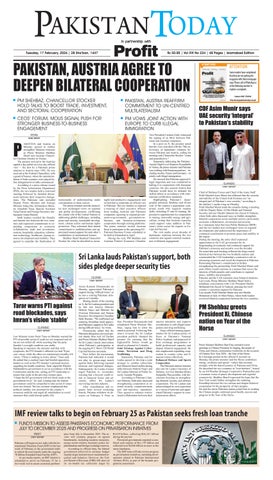
In a post on X the premier noted that the visit coincided with the 70th anniversary of diplomatic relations between Pakistan and Austria, calling his meeting with Chancellor Stocker “warm and prproductive "

the United Nations in addressing global challenges including peace and security sustainable development climate action and human rights protection They reiterated their shared commitment to multilateralism and appreciated mutual support for each other’s candidatures at international forums Shehbaz Sharif thanked Chancellor Stocker for what he described as mean-

ingful and productive engagements and invited him to undertake an official visit to Pakistan The two leaders co-chaired a meeting of chief executive officers from leading Austrian and Pakistani companies, agreeing to expand government-to-government government-tobusiness and business-to-business cooperation through existing platforms

The prime minister invited Austrian firms to participate in the upcoming EUPakistan Business Forum scheduled to be held in Islamabad in April During the visit PM Shehbaz and Austrian Federal Economic Chamber

Separately addressing the Pakistan–Austria High-Level Business Roundtable in Vienna, the prime minister said Pakistan was working with European partners including Austria, France and Germany to jointly curb illegal immigration He stressed that Pakistan opposed illegal migration and was committed to halting it in cooperation with European countries He also assured Austria that Pakistan would meet its demand for skilled labour in accordance with international certification standards Highlighting Pakistan’s demographic potential Shehbaz said 60 per cent of the country s population comprised youth who required modern skills, including IT and AI training He pointed to opportunities for cooperation in mining renewable energy and agriculture noting that Austrian expertise could support value addition in Pakistan s citrus sector for exports to Europe and beyond The visit marks seven decades of diplomatic relations between the two countries and signals renewed momentum in bilateral engagement

S ri L ank a lauds Pakistan's suppor t, both sides pledge deeper sec urity ties

COLOMBO s ta f f r e p o r t

Anura Kumara Dissanayake on Monday appreciated Pakistan s support during “difficult times” as he met a visiting Pakistani delegation in Colombo Sharing details of the meeting on X the Sri Lankan president said he had met Interior Minister Mohsin Naqvi and Minister for Overseas Pakistanis and Human Resource Development Chaudhry Salik Hussain “We reaffirmed our enduring friendship [and] appreciated Pakistan s support to Sri Lanka during difficult times, he wrote Dissanayake added that the Pakistani delegation conveyed special thanks from Asif Ali Zardari and Prime Minister Shehbaz Sharif for Sri Lanka s timely intervention when Pakistan s participation in the ongoing ICC Men s T20 World Cup had become uncertain Days before the tournament, Pakistan had indicated it would not play its group-stage match against India following regional tensions and logistical changes

Subsequently, Sri Lanka Cricket urged Pakistan to reconsider, warning that a boycott could result in financial losses and adversely affect Sri Lanka’s recovering tourism industry

After consultations and requests from several cricketing boards, Pakistan withdrew its decision on February 9 Prior to

that President Dissanayake had telephoned Prime Minister Shehbaz urging him to allow the match to proceed Following Pakistan s reversal, the Sri Lankan president publicly thanked the premier for ensuring that the high-profile fixture would go ahead as planned in Colombo Joint Strategy Against Cybercrime, Terrorism and Drug Trafficking Separately, Pakistan and Sri Lanka agreed to develop a joint strategy to combat cybercrime and financial fraud mafias during talks between Mohsin Naqvi and Sri Lankan Minister of Public Security Ananda Wijepala

The Pakistani interior minister also met Sri Lanka s Secretary of Defence, Air Vice Marshal (Retd ) Sampatha Thuyacontha, with discussions focusing on strengthening bilateral security and defence cooperation The Sri Lankan side acknowledged its own experience as a

According to Pakistan’s Interior Ministry both sides discussed strengthening cooperation in internal security counterterrorism and anti-narcotics operations They agreed to enhance institutional collaboration between their interior ministries and improve coordination to curb illegal immigration and drug trafficking Naqvi offered training opportunities for Sri Lankan police officers at Pakistan’s National Police Academy and proposed officer exchange programmes to build professional capacity and deepen bilateral engagement He also emphasised expanding cooperation to counter cyber and financial crimes effectively Enhanced Defence and Sports Cooperation

PSX CLOSES AT A LOSS OF MORE THAN 5000 POINTS AS SELLING PRESSURE INTENSIFIES

Petroleum Division warns of operational risks due to fur ther cuts in RLNG cargoes for 2026

petroleum These projections were also incorporated into the Wood Mackenzie study to determine Net Proceed Differential (NPD) cargo volumes

demand fluctuations within a tolerance range of 5–10 percent and adhere to previously agreed volumes

The Petroleum Division has raised concerns over a request by the Independent System and Market Operator (ISMO) to further reduce RLNG cargoes for 2026, warning that additional cuts could conflict with agreed planning benchmarks and create operational disruptions Business Recorder reported In a communication to the Power Division, Special Secretary Petroleum Mirza Nasiruddin Mashhood Ahmad referred to ISMO’s letter dated December 13 2025 in which RLNG demand for the power sector for calendar year 2026 was revised downward once again Under the LNG Sale and Purchase Agreements (SPAs) with Qatar, the Annual Delivery Plan (ADP) must be finalised by October 15 for the following calendar year The Petroleum Division said that RLNG volumes for 2026 had already been confirmed in line with the Integrated Generation Capacity Expansion Plan (IGCEP) during meetings cochaired by the ministers for power and

The ADP for 2026 was finalised with QatarEnergy on November 30 2025 However ISMO s subsequent revision proposes significant monthly changes that could result in a surplus of around 10 additional LNG cargoes beyond previously adjusted volumes

The Petroleum Division maintains that further revisions at this stage are not feasible as they would create a mismatch between IGCEP-based requirements and revised power-sector demand Officials warned that earlier demand adjustments have already caused operational strain including high line pack pressures and curtailment of approximately 200 million cubic feet per day (MMCFD) of indigenous gas to maintain system stability The division cautioned that continued reductions could risk damage to gas fields and reduce non-tax revenues for the government

The Power Division has been advised to manage intra-day and inter-day

Separately the federal cabinet has approved diversion of between 24 and 29 surplus LNG cargoes from Qatar under the NPD mechanism for 2026 due to declining gas demand, mainly from the power sector The surplus has posed financial and operational challenges for Sui Northern Gas Pipelines Limited (SNGPL)

Earlier Pakistan LNG Limited (PLL) and Eni sold 11 surplus cargoes during 2025 under NPD arrangements, while five Qatar-sourced cargoes were deferred through negotiations by the Petroleum Division and Pakistan State Oil (PSO)

Projections indicate that around 177 additional cargoes could become surplus between July 2025 and December 2031, equivalent to roughly 24 cargoes per year SNGPL and PSO have recommended engaging QatarEnergy for rescheduling reducing committed volumes or increasing power-sector offtake

PAkiSTAN iN ADvANCeD TALkS

c ybersecurity

Iran says potential energy, mining and aircraft deals on table in talks with US g

“For the sake of an agreement’s durability, it is essential that the U S also benefits in areas with high and quick economic returns foreign ministry deputy director for economic diplomacy Hamid Ghanbari said, according to the semi-official Fars news agency

“Common interests in the oil and gas fields joint fields mining investments and even aircraft purchases are included in the negotiations Ghanbari said arguing that the 2015 nuclear pact with world powers had not secured U S economic interests In 2018, Trump withdrew the

U S from the pact that had eased sanctions on Iran in exchange for curbs on its nuclear programme and re-applied tough economic sanctions on Tehran On Friday, a source told Reuters that a U S delegation including envoys Steve Witkoff and Jared Kushner would meet Iranian officials in Geneva on Tuesday a meeting later confirmed to Reuters by a senior Iranian official on Sunday Steve Witkoff and Jared Kushner will be traveling, I think they are traveling right now, to have important meetings and we’ll see how that turns out ” Rubio said without providing further details While talks leading to the 2015 nuclear pact were multilateral the current negotiations are confined to Iran and the United States, with Oman acting as mediator Iran’s Foreign Minister Abbas Araqchi left Tehran for Geneva to take part in the indirect nuclear talks with the U S and meet the head of the UN nuclear watchdog, the IAEA, and others, his ministry said

COMMENT

ST R AT E G I C partnership, time-tested, all weather, higher than mountains deeper than Arabian Sea, mutually beneficial most enviable friendship between the neighbouring countries of China and Pakistan continue to be further consolidated promoted strengthened and expanded with every passing day through the frequent high-level contacts and visits between the top leaderships between Beijing and Islamabad The positive development trajectories of both the countries have surely and certainly injected strong momentum into China-Pakistan all strategic cooperative partnership Quite frequent high-level mutual visits by top leadership have been making positive contributions in boosting the time-tested mutually beneficial friendship between the two countries Chinese President Xi Jinping has been holding talks in a free and frank manner further cementing the bilateral relation as and whenever President Asif Ali Zardari and Prime Minister Mohammad Shehbaz Sharif visit China These meetings have been reaching important and quite significant consensus that have charted the blueprint and provided guidance for the advancement of bilateral relations Both Pakistan and China have issued an Action Plan to foster an even closer China-Pakistan community with a shared future in the new era

Practical cooperation was yielding productive results in abundance such as the Karakoram Highway Phase-11 necessitated by Dasu Dam construction, was in progress steadily, the new Gwadar International Airport has already been put into operation, the project “Training of 1000 young Pakistani agricultural professionals in China” has been quote successfully implemented the Lahore Orange Line Metro has by now carried more than 270 million passengers and high quality Pakistani products such as rice, sesame, and seafood have made an accelerated entry into the Chinese market, cooperation in the livelihood cooperation was evident from the fact that 50 thousand health kits have benefited the people of Balochistan province Chinese medical teams have brought hope to large number of families of children with congenital heart diseases People to people contacts and cultural exchanges between the two countries were also being promoted in an appreciable manner As mentioned above, high-level contacts between

China and Pakistan are continuing As new year 2026 started, Pakistan s Deputy Prime Minister/Foreign Minister Ishaq Dar visited China in the first week of January to attend the 7th round of China-Pakistan Foreign Ministers’ Strategic dialogue The two sides had a detailed exchange of views regarding bilateral relations and cooperation in wide-ranging areas including strategic and political cooperation, as well as cooperation on defence and security, economy, trade, investment, international and regional issues During the just commenced new year, strategic partnership and cooperation between the two countries in various fields and sectors topped by the great game Changer China-Pakistan Economic Corridor (CPEP) which was all set to enter its second phase after successfully accomplishing and completing large number of projects in different sectors in road, rail, industry, agriculture and mining enabling Pakistan achieve self-reliance and sustainable development Strategic partnership of the two countries was also discussed and highlighlated when Vice-Minister of the International Department of the Central Committee of the Communist Party of China (IDCPC) Sun Haiyan along with a delegation, visited Pakistan in second week of January and held a bilateral meeting with Prime Minister Muhammad Sharif besides other engagements and activities Her visit coincided with the 75th anniversary of Pakistan –China diplomatic relations which was being celebrated by holding meetings ceremonies and talks at the appropriate levels in Islamabad and Beijing every now and then Talking to her, the PM quite emphatically lauded China’s generous and consistent support to Pakistan particularly under CPEC emphasized the need for timely and effective implementation of projects under CPEC Phase-2 for further strengthening economic cooperation he said that the year 2026 had begun on a positive note with the successful visit to Beijing by our Deputy PM/Foreign Minister and the Interior Minister ’s visit to Shanghai while National Assembly Speaker ’s upcoming visit was also being planned and these visits duly reflected the growing momentum of

h y K a r a c h i k e e p s b u r n i n g ?

invest life savings into modest enterprises When fire destroys their stock records and premises there is rarely insurance to soften the blow The result is long term debt unemployment and downward social mobility At a city wide level, repeated destruction undermines investor confidence and pushes economic activity further into informality, reinforcing the very conditions that make disasters more likely There is also a broader strategic consequence Urban risk is often treated as a municipal issue separate from national economic planning In reality, a city that cannot protect its

markets cannot claim to protect its economy Karachi’s instability disrupts supply chains, weakens trade confidence and erodes trust in state capacity A city that burns regularly is not merely mismanaged; it is structurally vulnerable What makes Gul Plaza particularly troubling is not that it revealed unknown problems, but that it demonstrated how little has changed Karachi, a city of over 20 million people, is served by just 35 fire stations with limited modern equipment and specialised training Narrow roads unplanned growth and ageing infrastructure continue to obstruct emergency response These are not technical challenges without solutions; they are the result of policy choices that have consistently placed urban safety low on the list of priorities Preventing such disasters does not require grand visions or megaprojects It requires altering incentives Safety inspections must be mandatory and publicly disclosed Violations must carry real financial and legal consequences Responsibility must extend beyond junior officials to those who have benefited from unsafe construction and operation over decades Most importantly compliance must become cheaper than corruption Whether Gul Plaza becomes another footnote or a turning point depends less on promised inquiries than on political will Karachi will burn again if current patterns persist The question is whether this fire will be treated, once more, as an isolated tragedy or finally recognised as evidence of a system that has normalised preventable disaster

The writer can be reached at alinaijaz2006@gmail com

The deadly fire at Gul Plaza in Saddar on 17th January fits this pattern with unsettling precision At least 23 people were killed, dozens were repor ted missing, and one of KarachiÊs busiest commercial centres was reduced to ash Officials promised inquiries and compensation, as they have before For residents of the city, however, the scene felt familiar: smoke over a central market, blocked roads, exhausted firefighters and a rescue operation stretched across days.

unite

alina ijaZ
Rifat

One district’s water tale

WH E N 93 percent of water supply schemes in a single district fail to meet basic health standards, we are not witnessing administrative incompetence We are witnessing systematic abandonment Nawabshah officially renamed Shaheed Benazirabad but still known by its old name to most, represents everything catastrophic about Pakistan s approach to public health The numbers are devastating the political will absent and the consequences measured in preventable deaths particularly of children under five Pakistan ranks third globally among nations with insufficient water and sanitation, a distinction that should shame us all But nowhere is this crisis more acute than in central Sindh, where Nawabshah’s 1 8 million residents contend with water so contaminated that health officials warn against its consumption Recent assessments reveal that approximately 70 to 74 percent of drinking water in the Nawabshah district is unsuitable for human use, contaminated with everything from E coli bacteria to heavy metals, excessive sulfates and agricultural pesticides

This is not a natural disaster This is policy failure crystallized into disease The connection between contaminated water and death is direct and documented In 2017 alone, Pakistan reported 2 5 million deaths from diarrhea, with water contamination implicated in half the country’s diseases and 40 percent of its deaths Nationally waterborne illnesses kill nearly 94 000 people annually 56 percent of them children under five These are not statistics They are indictments When a nation allows more than half its child mortality to stem from something as preventable as clean water access, it has surrendered its moral authority

Nawabshah’s crisis extends beyond individual suffering to create regional and global health threats The district sits geographically proximate to Hyderabad, the epicenter of the extensively drug resistant typhoid outbreak that began in November

2016 Between that date and June 2021, Sindh province reported 5,741 confirmed cases of XDR typhoid excluding Karachi with 69 5 percent concentrated in District Hyderabad Recent data shows that 57 percent of typhoid isolates from Pakistani laboratories between 2017 and 2019 were extensively drug resistant, rendering this once easily curable disease potentially untreatable This antibiotic resistant strain has already spread internationally to the United States United Kingdom Canada Australia and Denmark through travelers transforming a local sanitation failure into a global health security threat

The business community’s response to this crisis reveals both opportunity and moral bankruptcy The global hygiene products market valued at 595 billion dollars in 2024 and projected to reach 808 billion by 2033 thrives on the very conditions that kill Pakistan s children Companies develop biodegradable formulations, recyclable packaging, and natural ingredients for consumers in wealthy nations while Pakistan’s poorest quintiles bear disproportionate costs for waterborne illness A single episode of typhoid costs an affected household 32 640 rupees, malaria 5,688 rupees, and diarrhea 1,757 rupees, amounts that devastate families already struggling for survival Pakistan’s own hygiene products market demonstrates both domestic demand and the inadequacy of market solutions alone Major brands like Unilever and Reckitt Benckiser dominate the soap and detergent sector yet half the population lacks a dedicated handwashing facility with soap at the household level according to the 2018 to 2019 Pakistan Social and Living Standards Measurement survey This reveals the fundamental fallacy of treating public health as a consumer market problem No amount of product innovation can substitute for infrastructure investment, regulatory enforcement, and political accountability The infrastructure deficit in Nawabshah is staggering and getting worse The Shaheed Benazirabad Municipal Corporation oversees water supply and waste management across

19 union committees but operates with deteriorating drainage systems, insufficient treatment capacity and inadequate solid waste management Up to 80 percent of groundwater in Sindh s canal irrigated zones including Nawabshah is saline and unsuitable for drinking or irrigation without treatment, a fact that accelerates both soil degradation and agricultural decline Deputy commissioners repeatedly order emergency improvements to drainage and water supply schemes but emergency measures cannot fix systemic neglect

The district s literacy rate of just 50 86 percent compounds every other challenge When seven out of ten residents cannot read warning labels, public health campaigns become exercises in futility When families lack basic knowledge about disease transmission even access to soap cannot guarantee proper hygiene practices The People s Medical University Hospital in Nawabshah functions as the principal tertiary referral center, but no hospital can treat its way out of contaminated water supplies The common waterborne diseases reported throughout the district gastroenteritis diarrhea typhoid hepatitis kidney problems and skin conditions reflect failures upstream from medical intervention International organizations recognize what Pakistan s government apparently does not The World Health Organization estimates that unsafe water, sanitation, and hygiene services contribute to 74 million disability adjusted life years lost globally representing 2 5 percent of total global disease burden The Centers for Disease Control and Prevention reports that 2 3 billion people globally lack access to basic handwashing facilities with soap and water at home while 670 million people have no handwashing facilities whatsoever Yet research consistently demonstrates that promoting handwashing with soap can reduce diarrheal disease incidence by 30 percent, potentially preventing one million deaths from diarrheal diseases alone

The economic burden is as crushing as the health toll In 2018 to 2019 WASH related illnesses in Pakistan led to 32 million

The infrastructure deficit in Nawabshah is staggering and getting worse The Shaheed Benazirabad Municipal Corporation oversees water supply and waste management across 19 union committees but operates with deteriorating drainage systems, insufficient treatment capacity, and inadequate solid waste management

lost days and imposed an economic burden of 116 billion rupees That calculation only captures direct costs, ignoring lost productivity, reduced educational attainment, and intergenerational poverty perpetuation When children spend their formative years battling preventable diseases when families bankrupt themselves treating waterborne illnesses when communities lose their most productive members to typhoid and hepatitis, economic development becomes impossible

Some will argue that Pakistan lacks resources for massive infrastructure investment This is convenient fiction The country finds billions for other priorities for motorways and monuments, for military spending and political patronage What it lacks is political will and accountability

When municipal corporations can oversee districts where 93 percent of water schemes fail safety standards without facing consequences when outbreaks of extensively drug resistant typhoid spread from one district to encompass an entire province and then the world, when half the country s deaths stem from contaminated water without triggering governmental urgency the problem is not resources The problem is priorities Nawabshah needs emergency interven-

The

The unique resilience of Iran’s theocracy

It

But the elites in Iran enjoy more than a sticky ide-

ON January 8 a general of the Islamic Revolutionary Guard Corps (IRGC) appeared on state television with a message for Iranians: Hold onto your children After two-weeks of country-wide protests, the regime was issuing one final

disguised as a plea to parents to bring their sons and daughters off the streets That night, it would begin the bloodiest crackdown against its civilians since coming to power in 1979 killing anywhere from 3 000 to 36 000 in the days to come It is a sign of how vulnerable the regime feels that it resorted to such violence Its leaders are right to be nervous Economically, the country is in shambles, with the value of its currency dropping to record lows (1,445,000 rials to the dollar in December) Strategically it suffered the indignity of being bombed by both Israel and the United States last summer while its regional proxy network collapsed Socially this was the sixth mass protest in a decade and saw nearly all segments of society join in (including the more conservative merchant class) After five decades, the mullahs have little to show for themselves but hyperinflation, strategic humiliation and a population that prefers secular democracy to clerical rule

And yet despite its weakness the regime displayed a disquieting will to stay alive A month after the early January massacres, the protests have quelled, and the regime seems to have survived yet again Tragic as it is, we should not be surprised Iran’s particular blending of Shia resistance theology and its prescribed authoritarian political structure has yielded a system uniquely insulated against popular discontent Fostering a peaceful collapse will take more time and a careful exploitation of the regime s weak points

ELITE UNITY: Political scientists rarely agree on anything, but a few topics command broad assent Among these is that popular (or social) revolutions can succeed only when there is a major cleavage in the reigning elite Where there is elite unity the likelihood of success diminishes considerably This was the key insight made by Theda Skocpol in her 1979 work, States and Social Revolutions To put it more starkly, the most determined, popular, well-organized revolution will fail if the state apparatus remains unified and has the will to survive Accordingly one key to figuring out whether a popular revolution stands a chance is if there is major infighting

between or defections from the elites in the protested regime In Iran there weren t any In many other countries, either an economic crash or a military defeat could alone suffice to generate the kind of elite cleavage necessary to cripple the state But the Islamic Republic is a different kind of beast Part of the regime’s advantage is the substantive teaching of its founding ideology Unlike other twentieth-century ideologies Khomeinism is explicitly (and fanatically) religious, granting its adherents the confidence that God is on their side It is one thing for a secular dictator to walk away from power and live in comfortable exile; it is another for a believing man to turn his back on God The former faces shame and irrelevance The latter faces shame irrelevance and eternal damnation Put differently the costs of defection are higher in theocratic regimes This problem is accentuated by the specifically Shia brand of Islamism animating Iran All countries honor their dead But in Iran, they are worshipped This is in part because Shia Islam is drenched in sacrificial tragedy more so than most religions and certainly more so than other branch of Islam

Shi ism begins in a sense with the martyrdom of Imam Hussein (Prophet Muhammad s PBUH grandson and third Imam according to Shias) at the Battle of Karbala in 680 AD His death at the hands of the Umayyads infused Shia Islam with a sense that the world is fundamentally unjust that tyrants will trample over the righteous that struggle is a virtue and that one who dies on behalf of God is walking in the path of the Imams Tehran has made ample use of the Karbala metaphor, comparing itself to Hussein and the West to the Umayyads since the beginning It has also acted on this comparison, notably when it sent hundreds of thousands to die in the Iran-Iraq war a point Ayatollah Khamenei reminded listeners of during the January protests

Stepping back from the religious dimension the specific historical narrative told by Khomeinism lends itself, as Haviv Rettig Gur put it, to a zero sum view of the world According to Khomeinism, the West seeks no less than the destruction of Islam Accordingly, the chief aim of the regime is resistance against Western “imperialism The more the country suffers the more elites can tell themselves (and those in the population who will listen) that the West continues to seek its destruction In such an ideological frame, high losses are easily recast as evidence of righteousness, not of policy failure; as showing a willingness and capacity to survive ” The regime can grind on in full conviction that the blood in the streets is a consequence of imperialist meddling not regime corruption or incompetence We should not underestimate the confidence these dimensions of Khomeinism give to regime leaders or the lengths they are willing to go to fulfill their divine mandate It was revealing how committed the regime remained to Khomeinism in the aftermath of the Woman, Life Freedom protests in 2022 when it refused to relax laws requiring women to wear head coverings Instead of compromising and appeasing its frustrated populace it dug in its heels in defense of medieval legislation

ology They also benefit from military and political institutions consciously designed to lock in the Islamist character of the 1979 revolution and withstand public pressure for reform As I’ve written previously, Iran has a parallel military system consisting of the formal armed forces (Artesh) and the more ideologically infused IRGC (Sepah) The IRGC both checks the armed forces and oversees paramilitary units (the Basij) whose formal charge includes defend[ing] neighborhoods in case of emergency Put more directly, the IRGC is a revolutionary institution specially tasked with making sure another revolution doesn’t succeed

This poses major problems for any popular uprising In most cases it is both necessary and difficult to flip the military to the protesters side In Iran doing so without major buy-in from the IRGC could trigger civil war

On the political side, Khomeini deliberately designed a regime that maximized the power of the “guardian jurist” in the office of the Supreme Leader Because he was meant to be the wisest and most morally pure the guardian jurist could do with minimal legal constraints Accordingly Iran s institutional design gives significant discretion to the Supreme Leader Ali Khamenei In addition to appointing chiefs and department heads in the armed forces (both Artesh and Sepah), the Supreme Leader also appoints half of the members of the Guardian Council, who in turn vet candidates for the Assembly of Experts (on paper the primary check on the Supreme Leader) Both the Assembly of Experts and the Guardian Council in turn vet candidates for Iran s Parliament and can disqualify candidates even after they secure an election Most political roads lead back to the Supreme Leader Khamenei has always taken advantage of these institutional strings to ensure committed Khomeinists remained in charge In recent years however the regime has shrunk the space for dissenting opinions even further in an effort at political purification For example in the 2024 elections to the Assembly of Experts, the Guardian Council barred previous incumbents from running, including moderate reformers like former president Hassan Rouhani Regime meddling and strategic vetting have yielded a similar “hardline” trajectory in the Iranian parliament such that voter participation dropped to its lowest in 2024 (at 41 percent compared to 62 percent two cycles previously) These trends indicate a weakening legitimacy of the regime, but they also suggest consolidation of a more stringently conservative elite, even less likely to defect now than ten years ago LOOKING AHEAD: The substance of Khomeinism and its attendant political structures provide regime officials unique durability against unrest, but they do not make the regime invincible Like all authoritarian arrangements, the

Maria Keerio

LAHORE S ta f f r e p o r t

Provincial Minister for Information and Culture Punjab, Azma Bokhari, has extended heartfelt congratulations to the newly elected officebearers of the Punjab Union of Journalists (PUJ) She conveyed her best wishes to the newly elected President Naeem Hanif, Secretary Qamar Bhatti, and the entire body Azma Bokhari stated that the Punjab Union of Journalists has a long and

commendable history of struggle for press freedom and the protection of journalists rights She acknowledged that PUJ has consistently played a frontline role in addressing the issues faced by the journalist community and has effectively represented journalists during challenging times The Provincial Minister reaffirmed the Punjab Government s commitment to ensuring the protection welfare and resolution of issues concerning journalists She emphasized that under the leadership of

complete the development works in both sectors The housing sectors were originally launched in 2015 but faced delays due to various administrative and legal issues However as a result of sustained efforts to resume the stalled works development activities have now gained renewed momentum Sectors F14 and F-15 comprise approximately 11 000 residential plots spread over 10,875 kanals, located at a prime site in Islamabad Speaking on the occasion, the Federal Minister for Housing and Works expressed satisfaction that FGEHA’s housing sectors are gradually coming back on track

by senior government representatives and leadership from VEON and Nutshell Group including Bilal Azhar Kayani, Minister of State for Finance

Chief Minister Maryam Nawaz the journalist community remains among the top priorities of the provincial government and practical measures in this regard will continue Azma Bokhari expressed hope that the newly elected PUJ leadership will perform its responsibilities with sincerity and professionalism playing an active role in safeguarding journalists rights and resolving their concerns thereby further strengthening journalistic values in the province

Jaz z and Universal Ser vice Fund Sign Badin Project to Expand Digital Connectivit y in Sindh

Jazz and the Universal Service Fund (USF) have taken another step to expand digital connectivity in Sindh with the signing of the Badin Project aimed at bringing reliable mobile voice and broadband services to underserved communities in District Badin The agreement formalized at a ceremony in Karachi, reflects a shared effort to extend meaningful digital access to areas where connectivity has remained limited The ceremony was attended by the Honorable Governor of Sindh Mr Kamran Tessori and the Federal Minister for IT & Telecom Ms Shaza Fatima as Chief Guests The project marks continued progress in strengthening telecom infrastructure to support inclusive digital access across the province The PKR 668 million Badin Project will strengthen telecom access in the district by deploying 45 new telecom sites and upgrading four existing ones extending reliable voice and highspeed mobile broadband services to 144 unserved and underserved mauzas and reaching an estimated 0 43 million people

IGP Islamabad directs enhanced securit y and public facilitation measures during Ramadan

ISLAMABAD S ta f f r e p o r t Inspector General of Police (IGP) Islamabad Syed Ali Nasir Rizvi held an important meeting at the Central Police Office The meeting was attended by DIG Headquarters Malik Jameel Zafar, AIG Logistics Abdul Haque Umrani, AIG General Syed Inayat Ali Shah, SSP Prisons Ali Akbar, and other senior police officers During the meeting a comprehensive strategy was discussed to provide maximum facilitation and security to citizens during the holy month of Ramadan The IGP Islamabad directed all officers to further strengthen security measures at mosques, imambargahs, commercial centers, Ramadan bazaars, and other important public places He also emphasized maintaining smooth traffic flow preventing street crime increasing patrol duties and making emergency response more effective Furthermore special instructions were issued to ensure proper arrangements for the welfare of police officers and

PTI resumes sit-in outside KP House; Police register c ase over Red Zone protest

t

The Pakistan Tehreek-e-Insaf (PTI) on Monday resumed its sit-in outside Khyber Pakhtunkhwa House after briefly calling it off earlier in the day The decision came after a meeting of the PTI K-P Parliamentary Party chaired by Chief Minister Sohail Afridi, where members reviewed their strategy and discussed the health report of party founder Imran Khan received on Sunday Former chief minister Ali Amin Gandapur and other party leaders attended the meeting Following consultations, around 90 parliamentarians returned to the protest site chanting slogans and blocking the road once again Sources said the sit-in would continue until Leader of the Opposition in the National Assembly Mahmood Khan Achakzai announced its conclusion Earlier, the protest had appeared to wind down as Afridi and Gandapur left the venue and adjoining roads were

Describing the findings as alarming Khosa said Sunday s medical examination at Adiala Jail was conducted without prior notice to the family personal doctors or legal representatives He rejected claims that the family had been informed but chose not to attend, terming such as-

Central Spokesperson of the Pakistan Peoples Party (PPP) Shazia Marri on Monday criticised the federal government for increasing petrol and high-speed diesel (HSD) prices just days before Ramzan, calling the move “unjust” and “highly unfair ” The government on Sunday night raised petrol by Rs5 per litre and HSD by Rs7 32 per litre bringing the ex-depot price of petrol to Rs258 17 per litre and HSD to Rs275 70 per litre

Officials

briefly reopened However the sit-in by opposition MNAs at Parliament House continued, with Achakzai, Leader of the Opposition in the Senate Allama Nasir Abbas former NA speaker Asad Qaiser and PTI Secretary General Salman Akram Raja present PTI Chairman Barrister Gohar Ali Khan told the media that the party was awaiting the founder s medical report, which would be made public Supporters also staged a protest outside the Lahore High Court at GPO Chowk demanding Imran’s release The demonstration included PTI MPA Imtiaz Mahmood Sheikh Information Secretary Faiza Murad, lawyers and party workers Meanwhile, Minister of State for Interior Talal Chaudhry rejected claims that opposition lawmakers were denied food and water during the protest calling the allegations misleading He accused some protesters of misusing parliamentary premises and bringing non-parliamentarians, including armed individuals, into Parliament Lodges

sertions “wholly incorrect” According to Khosa Imran had repeatedly sought access to his personal physicians Dr Faisal Sultan and Dr Asim Yousaf, for independent examination and treatment of his deteriorating eyesight, but such access was not granted

households were already struggling with record inflation She said the move was highly unfair and unwise and criticised the government for imposing additional financial burdens on the public ahead of the holy month Marri warned that the increase would severely affect low-income

families labourers and the middle class, while also triggering a rise in food and transportation costs She urged the government to focus on providing relief to citizens rather than compounding economic hardships

Highlighting what she called policy contradictions she pointed out that the government was simultaneously announcing a Ramzan relief package while approving measures that would push up inflation “On one hand the government is announcing a Ramzan relief package while on the other it is fuelling inflation through price hikes It is a clear policy failure, she said She called on the federal government to immediately review and withdraw the increase in petroleum prices and take concrete steps to address unemployment inflation and the broader economic crisis ensuring tangible relief for the public ahead of Ramzan

SHANGLA s ta f f r e p o r t

The Counter Terrorism Department Khyber Pakhtunkhwa (CTD KP) conducted its first-ever independent targeted operation in Kabalgram, District Shangla, following credible intelligence about the presence of a militant “FAK Tashkeel” posing a serious threat to law enforcement agencies and development projects in the region

According to operational details, intelligence reports indicated that high-value targets (HVTs) were residing in natural cave complexes in the mountainous terrain, with active facilitation from local elements Additional militants were reportedly positioned inside the village to provide logistical support and reinforcements Security officials said earlier VBIED attacks targeting Chinese nationals had been traced back to networks linked with this group The proximity of the militant pres-

ence to the Karakoram Highway (KKH) was assessed as significantly elevating the threat to Chinese projects and strategic road infrastructure

The operation was launched at 6:30am in coordination with local police after detailed planning Contact and Engagement

with armed militants In the ensuing exchange of fire three suspected terrorists were killed Among the deceased was Noor Islam alias Salman alias Khog Bacha, son of Zaman Wali, a resident of Kabalgram and described as the Shangla “masool” and an ex-member of the banned Tehreek-e-Taliban Pakistan (TTP) faction He was listed in the CTD K-P Red Book and carried a head money of Rs5 million CTD KP conducts

As CTD teams advanced toward the identified cave-based hideouts they established contact

Turn static files into dynamic content formats.

Create a flipbook