In partnership with
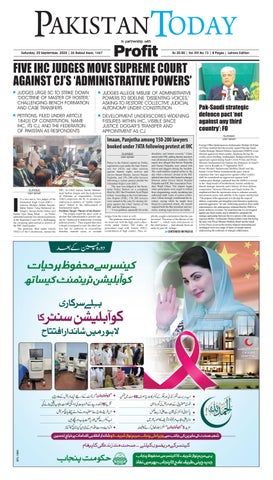
FIVE IHC JUDGES MOVE SUPREME COURT AGAINST CJ’S ‘ADMINISTRATIVE POWERS’ Saturday, 20 September, 2025 | 26 Rabiul Awal, 1447
g
g
JUDGES URGE SC TO STRIKE DOWN ‘DOCTRINE OF MASTER OF ROSTER,’ CHALLENGING BENCH FORMATION AND CASE TRANSFERS
PETITIONS, FILED UNDER ARTICLE 184(3) OF CONSTITUTION, NAME IHC, ITS CJ, AND THE FEDERATION OF PAKISTAN AS RESPONDENTS
g
g
Profit
Rs 20.00 | Vol XVI No 73 | 8 Pages | Lahore Edition
JUDGES ALLEGE MISUSE OF ADMINISTRATIVE POWERS TO SIDELINE ‘DISSENTING VOICES,’ ASKING TO RESTORE COLLECTIVE JUDICIAL AUTONOMY UNDER CONSTITUTION DEVELOPMENT UNDERSCORES WIDENING FISSURES WITHIN IHC, VISIBLE SINCE JUSTICE DOGAR’S TRANSFER AND APPOINTMENT AS CJ
Imaan, Panjotha among 150-200 lawyers booked under 7ATA following protest at IHC ISLAMABAD
Staff report
I
ISLAMABAD
Staff report
N a rare move, five judges of the Islamabad High Court (IHC) — Justices Mohsin Akhtar Kayani, Babar Sattar, Tariq Mehmood Jahangiri, Saman Rafat Imtiaz and Sardar Ejaz Ishaq Khan — on Friday submitted separate but identical petitions in the Supreme Court (SC), challenging the sweeping administrative powers of the IHC chief justice. The petitions, filed under Article 184(3) of the Constitution, named the
IHC, its Chief Justice Sardar Muhammad Sarfraz Dogar, and the Federation of Pakistan as respondents. Article 184(3) empowers the SC to assume jurisdiction in matters of “public importance” linked to the enforcement of fundamental rights. Petitions Target ‘Master of the Roster’ The judges urged the apex court to declare that administrative powers cannot be “deployed to undermine or trump judicial powers.” They argued that once a bench is assigned a case, the chief justice has no authority to reconstitute benches, transfer cases, or exclude
Police in the federal capital on Friday registered a case under the Anti-Terrorism Act (ATA) and other sections against human rights activist and lawyer Imaan Mazari, lawyer Naeem Panjotha, and 150–200 other lawyers following a violent protest outside the Islamabad High Court (IHC). The case was lodged at the Secretariat Police Station on a complaint filed by IHC Bar President Syed Wajid Gilani. According to the First Information Report (FIR), 150–200 lawyers were named in the case for raising slogans against the Chief Justice of the IHC and the Pakistan Army. “I was grabbed, repeatedly hit on the
judges from the roster at will. The petitions stressed that such powers must rest with the high court collectively under Article 202 (rules of procedure) read with Article 192(1) (constitution of high courts). They ex-
shoulders, and beaten severely,” Gilani stated in the FIR, adding that the attackers were all dressed in lawyers’ uniforms. The report also alleged that Intizar Panjotha and Naeem Panjotha were armed with knives and daggers during the incident. The confrontation erupted earlier in the day when a lawyers’ protest at the IHC spiraled into chaos after heated exchanges between senior lawyer Intizar Hussain Panjotha and IHC Bar Association President Wajid Gilani. The dispute began when participants were urged to refrain from sloganeering, nearly escalating into a physical clash. Later, at a press conference, Gilani strongly condemned the incident, saying while he might have forgiven a personal attack, the assault targeted both the Bar president and secretary, making legal action inevitable.
plicitly sought a declaration that the controversial “Doctrine of the Master of the Roster” — which vests such powers in the chief justice — had already been set aside by past SC rulings.
CONTINUED ON PAGE 03
Pak-Saudi strategic defence pact ‘not against any third country’: FO ISLAMABAD
Staff report
Foreign Office Spokesperson Ambassador Shafqat Ali Khan on Friday clarified that the recently signed Pakistan-Saudi Arabia Strategic Mutual Defense Agreement (SMDA) is not directed against any third country. Speaking during the weekly press briefing, Ambassador Shafqat referred to the agreement signed during Saudi Crown Prince and Prime Minister Mohammed bin Salman bin Abdulaziz Al Saud’s state visit to Riyadh on 17 September 2025. Prime Minister Muhammad Shehbaz Sharif and the Saudi Crown Prince formalized the pact, which stipulates that “any aggression against either country shall be considered an aggression against both.” Ambassador Shafqat explained that the SMDA is rooted in the “deep bonds of brotherhood, Islamic solidarity, shared strategic interests, and a history of close defence cooperation” between Pakistan and Saudi Arabia. He emphasized that the agreement aims to enhance security and promote peace and stability in the region and beyond. “The purpose of the agreement is to develop the scope of defence cooperation and strengthen joint deterrence against any potential aggression,” he said. Addressing questions from media representatives, the spokesperson reiterated that the SMDA is purely defensive in nature. He underlined that it is not targeted against any third country and is intended to safeguard the strategic partnership between the two nations while ensuring regional stability. Ambassador Shafqat further noted that during the state visit, Prime Minister Shehbaz Sharif and the Saudi Crown Prince reviewed the historic bilateral relationship and exchanged views on a range of issues of mutual interest, underscoring the continuity of strategic collaboration.