In partnership with
Profit
terrorists ISLAMABAD, RIYADH ENTER HISTORIC Five killed in Khuzdar IBO: ISPR ‘MUTUAL DEFENCE PACT,’ PLEDGING JOINT RESPONSE TO ANY AGGRESSION Thursday, 18 September, 2025 | 24 Rabiul Awal, 1447
Rs 20.00 | Vol XVI No 71 | 8 Pages | Karachi Edition
KHUZDAR
staff report
g
AGREEMENT REFLECTS SHARED COMMITMENT OF BOTH NATIONS TO ENHANCE THEIR SECURITY, ACHIEVE SECURITY AND PEACE IN REGION AND WORLD
P g
g
IT AIMS TO DEVELOP ASPECTS OF DEFENSE COOPERATION BETWEEN TWO COUNTRIES AND STRENGTHEN JOINT DETERRENCE AGAINST ANY AGGRESSION
SAUDI CROWN PRINCE, PREMIER SHEHBAZ EXCHANGE DOCUMENTS OF ‘STRATEGIC MUTUAL DEFENSE AGREEMENT’ (SMDA) AFTER ITS SIGNING AT YAMAMAH PALACE RIYADH/ISLAMABAD saleem JaDooN
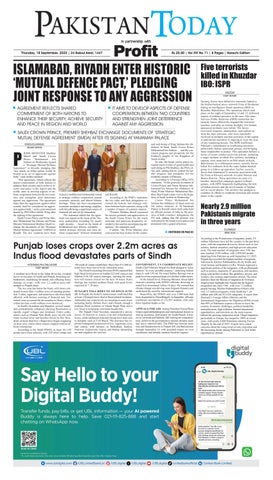
RIME MINISTER Shehbaz Sharif and Saudi Crown Mohammed bin Prince Salman on Wednesday signed a “Strategic Mutual Defence Agreement” in Riyadh, pledging that “any attack on either nation would be treated as an act of aggression against both,” state media reported. “This agreement, which reflects the shared commitment of both nations to enhance their security and to achieve security and peace in the region and the world, aims to develop aspects of defense cooperation between the two countries and strengthen joint deterrence against any aggression. The agreement states that any aggression against either country shall be considered an aggression against both,” said a joint statement shared by PM Office Media Wing after the signing of the agreement. Saudi Crown Prince and Prime Minister Muhammad bin Salman and Prime Minister Muhammad Shehbaz Sharif exchange the documents of the “Strategic Mutual Defense Agreement” (SMDA) in Riyadh. The two countries have been
locked a multifaceted relationship rooted in strategic military cooperation, mutual economic interests, and shared Islamic heritage. These ties have encompassed economic assistance and energy supplies, with Riyadh being a significant source of financial aid and oil for Islamabad. The statement added that the agreement was signed on the basis of the “historic partnership extending for nearly eight decades … based on the bonds of brotherhood and Islamic solidarity … shared strategic interests and close defense cooperation” between Islamabad
and Riyadh. According to the PMO’s statement, the two sides and their delegations reviewed the historic and strategic relations between both countries, along with a number of topics of common interest. “Premier Shehbaz Sharif expressed his sincere gratitude and appreciation to the Saudi Crown Prince for the warm welcome and generous hospitality extended to him and his accompanying delegation,” the statement read. It added, “the Prime Minister also conveyed his best wishes for the contin-
ued well-being of King Salman bin Abdulaziz Al-Saud, Saudi Crown Prince Mohammed bin Salman … and the continued progress and prosperity for the brotherly people of the Kingdom of Saudi Arabia.” In turn, the Saudi crown prince extended warm wishes of good health and well-being to PM Shehbaz, the PM’s office said, adding that he wished for further progress and prosperity for the brotherly people of Pakistan. According to a Foreign Office (FO) statement, “At the gracious invitation of Crown Prince and Prime Minister Mohammed bin Salman bin Abdulaziz Al Saud, Prime Minister Muhammad Shehbaz Sharif paid a state visit to the Kingdom of Saudi Arabia on Wednesday.” Crown Prince Mohammed bin Salman bin Abdulaziz Al Saud received the prime minister at Al-Yamamah Palace in Riyadh where both sides held an official session of talks in the presence of both countries’ delegations, the FO said, adding that the premier was welcomed by the Saudi crown prince and presented with a guard of honour.
CONTINUED ON PAGE 03
Punjab loses crops over 2.2m acres as Indus flood devastates parts of Sindh HYDERABAD/MULTAN/LAHORE staff report
A medium-level flood in the Indus River has wreaked havoc across parts of Sindh and Punjab, breaching embankments, inundating farmland, and inflicting heavy damage on crops—with over 2.2 million acres submerged in Punjab alone. The rice crop has borne the brunt, with losses estimated at more than 1 million acres of standing production. Cotton, sugarcane, and maize have also been badly affected, with farmers warning of financial ruin. Torrential rains worsened the devastation in Obaro, where cotton harvests worth millions were destroyed. In Sindh’s Kandiaro and Manjhot, several zamindari embankments collapsed, allowing floodwaters to rapidly engulf villages and farmland. Entire settlements such as Ghulam Nabi Brohi were cut off, with roads washed away and families forced to flee. Residents of more than five villages have begun migrating on their own, while others remain trapped without official evacuation. According to the Sindh PDMA, at least 181,159 people have been affected, with 528 relief camps and
184 medical camps established. More than 471,000 animals have been moved from vulnerable areas. The Flood Forecasting Division (FFD) reported that high flood levels persist at Guddu (523,842 cusecs) and Sukkur (518,120 cusecs) barrages, warning the situation will remain critical for the next 36 hours. Kotri Barrage has reached medium flood, with peak levels expected in 7–10 days.
PUNJAB’S TOLL RISES TO 118 SINCE JUNE 25: In Punjab, the Relief Commissioner confirmed that at least 118 people have died in flood-related incidents. Authorities say water levels are receding at most rivers including Sutlej, Jhelum, Ravi, and Chenab, though a medium flood continues at Ganda Singh Wala and a low flood at Sulemanki and Islam headworks. The Punjab Chief Secretary announced a survey across 28 districts to assess crop and infrastructure losses, while additional tents and rations have been sent to hotspots such as Uch Sharif. The province has reported widespread destruction of rice, sugarcane, corn, and cotton, with farmers in Hafizabad, Sialkot, Narowal, Gujranwala, Gujrat, and Multan demanding tax and irrigation fee waivers.
GOVERNMENT, UN COORDINATE RELIEF: Sindh Chief Minister Murad Ali Shah pledged to assist farmers “in every possible manner,” endorsing federal plans to seek UN aid. He noted Sukkur Barrage was at peak level but expressed hope of a decline within hours. At the federal level, Planning Minister Ahsan Iqbal chaired a meeting with NDMA officials, directing an initial loss assessment within 10 days. He warned that climate change was driving more frequent disasters and underlined the need for international support. Meanwhile, the NDMA said over 5,000 tents had been dispatched to Muzaffargarh. In Sargodha, officials confirmed vaccination of 152,565 animals, with only three reported deaths so far. APPEALS FOR AID: Acting President Yousaf Raza Gilani urged philanthropists and international donors to step up assistance, particularly for South Punjab. Farmers in Arifwala and Qubula, still waiting for compensation, called on the government to declare disaster areas and waive tubewell bills. The PMD has forecast more rain and thunderstorms in Punjab, KP, and Balochistan through September 19, with potential impact on river catchments and already strained flood-hit regions.
Security forces have killed five terrorists linked to the Indian-backed proxy network Fitna al Hindustan during an intelligence-based operation (IBO) in Khuzdar, Balochistan. The operation, which took place on the night of September 14 and 15, followed reports of militant presence in the area. The InterServices Public Relations (ISPR) stated that the security forces effectively engaged the terrorists’ location, and after an intense firefight, five Indiansponsored militants were killed. The forces recovered weapons, ammunition, and explosives from the slain militants, who were reportedly involved in multiple terrorist activities in the region. A sanitisation operation is ongoing to clear the area of any remaining threats. The ISPR reaffirmed Pakistan’s commitment to eradicating terrorism, particularly Indian-sponsored groups, and bringing those responsible to justice. This operation follows a series of recent counter-terrorism actions, including a tragic incident in which five soldiers, including a captain, were martyred in an IED attack in Kech, Balochistan. In a subsequent action, security forces killed five militants from the same Indian-backed group in a follow-up operation. Earlier, security forces had eliminated 31 terrorists associated with the Fitna al Khwarij network in Lakki Marwat and Bannu districts. These operations are part of a broader, intensified campaign against militant groups, with ISPR frequently highlighting the role of Indian proxies and the involvement of Afghan soil in recent attacks. The military has pledged to continue its efforts to eradicate terrorism and restore peace in the region.
Nearly 2.9 million Pakistanis migrate in three years ISLAMABAD News Desk
According to the Protectorate of migrants, nearly 2.9 million Pakistanis have left the country in the past three years, with the migration driven by factors such as low salaries, limited amenities, and high private education costs. The total number of emigrants since 1981 has now reached 13.89 million, with 2,894,645 people departing from Pakistan up until September 15, 2025. Punjab has recorded the highest number of migrants, followed by Khyber-Pakhtunkhwa (K-P), Sindh, and Azad Jammu and Kashmir (AJK). Women represent a significant portion of the emigrants, with professionals such as doctors, engineers, IT specialists, and teachers, along with skilled workers like plumbers, drivers, and welders, also seeking opportunities abroad. The latest statistics from the Bureau of migration & Overseas Employment highlight that Punjab has the highest emigration rate since 1981, with over 7.2 million people leaving. Khyber-Pakhtunkhwa follows with over 3.5 million emigrants, while Sindh has 1.28 million and AJK has 813,526 emigrants. A report from Denmark’s Foreign Affairs Ministry and the International Organization for Migration (IOM) reveals that 40% of Pakistanis express a desire to leave the country. Economic challenges, political instability, unemployment, high inflation, limited educational opportunities, and terrorism are the main reasons behind the growing emigration trend. Illegal migration, particularly to Europe, has surged by 280% in recent years, with nearly 8,800 Pakistanis entering Europe illegally by the end of 2023. Experts have raised concerns about the rising trend of risky migration and the increasing desire among Pakistanis to seek better opportunities abroad.