In partnership with
Profit
Saturday, 6 December, 2025 | 14 Jamadiul Sani, 1447
Rs 20.00 | Vol XVI No 151 | 8 Pages | Lahore Edition
DG ISPR ASSAILS IMRAN KHAN FOR ‘ANTI-ARMY’ RHETORIC, BRANDS HIS NARRATIVE ‘CREEPING NATIONAL SECURITY THREAT’
g
g
g
DG LT-GEN CHAUDHRY CALLS IMRAN KHAN A ‘MENTAL PATIENT’ WITH A ‘DELUSIONAL MINDSET’ DRIVING ANTI-STATE RHETORIC
g
ASSERTS ARMED FORCES REFLECT ALL ETHNIC, SECTARIAN, AND SOCIO ECONOMIC CLASSES OF PAKISTAN
SAYS CAMPAIGN AGAINST ARMY CROSSED INTO NATIONAL SECURITY,’ WARNING NARRATIVES AMPLIFIED BY FOREIGN MEDIA, RAW-LINKED NETWORKS g
CITES ATTEMPTS TO BLOCK REMITTANCES, IMF LETTER AND CIVIL DISOBEDIENCE AS DESTABILISATION TACTICS
LINKS RHETORIC TO ADVERSARIAL INTERESTS IN DELHI, AFGHAN KHAWARIJ FACILITATORS AND COORDINATED NODES ABROAD
I
g
RAWALPINDI
QUESTIONS PTI’S KP GOVERNANCE, CALLS APPEASEMENT OF MILITANTS DISASTROUS
Staff report
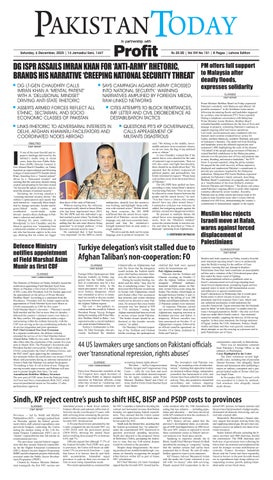
N one of the most forceful and expansive briefings delivered by the military’s media wing in recent years, Inter-Services Public Relations (ISPR) Director General Lt Gen Ahmed Sharif Chaudhry on Friday launched an unprecedented and blistering critique of incarcerated PTI founder Imran Khan, branding him a “mental patient” driven by a “delusional mindset” and warning that the anti-army rhetoric being created and spreading by him had crossed “far beyond the sphere of politics and entered the domain of national security.” Declaring the evolving situation a “creeping national security threat,” the military’s spokesperson said openly that such narratives—especially those amplified by foreign networks, hostile intelligence-linked media outlets, and coordinated social-media nodes abroad—posed a direct challenge to Pakistan’s cohesion and stability. Opening his press conference in Rawalpindi, Lt Gen Chaudhry said the threat in question was “emanating from a delusional mindset of a delusional person who has become captive to his own ego, thinking that his wishes are bigger
than those of the state of Pakistan.” Without naming him, the reference was unequivocally aimed at Imran Khan, who has been imprisoned since 2023. The DG ISPR said this individual’s ego had reached a point where “he thinks the world would cease to exist without him,” adding that the anti-state rhetoric being generated “is no longer political—it has become a national security issue.” He explained that it had become “very important” for the ISPR to clarify
Defence Ministry notifies appointment of Field Marshal Asim Munir as first CDF ISLAMABAD
Staff CorreSpondent
The Ministry of Defence on Friday formally issued the notification appointing Field Marshal Syed Asim Munir as Pakistan’s first Chief of Defence Forces (CDF), a day after President Asif Ali Zardari approved the appointment on the advice of Prime Minister Shehbaz Sharif. According to a statement from the Presidency, “President Asif Ali Zardari approved the appointment of Field Marshal Syed Asim Munir as COAS concurrently as CDF for five years.” Field Marshal Munir’s elevation — Pakistan’s second field marshal and the first in more than six decades — followed the country’s claimed victory over India in the May conflict. His appointment marks a major restructuring within the military hierarchy, with the CDF now serving as the top coordinating authority for tri-service integration and joint operations. PAF Chief Granted Two-Year Extension In a separate notification, the defence ministry extended the service of Air Chief Marshal Zaheer Ahmad Babar Sidhu by two years. His extension will take effect after the conclusion of his current five-year term in March 2026. The President’s Secretariat said President Zardari conveyed his “best wishes to the COAS, concurrently the Chief of Defence Forces, and the PAF chief” upon approving the summaries. Just moments before the notification was issued, COAS Munir told journalists during an informal interaction at Aiwan-e-Sadr that Pakistan was poised for progress. “Everything is fine; it’s all in front of you. Things are moving towards improvement, and Pakistan will now soar to greater heights from here,” he said. Amendments Redefine Military Structure The new post of CDF stems from the Pakistan Army, Air Force and Navy (Amendment) Bills 2025, which received presidential assent on November 15 after parliamentary approval.
ambiguities, identify how the narrative was working, and highlight “deep collusion with external actors.” Before detailing those concerns, the DG ISPR reaffirmed that the armed forces represented all of Pakistan—across ethnicity, language, sect, and socio-economic background—and that the institution’s strength stemmed from its unity under a single uniform. “We strive and die daily not for some language, area or political viewpoint,” he
said. “We belong to the middle, lowermiddle and poor socio-economic classes; we do not carry the flag of any political actor or elitism.” Lt Gen Chaudhry warned that if the armed forces were attacked for the sake of someone’s ego or narcissism, “then we will also come and fight bare-knuckle, there should be no doubt about that.” He repeated that the military respected all political parties and personalities, but firmly reiterated its request: “Please keep your politics away from the armed forces of Pakistan.” The DG ISPR then spelled out how, according to him, Imran Khan’s rhetoric was harming Pakistan. “First, no one can be allowed to create fissures between the people and the armed forces,” he said. “You don’t have a choice; this country doesn’t have any other armed forces.” Constructive criticism was welcome, he added, but instigating people against the military crossed into dangerous territory. He pointed to multiple threats the armed forces were managing simultaneously, from the “Hindutva mindset” across the eastern border to terrorist outfits and what he described as “fitna alkhawarij” operating from Afghanistan.
CONTINUED ON PAGE 03
Turkiye delegation’s visit stalled due to Afghan Taliban’s non-cooperation: FO ISLAMABAD
Staff report
Foreign Office Spokesperson Tahir Hussain Andrabi on Friday suggested that the Taliban regime’s lack of cooperation may be a key factor behind the delay in the much-anticipated visit of a highlevel Turkiye delegation, which was scheduled to arrive in Islamabad last month to discuss escalating tensions between Pakistan and the Afghan Taliban regime. The visit — first publicly revealed earlier this month by Turkish President Recep Tayyip Erdogan during his meeting with Prime Minister Shehbaz Sharif in Baku—was expected to play a crucial mediatory role amid strained bilateral ties. Turkiye’s Ambassador to Pakistan, Dr. Irfan Neziroglu, who previously facilitated the Istanbul
trilateral talks on Afghanistan, had told The News that the delegation would include the Turkish intelligence chief and key ministers. However, the visit has yet to materialise. During his weekly briefing, Andrabi said the delay “may also be due to scheduling issues,” but underscored that Pakistan would keep its border with Afghanistan closed until Kabul offers firm assurances that terrorists and violent elements would not be allowed to enter Pakistan. He stressed that cross-border terrorism was “not limited to TTP or TTA militants,” noting that Afghan nationals had been involved in serious crimes inside Pakistan. “The border closure should be understood in this broader security context,” he added. On Thursday’s limited reopening of the Torkham and Chaman border crossings, the spokesperson
clarified that both were opened solely for humanitarian aid. Pak-Afghan tensions Pakistan shut the Torkham and Chaman crossings on October 12 after the Afghan Taliban, working alongside affiliated militants, launched multiple attacks on Pakistan Armed Forces posts along the border. The clashes, which began on the night between October 11 and 12, resulted in the killing of over 200 Taliban and affiliated militants, while 23 Pakistani soldiers were martyred. In response, Pakistan carried out “precision strikes” deep inside Afghanistan, targeting terrorists in Kandahar province and Kabul. A temporary 48-hour ceasefire was later announced on October 15 at Afghanistan’s request, followed by an official ceasefire agreement on October 19 in Qatar, mediated by Doha and Turkiye.
PM offers full support to Malaysia after deadly floods, expresses solidarity ISLAMABAD
Staff report
Prime Minister Shehbaz Sharif on Friday expressed Pakistan’s solidarity with Malaysia and offered “all possible assistance” to the Southeast Asian nation following devastating floods and landslides triggered by cyclones, state broadcaster PTV News reported. During a telephone conversation with Malaysian Prime Minister Anwar Ibrahim, Shehbaz Sharif extended heartfelt condolences for the loss of lives and damage to property, reiterating Pakistan’s readiness to support ongoing relief and rescue operations. Last week, record monsoon rains combined with two tropical storm systems wreaked havoc across Sri Lanka, northern Malaysia, southern Thailand, and parts of Indonesia’s Sumatra. The death toll from flooding and landslides across the affected regions has now surpassed 1,000, highlighting the scale of the disaster. “On behalf of the people and government of Pakistan, I extend heartfelt condolences to the Malaysian prime minister over the precious loss of lives and property due to rains, flooding, and massive landslides,” the PTV News X account reported, citing the prime minister. He prayed for the swift recovery of those injured or displaced and emphasized Pakistan’s commitment to provide any assistance required by the Malaysian authorities. Malaysian PM Anwar Ibrahim expressed gratitude for Pakistan’s timely outreach, describing Shehbaz Sharif’s sentiments of sympathy and concern as a “manifestation of the close brotherly relations between Pakistan and Malaysia.” The phone call comes amid Pakistan’s ongoing efforts to assist other regional countries affected by severe weather. Recently, Pakistan sent an urban search and rescue team to Sri Lanka to help flood-hit areas after Cyclone Ditwah claimed over 450 lives, demonstrating the country’s commitment to humanitarian support in the region.
Muslim bloc rejects Israeli move at Rafah, warns against forced displacement of Palestinians ISLAMABAD/RIYADH
Muslim and Arab countries on Friday issued a forceful joint statement rejecting Israel’s move to unilaterally open the Rafah crossing for the outflow of Gaza residents, warning that any attempt to displace Palestinians from their land constitutes an unacceptable red line and a violation of the US-brokered peace plan that ended the latest round of fighting. The unprecedented collective pushback came as Israel’s announcement revived long-standing fears about forced displacement, prompting Egypt and key regional states to insist on full humanitarian access and adherence to agreed commitments. Israel’s declaration on Wednesday that it would open Rafah solely to allow Gazans to leave drew an immediate and firm response from Cairo, which said any unilateral mechanism would undermine the ceasefire framework. Egypt reiterated that the blockade must be lifted “in both directions” to enable relief for Gaza’s besieged population. Rafah—the only exit from Gaza not under direct Israeli control—has remained sealed for months, crippling the delivery of life-saving supplies. In their joint statement, the foreign ministers of Egypt, Jordan, the UAE, Indonesia, Turkiye, Saudi Arabia and Qatar said they were gravely concerned about attempts to use the crossing as a pressure tool to push Palestinians out of Gaza.
44 US lawmakers urge sanctions on Pakistani officials over ‘transnational repression, rights abuses’ ISLAMABAD
Staff CorreSpondent
Forty-four Democratic members of the US Congress have urged Secretary of State Marco Rubio to impose targeted sanctions on Pakistani officials, citing what they termed an “escalating campaign of transnational repression and
worsening human rights abuses.” The letter — led by Congresswoman Pramila Jayapal and Congressman Greg Casar — calls for visa bans and asset freezes on individuals deemed responsible for rights violations under Prime Minister Shehbaz Sharif and Chief of Army Staff (COAS) Field Marshal Syed Asim Munir.
Staff report
The lawmakers said Pakistan was facing “an escalating crisis of authoritarianism,” claiming that opposition leaders are detained without charge, independent journalists face harassment or exile, and citizens have been jailed for social media activity. They also pointed to intensified surveillance and violence targeting women, religious minorities, and ethnic
communities, especially in Balochistan. There was no immediate comment from Pakistan’s Foreign Office or the embassy in Washington. Cases Highlighted in the Letter The letter references several highprofile cases, including that of journalist Ahmed Noorani, who allegedly faced threats and harassment after publishing a report on military corruption and a purported leaked audio of former chief justice Saqib Nisar. In November 2021, Noorani’s wife was assaulted in Lahore by unidentified attackers who allegedly issued death threats.
Sindh, KP reject centre’s push to shift HEC, BISP and PSDP costs to provinces ISLAMABAD
Staff report
Provinces — led by Sindh and Khyber Pakhtunkhwa (KP) — strongly pushed back on Thursday against the federal government’s bid to shift selected expenditures onto provincial budgets, cautioning the Centre during the maiden sitting of the 11th National Finance Commission (NFC) not to “dictate” responsibilities that fall outside its constitutional purview. The provinces rejected federal suggestions that they assume financial responsibility for the Higher Education Commission (HEC), Benazir Income Support Programme (BISP) and development projects historically executed under the Public Sector Development Programme (PSDP). Chaired by Finance Minister Muhammad Aurangzeb, the first NFC session saw
Islamabad present a bleak fiscal outlook. Federal officials said national coffers had effectively run dry over the past 15 years, with debt servicing alone consuming the government’s entire resource envelope in the postSeventh NFC Award period. A 30-year fiscal review presented by the Centre compared the pre-Seventh NFC era (1995–2010) with the post-award period (2010–2025), showing the annual fiscal deficit swelling from around 4% to between 6.6% and 7%. Officials argued that although 57.5% of the Federal Divisible Pool (FDP) now goes to provinces, the Centre still incurs an additional 15% on provincial functions — a gap that forces it to borrow heavily and fuels debt accumulation. Islamabad urged provinces to scale up their own revenue efforts to meet rising expenditure needs. Provincial representatives countered that
the NFC’s mandate is limited to deciding the vertical and horizontal revenue distribution formula, not apportioning federal expenditures. They stressed that the Centre cannot scrutinise how provinces utilise funds transferred under the NFC. Sindh took the firmest line, asserting that the federal government has “no authority” under the constitutional NFC framework to question provincial spending decisions. Sindh also objected to the proposed Terms of Reference (ToRs), prompting the federation to state that any ToR-related dispute would be referred to the president. Despite sharp disagreements, the meeting produced one notable breakthrough: consensus on formally recognising the merged tribal districts within KP as part of future NFC calculations. KP Chief Minister Ali Amin Gandapur argued that the Seventh NFC Award had be-
come outdated after the 18th Amendment, noting that key subjects — including population and education — had been devolved, while KP continued to bear the enormous financial burden of terrorism. KP’s finance adviser added that the province’s development share, as a percentage of GDP, had dipped below its 2005 level. The next NFC session is expected to revisit these contentious issues as federal–provincial tensions over fiscal space persist. Speaking to reporters outside the Q Block, Sindh Chief Minister Murad Ali Shah described the meeting as “congenial,” noting that the maiden session had earlier been postponed due to floods. He said all stakeholders agreed to issue a joint statement. KP Finance Adviser Muzammil Aslam told the media the Centre reiterated it was left with “no money” after debt servicing. Punjab assured full cooperation in the re-
newed NFC process; its finance minister said the province had presented a budget surplus, eliminated all domestic borrowing, and carried only external debt. Meanwhile, Balochistan’s finance minister argued that despite hosting Reko Diq and supplying natural gas, the province continued to receive an unfairly low share of national resources. Senior federal officials, including the finance secretary and FBR chairman, briefed the commission. The FBR chairman said both tiers of government were collecting far below their tax potential and emphasised the need for stronger revenue mobilisation nationwide. Finance Secretary Imdadullah Bosal said the Centre had been repeatedly forced to borrow in the post-Seventh Award era as expenditures kept rising without corresponding revenue growth, putting Islamabad under severe fiscal stress.