In partnership with
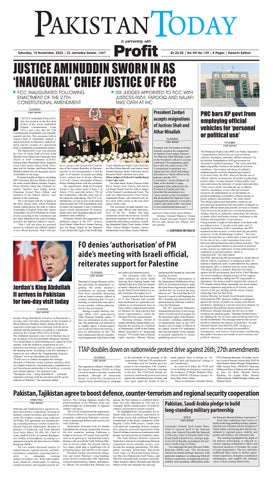
JUSTICE AMINUDDIN SWORN IN AS ‘INAUGURAL’ CHIEF JUSTICE OF FCC
Profit
Saturday, 15 November, 2025 | 23 Jamadiul Awwal, 1447
g
FCC INAUGURATED FOLLOWING ENACTMENT OF THE 27TH CONSTITUTIONAL AMENDMENT
J
g
ISLAMABAD
SIX JUDGES APPOINTED TO FCC WITH JUSTICES-RIZVI, FAROOQ AND NAJAFI TAKE OATH AT IHC
President Zardari accepts resignations of Justices Shah and Athar Minallah
staff report
USTICE Aminuddin Khan on Friday was sworn in as the first chief justice of the newly established Federal Constitutional Court (FCC), just a day after the 27th Constitutional Amendment was formally enacted into law. The ceremony, held at Aiwan-i-Sadr in Islamabad, marked a major milestone in Pakistan’s judicial reforms and the creation of a specialized body to adjudicate constitutional matters. The high-profile event was attended by Chief of Army Staff (COAS) Field Marshal Asim Munir and Chairman Joint Chiefs of Staff Committee (CJCSC) General Sahir Shamshad Mirza. Supreme Court Chief Justice Yahya Afridi, President Asif Ali Zardari, and Prime Minister Shehbaz Sharif also sat alongside Justice Aminuddin on the stage. Prominent political figures, including PPP Chairman Bilawal Bhutto-Zardari, his sister Aseefa Bhutto-Zardari, Deputy Prime Minister Ishaq Dar, National Assembly Speaker Ayaz Sadiq, Senate Chairman Yousuf Raza Gillani, and members of the federal cabinet, were present at the ceremony. The event began with the recitation of the Holy Quran, after which President Zardari administered the oath to Justice Aminuddin in English. In his oath, Justice Aminuddin vowed to discharge his duties strictly according to the Constitution and law while adhering to the code of conduct issued by the Supreme Judicial Council. “That I will not allow my personal interest to influence my official conduct or my official decisions. That I will pre-
Rs 20.00 | Vol XVI No 129 | 8 Pages | Karachi Edition
ISLAMABAD
staff report
serve, protect and defend the Constitution of the Islamic Republic of Pakistan, and that in all circumstances, I will do right to all manner of people according to law, without fear or favour, affection or ill will,” Justice Aminuddin affirmed, before shaking hands with the president. His appointment, made by President Zardari a day earlier under Clause 3 of Article 175A, read with Article 175C of the Constitution, officially came into effect upon his oath-taking. The FCC’s establishment, revived as part of the judicial reforms under the 27th Amendment, aims to reduce the Supreme Court’s workload, ensure timely adjudication of constitutional cases, and strengthen judicial independence and credibility. President Zardari also appointed six additional judges to the FCC: Justices Syed Hasan Azhar Rizvi, Aamer Farooq, and Ali Baqar Najafi of the Supreme Court; Justice KK Agha of the Sindh High
Court; Balochistan High Court Chief Justice Rozi Khan Barrech; and Justice (retd) Arshad Hussain Shah, following Justice Musarrat Hilali’s decision not to join. Three judges of Federal Constitutional Court take oath On other hand, Justice Hassan Azhar Rizvi, Justice Amir Farooq, and Justice Ali Baqar Najafi took the oath as judges of the Federal Constitutional Court. The oath was administered by Chief Justice Aminuddin Khan, who himself took office short while earlier as the first chief justice of the court. The ceremony brought together senior judges, legal officers and representatives of the bar. Judges and legal community attend the ceremony. Several prominent members of the judiciary attended the oath-taking ceremony, including Islamabad High Court Justice Arbab Tahir, Justice Khadim Soomro, Justice Muhammad Azam Khan, Justice Muham-
President Asif Ali Zardari on Friday formally accepted the resignations of Supreme Court judges Mansoor Ali Shah and Athar Minallah, a post on the President’s official X account confirmed. The resignations came hours after the controversial 27th Constitutional Amendment was signed into law, which both judges described as a “direct affront to the judiciary and the 1973 Constitution.” Justice Mansoor Ali Shah, in his detailed 13-page resignation letter addressed to the President in English and Urdu, described the amendment as a “grave assault on the Constitution” that dismantled the Supreme Court, subjugated the judiciary to executive control, and struck at the “very heart of our constitutional democracy.”
mad Asif, Justice Inam Amin Minhas Attorney General Mansoor Usman Awan, Punjab Advocate General Amjad Pervez, and various law officers were also present.
CONTINUED ON PAGE 03
FO denies ‘authorisation’ of PM aide’s meeting with Israeli official, reiterates support for Palestine Jordan’s King Abdullah II arrives in Pakistan for two-day visit today ISLAMABAD
staff report
Jordan’s King Abdullah II will arrive in Pakistan for a two-day state visit today (Saturday) at the invitation of Prime Minister Shehbaz Sharif, during which he is expected to hold high-level meetings with the prime minister and the president, according to a statement issued by the Foreign Office (FO) on Friday. The Jordanian monarch’s last visit to Pakistan was at the invitation of former president Mamnoon Hussain. Two memoranda of understanding were signed by both nations, with one related to cooperation in civil protection and defence and the other to cooperation in the housing sector. According to the FO, Saturday’s high-level visit reflects the “longstanding, fraternal relations” between Islamabad and Amman. “It will serve to further strengthen the strategic direction of Pakistan–Jordan relations and place them on a higher trajectory, encompassing a comprehensive and broad-based partnership in the political, economic, and cultural spheres,” the statement read. “During his visit … King Abdullah II … will hold important meetings with the president and the prime minister of Pakistan,” the statement added.
ISLAMABAD
staff report
Pakistan’s Foreign Ministry on Friday said it had “no information” regarding the prime minister’s coordinator on tourism, Sardar Yasir Ilyas, reportedly interacting with an Israeli ministry official in London, reiterating that “if such a meeting or interaction took place, it was certainly without authorisation by the government.” During a weekly briefing, Foreign Office (FO) spokesperson Tahir Hussain Andrabi stated, “I have no information on this meeting. The gentleman you referred to is a public figure. I would request you to ask him about the meeting. I have no information on this.” He later emphasized that any unauthorised engagement with Israel would
not reflect government policy. The comments came after a video surfaced on social media showing Ilyas shaking hands with Michael Izhar-Kov, Director General of Israel’s Ministry of Tourism, during the World Travel Market in London, held from November 4 to 6. Israeli journalist Rai Kais noted on X that Pakistan had recently been mentioned as a potential contributor to an international force in Gaza, while London-based journalist Murtaza Ali Shah reported that Israeli representatives visited the Pakistan Pavilion unannounced. Reacting strongly, former JI senator Mushtaq Ahmed Khan condemned the meeting as a betrayal of Palestinians, while writer Fatima Bhutto described it as “disgusting treason.” PTI leader and ex-human rights minister Shireen Mazari
questioned the manner in which the meeting occurred. On Pakistan’s participation in the International Stabilisation Force (ISF), a US-brokered initiative under the Gaza Peace Agreement, Andrabi clarified that “no decision has been taken as yet.” He noted that the UN Security Council is still finalising the ISF’s mandate and stressed that any participation by Pakistan would involve the Parliament. The FO reiterated Pakistan’s longstanding position of non-recognition of Israel and firm support for the legitimate rights of the Palestinian people, including establishing an independent state on pre-1967 borders with Al-Quds Al-Sharif as its capital. Recent FO statements also rejected reports of any changes to passport regulations or clauses prohibiting travel to Israel.
PHC bars KP govt from employing official vehicles for ‘personal or political use’ PESHAWAR
staff report
The Peshawar High Court (PHC) on Friday imposed a “comprehensive ban on the use of government vehicles, machinery, and other official resources” by the Khyber Pakhtunkhwa (KP) government for “personal or political purposes.” The court ruled that deploying public resources for political activities constitutes “misconduct and abuse of authority,” emphasizing the need for impartial governance. In its short order, the PHC observed that the use of official vehicles or manpower for political gatherings, protest rallies, or long marches violates public trust and undermines the principle of neutral administration. “This court is of the view that the use of official vehicles, machinery, or any other government resources for participation in, or facilitation of, political gatherings constitutes a blatant misuse of public property and authority,” the order stated. The ruling underscored that public resources are procured and maintained from the public exchequer to perform official duties and provide services to citizens. Their diversion for political or extraneous purposes, whether directly or indirectly, undermines the sanctity of public office and erodes citizens’ confidence in the fairness and impartiality of governance. Citing Articles 4 (right of individuals to be dealt with according to law), 5 (loyalty to the state), and 25 (equality of citizens) of the Constitution, the PHC emphasized that no party or individual can use public resources “to the disadvantage of others.” The court further stressed that, in a democratic system governed by the rule of law, a strict separation must exist between official functions and political activities. “The use of government vehicles or personnel in political events conveys an impression of state endorsement or complicity in partisan matters, which is impermissible,” the order added. The PHC directed the KP government to ensure that no official vehicle, machinery, or manpower under its control is deployed, used, or permitted for any protest, long march, rally, or political activity of any nature. The ruling follows a petition filed last November against the KP government, then led by Chief Minister Ali Amin Gandapur, alleging misuse of fire engines and heavy machinery during the PTI long march to Islamabad. The protest, held to demand the release of PTI founder Imran Khan, reportedly involved clashes between supporters and police at D-Chowk, amid reports of tear gas shelling and the retreat of party leadership from the Red Zone. Federal Minister for Health Syed Mustafa Kamal welcomed the PHC decision, calling it a safeguard against the misuse of public tax money and official machinery. Speaking to a private television channel, he emphasized that political parties should resolve differences through dialogue and not rely on state resources for partisan gains. “Pakistan Armed Forces are fighting the war on terror and sacrificing their lives for the motherland. The message must be that we are united to eliminate the menace of terrorism,” he said. Mustafa Kamal described the PHC ruling as a positive step toward ensuring accountability, transparency, and fairness in governance, reaffirming that public resources are meant to serve citizens, not political interests.
TTAP doubles down on nationwide protest drive against 26th, 27th amendments ISLAMABAD
staff report
The opposition alliance Tehreek-i-Tahafuz Ayeen-i-Pakistan (TTAP) on Friday vowed to mount a forceful, countrywide pushback “through all democratic means” to restore the Constitution to its original form, intensifying its campaign
in the aftermath of the passage of the ‘contentious’ 26th and 27th amendments. President Asif Ali Zardari gave his assent to the contentious 27th Constitutional Amendment on Thursday, enacting it into law. The TTAP had already announced a nationwide protest movement against the amendment since Sunday and once again urged the people to take a
stand against what it termed an “extremely dark and dangerous” change in the Constitution. In a post on X today, the TTAP said it was holding an emergency meeting at the residence of Majlis Wahdat-i-Muslimeen (MWM) Chairman Senator Allama Raja Nasir Abbas. Those in attendance included Qaiser,
PTI Chairman Barrister Ali Gohar, Secretary General Salman Akram Raja, BNP-M chief Sardar Akhtar Mengal, Pashtunkhwa Milli Awami Party (PkMAP) Chairman Mahmood Khan Achakzai and others such as Zain Ali Shah, Mustafa Nawaz Khokhar, Ali Asghar Khan, Hussain Akhwandzada, Shahid Khaqan Abbasi and Shaukat Basra.
Pakistan, Tajikistan agree to boost defence, counter-terrorism and regional security cooperation RAWALPINDI
staff report
Pakistan and Tajikistan have agreed to expand their defence cooperation, focusing on training, counter-terrorism, and regional security, the military’s media wing confirmed on Friday. The agreement was reached during a meeting between Colonel General Sobirzoda Emomali Abdulrahim, Minister of Defence of Tajikistan, and Field Marshal Syed Asim Munir, NI (M), HJ, Chief of Army Staff (COAS), at General Headquarters (GHQ) in Rawalpindi, according to a statement issued by the Inter-Services Public Relations (ISPR). The two leaders discussed matters of mutual interest, regional security, and bilateral defence cooperation, expressing their resolve to strengthen existing military-to-military ties. Both sides emphasized enhanced collaboration in training, counter-terrorism, and regional security ini-
tiatives. The visiting dignitary lauded the professionalism of the Pakistan Army and acknowledged its contribution to regional stability and peace. The COAS underscored the importance of collective efforts for regional stability and prosperity, reaffirming Pakistan’s commitment to deepening defence and security ties with Tajikistan. Meanwhile, President Asif Ali Zardari highlighted the strategic partnership between the two countries, terming Tajikistan a bridge to the heart of Central Asia and Pakistan as its gateway to international waters, during a call-on with the Tajik Defence Minister at Aiwan-e-Sadr. He stressed that the two states could play a significant role in promoting peace and stability in the region. President Zardari welcomed the delegation and noted Pakistan’s long-standing, multi-faceted relationship with Tajikistan, rooted in shared history, culture, and linguistic affinity. He reminded that Pakistan was
among the first nations to establish diplomatic ties with Tajikistan in 1992 and encouraged further enhancement of political, cultural, and people-to-people contacts. He highlighted the vast potential for bilateral trade and investment, particularly in the energy sector, and reaffirmed Pakistan’s commitment to the timely completion of the flagship CASA-1000 project. Zardari also welcomed the expanding defence cooperation, citing the successful organization of the Dosti-II military exercise as a testimony to the historic ties between the two brotherly states. The Tajik Defence Minister expressed Tajikistan’s interest in strengthening bilateral cooperation across multiple sectors, reinforcing the strategic partnership. The delegation included Ambassador Sharifzoda Yusuf Tohir, Col Rasulzoda Karim Abdurasul, Maj Gen Hakimzoda Zarif Yunusi, and Maj Gen Amonullozoda Aminjon Amonullo, while Senators Sherry Rehman and Saleem Mandviwalla also attended the meeting.
Pakistan, Saudi Arabia pledge to build long-standing military partnership RIYADH
staff report
Lieutenant General Syed Aamer Raza, Chief of General Staff of the Pakistan Army, met General Fayyadh Bin Hameed Al-Rowaily, Chief of General Staff of the Royal Saudi Armed Forces, during a highlevel visit to Riyadh, according to the military’s media wing on Friday. In a statement the Inter-Services Public Relations (ISPR) said, “The discussions centred on mutual strategic interests, with particular emphasis on enhancing bilateral defence cooperation, strengthening interoperability and expanding collaboration under
the Strategic Mutual Defence Agreement.” Both sides underlined their resolve to build on the long-standing military partnership between Pakistan and the Kingdom of Saudi Arabia, reinforcing their shared commitment to regional peace, stability and greater self-reliance, the statement said. The meeting highlighted the depth of the defence relationship, as officials reviewed ongoing collaborative efforts and discussed measures to broaden the scope of joint programmes. The two militaries reaffirmed their intent to further operational cooperation, strengthen coordination mechanisms, and amplify the strategic value of their existing frameworks.
02 NEWS
Saturday, 15 November, 2025 | KARACHI
FUEL DEALERS WARN OGRA OF ‘ARTIFICIAL DIESEL SHORTAGE’ AHEAD OF NOV 15 PRICE REVIEW
T g
PETROL PUMP DEALERS ASSOCIATION ALLEGES OMCS RESTRICTING DIESEL SUPPLIES; PUMPS REPORT DRY OUTS NATIONWIDE ISLAMABAD
AhMAD AhMADANi
he Petrol Pump Dealers Association (PPDA) has warned the Oil and Gas Regulatory Authority (OGRA) of an “artificial shortage” of high-speed diesel (HSD) allegedly caused by oil marketing companies (OMCs) ahead of the expected petroleum price revision on November 15. In a letter addressed to OGRA Chairman Masroor Khan, the association’s vice chair-
Communications ministry plans new toll plazas across KP to boost NHA revenue
man, Nouman Ali Butt, said fuel stations across Pakistan have been facing severe difficulties for the past week due to capping and quota restrictions imposed by OMCs on diesel supplies. According to the association, OMCs are either withholding product or providing quantities so limited that fuel stations cannot meet public demand, resulting in pumps running dry. Orders placed by fuel dealers are being cancelled, with lorries reportedly stuck for hours without being allowed to load diesel. The PPDA claims the OMCs have inten-
PROFIT
FBR reconstitutes Single Portal Committee to unify sales tax return filing across provinces
g
News Desk
Federal Minister for Communications Abdul Aleem Khan has directed the establishment of new toll plazas across Khyber Pakhtunkhwa to increase revenue collection on highways and motorways in the province. The directive was issued while the minister chaired a meeting in Islamabad, where National Highway Authority (NHA) officials briefed him on periodic works, routine maintenance, and pending financial liabilities. During the session, approvals for several outstanding liabilities were also sought. The minister instructed the Secretary Communications to formally consult the Khyber Pakhtunkhwa government and communicate the plan to the chief minister and chief secretary regarding the placement of new toll plazas. He stressed that revenue generation was essential for sustaining development and maintenance activities. He said the funds collected from toll plazas would be reinvested in the highway network in KP. He noted that the province would directly benefit from the revenue generated within its jurisdiction, particularly from tourismrelated traffic. The minister further directed the Secretary Communications to personally visit projects with pending liabilities and assess whether payments should be approved. He ordered that any project with liabilities exceeding Rs10 million must undergo physical verification before release of funds, adding that payments would only be made after thorough inspection. Responding to reports of damage to toll facilities, the minister warned that vandalism at toll plazas or any harm to government property would not be tolerated. He directed the NHA to take immediate legal action, including lodging FIRs, against those involved. He also said he would not allow routine maintenance projects, arguing that such works often create opportunities for corruption. He emphasised that accountability must be ensured at all levels and that it was not sufficient for one official to be upright while subordinates engaged in corrupt practices. Secretary Communications Ali Sher Mehsud and senior officials attended the meeting.
tionally created an artificial shortage in anticipation of a speculated hike in fuel prices at the end of the fortnight. The association has urged OGRA to direct OMCs to supply diesel at least in accordance with the sales volume of each fuel station. The letter warns that if their concerns remain unaddressed, petrol pump dealers may take the issue to the media and hold a press conference. The letter has also been copied to the Minister for Petroleum, Secretary Petroleum, Director General Oil and Secretary OCAC.
NEW BODY INCLUDES FBR AND ALL FOUR PROVINCIAL AUTHORITIES TO FINALISE ROLLOUT FRAMEWORK FOR SINGLE SALES TAX RETURN PROFIT
News Desk
The Federal Board of Revenue (FBR) has reconstituted the Single Portal Committee responsible for developing and implementing a unified system for filing sales tax returns across the federation and all four provincial revenue authorities. A notification issued on Thursday stated that the committee has been restructured following decisions made during the recent Tax Round Table Meeting between the FBR and provincial authorities. According to the notification, Aamer Amin Bhatti (IRS-BS20) and Zainul Abidin Sahi (IRS-BS20) will represent the FBR. The Punjab Revenue Authority will be represented by Salman Zafar, Director IT, while the Sindh Revenue Board has nominated
more than one jurisdiction, including proposed changes to return forms, checks and calculations, enforcement, extensions and revisions. The body will also make recommendations for software development, timelines, and the format of common and jurisdiction-specific annexures for the unified return portal. The committee will advise on legal or regulatory amendments needed to introduce the new return format and ensure synchronised filing dates across authorities. It will additionally provide recommendations on data privacy, system ownership, and operational control of the portal. The Pakistan Raises Revenue Programme Office at FBR headquarters will support the committee through coordination, communication, and scheduling of meetings.
Abdul Hameed Memon, Senior Member Operations-I and former Inland Revenue official at FBR Headquarters. The Khyber Pakhtunkhwa Revenue Authority’s representative is Abdur Raziq, Additional Collector, and the Balochistan Revenue Authority will be represented by Member Ops-II Etheshamul Haq and Commissioner Ops-II Fahad Shabir. Under the committee’s terms of reference, members will review readiness, actions and operational arrangements required for the roll out of the Single Portal for the filing of Sales Tax Return across all sectors and jurisdictions. The committee has been empowered to consult experts from FBR, provincial authorities, PRAL, or any other relevant institution. It will also determine how to address issues arising when a single return is filed across
PPL announces gas discovery in Sawan field’s SND-1 well in Sindh
g
terval sands. Based on wireline logs and drilling results, post-completion testing was conducted, yielding gas at a rate of approximately 0.30 million standard cubic feet per day. The company said the test was recorded “against Flowing Wellhead Pressure (FWHP) of ~100 psig at 128/64-inch choke.” PPL added that the well was the first in the Sawan area drilled using an exclusive sequence stratigraphic trap evaluation approach. “This pioneering methodology has successfully resulted in a hydrocarbon discovery, validating the underlying geological concept and opening new exploration horizons within the Sawan region,” the notice said.
JOINT VENTURE PARTNERS REPORT NEW FIND AT 14,017 FEET WITH INITIAL FLOW OF 0.30 MMSCFD PROFIT
News Desk
Pakistan Petroleum Limited (PPL) has announced a gas discovery in the Sawan field of Sindh’s Khairpur district, following drilling and testing at the exploratory well Sawan North Deep-1 ST-1 (SND-1 ST-1). In a disclosure to the Pakistan Stock Exchange on Friday, the company said the discovery was made by the Sawan Joint Venture, which includes UEP Beta as operator with a 25% working interest, PPL with 30%,
PPL Europe E&P Limited with 10%, Prime AEP Limited with 30% and Government Holdings (Private) Limited with 5%. “This is to disclose that Sawan Joint Venture has discovered hydrocarbon from its exploratory well Sawan North Deep-1 ST-1, located in District Khairpur, Sindh Province,” the company stated. According to PPL, drilling of the well began on September 16, 2024, and reached a measured depth of 14,017 feet. The primary target was the Lower Goru Formation, specifically the A-In-
NASDAQ-listed US firm eyes investment in Pakistan’s gold, antimony and rare earth mining PROFIT
News Desk
Federal Minister for Board of Investment (BOI) Qaiser Ahmed Sheikh on Thursday met a delegation from Nova Minerals Ltd., a US-based mining exploration and development company listed on the ASX and NASDAQ, to discuss potential investment in Pakistan’s mineral sector. During the meeting, the minister said Pakistan held vast and largely untapped potential in minerals and mining, noting that the country offered opportunities in exploration and local processing of highvalue resources. He emphasised that for-
g
BOARD OF INVESTMENT ASSURES FULL FACILITATION TO FOREIGN INVESTORS AND JOINT VENTURES
eign investment in mining could strengthen economic partnerships, promote technology transfer, and create avenues for skill development and higher education. He added that the government aimed to shift from exporting raw minerals to promoting local mineral processing and industrial expansion. The BOI, he assured, would extend full facilitation to foreign investors and joint ventures.
The Nova Minerals delegation expressed strong interest in investment prospects in antimony, rare earth minerals, and related mining activities. They said Pakistan’s geological diversity, policy reforms and government support made it attractive for long-term investment, and signalled their intent to pursue technical collaboration, knowledge exchange and feasibility studies with local partners. Minister Sheikh welcomed the com-
pany’s interest and said the government encouraged responsible, technology-driven ventures focused on sustainability and local value addition. He said such projects would help build an investment ecosystem capable of attracting more global firms to Pakistan’s mining sector. He also noted that Prime Minister Shehbaz Sharif supported foreign investment and joint ventures as drivers of economic growth. Concluding the meeting, the minister reiterated that the BOI would continue to facilitate investors through a transparent and efficient framework to ensure Pakistan’s resources contribute to sustainable economic development.
Pakistan’s edible oil imports set to rise to 3.5m tonnes amid higher demand, exec says PROFIT
MoNitoriNg Desk
Pakistan’s edible oil imports are expected to reach 3.4–3.5 million tonnes in 2025 as domestic demand continues to climb, Abdul Rasheed Jan Mohammad, chief executive of the Westbury Group, said on Friday. As per reports, speaking at an industry conference in Bali, he noted that imports had already hit 3.07 million tonnes between January and October, exceeding the 3 million tonnes recorded in 2024. “This is a huge increase going on … and this is primarily because of the surge in the population growth and also certain economic development,” he said. Pakistan imported between 2.9m and 3m tonnes annually from 2022 to 2024. In the first 10 months of 2025, the country also brought in 2.2m tonnes of oilseeds. During a recent meeting on edible oil regulation, officials highlighted that nearly 30 per cent of Pakistan’s annual edible oil consumption — over 4.5m tonnes — consists of unbranded, loose oil sold largely in semiurban and rural markets. Experts warned that such loose oil, commonly sold without packaging or labelling, often contains impurities, harmful chemicals and biological contaminants. They said the widespread use of unregulated oil poses significant health risks, including heart disease, strokes and neurological complications.
Pakistan Customs seizes 20,000kg of misdeclared Chinese salt in Karachi raid PROFIT
MoNitoriNg Desk
Pakistan Customs has seized 20,000 kilograms of Chinese salt, valued at Rs20.5 million, after detecting a misdeclared consignment at a storage facility near Walika Chowrangi, the Federal Board of Revenue (FBR) said on Friday. According to the FBR, the AntiSmuggling Organisation of the Collectorate of Customs Enforcement conducted a targeted raid at A-One Godown based on intelligence reports. During inspection of Shed No. 9, operated by M/s United Traders, officers recovered several bags labelled as citric acid. Initial checks indicated that a substantial portion of the consignment actually contained Chinese salt (monosodium glutamate), identified through its smell and texture, while the remaining bags held genuine citric acid. The custodian produced Goods Declaration No. GWRI-HC-1444-10-11-2025, under which the entire shipment had been declared as citric acid imported from Iran. A detailed examination confirmed the misdeclaration, leading to the seizure of 800 bags of Chinese salt and 100 bags of citric acid, each weighing 25kg. Customs officials moved the seized goods to a secure warehouse, and samples have been sent for laboratory testing. Legal proceedings have been initiated under the Customs Act, 1969.
Govt forms 17-member committee to update Pakistan’s poverty, inequality figures g
NEW PANEL INCLUDES WORLD BANK, ADB AND UNICEF REPRESENTATIVES; COMMITTEE TO REVISE POVERTY LINE AND ESTIMATE NATIONAL-PROVINCIAL POVERTY USING HOUSEHOLD INTEGRATED ECONOMIC SURVEY 2024-25 PROFIT
MoNitoriNg Desk
The federal government has constituted a high-powered 17-member Poverty Estimation Committee to compute Pakistan’s latest poverty and inequality figures following the completion of the Household Integrated Economic Survey (HIES) 2024-25, The News reported. A notification issued by the Ministry of Planning, Development and Special Initiatives said the committee has been formed under the mandate of estimating national poverty levels, with the panel chaired by Dr G.M. Arif, former Joint Director of the Pakistan Institute of Development Economics (PIDE). The committee notably includes representatives from major international donors — the World Bank, Asian Development Bank (ADB) and UNICEF — alongside na-
tional experts from leading universities, research institutions and federal ministries. According to the notification, members include Dr Nadeem Javaid (PIDE), Dr Aliya H. Khan (QAU), Dr Abid Qaiyum Suleri (SDPI), Dr Rashid Bajwa (NRSP), Dr Hadia Majid (LUMS), Dr Asma Hyder (IBA), Dr Akhtar Hussain Shah (independent economist), representatives of the Finance Ministry, Poverty Alleviation Ministry, National Food Security Ministry, the Pakistan Bureau of Statistics and all provincial chief economists. UNICEF’s Ali Raza, ADB’s Dr Babur Wasim and the World Bank’s Christina Wieser are also part of the committee. The committee has been tasked with estimating national and provincial poverty and inequality levels using the Cost of Basic Needs (CBN) approach, updating Pakistan’s national poverty line by assessing whether the threshold requires revision since 2013-
14, preparing fresh national and provincial estimates based on the HIES 2024-25, and conducting a detailed analysis of poverty dynamics, including underlying causes and contributing factors. Officials said Pakistan has historically calculated poverty under the CBN-based method, adjusted for inflation. Poverty levels have declined from 50.4% in 2005-06 to 21.9% in 2018-19, with urban poverty at 11% and rural poverty at 28.2% in the same period. They added that Pakistan initially consulted World Bank experts when adopting the CBN approach, but shifts in economic structure, household consumption patterns and inflation dynamics now require a fresh evaluation of the poverty line. The government is also finalising the latest Labour Force Survey, expected to be released soon.
NEWS 03
Saturday, 15 November, 2025 | KARACHI
GOvt FiNaLiSES DRaFt tExtiLE aND aPPaREL POLiCy 2025–30 tO BOOSt ExPORtS
t
PROFIT
MoNitoriNg Desk
HE Ministry of Commerce has finalised a draft of the five-year Textile and Apparel Policy (2025–30) for submission to the Economic Coordination Committee (ECC), aiming to lift Pakistan’s textile and apparel exports to $29.38 billion by FY2030, Business Recorder reported. Under the proposed framework, export targets are set at $19.37bn for FY26, $21.42bn for FY27, $23.74bn for FY28, $26.71bn for FY29, and $29.38bn for FY30,
Oil rises 2% after Ukrainian attack damages Russian oil depot brent crude futures rise $1.24, or 1.97%, to $64.25 while uS wti rises $1.25, or 2.13%, to $59.94 a barrel PROFIT
News Desk
Oil prices jumped about 2% on Friday on supply fears after a Ukrainian drone attack hit an oil depot in the Russian Black Sea port of Novorossiysk, a major export hub. Brent crude futures rose $1.24, or 1.97%, to $64.25 a barrel by 0315 GMT, while U.S. West Texas Intermediate crude rose $1.25, or 2.13%, to $59.94 a barrel. The attack early on Friday damaged a ship in port, apartment buildings and an oil depot in the Russian Black Sea port of Novorossiysk, injuring three crew members of the vessel, Russian officials said. “Ukrainian drone attacks on the port of Novorossiysk have sparked new fears of oil supply flow disruptions as this port is the second largest oil export hub in Russia and comes on the heels of another major attack at Tuapse barely two weeks ago,” said June Goh, senior oil market analyst for Sparta Commodities. “The extent of the damage is not yet known but if the pattern of escalation continues, then there would be a supply curtailment both in crude and product exports out of Russia.” The gains came after both Brent and WTI fell about 3% on Wednesday, weighed down by an OPEC report saying global oil supply will match demand in 2026, marking a further shift from its earlier projections of a supply deficit. For this week, Brent has gained 0.94% and WTI 0.28%. The U.S. Energy Information Administration on Thursday reported a larger-than-expected rise in U.S. crude stocks last week, while gasoline and distillate inventories fell less than expected. Crude inventories rose by 6.4 million barrels to 427.6 million barrels in the week ended on November 7, the EIA said, compared with expectations in a Reuters poll for a gain of 1.96 million barrels. Investors are also watching the impact of Western sanctions on Russian oil supply and trade flows. The U.S. imposed sanctions on Russian oil companies Lukoil and Rosneft as part of efforts to bring the Kremlin to peace talks over Ukraine. The sanctions prohibit transactions with the Russian companies after November 21. Around 1.4 million barrels per day of Russian oil, or almost a third of the country’s seaborne exporting potential, has been added to stocks held on tankers as unloading slows due to U.S. sanctions against Rosneft and Lukoil, JPMorgan said on Thursday. The bank also said after the cut-off date of November 21 for receiving oil supplied by the sanctioned companies, unloading cargoes could become significantly more challenging.
g
ExPOrt tArGEtS SEt At $19.37b fOr fy26, $21.42b fOr fy27, $23.74b fOr fy28, $26.71b fOr fy29 AND $29.38b fOr fy30 uNDEr urAAN PAkiStAN PrOjECtiONS
aligned with projections developed by the National Export Development Board under the Uraan Pakistan initiative. Officials said the draft would be discussed with relevant ministries in an upcoming inter-ministerial meeting before being forwarded to the ECC to ensure all concerns and suggestions are reflected in the final summary. However, industry stakeholders expressed reservations, arguing that the draft is unlikely to deliver results without full in-
corporation of sector recommendations. The Commerce Ministry said the policy’s strategic objectives include creating a conducive business environment; boosting exports of value-added textile products; encouraging export-led investment in highvalue and environmentally sustainable projects; improving productivity and economies of scale; and enhancing human resource capacity. A wide set of interventions has been
proposed. The State Bank of Pakistan and EXIM Bank, in coordination with the Commerce and Industries ministries, will redesign the Export Finance Scheme, enhance credit limits for value-added sectors and MSMEs, and lower mark-ups. EXIM Bank will roll out targeted low-mark-up financing schemes for investments in value-added textiles, technical textiles, smart and high-performance materials, and clean-energy and technological upgrades.
KSE-100 extends rally with 1,278-point gain as political clarity lifts sentiment g
iNDEx CLOSES NEAr 162,000 AMiD CONtiNuED buyiNG; bANkS, ENErGy StOCkS LEAD GAiNS “clarified the political outlook and eased recent investor concerns.” According to Topline, major support came from HBL, UBL, Maple Leaf Cement Factory (MLCF), Oil and Gas Development Company (OGDC), and Pakistan Petroleum Limited (PPL), which collectively added 514 points to the index. On the corporate front, the Board of Directors of K-Electric once again postponed its meeting on Thursday after one group of directors walked out following approval of the first agenda item, sources told Business Recorder. Directors representing the government and AsiaPak were seeking a deci-
KARACHI
News Desk
Buying momentum continued at the Pakistan Stock Exchange (PSX) on Friday, with the benchmark KSE-100 Index gaining 1,277.69 points, or 0.80%, to close at 161,935.19. The rally extended the upward trend from the previous sessions, as investors remained net buyers across key sectors. Brokerage house Topline Securities said the positive sentiment was supported by the National Assembly’s approval of the 27th Constitutional Amendment, which it said
sion on the removal of Chief Executive Officer Syed Moonis Abdullah Alvi. The recent actions of some board members have drawn concern from Al-Jomaih Group of Saudi Arabia, which has already issued a $2 billion legal notice to Islamabad. On Thursday, the PSX had maintained a strong upward trajectory, with the KSE100 Index closing at 160,657.50 after a gain of 2,473.55 points, or 1.56%, helped by renewed optimism over merger and acquisition activity in the cement sector. Meanwhile, the Pakistani rupee extended its mild gains against the US dollar in the inter-bank market, appreciating
Two Chinese firms eye major investments in Punjab’s textile, auto parts and transport sectors g
ShENzhEN SEA ENErGy AND zhihyuzuN GrOuP PrOPOSE MuLti-biLLiON-ruPEE PrOjECtS, SEEk LAND iN QuAiD-i-AzAM buSiNESS PArk AND PLAN 420-buS iNtErCity NEtwOrk PROFIT
MoNitoriNg Desk
Two major Chinese investment groups have expressed interest in launching large-scale projects in Punjab, proposing multi-billion-rupee investments across the textile, auto parts and transport sectors, officials said on Thursday. In a meeting with Punjab Minister for Industries and Commerce Chaudhry Shafay Hussain at the Punjab Small Industries Corporation (PISC) House, representatives of Shenzhen Sea Energy Power Holding Company and Zhihyuzun Group outlined their investment plans and sought facilitation for project execution. According to the provincial government, Shenzhen Sea Energy intends to invest in new textile and auto-parts
manufacturing units, while Zhihyuzun Group has proposed a Rs3 billion investment in Punjab’s transport sector. Together, the planned projects are expected to generate around 21,000 jobs. Patrick, who led the Shenzhen delegation, told the minister that the group requires 250 acres in the Quaid-i-Azam Business Park, Sheikhupura to establish manufacturing facilities. “Our company is looking to set up textile and auto parts units, and we are seeking land allocation to move forward,” he said. Zhihyuzun Group head Mr Luo said the company plans to roll out an intercity bus project under a public-private partnership. “The first phase will include 120 buses, followed by another 300 in the second phase. If the project performs well, we will also shift our bus manufacturing plant to Punjab,” he
stated. Minister Shafay welcomed the proposed investments and assured full government support. He said Punjab’s Special Economic Zones offer extensive opportunities for foreign investors with dedicated incentives. “Punjab has become the first choice for investors due to its favourable business environment,” he said, adding that a community centre for foreign investors is being established in the Faisalabad Industrial Estate. He also noted that Chinese companies can obtain industrial land on a 30year lease, extendable for another 30 years, facilitating long-term relocation plans. The meeting was attended by Punjab Board of Investment & Trade (PBIT) Director Dr Imran Hashmi, Executive Member Wahab Tariq Butt and other officials.
President administers oath to Justice Aminuddin Khan as first CJ of FCC CONTINUED FROM PAGE 01
Leaders of the Islamabad High Court Bar Association, including President Wajid Gilani and Secretary Manzoor Jajja, participated in the event. Justice Musarrat Hilali ‘declines’ to become FCC judge Supreme Court (SC) judge Justice Musarrat Hilali has declined to become a judge of the newly-formed Federal Constitutional Court (FCC). According to the sources, Justice Hilali cited her health issues for not accepting the post. The initial strength of the FCC was determined by presiden-
tial order, with any future increase in judges requiring parliamentary approval. The oath-taking ceremony, initially scheduled for Thursday at 10 a.m., was delayed due to minor revisions to the 27th Amendment, requiring the legislation’s return to the Senate. Sources said the ceremony’s location also changed after judges of the Federal Shariat Court (FSC) resisted immediate relocation to the third floor of the IHC, expressing dissatisfaction over the sudden move. The creation of the FCC, intended to be initially housed in the FSC building, represents a significant step in Pakistan’s judicial reform agenda, aiming to balance institutional efficiency with the independence and credibility of the judiciary.
K-Electric board revolt blocks CEO ouster again as majority directors stage walkout
SECP overhauls NBFC lending rules to boost fintech and credit access
Second attempt in 10 days to oust CEO Moonis Alvi fails after five directors exit six-minute meeting, blocking government-backed motion
The Securities and Exchange Commission of Pakistan (SECP) has unveiled a comprehensive set of amendments to the Non-Banking Finance Companies (NBFC) Regulations, 2008, marking a significant shift in the country’s nonbank lending landscape. The reforms are designed to encourage technological innovation, expand access to finance, and strengthen regulatory oversight. A key focus of the amendments is the formal recognition and regulation of modern financial services. The SECP has introduced a official definition for “Buy Now Pay Later” (BNPL) arrangements and created a new category for “Credit Guarantee Institutions” aimed at enhancing risk-sharing and encouraging lending to underserved segments. The regulatory framework for Peer-to-Peer (P2P) lending has been substantially revamped. The changes allow for secured lending on P2P platforms and introduce higher prudential limits for individual lenders. To protect participants, platforms are now mandated to use trust or escrow accounts managed by highly-rated banks and must submit to regular IT audits. Furthermore, new eligibility criteria for lenders on P2P platforms have been established, and platforms must create a “platform contingent fund” from their profits to act as a buffer. In a move to support small businesses, the SECP has doubled the loan size limit for microenterprise and housing finance provided by Non-Bank Microfinance Companies (NBMFCs) from Rs. 1.5 million to Rs. 3 million. The definition of “Microenterprises” has also been broadened to include a wider range of small trades and services. To promote inclusive governance, the amendments now require NBMFCs to have at least two female directors on their boards, one of whom must be independent. The reforms make reporting to Credit Bureaus mandatory for all NBFCs, a move expected to improve credit discipline and risk assessment across the sector. Lending NBFCs are also now required to maintain a public website with key information, including financial statements and complaint handling mechanisms. For digital lenders, a simplified “Borrower Fact Sheet” must be used to ensure transparent customer onboarding.
ISLAMABAD
MoNitoriNg Desk
The policy also proposes scaling up credit risk insurance to cover commercial and political risks for exporters, re-launching renewable-energy financing for MSMEs, and incentivising the establishment of overseas warehouses for e-commerce exporters. The SBP will review export realisation timelines and revise the definition of MSMEs to reflect currency fluctuations. Energy reforms form a critical component of the draft. The Power Division is tasked with supplying regionally competitive electricity tariffs to exporters—exclusive of cross-subsidies and inefficiencies—ensuring uninterrupted supply, modernising the grid, reducing T&D losses, operationalising the Competitive Trading Bilateral Contracts Market, and reviewing surplus-unit limits under solar net-metering rules. Officials said the Commerce Ministry plans to move the summary to the ECC after completing inter-ministerial consultations, with the policy forming a key component of the government’s broader strategy to revive export-led growth.
A fresh attempt by the government-appointed director on the KElectric board to remove CEO Moonis Alvi failed on Thursday after a majority of directors walked out of a specially convened meeting, bringing the session to an abrupt end for the second time in 10 days. According to a report by Dawn, the meeting, held at the company’s head office in Karachi, was called with the same agenda as earlier this month — the proposal to remove the CEO. The session began with a proper quorum, unlike the Nov 5 meeting, with nine of the ten directors present. The federal finance secretary, however, was unable to attend. Proceedings were recorded in accordance with corporate procedure, and Mr Alvi did not participate given the agenda’s focus. But within minutes of commencement, the effort collapsed. Five directors, Adeeb Ahmad, Mubasher H. Sheikh, Muhammad Kamran Kamal, Saad Amanullah Khan and Shan A. Ashary, excused themselves and left the venue. Their exit left only two government nominees, the Power Secretary and Director Javed Kureishi, who had requisitioned the meeting, in the room. Board Chairman Mark Gerard Skelton also remained on the premises but the walkout rendered the proceedings unworkable. The meeting ended after just six minutes, effectively blocking the motion to dismiss the CEO for a second time.
ISLAMABAD News Desk
0.01%. The currency closed at 280.72, up Re0.04 from the previous session. Trading volume on the all-share index fell to 673.45 million shares from 797.18 million a day earlier, while the traded value declined to Rs34.65 billion from Rs35.12 billion. Pace (Pakistan) Limited led the volume chart with 51.75 million shares, followed by F. Nat. Equities with 37.67 million shares and Bank of Punjab with 36.99 million shares. Shares of 480 companies were traded during the session, of which 276 advanced, 155 declined, and 49 remained unchanged.
HUBCO Jv wins exploration rights in four oil and gas blocks PROFIT
News Desk
The Hub Power Company Ltd (HUBCO) has announced that its joint venture arm has secured provisional exploration rights in four onshore oil and gas blocks, marking a significant expansion of the company’s footprint in Pakistan’s upstream energy sector. In a notice to the Pakistan Stock Exchange on Friday, HUBCO said the award was granted to Prime Global Energies Limited — a wholly owned subsidiary of Prime International Oil and Gas Company Limited, itself a joint venture of Hub Power Holdings Limited. “We are pleased to inform that, subject to approval from regulatory authorities and completion of legal and procedural formalities, Prime’s wholly owned subsidiary, Prime Global Energies Limited, has been provisionally awarded exploration rights over 4 (four) onshore blocks,” the company stated in the disclosure. According to the filing, the blocks include Sapat Bandar (2465-5), where Prime will act as operator with a 31 percent working interest; Zarrar (2267-3) with a 20 percent share; Keti Bandar (2367-6) also with a 20 percent share; and Bin Qasim South (2466-10), where Prime will hold another 20 percent stake. HUBCO added that Prime Global Energies will operate alongside major state-owned and private exploration partners. The notice listed Pakistan Petroleum Limited (PPL), Mari Energies Limited (Mari), and Oil and Gas Development Company Limited (OGDCL) as joint venture participants across the awarded blocks. HUBCO said the transaction remains subject to approval from regulatory authorities and completion of legal and procedural formalities, adding that further updates will be communicated as the process advances.
OGDCL starts oil production from Pasakhi-14 well in Hyderabad
New development well adds 1,100 bpd under 100% OGDCL-operated Pasakhi lease in Sindh ISLAMABAD News Desk
Oil and Gas Development Company Limited (OGDCL), Pakistan’s largest exploration and production company, has commenced oil production from its Pasakhi-14 development well in the Hyderabad district of Sindh. The company disclosed the development in a notice to the Pakistan Stock Exchange (PSX) on Friday. According to the filing, Pasakhi-14 has started producing 1,100 barrels per day of oil. The well is part of the Pasakhi and Pasakhi North Development and Production Lease (D&PL), where OGDCL holds a 100% working interest. OGDCL said the well was drilled to a depth of 2,183 metres, targeting the upper sands of the Lower Goru formation. The company deployed Rotary Steerable System (RSS), Electromagnetic Measurement While Drilling (MWD), and a nitrified mud system—used for the first time by OGDCL—to improve directional control and preserve formation integrity. The well is equipped with electric submersible pump (ESP) technology to support production. OGDCL stated that the addition of Pasakhi-14 is in line with its strategy of focused exploration, efficient drilling, and production optimisation to support national energy security. Incorporated on October 23, 1997, OGDCL was established to take over the exploration, development, and production activities of the former Oil and Gas Development Corporation, founded in 1961.
04 COMMENT
AI and the risks of modern warfare
Saturday, 15 November, 2025
The dust is not settling
T
That there are still tweaks going on and judges resigning shows how big a change has happened
AI could set off a nuclear war
HE extent to which the 27th Amendment affected life was to be estimated by how the National Assembly had to pass amendments to the three armed forces acts, and how two judges of the Supreme Court resigned, while two judges of the Islamabad High Court indicated their intention to resign soon. The Supreme Court judges wrote detailed letters to the President, saying that the could no longer serve. Mr Justice Mansoor Ali Shah said in his resignation that justice had become more distant; Mr Justice that Miinallah said that the Constitution he had sworn to defend was no longer. The Chief Justice of Pakistan, Mr Justice Yahya Afridi, has summoned a meeting of the full court, which had been requested earlier by Mr Justice Shah and Mr Justice Minallah, as well as by Mr Justice Salahuddin Panhwar. However, that meeting did not take up the 27th Amendment when it was held on Friday, but merely approved the new Supreme Court Rules as recommended by the Rules Committee. Meanwhile, Mr Justice Aminuddin Khan took oath as the first Chief Justice of the Constitutional Court, and then administered oath to the six new judges of the FCC. Three of them come from the Supreme Court, one is the Chief Justice of the Balochistan High Court, and one is a former Chief Judge of the Supreme Appellate Court of Gilgit-Baltistan and former caretaker CM of KP. There will be a period of transition, as the courts divide up the pending cases between them. That will not take that long, because most of the work has taken place. Though the initial protests promised by the opposition Tehrik Tahaffuz Ayeen Pakistan have not materialized, the government probably does not realize how much it has unleashed. There are parallels with the 2007 Lawyers’ Movement, and the government should not be taking the matter too casually. It has created confusion among the legal fraternity, and it is its duty to ensure that calm is restored. This is best down by the new FCC publicly setting itself goals so as to achieve the purpose given out for its being set up, reducing pendency, and achieving them. There is a very real danger of its becoming merely another layer through a case must seep before achieving finality. If that happens, pendency will remain the same, or even increase.
I
Abu HurrAirAH AbbAsi
N modern battlefields, Artificial Intelligence is increasingly common. In the RussiaUkraine war, it is used in geospatial intelligence, where AI is employed to trace and analyze open-source information and define enemy installations, and to coordinate drone attacks. Nonetheless, during this high-tech war, even the final targeting decisions have been consciously made to remain under human control. In the Middle East, they are also using advanced algorithms; US tech giants are supplying cloud and AI services to the Israeli military, and Palantir has a strategic partner to offer AI systems to target. These achievements demonstrate that AI excels at quick analysis and enhanced detection, but they also reveal profound threats. Humanity cannot be left to an algorithm; that is what the UN Secretary-General, Antonio Guterres, warned about. Google, Amazon, and Palantir, large technology companies, are supplying Israel with cloud computing and artificial intelligence. These cases indicate that AI-based targeting has become a reality, and accountability is a severe ethical and legal issue in such circumstances. As a state in a troubled region, having a nuclear arsenal, Pakistan has been vocal on these very dangers. Islamabad reported in its April submission to the UN that the implementation of AI in the nuclear command, control, and communications would pose strategic risks that could result in miscalculation, accidents, and disastrous consequences. Nuclear deterrence has always been based on the ability of humans to make rational choices and restrain themselves. Automating those processes may eliminate or greatly diminish the human factor, in which case, the process may easily grow out of control. Pakistan, thus, calls on all the nations with nuclear weapons to sign a declaration that they will engage in meaningful human control of weapons. As a matter of fact, a typical AI-controlled strike in South Asia could soon escalate to the nuclear front. Any fake signal or signal hack on such a system, whether due to a cyber attack or a sensor failure, would have a disastrous effect. Other than the nuclear aspect, Pakistan emphasizes that AI makes the fog of war run like a machine. The characteristics of automated
Dedicated to the legacy of late Hameed Nizami
Arif Nizami (Late) Founding Editor
decision-support can reduce crisis timelines to extreme levels, so that the time frame for negotiation and de-escalation disappears. By excessively relying on AI-generated suggestions, commanders might lose context and nuance. In April, the submission points out that militaries eager to gain an edge can use AI in such a widespread way that armed conflict can be brought down to low-cost levels. Technical vulnerabilities complicate these dangers. Since most AI tools are black boxes where the underlying code cannot be read, a malfunction or an imprecision in calculations is likely to be detected only when it is already too late. It has already been witnessed that machine translators may make deadly mistakes, or that incorrectly tagged imagery may do so. Overall, any malfunction of AI that results in a false intelligence signal, or that of a cyber-attacker, may trigger a domino effect that no one can foresee until the sound of weapon alarms is heard. The legal and ethical connotations of AI are also serious. International Humanitarian Law is developed based on human conscience and discernment, distinguishing between soldiers and civilians and requiring proportionality. However, such judgment is absent in an autonomous weapon that moves at the speed of light. Pakistan’s warning is justified, that allowing AI to select and interact with targets may violate the primordial principles of IHL. Should a killer robot make a mistake, who will be responsible? It is possible that soldiers could add that the computer forced him to do it, bringing commanders into lawsuits previously unknown to humanity. This has also been repeated by the UN Secretary-General, who urged a moratorium on totally autonomous lethal weapons. He said that any action to use nuclear weapons must be left to human beings, not machines. This new interna-
Babar Nizami Editor Profit
T
Understanding the mind’s instinct to avoid struggle and how it shapes learning HAfiz MuHAMMAd idrees butt
HE human mind is built to avoid pain. It saves energy, seeks comfort, and chooses the path that promises the quickest reward. This instinct helps us survive, but it quietly works against us when the task is learning. Real understanding demands effort. It requires staying in moments of uncertainty where the brain must build new connections and endure the discomfort of not knowing. When I saw my students struggle, I realised they were not being lazy. They were simply human. We rarely suffer unless we see a visible benefit ahead. Many of the real rewards of learning are hidden behind time. You cannot show a ten-year-old what it feels like to solve hard problems as an adult. The benefit is invisible, and so the motivation weakens. That invisibility creates a great challenge for any teacher. How do you make a child choose thinking over comfort? How do you make them push through struggle when every part of their being is asking for ease? The only way is to make meaning visible, to help them see that every effort carries value. That takes imagination, patience, and empathy. Every child carries natural curiosity, but curiosity alone is fragile. It needs structure, challenge, and trust to survive. The teacher’s task is to protect that spark from being replaced by the false pleasure of shortcuts. Even then, there are no guarantees. Sometimes, the right understanding arrives months later in another class or in a quiet moment at home. Yet the effort must still be made, because the alternative is disengagement, and disengagement is the death of curiosity. When we fail to solve this problem, we take the easy way out. We simplify the subject, skip the hard parts, or teach tricks that get the answer but hide the logic. We call this efficiency, but it slowly teaches students that understanding is optional. They begin to believe that the goal is to get the result, not to understand the process. Part of this attitude lies in how we design our classrooms. The race to cover the syllabus and show visible progress makes deep learning look like a luxury. The teacher feels pressed for time. The student senses that speed matters more than clarity. Both adjust to survive the system. But every time we rush through a difficult concept to save time, we quietly build a foundation of confusion that will cost far more time later. The same logic appears in life. We know using a mobile phone while driving is dangerous, yet we keep doing it. We know smoking harms us, yet we postpone quitting because the damage feels far away. We know a healthy routine matters, yet we trade it for a few extra minutes of sleep. We are built to prioritise the short term. The mind always chooses the smaller, visible comfort over the distant, invisible benefit. The classroom is no different. Students prefer
the small comfort of quick answers over the hidden reward of understanding deeply. The pattern repeats, the habit strengthens, and by the time they reach higher grades, many believe that understanding is optional as long as results look fine. This mindset is not entirely their fault. Adults behave the same way in workplaces, families, and even in spiritual life. We prefer instant gratification, checklists over contemplation, tools over thinking, and visible outcomes over invisible growth. The same instinct that stops a child from grappling with a hard problem is what stops many grown-ups from reflecting deeply on their own choices. The pattern is human, not academic. It is also spiritual. The very words Dunya and Akhirah capture this truth. Dunya literally means what is near and immediate. It is also referred to in the Quran as al-Aajila (the hasty or short term). Akhirah means that which comes later, long term and hidden from sight yet promised to those who see with understanding. The entire concept of faith rests on this contrast. To believe is to prefer what is lasting over what is temporary, what is unseen over what is visible.
The Quran reminds us of this when it says: Whoever desires the harvest of the Hereafter, We increase for him his harvest, and whoever desires the harvest of this world, We give him thereof, but he has no share in the Hereafter— Ash-Shura, 42:20.
Faith, in its purest sense, is a training of perspective. It teaches us to look beyond what is immediate and to trust what is coming. The same principle that defines religious maturity also defines intellectual maturity. A believer chooses patience over haste, reflection over reaction, and meaning over momentary relief. If only we allowed this belief to shape our thinking in everyday life, our entire approach to learning and teaching would change. The class-
room would no longer be about quick results or visible scores. It would become a place where the unseen reward of understanding matters more than the visible grade on a paper. When I think about it, the pattern of Dunya and Akhirah is the same pattern that governs learning. The effort of today is often unrewarded until later. The reward of clarity, the quiet confidence that comes from true understanding, belongs to those who were willing to stay with difficulty long enough for it to turn into meaning. This is how the mind matures. Mathematics and language should be the gymnasiums of the mind. They train reasoning, patience, and structured thought. But we have treated them as subjects to be covered rather than spaces to think about. Early education should build the ability to handle complexity. Once that skill is strong, every other subject becomes lighter. The irony is that we measure education in years, not in depth. We celebrate completion rather than comprehension. We value speed more than stillness. But learning is not a race. It is a conversation with meaning, and like all deep conversations, it takes time to unfold. The problem is not the difficulty itself. The problem is our relationship with it. Difficulty is not an enemy; it is an invitation. A child who learns to find satisfaction in a solved problem will carry that courage for life. That child needs a teacher who is patient enough to reveal the beauty hiding inside the struggle. When I began to see this clearly, my frustration with struggling students turned into compassion. Their hesitation was not laziness. It was the natural fear of effort that does not yet promise reward. My job was not to remove the difficulty but to make the meaning shine through it. What we often call difficulty is simply a lack of visible meaning. Once meaning becomes clear, even the hardest task becomes manageable. The mind resists what it cannot connect, but once the connection appears, effort feels natural. That is the secret of sustained learning, not less effort, but effort guided by purpose. As teachers, parents, and learners, we must learn to see the long view again. The short term may bring results, but the long term builds understanding. Only through understanding does effort become joy, and struggle become light.
The writer is a tech entrepreneur, and teaches out of passion.
As teachers, parents, and learners, we must learn to see the long view again. The short term may bring results, but the long term builds understanding. Only through understanding does effort become joy, and struggle become light.
Lahore – Ph: 042-36300938, 042-36375965
I
Karachi – Ph: 021-32640318 I
The writer has been a research assistant at the Institute of Strategic Studies Islamabad.
The current trend in the world is both promising and dangerous. The usefulness of AI in development and security is no myth, as it can predict pandemics and optimize disaster management. But its weaponised version may destroy decades of strategic stability.
Why we turn away from difficulty M. A. Niazi
Editor Pakistan Today
tional convention, then, is sustained by Pakistan, maybe a treaty whereby there is a real human control of all weapon systems, and most notably, the ones that determine life or death. Pakistan sees a systematic UN-sponsored procedure. In its submission, it requests that all pertinent UN bodies address the strategic risks in the nuclear world. This multi-forum would avoid the disjointed shopping that occurs in forums, making them less coherent. More importantly, it would allow developing countries to speak, as has been observed in recent debates of the UNGA, that the revolution of AI should not deepen the divide between rich and poor nations. The UN’s universal membership is perceived as Pakistan’s major strength: it is here that the interests of all states, large and small, are heard simultaneously. The current trend in the world is both promising and dangerous. The usefulness of AI in development and security is no myth, as it can predict pandemics and optimize disaster management. But its weaponised version may destroy decades of strategic stability. Pakistan urges the UN and all states to apprehend it. It is high time to ask for legally binding caps, a ban on fully autonomous weapons, binding commitments in treaties to keep human beings in control, or standards against using AI to perform nuclear or cyber attacks. The world should treat military AI as the strategic priority that it is. The recent highlevel dialogues are a beginning, but only inclusive, multilateral frameworks will work. Allow the voices of the people within the UN disarmament institutions to formulate regulations that make AI an instrument of peace rather than a source of instability.
Islamabad – Ph: 051-2204545
I
Editor’s mail
Send your letters to: Letters to Editor, Pakistan Today, 4-Shaarey Fatima Jinnah, Lahore, Pakistan. E-mail: letters@pakistantoday.com.pk Letters should be addressed to Pakistan Today exclusively
Bullying wards
POSTGRADUATE residency is meant to shape young doctors into competent and confident professionals. Supervisors and unit heads are entrusted not only with the task of passing down technical skills, but also with modelling leadership, integrity and compassion. In Pakistan, however, too many residency programmes are marked by something far more corrosive: bullying disguised as teaching. Across specialities — whether in general surgery, medicine, paediatrics, gynaecology or any other professional domain — the pattern is disturbingly consistent. Ward rounds often turn into public spectacles of humiliation. Operating theatres echo with shouting and ridicule. Residents are mocked in front of patients and colleagues. Mistakes, instead of becoming opportunities to learn, are punished with sarcasm or verbal abuse. This is not about the odd ‘difficult personality’. It is systemic. A generation of consultants, who once endured the same treatment, now perpetuate it, convinced that harshness produces ‘tough’ specialists. But instead of resilience, this culture produces burnout, silence and fear. Trainees avoid asking questions lest they be ridiculed. Errors are hidden rather than openly discussed. Some residents, exhausted by humiliation, quietly consider abandoning the training altogether. Others seek training abroad, fuelling the ongoing brain drain. The consequences extend beyond the wellbeing of doctors. Patients, too, are affected when their caregivers are trained in fear instead of support. A resident who hides mistakes to avoid reprimand, which happens frequently, endangers patient safety. A trainee too anxious to clarify a doubt risks repeating it in the wards. A system that normalises bullying ultimately fails the very people it is meant to serve. Our institutions cannot just look away. The Pakistan Medical and Dental Council (PMDC) and the College of Physicians and Surgeons Pakistan (CPSP) bear the responsibility of ensuring that training environments meet both academic and ethical standards; just listing these objectives as part of the standard operating procedures (SOPs) is not enough. Workplace harassment laws must be applied within hospitals, including wards and operating theatres. Hospitals should establish formal mechanisms for residents to report abuse without the fear of retaliation. Supervisors themselves should undergo structured training in mentorship, communication and leadership — not just bedside manners and surgical techniques. Other countries have moved beyond this outdated sink-or-swim model. Structured teaching programmes, simulation-based trainings, and constructive feedback systems have proven that mutual respect strengthens doctors far more than intimidation ever can. Pakistan’s surgical or medical training must evolve as well, or risk falling further behind, which sadly, it already has. In case of surgery, it demands toughness, but toughness is not cruelty. A true mentor challenges without humiliating, corrects without crushing, and leads without demeaning. In the last five years since graduation, I have only seen one or two individuals who had these qualities. If we want to produce physicians and surgeons who are both skilled and compassionate, we must break the toxic cycle of bullying in hospitals, and replace it with genuine and sustained mentorship. Our medical residents and, indeed, our patients deserve nothing less than that. A REHMAN S KARACHI
Web: www.pakistantoday.com.pk
I
Email: editorial@pakistantoday.com.pk
COMMENT 05
When climate disaster strikes
Saturday, 15 November, 2025
T
From crisis to action: Lessons and solutions Ghazala ambreen
he devastation during recent floods in Pakistan made the heart cry and the eyes weep. The Pakistani society is in serious grip of climate change. every passing year increasing temperature of the earth and lack of water are making life difficult for the people. A seasoned environmental and climate change expert is of the view that the destruction as was witnessed in recent floods cannot be attributed wholly to the environmental causes but human neglect also has much to do with it. however, in his view better planning, implementation of environmental laws coupled with a strong political will can improve the situation and bring relief to some extent. Following is a brief extract of environmental insights explained further in this regard. The Islamabad disaster, in which a colonel and his daughter were swept away by floodwater, could have been avoided. There are three to four nullahs in Islamabad and retention points can be made where the streams bring water in the city. Moreover, a serious compliance with environmental regulations is required. Groundwater contamination is very costly to remedy. Once contaminated, it is very difficult for the groundwater to get fully restored to normal. In this context there is a need to check the agricultural products grown in Pakistan. If found containing heavy metals as a result of being irrigated by contaminated water, they should be bzarred from public consumption. In Karachi about 40 percent of the city’s garbage is dumped into the nullahs. There should be a proper system of waste collection, transportation, safe disposal, and recycling. As for the impact of climate change in Pakistan global climate change is connected to excessive heat. We contribute only a small fraction of global CO₂ but its impact is seriously affecting us. It is because of the developed world that we are so vulnerable. In order to mitigate the adverse effects, the world is ready to extend assistance but all they need is to reassure them that the money they are giving is being used to tackle climate change. Climate change started about 15 to 20 years ago. But unfortunately, even today we have not taken enough measures. Whatever happened in Khyber Pakhtunkhwa and
Gilgit Baltistsan, we should be mindful of the fact that all this was not normal. We have to see whether it is because of climate change or routine environmental changes. It is a fact that because of the developed world Pakistan has to pay a heavy price. however, locally we are also contributing to this global warming to some extent. Our industrial emissions are not under control. Two or three streams located outside Karachi contribute water to its catchment area. A retention or detention basin (man-made ponds) as per its capacity can hold rain water for two or three hours while the ground water is recharged during this time. After this, the excess water from Karachi can flow to the sea. We burn crop residue which leads to generating more heat and increases air pollution. About 5.1 million acres of Pakistan consist of trees. It is said that approximately 11 percent of Pakistan has lost forest in the previous decade. The timber mafia is mainly responsible for this situation. A major tree plantation initiative launched in recent years was internationally appreciated. even the harvard magazine cover had highlighted this project. Such initiatives related to environmental restoration should be continued and strengthened under every government. Cleanliness of nullahs is essential. Our open dumps generate heat as they decompose. Vehicular emissions are also contributing to this warming. We are using euro 2 fuel while many countries are using euro 6 fuel. Due to an excessive rise in temperature, there is more sea evaporation from the water bodies. In the plain areas the conditions are not conducive for water to accumulate in some low-lying areas. Therefore, it travels further and eventually it reaches KPK, AJK, and GB where this water gains height and
Soeharto cannot be a true hero, only a false one, until his role in the military-led mass killing campaigns in the mid-1960s that led to his seizure of power is clarified
The military should stop preventing every attempt at uncovering the truths surrounding those years. This is for Soeharto’s own good, for the military’s own good
P
editorial
ReSIDeNT Prabowo Subianto has created a new sub-category of National hero, an official title which the country awards to its best sons and daughters for outstanding services to the nation. This new category is for “false heroes” to accommodate Indonesia’s second president Soeharto, who ruled the country from 1966 to 1998 with an iron fist and with lots of bloods on his hands. he may be a hero to some, but to the nation, he cannot be but a false one, not until we clarify his role in the military-led mass killing campaigns in the mid-1960s that led to his seizure of power which he held on to for over three decades. We lament that President Prabowo ignored the protests these past few weeks in opposition to the plan to confer the title on Soeharto on National hero Day on Monday. Adding insult to injury, he added the name of Sarwo edhie Wibowo, the chief of the Army’s Special Forces who led the military’s extrajudicial slaughter in the mid-1960s, to the list of this year’s recipients of the hero title. It is an affront to the nation’s sense of justice, and goes against the values enshrined in the state ideology of Pancasila. Massive corruption during Soeharto’s reign brought the country to the brink of an economic collapse in 1998. he squandered massive windfalls from the oil booms of the 1970s and 1980s when Indonesia was a net oil exporting country. he enriched his family, relatives and cronies but left most of the nation impoverished. Conferring the national hero title on Soeharto and Sarwo edhie reopens an old national wound that has hardly healed from the bloodbath of the 1960s, when they led the Army campaign to crush the Indonesian Communist Party (PKI) through extra-judicial mass killings conducted in collaboration with paramilitary groups. We will never know the extent of the deaths because the military keeps preventing any attempt to dig into the truth about the circumstances of
and forecast. Advanced radars can help us a lot with early warnings and cloud bursts. This can be done by using technology such as Doppler Weather Radar. Its advanced radars emit energy to the clouds and take signals or feedback from the clouds. In this way, the intensity and cloud movement can be ascertained. In Islamabad, some radars of this type are installed, but their availability in KPK is not enough. The scientists say that the range of radars is limited in such areas and thus their effectiveness is decreased because of the height and rugged mountainous terrain. But saying that they are totally useless is not correct. At least 12 hours’ warning, we may get. During this time the traffic
PakistanÊs climate disasters can be minimized through proper planning, enforcement of environmental laws and also through discovering more of the local solutions. Rain harvesting is one such solution through which the excessive rainwater can later be utilized. It can be said that environmental planning, political will, and strict regulation enforcement are vital to averting climate disasters in Pakistan. The reality remains that the floods and devastation are not merely acts of nature; they are worsened by our neglect.
False national heroes
THE JAKARTA POST
gets condensed on cooling down. Due to this phenomenon, within a small area, the intensity of rain is quite high. We can make local environment good so that the impact is curtailed. Proper planning is required to know where we can minimize heat. We have to control excessive heat as the increased temperature also causes glaciers to burst. The difference between cloud burst and normal rain is that this particular type of cloud has a very highly concentrated vapour. When it rises to a high altitude and gets cool, it just bursts open, thus causing a cloud burst. however, such clouds can be tracked
the political struggle that forced Sukarno, Indonesia’s first president, to hand over power to Soeharto. But we know it was bloody and traumatic, and it has left a deep impact on the nation’s psyche to this day. Successive governments have since tried to erase this darkest era in the national history from our collective memory. The current project to rewrite the national history will not likely lead to an admission of the genocide of the 1960s. Soeharto was clearly a historical mistake, and if the proverb “those who cannot remember the past are condemned to repeat it” rings true, we must brace ourselves to repeat that mistake. We are seeing a consistent pattern to whitewash the horrors of the Soeharto regime, including the massacre and persecution of PKI members, supporters, sympathizers and their relatives, children and grandchildren, not to mention the way he silenced critics. The ghosts of the victims and the perpetrators of that tragic period will not likely rest in peace until we as a nation own up to our history. The Soeharto clan, through their supporters, have long been trying to get the government to bestow the hero title on him. Presidents Susilo Bambang Yudhoyono and Joko Widodo rightly rejected the request. Prabowo is too personally conflicted to be making the decision. As the former son-in-law of Soeharto, and one who built his career in the Army, he should have excused himself from making the final decision and deferred it to the next president. The nation may one day accept Soeharto’s contribution and services to give him the national hero title, a real one rather than false, but for this to happen, first we need to establish the role he played in the tragedy of the 1960s. The military should stop preventing every attempt at uncovering the truths surrounding those years. This is for Soeharto’s own good, for the military’s own good and ultimately, for the good of the nation. Six decades have lapsed, surely the nation deserves to know the truth. Otherwise, we as a nation will never heal.
can be stopped and a potential catastrophe can be avoided. Political will is also required to tackle climate change to save the environment. According to the environment expert, the liner system (a protective barrier placed at the bottom (and sometimes along the sides) of a landfill to prevent toxic waste from seeping into the ground and contaminating soil or groundwater) should be made to safely dispose of the waste of the landfill. We can emulate the practice used in Japan. Underneath the roads, there are large ponds which are connected through pipelines, and when the water level rises, the excess water is safely directed to the oceans. Pakistan’s climate disasters can be minimized through proper planning, enforcement of environmental laws and also through discovering more of the local solutions. Rain harvesting is one such solution through which the excessive rainwater can later be utilized. It can be said that environmental planning, political will, and strict regulation enforcement are vital to averting climate disasters in Pakistan. The reality remains that the floods and devastation are not merely acts of nature; they are worsened by our neglect.
Is China’s defense industry outcompeting the US?
The writer is a freelance columnist
That China has reinvented itself as a foundry for sea power is beyond serious dispute, even as US and Western efforts at a seapower renaissance flounder
T
THE NATIONAL INTEREST James holmes
he People’s Liberation Army Navy might not actually be able to beat the US Navy in the Indo-Pacific. But if it looks like it can, China will reap strategic benefits. The authoritarians are the dynamists now. That startling claim came up some years ago during the Q&A following a China talk I gave at a gathering of the Chief of Naval Operations (CNO) executive Panel down in Washington. This philosophical query entails colossal practical import for the course and outcome of what some now call a second Cold War. Dr. Steve Wills of the Navy League’s Center for Maritime Strategy raised this question obliquely in replying to my column on the US Navy’s 250th birthday. Steve maintains that open societies such as the United States—where all segments of society excoriate their institutions for subpar performance—enjoy better prospects than authoritarians in strategic competition and warfare. The syllogism is straightforward. Discussion and debate, hallmarks of a liberal society, beget wiser policies over time, including those touching the naval service. Debate fuels public and elite pressure on institutions to improve. Accountability results. QeD. The postulate that criticism gives rise to improvement should be true. I hope it is true. But I’m not sure how much confidence it merits these days. To date the results of the US-China competition—the defining challenge before our navy and joint force—have done little to bear out the notion that an open society is more dynamic than a closed one. The executive Panel was a body of advisers to Admiral John Richardson, then serving as the CNO, the US Navy’s top uniformed officer. The drift of the conversation seemed to say Yes: today’s authoritarian regimes, China’s in particular, command both the advantages that go to closed societies and those typically ascribed to open societies. They can act swiftly and decisively because, by definition, authoritarians give orders and their subjects carry them out.
DICTATORS GET FAST RESULTS—BUT OFTEN CAN’T THINK CREATIVELY: The greats of strategy agree. In his works on seapower theory and history, Captain Alfred Thayer Mahan affirms that “despotic power, wielded with judgment and consistency, has created at times a great sea commerce and a brilliant navy with greater directness than can be reached by the slower processes of a free people.” Mahan would hail Communist China’s ac-
complishments, but at the same time he might regard them as perishable. As he points out, for an authoritarian state to flourish at sea, the despot must approach the nation’s high-seas project with “judgment and consistency.” Leaders boasting these traits are few and far between. They cannot be replaced if they fall short in judgment and consistency, or if they fail to keep pace with change. The fallacy of an authoritarian society, then, is that it depends on the wisdom and mental dexterity of one or a few leaders, Xi Jinping and his lieutenants in the case of China. This is where human nature gets in the way. Ambient surroundings have a way of metamorphosing around a society. Times and circumstances are transient. Yet human beings—including paramount leaders—do not cope well with transients. They resist change, and tend to fall behind changing times. They might develop policy implements unfit for the times, or develop the right implements but misuse them. Stasis prevails, and their quest for national greatness falters. Plus, no authoritarian leader lives forever. A successor might entertain different priorities. his predecessor’s policies might languish through neglect. So how to navigate change lies at the core of competition between open and closed societies.
FREE SOCIETIES ARE MORE DYNAMIC—AT LEAST IN THEORY: Which leads to the advantages afforded free societies. While individual people may not change, an open society can change out people to keep abreast of the times. Machiavelli cites the example of Rome, which appointed the defensive-minded Fabius “the Delayer” to fend off defeat in the Second Punic War against Carthage. Fabius resisted going on offense when the time came—again, change is an ordeal—and so Roman magnates sent him into retirement and handed the offensive-minded Scipio “Africanus” command of the army. Scipio carried the war from Italy across the Mediterranean to North Africa and vanquished Carthage at the source. In theory, at least, open societies are more flexible and adaptive than authoritarian antagonists, and thus better able to keep pace with change. They can choose fresh leadership for new times. This adds up to a compelling brief on behalf of open societies. But what if Machiavelli and kindred philosophers are wrong about the nature of individuals and regimes? That would be worrisome. An authoritarian society gifted with dynamism could act decisively without stultifying enterprise and innovation the way command societies commonly do. Such a society would harness the best of both modes of governance. If the CNO panelists had it right, America stands in dire need of cultural reform. Its leadership must do its utmost to restore dynamism to the workings of government, the armed services, and private industry to outcompete China and other rivals.
WHETHER OR NOT IT IS STRONG, THE PLA NAVY LOOKS STRONG: Back to Steve Wills’s critique. Let’s break it down. Toolmaking and tool-wielding are the rudiments of maritime strategy. Mahan contends that the goal of maritime strategy is “to found, support, and increase, as well in peace as in war, the sea power of a country.” For him, sea power—the tool to be forged—consists of industrial production at home, merchant and naval fleets, and commercial, diplomatic, and military access to foreign seaports. That China has reinvented itself as a foundry for sea power is beyond serious dispute, even as US and Western efforts at a seapower renaissance flounder. Beijing’s share of world manufacturing and trade is daunting. It has constructed the world’s most numerous commercial fleet, navy, and coast guard. And it has parlayed economic largesse into commercial, diplomatic, and—perhaps, eventually—military access to harbors the world over. Now, Steve is correct that the jury remains out on how well China will perform as a tool wielder relative to America and its allies. By their nature, authoritarian societies can stamp out bad news before it poisons domestic popular opinion or soils the nation’s reputation abroad. The People’s Liberation Army Navy (PLA Navy) has doubtless suffered its share of travails, but party leaders can muffle their impact, and thus navy leaders’ incentives to do better. By contrast, officialdom, media outlets, and ordinary folk rain constant opprobrium on the US Navy and fellow armed forces following bad news. Collisions at sea, shipbuilding woes, and even imagery of rusty hulls on social media hurt the Navy’s good name, casting doubt on whether the service is a good steward of taxpayer largesse and can be counted on to prevail in martial strife—but also providing it with a strong incentive to do better. There is another critical point here as well. Tool wielding involves much more than winning high-seas battles. Battle does not happen in peacetime. Reputation is everything in the absence of open combat to render an objective verdict on which contestant is superior to which. In other words, peacetime strategic competition takes place in the minds of influential observers, foreign and domestic. A China that appears to perform better than its opponents as a tool wielder derives real political benefit from appearances—even if that reputation is unwarranted by objective metrics. here, the PLA Navy wields a decisive advantage. It looks like a force on the make. It looks like the probable victor should competition flare into sea combat. Perceptions of relative superiority have consequences. human nature being what it is, people tend to rally to stronger contenders while shying away from the weak. Few relish pooling their fortunes with the likely loser and sharing the wages of defeat. Whoever most observers judge would have won in battle tends to “win” showdowns short of war. Whether they judge rightly or wrongly, their opinions matter all the same.
06 NEWS
Saturday, 15 November 2025 | KARACHI
FRESH US DRAFT ON GAZA MENTIONS PATH TO PALESTINIAN STATEHOOD WHILE RUSSIA SUBMITS COUNTER PROPOSAL
T
NEW YORK Agencies
HE United States circulated a second revision of its draft resolution on Gaza at the UN Security Council (UNSC) on Thursday, even as Russia countered with its own text calling for the preservation of the current ceasefire and a renewed commitment to a two-state solution. Senior UN diplomats told Dawn that Washington placed “Revision 2” of its draft under a silence procedure until 6:30pm New York time on November 13, a step intended to indicate that the negotiation phase was nearly complete. Under this procedure, the absence of objections signifies consent. “But China and Russia broke the silence,” one diplomat said, noting that both delegations submitted formal objections shortly before the deadline. “Once silence is broken, other member states may also submit comments — and some did — although Pakistan did not,“ the diplomat added. Following the break, Russia swiftly distributed its own draft resolution to UNSC members. Breaking silence means, the US may now be forced to resume negotiations. Washington may still put its draft “in blue”, the final pre-vote format, but doing so without addressing the concerns of permanent members would almost certainly trigger a veto. Diplomats said another negotiation round is now expected before any vote is scheduled. The latest US revision builds on Trump’s broader post-conflict Gaza plan,
which includes the creation of a foreignadministered “Board of Peace” to manage Gaza during a transitional period. The plan also proposes the deployment of an International Stabilisation Force (ISF) to disarm armed groups and secure the territory. The plan places Gaza under a multilateral but foreign-led body while Palestinian institutions undergo reforms. Several countries have expressed reservations about this model, prompting Washington to refine the language in its second revision. One of the most significant additions in the revised draft is the explicit call to maintain the Gaza ceasefire, a concession made after weeks of discussions with Arab, Muslim and European delegations. The US also expanded the section on Palestinian statehood. The new language
in Operative Paragraph 2 (OP2) states: “After the Palestinian Authority reform programme is faithfully carried out and Gaza redevelopment has advanced, the conditions may finally be in place for a credible pathway to Palestinian self-determination and statehood.” The paragraph then commits Washington to political engagement, saying: “The United States will establish a dialogue between Israel and the Palestinians to agree on a political horizon for peaceful and prosperous coexistence.” This wording aims to reassure delegates that Palestinian statehood will not be indefinitely delayed, but will depend on concrete progress in governance and reconstruction. Another change specifically clarifies that the Board of Peace’s authority is strictly “transitional”, addressing concerns from
US announces new military operation in Latin America WASHINGTON Agencies
US Defence Secretary Pete Hegseth announced on Thursday a military operation to “remove narco-terrorists,” amid growing concerns that a US naval build-up in Latin American waters could presage land strikes and a wider conflict. “Today, I’m announcing Operation SOUTHERN SPEAR,” Hegseth posted on social media
platform X. “This mission defends our Homeland, removes narco-terrorists from our Hemisphere, and secures our Homeland from the drugs that are killing our people,” he said. The post gave no details of what the operation would entail or how it might differ from military actions already being undertaken. President Donald Trump’s administration is conducting a military campaign in the Caribbean and eastern Pacific,
deploying naval and air forces for what it calls an anti-drugs offensive. US forces have carried out strikes on about 20 vessels in international waters in the region since early September, killing at least 76 people, according to US figures. Asked for clarification on the precise nature of Operation Southern Spear, a Pentagon spokesperson simply referred inquiries back to Hegseth’s post on X.
several UNSC members that the board might evolve into a long-term trusteeship. Crucially, diplomats noted that the revised draft also specifies the conditions for Israeli withdrawal from Gaza. The revised language states that Israel will withdraw “as the ISF establishes control and stability”. By linking withdrawal to ISF deployment and consolidation, the US draft outlines a phased exit rather than an immediate pullout, something that has drawn objections from Moscow and Beijing. Russia’s counter-resolution In response to the US initiative, Russia circulated its own draft resolution on Thursday evening. Moscow’s proposal centres on preserving the ceasefire, guaranteeing humanitarian access, and reaffirming the twostate solution without introducing foreign transitional authorities or an externally imposed governance structure. The Russian draft cites the UN Charter and recalls “all its relevant resolutions on the situation in the Middle East, including the Palestinian question”, as well as a UN General Assembly resolution on the peaceful settlement of the conflict. It “welcomes the initiative that led to the ceasefire in the Gaza Strip”, referring to the Comprehensive Plan to End the Gaza Conflict of September 29, and calls on all parties — with UN facilitation — to determine practical steps to implement it. The resolution also “stresses the need to maintain the ceasefire in the Gaza Strip that should lead to a comprehensive and permanent cessation of hostilities”, urging all sides to comply with international humanitarian and human rights law.
Pakistan urges world to defend UNRWA against Israeli threats UNITED NATIONS stAff report
Pakistan has strongly urged the international community to protect the United Nations Relief and Works Agency for Palestine Refugees (UNRWA) amid Israel’s campaign to dismantle the agency. Speaking at the General Assembly’s Fourth Committee, which handles decolonization and special political issues, Ambassador Usman Jadoon, Pakistan’s deputy permanent representative to the UN, described Israel’s measures as an attempt to remove “the last remaining structure that sustains Palestinian refugees.” Highlighting the “gravest assault” faced by UNRWA, Ambassador Jadoon said its mandate is under threat, staff are being vilified, and facilities are being targeted, endangering the agency’s ability to function. He called UNRWA a “beacon of hope” and reaffirmed Pakistan’s full support for the agency, emphasizing its role in providing education, healthcare, and emergency relief to millions of Palestinian refugees across Gaza, the West Bank, Jordan, Lebanon, and Syria. UNRWA Commissioner-General Philippe Lazzarini also addressed the committee, warning that chronic underfunding and a “virulent” disinformation campaign were jeopardizing the agency’s operations. He stressed that the agency is indispensable not only for Palestinian refugees but for the broader stability and reconstruction of Gaza and the region. Ambassador Jadoon criticized recent Israeli legislation seeking to ban UNRWA operations, revoke its immunities, and designate it a “terrorist organization.” He described these measures as a “travesty of international law” and a violation of the UN Charter. “No member state has the authority to dissolve or dismantle a United Nations agency established by the General Assembly,” he said, calling on the global community to reject such actions. He reaffirmed Pakistan’s commitment to the inalienable rights of the Palestinian people, including self-determination and statehood, and urged the international community to ensure UNRWA can continue its humanitarian work until a just political settlement is achieved.
CEO EDB says local auto industry should focus on exporting ‘make in Pakistan’ vehicles
KARACHI
stAff report
Chief Executive Engineering Development Board, Hammad Ali Mansoor has said that local auto manufacturers should focus on exporting ‘make in Pakistan’ vehicles since Pakistan’s auto market is far better than the auto markets of Bangladesh, Ethopia, and Sri Lanka. “I ask local auto manufacturers and auto parts manufacturers to work on the formula of future development and must try to get export orders from global market,” said Hammad while speaking at the inauguration of Pakistan Auto Show at Karachi Expo Center on Friday. Senior Vice President FPCCI Saqib Fiaz said that local automotive industry has improved quite much this year with the implementation of ‘make in Pakistan’ formula. “I hope now ‘made in Pakistan’ formula will be implemented soon in the local auto industry since it has key role in national development, employment, and tax collection,” said Saqib. He added that new technology in local automotive sector will help expand it and now the need is to have long lasting industrial policy which in turn will strengthen the sectors of development, engineering, and manufacturing.
Dr Fai urges UN action, says Kashmir tensions risk wider international security ISTANBUL Agencies
World Forum for Peace and Justice Chairman Dr Ghulam Nabi Fai has said the unresolved Kashmir dispute continues to threaten international peace and security, warning that tensions between Pakistan and India had brought the region close to nuclear confrontation as recently as May 2025. Speaking at the inaugural session of the Ninth Annual Assam Congress in Istanbul, and citing the United Nations Charter and Security Council resolutions, Dr Fai said the conflict remained an international issue and a major impediment to the development and stability of both countries. According to Kashmir Media Service, he said the ceasefire arranged by then US President Donald Trump had quietened the guns, but “a ceasefire is not a solution,” arguing that a durable settlement required allowing the nearly 23.5 million people of Kashmir to exercise their right to self-determination. Dr Fai said peace in the region could not be achieved through repression. He called for the release of political prisoners, including Masarat Aalam, Shabbir Ahmed Shah, Mohammad Yasin Malik and Aasiya Andrabi, saying such a step would signal a commitment to dialogue and democratic engagement. He criticised restrictions on the press in Indian-administered Kashmir, noting the closure of the Kashmir Press Club and the harassment and travel curbs faced by journalists. Dr Fai urged the United Nations to take a more active role in facilitating a political settlement, saying that conflicts in Kashmir had repercussions far beyond the region and demanded collective international responsibility. In his opening remarks, Professor Melih Tanriverdi, President of the Just Defender Strategic Studies Center, said the vision of General Adnan Tanriverdi on Palestine, Kashmir and other global issues showed Turkey’s growing moral and political influence.
Saturday, 15 November 2025 | KARACHI
CORPORATE CORNER
NEWS 07
KOREA LAUNCHES GLOBAL ‘VIBE WITH US’ CHALLENGE TO CONNECT PAKISTANI YOUTH
T g
islamabad: Prof-Dr Ahmed Saad Alahmed, President International Islamic University Islamabad (IIUI), delivering Friday sermon at Faisal Masjid. pr
Islamabad’s Capital Hospital launches first public Neurology, Stroke Centre
ISLAMABAD
Staff report
Capital Hospital Islamabad has inaugurated the twin cities’ first public Neurology and Stroke Centre, alongside a Paediatric Dermatology Unit and a Telemedicine Department, in a ceremony held to mark World Diabetes Day. Islamabad’s Capital Hospital launches first public Neurology, Stroke Centre Chairman Capital Development Authority (CDA) and Chief Commissioner of Islamabad, Muhammad Ali Randhawa, officially opened the new facilities on Friday, highlighting the importance of patient-centred care and access to modern medical equipment. Islamabad’s Capital Hospital launches first public Neurology, Stroke Centre “In this era, timely diagnosis, advanced technology, and research are vital to treat complex diseases effectively,” he said, commending the hospital for its focus on public health and awareness campaigns for diabetes, stroke, and other chronic illnesses. Dr Naeem Taj, Executive Director of Capital Hospital, said the new centres will strengthen the hospital’s commitment to high-quality, compassionate care. He emphasised the role of a multidisciplinary approach and telemedicine in modern healthcare and the hospital’s ambition to become a centre of excellence in the region.
Abdul Aleem Khan directs NHA to establish new toll plazas in KP
ISLAMABAD
Staff report
Federal Minister for Communications Aleem Khan has ordered the National Highway Authority to establish new toll plazas in Khyber Pakhtunkhwa. The minister chaired an important meeting in the capital where the NHA gave him a detailed briefing on ongoing development projects. He added that the revenue collected from these toll plazas would be spent exclusively on improving KP’s road infrastructure while also warning that acts of vandalism at toll plazas would not be tolerated. Khan highlighted the importance of revenue collection for ensuring continuity of both development and maintenance projects while also directing the mandatory inspections for all projects with liabilities exceeding Rs10 million. Reiterating his commitment to eliminating corruption within the NHA, Khan said no officer or staff member would be allowed to engage in corrupt practices and stressed that transparency and integrity must be upheld at every scale. The meeting was attended by Communications Secretary Ali Sher Mahsud and other senior officials.
Foodpanda, Punjab govt join hands to improve air quality awareness LAHORE
Staff report
foodpanda on Friday announced the signing of a Memorandum of Understanding (MoU) with the Environmental Protection and Climate Change Department (EP&CCD), Government of Punjab. The objective of this agreement is to jointly promote public awareness and implement important air quality improvement initiatives across Punjab. The partnership is a powerful commitment by both the private sector and the government to safeguard public health and encourage environmental responsibility. Under the MoU, foodpanda will engage its vast digital network to support the government's environmental goals. This includes using its digital platforms and communication channels to disseminate approved public health messages and communication issued by the EP&CCD. The EP&CCD, acting under the authority of the Government of Punjab, will ensure the strategic importance of this collaboration by jointly designing and executing public awareness campaigns on air quality, smog control, and environmental protection.
KOREAN FOREIGN MINISTRY ROLLS OUT SOCIAL MEDIA DRIVE TO FOSTER HOPE AMONG YOUTH ISLAMABAD
Staff report
HE Ministry of Foreign Affairs of the Republic of Korea has launched a global social media initiative, the “Vibe With Us” Relay Challenge, aimed at fostering connection, empathy, and hope among young people worldwide. The campaign is being hosted via the ministry’s public diplomacy Instagram account, @mofa_koreaz. According to a press release, the initiative seeks to recognize the challenges facing today’s youth—including economic hardship, limited opportunities, generational divides, loneliness, and social isolation—while encouraging participants to share messages of solidarity and understanding across borders. Participants are invited to upload photos or short videos using an Instagram Reels template, make the signature K-hand sign, and highlight their “My K”—a personal representation of Korean culture that has inspired, comforted, or connected them to the global community. In Pakistan, the challenge has gained significant momentum, thanks to promotional videos from Majid Mushtaq, a Pak-
istani YouTuber and recipient of the Global Korea Scholarship (GKS), and Leneha Junsu, a well-known K-influencer supported by Korea’s Ministry of Culture, Sports and Tourism. Their participation has encouraged many young Pakistani fans of Korean culture to join the challenge and share their own experiences. The Embassy of the Republic of Korea in Pakistan has also actively promoted the campaign, integrating it into its broader public diplomacy efforts. A KOREAZ promotion booth was featured at the K-Wave Festa held in October at Islamabad’s Serena Hotel, allowing participants to learn more about Korean culture, society, and foreign policy. The embassy is directing audiences to the @mofa_koreaz Instagram page and the KOREAZ YouTube channel for continued engagement, ensuring that the initiative reaches a wide, global youth audience. The embassy emphasized that it will continue working to deepen cultural exchange and mutual understanding between Korea and Pakistan through a variety of public diplomacy initiatives, reinforcing ties between the two nations while empowering young people to connect and share across borders.
Those challenging parliament’s authority Negative workplace treatment affects more can’t digest civilian supremacy: Azma than 2 in 3 employees living with diabetes
LAHORE
KARACHI
Staff report
Punjab Minister for Information and Culture, Azma Bokhari has said that those attempting to dissolve the Assembly unconstitutionally are unable to accept the supremacy of Parliament. She emphasized that the era of taking suo motu notices has come to an end. Azma Bokhari reaffirmed that all state institutions are bound by the Constitution, with Parliament holding ultimate authority, which defines true civilian supremacy. She praised the Pakistan Armed Forces for bringing honor to the country worldwide. Highlighting their exemplary performance, she recalled how the Pakistan Army, in May, compelled an enemy five times its size to surrender within hours. The sacrifices of the Armed Forces in safeguarding the nation’s defense and peace are unforgettable. Under the leadership of Field
Staff report
Marshal Asim Munir, the Pakistan Army made history on May 10. Both General Asim Munir and Air Chief Marshal Zaheer Baber have earned national respect for their dedication to Pakistan’s defense. Azma Bokhari reiterated that
KE deepens outreach in theft-affected Korangi, hosts Customer Facilitation Camp KARACHI
Staff report
Continuing its customer outreach and community engagement drive, K-Electric (KE) organized a Customer Facilitation Camp and Khuli Kachahri in Abdullah Shah Noorani Basti, Korangi. The initiative aimed to assist residents with billing concerns, meter-related queries, and new connection requests. KE’s Chief Distribution and Marcomms Officer, Sadia Dada, visited the camp, met with customers, and reviewed ongoing service facilitation efforts. She also interacted with KE field teams addressing local challenges in the area. The camp drew a strong response from local residents, who were guided on bill payments, account verifications, and applications for new connections. Teams also shared information on safe internal wiring practices and the hazards of illegal connections, along with flexible payment options to help customers clear outstanding dues. “Our goal is to bring KE’s services closer to our customers, right where they live,” said Sadia Dada, Chief Distribution & Marcomms Officer, K-Electric. “These camps are not only about resolving queries, but about building trust, listening to communities, and working together toward a safer, more reliable electricity network. Our focus on zero electrocution incidents and responsible electricity use remains central to these efforts.”
Pakistan’s Army, Air Force, and Navy are among the most professional and courageous forces globally. She criticized those raising objections over constitutional amendments passed swiftly, calling it indicative of their discomfort with the nation’s democratic processes.
Spotify reveals sounds of ‘Pakistan’s Shaadi Season’ KARACHI
With the wedding season in full swing across Pakistan, Spotify is amping up the celebrations with the country’s favourite beats. The nation’s listening patterns reveal just how central music is to every Shaadi moment. According to Spotify data, searches for wedding-related keywords rise by nearly 20% during the September–February period each year (2022–2025), while user-created wedding playlists have surged by a remarkable 330% since 2022. More than ever, the trends show that listeners are taking control of their soundtracks, crafting personalized playlists that match the vibe of every function. The sound of today’s Pakistani wedding is a lively blend of Bollywood, Desi Pop, Dance, Bhangra, and Disco, with the 2010s emerging as the most-featured decade in user compilations. From local favourites like “Nach Punjaban” by Abrar Ul Haq, “Haye Dil” by Jimmy Khan, and “Shakar Wandaan” by Asrar, to global party anthems such as “London Thumakda”, “Gallan Goodiyaan”, and “Sadi Gali”, listeners are blending nostalgia with highenergy hits. During the last wedding season (September 2024–February 2025), streams of these user-created playlists were almost 30% higher compared to the rest of the year. At the heart of these celebrations lies Spotify’s Shaadi hub, the go-to destination for every wedding playlist, from mehndi nights to dance floor showstoppers. Streams of the Shaadi hub playlists in Pakistan jumped by 65% during last year's wedding season, reflecting the growing love for curated, localized soundtracks. Staff report
BYD - Mega Motor Company partners with Pakistan’s first World Athletics–Certified Karachi Marathon
KARACHI: Mega Motor Company (MMC), the official partner of BYD in Pakistan, has formally signed a partnership agreement with Karachi Marathon 2026, marking the beginning of a strategic collaboration aimed at supporting Pakistan’s first World Athletics–Certified marathon. The signing ceremony took place at BYD Pakistan’s Karachi Experience center, attended by senior leadership from MMC, BYD and the Karachi Marathon organizing committee. Under this partnership, MMC will extend support through brand visibility, athlete sponsorship and mobility-led initiatives that will contribute to raising Pakistan’s profile on the global running and sports map. Cricket legend Misbah-ul-Haq also graced the occasion as a special guest, adding to the spirit of endurance, discipline and national pride that defines the marathon. The BYD SHARK 6 will feature as the official ‘timer car’ for Karachi Marathon 2026, leading runners from the start line and symbolizing smart mobility, innovation and precision timing on Pakistan’s biggest race route. Representing Pakistan’s largest international race event, the Karachi Marathon 2026 will bring together local and international runners, contributing to the vision 2032 - an initiative aimed at helping Pakistani athletes qualify for major world marathons and ultimately, the Olympics. Speaking at the signing ceremony, Danish Khaliq, Vice President Sales & Strategy, MMC, said, “At MMC, our vision extends beyond mobility; it’s about cultivating a sustainable lifestyle and strengthening communities. Staff report
More than 2 in 3 employees living with diabetes in Pakistan reported negative treatment in the workplace because of their condition, according to a new study conducted by the International Diabetes Federation (IDF). To mark World Diabetes Day on 14 November, the Federation is highlighting the stigma, discrimination and lack of structural support that people living with diabetes continue to face at work. The survey found that well over half [58%] of employees living with diabetes have considered leaving their job due to the way people with the condition are treated at work. Ms Erum Ghafoor, President, National Association of Diabetes Educators of Pakistan, Vice President, International Diabetes Federation, described the findings as “deeply concerning” and a wake-up call for employers around the world. “It is indefensible that people living with diabetes are facing stigma, isolation and discrimination in the workplace,” she said. Nearly three quarters [72%] of employees diagnosed with type 1 diabetes reported negative treatment in the workplace, compared with over two fifths [41%] of workers living with type 2 diabetes.
China’s BRI counted as key for economic growth and prosperity to developing countries KARACHI
Staff report
China’s Belt and Road Initiative offers new opportunities for economic growth and prosperity to developing countries. Through this project, nations can strengthen their basic infrastructure, build modern roads, railways, ports, and economic zones, benefit directly from global trade, boost local industries, and create more jobs. Renowned economist and scholar Dr Shahida Wizarat expressed these views while addressing the session of Hamdard Shura Karachi, presided over by Speaker Gen (r) Moinuddin Haider at the Hamdard Corporate Head Office yesterday. Ms Sadia Rashid (Hilal-e-Imtiaz) President Hamdard Foundation Pakistan was also present. Dr Shahida Wizarat said that the Western economic model is based on loans, which has led to rising poverty and inflation across the world.
JS Bank strengthens partnership with Visa to enhance its innovative cards portfolio
LAHORE
JS Bank has signed an agreement with Visa, a world leader in digital payments, to further enhance and expand its innovative cards portfolio. The signing ceremony was held at JS Bank’s Head Office and was attended by Leila Serhan, Visa’s Group Country Manager for North Africa, Levant & Pakistan, Umar Khan, Country Manager Pakistan & Afghanistan at Visa and Basir Shamsie, President & CEO and Atif Malik, COO of JS Bank, along with senior executives from both organizations. Through this collaboration, JS Bank aims to introduce a broader range of Visa-powered products and solutions, enabling customers to enjoy greater convenience, security, and global acceptance. Staff report
Saturday, 15 November, 2025
Cabinet approves PPP SUBMITS NO-CONFIDENCE MOTION AGAINST Pakistan–Oman ferry AJK PM, NOMINATES RATHORE AS SUCCESSOR service for passenger prayer tiMings
NEWS
T
MUZAFFARABAD staff report
HE Pakistan People’s Party (PPP) on Friday took a major political step in Azad Jammu and Kashmir (AJK) by submitting a no-confidence motion against incumbent Prime Minister Chaudhry Anwarul Haq to the AJK Assembly Secretariat. The party leaders confirmed that the motion carries signatures of more than 17 members of the Azad Kashmir Legislative Assembly and has been filed under Article 18-A(4) of the 1974 Interim Constitution. The motion states that Prime Minister Anwarul Haq has “failed to retain the confidence of the House,” prompting the Assembly Secretariat to formally receive the submission. Alongside the motion, a requisition has been submitted to summon an immediate session of the AJK Assembly, obligating the Speaker to convene a session within three days and ensure the election of a new prime minister within seven days. Chaudhry Anwarul Haq, elected as a member of the Assembly on a PTI ticket, had assumed the office of prime minister with support from the PTI for-
FAJR SUNRISE
ZUHR
ASR MAGHRIB ISHA
6:26
1:30
4:00
5:50
ward bloc, PPP, PML-N, and the Muslim Conference. In the meanwhile, the PPP has nominated Raja Faisal Rathore as its candidate for the post of AJK prime minister. Faisal Rathore, son of former AJK Prime Minister Mumtaz Rathore, currently serves as the Secretary General of PPP in Azad Kashmir. Party leader Chaudhry Yasin stated that the party leadership, including President Asif Ali Zardari, Bilawal BhuttoZardari, and Faryal Talpur, has expressed
BHC issues show-cause notice to aviation chiefs QUETTA
staff report
The Balochistan High Court on Thursday issued showcause notices to the PIA chief executive and senior Civil Aviation Authority officials for failing to appear despite personal summons. A bench headed by Chief Justice Rozi Khan Barich, along with Justice Sardar Ahmed Halimi, expressed firm displeasure over what it described as the officials’ disregard for public grievances and repeated judicial directives. The court was hearing a petition filed by Quetta Chamber of Commerce Vice President Akhtar Kakar, who argued that residents and businesses were suffering due to limited air connectivity and sharply rising ticket prices on routes linking Quetta with other parts of the country. Chief Justice Barich remarked that public problems were not being taken seriously, noting that the senior aviation officials had ignored earlier instructions to explain reduced flight operations to Balochistan. The Additional Attorney General and PIA’s legal representative apologised for the officials’ absence and assured the bench that they would attend the next hearing. In his petition, Kakar said that while five airlines operate nationwide, only two provide limited services to Quetta. He added that there are no direct flights to Gwadar, Turbat or Zhob and accused the airlines of acting in concert to drive up fares, which he said have risen repeatedly due to the lack of competition. Petitioner’s counsel Dr Pervaiz Khan told the court that a deteriorating security situation has closed most bus and train options, leaving citizens dependent on air travel. He said people travelling for medical treatment, education, business or employment are facing ticket prices that have become impossible for ordinary travellers and traders from remote districts. The court has directed the aviation officials to submit their responses at the next hearing.
Full Court updates Supreme Court rules, 2025 ISLAMABAD
staff report
The Supreme Court’s Full Court on Friday unanimously approved updates to the Supreme Court Rules, 2025, in a session convened following the enactment of the 27th Constitutional Amendment, which had earlier prompted the resignation of two senior judges. According to an official SC statement, the Full Court endorsed revisions prepared by a committee comprising Justice Shahid Waheed, Justice Irfan Saadat Khan, Justice Naeem Akhtar Afghan, and Justice Aqeel Ahmed Abbasi. The committee was constituted under Rule 1(4) of Order I of the Supreme Court Rules, 2025, to address difficulties arising in the implementation of its provisions. The court expressed sincere appreciation for the committee’s meticulous review of the Supreme Court Rules, 1980, and for drafting the updated 2025 rules while addressing suggestions for removing procedural difficulties. The updated rules aim to enhance service delivery and ensure inexpensive and expeditious administration of justice. In addition, the Full Court unanimously approved the grant of the status of Senior Advocate Supreme Court to Muhammad Munir Paracha, Advocate, in accordance with Rule 5 of Order IV of the Supreme Court Rules, 2025.
full confidence in Rathore. He added that the PPP has sufficient numbers to secure Rathore’s election as the new leader of the House. Speaking to the media in Islamabad, senior PPP leader and former Prime Minister Raja Pervez Ashraf emphasized that all decisions were taken through mutual consultation. “The decision to submit a no-confidence motion has been taken, and the Pakistan People’s Party will form the government in Azad Kashmir,” Ashraf declared. He highlighted the
party’s emotional ties to the region, stating, “Azad Kashmir is close to the heart of the PPP. We will try our best to bring convenience to the Kashmiris. If we have the numbers, there is no need for anyone’s support.” PPP Azad Kashmir President Chaudhry Yasin reinforced the party’s commitment to the Kashmir cause, citing Shaheed Benazir Bhutto’s prioritization of the issue and President Asif Ali Zardari’s advocacy for Kashmiri self-determination at international forums. Yasin described the PPP’s position in Azad Kashmir as “very strong,” noting that the party already holds the “golden number of 27” seats required for a majority in the Legislative Assembly. He added that if members of the Muslim League-N join, the total could rise to 40, further consolidating their mandate. The announcement signals a major political shift in Azad Kashmir, with the PPP aiming to leverage its legislative strength to replace the current administration and address longstanding issues in the region. Yasin cautioned, however, that governing Azad Kashmir “is not a bed of flowers but a garland of thorns,” highlighting the challenges ahead for the incoming administration under Faisal Rathore.
Pakistan urges strengthening of UN General Assembly to resolve disputes, uphold peace UNITED NATIONS staff report
Amid rising global conflicts and emerging international challenges, Pakistan has renewed its call to strengthen the role of the UN General Assembly—the only principal organ with universal membership—in resolving disputes and maintaining global peace. “A revitalized General Assembly is essential to a revitalized United Nations,” Ambassador Asim Iftikhar Ahmad, Pakistan’s permanent representative to the UN, told the 193-member Assembly during a debate on the ‘Revitalization of the work of the General Assembly.’ He stressed that the Assembly’s work extends beyond procedural matters, encompassing the
peaceful settlement of disputes through mediation and arbitration in line with the UN Charter. “For the United Nations to remain credible, its resolutions must be implemented in both letter and spirit,” Ambassador Asim Ahmad said, highlighting that such resolutions carry moral, legal, and political weight, reflecting the collective will of the international community. “All organs and member states must therefore respect and implement these decisions,” he added. Reiterating Pakistan’s proposal, the envoy called for a dedicated mechanism to monitor the implementation of GA resolutions, supported by regular, detailed reporting from the UN Secretariat. “Such a mechanism would strengthen the Assembly’s effectiveness, accountability, and rele-
vance,” he noted. He also reaffirmed that resolutions remain valid until their mandates are fully implemented — a principle underscoring the enduring authority of the Assembly’s decisions. Looking ahead, Ambassador Ahmad emphasized that as the world confronts new challenges, from governance of digital technologies and artificial intelligence to sustainable use of outer space and global commons, the Assembly must remain central to these discussions to ensure inclusive and equitable global governance. Highlighting the Assembly’s complementary role to the Security Council, he said, “When the Council is unable or unwilling to act, the Assembly is fully empowered to assume its responsibilities under the UN Charter.”
Ahsan Iqbal defends 27th amendment as milestone for strengthening judicial system ISLAMABAD
staff report
Minister for Planning, Development and Special Initiatives Ahsan Iqbal on Friday described the passage of the 27th Constitutional Amendment as a landmark step aimed at strengthening the judiciary, improving federal cohesion and advancing democratic reform. Speaking to reporters after unveiling the Monthly Development Update for November 2025, he said the creation of a constitutional court fulfilled a commitment made nearly two decades ago under the Charter of Democracy, signed by Benazir Bhutto and Nawaz Sharif
and supported by all major parties at the time. He said the concept had long enjoyed broad political agreement, adding that its purpose was to ensure equal provincial representation in constitutional matters and ease concerns about exclusion from key legal decisions. No political group, he added, had opposed the idea on grounds of weakening the judiciary since 2006. He dismissed criticism that the amendment undermined judicial independence, calling such objections political rather than substantive. According to him, the reform would help the Supreme Court function more efficiently by allowing constitutional questions to be handled sep-
arately, freeing regular benches to deal with day-to-day caseloads. The minister said the court would streamline adjudication and reduce delays that often tied up judges for weeks. He linked the reform to wider national security considerations as well, arguing that modern governance required integrated decision-making much like contemporary defence structures that operate across land, air, sea, cyber and space domains. Ahsan Iqbal criticised opposition lawmakers for protests during the parliamentary session, saying they had offered no alternative proposals and instead chose confrontation over debate.
Govt forms commission to protect journalists ISLAMABAD
staff report
The federal government has established an independent commission for the protection of journalists and media professionals, officials said on Friday. The move comes under Section 12 of the Protection of Journalists and Media Professionals Act, 2021, aimed at safeguarding media workers against harassment, threats, and violence. The Commission for the Protection of Journalists and Media Professionals (CPJMP) has been formally notified by the Ministry of Information and Broadcasting
(MOIB). It will exercise the powers and perform the functions prescribed under the Act. The CPJMP comprises both ex officio members and representatives from journalist bodies across the country. Ex officio members include the Principal Information Officer and Executive Director General from the Ministry of Information and Broadcasting, as well as the Director General HR from the Ministry of Human Rights. The commission also includes representatives from journalist associations nationwide: Ghulam Nabi Yousafzai from the Press Association of Supreme Court,
Nayyer Ali from the National Press Club Islamabad, Naveed Akbar Chaudhary of the Parliamentary Reporters Association of Pakistan, Afzal Butt of the Pakistan Federal Union of Journalists – Barna, Hassan Abbas of Pakistan Federal Union of Journalists – Barna Azeem Group, Muhammad Nawaz Raza of Pakistan Federal Union of Journalists – Dastoor, Tahir Hassan Khan from the Karachi Union of Journalists, Tamsela Chisti from the Punjab Union of Journalists, Nadia Saboohi from the Khyber Union of Journalists, and Khalil Ahmed from the Balochistan Union of Journalists.
5:10
7:00
and cargo operations PROFIT
Monitoring Desk
Federal Minister for Maritime Affairs Muhammad Junaid Anwar Chaudhry announced on Friday that the federal cabinet has approved the launch of a new passenger and cargo ferry service between Pakistan and Oman. The decision marks a significant step toward enhancing bilateral maritime connectivity and expanding regional trade routes. According to a statement issued by the ministry, Pakistan and Oman will soon sign a Memorandum of Understanding (MoU) to formalise the ferry link. An Omani delegation is expected to visit Pakistan shortly to finalise operational arrangements. The initiative builds on a high-level meeting held in July 2025 between Chaudhry and Oman’s Ambassador Fahad bin Sulaiman bin Khalaf Al Kharusi in Islamabad, where both sides discussed avenues for expanding maritime and economic cooperation. At the time, Chaudhry had projected that Pakistan could earn an estimated $10–15 billion annually through maritime operations associated with the proposed Gwadar–Oman ferry route. Providing updated estimates on Friday, the minister said Gwadar’s annual export revenue is forecast to exceed $850 million, driven mainly by value-added fisheries contributing around $645 million and the date sector generating $200–205 million. He added that Oman and regional partners would benefit from a more efficient route to access Central Asian markets. Pakistan’s exports to Oman amounted to $224 million in 2024, and the minister noted that the introduction of the ferry service—combined with improved port infrastructure and deeper bilateral cooperation—could significantly increase this figure. The government has already issued the country’s first international ferry service licence, enabling licensed passenger ferry operations between Pakistan and Gulf Cooperation Council (GCC) states, including Oman, the UAE, Bahrain, and Iran. The licensing framework aims to provide regulatory clarity and encourage private-sector participation in maritime transport. Chaudhry also underscored the importance of the Pakistani diaspora in Oman, estimating that between 250,000 and 320,000 Pakistanis were residing there by the end of 2024, with the number reaching up to 360,000 depending on classification. He said the new ferry link would help facilitate travel for these communities, improving personal mobility and strengthening business ties between Pakistan and Oman.
Pakistan blocks Afghan-origin fruit imports via Iran as 5,500 transit containers remain stranded PROFIT
Monitoring Desk
Pakistan has prevented an attempt to import Afghanorigin fresh fruits through Iran, a move authorities say was aimed at bypassing the suspension of bilateral trade with Afghanistan, even as more than 5,500 Afghan transit containers remain stranded due to ongoing border closures. The Express Tribune reported, citing customs officials that on November 8, an importer attempted to bring a 23-metric-tonne consignment of Afghanorigin fresh fruits via Taftan under the Early Harvest Programme. The importer submitted Afghan-origin documents including invoices, bills of lading, export declarations and phytosanitary certificates. However, officials rejected the consignment, saying the facility could not be claimed when no bilateral trade is taking place due to border closures. Authorities also warned that similar attempts could allow Iranian-grown produce—such as apples and grapes, which mirror Afghan crops—into Pakistan disguised as Afghan goods, undermining the programme. Afghanistan, which relies heavily on Pakistan for access to seaports and low-cost transit, has been hit hard by the closures, particularly exporters of perishable goods such as fruits, vegetables and dry fruits. Longer routes through Iran or Central Asia significantly increase costs, risk spoilage and strain Afghanistan’s limited cold-chain infrastructure. The growing pile-up of Afghanistan-bound cargo inside Pakistan underscores Kabul’s dependence on Pakistani transit routes, despite its efforts to seek alternative corridors after recent border skirmishes led to shutdowns at Torkham and Chaman. To avoid disruptions in regional commerce, Pakistan has also decided to facilitate Uzbekistan by allowing it to airlift five urgent cargoes and reroute 29 containers through China under the Customs Convention on the International Transport of Goods. Sources said procedural work to enable these movements is near completion.
Punjab govt, sugar millers head for showdown as industry refuses to begin crushing from Nov 15 PROFIT
Monitoring Desk
Punjab’s sugar sector is heading toward a major confrontation as sugar mills across the province have united in defiance of the government’s directive to begin the sugarcane crushing season from November 15. According to reports, the Pakistan Sugar Mills Association (PSMA) rejected the provincial government’s order, calling it commercially untenable. PSMA central leader Ch Zaka Ashraf said that only three or four mills may start operations tomorrow, while the rest cannot meet the deadline due to crop and market conditions. He cited irreparable loss from recent
rains and floods, coupled with complications from the global market and the Indian factor, as key reasons mills are unable to begin crushing. He added that mills have invested billions and cannot survive without the ability to make independent business decisions. He further claimed that Pakistan has enough sugar stocks to last until December 15, suggesting no immediate market emergency exists. The Punjab government, however, remains firm. Its earlier notification required all mills to start crushing from November 15 to protect farmers and stabilise market prices. With widespread resistance expected, the administration has moved to enforce compliance.
Deputy commissioners and additional cane commissioners have been instructed to form special multi-agency monitoring teams comprising representatives from district administration, special branch, anticorruption establishment, DFC offices and the industries department. These teams will conduct physical inspections at every sugar mill on November 15 to verify whether crushing has begun. According to the cane commissioner’s directive, any instance of non-compliance discovered during inspections must be immediately documented and reported to the director-general (food)/cane commissioner. Officials say timely crushing is essential to ensure sugarcane harvesting precedes
wheat sowing. The special assistant to the chief minister on price control said the crop
has reached the required sucrose level, leaving no reason to delay crushing.
Published by Asad Nizami at Plot No 66-C, 1st Floor, 21st Commercial Street, Phase-II (Extension), DHA Karachi and printed at Ibn-e-Hassan Printing Press, Hockey Stadium, Karachi, for PT Print (Pvt) Limited. Ph: 021-32640318 . Email: newsroom@pakistantoday.com.pk