In partnership with
Profit
PM SHEHBAZ, CROWN PRINCE MBS VOW TO ENHANCE PAK-SAUDI BILATERAL COOPERATION Tuesday, 28 October, 2025 | 5 Jamadiul Awwal, 1447
g
Rs 20.00 | Vol XVI No 111 | 8 Pages | Lahore Edition
g BOTH LEADERS HOLD CHIEF OF ARMY STAFF g PM TO ENGAGE WITH SAUDI LEADERSHIP TO EXPLORE DETAILED DISCUSSION ON FIELD MARSHAL SYED COOPERATION IN TRADE, PROMOTION OF BILATERAL ASIM MUNIR ALSO TRADE AND INVESTMENT ATTENDS THE MEETING INVESTMENT AND ENERGY SECTORS
P
ISLAMABAD
Staff report
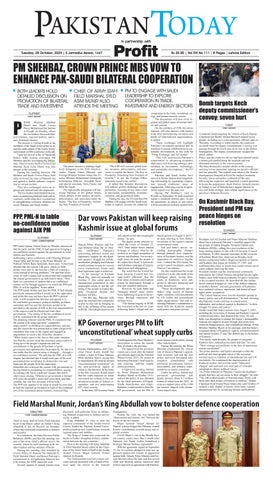
RIME Minister Shehbaz Sharif met Saudi Crown Prince Mohammed bin Salman in Riyadh on Monday, where the two leaders discussed bilateral relations, regional matters, and issues of mutual interest. The premier is visiting Riyadh at the invitation of the Saudi crown prince to attend the ninth edition of the Future Investment Initiative (FII9) conference in Riyadh. Upon his arrival at the Al Yamamah Palace, MBS warmly welcomed PM Shehbaz and his accompanying delegation. Chief of Army Staff (COAS) Field Marshal Syed Asim Munir was also present in the meeting. During the meeting between PM Shehbaz and Saudi Crown Prince, both sides reviewed the state of bilateral ties and agreed to further enhance cooperation in various sectors. They also exchanged views on regional and international developments. The two leaders held detailed discussions on promoting bilateral trade and investment, reaffirming their commitment to strengthening economic relations between Pakistan and Saudi Arabia.
The prime minister is leading a highlevel delegation to the FII9, which includes Deputy Prime Minister and Foreign Minister Senator Ishaq Dar, Finance Minister Muhammad Aurangzeb, Information Minister Attaullah Tarar, and special assistants Tariq Fatemi and Bilal bin Saqib. The high-profile delegation will represent Pakistan at the global forum, which gathers world leaders, investors, policymakers, and innovators under the theme: “The Key to Prosperity: Unlocking New Frontiers of Growth.”
PPP, PML-N to table no-confidence motion against AJK PM ISLAMABAD
Staff CorreSpondent
“The FII9 will convene global leaders, investors, policymakers, and innovators to explore the theme ‘The Key to Prosperity: Unlocking New Frontiers of Growth,'” as per the Foreign Office statement issued a day earlier. It added that thematic discussions will address global challenges and opportunities, focusing on key topics such as innovation, sustainability, economic inclusion, and geopolitical shifts. During his stay, the FO said that PM Shehbaz will engage with the Saudi leadership to explore avenues for enhanced
Dar vows Pakistan will keep raising Kashmir issue at global forums ISLAMABAD
Staff report
PPP leader Qamar Zaman Kaira on Monday announced that his party and the PML-N had agreed on bringing a no-confidence motion against the government in Azad Jammu and Kashmir. Addressing a press conference with Planning Minister Ahsan Iqbal and Adviser to the Prime Minister on Political Affairs Rana Sanaullah, Kaira said, “It has been decided that the current AJK govt, which we both parties were part of, has become a basis of creating a crisis instead of solving problems.” He said that twice, crises of such a nature had occurred that had compelled the federal government to go and resolve them. “Now there is a consensus of opinion that a no-confidence motion will be brought against it on which the PPP and PML-N will be together,” Kaira added. The PPP leader further said that the PML-N had already previously announced that it would sit in the opposition and while this may not have been the PPP’s desired wish, it still accepted the decision and agreed to it. He said better governance, political stability, problem resolution and free and fair elections needed to be provided to the people of AJK so the true representatives of the region could be elected and form their government. “The timing of the [no-confidence] move will be consulted with the prime minister.” The planning minister said the PML-N considered that the current AJK setup had been “completely unsuccessful” in fulfilling its responsibilities, and this was the reason the two parties had to form a high-level committee that went to the region and engaged in negotiations to resolve the crisis-like situation. “What clearly came to the fore in that entire situation was that the current setup has remained unsuccessful in living up to the people’s aspirations and our commitment to the people of Kashmir of good governance and opportunities for prosperity, for that it is inevitable that the current setup is changed … through a no-confidence motion.” He said that the PML-N’s AJK chapter had decided that it would form part of the next government but would play its democratic role and represent the people from the opposition. Sanaullah also criticised the current AJK government as having failed in completing its responsibilities, saying its missing role led to a political vacuum that led to other issues arising. “Whichever government is formed will solve the people’s issues and serve them and then credible, fair and free elections will be held.” The PPP now appears to be ready to install its own man to lead the regional government in light of the imminent exit of the incumbent prime minister, Anwarul Haq.
cooperation in the trade, investment, energy, and human resource sectors. The discussions will also cover regional and global issues of mutual interest and concern. On the sidelines of FII9, the prime minister will also interact with leaders from other participating countries and heads of international organisations, it added. “These exchanges will highlight Pakistan’s investment potential and its readiness to pursue collaborations in sustainable development, in line with the ‘Think, Exchange, and Act’ model.” “This visit underscores Pakistan’s commitment to advancing economic diplomacy and fostering strategic partnerships in investment, technology, and sustainable development,” the FO concluded. Pakistan and Saudi Arabia have moved to further deepen their longstanding relationship by expanding cooperation beyond traditional areas of engagement, following a series of agreements signed over the past year. During PM Shehbaz’s visit to Riyadh on September 18, both countries signed a landmark defence pact. As per the agreement, an attack on one nation will be considered an attack against both.
Deputy Prime Minister and Foreign Minister Ishaq Dar on Monreaffirmed Pakistan’s day unwavering political, moral, and diplomatic support for the Kashmiri people’s struggle for self-determination, pledging that Pakistan would continue to raise its voice at every international forum until their legitimate right is achieved. In his message on Kashmir Black Day, observed annually on October 27, Dar called upon the international community to take meaningful action to end the suffering of the people in Indian Illegally Occupied Jammu and Kashmir (IIOJK). “On this day, Pakistan calls upon the international community to play its due role in bringing an end to the suffering of the people in IIOJK. Their plight deserves not
only attention but also meaningful action,” he said. The deputy prime minister recalled the events of October 27, 1947, when Indian forces entered Srinagar to enforce what he described as an illegal occupation of Jammu and Kashmir. For seventyeight years, he said, the people of the region have faced “a systematic and relentless campaign of tyranny, oppression, and subjugation.” Dar noted that the United Nations Security Council had “unequivocally affirmed” that the final status of Jammu and Kashmir would be determined through a free and impartial plebiscite. However, he said, India had “blatantly defied” these resolutions, tightening its grip on the territory through repression and military force. “The human tragedy in IIOJK has worsened in the last six years following India’s illegal and uni-
lateral actions of August 5, 2019,” he said, referring to New Delhi’s revocation of the region’s special constitutional status. Dar said India’s moves—including demographic changes through domicile laws, imprisonment of Kashmiri leaders, and the imposition of restrictive legislation—violated the UN Charter, Security Council resolutions, and the Geneva Conventions. He also condemned the recent crackdown in the aftermath of the Pahalgam attack, saying thousands of Kashmiris were subjected to arbitrary detention and home demolitions. “These developments add to India’s long record of human rights violations, well documented by UN bodies and international rights organisations,” Dar said, reiterating Pakistan’s commitment to stand with the Kashmiri people until justice and peace prevail.
KP Governor urges PM to lift ‘unconstitutional’ wheat supply curbs PESHAWAR
Staff report
Khyber Pakhtunkhwa (KP) Governor Faisal Karim Kundi has written a letter to Prime Minister (PM) Shehbaz Sharif, urging him to immediately lift what he termed “unconstitutional restrictions” on the inter-provincial supply of wheat to the province. In his letter to the PM, Governor Kundi stated that the curbs imposed on wheat movement are contrary to the constitutional principle of federal cooperation and are undermining KP’s food security. In the letter, KP Governor Faisal
Kundi requested the Prime Minister’s intervention to restore the smooth flow of wheat to the province. The appeal from the governor comes just a week after the federal government approved the National Wheat Policy 2025–26, aimed at bolstering Pakistan’s food security and ensuring uniform supply across provinces. A high-level meeting chaired by Prime Minister Muhammad Shehbaz Sharif on October 19 finalised the policy. It was attended by the chief ministers of Punjab, Sindh, Balochistan, and GilgitBaltistan, a representative from the KP government, and the PM of
Azad Jammu and Kashmir, among other stakeholders. During the meeting, the Prime Minister emphasised the crucial role of wheat in Pakistan’s agricultural economy and said the new policy had been developed after extensive consultations with provincial governments, farmers’ associations, and industry representatives to ensure consensus. Under the policy, federal and provincial governments will jointly procure about 6.2 million tonnes of wheat from the 2025–26 crop at a support price of Rs 3,500 per maund, aligned with international import rates.
Bomb targets Kech deputy commissioner’s convoy; seven hurt TURBAT
Staff report
A roadside bomb targeting the vehicle of Kech Deputy Commissioner Bashir Ahmed Barraich injured seven people, including six Levies personnel, officials said on Thursday. According to initial reports, the explosion occurred when the deputy commissioner’s convoy was passing through the Kech area on its way to the district headquarters. The deputy commissioner escaped the attack unhurt. Police said the explosive device had been planted inside a motorcycle parked along the roadside and was detonated remotely as the convoy passed. The blast destroyed a second vehicle in the convoy carrying Levies personnel, injuring six security officials and one passerby. The injured were taken to the District Headquarters Hospital in Kech for medical treatment. Security forces and police cordoned off the area following the explosion and launched a search operation to locate the perpetrators. Kech District, formerly known as Turbat, is one of Balochistan’s largest districts by area and holds strategic and cultural significance in the province’s Makran Division.
On Kashmir Black Day, President and PM say peace hinges on resolution ISLAMABAD
Staff report
President Asif Ali Zardari and Prime Minister Shehbaz Sharif have reiterated Pakistan’s steadfast support for the people of Indian Illegally Occupied Jammu and Kashmir (IIOJK), calling for a just resolution of the long-running dispute in line with UN Security Council resolutions. In their separate messages on the occasion of Kashmir Black Day, observed on Monday, both leaders condemned India’s illegal occupation of Jammu and Kashmir that began on October 27, 1947, and reaffirmed that peace in South Asia would remain out of reach without resolving the issue. President Zardari said the international community, particularly the United Nations and global human rights bodies, must hold India accountable for grave violations in the occupied territory. He described the day Indian forces entered Srinagar as “one of the darkest chapters in modern history” and said generations of Kashmiris have endured violence, repression, and denial of basic rights under occupation. “The United Nations owes it to the Kashmiri people to ensure justice and self-determination,” he said, stressing that Pakistan would continue to extend moral, diplomatic, and political support to Kashmiris “in their struggle for peace and justice.” Zardari noted that India’s actions since August 5, 2019, including the revocation of Jammu and Kashmir’s special constitutional status, had deepened the crisis. He said India was attempting to change the region’s demographic makeup and suppress dissent through draconian laws, enforced disappearances, and extrajudicial killings. Prime Minister Shehbaz Sharif, in his message, said that India’s continued denial of Kashmiris’ right to self-determination had turned October 27 into “the darkest day in the history of Kashmir.” “For nearly eight decades, the people of occupied Kashmir have endured persecution and fear,” he said. “Their courage and resilience in the face of oppression remain unmatched.” The prime minister said India’s attempts to alter the political and demographic status of the occupied territory were in violation of international law and UN resolutions. He condemned the imprisonment of Kashmiri leaders and activists under “fabricated charges” and said such acts were part of a broader campaign to silence political voices. “As Prime Minister of Pakistan, I assure the Kashmiri people that they are not alone in their struggle,” he said. “The 240 million people of Pakistan stand firmly with them until their dream of freedom is realized.” Senate Chairman Syed Yousuf Raza Gilani also said October 27 marked a dark chapter in history when India violated international law by occupying Jammu and Kashmir.
Field Marshal Munir, Jordan’s King Abdullah vow to bolster defence cooperation RAWALPINDI
Staff CorreSpondent
Chief of Army Staff (COAS) Field Marshal Syed Asim Munir called on Jordan’s King Abdullah II ibn Al Hussein on Monday, where they discussed cooperation in defence and security. In a statement, the Inter-Services Public Relations (ISPR) said that the meeting was part of the army chief’s official visit to the country, where he held meetings with Jordan’s leaders and key military officials. During the meeting, also attended by Crown Prince Al Hussein bin Abdullah II, Field Marshal Munir reaffirmed Pakistan’s commitment to strengthening bilateral ties with Jordan, the ISPR statement read. Several matters of mutual interest were
discussed, with particular focus on enhancing bilateral cooperation in defence and security, it added. King Abdullah II, who is also the supreme commander of the Jordan Armed Forces, lauded the Pakistan Armed Forces’ professionalism and contributions towards regional peace and stability. The King of Jordan also expressed his desire to further strengthen defence collaboration between the two countries. Prior to his meeting with King Abdullah II, Field Marshal Munir called on the Chairman of the Joint Chiefs of Staff of the Jordan Armed Forces, Major General Yousef Ahmed Al-Huneiti. The field marshal received a warm welcome and was presented with a Guard of Honour upon his arrival at the General
Headquarters. During the visit, the two hailed the “deep-rooted and historic ties” between the forces of the two nations. Major General Yousef Ahmed AlHuneiti acknowledged the Pakistan Armed Forces’ contributions towards peace and regional security. COAS Munir’s visit to the Middle Eastern country comes more than a month after Pakistan and Saudi Arabia formalised a Strategic Mutual Defence Agreement. With the agreement, signed on September 17, the two nations pledged to treat any aggression against one country as aggression against both. Deputy Prime Minister and Foreign Minister Ishaq Dar later said that several Arab and Muslim nations expressed their wish to sign such an agreement with Pakistan.