In partnership with
Profit
Saturday, 11 October, 2025 | 17 Rabius Sani, 1447
Rs 20.00 | Vol XVI No 94 | 8 Pages | Karachi Edition
DG ISPR BLAMES GOVERNANCE FAILURES, POLITICAL CONFUSION AS TOLL RISES ‘PROTECT KP, STOP ‘BEGGING AFGHANISTAN’
g
g
g
LT GEN AHMED SHARIF CH URGES PROVINCIAL GOVERNMENT TO FIX GOVERNANCE GAPS, SAYING SACRIFICES OF SOLDIERS PAYING FOR POLITICAL FAILURES
g
IN CURRENT YEAR SO FAR, 10,115 IBOS CONDUCTED, 970 TERRORISTS KILLED, WHILE 311 ARMY PERSONNEL MARTYRED
g
OUTLINES FACTORS BEHIND RECENT RESURGENCE IN MILITANCY, INCLUDING FAILURE TO FULLY IMPLEMENT NAP, POLITICISING TERRORISM, USE OF AFGHAN SOIL AND ‘TERROR-CRIME NEXUS’
LT GEN CHAUDHRY LAMENTS ISSUE OF REPATRIATING ILLEGAL AFGHAN RESIDENTS HAD BEEN ‘UNNECESSARILY POLITICISED’
SAYING ALL OUR PARTNERS UNDERSTAND SPACE GIVEN TO NON-STATE ACTORS IN AFGHANISTAN IS NOT JUST A THREAT TO PAKISTAN BUT TO REGIONAL AND GLOBAL SECURITY
30 terrorists involved in Orakzai incident neutralized in ‘retribution operation’: ISPR RAWALPINDI
staff report
T
PESHAWAR/RAWALPINDI staff reporter
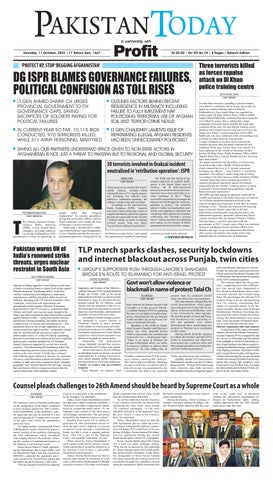
HE Director General of InterServices Public Relations (ISPR), Lt Gen Ahmed Sharif Chaudhry, on Friday called on the Khyber Pakhtunkhwa (KP) government to focus on protecting its
people rather than “begging Afghanistan” for security guarantees, saying that governance failures and political confusion were costing the lives of Pakistan’s security personnel. Addressing a detailed press conference at the Peshawar Corps Headquarters, Lt Gen Chaudhry said that the province’s governance gaps were “being paid for by
Pakistan warns UN of India’s renewed strike threats, urges nuclear restraint in South Asia NEW YORK/ISLAMABAD staff report
Pakistan on Friday urged the United Nations to take note of India’s continuing threats to launch fresh strikes against Pakistan despite its “humiliating defeat” in the May conflict, warning that such belligerence undermines regional peace, stability, and global efforts toward risk reduction. Speaking at the UN General Assembly’s First Committee, which deals with disarmament and international security matters, Pakistan’s Permanent Representative to the UN in Geneva, Ambassador Bilal Ahmad, said South Asia was once again brought to the brink when India launched an unprovoked military assault against Pakistan in May — using dual-capable missiles, autonomous loitering munitions, and fighter aircraft in violation of the UN Charter and international law. “This marked the first-ever use of such capabilities by one nuclear-armed state against another,” Ambassador Ahmad said. He said Pakistan had exercised its right of selfdefense under Article 51 of the UN Charter, responding precisely by downing seven Indian aircraft and compelling India to seek a ceasefire facilitated by US President Donald Trump and supported by several other friendly countries. “Notwithstanding this humiliating defeat, the Indian leadership persists in describing these reckless actions as the ‘new normal’ in South Asia, vowing to strike Pakistan again whenever it chooses,” he cautioned. The envoy noted that Indian political and military leaders continue to make provocative statements about “changing geography” and “erasing Pakistan from the map,” warning that such rhetoric reflects a dangerous delusion that one nuclear-armed state could annihilate another.
Thirty terrorists involved in this week’s deadly Orakzai incident—which claimed the lives of 11 security personnel, including two officers—were killed in a “retribution operation,” the military’s media wing said on Friday. According to the Inter-Services Public Relations (ISPR), “security forces have been conducting a series of targeted retribution operations against the kharijis responsible for the October 7 Orakzai attack, in which Lieutenant Colonel Junaid Tariq and Major Tayyab Rahat embraced martyrdom.” the blood of security forces,” and warned that appeasement or political exploitation
The ISPR said that during an operation conducted on credible intelligence in the Jamal Maya area of Orakzai, “all 30 India-sponsored khawarij involved in the terrorist incident have been sent to hell after an intense exchange of fire.” “These successful operations have avenged the heinous act and brought the main perpetrators to justice,” the statement added. It further said sanitization operations were ongoing to eliminate any remaining India-sponsored elements, reaffirming that Pakistan’s security forces “remain steadfast in eradicating and wiping out the menace of Indiasponsored terrorism from the country. of terrorism would not be tolerated.
CONTINUED ON PAGE 03
Three terrorists killed as forces repulse attack on DI Khan police training centre DERA ISMAIL KHAN staff report
At least three terrorists, including a suicide bomber, were killed in retaliatory fire by police forces after an attack on a police training centre in Khyber Pakhtunkhwa’s Dera Ismail Khan was repulsed on Friday night. DI Khan District Police Officer (DPO) Sajjad Ahmed Sahibzada confirmed that three terrorists were killed by police forces, adding that a large contingent of security forces reached the scene and cordoned off the area. He said that the training centre premises were cleared and all terrorists involved in the attack were killed. A search operation, led by DPO Sahibzada, was also conducted in the surrounding areas to ensure no other terrorists were present. A large contingent of security forces reached the incident site soon after the attack commenced and cordoned off the area. Earlier, there were reports of a loud explosion in the vicinity of the police facility. Earlier, DI Khan Police Public Relations Officer (PRO) Yaqoob Khan that a “suicide bomber and two terrorists have been killed.” The attack coincided with the killing of 30 terrorists involved in this week’s deadly Orakzai incident — which claimed the lives of 11 security personnel, including two officers — were killed in a “retribution operation,” the military’s media wing said on Friday. According to the Inter-Services Public Relations (ISPR), “security forces have been conducting a series of targeted retribution operations against the kharijis responsible for the October 7 Orakzai attack, in which Lieutenant Colonel Junaid Tariq and Major Tayyab Rahat embraced martyrdom.” The ISPR said that during an operation conducted on credible intelligence in the Jamal Maya area of Orakzai, “all 30 India-sponsored khawarij involved in the terrorist incident have been sent to hell after an intense exchange of fire.” Pakistan has witnessed an alarming surge in terrorist attacks, especially in KP and Balochistan, predominantly targeting the police, law enforcement agencies’ personnel, and security forces. Attacks increased after the banned Tehreek-i-Taliban Pakistan broke a ceasefire agreement with the government in 2022. A senior army officer was martyred during an intelligence-based operation (IBO) in the district a day ago. A cop was martyred in the district after a police checkpoint came under attack from multiple sides by terrorists late on Wednesday.
TLP march sparks clashes, security lockdowns and internet blackout across Punjab, twin cities g
GROUP’S SUPPORTERS PUSH THROUGH LAHORE’S SHAHDARA BRIDGE EN-ROUTE TO ISLAMABAD FOR ANTI-ISRAEL PROTEST LAHORE/ISLAMABAD staff report
Supporters and workers of the Tehreek-iLabbaik Pakistan (TLP) reached Shahdara Bridge late Friday night as the group pushed ahead with plans to march towards Islamabad to stage an anti-Israel demonstration outside the US Embassy, amid clashes with the personnel of the law enforcement agencies and extensive security measures, road blockades, and suspension of mobile services in the twin cities. According to media footage, protesters attempted to remove barriers at Chauburji Chowk to move forward, while clashes in several areas left multiple policemen injured. According to Edhi Foundation spokesperson Younis Bhatti, injured law enforcement personnel were shifted to hospitals by rescue teams. Meanwhile, TLP spokesperson Usman Naushahi claimed that one protester had died and 22 others were injured. Ahead of the march, the US Embassy in Islamabad issued an advisory on social media platform X, warning American citizens about possible traffic disruptions and urging them to avoid large gatherings. Clashes in Lahore and government response State Minister for Interior Talal
Govt won’t allow violence or blackmail in name of protest: Talal Ch ISLAMABAD
staff report
State Minister for Interior Senator Talal Chaudhry on Friday accused Tehreeke-Labbaik Pakistan (TLP) of exploiting the issue of corruption for political purposes, reiterating that the government would not allow any group to use violence or blackmail the state. Speaking to the media in Islamabad, Senator Chaudhry said Pakistan’s policy was clear: peaceful protest within a democratic and constitutional framework was a fundamental right. “There is no space in Pakistan for groups to blackmail others, use mobs, or resort to violence to achieve their objectives,” he said, adding that all
Chaudhry condemned the TLP for resorting to violence, asserting that “mob politics” had no place in Pakistan. Speaking at a press conference, he said the right to peaceful protest was guaranteed by the Constitution but had to be exercised
protests must be conducted strictly under specified terms and conditions. The state minister alleged that the recent demonstrations, which organisers claimed were being held in solidarity with Gaza and Palestine, were in fact motivated by other agendas. He said the people of Gaza and Palestine themselves were expressing relief and gratitude over recent developments there, questioning why protests in Pakistan were continuing in their name. Sharing details about the situation in Lahore, the minister said that TLP’s centre in Samanabad had effectively been turned into a political office and that mosque premises were being misused for mobilising protestors.
“under specified terms and conditions.” Chaudhry said the TLP’s past record included attacks on police and use of violence during protests. “Footage shows them using sticks, chemicals, glass balls, and tennis balls studded with nails as slingshots against
police and Rangers, injuring over a dozen,” he said. He noted that a peace pact between Hamas and Israel had already brought relief to Palestinians and questioned the purpose of the TLP’s continued agitation. The minister added that the group’s rally—comprising fewer than 2,000 people—had moved from Samanabad to Ravi Road via Bund Road, where police exercised restraint and avoided using force. He said footage also showed TLP workers firing in the air and destroying Safe City cameras, contradicting their claims of a peaceful protest. In the National Assembly, Speaker Ayaz Sadiq and Parliamentary Secretary Asia Ishaq also questioned the motive behind the protest, asking why demonstrations were being held “when the people of Palestine themselves were satisfied with the truce.” Internet suspension and road closures In anticipation of the march, the Interior Ministry directed the Pakistan Telecommunication Authority (PTA) to suspend 3G and 4G services in Islamabad and Rawalpindi from midnight on October 9 until further orders. Roads leading to the federal capital, including Faizabad Interchange, were blocked with shipping containers. Islamabad’s traffic police issued diversion plans, barring heavy vehicles from entering the city and rerouting smaller ones around Faizabad. Reports suggested that around 500 containers were being used to seal the Red Zone, including key entry points such as Serena Chowk, Express Chowk, and Nadra Chowk.
Counsel pleads challenges to 26th Amend should be heard by Supreme Court as a whole ISLAMABAD
staff report
The Supreme Court on Thursday deliberated on the composition of the bench competent to hear petitions against the 26th Constitutional Amendment, as the petitioners’ counsel urged that the case be referred to a full court comprising all 16 judges who were part of the apex court before the amendment came into force. An eight-member constitutional bench (CB) headed by Justice Aminud Din Khan resumed hearing of the petitions challenging the 26th Amendment, which introduced wide-ranging reforms in the judiciary, including the creation of constitutional benches in the Supreme Court and high courts. Senior lawyer Munir A. Malik, representing the Balochistan Bar Council (BBC) and the Balochistan High Court Bar Association (BHCBA), endorsed the arguments previously advanced by Hamid Khan, adding that the matter should be heard by a full court. “The case should be heard by the Supreme
Court as it existed prior to the amendment — by all 16 judges,” he submitted. Justice Jamal Khan Mandokhail pointed out that such a panel would not constitute a “full court” but rather a larger bench. Malik, however, insisted that under Article 176, the Supreme Court consists of the chief justice and all judges, and therefore “this case should be heard by the Supreme Court as a whole.” Reading from Article 191-A, Malik argued that the 26th Amendment did not restrict the apex court’s authority to exercise its powers except through a constitutional bench, nor did it create a separate judicial body. “The CB is part of the Supreme Court—not a parallel institution,” he said. When asked by Justice Mandokhail if such a panel would still be termed a bench, Malik replied that it would be referred to as the Supreme Court in banc, a universally recognized judicial practice. Justice Ayesha Malik observed that no judicial order barred the formation of a full court, while Justice Muhammad Ali Mazhar inquired to whom a CB’s order would apply.
Malik responded that such an order would bind all constitutional authorities. He further submitted that the Supreme Court’s powers could only be removed by abolishing the court itself, since Article 176 remained unchanged. “A full court should be referred to as the Supreme Court; the term ‘bench’ is alien to the Constitution,” he remarked. Justice Mandokhail observed that the 26th Amendment did not curtail the court’s jurisdiction, noting that the Judicial Commission of Pakistan (JCP) could form a CB comprising all judges. Justice Aminud Din Khan, however, questioned whether the current bench should ignore Article 191-A altogether. Justice Ayesha Malik stated that Article 191-A itself was under challenge, adding, “Why should we proceed by first endorsing it?” Justice Mazhar asked what would justify the current bench’s formation if that article was disregarded, to which Justice Aminud Din Khan noted that the existing bench was constituted through the committee created under the amendment. Malik maintained that
the bench retained authority to issue judicial orders despite this. During the hearing, a brief exchange of remarks took place among the judges. Justice Musarrat Hilali observed that the court
must revisit “point zero” to determine whether the subsequent amendments infringed on fundamental rights, adding, “Judges appointed after the 26th Amendment cannot hear this case.”