In partnership with
PAKISTAN BLAMES INDIA FOR CARRYING OUT TARGET KILLINGS ON ITS SOIL
Profit
Friday, 26 January, 2024 I 14 Rajab, 1445
'CREDIBLE EVIDENCE' FOUND OF LINKS g SAYS INDIA RUNNING ‘SOPHISTICATED AND BETWEEN INDIAN AGENTS, ASSASSINATION SINISTER’ CAMPAIGN OF ‘EXTRA-TERRITORIAL OF TWO PAKISTANIS: FOREIGN SECRETARY AND EXTRA-JUDICIAL KILLINGS’ INSIDE PAKISTAN
I g
Rs 15.00 | Vol XIV No 208 I 8 Pages I Lahore Edition
ISLAMABAD
STAFF REPORT
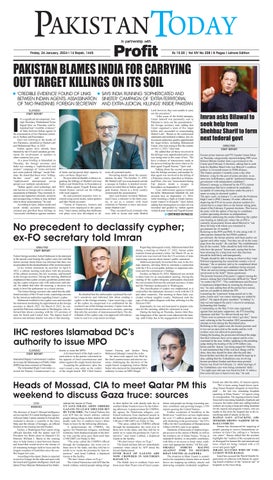
N a significant development, Foreign Secretary Muhammad Syrus Sajjad Qazi on Thursday said Islamabad had “credible evidence” of links between Indian agents in the assassination of two Pakistani nationals in Sialkot and Rawalakot. Qazi was referring to the deaths of two Pakistanis, identified as Shahid Latif and Muhammad Riaz, in 2023. Indian agents have already been blamed by the US and Canadian governments for involvement in murders in other countries last year. At a press briefing in Islamabad on Thursday, the foreign secretary said India was running a “sophisticated and sinister” campaign of “extra-territorial and extra-judicial killings” inside Pakistan. He stated that these were “killingfor-hire cases” and involved a “sophisticated international set-up spread over multiple jurisdictions”. “Indian agents used technology and safe havens on foreign soil to commit assassinations in Pakistan. They recruited, financed and supported criminals, terrorists and unsuspecting civilians to play defined roles in these assassinations,” he said. According to Qazi, Indian media and social media accounts immediately claimed and glorified these killings as “successful retribution against enemies
of India and projected their capacity to carry out these illegal acts”. He provided irrefutable evidence regarding the killings of Shahid Latif near Sialkot and Mohd Riaz in Rawalakot in 2023. Indian agents Yogesh Kumar and Anand Kumar carried out the killings with local support. He said potential assassins were recruited using social media, talent spotters and fake Daesh accounts. “Teams of financiers, locaters and assassins were employed in the operation,” Qazi stated, adding that deliberate exit plans were also developed to ob-
scure all potential tracks. Revealing details about the assassinations, he said: “On October 11, 2023, Mr Shahid Latif was assassinated outside a mosque in Sialkot. A detailed investigation revealed that an Indian agent, Yogesh Kumar, based in a third country orchestrated the assassination.” Qazi said Kumar recruited Muhammad Umair, a labourer in the third country, to act as a contact with local criminals in Pakistan to trace and assassinate Shahid Latif. “They recruited local criminals who were able to locate and trade Shahid
Latif, however, they were unable to carry out the execution.” “After some of the failed attempts, Umair himself was personally sent to Pakistan to carry out the assassination,” the foreign secretary said, adding that Umair organised a team of five target killers and succeeded in assassinating Shahid Latif. “Based on the confessional statements and technical evidence, law enforcement authorities quickly apprehended the target killers, including Muhammad Umair, who were trying to flee the country on Oct 12, 2023,” Qazi said. He added that all those involved in the killings were apprehended and a case was being tried in the court of law. “We have evidence of transactions made in the process linking the entire chain to Indian agent Yogesh Kumar,” Qazi said. Talking about the second assassination, the foreign secretary said another Indian agent was involved in the killing of a Pakistani citizen, identified as Muhammad Riaz, who was “assassinated during Fajr prayers inside a mosque in Rawalakot on September 8, 2023”. “Law enforcement agencies tracked the killer, Muhammad Abdullah Ali, and arrested him on September 15, 2023, while boarding a flight at Jinnah International Airport in Karachi,” Qazi stated, adding that interrogation revealed Ali was recruited and guided by Indian agents Ashok Kumar Anand and Yogesh Kumar.
No precedent to declassify cypher; ex-FO secretary told Imran RAWALPINDI
STAFF REPORT
Former foreign secretary Sohail Mahmood, in his statement to the special court hearing the cypher cases, has said that former premier Imran Khan was informed that there was no precedent for the declassification of the secret document. In his written statement, he said that on April 8, 2022, a cabinet meeting took place with the presence of the cabinet secretary, the law secretary, and himself as the foreign secretary. During the meeting, Mahmood emphasised that cypher security guidelines permit sharing the cypher telegram only with authorised individuals. He added that after the meeting, a decision was made to brief the parliament in a closed session. The former foreign secretary also stated that the additional secretary of the US sent a note, expressing concerns by the American authorities regarding Imran’s cypher. Mahmood testified in the cypher case and recorded his statement mentioning his appointment as the foreign secretary in March 2022. On March 8, 2022, he contacted the Pakistani ambassador in Washington, who informed him about a meeting with the US secretary of state for South and Central Asia. The deputy head of mission and defence attache was also in that meeting.
He detailed that the ambassador explained the matter’s sensitivity and informed him about sending a cypher to the foreign ministry. Upon receiving a copy of the cypher, he categorised it as confidential for the exclusive use of the foreign secretary. Copies were distributed with strict instructions not to circulate, ensuring that only the secretary of state possessed them. The distribution of the cypher copy was approved with instructions to seal it in a top-secret envelope.
IHC restores Islamabad DC’s authority to issue MPO ISLAMABAD
STAFF REPORT
Islamabad Deputy Commissioner’s authority to issue the Maintenance of Public Order (MPO) has been restored on Thursday. The Islamabad High Court today restored the Deputy Commissioner’s au-
thority to issue the MPO. A division bench of the high court issued notices to the parties concerned on the appeals of chief commissioner and others against the single bench decision. Accepting the petitioners’ plea, the court issued a stay order on the verdict of the single bench. IHC Chief Justice
CONTINUED ON PAGE 03
Regarding subsequent events, Mahmood stated that during a meeting on March 27, 2022, former prime minister Imran presented a letter. On March 28, an internal note was received from the US secretary of state expressing concern about Imran’s public statement. Mahmood promptly forwarded this note to the foreign ministry, advising them to maintain a connection with the US to avoid public debates on important relations and the commission’s findings. Further, on March 29, 2022, Mahmood was invited to Bani Gala for an unscheduled meeting. During the reading of the cypher telegram, participants discussed the conversation between the assistant secretary of state and the Pakistani ambassador in Washington. The classification of cypher was emphasised, as it could affect the diplomatic mission’s work with the US and other countries. The meeting in Bani Gala concluded without tangible results, Mahmood took the copy of the cypher telegram with him, referring it to the Director FSO. Importantly, he was not instructed to prepare minutes for this meeting, added his statement in court. During the hearing on Thursday, Justice Abul Hasnat Zulqarnain of the special court adjourned the hearing until Friday due to the engagement of the counsel.
Aamer Farooq and Justice Tariq Mehmood Jahangiri issued the order. An intra-court appeal was filed by the chief commissioner and interior secretary challenging the decision of the single bench comprising Justice Babar Sattar who declared the Islamabad DC’s authority to issue an MPO illegal.
Imran asks Bilawal to seek help from Shehbaz Sharif to form next federal govt RAWALPINDI
Former prime minister and PTI founder Imran Khan on Thursday categorically rejected helping PPP scion Bilawal Bhutto-Zardari form a government in the Centre post-February 8 elections, asking him to seek help fro Shehbaz Sharif who was Bilawal’s coalition partner in 16-month tenure in PDM alliance. The former premier’s remarks come a day after Bilawal, vying for the post of prime minister, in an interview with Reuters, said he “preferred forming a government with independent candidates”. Bilawal’s strategy is informed by the PTI’s current circumstances that have rendered its candidates incapable of contesting elections under the party’s name or using its electoral symbol. The apex court, on January 13, set aside the Peshawar High Court’s (PHC) January 10 order, effectively depriving the PTI of its iconic election symbol of a cricket bat in a major blow to the former ruling party ahead of the February 8 general elections. This leaves the party with the option of having its candidates contest upcoming elections as independents. Informally addressing the media following the cypher case hearing at Adiala jail, where the ex-PM is currently incarcerated, Imran asked Bilawal to “ask those for help with whom you remained in government for 16 months”. Referring to the PPP and PML-N who along with 13 other parties formed the last PDM coalition government, the former premier said these parties are against each other today, “but they are all on the same page from the inside”. He said that “the establishment has all the control. Talks should be held with those who have the power,” Imran said, saying that he has been stressing for a long time now that elections should be held fairly and transparently. “People should be able to bring in whoever they want. Political engineering has caused the country a lot of damage,” the ex-premier said as he complained about his party’s supporters and candidates being arrested. “How are surveys being conducted when the PTI is not present in the field?” Imran questioned. The premier boasted of his party’s support among the masses, stating that it had become difficult for “them” “to control the PTI”. “The establishment and Election Commission helped them in winning by-elections too,” he said, adding that all the parties have united, and are yet unable to defeat the PTI. Lamenting the ‘treatment’ being meted out to the party, Imran said “our corner meetings are raided by police”. He urged all party members “in hiding” to step out and support the party’s electoral campaign, kickstarting this Sunday. Commenting on the May 9 riot cases registered against him and party supporters, the PTI founding chairman said that “we did not break any law”. “There were no protests even when I got shot,” Imran said, referring to the November 2022 assassination attempt on him during the Wazirabad jalsa. Referring to the cypher trial, the former premier said it was not an open trial as the media and his wellwishers were not allowed to participate. During the hearing, the prosecutor informed the judge that their witnesses have yet to appear and be crossexamined in the case. Earlier, speaking to the presiding judge during the hearing of the £190 million case, Imran said the ‘drama’ was being staged for February 8, and maintained that if this was how things will be done, then they should be done after the poll date. Imran further said that all cases should be kept up to date, adding that the Toshakhana case involving former president Zardari and three-time premier Nawaz was fixed for February 13, while hearings of his Toshakhana case were being conducted ‘daily’. “An eight-year-old case was fixed for Feb 13 while a four-year-old case is heard every day,” he said.
Heads of Mossad, CIA to meet Qatar PM this weekend to discuss Gaza truce: sources DOHA
AGENCIES
The directors of Israel’s Mossad intelligence service and the US Central Intelligence Agency will meet Qatar’s prime minister in Europe this weekend to discuss a ceasefire in the Gaza Strip and the release of hostages, an official briefed on the meeting has told Reuters. Earlier, a Washington Post report citing officials familiar with the matter said US President Joe Biden plans to dispatch CIA Director William J. Burns in the coming days to help broker a deal between Hamas and Israel that would involve the release of all remaining hostages held in Gaza and the longest cessation of hostilities since the conflict began last year, According to the report, Burns is expected to travel to Europe for the talks and meet with the Israeli and Egyptian intelligence chiefs and Qatari Prime Minister Mohammed bin Abdul-
rahman bin Jassim Al Thani. UN SAYS ISRAEL ARMY ORDERS GAZANS TO LEAVE SHELTER HIT BY TANK FIRE: The United Nations has told AFP that the Israeli military ordered people taking refuge in their shelter hit with deadly tank fire in southern Gaza’s Khan Yunis to leave by the following afternoon. A spokeswoman for UNRWA, the agency for Palestinian refugees, confirmed testimony from displaced people in the shelter who said the army gave them until 5pm (1500 GMT) on Friday to flee. “The army called the UNRWA official through the loudspeaker, she went over to them next to the tanks, and they told her to notify us to vacate the premises by 5pm tomorrow,” said Amal Lubbad, a displaced Gazan at the facility. “We don’t know where we’ll go.” The United Nations has told AFP that the Israeli military ordered people taking refuge
in their shelter hit with deadly tank fire in southern Khan Younis to leave by the following afternoon. A spokeswoman for UNRWA, the agency for Palestinian refugees, confirmed testimony from displaced people in the shelter who said the army gave them until 5:00 pm (1500 GMT) on Friday to flee. “The army called the UNRWA official through the loudspeaker, she went over to them next to the tanks, and they told her to notify us to vacate the premises by 5 pm tomorrow,” said Amal Lubbad, a displaced Gazan at the facility. “We don’t know where we’ll go.” The Israeli military did not immediately comment when asked by AFP about the forced displacement. OVER HALF OF GAZANS ARE NOW CROWDED IN SOUTHERN RAFAH: UN The Rafah area in southern Gaza now hosts more than 50 per cent of Gaza’s popu-
STAFF REPORT
lation, and people are facing worsening sanitary conditions and growing hunger, CNN reports quoting the United Nations. Further escalation of hostilities in the Rafah area “could have serious implications for over 1.3 million people who are reportedly sheltering in the governorate,” the UN’s Office for the Coordination of Humanitarian Affairs (OCHA) said in an update. Hundreds of thousands of displaced people are now in the streets of Rafah, as well as the southern city of Khan Younis, “living in makeshift shelters in miserable conditions, with little or no access to food, water, medicines and appropriate shelter,” OCHA said. ISRAELI FORCES RACING AGAINST TIME TO DESTROY KHAN YOUNIS: AL JAZEERA The situation in Khan Younis is considered to be completely chaotic there as Israeli forces are stepping up military attacks and destroying complete residential neighbour-
hoods one after the other, Al Jazeera reports. “We’ve been seeing Israeli forces encircling Nasser Hospital alongside al-Amal Hospital — the last two remaining hospitals operating in Khan Younis,” AJ reports citing its correspondent. The ongoing action by Israeli forces led to terrorising hundreds of patients and evacuees, the media outlet said, adding medical workers are trying to keep providing treatment for the injured and pregnant women, who are unable to flee from the hospital due to the intensifying raids of attacks on the city. HAMAS SAYS ATTACKING AIDSEEKERS SHOWS ‘SADISM’ OF ISRAELI FORCES Hamas has denounced the targeting of people queuing to receive humanitarian assistance in Gaza City, calling it a “heinous war crime”. Hamas added that the incident highlights the “sadism of the occupation and its disregard for human life and international laws, which are being violated with a US cover and green light”. ISRAEL ACCUSES WHO OF ‘COLLUSION’ WITH HAMAS Israel has accused the World Health Organisation of collusion with Hamas by ignoring Israeli evidence of the “terrorist use” of hospitals in the Gaza Strip.
02
PAKISTAN’S DEBT SERVICING COSTS SURGE BY 74% IN FIRST FIVE MONTHS OF FY24 NEWS
Current fiscal year saw a surplus of Rs107.9b in July-November, a notable decrease from Rs202.5b in previous year
P g
PROFIT
staff report
AKISTAN has experienced a 74% increase in debt servicing costs during the first five months of the fiscal year 2024. This rise, observed from July to November, is primarily attributed to the higher policy rates impacting the markup on principal and outstanding loans.
The comparison is made against the same period in the previous fiscal year, FY2023. This fiscal challenge is further compounded by a reduction in the revenue surplus generated by the provinces. The current fiscal year saw a surplus of Rs107.9 billion in this period, a notable decrease from Rs 202.5 billion in the previous year. The primary factor driving this trend is the increased current expenditures, mainly
due to the heightened mark-up payments resulting from the high policy rates. these challenges, the Despite government has demonstrated a concerted effort in controlling non-mark-up spending. This is evident in the reported rise in primary surplus during the same period, marking a notable fiscal management strategy. The State Bank of Pakistan’s (SBP) Monetary Policy Committee is set to
convene next week to deliberate on either maintaining or increasing the policy rate. Any decision to hike the rate is expected to further amplify debt servicing costs, posing additional challenges for the Ministry of Finance. In a broader fiscal perspective, the total expenditures from July to November in FY2024 grew by 43% to Rs4,831.0 billion, compared to Rs3,367.4 billion in the previous year. This growth is primarily driven by a 46% increase in current spending, with mark-up payments alone surging by 74%. In contrast, non-mark-up spending saw a modest growth of 20%, reflective of the government’s spending restrictions.
Customs Intelligence uncovers illegal tunnel used for diesel theft g
174-foot-long underground tunnel, intricately connected to the PARCO pipeline, has reportedly caused daily losses of billions of rupees PROFIT
News Desk
Customs Intelligence in Karachi has uncovered a significant operation involving the theft of non-duty paid diesel from the PARCO oil pipeline. This was achieved through a sophisticated system involving a 174-foot-long underground tunnel, used by smugglers to extract and transport the fuel illegally. The operation was first identified
through meticulous intelligence gathering and surveillance, particularly focusing on a suspicious industrial site in Karachi. This led to the discovery of the tunnel, which was intricately connected to the PARCO pipeline, facilitating the illegal extraction of diesel. A recent Intelligence Based Operation (IBO) conducted by Customs Intelligence resulted in the seizure of 65,000 litres of non-duty paid diesel, valued at approximately Rs 20 million.
CPEC emerges as a symbol of exemplary friendship: Chinese Consul General
LAHORE: The Consul General of the People’s Republic of China in Lahore Mr. Zhao Shiren has said that China Pakistan Economic Corridor (CPEC) is the glowing example and hallmark of deepening China-Pakistan friendship and partnership. He expressed these views while talking to journalists in Meet the Press Program of Lahore Press Club on Thursday. While addressing the media, Consul General Mr. Zhao Shiren further sais that CPEC is the joint venture of China and Pakistan which has completed 10 years and will be completed in any case. Under CPEC, 26 billion dollars have been invested so far, while construction is still going on. About electric transmission line, he said it is being upgraded. We want to bring prosperity to our old friend Pakistan. Pakistan is an agricultural country and Punjab government has formulated a ten year plan regarding agricultural development. The Consulate General stands ready to work with the Punjab to enhance agricultural cooperation. He said that China, Pakistan and Iran are three friendly countries and together they will move jointly ahead in the region. There should not be any conflict between Pakistan and Iran, the situation will return to the previous position soon. Friendship between brothers and friends is in China’s interest. staff report
The operation, which has been running unchecked for an extended period, has reportedly caused daily losses of billions of rupees. Further to the seizure, investigations led to the arrest of the owner of an edible oil factory at Port Qasim. This factory was identified as being intricately involved in the illegal activities. The arrest marks a significant development in unraveling the network behind this sophisticated smuggling operation.
The Directorate of Intelligence & Investigation-Customs, Karachi, initiated this operation based on information provided by the Director General of Customs Intelligence, Faiz Ahmad Chadhar. The information pointed to an organized syndicate involved in the theft and sale of non-duty paid diesel. Ongoing investigations aim to arrest other members of the gang and determine the full extent of the losses over time.
Inland Revenue Service petitions ECP to halt interim govt’s FBR restructuring plan g
Petition highlights that restructuring violates several statutes including FBR Act 2007 and various tax laws PROFIT
News Desk
The Inland Revenue Service (IRS) has filed a petition with the Election Commission of Pakistan (ECP), requesting intervention to stop the interim government from restructuring the Federal Board of Revenue (FBR), a move they consider illegal and unconstitutional. This petition was filed amidst discussions within a federal cabinet sub-committee, formed to review the proposed overhaul of the FBR. At the core of the restructuring proposal is the separation of the Inland Revenue Board and the Federal Customs Board, along with distinguishing tax policy from operations. Some tax officials reportedly have concerns regarding the caretaker finance minister’s rapid and selective approach to tax administration reform.
The federal cabinet on Tuesday established an inter-ministerial committee with the mandate to finalize recommendations for restructuring the Federal Board of Revenue (FBR) within a four-day deadline. The IRS, responsible for collecting various domestic taxes, is contesting this move, which was initiated by the caretaker finance minister aiming to increase Pakistan’s tax-to-GDP ratio from 8.5% to 22%. Deputy Commissioner Ali Saleh Hayat Kalyar, representing the IRS, filed the petition. It argues that the caretaker government lacks the legal mandate for such major changes, highlighting that the restructuring violates several statutes including the FBR Act 2007 and various tax laws. The IRS is emphasizing that such major policy decisions should be left to an elected government. Furthermore, the IRS has raised
Company reports 21.25% and 89.13% increases in sales and net profit respectively PROFIT
News Desk
The board of directors of Fauji Fertilizer Bin Qasim Limited announced on Thursday a proposed cash dividend of Rs 1 per share for FY2023, marking a 10% return, and no bonus or right issues. Fauji Fertilizer’s sales increased by 21.25% and net profit by 89.13%. A 10% return on shareholders-provided money from fertiliser manufacturing money is low, especially when other industries are generating high returns. Gas shortages have affected throughout the year, impacting not only its
production but also exacerbating challenges for the farmers due to higher
prices of Urea. The company’s Urea plant operated at
concerns about the proposed establishment of oversight boards under the new structure, fearing that these may open doors to vested interests and conflicts of interest, especially with the involvement of private sector individuals. The petition concludes by urging the ECP to prevent the caretaker government from proceeding with the FBR restructuring, asserting that such actions are beyond their mandate and could lead to legislative overreach and potential system collapse.
a mere 52% capacity due to gas curtailment and it faced a shortfall of 42% in gas supply compared to the government allocation. This shortage, totaling 13,714 MMSCF, significantly hindered operations, leading to a 36% decline in Urea production, down to 336 KT from 524 KT in the previous year. In addition to gas-related challenges, the company grappled with economic hurdles, including adverse fluctuations in the Pakistani rupee against the US dollar and escalating borrowing rates. With all these challenges, the company reported a profit of Rs 4.4 billion in 2023, representing an 89% increase compared to 2022. The increase in revenues is achieved by focused management efforts and improvement in supply chain economics.
SBP raises Rs 294bn from PIB-PFL, Rs 185bn from MTBs g
MTBs auction saw a sharp fall in cut-off yields PROFIT
News Desk
The State Bank of Pakistan (SBP) on Wednesday sold Rs 293.638 billion worth of Pakistan Investment Bond – Floating Rate (PIB-PFL), and Rs 184.66 billion worth of short-term Market Treasury Bills (MTBs). The SBP exceeded its targeted funds of Rs 280 billion for PIB-PFL bonds and Rs 225 billion for MTBs. PIB-PFL auction attracted bids worth Rs 703.092 billion, indicating a strong demand for the bonds. The SBP accepted Rs267.438 billion for the
semiannual bonds and Rs26.2 billion for the quarterly bonds. Floating rate bonds have varying maturities of 2, 3, 5 and 10 years. They are linked to the policy rate of the SBP and offer semiannual or quarterly payments to investors. The quarterly bonds were only sold for the 3-year maturity, as the SBP rejected the bids for the 2-year maturity. The semiannual bonds were sold for both the 5-year and 10-year maturities. The cut-off price for the 3-year quarterly bond was Rs98.1357, while the cut-off prices for the 5-year and 10-year semiannual bonds were Rs96.5915 and
Rs94.8122 respectively. The cut-off prices reflect a slight decrease in the yields of the bonds, compared to the previous auction held on January 10, when the SBP sold Rs173.8 billion worth of PIB-PFL. YIELDS DROP ON MTBS On the other hand, the SBP also sold short-term treasury bills, also known as Market Treasury Bills (MTBs), worth Rs 184.66 billion, exceeding its target of Rs 225 billion. But, the auction saw a sharp fall in the cut-off yields of the MTBs, which indicate the interest rate that the SBP pays to the investors. The cut-off yields for 3, 6, and
The overall fiscal deficit has been marginally reduced to 1.3% of the Gross Domestic Product (GDP), equating to Rs1,375.4 billion, compared to 1.4% (Rs1,168.6 billion) in the same period last fiscal year. However, the overall primary balance recorded a surplus of Rs1,542.1 billion, significantly higher than Rs511 billion in the previous year. This surplus aligns with the government’s agreement with the International Monetary Fund (IMF) to maintain a primary surplus of 0.4% of the GDP. For FY2024, the fiscal deficit is projected at 6.5% of the GDP. Notably, net revenue receipts have improved by 68% to Rs3,347.7 billion, against Rs1,996.5 billion in the previous year. This improvement is largely due to a 114% increase in non-tax collection and a 30% rise in tax collection. The Federal Board of Revenue (FBR) reported a 30.3% increase in tax collection during the period, amassing Rs4,469 billion, which surpasses the assigned target by Rs44 billion.
IMF tranche propels Pakistan’s forex reserves to $8.27bn PROFIT
MoNitoriNg Desk
The State Bank of Pakistan (SBP) has reported a increase in its foreign exchange reserves, marking a rise of $243 million within a week. According to the data released by the central bank on Thursday, the reserves held by the SBP as of January 19 amounted to $8.27 billion, up from $8.027 billion on January 12. This increase is largely attributed to the receipt of the second tranche of $705 million from the International Monetary Fund (IMF), which is part of a broader $3 billion Stand-By Arrangement (SBA) with Pakistan. Additionally, the central bank has successfully managed the government’s external debt repayments in this period. In a wider context, the total liquid foreign currency reserves of Pakistan, including the reserves held by banks other than the SBP, stood at $13.341 billion. This figure represents an increase of $196 million compared to the previous week. However, it is important to note a decrease in the net reserves held by other banks, which fell by $47 million to a total of $5.071 billion. The recent developments in Pakistan’s foreign exchange reserves demonstrate the country’s effective financial management and its active collaboration with international financial entities like the IMF.
Petroleum prices likely to increase in next review PROFIT
Fauji Fertilizer announces cash dividend of Rs 1 per share g
Friday, 26 January, 2024 | LAHORE
12 months were 20.4997%, 20.4000%, and 20.2298%, respectively, showing a decrease of 50 bps, 56 bps, and 62 bps from the previous auction. The auction received bids worth Rs 1.121 trillion, out of which the SBP accepted Rs 185 billion. The bid-to-cover ratio, which measures the demand for the MTBs, dropped to 6.07 from 9.73 in the last auction. The treasury bills have maturities of 3, 6, and 12 months. They are issued by the SBP to raise funds for the government and regulate the money supply. The lower yields surprised some market analysts, who attributed them to the low uptake of the Sukuk bonds by the government in the previous day’s auction.
MoNitoriNg Desk
Industry officials have alerted citizens to brace for an increase in petrol and high-speed diesel (HSD) prices in the upcoming fortnightly review of petroleum prices. Citing a surge in international prices amidst escalating tensions in the Middle East, officials anticipate a rise of Rs7 per litre for both petrol and diesel by January 31, 2024. Petrol prices in the global market escalated from $83 to $89 per barrel, while HSD surged from $93 to $97-98 per barrel within a week. Crude oil prices similarly climbed from $76 to $80 per barrel. This potential hike would mark a departure from the recent trend of stability or slight decreases in domestic fuel prices since November 01, 2023. An oil sector official emphasized the current geopolitical turmoil, especially the Houthi attacks on ships in the Red Sea, which prompted retaliatory strikes from the US and UK against them in Yemen. This crisis catalysed a surge in global petroleum product prices over the past week, with petrol and HSD prices rising by four to five dollars per barrel. Despite stable local currency rates, officials warn of impending price hikes domestically, reflecting the global price fluctuations. They noted that resistance in international prices may temper further increases in the coming days.
E&P companies to invest $33m in Pakistan’s hydrocarbon exploration PROFIT
News Desk
Exploration and production (E&P) companies are gearing up to invest $33.3 million in hydrocarbon exploration over the next three years across eight blocks, aiming to alleviate Pakistan’s ongoing energy crisis. These companies recently signed petroleum concession agreements (PCAs) with the government, securing exploration licenses for their endeavors. The designated blocks, including Kotra East, Murradi, Sehwan, Zindan-II, Multanai, Sawan South, Gambat-II, and Saruna West, hold the promise of bolstering the nation’s hydrocarbon reserves. Minister for Power and Petroleum Muhammad Ali emphasized that these agreements not only stimulate investments in the petroleum sector but also aid in narrowing the energy demandsupply gap. Under the agreements, E&P firms are mandated to allocate a minimum of $30,000 per year per block for local social welfare initiatives. Despite the lackluster response from foreign entities, Pakistani firms, predominantly state-owned, have stepped forward to seize these opportunities. This move comes at a critical time when Pakistan is working to attract foreign investors amidst challenges like policy inconsistencies, corruption cases.
Friday, 26 January, 2024 | LAHORE
FBR UNVEILS SIMPLIFIED TAX SCHEME FOR RETAIL SECTOR NEWS
Initiative aims to bring remaining 3.2m retailers into tax net, with potential to generate income tax revenue between Rs400b and Rs500b
T
g
PROFIT
newS DeSk
HE Federal Board of Revenue (FBR) has introduced a simplified tax scheme aimed at taxing the estimated incomes of traders, retailers, and specified individuals, as part of an effort to reduce the informal
economy’s size. The FBR expects this new scheme to potentially generate income tax revenue ranging from Rs400 billion to Rs500 billion. The scheme’s details were presented to the federal cabinet for endorsement, to calculate the estimated income of traders and retailers. The proposal takes into account factors
such as shop location, value, and rent to determine indicative incomes. To facilitate this process, a specialized mobile application named ‘Tajir Dost’ has been developed to streamline income calculation and tax collection. Under this scheme, indicative income will be determined based on a rate three times the rental value, considering the
general ratio of rent expenses to income. Tax payments will be made in 12 monthly installments, with a 50% discount offered to proactive individuals who file tax returns before the first monthly installment. Additionally, the minimum tax can be adjusted based on self-declaration in the annual return, encouraging timely tax filing.
IHC extends its stay on Iddat Nikah case proceedings till January 31 ISLAMABAD
Staff RepoRt
The Islamabad High Court on Thursday extended its stay order barring the trial court from conducting proceedings on the illegal Nikah case against former premier and PTI founder Imran Khan and his spouse Bushra Bibi till January 31. IHC Chief Justice Aamer Farooq heard the petitions filed by Imran Khan and Bushra Bibi seeking dismissal of the Nikah in Iddat case against them. The counsel for the PTI founder and Bushra Bibi, Salman Akram Raja, did not appear in the court on Thursday. His assistant lawyer requested the court to
120 KP lady teachers suspended for skipping poll training PESHAWAR
Staff RepoRt
More than 120 lady teachers were suspended in Khyber Pakhtunkhwa for not attending training sessions for upcoming general elections, reported on Thursday. Overall 133,048 presiding and senior assistant presiding officers’ were being trained in 125 training centres of the province. Training of 27,600 teachers was completed. Provincial Election Commission, taking notice of the reports, has directed action against the absentees. Kurram district women education department in a notification said it has suspended 97 female teachers for not appearing in the training session. Likewise 26 absent female teachers from Peshawar city were also issued notices, with the competent authority asking them to submit their replies within three days.
Cop martyred in Peshawar firing PESHAWAR
Staff RepoRt
A cop was martyred in firing of unidentified armed men in Daudzai area of the provincial capital on Thursday. According to details, unknown gunmen targeted Constable Kamran while he was taking his children to school van. As a result of firing, Constable Kamran was martyred and attackers disappeared in the cultivated agricultural fields in the surroundings. The body of martyred cop was shifted to hospital and police after registering a case into the incidents started efforts to trace and arrtest the assailants.
Former PTI MPA arrested from Abbottabad ABBOTTABAD Staff RepoRt
The Anti-Corruption Establishment has arrested former PTI MPA Nazir Abbasi from Abbottabad. He is contesting from PK 42 as an independent candidate. According to sources, the Abbottabad ACE arrested the former PTI member of the provincial assembly, Nazir Abbasi, in the corruption and bogus recruitment cases. PTI leader from Attock quits party, joins PML-N. Separately, in Attock, former PTI district president Waheed Murad left his party and joined the Pakistan Muslim League-Nawaz. He announced his decision to leave the PTI during a press conference on Thursday. The PML-N candidate for PP 3, Hameed Akbar, and other Nawaz League workers were present on the occasion. Waheed Murad said that the country is surrounded by problems and it needs Nawaz Sharif at this time. “I am joining the PML-N for the country’s interest and development,” he added. He said if the projects completed and launched by Nawaz Sharif were removed from Pakistan, nothing would be left. He said that he would fully support all the candidates of the PMLN in the forthcoming elections.
adjourn the hearing till next week. However, Bushra’s ex-husband Khawar Maneka’s lawyer Raja Rizwan Abbasi pleaded with the high court to vacate its stay order on the trial court’s proceedings. He said that since the petitioners got such relief from the court, their lawyer won’t come to the court. The chief justice corrected the lawyer remarking ‘don’t say that. Three lawyers from the petitioners are already in the court’. Saying this, the court adjourned the hearing till January 31. On January 16, a Rawalpindi trial court indicted former prime minister Imran Khan and his spouse Bushra Bibi in the Iddat case. The charges against the couple were framed by senior
civil judge Qudratullah on a complaint filed by Bushra Bibi’s ex-husband Khawar Farid Maneka under Sections 34 (common intention), 496 (marriage ceremony fraudulently gone through without lawful marriage) and 496B (fornication) of the Pakistan Penal Code. Last week Imran Khan and Bushra Bibi filed a petition in the IHC seeking dismissal of the case against them. During its previous hearing on January 19, the Islamabad High Court stopped the trial court from recording the statements of the witnesses in the Nikah in Iddat case. The chief justice remarked during the hearing that “according to the law, if a marriage takes place during Iddat, it would be regularized later, if the marriage is not regular, then what is the crime in it?”
Pakistan blames India for carrying out target killings on its soil CONTINUED FORM PAGE 01
He said Indian agents used the social media platform Telegram to recruit Ali, claiming that Ali received payments and was provided with weapons and ammunition. Qazi added that the case was being tried in the court of law. The foreign secretary went on to say that the investigators “quickly identified” Ali’s facilitators on the basis of confessional statements and technical evidence. “We have documentary, financial and forensic evidence of the involvement of the two Indian agents who masterminded these assassinations,” he said, adding that the Pakistan government was releasing the passport details of these agents. Qazi further said that Islamabad had also reached out to the governments of relevant third countries. “There are a few other cases of similar gravity at various stages of investigation,” he added. He stated that these cases revealed a “growing sophistication and brazenness of Indian-sponsored
terrorist acts in Pakistan,” highlighting that such incidents were also reported in Canada and the US. “Clearly the Indian network of extra-judicial and extra-territorial killings has become a global phenomenon,” the foreign secretary said. He asserted that it was critical to bring the killers, their facilitators and financiers to justice. “India must be held accountable internationally for its blatant violation of international law. India’s assassination of Pakistani nationals on Pakistani soil is a violation of its sovereignty and a breach of the UN charter,” Qazi stressed, calling it “completely unacceptable”. He maintained that Pakistan remained committed to protecting its people and securing its sovereignty, asserting that the protection of Pakistan and any foreign national on Pakistani soil “is a high priority” for the government. “India’s reckless and irresponsible act calls into question India’s reliability as a credible international player and its claims for enhanced global responsibilities,” Qazi added.
SCCI demands allowing import of cotton in open trucks PESHAWAR
aziz BuneRi
Sarhad Chamber of Commerce and Industry president Fuad Ishaq urged the government and ministry of National Food Security and Research to review procedural and regulation changes and allow import of cotton in open trucks that will not only increase foreign exchange and textile export, but also cut additional monetary burden on importers. The SCCI chief while chairing a meeting of traders/importers here at the chamber house said government and authorities concerned had brought procedural change with regard to import of cotton. Under the new regulation, he said import of cotton from Afghanistan has been made mandatory in containers. He, however, said traders and importers are facing hardships owing to unavailability of containers and to meet this condition. To comply with this condition, Fuad Ishaq said traders and importers will have sent empty containers from Pakistan to Afghanistan then cotton loaded in these
containers and imported to Pakistan, because of which traders/importers will pay fourfold the transportation cost. The meeting was attended by the chamber’ former senior vice president Engr Mansoor Elahi, traders and importers. Fuad Ishaq told the meeting that importers fully acknowledged the importance of fumigation including cotton, and assured fully adhering with its procedure. However, he said that during import of cotton, it fully covered by plastic and canvas when transported in open trucks, effectively serving the purpose of fumigation. The SCCI chief urged the government, federal secretary for National Food Security and Research and other relevant authorities to issue immediate orders, allowing import of cotton in open trucks, which couldn’t only earn hefty foreign exchange for the country but also enhance textile export and lower additional burden of the importers. Fuad Ishaq said smooth import of cotton was in the best interest of Pakistan. Therefore, he said SCCI and business community/traders and importers urged the government to withdraw procedural changes with regard to import of cotton.
Artist entrepreneur fund of Rs.1bln being established for artists: DG PAC AWALPINDI
Staff RepoRt
Director General of Punjab Arts Council, Syed Bilal Haider has said that an artist entrepreneur fund of Rs.1 billion was being established for the welfare of artists, out of which interest-free loans of up to Rs.25 lakh will be given to artists, artisans and fine arts graduates. He stated this while chaired a meeting of the Board of Management (BoM) held after the painting
exhibition organized in Punjab Arts Council in collaboration with VSCOPK on Thursday. More than 70 works of art of the students of twin cities were displayed in a painting exhibition. Director General of Punjab Arts Council, Syed Bilal Haider who was the chief guest at the opening ceremony of the exhibition also distributed certificates of appreciation to all the students who participated in the exhibition. Syed Bilal Haider informed the members of the Board of Management about the aims and objectives.
Pakistan Commercial Center launched at ICT Belt and Road Union SHANGHAI
Staff RepoRt
Zheng Chuanjun, Deputy Secretary General of the ICT Belt and Road Union, and Ms. Ayesha Khan, representative of Lasiro Limited, signed an agreement to launch the Pakistan Commercial Center at the ICT Belt and Road Union, China Economic Net (CEN) reported on Thursday. This is part of the efforts promoting high-quality economic and trade cooperation between China and Pakistan and on a wider scale The launch of the center was witnessed by government officials,
business leaders and more than 500 global entrepreneurs in the fields of digital economy and industrial investment at the 2024 Future
Opportunity Investment Conference. The Pakistan Commercial Center will serve as a one-stop shop for Pakistani businesses looking to expand
their reach in China by providing membership services for Pakistani enterprises in China or preparing to enter China. This includes market research, legal advice and other essential services to support businesses in their international endeavors. The Center will provide a platform for exporters, importers and investors to connect, negotiate deals and explore opportunities with the Belt and Road partners. The ICT Belt and Road Union is a partnership between China and other Belt and Road countries, aimed at promoting trade, investment, and cultural exchanges.
03
The goal of this initiative is to bring the remaining 3.2 million retailers, primarily located in major cities, into the tax net, expanding the tax base and revenue collection. Currently, only 300,000 out of an estimated 3.5 million retailers actively file tax returns. In addition to this tax scheme, the FBR is finalizing the digitization of withholding tax collection through the Synchronised Withholding Administration and Payment System (SWAPS).
TTP network busted, commander among 17 terrorists held in Karachi KARACHI
Staff RepoRt
Security forces in an intelligence-based operation busted banned Tehrik-e-Taliban Pakistan (TTP) network and arrested 17 terrorists including a terror commander from Karachi on Thursday. The terrorists were involved in target killings, ransom and dacoity cases. The terrorists were planning to collect funds from traders for ransom, attack political and religious parties’ leadership to create law and order situation in the country. The arrested terrorists were brought to Pakistan by banned TTP in disguise of madrassa students. The terrorists were part of TTP network between 2007 to 2014 and were involved in attacks on security forces and NGOs at different places.
Stray cheetah shot dead in Bajaur after ferocious attack BAJAUR
Staff RepoRt
A cheetah who was strayed into a residential locality in Khyber District of Khyber Pakhtunkhwa and attacked a man, was shot dead by the local residents, reported on Thursday. The wild beat attacked the man in Bara area of Khyber district injuring him seriously. The locals rushed to the site and shot the animal dead. While the officials of Forests and Wildlife Department did not turn up at the attack site despite being informed, the local residents skinned the dead cheetah even the police reached there. The locals accused the Forests and Wildlife Department of illegally cutting trees in the jungle, due to which the wild animals are now heading towards populated areas. A number of wild animals including several cheetahs were killed in many such incidents before.
Sheikh Rashid shifted to Rawalpindi Institute of Cardiology after heartache
RAWALPINDI: Sheikh Rashid Ahmed complains of heart problem in Adiala jail and shifted to Rawalpindi Institute of Cardiology for treatment. Rashid Shafique, former minister’s nephew told media that he was informed by the jail administration that former Interior Minister was being shifting to RIC after reporting heart problem. Sheikh Rashid was arrested on January 16 in May 9 case after the cancellation of his bail. After the complete check up, Sheikh Rashid will be shifted to the jail at the advice of the doctors. Staff RepoRt
04 COMMENT
Religiosity and modernity
Shake-up at a start-up
W
T
The exit of Daraz’s CEO doesn’t just mean a shake-up there, but shows how start-ups need to double down
noticeable scale, perhaps because the PTI endorsement is a cross to be borne rather than something to boast of. But if the PTI ticket is such a burden, why take it? Some have taken it because the only other option M A NIAZI is to get out of politics, others because it provides a HETHER the PTI’s loss of its ‘bat’ winning margin against an old rival. All have taken symbol provoked a strong or a weak it because it represents votes. It may no longer be a response is unknown, because the registered party, but its voters must go somewhere. So who are they? Election Commission of Pakistan’s First, they are Imran Khan fans. He has successaction is so unprecedented. Such an fully tapped into the fan following he developed by evaluation can only be comparative, and as no previous instance comes to mind of a major party being two things. First was captaining Pakistan to victory in the 1992 World Cup. Then he raised money for a denied the allocation of a symbol. The so-called withdrawal of symbol was not so cancer hospital. Getting into politics was thus almost much a punishment for not having held proper elec- inevitable. Even before, he had developed name tions, as the natural consequence of not having con- recognition which meant that he would become PM ducted elections in accordance with the Party’s without ever having held ministerial office before, constitution, and of failing to provide the ECP the something only Benazir Bhutto had managed before requisite certifications which would allow it to hon- in Pakistan. So what was so attractive about Imran? our those elections. The ECP cannot be said to have First of all, his message resonated. It was against elite been over-active, for it acted on petitions, not off its capture, which meant that the two parties which had played at ‘ins’ and ‘outs’ from the time of the Zia own bat. Martial Law onwards, now needed to be replaced by It could have ignored the petitions until after the elections, but that would have been to favour the PTI clean leadership, because of corruption. That is why unduly. That it did not do. It might be argued the ECP it was thought necessary, once he was removed from does not apply the same close scrutiny to documents office, to tar him with the brush of corruption. It may filed by other parties, but that should not obscure how have tarnished him, but it did not absolve his predethe documents filed by the PTI were amateurish at cessors. Another problem is that he depended on elecbest, and the failure to meet legal standards could not tables, because like other parties, he needed candibe covered by that of others. The failure to hold intraparty elections meant that dates who could afford to fight an election. That officebearers to issue ‘tickets’ (actually letters to Re- meant that he had in his ranks the descendants of the turning Officers asking them to allocate the symbol Unionists, the friends of the British, who had won the to someone) did not exist. The symbol was thus no 1937 election, then joined the Muslim League before 1946, the Republicans in the 1950s, then the Convenlonger available to the PTI to allocate. tion League during the Ayub era, then the PPP before However, the decision, and after 1971, then the followed by the Peshawar Junejo League in 1985, and High Court’s striking it who switched with dizzying down, and then the Supreme speed between 1988 and Court’s upholding it, cannot obscure the fact that the Feb- That the PTI has been deprived 2018. It should be noted that the ruary 8 election is taking of its symbol has caused its PML(N) and the PPP were place without the PTI symbol being used anywhere, even candidates many problems, the still in the field. These parties had been created by men who though the PTI has still put had risen during Martial Law foremost being the need to up its candidates, though as regimes. PPP founder Zulindependents. educate their voters enough fikar Ali Bhutto had emerged It does raise the question during the Ayub era, Mian of who, if anybody, has been into voting for them axs Nawaz Sharif during the Zia deprived, a claim by the PTI: that millions of PTI support- independents. The tests for the era. The PTI is different to the extent that Imran Khan had ers have been. This may well never held any office during PTI will begin after the election, be an exaggerated claim, and the Musharraf Martial Law. it will be tested on February the first being how to keep An interesting phenome8. Of course, the first test will non has been the shift of PPP be to get the voters to accept its members in line votes to the PTI, making it the mandate to vote for indeworthwhile seeking a compendents. Then the candiparison between the two dates will need to convince party’s messages. It is intervoters that their symbol esting that the PPP promoted should be voted for; something that needs doing, but which is not that difficult. socialism at a time when the whole world was movThe real danger was of more than one independ- ing left, towards state enterprises and managed ent claiming to be the ‘asli nasli’ PTI candidate. How- economies, and the rise of the PML(N) and its indusever, that does not seem to be happening on a trialist founder came during an era of supply-side economics and privatization. The era continued dur-
Who is the PTI voter?
HE resignation of Daraz CEO Bjarke Mikkelsen sent tremors throughout the company, as it was a sign that a cost-cutting effort was about to start, with as much as 25 percent of the workforce of the country’s biggest ecommerce company about to lose their jobs, including many members of senior management. Daraz was probably the country’s biggest start-up, and the possibility of its being in trouble means that the whole start-up ecosystem is in turmoil. Unfortunately, the Daraz crisis is not a one-off, as other start-ups have either had to close their doors or at least cut back. Though Daraz is certainly undergoing a crisis, it will probably pull through. However, that is probably not going to be true of other start-ups. This probably has to do with the fact that the startups are all built on venture capital, which was once plentiful and in search of relatively lower returns, but as the US Federal Reserve slowed raised interest rates, better and safer returns became available elsewhere than in start-ups. Money, which at one time had been thrown at start-ups, began to dry up. As much of the money had not been spent on expansion, but on operations, start-ups started to go under. With young, and thus inexperienced, people at the helm, only those start-ups that survive this winnowing will receive fresh venture capital when they come back into fashion. One problem is that the focus was not on turning a profit, but on growing market share. Venture capital had come in to make money, which did not happen. What is happening at Daraz will probably hit not just ecommerce but also fintech. The whole world, Pakistan included, is gearing up to apply new technologies to old problems, and it is the start-ups which will find new ways of doing things. Of course, part of the problem may be that the start-ups seem determined to fit into the paradigms set by the old capitalist economy. Whether or not the new technologies are so powerful that they call forth a new ideology is something future economic historians will judge, but before that judgement, more start-ups will come and go, and those that stay may face the same sort of turmoil as Daraz is now doing.
Dedicated to the legacy of late Hameed Nizami
Arif Nizami (Late) Founding Editor
Yousaf Nizami Editor Umar Aziz M. A. Niazi
At Penpoint
Pandemic in our Academic Spaces Joint Editor
Executive Editor
When 'How' is more powerful than 'Why'
A
INAMullAh MArwAt
CADEMIC spaces should nurture thinking. Academic spaces should encourage thinking. Academic spaces should be hubs of curiosity. Academic spaces should be places where one learns how to think outside of the box. Academic spaces should put minds on fire. Academic spaces should ignite an urge of curiosity among their attendees. All these “shoulds” reflect the essence of academic spaces, and can only be actualized if academic spaces promote “how to think” instead of “what to think.” The question worth exploring is where our academic spaces stand in the light of all these “shoulds.” I have been teaching International Relations for the last four years to undergraduate students at various universities in Lahore. I meet students in classes daily, and I love interacting with students in classes. I see a pandemic in our academic spaces. This pandemic is present in the shape of the promotion of “what to think” or “understanding of what” only, in simple words. In schools, colleges, and even in universities, if not everywhere but in the majority of institutions, learning is only confined to “what to think.” What is usually taught in various courses revolves around what is this and what is that. What is usually considered as a criterion for measuring students’ intellect is how good they are at memorizing many “whats” of something because in exams usually understandings of these “whats” are verified in various questions. This “what to think” learning is, I think, predominantly coming from Natural Sciences for which there is a huge fascination among students in schools and colleges all because of two coveted professions, that are medicine and engineering, which the majority of students want to pursue, and this level of learning, which is focused on “what, can be a good fit for Natural Sciences, but it’s suicidal for social sciences if
it’s confined only to this level. In social sciences, a lot is expected from students in learning about social reality, covering what, when, where, why, and how. In learning Natural Sciences, I am not saying that there are no “whys” or “hows” or there is no nuanced approach towards learning but the reality in Natural Sciences is usually fixed and you can study things objectively while in Social Sciences it’s nothing like this. Reality is not objective in social sciences and to make a better sense of reality you need to be very creative, knowing many whys and hows. You cannot make a better sense of social reality with a pure Natural Sciences lens. Unfortunately, a majority of the students opting for social sciences degrees in their undergraduate studies programmes at universities in Pakistan bring with them this “what to think” mentality either because of their previous backgrounds in Natural Sciences or because of their overall experiences with learning in this way. Knowing “what” is not a bad thing and can be a good start to advanced learning, but confining the whole of learning to “what” is problematic. Because in academic spaces, especially at schools and colleges, students are usually not exposed to “whys” and “hows” in a nuanced way and their understanding of the world is pre-
he or she is doing it without being aware of its downsides. However, whatever the case is, by confining learning to “whats”, he or she is compromising on the essence of an academic space that is inspiring thinking among students. I usually teach freshly enrolled students in a university. I attest to this that this promotion of “what to think” learning is crippling students’ creativity and motivation towards learning. I see how pressurized they feel when they approach exams. I see how less confident they seem when they express themselves in classes. In their exam papers, they rarely speak from their minds or creatively develop their answers. Even when they write something from their minds, they feel less confident about it. I see how at times they note down every word delivered to them from the podium, and when you ask them to share the concept in their own words; they answer you in the same words that you used for explaining that point and they hardly put things in their own words. I think it’s all because we have turned our whole academic system into a kind of box in which we ask our students to fit. To fit within that box, we as teachers implicitly or explicitly give these messages to students that they have to catch up with all the “whats” that have been shared with them. Perhaps, it’s because the people who are occupying the podium- teachershave also been trained in this way in this system and unconsciously they are promoting this, or maybe it’s a strategy to keep things under control because allowing “whys” can make the present “whats” questionable and can push the podium out of its comfort zone. Confining learning only to understanding “what” feels suffocating in social sciences, and it should not surprise us the faculty when we find students reluctant to participate in classes. Whatever the case, whether it’s the entire academic system that is promoting only “what to think” or it’s the podium that is promoting understanding of “whats” among students consciously or unconsciously, this pandemic is present in our academic spaces, and needs a cure. In this digital age in which there is no scarcity of information, teaching “whats” in academic spaces and confining whole learning to “whats” is lowering the bar too much for academic spaces. The essence of any academic space in the present age lies in the promotion of how to think, not what to think only.
Whatever the case, whether it’s the entire academic system that is promoting only “what to think” or it’s the podium that is promoting understanding of “whats” among students consciously or unconsciously, this pandemic is present in our academic spaces, and needs a cure. In this digital age in which there is no scarcity of information, teaching “whats” in academic spaces and confining whole learning to “whats” is lowering the bar too much for academic spaces. The essence of any academic space in the present age lies in the promotion of how to think, not what to think only dominantly based upon many “whats”; that’s why their critical thinking skills are below par. Not all the time. It’s the exposure to Natural Sciences at schools and colleges that confine students’ learning only to “what to think” at universities in social sciences. At times, it’s the podium in classes that promote “what to think” among students. I have heard students how at times teachers push them to write in exams exactly what has been shared with them in classes, to get good grades. When a podium only promotes “what to think”, especially in social sciences, it may be because the teacher wants everything in control or maybe unconsciously
Lahore – Ph: 042-36300938, 042-36375965
Friday, 26 January, 2024
I
Karachi – Ph: 021-35381208-9
Inamullah Marwat is a lecturer at the Department of Political Science & International Relations (DPSIR) at the University of Management & Technology (UMT), Lahore. He can be reached at inamullah.marwat@umt.edu.pk
I
Islamabad – Ph: 051-2204545
I
ing the PPP periods in power, and it too followed free-enterprise policies. The shift in 2018 is why it seems that the PPP is campaigning to get that voter to return, now that the PTI is not available as an option. If it can court even part of the PTI vote, it could do well in some constituencies. This would explain why the PPP is also targeting the PML(N) leaders, almost as it it was trying to outdo the PTI. This might be an acknowledgement that many PPP voters went to the PTI because they wanted to win for once: they were tired of losing to the PML(N) all the time. One of the major differences between the PPP and the PTI was religion. The PPP was not an irreligous party, and claimed Islamic credentials. However, the PTI laid more emphasis on religion, with Imran Khan having said that he wished to build the ‘riyasat-i-Madina’. He explained that he meant a welfare state like those in Europe, but this proved a point of attack from both left and right. The stance he had taken was not logically consistent within the Islamic tradition, but it resonated with the masses, who wished to retain their Islamic identity, but did not want to obey the dictates of the Sharia, especially as propounded by the orthodox ulema. This was the result of a resentment of the monopolisation of the Sharia by the ulema, as well as a recognition that orthodoxy had not stopped colonization. The mixing in of religious tropes, such as carrying a rosary and having a wife who observed hijab, reflected the aspirations of the PTI supporter, who wanted to retain his or her Muslim identity without giving up the full fruits of modernity. The playboy image helped rather than hindered, for supporters freely conceded that Imran had been a bit of a lad in the past, though he was now reformed. That reflected a desirable trajectory, of a colourful past as something that could successfully be put behind one, rather than something that need be a cause of condemnation. That the PTI has been deprived of its symbol has caused its candidates many problems, the foremost being the need to educate their voters enough into voting for them axs independents. The tests for the PTI will begin after the election, the first being how to keep its members in line. The writer is a member of staff
Editor’s mail
Send your letters to: Letters to Editor, Pakistan Today, 4-Shaarey Fatima Jinnah, Lahore, Pakistan. E-mail: letters@pakistantoday.com.pk Letters should be addressed to Pakistan Today exclusively
Cancer treatment
I would like to draw the government’s attention to a serious issue - the unavailability of cancer treatment. It has become a significant hardship for cancer patients to access quality treatment due to a lack of sufficient doctors and facilities. The government has not adequately addressed this alarming matter properly. This compels patients to move to other cities. Each year, a substantial number of people lose their lives merely because of cancer. Pakistan has been a global leader in cancer treatment. Yet, the matter has been overlooked by authorities. Therefore, I earnestly implore the government to look into this matter as soon as possible. PALWASHA A. GAHOOR PESHAWAR
Climate change
IN the face of the increasingly negative impact of climate change, countries across the globe have come up with effective measures to counter the challenges. For instance, Indonesia has enacted a law that makes it mandatory for a couple to plant a tree as they tie the knot. This way, the country has decided to encounter the climate change impacts. Pakistan can learn from the experience of such countries and initiate its own plans to face the menace. NIAZ AHMED QUETTA
Peace and stability
THE recent attack on a passenger bus in the Chillas area of Gilgit-Baltistan (GB) has shaken the local community, and raised concerns about the safety and security of those using the region’s transport services. GB is known for its beauty and peace. However, terrorist attacks in the past have damaged the sanctity of the region, and cast a dark shadow over the massive tourism potential of the region. The local and federal authorities should collaborate, and implement enhanced security measures in the region by increasing the number of security personnel, and conducting regular patrols and comprehensive screening procedures. EASHA TAJUDDIN KARACHI
Inexperienced teachers
THE induction of inexperienced teachers in private schools is like playing with the future of students. Such teachers often lack the essential experience, qualifications and level of maturity that are needed to effectively teach and manage a classroom. Teachers have to perform multifaceted tasks. Along with imparting education, the teachers need to understand the psychology of their students in order to guide them properly. IRSHAD ULLAH BUNER
Awaiting decision
The Federal Government Employees Housing Authority (FGEHA) had invited applica- tions from the general public and overseas Pakistanis in September 2023 for residential plots in sectors G-12 and F-12 of Islamabad. The processing fee, ranging from Rs5,000 to Rs20,000 against various plots of land, was collected by the authority. Moreover, it promised to hold a ballot for plot allocation within two weeks, but the ballot has not taken place even though many months have passed. The FGEHA should update the applicants about the reason behind the delay, and about what lies ahead. FARHAT-UR-REHMAN ISLAMABAD
Web: www.pakistantoday.com.pk
I
Email: editorial@pakistantoday.com.pk
COMMENT 05
Euphoria about elections? Friday, 26 January, 2024
A déjà vu?
T
amJEd JaavEd
HERE is ear-rending clamour for holding elections on time, lest heavens should fall on earth. It is hoped that it will be all hunky-dory after the election. Hallmarks of the post-election governments to date have been patronage and clientelism. Whichever party comes into power, it enriches and empowers only the close coterie encircling it: ministers, advisers and similar luminaries. The masses remain empty-handed. They get nothing by way of healthcare, housing and other basic needs. Not to speak of masses, the healthcare and housing system is highly skewed even in civil services. I for one retired plot-less, flat-less after cumulative 39 years’ service under the province and federation. I was deprived of in-service healthcare upon retirement. Aside from the wretched common man, why has no court ever taken notice of perks and privileges of various classes of serving people, including judges and bureaucrats. Our courts remain submerged in a plethora of politically-tinged cases. They do not focus on real needs and human rights. Judicial gladiators focus on optics, which have nothing to do with the needs of the man in the street. Roedad Khan in his book Pakistan: A Dream Gone Sour cautions the judiciary against over-indulgence in politics. He says Mr Justice Muhammad Munir, shortly before pronouncing his infamous verdict on the notorious Dosso case, said: “… when politics enters the portals of justice,
democracy, its cherished inmate, walks out by the backdoor”. Periodic elections are a sine qua non of Westminster–type democracy. Democracy has certain flaws which obstruct it from delivering the goods (welfare). Some flaws, mentioned heretofore, are inherent and others are peculiar to Pakistan. Not democracy, plutocracy. In his study of political systems (oligarchy, monarchy, etc), Aristotle concluded demokratia was probably the best system. The problem that bothered him was that the majority of free people (excluding women and slaves) would use their brute voting power to introduce pro-poor legislation like taking away property from the rich. Aristotle suggested that we reduce income inequalities so that have-not representatives of the poor people were not tempted to prowl upon haves’ property. One of the USA’s Founding Fathers, who was later President, James Madison harboured similar concerns. He feared `if freemen had democracy, then the poor farmers would insist on taking property from the rich’ via land reforms . The fear was addressed by creating a senate (as in the USA) or a house of lords (as in Britain) as antidotes against legislative vulgarities of a House of Representatives or a House of Commons. Aristotle would rejoice in the grave to see both Pakistan’s National Assembly and Senate, being populated by the rich. One member, now predicted to be a PM 4.0, defiantly wore A Louis Moinet `Meteoris’ wristwatch, worth about Rs460 million. Another, a proponent of Medina riasat, lived in a 300-kanal house. Our PMs-to-be (like the PMs-that-were) never took any legislative steps to promote merit. Or equalise citizens in access to education, medicare, housing and jobs. Both houses are populated by the rich. Authority: In real life, ‘authority’ does not vest in elected representatives (see golden words of our Constitution). There are visible and invisible stakeholders. The most questionable is the megalomaniac exercise of authority by judicial adventurers. There is a Latin quip, quis custodiet ipsos custodies?, who will guard the guardians? The phrase epitomises Socrates’ search for guardians who can hold power to account. Power cor-
rupts and absolute power tends to corrupt absolutely, according to historian Lord Acton. Theoretically, the people hold ‘power’ to account. But the ‘people’ are an amorphous lot without a legal identity like an institution, except as ‘voters’ during elections, usually not fair. Elected representatives (power) are under the delusion that they are superior to all unelected institutions. But the representatives should exercise their authority under Allah’s authority within the bounds of our Constitution. The Constitution is based on separation of powers. But, the purblind titans of author-
To correct multifaceted social injustice, all stakeholders, in khaki and muftis, should try to achieve the Aristotelian `Golden Mean’. Or else, continue on auto-pilot until divine retribution strikes ity think each of them is omnipotent. Their clash paves way for the invisibles. Lest the kingpins in various institutions should forget French jurist Jean Bodin’s dictum ‘majesta est summa in civas ac subditos legibusque salute potestas’, that is ‘highest power over citizens and subjects, [is] unrestrained by law’. Bodin explained power resides with whosoever has ‘power to coerce’. In the past, Pakistan’s bureaucrats, judges, politicos, and even praetorian rulers fought tooth and nail to prove ‘I’m the locus in quo of ultimate power.’ Demagogues, no leaders: During election season politicians pander to base sentiments of people to garner votes. The demagogues have no worldview. They pander to base sentiments of the gullible elec-
Turkey: Internet censorship before local elections
Ahead of local elections, Turkey is facing increased internet censorship, with the government blocking web pages and VPN s ervices. This suppression is part of Erdogan's strategy to regain control over major cities
T
DW
Elmas Topcu
HE Turkish President Recep Tayyip Erdogan wants to boost confidence among his voters. "We will defeat the opposition in all their strongholds!" he declared when he launched the local election campaign a few days ago by presenting his AKP party's candidates. In these elections, which will take place on March 31, Erdogan is especially keen to win back Turkey's economically powerful metropolises, like Istanbul, Ankara, Izmir, and Antalya, from the opposition. However, he does not seem confident of victory. Erdogan is well aware that voters in the major cities are unpredictable, which is why these seats are so fiercely contested. Whoever controls the major cities wields considerable power. Together, the metropolises account for almost half of Turkey's economic output. The AKP is, therefore, determined to regain them at all costs and is doing whatever it believes necessary to achieve this, including censoring the Internet by imposing evertighter controls. In December, it was revealed that 16 virtual private network (VPN) services in Turkey had been blocked without a court order based on a directive from the Information and Communication Technologies Authority. They include popular ones like Proton, Surfshark, SuperVPN, and Psiphon. Some of the blocked VPNs are used and recommended by DW to bypass censorship in some areas of the world. A VPN is a digital service that allows users to surf the Internet encrypted and protected. They are particularly popular and widespread in countries with authoritarian regimes, where they are used primarily to access blocked websites and restricted social media. 712,000 WEB PAGES BLOCKED IN 2022 According to the Turkish Freedom of Expression Association, which has documented internet censorship in Turkey for many years, more than 712,000 web pages were blocked there in 2022. The association's annual report says that around 150,000 URL addresses, 9,000 accounts on Twitter (now X), 55,500 tweets, 16,585 YouTube videos, 12,000 Facebook pages and 11,150 Instagram posts were also blocked. These actions were taken in response to the Internet law that came into force in Turkey in 2007. Füsun Sarp Nebil, an expert in digital technologies, says that passing that law was the start of Internet censorship in Turkey. "Until 2013, there was some blocking of YouTube and Eksi Sözlük (a popular information site to which users can contribute), but there wasn't much censorship," she says. However, Nebil explains that since the Gezi protests in 2013 and the corruption scandal that same year, the legislation has been tightened considerably. In May 2013, environmental activists began protesting against the development of the popular Gezi Park in
Istanbul. The protests, organized primarily online, soon escalated. They were followed in December 2013 by the biggest corruption scandal to date involving Erdogan. Numerous telephone recordings of confidential conversations were published on YouTube, exposing dubious money transfers between government officials and shady business people. The Turkish government responded by making the Internet law even more restrictive. "In the past 17 years, the government has reformed the law 19 times," says Nebil. In 2020, it was amended to include social media. The so-called "disinformation law" followed in 2021. Many experts describe the disinformation law as yet another instrument for suppressing freedom of speech and the press. They say it creates an atmosphere of fear and aims to silence all criticism under the pretext of protecting citizens from supposedly false information. The law imposes strict penalties on anyone disseminating misleading or "untrue information concerning the internal and external security … of the country." The vague formulation allows for broad interpretation. A single post, for example, can be punishable by up to three years imprisonment, a provision which governmentfriendly prosecutors and judges often use. CRITICISM OF RULING AKP BLOCKED Füsun Sarp Nebil explains that the Internet law is often used to block criticism of the ruling AKP. Posts about corruption, failures, or nepotism are swiftly censored. "Last year, a prosecutor's letter revealed that a block could also be obtained with bribes," she says. The government does not want any critical reporting ahead of the important local elections, either. Candidates standing for its election alliance should not be portrayed negatively. The digital technology expert Nebil says that, by blocking the 16 VPN services, the government aims to exert maximum control over the Internet. Is this strategy proving successful? Probably, she says. "If the government continues to do well in elections, despite its many failures and poor management of various crises, we must assume that its tactics are working." On the other hand, Nebil points out that the constant tightening of internet laws and bans on services in recent years mean that Turkish citizens are now good at getting past them. As soon as one VPN is blocked, they switch to an alternative. "Compared with many other countries, many people in Turkey are very familiar with VPNs," she says. "It's a cat-and-mouse game. These days, we even laugh about it." TECHNOLOGICAL RESTRICTIONS ARE ANOTHER FORM OF CENSORSHIP Nebil explains that not only is the government tightening the screws of censorship to silence criticism, it is also deliberately hindering the expansion of digital infrastructure. She told DW that in 2006, 11 companies acquired licenses to lay modern fiber-optic networks, paying huge sums at the time: between 100,000 and 200,000 US dollars, depending on the region. Yet the government repeatedly delayed the completion of the digital infrastructure, with the result that only a fraction of the progress initially planned has been achieved. "We saw the disastrous consequences of this after the major earthquakes," Nebil points out. On February 6, 2023, two powerful earthquakes shook southern Turkey. More than 50,000 people died. The telecommunication network partially collapsed after the quakes, making the coordination of search and rescue operations and humanitarian aid impossible. This article was originally written in German.
torate to garner votes. They are megalomaniacs without any ideology. None of the “elected” governments made an effort to ameliorate the lot of the common man. However those at the helm of affairs did enrich themselves and their kith and kin at the cost of the national exchequer. The poor performance of the democrats emboldened the praetorians to overthrow the “elected governments” or precipitate their downfall through political engineering. If not overthrown, some governments preferred to stay tamed and devolve the blame for mis-governance on the invisibles. Why it is so? Stanley A. Kochanek unpuzzles the conundrum by pointing out `Parties in Pakistan are built from the top-down and are identified with their founders. The office holders are appointed by the leader. Membership rolls are largely bogus and organizational structure exists only on paper’ (Interest groups and Development). `Most political parties are non-democratic in their structure, character and outlook. The process for leadership selection is not by election, but by nomination. Political parties have no links with the policy process as personalities rather than issues matter’ (Saeed Shafqat, Contemporary Issues in Pakistan Studies). Iron law of technocratic oligarchy: A German sociologist Robert Michels in his 1911 book, Political Parties postulated the Iron Law of Oligarchy. Michels stated that the raison d'être of representative democracy is eliminating elite rule. It is an impossible goal. Representative democracy is a façade legitimizing the rule of a particular elite, and that elite rule, which he refers to as oligarchy, is inevitable. That’s why Noam Chomsky called even the American people a “bewildered herd” as a handful of people make decisions for them without their true participation. According to the “iron law,” democracy and large-scale organization are incompatible. The rule by an elite, or oligarchy, is an inevitable upshot of “tactical and technical necessities” of democratic organisations. All organisations eventually come to be run by a “leadership class”, who often function as paid administrators, executives, spokespersons or political strategists for the organization. Far from being “servants of the masses”, the “leadership class,” rather than the organization’s membership, will inevitably dominate the organization’s power structures. They control access to information, with little accountability. They manage to centralise their power, as masses (rank-and-
file members) are apathetic, and indifferent to their organization’s ,decision-making processes. No large and complex organization can function purely as a direct democracy. Power within an organization will always get delegated to individuals within that group, elected or otherwise. Democratic attempts to hold leadership positions accountable are bound to fail. The oligarchy has power to reward loyalty, gag dissent and influence members (masses). Tax evasion: Shabbar Zaidi’s book Rich People, Poor Country points out that around 7-8 percent of the country’s total population have individual incomes possibly exceeding even the highest average per capita incomes in the world. In sharp contrast, our government remains poor— being able to collect taxes that constitute only 10 percent of the GDP. He argues, a government not able to tax the rich will never have the resources required to provide the poor with economic and social protection. No social democracy: In Pakistan, it is the vested interests, not the demos (people) of demo-kratia, who rule. There is no social democracy. In India, feudal fiefs were abolished in 1948. But, they have a heyday in Pakistan even today because of a decision of the Shariat Appellate Bench of the Supreme Court of Pakistan in the case of the Qazalbash Waqf versus Chief Land Commissioner, Punjab, on 10 August 1989 (made effective from 23 March 1990). The Court, by a 3-2 vote declared land reforms un-Islamic and repugnant to injunctions of Islam. Article 38 is titled ‘Promotion of social and economic well-being of the people’. And abolition of riba is just a sub-paragraph. While riba (interest) was re-christened PLS, partnership modarba/mosharika, and so on, nothing was done to provide social justice to the people. People are taxed without taxpayers’ welfare. Locke and others say the government can’t tax without the taxpayer's consent. To correct multifaceted social injustice, all stakeholders, in khaki and muftis, should try to achieve the Aristotelian `Golden Mean’. Or else, continue on auto-pilot until divine retribution strikes.
The writer is a freelance journalist, has served in the Pakistan government for 39 years and holds degrees in economics, business administration, and law. He can be reached at amjedjaaved@gmail.com
Netanyahu asserts no ‘two-state solution’ under his leadership
By the time the war ended Israel had occupied 78 per cent of the country and expelled 750,000 Palestinians from occupied territory
I
JORDAN TIMES
michaEl JansEn
SRAELI prime minister Benjamin Netanyahu has made it clear that as long as he is in office there will be no “two-state solution,” no emergence of a Palestinian state alongside Israel. He has said Israel will retain exclusive security control over the territory between the Mediterranean Sea and the Jordan River. According to US sources cited by The Guardian, Netanyahu told US President Joe Biden that Israel’s “security needs left no space for a sovereign Palestinian state”. He stated. “For 30 years, I have been very consistent, and I’m saying something very simple.. This conflict is not about the lack of a state, a Palestinian state, but about the existence of a state, a Jewish state.” Netanyahu meant, of course, a “Jewish state” in the whole of Palestine. This was the inevitable consequence of British foreign secretary Arthur Balfour’s pledge on behalf of the then government to facilitate the emergence of a “Jewish national home” while Britain occupied Palestine after World War I. This was strongly resisted by indigenous Palestinians who were 94 per cent of the population. By 1937, they compelled Britain to propose the partition of Palestine. This was a very unfair proposal as it gave European Jewish colonists 20 per cent of the country containing most of the coastline and some of the country’s richest agricultural land. The plan introduced the “transfer” of populations which was again unfair as this involved 225,000 Palestinians and only 1,250 Jews. The Arabs opposed the plan while key Zionist leaders saw it as the launch of the eventual conquest of Palestine and prepared to achieve this goal. The Peel Commission plan was followed a decade later by the UN partition plan which gave Israel 56 per cent of Palestine and the Palestinian state 42 per cent with three per cent reserved for Jerusalem which was meant to be internationally administered. Jewish leaders accepted the plan while Arab governments rejected it as native Palestinians were two-thirds of the population and the one-third Jews owned only six per cent of the land. While the Peel plan was unfair it was workable. The UN plan was both unfair and unworkable as the proposed states consisted of a patchwork of Palestine’s 16 districts. Of the nine awarded to Israel, only one had a Jewish majority and in the other eight the indigenous Palestinian minority constituted 47 per cent. The Zionists had prepared to remedy this situation by “transfer,” the expulsion of Palestinians. The
Jewish political and underground paramilitary leaderships had drawn up detailed plans for the conquest of territory allocated to the Arab State. The offensive began in early April, six weeks before the end of Britain’s mandate on May 14th, 1948, and by the time the war ended Israel had occupied 78 per cent of the country and expelled 750,000 Palestinians from occupied territory, negating the division envisioned in the partition plan. Israel was able to maintain its grip on conquered territory because in 1948 US president Harry Truman adopted a policy of providing arms to give Israel the ability to defend itself against all Arab antagonists. This policy has not only persisted but also enabled Israel to defend its occupation of Palestinian and Syrian lands conquered in 1967. Whenever Israel is challenged militarily, the US and its ally Britain rush in bombs, artillery shells, and other needed weaponry. This is exactly what the US and Britain have been doing since October 7th to enable Israel to fight Hamas, kill 25,000 Palestinians and devastate Gaza. By arming Israel to “defend itself” and hold onto the territories it has conquered, the US-led Western powers have empowered Israel to reject sharing Palestine with the Palestinians via the two-state solution: the Arab world’s demand for peace. Whenever pressed to withdraw from occupied Palestinian territory, Israel refuses on the grounds of “security,” as Netanyahu has done when urged to pull out of Gaza. If it had not enjoyed this Western guarantee during its early years, Israel might have been prepared to take seriously an initial peace offering which has largely been forgotten. In 1955, during the presidency of Dwight Eisenhower, Elmore Jackson, a US Quaker, was asked by the Egyptian leader (later president) Gamal Abdel Nasser to organise secret meetings between Egyptian and Israeli officials to explore the possibilities of making peace. The effort was backed by the administration and, Jackson wrote in his book, “Middle East Mission”, Israeli prime minister David Ben Gurion and — especially — foreign minister Moshe Sharett. The effort collapsed when Israel responded disproportionately to pin-prick attacks mounted from Gaza by Palestinian fedayeen fighters. Early mediation was made impossible after October 1956 when Israel joined with Britain and France in trying to topple Nasser and seize control of the Suez Canal which he had nationalsed that July. During the “Tripartite Aggression” Israel occupied Egyptian Sinai and intended to annex strategic areas, allegedly to provide “security” for shipping through the Canal. Eisenhower ordered Israel to pull out which it did in 1957. After the 1967 occupation, Israel occupied East Jerusalem, isolated Gaza, expelled 250,000 Palestinians and planted 720,000 Israeli colonists in East Jerusalem and the West Bank where thousands of Israeli soldiers are deployed to provide security for the colonists. Their domineering presence makes it impossible for Palestinians to create a sovereign, contiguous state with its capital in Jerusalem unless most if not all Israeli colonists are withdrawn from 44 colonies and 100 outposts and military camps are abandoned.
06 NEWS
CHINA, FRANCE EYE GLORIOUS FUTURE ON 60TH ANNIVERSARY OF DIPLOMATIC TIES
C
BEIJING
STAFF CORRESPONDENT
HINESE President Xi Jinping and his French counterpart Emmanuel Macron delivered video speeches to a reception in Beijing celebrating the 60th anniversary of the establishment of diplomatic ties between China and France on Thursday night. The reception was held in the National Center for the Performing Arts, which was designed by French architect Paul Andreu. On the same night, the opera “Romeo and Juliet” by French composer Charles Gounod also begins its first-day performance at the National Center for the Performing Arts as an inaugural event of the China-France Year of Culture and Tourism. The performance of the opera is one of the many frequent cultural exchanges between China and France since they established diplomatic relations. The establishment of diplomatic ties between both countries in 1964 made France the first major Western power to establish diplomatic relations with the People’s Republic of China. Lauding the wisdom and courage of the late leaders of both countries, Chair-
man Mao Zedong and General Charles de Gaulle, President Xi said their decision to establish diplomatic ties opened the door for exchanges and cooperation between China and the West, bringing hope to the world amid the Cold War. Chinese President Xi Jinping delivers a video speech to a reception celebrating the 60th anniversary of the establishment of diplomatic ties between China and France in Beijing, China, January 25, 2024. /Xinhua Over the past 60 years, China-France relations have always been at the fore-
North Korea says it tested new strategic cruise missile SEOUL
REUTERS
North Korea said it tested its new strategic cruise missile on Wednesday, state media KCNA reported on Thursday, confirming what the South Korean military said the day before. The missile dubbed “Pulhwasal3-31” is currently under development and the test-firing had no impact on the security of neighbouring countries, the state media said, adding it had “nothing” to do with the regional situation. The test was also part of the process of updating the country’s weapon system, the report said, citing The Missile Administration. South Korea’s Joint Chiefs of Staff said it believed the firing was to test upgrades of existing missiles’ capabilities.
front of China’s relations with Western countries, bringing benefits to the two peoples and contributing to world peace, stability and development, Xi added. Currently, France is China’s thirdlargest trading partner in the European Union, and China is France’s top trading partner in Asia. In 2023, the bilateral trade totaled $78.9 billion, according to data from China’s General Administration of Customs. Xi attributed the feat to the “ChinaFrance spirit” featuring independence, mutual understanding, foresight, mutual
benefit and win-win cooperation. Facing the new era, Xi said China and France should uphold the original aspiration of the establishment of diplomatic relations, unswervingly develop bilateral relations and respond to global uncertainties with the stability of China-France relations, as well as continue to contribute to maintaining world peace and stability and addressing global challenges. The year 2024 marks the ChinaFrance Year of Culture and Tourism and celebrates the Paris Olympic Games. Xi said both China and France should take the opportunity to expand cultural and people-to-people exchanges and promote closer people-to-people ties, adding that while deepening traditional cooperation, the two sides need to actively tap the potential of cooperation in emerging areas such as green industries and clean energy and make the “pie” bigger for mutual benefit. Facing the next 60 years, China and France will work together to create greater glories, Xi added. Echoing Xi, Macron said France will cooperate with China to address global challenges, promote the resolution of international crises, enhance exchanges between both peoples, especially the youth, and lay a more solid foundation for the future of France-China relations.
Muslim shopfronts torn down in Mumbai after Ram temple opening sparks communal clashes NEW DELHI AFP
Authorities in India’s financial capital Mumbai have torn down several Muslim-owned makeshift shopfronts after communal clashes sparked by a divisive Hindu temple opened this week by Prime Minister Narendra Modi. Minor clashes broke out on Sunday in parts of Mumbai, including one incident where Hindus chanting religious slogans passed through a Muslim neighbourhood on the megacity’s outskirts. No serious injuries were reported in the melee but by Tues-
day, authorities had called in excavators to knock down more than a dozen shopfronts belonging to Muslims in that locality, according to local media reports. The following evening another 40 shopfronts were knocked down on Mohammed Ali Road, a major downtown thoroughfare and centre of local Muslim commerce that had also seen weekend clashes. “We were undertaking deep clearing of the road in which some temporary hawkers and so forth were removed,” a local municipal officer, who declined to be named, told AFP on Thursday. Numerous traders of all faiths often build
makeshift shopfronts out of canvas and wood to shield their businesses and patrons from the city’s scorching sun and pounding monsoon rains. “I cannot fathom why this was done,” Abdul Haseeb Khan, owner of a restaurant hit in the clearance drive, told AFP. “If they didn’t want these structures here, they should have informed us and we would have removed it. This is no way to take action.” Municipal officials told local media that the campaign was “routine” and planned before Sunday’s clashes.
China says ready to work with Pakistan to upgrade CPEC
g
BEIJING IS ALL SET TO BUILD A CLOSER CHINA PAKISTAN COMMUNITY WITH A SHARED FUTURE IN NEW ERA, FOREIGN MINISTRY SPOKESPERSON PROFIT
MONITORING DESK
China said that it stands ready to work with Pakistan to upgrade the China-Pakistan Economic Corridor (CPEC), and accelerate the building of an even closer China-Pakistan community with a shared future in the new era. “China stands ready to work with Pakistan to deliver on the important common understandings between the leaders of the two countries, deepen political mutual trust, and expand practical cooperation,” Chinese Foreign Ministry Spokesperson Wang Wenbin said during his regular briefing on Wednesday. About the recent visit of Chinese Vice Foreign Minister Sun Weidong to Pakistan, the spokesperson said that Sun Weidong paid courtesy calls on President Arif Alvi, Prime Minister Anwaar-ul-Haq Kakar, Foreign Minister Jalil Abbas Jilani and top military leadership and to had in-depth exchanges of views on the bilateral relations and issues of mutual interest. Wang Wenbin said that the Chinese vice foreign minister co-chaired the Fourth Meeting of the CPEC Joint Working Group on International Cooperation and Coordination with Foreign Secretary Muhammad Syrus Sajjad Qazi. “China and Pakistan are allweather strategic cooperative partners,” he said. “China appreciates Pakistan’s firm commitment to the one-China principle, supports Pakistan in defending its sovereignty, independence and territorial integrity, and supports its unity, stability, development and prosperity.”
Friday, 26 January, 2024 | LAHORE
US envoy sees rapid F-16s sale to Turkey after Sweden NATO bid sign-off ISTANBUL
REUTERS
The US ambassador to Turkey said he anticipates that President Tayyip Erdogan will give a final sign-off on Sweden’s NATO membership within days, triggering rapid steps toward US Congress endorsing a sale of F16 fighter jets to Ankara. In an interview on Thursday, Ambassador Jeff Flake said that once the formal ratification document is received in Washington, the US State Department will immediately send Congress notification of the $20 billion F-16s sale. Turkey’s parliament ratified Sweden’s NATO membership bid on Tuesday, clearing a major hurdle to expanding the Western military alliance after 20 months of delay. Erdogan needs to sign the legislation, which would be published in Turkey’s Official Gazette. The instrument of accession for Sweden also needs to be sent to Washington. Asked whether he expected this “within days”, Flake, a former US Republican senator, told Reuters: “Yes, I do.” “I see no reason why, with the parliament having acted here, that Turkey would wait,” he said. “So I would expect as soon as that is conveyed to Washington, then congressional notification (of the F16 sales) will happen.” “The president here needs to sign it and then the instrument needs to be conveyed to Washington,” he told Reuters by phone. “As soon as that happens, then we expect notification to happen. And official notification will happen.” Both Erdogan and members of the US Congress had tied Turkey’s backing of Sweden’s NATO bid with congressional approval of the $20 billion sale of Lockheed Martin (LMT.N), opens new tab aircraft and modernization kits to Turkey. US President Joe Biden sent a letter to leaders of key Capitol Hill committees on Wednesday informing them of his intention to begin the formal notification process for the F-16 sale once Ankara completes Sweden’s NATO accession process.
Friday, 26 January, 2024 | LAHORE
CORPORATE CORNER Lucky Core Industries Limited Announces Results for the Six Months Ended December 31, 2023
KARACHI: Following the meeting of the Board of Directors, Lucky Core Industries Limited (the “Company”) announced its financial results for the six months ended December 31, 2023. Financial Highlights ● On a consolidated basis, Net Turnover for the six months under review at PKR 60,054 million is higher by 21% over the same period last year (SPLY). ● The consolidated Operating Result at PKR 8,135 million is higher by 52% in comparison to the SPLY. ● On a consolidated basis, Profit After Tax (PAT) for the six months ended at PKR 5,041 million is 54% higher than the SPLY, whereas Earnings Per Share (EPS) attributed to the owners of the holding company at PKR 54.58 is 67% higher than the SPLY owing to improved operating performance and income derived from short-term investments. ● On a standalone basis, for the six months under review, PAT and EPS at PKR 5,040 million and PKR 54.57 respectively are 67% higher than the SPLY. The Board has approved an interim cash dividend in respect of the financial year ending June 30, 2024, at the rate of 270% i.e., PKR 27/- per share of PKR 10/- each to be payable to the shareholders. PR
GTR Tyre Presents Kaliwali Zalmi Cricket League Season 3
The Kaliwal Zalmi League Season 3, proudly presented by GTR Tyre, has culminated in an extraordinary cricketing spectacle, showcasing the raw talent and passion that define the heart of cricket in Khyber Pakhtunkhwa (KPK). The event, featuring a record-breaking 782 teams and over 12,500 young cricketers, unfolded across the vibrant landscapes of the province.The climactic final round of the Kaliwal Zalmi League Season 3, which took place at Kabal Ground Swat from December 29th to 31st, 2023, showcased an intense battle among the top eight teams, each representing the divisional champions from the 34 districts of Khyber Pakhtunkhwa (KPK). These elite teams included the Hazara Panthers, Bannu Bulls, Khyber Tigers, Swat Hawks, Kohat Knights, Charsadda Eagles, Bara Titans, and DI Khan Stallions. PR
Reduced power tariff to revive economic activities: President FBATI
KARACHI: President Federal B Area Trade and Industries (FBATI), Syed Raza Hussain, said the decision to cut down the power tariff by 7 cents will give a little relief to industrial consumers across the country.Lauding the role of the caretaker government in announcing the reduction of the power tariff from 16 cents per KWh to 9 cents per KWh, the FBATI President urged the upcoming government to further revise down the power tariff to empower industries to curtail their cost of doing business significantly, enhancing industrial production for the local and export markets.President FBATI also underscored the need for uninterrupted supplies of electricity to industrial consumers for a positive and attractive business climate, improving the investment climate of the country while attracting investment from local and foreign investors in multiple sectors ultimately.Further, the competitiveness of the local brands with this decision will be improved, which will also support the growth of exports to various foreign countries, particularly the SECP, he added.He also requested the interim government issue the notification immediately to revive hope for industrialists and businessmen to sustain their businesses on the road to recovery, growth, and development. PR
Mastering Narratives: Navigating Disinformation and Shaping Perceptions for Pakistan's Future
The Centre for Aerospace & Security Studies (CASS), Lahore, hosted a seminar titled ‘Mastering Narratives: Navigating Disinformation and Shaping Perceptions for Pakistan's Future’ on 25 January 2024. The event discussed the challenges that Pakistan faces in the context of 5th Generation Warfare, which is characterised by the strategic use of deception and disinformation. The seminar commenced with opening remarks by Ms Nidaa Shahid, Senior Researcher at CASS, Lahore. This was followed by a keynote address by Mr Amir Jahangir, Founder and CEO of Mishal Pakistan, who spoke about disinformation and its implications in the media age. Dr Zeeshan Zaigham, an Assistant Professor at Beaconhouse National University, shed light on the hostile narratives and perception-building tactics being used against Pakistan. Ms Amber Shamsi, Director of the Centre for Excellence in Journalism, provided valuable insights for countering disinformation and guarding narratives. In his concluding remarks, Air Marshal Asim Suleiman (Retd), President, CASS Lahore, acknowledged the dangers posed by disinformation and false narratives to Pakistan’s international image and security. PR
07
INTEREST RATE UNCERTAINTY PREVAILS AS SBP’S MPC PREPARES FOR CRUCIAL MEETING NEWS
SPECULATION RIFE OVER POTENTIAL RATE CUT AS SBP'S POLICY COMMITTEE GEARS UP FOR MEETING IN JANUARY
T g
PROFIT
NEWS DESK
HE Monetary Policy Committee (MPC) of the State Bank of Pakistan (SBP) is set to hold its first meeting of the year on January 29, 2024, against a backdrop of market speculation about possible changes to the current policy rate of 22%. Recent insights from a Topline Research poll, which surveyed key market players, reveal that a majority (68%) believe the policy rate will remain unchanged. However, a substantial minority (32%) is betting on a rate cut, with varied expectations ranging from a slight decrease of 25 basis points to a significant cut exceeding 100 basis points. Notably, none of the surveyed participants anticipate an increase in the policy rate, despite an unexpected decline in Treasury Bill (T-Bill) yields. Projections for the timing of the first rate cut vary, with 56% expecting it in March 2024, should there be no change in the upcoming meeting. Others predict the
cut will occur in April (18%), June (13%), or even after June 2024 (13%). The MPC’s last meeting on December 12, 2023, concluded with the decision to maintain the policy rate, in line with market expectations. The Committee emphasized the positive outlook for real interest rates and projected a downward trajectory for inflation, aiming to reach the 5-7% target by the end of FY25. Key developments since the December meeting,
PSX’s KSE-100 index drops over 500 points g
VISIBLE PATTERN OF PEAKS AND TROUGHS HAS BEEN WITNESSED DURING INTRADAY TRADE PROFIT
NEWS DESK
The benchmark KSE-100 index of the Pakistan Stock Exchange (PSX) witnessed a bearish trend on Thursday, dropping by 524 points or 0.81% to end the day in the red zone at the 64,298 level. According to the PSX website, around 11:00 am, the market reflected a high peak as the KSE-100 index increased to the 65,213 level – marking the highest reported point during intraday trading. Companies from major sectors on the KSE All Share Index reflected a mixed trend.
In the Chemical Sector, Lucky Core’s share price increased by Rs 55.43 on the same day, following the notification to the PSX about the board’s approval of an interim cash dividend of Rs 27 per share. Fauji Fertilizer Bin Qasim’s share price decreased by Rs 1.08 amid their announcement of a cash dividend of Rs 1 per share – offering a 10% return on shareholders’ investment and reporting an 89% increase in profit after tax in 2023 compared to 2022. In the Sugar and allied industries, Al-Abbas Sugar’s share price experienced the highest dip of Rs 8.37, as their board of directors recommended a policy of no
cash dividend, bonus, or rights shares, despite quarterly financial results showing earnings per share for the quarter ending December 31, 2023, at Rs 64.53 compared to Rs 26.95 for the same quarter last year. The majority of companies in the Power Generation and Distribution sector felt pressure during intraday trading, with most companies’ share prices reflecting a downward trend. The stock market was also impacted as the interim prime minister ordered the Ministry of Energy to consult with the Finance Ministry for a plan to reduce the circular debt of the power and gas sectors.
Bruised by stock market, Chinese rush into banned bitcoin PROFIT
REUTERS
Dylan Run, a Shanghai-based finance sector executive, started moving a bit of his money into cryptocurrencies in early 2023, when he realized that the Chinese economy and its stock markets were going downhill. Crypto trading and mining has been banned in China since 2021. Run used bank cards issued by small rural commercial banks to buy cryptocurrencies through grey-market dealers, and capped each transaction at 50,000 yuan ($6,978) to escape scrutiny. “Bitcoin is a safe haven, like gold,” says Run. He now owns roughly 1 million yuan worth of cryptocurrencies, accounting for half of his investment portfolio, compared with just 40% in Chinese equities. His crypto investments are up 45%. China’s stock market, meanwhile, has been sinking for 3 years. Like Run, more and more Chinese investors are using creative
ways to own bitcoin and other crypto assets that they believe are safer than investing in crumbling stock and property markets at home. They operate in a grey area. While cryptocurrency is banned in mainland China and there are strict controls on capital movement across the border, people are still able to trade tokens such as bitcoin on crypto exchanges such as OKX and Binance, or through other over-the-counter channels. Mainland investors can also open overseas bank accounts to buy crypto assets. After Hong Kong’s open endorsement of digital assets last year, Chinese citizens are also using their $50,000 annual forex purchase quotas to move money into cryptocurrency accounts in the territory. Under Chinese rules, the money can only be used for purposes such as overseas travel or education. China’s economic downturn “has made investment on the mainland risky, uncertain and disappointing, so people are looking
to allocate assets offshore”, said a senior executive of a Hong Kongbased cryptocurrency exchange, who declined to be identified due to sensitivity of the topic. Bitcoin and crypto assets have attracted such investors, he said: “Almost everyday, we see mainland investors coming into this market.” As retail investors make a dash for cryptocurrencies, China’s brokers and other financial institutions aren’t far behind. Starved of growth opportunities at home, many of them are exploring crypto-related businesses in Hong Kong. “If you are a Chinese brokerage, facing a sluggish stock market, weak demand for IPOs, and shrinkage in other businesses, you need a growth story to tell your shareholders and the board,” said the exchange executive. The Hong Kong subsidiaries of Bank of China, China Asset Management (ChinaAMC) and Harvest Fund Management Co are all exploring businesses in the territory that deal in digital assets.
PTCL Group renews partnership with SNGPL for cellular services
75 Years of Diplomatic relations between Netherlands, Pakistan Celebrated
ISLAMABAD: Pakistan’s largest telecommunications and integrated ICT services provider, PTCL Group (PTCL & Ufone 4G), and largest integrated gas company of Pakistan, SNGPL have renewed their partnership for the continued provision of the state-of-the-art cellular services to SNGPL under PTCL Group Business Solutions.Group Chief Business Solutions Officer (GCBSO), PTCL & Ufone 4G, Zarrar Hasham Khan, and MD/ CEO, SNGPL, Amer Tufail signed the agreement at SNGPL headquarters in Lahore, in the presence of senior officials from both organizations. Under this agreement, PTCL Group will provide wireless connectivity and a host of bundled services to SNGPL.Speaking at the signing ceremony, Zarrar Hasham Khan, Group Chief Business Solutions Officer PTCL & Ufone 4G, stated, "PTCL Group takes pride in playing a significant role in driving technological advancement and transformation in Pakistan. Our provision of connectivity and ICT services brings substantial convenience and empowerment to individual users and enterprises, including SNGPL. PR
KARACHI: The 75th anniversary of the enduring diplomatic relationship between the Netherlands and Pakistan was celebrated with great enthusiasm and fervor at the historic Mohatta Palace in Karachi. The event, organized with the generous support of the Consulate General of Karachi, Mr. Tarek Khan, witnessed the gathering of esteemed guests, including the Sindh Caretaker Chief Minister Justice (retd) Maqbool Baqar and the Governor Sindh Kamran Tessori, alongside other dignitaries and community members.Commenting on the occasion, Ambassador Henny de Vries expressed her gratitude for the support and participation of all the distinguished guests and reiterated the importance of fostering and nurturing the enduring bonds between the Netherlands and Pakistan. She further added “This celebration not only highlights the depth of the partnership between our two countries, but also serves as a testament to the power of collaboration and friendship. Together, we will work towards promoting sustainable development, addressing climate change, and fostering innovation. PR
likely to influence the MPC’s upcoming decision, include an increase in CPI inflation, a shift to a current account surplus in December 2023, a decrease in local fuel prices, stable international oil prices, and a stable Pakistani rupee against the US dollar. Furthermore, yields from the latest T-Bill auction have decreased, now positioned between 20.22% and 20.49%. The International Monetary Fund’s (IMF) First Deputy Managing Director, Gita Gopinath, has cautioned central banks against rapid interest rate cuts, advising a careful approach to avoid market destabilization. When asked about the expected Policy Rate in June 2024, 60% of survey participants predict a rate between 18-20%, indicating a shift in expectations from previous surveys. The rest of the participants are split, some anticipating higher rates and others lower. Considering these factors, the consensus among market observers is that the SBP is likely to keep the policy rate unchanged at 22% in the upcoming MPC meeting, adhering to its strategy of cautious and measured responses to economic developments.
IESCO's successful campaign targets electricity theft, recovers dues, and enhances safety across region
Indiscriminate operations against electricity thieves, defaulters and securing dangerous power points are continuing all the operation circles of IESCO. According to the details, in the ongoing antielectricity theft campaign since September 7, 2023, IESCO detection teams have checked 654911 meters, electricity was stealing from 12190 meter. IESCO imposed fine of 502.53 million by charging 11.05 million units to electricity thieves. By registering 815 FIRs against electricity thieves, police arrested 663 people. On the other hand, IESCO's recovery campaign is also going on successfully, as a result IESCO recovered over all 1858.55 million recovered from 74451 consumers. In order to protect the consumers and IESCO line staff from accidents, during the ongoing campaign IESCO Operation and construction formation so far secured 9061 safety hazard points. PR
German Ambassador Honors Special Meetup with German Alumni at COMSATS University Islamabad
ISLAMABAD: H.E. Mr. Alfred Grannas, Ambassador of the Federal Republic of Germany to the Islamic Republic of Pakistan, Islamabad added distinction to a special meeting with German alumni here at COMSATS University Islamabad (CUI). The event was also graced with the presence of Ms. Yasmin Paracha, Interim Director of the DAAD Information Centre, Islamabad. Prof. Dr. Sajid Qamar, Rector CUI, extended a warm welcome to the distinguished guests and highlighted the significant contributions of German alumni of the university, illustrating the lasting bonds between the two nations. The university forged academic, cultural, research and scientific connections with Germany in 2005 under the leadership of the founding Rector, Dr. S. M. Junaid Zaidi, H.I., S.I., who was also present during the event. “The university features one of the longest and most extensive partnerships with Germany”, Dr. Qamar revealed. PR
2nd federal & 4th engineering capstone expo’2024
Pakistan Engineering Council - PEC conducted 2nd Federal CAPSTONE EXPO (FYDP- Final Year Engineering Design Projects Exhibition) and 4th Regional CAPSTONE (A project of PEC Pakistan Development committee - PPDC) on 23rd JAN’2024 at “PAK – CHINA FRIENDSHIP CENTER”, ISLAMABAD. In this Expo 27 Universities participated and 252 shortlisted projects were showcased out of which 72 projects were PEC sponsored. In CAPSTONE Engineering Universities showcased their Engineering students’ projects that pertains to market/industry, in which industries were present along with Islamabad Chamber of commerce to participate and select projects as per their business need. CAPSTONE is the PEC initiative 1st time in Pakistan by PEC Pakistan Development Committee. This opportunity granted by PEC free of cost to help our universities gain more market exposure as well as be able to network with world-class manufacturers of different varieties of engineering products. Market compatible projects being sponsored by PEC. More than 2000-foot fall at the inauguration ceremony whereas visitors over 4000. PR
PTI’S INTRANSIGENCE ALONE DEPRIVED IT OF ITS ‘BAT’ SYMBOL: SC DETAILED VERDICT SAYS NEWS
T
ISLAMABAD
STAFF REPORT
HE Supreme Court of Pakistan issued the detailed judgment on Thursday regarding the intraparty polls case of the Pakistan Tehreek-e-Insaf (PTI), highlighting the party leadership’s steadfast refusal to hold intra-party elections. Chief Justice of Pakistan Qazi Faez Isa authored the comprehensive ruling, emphasising the pivotal role played by the party’s intransigence in depriving the PTI of its iconic electoral symbol, the ‘bat.’ On January 13, the apex court overturned the January 10 order of the Peshawar High Court (PHC) and upheld the decision of the Election Commission of Pakistan (ECP) to declare PTI intraparty elections as illegal. This decision dealt a significant blow to the former ruling party just weeks before the February 8 general elections, stripping it of its symbolic cricket bat. The ECP’s decision to invalidate the PTI’s intra-party polls, held on December 2, came after hearing complaints from dis-
satisfied PTI members on December 22. Challenging the ECP order, the PTI approached the PHC, which, earlier this month, declared the polls body’s decision as “illegal, without any lawful authority, and of no legal effect.” Subsequently, the ECP appealed to the Supreme Court against the PHC order. A three-member bench, led by Chief Justice Qazi Faez Isa
and including Justice Muhammad Ali Mazhar and Justice Musarrat Hilali, issued a short order on January 13 after continuous three-day hearings. The short verdict, authored by the Chief Justice, had emphasised that the mere production of a certificate by the PTI, stating the holding of intra-party elections, was insufficient to establish the actual oc-
currence of such elections, especially when challenged by some party members. “As a consequence of not holding intra-party elections in PTI, it became ineligible to be allocated an election symbol. The sole responsibility lies with those running the affairs of the PTI, who opposed democracy within the party. Their unilateral and arbitrary takeover of the political party disregarded the stated 850,000 members of the PTI. By neglecting the fundamentals of democracy, specifically the absence of elections, the party suffered and became ineligible to receive its election symbol”. “While minor violations should not deprive a political party of its symbol, neglecting intra-party elections constitutes a major violation of the law and the Constitution. Those in charge of the PTI adamantly refused to hold intra-party elections, and their intransigence alone resulted in the PTI losing its symbol. If intra-party elections had been conducted, the benefits outlined in the Elections Act, including the party retaining its symbols, would have ensued,” reads the detailed judgment issued on Thursday.
Collapsing sales? No problem; Honda carries torch nine months into market year ECP initiates inquiry into alleged irregularities in recruitments LAHORE
STAFF REPORT
The Election Commission of Pakistan has initiated an inquiry into alleged irregularities in recruitments and promotions within the Punjab Assembly Secretariat. Over 300 appointments and promotions have come under scrutiny, with particular attention to 35 new recruitments approved during the recent caretaker government period. Reports indicate that the Election Commission has taken note of promotions violating rules, including the elevation of four deputy superintendents during the caretaker government. Additionally, promotions of retired employees were uncovered during the investigation. Sources reveal that within four days, promotions extended to various positions such as assistant secretary, deputy secretary, staff officer to the speaker, English reporters, assistant security officers, telephone operators, assistant garage supervisor, lawn supervisor, and security assistants. In related news, the Lahore High Court deferred the hearing on the bail application of former Punjab Chief Minister Chaudhry Pervaiz Elahi. Elahi faces charges in the case of illegal recruitment in the Punjab Assembly. The adjournment was granted at the request of the government lawyer, with the Prosecutor General summoned to present arguments during the next hearing. Justice Shahram Sarwar Chaudhry, presiding over the bail application, expressed that ‘more respite should be given,’ leading to the adjournment of the hearing. Anti-corruption authorities have filed a case against Chaudhry Pervaiz Elahi, and the Lahore High Court is now reviewing his bail application after an earlier rejection by the anti-corruption court.
Five workers of telecom company kidnapped in Balochistan AWARAN
STAFF REPORT
A group of five labourers and a technician of a telecom company have been kidnapped by unknown armed men in Awaran district of Balochistan province, reported on Thursday. According to sources, the workers had gone to Sajidi Bazar in Hoshab tehsil of Kech district in Turbat to install a mobile tower, from where they were reportedly abducted near Dandar Dhale Bazar which is 7 km away from Awaran. The disappearance of the workers was revealed when they did not reach their office in Awaran. Sources said that the abducted workers belong to Punjab. Officials of the mobile phone company have also confirmed the abduction of their employees. The district administrations of Awaran and Kech are making efforts to recover the kidnapped workers, sources added.
g
HONDA’S GROSS AND NET PROFIT MARGINS RISE DESPITE COLLAPSE IN SALES REVENUE PROFIT
DANIYAL AHMAD
Honda, officially operating as Honda Atlas Cars in Pakistan, has experienced its most lacklustre performance in terms of sales revenue, gross profit, and operating profits for a nine-month period of a market year, over the past halfdecade. Yet, paradoxically, this seems to be of no consequence. It has astonishingly achieved its third-highest final profit in the same duration for a nine month period. Moreover, it has also registered its most impressive gross and net profit margins. Honda has concluded the third quarter of its market year, commencing from April 1 to March 30, with a profit amounting to Rs 143 million. This has culminated in a cumulative profit of Rs 964 million for the nine month period. Judging by the sheer numbers, this is the worst quarter for Honda in a quarter that it has not incurred a loss over the past five years — it’s the lowest profit they have ever made whenever they have made a profit over the past five years. It is only when we look at Honda’s cumulative final profits for the nine month period that we understand Honda’s success. On a net profit basis, Honda is currently basking in its third-best nine-month period in the past five years. This is despite its revenue for the nine months ending December 31, at Rs 30 billion, being 59% lower on a year-on-year basis when compared to the same period last year.
“It’s a commendable result considering the very low sales. They’ve managed to achieve this by maintaining higher prices,” elucidates Yousuf Farooq, Director Research at Chase Securities. Farooq’s remark encapsulates the crux of the situation. It is actually its plummeting revenue that paradoxically reveals how well Honda is actually doing. The diminished demand, coupled with the inflated prices of Honda’s products, is one of the factors propelling the soaring profit margins. Margins are pivotal here, because Honda is thriving on this metric. Its gross profit margin ranks second over a five-year span, while its net profit margin tops the list. Only its operating profit margin seems to lag behind, but that also reveals the source of its earnings. Honda’s sales composition has also undergone a subtle metamorphosis. Its crossovers, the BRV and HR-V, now constitute 21% of the total sales volume. This is the highest proportion they have ever achieved in the last three years. What does this imply? They are, on average, pricier than Honda’s sedans, which bolsters the aforementioned high-pricing strategy that Honda is employing. This is how Honda secures its gross profit margin. Now, net profit margin. The secret behind this impressive figure is simple: ‘other income’. Honda’s ‘other income’ for the nine-month period stands at a staggering Rs 2 billion. This is the highest level it has ever reached over a five-year span. It’s a 27% increase on a year-on-year
basis, and almost a 900% leap from the ‘other income’ Honda registered in the nine-month period ending on December 31, 2019. What’s truly astounding here is that Honda could have, in fact, reported an even loftier ‘other income’. “It’s logged a lower ‘other income’ compared to its preceding quarters,” notes Mustafa Mansir, the Director Research and Business Development at Taurus Securities. Honda’s ‘other income’ for the third quarter of the fiscal year 2024 is the solitary instance it has dipped below Rs 500 million, with it recording Rs 897 and Rs 903 million in the two preceding quarters respectively. Do Honda’s financials going into the final quarter pose any cause for concern for the future? “The issue is with the volumes. Everything else is shipshape,” clarifies Mustansir. Is there anything Honda can do about this? Its scope of action is limited, however, there are now hopes that external assistance is on its way. “A significant catalyst for sales could be the decline in interest rates over the ensuing year, and as volumes incrementally ascend, so too will the overall profitability,” asserts Farooq. Whether this surge in volumes can materialise before Honda concludes its fiscal year on March 31 is anyone’s guess. However, Honda has clearly found a winning formula to weather the storm that is the current automotive slump.
Old politicians are playing their last innings, says Bilawal ISLAMABAD
STAFF REPORT
Former foreign minister and PPP Chairman Bilawal Bhutto Zardari has said that the old politicians are playing their last innings, this time the contest will be between the ‘arrow’ and ‘lion’. In an exclusive interview with Rohi TV programme Newsnight, PPP Chairman Bilawal Bhutto Zardari said that he wants to start a hunger eradication programme and
a Kisan Card scheme for the farmers of South Punjab. He said that the Kisan Card would be very popular among the rural population and would help them improve their living standards. He also said that he would give benefits to the backward classes and uplift them from poverty if his party comes to power. Bilawal lamented that whatever government comes, only the elite get benefits and common people are ignored. He said there is a historic eco-
nomic crisis in the country and the government has failed to address it. On political victimization, the PPP chairman said that they had warned the founder of Pakistan Tehreek-i-Insaf to not put sisters and daughters of the rivals in jail. He said that former president Asif Ali Zardari preferred service over revenge and did not take any action against those who wronged him. He also said that the old politicians are playing their last innings and they have no future in politics.
Friday, 26 January, 2024
PRAYER TIMINGS FAJR SUNRISE
ZUHR
ASR MAGHRIB ISHA
6:20
1:30
4:15
7:00
5:30
Khaqan Abbasi expresses concerns over current election process RAWALPINDI
STAFF REPORT
Former Prime Minister and Muslim League (N) leader, Shahid Khaqan Abbasi, expressed disapproval of the current election process, stating that the country cannot function through elections conducted in such a manner. Abbasi raised his concerns during a visit to the anti-corruption office, accompanied by his coordinator. Addressing the media on Thursday, Abbasi questioned the summons issued to Hafiz Usman, attributing the situation to unclear notices regarding the request for a PML ticket. He highlighted the trend of individuals being summoned by various entities, such as the police, NAB, and anti-corruption, leading to harassment during the election period. Emphasizing his detachment from the Punjab government, Abbasi drew parallels with past instances during the tenure of the former Chairman of PTI. He stressed the need for a non-controversial election process, expressing dissatisfaction with the current treatment of representatives who are not actively contesting elections. Abbasi asserted that the country cannot be run through elections marred by controversy. He urged for transparent and non-controversial elections to ensure the smooth functioning of the constitutional process. Despite his disagreement with the current stance of PML-N, Abbasi clarified that he has been associated with the party for thirty-five years. While acknowledging his lack of contact with Nawaz Sharif since the latter’s return, Abbasi affirmed that he has neither applied for nor contested any election against PML-N.
Police raid Javed Hashmi’s Multan residence, ‘arrest son-in-law, workers’ MULTAN
STAFF REPORT
Police raided the residence of senior politician Javed Hashmi on Thursday and arrested his son-in-law and servants. Taking to social media site X, former twitter, Javed Hashmi said police raided his residence in Makhdoom Rashid area while the Tehreek-e-Insaf (PTI) workers convention was in progress and arrested the PTI candidate and his servants. His son-in-law, Zahid, is a candidate from PP-220 Multan for PTI. He said police entered the house by breaking the doors and tortured women as well. Police violated the sanctity of his house [chaddar aur chaar deewari] by forcefully entering the residence without a warrant and took his son-in-law and grandson into custody. It is learnt that PTI leaders Mehr Bano Qureshi and Zain Qureshi were also scheduled to attend the workers’ convention. Hashmi took to the micro-blogging website X (formerly Twitter), claiming that at least 20 police officials surrounded his house and broke down the doors. However, police maintained that no individual was taken into custody during the raid. The veteran leader earlier announced the withdrawal of his candidacy and pledged support to the local PTI candidate from NA-149 Multan. The Election Commission of Pakistan (ECP) had accepted Hashmi’s nomination papers for the upcoming general elections as an independent candidate from the NA-149 constituency. Lates, speaking to the media, Hashmi said, “I am announcing my withdrawal as a candidate from the general elections on February 8 and joining the PTI fold with all my strength.” .Hashmi also announced that he was not boycotting the elections, adding that now “I will ask for votes not for myself but for the PTI candidate” and added that instead of asking for votes, he would raise his voice. Last month, Hashmi declared his support for Imran Khan and the embattled PTI.
General Elections 2024: Media should follow ECP’s code of conduct: Solangi ISLAMABAD
STAFF REPORT
Caretaker Federal Minister for Information and Broadcasting Murtaza Solangi has said that during the upcoming general elections, the mainstream media should follow the code of conduct issued by the Election Commission of Pakistan (ECP). While addressing a seminar on Electoral Code of Conduct: Ethical Practices of Stakeholders including Media organized by Press Information Department (PID) in Islamabad on Thursday, he said the code of conduct was available in both English and Urdu languages. Murtaza Solangi expressing regret over the speculations surrounding the elections, affirmed that the federal government consis-
tently asserted that the elections will take place on the 8th of February. There was a consensus that there will be a federal parliamentary democratic system in the country, he said adding that improvement can be brought in the parliamentary system through legislation. He stressed that democratic system was must for the people. The Information Minister said we have no complaints with the mainstream media. He however said that the digital frontier poses a challenge as there are certain elements within and outside the country who want instability and chaos in the country. Murtaza Solangi said the relevant departments including the FIA and Pakistan Telecommunication Authority (PTA) will have to stay alert to deal with this challenge.
In her remarks, Secretary Information and Broadcasting Shahera Shahid emphasized the importance of the code of conduct saying it provides the broadlines to operate. She said this also ensures the safety and security of the people. Press Information Officer Tariq Mahmood said we have organized a series of seminars to raise awareness about the general elections. A spokesperson of Election Commission of Pakistan said the code of conduct was prepared after consultations with the political parties. He said it prohibits hate speech and puts a limit to the election expenditures of the contesting candidates. Participants on the occasion emphasized the implementation of the electoral code of code.
7:15
Published by Asad Nizami at Qandeel Printing Press, 4 Queens Road, Lahore, for PT Print (Pvt) Limited. Ph: 042-36300938, 042-36375965. Email: newsroom@pakistantoday.com.pk