In partnership with
Profit
for Pakistan’s PRESIDENT ALVI INVITES CEC FOR MEETING Demand rice surges as India mulls Non-Basmati export ban TO ‘FIX APPROPRIATE DATE’ FOR POLLS TODAY thursday, 24 august, 2023 I 6 safar, 1445
g
Says he is obliged under Article 48(5) of Constitution to appoint a date not later than 90 days
ECP invites PPP, PML-N, PTI and JUI-F for discussions on matters regarding elections
P g
ISLAMABAD
staff RepoRt
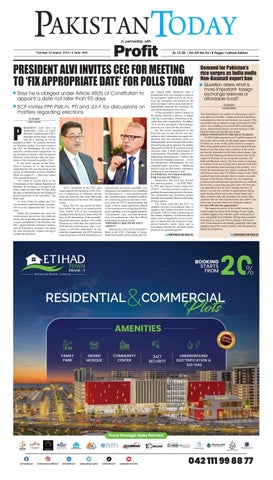
RESIDENT Arif Alvi on Wednesday wrote to Chief Election Commissioner (CEC) Sikandar Sultan Raja, inviting him for a meeting to “fix an appropriate date” for general elections on Thursday (today). In a letter wrote to the CEC on Wednesday, Dr Arif Alvi cited the constitutional requirement for the president to decide a date for general elections within 90 days after the dissolution of the National Assembly (NA). In the letter, posted on the Presidency’s account on X, the president noted that the NA was dissolved on the advice of then-prime minister Shehbaz Sharif on August 9 — three days ahead of its mandated period. “By virtue of Article 48(5) of the Constitution of the Islamic Republic of Pakistan, the president is obliged to appoint a date not later than 90 days from the date of dissolution for the holding of general elections of the assembly”, the letter read. In view of this, he added, the CEC was invited to meet him today or tomorrow to set an “appropriate date” for elections. While the president has cited the constitutional provisions that elaborate on his role in deciding the election date, a recent amendment to the Elections Act 2017 empowered the Election Commission of Pakistan to announce the dates for polls unilaterally without having to consult the president.
Alvi’s invitation to the CEC also comes against the backdrop of the Election Commission of Pakistan having ruled out elections this year, following the notification of the latest 2023 digital census. Since the NA was dissolved three days before the end of its constitutional term, Article 224 of the Constitution mandates that elections be held within 90 days of the dissolution of the assembly. But at the same time, Section 17(2) of the Elections Act states that “the commission shall delimit constituencies after every census is officially published.” In line with this requirement, the ECP said last week the process of fresh delimitation of
national and provincial assembly constituencies was expected to be completed by December 14 — over a month beyond the constitutionally mandated deadline for conducting general elections. However, after the ECP’s announcement last week, a Dawn report quoted an official of the commission as saying that the electoral watchdog was not legally bound to “immediately” carry out fresh delimitation of constituencies after the official notification of census results. ‘PRESIDENT BOUND BY PM’S ADVICE’ Sharing his views on the president’s letter to the CEC, Chairman of Islamabad-based public policy think tank Pil-
Rs 15.00 | Vol XIV No 54 I 8 Pages I Lahore Edition
g
Question arises what is more important: foreign exchange reserves or affordable food?
dat Ahmed Bilal Mehboob said it seemed that Alvi was aiming to exercise his prerogative under Article 48. However, the president was bound by the prime minister’s advice and could not independently exercise this authority, he said while speaking to Geo News. “If the president’s letter is based on the prime minister’s advice, it aligns with the Constitution. Otherwise, it deviates from the Constitution,” he added. “It is not the president’s discretionary power to set a date [for the elections].” On the recent amendment to the Elections Act, he said the law was secondary to the Constitution but again emphasised that the president could not independently set an election date unless advised by the prime minister. He further disagreed with the ECP assertion to hold elections after a fresh delimitation of constituencies.“Personally, I find this interpretation unsatisfactory. I believe the Constitution mandates elections … From my perspective, delimitations are not constitutionally necessary.” Mehboob said he could see this matter “ultimately ending up in the Supreme Court”. ECP WRITES TO FOUR PARTIES FOR TALKS ON POLLS Meanwhile, the ECP has invited four political parties — the PPP, PMLN, PTI and Jamiat Ulema Islam-Fazl (JUI-F) — for discussions on matters regarding the upcoming general elections. The commission has invited the parties through four separate letters to the heads of these parties. The letters state that the ECP “is charged with the constitutional duty to organise and conduct elections in terms of Article 218(3) of the Constitution of the Islamic Republic of Pakistan and to make such arrangements as are necessary to ensure that the election is conducted honestly, justly, fairly and in accordance with the law and that corrupt practices are guarded against”.
The international rice market is witnessing a significant upheaval as India, a major global rice producer, contemplates a ban on non-basmati rice exports. This uncertainty has prompted a surge in demand for Pakistan’s rice, leading to increased offers and higher prices. International buyers are now turning to Pakistan for their non-basmati rice needs. INDIA’S POSITION IN THE RICE MARKET In 2022 India exported over 22 million tonnes of rice to the entire world. As the single largest exporter of white rice in the world, India control’s a massive 40% of the global market for rice providing different kinds of rice that many other countries in the world are heavily dependent on for their caloric intake. And this year the Indian government has put a ban on the export of all kinds of rice except the aromatic and high-end Basmati variety. The ban comes in response to soaring rice prices in India and a general food inflation crisis that has been brewing in the country. As a result, the international rice market suddenly finds itself short on more than 10 million tonnes of rice. With a global food crisis already about to reach crescendo because of the Russia-Ukraine war, rice importing countries and international organisations are suddenly faced with a concerning question: how will this massive shortfall of rice be met? Already the news of India’s rice ban has resulted in supermarkets facing panic buying all the way in the United States and other countries that rely on Indian rice. Some other countries that are also exporters may also follow suit with a ban to protect their own domestic markets. So who will take the opportunity? The impact on prices of the world’s most consumed staple has been swift, hitting 15-year highs. Limited supplies risk a further spike in the price of rice, and global food inflation, hitting impoverished consumers in Asia and Africa, analysts and traders said. Food importers are already grappling with tight supplies caused by erratic weather and disruptions in Black Sea shipments.
CONTINUED ON PAGE 03
CONTINUED ON PAGE 03
ISLAMABAD
Ghulam abbas