Profit PM KAKAR REITERATES GOVT’S RESOLVE TO PROTECT MINORITIES In partnership with
Rs 40.00 | Vol XIV No 52 I 40 Pages I Islamabad Edition
Tuesday, 22 August, 2023 I 4 Safar, 1445
Pm KaKar dePlores such incidents highlight ‘Prevailing societal ailment’
g
C
g
JARANWALA
Why tWo faiths Who share similar beliefs Would be at odds With each other; argues Pm
STAFF REPORT
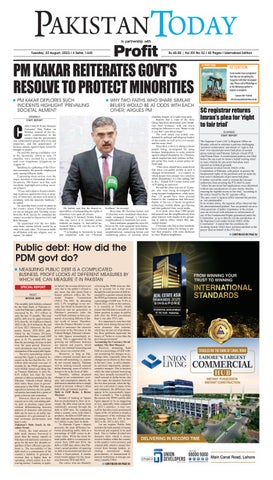
ARETAKER Prime Minister Anwaarul Haq Kakar on Monday assured all the minority communities in the country that the government was committed to protect their lives and properties, and the perpetrators of heinous attacks against them would be brought to justice. He said this during a solidarity visit to the Jaranwala, where at least 19 churches were torched by a violent mob over blasphemy allegations on August 16. Speaking at a gathering of the Christian community, the premier emphasised unity among different faiths. Expressing deep sorrow over the tragic incident in Faisalabad district’s Jaranwala, PM Kakar said that such incidents highlight prevailing societal ailment. “If any individual is found committing injustices against the lives or property of minorities, the state will stand in solidarity with the minority brethren,” he added. He said that there exists no place in the country where Christian brethren are not an integral part. Quoting verses from the Holy Quran, he reminded the respect accorded to Hazrat Isa (AS) and Bibi Maryam. He questioned why the two faiths who share similar beliefs would be at odds with each other. “Extremism holds no affiliation with any religion, sect, or region,” he added.
He further said that the shared responsibility of safeguarding the rights of minorities rests upon all citizens. Taking to X, formerly Twitter, Kakar, who was sworn in as caretaker prime minister on August 14, had earlier announced that he will visit the site of the incident today. “I’m heading to Jaranwala to meet and empathise with our Christian
brethren,” he tweeted. More than 80 Christian homes and 19 churches were vandalised when thousands rampaged through a Christian neighbourhood in Jaranwala last week. Terror and panic gripped the town for hours as the mob equipped with batons, push carts and patrol cans stormed the neighbourhood, ransacking homes and vandalising places of worship while
Public debt: How did the PDM govt do?
g
measuring Public debt is a comPlicated business. Profit looKs at different measures by Which We can measure it in PaKistan SPECIAL REPORT PROFIT MEERUB AMIR
The monthly debt bulletin released by the State Bank of Pakistan reveals that Pakistan’s public debt has increased by Rs. 18.5 trillion in only the last 15 months. The total public debt rose by approximately 41% from Rs. 44.4 trillion in March 2022 to Rs. 62.9 trillion by the end of June 2023. Moreover, the Economic Survey 2022-2023, published by the Finance Division, revealed that Pakistan’s total GDP grew at 21.7%, around 20% less than the percentage increase in debt over the same period. However, such calculations may be a misrepresentation of the actual debt figure. The news speculating concern around this figure is primarily focused on the fact that this Rs. 18.5 trillion debt incurred over just 15 months by the PDM government with Miftah Ismail and Ishaq Dar as Finance Ministers is only Rs. 0.91 trillion less than the total amount of debt accumulated by the Pakistan Tehreek-e-Insaf during their entire three years in government prior to the PDM. The strong opposition between the two political parties has made this a point of great criticism and contention. However, there are two basic reasons as to why calculating public debt in absolute rupee terms without differentiating between patterns of domestic and external debt can be seen as an unfair representation of a government’s actual economic performance and here’s why: Pakistan’s Debt Stock in Absolute Terms Firstly, the total amount of debt stock (money borrowed is more than the money repaid) in Pakistan will definitely continue to grow for the next few decades regardless of how efficient a government is. The inevitability of the debt stock is a consequence of the country’s inability to generate a revenue that is higher than its spending, which results in it borrowing money. Contrary to popu-
lar belief, the revenue deficit is not only due to the public’s refusal to pay taxes, but also stems from a deeper problem within the National Finance Commission (NFC). The NFC, by allocating only 2-5% weightage to tax revenue, has failed to incentivize tax collection and tax generation in Pakistan’s provinces (who the world bank estimates to have a potential of accruing billions of dollars worth of taxes). Therefore, when the Finance Minister is compelled to announce the resource provisions to the Provinces in the Federal Budget, Pakistan’s domestic debt figures immediately increase. This is aggravated by the growing net difference between our imports and exports, which drives our external borrowing and thus, raises our external debt. Moreover, as long as Pakistan’s external account does not become self-sustaining, i.e, exports do not exceed imports, Pakistan will be looking towards external dollar financing, some of which is bound to be in the form of debt. Therefore, without structural changes to our commissions, economy, and consumption patterns, the debt stock in absolute terms is simply bound to increase without a direct fault of the government in power. Debt to GDP Ratio: A Better Measure Instead of looking at figures that are predestined to show an increase, the debt crisis can be more realistically assessed through the debt to GDP ratio. By comparing what a country owes with what it produces, the debt-to-GDP ratio reliably indicates that particular country’s ability to pay back its debts. To illustrate, Figure 1 depicts precisely the stark difference between presenting public debt as a percentage of GDP versus in absolute terms. While the trend for total public debt is a consistent increase from 2009 and 2018, the debt to GDP ratio shows that Pakistan’s actual position of repaying its debt is inconsistent and does not follow a fixed pattern. A similar trend would appear for the measures between 2018 and 2023. The critics who are blatantly
criticising the PDM-stint are failing to account for is that even though the total amount of debt increased by a greater amount during the PDM government, total debt as a percentage of GDP was 75.8% in March 2022, while on the contrary, it is currently at 73.6%, which means that Pakistan is actually at a better position to repay its public debt after the PDM government than it was after PTI’s rule. It is important to note here that the debt stock during this period is more domestic than external, which has its own set of problems, but these problems supersede the binary of “better or worse than the previous government”. Accounting for Currency Devaluations: The Best Measure However, measuring Total Debt as a percentage of GDP without accounting for changes in exchange rates, especially when the changes are as drastic as they were in the last 1 year, is still a simplistic and more importantly, unrepresentative measure. This is because while the total external borrowing may have actually increased by a small amount in dollar terms, due to the rupee devaluation between the two time periods, when the figures are converted to rupee terms and compared, the difference may appear to be exponentially larger than it actually is. This is perhaps the reason why PDM’s public debt figure appears to be as staggering as it is, especially when compared to 2022’s statistics– it may very well be that this overly pronounced figure of Rs. 63 trillion is simply a consequence of the exchange rate increasing from Rs. 205 in July 2022 to Rs. 285 in July 2023. Let me explain. Public Debt includes the total amount of money borrowed and required to be paid back. This is further divided into domestic debt, which is money owed to lenders within the country in the country’s own currency, and external debt, which is money borrowed from foreign lenders, including commercial banks, governments, or international financial institutions in foreign currency (usually USD).
CONTINUED ON PAGE 03
chanting slogans of a right-wing party. Reports that a copy of the Holy Quran had been desecrated were broadcast from mosques, with one cleric telling his followers it was “Better to die if you don’t care about Islam”. The mob attack was widely condemned by political and religious leaders of the country as well as by civil society and the army chief. Since then, a cleric is among a dozen people being investigated for using mosque loudspeakers to order protests against alleged blasphemy by Christians which erupted into mob violence in Punjab earlier this week, a senior police official said. “That cleric should have understood that when you gather people in such a charged environment… in a country in which people were already very sensitive about (blasphemy) it is like adding fuel to fire,” Punjab IGP Usman Anwar told AFP during an interview. He said the cleric was one of 12 people who were being investigated for using mosque loudspeakers, while more than 125 people have been arrested linked to the vandalism that followed, thanks to the use of facial recognition technology, mobile phone geo-fencing and data gathered from social media. At its peak, more than 5,000 people had poured into the neighbourhood from other districts, with smaller mobs spreading to narrow alleys where they ransacked homes. Christians who fled in their hundreds have criticised police for failing to protect their property, with some sheltered by their Muslim neighbours.
IN TODAY’S ISSUE
ATTENTION Some readers have complained that they are not getting the magazine with their newspaper copy. Please call or WhatsApp us at the following number to register a complaint. Contact: 0307-7338168
SC registrar returns Imran’s plea for ‘right to fair trial’
irfan.farooq@pakistantoday.com.pk
ISLAMABAD
STAFF REPORT
The Supreme Court’s (SC’s) Registrar Office on Monday refused to entertain a petition challenging ‘political victimisation’ and denial of ‘right to fair trial’ over rejected pre-arrest bail pleas of ousted prime minister and Pakistan Tehreek-i-Insaf (PTI) chief Imran Khan. A constitutional petition was filed before the top court on Imran’s behalf seeking relief in cases wherein his pre-arrest bail pleas were rejected on technical grounds. The petition invoked Article 184(3) of the Constitution of Pakistan, with prayer to protect the fundamental rights of the petitioner and set aside the trial court’s dismissals of pre-arrest bail pleas. It further moved the court to restrain the relevant authorities from arresting the PTI chief in cases “where his pre-arrest bail applications were dismissed without due consideration of cases merits, thereby ensuring his rightful access to fair trial,” according to the notice issued by the SC registrar office. The apex court’s registrar office returned the petition as ‘not entertainable’. In its written notice, the registrar office observed that the aforementioned petition “has not pointed out as to what questions of public importance in the instant case are involved with reference to enforcement of any of the Fundamental Rights guaranteed under the Constitution, so as to directly invoke jurisdiction of the Supreme Court under Article 184(3) of the Constitution”. It stated that the conditions for invoking Article 184(3) have not been satisfied in the prayer filed on behalf of the PTI chief.
CONTINUED ON PAGE 02