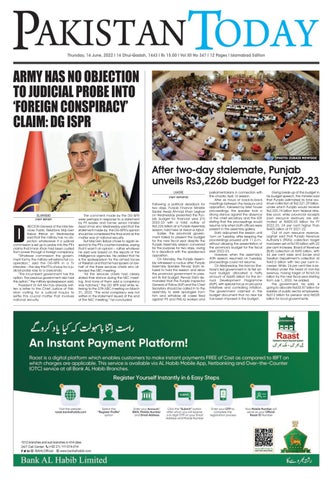
Thursday, 16 June, 2022 I 16 Dhul-Qadah, 1443 I Rs 15.00 I Vol XII No 347 I 12 Pages I Islamabad Edition
Army hAs no objection to judiciAl probe into ‘foreign conspirAcy’ clAim: dg ispr photo: zubair mehfooz
After two-day stalemate, Punjab unveils Rs3,226b budget for FY22-23 LAHORE Staff RepoRteR
ISLAMABAD
d
Staff RepoRt
IRECTOR-General of the Inter-Services Public Relations Maj-Gen Babar Iftikhar on Wednesday said that the military has no objection whatsoever if a judicial commission is set up to probe into the PTI’s claims that Imran Khan had been ousted from power through a foreign conspiracy. “Whatever commission the government forms, the military will extend full cooperation,” said the DG-ISPR in a TV interview – the day the PTI’s chorus for a judicial probe rose to a crescendo. “The incumbent government has this option. The previous government also had this option,” the military spokesperson said. President Dr Arif Alvi has already written a letter to the Chief Justice of Pakistan calling for a judicial inquiry to settle this crucial matter that involves national security.
The comment made by the DG-ISPR were perhaps in response to a statement by PTI leader and former senior minister Asad Umar who Wednesday said that the statement made by the DG-ISPR’s opinion should be considered the final word as the matter was of national security. But Maj Gen Babar chose to again respond to the PTI’s counter-narrative, saying that it wasn’t an opinion – rather whatever he said was based on the reports of the intelligence agencies. He added that he is the spokesperson for the armed forces of Pakistan and that he had spoken on behalf of the three services chiefs who attended the NSC meeting. “All the services chiefs had clearly stated their stance during the NSC meeting. And none of them said a conspiracy was hatched,” the DG ISPR said while referring to the 37th NSC meeting on March 31, 2022. “The word conspiracy was not written in the statement issued at the end of the NSC meeting,” he concluded.
Following a political deadlock for two days, Punjab Finance Minister Sardar Awais Ahmad Khan Leghari on Wednesday presented the Punjab budget for financial year (FY) 2022-23 with a total outlay of Rs3,226 billion at a Punjab Assembly session, held here at Aiwan-e-Iqbal. Earlier, the provincial government failed to present the budget for the new fiscal year despite the Punjab Assembly session convened for the purpose for two days, owing to a deadlock with the speaker-led opposition. On Monday, the Punjab Assembly witnessed a ruckus after Punjab Assembly Speaker Pervaiz Elahi refused to hold the session and allow the provincial government to present its first budget. Pervaiz Elahi demanded that the Punjab Inspector General of Police (IGP) and the Chief Secretary should be called in to the assembly to seek apologise from him and withdraw all cases filed against PTI and PML-Q workers and
parliamentarians in connection with the chaotic April 16 session. After six hours of back-to-back meetings between the treasury and opposition, followed by brief house proceedings, the speaker took a strong stance against the absence of the chief secretary and the IGP, stating that the proceedings would resume only when both officers were present in the assembly gallery. Elahi adjourned the session until 1pm on Tuesday, after keeping the proceedings paused until 11 p.m., without allowing the presentation of the province’s budget for the fiscal year 2022-23. However, when the assembly’s 40th session resumed on Tuesday, proceedings could not resume. On Wednesday, the Hamza Shehbaz’s led government in its first annual budget, allocated a hefty amount of Rs685 billion for the Annual Development Programme (ADP), with special focus on pro-poor initiatives and controlling inflation. The government claimed in the budget document that no new tax has been imposed in the budget.
Giving break-up of the budget in his budget speech, the minister said that Punjab estimated its total revenue collection at Rs2,521.29 billion, under which Punjab would receive Rs2,020.74 billion from federal divisible pool, while provincial receipts (own resource revenue) are estimated at Rs500.53 billion for FY 2022-23, 24 per cent higher than Rs405 billion of FY 2021-22. Out of own resource revenue, Leghari said that Punjab Revenue Authority’s (PRA’s) collection target had been set at Rs190 billion with 22 per cent increase, Board of Revenue (BoR) collection at Rs95 billion, with 44 per cent raise and Excise and Taxation Department’s collection at Rs43.5 billion with two per cent increase. While, 24 per cent hike is estimated under the head of non-tax revenue, having target of Rs163.53 billion for the next fiscal year starting from July 1, 2022, he added. The government, he said, is going to allocate Rs435.87 billion for salaries of public sector employees, Rs312 billion for pension and Rs528 billion for local governments.
02-03 NEWS 16 June 2022_Layout 1 6/16/2022 12:07 AM Page 1
02
Thursday, 16 June, 2022 | ISLAMABAD
NEWS
SaLient featureS Of Punjab buDGet fOr 2022-23
t
APP
HE Punjab government presented budget for financial year (FY) 2022-23 with a total outlay of Rs3,226 billion in the Punjab Assembly session held here at Aiwan-e-Iqbal on Wednesday. In its first annual budget, the present government allocated a hefty amount of Rs685 billion under Annual Development Programme (ADP) with special focus on pro-poor initiatives and controlling the inflation, and no new tax has been imposed in the budget. The Annual Development Programme (ADP) in the Punjab’s annual budget for
fiscal year 2022-23 has been set at Rs685 billion. In terms of development sectors, the highest allocation of Rs272.6 billion is for the Social Sector which includes Rs172.5 5 billion for the health sector and Rs64 56 billion for the education sector. Rs164 billion has been allocated to Infrastructure Development, including Rs80.8 billion for roads sector. Major development programs/initiatives for financial year 2022-23 include Rs58.5 billion for Sustainable Development Programme (SDP) and Rs31.5 billion for South Punjab SDP, Rs125 billion for Universal Health Insurance Programme, Rs1 billion for establishment of Nursing University at PKLI (Pakistan Kidney and
Liver Transplant Institute), a total of Rs53.19 billion with Rs14.77 billion for development and transformation of Agriculture sector in Punjab, Rs4.8 billion for Afternoon School Programme, Rs1.7 billion for establishment of universities in five major cities, Rs5.5 billion for the construction of additional classrooms in educational institutions, Rs10.9 billion for Road Maintenance Rehabilitation Programme. According to the budget document, the other initiatives include provision of laptops to students at cost of Rs 1.5 billion, revamping of THQ (Tehsil Headquarter) and DHQ (District headquarter) hospitals at cost of Rs 3.1 billion, Punjab Skill Development Programme Rs4.2 billion and Punjab Urban
Land Systems Enhancement Rs500 million. The salient features of Annual Development Programme for 2022-23 also include economic development through public investment, inclusive and balanced regional development, transformation of agriculture sector, ensuring water and food security, human development through skills development, creating an environment conducive to mobilizing private sector resources, support for public-private partnerships, strengthening governance through information technology and bridging the gender divide. The government would also launch a special aid package to control the inflation and price of edible items alongside increasing the purchasing power
Miftah orders feasible plan to resolve issues faced by fertilizer sector
of the common man. Various schemes have also been chalked out to ensure efficient use of the energy in an effort to overcome electricity load-shedding and curtail the electricity bills. In the next FY budget, the government would not impose any new tax, rather the tax relaxations and exemptions given during the last two years would continue to minimize hardships of the businesses, trade and the commoners. A hefty portion of the budget will be spent on achieving development goals with first priority to the social sector and revival of the economy. Under sustainable development goals, the solution of public problems at the district level would be ensured.
OMCs, petroleum dealers demand 6pc margin for smooth oil supply
iSLAMABAD
AhmAd AhmAdAni
StAff RepoRt
Federal Minister for Finance and Revenue Miftah Ismail has directed the authorities to work out a feasible plan for the resolution of GST input and output and gas subsidies issues faced by the Fertilizer sector. The Finance minister on Wednesday chaired a meeting of the Fertilizer Manufactures of Pakistan Advisory Council (FMPAC) at the Finance Division. Secretary Ministry of Industries and Production, Nadir Salir Qureshi, CEO Engro Fertilizer, Faisal Muzammil, CEO Agritech, Asad Murad, COO Fatima Fertilizers and senior officers from Finance Ministry and FBR attended the meeting. The Chair was briefed about the several issues being faced by the fertilizer manufacturers in Pakistan. The matters majorly deliberated during the meeting were related to GST input and output and gas subsidies with a prime focus on ensuring continuous provision of subsidized fertilizer to farmers. The Finance Minister appreciated the role of FMPAC in facilitating the farmers and reassured about the present government’s policy to provide full support to the agriculture sector for its growth and development. The Finance Minister further directed the relevant authorities to work out a feasible plan for the resolution of issues faced by the Fertilizer sector. It was also informed that another round of meeting will be held in this regard with all of the stakeholders.
OGDCL discovers gas reserves in Ghotki, Sindh KArACHi StAff RepoRt
The Oil and Gas Development Company Limited (OGDCL) has discovered gas from its exploratory efforts at Umair South East-1 Well located in Guddu Block, District Ghotki, Sindh. OGDCL, in a letter dated June 15, 2022 to General Manager, Pakistan Stock Exchange Limited Karachi and London Stock Exchange informed that Umair South East-1 was earmarked as an exploratory well to test the hydrocarbon potential of Pirkoh Formation and Habib Rahi Limestone (HRL). The well was spud-in on 9 May 2022 and successfully drilled down to the depth of 790m. During testing, the Pirkoh formation flowed gas at the rate of around 1.063 MMSCFD with a Wellhead Flow Pressure (WHFP) of 210 psi at 32/64 inch choke size, said the OGDCL. According to OGDCL, the discovery is the result of the aggressive exploration strategy adopted by the Guddu Joint Venture Partners and has opened a new avenue for contributing to mitigating energy demand and supply gap from indigenous resources.
LAHORE: Punjab Finance Minister Awaise Leghari delivers budget speech at Awan-i-Iqbal, two days late then scheduled date following a political deadlock with opposition. photo by ZubAiR mehfooZ
Parliamentary panel recommends no hike in tax on electric vehicles ShAhZAd pARAchA
The senate standing committee on Finance, Revenue and Economic Affairs has recommended to levy 12.5% tax on electric vehicles up to 50 kWh. The meeting of the committee was held under the chair of Senator Saleem Mandviwala on Wednesday. FBR officials informed the committee that the finance bill also proposed to increase tax from 12.5% to 17% on imported CBU electric vehicles. People are importing the expensive E-tron electric vehicles so we should encourage the taxes on expensive vehicles, he added. Senator Farooq Ahmed Naik also supported the idea that the tax on expensive electric vehicles should be higher comparable to small electric vehicles. Senator Zeeshan Khanzada and Mohsin Aziz said that we should encourage the use of electric vehicles and should not increase the taxes. After the discussion, the committee members unanimously agreed to introduce different slabs for electric vehicles and recommended only to levy 12.5% tax on vehicles up
to 50 kWh. Chairman FBR Asim Ahmad informed that committee that the Finance bill proposed to enhance levy from Rs10,000 to Rs50,000 on business class for international travel from Pakistan. Member of committee Senator Talha Mahmood suggested gradually increasing the tax on business class. Chairman FBR said that the tax department will be able to collect this tax within the country. The committee members directed that the tax should be implemented in such a way that the money would not go out of the country and the national exchequer would benefit from it. The committee, after detailed consideration, unanimously approved the proposal. Representatives of the Islamabad Chamber of Commerce briefed the committee that the construction sector would be severely affected by the government’s ban on imported goods. They requested the FBR to lift restrictions on the construction industry. They also informed that 6 big hotels are going to be built in Islamabad and if the ban is not lifted
then these projects may be affected. They also informed that advance tax on filers has been increased from 1% to 2% and for non-filers from 2% to 5% for the real estate industry adding that the representatives requested the government to reduce the tax for filers to 1%. The committee recommended to the FBR that the advance tax for filers in real estate should not be increased from 1%. Ministry of finance officials informed the committee that the government has also proposed to enhance levy on the import of mobile sets. A levy ranging from Rs100 to Rs16000 has been proposed from up to $30 or above phones. FBR officials said that it is expected to generate about Rs670 million in revenue. The committee also unanimously approved the levy on mobile phones. Explaining the income tax proposals, member IR policy informed that the finance bill proposed to impose 2 percent tax on high earning persons for poverty alleviation. Any person of a company has above Rs300 million profit on income then they are liable to pay 2% tax.
Oil Marketing Companies and petroleum dealers have demanded from the government to fix six percent margin to avoid disturbance in the oil supply chain and in case otherwise they would go on strike from July 1, 2022. Warning the government to avoid chaos in the fuel supply chain of the country, Chairman Petroleum Dealers Association Abdul Sami Khan has declared that if the government will not fulfil the promise of fixing six percent margin on the sale of petroleum products from 1st July then they will go on strike in the country. He said the government has made assurance that their margin will be fixed at six percent. However, no progress has been made in this regard. He said that the Petroleum Minister has so far not given time for a meeting despite repeated efforts. He said the oil industry has been facing serious problems in bringing oil to the country while the concerned minister is not paying heed to their demands. We will be forced to go on strike in the country if our demands are not met during the months of June, said Abdul Sami while talking to Profit. The Oil Marketing Companies (OMCs), in a SOS appeal for fair adjustment of margins for OMCs based on increase in fuel prices, said that due to unrestrained growth in inflation, the OMCs are facing a catastrophic condition and finding it strenuous to execute routine operations. The increase in operating costs by more than 50 percent along with 100pc increase in the cost of product in the last six months alone has crucially added to the pressure, said OMCs. It added that currently, the margin of OMCs is really thin Rs3.68 per liter and in no way covers the drastic increase in logistic cost, financing costs, operating cost, electricity tariff, labour cost, maintenance costs and other necessary costs of OMCs which resultantly make it impossible to operate on these margins. According to OMCs, another important factor causing havoc in turnover tax on OMCs which currently stands at 0.5%. It should be revised down or should be applied to OMC margin rather than turnover in view of the thin margin earned by the industry. At the current prices of petrol and HSD (high speed diesel) 50% of margin is taken by the Federal Board of Revenue (FBR) as turnover tax. It is worth mentioning that the Price Differential Claim PDC) process is already denting our working capital and we are finding it really very hard to make both ends meet. “Despite all the above facts OMCs are regularly importing products and running their fuel stations with a severe cashflow crunch,” said OMCs, adding,” If left unattended, the supply chain of the country could be impacted since this position is untenable and cannot go on for much longer.”
Pharmaceutical manufacturers demand increase in MRP of medicines Aziz Buneri Local pharmaceutical manufacturers have expressed outcry over the non-increase in maximum retail prices (MRP) of medicines/lifesaving drugs and not paying serious attention towards resolution of their issues, demanding the government, ministry of health and other relevant authorities to increase in MRP by 20 to 30 per cent and immediately abolishment of 17 per cent sale tax on pharma sector. The issue was taken up during a meeting of a delegation of local pharmaceutical manufacturers with Sarhad Chamber of Commerce and Industry (SCCI) Hasnain Khurshid Ahmad here at the chamber’s house on Wednesday.
The delegation was led by Chairman SCCI’s Standing Committee, and former vice president Junaid Altaf along with owners of different pharma manufacturing units were present during the meeting. The meeting demanded an increase in MRP by 20 and 30 per cent and abolishment of 17 per cent sale tax on pharma sector to prevent destruction and shortages of medicines and price hike as result of closure of many units of this crucial pharma industry. Junaid Altaf told the meeting that it would be completely unjust to not increase maximum retail price (MPR) after rising oil and raw materials prices in global and local markets. He continued to say that prices of
raw materials have gradually increased in the global market, especially the pharma companies have been confronted with enormous difficulties and issues after the novel coronavirus pandemic situations. Altaf informed the forum that the government is collecting 17 per cent sale tax from the pharma sector, whereas cost of production has remarkably increased following rapid depreciation of Pakistani rupee against US dollar. On the other hand, the SCCI’s committee chairman said the cap of MRP of medicines and drugs is not only making it hard for them to run industries, but it has been made completely impossible. Hasnain Khurshid assured the visiting
delegation on the occasion that the chamber would take up issues relating to the Pharma sector with federal and provincial relevant authorities in an efficient manner. The SCCI chief while highlighting different issues of the business community said that excessive power outages have badly affected the industrial production while losses were also increased inordinately. Over 70 to 80 pharmaceutical manufacturing units in Khyber Pakhtunkhwa are near to closure which is a prime source of employment for many people, Junaid Altaf told the meeting. He warned that if the pharma sector issues were not resolved seriously then a large number of people would be employed after closure of many units in the province.
The meeting was informed that poor people would face difficulties after medicines shortages and ‘price hike’. Altaf told the meeting that such policy was not implemented on raw materials industries but non-increase of MRP of medicines and drugs would also be unjust and unfair, which was unacceptable and unbearable. Therefore, the participants requested the federal ministry of health and relevant authorities to immediately increase the MRP of medicines and drugs by 20 to 30 percent and abolish the 17 percent sales tax on the pharma sector. Otherwise, they warned that SCCI along with people attached with the pharma sector would be strongly agitated.
02-03 NEWS 16 June 2022_Layout 1 6/16/2022 12:07 AM Page 2
Thursday, 16 June, 2022 | ISLAMABAD
NEWS
03
Punjab MiniSterS bLaSt OPPOSitiOn fOr hinDerinG buDGet SeSSiOn LAHore
P
StAff RepoRt
ROVINCIAL Minister Atta Tarar said on Wednesday that the illegal and unconstitutional behavior of the opposition parties forced the Punjab governor to convene the 40th session of the assembly for presentation of budget. “The opposition parties attempted to hinder the present government’s public service mission by delaying the provincial budget presentation. That’s why, the governor issued three ordinances after approval by the provincial cabinet to ensure that the rights of 120 million people of Punjab are protected.” Addressing a press conference along with Punjab Minister Malik Ahmad Khan, he alleged the Punjab Assembly staff was creating hurdles in presentation of budget 2022-23, adding that the provincial ministers
were stopped from entering the assembly premises. “An emergency meeting of the provincial cabinet was held on Tuesday night in which Secretary Law presented a summary that the Punjab Assembly speaker did not allow presentation of budget according to the schedule. If the budget session is not convened, it would affect the rights of masses as the budget would bring welfare and relief for them,” Atta Tarar informed. He said that in the prevailing, the Punjab cabinet advised the Punjab governor on Tuesday night to convene the 40th session of the assembly, adding that three ordinances were issued by the governor after approval of the provincial cabinet. Malik Ahmad Khan said that the opposition was trying to create constitutional crisis in the province by using delaying tactics, adding that it had created crises on the occasion of chief minister’s election and the provincial cabinet oath. He said that he
Pakistan signs accords with jiCa, Swiss Confederation under G-20 DSSi StAff rePort The government of Pakistan, on 15th June, 2022 signed two Debt Service Suspension Agreements amounting to suspension of loans worth $197.49 million, under the G-20 Debt Service Suspension Initiative (DSSI) framework. Of this total amount, $191.60 million were owed to JICA during the period from January to June 2021 and $5.89 million were owed to the Government of the Swiss Confederation during the period from July to December 2021. These amounts will now be repaid over a period of six years (including one-year grace period) in semi-annual installments. Due to the support extended by the development partners of Pakistan, including JICA and Government of the Swiss Confederation, the G-20 DSSI has provided the fiscal space which was necessary to deal with the urgent health and economic needs of the Islamic Republic of Pakistan. The total amount of debt that has been suspended and rescheduled under the DSSI framework, covering the period from May 2020 to December 2021, stands at $3,688 million. Pakistan has already concluded and signed 91 agreements with 21 bilateral creditors for the rescheduling of its debts under the G-20 DSSI framework, amounting to rescheduling of almost $2,953 million. The signing of abovementioned agreements brings this total to $3,150 million. Negotiations for remaining agreements to be signed under the G-20 DSSI are on-going.
fia books Moonis elahi in money laundering case LAHore inp
The Federal Investigation Agency (FIA) launched a money-laundering probe against former federal minister and Pakistan Muslim League-Quaid (PML-Q) leader Moonis Elahi. Reports citing sources privy to the development revealed that the Lahore chapter of FIA has registered a case against Elahi who it has accused of amassing properties abroad by allegedly laundering money, the FIA said. The FIA has also arrested two close associates of the Punjab Assembly secretary — Nawaz Bhatti and Mazhar Iqbal — in a case related to money laundering. Talking to the media, Elahi said he came to know about the matter through media and was ready to face all such “bogus” cases. “I will appear before FIA today to face FIA inquiry,” he said, adding the agency registered FIR against him without sending notice. “I am coming […] Arrest me or do whatever you intend to do,” he added. Earlier reacting to the news, Elahi himself posted a screen grab of the TV report and wrote “Bismillahir Rahman Arraheem”, asserting that he was ready to face any probe. It should be noted that last year, former prime minister Imran Khan had tasked the FIA to investigate the sugar crisis throughout the country and find out who benefited from it.
could not even imagine that Punjab Assembly Speaker Pervaiz Elahi could create hurdles in presenting the provincial
budget. “It is not just about governance but the life of people,” he said. The minister said that the budget was
linked with the matters and well-being of common man as around 120 million people of the province would directly benefit from it.
NBF sector posts 32pc growth in FY21 APP The Non-Banking Financial (NBF) sector grew by 32 percent in 2021 as the aggregate asset size was Rs1,790 billion as of June 30, 2021 compared with assets of Rs1,361 billion as of June 30, 2020. According to the Security Exchange Commission of Pakistan (SECP) Annual report, the Assets under Management (AUMs) of the mutual fund industry are the largest segment within NBF Sector with assets of Rs1,086,705 million as on June 30, 2021, showing a growth of 35.5% on a yearly basis. Money Market funds dominated the AUMs of the mutual fund industry with the largest share of 42%, followed by
Income Funds having share of 24%, the report added. There are currently 18 Asset Management Companies (AMCs) which have been licensed to offer Investment Advisory Services with portfolio of Rs338 billion as on June 30, 2021,posting a growth of 18% on yearly basis. The report said that the total assets of 19 pension funds managed by ten Pension Fund Managers (Voluntary Pension Systems) stood at Rs39,700 million as on June 30, 2021. This asset class also showed strong growth of 27% in the year under review. Further, another AMC has been allowed to act as Pension Fund Manager during the year. As regards the Real
Estate Investment Trusts (REITs), 3 new REIT Management Services licenses have been granted during the year, thus the number of RMCs has risen to 10. Previously, there was only one REIT Scheme i.e. Dolmen City REIT (DCR), launched by Arif Habib Dolmen REIT Management Company Limited. As of June 30, 2021, the fund size of DCR was Rs54,291 million marking a growth of 10.8 % over the previous year’s figure. Following amendments to REIT Regulations, 2015 and prioritization of the sector by the Government, the capital market and the banking regulator; the SECP has approved registration of the first
Friesland Campina, HBL & SEDF partner for subsidized financing to empower dairy farmers KArACHi pReSS ReleASe
FrieslandCampina Engro Pakistan Limited (FCEPL), HBL and Sindh Enterprise Development Fund (SEDF) have collaborated to provide easily accessible, subsidized financing to dairy farmers in Pakistan with a long-term commitment of five years. Dairy farmers require financial support to upscale their operations, enhance milk yield and improve herd size. Committed to Nourishing Pakistan with better nutrition and better living for farmers, FCEPL aims to provide a long-term sustainable financing solution for the dairy farmers in partnership with HBL and SEDF. This one-of-a-kind partnership will facilitate upscaling operations for sustainable dairy farming and the purchase of exotic animals, benefitting the overall milk supply value chain. Ali Khan, Managing Director – FCEPL, said: “This is the first time such an initiative is being undertaken for dairy farmers. Our partnership with HBL and SEDF will enable farmers to upscale their operations, enhance milk supply within Pakistan and benefit the economy. Farmers will be able
to make independent decisions to grow their operations. The idea behind the tripartite agreement is to work with farmers on herd improvement, mechanization and infrastructure development.” Muhammad Aurangzeb, President & CEO – HBL stated: “Livestock and dairy alone contributes more than 14% to the national GDP. Pakistani dairy farmers produced more than 60 Billion Liters of milk during 202122 making it the fourth largest milk producer globally. Despite these impressive statistics, milk yields and animal productivity are amongst the lowest. This necessitates policy intervention and collaboration. HBL is the leading farmer financing provider in the country and is committed to enhancing financial inclusion in rural Pakistan. The Bank has been actively lending for dairy partnering with farmers for the purchase of quality animals and ensuring funds for feed, vaccine and animal well being. HBL’s dairy value chain partnership with FCEPL will facilitate dairy farmers in improving their farm practices and timely availability of credit. This will increase milk yield resulting in sustained and higher profits for our hardworking dairy farmers.”
SEZs establishment a priority to boost industrialisation: PM Shehbaz iSLAMABAD StAff RepoRt
Prime Minister Shehbaz Sharif on Wednesday said his government was committed to completing Special Economic Zones (SEZs) at the earliest to ensure development and prosperity in the country. During his visit to Rashakai Special Economic Zone, he said all problems and hurdles in the smooth execution of zones would be addressed on a priority basis. PM Sharif said that focusing on establishing SEZs across the country would boost industrialization, and exports and generate employment. He said the solution to Pakistan’s economic problems was massive industrialization and diversifying the export base. He said massive economic activity in the country would
create employment, encourage exports and stimulate import substitution. The prime minister said nine SEZs had been planned to be developed in Pakistan aimed at promoting industrial infrastructural and technology transfer. He said China had switched to high-tech industrial projects and invited the Chinese companies to invest in Pakistan. He said the Chinese expertise in technology and the cheap labour of Pakistan could act in a balance to benefit both sides. The prime minister proposed the launch of roadshows in China to highlight Pakistan’s potential for trade and investment. He emphasized on sharing of expertise between the two countries and the need to further augment development by exploring areas in Khyber Pukhtunkhwa and other parts of Pakistan.
shariah compliant Developmental REIT Scheme during the year. Another important area in the NBF Sector is Private Fund Management. In this context, Private Equity and Venture Capital (PE & VC) investment is poised to take off in Pakistan as the country enters a high growth phase, increasing funding needs for new profitable ideas in small and medium sized businesses. During the year, three new licenses to undertake PE & VC Fund Management Services were granted. The total asset size of the Private Funds sector stood at Rs7,036 million as of June 30, 2021, compared to Rs6,779 million on June 2020, showing a moderate growth of 3.8%.
SbP renews status of ViS, PaCra as external credit assessment institutions APP State Bank of Pakistan on Wednesday renewed the status of two credit rating agencies operating in Pakistan as External Credit Assessment Institutions (ECAIs) for the calendar year 2022. According to a press statement issued here, the spokesperson of the central bank said that SBP had renewed the status of both credit rating agencies operating in Pakistan namely “VIS Credit Rating Company Limited (VIS)” and “The Pakistan Credit Rating Agency Limited (PACRA)” as eligible / recognized External Credit Assessment Institutions (ECAIs) for the calendar year 2022. The central bank had allowed banks and development finance institutions (DFIs) using the standardized approach of Basel framework to use credit ratings assigned by VIS and PACRA for CAR calculation purposes, the statement added.
bangladesh approves nearly $700m electricity project APP Bangladesh’s highest economic policy-making body has approved an electricity network project worth 61.79 billion taka (about 700 million U.S. dollars) to enhance the electricity network in Dhaka and Mymensingh divisions. The modernization and capacity enhancement of BREB (Bangladesh Rural Electrification Board) Network was approved at a meeting of the Executive Committee of the National Economic Council (ECNEC) chaired by Prime Minister Sheikh Hasina on Tuesday. After the meeting, Bangladeshi State Minister of Planning Shamsul Alam told media that the ECNEC approved the project to improve electric distribution systems in Dhaka and Mymensingh divisions.
04 NEWS 16 June 2022 (Islamabad)_Layout 1 6/16/2022 12:18 AM Page 1
Thursday, 16 June, 2022 | ISLAMABAD
04 NEWS
‘Girls’ educAtion is A cliMAte solution’: MAlAlA joins cliMAte protest sTOCKHOLM
t
ReuteRs
HE fight against climate change is also a fight for the right to education of girls, millions of whom lose access to schools due to climate-related events, Nobel Peace Prize laureate Malala Yousafzai told Reuters. Yousafzai was speaking outside the Swedish parliament where she joined environmental campaigners Greta Thunberg and Vanessa Nakate at one of the climate protests
which have been held there every week since 2018 and sparked a global movement. In 2012, the now 24-year-old survived being shot in the head by an Afghanistanbased proscribed Tehreek-i-Taliban Pakistan (TTP) gunman after she was targeted for her campaign against the Taliban’s efforts to deny women education. She subsequently became the youngest recipient of the Nobel Peace Prize for her education advocacy. “Due to climate-related events, millions of girls lose their access to schools. Events like droughts and floods impact
schools directly, displacements are caused due to some of these events,” Yousafzai said in an interview. “Because of that, girls are impacted the most: they are the first ones to drop out of schools and the last ones to return.” During the demonstration, Yousafzai recounted a story of how her own education was interrupted by climate change as her school and many others in the locality were flooded. Yousafzai, Nakate and Thunberg all stressed how women, especially those in developing countries, were dispro-
portionately affected by the climate crisis and can be part of the solution if they are empowered by education. “When girls and women are educated, it helps reduce greenhouse gas emissions, it helps build resilience and it also helps reduce the existing inequalities that so many women and girls face in different parts of the world,” said Nakate, a 25-year-old activist from Uganda. Yousafzai, who tough her Malala Fund has also become a global symbol of the resilience of women in the face of repression,
took selfies with passing locals and tourists, and talked at length to the Fridays For Future activists who have protested outside the parliament building since 2018, becoming a global movement in the process. Activists unveiled banners and placards expressing support for the right of Afghan girls to education and linking the climate crisis and future solutions to it to the educational opportunities of women around the world. “Any girl can change the world if provided with the right tools to do so,” said Thunberg, 19.
Sea turtles along coasts face host of threats KARACHI AnAdolu Agency
Sea turtles along the coast in Karachi are facing a welter of anthropogenic threats, including habitat degradation, plastic pollution, and entanglement in fishing gears, according to the World Wildlife Fund (WWF). As a result of the construction of huts along beaches in Karachi, and Balochistan, major nesting grounds of sea turtles are adversely affected, the study said on the eve of World Sea Turtle Day. Since 2000, World Sea Turtle Day is observed every year on June 16 to raise awareness about the dwindling population of sea turtles and their diminishing habitat. According to Muhammad Moazzam Khan, the technical adviser to WWF-Pakistan, plastic waste, collapsing huts, and rubble pose a serious threat to nesting females and juveniles along the coastal areas. In Pakistan, sea turtles are known to nest on a number of beaches, including Sandspit, Hawke’s Bay, and Cape Monz along the Sindh coast, as well as Taq (Ormara), Astola Island, Gwadar Headland, and Daran along the Balochistan coast. Thousands of female turtles visit these beaches to nest and lay eggs. To collect data on the entanglement of turtles, the WWF-Pakistan initiated a study in 2012, which revealed that 30,000 sea turtles were annually caught in tuna gillnet fisheries of the country. This included roughly 25,500 Olive Ridley and 4,500 Green turtles in the offshore waters of Pakistan. Entanglement in
fishing nets is the most serious threat to marine turtles. It was estimated that about 3 percent of entangled turtles were dying due to drowning or mishandling onboard fishing vessels. Protecting endangered sPecies: To protect the endangered species, the organization has trained some 100 “skippers and crew members” to safely release the entangled sea turtles and developed a modification in the operation of the gillnets. This, the study said, has reduced the entanglement of sea turtles by 85 percent. Pollution is also another major threat to the sea turtle population in Pakistani waters. Popular beaches are littered with garbage, dominated by single-use and micro-plastics. The study has also reported on the impact of diesel and petrol on the population of turtles, stating that exposure to these fuels results in deformation in hatch-
lings and so, poses a serious threat to their survival. Government agencies have taken several steps in recent years for the protection of sea turtles along the coasts. “Through the efforts of WWF-Pakistan, fisheries-related legislation of both maritime provinces have been amended and sea turtles, as well as freshwater turtles, are declared protected,” the study added. According to Khan, the declaration of Astola Island as a marine protected area, actions taken by the wildlife departments of Sindh and Balochistan, as well as awareness programs initiated by nongovernmental wildlife organizations, have collectively increased the turtle population along Pakistani coastal regions. However, he added that there is a need to declare all turtle beaches along the coast of Sindh and Balochistan marine protected areas. Rab Nawaz, the sen-
ior director of WWF-Pakistan’s Conservation Biodiversity, for his part, called for “better protection and conservation” of sea turtles in the country. He said these unique and iconic animals have been in existence for more than 100 million years but are under “serious” threat. Human activities such as the destruction of nesting sites and unplanned development, as well as climate change, are pushing turtles closer to extinction, which calls for immediate steps for their conservation, he stressed. Major sPecies: Experts believe that the country has lost 25-30 percent of the nesting ground for Green turtles over the past decade. Female turtles lay their eggs on beaches between October and February, and the eggs hatch in about 60 days. Five species of marine turtles are reported from Pakistan, with Green turtles (Chelonia mydas) the most dominant one, while another important sea turtle is the Olive Ridley (Lepidochelys olivacea) which used to nest along the coast of Pakistan. However, no nest of this turtle species has been reported since 2001, the study said. The other three species, including loggerhead turtle (Caretta caretta), hawksbill turtle (Eretmochelys imbricata), and leatherback turtle (Dermochelys coriacea) are reported from Pakistan and only a few authentic records are made by WWF-Pakistan. Although turtles are not commercially harvested for food in Pakistan, however, poaching of turtle eggs has been reported.
Pakistan eyes to collaborate with Argentina in defence production: Tareen News DesK Minister for Defence Production Muhammad Israr Tareen on Wednesday said Pakistan had good bilateral coordination history with Argentina and was looking forward to collaborate with it in the field of defence production with positive outcome and mutual gains. The minister expressed these view during a call on paid by Chief of Joint Staff of the Argentina Armed Forces Teniente General Juan Martin Paleo along with his delegation here at the Ministry, said a media release.
The delegation was briefed about various possible mutually beneficial collaborations in the field of defence production. General Juan Martin Paleo appreciated Pakistan’s Defence Production capabilities and opined that two countries have a lot of potential for extensive collaboration in the field of defence production in the future. Briefing was attended by Secretary Ministry of Defence Production, Lieutenant General (R) Humayun Aziz and various other notable officials from both countries.
Indian forces in occupied Kashmir kill fighter suspected of targetted killing sRINAGAR ReuteRs
Indian forces in occupied Kashmir killed two fighters on Wednesday, one of them suspected of gunning down a bank manager this month, police said, part of a stepped-up military effort that has triggered an exodus from the disputed Muslim-majority region. India has been fighting a freedom movement in Kashmir since the late 1980s. Pakistan also claims the region over which the nuclear-armed neighbours have fought two of their three wars. “Indian troops killed two militants this morning in a gun battle, one of them, Jan Mohammad Lone, was involved in
the killing of a bank manager,” said Vijay Kumar, the police chief of Kashmir. Fighters entered a branch of the Ellaquai Dehati Bank in Kulgam town this month and killed the manager, who came from the desert state of Rajasthan, and had only been posted to the branch four days earlier. A little-known fighter group called the Kashmir Freedom Fighters claimed responsibility for the attack, warning outsiders not to settle in the Kashmir Valley. At least 16 people — both Hindu and Muslims — have been killed in targeted attacks in Kashmir this year. Kumar said troops were tracking fighters and had killed eight involved in killings in recent weeks.
CARE International Country Director Adil Sheraz and MMBL President & CEO Ghazanfar Azam presents a souvenir to Special Advisor to Prime Minister Romina Khurshid Alam at an event origanized to celebrate successful women entrepreneurs in Islamabad. PR
Hurriyat activist Abdul Hameed passes away in Muzaffarabad Kashmiri Hurriyat activist, Abdul Hameed alias Liyaqat Hussain, passed away in Muzaffarabad, today. Abdul Hameed, who hailed from Aglar area of Pulwama district of Indian illegally occupied Jammu and Kashmir, had to migrate to Azad Jammu and Kashmir in 1994 due to continued harassment by Indian troops. He dedicated his entire life to the Kashmir freedom movement. Abdul Hameed had been seriously ill for the last one year and was receiving treatment at various hospitals. News Desk
news
05
KaraChI-alMatY dIrECt flIGhts to boost PaK-KazaKh tIEs: MInIstEr Islamabad
President Alpine Club Abu Zafar Sadiq along with young mountaineers Shehroze Kashif and Abdul Joshi called on Federal Minister for Inter-Provincial Coordination Ehsanur Rehman Mazari in Islamabad. pr
Minister for IPC met with Young Mountaineers Islamabad: President Alpine Club Abu Zafar Sadiq along with young mountaineers Shehroze Kashif and Abdul Joshi called on Federal Minister for Inter-Provincial Coordination (IPC) Ehsan Ur Rehman Mazari today. Mountaineering is quite a challenging sport and Pakistan is blessed with few of the highest mountains including world’s second highest peak K-2, these peaks attract number of mountaineers, climbers and tourists from across the globe. Pakistan has also produced great mountaineers who conquered these giants. and one of those young mountaineers is Shehroze Kashif who started trekking and mountaineering just at the age of 11. Before he reached 20, he already had climbed world’s seven highest mountains. Shehroze Kashif during the meeting with Federal Minister Ehsan Ur Rehman Mazari expressed his future plan of becoming the world’s youngest man to climb all 14 highest mountains in the world. It will not only bring pride for the nation but will also promote tourism and help the economy. Federal Minsiter said that it is delightful to see our youth is associated to the challenging sport of mountain climbing and building soft image of Pakistan. Federal Minister Ehsan Mazari appreciated the young aspirants and assured that anyone who contributes building soft image of Pakistan is indeed praiseworthy. He also promised that government will provide him maximum support to achieve this honor for the nation, the Minister added that this will inspire other young people to come forward and bring laurels for their country. pr
Gas discovery at umair south east-1 well in guddu block, sindh
M
staff report
INISTER for Inter-Provincial Coordination (IPC) Ehsanur Rehman Mazari has welcomed the start of direct flights from Karachi to Almaty this year, saying it would boost people to people contact between the two friendly countries. The ambassador from Kazakhstan Yerzhan Kistafin called on the minister on Wednesday and informed the minister that initially two flights in a week would be started from Karachi to Almaty and the number will
increase up to 5 in coming months. In the meeting, the ambassador proposed that there were various areas of cooperation between both the brotherly countries specifically in tourism and sports which could bring two nations even closer. Yerzhan Kistafin informed the minister that recently a large exhibition of Pakistan (Gilgit-Baltistan) products was arranged in the largest metropolis Almaty. Moreover, various business groups, tourist groups visited Pakistan and Kazakhstan was keen to sign a memorandum of understanding (MOU) regarding tourism with Pakistan. The minister welcomed the proposals and said we were also looking forward to take
Federal minister for power holds meeting with Sindh Energy Minister
It is decided to create a working group between federal and Sindh Government to determine modalities of provincialization of HESCO and SEPCO. It is very unfortu-
nate that the inability of previous government to even add 1 Megawatt of electricity in the system has pushed the country into this crisis. Government has decided
to shift imported coal based plant on Thar coal. Sindh energy minister assured full cooperation in Thar power generation.Federal minister for power reiterated that Allah has blessed Pakistan with Thar coal and we must harness its potential. Reliance on imported fuel for power generation is not sustainable. Further hybrid plants on wind power will also be added. Federal Secretary power Rashid Langrial, CEO AEDB Shahjahan, Secretary power Sindh, Memeber Thar coal energy board were present in the meeting. pr
Federal Minister for Science and Technology meets MNAs By the Grace of Almighty Allah, the Joint Venture of Guddu Block Comprising Oil & Gas Development Company Limited (OGDCL) as Operator (70 %), SEPL (13.5 %), IPRTOC (11.5 %) & GHPL (5 %) has discovered Gas from an Exploratory well namely Umair South East # 01, which is located in District Ghotki, Sindh Province. Umair South East # 01 was spudded-in 09th May, 2022 as an exploratory well to test the hydrocarbon potential of Pirkoh Formation and Habib Rahi Limestone (HRL) to planned depth of ±785m into HRL. The well was drilled down to 790m into HRL.Based on the results of wireline logs interpretation, successful Drill Stem Test-1 in HRL has tested 1.063 Million Standard Cubic Feet per Day (MMSCFD) Gas through choke size 32/64’’ at Well Head Flowing Pressure (WHFP) of 210 Pounds per Square Inch (PSi). The discovery of Umair South East-1 is the result of aggressive exploration strategy adopted by Guddu Joint Venture Partners. It has opened a new avenue and will positively contribute in mitigating energy demand and supply gap from indigenous resources and will add to the hydrocarbon reserves base of OGDCL and of the country. pr
Assembly Salahuddin and Engineer Sabir Hussain Qaimkhani in his office today on June 15, 2022. In the meeting, the issue of some employees fired from Pakistan Standards and Quality Control Authority regional office in Karachi was discussed. Engineer Sabir Hussain Qaimkhani said that the court has ordered in favour of the restoration of these employees. Parliamentary Standing Committee has also made a recommendation for the restoration of these employees. He added The Federal Minister for Science and Technology assured both the members of the National Assembly that the ministry is with them in resolving the issue on an urgent basis. The federal minister assured them that the issue would be resolved before Eid. Agha
Hassan Baloch expressed the resolve of the present government to provide different avenues for the youth to fully exploit the opportunities. We understand the problems of the people, And we are working hard to enhance the living standards of the underprivileged people in the country. Agha Hassan Bloch said both the Awami National Party and the MQM are from the middle class. That is why we real-
ize the struggle and difficulties of people. He ascertained that all parties in the government are united in every manner to bring prosperity and progress to the country. MNA Salahuddin and MNA Engineer Sabir Hussain Qaimkhani thanked Federal Minister for Science and Technology Agha Hassan Baloch and appreciated his services for the welfare of the people. pr
these friendly relations to new heights specifically in sphere of sports involving youth from both the nations. He said both nations enjoy 30 years of diplomatic relations and we have to work mutually for extending these beyond the current status. The minister said Pakistan was a home to the world’s second highest mountain in the world K-2 along with other high peaks, this could be a greatest attraction for mountaineers from Kazakhstan. Moreover, both agreed to work at their respective ends for enhancing the bilateral trade and expand its volume which is currently not very high.
Experts for capacity building of media on health issues Islamabad: Considering media as the fourth pillar of a state due to its important role towards transferring information and opinion making, experts at a consultative workshop have called for capacity building of media persons especially on health issues including provision of emergency healthcare services. Healthcare professionals, representatives from media regulators, media experts and academicians attended the consultative workshop which was organized by the International Committee of the Red Cross (ICRC), APPNA Institute of Public Health-Jinnah Sindh Medical University and Khyber Medical University in Karachi. Objective of the workshop, which was part of the ICRC’s Health Care in Danger (HCiD) initiative, was to develop training for journalists to promote ethical and responsible reporting on the issues related to healthcare in Pakistan. Speaking on the occasion, Prof. Lubna Ansari-Baig, Chairperson AIPH-JSMU, said, “Various research studies have identified that mature media reporting always ensures the provision of emergency healthcare services. There is a need to improve the standards of media reporting on health issues to counter misperceptions, promote factual reporting, and stop the gradual erosion of trust between healthcare providers and the public.” The experts in the workshop deliberated in depth upon the problems pertaining to reporting on health matters in national media and provided their feedback to strengthen the content of the training. They also stressed upon the need for following up this exercise with handson trainings for journalists on ethical standards of reporting on health. Participating in the discussion, Secretary General of Pakistan Medical Association, Dr Qaisar Sajjad, said, “Healthcare workers are working in challenging circumstances, especially in emergency departments, to provide life-saving services. They need the support of media personnel to promote attitudes and behaviours among the general public that facilitate the provision of healthcare services”. The representatives of media at the workshop voiced the needs of journalists and reporters specific to reporting on health care. They called for media persons’ capacity building and trainings to objectively report on the issues facing the healthcare sector. pr
Chief of joint staff of Argentina armed forces visits naval headquarters Islamabad pr
Chief of the Joint Staff of Argentina Armed Forces Teniente General Juan Martin Paleo called on Chief of the Naval Staff Admiral Muhammad Amjad Khan Niazi at Naval Headquarters, Islamabad. Upon arrival, Chief of the Joint Staff of Argentina Armed Forces was received by Naval Chief. During one-on-one meeting between the dignitaries, matters of mutual interest including bilateral collaboration and re-
CmYK
gional security were discussed. The visiting dignitary appreciated and acknowledged Pakistan Navy’s efforts and commitments in support of collaborative maritime security in the region. Both the Forces Heads pledged to further strengthen and diversify the scope of existing bilateral relationship. The visiting dignitary was also given briefing on roles and capabilities of Pakistan Navy. The visit of Chief of the Joint Staff of Argentina Armed Forces will further enhance bilateral collaboration between the two navies.
06-07 Comments - 16th June 2022_Layout 1 6/16/2022 12:01 AM Page 1
Thursday, 16 June, 2022
06 COMMENT
From Zia to Bajwa
Fears of social strife As IMF moves slow percent
P
aKIStaN has slashed fuel subsidies in two instalments to control the fiscal deficit. Its power and gas regulators have determined an increase of 45-50 percent in electricity and gas rates effective from July 1. the measures have already raised petroleum prices to the highest ever level besides hiking prices of consumer goods and fares. Despite the measures taken by the Finance Ministry, the IMF still appears to be dissatisfied. according to economists at Citigroup In Pakistan’s budget isn’t enough to unlock the IMF loan for a number of reasons that include the tax-to-GDP ratio which is budgeted to rise to 9.2 percent of GDP in the year starting July 1 from 8.6 percent. this is said to be low compared to Pakistan’s emerging market peers and its own history. the rise in inflation has led PtI leaders to paint a doomsday scenario. Former PtI Federal Energy Minister Omar ayub claims that when the power rate would touch rs40 per unit, the people would stone leaders of the ruling alliance. according to Mr ayub petrol prices would exceed rs300 to rs310 per litre in the coming months which would destroy agricultural and industrial sectors and the inflation would batter down the man in the street. PtI Finance Minister Shaukat tarin maintains that the newly passed budget would trigger a storm of inflation and unemployment. PtI leader asad Umer warns that Pakistan is only weeks away from becoming Sri Lanka. a report in a national daily based on unquoted sources claims that the IMF officials acknowledge that some of these measures can hurt the poor and that they are ready to work with Pakistan to reduce the impact on essential commodities and the power sector to protect low-end consumers. On Wednesday the dollar breached the rs 206 mark as the IMF loan facility remained stalled. there is need for the IMF to move apace. Unless it takes timely decisions, policy reforms could lead to unintended consequences that include social strife. this is the opposite of what the IMF is supposed to be working for.
There are similarities between 1977 and 2022
Dr FariD a Malik
O
N 5 July 1977 Gen Zia-ul-haq deposed the elected government of Zulfiqar ali Bhutto. as required by the Constitution, elections were announced within 90 days. Fearing his safety due to prolonged street protests, ZaB was kept in confinement at the Governor’s house in Murree. Zia visited the deposed leader before his release, whom he found to be furious and determined to fight back with vengeance. Unsure about his dwindling popularity ZaB arrived at the Lahore airport to a mammoth welcome by the masses. along the entire route from the old airport to Shadman Colony where he was staying as a guest of Sadiq hussain Qureshi, there were a sea of people who wanted to meet the deposed leader. the establishment had grossly miscalculated the popularity of ‘Quaid-e-awam’. Zia not only reneged on his promise of holding free and fair elections but also decided to go after the popular leader and his party (PPP). Zia’s misrule stretched for over 11 years (July 1977 to august 1988) in which he damaged all civilian institutions, eliminated ZaB through the judicial process, disfigured the Constitution, created a third-rate political leadership and against national interests decided to join the USa’s proxy war in afghanistan which has proven to be deadly for the republic. ‘ Zia’s Dark ages ‘ continue to haunt the nation till today. In the 1950s it was ayub Khan who compromised the sovereignty of the republic while in the 1070s and 1980s it was Zia-ul-haq. against the will of his own nation, the usurper served his foreign masters well.
Storm in a teacup Surely he isn’t serious?
F
EDEraL Planning Minister ahsan Iqbal has come up with a suggestion that the common man should have less tea. he explained that this would help reduce the import bill. If this is a serious suggestion, it should be countered with some serious questioning about who let him into the federal Cabinet. Indeed, the questioning should extend to who granted him his various degrees, of which he seems inordinately proud. If not serious, it seems a case of rubbing salt into the wounds of the common man, who is not only being battered by increasing inflation, but has now got salt rubbed into their wounds. Mr Iqbal’s misplaced levity is even more of a surprise because he is a veteran who has never before shown signs of such misplaced humour. he has the Planning portfolio, has held Interior, and been an MNa since 1998, and is presently Secretary-General of the PML-N. During the PtI government, federal minister ali amin Gandapur once attempted to defend rising sugar prices by saying that people should consume less sugar for the health benefits. Mr Gandapur was the kind of minister Mr Iqbal used to point at, to show how badly the PtI was running the government. If the whole purpose of the coalition building, the no-confidence motion, and PtI long marches was merely to replace Mr Gandapur’s vacuity by Mr Iqbal’s inanity, even PtI opponents would have to wonder if the change was worth it. this is a government that came to power ahead of a general election, by overthrowing the sitting elected government, precisely because of the economic situation. Since taking the reins into its own hands, the government has presided over a continual decline of the rupee, and its main response has been to increase the price of petrol by rs 60 per litre in a week. true, the previous PtI government may have artificially lowered petrol prices by an unsustainable subsidy, but there is no need for remarks which merely mock the citizen for the economic woe that apparently have no end in sight.
Playing our part
attiya Munawer
E
arth is getting hotter and mountains- the water towers suffer glacier retreat by passing a phase of global warming due to an increase in amount of CO2 in the atmosphere from 316 ppm in 1958 to 412 ppm in 2020 leading to worsening the issue of glacier melting. Pakistan is the home of more than 7000 glaciers, especially in the northern regions of Gilgit-Baltistan and Khyber Pakhtunkhwa. Glaciers are melting rapidly in South asia and this is unlikely to slow. as a result, unprecedented heat waves recently melted the ice on the Shisper Glacier, creating flooded lakes, destroying the hasanabad Bridge, and damaging nearby localities, buildings, and two power plants. It is one of the largest in a series of catastrophic events in the region known as a Glacial Lake Outburst Flood. Such flooding has not only posed damage to the local community but also continues to spell disaster for Pakistan’s long-term issue of water scarcity. Undoubtedly, Pakistan, Iran, India, Kyrgyzstan and central asian countries are coming to face the worst drought conditions because of too little water availability, dryness and record low precipitation. Similarly, the Sindh government reported to IrSa that the severe water crisis hit the province and demanded extra water supply to cut the shortage in the province as per the water accord of 1991. the unequal water distribution put the farmers in grave concern due to the lack of timely irrigation of crops will give less yield, infuse food insecurity, starvation and disease outbreaks in the country. On the
Arif Nizami (Late) Founding Editor
Yousaf Nizami M. A. Niazi
Umar Aziz
Joint Editor
Joint Editor
Executive Editor
Lahore – Ph: 042-36300938, 042-36375965
The writer is ex-Chairman, Pakistan Science Foundation. He can be contacted at: fmaliks@hotmail.com.
Only One Earth and Pakistan’s initiatives
Dedicated to the legacy of late Hameed Nizami
Editor Aziz-ud-Din Ahmad
When he was finally gone there was a sigh of relief. Benazir Bhutto emerged victorious in the elections that followed in 1988. On 9 april 2022 a similar event took place in the land of the pure. Imran Khan, the popularly elected Prime Minister of Pakistan was removed through a vote of no-confidence in Parliament but with the support and blessings of the establishment. It was asif ali Zardari’s script, the expert in such clandestine operations. In the 180s he had played a key role in saving the first government of his wife Benazir Bhutto; now he was tasked to spearhead the removal of an elected PM. Unfortunately for the establishment it proved to be another misadventure, and Imran’s popularity graph spiralled instead of biting the dust. During his lifetime, Zia never risked free and fair elections. he talked about ‘Positive results’ . In 1988, the electoral contest took place after his demise, and such a deadlock exists today in 2022. Zia in 1977 and Bajwa in 2022, there are similarities and differences. Zia had to deal with the popularity of an elected leader for which he had to rely unpopular and corrupt leaders like the Chaudhrys of Gujrat who never wanted elections. air Marshal ashgar Khan was misled by the dictator. he was made to belief that free and fair elections would follow after the fall of ZaB but they never took place, thus seriously damaging the political career of the honest and able air Marshal. Finally he decided to merge his tehreek-e-Istiqlal with Imran Khan’s tehreek-e-Insaf after which he retired from politics. he had played a key role in building the Pakistan air Force PaF) and Pakistan International airlines (PIa) but left a very mediocre political legacy. Like Zia, Bajwa continues to rely on the corruptto-the-core politicians who do not desire elections as they stand exposed. In order to prolong his misrule Zia decided to serve his foreign masters by offering his services for their dirty work. the current unpopular dispensation cannot continue unless they decide to follow the previous approach adopted by Zia, the third usurper. Only dirty work of their foreign masters can keep the present regime in power otherwise their collapse in imminent. as Chief of army Staff (COaS) Gen Qamar Javed Bajwa is in the last year of his second term which ends in November this year. he has announced that he desires to go home at that time and will not accept any further extensions. Earlier Gen Waheed Kakar had also refused to continue after the expiry of his first term. General Zia never took off his uniform till the last day of his life. Gen asif Nawaz Janjaua died while in office.
Gen Jahangir Karamat was removed by Nawaz Sharif. Gen Pervez Musharraf only agreed to doff his uniform after he was weakened by the Lawyers’ Movement. Gen ashfaq Parvez Kiani had two terms in uniform, only Gen raheel Sharif gave up the position but stepped up to another very lucrative post in Saudi arabia. Extensions serve no purpose, they only weaken institutions and should be done away with. haider Mehdi, the son of the legendary Col. S. G. Mehdi and an ex-soldier himself, has written extensively about the powers enjoyed by the COaS. ZaB, the chief architect of the 1973 constitution, was convinced that article 6 would end Military adenturism but it has been repeatedly violated. Justice Muhammad Munir who founded the ‘Doctrine of Necessity’ wrote an interesting book in his defence under the title of From Ayub to Zia. the higher judiciary has repeatedly failed the nation by siding with the boots against the Constitution. Pervez Musharraf got entangled with the law in his second attempt to usurp power but got away scot-free on the first violation. then Justice Yakub ali, the former Chief Justice and father-in-law of Justice Khalil-ur-rehman ramday, came up with another approach to contain such misadventures. ‘First disarm and then punish the usurper’. It is as simple as that. anyone who violates the Constitution should not go unpunished as it is an agreement between the rulers and the ruled which must be honoured. after the conviction of General Musharraf under article 6, the ‘ Sword of Damocles ‘ of Martial Law has been permenantly removed, but the power to usurp and manipulate remains, which has to be checked for democracy and rule of law to flourish. On 14 august 1973, the country achieved the status of a ‘Constitutional republic ‘ which has been repeatedly violated by those who hold state power. the higher judiciary, despite tall claims of independence, has mostly caved in. the people of the Islamic republic of Pakistan have suffered at the hands of their own institutions. Despite losses, lessons have not been learnt. Zia was the first COaS after the promulaation of the 1973 Constitution when the post of chief was redesignated (C-in-C to COaS). as the first desi C-inC General ayub Khan faltered, Zia also crossed the line and now it’s General Bajwa holding the fort till November while the nation is demanding free and fair elections aSaP. Despite his elimination through a questionable court verdict in april 1979, the legacy of ZaB is alive. In the year 2022, IK is the most popular leader who will live on till the republic regains its lost sovereignty compromised by the likes of Generals ayub, Zia and Musharraf. I am sure General Bajwa will learn from history and follow the likes of Generals Janjua, Karamat and Kakar by keeping away from the legacy of the usurpers.
I
Karachi – Ph: 021-35381208-9
I
other side, the extreme drought conditions prevailing in the world brought some outstanding rediscoveries such as the ruins of 3,400 year old city of the Mittani Empire in Iraq owing to falling water level in the Mosul reservoir. this does not mean that we should not focus on environmental issues, rather that our goal as a nation should be to reduce the severity of environmental catastrophes by changing our behavioral approaches regarding consumption of natural resources, adopting mitigation measures and limiting carbon emissions that can be done while pledging to reach net-zero emission targets in every sector of life. Pakistan has laborious recovered from the covid19 pandemic period and its cumbersome toll on the health sector with economic effects, but the country remained in the mud of environmental pollution as general public had remained dependent more on the utilization of high-priced fuel products that lead to more carbon emissions even on the halting of major industrial activities that have shown the deadly air quality venture for the locals of mega cities in the country with Lahore topping the world in the ranking of most polluted cities in this scenario, and now the heat waves striking the South asian countries including India and Pakistan again depicting the need of disseminating environmental awareness. thus, it is the necessity of time to focus on “Living Sustainably in harmony with Nature” a step that embraces all humanity to celebrate the “Only One Earth” theme of this year’s World Environment Day on June 5, 2022, hosted by Sweden in which Federal Minister for Climate change Sherry rehman on behalf of G77 and China addressed on achieving a healthy planet and prosperity for all in the Stockholm+50 plenary meeting. Pakistan is currently making many efforts in this respect by conducting dialogues on national and internal levels, awareness walks, celebration events, promoting sustainable agriculture practices, creating massive olive production and its exports, constructing dams, green infrastructure development, institutions and industries transferring to solar energy, reforestation, check-up control methods for smoke emissions from brick kilns, factories, green taxing, banned the use of plastic in all mega cities, suburban development with a scalable solution of utilizing dumping plastic waste in the construction of roads with plastic- first time evident in Islamabad on ataturk avenue, and scaling-up of Glacial Lake Outburst Flood risk reduction in Northern Pakistan (GLOF II) project, for evaluating, mitigating possible risks through early warning, community-based
Islamabad – Ph: 051-2204545
I
Web: www.pakistantoday.com.pk
I
awareness, disaster management and infrastructure enhancement. according to the latest reports of Pakistan Council of research in Water resources (PCrWr) and UNDP, there is a huge possibility that country will soon reach absolute water shortage by 2025 if no counter-measures opt since Pakistan is the fourth in the world in terms of its largest water usage rate and an ongoing intense heat wave has recently caused huge loss to the ecosystem diversity of the world’s largest Chilghoza forest in Koh-e-Sulaiman region, Balochistan. For this reason, the economy and human wellbeing are contingent on food, clean water, flood protection, erosion control, water conservation, rain harvesting, and the drive for innovation, and more will ensure when government and business leaders have recognized the importance of green recovery, and their focus must be the path of climate action. as part of the restoration and environmental protection system, many countries have taken comprehensive measures to protect the environment in response to their covid-19 policies, like Pakistan has been protecting human health through the provision of safe drinking water by the installation of filtration plants in all cities even meeting the needs of Cholistan, thar inhabitants water supply, initiating employment programs in coordination with provincial environment departments and international programmes that focused on ecosystem restoration, sustainable forest management, the 10-billion-tree tsunami project and control of threatened species hunting by allocating permits to locals by Foreign ministry in previous government for organizing controlled hunting events only on a condition of playing a justifiable role in the conservation of wild species which in turn improves their lives and uplift the community development and concerned conservancy aspect. also, the government has already taken the abovementioned various precautions to avoid the impending effects of climate change with subsequent sustainable development goals (goal- 13 Climate action) and formulation of sustainable policies. Every religion also emphasizes the importance of environmental education. therefore, it is necessary to advance awareness campaigns through communication that would help in transforming the way how people demonstrate and sustainably work in most of the cities of Pakistan to cope with severe environmental crises, encompassing key economic and social establishment and green practices that solely depend on promoting multifaceted strategies to warrant environmental protection, and only then Pakistan will be able to move on the right path of ecosystem restoration.
Email: editorial@pakistantoday.com.pk
06-07 Comments - 16th June 2022_Layout 1 6/16/2022 12:01 AM Page 2
Thursday, 16 June, 2022
COMMENT 07 Editor’s mail
Send your letters to: Letters to Editor, Pakistan today, 4-Shaarey Fatima Jinnah, Lahore, Pakistan. E-mail: letters@pakistantoday.com.pk Letters should be addressed to Pakistan today exclusively
Afghan War
Modi fails to change Kashmir’s demography Moving towards a Final Solution?
aMjeD jaaveD
A
series of events took place in which Kashmiri pandits (brahmin) or nonKashmiri settlers in occupied Kashmir were attacked. rahul Bhat, a pandit employee, in Budgam’s Chadoora was shot dead. on May 12. a hindu teacher was shot dead outside a school where she worked. Some unknown person hurled a grenade at a group of Bihari workers, mostly brick-kiln labourers. In protest, hundreds of Pandit employees left the valley. apparently to alter the demography of the occupied Kashmir, over 4,000 Pandits were recruited since 2008 under the Indian PM’s special employment package. Bihari settlers were issued domicile certificates to work and settle in the Valley. a vast tract of land was allotted to the military. the Modi government has been reciting the mantra that all is hunky dory since abolition of statehood. the killing of non-Kashmiri settlers brought home the truth that the situation was not peaceful in occupied Kashmir. hindus in Jammu launched violent protests that the Pandit employees and Bihari employees should be relocated to safer locations. the Indian government relocated the 177 protesting employees to safer urban centres. the militants have changed their strategy. they no longer take to social posts to own responsibility for the killing of the non-Kashmiris. a secular-sounding resistance Group appears to be in the forefront. the Modi government however continues to propagate that it was just another splinter group of religious outfits like Lashkar-etoyaba, Jaishe-Mohammad or their ilk. the group first surfaced with a grenade attack in October 2019. Injuring at least eight civilians on Srinagar’s busy hari Singh high Street, it was the first grenade attack in the city after the region lost special status. India says it was in april 2020 that the group first drew official attention. an intense gunfight between militants and security forces in the Keran sector of the Line of Control, in North Kashmir’s Kupwara district, left five personnel of the army’s elite Special Forces dead. an equal number of militants, all native Kashmirs, were also martyred. the resistance Front struck again that month, this time in Sopore, a town in North Kashmir’s Baramulla district, killing three personnel and injuring two others from the Central reserve Police Force. More attacks followed in May 2020: a 16-hour gunfight with security forces in Kupwara district that killed five security personnel. another attack on Central reserve Police Force personnel left three personnel dead. Members of the resistance Front keep a low profile, unlike the hizbul Mujahideen militants
of recent years, who became household names and faces through their social media presence. the Kashmiri has been ruled by Shah Mirs and Sultans (1339-1586), Mughals (1586-1751), and Dogras (1846-1947).an immutable lesson of history is that they never reconciled with foreign rule. If they could no longer fight an invader with arms, they pelted stones on invaders (Moghal). the stone throwers were called dilawars, and the Moghal, were addressed as shikas mogle. this Kashmiri-language expression is spoken when something is lost. C’est dommage in French (it’s too bad, or it’s tough) is a rough equivalent.. the Moghal were Muslim. Yet, the Kashmiri hated them. the expression Shikas mogle affords a peek into the Kashmiri heart and mind. they cursed foreigners, be they be Muslim. they are honest and simple, people, rather gullible though not imbeciles . they hate cheating and consider akbar `the Great’ an epitome of treachery. akbar invited Kashmir ruler Yusuf Chak (1579 – 1586) for talks. But treacherously imprisoned and killed him in Bihar state. Be it noted that akbar had failed to subjugate Kashmir in his earlier two expeditions. after takeover, the Moghal lived in a walled nagri, city, later called Sri nagar). the helpless Kashmir used to throw stones at the walled city to express their anguish. the general feeling of hatred, Kashmiriyat, was akin to what Ibn-eKhuldoon calls asabiya (national cohesion). It ran across all sects (Shia-Sunni), religions, castes and creeds. It baffles one’s imagination how Kashmiris have sustained their spirit of resistance despite over174 years of oppression (Dogra rule 1846-1947 to India’s raj, 1947 onwards). India marched its forces into the Valley and annexed Kashmir on 27 October 1947. the self-conceited basis for India’s aggression was a fake instrument of accession. the world community does not recognise this so-called accession instrument. as such, the United Nations granted the right of self-determination to the Kashmiris. this right is enshrined in the UN’s resolutions of 1948 and 1949. Let us have a glimpse of the Dogra’s reign of terror in Kashmir. to stifle the Kashmiri’s fighting spirit, the Dogra punished even Kashmiri children who played with slingshots (ghulail) and stones (Muhammad Yousaf Saraf, Kashmiris Fight for Freedom, vol. 1, p. 50). Under the Dogra rule, the Kashmiri were treated as no better than beasts of burden. Instead of donkeys and horses, Kashmiri Muslims were used to transport goods across Gilgit, Leh and Skardu. they carried luggage on their backs across glaciers as high as 17,000 feet. thousands of them perished along the way each year owing to frostbite, falls from precipices, and hunger or sickness. the reign of terror by Indian forces (now estimated at about 900,000 regulars and security personnel) who replaced the maharajah’s constabulary on 27 October 1947, is no less gruesome.
International human rights organisations, as well as India’s National human rights Commission, have brought into limelight the Kashmiris’ mysterious disappearances, their custodial deaths, and countless rapes of hapless Kashmiri women. Like the Dogra, Indian rulers are mercilessly exploiting Kashmiris’ economic resources. the bulk of locally-generated electricity is being diverted to Indian states. the tourism industry is in shambles. highly educated people have no jobs. With no inflow of tourists, the shopkeepers have no business. Unlike the occupied Kashmir, all the socio-economic sectors in azad Kashmir are progressing by leaps and bounds. Neither Indians nor the Dogra could gag them. the struggle for freedom has continued unabated despite centuries of oppression. the lesson from Kashmiris’ struggle for freedom is that repression or palliatives like elections in occupied Kashmir are no good. India shall have to allow the Kashmiris to exercise their right of self-determination. India should learn a lesson from the history of Kashmir. Dogra oppression spanned 101 years, 1846-1947 followed by Indian yoke for over 73 years, until today. the struggle for freedom goes on. the sooner India replaces its terrorising military operation all-Out, with –get-out, the better. Modi’s government applied the Public Safety act and the Unlawful activities Prevention act to stifle dissent. the Public Safety act (PSa), 1978, of Jammu & Kashmir is an administrative detention law that allows detention of any individual for up to two years without a trial or charge. the Public Safety act allows for the arrest and detention of people without a warrant, specific charges, and often for an unspecified period of time. Kashmiri journalist Sajad Gul was arrested under the Jammu and Kashmir Public Safety act [JKPSa], a day after a court granted him bail in connection with a police case that accused him of criminal conspiracy. Gul was working with an NGO The Kashmir Walla and was arrested by police for allegedly “spreading disinformation through fake tweets regarding the recent anti-terrorist operation”. In an interview, many Indian retired generals exposed the “myth of normalcy” in the occupied Kashmir. they pointed out those talks with all stakeholders including Pakistan was the only way to restore peace in Kashmir. the hindu protesters in Jammu have been demanding a crackdown on the Kashmiri population in the Valley. already the Indian security forces are killing countless Kashmiris, even minors, in the guise of fake encounters. the killing of pandits may be used as an excuse to carry out genocide of the Kashmiri population.
The Hindu protesters in Jammu have been demanding a crackdown on the Kashmiri population in the Valley. Already the Indian security forces are killing countless Kashmiris, even minors, in the guise of fake encounters. The killing of pandits may be used as an excuse to carry out genocide of the Kashmiri population.
The writer is a freelance journalist, has served in the Pakistan government for 39 years and holds degrees in economics, business administration, and law. He can be reached at amjedjaaved@gmail.com
thE 11th of September 2001 was the day the world changed. the 2,977 deaths caused by al-Qaeda terrorists resulted in sweeping policy reforms and dominated U.S. politics for years. the United States went to war in afghanistan to overthrow the taliban, and the subsequent attacks influenced the 2003 decision to invade Iraq. the United States initiated a variety of extreme counterterrorism operations, such as the use of armed drones to kill suspected terrorists, indefinite incarceration at the naval facility in Guantanamo Bay, Cuba, and even torture. Domestically, the U.S. government jailed numerous american Muslims on dubious grounds and developed contentious monitoring operations. Now that the taliban has claimed their right in afghanistan, Some say that the taliban’s swift takeover demonstrates staying in afghanistan is futile. how could a few extra months matter if we couldn’t beat them in 20 years? Many factors would keep america in afghanistan indefinitely: an ascendant taliban, an afghan government intent on corruption and personal gain, and President Donald trump’s Doha deal, which President Joe Biden inherited with a May deadline after which the taliban would resume offensive operations against america. Given these facts, Biden made the prudent choice.the United States’ war in afghanistan has ended, and Washington is moving on. the Biden administration will announce a new National Security Strategy and a new National Defense Strategy within a few months. Similar to its predecessors, the military policy is likely to emphasise the threat posed by China and russia while downplaying the threat provided by international terrorism. the defense analytical community will focus on the posture, capabilities, and concepts necessary to win the upcoming conflict. Nevertheless, afghanistan will continue to cast a shadow over all of these new arguments. the willingness to fight is the unquantifiable variable in every model of future conflict. Without it, the hardware of war, including all aircraft, tanks, and ships, is worthless, and all clever notions are merely theoretical. and following the U.S. defeat, any assessment of american willingness to fight in any possible war between great powers must conclude with a question mark. Even under the most favorable conditions, these upcoming wars are going to be a herculean test of american willpower. a war with China over taiwan or russia over the Baltics would be militarily far more difficult than the war in afghanistan or Iraq, and the economic devastation and casualties of these future wars could be orders of magnitude greater than those experienced by the United States during the global war on terrorism. and winning in these upcoming conflicts is more uncertain than it was in afghanistan. the question has to be whether the United States will have more fortitude in future “forever wars” than it did in this last one, or whether, as time wears on, americans will eventually say that a democratic taiwan or a Europe “whole, free and at peace” is just not worth the price ITRAT BATOOL LAHORE
Poor optics thErE was absolutely no justification, whatsoever for PM Shahbaz Sharif and his team to go to London and seek guidance or consultations with Nawaz Sharif. It is not just bad optics but is cause for concern for those who think that Shahbaz Sharif is more competent and qualified to handle the affairs of governance than his predecessor Imran Khan. PM Shahbaz Sharif heads a coalition government which includes all major political parties and came to power constitutionally through a Vote-of-No-Confidence moved by the majority of members of the National assembly. this confidence in the coalition government headed by Shahbaz Sharif is shaken by such bad optics. If any advice is needed, it can be sought in this age of technology through known secure modes of electronic communications. In a democracy there is no place for cults, be it altaf hussain, Imran Khan or any other individual. Decisions must be made through collective wisdom, either by consensus or majority vote. Sole individual sovereignty over all matters is a divine right of almighty allah SWt and not of any other individual human being, whosoever he may be. the PtI-led coalition government failed because it was run like a cult. Khan chose a kitchen cabinet comprising of men who had no stakes in Pakistan and were not even eligible to be elected, most of them involved in real estate profitable ventures all over the world. If only former PM Imran Khan had not succumbed to pressure when his coalition government took over in 2018, Pakistan in all likelihood would never have been in the economic mess it is today. MALIK TARIQ ALI LAHORE
Battle with technology tODaY, technology has surely permeated every part of our lives. Be it ordering food, a ride, shopping or even submitting a university assignment, everything is powered or aided directly or indirectly by modern technology. this conversion to a digitalised world, aided in part by the pandemic, is no more a choice; it is essential for economic progress and integration with the rest of the world. In this regard, the hesitation of Pakistani government departments to go the digital route is baffling. the existing standard operating procedures (SOPs) are inefficient, and suck time, money and already meagre resources dry. In this context, the government’s way of promoting sustainable power generation through alternative energy resources by removing 17 per cent general sales tax (GSt) is an interesting case study. I discovered through Google maps that though the government appears to be encouraging businesses and households to shift to solar energy, its own establishments, such as the passport office, Nadra centre and the driving licence office, have ample roof space to install solar panels – remain connected to the conventional power grid. this reflects the hesitancy by government departments and machinery to themselves take steps that they want the people to take. Not doing so contributes to our traditional bureaucratic inefficiency, meaning long queues, manual filling up of bank challans, waiting for token numbers, which are all processes that are time-consuming and prone to human mistakes. For example, in these departments, the authorities can easily make use of Point of Sale machines so that the customers may not have to wait in long queues. the argument that automation and digitalisation reduce employment opportunities and that a developing country like Pakistan does not have enough digital literacy to make things work do not hold much water. By investing in people and equipping them with the right set of skills, such issues can be overcome without much of a hassle. TAHA SOOMRO KARACHI
08 WORLD VIEW 16th June 22_Layout 1 6/15/2022 9:56 PM Page 1
Thursday, 16 June, 2022
08 WORLD VIEW
Who is afraid of electronic voting machines (evms) and Why? Star Pallab bhattacharya
B
angladesh’s Chief election Commissioner (CeC) Kazi habibul awal, in a recent interview with The daily star, said there was no scope for showing muscle power during voting if the electronic voting machines (eVMs) are used during polls. his remarks have more than anything reignited the debate over the reliability of eVMs in reflecting people’s mandate. however, the main opposition party, the BnP, remains as sceptical about eVMs as ever. It is pertinent to turn to India, Bangladesh’s closest neighbour and the world’s largest democracy, to find out how the Indian election Commission manages eVMs during state assembly and parliamentary elections, and sustains the sanctity of the adult franchise. It was in 1982-83 that the Indian election Commission first used eVMs on an experimental basis in 50 polling stations of Parur assembly constituency in the southern state of Kerala. The supreme Court had, however, suspended their use in 1984, on the grounds that their usage could not be allowed till the Representation of the People act, 1951 was amended. It took another four years to amend the law, enabling the use of eVMs with effect from March 15, 1989. since the year 2000, eVMs have been used in all elections across India – four lok sabha and 122 state legislative assembly polls. But it hasn’t been a smooth journey all the way for eVMs in India, as opposition from various quarters persists till today, with some parties continuing to harbour doubts about the possibility of tampering with the machines and how they are transported from booths to strongrooms of the election Commission, and then to counting centres. In 2018, the apex court rejected a petition seeking to restore ballot papers. despite that, political parties that have lost the electoral battles have gone public from time to time, airing their suspicion of eVMs and preference for paper ballots. Politicians have accused parties of tampering with the machines, hacking them or stealing them to influence poll results. But none of them have been proven. Those complaining about eVMs are caught in selfcontradiction. For instance, in 2017, after the aam aadmi Party’s defeat in Punjab assembly elections, the party had demanded a probe into the alleged malfunctioning of eVMs, and claimed eVMs can be hacked in 90 seconds. aaP legislator saurabh Bhardwaj even sought to demonstrate in a public session
how eVMs can be tampered with. The election Commission invited all parties to prove their claims, but no political party took up the gauntlet. Five years down the line, the aaP won the Punjab assembly polls earlier this year and assumed power in the state for the first time, and it did not complain about eVMs. In early 2017, Mayawati’s Bahujan samaj Party was decimated in the Uttar Pradesh assembly polls, prompting her to allege that the BJP had tampered with the eVMs. Mayawati was supported by her rivals, the samajwadi Party and Congress, but the election Commission rejected the charges. a series of setbacks in both national and statelevel polls prompted India’s main opposition party, the Congress, to discuss the use of eVMs and its possible tampering at its brainstorming session in Udaipur city in May this year. senior party leader Prithviraj Chavan wanted the party to pass a resolution saying India would return to paper ballots if the Congress returned to power. There were many leaders at the meeting who opposed the use of eVMs. The Congress needs to be reminded of two important things: i) That the party won several elections, including the two consecutive general elections in 2004 and 2009, with votes cast using eVMs; and ii) Chavan’s suggestion that Congress make a promise to switch to paper ballots if the party is voted back to power can happen only through the existing system of general elections using eVMs. even at the height of the BJP’s supremacy in electoral battles in most parts of India in 2018, Congress won assembly elections in the heartland states of Rajasthan, Chhattisgarh and Madhya Pradesh, defeating the saffron party in votes cast through eVMs. so, is it fair for certain parties to blame the eVMs? some parties have often complained about instances of eVMs being found in private vehicles of politicians, but they have been nothing more than stray cases, and certainly not at a scale to vitiate the polling in its entirety. The Indian election Commission has put in place elaborate measures regarding the safety of eVMs during transportation and against loss or theft. Measures include tracking software, installing gPs devices in vehicles carrying eVMs, and mandatory video recording of the entire process. The parties also wanted the election Committee to introduce Voter Verifiable Paper audit Trail (VVPaT) attached to eVMs for further transparency and verifiability in the poll process. The poll body has done that too. Pallab Bhattacharya is a special correspondent for The Daily Star. He writes from New Delhi, India.
Kerala belies Bhagwat’s invader theory on islam
tribune VaPPala balachandran
r
ss sarsanghchalak Mohan Bhagwat’s call on June 2 not to “look for a shivling in every mosque” has been welcomed by all. according to the media, he had also said: “The gyanvapi issue is on. gyanvapi has a history which we cannot change now. We did not create that history. not today’s hindus, not Muslims. It happened then. Islam came here with the invaders.” There is, however, one example of Islam coming to India not with the invaders. That was in Kerala. This was chronicled in 1887 by William logan of Madras Civil service. This scottish officer spoke Malayalam, Tamil and Telugu. he served from 1862 to 1887 in the Malabar-Cochin-Travancore area in many capacities, the last as Collector and Magistrate of Malabar district. In 1884, he thwarted a local land grab by predators and saved the “silent Valley”, one of the last remaining rain forests in the world. In 1887, he published two volumes of Malabar Manual based on east India Company archives, local records, oral history and an earlier book, The land of the Perumauls of Cochin, in 1863 by dr Francis day, Civil surgeon of British Cochin. logan mentions two theories on how Islam came to Kerala. The indigenous “Mappilla” manuscripts indicate that the first convert had audience with the holy Prophet (PBUh) who instructed him on the “Fourth Vedam”, i.e. Koran. The Prophet (PBUh) addressed his followers on that occasion and named the first convert as “Taj-ud-din” (Crown of the Faith). The “Malayali arabs” however say that Islam was not introduced into Malabar until 200 years after hijra. This was recorded by arab merchant traveller sulaiman in ah 237 (anno hijra), (“in the year of the hijra”) which would correspond with Ce 851-52. sulaiman had said that he did not trace any Chinese or Indians who were Muslims or spoke arabic. also, “Taj-ud-din does not figure in the list of assahabi”, or persons who saw the Prophet (PBUh). logan says that the last king or emperor of Malabar, Cheraman Perumal who reigned in Kodungallur (Muziris of the greeks) dreamt that “the full moon which appeared on the night of the new moon in Mecca had split into two at the meridian — the other half descending to the foot of a hill called abikubais, when the two halves joined together and then set”. later, a group of Mohammedan pilgrims on their way to the sacred Footprint shrine at adams Peak in Ceylon visited Perumal. sheikh sekke-ud-din, one of the pilgrims “related to the Perumal the apocryphal story of Prophet Muhammad (PBUh) having, by the miracle about which the Perumal had dreamt, converted a number of unbelievers.”
Perumal then decided to relinquish his title and “unite himself to them”. he designated his successors and waited for sheikh sekke-ud-din to take him to arabia. On their way, they reached Pantayani-Kollam, a medieval port in north Kerala which was a trade centre for the Moors and Chinese. From there, they went to dharmadam, also called “Poyanaad”, meaning the last stop from where Perumal sailed to Mecca. They stayed there for three days and sailed to shahr in arabian coast. Perumal stayed there for some years. no explanation was given why the Perumal did not proceed further. at shahr, he was in the company of people like Malik-ibn-dinar and his family, where he converted to Islam, changed his name as abdul Rahman samiri and married a lady named Rahabieth. Instead of going to Mecca, he decided to return to Malabar and prepared for the return voyage. however, his health deteriorated, and he passed away in shahr or Zaphar where his tombstone exists with the inscription: “arrived at Zaphar, ah 212. died there ah 216”, corresponding to the years 827-832 Ce. Before his death, he had prepared letters to his successors to grant lands to build mosques for the new religion. he asked Malik-ibn-dinar to grant land only in Kodungallur, PantayaniKollam, or southern Kollam. some years after his death, Malik-ibn-dinar and his family reached Kodungallur where they were received cordially by the southern Raja who gave them land for the first mosque, now called “Cheraman Perumal Jumma mosque”. Malik-ibn-dinar became the first Kazi. From there, Malik-ibn-dinar went to southern Kollam where the southern Kolattiri (Travancore Raja) received him with honours. The second mosque was built where hassan, one of Malik’s sons became the Kazi. after this, they went to north Kerala to meet the northern Kolattiri (Chirakkal Raja) and established the third mosque. later, they went to Bakkanur (Barkur), Manjalur (Mangalore) in Karnataka region and Kanyrode (Kasargode). logan says: “There is good reason for thinking that this account of the introduction of Mohammadanism into Malabar is believable.” he says that by the ninth century Ce, arabs had penetrated beyond India and even to China for trade, when these events were said to have happened. Besides, it is notable that all the places where mosques were built were either the headquarters of the small potentates of the region, or such places which had facilities for trade, and in some cases, the places had the additional advantage of having the chieftains’ strongholds like Kodungallur, Kollam etc. also, Malik-ibn-dinar would not have been able to build so many mosques so quickly without local help. noted historian sreedhara Menon, a Fulbright scholar at harvard, who has written an excellent book on Kerala’s history does not, however, accept logan’s theory as “the Perumal could not have met Prophet Muhammad (PBUh) at Jeddah” as the periods did not tally with the life of the Prophet (PBUh). however, logan had never claimed that the Perumal had met the Prophet (PBUh). Menon’s objection is also that there was never a Cheraman Perumal. logan has also quoted sheikh Zin-ud-din in Tahafatul-Mujahidin that Perumal’s death had happened “200 years after the flight of the Prophet (PBUh)”. In the footnote on Page 196 of his book, he also adds that the Mappillas “assert” that it was a “Zamorin” (samoothiri of Calicut) because of the name “samiri” on the tombstone. To conclude, the invaders did not bring Islam to Kerala. Vappala Balachandran is the Ex-Special Secretary, Cabinet Secretariat.
the Wto, with its ‘market knows best’ ideology, has failed. it’s time to bury it THE WORLD TRADE ORGANIZATION HAS ENCOURAGED AGRICULTURAL MONOPOLIES AND CHEAP LABOUR, AND CREATED VULNERABLE SUPPLY CHAINS Guardian nick dearden
W
hen delegates arrive in geneva for the long delayed World Trade Organization (WTO) summit, they will find an institution in the middle of an existential crisis. For 18 long months, the WTO has been debating a moderate proposal from south africa and India which would have allowed countries to temporarily override the property rights of pharmaceutical corporations so they could produce patented Covid-19 vaccines. Opposition by Britain, switzerland and other european countries has kept it from progressing. even a global pandemic, it seems, isn’t sufficient cause to prompt a temporary rethink of the WTO’s pro-business approach. Just as bad, the WTO cannot agree a common approach to the food crisis fast spreading across the globe, or the invasion of one of its members by another, or, most serious of all, the climate catastrophe facing humanity. all it can do is fall back on the mantra of more free trade. Unable to break with a “market knows best” ideology which
is actively exacerbating the world’s problems, the WTO is now a failed institution. It’s time to bury it. The WTO’s crisis is part and parcel of the greater crisis of free-market globalisation as a whole. It was formed in the mid-1990s, the high point of free-market capitalism, when the answer to every problem was more markets, more private sector, less government red tape. There was, we were told, simply no alternative. summing up the feeling a few years later, Tony Blair told the labour party conference, “I hear people say we have to stop and debate globalisation. You might as well debate whether autumn should follow summer.” But it hadn’t always been that way. Before the WTO, there had been a much looser set of international trade rules created at the end of the second world war. This system was also based on the idea that trade was a good thing and high tariffs were usually a bad idea. But to the extent that free-trade policies didn’t achieve those goals, countries had a fair bit of freedom to ignore them. There was no enforcement mechanism, and plenty of room for developing countries, in particular, to design policies they thought worked best for their own development. The WTO changed all that. Radical free
trade became an end in itself. WTO treaties laid the basis for a set of hard global economic rules, embedded in international law. at their core, they removed power from the state to interfere with the supposed rights of big business and big finance, undermining the ability of governments to protect their farmers and infant industries, and to regulate big finance and big business. Unlike its predecessor, the WTO incorporated a dispute system with real teeth which made the whole system enforceable. We can see the results all around us. Far from creating a global version of a farmers’ market, it has encouraged the growth of agricultural monopolies practising intensive farming, which dominate our food system at huge cost to the environment. It has encouraged manufacturers to “offshore” production to wherever labour is cheapest and regulations are lowest, creating political resentment and fuelling rightwing populism in the west. It has created staggeringly complex and vulnerable supply chains, best symbolised by an oversized container ship becoming stuck in the suez canal and bringing global trade to a halt. and it has allowed a handful of multinational corporations to dictate the world’s ability to produce the vaccines
needed to end a global pandemic, because they owned the – often publicly funded – research behind those medicines. none of this should surprise us. The great theorist of capitalism, Karl Polanyi, warned us 75 years ago that trying to turn the whole world into a gigantic marketplace would end in the “demolition of society”. The fascism of the 1930s was the nightmare reaction that Polanyi lived through, but we see our own version of that social breakdown today. This system cannot cope well with crisis. But crises are now a defining feature of our era. Which is why many governments, including Joe Biden’s administration in the Us, are moving gradually away from the WTO’s free-trade system. It’s a process initiated, perhaps unwittingly, by donald Trump. seeing which way the wind was blowing, Biden has continued in this direction – with less bullying and bluster – eschewing free trade deals and standing up to the corporate monopolies that globalisation has created. This is to be welcomed. But we’ll need to go further and faster if we don’t want to replace a global free-market system with one of nationalist competition in which the strongest player wins. We need a fundamentally differ-
ent global trade system, which helps rather than hinders government action in protecting their people and the planet. The WTO cannot play that role. It is not reformable, as the Covid waiver debacle proves. developing states have always been especially constrained by this system. If we want change, these countries will have to work together to begin creating change on the ground: building up their own industries, supporting their small farmers, regulating and taxing big business and big finance, and using the proceeds to build up public services to remove people’s basic needs from the market. There are hopeful signs – from south africa’s creation of “open source” medical research to Indian farmers successfully refusing to be further liberalised. The globalisation project cut short the developing world’s experiment with economic decolonisation. It’s time to return to it. any attempt by the Us and europe to punish these countries will have to be met with resistance, there and here. From this point, we can begin rebuilding an international architecture for actual fair and free trade. none of the problems we face will be solved by the WTO’s “market knows best” proposals, which will only accelerate social and environmental breakdown. It would be no loss to the vast majority of the world if this WTO summit was the last. It’s long past time for something else. Nick Dearden is director of Global Justice Now.
Thursday, 16 June, 2022 | ISLAMABAD
NEWS corporate corner
BaNK aLFaLah CeLeBraTeS INTerNaTIONaL Day OF FaMILy reMITTaNCeS Karachi pr
T Total Parco Pakistan Limited (TPPL) signed MOU with the Ecolean Pakistan private limited (EPPL) for the solarization of the Ecolean plant at Lahore. The signing ceremony for the project was held at Ecolean Corporate office in Lahore on 10th June 2022. pr
BOP Launches its Premium Banking Segment ‘BOP Khaas Premium Banking’
09
ODAy on International Day of Family Remittances, as adopted by the United Nations General Assembly, Bank Alfalah recognizes the contributions of the migrant workforce of the sixth-largest remittance-receiving country in the world. Remittances sent by migrant workers account for more than 9% of Pakistan’s GDP while being the biggest source of foreign reserves after foreign direct investment into the country. Cross-border payments by migrant workers are a lifeline for countless families around the world that help low and medium-income households manage their expenses and uplift living standards. As per the United Nations, remit-
tances contribute to achieving its Sustainable Development Goals, one family at a time. The World Bank estimates family remittances to be three times the amount sent in International Aid. Bank Alfalah, a key player in this landscape, has a vital role in delivering remittances at the last mile to more than a million families every month. The bank is among the few elite financial institutions in the world that offer instant payment processing capabilities with credit to accounts within 30 seconds and immediate availability of cash over-the-counter payments at any of its 800 branches across Pakistan. Mr. Saad Ur Rahman Khan, Group Head Corporate, Investment Banking and International Business Group at Bank Alfalah shared his views. “We at Bank Alfalah are committed to supporting millions of households that
rely on family remittances as their lifeline. For us, this is a national cause while our services benefit the unbanked, underbanked and financially included alike”. The cost of sending remittances remains a global challenge. Bank Alfalah is collaborating with Pakistan Remittance Initiative (PRI) under their freesend / rebate model whereby neither the remitters nor the beneficiaries are charged any fee when remittances are sent from select partnering institutions. “Under the mandate of the PRI and meeting the objective of the Global Compact for Migration, Bank Alfalah is committed to pushing down the costs associated with family remittances and enhancing financial inclusion in the country,” said Mr. Saad Ur Rahman Khan. “Innovative solutions are shifting
the landscape of remittance services towards digitization for reducing costs and providing ease for migrant families. Bank Alfalah has always been at the forefront of this revolution and we are always looking for ways to improve. At Bank Alfalah, we celebrate and uphold every aspect of International Day of Family Remittances on June 16 each year along with every other day to provide convenience and ease of receiving remittances that will support families across Pakistan,” he reiterated,” he reiterated. Bank Alfalah recognizes the critical importance of economic contribution of cross border payments. We will continue to provide the best possible remittance solutions for remittance families in order to foster their personal development, as well as to strengthen our progress as a nation.
Beaconhouse School shortlisted in T4 World’s Best School Prizes Karachi pr
The Bank of Punjab (BOP) has launched its flagship proposition for affluent customers under the brand name of BOP ‘Khaas’. BOP Khaas proposition is aimed at meeting the unmet segment needs of High-Net-Worth individuals through innovative products and services. The ‘Khaas’ brand also comes with its own unique brand identity and brand positioning. The proposition consists of a personalized service model with dedicated Relationship Managers and access to our Premium ‘Khaas’ lounges across Pakistan, to meet the needs of our customers. It also offers superior service through our entire branch network and our dedicated contact center. It also comes with rich product suite and preferential rates for our ‘Khaas’ customers. Speaking at the launch ceremony, Mr. Zahid Mustafa (Group Chief – Consumer & Digital Banking Group - BOP) mentioned that BOP is well placed to offer exciting features to affluent customer segment. The richness of our offering is not only limited to our products & services, but also showcases Pakistan’s vibrant culture & heritage through various elements of BOP ‘Khaas’. Hand crafted welcome kits, paintings made by local budding artists, and feature walls in our lounges with pottery from all over Pakistan will surely excite our customers. In addition, our unique ‘Khaas’ vertical Debit Card comes power-packed with exclusive features and benefits. Gracing the same occasion, Mr. Zafar Masud (President and CEO – BOP) talked about how BOP is catering to various customer segments through its customized solutions. This is in line with our motto #HarFardKaKhayal. BOP ‘Khaas’ is a big step forward in the right direction for the Bank. He mentioned that the extensive network of BOP within Punjab and outside offers a unique opportunity to offer these premium services in Tier 2 and 3 cities as well. In addition, BOP ‘Khaas’ also offers additional features and benefits to its RDA customers, which makes it a unique offering for both resident and non-resident Pakistanis. pr
NBP’s Victory in US Terror Financing Case
NBP has won the case entitled Harold Brown Sr., et al vs NBP filed in the United States District Court, Southern District Court, Second Circuit, New York. NBP had filed a motion to dismiss which was vigorously contested through its US attorneys leading to the case against NBP being dismissed in its favour. The Harold Brown case falsely alleged that NBP allowed money transfers which resulted in financing of terrorism against US persons in Afghanistan which may have amounted to an offence under the US Anti-Terrorism Act, as amended by the Justice Against Sponsors of Terrorism Act. The dismissal of the case has shown that the claim against NBP was without any legal basis. NBP has historically remained committed to combating financial crime through compliance with local and international laws, regulations and international best practices with regards to Anti Money Laundering and Know Your Customer related matters. NBP shall continue its strong adherence to such laws and regulations. NBP is the largest public sector bank in Pakistan having a significant branch network of 1,500 plus branches across the country and a strong international presence. pr
Beaconhouse, the country’s largest network of private educational institutions, has added another feather to its cap with Beaconhouse Gulshan Middle 1 Karachi campus being shortlisted among the top 10 schools across the world for the UK-based T4 World’s Best School Prizes. This nomination is for the category of ‘Community Collaboration’ and Beaconhouse is the only school in Pakistan to re-
ceive this nomination. T4 is a global digital platform that celebrates, recognizes, and shares the stories of schools that are leading with innovative practices aimed at transforming the lives of students and making a real difference to their communities. Beaconhouse Gulshan Middle 1 Karachi campus was shortlisted for the initiatives it has taken to foster successful community engagement programmes based on effective communica-
tion, community programmes, skills development, social inclusion, diversity, and much more. The announcement for the top 10 nominees for T4 World’s Best School Prizes came from Vikas Pota, Chief Executive Officer and Founder of T4 Education, acknowledging and appreciating the efforts the thousands of hours schools put in for their applications. The top 10 shortlisted schools for each category will be featured in World Education Week, the biggest global online celebration of schools, hosted by T4 Education in October. Ali Ahmed Khan, Chief Operating Officer at Beaconhouse, stated, “We are truly honoured and proud of the team at Beaconhouse Gulshan Middle 1 campus in Karachi for the nomination that recognizes the hard work put in by students, staff, and administration to create key outreach programmes based on progressive and inclusive values that are necessary to help some of the most vulnerable people in the community.”
Metro commemorates ‘world internment day’ with tree plantation drive METRO, the leading international wholesale company, in line with its vision of ‘Clean & Green Pakistan’, held a tree plantation drive at its Head Office in Lahore, in collaboration with the Punjab Forest Department (Extension Wing). The event was part of the activities to commemorate the “World Environment Day”, attended by the senior management of METRO, along with the participating employees and customers. More than 200 tree saplings have been planted at METRO Canal Bank Store under this initiative. Sharing his thoughts, Mr. M. Thiru, Head of Store Operations, METRO Pakistan said. “METRO being a socially responsible organization realizes the importance of environment for the well-being of all and has been always at the forefront in the areas of environmental stability and sustainability. Be it the cleaning drives, or reducing the Co2 emissions, we have always adopted the best practices.”
Covid-19 vaccination in Pakistan: Impact and Future Perspective By Professor Bushra Jamil Covid-19 pandemic has presented a number of challenges to mankind and will not end with the virus disappearing from the face of the earth. It is now widely believed that world-wide, enough people will gain immune protection from vaccination and from natural infection leading to less transmission and much less Covid-19-related hospitalizations and death, even as the virus continues to circulate, as endemic. According to Tedros Adhanom Ghebreyesus of World Health Organization, the acute phase of the pandemic may end by mid-2022, if about 70 percent of the world gets vaccinated, highlighting the importance of vaccine-induced immunity as the single most important factor in ending the pandemic. However, varying levels of interventions and unpredictable emergence of Variants of Concern (VOC) in addition to population and environment-related factors, periodic increases in cases to outbreak or epidemic, well beyond the endemic levels, are likely to occur. Vaccines are among the most effective interventions in modern medicine and save millions of lives each year. Ever since Edward Jenner’s first use of a vaccine against smallpox in 1796, the use of vaccines has become indispensable to the eradication of infectious diseases. Vaccines work by training and preparing the body’s natural defenses and the immune system to recognize and fight off the viruses and bacteria they target. After vaccination, if the body is later exposed to those disease-causing germs, the body is immediately ready to destroy them, thus preventing illness. Vaccines represent the least expensive and most simple way to protect against devastating epidemics and have played a pivotal role in combating the Covid-19 pandemic. Currently, re-exposure and evolution of new variants is driving the pandemic. Covid-19 vaccines may
not prevent infection after exposure to SARS CoV2. The main benefits of these vaccines include prevention of symptomatic infection and development of serious disease requiring hospitalization and death from Covid-19. Prevention of severe symptomatic disease indirectly leads to economic benefits as well, by preventing hospitalizations, decreasing burden on health systems, avoiding long-term disability, and reducing absence from work. Pakistan’s Covid-19 control strategy has been lauded by international organizations including the WHO. The effective vaccination plan, tailored to local needs (like other non-pharmacological interventions) was successful in containment of disease. Seven different types of vaccines were rolled out in phases for healthcare workers, elderly, immunosuppressed (high risk groups) and general population. All vaccines were found to be effective with negligible adverse events. Vaccinated individuals were noted to be 7 times less likely to develop severe symptomatic disease requiring hospitalization. Immunity to SARS CoV-2 wanes over time and breakthrough infections have been reported in persons who have completed a primary vaccination series. A subsequent additional dose of the vaccine (i.e. a booster dose) has been shown to restore vaccine effectiveness against infection and severe/critical disease. First booster dose is now recommended 5 months after the primary series and second booster dose may be administered 4 months after the first booster dose. As countries transition over time to managing Covid -19 as an endemic disease, the world may reach a long-term state of disease prevention similar to that seen with the flu, with annual or twice yearly booster doses. In the short term, an accelerated rollout of booster doses of Covid -19 vaccines is likely to be one of the best protections against new VOCfueled wave of the disease.
The pandemic to endemic transition would be complete when the overall Covid-19 disease rates become static — neither rising, nor falling. However, endemicity should not be considered a benign phenomenon. A disease can be endemic and yet be widespread and deadly. Endemicity does not imply that evolution has somehow tamed a pathogen so that life simply returns to ‘normal’. There can still be disruptive waves arising from endemic infections, as seen with other infectious diseases like measles. Persistence of SARS-CoV-2 as an endemic virus, perhaps with seasonal epidemic peaks, may be fueled by pockets of susceptible individuals and waning immunity after infection or vaccination; emergence of VOCs that escape vaccine-induced immunity and reentries from zoonotic reservoirs are factors which will impact long term behavior of the virus and its ongoing transmission in different populations. In light of the extensive infection rate and the enormity of cases, hospitalization and severe illness, fourth dose of vaccination is being recommended for those aged 18 and older, those with pre-existing conditions and risk factors for severe Covid-19 illness, for their caregivers and for anyone else at high risk for exposure to a confirmed Covid-19 patient in their line of work. Studies show that those vaccinated with the fourth vaccine are twice as protected against infection than those vaccinated with three doses, and 3 to 5 times better protected from severe illness compared to those vaccinated with three doses. Pakistan is currently offering first and second booster doses to eligible groups. Guidelines, policies and plans are being regularly reviewed and updated based on available international data to protect health of our people. The author is consultant, Infectious Diseases, The Aga Khan University, Member NCOC, MINHSRC; PHEOC, NIH Islamabad.
Thursday, 16 June, 2022 | ISLAMABAD
10 FOREIGN NEWS
ChIna TO baCK RUSSIa On CORE ISSUES Of ‘SOvEREIgnTy, SECURITy’ BEIJING
C
agencies
HINESE President Xi Jinping on Wednesday held a phone conversation with Russian President Vladimir Putin. During their conversation, Xi noted that since the beginning of this year, bilateral relations have maintained a sound development momentum in the face of global turbulence and transformations. The economic and trade cooperation between the two countries has made steady progress, Xi said, adding that the Heihe-Blagoveshchensk crossborder highway bridge has opened to traffic, creating a new channel connecting the two countries. The Chinese side stands ready to work with the Russian side to push for steady and long-term development of practical bilateral cooperation, Xi said. China is willing to work with Russia to continue supporting each other on their respective core interests concerning sovereignty and security, as well as on their major concerns, deep-
ening their strategic coordination, and strengthening communication and coordination in such important international and regional organizations as the United Nations, the BRICS mechanism and the Shanghai Cooperation Organization, Xi said. China is also willing to work with Russia to promote solidarity and coop-
eration among emerging market countries and developing nations, and push for the development of the international order and global governance towards a more just and reasonable direction, he added. For his part, Putin said the Russian side sincerely congratulates China on its remarkable development achieve-
ments under the strong leadership of Xi. Since the start of the year, the practical cooperation between Russia and China has been developing steadily, he said, adding that Russia supports the Global Security Initiative proposed by the Chinese side, and opposes any force to interfere with China’s internal affairs using so-called issues regarding Xinjiang, Hong Kong and Taiwan, among others, as an excuse. He noted that Russia is ready to strengthen multilateral coordination with China so as to make constructive efforts in boosting multipolarization of the world, and establishing a more just and reasonable international order. The two heads of state also exchanged views on the Ukraine issue. Xi emphasized that China has always independently assessed the situation on the basis of the historical context and the merits of the issue, and actively promoted world peace and the stability of the global economic order. All parties should push for a proper settlement of the Ukraine crisis in a responsible manner, Xi said, adding that China for this purpose will continue to play its due role.
Fumino Kishida to become 1st Japanese PM to attend NATO summit ISTANBUL aFp
IIOJK delimitation panel’s head selected as new PCI chief Former judge of the Indian Supreme Court, Justice Ranjana Prakash Desai, a former judge of the Supreme Court, have been appointed the Press Council of India (PCI) chairperson. Narendra Modi-led fascist Indian government has rewarded Justice Ranjana Desai for carrying out the recently concluded delimitation process in Indian illegally occupied Jammu and Kashmir as per the wishes and directions of the rightwing Bharatiya Janata Party and Rashtriya Swayamsevak Sangh (RSS). The delimitation panel headed by Justice Desai had recommended increase of six seats for Hindu-dominated Jammu region and one for the Kashmir Valley for the so-called Assembly. This unjust increase in the Assembly seats has paved the way for the BJP and RSS to install a Hindu chief minister in the elections to be held in IIOJK in future. A committee comprising Indian Vice President M Venkaiah Naidu, Lok Sabha Speaker Om Birla and PCI member Prakash Dubey approved her appointment as the PCI chairperson at a meeting held on Tuesday, Indian media quoting sources reported. Justice Desai, 72, is a former judge of the Bombay High Court. An official notification on Justice Desai’s appointment as the PCI chief will be issued soon, the reports said. Other members of the media watchdog will also be appointed soon, they added. The post was lying vacant since Justice (retd) Chandramauli Kumar Prasad completed his term as the PCI chairperson and demitted office in November last year. news desk
Japanese Prime Minister Fumio Kishida on Wednesday announced that he will attend a NATO summit to be held later this month. He will become the first Japanese premier to attend the summit scheduled for June 29 in Spain’s capital Madrid. Speaking at a news conference in the capital Tokyo, Kishida said he will be attending a G7 meeting on June 26 before flying to Spain, according to Kyodo News Agency. Leaders of Australia and South Korea are also expected to attend the NATO summit in which, Kishida said, Japan “intends to underscore that any unilateral attempt to change status quo by force is impermissible anywhere in the world.” The expected participation of leaders from the Asia Pacific region in the western security alliance’s meeting came amid Washington’s moves to shore up bilateral and multilateral relations in the region to counter China’s expand-
ing economic and military influence. The US also led a loose defense cooperation group that includes Japan, Australia, and India. It has also formed a wider Indo-Pacific Economic Framework, or IPEF, which has been signed by at least 13 nations, including the US.
Saudi Arabia adds 19 Yemeni individuals, entities to terror list RIYADH agencies
Saudi Arabia announced late Tuesday that it has added 19 Yemeni individuals and entities to its terrorist list. The eight Yemenis and 11 entities were listed for their involvement in facilitating the financial activities of Yemen’s Houthi rebel group, while some of them are associated and cooperating with the Al-Qaeda terrorist group and Iran’s Islamic Revolutionary Guard Corps, according to the kingdom’s Presidency of State Security. The motion involves “freezing all assets belonging to the names of designated individuals and entities and prohibiting dealing with them
or for their benefit,” it said in a statement. Riyadh also accuses these individuals and entities of providing weapons to the Houthis and facilitating the smuggling of money and oil to it. The Presidency of State Security said it “will continue to work to stop the influence of the terrorist Houthi militia and to target the most prominent individuals and entities who provide them with financial support and cause violence.” This is the second move of its kind in a week. On June 7, Saudi Arabia, the rest of the Gulf states and the US added 16 individuals and entities to their terrorist lists, some of whom are linked to Iran’s Islamic Revolutionary Guard Corps, Da’ish/ISIS and the Boko Haram terrorist group in Nigeria.
So long, Internet Explorer. The browser retires today SAN FRANCISCO The associaTed press
Internet Explorer is finally headed out to pasture. As of Wednesday, Microsoft will no longer support the once-dominant browser that legions of web surfers loved to hate — and a few still claim to adore. The 27-year-old application now joins BlackBerry phones, dial-up modems and Palm Pilots in the dustbin of tech history. IE’s demise was not a surprise. A year ago, Microsoft said that it was putting an end to Internet Explorer on June 15, 2022, pushing users to its Edge browser, which was launched in 2015. The company made clear then it was time to move on. “Not only is Microsoft Edge a faster, more secure and more modern browsing experience than Internet Explorer, but it is also able to address a key concern: compatibility for older, legacy websites and applications,” Sean Lyndersay, general manager of Microsoft Edge Enterprise, wrote in a May 2021 blog post. Users marked Explorer’s passing on Twitter, with some referring to it as a “bug-ridden, insecure POS” or the “top browser for installing other browsers.” For others, it was a moment for 90′s nostalgia memes, while The Wall Street Journal quoted a 22-year-old who was sad to see IE go. Microsoft released the first version of Internet Explorer in 1995, the antediluvian era of web surfing dominated by the first widely popular browser, Netscape Navigator. Its launch signaled the beginning of the end of Navigator: Microsoft went on to tie IE and its ubiquitous Windows operating system together so tightly that many people simply used it by default instead of Navigator. The Justice Department sued Microsoft in 1997, saying it violated an earlier consent decree by requiring computer makers to use its browser as a condition of using Windows. It eventually agreed to settle the antitrust battle in 2002 over its use of its Windows monopoly to squash competitors. It also tangled with European regulators who said that tying Internet Explorer to Windows gave it an unfair advantage over rivals such as Mozilla’s Firefox, Opera and Google’s Chrome. Users, meanwhile, complained that IE was slow, prone to crashing and vulnerable to hacks. IE’s market share, which in the early 2000s was over 90 percent, began to fade as users found more appealing alternatives. Today, the Chrome browser dominates with roughly a 65 percent share of the worldwide browser market, followed by Apple’s Safari with 19 percent, according to internet analytics company Statcounter. IE’s heir, Edge, lags with about 4 percent, just ahead of Firefox.
UK confident it can overturn legal ban on Rwanda plan LONDON agencies
Britain pressed on with its plan to deport asylum seekers to Rwanda on Wednesday despite a last-minute intervention by European judges that grounded the first flight minutes before it was due to depart. The government had been forced to fight a series of legal challenges in London courts, and believed it was ready to deport a handful of migrants on a charter plane to Rwanda on Tuesday night before the European Court of Human Rights (ECHO) stepped in. Charities, political opponents and religious leaders have accused the government of waging an “inhumane” battle against asylum seekers. The government argues the policy will smash the business model of peoplesmuggling networks.
Photography book released to highlight Sino-Pak friendly ties BEIJING app
“Beyond the Karakoram: A Collection of Photographic Dialogues between Chinese and Pakistani Scholars” was published to highlight friendly relations between the two countries The book is co-authored by researcher Jin Qiang from the Intercultural Communication Research Center of Hebei University, China and Assistant Professor Muhammad Arif from the School of Social Sciences & Humanity at the National University of Science and Technology, Pakistan, China Eco-
nomic Net (CEN) reported on Wednesday. This book represents the deep cultural connection of the Sino-Pakistan friendly relationship. It is also a testimony to the connection between the people’s hearts and cultures of China and Pakistan since the “Belt and Road” initiative was proposed, authors stated. The book is a collection of Photographic Dialogues under two main parts from which Part 1 is based on Photographs from Pakistan and the second part consists of Chinese photographs. The book tells its readers cultural stories chapters wise of natural scenarios, architec-
ture and sculptures, people, food, restaurants, fruits, mosques, street views, shops, arts festivals, and both countries’ unique cultural aspects in a pictorial way as photographic dialogue. As many as 668 photos have been selected from a total of 10,000 photo collection by both authors. This book also has some text of dialogue which concentrates on people’s observations and unique insights on various aspects of both countries. The book is available in both Chinese and English versions with some important content added to the book in Urdu as well.
11 Sports 16 JUNE 2022_Layout 1 6/15/2022 11:21 PM Page 1
Thursday, 16 June, 2022 | ISLAMABAD
England shockEr hEaps prEssurE on southgatE bEforE World cup
g
AgENciES
sides to play four matches this month after a physically exhausting campaign for many players at club level. World champions France are also bottom of their Nations League group without a win in four games, while Belgium’s Kevin De Bruyne and Dutch manager Louis van Gaal have criticised the punishing schedule. Southgate pointed to that as a major factor in England’s failure to win in four consecutive games for the first time in his six-year tenure. “This has been a really unique set of fixtures,” he said. “I was concerned about it before because I knew we were going to have to make changes and we couldn’t field a full team for every game. “I tried to give some young players experiences and rest some of the players I think have had long seasons. We are going to need them in the World Cup and we didn’t want to break them.”
ARETH Southgate was a national hero less than a year ago as he led England to a first major tournament final for 55 years but is now in the firing line after a humiliating 4-0 defeat to Hungary. England’s worst home loss since 1928 leaves the Three Lions facing the ignominy of relegation from the top tier of the Nations League. But it is the impact such an embarrassment will have on Southgate’s preparations for the World Cup in five months’ time that is the most pressing concern. England have only two more matches, away to Italy and home to Germany in September, before starting their World Cup campaign against Iran on November 21. The switch to a winter World Cup due to the climate in Qatar created a quirk in the calendar that forced international
news Desk
Pakistani pacer Shaheen Shah Afridi on Wednesday met with former prime minister and Pakistan Tehreek-e-Insaf (PTI) Chairman Imran Khan at Bani Gala. During the meeting, matters related to cricket and promotion of sports in Khyber Pakhtunkhwa (KP) were discussed. The PTI chief also lauded performance of national team in ODI series against the West Indies.
Khyber Pakhtunkhwa Chief Minister Mahmood Khan also attended the meeting. On the other hand, Pakistan’s ace pace bowler, Shaheen Afridi has moved up to the fourth spot in the latest ICC bowler rankings. New Zealand pacer, Kyle Jamieson moved down from the third spot to the sixth spot which has resulted in Jasprit Bumrah, Shaheen Afridi and Kagiso Rabada climbing one spot.
US Open allows Russian, Belarusian players NEW YORK Agencies
demned the Russian invasion of Ukraine, supported by Belarus. They banned the countries from in-
pakistani visually impaired archers to feature in two int’l championships NEWS DESK Two Pakistani blind archers would be featuring in two upcoming back-to-back international championships to be held at Nove Mesto Czech Republic from July 1 to 10. According to details, the two back-to-back international championships include European Championship and World Ranking Event, 2022, to be held at Nove Mesto Czech Republic from July 1 to 10. The head of Para Archery Committee Shah Manzar Fareed, working under Pakistan Archery Federation, announced the Pakistan’s Blind Archery Team which included Tanveer Ahmed VI-2/3 and Waleed Aziz VI-1. Tanveer was current World No 2 in World Blind Archery Rankings as he took a Silver Medal in the World Championship’s played in February, 2022. Meanwhile, Muhammad Ijaz would accompany the players as the coach and Syed Junaid Raza Shah would be holding responsibilities of manager. European Cup and World Ranking Event would commence in July, 2022 at Nove Mesto Czech Republic and the team will leave for the event on July 1 from Islamabad International Airport.
Pakistani pacer Shaheen Afridi meets PTI chief iSLAMABAD
SPORTS 11
ternational team competitions and issued directives that players from those nations compete under a neutral flag in
Players from Russia and Belarus will be allowed to compete in the 2022 US Open under a neutral flag, the US Tennis Association announced Tuesday. “The USTA will allow all eligible players, regardless of nationality, to compete at the 2022 US Open,” the organization said in a statement. The move comes after the ATP and WTA stripped Wimbledon of ranking points after the grass-court Grand Slam tournament banned Russian and Belarusians. Ukrainian former player Sergiy Stakhovsky immediately condemned the US Open decision. “You cannot put a price tag on being able to live with yourself,” tweeted Stakhovsky, who retired from tennis earlier this year and has joined Ukraine’s reserve forces in Kyiv. “I salute Wimbledon, the only entity which has a moral code.” The International Tennis Federation, the ATP and WTA Tours have all con-
other competitions. “The USTA will work with the players and both tours to use the US Open as a platform to further the humanitarian effort of the ‘Tennis Plays for Peace’ program.” The USTA also said it would introduce initiatives to help ongoing Ukrainian humanitarian efforts. “Unfortunately, the need for help only continues to grow,” said USTA president Mike McNulty. “The USTA will be responding very soon with a broad set of initiatives that will include significant financial assistance and other programs to further support humanitarian relief and the people of Ukraine.” Wimbledon’s ban has ruled out a swathe of top players, including Daniil Medvedev, the men’s world number one and the reigning US Open champion, as well as last year’s women’s US Open semi-finalist Aryna Sabalenka and twotime major winner Victoria Azarenka. They will be eligible to appear at the US Open now.
rizwan, Imam join babar at top of Icc odI, t20I rankings NEWS DESK Pakistani batters Babar Azam, Imam-ul-Haq and Mohammad Rizwan have clinched top two slots in the ODI and T20I rankings in the latest rankings, released by the ICC on Wednesday. It is for the first time time since the introduction of the ICC that Pakistani batters have occupied the top two positions. Pakistan’s all-format captain Babar Azam is joined by Imam-ul-Haq as the secondranked ODI batter, while Mohammad Rizwan has moved up one place to second in the T20I rankings. Imam’s 199 runs in the ODI series against West Indies in Pakistan’s 3-0 series win has helped him to move ahead of India’s Virat Kohli. Imam now leads Kohli (811 points) by four points, while Babar continues to sit on top of the three with 892 points. Pakistan opener Fakhar Zaman has joined India’s Shikhar Dawan at 13th position. Amongst the ODI bowlers, Shaheen Afridi has broken into the top-five for the first time in his career. The left-arm fast bowler, who is ranked fourth in Tests with 827 points, is now in fourth position (up by two places). The list is headed by New Zealand’s Trent Boult (726 points), followed by Josh Hazlewood (691 points) and Matt Henry (683 points). Shadab Khan has also made good progress, rising eight places to 30th, while Mohammad Nawaz has vaulted 53 places to enter the top-50 in 47th position. In the T20I player rankings, Babar Azam is ranked number-one with 818 points, while Mohammad Rizwan is second (794 points). South Africa’s Aiden Markram has slipped to third on 772 points. Fakhar Zaman is the next highest-ranked Pakistan batter in 46th position (490 points). Amongst the T20I bowlers, Shaheen Afridi is in 12th position, followed by Shadab Khan (16th), Haris Rauf (29th), Mohammad Nawaz (60th) and Hasan Ali (63rd). In the latest Test rankings, Babar Azam has retained his fourth position, while Azhar Ali and Mohammad Rizwan are 18th and 19th, respectively. Abid Ali, Abdullah Shafique and Fawad Alam are 23rd, 35th and 42nd, respectively. Apart from Shaheen Afridi, notable Pakistan bowlers in the Test rankings are Hasan Ali (15th), Mohammad Abbas (20th), Yasir Shah (37th), Nauman Ali (62nd), Naseem Shah (68th), Faheem Ashraf (73rd) and Sajid Khan (75th).
Skipper Yoshida fires World Cup warning after Japan ‘fell apart’ OSAKA AFP Captain Maya Yoshida warned Japan they will have no chance at the World Cup if they “fall apart after conceding one goal”, following a sobering 3-0 home defeat to Tunisia. The four-time Asian champions ended an encouraging run of results on a sour note on Tuesday with a second-half collapse in Osaka. The experienced Yoshida gifted Tunisia a penalty in the 55th minute and made another defensive howler just over 20 minutes later as the visitors — who are also going to the World Cup — doubled their lead. A third Tunisian goal in injury time com-
pleted a miserable evening for Japan and Yoshida warned a repeat is likely to be fatal in Qatar, with Germany, Spain and Costa Rica their opponents in an ominous Group E this winter. “We have to learn our lessons from this game. The things we need to address are clear and we need to get to the bottom of them,” said the 33-year-old Sampdoria defender. “We need to be sure that we know where we can and can’t make mistakes.” Yoshida said Japan’s game “fell apart” after he scythed down Taha Yassine Khenissi in the box and Mohamed Ali Ben Romdhane slammed home the penalty. The Japan captain was again at fault for Tunisia’s second, allowing Youssef Msakni to sneak in and dispossess him before passing to Ferjani Sassi to rifle home.
Substitute Issam Jebali added a late third with Japan stretched, but Yoshida said the game had been lost long before then. “It’s tiring when you concede a second goal against an opponent like this,” said Yoshida. “We can’t fall apart after conceding one goal. We can’t forget to dig in when we’re 10 down.” Japan had been buoyant going into the game after beating Paraguay and Ghana 4-1 and losing only 1-0 to Brazil in friendlies, just five months before the World Cup. Manager Hajime Moriyasu said he was pleased he had increased his “options” after trying out several players and tactics during the four games. “It’s not just the games, the whole time we have been together has been important,” he said.
Thursday, 16 June, 2022
prayer timiNgs
NEWS
PRohIbIted but not foReIgn: eCP RebRAnds fundIng CAse on PtI Request IsLAMABAd
t
staff report
HE chief election commissioner on Wednesday directed the Election Commission of Pakistan (ECP) to not list a 2014 funding case against Pakistan Tehreek-e-Insaf (PTI) as “foreign funding” in the future after he accepted the party’s position that the matter instead involved finances secured from “prohibited” sources. The petitioner, Akbar S. Babar, a founding member of the party, claimed in his petition the PTI received $7.3 million in funding from foreign donors, including those from India and offshore companies. He has accused party chairman Imran Khan of submitting fake certificates to the commission. During the proceedings on Wednesday, Anwar Mansoor Khan, counsel for PTI, concluded his arguments in favour of the party. A three-member panel of the commission headed by CEC Sikandar Sultan Raja resumed the hearing. Barrister Khan rejected a report of the scrutiny committee on the accounts of the party. “The cause list of the Election Commission of Pakistan has mentioned ‘foreign funding’,” he complained.
At this, the CEC directed the officials to avoid employing the term in future. “Your client is also using the same words in the press,” Raja said. “We are saying from day one that it’s related to prohibited funding, not foreign funding,” Khan said. “You are correct, this is the reason instructions were issued,” Raja responded. Khan further argued that ”not the Election Act, 2017, but the Political Parties Order, 2002, will be the relevant law to deal with the case.” “Foreign governments, multi-na-
tional and local companies come under the PPO,” he said. “Election Act, 2017, prohibits getting funds from anyone except Pakistan nationals,” the lawyer said. “The 2002 law will be applicable to all cases prior to 2017. Non-resident nationals in India have not been eligible to donate any political party,” he further argued. “Indian law not allows dual nationality but in Pakistan it is legally permissible,” he said. “The law is also clear with regard to a foreign-funded party,” a counsel for Babar said.
“Only federation has the authority to act against a foreign-funded party and not the election commission,” Khan said. “The scrutiny committee was briefed about all details and our stance over it,” Khan said. “A scrutiny committee could only depend on the procedure described in the law. The committee declared, it will only accept that which meets its standards,” he said. “PTI didn’t accept prohibited funding in its accounts and returned it to the account, which sent the amount,” the counsel for PTI said. “The India and we have different laws with regard to prohibited funding. We accepted the amount, which was lawful and returned the unlawful money,” he argued. “Do you have documentary evidence of sending back that money,” a member of the panel questioned. “Yes, definitely, I will submit documents,” Khan said. “There is a law but the scrutiny committee collected papers from outside, it said we will move forward in accordance with the Indian law, which is different from our law,” he said. “The scrutiny committee wrote that our evidence is insufficient. It rejected the information provided by me and Akbar S. Babar. It said that your list is not trustworthy.”
Senate weighs in on Musharraf’s return to Pakistan news desk
Allies iron out differences over Punjab ministries share Pakistan Muslim League-Nawaz and People’s Party have ironed out their differences over share of ministries in Punjab Cabinet. Former president Asif Ali Zardari played role to decide matters between the two coalition partners. “People’s Party has got three key provincial ministries including irrigation, agriculture and CWD portfolios in the understanding,” sources said. The PML-N however disagreed over giving finance and revenue ministries to the PPP and instead offered to other provincial ministries of their choice, according sources. “The People’s Party will give the names of these ministries to the PML-N after consultation,” sources said. The PPP will get five provincial ministries in provincial cabinet including the senior minister. Two advisers and special assistants will also be given to the party, according to sources. The provincial cabinet will likely to take oath soon after agreement between the coalition partners. Earlier, PML-N and the PPP were failed to reach understanding over the distribution of portfolios as Peoples Party (PPP) expressed reservations over cabinet portfolios and demanded key ministries in the provincial set up. PPP – a key coalition partner of PML-N in Punjab – was interested in three portfolios of finance, education and law but CM Hamza wanted them for his party. PPP co-chairman Asif Ali Zardari held a detailed meeting with Punjab CM Hamza Shehbaz in Lahore last week to end the impasse over their share in the coalition government. News Desk
Speculations regarding the return of former president and military dictator Gen (retd) Pervez Musharraf to Pakistan due to his “frail” health echoed in the Senate on Wednesday as lawmakers from both sides of the aisle expressed their opinions on Musharraf’s homecoming. The former army chief, who ruled Pakistan for nine years, made the headlines again, after he had expressed his wish to spend his remaining years in Pakistan. The sources close to the ex-chief had said that Musharraf wanted to move to Pakistan at the earliest. His family said it was impossible for him to recover. The report was followed by a statement by Pakistan Muslim League-Nawaz (PML-N) supreme leader Nawaz Sharif wherein he urged the PML-N government to allow the dictator to come back. It may be noted here that Musharraf had come to power after toppling the government of Nawaz Sharif. Similarly, the Pakistan Army spokesperson expressed support for the return of the former chief during a press conference on Tuesday. Starting the debate, Jamaat-iIslami Senator Mushtaq Ahmad Khan, referring to reports of bringing back Musharraf, said, “There are talks regarding allowing Musharraf to come back to Pakistan…Mian Nawaz Sharif has also issued a statement…The country and the Constitution suffered grave injustice but our hands are tired…
FAJR SUNRISE
ZUHR
ASR MAGHRIB ISHA
4:10
1:30
5:15
IsLAMABAd The election commission of Pakistan (ECP) on Wednesday issued the assets statement of parliamentarians for the year 2021. According to the data provided by the ECP, Prime Minister Shehbaz Sharif owned assets worth Rs245 million in 2021. The ECP data shows that the PM also has a liability worth Rs140 million. The PM has also taken a loan of Rs60 million from his son Salman Shehbaz Sharif, it adds. Meanwhile, PPP chairman Bilawal Bhutto Zardari owned Rs1.6 billion assets in
2021, with a bank balance of over Rs120 million. While the PPP co-chairman Asif Ali Zardari owns assets worth Rs710 million, while he does not have any overseas assets. PTI Chairman Imran Khan held assets worth Rs140.21 million in 2021, with no debts to his name. Imran Khan’s assets were worth Rs80 million in 2020, the ECP data shows. The former Premier does not have any foreign businesses, and he does not even own a car. The PTI Chief’s bank balance was Rs60.3 million in 2021. Former Speaker of National Assembly Asad Qaisar held Rs80 million worth of assets in 2021, with properties worth Rs60 mil-
7:08
9:15
Petrol price up by another Rs24, third time in 20 days IsLAMABAd News Desk
Finance Minister Miftah Ismail on Wednesday announced that the federal government has decided to raise the price of petrol by another Rs24 per litre — the third such raise within the last 20 days. The new prices will come into effect at midnight Wednesday, the minister said while addressing a press conference in Islamabad. The latest round of hike would see petrol's price increase by Rs24.03 and soar to Rs233.89, and diesel will be sold at Rs263.31 — up by Rs16.31. Meanwhile, kerosene oil's new price will be Rs211.43 following a Rs29.49 surge and light diesel's price will be Rs 207.47 after an increase of Rs29.16. Ismail said the government had no choice but to "pass on" the impact of international prices to consumers in Pakistan. The government has raised the petrol price by more than Rs84 per litre in the last 20 days. Explaining the reasons behind another hike in prices of petroleum products, the minister said that the international price of petrol was $120 per litre. "Our country is still facing a loss of Rs24.03 in petrol, Rs59.16 in diesel, Rs29.49 in kerosene oil and Rs29.16 in light diesel oil," he told the press conference. He said the government was spending Rs120 billion on petrol subsidies. "I have been seeing the country's situation for 30 years, but I've never seen such a situation in terms of inflation." He also blamed former prime minister Imran Khan for devising policies that "damaged" the national economy. Ismail said the government was tied by agreements made by the PTI government with the International Monetary Fund (IMF). He acknowledged that the middle class will suffer from the petrol price hike, adding that the government would take measures to limit the impact on the most vulnerable. "We have taken difficult decisions before and we will take in the future as well to protect the country from financial difficulties," the minister said. Minister of State for Petroleum Musadiq Malik said the government deliberated in detail before announcing the latest hike. "This decision is taken because we import 9 million tonnes of oil every year, and 8.8m tonnes of diesel and if we did not increase the price, the government would have had to bear a loss of over Rs100bn monthly." Answering a question, Miftah said Pakistan could not control the UkraineRussia war and its impact on international fuel prices. "We will only be able to control fuel prices when our difficult period ends and the country's relations with global financial institutions improve," he added.
Punjab faces complete political anarchy, says Imran Khan we are practically slaves.” He recalled that Musharraf was the absolute ruler of Pakistan for 10 years. He “abrogated the Constitution, attacked the judiciary… a former chief justice was dragged by his hair,” the JI lawmaker said. The Peshawar High Court (PHC) ruling is there, he said referring to a ruling by the late PHC Chief Justice Waqar Seth. Justice Seth had sentenced Musharraf to death in a treason case. During the session of the Senate today, most lawmakers were sympathetic to the plea. PPP leader Yousaf Raza Gillani said if Musharraf wanted to come back then Pakistan is his home and added that “they do not oppose” his return. However, he added that a similar treatment should be meted out to others as well.
The PPP senator said, “We cannot decide [on his return] these decisions will be made elsewhere. When he flew out of the country, could you stop him…and now when he will be coming back, would you be able to stop it?” “I had forgiven Musharraf when he was still in Pakistan,” the PPP leader added. JUI-F leader Abdul Ghafoor Haideri too endorsed his return. He added Musharraf was fighting for his life and should be allowed to come back. “It would not be appropriate to create hurdles in his return.” PML-N Senator Irfan Siddiqui said a person on their deathbed should not be stopped from returning. “If not Pakistan, where else will he go,” he said, adding that if the law and the Constitution were strong then let them chart their course after his return.
Former Prime Minister and Pakistan Tehreek-e-Insaf (PTI) Imran Khan has lashed out at Punjab government led by Chief Minister Hamza Shehbaz, saying that there is complete political anarchy in ‘Pakistan’s most populous province’. Taking to Twitter, the former premier wrote: “Ever since Imported Crime Minister’s corrupt son [Hamza Shehbaz] illegally grabbed power in Punjab [through] a farcical election there is complete political anarchy in Pakistan’s most populous province.” “People suffering, farmers crops under threat, no governance in sight just a criminal mafia running riot,” Imran Khan said, while referring to Punjab. In another tweet, the PTI chief said: “Police [and] local administration have become complicit with this mafia [and] had unleashed a reign of terror on peaceful PTI workers, leaders and their families.” “Now they feel they [are] not answerable before the people’s elected [leadership]. We cannot allow such anarchy [and] criminal rule to prevail,” the former premier added. It is pertinent to mention here that the first session of the Punjab Assembly after the election of Chief Minister Hamza Shehbaz was once again postponed as deadlock persisted between the provincial government and the opposition. News Desk
ECP 2021 asset statements: Bilawal richest lawmaker with Rs1.6b assets staff report
5:00
lion and business worth Rs5.8 million. He also holds an amount of Rs9.6 million in his bank account. Former Defence minister Pervaiz Khattak held assets worth Rs160 million in 2021, with a bank balance of Rs30 million, while he is indebted for Rs25.6 million, the ECP data shows. According to the data, PTI MNA Murad Saeen owned a car, 15 tolas of gold and Rs2.96 million in his bank account in 2021. However, PTI MNA Umer Ayub held assets worth Rs190 million, with 1.1 million debt to his name. The PTI lawmaker also submitted details of his overseas businesses.
Published by Arif Nizami at Plot # 7, Al-Baber Centre, F/8 Markaz, Islamabad, for PT Print (Pvt) Limited. Ph: 051-2204545. Email: newsroom@pakistantoday.com.pk