Saturday, 11 June, 2022 I 11 Dhul-Qadah, 1443 I Rs 15.00 I Vol XII No 342 I 12 Pages I Karachi Edition
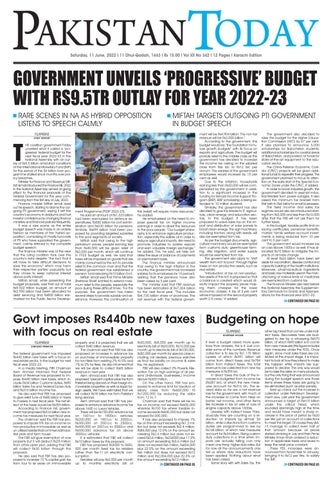
Government unveils ‘proGressive’ budGet with rs9.5tr outlay for year 2022-23 g
RARE SCENES IN NA AS HyBRID OPPOSITION LISTENS TO SPEECH CALMLy
g
MIFTAH TARgETS OuTgOINg PTI gOVERNMENT IN BuDgET SPEECH
islamabad
t
staff rePort
HE coalition government Friday unveiled what it called a ‘progressive’ federal budget for the next fiscal year 2022-23 in the National Assembly with an outlay of Rs9.5 trillion amid strict conditions of the International Monetary Fund (IMF) for the revival of the $6 billion loan programme stalled since months over policy breaches. Minister for Finance and Revenue Miftah Ismail introduced the Finance Bill, 2022 in the National Assembly aimed at giving effect to the financial proposals of the Federal government for the year commencing from the first day of July, 2022. Finance minister Miftah Ismail read out his speech, starting to blame the outgoing PTI government, saying it left the country’s economy in doldrums and hurt investor confidence by changing finance ministers and financial policies frequently. It was a rare scene as the entire budget speech was made in an orderly fashion as members of the ‘hybrid opposition’, comprising of mostly turncoats of PTI who have supported the government, calmly listened to the complete budget speech. The finance minister was of the view that the ruling coalition took over the country’s reins despite “the fact that it will have to take difficult decisions to save the economy” which may harm their respective parties’ popularity but they chose to keep national interest above party interest. Miftah Ismail, while presenting the budget proposals, said that out of total Rs9.502 trillion budget, an amount of Rs2,950 billion had been allocated for debt servicing and Rs800 billion earmarked for the Public Sector Develop-
ment Programme (PSDP 2022-23). He said an amount of Rs1,523 billion had been earmarked for defence expenditures, Rs550 billion for civil administration and Rs530 billion for pensions. Similarly, Rs699 billion had been proposed for providing targeted subsidies to the poor segments of society. Miftah said that owing to the high petroleum prices, people earning less than Rs40,000 will be given relief of Rs2,000 per month, which will continue in Fy23 budget as well. He said that taxes will be imposed on goods that are mainly consumed by the rich to provide relief to the common man and that the federal government has established a pension fund releasing Rs10 billion for it. Miftah Ismail said that Prime Minister Shehbaz Sharif wanted to extend maximum relief to the people, especially the poor during these difficult times. “For this purpose, the government has taken several steps to provide subsidy and assistance. However, the continuation of
this (relief) will require more resources,” he added. He emphasised on the need to impose special tax on higher income earnings in order to divert the resources to the poor people. “Our budget philosophy is to enhance agriculture production, especially the edible oil in order to reduce agricultural imports. We need to promote industries to bolster exports and earn valuable foreign exchange,” he added. This, he said, will help address the issue of balance of payments on permanent basis. The finance minister announced that owing to the high inflation in the country, the government has increased salaries for its employees by 15 percent, adding that the pensions have also been raised by 5 per cent. The minister said that FBR revenue has been estimated at Rs7,004 billion for the next fiscal year. “This includes Rs4,100 billion share of provinces. The net revenue with the federal govern-
ment will be Rs4,904 billion. The non-tax revenue will be Rs2,000 billion.” According to the government, this budget would lay “the foundation for future growth budgets” with its focus on exports and agriculture. The budget will provide relief to the middle class as the government has decided to increase the income tax ceiling on the salaried class from Rs6 lac to Rs12 lac per annum. The salaries of the government employees would increase by 15 per cent as well. Due to the inflation, households earning less than Rs40,000 will be compensated by the government in addition to a significant increase in the funding for Benazir Income Support Program (BISP). BISP scholarship is being extended to 10 million students. Similarly, the government has also decided to give tax breaks to IT, agriculture, clean energy, and education sectors. In this budget, it has been proposed to waive sales tax on the import and distribution of solar panels to boost clean energy. The agri machinery, including tractors, along with seeds, will also be exempted from tax. As per the budget documents, agriculture machinery would be exempted from customs duty; greenhouse farming, drip irrigation, and water supply would be exempted from tax. The government also plans to “shift wealth from rich to poor” through higher taxes on non-productive assets, such as real estate. “Introduction of tax on non-productive assets of the rich is proposed so that a balance is created which would directly impact the property prices making them cheaper for the lower economic classes. A tax of 5 per cent will be imposed on the second property worth 2.5 crore,” it added.
The government also decided to raise the budget for the Higher Education Commission (HEC) by 67 per cent. It also planned to announce 5,000 scholarships for Balochistan students, additional scholarships for coastal areas of Balochistan, and provision of funds for state-of-the-art equipment to the education sector. The China-Pakistan Economic Corridor (CPEC) projects will be given additional funds to expedite their progress. The government planned to focus its attention on the early start of the Special Economic Zones under the CPEC, it added. In order to boost industrial growth, the government decided to exempt industrial feeders from power outages. It also raised the minimum tax bracket from Rs4 lakh to Rs6 lakhs for small businesses. The fixed income and sales tax regimes would also be introduced starting from Rs3,000 and less than Rs10,000 after that the FBR will not ask them for further taxes. In this budget, taxable profits limit on saving certificates, pensioner benefits, martyrs’ family welfare account investments is being reduced from 10 per cent to 5 per cent. The government would increase tax on cars above 1600cc as well. It has allocated Rs10 billion to mitigate the impacts of climate change. At least Rs24 billion have been set aside for vaccination, disease control and capacity building of the health institutions. Moreover, pharmaceutical ingredients and basic raw materials used in the manufacturing of various kinds of medicines are exempted from customs tax. The Finance Minister also laid before the National Assembly the Supplementary Demands for grants and Appropriations for the financial year 2021-22.
CONTINUED ON PAGE 05
Govt imposes Rs440b new taxes Budgeting on hope with focus on real estate islamabad
Khurram husain
islamabad shahzad Paracha
The federal government has imposed Rs440 billion new taxes with a focus on real estate sector, in the budget for next fiscal year 2022-23. In a media briefing, FBR Chairman Asim Ahmad informed that Federal Board of Revenue has proposed to impose Rs440 billion new taxes, which include Rs34 billion Customs duties, Rs90 billion Sales Tax and Federal Excise duty and Rs316 billion income tax. He also said that FBR has proposed to give relief tune of Rs85 billion in taxes to masses in next fiscal year. The net effect of the taxes would be Rs355 billion. According to Finance bill, government has proposed Rs316 billion new income tax measures for next fiscal year. The chairman said the FBR has proposed to impose 5% tax on income on non-productive immoveable as well as un-utilized residential/commercial/industrial plots and farm house. The FBR will give exemption of one property but it will deduct Rs25 million from other open plot, adding that FBR will collect Rs30 billion through this proposal. He also said that FBR has also proposed to increase 15 % capital gain tax from four to six years on immoveable
property and it is projected that we will collect Rs40 billion revenue. The chairman said that FBR has also proposed an increase in advance tax on purchase of immoveable property for non-filers from existing 2% to 5% and 1% to 2% for filers. He also informed that we will be able to collect Rs65 billion revenue in next year. Asim ahmad said that FBR has also proposed 1percent capital value tax from Pakistani living abroad on their foreign immoveable properties as well as liquid foreign assets. We have estimated that we will collect Rs18 billion tax from Pakistani living abroad. Asim ahmad said that FBR has proposed to enhance advance Income Tax above 1600 cc Luxury Vehicles. There will be Rs150,000 advance tax on 1601cc to 1800cc vehicles, Rs200,000 on 1801cc to 2000cc, Rs300,000 on 2001cc to 2500cc, Rs400,000 on 2501cc to 3000cc and Rs500,000 advance tax on above 3000cc vehicles. It is estimated that FBR will collect Rs10 billion taxes by this proposal. FBR has proposed Rs3000 to Rs50, 000 per month fixed tax for retailers (other than Tier-1) on electricity consumption. Retailers will pay Rs3,000 per month up to monthly electricity bill of
Rs30,000, Rs5,000 per month up to electricity bill of Rs50,000, Rs10,000 per month up to electricity bill of Rs100,000, Rs50,000 per month for special class including car dealers, precious watches as final tax liability on income & sales tax, he explained. FBR will also collect 2% Poverty Alleviation Tax on high earnings of all persons (Individuals, businesses,) income above Rs300 million. On the other hand, FBR has proposed to enhance limit for taxation of salary class from Rs600,000 t0 Rs1200,000 by reducing the slabs from 12 to 7. Chairman said that there will be no tax on income not exceed Rs600,000 whereas Rs100 tax where taxable income exceeds Rs600,000 but does not exceed Rs1200,000. It has also proposed to impose 7% tax on the amount exceeding Rs1.2 million but does not exceeds Rs2.4 million, Rs84,000 plus 12.5% on the amount exceeding Rs2.4 million but does not exceed Rs3.6 million, Rs234000 plus 17.5% on amount exceeding Rs3.6 million but does not exceed Rs6 million, Rs654,000 plus 22.5% on the amount exceeding Rs6 million but does not exceed Rs12 million and Rs2,004,000 plus 32.5% on the amount exceeding Rs12 million.
CONTINUED ON PAGE 05
If ever a budget raised more questions than answers, this is it. Just consider some of the numbers. Revenue collection is to rise by Rs1.175 trillion rupees of which Rs391 billion will come from direct taxes and Rs784 billion from indirect taxes. The total revenue to be collected from new tax measures is Rs355 bn. In direct taxes the bulk of the increase is budgeted from income tax (Rs387 bn), of which the new measures account for Rs316 bn. The revised slabs so far are a net revenue loss for the government, with much of the increase to come from hikes on banks’ net income, and other items like increase in tax on sale of cars of engine capacity above 1600ss. Likewise with indirect taxes. Paradoxically they are counting on a reduction of imports by almost $6 billion, while collections from customs duties are programmed to rise by Rs168 billion, of which new measures account for Rs34 billion. Rising custom duty collections in a time when imports are actually falling can only mean one thing: higher duty rates. But for now all the announcements only tell us where duty reductions have been applied. Nothing about what has been raised. Same story with with Sales Tax, the
other big head that comes under indirect taxes. Recoveries here are budgeted to rise by a whopping Rs570 billion, of which Rs90 billion is to come from new measures (this figure includes new measures under the FED). Once again, since most sales taxes are collected at the import stage, it is important to look at how they intend to make this happen while imports are supposed to decline. The only way would be to raise the rates on many products, but the only thing that was announced during the budget speech was those items where these taxes are going to be eliminated (such as solar panels). Next up check out the increase in collection under Petroleum Development Levy. Last year the government announced a target of Rs610 billion under this critical head, which sounded alarmingly high at the time and would have meant a sharp increase in the price of petrol by Rs30 per litre just on account of collections to meet this target. Of course they didn’t manage to collect even half of that amount because oil prices started climbing in July and then Prime Minister Imran Khan ordered a reduction in applicable taxes and levies to keep the retail price constant. Three PDL increases were announced from November to January, bringing it to Rs12 per litre, to satisfy the IMF.
CONTINUED ON PAGE 03
02-03 NEWS 11 June 2022 (ISB)_Layout 1 6/11/2022 1:36 AM Page 1
02
Saturday, 11 June, 2022 | KARACHI
NEWS
Russia Ready to offeR oil on cheapeR Rates to pakistan: consul GeneRal kARACHI
c
aGeNcieS
ONSUL General of the Russian Federation Andrey V. Fedorov has said Russia is ready to help inflation-hit Pakistan by offering oil on cheaper rates. “Pakistan and Russia could receive another boost as last week Pakistan’s Finance Minister Miftah Ismail had expressed Pakistan government’s interest to buy Russian oil. Russia is open for cooperation with any political party as long as the relations are mutually beneficial and constructive,” said the Russian Consul General during an interaction with media here at the Consulate
late Thursday. He said Russia was interested in developing relations with entire world including Pakistan. Russia considered Pakistan as a friendly country and when friendly countries have a discussion at negotiation table they agree on everything. He said the Consulate General of Russian Federation in Karachi extends every possible support to Pakistani side to strengthen bilateral contacts and cooperation to the benefit of both countries. “For increasing the bilateral volume, the two countries had to broaden the dimension of their economic cooperation. There was big untapped potential in almost every sphere of trade partnership. The bilateral trade was
mainly confined to commodities although many other products and services were available to offer to each other,” said Consul General of Russian Federation Andrey V. Fedorov. He said Pakistan could export to Russia surgical instruments, leather and sports goods. Pakistan had also huge potential in information technologies and pharmaceutical sectors. However, Pakistan was also interested to buy cancer medicine due to its high effectiveness and reasonable price. The Commercial Attaches of both the countries were also working hard to elevate bilateral trade and economic cooperation to new high level, he said. He said his country was ready to provide all necessary assistance to execute
Pakistan Stream Gas Pipeline project— from Karachi to Lahore. Russian envoy mentioned that his government was closely monitoring the developments around Pakistan Steel Mills. “We are waiting for completion of international tender auction and ready to share necessary information with Russian companies to prepare their offers for participation in the revival and modernization of PSM,” he said adding that China-Pakistan Economic Corridor and special economic zones provided tremendous opportunities for enhancing our bilateral trade and investment. The council general also replied various queries from media persons.
Foreign Security Cell set up for foreigners’ security: Murad kARACHI Staff RepoRt
The Sindh government has established Foreign Security Cell at Chief Police Office (CPO) in the city with its 31 branches in all district headquarters. The decision to establish Foreign Security Cell was taken in a meeting held under the chairmanship of Sindh Chief Minister Syed Murad Ali Shah here at CM House on Friday. The meeting was held to register data of foreign nationals, particularly of the Chinese and provide them foolproof security to them. Advisor to CM on Law Murtaza Wahab, Chief Secretary Sohail Rajput, Home Secretary Saeed Mangnijo, IG Police Ghulam Nabi Memon, Additional IG CTD Imran Yakoob Minhas, Additional IG Karachi Javed Odho, Deputy DG
Rangers, provincial heads of intelligence agencies and other concerned officer attended the meeting. Speaking at the meeting, the chief minister said that the incidents like Karachi University where Chinese teachers were attacked in a suicide attack would not be allowed to happen again. “We have to strengthen the security of all foreign nationals, particularly the Chinese working on CPEC and other projects in the province,” he said and added that he had given guidelines to the police and other law enforcement agencies to chalk out a detailed foolproof security plan. Syed Murad Ali Shah said that provision of security to Chinese nationals working on CPEC and other projects was a joint responsibility of all the stakeholders concerned. “Any incident threatening the security of Chinese nationals employed on
various projects will have an impact on national level,” he said and added the Karachi University incident highlighted the vulnerability of Chinese nationals’ security working here. The chief minister was told that at present, eight CPEC projects were running in six districts of the province where around 4,000 Chinese were working. In 2016, the Police had created a Special Protection Unit (SPU) to provide security cover to CPEC projects based in Sindh. The Home Secretary said that Sindh police, Pak Army, rangers, FC and private security guards were providing security cover to the CPEC projects under the umbrella of Special Security Division (SSD) in the light of SOPs issued by NECTA. It was disclosed that there were 214 projects, including 21 non-CPEC but government sponsored and 193 non-CPEC projects privately sponsored where 2,300
Chinese were working. IG Police Ghlam Nabi said that a Foreign Information Desk has also been established by the Special Branch at Karachi Airport to register the data of all foreign nationals, including Chinese. He added that the FIA has been requested to provide 40 dashboard terminals for entry/exit data of foreign nationals and it is yet to be done. The chief minister was told that a well-coordinated security mechanism for Chinese security was being prepared. The prime minister has formulated a national action plan for their [Chinese] security which has been developed for which a task force has been constituted under the ministry of interior. The chief minister directed the IG police to keep the Chinese consulate in the loop for the proposed security arrangement and compiling of the data.
Govt earmarks over Rs44000m for higher education in PSDP 2022-23 News Desk The Federal Government has allocated an amount of Rs 2.232 billion for five ongoing and as many new schemes under the Public Sector Development Programme (PSDP) for Fiscal Year 2022-23. According to a budgetary document released here on Friday, an amount of Rs 1824.575 million allocated for the five ongoing schemes of the Defence Division. An amount of Rs 613.575 million has
been allocated for the Construction of Multi Functional Office Building at DCI, Rs 300 million for Development of ICT and Artificial Intelligence-Based Precision Agriculture System utilizing dual-use Aerospace Technologies -GreenAI, and Rs 21 million for the Establishment of FG Degree College for Boys at Kohat (Revised). The maximum amount of Rs 800 million has been allocated for the Establishment of National Aerospace
Science & Technology Park (NASTP) Aviation City Pakistan (ACP) and Rs 90 million were earmarked for the Feasibility Study for Establishment of National Spatial Data Infrastructure (NSDI) for Pakistan. The federal government had allocated an amount of Rs 407.515 million for new schemes including Rs 21 million for Establishment of New Generation National Geodetic Datum of Pakistan, Rs 86.515 million for the Establishment of Institute
of Inclusive Education, Islamabad and Rs 50 million for NIHD Center of Excellence for Preventive, Cardiovascular Research & Development (NEPCARD) and as many for Acquisition of Land from CDA for Establishing Medcial City at Islamabad by National University of Medical Science (Phase-I). The maximum amount for any new scheme was allocated for the Establishment of National University of Pakistan, Islamabad.
Rs. 7.3951 billion earmarked for SUPARCO in new budget NewS DeSk
The government has allocated Rs. 7.3951 billion for Pakistan Space and Upper Atmosphere Research Commission (SUPARCO) in Public Sector Development Programme (PSDP) 2022-23. According to budgetary documents issued on Friday, Rs. 7.0998 billion has been earmarked for the nine ongoing schemes of the Science and Technological Research Division while Rs. 295.266 million has been allocated for the one new scheme. Among the ongoing schemes, Rs. 3 billion including Rs.805.065 million foreign component has been allocated for Establishment of Pakistan Space Center (PSC), Rs. 2500 million including Rs. 498.041 million foreign
component for Pakistan Multi-Mission Communication Satellite System (PakSat-MM1). Rs. 500 million has been earmarked for Pakistan Optical Remote Sensing Satellite (PRSS-O2), Rs. 345.945 million for Feasibility and System Definition Study (FSDS) of Pakistan Satellite Navigation Program (PSNP), Rs. 300 million for Advanced Systems for PakSat-1R Ground Control Segment (GCS) and Rs. 194 million for Feasibility and System Definition Study (FSDS) of Pakistan Remote Sensing Synthetic Aperture Radar Satellite System (PRSS-S1). Among the new schemes, Rs. 295.266 million has been earmarked for Feasibility and System Definition Study (FSDS) of Pakistan Communication Satellite – 2 (PakSat-2).
Rs600m allocated for desalination plant in Gwadar IsLAMABAD Staff RepoRt
The federal government has allocated Rs600 million under its Public Sector Development Programme (PSDP) 2022-23 for setting up a desalination plant in Gwadar to fulfill the fresh water requirements of the port city. The desalination plant in Gwadar would desalinate 5 million gallons of sea water daily to cater the needs of the port city residents for clean drinking water.
The total cost of the project is estimated at around Rs3397.858 million out of which Rs1,110 million have been utilized up to June 2022. The federal government would be fund 67 shares of the total cost while Balochistan government would bear the remaining cost for the development of desalination plant in Gwadar. With the desalination plant, the water supply to Gwadar would be resolved in the short period as the work on the establishment of desalination plant is in progress.
ecp revises schedule for 2nd phase of sindh lG polls ISLAMABAD: The Election Commission of Pakistan (ECP) on Friday issued a fresh schedule for the second phase of local government elections in Sindh. As per the new schedule, candidates can submit their nomination papers till June 15. The ECP would scrutinize the nomination papers from June 17 to 19. Any complaints against the nomination can be filed latest by June 22, the ECP said. The final list of nominated candidates will be published on June 29 after completion of all phases, including scrutiny of papers. In the second phase, local bodies elections will be held in Karachi, Hyderabad and Thatta divisions. July 24 has been set as the polling day, according to a notification issued by the election monitoring body. At least 946 candidates from 14 districts have been elected unopposed in the first phase of the LG polls in Sindh. NewS DeSk
Govt expects over Rs3tr in foreign assistance during fy22-23 ISLAMABAD: The government has estimated foreign assistance of Rs3.166 trillion for 202223 against Rs2.747 trillion was budgeted for the current fiscal year, which was later revised upward to Rs3.144 trillion. The external resources projected for 2022-23 are greater by around 15 percent and one percent, respectively, when compared to the budgeted and revised estimates for 2021-22. The government has budgeted estimates of Rs722.341 billion under the head of programme loans and Rs2.133 trillion under the head of other loans. The programme loans estimated in the budget for 2022-23 are classified as Rs140.884 billion from Asian Development Bank (ADB), Rs159.608 billion from International Development Association (IDA), Rs115.878 billion from International Bank for Reconstruction and Development (IBRD) and Rs303.180 billion from Pakistan certificates. The government had budgeted Rs496 billion from the International Monetary Fund (IMF) for the current fiscal year for budgetary support, however, no amount has been budgeted for the next fiscal year from the Fund. Further, no amount has been budgeted from China’s safe deposits (bilateral) for the next fiscal year. The government has budgeted Rs148.8 billion from Saudi Arabia (oil facility) for the next fiscal year against zero for the current fiscal year, which has been revised to Rs70 billion. Ghulam abbaS
Medical insurance policy for artists announced in budget ISLAMABAD: The government has announced to establish Film Finance Fund with the annual allocation of one billion rupees and launch first-ever medical insurance policy for the artists. This was revealed by the Federal Minister for Finance Miftah Ismail during the budget speech in the National Assembly on Friday. The uplift of film, culture and heritage, drama and fine arts was termed necessary to promote soft image of the country at international level and bringing innovations in societal trends.app
02-03 NEWS 11 June 2022 (ISB)_Layout 1 6/11/2022 1:36 AM Page 2
Saturday, 11 June, 2022 | KARACHI
NEWS
prosecutor in shehbaz sharif’s money laundering case faints in court LAHoRe
Govt eaRMaRks Rs2.23b foR defence division undeR psdp 2022-23
iNp
News Desk
A prosecutor in the money laundering case against Prime Minister Shehbaz Sharif fell unconscious amid a hearing in a banking court. According to details, Farooq Bajwa, who is the prosecutor in the money laundering case against Shebaz Sharif fell unconscious during a hearing in a banking court in Lahore.Farooq was moved to a nearby hospital for medical treatment. However, he has recovered and is healthy. A day earlier, the Sharif family’s renowned servant Malik Maqsood had passed away in the UAE. Maqsood was also nominated in the money laundering case.
HE Federal Government has allocated an amount of Rs 2.232 billion for five on-going and as many new schemes under the Public Sector Development Programme (PSDP) for Fiscal Year 202223. According to a budgetary document released here on Friday, an amount of Rs 1824.575 million allocated for the five on-going schemes of the Defence Division.
General Musharraf’s family denies rumours about his death kARACHI NewS DeSk
Amid rumours of death of former military dictator General (R) Pervez Musharraf, his family has denied the reports of his death, saying that he was hospitalised in a serious condition. A message from family of General (R) Pervez Musharraf posted at his twitter handle, the former president is not on the ventilator and rather has been hospitalised for the last three weeks due to a complication of his ailment (Amyloidosis). “Going through a difficult stage where recovery is not possible and organs are malfunctioning. Pray for ease in his daily living,” concluded the message.
slic unveils innovative golden endowment plan LAHoRe Staff RepoRt
The State Life Insurance Corporation of Pakistan (SLICP) has launched innovative Golden Endowment Plan for catering to modern day needs of policy holders, said Shoaib Javed Hussain, SLIC chairman while addressing a press conference at a local hotel on Friday. “It is a comprehensive limited premium payment term plan that offers enhanced financial benefits. One of the major reasons why one should buy this plan is that it does not require a commitment of paying premiums for the entire term of the policy. Short-term savings can be used to provide the funding for the first seven years while availing full benefits for the 20 years of the policy. It includes death along with survival benefits, higher returns and tax benefits”, he said, adding that he would be the first buyer of this futuristic plan launched as part of the golden jubilee celebrations of the most successful state owned enterprises in the country.As part of the golden jubilee celebrations, SLIC arranged conferences of its different regions. Shoaib Javed Hussain said that persons of 20-55 years of age could buy this plan giving extensive protection and long-term benefits.
03
t
An amount of Rs 613.575 million has been allocated for the Construction of Multi Functional Office Building at DCI, Rs 300 million for Development of ICT and Artificial IntelligenceBased Precision Agriculture System utilizing dual-use Aerospace Technologies -GreenAI, and Rs 21 million for the Establishment of FG Degree College for Boys at Kohat (Revised). The maximum amount of Rs 800 million has been allocated for the
Budgeting on hope CoNtINueD fRoM pAge 01 Along with this a commitment was given that there will be a Rs4 per litre increase every month after that to eventually bring the total PDL to Rs30 per litre by June. That was in January, but the very next month Khan backtracked, announced a price reduction, zeroed the collection under PDL and froze retail prices “till the budget”. This year they have announced Rs750 billion to be collected under the PDL, higher even than last year. It is hard to see how this will be possible under present conditions. The only way would be if oil prices in global markets drop sharply from the $120-125 range they are in these days to below $90 in a few months. That way the government could keep retail prices at the pumps steady and collect the difference through the PDL. But this is unlikely to happen. So far all oil market prognoses for the next 12 months are saying prices are expected to continue rising, with some, such as Goldman Sachs, forecasting them to reach $135 and others going so far as to say $150 could also be possible. Hardly anybody in global oil markets is expecting prices to come down in the near future, so it remains to be seen how this government will reach its target of Rs750 billion. Something similar is the case in the Gas Infrastructure Development Cess (GIDC) that is programmed to rise from Rs130 billion to Rs200 billion. Coming at a time when industry (the main party responsible for paying this Cess) is already reeling from gas shortages and proposed price hikes, it is difficult to see
how the government will squeeze this additional bit of revenue out of an already overburdened economy. The revenue plan is at the heart of this budget. In a few days further details will emerge about how they intend to meet these ambitious targets at a time when the growth rate is tapering off and imports are being compressed. For now we can see that some innovative thinking is at play. For example, the speculative holding of “non productive assets” like land is being discouraged. Land held for less than one year will be taxed at 15 percent, although its not clear yet how the valuation will be done. After the first year the value of the tax will drop by 2.5 percent every year till it reaches zero in six years. The idea is to reduce speculative buying and selling of land. This is not the first time the government has tried this, and the last time it was tried it didn’t work mainly because the FBR was not particularly eager to do all the work that it takes to operate such a tax scheme. Let’s see how much luck they have this time round. Moreover, people who are sitting on multiple properties will now have to pay a tax on all those they are not using for their own residence. Any property worth above Rs2.5 crores will be liable to a tax at 1 percent of fair market value (not clear how this will be assessed) or 20 percent of “deemed rental income” which will be assessed as a percentage of the property value. The idea here is to generate revenue from people who are sitting on large holdings of land, whether productive or not, in an effort to squeeze revenue out of the rich. Whether this
Govt allocates Rs183.215b funds for 87 water projects AHMAD AHMADANI The Federal Government on Friday earmarked funds amounting to Rs183.215 billion for 87 ongoing and new schemes of the Water Resources Division. According to federal government’s budget documents for Financial Year (FY) 2022-23, an amount of Rs180,015.465 million has been allocated for 74 ongoing schemes, and Rs3,200 million for 13 new projects. The ongoing schemes include 13 hydel and 61 water sector projects, whereas the new projects are only 13. As per details, the allocation of ongoing hydel projects includes Rs55,383 million for Dasu Hydropower Project (2,160 MW), Rs12,083 Neelum Jhelum Hydropower Project (696 MW), and Rs12,000 million for Tarbela 5th Extension Hydro Power Project (1,410 MW). Similarly, for the ongoing water sector projects, Rs20,000 million
each has been allocated for Diamer Basha Dam Project and K-4 Greater Water Supply Scheme (260 MGD), Rs12,060 million for Mohmand Multipurpose Dam Project, Rs7,000 million for Diamer Basha Dam Project (Land Acquisition and Re-settlement), and Rs5,000 each for Nai Gaj Dam Project Dadu (Sindh) and Kaachi Canal Project (Phase-I) Dera Bugti, Naseerabad, Bolan and Jhal Magsi. It is also learnt from the budget documents that the major allocation for new schemes includes Rs500 million for Chashma Right Bank Canal Left Cum Gravity Project and Rs300 million each for construction of five Small Dams Salari-2 Dam, Rai Jo Da Dam, Shalmani Dam, Garwari Dam and Amari Dam in Kohistan Dadu, for construction of six dams including Densi, Kcodal, Kambowah, Khiropora and others; for construction of six smalls dams in District Zhob and Sherani, and others projects.
Rupee sheds Rs1.59 against dollar App Exchange rate of Pak Rupee weakened by Rs1.59 against the US Dollar in the interbank trading on Friday and closed at Rs202.35 against the previous day’s closing of Rs200.76. According to the Forex Association of Pakistan (FAP), the buying and selling rates of dollar in the open market were recorded at Rs200.6 and
Rs202.6 respectively. The price of Euro depreciated by 03 paisas and closed at Rs215.01 against the previous day’s closing of Rs215.04. Meanwhile, Japanese Yen gained one paisa to close at Rs1.51, whereas an increase of Rs1.06 was witnessed in the exchange rate of British Pound, which was traded at Rs252.40 as compared to its last closing of Rs251.34.
Establishment of National Aerospace Science & Technology Park (NASTP) Aviation City Pakistan (ACP) and Rs 90 million were earmarked for the Feasibility Study for Establishment of National Spatial Data Infrastructure (NSDI) for Pakistan. The federal government had allocated an amount of Rs 407.515 million for new schemes including Rs 21 million for Establishment of New Generation National Geodetic Datum of Pakistan, Rs 86.515 million for the
Establishment of Institute of Inclusive Education, Islamabad and Rs 50 million for NIHD Center of Excellence for Preventive, Cardiovascular Research & Development (NEPCARD) and as many for Acquisition of Land from CDA for Establishing Medcial City at Islamabad by National University of Medical Science (Phase-I). The maximum amount for any new scheme was allocated for the Establishment of National University of Pakistan, Islamabad.
works is also question mark. Those with declared earnings above Rs300 million per year will pay a “poverty alleviation tax” of 2 percent, a throwback to the “supertax” that was imposed on large enterprises in the wake of the floods in 2010. One strong signal sent by the budget is the increase by 15 percent of government salaries because private sector employers will now be under pressure to follow suit. How they will manage this in an environment of rising costs and taxes will be their headache. A number of items have been added to the Sixth Schedule of the Sales Tax Act 1990, making them exempt. They include newsprint (although these were already exempt for newspapers, all this means is now everybody can import newsprint without paying GST and sell it in the market), books, solar panels, tractors, seeds, gold and silver, and raw materials for export purposes. Some of this will come as good news to the users of these goods. In the case of solar panels, the distributors are now in a small fix since some of them already hold inventory on which these taxes have been paid and they will have a hard time selling them from here on because buyers will demand the exemption right away. But that’s their headache. The elimination will help reduce prices of solar panels at a time when their sales are picking up and will help spur their adoption further. It is important to normalize solar panels like other household appliances. People need to start seeing rooftop solar like they do any other essential household appliance like TVs and fridges. On the whole the budget seems to be riven with its challenges. There is a visible effort to push the burden of the tax effort onto the rich, but the steps don’t seem to go far enough.
people-friendly budget to change economic landscape: Marriyum News Desk Minister for Information and Broadcasting Marriyum Aurangzeb Friday said, pro-poor and peoplefriendly budget for the fiscal year 2022-23 would change economic landscape by stabilizing the national economy. “This budget will lead the country towards economic stability, help provide relief to the people especially the poor, and promote industry, trade and commerce in the country,” Marriyum said while addressing protesting government employees here. Gone were the days when the prime minister of country did not pay heed to the problems of government employees, she said, adding Pakistan was going through a difficult situation today due to the incompetence, inefficiency, theft and corruption of Imran’s regime. The minister said Prime Minister Shehbaz Sharif had directed for 15 per cent increase in salaries of the government employees, besides merger of adhoc relief in the basic pay. There would be a big announcement for pensioners in the budget today, she added. Today, when the Finance Ministry proposed a 10 per cent increase in the salaries of government employees, the Prime Minister rejected it and approved 15 per cent increase in salaries of government employees during the meeting of Federal Cabinet.
04 NEWS 11 May 2022_Layout 1 6/11/2022 12:30 AM Page 1
Saturday, 11 June, 2022 | KARACHI
04 newS
SenATorS rAlly ouTSIde IndIAn HC: delHI muST APologIze To muSlImS over ProfAne remArKS ISLAMABAD
P
staff RepoRt
ARLIAMENTARIANS led by Senate Chairman Muhammad Sadiq Sanjrani on Friday staged a rally to protest the blasphemous remarks of Indian Bahartiya Janata Party (BJP) leaders here in front of Indian High Commission (HC) at Diplomatic Enclave. The protest rally was attended by Deputy Chairman Senate Mirza Muhammad Afridi,
Minister of State for Law and Justice Shahadat Awan, Leader of the Opposition in the Senate Dr Shahzad Waseem, Senator Maulana Attaur Rehman, Senator Abdul Ghafoor Haidri, MNA Khalid Hussain Magsi, Senator Mushtaq Ahmed, Senator Hidayatullah, Senator Danesh Kumar, Senator Gurdeep Singh, MNA Rubina Irfan, Senator Hilalur Rehman, Senator Seemi Ezdi, Senator Sania Nishtar, Senator Fawzia Arshad, Senator Sana Jamali, Senator Dilawar Khan, Senator Azam Swati and Sena-
tor Keshoo Bai and others. Addressing the participants, Senate Chairman said that they were here to record their protest against the blasphemous remarks of Indian leaders. He said that Hazrat Muhammad (SAWW) was Rehmatul Alamin for the whole universe and appealed Indian general public to condemn such incidents and put pressure on its government to avoid such acts. He demanded the suspension and severe punishments of those BJP officials.
He said that they should apologize to the Muslims for hurting their sentiments. “We are here to represent 220 million people of Pakistan and it is our demand that Indian government should apology for blasphemous remarks, adding that “Muslims never tolerate desecration of their holy Prophet (SAWW)”. Speaking on the occasion, the parliamentarians in their brief speeches strongly condemned the Indian government officials for blasphemous remarks and demanded
Allocation raised 119pc for P&D division in PSDP 2022-23 ISLAMABAD staff RepoRt
The government has proposed to raise allocation for the development projects of the Planning and Development Division by 119% to Rs42.17 billion
under the Public Sector Development Programme (PSDP) 2022-23. The government has set aside Rs9.1 billion for the ongoing development schemes, whereas Rs33 billion for new development schemes of the Division, said the budgetary document
PSDP 2022-23 released on Friday. Among the ongoing schemes, the government has proposed the allocation of Rs3.4 billion for operationalization of Green Line BRTS and installation of integrated intelligent transport system equipment.
Similarly, for construction of interchange over Malir link road to M-9, an amount of Rs500 million was allocated, for cadastral mapping and for capacity building and institutional strengthening of ministry of planning, the government has earmarked Rs500 billion each. The government has also proposed to set aside Rs1.517 billion for Greenline Bus Rapid Transit System (BRTS), Rs332 million for development communication project, Rs250 million for CPEC Support project, Rs166 million for re-construction of Mangho Pir Road from Jam Chakro to Banaras, Karachi, and Rs500 for National Initiatives for SDGs / Nutrition. Out of the new schemes, the government has allocated Rs1.5 billion for the feasibility and construction of Pakistan Institute of Development Economics (PIDE) campus at H-11/2, Islamabad. Similarly, the government has also earmarked Rs20 billion for Special Development. Initiatives for Backward/poor districts in the country, Rs9 billion for innovation support project, and Rs one billion each for feasibility and construction of plan house in administration sector, F-5/2, Islamabad, and National Endowment Scholarships for Talents (NEST).
Blasphemous remarks reflect growing Islamophobia under Modi regime ISLAMABAD news desk
Sacrilegious remarks by Bharatiya Janata Party (BJP) leaders Nupur Sharma and Naveen Jindal reflect the growing anti-Muslim sentiment in India under fascist Modi regime. Anti-Muslim hatred is stoked as part of official policy of the BJP-led regime as it has touched new heights in Modi’s India, said a report released by the KMS, today. It said Modi is a trained fanatic of RSS, a fas-
cist outfit of Hindu zealots that have for decades terrorized Muslims in India and Hindutva ideology peddled by Modi and his ilk want an India in which there is no room for Muslims. Even before Modi became Indian Prime Minister in 2014, he had gained notoriety as an anti-Muslim bigot, it added. The report said the BJP leaders’ disrespectful remarks against the Prophet (PBUH) have further exposed the so-called secular face of India, adding the blasphemous statements by the BJP
stalwarts, Nupur Sharma and Naveen Jindal aren’t isolated incidents. It lamented that the Hindu fascists had repeatedly perpetrated massacres of Muslims and now the BJP and RSS leaders were openly hurting religious sentiments of Muslims. The report maintained that hostility against Muslims was ingrained in the followers of BJP and RSS and Modi must remember that insults to the Prophet (PBUH) are unacceptable and would not be tolerated, at any cost.
strict action against such leaders and avoid recurrence of such incidents in future. Senator Attaur Rehman said that he was thankful to Senate Chairman for endorsing his suggestion of holding today protest rally. He said that this was our demand that action should be taken against Indian officials for hurting sentiments of Muslims. The protesters also carrying placards inscribed with condemnation slogans and demand for punishment of the desecrators of the holy Prophet (SAWW).
KP Assembly legislates online taxi services registration NeWS DeSk Khyber Pakhtunkhwa (KPK) Assembly has passed a bill making it necessary for all online taxi services to register themselves with the government.According to the bill registration of the online taxi services has been made compulsory. The company will be compelled to provide information about the owner and drivers of the company. The bill says that companies operating without registration would be fined up to Rs1 million. The Transporation Department will have the authority to cancel a company’s registration, the registration bill read. It adds that the company can be fined in case of a legitimate complaint by a customer. The driver will be penalized if a case of harassment is proven. On June 5, the Khyber Pakhtunkhwa (KPK) government passed the universal number plate bill from the provincial assembly.
Court grants interim bail to 14 PTI leaders till June 17 NeWS DeSk Anti-terrorism court has granted pre-arrest bail to 14 Pakistan Tehreek-e-Insaf (PTI) leaders till June 17. Earlier the ATC in Lahore had issued non-bailable arrest warrants for the former ruling party’s leaders at the request of Shahdara police station under charges of damaging public property, torturing police officials, and creating chaos during the party’s long march to Islamabad on May 25. Upon the issuing of warrants, former ministers Shafqat Mahmood, Hammad Azhar, Dr Yasmeen Rashid, Mian Aslam Iqbal, Jamshed Iqbal Cheema, Ijaz Chaudhary, Zubair Niazi, Nadeem Abbas Bara and others reached the court seeking bail. The arrest warrants were issued to former ministers Shafqat Mahmood, Hammad Azhar and Dr Yasmeen Rashid. Other non-bailable warrants have also been issued against PTI leaders Nadeem Bara, Mian Mahmood Al-Rasheed and Ejaz Chaudhry, amongst others. The Gulberg police and Shahdra police had registered First Information Reports (FIR) against the alleged perpetrators under different sections of the Anti-Terrorism Act (ATA) including 7-ATA related to punishment for terrorist activities and violence. The court had issued the warrants on the request of Shahdara police station. While the antiterrorism court Judge Abhar Gul Khan had issued the arrest warrants.
Woman, two kids burnt alive as wildfire rages on in Shangla SWAT syed shahabuddin
A woman along with her two minor children was burnt alive when a wildfire engulfed her house in Lilai Dandai area of Behsam Tehsil in Shangla district, taking the death toll from hill fire to eight so far in a week. The three family members were killed when a fire broke out on Dandai Hill in Besham Tehsil, officials confirmed. According to DSP Besham circle Jehanzeb Khan, the deceased included a mother and her two children. He said that a wildfire erupted in Lilai Dandai area of Behsam Tehsil and spread to the residential area. The raging fire killed a woman identified as: 27-year-old Mrs Najma, wife of Hayat Zada, and her two children: three-year-old Aiman and infant Hameed. “Two buffaloes, two cows and three
goats were also killed in the blaze”, he added. Rescue spokesperson Rasool Khan said that a Rescue 1122 team, police and revenue department staff have reached the area to extinguish the fire with the help of locals. He said that the bodies of the victims were taken to the Tehsil Headquarters Hospital Besham. Shangla Deputy Commissioner Ziaur Rehman told Pakistan Today that the relevant staff has reached the affected area and provided tents, blankets, kitchen sets and other items to the victim’s family. The Deputy Commissioner claimed that the officials have been directed to control the fire as soon as possible in the district. RESCUE 1122 WORKER DEAD: It is to be noted that the raging fire killed Rescue 1122 worker Nizam Ullah, due to intense heat and smoke on Thursday in the
Manga area of Chakesar Tehsil. The deceased belonged to Baina village of Puran Tehsil and his funeral prayer was offered in Chekesar hospital. Four members of a family were killed by a forest blaze in Ali Jan peak of Chakesar Tehsil last Monday. FIRE INCIDENTS INCREASED: On the other hand, the number of fire incidents has increased to a dangerous level and eight more fire incidents were reported at various places in Swat District. According to Rescue 1122, District Emergency Officer Malik Sher Dil Khan, fire broke out on Friday in the hills of Marghazar, Tutatono Bandai, Sangota, Manglawar, Amlook Dara, Kanju Township and Shokdara. He said that about 70 fire incidents have been reported in a week in Swat District. However, no casualties have been reported so far.
Saturday, 11 June, 2022 | KARACHI
NEWS
Government unveils ‘progressive’ budget with Rs9.5tr outlay for year 2022-23 continued from page 01 During the session which began at 4:41 pm, the Minister for Finance provided an insight into the government’s estimated expenditures, revenues, and how it aims to allocate funds for vital sectors of the economy. The minister continued his speech uninterruptedly and said that the volume of the federal budget has been set at Rs 9.5 trillion. He said that Prime Minister Muhammad Shehbaz Sharif did not shy away from taking difficult decisions for the sake of the country and assumed the office when the country had been facing severe economic issues and challenges on multiple fronts. He said when the PML-N came into power, the economy was almost bankrupt. “Everyone knows we were under the burden of so many loans,” he said, adding that the current account deficit was at a historic high. Criticizing the previous governments, the minister said that the PML-N led government had to inherit a huge circular debt amount after coming into power, adding that the debt was accumulated due to botched policies. He said there were lot of difficulties but the government would lay the ground for the economy to revive and to move towards development and prosperity. The minister said Prime Minister Muhammad Shehbaz Sharif does not hesitate from taking difficult decisions. He said the incumbent government had, through its sound economic policies, would ensure development in the country. The Prime Minister Muhammad Shehbaz Sharif also attended the sitting and remained present during the entire speech of the Finance Minister. Other Ministers including Ashan Iqbal, Khurram Dastgir, Rana Tanveer Hussain, Asad Mehmood, Syed Faisal Ali Subzwari, Shah Zain Bugti and senior leaders of PML-N and PPPP attended the sitting. The entire sitting was chaired by the Speaker Raja Pervaiz Ashraf who adjourned the House to meet again on June 13, 2022 (Monday) at 4 pm. The House would formally convene the debate on the budget in the next sitting and Leader of the Opposition Raja Riaz likely to open debate on it as per parliamentary tradition.
Rs118,583m for projects of Communications division
isLamaBad staff report
The federal government has allocated Rs118,583.402 million for 115 development projects of the Communications Division in the Public Sector Development Programme (PSDP) for fiscal year 2022-2023. According to the budgetary document released on Friday, the government has specified a total of Rs180 million for four schemes of the Ministry of Communications (excluding NHA). Rs118,403 million have been allocated for National Highway Authority’s 110 development projects out of which Rs86,288.281 million have been earmarked for 64 ongoing schemes, Rs24,045.121 million for its 46 new schemes whereas Rs8,070 million have been earmarked for BuildOperate-Transfer(BOT) schemes. Out of NHA’s ongoing development projects, the highest amount of Rs6,000 million has been set aside for dualization of Khuzdar-Kuchlak section of N-25, whereas Rs4,500 million have been allocated separately for additional carriageway of Shikarpur-Rajanpur section of Indus Highway and three sections of CAREC corridor development program tranche-I projects of Indus Highway. Rs4,000 million have been earmarked for the construction Hosahb-Awaran section of M-8 whereas Rs3,500 million have been set aside for Sukkur-Multan section of motorway. Among the new NHA schemes, Rs 5000 million have been apportioned for DI Khan-Lakki Marwat-Tank package, Rs3,000 million each for dualization and rehabilitation of Karachi-Kararo, Wadh-Khuzdar sections of N-25. Rs3,000 million have also been earmarked for construction of Lahore-Sialkot Motorway link via Narang Mandi to Narowal.
AAmiR LiAquAt LAid to Rest At AbduLLAh shAh GhAzi GRAveyARd
F
news desk
AMOUS TV personality and PTI MNA Aamir Liaquat Hussain has been laid to rest at Karachi’s Abdullah Shah Ghazi graveyard after his funeral prayers were offered here on Friday. A large number of people, including Hussain’s family and friends, attended the prayers. Former governor of Sindh Imran Ismail and former mayor of Karachi Farooq Sattar also attended the funeral. The police reached a settlement regarding the matter of the deceased’s burial and decided to hand the body to Ahmed Aamir, the son of Hussain. Pakistani social worker Ramzan Chhipa
performed the ghusl (the process of washing and shrouding the deceased ahead of burial) of the PTI MNA. Earlier, the police stopped Hussain’s burial for an autopsy to determine the exact cause of his death. However, his family was not on board. The 50-year-old televangelist passed away on Thursday. The news of his untimely death sent shock waves across the country. Hussain had revealed in one of his recent video statements that he has booked a grave in the graveyard of Abdullah Shah Ghazi’s shrine. His parents, politician Sheikh Liaquat Hussain and columnist Mahmooda Sultana are also buried at the same spot and he will be laid to rest beside them.
Govt imposes Rs440b new taxes with focus on real estate continued from page 01 Customs Revenue measuRes: Chairman FBR briefed the media that FBR has also proposed to impose 10% regulatory duty on import of Motor Spirit to address duty free import under China Pakistan Free Trade agreement (CPFTA). We have estimated to collect Rs30 billion revenue in next year, he added. It has also been proposed to enhance Customs duty from 10 to 11percent and 2% additional Customs duty on import of Synthetic Filament Yarn, Monofilament and Staple Fibers of Polypropylene. FBR has also proposed to withdraw RD exemption on import of high carbon wire rod as well as stamping foils and increase in RD rate on optical fiber cables from 10% to 20%. sales tax: Member IR policy FBR informed that FBR has also proposed to impose 3% sales tax on compressor scrap, motor scrap and copper cutting scrap even if imported by manufacturers. As per the Finance bill, a new levy up to Rs16,000 has been proposed on the import of mobile phone handsets. There will be a levy of Rs100 per set on a mobile phone with cost and freight (C&F) value of up to $30. The rate of levy per set on mobile phones having a C&F value between $30 and $100 will be 200. The rate of levy per set on mobile phones having a C&F value between $101 and $200 will be 600. Similarly, the rate of levy per set on mobile phones having a C&F value between $201 and $350 will be 1800. The rate of levy
per set on mobile phones having a C&F value between $351 and $500 will be 4000. The rate of levy per set on mobile phones having a C&F value between $501 and $700 will be 8000. The rate of levy per set on mobile phones having a C&F value of above $701 will be 16000. On the other hand, it has also proposed to exempt all types of seeds, power generation projects, solar panels, tractors, local supply to charitable hospitals and imports by UN diplomats, privileged persons from sales taxes from next month. FedeRal exCise duty: He also said that FBR has also proposed to increase Federal Excise Duty (FED) from Rs5200 to Rs5600 on locally produced cigarettes if their on pack printed retail price exceeds Rs5960 per 1000 cigarettes. Meanwhile, it has also proposed to increase FED from Rs1650 to Rs1850 on locally produced cigarettes if their on pack printed retail price exceeds Rs5960 per 1000 cigarettes. In addition, FBR has also proposed to increase FED from Rs10,000 to Rs50,000 on club, business and first class travel by air. Moreover, It has also been proposed to increase in rate of FED on Telecommunication Services from 16% to 19.5% which means phone calls would be expensive from next month. Chairman FBR said that FBR will collect Rs6000 billion taxes in outgoing year and we set Rs7002 billion tax revenue target for next fiscal year.
The overseas Pakistani workers’ remittances grew by 6.3 percent in 11 months (Jul-May) of current fiscal year to US$28.4 billion against the inflows of $26.7 billion in same period of the previous year. On year-on-year basis, the remittances decreased from $2.5 billion in May 2021 to $2.3 billion in same period of current fiscal year. On month-on-month basis, the inflows of remittances also declined from $3.1 billion in
NA speaker, senate chairman reduce fuel quota of secretariats by 40pc The National Assembly speaker and the Senate chairman have decided to reduce the fuel expenditure of their respective secretariats by 40 per cent as part of austerity measures in light of the record increase in prices of petroleum products. According to a statement issued by the National Assembly Secretariat, the decision was taken during a meeting between NA Speaker Pervaiz Ashraf and Senate Chairman Sadiq Sanjrani. The decision to cut down on fuel expenditure by the Senate and the National Assembly secretariats will be applicable to the Senate chairman, deputy chairman, the NA speaker, and deputy speaker among other bigwigs. The heads of standing committees and officers will take austerity measures and reduce fuel consumption as well, added the statement. Sanjrani and Ashraf also discussed current political and economic crises and said the government officials stood by the masses in this difficult hour. The decision to reduce the fuel expenditure by the two secretariats came after the federal cabinet, provincial governments significantly slash their fuel spending. Along with the federal cabinet, Punjab and Sindh had reduced their fuel quota by 40 per cent whereas Balochistan and Khyber-Pakhtunkhwa cut down on their fuel expenditure by 50 and 35 per cent, respectively. The austerity measures are being taken as part of the government’s plan to rein in the cash crunch as well as minimise the use of petrol amid a record increase in the price of petroleum products in the global market. news desk
Sherry Rehman, CITES board decide to ban import of wild cats, mammals news desk Federal Minister for Climate Change Senator Sherry Rehman and the CITES Management Authority Board meeting on Friday decided to impose a ban on the import of all exotic mammals into Pakistan. Speaking to the attendees of the Board Meeting, the Minister remarked that “Import of exotic mammals is becoming a serious problem in Pakistan. It is against the natural rights of an animal species to deprive them of their habitats especially when we cannot provide them the specified accommodation needed, merely for personal entertainment purposes. Confining these mammals to cages, zoos, and private residences affect their mating patterns, putting them at risk of abuse, either voluntary or inadvertent. Moreover, with a change in their accommodations these
mammals end up dying lonely and painful deaths.” Ban will include CITES and Non-CITES listed mammals, elephants, Wild Big Cats like lions, tigers, and leopards. In addition there will be a ban on the export of local species of birds (live, parts, and derivatives) on commercial bases. “It is not only our humane duty to protect the biodiversity of this earth we share with other species but also our responsibility especially after we have destroyed countless habitats and ecosystems for our food, housing, and industries. We will not be issuing any NOCs (No Objection Certificate) to any zoo or private owner for any exotic mammal to be brought to Pakistan. It is against all laws of nature to import any exotic mammal, big or small and throw them into spaces where they neither grow nor survive , therefore by consensus the board has decide that no NOCs will be allowed for those who attempt
Workers’ remittances up 6.3% to $28.4 bn in 11 months news desk
05
April 2022 to $2.3 billion in April 2022. According to data released by State Bank of Pakistan (SBP) on Friday, remittances’ inflows during May 2022 were mainly sourced from Saudi Arabia ($541.9 million), United Arab Emirates ($435 million), United Kingdom ($354 million) and the United States of America ($232.9 million). During the corresponding month, the overseas Pakistanis living in Bahrain sent $39.1 million, from Kuwait $67 million, from Qatar $76 million whereas $114.6 million
were dispatched from Oman. Similarly the inflows from Germany, France, The Netherlands, Spain, Italy, Greece, Sweden, Denmark, and Ireland were recorded at $41.5 million, $38.0 million, $5.0, $43.3 million, $68.8 million, $30.2 million, $6.0 million, $5.2 million and $12.8 million respectively. Likewise, from Malaysia, Belgium, Norway, Switzerland, Australia, Canada, and Japan, the workers dispatched $10.9 million, $19.2 million, $11.0 million, $3.1 million, $52.7 million, and 5.7 million respectively.
cmYk
to continue such practices”, said the Minister. The meeting was attended by Secretary of MOCC, Additional Secretary MOCC, Joint Secretary MOCC, Director General WWF Hammad Naqi Khan, SNR Director WWF, MOFA Ali Haider, and Syed Faraz Raza, Islamabad Administration ICT Sheryar Arif Khan, DG Environment CDA, Mr Saeed-uz-Zaman KPK, IUCNPakistan, Gilgit-Baltistan, Nawabzada Amir Khusro Khan Jogazai, Balochistan, Chief Conservator Forest, GB, Forestry Environment and Wildlife Department KPK, Conservator Wildlife, Sindh Wildlife Department, Malik Sanaullah Khan Director General, Mr. Mohsin Farooque, Mr. Naeem Iftikhar Dar, Director AJK, Secretary Forest and Wildlife, Secretary Forest and Wildlife, Balochistan, Raja Omer, DIGF MOCC, Ms. Mona Zaidi Deputy Conservator MOCC, and Ms Mahvish Rauf, Assistant Secretary (wildlife) MOCC.
06-07 Comments - 11th June 2022_Layout 1 6/11/2022 12:46 AM Page 1
Saturday, 11 June, 2022
06 COMMENT
Before Aizaz Syed’s funeral
Will the budget satisfy IMF?
A mindset of privilege prevails
Political stability indispensable for economic revival
A
S was being predicted the budget for 2022-23 has turned out to be one of the toughest in the country’s history. Pakistan is facing a severe balance-of-payments crisis. Its foreign exchange reserves have fallen sharply in the past two months. The cashstrapped country finds it difficult to buy coal or natural gas from overseas to fuel its power plants. Its five-year sovereign bonds are trading near 13 per cent, which is among the highest in the emerging markets. The new government is keen to stop the bleeding with an enhanced IMF package leading to more short-term loans from China and Saudi Arabia. Pakistan needs $41 b53356n in next 12 months. No friendly country is willing to lend till there is a nod from the IMF. To strike a deal with the IMF, the government has already increased the prices of petroleum products and secured a determination from the power regulator for about rs 8 per unit increase in electricity rates. However the agreement may not be reached until Pakistan takes wide-ranging steps to repair macroeconomic stability and reaches a consensus with the IMF on the next fiscal year’s tax proposals. The budget is not aimed at providing immediate relief to the common man. The dole out of rs 2,000 per poor family, lowest Income tax slab being raised from rs 6 lac to rs 12 lac and 15 percent rise in salaries will be wiped out by over 14 percent inflation. The rise in the price of petroleum products would stoke inflation. So would the economic stabilisation efforts which are likely to slow down the country’s growth prospects. It Is widely understood that the prevailing instability is exacerbating the economic crisis. Political parties need to exercise some restraint and allow the needed economic correction to proceed unhindered. As PM Shehbaz Sharif told a pre-budget gathering of stakeholders, economic revival is interlinked with political stability. The ruling alliance leadership that gathered at former President Asif Zardari’s dinner sent out a message to the IMF, that the alliance stands solidly behind the deal with the Fund. They also sent an implicit message to the establishment that there have to be no early elections and no tolerance for marches aimed at government change if the economy is to be put on rails. But will Imran khan care?
dR QaisaR Rashid
D
eMOCrACy is an unpleasant yet unavoidable reality for patriarchy-driven and authority-seeking members of any society. The way developing countries are sticking to democracy invariably, a big change is expected in the power structure, though challenges are immense. Pakistan is no exception to this phenomenon. On 6 June 2022, led by Lieutenant General (retired) Ali Quli khan, ex-servicemen from the Pakistan Army held a press conference outside the National Press Club, Islamabad. The retired army officers demanded dissolution of Parliament and the holding of early elections, but they refused to take any questions from the media. On the occasion, a veteran journalist Aizaz Syed asked Lt Gen (retd) Asif yaseen Malik a thorny question: “In the given economic crisis, do you think army generals should help the government by handing back the lands allotted to them?” As an expression of annoyance, the question invited a dismal reply: “you must plan your funeral.” It was apparent that General Malik had no answer to journalist Syed’s question and this was why the general yelled the condescending condemning remark. The question is why? Is asking a question such a terrible idea? Being a journalist in a country like Pakistan is an arduous task. It is a low-paid but a high-risk job.
The boot on the other foot?
T
MuhaMMad Zahid Rifat
T
urkey and Pakistan are key members of the Islamic World and share views on problems and issues confronting the Muslim ummah. Both countries have a deep-rooted relationship and share unanimity of views on almost all issues of regional and international importance. For the past 75 years, the two countries have enjoyed a partnership, which can easily be described as an all-weather partnership, that has been mutually beneficial and centred around economic development, diplomatic backing and collaboration over security and defence issues. Apparently in a determined attempt to renew bilateral relations and encourage more cooperation, Prime Minister Shehbaz Sharif recently paid a threeday official visit to Turkey which turned out to be quite friendly, productive and result-oriented. Prime Minister Shehbaz Sharif visited Turkey in order to have the highest-level discussions there on enhancing and boosting cooperation and collaboration in various sectors like investment, trade, health, education, culture. It is pertinent to mention here that Pakistan and Turkey already enjoy a strong collaborative partnership when it comes to defence. Both brotherly countries combined their resources to create the largest warship MILGeM-class PNS Badar which was launched in karachi in May 2022. This was indeed a shining example of the excellent cooperation between the two countries in the defence sector. In order to help and assist each other economically, both countries have also signed a Strategic economic Framework that inspired innovation in the fields of technology, tourism, education and health sectors. Turkish companies’ investment in Pakistan has also increased to $ I billion for the first time since 2011.
Dedicated to the legacy of late Hameed Nizami
Arif Nizami (Late) Founding Editor
Yousaf Nizami Umar Aziz
Joint Editor
Joint Editor
Executive Editor
Lahore – Ph: 042-36300938, 042-36375965
be
reached
at
A visit based on a shared culture
HAT cases were registered against PTI ladders from Lahore by an Anti-Terrorism Court in connection with the events of March 25, followed by their obtaining bail, shows that the government’s refusal to allow the constitutionally guaranteed right of assembly is as bullheaded as ever, the change of government having made no difference. The only difference is that whereas previously it was former ministers of the PML(N) who faced the wrath of the state, now it is former PTI ministers. The method is painfully familiar, and has been used by the colonial-era police: first restrict the right to assemble, if necessary by such means as tear-gas shelling and police lathi charge, then register cases against objects of your ire, and make them do the rounds of police stations and courts, getting bail and facing charges. While those who had cases registered against them were able to obtain bail, this does not mean that there was any reason for their original right of assembly to be violated. The courts have historically taken a liberal view of bail mainly because they know that the law is designed to enable the police to detain. The government uses the violation of a declaration under Section 144 PPC, preventing the gathering of more than five persons, as the basis for picking up people. Truer, if the government learns that a gathering has some criminal intent, such as committing a robbery, or a riot, it should be able to stop it, but that should not be at the cost of the citizen’s right of assembly. The PTI should reflect on the use of such laws, while the PML(N), PPP and other coalition members should remember that these laws were used against them only recently.
M. A. Niazi
The writer can qaisarrashid@yahoo.com
A friendly visit to Turkey
PTI leaders’ cases show that nothing has changed
Editor Aziz-ud-Din Ahmad
Whether from the peace domain or the war zone, dozens of journalists have lost their lives while exploring a matter and reporting the truth. The brave are the journalists who ask questions, no matter how acrimonious these are. Journalist Syed also asked, “your press conference did not permit the journalists t6 ask questions.” That was an appalling fact to which General Malik should have responded. Held by the retired army officers, what kind of press conference could it be that deprived journalists of an opportunity to ask questions? It means that the press conference holders did know that they could not face the press. Second, they had no taste for being answerable. Journalist Syed also asked, “Should army generals participate in politics?” He also asked, “After 1971, the biggest challenge to Pakistan’s security was on 2 May 2011 when the uS Navy Seals breached Pakistan’s security and launched the Abbottabad operation. Why did you not resign from the post, as you were the Secretary Defence?” There were no answers. The respondent was speechless. It is apparent that public life is entirely different from official life. When an order-issuing authority decides (post-retirement) to face the public, especially journalists, awkward and excruciating scenarios do emerge. In public life, a retired military officer without the habit of hearing noes is confronted with unsolicited, unwelcomed questions. The retired officer must have a head for tolerance tested publicly. Democracy is ruthless. It gives voice to the masses and is disrespectful to oppression. Journalist Syed was showcasing for the retired officers the public face of democracy. In an effort to bully the journalist into silence, the undertone of General Malik was foreboding. The reply insinuated retaliation in the form of a death sentence. A retired army officer cannot reply in this insane way to a journalist asking a question. Threatening a journalist is a serious matter, calling for an apology. General Malik failed to learn the ways of evading questions of journalists. Journalist Syed also asked more questions afterwards, but General Malik decided to flee the spot. No patriot is immune from accountability, which is not the prerogative of controlled institutions such as the National Accountability Bureau (NAB) to implement. In democracy, accountability knocks at every door that had tasted power. On 4 March 2016, a PhD candidate in the field of immunology visited the office of the then Vice Chancellor (VC) of university of Health Sciences Lahore General retired Muhammad Aslam and informed him of the irregu-
larities and problems in the admission processes for PhD candidates. General Aslam was not habitual of listening to complaints; hence, he shouted the candidate out of his office. The deployed soldier of the Pakistan army standing alert outside the office also dealt with the candidate harshly. Owing to being denied entry into the office, the PhD candidate asked in writing about the quality standards of research practised at the university. The VC refused to answer. Such was the arrogance displayed by a retired general working in the civilian domain. Later on, the PhD candidate also informed the university in writing that several research articles published by General Aslam also violated mandatory universal medical research guidelines updated in 2016 by the World Health Organization (WHO) and the Council for International Organization of Medical Science (CIOM). Both the WHO and the CIOM made it mandatory that principles of ethical research set forth in these guidelines should not only be followed strictly in performing research experiments internationally, but these should also be upheld in the ethical review of research protocols internationally. Violating this bearing, at the behest of the VC, on 6 February 2017, Asad Zaheer, registrar of the uHS, inveigled the Chancellor, who happened to be the Governor of Punjab Malik Muhammad rafiquerajwana, into overlooking Pakistan’s international obligations just because the research articles were published by an army general. Amenable to enticement and pressure, the Chancellor acted accordingly and avoided taking cognizance of the issue of conducting substandard research and producing fake research articles. The conclusion is simple: In Pakistan, international obligations to improve medical research and do ethical research are subject to the will of retired army generals. All resources are employed to safeguard their reputation and interest, irrespective of the consequences. The outcome was that when the COVID-19 crisis hit the country in 2020, there was no medical researcher in the field of immunology available to take on the challenge and prepare an indigenous vaccine. Medical researchers undertaking substandard research and producing fake research articles to earn credit for seeking job promotions by the Higher education Commission were found helpless in the face of the pandemic. Pakistan had to wait for several months for the supply of vaccine from China and the uSA. Hundreds of precious lives were lost in the waiting period and the economy suffered amounting to millions of dollars. Nevertheless, the mandatory universal medical research guidelines declared by the WHO and CIOM in 2016 are still awaiting implementation in Pakistan.
I
Karachi – Ph: 021-35381208-9
I
Needless to mention, contacts between the top leadership of the two countries greatly help in promoting bilateral relations and cooperation in various fields and sectors for the mutual benefit of their people. On the very first day of the visit, Prime Minister Shehbaz Sharif, while interacting with Turkish businessmen and investors, emphatically pointed that somehow closeness in Pakistan and Turkey’s relationship was not fully reflected in the trade ties and expressed the desire that the volume of trade between the two countries should go up to $5 billion annually. He quite rightly pointed out that Turkey and Pakistan have a long historical relationship firmly anchored in common faith, shared history and a glorious tradition, and extend mutual support to each other on issues of core interest, s6 there was certainly and surely no doubt that both the countries have a great potential for increased and enhanced trade and economic relations mutually beneficial for both sides. The Pakistani Prime Minister had a one-on-one long meeting with host President recep Tayyip erdogan and then the two leaders addressed a joint press conference. Among other things, Turkish and Pakistani leaders had also exchanged views regarding kashmir, Palestine, Cyprus and Afghanistan. President erdogan said that they had discussed a vast number of regional and international issues in detail, reaffirmed to further enhance the scope of bilateral ties, resolved that the close friendship and cooperation between the two countries would be further strengthened and both were also moving on cooperation in defence projects, citing joint construction of ships. He went on to say that mutual trade between the two countries had already soared to over $1 billion and they have resolved to it it further onward to $5 billion annually, assured to encourage the Turkish companies to increase their investment in Pakistan, tourism, education, logistic and civil aviation were among other sectors in which they were working to enhance cooperation. Turkey has all along been supporting the kashmiris’ right to self-determination and reiterating the quite appreciable stance, President erdogan called for resolving lingering and burning kashmir issue in accordance with uN Security Council resolutions amicably. On his turn, PM Shehbaz Sharif lauded the un-
Islamabad – Ph: 051-2204545
I
Web: www.pakistantoday.com.pk
I
flinching support of Turkey over the kashmir issue and said that the kashmiris had been struggling for their legitimate right of self-determination and been subjected by Indian occupying security forces to worst brutalities and atrocities for more than seven decades of their freedom struggle and also nd5a was making attempts to effect demographic changes in the Indian Illegally Occupied Jammu and kashmir. He went on to reaffirm Pakistan’s principled stand and said that Pakistan would not abandon its quest for peace, which was only possible in South Asia if the long outstanding issue of kashmir was resolved under the uN Security Council resolutions and in accordance with the aspirations of the kashmiri people. He also reaffirmed Pakistan’s support to Turkey over Northern Cyprus saying that Pakistan stands with Turkey in its fight against terrorism and terrorist groups as enemies of Turkey are enemies of Pakistan. Both Turkey and Pakistan have worked for decades for their shared goals of a peaceful and stable Afghanistan and were hosting the largest number of Afghan refugees in the world. It is worth mentioning here that warm bonds between Turkey and Pakistan had been close to their hearts going beyond conventional ties and diplomatic niceties, bonds of friendship were deeply rooted in history and intertwined in the very fabric of their respective societies, such a relationship was deep in their hearts as they were tied with each other in the unbreakable, intertwined and interlinked bonds which also connected them at all levels, whether the governments, the institutions, the armed forces or the people. The visit of the PM had taken place when the two countries were celebrating the 75th anniversary of establishment of diplomatic relations between Turkey and Pakistan. The Seventh High-Level Strategic Cooperation Council will be meeting in Islamabad in September 2022 and hopefully will go a long way in further promoting and strengthening the existing warm, sincere and brotherly relations between the two countries. All in all, the visit was quite productive as a number of agreements, memorandum of understandings and protocols were signed for further expanding cooperation and assistance in various sectors. The writer can zahidriffat@gmail.com
Email: editorial@pakistantoday.com.pk
be
reached
at
06-07 Comments - 11th June 2022_Layout 1 6/11/2022 12:46 AM Page 2
Saturday, 11 June, 2022
COMMENT 07 Editor’s mail Send your letters to: Letters to Editor, Pakistan Today, 4-Shaarey Fatima Jinnah, Lahore, Pakistan. E-mail: letters@pakistantoday.com.pk Letters should be addressed to Pakistan Today exclusively
Energy consumption and usage of ACs THe deadly combo of lengthy load-shedding and heatwaves has made life miserable across the country. Adding to the list of woes is the worsening economic crisis. The government seems clueless as to how go about handling either the energy shortfall or the economic crisis. The least it shall do is to limit the usage of air-conditioners in offices and other places. For instance, there is no point in keeping the air-conditioners on round the clock in ATM booths. It takes hardly a couple of minutes for one to withdraw cash and move on. MUHAMMAD NOORULAIN SKARDU
What have we done?
The Supreme Court verdict on defection The matter is not that simple
dR faQiR hussain
T
HIS article examines the effect of the Supreme Court verdict/short order on the application of Article 63A of the Constitution. The Constitution was amended with a view to tackle the perennial problem of political defection in our political culture. The term “horse trading” gained currency during the 1990s with the revelations of ugly episodes of encampment of MPs in rest houses in Murree and Chhanga Manga. Both the PPP and PML(N) were involved in attempting to snatch mandate from each other. Ms Benazir Bhutto was then Prime Minister and Mian Nawaz Sharif was the Chief Minister of Punjab. Both the political parties were involved in the game of horse-trading by offering inducements to MPs, including pecuniary benefits and/or ministerial posts, in exchange for change of political loyalties. And even though the attempts at ousting the opponent through vote of no confidence ultimately failed, the parliamentarians earned the unsavoury distinction of being referred to as “traded commodity”. This was in addition to them being referred to as inefficient, nepotistic and corrupt, the last tag pinned on their lapel by General Zia ul Haq, when he had them involved in getting development funds. During the time of General Musharraf, the switching of political loyalties and turn-coating became an art: many technocrats, freelance politicians and clusters of political parties, joined the Federal/provincial cabinets, and some made it to occupying the top slot of Prime Minister or Chief Minister. No sooner was General Musharraf ousted than such politicians hopped back to their respective political parties and were welcomed there. And getting another opportunity, some of them jumped on the bandwagon of PTI. Thus, given incentives, there is a crop of a few serial turncoat politicians and political groups (registered as political parties), who have no qualms about quitting principles to join the new government! Political defection has been a perennial problem the world over. However, the advanced democracies control it through ethical norms and the development of political values, where such a practice is abhorred by parties and constituents alike. Thus, there is no law for defection in the uk, uSA and Canada. Certain other countries, like New Zealand and South Africa, enacted laws with sunset clauses and let it lapse, for there was
no pressing need to retain them. Some 40 countries, mostly nascent democracies, have laws for curbing defection. It includes India, Bangladesh and Sri Lanka in our region. The first to legislate was India, which passed the 52nd Amendment to the Constitution in 1985. Defection being a major cause for political instability in Pakistan, it followed suit. Thus, the menace of floor-crossing and horse-trading was sought to be checked through law. Initially, the Parliament introduced Article 63A through the Constitution 14th (Amendment Act) 1997, but being very general, it was seldom used. The clause was therefore further amended and made more specific as well as stringent through the Constitution 18th (Amendment Act) 2010. It is a self-contained code containing substantive and procedural provisions for handling the issue of defection, as follows: Defection is restricted to 4 grounds namely resigning from membership of a political party or joining another parliamentary party; voting or abstaining from voting in Parliament or Provincial Assembly contrary to the parliamentary party direction in relation to the election of, or casting vote of confidence/no confidence against the Prime Minister or Chief Minister; constitutional amendment bill and money bill. When defection is alleged, the Party Head is required to issue a show cause notice to the member and if not satisfied with his reply, may make a declaration of defection and forward it to the Chief election Commissioner, who places it before the election Commission for decision. The Commission may confirm the declaration or otherwise. If the declaration is confirmed, the defector ceases to be a member and his seat becomes vacant. The aggrieved party (Party Head 6r defector) may file appeal in the Supreme Court, whose decision is final. Given the predictable outcome of the PDM move to oust the Prime Minister, the PTI made strenuous efforts to lure the party dissenters back into the fold and offered inducements to the estranged political allies to forestall the no-confidence motion. And being unsuccessful, in utter desperation, the party sought assistance from the Supreme Court. The President sent a reference, asking the Court to answer a few loaded questions, actually wanting it to interpret Art 63A in a manner to preempt the no-confidence motion. It was an inappropriate move on account of the time and content of the reference. Article 186 requires the Court to entertain the reference, but in no way obligates it to answer all, and especially, the politically motivated and loaded questions. And with due respect to the august court and in no way doubting the wisdom and sagacity of its judges, it was not the occasion to give opinion on such politically-loaded questions at a time of severe political crisis. More so, because answers thereto, may have exposed the Court to unnecessary criticism of being perceived as a partisan arbiter. Nothing damages public confidence in the administration of justice more than in giving opinion or settling political controversies. And whereas admittedly, the Court is at times required to adjudicate and decide about the legality or constitutionality of the executive/legislative actions, it should avoid involvement in political wrangling, where it can wriggle out of it. Had it not been post-event (after a vote of no-confidence passed and a new PM/CM elected), the reaction to the court verdict/opinion may have been catastrophi,: raising concerns about its neutrality as well as inde-
pendence or impartiality. Again, with profound respect to the conclusion arrived at by the majority bench to the effect that the votes cast by a defector shall not be counted but disregarded, it is fantastic, to say the least! Where is it written in the Constitution? If the Parliament had intended such an outcome, it would have said so. This way, Article 63A would have been a one-liner provision. But it is not so. The Article is one of the lengthiest provisions, describing the grounds of defection and a detailed process/procedure for disqualifying the defector. Multiple constitutional authorities (Party Leader, Speaker, Chief election Commissioner) and two constitutional bodies (election Commission and Supreme Court) are involved in the process of imposing the penalty. All that process/procedure stands redundant and abolished, by saying that the vote cast will not be counted. Again, if the end result is to disregard the vote, who would vote and why? No sane person will do so. Again, where is it written that an elected member can be deprived of his representative status and deprived of his right to vote? The Court’s reasoning of giving importance or preponderance to the collective entity (political party) vis-à-vis the individual member, is equally flawed. A political party is composed of members and can function only when it addresses their concerns and accommodates their interests. Again, in the case of our country, parties are neither democratically organized nor observe democratic norms or principles. Almost all the political parties, with a few exceptions, are organized on hereditary principles. The son or daughter succeeds the father as party head. elections, being a legal requirement, are a mere eyewash to perpetuate the hold of the ruling family over the party. examples abound, such as the father-son duo operating as PM/CM in PML(N) and party chairman/co-chairman in the PPP. Further, in their conduct, the party leaders are no less nepotistic and corrupt than ordinary members. It is a well-known fact that reserved seats in the assemblies and Senate seats are dished out to family members, loyalists and highest bidders. The verdict will further embolden the dictatorial hold of the party leader over members. And whereas the act of defection is abhorrent and condemnable, and disqualification is the proper punishment for the act, but still a public representative may be at liberty to vote according to his conscience and enjoy the freedom to express his opinion, contrary to that of his leader. More so, when he is ready to face the consequences of his act of defection. Finally, how may the Court declare a constitutional provision redundant? There is absolutely no basis for it in the Constitution. Article 63A is crystal clear, as regards the process/procedure of disqualifying a defector. The Court has the power of judicial review, but is limited to striking down a law, when it is in conflict with the Constitution. Otherwise, the Court is as much a creature of the Constitution as the other State organs. It has no special or higher status. It is duty-bound to interpret the law and Constitution, but cannot rewrite it. Parliament may reexamine the verdict of the majority bench and amend the Constitution so as to restore the original clause. The author served as Registrar, Supreme Court, and Secretary, Law and Justice Commission of Pakistan)
THe summer in Pakistan is breaking records due to intense hot weather. According to reports, last April was the hottest in 61 years. The maximum temperature was recorded at 49 degrees in Sindh, bringing Pakistan to the top among the hottest places in the world. This sudden temperature change is severely affecting every living being, be it animals, human beings or plants. People are suffering from dehydration and heat strokes all across the country. This alarming situation demands serious policymaking from people at the helm of affairs as it has ignited grave concerns. The government needs to come up with a unified response at the national and international levels before things go wrong. It is high time to address climate change challenges at all possible levels and implement environmentally friendly measures in order to roll back the damages it has caused to make this planet safe from horrible outcomes as anticipated. GUL E ZAHRA SIALKOT
Load-Shedding I would like to draw the attention of the authorities concerned towards a serious matter. Since the beggining of summer, our electricity is dawn three to four times a day. Temperatures have begun to soar and unscheduled load-shedding has increased, making our lives miserable. Students cannot study or rest before or after school and college. Those who work are under a lot of pressure to get a uPS or generator which is an added expense and quadruples stress. The government had promised to bring an end to load-shedding and I believed that there was a light at the end of the tunnel. The continuous rise and fall of electricity have made the life of the average Pakistani problematic. LeSCO is making us live without electricity but charging us as if we are living like kings. This is just too much. The authorities concerned should look into how much electricity we generate, use and are being billed for. ZUNARA HAROON LAHORE
Child marriage DeSPITe several laws prohibiting child marriages, the menace of child marriage is still running rampant in society. The Child Marriage restraint Act 1929 placed responsibility on three categories i.e. contracting party, promoter of the marriage and guardians or parents. The contracting party or male adult above 18 years of age and those who perform, conduct, or direct any child marriage are all liable to punishment. Also, the parent or guardian of a minor who contracts the child marriage is liable to punishment. unfortunately, however, these laws are seldom followed especially in the rural areas of the country. Due to high poverty and low literacy, families see early marriage as a safety net for their daughters. Some families even take money from men wanting to marry their underage daughters. In many cases, young girls are married to even settle tribal disputes, property feuds, etc. Other reasons for child marriages include local customs and traditions. The earlier the girls get married, the more children they are likely to bear, which contributes to overpopulation. Also, girls are faced with severe health risks such as anaemia, hormonal disorders, complications in pregnancy, and malnutrition because girls undergoing growth cannot keep themselves and their babies healthy. Most young brides are uneducated and at higher risk of facing domestic violence because they have limited options to earn and cannot escape abusive marriages. Also, younger mothers are more likely to struggle with the upbringing of their children. To address the issue of child marriages, local government bodies should ensure that the laws are implemented in both letter and spirit. The provision of CNIC should be made mandatory for the registration of marriages. Also, a widespread campaign can help raise awareness about the harmful impact of child marriages. Importantly, secondary education must be made compulsory, and girls should be given access to the necessary resources and funds to secure their futures. EENA SIDDIQUE KARACHI
Politics of ego PAkISTAN, a nuclear power and a country of over 220 million people, has been embroiled in a constitutional crisis. This is because individual ego seems to prevail over the collective national interest. This country also faces an acute economic crisis because of years of mismanagement, poor governance and political engineering. This needless prolonging of political uncertainty is not only having an adverse impact on an already ailing economy but is also sowing seeds of hatred and division among the masses. In the process, the Quaid’s motto of “unity” between all citizens who have “faith” in the constitution and “discipline” enforced through laws to which all citizens must submit to is being ridiculed. Who gains if Pakistan and its citizens suffer needlessly because of the egoistic pursuits of a few? A political party which enjoys the support of the majority in the parliament is allowed to form a government and exercise all the powers given by the constitution. The moment the political party loses support of the majority, it stands removed from office. It is the constitution which allows a vote of no-confidence to be moved against the ruling party. There is no rocket science involved. ABRAIZ SHAH LAHORE
08 WORLD VIEW 11th June 22_Layout 1 6/10/2022 11:00 PM Page 1
Saturday, 11 June, 2022
08 WORLD VIEW
Middle eaSt eye Chris Mullin
P
eter Oborne is a born-again journalist. Brought up, as he says, in the British establishment, in a prosperous part of the home Counties, his father an army officer, his grandfather a war hero. Privately educated at one of our better public schools and Christ’s College Cambridge, his early writing career followed a predictable path as a political correspondent for such bastions of the tory establishment as the Daily Mail, the telegraph and the spectator. somewhere along the line, however, he began to notice that the world was not quite as he had been brought up to believe and, therefore, to stray off message. i sympathise. although not quite from the same drawer as Oborne, i, too, was born into a middle-class, home Counties family and privately educated. My road to Damascus (probably the appropriate term considering the subject we are about to discuss) came earlier than his. even in the isolation of my Catholic boarding school, with only the times and the Daily telegraph to rely upon for information about the outside world, i managed to work out that there was something wrong with the official version of the war in Vietnam and my outlook changed from that moment on. Oborne’s “road to Damascus” came later in life. a deeply moral man, with a profound sense of right and wrong and a questioning intelligence, he became increasingly uneasy about the demonisation of Muslims that followed the terrorist attack on New york’s twin towers in 2001. in 2015 he resigned his comfortable billet as chief political commentator of the Daily telegraph and has since ploughed his own furrow. the result is this magnificent work documenting relations between islam and the West. A MAGNIFICENT WORK: the early chapters recount the history of relations between Muslims and three of the great imperial powers: the Us, France and Britain. Until the mid-20th century contact between the Us and the islamic world had been limited to fighting off Barbary pirates and suppressing Moro tribesmen in the Philippines. the first Muslims came to the Us 400 years ago as slaves, and until the 9/11 attacks their influence on Us politics and culture was marginal. america first began to engage with the arab world in the 1930s when, following the discovery of vast oil reserves, it supported the arab tyrannies and the shah in iran. the role of the Cia in the overthrow of iran’s first elected government and decades of unconditional support for israel placed it irrevocably on a collision course with much of the arab world. British and French engagement with the Muslim
Why the West should rethink its relations With islam “THE INTELLECTUAL ERROR HAS BEEN TO THINK ABOUT ISLAM IN TERMS OF THE COLD WAR…”
world stretched back much further to the days of their respective empires. in Britain, the post-colonial era resulted in relatively large-scale migration by Muslims to the UK where - by and large - they lived in relative harmony with the indigenous population. the French, however, had to be prised out of their empire. the vicious algerian civil war resulted in large-scale migration to the motherland by former colonialists whose extreme-right views have poisoned the well of French politics ever since. Native algerians who served the colonial regime also fled to France in large numbers, resulting in the growth of a large, impoverished, resentful and resented Muslim underclass. the 9/11 terrorist attacks were the spark that lit the prairie fire. THE WEST’S NEW ENEMY: the influential american political scientist, samuel huntington, had long predicted that the vacuum which followed the collapse of the Ussr would be filled by a clash of civilisations, notably between islam and the West. the rise of al Qaeda and the attack on New york and the Pentagon appeared to be the fulfilment of that prophecy. Oborne argues that it was nothing of the sort. “Not a single one of the world’s fifty Muslim-majority countries has declared war on the Us. Nor have we seen an islamic coalition forming.” he goes further: “Many credible analysts in the arab world hold the Us responsible for the conditions that allowed terror groups like al Qaeda to flourish – and islamic state to exist in the first place – when they invaded and occupied iraq and destroyed state institutions. huntington mattered very much. his thesis that the civilised world was fighting “radical islam” provided the Western military-industrial complex with the idea of a global, systematic, multinational enemy. it has helped create wars and provoked hatred in the United states and among its allies across the globe.” One of the most interesting chapters documents how, in the wake of the 9/11 attacks in both the Us and the UK, the usual suspects – the Christian right, neo-conservative think tanks and redundant cold war warriors - rapidly took control of the narrative about islam and extremism, often with tragic consequences. One small example: tahir alam, a highly motivated British citizen of Pakistani origin, who, as chairman of governors, played a leading part in turning round a failing secondary school in Birmingham. he was denounced and disgraced on the basis of inaccurate and anonymous allegations about “Operation trojan horse”, a non-existent plot by Muslim extremists to “islamicise” local schools. Particularly depressing
was the ease with which government agencies, politicians and the media fell for it. the West, says Oborne, needs to rethink its relations with islam. recent western analysis has been beset by intellectual and moral error. “the intellectual error has been to think about islam in terms of the Cold War…” “the moral error has been to suppose that the West is engaged in an existential conflict with islam (or islamism), as it had been against the soviet Union.” he goes on: “the strategy was wrong in itself. it also awarded a legitimacy to movements such as al Qaeda and islamic state. these terror groups had always argued that Western support for democracy was a sham. Western policy since 9/11 has validated that al-Qaeda analysis. Both sides have a shared contempt for democracy, human rights, the rule of law and due process. in their different ways both accept the Marxist doctrine that the end justifies the means, up to and including barbaric methods like torture and civilian casualties.” When it comes to democracy, western governments speak with a forked tongue. although their leaders regularly profess their love of free elections and human rights, they have all too often – as during the cold war – allied themselves with tyrants. egypt is only the most recent example. No sooner had the Muslim Brotherhood won power in 2012 in the nearest thing to a free election that egypt has ever known than alarm bells began to ring. When, inevitably, the egyptian military overthrew the elected government, imprisoned the president and began arresting, torturing and murdering its supporters, the West stayed silent. On the contrary the military dictator, General abdel Fattah el-sisi, has been received with honour in western capitals. the flow of arms and aid continued. how do we suppose this looks to the average egyptian listening to western leaders prattling on about democracy and freedom? A GREAT SERVICE: this is an impressive work, scrupulously documented and written with beautiful clarity. there is, Oborne argues, no inherent reason for three of the great religions of the world – Judaism, Christianity and islam – to be at war with each other. they all worship the same God as the Old testament prophet abraham. all three religions originated in the Middle east and venerate many of the same historic holy sites. We have to start somewhere, of course, but given recent history, it will not be easy to put the genie back in the bottle. if i have any quarrel with the author’s analysis it is that he tends to imply that the blame for the present sad state of affairs can be laid almost entirely at the door of
the West. to be sure much of it can, but how can one explain the ferocious cycle of sectarian violence or the titfor-tat slaughter in northern Nigeria? all the great religions contain the virus of extremism. Nor do i quite buy the suggestion that the fault lies mainly or entirely with the West. to be sure much of it does, but there are aspects of Muslim culture that need to be challenged. the treatment of women and girls, for example. and how did it come to pass that those who planted bombs in the London Underground or who murdered the MP David amess were British citizens, born and bred in this country with access to all the advantages that life in a prosperous liberal democracy can confer? i once knew a famous journalist who had reported from almost all the wars and battlefronts of the post-war era. “every day,” he said, “i get up and thank God that he never made me an expert on the Middle east.” Generally speaking, that has been my sentiment, too. Oborne has rendered a great service by going where other mainstream journalists and commentators fear – or perhaps can’t be bothered - to tread. Chris Mullin is a former Labour minister. He was a member of the House of Commons from 1987-2010. His latest novel, The Friends of Harry Perkins, is now available in paperback.
Why rss chief mohan Bhagwat is calling for hindu-muslim tensions to be dialled down Scroll ViVek DeshpanDe
r
ashtriya swayamsevak sangh chief Mohan Bhagwat’s startling statement on June 3 questioning the seeming desire of hindutva supporters to search for shivlings under every mosque has set off a wave of speculation. some people rushed to welcome Bhagwat’s remarks, which alluded to the standoff at the Gyanvapi mosque in Varanasi, where a court-appointed surveyor reported that an oval object had been found in the tank of the Muslim place of worship. hindu petitioners claimed it is a shivling, a symbolic representation of shiva. Muslims, however, say that the object is actually a fountain. however, sceptics are wondering about the real intention of Bhagwat’s statement, coming at a time when hindutva fronts are leading a heated campaign to dig up the graves of history to lay claim to Muslim monuments they claim were built on the ruins of destroyed hindu structures. the rashtriya swayamsevak sangh is often known to hint at the direction of its plans and future campaigns. these hints are never aimed at derailing hindutva campaign. Bhagwat’s assertion did not outwardly seem to conform to this tradition. in fact, he appeared to detach the sangh from all attempts to lay claim to mosques. Given the rashtriya swayamsevak sangh’s style of functioning and its unambiguous non-secular disposition, taking Bhagwat’s statement at face value might prove to be a naive misjudgement. it could just be the next logical point of action to what he has reiterated over the past few years, including last year at an event organised by the Global strategic Policy Foundation in Pune. Bhagwat had emphasised the “oneness” of hindus and Muslims by invoking their “common ancestry”. this was a huge departure from the second rashtriya swayamsevak sangh chief Ms Golwalkar’s views of indian Muslims as second-class citizens. What, then, is behind the sangh’s seeming new empathy for Muslims? to believe this is a genuine change
THE SANGH KNOWS WELL THAT SHORT-TERM HATE WILL ATTRACT INTERNATIONAL SCRUTINY AND COULD DERAIL ITS LONG-TERM PLANS TO ESTABLISH A HINDU RASHTRA of heart, is to give the sangh the undeserved benefit of the doubt, given its distinct 100-year islamophobic trajectory. to believe that the sangh is shedding its antipathy towards Muslims would be to believe that is the organisation has set out to negate everything that it has worked for all these decades. LONG-TERM GOALS: Why, then, this apparent softening of stand? One plausible reason could be that the rashtriya swayamsevak sangh has not changed its goal – but only the way to get there. the first major goal of the rashtriya swayamsevak sangh is the establishment of a hindu rashtra, or hindu nation. But however far it might go in that direction, the significant size of india’s Muslim population – just over 14% – will always pose a challenge to the achievement of this goal. the rashtriya swayamsevak sangh knows too well that the hasty establishment of a de jure hindu nation is fraught with danger. Not only could it lead to violence within the country, it will also invite huge international backlash. the rashtriya swayamsevak sangh understands that it can achieve its objectives only from a position of strength. “Non-violence is fine but the world doesn’t listen to the weak,” is something Bhagwat reiterates in his important speeches. “the world doesn’t even listen to your wisdom if you are weak.” the rashtriya swayamsevak sangh does not want any hurdles, external or internal, on the path of its objectives. it has probably realised that the surging islamophobia could prematurely puncture the entire hindu rashtra project. that is why the sangh may have decided to say things that sound like music to its critics in general and Muslims in particular.
HISTORY OF COURSE CORRECTIONS: history is replete with instances of how the sangh has changed tack, but not track. it was fiercely critical of Br ambedkar at the time he was drafting the indian Constitution. Over the past few years, however, it has appropriated ambedkar as one of its revered icons. More relevant to the matter at hand is Balasaheb Deoras, the third rashtriya swayamsevak sangh chief, who had categorically stated that only one born to hindu parents can be considered a hindu. the way Bhagwat has been defining the hindu is a far cry from Deoras’s position on the subject. Bhagwat has said that everyone living in india is a hindu, no matter if they practice islam, Christianity or any other faith. the fact that the sangh, under Bhagwat’s leadership, has consciously edited out uncomfortable and offending references to Muslims from Golwalkar’s book, Bunch of thoughts, is a telling landmark in the paramilitary organisation’s history of tactical ideological course corrections. But the long-term objectives of achieving a hindu rashtra, akhand Bharat and the dream of making india a vishwaguru, or world leader, has remained unchanged. Make no mistake: the rashtriya swayamsevak sangh will never abandon its ultimate goals, unless, of course, Bhagwat is out to sabotage them all – something nobody believes is possible. transforming india into a superpower and then enforcing ideas to their logical end appears to be the sangh’s strategy, under a liberal camouflage. the rashtriya swayamsevak sangh has realised, particularly after its political wing the ruling Bharatiya Janata Party assumed power, that it is not possible to attack Muslims and yet achieve the goal of a hindu nation.
BJP’S OVERZEALOUS SABOTEURS: it is quite possible that the sangh may already have sensed the trouble brewing in the islamic world about the rising attacks on indian Muslims, and Bhagwat was quick to adopt a seemingly liberal posture. another danger that the sangh might well have sensed is the frequent bad press the Narendra Modi-led government gets in the Western world. the continuous downrating of india on core democratic markers might attract closer scrutiny of the BJP regime under Modi and, in turn, of the rashtriya swayamsevak sangh from where the BJP draws its ideological and cadre strengths. the sangh runs its international projects through the hindu swayamsevak sangh, whose activities might attract attention from foreign governments that might prove uncomfortable. it cannot be ruled out that the sangh might actually be seeing the BJP’s overzealous foot soldiers as causing damage to the organisation’s long-term goals. it might have begun realising that rushing indiscreetly through the hindutva project could actually derail it. also, what most observers did not notice in Bhagwat’s speech last week was his statement about “willing Muslims” would be welcomed “back” into the hindu fold. the sangh chief added that those who did not want to “return” could continue to follow their way of worship. When seen in conjunction with the refrain about hindus and Muslims having a common ancestry, perhaps the sangh’s new focus could be to convert as many Muslims to hinduism as possible. Once the sangh gets all of india’s power centres under its control, getting Muslims to submit to the inevitability of hindu rashtra will be a given. Donning the hat of seeming liberalism and putting the black sanghi cap aside for some time is a small price to pay for taking the hindutva project to fruition. Unlike some hindutva votaries and BJP supporters, the sangh is in no tearing hurry. in his speech, Bhagwat appeared to have been rocking the BJP’s boat – but he was only trying to protect the sangh’s own giant battleship. Vivek Deshpande worked with The Indian Express and is now a freelance journalist in Nagpur.
Saturday, 11 June, 2022 | KARACHI
ICMA TABlES ENERgy CONSERVATION fORMUlA
corporate corner
T
Federal Minister for Climate Change, Senator Sherry Rehman, visits Tetra Pak stall during Sweden’s Nation Day hosted at Swedish Embassy where Mr. Awais Bin Nasim, Managing Director and Sonya Kiyani, Regional Communications Director Greater Middle East at Tetra Pak Pakistan gave her a briefing about the company’s sustainability goals. pr
HE Institute of Cost and Management Accountants (ICMA) of Pakistan has submitted the Pre-Budget proposals to the Federal Board of Revenue (FBR), Ministry of Finance, and other Government organizations for consideration in the forthcoming Federal Budget 2022-23. In its Budget Proposals, the ICMA has proposed two days of work from home and markets closure at 6 PM to minimize heavy oil imports. The Institute has also proposed immediate priva-
tization to generate 6 to 10 billion dollars to strengthen foreign exchange reserves. Institute is of the view that tax laws should be simplified so that businessmen and people from other walks of life are encouraged to pay their applicable taxes. The Institute has also recommended the withdrawal of all subsidies for strengthening the economy. The Budget Proposals 2022-23 are aimed to cover Tax-related proposals including Income tax, sales tax, customs duty, and federal excise. The primary intention of these proposals is to
create an attractive environment for the taxpayer by removing anomalies in the relevant laws and to create more opportunities for the private sector and businesses to promote industrial productivity, investment, and economic growth in the country. Special incentives, exemptions, and reliefs to SMEs and small businesses may be provided to survive and sustain themselves in the long run. It is also recommended in the proposals that in order to support ease of doing business, harmonization should be achieved between various
Moot on Gandhara civilization held to commemorate Vesak Day FPCCI President Irfan Iqbal Shaikh inaugurates HVACR (Heating, Ventilation, Air-Conditioning and Refrigeration) Exhibition & Conference at Expo Centre. HVACR President Ahmed Nawaz, Chairman Ahmad Naeem Chughtai and others are also present. pr
The Bank of Punjab Takes Measures for Staff During Rising Inflation Inflation is a global phenomenon that has impacted many countries worldwide resulting in high fuel prices. Pakistan is also witnessing unprecedented economic turmoil, with inflation rate rising at an exponential rate. Keeping in view the current economic situation and the vision of the Pakistan Government to support low paid population through various possible initiatives during these challenging times, the Bank of Punjab has taken positive measures for its employees. The Bank of Punjab has also taken a number of initiatives for the welfare of its staff at clerical and nonclerical levels as well as lower grade employees. These measures are driven by the spirit of empathy to support our colleagues and the country at large, playing our due part as responsible employees of a corporate organization: - Salary Increment up to 10% of basic salary for Officer Grades is provided in line with the Bank’s commitment to align salaries of its employees with market standards and to provide relief in these testing times. This relief is provided to employees where the salary of an employee is lower than the desired percentile at this level. - Salary Increment for Clerical/Non-Clerical/Outsourced resources to bring them at par with the highest minimum wage applicable in any province which is PKR: 25,000/-. This initiative intends to bring some further relief to the category of staff who are at the base of the pyramid and require support. - Capping of fuel price: In response to the escalating fuel prices as a result of global pressures, the management has decided to cap the price of fuel while absorbing recent price increases for middle and lower management. - The above measure is focused to create some space at the top levels and bring a balance in measures adopted for better management of expenditure. pr
RAWALPINDI pr
Gandhara Chair at University of Wah organized a Seminar titled “Gandhara Civilization: The Confluence of Cultures” to commemorate the Vesak Day and to deliberate and discuss the religious, cultural, archaeological, and architectural aspects of Gandhara Civilization. Vesak is the day of the full moon in the month of May, which has been declared by the UN as the most sacred day internationally to millions of Buddhists around the world as it marks Buddha’s birth, en-
lightenment and passing away. The Seminar provided an opportunity to present and project the Gandhara region as a popular attraction hub for the Buddhist religious tourism. Lt Gen Ali Amir Awan HI(M), Chairman, POFs was the Chief Guest of the event. In his address, he emphasized the importance of reclaiming Gandhara civilization as part of Pakistan’s glorious national heritage and congratulated UW for arranging a Seminar on Vesak Day. Maj Gen Rashid Mahmood, Director General Commercial also addressed the scholarly gathering. Prof. Dr.
Jameel-Un Nabi, VC, UW, welcomed the worthy guests and shared his valuable thoughts. Dr Nadeem Omar Tarar, UW Gandhara Chair moderated the event. He elaborated that Gandhara Chair at UW had been established to cater for the educational needs of Pakistani and overseas students, especially from the Buddhist countries of Asia. A galaxy of intellectuals, scholars and poets attended the event and appreciated efforts of the University. Scholars including Anjum Dara, Curator, Taxila Museum, Taxila; Malick Ushthar, Project Manager, Gandhara Resource Center Pakistan; Dr Qaiser Shahzad, Associate Professor, Department of Comparative Religions, IIUI; Ilyas Bhatti, Former Professor of Anthropology, QAU, Islamabad and Ziaudd-Din, Chairman, Gandhara Hindko Board, Peshawar enlightened the audience with their insightful discussions. The Seminar ended with a note of thanks to all.
Zaheer Abbas takes charge as COO TEVTA Zaheer Abbas Malik has taken charge as Chief Operating Officer (COO) Technical Education and Vocational Training Authority (TEVTA) on Thursday morning. While addressing introductory meeting newly appointed COO Zaheer Abbas Malik vowed at providing technical and vocational training to the
youngsters belonging to rural areas regardless of their gender. He said, “It’s our priority to provide them equal employment opportunities”. Senior Director General Akhtar Abbas Bharwana led
NEWS
the briefing. Zaheer Abbas Malik is an officer of Pakistan administrative Service and had served on many other key roles. He is also SOAS, Chevening alumnus. pr
09
tax and corporate laws. It is further In addition, ICMA also recommends that the Government must consider mandatory cost audits for the public utilities and major segments of consumer companies to protect consumer interest and to minimize the cost of doing business in Pakistan. This will also enable the government to control and monitor unnecessary and unusual price hike. ICMA Pakistan also proposes to make business registration mandatory for all the businesses in the country to move towards a documented economy. pr
AIOU to host National Seerat Writers Conference ISLAMABAD: A two-day National Seerat Writers Conference will be held on 15th and 16th June 2022 at Allama Iqbal Open University (AIOU on "History and Services of Seerat Nigari in Pakistan, Contemporary Trends and New Perspectives". Renowned Scholars and Seerat writers from all over Pakistan will participate. Contemporary, social, economic, and moral problems and their solutions in the light of Seerat, Seerat Nigari in the context of national issues and new aspects of Seerat are the sub-themes of this conference. A mushaira will also be organized in which famous Naat poets of the country will participate. Vice Chancellor, AIOU, Prof. Dr. Zia UlQayyum will preside over the inaugural session while Prof. Dr. Sahibzada Sajid-ur-Rehman, Head Center of Excellence for Sirat-Un-Nabi, will be the host. Muhammad Rafiq Tahir, Senior Advisor, Center of Excellence / Head of the Project Management Unit will explain the purpose of the conference and establishment of the Center of Excellence. All deans, faculty members and principal officers will attend the inaugural session. It is pertinent to mention here that under the leadership of VC, AIOU Prof. Dr. Zia Ul-Qayyum, the educational, teaching, and research activities in the university have gained momentum. One of the notable aspects in the promotion of scientific and research activities is the establishment of Excellence Center at AIOU. Three chairs are working under the excellence center including the Chair for Seerat-Un-Nabi (SAW), Iqbal chair of Muslim thoughts and Tasawwuf, and Dialogue with History. The purpose of establishing the Seerat-Un-Nabi Chair is to promote studies of Seerat at the national and international level, to conduct research on Seerat-Un-Nabi and to build society in the light of Uswa-e-Hasana. pr
NDU Entry Test rescheduled ISLAMABAD: According to the Registrar of National Defence University (NDU), the date of BS Entry Test of National Defence University Islamabad which was scheduled on 11 June 2022 will not be conducted on 19 July, 2022 due to HSSC Board Examinations. pr
Pakistan needs to harness emerging technologies for strengthening national security: experts ISLAMABAD App
Experts at a seminar on 'Disruptive Technologies – Impact on Future Warfare’ said Pakistan needed to harness emerging technologies for strengthening national security and sovereignty and remain part of the debate to ensure control of mankind on these scientific advancements. This was the key message of former senior military officers and eminent intellectuals at the seminar on ‘Disruptive Technologies – Impact on Future Warfare’ organised by the Centre for Aerospace & Security Studies (CASS). Former Chairman Joint Chiefs of Staff Committee General (R) Zubair Mehmood Hayat was the Keynote Speaker, while other eminent speakers included Associate Professor, National University of Modern Languages (NUML) Dr Rizwana Karim Abbasi, Acting Dean, Faculty of Aerospace and Strategic Studies (FASS), Air University Dr Adil Sultan, and Former Vice Chancellor, Air University Air Vice Marshal (R) Faaiz Amir.
The seminar was chaired by President CASS Air Marshal (R) Farhat Hussain Khan, while Advisor to Chief of the Air Staff on CASS Affairs Air Marshal (R) M Ashfaque Arain moderated the proceedings where an introductory of CASS was also presented before the participants highlighting the key areas of research and study focused by CASS. In his opening remarks Air Marshal (R) Ashfaque Arain Opening Remarks,highlighted that new technologies offered enormous opportunities for civilian as well as defence sectors, but also presented new vulnerabilities and security challenges. While analysing the role of state actors and non-state actors, he cautioned that the latter had greater prospects of exploiting many of the easily accessible technologies in inventive and disruptive ways. They also provided opportunities to smaller states to offset military asymmetry. He further noted that in the endeavour to stay ahead, rapid technological advancements had resulted in increasingly intense technological competition and rivalry between states.
Looking at the impact of these changes on Pakistan, he urged that it was important to stay abreast of such technological advancements and how they would affect military doctrines and strategy in the future. This was especially important in case of nuclear-armed adversaries with unresolved disputes, mutual distrust, and shared borders, significantly reducing reaction time, he said. In his Keynote Address, General (R) Zubair Mehmood Hayat outlined how disruptive technologies had now become a new toolkit in the hands of policymakers and in his assessment, their greatest impact would be in the political domain as they would disturb the existing balance of power. He explained that such technologies would not only impact the military but also the economy significantly. On the military side, all three traditional domains would be impacted to the extent that the character of the war was likely to be changed fundamentally, the General said. He warned how Artificial Intelligence, if left unbridled, could threaten the very existence of mankind. General Hayat recom-
mended that as a nation, Pakistan needed to be part of the debate and process to ensure human control over these technologies. ‘Disruptive technology is likely to create technical apartheids. We, therefore, need to harness it as a catalyst of change to strengthen our national security and national sovereignty,’ he
concluded. Dr Rizwana Karim Abbasi underlined that disruptive technologies could erode the foundation of ‘Deterrence Theory’, thereby undermining nuclear strategic stability through its effect on nuclear secondstrike capability, including C4ISR and force postures.
Saturday, 11 June, 2022 | KARACHI
10 FOREIGN NEWS
PRoTeSTS flaRe aCRoSS IndIa oveR ISlamoPhobIC RemaRKS by bJP membeRS LUCKNOW/SRINAGAR
P
Agencies
OLICE confronted stonepelting crowds in at least two Indian cities on Friday as crowds protested in many areas of the country over derogatory remarks about the Holy Prophet (PBUH) made by two former members of the ruling party. Prime Minister Narendra Modi’s government has faced a backlash from Muslims at home and abroad, including from a number of Gulf countries, after two officials from his Bharatiya Janata Party (BJP) made Islamophobic remarks. indian police books bJp leaders: An official of India’s ruling party has been named by police in a case for inciting people after her insulting remarks against Prophet Muhammad (PBUH) spurred a string of condemnations from the oil-rich Gulf states and other Muslim-majority nations. Nurpur Sharma, spokeswoman for the Bharatiya Janata Party (BJP), has been named in one of two cases registered for “inciting people on the basis of various divisive lines,” the Delhi police said on Thursday. Indian journalist and author Saba Naqvi was also booked in the case after an alleged anti-Hindu tweet.
On Sunday, BJP suspended the membership of Sharma, and another worker Naveen Kumar Jindal was expelled from the party over comments he made about Islam on social media. Sharma had made insulting remarks against Prophet Muhammad (PBUH) in a television debate, triggering a wave of condemnations within India and from the Islamic world. More than a dozen countries — as well as international organisations — condemned the controversial remarks. Calls have grown for a boycott of Indian products in Gulf countries, while the BJP has suspended Sharma and asked its spokespeople to speak
Ukraine hits Russian targets in Kherson as fighting rages Ukraine said Friday it had launched new air strikes on Russian positions in the captured southern region of Kherson as President Volodymyr Zelensky insisted Kyiv’s forces were “holding on” in the east of the country. Ukraine is trying to carry out a counterattack in Kherson, one of the first areas to be taken by Russia after the February 24 invasion, as Kyiv’s troops struggle in the eastern Donbas region. Russian President Vladimir Putin meanwhile compared his current actions to Peter the Great’s against Sweden 300 years ago, saying the tsar “wasn’t taking anything, he was taking it back”. Zelensky said in his evening address on Thursday that several “cities in Donbas, which the occupiers now consider key targets, are holding on”. He added that Ukrainian forces have made positive strides in the Zaporizhzhia and Kharkiv regions outside Donbas, and are in the process of “liberating our land”. Ukraine’s defence ministry said on Friday it had struck Russian military positions in Kherson, which is just north of the Crimean peninsula that was annexed by Russia in 2014, and among the first regions seized by Russia in February. “Our aircraft carried out a series of strikes on enemy bases, places of accumulation of equipment and personnel, and field depots around five different settlements in the Kherson region,” it said in a statement. Moscow’s authorities in occupied Kherson have floated holding a referendum on integrating with Russia, mirroring a controversial vote in Crimea in 2014, and have announced the Russian ruble would now be used in the region. The fiercest fighting remains around the eastern industrial city of Severodonetsk, a battle that Zelensky has said is pivotal for the fate of the Donbas region. Local governor Sergiy Gaiday said on Friday that Russian forces had destroyed a major sports centre, adding: “One of the symbols of Severodonetsk was destroyed. The Ice Palace burned down.” Pro-Russian separatists have held part of the Donbas region since 2014 and it is now the focus of Moscow’s offensive after its forces were repelled from Kyiv weeks into the invasion. People in the town of Lysychansk, which is located just across a river from Severodonetsk, spoke to AFP about the stark choices the war has forced on them: either stay and brave the shelling, or flee and abandon their homes. Yevhen Zhyryada, 39, said the only way to access water is by heading to a water distribution site in the town. “We have to go there under shelling, and under fire,” he said. “This is how we survive.” But others have chosen to pack up their belongings and get as far away from the fighting as possible. “Life made me leave. The constant shelling. And also my grandson. My grandson pleaded with me: ‘Grandma, come to us.’ Only it’s not clear for me where to go, I left their address at home,” Lyubov Akatyeva, 65, said. Defence Minister Oleksiy Reznikov has said around 100 Ukrainian soldiers were being killed every day in frontline fighting and as many as 500 wounded. Western countries meanwhile reacted with outrage after pro-Russian rebels in the east sentenced one Moroccan and two British fighters to death on Thursday after they were captured while fighting for Ukraine. Separatist authorities in the Donetsk region of the Donbas ordered the death penalty for Aiden Aslin, Shaun Pinner and Saadun Brahim, Russian media reported. Agencies
more responsibly in public. The latest development comes as Iran’s Foreign Minister Hossein AmirAbdollahian is on a three-day visit to New Delhi. Abdollahian met Ajit Kumar Doval, India’s national security adviser on Wednesday. One of them, spokeswoman Nupur Sharma, has been suspended and the other official has been expelled by the party. That has not calmed anger in the latest instance of what some in the minority Muslim community see as increased pressure under the rule of the Hindu nationalist BJP on issues ranging from freedom of worship to the
wearing of hijab head scarves. In the Uttar Pradesh city of Prayagraj, riot police with shields charged and fired tear gas at crowds on Friday in a street strewn with broken bricks and stones, video footage from Reuters partner ANI showed. “Additional police forces have been deployed and strict action will be taken against those who are found responsible for this,” said Prashant Kumar, a senior Uttar Pradesh police official. In Jharkhand’s capital Ranchi, protesters lobbed stones at police and injured some officers, senior police official Anis Gupta told Reuters by phone, adding the situation was now under control. Protests in other cities and town remained peaceful. In the Muslim-majority region of IIOJK, small groups gathered in dozens of locations, some of them raising slogans against the fired BJP officials. Authorities in the occupied territory cut off mobile internet connections to forestall any violence, a police official said. In Ahmedabad, the main city in Modi’s home state of Gujarat, protesters including children marched holding posters of the two BJP officials and calling for police to arrest Sharma.
Sino-Korea defence talks discuss efforts for peace in Korean peninsula Chinese and South Korea defense ministers exchanged views on critical issues on Friday at the Shangri-La Dialogue in Singapore, with the joint efforts to be waged for peace and normalisation of relations in the Korean peninsula and the installation of US missile system THAAD atop the agenda which is a major issue between the two neighbours. Observers saw the talks as an important and timely occasion for the two neighbours to have a comprehensive communication to better understand each other and jointly work toward regional peace and security which is facing great challenges amid external interference. Chinese State Councilor and Defense Minister Wei Fenghe and South Korean Defense Minister Lee Jong-sup’s meeting, the first since November 2019, came as tensions rise on the Korean Peninsula. Wei reiterated China’s stance to maintain peace on the Korean Peninsula and hopes China and South Korea will cooperate on realizing the denuclearization of the peninsula. 2022 marks the 30th anniversary of the establishment of China-South Korea diplomatic relations, and Wei and Lee noted both sides should enhance practical cooperation based on mutual respect and shared interests, Yonhap reported. Wei hopes exchanges will be deepened be-
tween the defense authorities and militaries of the two countries. They also agreed to push forward mutual visits of defense ministers, strategic dialogue and other exchange activities. On June 2, the two countries set two new military hotlines, bringing the total number to five. The same day, China’s top diplomat Yang Jiechi had a phone conversation with South Korea’s Head of the Office of National Security Kim Sung-han, noting bilateral relations are off to a good start since the new South Korean government took office. Wei and Lee’s meeting, with the Korean Peninsula issue on top of the agenda, also provided an opportunity for China and the Yoon government to have comprehensive communication to better understand each other’s policies and avoid unilateral moves that could bring obstacles to hard-fought bilateral friendliness or further shaken regional security, Lü Chao, an expert on the Korean Peninsula issue at the Liaoning Academy of Social Sciences, told media. The latest peninsula tension was sparked by combined military exercises of South Korea and the US last week involving an American aircraft carrier, the first in more than four years, after which North Korea launched missiles on Sunday in response. Agencies
US Capitol riot probe puts Trump at heart of ‘attempted coup’ A US congressional panel investigating last year’s mob assault on the US Capitol laid out its case on Thursday that Donald Trump and his claims of a stolen election were at the heart of what amounted to an “attempted coup” to remain in power. In a prime-time presentation of its findings from a year-long probe, the special committee sought to persuade a divided country of the existence of a deep-rooted and ongoing plot — orchestrated by the former president — to overturn the result of the 2020 election won by Joe Biden. “President Trump summoned the mob, assembled the mob and lit the flame of this attack,” the Republican vice-chair of the panel, Liz Cheney, said in her opening remarks at the first in a series of hotly anticipated summer hearings. Minutes earlier, Democratic committee chief Bennie Thompson accused Trump of being “at the centre of this conspiracy.” “January 6 was the culmination of an attempted coup — a brazen attempt, as one rioter put it shortly after January 6 — to overthrow the government. The violence was no accident.” Rioters acted “at the encouragement of the president of the United States” to march on Congress and block the formal transfer of power by lawmakers to Biden, he added. The panel’s carefully produced presentation made use of testimony given behind closed doors by some of Trump’s most senior and trusted advisers, including former attorney general Bill Barr and Trump’s son-in-law and senior aide, Jared Kushner. ‘Witch hunt’: The panel aims to demonstrate that the violence was part of a broader — and ongoing — drive by Trump and his inner circle to illegitimately cling to or regain power, tearing up the constitution and more than two centuries of peaceful transitions from one administration to the next. Thursday’s session and five subsequent hearings over the coming weeks will focus on Trump’s role in the multipronged effort to return him to the Oval Office by disenfranchising millions of voters. Trump has defiantly dismissed the probe as a baseless “witch hunt” — but the public hearings were uppermost in his mind on Thursday as he fired off a largely false tirade on his social media platform, defending the insurrection as “the greatest movement in the history of our Country to Make America Great Again.” The case the committee wants to make is that Trump laid the groundwork for the insurrection through months of lies about fraud in an election described by his own administration as the most secure ever. His White House is accused of involvement in several potentially illegal schemes to aid the effort, including a plot to seize voting machines and another to appoint fake “alternative electors” from swing states who would ignore the will of their voters and hand victory to Trump. ‘slipping in people’s blood’: Thursday’s hearing featured live testimony from two people who interacted with members of the neofascist organisation, the Proud Boys, on January 6 and in the days leading to the violence. Emmy-winning British documentary filmmaker Nick Quested testified about his experience shadowing members of the Proud Boys in the days leading up to January 6 and his interactions with them on the day itself. Quested recalled being shocked by “the anger” he saw among the group’s members and described the larger rally crowd as transforming “from protesters to rioters to insurrectionists.” “I was surprised at the size of the group, the anger and the profanity,” he said. Capitol Police Officer Caroline Edwards, who was present at the breach of the first barricade, described sustaining head injuries in clashes with the Proud Boys, whose leader has been charged with seditious conspiracy, along with four lieutenants. Agencies
China warns US not to cross its ‘red-lines’ on Taiwan issue The Chinese military won’t hesitate to fight anyone who dares to separate the island of Taiwan from China, China’s State Councilor and Defense Minister Wei Fenghe told US Defense Secretary Lloyd Austin during their first meeting in Singapore at the International Institute for Strategic Studies’ (IISS) 19th Shangri-La Dialogue on Friday. With the purpose to use Taiwan island and topics on the South China Sea to hype “China threat,” the US seeks to build an iron curtain between China and other Asian countries and to implement its “Indo-Pacific Strategy” by rallying allies, analysts said, noting that China is drawing a bottom line by reiterating its firm stance on the Taiwan question. After being canceled for two years due to the COVID-19 pandemic, the IISS 19th Shangri-La Dialogue is taking place in Singapore from Friday to Sunday. The talks between Wei and Austin on Friday were the first meeting between Chinese and US defense ministers since Austin took office in January 2021. Topics on the island of Taiwan, South China Sea, and the Ukraine crisis had been discussed at the defense ministers’ meeting.
There is only one China, and Taiwan is a sacred, inalienable part of China’s territory, Wei told Austin, noting that if anyone dares to separate Taiwan from China, the Chinese military will not hesitate to fight, and will resolutely crush any “Taiwan independence” attempts at all cost to firmly safeguard national sovereignty and territorial integrity, senior Colonel Wu Qian, a spokesperson at China’s Ministry of National Defense, said at a press conference after the meeting. Austin reiterated to Wei that the US remains committed to its longstanding one-China policy, which is guided by the Taiwan Relations Act, the Three USChina Joint Communiqués, and the Six Assurances. However, he also “reaffirmed” opposition to “unilateral changes to the status quo,” according to a press release from the US Department of Defense. The Chinese defense minister’s remarks stressed China’s bottom line for the US as Washington has ramped up efforts to link the Russia-Ukraine conflict with the Taiwan question and create tensions in the region, analysts said. They lashed out at the US for taking “a sausage cutting” strategy to hollow out
its one-China policy gradually and intensify the situation at the Taiwan Straits. Analysts said the US is attempting to shift its EU allies’ focus to the AsiaPacific region and also consolidate its alliance in Asia. Japan is the one that closely follows the US in using the current RussiaUkraine crisis to hype the Chinese mainland’s “threat” to the island of Taiwan. Japanese Prime Minister Fumio Kishida used the Russia-Ukraine conflict as an example to oppose “unilateral changes” to the status quo by force and unveil a plan to raise Japan’s defense budget The US and its allies have stepped up efforts to promote the implementation of the “Indo-Pacific Strategy” this year, as it is trying to build an iron curtain between China and others in the Asia-Pacific region, Yang Xiyu, a senior research fellow at the China Institute of International Studies, told the Global Times on Friday. Yang said that the biggest difference in this year’s Shangri-La Dialogue is that the Asia-Pacific region is now facing an unprecedented strategic instability. The conflict between Russia and Ukraine has spilled over to the world.
NATO is going global, and Western countries have deliberately added fuel to the fire by linking Ukraine with Taiwan, which are irrelevant. The US had built QUAD, AUKUS, and the Indo-Pacific Economic Framework, but China decided to confidently face them or integrate into them, Yang said, pointing out that China’s choice to send its top defense official this year at this sensitive time shows China’s confidence and strategic focus, as well as China’s strategic sincerity of pushing the Asia-Pacific to integration and cooperation standing at the crossroads. Frank exchanges: Wei and Austin’s meeting on Friday is of significance to implementing the important consensus between the two countries’ top leaders and pushing forward the development of the two countries’ military ties, said Senior Colonel Wu, noting the conversation was a frank, positive and constructive strategic communication. Both sides agreed that the two militaries should carefully implement the key consensus reached by the two countries’ top leaders, keep frequent communication and manage risks and crises, Wu noted. Agencies
11 Sports 11 June_Layout 1 6/11/2022 1:59 AM Page 1
Saturday, 11 June, 2022 | KARACHI
NaWaz sHINEs as PakIsTaN THrasH WEsT INDIEs IN 2ND ODI MULTAN
P
stAff RepoRt
AKISTAN have swept the three-match one-day international series against the West Indies at the Multan International Cricket Stadium, with a match to spare. The second match’s win became possible due to sensational batting from skipper Babar Azam and Imam-ul-Haq and Mohammad Nawaz’s exemplary bowling. Nawaz claimed four wickets and Mohammad Wasim Jr took three wickets as Pakistan beat West Indies by 120 runs. The all-rounder spun his magic deliveries to rattle the West Indian batting line-up whereas Wasim, who replaced Hassan Ali in the line-up, bagged three crucial wickets. Earlier, batting first, Pakistani captain Babar Azam and opener Imam-ul-Haq played sensational knocks0, smashing half-tons, to take their side to 275-8 against a disciplined West Indies bowling in Multan on Friday. Azam scored 93-ball 77 and Haq run-a-ball 72 — both hitting sixth consecutive half-centuries in successive one-day internationals — before the home team lost track in the middle overs. Pakistan, who won the toss and batted in the sweltering
SPORTS 11
conditions in Multan, were cruising along nicely at 187-2 with Azam set for his fourth hundred in as many ODIs when spinner Akeal Hosein dismissed Pakistan skipper in the 36th over. Azam, who became the first batter in ODI cricket to score three hundred in as many matches on two occasions on Wednesday, gave a return catch to Hosein. Azam, who hit five boundaries and a six, failed to equal Sri Lanka’s Kumar Sangakkara’s record of four hundreds in as many ODIs scored in the 2015 World Cup in Australia and New Zealand. He had set the tempo with a 120-run second-wicket stand with Haq — their fourth successive 100-plus stand — before Haq was run out, without watching his static partner while going for a single. Haq hit six boundaries. With Azam’s wicket, West Indies grabbed five wickets in the space of 23 balls for 20 runs to derail Pakistan, with Hosein (3-52) and Alzarri Joseph (2-33) sharing the spoils. Fast bowler Anderson Phillip also chipped in with 2-50. Joseph had Mohammad Haris (six) and Shadab Khan (22) while Hosein also had Mohammad Rizwan (15) and Mohammad Nawaz (three). Khushdil Shah (22), Mohammad Wasim (17 not out) and Shaheen Shah Afridi (15 not out) took the total past 250. Pakistan leads the three-match series 1-0 after winning the first match — also in Multan — by five wickets on Wednesday.
Russian accuses IOC chief of creating ‘new war’ PARIS Agencies
Williamson ruled out of second England Test due to Covid-19
Russian Olympic high jump champion Mariya Lasitskene on Thursday accused IOC president Thomas Bach of having created a “new war” by recommending Russian athletes be banned from international competition. Following the invasion of Ukraine in February, the International Olympic Committee had recommended a ban on Russian and Belarusian athletes, a request followed by most federations. “You say you made this decision for our safety but it’s not true. Russ-
ian tennis players who play around the world prove it. Fans love athletes for the show they put on, not for their nationality,” Lasitskene wrote in an open letter published on Instagram in both English and Russian. “In high jump, my main competitors are Ukrainians. I wouldn’t know how to look them in the eye, or what to say to them. They and their families are experiencing what no human being should have to experience. “Your decision did not stop the war but gave birth to a new one, around and inside sport, which is impossible to contain.” The three-time world champion
added: “I suspect that you will not have the courage or the dignity to put an end to the sanctions against Russian athletes.” In recent years, Lasitskene has been an outspoken critic of her own national sporting bodies mired in scandal. She and her track and field teammates were banned from taking part in the 2016 Olympics in Rio when Russia was punished for its statebacked doping. Russia’s football team was kicked out of the World Cup this year due to the invasion while Russian tennis players have been banned from Wimbledon.
NEwS DESk New Zealand skipper Kane Williamson will miss the second Test against England starting on Friday at Trent Bridge after testing positive for COVID-19 on the eve of the match. Williamson, his country’s best batsman, will begin five days of isolation and be replaced as captain by Tom Latham, New Zealand Cricket said in a statement. Experienced opener Hamish Rutherford, who is in England playing in a domestic Twenty20 competition, will come into the squad. “It’s such a shame for Kane to be forced to withdraw on the eve of such an important match,” said New Zealand coach Gary Stead. “We’re all feeling for him at this time and know how disappointed he will be.” New Zealand crashed to a five-wicket loss at Lord’s on Sunday to go 1-0 down in the three-match series. The final Test will take place at Headingley from June 23. The Black Caps have already lost all-rounder Colin de Grandhomme for the series due to a heel injury. He was replaced in the squad by Michael Bracewell.
Latif argues Haris’ batting slot in ODI team NEwS DESk Former Pakistan captain Rashid Latif has criticised the selection of emerging wicketkeeper-batter Mohammad Haris as a middle-order batter. The 21-year-old Haris made his ODI debut and was slotted at the No.5 position but didn’t bat and was demoted further down the order to No.8. Rashid Latif highlighted that they exclude Shan Masood as he is an opener and can’t play as middleorder batter while adding that it wasn’t a good look when Mohammad Haris played in the middle-order despite performing as an opener in the Pakistan Super League (PSL). “In the pre-match press conference, Babar Azam had said that he’s not a middle-order batter, he’s an opener. But the next day, Haris gets into the middle-order on the basis of his T20 performance. I didn’t like it. I actually felt bad,” Latif said on his official YouTube channel. Further talking about the selection of Haris, Latif also talked about the omission of young wicketkeeper-batter Haseebullah, who is performing consistently in Pakistan’s domestic circuit. “Everyone is involved in it. When a team is selected, the committee makes the playing XI first, which means Haris already got into the XI. I don’t get it. I’ve seen Haseebullah performing so well for Balochistan, he keeps as well. He had two centuries in U19. Do Balochistan players not have the right to play?” said Latif.
Akhtar recalls how he planned Sachin’s first ball dismissal in 1999 Kolkata Test NEwS DESk Former Pakistan pacer Shoaib Akhtar has recalled how he had planned Sachin Tendulkar’s first-ball dismissal during the 1999 Test against India at the Eden Gardens in Kolkata. The world’s fastest pacer had bowled Rahul Dravid and Tendulkar off consecutive deliveries during the first Test, which made him an overnight sensation in international cricket. During an interaction on Sportskeeda, Akhtar said he wasn’t surprised with Tendulkar’s dismissal, saying he was confident about getting him out on the first ball. “When Sachin was getting ready to take strike,
Wasim Akram advised me to bowl reverse swing. He told me to ensure that the ball ends up in line with the stumps after pitching. Initially, I was very anxious about getting him out. But when I started running in, I was completely focused as I wanted to get my runup completely right – whether it was my jump or my bowling action,” he said. “The moment Sachin lifted his bat, I knew he was out. His backlift was high, and I knew the ball was reverse-swinging. I wasn’t surprised with the result since I had planned the delivery,” he added. Akhtar also recalled the scenes inside the stadium after Tendulkar’s dismissal, saying that one lakh fans inside the Eden Gardens were absolutely
stunned. “There was pin-drop silence in the ground,” Akhtar stated. Akhtar also revealed that he had a friendly banter with former teammate Saqlain Mushtaq as to who will get the “God of cricket” out. “There were 1 lakh people inside the stadium and almost as many waiting outside. I spoke to Saqlain Mushtaq and asked him who the crowds were referring to as the ‘God of Cricket’. So, he told me that in India, Tendulkar is considered God. My instant reply was – what if I get him out? He reminded me that he had dismissed Tendulkar in the last two Tests. So, we got into a friendly banter over who would get Sachin out,” he concluded.
Salah-less Egypt suffer shock loss JOHANNESBURG Agencies
Egypt sorely missed injured captain Mohamed Salah as they slumped to a shock 2-0 defeat by Ethiopia on Thursday in 2023 Africa Cup of Nations (AFCON) qualifying. A strain ruled out the prolific Liverpool scorer after he defied his club last Sunday and played in a victory over Guinea despite not being fully fit. Egypt lacked several other injured first choices, but were still expected to secure maximum Group D points in neutral Malawi against opponents 108 places lower in the world rankings. But the quick Ethiopian forwards repeatedly troubled a
slow Egyptian defence in the opening half and goals from Dawa Hotessa and captain Shemeles Bekele gave them a two-goal half-time advantage. Egypt had more possession in the second half on a pitch badly cut up in places due to
torrential pre-match rain. Ethiopia were forced to play in Lilongwe because, like 16 other countries competing in qualifying, they do not have an international-standard stadium. Coach Ehab Galal has only been in charge of Egypt for two
matches after Portuguese Carlos Queiroz could not agree terms for an extension of his contract. Galal, who left Cairo club Pyramids to take over the Pharaohs, will now come under intense pressure as a year filled with disappointments for Egypt continues. They lost the last Cup of Nations final to Senegal on penalties in February and one month later suffered a similar fate against the same team in a play-off to decide who went to the 2022 World Cup in Qatar. Egypt needed 87 minutes to score the goal that beat Guinea in the opening round of 2023 Cup of Nations qualifying and the loss to Ethiopia left them bottom of the table. The only consolation for
Galal and his squad is that the other teams in the section — Ethiopia, Malawi and Guinea — have also won and lost so each side has three points. Guinea left it late to beat Malawi 1-0 in Conakry with Naby Keita, a Liverpool teammate of Salah, scoring in added time. Nigeria ended a five-match winless run by coming from behind to beat Sierra Leone 2-1 in a Group A match played behind closed doors in Abuja because of crowd trouble in a World Cup play-off against Ghana. All the goals came before half-time with Jonathan Morsay nodding the Leone Stars into an early lead, Alex Iwobi levelling and Victor Osimhen scoring what proved the match winner on 41 minutes.
Saturday, 11 June, 2022
PrAyer tImINGs
NEWS
ImRAn KhAn RejectS ‘AntI PeoPle, AntI buSIneSS’ budget ISLAMABAD
P
stAff rePort
AKISTAN Tehreek-e-Insaf (PTI) Chairman and former prime minister Imran Khan on Friday rejected federal budget for the new fiscal year, terming it “anti-people” and “anti-business”. “The budget is based on “unrealistic assumptions” on inflation and economic growth. In the budget, the government has set the targets for inflation and economic growth at 11.5 per cent and 5pc, respectively,” he said in a series of tweets posted on the social media blogging site. Imran went on to say that weekly inflation, as measured by the Sensitive Price Index (SPI), came in at about 24pc. “[This] indicates that inflation will be between 25-30pc, which on the one hand will destroy the common man, and on the other hand, retard economic
growth due to high interest rates.” All tax reforms and pro-poor programmes introduced during the PTI government had been shelved, he lamented. “It is an unimaginative, purana (old) Pakistan budget creating more burdens and misery for the nation.” Other PTI leaders also rejected the budget, terming it as “ill-planned”, saying it will unleash a new wave of inflation in the country. Finance Minister Miftah Ismail on Friday unveiled the Rs9.5 trillion federal budget, aiming for economic growth of 5% amid pressure to control the fiscal deficit and secure International Monetary Fund bailout money. Reacting to the budget, PTI Secretary General Asad Umar said that Finance Minister Miftah had made hollow claims of reducing inflation and no relief was given to the people by the “imported government”. The former planning minister said
PSX becomes third worst performing market in Asia Pakistan Stock Exchange (PSX) became the third-worst performing market in the region amid the boiling political temperature and melting economy. PSX won the title of Asia’s best-performing stock market in August 2020. A wipeout of 16.27% (Rs1.35 trillion) was witnessed by investors at the PSX in June 2021. The total value of all listed companies (market capitalization) slumped to a multi-year low at Rs6.95 trillion on Thursday. The market capitalization peaked in June 2021 with a value of Rs8.29 trillion. According to the Pakistan Economic Survey 2021-22, the Petroleum refinery, losing half of its value to Rs66 billion in March, was the most affected sector. The sector was valued at Rs146.56 billion at the end of June 2021. The cement sector lost 24% of market capitalization while the automobile assemblers’ capitalization went down by 13%. According to the survey, PSX became the thirdworst performing market in Asia after dropping by 5.1% (or 2,427 points) in the first nine months (Jul-Mar) of the outgoing fiscal year and closed at 44,929 points on March 31. According to Arif Habib Limited (AHL), PSX has dived almost 31% in dollar terms in the current fiscal year to date. The survey said, “Pakistan stock market’s performance has posted a boom-andbust situation during FY2022 (Jul-Mar) due to geopolitical tension, especially Russia-Ukraine conflict, and domestic political uncertainty.” PTI leader Fawad Chaudhry took to Twitter and said that the market that was rated the best performing under PTI rule in 2020 has become the third-worst performing under the incumbent government. INP
PM approves 15% increase in govt employees salaries: Marriyum Minister for Information and Broadcasting Marriyum Aurangzeb said on Friday that Prime Minister Shehbaz Sharif has approved 15 per cent increase in the government employees salaries. In a tweet, she said that the PM rejected the Finance Ministry’s proposal of a 10 per cent increase and has approved an increase in government employees’ salaries of 15 per cent with the consent of the cabinet. She said that the merger of adhoc allowances into the basic pay has also been approved. APP
“corrupt rulers” have passed on the burden of inflation to the masses. “Miftah Ismail had told the nation a few months back that the price of petrol should not be more than Rs137 but now it has gone up to Rs210,” he added. Similarly, Asad said the prices of other commodities including electricity tariffs have also witnessed a sharp increase since the coalition government came into power. “On the one hand there is a storm of inflation and on the other the economy is collapsing rapidly. Construction sector will come to a standstill and those associated with it will become unemployed.” Citing massive depreciation of rupee against the dollar, he expressed fear that the country’s economic situation is fast deteriorating which he said could turn into Sri Lanka-like crisis. Former energy minister Hammad Azhar expressing similar views said con-
trary to the claims of the government, the inflation rate will increase by 2%-3% while the GDP growth will drop to 2%3% from current 6 per cent. In a video statement, Hammad said the government’s claims that the budget will bring stability to the economy are based on “lies”. He claimed that the country’s economy was on the verge of default due to political instability, adding that the budge was prepared in “haste”, which he said also lacked direction to steer the country out of crisis. PTI Senator Shibli Faraz said the incumbent government did not have legitimacy to present the country’s budget, saying that they have destroyed economy within two months after ousting former prime minister Imran Khan through a vote of no-confidence. He also reiterated that early elections were the only solution to stabilise the economy.
PM congratulates Miftah on progressive, pro-people budget ISLAMABAD APP
Prime Minister Shehbaz Sharif on Friday congratulated Federal Minister for Finance Miftah Ismail and his entire team on the presentation of a balanced, progressive and pro-people budget. The prime minister, in a series of tweets, said: “Making a budget in financially challenging times with so many constraints is no less than a herculean task.” “Government has increased funding for Benazir Income Support Programme. Benazir scholarship programme has been extended to ten million students. Zero tax has been announced for import of agricultural machinery and implants. This major step will enable our farmers and agriculture to progress.” He said the government has reduced tax on import and distribution of solar panels to zero. The government has also decided
to tax non-productive assets of the rich including 5% tax on purchase of second property and increase in tax on luxury cars, he added. “The tax slabs have been revised. Those earning up to Rs1.2 million annually have been exempted from taxes. Mindful of the financial difficulties of the employees in public sector, the government has given a raise of 15% and merger of ad hoc allowance in their basic pay.” The prime minister said: “We have allocated billions of rupees for targeted subsidies. This amount is in addition to Rs344 billion allocated for BISP. Only deserving people to get the subsidy.” “I am sharing my thoughts on how we aim to shield financially weaker citizens from economic hardships. Financially stronger people contribute more to national treasure through taxes,” he added. He said these are difficult times brought upon by people by recent years of economic mismanagement.
“Through this budget, my government will steer our way out of these challenges by taking tough decisions while minimising impact on vulnerable segments of population,” the prime minister added. In a statement, Shehbaz further said in difficult economic circumstances, the allied government presented the best possible budget which showed its sincerity and capability. He thanked the government allies, members of the cabinet and the business community for giving their precious suggestions, opinions and guidance. He said in the budget, the rich are asked to give sacrifice while weaker sections of the society are given financial assistance. “The well do to people have to act like a big brother to share difficulties of the poor.” Focus is given on measures for improvement in every sector including industry, trade, information technology, film and culture, he added.
Govt announces executive allowance for grade 17 to 22 officers ISLAMABAD shAhzAd PArAchA
The government has announced to grant executive allowance at 150% of the basic pay for officers working in federal Secretariat in BPS 17 to 22. As per the details, cabinet on Friday has approved a number of relief measures for pensioners and government employees. The adhoc relief allowance of 15% of 2016 to 2021 will be merged in the basic pay scale with effect from July 1, 2022. Similarly, pension of the pensioners of federal government will be enhanced to 15% as PTI government made an increase of 10% pension in March 2022.
Meanwhile, the disparity reduction allowance of 15% (already provided to BPS 1 to 19 in March 2022) will be extended to the officer in BPS 20 to 22 on the existing term and conditions with effect from July 1, 2022. This aims at reducing disparity for senior officers such as principal, Secretariat department, Bureau of Statistics, oceanography, archives, different training institutes and libraries. Sources said that cabinet not only allowed enhancing conveyance allowance by 100 percent but also gave approval to give Rs25,617 transport allowance. The existing rate of qualification pays will be enhanced by 100 percent and orderly allowance will be increased from Rs17,500 to Rs25,000 with effect from July 1, 2022.
Fajr SunriSe
Zuhr
aSr MaGhrib iSha
4:10
1:30
5:15
5:00
7:08
9:15
Armed forces to observe Fridays as ‘dry days’ to save fuel ISLAMABAD APP
The armed forces, keeping its tradition of leading national efforts with extraordinary initiatives, declared every Friday as a “dry day” for the entire military to save fuel amid economic crisis while no government transport would run except in emergencies on that day. The forces, once again, made a big decision to take measures in order to stabilise the economy. Despite the challenges faced by the country and the rising cost of living, the Pakistan Army did not allow any shortfall in its military capabilities and pledged to ensure national defence and security with the available resources, the official sources said. The forces have taken long-term measures for special savings in terms of diesel and petrol consumption. Instead of going to remote areas for large training exercises and training, it has been decided to conduct small scale trainings near the cantonments. The armed forces did not demand any additional funds in the budget 2022-2023 as per the practice in the previous two years. It has also been decided to work online for conferences and other important issues using technology that would help in reduction of unnecessary mobility and saving of the precious reserves of the national exchequer. A number of agreements have been executed in local currency for the purchase of military equipment in order to save foreign exchange reserves. In addition, the Pakistan Army saved Rs6 billion from the amount allotted in the last financial year in lieu of COVID-19 funds and returned it to the government. It also saved about Rs3.5 billion from the amount allotted in the previous budget for the purchase of military equipment and returned it to the national treasury.
KP expects Rs79b loans from international institutions ISLAMABAD AzIz BuNerI
The Khyber Pakhtunkhwa (KP) government is expected to receive loans and grants of over Rs79.69 billion for 65 development projects from international aid agencies in the financial year 2022-23. The provincial government expects more than Rs13.49 billion in grants from international organizations. The highest loans of Rs41.53 billion is expected from the Asian Development Bank and Rs37.35 billion from the World Bank. Funds could not be allocated for four foreign aid supported projects Home Department, Industry and Science and Information Technology and now these projects have been restricted to token amount only. According to sources in planning and development department, the KP government is likely to receive Rs93.18 billion next year in the development program, of which Rs79.69 billion will be loans and Rs13.49 billion will be grants. The highest loan of Rs20.95 billion is expected for eight projects in the energy sector. The two projects of Finance Department – Revenue Mobilization and Resource Management Program – are likely to receive more than Rs18.17 billion from the International Development Agency (IDA). Similarly, Rs12.85 billion is expected for five road projects including Rs5.22 billion for rehabilitation of roads with the assistance of Asian Development Bank, Rs4.3 billion for Mardan-Swabi Road, Rs2 billion for Rural Roads Development Project from the World Bank. Rs1.5 billion for access roads while Rs100 million for the rehabilitation of flood-affected roads with the support of Japan government. The multi-sector development sector will get Rs9.76 billion for 19 projects, of which Rs2.78 billion will in the form of loan and Rs6.97 billion as aid. The government is likely to get a loan of Rs6.87bn for two sports and tourism projects. The provincial government will get Rs4.20 billion – Rs3.78 billion in loans and Rs411 million in aid – from international financial agencies for five projects in helped sector. The agriculture sector is expects Rs3.98 billion – Rs3.594 billion will be loan and Rs386 million aid. The primary and secondary education sector expect Rs3.41 billion for four projects while the local government to get 3.18 billion from foreign institutions. Similarly, Rs700 million is expected for three drinking water projects and Rs300mn for forest projects.
Govt presents Rs2.263tr development outlay for FY 2022-23 ISLAMABAD GhulAm ABBAs
As earlier indicated federal government has proposed National Development Outlay of Rs2,263 billion (Rs2.263 trillion) for fiscal year 2022-23 which included Rs800 billion for Federal Public Sector Development Program (PSDP), as the multiparty government presents annual budget in the national assembly on Friday. As per the budget documents, in the budget of fiscal year 2022-23
at least Rs564 billion has been allocated for federal ministries and departments. The government has allocated Rs118 billion for different projects in the National Highway Authority, Rs2.48 billion for aviation and Rs70.05 billion for Cantonment Division. The documents show that the government has also allocated Rs9.60 billion for different projects of the ministry of climate change and Rs7.23 billion for projects in the education department. Besides, Rs800 million has been allocated for the Board of Investment.
The government under PSDP 2022-23 has also allocated Rs135.85 billion to provinces and special areas. For Azad Jammu and Kashmir and Gilgit-Baltistan at least Rs52.640 billion has been allocated for different projects in the next financial year. For Higher Education Commission and Housing ministry Rs44.170 billion and Rs13.950 billion have been allocated respectively. The Ministry of Interior, Ministry of National Food Security & Research Division, Ministry of Health and Atomic Energy
Commission have been allocated Rs9.90 billion, Rs10.12 billion, Rs12.650 billion and Rs25 billion respectively. As per the PSDP documents, the ministry of Planning Development and Special Initiatives are given Rs42 billion to its projects in next fiscal year while the Railway Division has been given Rs32.640 billion in next fiscal year. The Ministry of Water Resources and Power Division have been allocated Rs99 billion and Rs43.130 billion respectively. As per the documents, Rs2.23 billion has
been allocated for defence projects under the Public Sector Development Program (202223) against the allocated funds of around Rs1.8 billion. “As many as 407 million has been allocated for the new defence-related projects,” said the document issued by the planning ministry. The focus of the development sector programme is “the revival” of the China-Pakistan Economic Corridor and related projects for inter-provincial and regional connectivity with equal importance to special economic zones to promote trade and create job opportunities.
Published by Arif Nizami at Plot No 66-C, 1st Floor, 21st Commercial Street, Phase-II (Extension), DHA Karachi and printed at Ibn-e-Hassan Printing Press, Hockey Stadium, Karachi, for PT Print (Pvt) Limited. Ph: 021-35381208-9. Email: newsroom@pakistantoday.com.pk