01 FRONT PAGE (10-6-2022)_Layout 1 6/10/2022 12:48 AM Page 1
Friday, 10 June, 2022 I 10 Dhul-Qadah, 1443 I rs 15.00 I Vol XII no 341 I 12 Pages I karachi edition
IMF prograM lIkely to revIve aFter budget: MIFtah IsMaIl ISLAMABAD
F
Shahzad paRacha
INANCE minister has said that staff level agreement with the International Monetary Fund is likely to be revived after the budget as we have taken difficult decisions. Federal Minister for Finance and Revenue Miftah Ismail said this after launching the Pakistan Economic Survey 2021-22 alongwith Federal Minister for Planning and Development Ahsan Iqbal, Federal Minister for Energy Khurram Dastgir, MoS Dr Aisha Ghous Pasha. He said that IMF program will likely to revive after the budget as the government shared ever ything with the Fund to ensure transparency and bridge the trust-deficit, he added. He also said that Pakistan is bound to make payment to Chinese independent power producers (IPPs) under the China-Pakistan Economic Corridor (CPEC) energy deals and government is giving only 17% rate of return to IPPs dispelling the notion of 34% return. China established energy related projects under the CPEC framework when no one was ready to invest one dollar in Pakistan so we thank to Beijing that they made investment in crucial times, Minister for planning also added. Addressing on the Pakistan Economic Survey 2021-22, Miftah said that the economic growth of Pakistan has forecasted at 5.97pc as opposed to the target of 4.8pc in 2021-22. When there is a growth in economy then balance of payment crisis also emerged adding that he said that import has been increased 48pc whereas an increase of Rs28% witnessed in Export due to which there is a trade deficit of $45 billion in this year. Finance minister also said that the foreign exchange reserves of Pakistan would improve by $2.4 billion to over $12 billion by early next week. “The reserves would increase after China rolls over $2.4 billion,” Miftah added. In addition he said that the Brent oil prices in international market recorded 123 dollar due to which not only the gov-
ernment enhanced the petroleum prices by Rs60 but the price of every item has been increased. While blaming former PM for giving subsidies, Finance minister said that we have made tough decisions due to which PML-N government saved Pakistan from the default. Miftah Ismail said that the economy is on the road to stability but we would have to ensure sustainable growth as inclusive growth help in improving the economic situation. Regarding giving tax exemptions to affluent class, Finance minister said that every government announce the tax exemptions to rich people as they established the industries which is important for country. Miftah said there would have been no gas crisis in the country had the PTI government signed long-term agreements for LNG like the PML-N. About the foreign direct investments, he said the investments dropped to $1.25 billion in the outgoing financial year against last year’s $2 billion. The finance minister said that the tax-to-GDP ratio will remain at 11.1 per cent that should be around 15%. He further said that Pakistan will need to allocate Rs3,900 billion for debtservicing in the upcoming financial year. The Finance minister said that our government is also importing wheat from Russia as cabinet allowed to import 3 million matric ton wheat. Federal minister for Planning, development and Special Initiative Minister Ahsan Iqbal attributed the growth witnessed in the outgoing financial year to rebasing of the economy by the PTI government last year.
He added that the former government slashed the Public Sector Development Budget (PDSP) to Rs500 billion from Rs1000 billion announced by PMLN government in 2018. He said the private sector investment in Pakistan depended on the money invested by the government in the public sector development projects and regretfully, the PTI government did not release any penny in last quarter for development projects. Iqbal criticized the former government for damaging the CPEC projects adding that the PML-N government had established nine Special Economic Zones but the PTI government failed to start work on five zones in last three and half year. He added that the PML-N has also expedited the work started by the PTI on dam projects. He added that industrial development, transport and communication were being focused on in the upcoming year. Power Minister Khurram Dastgir said the PTI government failed to add electricity to the national grid during its rule. “Had the PTI government set up the required 8,000MW projects, there would be no power outages today,” he added. According to Dastgir, K-Electric’s 1250MW project using coal produced in Thar was also delayed. The minister added that the government would install power plants that would use indigenous energy for production to ease the balance of payment crisis. Replying the answers, Miftah said the economic growth through upgrading the agri sector would be sustainable and that the government would also increase the salaries of the state employees to offset the impact of inflation. He claimed that the government would not make any “unnecessary expenditures” and that it was available to be held accountable for budget expenditure. “We will definitely announce an increase in salaries of the employees amid a record increase in inflation,” he said, adding that the petrol quota of government high-ups had been slashed as well to cut down on expenses.
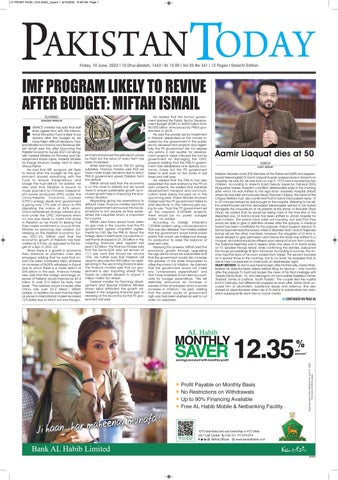
Aamir Liaquat dies at 50 KARACHI Staff RepoRt
Pakistan Tehreek-i-Insaf (PTI) Member of the Parliament (MP) and bespectacled televangelist Dr Aamir Liaquat Hussain passed away in Karachi on Thursday. He was 50. He was born on July 5, 1972 and is survived by two children. According to Karachi (East) Deputy Inspector General (DIG) Muquddas Haider, Hussain’s condition deteriorated early in the morning after which he was shifted to the Aga Khan University Hospital (AKUH) where he was later pronounced dead. Ramzan Chippa, the head of the Chippa Welfare Trust, also confirmed that Dr Aamir had passed away 15 to 20 minutes before he was brought to the hospital. Referring to his will, the philanthropist said the deceased televangelist wished to be buried alongside the mausoleum of his parents at the shrine of Abdullah Shah Ghazi. He added that he would be taking care of the final rites of the departed soul. Dr Aamir’s body has been shifted to Jinnah Hospital for post-mortem. The police have ruled out foul-play, but said that they would be able to give a definitive answer after the autopsy. A medical board has been constituted for this purpose. Police Surgeon Karachi Dr Samia Syed will head the board, while Dr Sikander Azam and Dr Rajendra Kumar will be the other members. However, the daughter of Dr Amir Liaquat refused to give permission and hence the body was shifted to a morgue. His funeral would be offered upon arrival of his son from London. The National Assembly was in session when the news of Dr Aamir broke on TV. Speaker Pervaiz Ashraf, while confirming the demise, adjourned the house proceedings till 5pm tomorrow. According to sources, the anchor had the door of his room locked from inside. The servant knocked on it several times in the morning, but to no avail. He revealed that Dr Aamir had complained of chest pain on Wednesday night. HeArt broken: Dr Aamir was heart-broken after his third wife, Dania Shah, leaked his objectionable videos before filing for divorce – only months after the popular TV host had broken the news of his third marriage with “Syeda Dania Shah, 18, who belongs to an honourable Najeebut Tarfain ‘Sadaat’ family of Lodhran, South Punjab”. The couple tied the nuptial knot in February, but differences popped up soon after. Dania Shah accused him of alcoholism, substance abuse and violence. She also shared an objectionable video clip of Dr Aamir to substantiate her claim which subsequently went viral on social media.
CONTINUED ON PAGE 05
02-03 NEWS 10 JUNE_Layout 1 6/10/2022 12:46 AM Page 1
02
Friday, 10 June, 2022 | KARACHI
NEWS
Pak-CHIna CRoSS-boRDeR LoGISTICS bRInGS eMPLoYMenT, TeCHnoLoGIeS To PakISTan
P
nEws dEsk
AK-CHINA cross-border logistics brings employment and technologies to Pakistan, says a report published by China Economic Net (CEN) on Thursday. In recent years, with increasing mobile phone users and young population, online shopping is emerging in this country. “To support logistics demand from local online consumption and cross-border trade, we rolled out nationwide logistics services in Pakistan last November, and our business has increased 15-fold”, Mr. Sun Chao, head of Speedaf Express Pakistan told CEN.
Up to now, except the remote and sparsely-populated Quetta city, the company has established delivery stations in 75% of the areas in Pakistan, covering over 80% of the population. Rapidly expanding business has brought multiple employment opportunities. Currently, the company is hiring hundreds of Pakistani staff, about 60% of them being deliverymen. This is just the beginning. At the end of last month, the company launched weekly China-Pakistan cargo charter flights between Macau International Airport (MFM) and Jinnah International Airport Karachi (KHI) for the transport of 3C electronic goods, e-commerce goods, and other goods that require prompt
transportation. “We are developing more flight routes between Pakistan and China which will be launched this year before air cargo peak season. In the future, we will also provide shipping service between these two countries”, informed Mr. Sun. With the thriving industry comes modern logistics technologies. On the employees’ side, they are exposed to efficient logistics tools such as PDA scanners, electronic waybills, conveyor belts, etc. On the customers’ side, they can track where their parcels are and complete the payment online. The report added, the pressure on cross-
border transport has been persisting since the outbreak of the pandemic. “We have set up high-standard warehouses with a total area of over 7000 square meters in Islamabad, Karachi, Lahore, and Multan. By providing full-chain, door-to-door logistics services, we hope to ease the shortage of international transport capacity”, Mr. Sun added According to the report, as usual, Syed Taha, 22, an express courier, arrived at a warehouse on the outskirts of Lahore, Pakistan at 10 am to check the parcels that needed to be delivered today. About three months ago, intrigued by the express delivery lockers around his residence, which is a “last mile delivery”
facility that stores packages near customers’ addresses before they take their parcels out with passcode, he joined his current company, Speedaf Express Pakistan, a Pakistan-China cross-border logistics provider. Before that, he was a motorcycle driver with an unstable income that seldom surpassed $ 300 a month and could hardly support his family. “Now my salary is similar to that of white-collars in Pakistan”, he said. Syed Taha is one of those who are riding the tide of the booming logistics industry in Pakistan.
NA passes ‘The Export-Import Bank of Pakistan Bill, 2022’ aPP The National Assembly on Thursday passed the [The Export-Import Bank of Pakistan Bill, 2022] with the majority vote aimed at establishing a facility for the promotion of international trade. The bill, moved by Minister of State for Finance and Revenue, Dr Aisha
LHC sets aside FIR registration orders against Rana Sanaullah lahORE
Ghaus Pasha, was passed by the lower house after clause by clause reading. According to the statement of objects and reasons, the government had taken several initiatives for the promotion and development of international trade as well as export oriented industries and import substitution in the national economic
interest. In continuation of its efforts and reforms, and in line with best international practices, the government of Pakistan intends to establish the Export-Import Bank of Pakistan as the national export credit agency for the promotion, expansion and diversification of international trade.
It would help provide credit, guarantee and insurance products as well as ancillary services to exporters and importers, in the form of a statutory corporation that had the backing and support of the Government of Pakistan as is customary for export credit agencies to achieve their desired potential and objectives.
PM for tapping vast potential of Pak-Iran trade, economic cooperation
Staff RepoRt
The Lahore High Court (LHC) Thursday suspended a sessions court order for registration of a case against Interior Minister Rana Sanaullah and police high-ups. Justice Sardar Muhammad Sarfraz Dogar passed the orders on a petition, filed by Constable Muhammad Aslam challenging orders of an Additional District and Sessions Court. The court also issued notices to the parties and sought reply till the next date of hearing. The petitioner’s counsel argued before the court that the sessions court passed the orders without caring for the case facts. He pleaded with the court to set aside the orders for being illegal. The court, after hearing initial arguments, suspended the sessions court orders and also issued notices to the parties. On June 1, a sessions court had ordered registration of a case against Interior Minister Rana Sanaullah, DIG Operations Lahore and CCPO Lahore over alleged torture of some lawyers on the day of Pakistan Tehreek-e-Insaf’s long march on May 25. The court had directed Station House Officer concerned to register a criminal case against the accused under Section 154 of Cr.P.C and then proceed as per law in the matter.
10pc raise in salaries of judges approved islamabad tLtp
President Dr Arif Alvi on Thursday approved 10 per cent raise in the salaries and judicial allowance of the judges of the Supreme Court and high courts. The president gave the approval on the advice of Prime Minister Shehbaz Sharif under Article 205 of the Constitution.
PTI senators boycott parliament’s joint session islamabad NewS DeSk
Pakistan Tehreek-e-Insaf (PTI) leader Faisal Javed on Thursday said that PTI senators boycotted joint session of the parliament. The PTI leader took to Twitter and said that the electoral reforms bill to be presented and passed in the joint session of parliament will deprive overseas Pakistanis of their right to vote. While the NAB reforms bill aims at giving a NRO-2 to the ‘imported government’, he added. He said that the abolishment of the electronic voting machine (EVM) would affect transparency of the upcoming elections and raise questions about its result. The government has already passed the bills from the National Assembly and the Senate, but the President has sent the bills back for review raising legal and moral concerns. The head of the state has advised the Parliamentary committees to review both the bills. The bills were passed in a haste by the National Assembly on May 26 and by the Senate on May 27, 2022, the president remarked.
aPP Prime Minister Muhammad Shehbaz Sharif Thursday called for tapping the vast potential existing in the areas of trade and economic cooperation between Pakistan and Iran by overcoming barriers and exploring new avenues of collaboration. The prime minister, in a meeting with Ambassador of Iran Seyed Ali Mohammad Hossenei, who called on him here, emphasized the early finalization of Polan-Gwadar project that would provide additional 100 MW of electricity from Iran to Pakistan.
He thanked Iran for its timely assistance in controlling forest fire in Balochistan, highlighting that it was a testament to the strong fraternal bond that exists between our two countries and peoples. The prime minister conveyed his warm greetings to the Iranian leadership and highlighted the importance of close fraternal ties between the two countries, based on shared geography, common heritage and people-to-people linkages. He also emphasized that in view of the historic relations, the 75th anniversary of the establishment of diplomatic relations this year, should be celebrated by both countries in a most befitting manner. In the regional context, Prime Minister Shehbaz Sharif conveyed gratitude for Iran’s consistent support on the issue of Kashmir, especially by the Iran’s Supreme Leader. He expressed the hope that with the continued support of the international community, the people of Kashmir would achieve their right to selfdetermination, in accordance with the UN Security Council resolutions, and their own wishes. Highlighting the precarious humanitarian and economic situation in Afghanistan, the prime minister underlined that the people of Afghanistan should be provided access to the frozen assets. He appreciated the close coordination between the two countries on the situation in Afghanistan. Ambassador of Iran, Seyed Ali Mohammad Hossenei reiterated felicitations from the Iranian leadership to the prime minister on assumption of office and reaffirmed commitment to enhance bilateral cooperation in all areas of mutual interest. He also highlighted close consultations between the two countries on important regional and international issues, including Afghanistan. While emphasizing the importance of highlevel exchanges, the prime minister renewed his invitation to the Iranian leadership to visit Pakistan, at an early date.
5.97pc GDP growth rate in FY22 unsustainable: Miftah Ghulam abbas Unveiling the important budgetary document of ‘Pakistan Economic Survey 2021-22′ on Thursday, Minister for Finance and Revenue Miftah Ismail termed the GDP growth rate of 5.97 percent during the outgoing fiscal year unsustainable as the country needed to stabilize the economy before moving towards sustainable growth. He said the country witnessed a higher economic growth during the year, which resulted in the Current Account Deficit (CAD) to soar to a level where the government had no option but to slow down the economy to control the CAD. Addressing a press conference after launching the economic survey, the minister said the growth rate was according to the new base year. “Had it been based on the old base year, the GDP (gross domestic product) growth rate would have been lower.” Flanked by Minister for Planning Ahsan Iqbal, Minister for Power Khurrum Dastgir, and Minister of State for Finance Ayesha Ghous Pasha, Miftah said during the current fiscal year, the imports increased by 48% to $75 billion whereas the exports rose by 28 percent. The government could manage to pay only 40% of the import bill out of the exports’ earning, while the rest was footed from other sources, including loans, he added.
WAPDA awards contracts worth Rs98.5bn to supply 260 MGD of water to Karachi ahmad ahmadani The Water and Power Development Authority (WAPDA) on Thursday awarded three contracts worth Rs.98.5 billion for construction of Phase-I of Greater Karachi Water Supply Scheme – also known as K-IV to supply 260 million gallon per day (MGD) of water to Karachi. As per details, the ceremony to sign the contract documents was held here on Thursday at WAPDA Mega Hydel Projects Complex. Water resources Federal Minister Syed Khursheed Ahmed Shah was the chief guest of the ceremony. WAPDA Chairman Naveed
Asghar Chaudhry, WAPDA Member (Water) Javed Latif, WAPDA Member (Power) Jamil Akhtar and representatives of the consultants and the construction firms concerned also attended the ceremony. During the course of this signing ceremony, WAPDA General Manager (South) Projects / Project Director K-IV Amir Moghal and representatives of the contractors signed the contract documents on behalf of WAPDA and the construction firms respectively. Addressing the ceremony Water Resources Federal Minister Syed Khursheed Ahmed Shah said K-IV is a vital project for Karachi, as it will help
address the issue of water supply to the cosmopolitan and economic hub of Pakistan. Expressing satisfaction over WAPDA for streamlining the Project, the Federal Minister said that today is a big day for K-IV and we hope that the Project will be completed in accordance with the timelines. Earlier, WAPDA GM (South) Projects / PD briefed the Minister that Phase-I of K-IV Project to be constructed to be in district Thatta, Malir and Karachi West, with approved PC-I of Rs.126.5 billion, envisages to supply 260 MGD of water to Karachi. The Project will be constructed through eight packages; of which two have already been awarded,
three being awarded today while remaining three will also be awarded in the next ten days. Two contractors have been mobilized to the site and construction of the Project will commence in the first week of July. The phase-I of K-IV is scheduled to be completed in October 2023, the Minister was further briefed. It is worth mentioning that the three contracts signed today include Contract Package K-IV – PL-I worth Rs.52.71 billion for pressurized water transmission MS pipelines and allied works from RD 0 to RD 64+200, contract package K-IV PL-II worth Rs.28.846 billion for pressurized water transmission MS pipelines and allied works from RD 64+200 to RD 111+700 and contract package K-IV – PS worth Rs.17.40 billion for engineering procurement and construction (EPC). Turnkey contract of pumping station (civil, electrical and mechanical works).
02-03 NEWS 10 JUNE_Layout 1 6/10/2022 12:46 AM Page 2
Friday, 10 June, 2022 | KARACHI
Total public debt recorded at Rs44.366tr Ghulam abbas
W
ITH the ever increasing debt burden on the country, the total public debt was recorded at Rs44,366 billion (Rs44.366 trillion) at end-March 2022, Economic Survey of 2021-22 revealed. As per the survey, the domestic debt was recorded at Rs 28,076 billion, while external public debt was recorded at Rs16,290 billion or $ 88.8 billion at endMarch 2022. The public debt portfolio witnessed various positive developments during the first nine months of the ongoing fiscal year (July-March FY2022). Within domestic debt, the government relied entirely on long-term domestic
debt securities for the financing of its fiscal deficit and repayment of debt maturities. In fact, the Government retired/repaid a portion of Treasury Bills amounting to Rs1.5 trillion which led to a reduction of short-term maturities inline with the government’s commitment to reduce its Gross Financing Needs. As per the documents the government repaid Rs569 billion against SBP debt. Cumulative debt retirement against SBP debt stood at Rs2.3 trillion from July 2019 to March 2022. The Government successfully issued Shariah Compliant Sukuk instruments amounting to around Rs1.1 trillion, in line with the target specified in the Medium Term Debt Management Strategy of Pakistan (2019/20 – 2022/23), to increase the share of
Shariah-compliant securities within domestic debt stock; Debt from multilateral and bilateral sources cumulatively constituted around 79 percent of the external public debt portfolio at end-March 2022. A set of reforms initiated by the Government to improve the economy has brought strong support from multilateral development partners. This is expected to strengthen confidence and catalyze additional support from development partners in the coming years which will also help in reducing the pressure on domestic sources. Within external debt, inflows from multilateral and bilateral development partners remained major sources of funding. In addition, as per the survey Pakistan raised $1 billion in July 2021
NEWS through multi-tranche tap issuance of 5, 10 and 30-year Eurobonds. These bonds were issued at a premium. In January 2022, the government raised $1 billion through the issuance of International Sukuk under the ‘Trust Certificate Issuance Program’. This was the first time that the government issued an International Sukuk with 7 Year maturity and at a market-clearing price i.e., zero issuance premium. Furthermore the government repaid $ 1 billion against maturing International Sukuks in October 2021. Besides, it utilized the IMF allocated SDR equivalent to Rs475 billion to support its budgetary operations. Interestingly the total interest servicing/payment during the nine month period was recorded at Rs2,118 billion against its annual budget estimate of Rs3,060 billion. Out of this total, domestic interest payments were Rs1,897 billion and constituted around 90 percent of total interest servicing during the first nine months of the current fiscal, which is mainly attributable to a higher volume of domestic debt in the total public debt portfolio.
LSM posted 10.4pc growth in 9 month of FY 21-22 islamabad GhuLam abbaS
The Large Scale Manufacturing (LSM) witnessed a whopping 10.4 percent growth during July-March of the outgoing fiscal year 2021-22, against 4.24 percent growth in the corresponding period last year. The Economic Survey 2021-22 released here on Thursday, highlighted that although Pakistan had survived the Covid-19 crisis, it faced the daunting tasks in the current fiscal year such as controlling stimulus induced fiscal deficit, curtailing widening current account deficit, managing pressure on exchange rate along with achieving a sustainable post-pandemic recovery. In Pakistan, manufacturing with a share of 12.4 percent in GDP has a dominant presence within the industrial sector. Pakistan’s national accounts capture the manufacturing sector in three different components, Large Scale Manufacturing (LSM), Small Scale Manufacturing (SSM) and Slaughtering. The expansion of LSM also appeared to be broad based, with 17 out of 22 sectors of LSM witnessing a positive growth, including furniture, wood products, automobile, footballs, tobacco, iron & steel products, machinery and equipment, and chemical products.
Coke and Petroleum products marginally grew by 2.0 percent in July-March of the fiscal against 12.3 percent in the same period last year. The high global energy prices depressed the overall growth momentum, however, pickup in economic activities especially automobile and increase in transportation activities the oil sales too showed an increase of 14.9 percent during July-March 2021-22. The textile sector has the highest weight among all LSM, growing by 3.2 percent during July-March 202122 compared to 8.0 percent in the same period last year. Major growth originated from woolen segment production with the highest surge of 38.9 percent in blankets, 27.9 percent growth in woolen & carpet yarn, and 19.1 percent in woolen & worsted cloth. Production of yarn and cloth showed marginal growth of 0.7 and 0.3 percent, respectively. Congruent production units, invariant capacity and elevated cotton prices owing to demand and supply gap disruptions have moderated the growth momentum of the cotton sector. However, surge in imports of textile machinery, rising demand for concessionary financing from textile firms and high exports of this sector showing a sizable improvement in the textile sector. The export of garments escalated with 33.9 percent
growth in terms of quantity during July-March 202122. Food group having second highest weight in LSM witnessed growth of 11.7 percent, the historic bumper sugarcane crop and better international prices pushed up the production level of sugar in Pakistan. Production of cooking oil increased by 10.8 percent, while vegetable ghee was down by 2.5 percent, but high palm oil and soybean prices at international markets along with depreciating Rupee led to lower level of production. Automobile sector marked a vigorous growth of 54.1 percent during July-March 2021-22 against 21.6 percent growth last year. New Auto Policy, to promote new technologies including Electric Vehicles (EVs) and Hybrid, and accommodative monetary policy to promote auto financing paved the way to grew automobiles production. The iron & steel production jumped by 16.5 percent during the period under review against the contraction of 8.6 percent in the same period last year. The economic survey said that supply-side disruptions originating from Ukraine-Russia conflict further escalated this disruption. The commodity prices were increasing globally and all these may result in severe challenges in LSM performance as industrial production is mainly dependent on import of capital goods.
In confidential meeting, SBP warns banks at behest of Ministry of Finance kaRaChi aRiba ShahiD
A meeting was called on Tuesday at the State Bank of Pakistan (SBP), where the top 8-10 banks were warned by the central bank on the request of the Ministry of Finance. According to a source present in the meeting, bank treasuries were called to the SBP after the finance ministry expressed displeasure with the borrowing rates and the current exchange rate. The meeting discussed bank participation in the Treasury Bills (t-bills) and Pakistan Investment Bonds (PIBs) auctions, and participation in money markets, after which the SBP told the banks to start bidding lower in the auctions and talked about the threat of the government imposing a super tax on fixed income earnings in the case banks did not bring down yields. Banks were also cautioned on their Foreign Exchange (FX) activities. As per sources present, the SBP told banks to bring the exchange rate down in the interbank even if it means to incur losses. The Central Bank told treasurers that it was an issue of national importance and that incurring losses were part of having the privilege of running banking businesses. The source explains that the SBP is asking banks to sell dollars to customers without being allowed to buy them back from the inter-bank market. This exposes banks to changes in the FX rate, which could also mean potential loss of money for banks. Moreover, the bank treasurers present in the meeting were warned that if the banks did not comply, bank Presidents would be called in for a one-on-one meeting for a “dressing down” by the SBP. Profit reached out to the SBP for a comment but could not get one till the filing of this story. Can the SBP do this, and what does it have to gain?
The SBP acting on the behest of the government does draw questions onto the autonomy of the central bank that is to act without government or political pressure. Intervening in the market because the Ministry of Finance is not pleased by the money and securities market is not under the SBPs mandate, especially when it is encouraging the banks it regulates to incur losses. It is important to note that banks are private companies owned and answerable to shareholders who do not expect the bank to purposely engage in loss making activities. However, as per sources in the treasury departments at banks, they have agreed that banks incur FX losses from time to time when the SBP asks them to. Therefore, the SBP asking them to do so again, may bear results. Another source adds, “The business is run over the year so you get opportunities to make back the money. In the short term, going short (trading and not getting the chance to buyback in the interbank market) USD is negative trade but it can be recouped over the year.” It is also important to note that the SBP and government are blaming the banks for the depreciating rupee, despite the strict controls on FX. “The SBP is basically rationing dollars. Banks send a list of payments to the central bank. They then pick out approximately 10% payments to take place. The rest get carried forward. They’re in control and rationing. How can they claim the market is responsible?” explains the source. However, in the case of t-bill and PIB auctions, there is some ambiguity whether the SBP will be able to bring down yields. As the SBP cannot directly lend to the government, the government relies on borrowing from banks in auctions. The SBP, however, can indirectly lend to the government through OMOs (Open Market Operations).
Back in December 2021 when banks were asking for higher yields while lending to the government, in anticipation of a monetary policy rate hike; the SBP injected liquidity through a 63 day OMO injection to calm down markets and to signal that the policy rate would remain unchanged for the next 63 days at the very least. “This [asking banks to bring down yields] is not how the markets work. Unless the SBP and Ministry of Finance can back it with action, the markets will not respond, like it didn’t respond earlier,” explained a source. It is pertinent to point out that the market has already informed the central bank about restrictions in participating in t bill auctions. Banks claim to no longer have any more room on their balance sheet for t bills funded by OMO borrowing. “With OMOs at around Rs 4 trillion, that’s as much borrowingfunded market risk that banks can take.” In case of the imposition of a super tax, banks are likely to bid after adjusting for the tax. “Banks look at the tax effective yields. If taxes go up, banks will account for it,” explains a source. However, another source explains that it is not quite as simple and that not listening to the SBP and the government is a tough call for banks. “They can find all sorts of ways to hit banks with fines. This is a form of bullying,” says a source. Another source claims that the banks are likely to be compliant, especially banks that are hopeful for a digital banking license. “They hold leverage over us, banks are desperate for the license, the government and the SBP are desperate for control.” The previous government threatened banks to bring down yields. The SBP however, had to step in by conducting OMOs to calm the markets. This did not bring out desirable results. A comment was sought from the SBP Spokesperson but a response was not \received until the filing of this report.
03
8 arsonists held: Rescuer martyred, 8 injured in Shangla firefighting swaT SyeD ShahabuDDiN
A rescuer was martyred and several other persons including three rescuers, sustained severe burns while fighting a wildfire ravaging in Chakesar Tehsil of Shangla District in Swat region on Thursday. Confirming the incident, Shangla Deputy Commissioner Ziaur Rehman told Pakistan Today that 24-year-old rescuer Nizamullah embraced martyrdom during the operation going on to put out a wildfire in Manga hill of Chakesar area. “During the fire-fighting operation, three rescuers as well as five locals also sustained severe burns,” he added. The body of Shaheed rescuer and the injured persons were evacuated from the hill and shifted to Chakesar Tehsil Headquarters Hospital. According to hospital sources, condition of the injured persons is stable, adding they, however, are undergoing treatment for the burns. It is to be recalled that a woman, wife of Muhammad Tahir along with her three children burnt alive a couple of days ago when a wildfire engulfed their house in Chakesar area. On the other hand, hectic efforts have been going on to control the fire, which has been ravaging in the area. The officials of the district administration, police personnel, local volunteers along with officials of Forest and Wildlife Department have been busy making efforts to control the fire. EIGHT ARRESTED FOR ARSON: Meanwhile, the Swat District administration has arrested eight persons for allegedly for setting fire to 20,000 saplings planted during the plantation campaign in Kabal Tehsil. District Forest Officer( DFO) Waseem Khan said that an inquiry carried out by the Forest Department proved that the accused named: Toti Rehman, Gohar and Sardar Ali, sons of Shamshad, Khaista, Bacha and Ziarat Khan, sons of Bostan, Ali Sher and Bakht Sher, sons of Buner Gul were involved in arson in Tehsil Kabal. The fire started in Khem Dara area, which later spread to Asugay and Dokat Sarsenai. As a result, 20,000 plants were burnt, he informed. The Forest Department sent a letter to the police to register an FIR against the accused persons. Police have arrested the accused but no FIR has been registered yet, said the police officials. FIRE BREAKS OUT IN MORE AREAS: On the other hand, wildfire erupted in five more places in Swat including Kalakot, Elum, Bandai, Dherai Baba and Mela Gah hills. Rescue, police, levies and forest department personnel, with the help of locals, extinguished the fire. More than 30 fire incidents have taken place in the last five days in Swat and crackdowns have been launched against the culprits after receiving reports of arson in most places and 13 suspects have been arrested.
04 NEWS 10 KARACHI_Layout 1 6/9/2022 11:25 PM Page 1
Friday, 10 June, 2022 | KARACHI
04 NEWS
Bail of Rights activist extended in aRmy defamation case ISLAMABAD
t
staff RepoRt
HE Islamabad High Court (IHC) on Thursday extended until June 20 the interim bail of a women’s rights activist in a move that protects her from arrest after the army accused her of slandering its chief. Late last month, the legal cell of General Headquarters (GHQ) made an official complaint with the police
against Imaan Mazari, daughter of former minister Shireen Mazari, accusing her of using derogatory and hateful remarks against Gen. Qamar Javed Bajwa. According to her lawyer Zainab Janjua, she is accused of inciting against the armed forces and defaming Bajwa. Under the legal system, a person can seek a court order, or preemptive bail, protecting them from arrest by police. Mazari’s family was worried after she publicly lashed out at Gen.
staff locks Pakistan secretariat as increment talks fail
Bajwa, accusing him of being behind her mother’s arrest last Saturday. Imaan did not offer support for her allegations against Bajwa. The video of her outburst went viral on social media. During the proceedings on Thursday, Chief Justice Athar Minallah inquired from the lawyer representing the military: “What has been left behind after the last hearing of the case and the answer she (Imaan) submitted in the court?” The judge said that the lawyer
could see himself whether it could be categorised as an offence. An additional attorney general, representing the government, said the reason that has been offered by Mazari was not in accordance with the record. The judge observed that Mazari’s outburst on the day of her mother’s arrest was on the basis of a misunderstanding. The court has directed the GHQ to present arguments after reading the answer Mazari gave in the court.
Hindu temple vandalised in Karachi KARACHI MonitoRing RepoRt
ISLAMABAD staff RepoRt
Lower-grade members of the federal civil service Thursday closed the entry and exit points of the Pakistan Secretariat in protest over the refusal of the government to accept their demand for increased salaries. The move came after a series of talks between a representative body and the government failed, prompting the former to take some rigorous measures to press the administration to agree to their demands. Earlier, the civil servants staged a sit-in on the premises of the Finance Division, and they negotiated with the senior officials of the division for five long hours, but the negotiations ended up in a failure. It was learnt that heavy contingents of police were deployed to thwart any untoward situation in Islamabad amid continuous sloganeering by the federal government employees that had gathered in large numbers. Work at federal ministries and other departments and divisions in the Pakistan Secretariat was stopped due to protests by the government employees. The officers and other employees at the federal government departments could not reach their offices due to the closure of the entry gates of the Pakistan Secretariat. It is to be noted here the federal government employees have been protesting for three days for a raise in their salaries and allowances due to high inflation and for the acceptance of other demands.
covid-19 daily report: 89 new cases ISLAMABAD staff RepoRt
Pakistan reported 89 new Covid-19 cases on Wednesday, the ministry of health said on Thursday. The tally of infected people increased to 1,530,967 after adding the new cases, according to the data released by the ministry. A total of 30,379 people died from Covid-19 in Pakistan, with no more death on Wednesday, the ministry’s statistics showed. On Wednesday, 15,178 tests for Covid-19 were conducted in Pakistan while the positivity rate stood at 0.59 percent. Currently, there are 44 active cases that are in critical condition in the country.
A Hindu temple was attacked by unidentified people in the Korangi neighbourhood of Karachi late Wednesday. The incident took place at the Korangi Number 5 area of the port city.
The Shri Mari Mata Mandir, which also houses the residence of the Hindu priest, was attacked late at night, triggering fear among members of the Hindu community. A violent mob attacked the house of the priest and vandalised the idols. No arrests have been made by the police so far.
The idols were brought by the priest a few days ago to be installed in the under-construction temple. “We don’t know who has attacked [the temple] and why,” reports quoted a local Hindu resident as saying. According to a complaint registered at the Korangi police station, six to eight people on motorcycles
attacked the complex. “Five to six unknown suspects entered the temple and escaped after vandalising it,” said Korangi station house officer (SHO) Farooq Sanjrani. Police said that they are collecting the evidence adding that they cordoned off the area and provided protection to the community.
Across China: Belt and Road in the eyes of a Pakistan professor NANJING Xinhua
Before coming to China, Shabir Mohsin Hashmi knew little about the country. Now, the 47-year-old man not only has a family here but has also become an ambassador for the China-proposed Belt and Road Initiative (BRI). In 2006, Hashmi got a chance to study abroad. There were five countries to choose from. “I knew China and Pakistan are in a good relationship, so I put China as my first choice.” Eventually, he came to the Shanghai University of Finance and Economics to pursue a doctorate. Hashmi still remembers vividly the day he arrived in Shanghai. “I was wearing a T-shirt because it was hot in Pakistan. But it was windy in Shanghai and quite chilly.” Settling into a new place is not always pleasant but Hashmi has found his own fun. With the help of his Chinese teachers, Hashmi improved his understanding of the global economy and progressed in his academic study. Later, he earned his doctoral degree and applied to continue his postdoctoral research in China. In 2013, Hashmi joined Jinan University in south China’s Guangdong Province. It was in the same year that China put forward the Belt and Road Initiative. Since then, the BRI has gradually be-
Raging inflation squeezes the poor in Pakistan KARACHI ReuteRs
come an important direction of Hashmi’s academic research. In 2018, Hashmi started to work at the School of Economics and Management, Yancheng Institute of Technology as a professor. He now also serves as director of the BRI research center under the institute. Hashmi considered the BRI as a project of global significance. Noting that the BRI not only benefits China but also extends to the entire world, he believes the BRI is instrumental in helping improve infrastructure, particularly for the developing countries. “It can also help alleviate poverty and create millions of jobs in those areas.” Under the China-Pakistan
Economic Corridor (CPEC), a flagship project of the BRI, China is assisting Pakistan with a number of projects including energy, transportation, communication, and other infrastructure construction. “The CPEC is a manifestation of the good relationship between China and Pakistan,” Hashmi said. As an academic, Hashmi has always been concerned about students and teachers in China and Pakistan. In 2019, during a visit to his family in Pakistan, he invited some Chinese students to dinner, and helped them solve problems they were facing. “China is my second home and I love China, its people, and its culture,” Hashmi said.
Every penny counts for Anser Mai, a widow and mother of three, as Pakistan strains under the high inflation that’s hitting the globe. She earns about $134 a month working as a domestic helper. But everyday costs are piling up. The price of eggs and dairy have put even essentials out of reach. Same for the cost of getting around the fare for an everyday ride on a bicycle rickshaw- has jumped from around $2 to $3. It may not sound like much but being the sole provider for three kids and family back home means people like Anser are feeling the pinch: “Sometimes my children eat flatbread with just salt and pepper or pickle. They yearn for good food.” “I was able to buy this half-kilo of oil for 75 cents a week ago. Now its price is $1.20. What will the poor do? I was able to buy this kilo of sugar for 40 cents a month ago, now it is up to 60.” The State Bank of Pakistan (SBP) said earlier it expected inflation to remain high after the government removed fuel and power subsidies to secure bailout money from the IMF. Economists fear low-income and lower-middle-class earners will slide into poverty as a result of current inflation. Anser, who is illiterate herself, dreamed of a house of her own, good food and her children going to school, but now she said she is losing hope. “I don’t know. God knows better. We don’t know what will happen to us. How will we survive?”
Work on CPEC projects ‘being revived with full speed’, Senate told ISLAMABAD staff RepoRt
Minister for Board of Investment and Special Initiatives Chaudhry Salik Hussain on Thursday informed Senate the government has revived work on the multi-billion-dollar China-Pakistan Economic Corridor (CPEC) with full speed. Responding to queries during questions hour in the Senate, Hussain said a long term plan is being considered into an implementation matrix on CPEC, adding that joint working groups are being convened to pave the way for the 11th Joint Cooperation Committee (JCC) meeting in this regard. He claimed that Chinese investment decreased by 10 percent in the last two years of the last government. In a written response, the minister said the decrease in Chinese investments was due to various reasons, including the outbreak of Covid-19. He said the pandemic caused a sharp decline in global economic activity. “As a majority of Chinese investments fall under the
CPEC ambit, the economic disruptions and social restrictions caused by Covid-19 also impacted the pace of CPEC, thus impacting the overall Net FDI [Foreign Direct Investment],” he added. The minister said the decrease in the inflows in the last two years is partly due to the conclusion of CPEC Phase-1 which has overall impacted the outlay of Chinese investments in Pakistan. The minister claimed that during the previous government’s tenure, CPEC was not assigned priority in either allocation of resources or implementation. Hussain said the establishment of the CPEC Authority created confusion and duplication in the functions of ministries and departments. He said that most of the early harvest projects under the first phase of CPEC relating to power and infrastructure have been completed and CPEC has entered the second phase (2020-2025) which focuses on industrial cooperation which is a long-term endeavour and dependent on industrialisation
through industrial relocation from China, particularly in the Special Economic Zone (SEZs).
Sites for nine SEZs were identified but not a single project was readied. In fact, work on five SEZs was never started.
He said the decrease in Chinese investments is also due to a decrease in the FDI inflows in the manufacturing sector, with electrical machinery (36.41 percent) and ceramics (63.83 percent) being the top two sectors with a major decline. He said that despite all the aforementioned facts, the country-wise FDI data confirms that China has the largest share of foreign investment in Pakistan. Replying to another question, the minister said that as per a State Bank of Pakistan (SBP) report, Net FDI has been recorded at $1,056.6 million during the first half (JulyDecember) of the current financial year. He said the same is 20.1 percent higher than the corresponding period of FY 202021 i.e. $879.7 million. “However, last tenyear trend shows that since the FY 2017-18 onwards Net FDI has decreased to date,” he said. FDI from July to April 2021-22 has decreased, being $1,455.6 million as compared to the same period of the last FY 2020-21, being $1,480 million.
05-NEWS 10 June 2022 (Karachi)_Layout 1 6/10/2022 12:49 AM Page 1
Friday, 10 June, 2022 | KARACHI
NEWS
05
AlmoST 88PC Per unIT SubSIdy beInG GIven To GAS ConSumerS oF Two loweST SlAbS: nA
m
newS DeSk
INISTER of State for Petroleum Dr Musadik Malik on Thursday informed the National Assembly that the government is giving around 68-88 percent per unit subsidy to domestic gas consumers of two lowest slabs, which constitutes 91 percent and 80 per cent of total households connected with the networks of SNGPL and SSGC respectively. “If the consumers of third slab are included, the overall percentage stood at 99,” he said responding to a Calling Attention Notice moved by MNAs Aliya Kamran, Syed Mehmood Shah, Muhammad Anwar, Muhammad Jamalud-Din and Dr Shazia Sobia Aslam Soomro regarding ban on new domestic gas connection and Compressed Natural Gas (CNG) stations. Dr Musadik said the government would lift the ban once the local gas deposits and the commodity supply and transmission network improves in due course of time and with discovery of significant hydrocarbon reservoirs. He said the ban was imposed by the
previous government due to inadequate reservoirs of indigenous gas that were depleting at the rate of 10 percent annually. “If the depletion continues at the same ratio, by the year 2030, the LNG share in the total energy-mix of the country would be around 76 per cent and natural gas 24 percent” said the minister adding that during the peak winter season, almost 97 per cent of imported LNG was supplied to the domestic consumers to meet their needs, selling the commodity below the purchase price that had been putting an extraordinary burden on the national exchequer. He said it was unjustified that the government was importing the LNG that cost almost four times more than the natural gas being supplied to different consumers with massive subsidies. The minister said around Rs 162 billion subsidy was being given to the domestic gas consumers, Rs 81 billion to the zero-rated industry and Rs 18 billion to the fertilizer sector annually on account of LNG supply. Due to massive subsidies, he said the gas sector’s circular debt had reached Rs 1.4 trillion figure because of the wrong policies of the PTI govern-
ment, which was at zero when the PMLN government completed its five-year democratic term in 2018. Commenting on the demand-supply gap, the minister said at present the country was producing around 3,460 Million Cubic Feet per Day (MMCFD) gas against the demand of 6,653 MMCFD gas, adding if looked at the ‘system gas’ that could be injected in the supply lines it stood at 1600-1700 MMCFD. While, around 1,200 MMCFD Re-gasified Liquefied Natural Gas (LNG) was being injected in the system through two LNG terminals, established during the previous tenure of the Pakistani Muslim League-Nawaz government, he added. Dr Musadik said around 800 MMCFD gas was provided to consumers at the network of Sui Northern Gas Pipelines Limited (SNGPL) and 825 MMCFD at the system of Sui Southern Gas Company (SSGC), adding it reached 950 MMCFD and 1,350 MMCFD in winter at the transmission system of the two companies respectively. “First, we will attain stability and strengthen the national kitty, and then
the relief will be given to poor segments of the society. The subsidy to the downtrodden people will be given at every cost,” he said. In coming days, he said the government would share a complete road-map to achieve the much needed self-reliance in the energy sector, giving a special focus on increasing the oil and gas exploration activities in potential areas of the country and encouraging the private sector in the LNG business. Answering a question, the minister assured the House that the government would reconsider the Iran-Pakistan gas pipeline project and look into the possibilities, keeping in view the international sanctions imposed on the commodity exporting country. To another question, he said the government would make a formal announcement in the next few days about the discovery of hydrocarbon deposits in tribal areas of the country. The minister also reiterated in a categorical term that there were no ‘minutes, MOU or any contract at government-togovernment level’ signed by the previous PTI government with Russia for import of oil at 30 per cent reduced rate.
Traders warn of launching protest against ‘anti-business’ policies AzIz BunerI Local traders have warned the government to launch a protest movement against unwarranted actions and antibusiness policies of the public sector institutions, particularly multiple tax collection authorities, police, customs departments and cantonment board Peshawar. The announcement was made during traders meeting of Peshawar Saddar and Cantt areas, held under chairmanship of president Sarhad chamber of Commerce and Industry Hasnain Khurshid Ahmad here on Thursday. Besides, the meeting was attended by SCCI’s senior vice president Imran Khan Mohmand, vice president Javed Akhtar, former president Sherbaz Bilour, executive member Zahoor Khan, and Sohail Javed, Mujeebur Rehman, Shams Rahim, Saddar Gul, Rashid Iqbal Sidique, Nisar Ahmad, Arshad Mehmood, Nauman Rauf, Salman Wadood, Tahir Khan, Amir Afzal, along
with presidents, office bearers of traders and bazaars, market associations, a large number of traders of Saddar Bazaar and cant area. Traders severely criticised the police, custom departments, tax-collection authorities and Cantonment Board Peshawar for their allegedly illegal and ‘unwarranted actions’, harassment on pretext of collecting various taxes, unnecessary lodging cases and arrest and anti-business policies. Members of the business community complained about collection heavily taxes, like professional tax, income tax, different levies/duties on imported items, others and demanded to rationalization and reduction in ratio of taxes. They termed the unnecessary actions as reflection of anti-business policies of the present government, which should be altered immediately. Trade and commercial activities have reduced by 80 percent after different waves of novel coronavirus pandemic and terrorism in Khyber
IHC prevents FIA from going after social media activist ISLAMABAD Staff RepoRt
The Islamabad High Court (IHC) on Thursday restrained the Federal Investigation Agency (FIA) from harassing a pro-Pakistan Tehreek-i-Insaf (PTI) social media activist. Mariam Malik appeared before the court of Chief Justice Athar Minallah along with her counsel, Imaan Mazari-Hazir. The bench ordered the agency to record the petitioner’s statement while preventing it from going after her and members of her family. “Are you aware of a thing called Constitution?,” Justice Minallah questioned. “No one seems to care about the Constitution anymore,” he bench observed. “We have initiated an inquiry on the complaint of the state,” an FIA representative told the court. “Now only this job remains for the state,” the justice exclaimed. “She may be uninformed and doesn’t know the Constitution,” the judge responded. “People say all sorts of things about me on the internet […] even I have been given a flat,” the chief justice said. “They utter falsehood on social media about me, so am I influenced by it,” Justice Minallah said. “The institutions recognized with their work and character, tweets have nothing to do with it,” the judge remarked. “We have only served notice and didn’t take any further action,” an FIA official said.
Pakhtunkhwa, while government policies are compelling to push businesses toward complete closure, the traders said. The business community expressed grave concern over the new policy of the present government, regarding reduction in business and working timings. The community said it is the prime duty of the government to ensure protection of life and property of the common man. Traders demanded the lifting of a ban on import of mobile accessories. The speakers sought a holistic roadmap to resolve the traders’ problems on a permanent basis. Hasnain Khurshid expressed grave concern over unfriendly and business holistic attitude/behavior of state-run institutions, especially mentioned by traders, and assured the participants of the meeting that the chamber will take up their issues with relevant authorities in an efficient manner. On the occasion, he mentioned that
SCCI in collaboration with Smeda has launched an Investment Facilitation Centre/Web portal, which has been directly linked with federal and provincial ombudsmen that would directly contact 700 government institutions. Therefore, he urged the traders to register complaints about relevant public departments on SCCI’s web-portal so their complaints/issue will be resolved immediately. Regarding problems in issuance of business visas to China, Hasnain Khurshid informed that a meeting will be arranged soon with the Chinese Ambassador and senior officials, so the issue would be resolved by taking up with them. The SCCI chief stressed that all government institutions/departments are needed to work under its domain so it would avoid a gulf between the business community and government. The chamber, bazaar associations’ office bearers also spoke on the occasion.
IHC adjourns Maryam, Safdar’s appeals till June 16 ISLAMABAD app
The Islamabad High Court (IHC) Thursday adjourned hearing till June 16, on the appeals of Pakistan Muslim League Nawaz (PML-N)’s Vice President Maryam Nawaz and her husband Capt. (reted) Muhammad Safdar against their convictions in Avenfield Property reference. A twojudge bench comprising Justice Aamer Farooq and Justice Mohsin Akhter Kayani heard the appeals. Maryam Nawaz, Capt. (reted) Muhammad Safdar appeared before the court along with their legal teams. Maryam’s lawyer Irfan Qadir Advocate submitted written arguments to the court and said he was filing it to save the court time. Justice Aamer Farooq remarked that the court was trying to conclude the appeals as soon as possible. Maryam’s counsel Amjad Pervaiz argued that he had submitted the chart of facts related to the case. He said the defence was denied to provide the volume-X of the joint investigation team’s report. The volume-X was related to MLAs, he added, adding that the defence should be told that what information was sought in MLAs. Justice Kayani asked that lawyer why he was arguing on the matter which was not on the record. The lawyer said he was telling the court regarding the all events of the trial. Amjad Pervaiz
said MLA copy related to British Virgins Islands (BVI) was not shared with the defence and they did not know why it was not sent through the foreign office like other MLAs. He said letters sent to Dubai and Qatri authorities were provided but the sentence was announced on the basis of the proofs of BVI. The lawyer further said that JIT head Wajid Zia had admitted that the answer of MLA related to the ownership of the London property was never received. Amjad Pervaiz said the reference had not clarified the roles of the accused, adding that there was nothing against former prime minister Nawaz Sharif and Maryam Nawaz on the record. Even the top court had not declared Maryam Nawaz as dependent of her father, he said. The lawyer said the NAB had
CMYk
not conducted any investigation in this matter or it had done one sided work. If there was no fair investigation in a matter then how a fair trial was possible in that regard, he asked. Justice Farooq remarked that if there was proof against the main accused then still it had to be viewed that whether the co-accused had assisted him or not. The lawyer said amendments in NAB ordinance would not be applied from the past dates. Amjad Pervaiz said that no evidence was recorded during the trial related to the value of the property. The NAB had also not provided any proofs regarding sources of purchasing the avenfield property. The court asked the lawyer to continue his arguments on next hearing and adjourned the case till June 16.
NdeTech and Nutshell Communications Ltd enter a strategic partnership. The agreement was signed at NdcTech Head Office by Ammara Masood, CEO & President NdcTech, and Rabia Ahmad, Director & COO, Nutshell Communications. Muhammad Azfar Ahsan, Founder & CEO, Nutshell Group and senior officials also present.
Kuda Technologies, Fatima Group, The City School Group join hands to drive financial inclusion in Pakistan Pr: Kuda Technologies, a UK-headquartered financial services company focused on emerging markets, has partnered with Fatima Group and The City School Group to apply for a digital banking licence in Pakistan with the goal of driving financial inclusion in the country. The consortium members recently signed an agreement in the presence of Mr. Ryan Laubscher, Group Chief Expansion Officer, Kuda Technologies; Mr. Ali Mukhtar, Director, Fatima Group; Mr. Aurangzeb Firoz, Director, The City School Group; and Mr. Tooran Asif, Chief Executive Officer (Subject to Regulatory Approval). Founded in 2019 with over $90 million of funding from renowned institutional investors, including Valar Ventures and Target Global, Kuda Technologies has acquired more than 3 million customers in Nigeria alone on the strength of its proprietary core banking platform, a data-driven approach to the provision of instant credit, seamless, touchfree customer on boarding, and an overriding mission to provide affordable and inclusive financial services. Having processed transactions worth $10 billion over the past 6 months in its retail customer segment in Africa, Kuda Technologies is now aiming to provide the same access of affordable and user-friendly financial services to micro, small and medium sized businesses in the seven new markets by the end of 2022.
Aamir liaquat dies at 50 ContInueD froM pAge 01 “Everyone has buried my reputation in the muck over a girl whose interviews should not have taken in the first place. She filed for divorce and I was complying with it,” the TV host said in his last video message. “All these new YouTubers and so called journalists who have come forward [to give coverage to Dania] have done great injustice to Pakistan. I even cannot face my children. I have no choice but to leave the country,” he said. The former MNA’s driver told the police that they had heard a “scream from his [Aamir’s] room a day earlier”. Servant Javaid added that Dr Aamir cried the whole night and kept on saying that he was going to die. “He [Dr Aamir] kept repeating that she has betrayed me,” Javaid said. “I don’t know if she has cast a spell of black magic on me or what. I feel I’m going to die here,” he quoted Dr Aamir as telling him. Asked who he was referring to, Javaid said, “His wife.” Javaid recalled that Dr Aamir told him in the night that he would be leaving for Islamabad in the morning. Before joining the PTI, Dr Aamir was affiliated with the Karachi-based MQM-P. He had served as state minister during the government of military dictator Gen Pervez Musharraf. He got elected to the National Assembly twice – first in 2002 and then in 2018. Dr Aamir was a popular host of Ramazan transmissions – game shows which run pre and post Iftaar during the fasting month. Starting his media career in 2001 after joining a private news channel, he hosted “Aalim Online”, which contributed greatly to his early popularity. He also remained associated with Express Media Group. He continued hosting Ramazan shows throughout his career. Prime Minister Shehbaz Sharif, Sindh Chief Minister Murad Ali Shah, former president Asif Ali Zardari, PPP Chairperson and Foreign Minister Bilawal Bhutto-Zardari, and former Sindh governor Imran Ismail expressed sorrow over the demise of Dr Aamir and prayed for his soul. President Arif Alvi expressed grief over the passing of the lawmaker and “prayed for his soul”. Former prime minister Imran Khan also expressed his sorrow over the demise of the PTI MNA. ‘TrULY A LEGEND’ As a televangelist, Hussain, who once described himself as “truly a legend” on his website, was popular with the nation’s increasingly conservative urban housewives and his shows have topped the ratings in terms of advertising revenue. Hussain had been a key leader of the Muttahida Qaumi Movement (MQM) until 2016 when he parted ways with the party in August of that year, saying at the time he would quit politics.
06-07 Comments - 10th June 2022_Layout 1 6/10/2022 12:32 AM Page 1
Friday, 10 June, 2022
06 COMMENT
Adding fuel to the fire
After failure of Long March
Making hay near petrol fumes is dangerous
Imran Khan short of options
W
Hen it comes to the way the PTI works, there is little that differentiates it from dynastic politics. as in the case of Shehbaz Sharif, the election Commission had to goad Imran Khan to hold intra-party polls. again, as is the practice in dynastic parties, elections of PTI’s office bearers were more of a farce than a genuine polling. There was no voting for the slot of the party chief as in a well- orchestrated move those leading the other two contesting panels withdrew in favour of Imran Khan. The holding of intra-party elections indicates the PTI is now ready for general elections. Having no grass root party structures, the PTI lost in the first phase of KP’s local government elections. The party improved its position in the second round when mr Khan addressed several large gatherings raising the spectre of a foreign conspiracy against the country and calling upon the audience to conduct a jihad against the thieves and traitors by voting for his candidates. mr Khan wants to use the same tactics to win the general elections despite having developed doubts about their success. He has promised to give a date for the ‘biggest protest in Pakistan’s history’ within the next few days. With the PmL(n)-led coalition ruling the country and the establishment being still neutral, mr Khan knows he has a tough journey ahead. He lost face when the last march that was to bring over two million protesters to Islamabad simply fizzled out. What is more, the violence committed by PTI activists despite an undertaking to remain peaceful created a bad impression among the judiciary. mr Khan is still not sure if he would get a clean chit from the Supreme Court to hold the biggest march in history. mr Khan is worried about two things. He fears that attempts are being made to get the PmL(n)-led alliance elected, without telling who is making the attempts. Second, he is afraid of the independence shown by the election Commission. Wouldn’t it be better for mr Khan to hold talks with the opposition to work out a date for elections?
At Penpoint M A NIAZI
T
He shocking thing about the two-step Rs 60 hike in the per litre petrol price is that it still left the government paying a subsidy of Rs 9 per litre. That means that the petrol subsidy introduced by ousted Pm Imran Khan at its peak was costing the exchequer over Rs 69 per litre. Finance minister miftah Ismail also said meaningfully that the government was not raising any revenue from petrol. This was a clear signal that the Budget would clear the petrol situation, as the rest of the subsidy was eliminated, and taxes were reimposed. Petrol will go up. at the same time, the main driver of international oil prices, which has caused the current crisis, the Russo-Ukrainian conflict, is showing no signs of a resolution, which means that there is no decline in oil prices around the corner, at least not so that there can be any planning based on it. The PTI has got two issues in the fire. The first is whether it would have stuck with the subsidy had it remained in office. The consequences of sticking with the subsidy are extremely serious, and its has not been removed merely because of ImF orneriness. The ImF may have pushed the government, but the subsidy had to go sooner or later. The reason for this is that it was not simply a matter of taking taxes, which is the government skim-off, up or down, but actually paying the Oil marketing Companies the difference between the cost and the price at the pump. This was hard cash, which was unfunded, in the sense that the government didn’t know where the money was going to come from. Sooner or later, the government wouldn’t have the money, in which case, it would have a choice between welshing on its debts to the OmCs, or printing more money and paying them. There are already signs that it has tried welshing, which is why power generation plants are shutting down for want of fuel. This is separate from the circular-debt problem bedevilling the sector. and while the State Bank may well be printing more money, it has not yet done so because of the subsidy. The fall of the rupee does indicate, however, that there are more rupees in the market than before. In this era of fiat currencies, one of the first signs of there being a printing of money by the cen-
Moody’s downgrades the banks All roads now lead to the IMF
They are proving useful to the weaker side
ShAZA ArIf
U
nmanned aerial Vehicles (UaVs) have become an integral part of warfare. They have exhibited evolving roles in tactical and strategic domains in warfare and are allegedly significant for reducing asymmetries in military power. Being a weaker military, Ukraine has also resorted to this technology to reap maximum benefits vis-à-vis its conflict with Russia. drones, of varying sizes and different functions, have been employed extensively. However, the use of commercial drones stands out as an interesting case since the employment has been extensive and unprecedented. It has been reported that approximately 6000 drones are being used by Ukraine for Intelligence, Surveillance and Reconnaissance (ISR)– a large chunk of which comprise commercial drones. Being sources of important data, these drones function as valuable assets in the ongoing conflict. The information provided by commercial drones can strengthen the Ukrainian military in several ways. First, these drones allow the Ukrainian army to monitor their
Dedicated to the legacy of late Hameed Nizami
Arif Nizami (Late) Founding Editor
Yousaf Nizami M. A. Niazi
Umar Aziz
Joint Editor
Joint Editor
Executive Editor
Lahore – Ph: 042-36300938, 042-36375965
The writer is a member of staff
Ukraine and the use of commercial drones on the battlefield
m
OOdY’S downgrade of Pakistan’s five biggest commercial banks mirrored the downgrade of the country itself, but it still cannot be shrugged off. The downgrade, from stable to negative, does not yet take Pakistani paper into the category of junk bonds, but that is the direction in which matters are feeding. One major reason for this id the trouble that Pakistan has been having with the International monetary Fund (ImF). not being on the Fund programme means that benchmarks have been missed, which is why the downgrade has occurred. The downgrade itself would mean that Pakistan would find it that much pricier to approach the international financial markets. not only has Pakistan floated its bonds on the markets, but it has tapped the Islamic banking market by issuing sukuk bonds. It has financed this paper by issuing fresh banks whenever they fall due. after the downgrade, it will find it more expensive to do so, with a higher interest rate having to be paid than if the ImF programme was restarted. Being on the FaTF grey list will not be helpful either. maintaining the present ratings, which are of course nothing to write home about, will require the country to win the ImF ‘Seal of Good Housekeeping’ so that other financial institutions can be assured that Pakistan is no more a credit risk. The present government has already taken some of the more difficult measures demanded by the ImF, and in the Budget being unveiled today, is expected to take more. While such steps put a huge burden on the consumer, they do reflect the economists’ consensus about what is needed. It has been noted that the ImF doubles as a a kind of rating agency, and such ratings as moody’s has revised, merely reflect the ImF’s views. However, that also means that the ImF must be given due weightage in such activities as budget-making. The government will have to get back on the ImF eSaF before it can hope for the kind of upgrades it needs for the cheap money it needs.
Editor Aziz-ud-Din Ahmad
tral bank is its fall in value compared to other currencies. However, if the subsidy had continued, the government would have run out of money. The State Bank has already been granted, under ImF pressure, autonomy, and even under a PTI government ready to cock a snook at the ImF, the State Bank’s refusal to print more notes could have caused tremors. another painful reality is that oil is imported. Therefore, a decline in the rupee, even if oil prices remain the same, means that prices will go up in rupee terms, adding to the burden on the budget, leading it to print yet more rupees, and push down its value further. In a best-case scenario, the government would be unable to pay salaries. In a worst-case scenario, there would be hyperinflation. not only does hyperinflation have harsh economic consequences, but it is also grossly destabilizing socially and politically. If the government ran out of money, and stopped paying salaries, the subsidy would stop being paid as well, so government employees would find themselves hit by a double whammy. not only would they find they suddenly have to pay the full price of petrol, but their salaries would be worth almost nothing. Petrol would not be the only problem. Food would be too. The PTI is trying to guild the lily by saying that Imran would ave got cut-rate petrol from Russia. Somehow or the other, there has been a translation of the Pakistani courtship of the USSR into the belief that he was going to get the same for Pakistan as India has got. While Pak-Russia relations are stop-start, with long periods when Pakistan opposed it, Indo-Russia relations were warm during the Cold War. Just because India has access to discounted Russian oil, does not mean Pakistan would get the same access. There is no record available with the government of any discussion on discounted oil between Imran and Russian President Vladimir Putin. The meeting of the Pakistani ambassador in moscow with Russian officials has been as fruitless as the letter from the Pakistan government to its Russian counterpart. It seems that the Russian desperation to earn foreign exchange has not grown so great that it will sell discounted petrol. also, Pakistani demand is not so high (as is India’s) as to make the running for the market. The fuel subsidy removal is in the hope that this will enable the government to keep borrowing from the ImF. Though the ImF loan is substantial, its im-
portance is so that it will open further routes for borrowing, including from traditional sources of funding. Whereas Pakistan used to ask them to help it against the ImF, now they have combined with the ImF to put pressure on Pakistan. The petrol price hike has an underpinning that cannot be easily avoided: Pakistan wants to remain part of the international economic system. The price of keeping the petrol price low would be to exit that system. not only does the present government clearly have no such intention, but the PTI has made no proposals or expressions of intention which would imply that it wants to do anything different. Its record in government does not show that it has any radical ideas it would like to implement. Indeed, there have been none of the debates on this issue that would indicate that it was ruminating any change. .It seems that even if the PTI is brought back, or if the military takes power a fifth time, the price of petrol will go up. Is there any way out of this? The sort of posturing that is going on will not help. The only solutions possible are if there are genuine outof-the-box solutions. Those are not available with mainstream electoral parties, mainly because they subscribe to the kind of economic system which prevails. It is indicative that the all-India muslim League had a Fabiansocialist economic programme similar to that of the Congtress in its 1946 manifesto The League was not as concerned with economic issues as Congtress, which led by Pandit Jawaharlal nehru, who was a convinced Fabian, and an admirer of the post-1945 welfare state the Labour Party called into being. The PPP still includes ‘socialism hamari mueeshat’ (‘Socialism is our economics’) in its slogans, but it has not really practised it since the 1970s. The PTI has never had anything socialistic in its manifestoes except perhaps the riasat-i-Madina trope Imran as used at times. It seems as if all he meant was the establishment of a UK-style welfare state, not the economic revolution that was brought about. That meant he was unable to access the sayings of the Holy Prophet (PBUH) about land reforms (We must remember that madina was that rarity among the arabs, an agricultural society) or the commonalty of fire, pasture and water. at a certain level, it is possible to see that a society based on these three being public property would lead to a very different society (and economy) from the present one, and not have been merely a version of capitalism merely with Islamic labels, as the PTI tried to have. How far such a society would fit into the present system is a separate discussion, but it is safe to predict that it would be much more disruptive than anything Imran might have tried in the past, or would try in the future.
I
Karachi – Ph: 021-35381208-9
I
adversary more closely. They have the capability to collect and relay critical data regarding troop movements and positioning. This facilitates the Ukrainian forces to assess the threat, re-target weapons and take necessary actions to stop enemy advances. Furthermore, Ukraine also has armed commercial drones. These have been utilised to carry molotov cocktails, incendiary weapons consisting of glass bottlse filled with flammable material, against advancing Russian troops. This is an interesting dynamic because even though low-flying commercial drones cannot compete with advanced Russian aircraft, the same aircraft cannot stop the former from conducting an armed attack on ground, adding to the complexity of the battlefield. In addition to their on-ground use, commercial drones are also documenting the ongoing conflict. Faine Greenwood, a civilian drone researcher, has tracked and logged approximately 350 incidents in which commercial drones have been used in Ukraine with their video images being shared on various social media platforms. The drone photography and videography can be uploaded using Starlink satellite systems. Such footage has also created awareness about the day-to-day progress of the conflict. Shots capturing the plight of the besieged citizens, battle scenes and the scale of destruction after combat, are providing insights to the rest of the world and can lead to increased economic, military, and diplomatic support for the Ukrainians. In addition, the footage is also playing a role in boosting the morale of the nation. The events demonstrating Ukrainian victories and resistance of a smaller country against a larger military captured through UaVs rejuvenates the fighting spirit of the nation and its armed forces. The importance of commercial UaVs in the ongoing conflict can be analyzed from the fact that Ukraine’s military called on citizens to volunteer as drone pilots in the war. even if they were not trained as pilots, they were encouraged to donate their personal drones. The official Facebook post read: ‘do you have a drone? Put it to use for the experienced pilots! do you know how to operate a
Islamabad – Ph: 051-2204545
I
Web: www.pakistantoday.com.pk
I
drone? Join the joint patrolling with units 112 separate brigades of the city of Kyiv! Kyiv is our home, defending it is a common task. #StopRussia You and your drone need Kyiv in this fierce moment!’ The call triggered civilians to participate in the larger reconnaissance activity. To be fair, using commercial drones in military conflicts comes with challenges as well. One of the prime issues is the integration of commercial drones in the airspace management particularly in dense conflict zones. Secondly, it has been observed that the drone operator remains in danger. Ukraine has been using a large number of Chinese drones by dJI aeroScope. It claims that Russia also maintains the Chinese technology to detect them during take-off or landing, revealing the position of its operators and making them vulnerable to attack. This has forced drone operators to resort to newer strategies, such as using US-origin drones, landing their drones at a distant place, and waiting some while to retrieve them after they land. Given that civilians and journalists also operate drones in the area, it can put their lives at risk as well. Similarly, the ease of accessibility of this technology also makes it a threat vis-à-vis non-state actors who can acquire and use it for their notorious activities. However, these risks might not outweigh the potential benefits when it comes to an active asymmetrical battle. The use of commercial drones in the ongoing conflict is indicative of the innovative roles of UaVs in warfare. although there will be potential challenges in the integration of this technology in the larger scheme of the battlefield, it is evident that commercial drones will have unique roles in future conflict and their utility is likely to increase. They offer significant military capability at a lower economic cost. On the one hand, they extend a military’s range of action, while on the other hand, they are assets to create and shape respective narratives. It is imperative for countries around the world to familiarise themselves with the use of this technology, failing to do so can lead to discrediting its potential. The writer is a Researcher at the Centre for Aerospace & Security Studies (CASS), Islamabad, Pakistan. She can be reached at cass.thinkers@gmail.com
Email: editorial@pakistantoday.com.pk
06-07 Comments - 10th June 2022_Layout 1 6/10/2022 12:32 AM Page 2
Friday, 10 June, 2022
COMMENT 07 Editor’s mail Send your letters to: Letters to Editor, Pakistan Today, 4-Shaarey Fatima Jinnah, Lahore, Pakistan. E-mail: letters@pakistantoday.com.pk Letters should be addressed to Pakistan Today exclusively
Load-Shedding I would like to draw the attention of the authorities concerned towards a serious matter. Since the beggining of summer, our electricity is dawn three to four times a day. Temperatures have begun to soar and unscheduled load-shedding has increased, making our lives miserable. Students cannot study or rest before or after school and college. Those who work are under a lot of pressure to get a UPS or generator which is an added expense and quadruples stress. The government had promised to bring an end to load-shedding and I believed that there was a light at the end of the tunnel. The continuous rise and fall of electricity have made the life of the average Pakistani problematic. LeSCO is making us live without electricity but charging us as if we are living like kings. This is just too much. The authorities concerned should look into how much electricity we generate, use and are being billed for. ZUNARA HAROON LAHORE
Significance of Eco-preneurship
The PTI brand– a case study The PTI relies heavily on Imran Khan’s image
Dr IMrAN KhALID
T
He last three months have seen one of the most sweeping changes in the political arena of Pakistan. Indubitably, the most phenomenal change, however, is the unprecedented transformation of the acutely dwindling popularity of Imran Khan and his party into a populist movement. In the first week of april, owing to high inflation, drastic devaluation of rupee and soaring unemployment, Imran Khan’s popularity was at its lowest ebb. Particularly, the disgruntlement in the lower middle class of the society had reached boiling point. This was perhaps one of the key factors, apart from the “goahead” from the powerful quarters, that encouraged his opponents to join hands to throw the PTI out when the public sentiments were significantly against Imran Khan and his debauched governance. The Pdm leadership was quite confident that Imran Khan, once out of the corridors of the Prime minister House, would not be able to generate any kind of effective agitation against the new government. Prime minister Shehbaz Sharif, famous for being a hard taskmaster with a proven track record of initiating and completing “projects” within the tight deadlines, was overconfident that his traditional style of brinkmanship in the first few weeks would overshadow and muffle the possible reaction from PTI. majority of the political pundits and analysts were also expecting Imran Khan to have a lukewarm response from his supporters after his much-dramatic ouster from power. However, to the utter surprise of all the stakeholders, including Imran Khan himself, the PTI has suddenly emerged as a significantly popular political force in Pakistan within the span of just two months. From a pure academic and marketing perspective, the swift brand transformation of the PTI offers a lot of interesting learning points for the students of marketing as well as political analysts. There have been very few examples in the marketing text books where any brand has shown such a gargantuan enhancement of its “positioning” and “value proposition” in such a short time. The PTI brand– or to be more exact, the brand Imran Khan– has shown a real “turnaround” (in marketing vocabulary). The whole saga started with Imran Khan’s speech to a massive gathering in Islamabad on march 27 when he was desperately trying to mobilize public support to pre-empt the impending no-confidence motion of the then Opposition. Honestly
speaking, by march 27, Imran Khan had practically lost his majority in Parliament as most of his allies had publicly deserted him to join Pdm to dislodge him as the Prime minister. at that time, it was all clear to everyone that the PTI would not be able to muster enough mnas to quash the no-confidence motion. The PTI government, with a huge baggage of four years of incompetence, numerous stories of corruption scandals, nepotism, skyrocketed inflation and bad governance, was desperate to find a facesaving formula in the aftermath of the no-confidence motion. The PTI brand was at the weakest phase of its life cycle in the last week of march. Imran Khan’s slate was empty as far as his four-year stint was concerned. There was nothing that he could claim as a tangible and effective “achievement” to motivate his supporters. In desperation, the PTI’s communication and marketing team came up with the idea of playing the “patriotism card” to charge up the public against the socalled american conspiracy. On march 27, while addressing the gathering in the Parade Ground Islamabad, when Imran Khan waved an alleged letter in the air by claiming that it was a proof of the “american intervention” behind his ouster, it turned out to be the tipping point for the brand PTI and changed the whole complexion of the domestic politics. In a highly professional way, the PTI communication team utilized a routine internal diplomatic wire as a marketing tool to galvanize the public sympathies for Imran Khan. It is certainly one of the most powerful examples in marketing how to strengthen the brand and enhance its “positioning” on an ostensibly petite point/feature and blowing it out of proportion through an effective communication strategy. Three factors, appar87ently, have contributed to this effective marketing campaign of PTI. The first factor is the personal branding of Imran Khan himself. among his supporters, Imran Khan has been positioned as an honest, sincere, brave, macho celebrity. This positioning of Imran Khan is the main differential advantage when compared with his political opponents, whose pasts have been tainted with innumerable allegations of corruption scandals. There is no doubt that a vast majority of the urban middle and lower middle class (particularly the people around their 50s who have grown up seeing Imran Khan as a national hero winning the cricket World Cup) have been positively impressed by the personal charisma of Imran Khan. at the same time, despite being nearly 70, Imran Khan has cultivated his image as a “young leader” and his followers are popularly labelled as “Youthias”. This is very powerful positioning that has helped Imran Khan to build cult-like devotees among his supporters who always blindly defend his frequent U-turns and contradictions. despite apparent flaws and incongruities associated with the diplomatic communication regarding the so-called american intervention, Imran Khan’s personal credibility as an “honest and brave” leader has won him the exceptional support for his protest campaign – Imported Government na-manzoor. The second factor is the consistency of physical presence and engagement with his target audience. ever since Imran Khan’s departure from office, he has been continuously busy in protest jalsas, press conferences, interviews, video messages and web speeches. He has toured the entire
country and conducted 22 major public gatherings so far to mobilize his supporters. He is showing his face daily to the public through a very effective engagement campaign This daily engagement with the public has helped him to consistently connect with his target audience and build a momentum for his anti-american narrative - “Imported Government na-manzoor”. despite his unabating contradictory statements and U-turns in his daily sermons, the majority of his supporters are vehemently defending his blatant contradictions and illogicalities. The cult-like behaviour of his supporters is not a new phenomenon in our political history. Zulfiqar ali Bhutto and altaf Hussain had a similar kind of influence among their supporters, but the speed with which this cult-like behaviour has become contagious among his supporters in the middle and upper middle class is reflecting the success of his campaign managers. as they say in the textbooks of marketing, consistency is the key in hammering the brand into the minds of the target audience. The same tactic is being aggressively employed by the PTI team. The daily appearance of Imran Khan on different platforms has immensely helped him to keep the PTI brand (the brand Imran Khan) reinforced on a daily basis. The third contributing factor behind PTI’s brand building is the highly organized and effective social media team. There is no doubt that, despite not being a tightly knit political party like the Jamaat Islami, the PTI has established a very efficient and resourceful team to influence the public opinion through social media. no other political party in Pakistan has utilized the social media as effectively as the PTI. Courtesy some of the big media houses, the PTI social media team has been turned into a formidable propaganda apparatus. nowadays every brand needs a continuous reminder to the target audience through psychosomatic stimulations in the form of audiovisual content in the electronic media as well as social media. This is exactly what the PTI social media team has done consistently to the brand Imran Khan, which is actually synonymous with the PTI brand. The PTI social media team has not spared anything to keep alive the PTI and Imran Khan in the minds of the target audience through all kinds of manipulation. Right or wrong data, fake or original accounts, the PTI social media has resorted to all sorts of tactical measures to build the brand image of Imran Khan– and the PTI– as a hero who possess all the superlative qualities. none of the other political parties have been able to use the modern marketing practices to build the party and its leader’s brand the way the PTI has done. This is the fact that, with the help of the PTI social media campaign, Imran Khan’s positioning as an “honest and brave leader” has become extremely well-entrenched among his supporters. Very interestingly, under the new slogan of “Imported Government na-manzoor”, the PTI social media team has very shrewdly diverted the attention from the extremely poor performance of its past four years in the power. academically speaking, the PTI has implemented the brand building concepts very meticulously– a rare feat for a political party. Other political parties must learn from PTI regarding the brand building techniques– or image building in layman language. Last three months of the PTI brand building campaign offers an excellent case study for the students of marketing. The writer is a freelance columnist
THe concept of eco-preneurship emerged from the growing trend of sustainability because it is a possible solution for the transition toward a more sustainable society. ecopreneurs execute businesses based on sustainable ideas and methods and aim to tackle environmental and social needs. Globally eco-preneurship has gained significant momentum and has encouraged businesses to pay closer attention to their social and environmental impact. The transition toward a more sustainable system requires interactions between technology, economics, policymaking, and sociology. This interrelation between businesses and the environment concerning the role of entrepreneurs concludes that sustainability has developed as a key policy in executing business. Green entrepreneurs have speeded up innovation and demonstrated the ability to adapt and respond promptly to changes, which has also increased employment opportunities. Some examples of green entrepreneurship include energy auditing for impact assessment, green consulting for reducing environmental pollution associated with industrial activity, the use of environmentally friendly and ecological products (e.g., food, beauty products), renewable energy installations, etc. In Pakistan, eco-preneurship has received little attention in research and practice. However, it has the potential to provide opportunities for economic growth and can assist in the transition toward sustainability. Relevant authorities should facilitate educational institutes to raise awareness and provide training on green entrepreneurship. The introduction of green technologies coupled with eco-preneurship will support the country in sustainable development and fighting the impact of climate change. INTIKHAB ULFAT KARACHI
Facilitating research eVen though research plays a crucial role in the development of any nation, in Pakistan, little support or services are available for research students. Research enables the researcher to identify new areas for development and suggest remedial measures for improvements that can help with innovation and progress in different fields. One example is fastevolving digital technology, which is a discipline that is increasingly prioritised in research and investigative work. many countries today are competing with one another in the global market because of their technological developments. However, Pakistan is still lagging even in the most basic fields and struggling with different issues. One reason for a lack of progress in research is that many students are unable to enrol themselves in master’s or doctorate programmes because of financial constraints. Those who have taken up part-time or full-time jobs along with their studies, struggle with focusing on their work. They are unable to utilise their full potential and give their undivided attention to their research projects. also, the absence of sufficient resources often limits the scope of research, which results in poor outcomes. The research methodologies used are outdated and supervisors fail to provide proper assistance because of which some students resort to plagiarism. To support research students, local organisations or multi-national companies should partner with universities to hire interns for research and provide financial reimbursements for research projects. Given organisations are profit-driven, this will allow them to innovate and enhance and expand operations in emerging fields. also, the higher education commission (HeC) has collaborated with several countries to support Pakistanis in pursuing a master’s or a doctorate; however, there is little awareness about these programmes. Therefore, they must be promoted and made accessible to all. NADIA SAEED KARACHI
Healthy eating habits We tend to forget that as we grow older, our bodies undergo steady deterioration. To cope with this, we must make drastic changes in our lifestyle. I believe that my dietary choices enable me to be relatively healthier than an average person of my age. I think it is pertinent to mention here that I recently crossed 65. an important decision I made was to cut down on unhealthy condiments. Both sugar and salt in excess can cause harmful lifelong diseases such as diabetes and high blood pressure. Thus, I have taken efforts to cut out sugar completely and greatly reduced my salt intake. While many alternatives for sugar are available in the market, it is a challenge to find a substitute for salt. after days of research, I stumbled upon a study, which stated that monosodium glutamate, commonly known as mSG, contains significantly less sodium than table salt. Imagine my surprise to learn that mSG is a great alternative to salt but is completely banned in Pakistan even though renowned health organisations like the US Food and drug administration (Fda) have classified mSG as a food ingredient that is generally safe in suitable amounts. I would urge our food authorities to revisit the ban and seriously consider re-introducing mSG back into the market as a safer and healthier alternative to salt. SYED OVAIS AKHTAR KARACHI
08 WORLD VIEW 10th June 22_Layout 1 6/9/2022 9:24 PM Page 1
Friday, 10 June, 2022
08 WORLD VIEW
the game is up, BoRis Johnson BRITAIN DESERVES BETTER THAN THIS FARCE
specTaTor ALEx MAssIE
t
hE worst possible outcome for the Conservative and Unionist party is also a pretty lousy result for the country. That this needs saying – that Tory MPs need reminding of this – is itself yet another data point supporting the proposition that Boris Johnson’s leadership has thoroughly corrupted the party. So what to do now? This is now the necessary question. Since Johnson will not depart voluntarily he must be pushed. Those cabinet ministers with an ounce – imperial measurements, obviously – of moral fibre must surely recognise the game is up. This barky won’t float. You cannot credibly lose the support of 40 per cent of the party – including a chunky portion of the payroll vote – and remain in office. For we are now in the enjoyably ludicrous situation of having a prime minister who does not command the confidence of the house of Commons but a government which does. Or, at any rate, could. This being so, cabinet ministers with a care for their own credibility – and, indeed, their own advancement under a different leader – might be wise to ask if they can continue to serve, honourably, in this government. That is a question for their own consciences. Because if it were not clear before this
morning it is certainly obvious now that Johnson traps and entangles and besmirches everything he touches. his influence spreads like poison ivy. And my, the shamelessness. hark at how the government – or at least the Prime Minister’s – line has evolved in recent months. First, there were no parties in Downing Street and the Prime Minister was not just surprised but furious to discover there might have been. Then there were parties but the Prime Minister was neither present nor involved. Then there were parties at which he was undeniably both. But these parties were special parties, being redefined as work events even though work events of this kind were prohibited at the time they took place. When that line could not hold, they reverted to their bog standard party status but with a twist: it was actually right and wholly proper for the Prime Minister to attend these shindigs. Damn straight it was and not only had he done nothing wrong, he would in fact do it all again. This is the calibre of the man ministers are defending this morning. Well, if the Prime Minister wishes to play his colleagues for fools that is his business and if they wish to go along with this rigmarole that is theirs. But the country deserves something a little better than this farce. If there were a coherent, or even semi-coherent, government agenda to serve as a distraction from all this, matters might not seem quite so sunk in hopelessness. But as we all know there is no such agenda. Levellingup could have been something but since, in effect, it has been decided there cannot be any relative levellingdown, levelling-up would be doomed to failure even if the government could agree on what it might actually be.
Russian asset seizuRes must follow the law Two avenues are being explored: confiscating the already frozen accounts, yachts and mansions of Putin-linked oligarchs, and sequestering state property — above all, the $300bn of frozen Russian central bank reserves held abroad
Meanwhile, families are enduring the largest hit to household incomes since the second world war and the tax burden has reached heights last seen when the bills for that war had to be paid. This is plenty for government to do right now but no government capable of doing it. Events have conspired against Johnson but his inability to rise to them is hardly a surprise. Nothing he had done in politics before reaching Downing Street offered grounds for thinking he would be a success once he entered it. If these were days of sunshine and frivolity and economic growth of 3.5 per cent a year it might not matter so much. But these are not those kinds of days. Johnson has always been an amoral creature but the defences mounted by his supporters now teeter on the brink of immorality. The suggestion that we must support Boris because otherwise the United Kingdom will no longer be capable of supporting Ukraine’s resistance against Russian aggression is, even by this government’s standards, a grotesque, shameful, new low. There is nothing to suggest another prime minister could not, or would not, offer the same assistance. The spectacle of the Prime Minister using dead Ukrainians to bolster his own domestic position is revolting. All those who parrot this line – in parliament or the media or even in the country at large – should be ashamed of themselves. This is a shame-free ministry, of course, so even modest standards of decency are beyond it. Deep down, even many of those who voted for Johnson last night must know he isn’t up to the job. Indeed, the claim he gets the ‘big calls right’ is an admission of incapacity since it acknowledges that the Prime Minister cannot be trusted to get countless smaller decisions right.
So here we are. The government will likely lose in Wakefield and we must hope it loses in Tiverton and then keeps losing wherever and whenever voters are given the opportunity to return a verdict upon it. Only then, perhaps, will Conservative MPs appreciate the deep folly of their previous choices. Only then can there be the prospect of some relief. This stricture extends to the government’s previous friends in the media too for, even on Fleet Street, there must be a limit to how long the unsupportable may be supported. A Labour government led by Sir Keir Starmer will doubtless disappoint in many ways but, at least initially, these disappointments may lie within the bailiwick of normal politics. Beyond it being time for a change anyway, a Labour government would offer the prospect of some kind of return to decency. That is not too much to ask for but if all Labour is asking for is the chance to serve it may prove enough. In the meantime, this government – hobbled from the top – will continue its attempt to style it out. The brazenness is as breathtaking as the pretence last night’s vote was merely a flesh wound of no great consequence. The parliamentary party does not have much confidence in the Prime Minister but it still lags far behind the country whose patience for and with this rotting ministry was exhausted some time ago. If nothing else will, perhaps that thought will finally concentrate the minds of Tory MPs and ministers. Almost nothing good can come from Downing Street now because the days when such promise could be reckoned possible came and went long ago. Despite what he may claim, Johnson is finished. The public know this and their sense of justice demands action. The precise moment of Johnson’s demise may not yet be fixed but the gathering sense of inevitability means last night’s vote was a shattering prime ministerial defeat in all but name. Tick tock. Tick tock. Time’s up.
samrat prithviraj: why did a Bollywood film on a popular hindu king fail? CRITICS SAY THE FILM IS THE LATEST IN A LONG LIST OF MOVIES BEING MADE UNDER THE BJP GOVERNMENT TO PAINT INDIA’S MUSLIM MINORITIES AS “OUTSIDERS” AND “CRUEL INVADERS’’
Financial Times EDITORIAL BOARD
There is logic and a certain poetic justice to the idea of using frozen Russian assets to fund the reconstruction of Ukraine. Russian forces have done tens of billions of dollars’ worth of damage in an unprovoked attack on their neighbouring country, and perpetrated atrocities against Ukrainians. The moral case for ensuring the “aggressor pays” is powerful. To retain the moral high ground, however, the democracies backing Ukraine must follow due process and the rule of law. There are several complications. Freezing assets — depriving owners of their use — differs legally and practically from confiscating and redistributing them. Under international law, convicted war criminals’ assets can be seized to compensate victims. No such verdicts yet exist against senior Russians, though Moscow has defied a provisional order from the International Court of Justice to suspend its military action. Despite all their support for Ukraine, moreover, western allies are not themselves at war with Russia. Two avenues are being explored: confiscating the already frozen accounts, yachts and mansions of Putin-linked oligarchs, and sequestering state property — above all, the $300bn of frozen Russian central bank reserves held abroad. Canada has become the first G7 country to move forward with legislation that would authorise it to redistribute frozen Russian assets to compensate war victims. As part of America’s latest $40bn aid package for Ukraine, President Joe Biden is asking Congress to grant authority to seize assets of sanctioned Russian tycoons. In the EU, a “freeze-and-seize” task force is examining a similar approach. But some EU states, notably Germany, have legal or constitutional limits on confiscating assets, especially without a criminal conviction of the owner. Brussels is working to make sanctions evasion — by moving assets to other jurisdictions, for example — a criminal offence, which could pave the way to confiscations. But a number of Russian tycoons have already launched potentially lengthy lawsuits against the sanctions imposed on them, challenging governments to demonstrate that they have genuine ties to the Kremlin. The moral case for confiscating public assets such as central bank reserves may be more clear-cut, and these represent a more lucrative target. The US has seized Iranian and Afghan assets in the past, but in part to fund damages to American victims of terrorist attacks. Though the president is empowered by a 1977 law to freeze foreign-owned assets, he can confiscate and redistribute them only if America “is engaged in hostilities or has been attacked” by the country in question. The Biden administration could ask Congress for legislative approval to commandeer Russian sovereign assets. This would need careful framing to withstand future judicial review, including of whether it is constitutional. The risk of legal setbacks and reversals, however, is not a reason for governments not to attempt to use Russia’s overseas “treasure” to compensate Ukraine. Checks and balances are an integral part of lawbased democracy. It is important to be seen to be observing legal norms, even when responding to exceptional events, to maintain trust among global investors, private and sovereign, in the western financial system. The US, its allies, and Ukraine itself are, after all, battling to defend the global rules-based system, as the foundation of peace and security, in the face of Moscow’s aggression. That should include holding the Putin Kremlin to account, legally and financially, for the human and economic toll of its war — but not at the cost of compromising the values the west claims to uphold.
BBc GEETA PAnDEy
t
hE story of Prithviraj Chauhan - a handsome king who stole a beautiful princess, who had professed her love for him, from right under her treacherous father’s nose and fought valiantly in sweeping battles involving elephants, horses and larger-than-life men - has resonated with Indians for hundreds of years. Often described as “the last great hindu emperor”, Chauhan ruled over present-day Rajasthan and Delhi in the 12th Century. And the timeless love story of the king and his beautiful queen Sanyogita and the battles he won - and finally lost - against Muhammad of Ghor figure prominently in history textbooks. Bollywood star Akshay Kumar, who plays the titular historical role in the film and is one of India’s most bankable actors with legions of fans at home and abroad, recently said that playing the warrior king was “a matter of pride” for him and that if his mother was alive, she too would have been very proud of him. But on Sunday, when I took my seat in a cinema hall in the Indian capital, Delhi, to watch Samrat (emperor) Prithviraj, the much-hyped celluloid version, my expectations were already tempered. Just two days since the film’s release, there were plenty of tickets available, and the auditorium was at least one-third empty. Reviewers had trashed the film, calling it “soulless”, “tedious” and “dreary”. Shubhra Gupta, film critic for the Indian Express newspaper, described it as “simplistic, shorn-of-nuance, a film that is loud and lurid”. By Monday morning, reports said, cinema halls were cancelling shows due to a lack of ticket sales and the film was deemed a spectacular failure. So how did that happen? Samrat Prithviraj was wrapped in controversy from the start. In the run-up to its release last Friday, it had created a huge buzz on social media with Kumar’s controversial comment that “history textbooks are filled with information on Mughal invaders, but have little on the glory and valour of hindu kings such as Prithviraj Chauhan”. Kumar has made news in recent years not just for his films but for his growing proximity with Prime Minister Narendra Modi and his Bharatiya Janata Party (BJP) government, even earning the moniker of “poster boy for hindu
nationalism”. Three years back, he had attracted much ridicule for a TV interview where he’d asked the prime minister whether he ate mangoes and whether he chopped them up or sucked on them while standing over a sink. No surprises then that the film got a big leg up from the government. Three BJP ruled states made it tax free - to bring ticket prices down and make it more appealing to audiences. And home Minister Amit Shah, after watching it with Kumar at a special screening, described it as an important part “in the journey of India’s cultural revival which will take the country back to its glory days”. But the film, historians say, is riddled with inaccuracies, based as it is on Prithivaj Raso - a poem by Chand Bardai who was said to be the king’s court poet. They say it was a fake account, written in the 16th Century, 350 years after Prithviraj’s death.
reduced to the hindu-Muslim binary. “Prithviraj was fighting a war concerned with protecting his territory, he was not fighting Muslim invaders. To get to Delhi, the Turks from the west had to come via Rajasthan, his territory, so resistance was unavoidable for him, it was an accident of history. So he cannot be recruited into a camp now to serve the interests of the current ruling party.” But with muscular nationalism at its peak now, “is it any surprise that a hindutva-inclined Bollywood filmmaker finds Prithviraj an attractive personality to bring to the cinema screen?” he asks. “They are co-opting figures from history and it’s a part of BJP’s ever-advancing campaign to colonise people’s cultural beliefs. The aim of this film is to capture people’s imagination, so they want to show hindus who were victorious over Muslims.”
THE MUGHAL EMPEROR STILL BEING DEBATED TODAY: And critics say the film is the latest in a long list of movies being made under the BJP government to paint India’s Muslim minorities as “outsiders” and “cruel invaders”. historian Arup Banerji says these accounts were not written to meet historical accuracy. “You can’t judge historical writings by the standards of our time. These writings were mostly panegyrics, written to glorify the leaders and rulers.” And films, he says, are being made for a particular audience and they have a certain purpose - “a politically-conscienctising role” - and the audience that goes to see Bollywood films such as Prithviraj or Jodha Akbar or Padmavat is not looking for historical accuracy. But, Prof Banerji says, complexities of history cannot be
THE SOUTH INDIAN FILMS WINNING ON BOLLYWOOD’S TURF: Shubhra Gupta says many films are made “to buttress the glories of the past”. “The idea is to make them so shiny and formidable that the audience shut their eyes to all that’s happening in the present. It’s happening in many parts of the world, not just in India, where figures from history are being co-opted by the governments for their benefit.” But the big question for Akshay Kumar, she says, is - “why has your general audience turned their back on you?” “And to my mind, it seems that it’s not just because of the kind of film it is, but also that the narrative hasn’t got anything that leaps off the screen at me. Except for a few moments, this two-and-ahalf-hour film is so dreary.”
09 Business 10 June 2022_Layout 1 6/9/2022 10:44 PM Page 1
Friday, 10 June, 2022 | KARACHI
NEWS CORPORATE CORNER
UN WomeN PakistaN aNd Nishat mills joiN forces to Promote geNder eqUality lahore
t
Mr. Guillaume Valence, CEO Advans Pakistan Microfinance, Arshad Korai, Branch Manager & Mr. Ghulam Farid Bhutta, Head of Branch Banking Network, at formal opening of new branch of Advans Pakistan Microfinance Bank.
EBM’s Executive Director, Shahzain Munir accepting the award at Employer of Choice: Gender Diversity Awards 2022
iiUi vows to thwart attempts to tarnish University’s image ISLAMABAD: International Islamic University (IIUI) spokesman Nasir Farid has said that an untoward and violent incident took place on the campus on 3rd of January this year and an investigation was immediately launched in the light of the instructions of the President of the University. The investigation was done through CCTV footage. In the light of the investigation of the incident the disciplinary recommended disciplinary action against the guilty students so that no such incident would take place in future. As per recommendations of the committee, guilty students were punished accordingly. However, after hearing their appeals, the president of the university exercised his powers and reduced the sentences of the students in view of their future and the plight of their parents. In response, the students once again sabotaged the law and order of the university in the last few days and they have been protesting violently in response to the leniency and mitigation showed by the university. He said that the president of the university has said that students are our children and administration does not want to ruin their future that is why their punishments have been reduced. He further said that the university could take action against the students for stopping the buses, closing the gates of the university and their previous punishment can be restored for disrupting the academic activities but the university was still treating them leniently. He also said that International Islamic University is in contact with the protesting students and they have been conveyed to stop this activity as their punishments have already been reduced. The spokesman of the Islamic University further said that the management of the University has expressed its commitment to ensure the restoration of peace in the university. The administration has said that attempts to tarnish the image of the University will be thwarted. Press release
aioU to facilitate employees, Prof. dr. Zia Ul-qayyum ISLAMABAD: Interests of the organization are paramount for which the welfare of the employees and provision of conducive environment to the faculty members are top priorities, this was stated by the Vice-Chancellor, Allama Iqbal Open University (AIOU) while addressing to the General Body meeting of the newly elected Academic Staff Association (ASA). The Vice-Chancellor said that policy is being considered to increase the medical allowance while ODL is being made conditional on performance. He said that a uniform policy is also being formulated to address the issues and legitimate demands of the employees and teachers. All the steps till today have been taken following the rules and regulations of the university. Faculty members have been provided with a conducive environment for teaching and learning due to which 29 faculty members have completed their PhD in the last three years and they deserve appreciation for this achievement. President, ASA, Dr. Shah Moinuddin Hashmi said that AIOU stood out across the globe after its digitization. He said that all the recent steps taken for the development of the university and welfare of employees including digitalization are commendable and congratulated VC. He pointed out several points for the professional development and well-being of faculty members and also requested the Vice-Chancellor to advertise vacancies in various departments of the university. Secretary General, ASA, Dr Salman Qureshi presented the mission and manifesto of the association and welcomed newly inducted faculty members. At the beginning of the meeting, a collective prayer was offered for the relatives of the faculty members who have passed away since Covid 19. Moreover, shields were presented to those 29 faculty members who completed their PhD in the last 3 years. Press release
09
Press release
HE private sector is increasingly being recognized not only as a driver of economic growth, but also as a promoter of sustainable social development. The United Nations Entity for Gender Equality and the Empowerment of Women (UN Women) and Nishat Mills Limited (Apparel Division) signed an agreement to strengthen their cooperation and promote gender equality in the workplace through capacity building initiatives on harassment and redressal mechanisms and gender responsive policies and procurement, among others. The agreement was signed today during a signing ceremony in Lahore by Sharmeela Rassool, Country Representative, UN Women Pakistan and Wajeeha Khalid - Business Head, Nishat Mills Ltd (Apparel Division). Nishat Mills Limited (Apparel Division), is also the signatory of global Women’s Empowerment Principles (WEPs). Speaking at the signing ceremony,
Sharmeela Rassool, Country Representative, UN Women Pakistan applauded the efforts of Nishat Mills Limited in taking the lead from the private sector in taking on the agenda of gender equality and women’s empowerment. “We strongly believe that through partnerships like these can make a difference in promoting safer workplaces. The economic empowerment of women simply cannot be achieved without the engagement of the private
sector. We are committed to provide Nishat Mills Ltd (Apparel Division) with our technical expertise to advance the agenda of gender equality and women empowerment while at the same time learning from their expertise to further improve our programmatic interventions.” “Nishat Apparel makes diligent efforts to work towards creating a work environment that is based on merit, inclusion and diversity, and is strongly
committed to Women Empowerment Principles. WEPs can further refine our approaches towards treating women equally, providing them key leadership positions, involving them in decision making, and developing them professionally. We target to continue working to change the economic outlook for women along our entire supply chain. These initiatives also show our commitment towards United Nations Sustainable Development Goals, particularly SDG 5, Gender Equality”, said Wajeeha Khalid - Business Head, Nishat Mills Ltd (Apparel Division). The Global Goals and the WEPs promote cross-sector collaboration and long-standing partnerships between the public sector, private sector and civil society to expedite gender equality and women’s empowerment in the workplace, marketplace and community. Leveraging the Women Empowerment Principles, the pillars for the private sector’s impact on inclusive economic growth can be placed in four broad categories: workplace practices, procurement practices, investment and financing practices, and advocacy and community practices.
Launch of BOP-Digital Kissan Portal lahore Press release
OP launched its first indigenously developed Digital Kissan Portal on June 09, 2022. Speaking at the occasion, Mr. Zafar Masud (President & CEO – The Bank of Punjab) emphasized upon the impending need to digitize onboarding of agriculture clients which involves account opening and credit applications. He added that the launch of BOP’s Kissan Portal will bring in more efficiency and enhance bank’s outreach. At the launch, other senior executives of BOP were also present. The President appreciated the untiring efforts of Agriculture Credit Division, Digital Banking Division and Information Technology Group in making this portal live. Speaking at the occasion, he said, “This facility will enhance farmer’s capacity and ability to reach out to the bank from where they are, through a smart phone or laptop or tablet. Farmers shall not need to visit the Bank for account opening and making agricultural financing request instead the bank will approach them once they generate a request for finance through this digital platform”. The Bank of Punjab is already leading the Agri-
culture Financing from the front and also spearheading the government led initiatives. The Bank of Punjab is one of the largest public sector commercial banks, providing a diversified range of products and services to the agriculture sector. Mr. Asif Riaz (Group Head - Retail & Priority Sectors Lending) while addressing the ceremony said, “The Bank of Punjab is taking initiatives for increasing market penetration and growth in the priority sectors of the economy by developing and strengthening the farmers’ access to formal banking channels. The Agriculture Credit Division at BOP is leading these initiatives and focusing on financial inclusion of the underserved segments that have significant future prospects”.
Silkbank to receive Rs12b equity to further consolidate financial health Press release Backed by the significant announcement by Silkbank Limited of an Expression of Interest from M/s. Park View Enclave (Pvt.) Limited (part of Vision Group) to inject Rs. 12 billion in the capital of the Bank and the subsequent approval of the Board of Directors to take the process forward, the Board of Directors, in their meeting held on June 8, 2022, announced the financial results of the Bank for the period ending December 31, 2020, declaring an after-tax loss of Rs. 6.57 billion. The Bank attributes its posted losses due to various provisions taken against specific borrowers engaged primarily in the real estate businesses which were secured against mortgage of land. In December 2020, the Bank entered into an arrangement for disposal of the
mortgaged land held by the Bank with M/s Arif Habib Dolmen REIT Management Company. The transaction was duly approved by the SBP. This development will substantially address the Bank’s NPL issue and result in major provision reversals. Moreover, another REIT consisting of Bank owned property will not only reduce non-earning assets of the Bank by Rs. 6 billion but is expected to record a capital gain of Rs. 6.1 billion approximately. The Bank has already received approx. Rs. 2.6 billion as down payment against the said REIT structure. The Bank has further entered into arrangements with major borrowers to ensure expeditious recovery of loans classified in 2020. The Bank expects most of these provisions to reverse within the next 12 - 24 months through the settlement and sale of mortgaged properties.
PBm donates 15 wheelchairs to qUi students IslaMaBaD Press release
Pakistan Bait-ul-Mal (PBM) has donated fifteen wheelchairs to Quaid-i-Azam University, Islamabad, to facilitate the disabled students there. Vice Chancellor QAU, Prof. Dr. Muhammad Ali (TI) received the wheel chairs along with Dr. Hazir Ullah. Recognizing the PBM’s efforts to support the deserving students, VC QAU applauded the valuable initiatives to accommodate the Persons with Disabilities (PWDs) in the country. He was of the view that PBM is funding number of deserving students in QAU to keep them on educational track. Commited to excellence in teaching and research , Quaid-e-Azam University under the dynamic leadership of Prof . Dr . Muhammad Ali (TI) introduced wheelchairs for the differently abled students, employees and visitors in collaboration with Pakistan Bait-ulMal to ensure the mobility of differently abled students and even the visitors/senior citizens in the campus. The Vice Chancellor also appreciated the efforts of Dr. Hazir Ullah, Director ORIC, QAU and thanked pakistan Bait-ul-Mal for this very generous cooperation. It is worthy to mention that PBM has been providing wheel chairs, white canes, artificial limbs, hearing aids to PWDs. In order to accommodate the highest number of beneficiaries throughout the country, PBM has devised an inclusive plan introducing district-level digital infrastructure.
NUST takes a giant leap in world ranking; retains first place in Pakistan IslaMaBaD Press release
National University of Sciences & Technology, Pakistan has earned yet another crowning achievement by ascending an astounding 24 positions to stand 334th amongst higher education institutions worldwide. NUST has accomplished this feat as per the World University Rankings 2023 announced on June 8 by Quacquarelli Symonds (QS) – a prestigious UK-based ranking agency. As many as 2462 universities from around the globe were considered for ranking this year, out of which 1422 were ranked as compared to the last year, wherein 1300 made it to the ranking table. Despite a significant increase in the number of
participating universities in the new rankings, NUST has managed to stride into top 24% global higher education institutions. Meanwhile, NUST has also maintained #1 position in Pakistan for the third consecutive year. A total of 13 universities from Pakistan are ranked in the latest edition of QS rankings. In addition, NUST has retained the honour of being #1 in Pakistan both in the World and Asian Rankings, and the only Pakistani university in the top 340 global and 100 Asian universities. QS university rankings are centred around a few Key Performance Indicators (KPIs), including Academic Reputation, Employer Reputation, Citation per Faculty, Faculty-Student Ratio, and International Faculty / Students. In the KPIs of Employer Reputa-
tion and Faculty-Student ratio, NUST is now proudly positioned at #104 and #154, respectively. Reflecting on this meritorious accomplishment, Lt Gen (Retd) Javed Mahmood Bukhari, Rector NUST, said that it is indeed a proud moment for NUST and the whole nation. It is for the first time that any Pakistani university made it to the league of world’s top 340 universities. He attributed this monumental stride forward, for a university that is barely 30 years old, to farsightedness of its founding and successive leadership, and value-adding and rigorous contributions of NUST’s faculty, researchers, innovators and students in transforming NUST into a force to be reckoned with in the global academia.
10 Foreign 10 JUNE_Layout 1 6/9/2022 10:07 PM Page 1
Friday, 10 June, 2022 | KARACHI
10 FOREIGN NEWS
US USeS travel firmS aS Spying toolS neW JeRseY
f
Agencies
ORBES magazine disclosed that using a 233-year-old law, the US government ordered two major global travel companies to track a Russian national so he could be arrested and extradited,. The outlet sued to obtain the court records, aided by privacy advocates who have criticized such warrants as secretive and open to abuse. The magazine also revealed that Aleksey Burkov, the alleged hacker at the heart of the affair, was sent back to Russia in 2021 under circumstances the US government has yet to fully explain. A November 2015 court order told the US-based Sabre and UK-based Travelport to provide “complete and contemporaneous real-time account activity” of Burkov’s travel for two years, and give weekly reports to the US Secret Service, Forbes reported.
This was “significantly longer” in duration than a previous order issued to Sabre, telling the company to track another alleged hacker for a period of six months – which Forbes also dug up in 2020. The court also banned the two companies from disclosing the order without prior permission. Sabre and Travelport are major players in the business of collecting and storing information about international tourists. Along with the Spanish-based Amadeus, they dominate the global distribution system (GDS) industry in the West, coordinating bookings between airlines, hotels, car rental companies and cruise lines. The US Justice Department declined to comment or provide further details to Forbes. Court filings do not show that either Sabre or Travelport fought the orders. “Too much about these types of warrants is hidden from the public,” Forbes quoted Jennifer Granick, a surveillance and cybersecurity counsel at the American Civil Lib-
erties Union (ACLU). She called the collection of information about future travel “particularly invasive and susceptible to abuse.” “The police are capitalizing on private
data collection to obtain revolutionary surveillance powers that are essentially unapproved and unsupervised by democratic processes,” she said.
As it turned out, Travelport and Sabre did not have to monitor Burkov for long. He went to Israel with his girlfriend for a vacation in late 2015 and was arrested there on the US warrant. The Secret Service accused him of running a website called Cardplanet, which they said sold $20 million worth of stolen credit cards. “I’m an average man. I was dealing with cyber security and programming, I worked with databases. I did have acquaintances among people complicit in hacking, but I myself didn’t commit those crimes – the Americans simply decided to blame all this on me,” Burkov told RT in October 2019. Burkov ended up taking a plea deal to serve nine years in prison, in order to avoid an 80-year sentence. He was extradited to the US in June 2020, and sent to a prison near Washington, DC. The DOJ has “yet to provide a full explanation” why he was released and sent back to Russia in September 2021.
China’s exports surge to double-digit pace in May, beat forecast Agencies
explosive drone detonates in iraq’s northern city of erbil eRBiL ReuteRs
A drone exploded in Iraq’s northern city of Erbil on Wednesday injuring three people and damaging several cars, according to a statement by Kurdistan’s counter-terrorism service. The explosive drone detonated on Pirmam road in Erbil’s outskirts at 9:35 pm Iraq time, the statement said. Two security sources, speaking on condition of anonymity, said the drone was shot down. There was no immediate claim of responsibility. A security source said earlier that a drone attack targeted the US consulate but did not give further details. Iraqi Prime Minister Mustafa al-Kadhimi told Kurdish Prime Minister Masoud Barzani in a phone call that Baghdad will cooperate with Erbil to hold the perpetrators accountable, according to a statement. “Bombladen drone hit Erbil-Pirmam road, causing civilian injuries and damage,” the UN Assistance Mission for Iraq said on Twitter. “Iraq does not need self-proclaimed armed arbiters. Asserting State authority is essential. If the perpetrators are known, call them out and hold them to account.” Last month, Iran Revolutionary Guards artillery fire hit an area north of Erbil, targeting what Iranian state television described as terrorist bases. Also, in March the Guards attacked the capital of the Kurdish region with a dozen ballistic missiles in an unprecedented assault on the capital of the autonomous Iraqi Kurdish region that appeared to target the United States and its allies. At least three other attacks have targeted oil refineries in Erbil since the March attack, but no group has claimed responsibility for them.
China’s exports rebounded and grew at a double-digit pace in May, shattering expectations and adding to signs that China’s economy is recovering from COVID-19 outbreaks as factories restarted and logistics snags eased in Shanghai, customs data showed on Thursday. The country’s exports rose 16.9 percent in May year on year in dollar terms, accelerating from April’s 3.9percent increase, according to the General Administration of Customs (GAC). It was the fastest growth since this January and beat Reuters’ forecast of an 8percent gain. The dollar-denominated imports also
expanded for the first time in three months, rising 4.1 percent in May from a year ago. It compared with flat growth in April, and was above Reuters’ expectation of a 2-percent increase. Foreign trade value increased 11.1 percent to $537.74 billion last month, with exports jumping to $308.25 billion, and imports growing to $229.49 billion, according to GAC. The country posted a trade surplus of $78.76 billion in May, versus a $51.12 billion surplus in April. The Shanghai port, which was running at severely reduced capacity in April, has also been handling more cargo since last month, with official data showing that daily container throughput at the world’s biggest port is back to 95.3 percent of the normal level in late May.
China will introduce targeted measures to boost foreign trade, including improving port operations, lowering shipping costs, organizing online trade fairs to help foreign trade firms secure orders and offering export tax rebates, Vice Commerce Minister Wang Shouwen said Wednesday. “We must be clear about the uncertainties for foreign trade while the global economy recovery remains fragile and demand growth is still slow,” Wang said, adding that rising global inflation will reduce consumer spending on foreign goods. However, Wang believes that there’s positive outlook for China’s foreign trade, with easing COVID-19 disruptions, growing free trade agreement part-
ners, and the government’s supportive policies. The central government has recently announced a package of 33 measures, covering fiscal, financial, investment and industrial policies to prop up the economy. The central bank in May also cut its benchmark reference rate for mortgages, the second reduction this year. The Association of Southeast Asian Nations (ASEAN) remains China’s largest trading partner in May, making up 15.5 percent of China’s total foreign trade. China’s imports and exports to ASEAN, the EU and the U.S. were $76.98 billion, $66.52 billion and $59.78 billion, up 9.4 percent, 8.9 percent and 10.9 percent year on year, respectively.
Indonesian navy officers ask for $375,000 to release tanker singAPORe ReuteRs
Indonesian naval officers have asked for $375,000 to release a fuel tanker they detained last week, accusing it of anchoring illegally in Indonesian waters off Singapore, two people involved in negotiations over the unofficial payment said. The incident comes after Reuters reported a dozen similar detentions last year. In those cases, the ship owners made unofficial payments of about $300,000 each and the vessels detained by the Indonesian navy east of Singapore were released. The Nord Joy fuel tanker was boarded by armed navy personnel on May 30 whilst anchored in Indonesian waters to the east of the Singapore Strait, one of the world’s busiest shipping lanes, the two security sources said. Asked to comment on whether naval officers had asked for $375,000 to release the Nord Joy, Indonesian navy spokesman Julius Widjojono said it had conducted an investigation into the allegation and hadn’t found “any indication” of such a request. He said collecting unofficial payments to release ves-
sels was: “strictly prohibited”. Widjojono confirmed navy personnel had detained the Nord Joy on suspicion of anchoring in Indonesian waters without a permit, violating Indonesian sea passage rights and sailing without a national flag. “The initial information is that (the case) is still in the initial investigation process at Batam naval base,” he said. Under Indonesian law, anchoring without a permit carries a maximum penalty of one year in prison for the captain of a vessel and a 200 million rupiah ($13,840) fine, Widjojono said. The Indonesian navy said in November that there had been an increase in the number of detentions for anchoring without permission, deviating from the sailing route or stopping mid-course for an unreasonable amount of time. Vessels were either released due to insufficient evidence or the cases were processed through the Indonesian courts and no payments were made to the navy or its staff, the navy said. BATAM NAVAL BASE: The Nord Joy is a Panamaflagged vessel, 183 metres (200 yards) long and can carry up to 350,000 barrels of fuel. Reuters has been unable to
determine who owns the vessel. Synergy Group, the company based in Singapore that manages the Nord Joy, did not respond to questions about the alleged request by navy staff for an unofficial payment. Synergy told Reuters in a statement that Nord Joy anchored in a position thought to be clear of Indonesian territorial waters on May 26 and on May 30, the Indonesian navy boarded the vessel, alleging it was within its territory. Synergy said it was working with the navy, lawyers and local agents to resolve the issue. The Nord Joy was escorted by navy ships to an anchorage near Batam, an island 20 miles (32 km) south of Singapore, which is home to a naval base, the two sources told Reuters. The master of the tanker was taken onto the base and told by naval officers to arrange payment of $375,000 or potentially face months of lost income if the case went through the courts, the sources said. This year, the average cost for chartering a refined product tanker the size of the Nord Joy was $30,000-$55,000 per day, according to Clarksons, a shipping data provider.
Japan’s plan to release toxic water into sea ‘irresponsible’ Agencies The Fukushima Daiichi nuclear power plant, as seen in March, has been a focal point for concerns over the Japanese government’s plan to dump contaminated water into the sea. The Tokyo Electric Power Company, according to Japanese media reports, started seabed excavations on May 5 to build a drainage outlet for the nuclear-contaminated water to flow from the Fukushima Daiichi nuclear power plant to the Pacific Ocean. The seabed operation is expected to be completed in early July, meaning Japan has taken a substantive step toward discharging the radioactive water into the sea despite strong opposition at home and abroad. In March 2011, immediately after a tsunami triggered by a massive earthquake destroyed the Fukushima Daiichi nuclear power plant, TEPCO discharged the highly radioactive water into the sea. But under great pressure from the public, it stopped its controversial move and began building tanks to store the contaminated water. But these storage tanks can hold only
1.37 million cubic meters of water, and are expected to be full in 2023. So the Japanese government and TEPCO announced on April 13, 2021, that the radioactive water would be “discharged into the sea”. This plan, too, has come in for severe criticism from the Japanese people and the international community, because it would cause immense damage to the marine environment, as well as human beings, especially in neighboring countries, without benefiting the Japanese people. The Japan Atomic Energy Regulatory Commission issued “a draft of review paper” on May 18 preliminarily agreeing to the government’s plan, but will make a final decision after one month. However, the Japanese government said the radioactive water would be treated to meet the so-called standard for discharge. After the nuclear accident, TEPCO used a kind of “purification” equipment to treat the contaminated water to make it less harmful. It claimed that all radioactive materials will be removed from the toxic water, except for tritium. But in 2018, on studying the contaminated water treated in 2017, a group of ex-
perts found that it contained not only tritium but also other radioactive materials such as carbon 14, cobalt 60 and strontium 90, all of which are highly harmful to living beings. TEPCO has also said the radioactive water will be discharged after being diluted with seawater. But studies show that 1 liter of the radioactive water needs to be mixed with 254 liters of clean seawater to be properly diluted, and it would take at least 30 years for the process to be completed. The severe consequences of the Fukushima nuclear accident have been emerging over the years. The animals in the Fukushima isolation zone have been showing visible effects of radiation, radioactive materials in fish in the nearby waters are much higher than normal levels, and the incidence of thyroid cancer in Fukushima has significantly increased. Since the marine ecosystem is a highly integrated and delicate system, the Fukushima water will be enough to contaminate the entire Pacific and beyond. The international scientific community has reached a consensus on the cumulative effects of radioactive materials. For instance,
a Greenpeace report issued in October 2020 said that if discharged into the sea, the radioactive water could also affect human beings’ DNA. And the US National Oceanic and Atmospheric Administration and other marine authorities said that once the Fukushima water enters the sea, its radioactive materials will spread across the Pacific and other oceans, causing unprecedented damage to the marine ecology. Ever since the Japanese government decided last year to discharge the radioactive water, countries around the Pacific Rim have been opposing it. In particular, China, the Republic of Korea, Russia and some Pacific island countries have voiced serious concerns over Japan’s decision. Many environmentalists and scholars have also criticized Japan’s plan. In Japan alone, thousands of people, mainly belonging to NGOs, as well as the National Federation of Fisheries Associations have publicly opposed the plan. In a public opinion survey conducted by Japanese media outlets, nearly 60 percent of the respondents said they were worried about
the effects of the radioactive water on the sea and marine life. And rightly so, because even 11 years after the Fukushima nuclear accident, prices of sea food, vegetables and fruits from Fukushima Prefecture, Ibaraki Prefecture, Miyagi Prefecture and nearby places are still much lower than those from places not affected by nuclear radiation. Besides, the investigation report of the International Atomic Energy Agency’s technical work group released on April 29 did not give a final judgment on whether discharging the nuclear-contaminated water into the sea was safe, and instead suggested a series of technical improvements to reduce its environmental impact. In fact, Japan did not allow the IAEA’s technical work group to evaluate other plans. As a result, it was not possible for the agency to find the best way to deal with the problem. But despite the strong opposition to its plan both at home and abroad, Japan is hellbent on discharging the toxic water into the sea, which shows that it does not give two hoots to the concerns of the international community or the Japanese people.
11 Sports 10 JUNE_Layout 1 6/10/2022 12:36 AM Page 1
Friday, 10 June, 2022 | KARACHI
SPORTS 11
Hafeez Wants PakIstan to UtIlIse sHan to overCome mIddle-over dIffICUltIes
f
Ukraine beat Ireland after WC heartbreak
NEws DEsk
ORMER Pakistan captain Mohammad Hafeez has backed opening batsman Shan Masood to make a comeback to the team despite being snubbed from the limited-overs series against the West Indies. Hafeez, while speaking to Cricwick, said that Pakistan needs to utilise Shan to combat middle-over difficulties. “We have a product ready in the form of Shan Masood, we should think that a player like him, although he is an opener. I am not saying that we should make changes in our top three, but for the sake of our team, if we have a product ready, then we shouldn’t waste it,”
Hafeez said. “Shan is a technically very solid batsman and has all the shots plus he is very fit. So a player like him who can win matches and score hundreds for the team, then it shouldn’t be a problem,” he added. In addition to praising Shan, Hafeez also identified Kamran Ghulam as another future prospect. “And then you should find players for the fourth, fifth, and sixth number. Pakistan has some very good middle-order batsmen. Kamran Ghulam is a very good player, and he has beaten the Pakistan system, and despite that, we are not giving him the due respect,” he concluded.
Can Babar Azam equal Kumar Sangakkara’s record? NEws DEsk
AgENciEs Viktor Tsygankov lifted Ukraine’s spirits after their painful failure to qualify for the World Cup as the midfielder clinched a 1-0 Nations League victory over the Republic of Ireland on Wednesday. Tsygankov struck with a fine free-kick early in the second at Dublin’s Aviva Stadium. Ukraine held on to that slender lead as they bounced back from the 1-0 defeat against Wales on Sunday that ended the war-torn nation’s bid to qualify for this year’s World Cup. While Ukraine won’t be going to Qatar for the World Cup, their impressive response to such a devastating loss epitomised the spirit in Oleksandr Petrakov’s side. Of course Petrakov’s players have far greater concerns as the Russian invasion continues in their homeland. The Irish FA had handed out 3,500 tickets to Ukrainian refugees and there were other pockets of blue and yellow around the Aviva Stadium. “This is a very difficult time. The Ukrainians who came to see us play in Ireland were accepted by the incredible Irish hospitality and people,” Petrakov said. “You took our women and children who were basically risking their lives back in Ukraine. I want to thank the whole island. “Those Ukrainians in the stand just wanted to see some positivity from the team but they are really longing to go home to Ukraine. “We made them a little bit happier tonight. That is the major achievement in my view.” Petrakov had admitted the emotional and physical impact of the events in Cardiff combined with the ongoing war had taken its toll on his players. He made 10 changes after the Wales game and the understudies were good enough to extend Ireland’s winless run in the Nations League to 12 games. “Overall I’m happy with the result and with the attitude and performance. It is a very positive thing for the team especially after such a bitter result in Wales. We turn the page and we look forward to our future,” Petrakov said. Ireland’s hopes of winning the Nations League B group already look forlorn ahead of Scotland’s visit to Dublin on Saturday following successive defeats by Armenia and Ukraine. Vitaliy Mykolenko drilled an early attempt wide as playmaker Mykola Shaparenko started to make his influence felt. As the tempo settled, so too did Ukraine and Shane Duffy had to throw himself into the path of Serhiy Sydorchuk’s drive before Caoimhin Kelleher dealt ably with Oleksandr Zubkov’s well-struck effort. Ireland were spared with eight minutes of the half remaining when Taras Kacharaba’s strike was ruled out for offside during the build-up following a VAR review. Ukraine took the lead when Tsygankov’s in-swinging free-kick eluded everyone in the middle and flew inside Kelleher’s far post. The hosts almost snatched a 79th minute equaliser when Duffy powered his header against the bar.
Pakistan captain Babar Azam has been in red hot form in ODI cricket, scoring four centuries in the last five innings. The 27-year-old registered his 17th ODI century yesterday against West Indies, which was also his third consecutive century. The No.1 ranked batter became the first to score three straight centuries twice. The second ODI between Pakistan and West Indies is tomorrow Babar now has the chance to equal former Sri Lankan wicketkeeper-batsman Kumara Sangakkara’s record of scoring consecu-
LAHORE Fast bowler Mohammad Hasnain has been cleared to bowl again after remodelling his action, the cricket board said on Thursday. The 22-year-old was banned from bowling after his action was reported during his Big Bash League stint with the Sydney Thunder earlier this year.
Kumar Sangakkara – 4 Zaheer Abbas – 3 Saeed Anwar – 3 Herschelle Gibbs – 3 AB de Villiers – 3 Quinton de Kock – 3 Ross Taylor – 3 Babar Azam – 3 (twice) Jonny Bairstow – 3 Virat Kohli – 3
England eyes series win for Stokes and McCullum against New Zealand LONDON AFP
England will aim to carry on from where they left off under their new leadership duo of captain Ben Stokes and coach Brendon McCullum, the former New Zealand skipper, when they face the Black Caps in the second Test in Nottingham starting Friday. They are 1-0 up in this three-match series after a five-wicket victory over New Zealand at Lord’s last week gave England just their second win in 18 matches at this level. Now Stuart Broad wants to gee up the crowd at Trent Bridge, his home ground, just as he did in changing the momentum at Lord’s, when New Zealand lost three wickets in three balls to spark a collapse of six for 34 on the third day. Daryl Mitchell (108) and Tom Blundell (96) had shared a partnership of 195 to leave New Zealand, the World Test champions, well-placed. But Broad, returning alongside James Anderson after England’s all-time leading Test wicket-takers were controversially left out of a series loss in the Caribbean, got his team back into the game as he waved his arms at spectators. Broad had Mitchell caught behind and bowled Kyle Jamieson, either side of the careless Colin de Grandhomme’s run out by Ollie Pope. England eventually won by five wickets, with Joe Root making a com-
manding 115 not out in his first Test since resigning as captain. Broad is now looking to capitalise on a party atmosphere created by football club Nottingham Forest’s recent promotion to the Premier League. ‘NottiNgham roar’: “I ran in and felt the ground was a bit quiet, so let’s get this ground going,” said Broad as he reflected on the first Test. “I know that’s when I’m at my best […] I need to take that into Trent Bridge, because if I get that Nottingham roar, with the party mode the Forest fans are in, it could have a huge benefit.” The 35-year-old Nottinghamshire seamer is, however, well aware of the risks of such an approach: “If you whip the crowd up, then bowl a half-volley and go for four you look daft. But I quite like that pressure.” Durham quick Matthew Potts took an encouraging seven wickets on debut at Lord’s but England still have decisions to make about both their bowling and batting line-ups in Nottingham. Pace bowling all-rounder Stokes, who has been managing a knee injury, sent down just 9.4 overs at Lord’s, while spinner Jack Leach was concussed early in proceedings while fielding and had to be replaced by Matt Parkinson. If England are concerned about Stokes’s ability to play a full part with the ball, they could bring Craig Overton into the team. New Zealand were arguably inches away from victory at Lord’s given Stokes
Hasnain cleared to bowl again after remodelling action ReuteRs
tive hundreds. The Sri Lankan legend had scored four consecutive centuries at the 2015 Cricket World Cup. CriCketers with most CoNseCutive CeNturies iN oDi
Biomechanical testing in Lahore subsequently confirmed he breached the 15degree limit for elbow extension on certain deliveries. The Pakistan Cricket Board (PCB) said it was now “within the 15-degree level of tolerance”. “As such, he can now resume bowling in international cricket and all domestic cricket worldwide,” the PCB statement
read. Hasnain underwent a reassessment of his bowling action last month in Lahore and the report has been verified by Cricket Australia’s independent experts, the board added. The right-arm fast bowler had been a regular part of Pakistan’s white-ball squads and claimed a hat-trick in a T20 against Sri Lanka in 2019.
was on one when bowled by a de Grandhomme no-ball before making a valuable 54 in England’s second innings, having come in at 69 for four after a familiar collapse. England’s specialist batsmen could yet be retained in the XI even though the uncapped Harry Brook, averaging a colossal 140 for Yorkshire in this season’s County Championship, remains in the squad. New Zealand didn’t do that much wrong at the ‘Home of Cricket’, although they would dearly love a big score from captain and star batsman Kane Williamson at Trent Bridge. “We were probably a moment or two away from winning the last game, so
we’ll stay focused on what we do well and if we do that I think we’ll be alright for this one,” said towering paceman Jamieson, who took six wickets at Lord’s. De Grandhomme, whose lack of attention with bat and ball proved pivotal, has now been ruled out of the rest of the series with a heel injury, meaning fitagain batsman Henry Nicholls is in line for a recall. New-ball duo Trent Boult and Tim Southee should be better for their firstTest stints but New Zealand could freshen up their attack by bringing in either Neil Wagner or Matt Henry, with Ajaz Patel’s place uncertain after the spinner bowled just two overs at Lord’s.
BACK PAGE 10 June 2022_Layout 1 6/10/2022 12:57 AM Page 1
Friday, 10 June, 2022
Prayer Timings
NEws
FAJR SUNRISE
ZUHR
ASR MAGHRIB ISHA
4:27
12:29
3:55
5:50
7:07
8:31
IMF haRSh CondITIonS ‘wIll hURT PUblIC InTeReST’, SayS TaRIn iSLAmABAd
F
ter Imran khan went to Pakistan’s friends and the IMF to rescue the country from economic mess left by the previous government and successfully put the country on path of economic growth. The former finance minister stated that the economic team of the present regime released the statistics of PTI government, clearly indicating that the economy was strengthening, which they earlier refused to accept the reality. He noted that PTI’s policies in the past two years enabled higher growth for two consecutive years and in the current year, the country posted 4.4 percent growth in the agriculture sector and 7 percent in the industrial sector. However, he expressed surprise that when everything was running smooth and
shahzad Paracha
ORMER finance minister Shaukat Tarin said that that the agreement with International Monetary Fund (IMF) would not serve the interest of the public, as the incumbent government has laid down before the financial body and accepted its harsh conditions which were categorically refused by PTI government. Speaking at a press conference here on Thursday, he said that the PTI-led government took a bold step and rejected the IMF’s conditions of raising prices of electricity and petroleum products instead our plan was to cover the capital by increasing the tax base. He further said that former prime minis-
the country’s economy was stabilizing, dislodging PTI government was beyond comprehension. Shaukat Tarin said that India and China were procuring cheap oil from Russia but the imported rulers were giving lame excuses to avoid the deal. He said that during PTI regime, farmers were getting money and they became prosperous, besides the growth of industry made the workers prosperous. Shaukat Tarin said that at that time Pakistan’s exports went up to $32 billion which was never more than $25 or $24 billion. Expressing concern, Shaukat Tarin said that the imported government dropped petrol and diesel bombs on the people as soon as they took the reign, increasing the price of electricity and petrol.
“We were asked by the IMF to increase the price of electricity by Rs4.95 but we did not agree. The imported government is lying in front of the IMF,” he said. Shaukat Tarin said that the price of gas has been increased by 45%, the bills of the lowest slab users of 100 units will increase by 75%, the prices of ghee and flour have increased sharply and flour is also rare at utility stores. He said that downgrading of Pakistani banks would also affect the economy, inflation could reach 25 to 30 percent in the country and the economic crisis could stop the wheel of the country’s industries, besides rendering thousands of workers jobless. He warned that the incumbent government’s worst economic policy would reduce the growth rate, as at present there was worst load shedding in the country.
Govt unveils Pakistan Economic Survey 2021-22 nEwS dESk Federal Minister for Finance and Revenue, Miftah Ismail Thursday formally launched the pre-budget document, Pakistan Economic Survey 2021-22 during a press conference in Islamabad. While unveiling the Economic Survey 2021-22 in a press conference along with Planning Minister Ahsan Iqbal, the finance minister highlighted the key economic indicators and the performance of different sectors of the economy during the fiscal year 2021-22. The finance minister said that the present coalition government is taking
tough decisions to steer the economy through various crises. “Unfortunately, the weak economic management of the previous government has resulted in the deterioration of the exchange rate, high inflation and widened the twin deficits, thus bringing Pakistan to the verge of a financial crisis,” he lamented. Miftah Ismail went on to say that the present coalition government has inherited a fragile economy with a current account deficit of $13.8 billion in the first 9-months of the year, a fiscal deficit of 3.8 percent of GDP expected to increase to 7.0 percent by June, total
Sharif appoints blue-eyed civil servant his establishment advisor iSLAmABAd sTaff rePorT
President Dr. Arif Alvi has accorded his approval to the appointment of Ahad Cheema, a retired civil servant, as an advisor to the prime minister on the establishment, his office said. Alvi accorded his approval on the advice of Shehbaz Sharif under Article 93 (1) of the Constitution, the presidency said in a press release. Cheema spent three years in prison on unproven charges of “assets beyond means” before he was released on bail in April last year. He was the first high profile arrest in Punjab by the National Accountability Bureau (NAB) before the general elections of 2018. The agency had arrested him on February 21, 2018, when he appeared before its investigation team in an inquiry about Ashiana-i-Iqbal Housing Scheme. Later, the agency also initiated inquiries regarding the LDA City scam and assets beyond means against him. He has been granted bail in all three cases.
USF board approves projects worth Rs10b of broadband services AhmAd AhmAdAni The Universal Service Fund (USF) Board on Thursday approved award of eight contracts worth approximately over Rs10 billion to provide internet connectivity to about 3.3 million people through High-Speed Broadband services and Optic Fibre Cable (OFC) connectivity in the un-served and under-served areas of Balochistan, Punjab, Sindh and Khyber Pakhtunkhwa (KPK) provinces. As per details, the contracts were awarded to Jazz, PTCL, Ufone and Telenor while the completion time for all projects would be 16 months from the date of contract signing. The USF Board has also approved the annual budget of USF for the Fiscal Year (FY) 2022-23, over Rs32 billion. The Secretary MoITT & Chairman USF Board, Mohsin Mushtaq Chandna chaired the 82nd Board of Directors (BoD) meeting of USF at the USF Office on Thursday. Federal Minister for IT and Telecom Syed Amin-Ul-Haque, in his message congratulated the USF Board on approval of the projects. He said from July 2018 to June 2022, USF has launched a record 57 projects of worth Rs62 billion which speaks volumes about its performance and a proof of its commitment to connect all the un/under-served communities of Pakistan.
public debt at Rs44,366 billion (end March 2022), inflation at 11.3 percent and depleting forex reserves. “The government is taking measures to extend relief to the less well-off citizens through Benazir Income Support Programme (BISP),” he noted. This overall growth came on the back of 4.40pc growth in Agriculture, 7.19pc growth in Industries, and 6.19pc growth in Services against targets of 3.5pc, 6.5pc and 4.7pc, respectively. The finance minister further said that Pakistan’s imports grew 48pc to $72 billion and exports by 28pc to $28.9 billion during the first 11 months of 2021-22.
He shared that Chinese banks have agreed to refinance USD 2.3 billion worth of funds which will shore up Pakistan’s foreign exchange reserves. “Pakistan’s economy in FY2022 has witnessed an estimated GDP growth of 5.97 percent. This unsustainable growth has triggered macroeconomic imbalances,” he said. The Pakistan Economic Survey has reviewed the progress of the outgoing fiscal year based on the latest available data up to March-April 2021-22. As is customary, the Survey is launched just before the presentation of the Federal Budget 2022-23.
NEPRA okays another power tariff hike for KE consumers AhmAd AhmAdAni National Electric Power Regulatory Authority (NEPRA) has approved a colossal Rs7.82 per unit increase in the power tariff for the consumers of KElectric on account of quarterly adjustment for the quarters ending September 2021 and December 2021. As per details, NEPRA has jacked up power price by Rs7.82 per unit for the consumers of K-Electric in the matter of quarterly adjustments of K-Electric Limited for the quarters ending September 2021 and December 2021 and sent the decision of hike to the federal government for intimation and ac-
tion, if any, by the federal government under Proviso (ii) of Section 31(7) of NEPRA Act, before its notification by NEPRA pursuant to the said Proviso of Section 31(7) of NEPRA Act, 1997. “The instant decision is being intimated to the Federal Government, prior to its notification in the official Gazette as per Section 31(7) of the NEPRA Act,” reads NEPRA decision. According to the NEPRA decision, pursuant to notification of the determined Multi Year Tariff (MYT), KElectric filed its quarterly adjustments requests on account of Power Purchase Price (PPP), indexation of Operation & Maintenance costs, adjustment of
Transmission & Despatch losses etc. for the quarters ending September 2021 & December 2021 along with supporting documents. And, for the quarter ending September 2021 K-Electric (KE) initially requested Rs4.944/kWh, however subsequently KE revised its request to Rs.5.182/kWh vide letter dated December 16, 2021. Since the impact of any adjustments has to be made part of the consumer end tariff, therefore, the Authority (NEPRA), in order to provide an opportunity of hearing to all the concerned and meet the ends of natural justice, decided to conduct a hearing in the matter.
Working hard to steer country out of darkness: Maryam iSLAmABAd sTaff rePorT
PML-N Vice President Maryam Nawaz on Thursday claimed that all power plants that were closed in previous government are now running and by July an additional 5,000 megawatts will be added to the national grid. “We are not sitting idle or lamenting, we have given plan to the people and will deliver it,” she declared while talking to media after Avenfield case hearing in Islamabad High Court. “Those should be criticized who aggravated the matter, we have good intentions and will work hard to steer the country out of the darkness,” PML-N
leader asserted. “I deem it better to go to the people for new mandate. When they announced to come to Islamabad with hordes, the PML-N decided to remain steadfast and not to give Pakistan to these hordes,” PML-N leader said. Earlier in the day, the Islamabad High Court (IHC) heard pleas of Pakistan Muslim League-Nawaz (PML-N) vice president Maryam Nawaz and her spouse Capt (r) Safdar against their sentences in Avenfield reference. The hearing was conducted by Justice Aamir Farooq and Justice Mohsin Akhtar Kiyani. Maryam Nawaz, Capt (r) Safdar along with party leaders appeared before the court under strict measures. During the hearing Justice
Aamir Farooq remarked that after evidence it should be look into whether or not the co-accused helped in the execution of the offence. Amjad Pervaiz Advocate said that after amendments in the NAB ordinance, it will not come into force from back dates. “Now a law has been made to write letters to other countries to seek legal assistance,” he said. “No testimony recorded with regard to the price of the property in this case,” Maryam Nawaz’s counsel further said. “The NAB didn’t describe by a witness account the source of purchase or the price,” the lawyer argued. The court later adjourned further hearing of the case until June 16.
Unemployment rate in PTI tenure decreases to 6.3pc ShAhzAd PArAchA The unemployment rate in former Prime Minister Imran Khan’ government decreased from 6.9 percent to 6.3 percent. According to Economic Survey 2021-22, the unemployment rate decreased from 6.9 percent in FY2019 to 6.3 percent in FY2021. Overall employment to population ratio is 42.1 percent and this ratio is higher in male (64.1 percent) as com-
pared to female (19.4 percent) in FY2021. According to LFS FY2021, the share of employment in the agriculture sector decreased from 39.2 percent in FY2019 to 37.4 percent in FY2021. The share of employment in the construction sector has increased from 8.0 percent in FY2019 to 9.5 percent in FY2021. This increase shows that job opportunities are being created in the country. The wholesale and retail trade
sector has shown 14.4 percent employment in FY2021. According to Economic Survey, Pakistan is the 5th most populous country in the world. According to the National Institute of Population Studies (NIPS), the estimated population of Pakistan is 224.78 million in 2021 of which 82.83 million reside in urban areas whereas 141.96 million live in rural areas and the population density is 282 per Km.
Power crisis worsens as shortfall reaches 7,000 megawatts LAhOrE/iSLAmABAd sTaff rePorTs
Electricity supplies to homes, businesses and factories across Pakistan have been cut for several hours a day over the past few days as the country grapples with a 6,530 megawatts power deficit. The power supply remained at 20,170 megawatts against the nationwide demand of 26,700 megawatts.“Major urban centres are witnessing load-shedding duration of 10 hours while the rural areas are facing power outages of up to 15 hours,” multiple reports said, citing sources. Interestingly, only a year ago, Pakistan was generating more electricity than it needed. Large-scale construction of new power plants — largely coal-fired ones funded by China — had dramatically boosted the nation’s energy capacity. “It’s true. We are producing much more than we need,” Tabish Gauhar, former special assistant to thenprime minister Imran Khan on power, told the Thomson Reuters Foundation. The situation is likely to worsen as summer intensifies, when air conditioners are switched on full blast. Currently, the country gets 64 percent of its electricity from fossil fuels, with another 27 percent from hydropower, 5 percent from nuclear power and just 4 percent from renewables such as solar and wind. REPORT SOUGHT: Meanwhile, the Lahore High Court (LHC) sought a reply from the federal government on two separate petitions pertaining to power outages and inflation. The Judicial Activism Panel (JAP) filed the two petitions, on power crisis and inflation, which were taken up by Justice Shahid Karim. Press reports suggest loadshedding in Lahore has worsened of late, with people continuing to suffer from power outages for six to eight hours daily. Over the weekend, Prime Minister Shehbaz Sharif presided over a meeting to discuss loadshedding and directed the relevant authorities to come up within 24 hours with an ‘emergency plan’ aimed at reduction in the electricity loadshedding.
Slain Chinese teachers granted posthumous Tamgha-e-Imtiaz iSLAmABAd sTaff rePorT
President Arif Alvi has approved posthumous Tamgha-e-Imtiaz for three Chinese teachers who died in a suicide attack at the University of Karachi’s Confucius Institute. The posthumous Tamgha-e-Imtiaz was recommended for the Chinese teachers in recognition of their services in strengthening the Pakistan-China friendship and improving education and cultural exchanges between the two countries. The awards have been given under Article 259 of the Constitution and Decorations Act, 1975. Four people including three Chinese nationals and their Pakistani driver were killed in attack on a van carrying Chinese teachers of Confucius Institute at University of Karachi. According to initial reports, a van carrying teachers-mostly Chinese nationalscaught fire after a blast near the Confucius Institute leaving a number of passengers and security personnel injured. The van, was carrying Chinese teachers from their residence inside Karachi University premises to Confucius Institute- a nonprofit institute teaching Chinese language. A female suicide bomber belonging to a banned nationalist outfit was found involved in the attack as CCTV footage also showed her blowing herself near the vehicle. Police is searching for suicide bomber Shari Baloch’s husband Habitan Bashir and his accomplices in the case.
Published by Arif Nizami at Plot No 66-C, 1st Floor, 21st Commercial Street, Phase-II (Extension), DHA Karachi and printed at Ibn-e-Hassan Printing Press, Hockey Stadium, Karachi, for PT Print (Pvt) Limited. Ph: 021-35381208-9. Email: newsroom@pakistantoday.com.pk