saturday, 17 December, 2022 I 23 Jamadi awwal, 1444 I Rs 15.00 | vol XIII no 168 I 12 pages I Islamabad edition
Investor-frIendly polIcIes devIsed to promote busIness: pm g
SAyS IT, TELECOM, EnERGy, AGRICULTURE, FOOD PROCESSInG, TOURISM OFFER HUGE InvESTMEnT POTEnTIAL
iSLAMABAD
p
staff report
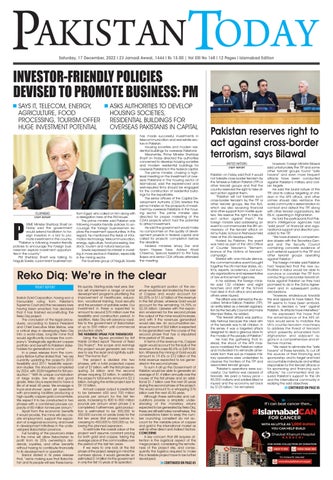
RIME Minister Shehbaz Sharif on Friday said the government would extend facilitation to foreign investors in a bid to promote investment in the country. “Pakistan is following investor-friendly policies to encourage the foreign businessmen explore investment opportunities in the country.” PM Shehbaz Sharif was talking to naguib Sawiris, a prominent businessman
g
ASkS AUTHORITIES TO DEvELOP HOUSInG SOCIETIES, RESIDEnTIAL BUILDInGS FOR OvERSEAS PAkISTAnIS In CAPITAL
from Egypt, who called on him along with a delegation here at the PM House. The prime minister said Pakistan was following investor-friendly policies to encourage the foreign businessmen explore the investment opportunities. In this regard, he mentioned the fields of information technology, telecommunication, energy, agriculture, food processing, livestock, tourism and natural resources. Sawiris expressed his interest in investing in more sectors in Pakistan, especially in the mining sector. The business group of naguib Sawiris
has made successful investments in telecommunication and real estate sectors in Pakistan. Housing societies and modern residential buildings for overseas Pakistanis Meanwhile, Prime Minister Shehbaz Sharif on Friday directed the authorities concerned to develop housing societies and modern residential buildings for overseas Pakistanis in the federal capital. The prime minister, chairing a highlevel meeting on the investment of overseas Pakistanis in the housing sector of Islamabad, said the experienced and well-reputed firms should be engaged for the construction of residential buildings for the expatriates. The senior officers of the Capital Development Authority (CDA) briefed the prime minister on the prospects of investment by overseas Pakistanis in the housing sector. The prime minister also directed for proper marketing of the CDA’s projects which had the potential to attract investment. He said the government would make no compromise on the quality of development projects in federal capital and called for projects’ completion before the deadline. Federal ministers Ishaq Dar and Azam nazeer Tarar, Advisor Ahad Cheema, Special Assistant to PM Tariq Bajwa and senior CDA officers attended the meeting.
Reko Diq: We’re in the clear profit report Barrick Gold Corporation, having won a favourable ruling from Pakistan’s Supreme Court and the necessary laws having been enacted, has declared that it has finished reconstituting the Reko Diq project. The conclusion of the legal procedures, according to Barrick President and Chief Executive Mark Bristow, was a critical step in developing Reko Diq into a world-class, long-life mine that would significantly increase the company’s “strategically significant copper portfolio and benefit its Pakistani stakeholders for generations to come”. In a press release from the company Bistrow further stated that, “we are currently updating the project’s 2010 feasibility and 2011 feasibility expansion studies. This should be completed by 2024, with 2028 targeted for first production.” “With its unique combination of large scale, low strip and good grade, Reko Diq is expected to have a life of at least 40 years. We envisage a truck-and-shovel open pit operation with processing facilities producing a high-quality copper-gold concentrate. We expect it to be constructed in two phases with a combined process capacity of 80 million tonnes per annum.” Apart from the economic benefits it would provide, the mine will also create employment, support the expansion of a regional economy, and invest in development initiatives in the undeveloped Balochistan province. Full funding of the province’s stake in the mine will allow Balochistan to profit from its 25% ownership’s dividends, royalties, and other benefits without having to contribute financially to its development or operation. Barrick stated in its press release that, “we’re making sure that Balochistan and its people will see these bene-
fits quickly. Starting early next year, Barrick will implement a range of social development programs prioritising the improvement of healthcare, education, vocational training, food security and the provision of potable water. Our investment in these is expected to amount to around $70 million over the feasibility and construction period. In addition, Reko Diq will advance royalties to the government of Balochistan of up to $50 million until commercial production starts.” The numbeRs speak foR Themselves Using the figures provided by Arif Habib Limited report “Revival of Reko Diq Project”, the scope and earnings this project would generate are massive to say the least and rightfully subtitled “The Home Run”. The project is divided into two phases, with a total projected capex cost of $7 billion, with the first phase requiring $4 billion and the second phase requiring $3 billion. In addition, the project’s total entry amount is $2.2 billion, bringing the entire project size to $9-10 billion. Annual copper output is predicted to be between 650 and 700 million pounds per annum for the first ten years, increasing to 800 to 850 million pounds per annum when phase 2 is completed. Furthermore, gold production is estimated to be 300,000 to 350,000 ounces on yearly basis for the first ten years (first phase) before increasing to 450,000 to 500,000 oz. following the planned expansion. To estimate the overall value of the project we’ll assume constant pricing for both gold and copper, taking the average price of the commodities over the period of the last ten years. If we were to only look at the first phase of the project, keeping in mind the numbers above, it would generate an estimated $ 14 billion for the government in only the first 10 years of its operation.
The significant portion of the revenue would be dominated by the sale of Copper and would account for 83.25% or $11.67 billion of the revenue in the first phase, whereas Gold would account for the remaining 16.75% or $2.35 billion. Likewise with the expansion envisioned for the second phase the output of the mine would increase, and with it the revenues generated would also rise. An accumulative revenue amount of $62 billion is expected to be generated over the course of the second phase that has a stipulated time period of 35 years. In terms of the revenue mix, Copper again would account for the bulk of the revenue in this case 80.6% or $49.9 billion. Whereas the mining of Gold would amount to 19.4% or $12 billion of the total revenue expected to be generated in the second phase. To sum it all up the Government of Pakistan would be able to generate an average of $1.4 billion annually over the course of the first phase and an additional $1.7 billion over the next 35 years during the second phase of the project. This would amount to a whopping $76 billion over the next 45-50 years. Although these estimates and calculations provide a simplistic understanding of the monetary returns expected to be generated by Reko Diq, these are still estimates nonetheless. The considerations taken to keep the number crunching consistent do not account for the variable price of copper and gold in the international market as well as other direct and indirect factors. ConCeRns A key concern that still requires attention is the logistical aspect of this mega project, considering the remoteness of the project site, and consequently the logistics required to make this a feasible project have to be further developed.
CONTINUED ON PAGE 05
pakistan reserves right to act against cross-border terrorism, says bilawal UNiteD NAtioNS staff report
Pakistan on Friday said that it would not tolerate cross-border terrorism by the Tehreek-e-Taliban Pakistan (TTP) or other terrorist groups and that the country reserved the right to take direct action against them. “Pakistan will not tolerate such cross-border terrorism by the TTP or other terrorist groups, like the BLA, which are also receiving financial and other support from hostile quarters. We reserve the right to take direct action against them,” the foreign minister said addressing an event to commemorate the 8th anniversary of the terrorist attack on Army Public School in Peshawar held here at the Un Headquarters. Hosted by Pakistan, the event was held as part of the Un’s Office of Counter Terrorism’s “Remembrance of the victims of Terrorism” campaign. Started with one-minute silence, the commemorative event brought together the Un member states, victims, experts, academics, civil society organizations and representative of law enforcement agencies. In his address, the foreign minister said 132 children and eight teachers and staff at the School had died in that attack and several others were injured. The attack was claimed by the socalled Tehrik-e-Taliban Pakistan (TTP), an entity listed as a terrorist organization by the Security Council and many Member States, he added. “This terrorist attack was particularly heinous because the clear aim of the terrorists was to kill children. In this sense, it was a targeted attack designed to deal a grievous blow to the morale of the people of Pakistan.” He told the gathering that instead, the shock of the APS massacre mobilized the Pakistani nation and motivated it to eliminate all terrorists from their soil as massive military operations were undertaken to cleanse the frontiers of the TTP and associated terrorist groups. “Pakistan’s operations were successful. Our territory was cleared of terrorists. We paid a heavy price – 80,000 civilians and soldiers killed or injured and the economy set back by $120 billion,” he remarked.
However, Foreign Minister Bilawal said unfortunately the TTP and some other terrorist groups found “safe havens” and even more frequent attacks have been conducted against Pakistan’s military and civilian targets. He said the brutal nature of the TTP, and its callous targeting of children in the APS attack, and other crimes should also reinforce the world community’s determination to combat and defeat the TTP, along with other terrorist organizations, like ISIL-k, operating in Afghanistan. He told the participants that Pakistan’s intelligence agencies had “solid proof” of financial and organizational support and direction provided to the TTP. “We have shared a comprehensive dossier with the Secretary-General and the Security Council containing concrete evidence of such external support to the TTP and other terrorist groups operating against Pakistan.” The foreign minister said Pakistan had ?expected that the new authorities in kabul would be able to convince or constrain the TTP from conducting cross-border terrorist attacks against Pakistan as they had promised to do in the Doha Agreement and in subsequent policy declarations. “However, endeavours towards this end appear to have failed. The TTP seems to have been emboldened to declare a “war” against Pakistan. Its attacks have intensified.” He expressed the hope that the remembrance of the APS attack would serve to mobilize the Un’s counter-terrorism machinery to address the threat of terrorism which presently emanated from Afghanistan and adjacent regions in a comprehensive and effective manner. “We need to eliminate the “safe havens” of these terrorists; to cut off the sources of their financing and sponsorship; and to target and hold accountable individuals and entities responsible for the terrorist attacks or for sponsoring and financing such attacks,” he commented and assured Pakistan’s support to the Un and the international community in realizing the said objectives.
CONTINUED ON PAGE 05 CONTINUED ON PAGE 05