Volume 72, Issue 6

Page 1


THE PAISANO

Independent Student Newspaper for the University of Texas at San Antonio Community @ThePaisano @paisanosports @paisanomedia /paisano-online.com @paisanosports

Researchers establish first neuromorphic computing hub

UT San Antonio is launching the nation’s frst open-access neuromorphic computing hub, making cutting edge, brain-inspired computing technology broadly available to researchers nationwide. The new computing lab is a specialized research facility that is dedicated to designing computer software and hardware that mimics the human brain.

The National Science Foundation funded the THOR initiative. The THOR initiative aims to allow researchers to request, co-develop, deploy and evaluate neuromorphic experiments on a heterogeneous computing system. The new hub is an open access large-scale neuromorphic research facility

THOR was brought by the joint efforts of research partners from across the country, including CoPrincipal Investigators Catherine Schuman Ph.D. and Gert Cauwenberghs Ph.D., Lead Engineer Tej Pandit Ph.D., Senior Personnel Vijay Janapa Reddi Ph.D. and

Pandit, who is also an artifcial intelligence research scientist for MATRIX AI Consortium, provided information about THOR’s development and detailed the neuromorphic computing lab and its impact on UT San Antonio.

“Neuromorphic computing is a branch of artifcial intelligence, or you can think of it as a precursor to artifcial intelligence where we actually study the brain, and its capabilities and its processes, and try to fgure out exactly what makes the brain special in its method of learning and fguring out the world around it,” Pandit said. “We try to abstract and recreate these processes inside commercial technology, or we try to build our own hardware to recreate these processes.”

In the context of those who may be familiar with software similar to the neuromorphic computing hub, Pandit explained the possibilities that can be explored with the THOR initiative.

“THOR is an open access research infrastructure

Race, gender departments to merge with bicultural-bilingual

UT San Antonio will be merging its Department of Race, Ethnicity, Gender and Sexuality Studies with the Department of Bicultural-Bilingual Studies, effective Sept. 1.

The San Antonio Express-News frst reported the consolidation, stating that an email was sent to UT San Antonio’s College of Education and Human Development faculty and staff on Jan. 16 announcing the two departments’ consolidation.

UT San Antonio College of Education and Human Development Dean Mario Torres, Ph.D., said in the email that “at this time, no changes to faculty or staff positions, reporting structures or job responsibilities are planned,” and that the move would be “an exciting opportunity,” leading to a “more prosperous future” for the college and its academic programs.

In a separate email to students, Torres stated, “No action is required on your part,” regarding the university’s decision.

According to the Express-News, UT San Antonio offcials did not respond to questions about who made the decision, why it was made or what would materially change as a result of this decision.

A faculty member who spoke to the Express-News anonymously stated that professors were informed at a faculty meeting before the start of the spring semester that the move to consolidate the departments was “already made,” and that faculty were not consulted before the announcement.

UT San Antonio’s move comes after the UT System Board of Regents’ Feb. 19 vote to approve an initiative that restricts the teaching of “controversial subjects” in classrooms. The policy requires that faculty “not attempt to coerce, indoctrinate, harass, or belittle students, especially in addressing controversial subjects and areas where people of good faith can hold differing convictions.” The policy also prohibits syllabi from containing “unrelated controversial or contested matters.”

Ellen Riojas Clark, Ph.D., a former professor in the Department of Bicultural-Bilingual Studies, discussed the history of the Department of Mexican American Studies and critiqued the university’s decision and its potential effects on students.

“UTSA was established under the premise that it was going to serve South Texas. I think it’s crucial that UTSA was established to meet the needs of underrepresented

ethnic minorities,” Clark stated. “Mexican American studies was set up so that we, as ethnic minorities, as people of color, as Mexican Americans, as Latinos, as Chicanos, needed to know who we were and who we are.”

Clark also emphasized that the decision to consolidate the departments into one is a political move by the UT System Board of Regents.

“The regents are appointed by [the governor]. They’re all going to vote in whatever way that that’s perceived. That’s political, and [Gov. Gregg] Abbott is speaking to the White House. So it’s all driven this way.”

When asked about the effect the move will have on students in the future, Clark highlighted the harm it will have on minority students.

“I think that it will affect students of color. It will affect Latino students. It will affect women and especially people with special needs of whatever, in terms of

“People will not be able to learn about who they are, why they are, and why this is such an issue right now.”

denying their identity development,” Clark said. “People will not be able to learn about who they are, why they are and why this is such an issue right now.”

Clark further delved into the topic, emphasizing the effects the move will have on future graduates entering the workforce.

“How can teachers work with primary students in public schools, who [are] largely ethnic [minorities]? Doctors, who do they work with? University Hospital, who do they work with? 67% of our community in San Antonio is Latino,” Clark stated.“The impact, I think, will be that students are not going to feel welcome in higher education if they don’t see a refection of self in what they study, other than a partisan view of what is presented.

“It’s going to have a negative effect, I think, on whatever discipline or career that students want to pursue, because they won’t be able to deal with the social, economic, socio-cultural factors of the real world.”

This is a developing story that The Paisano will continue to update on.

for neuromorphic computing, so those who are already familiar with the technology can apply for access directly from the THOR website. For students looking to get into neuromorphic computing, we offer a course at UTSA taught by Dr. Dhireesha Kudithipudi,” Pandit detailed.

Furthermore, Pandit discussed how the lab can be an opportunity for researchers to visit the computing platform for their project initiatives.

“What we’re hoping for is to bring together all these researchers so that they can have one common computing platform and also promote inter-framework research so that they can communicate and exchange models between each other,” Pandit said. “So it brings together neuromorphic building space rather than splits it up even further.”

The offcial launch of THOR is slated for Feb. 23 in the UT San Antonio San Pedro I building, with plans of a live demonstration to showcase the hardware’s capabilities.

Researchers and students interested in accessing the system or attending upcoming workshops can learn more via the project’s website, neuromorphiccommons.com.

US Senate race early poll results

A recent poll from the Texas Politics Project at the University of Texas at Austin for the U.S. Senate race shows that U.S. Rep. Jasmine Crockett has a 56% to 44% lead over state Rep. James Talarico.

For the Republican candidates, Texas Attorney General Ken Paxton is favored at 36%, followed by U.S. Senator John Cornyn at 34% and Congressman Wesley Hunt’s 26%.

If no candidate from a race has above 50% of the vote after Election Day on March 3, a primary runoff will be held. Early voting for this runoff election would take place from May 18-22, and Election Day would be on May 26.

Those who voted in the primaries must vote for the same party in the runoff election, but those who did not vote in the primary may vote for either party in the runoff.

Voters can cast their ballot for whichever party they please in the November general elections, regardless of which party they voted for in the primaries.

Polling also showed an overall 49% disapproval rate and 45% approval rate for President Donald Trump. The majority of Republicans approve of Trump, yielding an 81% job approval rate; however, this number is down from the 92% Republican approval rate that he started his second term with.

Early voter turnout almost doubled that of the 2022 midterm primaries.

The unoffcial voting total for Bexar County is 183,287. Democratic votes made up 123,730 of these votes, and 59,547 early votes were Republican.

According to Ryan Data and Research, a signifcant number of Democrats have voted in the primaries for the frst time this year, while most Republican early voters have voted in past primaries. More than a quarter of early Democratic votes came from individuals who have registered in general elections but never in primaries.

On Election Day, the Main Campus polling location is at the H-E-B Student Union in the Bexar room, 1.102. Voting is from 7 a.m. to 7 p.m., and individuals can legally vote as long as they are in line by 7 p.m. and registered to do so.

To prepare for Election Day, voters can download a sample ballot.

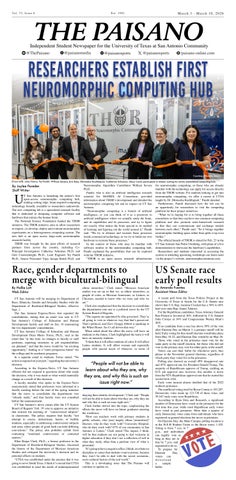
(From left): Jules Henry, Tej Pandit, William Severa, Eric Brey, Dhireesha Kudithipudi, Catherine Schuman, Stacy Cantu participate in ribbon cutting for newly established computing hub.
Neuromorphic Algorithm Contributor William Severa Ph.D.
Courtesy/Brandie Jenkins

Former professor detained by ICE

Former Associate Professor of Instruction in the School of Architecture + Planning Cansin İlayda Çetin was reportedly detained by the U.S. Immigration and Customs Enforcement shortly after her dismissal from UT San Antonio. Under a r/UTSA Reddit thread there is a post titled “Former UTSA Professor is in ICE Detention right now” that claims Çetin was detained in January.

User shmandameyes posted the message on Feb. 11, arguing that Çetin was allowed a grace period to seek other employment after being let go from UT San Antonio. It is not specifed what type of temporary visa she held. The Paisano reached out to Associate Vice President for Strategic Communications and External Affairs Joe Izbrand, inquiring about what course she taught and how long she taught for and the circumstances of her departure from the university last fall.

“Cansin Ilayda Cetin was a fxed-term faculty member who fulflled her contract as of December 2025. Her discipline is in interior design,” Izbrand stated.

U/shmandameyes states in the Reddit post that Çetin was let go from UT San Antonio after the fall 2025 semester concluded. A Report by UT San Antonio’s Appendix C. Faculty on Nov. 18, 2025, confrms Çetin as Associate Professor of Instruction. Çetin is currently not listed as a faculty member under the School of Architecture + Planning.

“UTSA has declined to hire her back, and she is in a limbo state waiting for a court date. She described a harrowing experience. She was denied her medications for 9 days. She is in a dormitory with 18 other women,” u/ shmandameyes detailed in the Reddit post.

Çetin is currently located at an ICE detention center in Karnes City, Texas. According to ICE’s Online Detainee Locator System listed Çetin to be held at the Karnes County Immigration Processing Center as of March 2. Çetin’s inmate number –A221376137– was also posted in the thread, and she is confrmed to be in ICE’s custody in a South Texas detention facility according to locator.ice.gov.

Right To Rebel SATX organized a mass meeting on Feb. 24 at 7 p.m. at an undisclosed location addressing Çetin’s recent detainment. The political organization provided anonymous quotes of UT San Antonio students that were in attendance.

“Dr. Cetin’s detention shows that ICE can go after anyone at a moment’s notice, and that UT San Antonio’s administration will do nothing to protect them,” a UT San Antonio student said.

“We can’t rely on asking nicely to prevent staff from getting detained. ‘Perfect Victim’ or not, they belong here, and we need to fght if we want people to stop getting taken,” another UT San Antonio student explained.

Çetin originates from Turkey, according to her LinkedIn profle. Her profle also contains her employment at UT San Antonio for two years and 11 months.

This is a developing story that The Paisano will continue to look into.

from external San Antonio news sources, State of the City follows the most captivating news headlines of the week. The topics for this week feature gun violence, U.S. Immigration and Customs Enforcement agent charges and voter participation.

Main Plaza expecting $15 million renovation, professor examination

The Main Plaza is expecting a $15 million renovation funded by the City of San Antonio and the Main Plaza Conservancy. Focused on following the Americans with Disabilities Act, which details requirements for buildings and facilities to be physically accessible to people with disabilities, the Main Plaza Improvement Project will address uneven surfacing, pedestrian circulation and lighting systems. Additionally, the project will include the installation of a pavilion and expanded food services.

The funding for the renovations and the redesign of the Main Plaza comes from years of investment. To start, Phase 1 was completed in April 2023 using $4.5 million approved by the City Council to remove the plaza’s fve fountains and stabilize the groundwork. To follow the renovation plan by the Main Plaza Conservancy, the City Council approved an additional $5.5 million as part of the 2023-2024 Fiscal Year Adopted Budget. The Main Plaza Conservancy pledged a $5 million donation to the project last year to complete funding for the plan’s estimated cost.

Since acquiring the budget, a public-input meeting was held at the Central Library on Feb. 23. The meeting presented slides to the public with conceptual plans, goals, palettes and rendered before-and-after images.

The available renderings provide a detailed view of the anticipated changes. In an interview with The Paisano, Director of the UT San Antonio School of Architecture + Planning Michelangelo Sabatino Ph.D., shared his thoughts on what stands out most in the renderings.

“The proposed feature of a continuous bench that weaves

through the site is particularly inspired because it allows for people to rest, and it also avoids the sort of clutter of just flling the space with individual chairs and benches,” Sabatino said. “This brings a little more discipline and aesthetic cohesion to that plan.”

The Main Plaza is located less than a mile from the SA+P building and is within walking distance of the Riverwalk. One of the design frms participating in the renovation — Ford, Powell & Carson — also designed the UT San Antonio Main Campus.

Sabatino connected the frm’s focus on lively, active places to the proximity between the plaza and college.

“Wouldn’t it be fun to see our students hanging out at Main Plaza more?” Sabatino proposed. “And if our students could go there for lunch as well as tourists along the Riverwalk, wouldn’t we have kind of a dynamic situation going on there?

“I also, frankly, like the idea of a potential pavilion or stage. I think that’s important in terms of how you activate the space in a way that people feel welcome, but also performers or speakers have an anchor with which to promote activity.”

Community members present at the input meeting responded to, “Is there anything else you’d like the design team to consider?” with a board full of sticky notes. Respondents wrote for the team to consider adding details such as bike racks, different seating heights and on-site water access. “I would say, potentially adding more trees to the existing trees in order to provide additional shade from the San Antonio heat,” Sabatino suggested when asked the same question.

Additional feedback or questions about the project can be submitted to the Main Plaza Improvement Project’s website at publicinput.com/m64674. The project will be presented to the Historic and Design Review Commission in March. The expected construction is set for summer 2027 to summer 2028.

Mayor Jones apologizes to Councilwoman Kaur for profanity

Mayor Gina Ortiz Jones issued an apology in response to yelling and using profanity toward District 1 Councilwoman Sukh Kaur during a city council meeting addressing public safety.

Kaur fled a formal complaint after the mayor allegedly used “profanity, abusive language, and intimidating behavior” while discussing a vote related to the LGBTQ+ venue Bonham Exchange, which failed to meet a 2023 deadline for mandatory fre sprinkler installation, causing a dispute on whether or not to force a capacity reduction.

In a Feb. 5 press conference, Jones mentioned that she privately apologized to the councilwoman.

“I wanted to publicly apologize, certainly to my colleague, to my teammate, Councilwoman Kaur. I have apologized to her privately, but I wanted to make sure everybody knew that I had done the right thing and certainly apologized for hurting her feelings. That was certainly never my intention,” Jones stated.

What Jones said to Kaur is unclear, as it was not detailed in the formal complaint fled by Kaur or addressed by Jones in the press conference.

“As an Air Force veteran, Iraq War veteran, I admit that I have a different set of experiences that allow me to view things a little bit differently than some of my colleagues,” Jones said. “But that morning, we were discussing public safety, and I should not have raised my voice, and I should not have used profanity, and for that, I apologize.”

On Friday, Jones faced a full censure vote from her

Verbal altercation turns death sentence

A fatal shooting occurred at the intersection of Zarzamora Street and West Commerce Street. Local police responded at approximately 3:40 PM on Friday, Feb.27. A 26-year-old man shot several rounds towards a 40-yearold male after both were seen engaging in a verbal argument. The two men were arguing while exiting a bus when the 26-year-old male fred several rounds towards the other male. The San Antonio Police Department has since detained the shooter for questioning.

colleagues. The censure from the council requests that Jones undergo leadership training and temporarily step down from her chairmanship of the council’s governance committee until the training is complete.

“I think that is separate and distinct from what I do on the Governance Committee, so I will not be doing that,” Jones said.

Kaur has stated she will not be partaking in the vote.

“To maintain the integrity of the process based on an external, independent investigation, I am recusing myself from this week’s meetings regarding the censure. I will release an offcial statement following Friday’s vote,” Kaur said.

The San Antonio council voted 8-1 to formally censure Jones on Feb. 27, concluding that her conduct violated the city’s Code of Conduct and workplace policies.

ICE agent escapes Texas Grand Jury charges

A South Texas Grand Jury declined to indict the U.S. Immigration and Customs Enforcement agent who killed Ruben Ray Martinez. When the accident occurred, Homeland Security Investigation special agents were assisting local police in controlling traffc after a major vehicle collision. The 23-year-old San Antonio resident was intoxicated and struck an agent with his vehicle on March 15, 2025. This led to another agent on site to shoot and kill Martinez.

Mayor Jones announced a new voting commission

During a City Hall press conference last Friday, Mayor Gina Ortiz Jones promoted a new voting commission to boost San Antonio voter turnout. The commission would comprise of an appointee from each district and three appointees chosen by the mayor. Jones has stressed that in the past that there have been attempts to make it harder for the city’s most vulnerable neighbors to be heard at the ballot box. The new commission is on track to be solidifed by April 3.

Cruz Delgado/The Paisano
Two people lounge in front of San Fernando Cathedral at the city’s Main Plaza located at 115 N Main Ave., San Antonio, TX, 78205.
Mayor Gina Ortiz Jones speaking at a Feb.19 town hall.
Rylan Renteria/The Paisano

OPINION

University burns inclusivity

Tyranny seldom triumphs on its own. While it requires brigades of bigots and losers, tyranny also needs an apathetic opposition — an opposition so unwilling to act, it might as well be complicit. Conveniently for President Donald Trump and the State of Texas, the UT San Antonio administration is more than willing to roll over when asked.

The university plans to fold its Race, Ethnicity, Gender and Sexuality Studies Department with the Department of Bicultural-Bilingual Studies, effective Sept. 1— a harmful and unnecessary concession. The dissolving department offers a certifcate in Mexican American Studies along with undergraduate degrees in African American Studies; Mexican American Studies; and Women’s, Gender and Sexuality Studies. These programs emphasize community engagement. On the other hand, the Department of Bicultural-Bilingual Studies focuses on equity, education and bilingualism within education.

These departments focus on distinct aspects of culture and aim to provide different outcomes for their students. On their face, the separate qualities should provide enough reason to halt departmental integration; however, the rapid rollback of diversity, equity and inclusion initiatives

across the state and nation gives UT San Antonio’s change a truly haunting backdrop.

Beyond the horrifc job cuts that have swept the nation in the name of eliminating “woke” culture, universities across Texas have announced plans to consolidate programs relating to race and gender studies. UT Austin announced a scheme to combine four related departments and will reevaluate which degree programs

The UT San Antonio Student Government Association claims to serve “as a communications link between the student body, faculty, staff and administration.” SGA is not able to accomplish this when nine of the 15 Executive Branch positions and three of the four Legislative Branch committee positions are vacant.

Vacancies like these make it diffcult for SGA to follow through on their stated mission: prioritize student needs, represent students and enhance student experiences. The SGA can amplify its effectiveness by increasing transparency, promoting engagement, ensuring representation, facilitating better communication and addressing student needs.

Tucking away budgets and actions harms everyone. It causes distrust and disconnect between the SGA and the students they are meant to serve. Transparency is not optional. SGA should publish itemized budget breakdowns. Doing this will ensure that students know where their money is going and allows them to advocate for spending on other organizations, assuming funds are allocated where they should be.

SGA has extremely low voter participation in its elections, with the most recent available data on turnout showing a participation rate of 1.82%. Students are not to blame for SGA’s poor presence on campus. One of the easiest ways to reach students is by expanding tabling efforts. During these tabling events, SGA should be sure to include activities for student engagement; for instance, SGA can provide a board and sticky notes for students to write their concerns or provide computers during election season

so students can vote on the spot. Simple activities like these would allow students to voice their concerns directly while actively increasing engagement.

It is important to note that UT San Antonio is not only one campus. The SGA tends to focus on UT San Antonio’s Main Campus, despite having a vacant committee position for the Downtown Campus, according to their website. With the newly formed College of AI, Cyber and Computing located downtown, campus representation is more important than ever as it fosters a sense of belonging for students, and updating the Get Involved page to include the college is just as important.

Integrating the Downtown Campus can open doors for SGA. This allows for potential virtual positions to fll those vacant seats and encourages those completing their degree online to participate in SGA. Online students matter just as much as those in-person.

Fostering better communication with students would further increase engagement. SGA has failed students — especially those who are hungry for involvement. Hosting socials and posting visible promotional materials to display across campus would improve communication with students immensely.

SGA must address student concerns. SGA initiatives are expressed directly on UT San Antonio’s website, yet they are unmet. Hoping that SGA circles back to its major initiatives, they can focus on the academic needs of students, like lowering the cost of textbooks through Academic Affairs — but frst, fnd someone to fll that seat.

If SGA takes these steps, it has the opportunity to rebuild trust and fulfll the mission it sets for itself.

are “necessary” moving forward. Further, Texas A&M completely removed its gender studies program.

With other universities throwing so much progress to the wind, it is hard to ignore UT San Antonio’s change as merely a coincidence. According to the Dean of Education and Human Development, there are no plans to change faculty positions, advisors and degree pathways, but no plans were made to consult faculty on the merger at all. Moreover, the university has failed to address what the new department will look like.

If curriculum is changed, faculty are dismissed or programs are diluted, UT San Antonio will have a hard time being taken seriously. University administration will prove that when the going gets tough, the Roadrunner spirit bends to authority. A university responsible for so many students should not decide what constitutes higher education depending on which political party sits in the White House.

These programs were created to help heal existential community divisions in the U.S. and recognize historical faults to move progress forward. Tearing them down is complacency in the face of injustice. Tyranny and authoritarianism are not ideas that live in the past but threats that press on the future. Repair higher education; reverse this decision.

The Men’s and Women’s U.S. Olympic Hockey Teams made history at the 2026 Milano Cortina Winter Olympics, fnishing undefeated and beating Canada during their respective games. Both teams performed phenomenally and deserve to be treated with equal respect, but instead of focusing on the historic sweep, the women’s team’s victory is being overshadowed by an offensive “joke” and undermined by public reactions.

President Donald Trump called into the U.S. men’s team locker room after their win to invite them to the State of the Union speech and White House to “just have some fun.” The president sounded like he was beaming with pride, but what should have been a heartfelt and sentimental phone call turned into a backhanded compliment and misogynistic slander towards the women’s hockey team.

but as a political necessity. According to a spokesperson for USA Hockey, the women’s team turned down the invite due to prior commitments. Whether or not that was the sole reason is unimportant, what matters is celebration became secondary to unwanted controversy.

Many players of the men’s hockey team have spoken out, claiming that they are proud of the women’s team and that they should have reacted differently to the distasteful joke. These claims are diffcult to take seriously when none of the players initially stood up for the women’s team.

“I must tell you, we’re going to have to bring the women’s team,” Trump said. “You do know that. I do believe I probably would be impeached [if the women’s team wasn’t invited].” This line was received with laughter.

The women’s team accomplished the same undefeated victory and was also invited to the State of the Union. However, it was not framed as an earned honor

The forward for the men’s team, Jack Hughes, stated in a call to the Daily Mail, “People are so negative out there, and they are just trying to fnd a reason to put people down and make something out of almost nothing,” downplaying the obscene comment that the president made. For centuries, women have been fghting for respect — not just in sports, but in society. Women are seen as lesser than, and their achievements are overshadowed by tasteless comments and bigotry. The tremendous effect of these comments is downplayed, as they are written off as “just a joke.” Men’s sports teams are celebrated, and women’s are seen as political obligations, with their achievements reduced to a punchline. It is not “just a joke,” and it never has been. It is a reminder that equality and respect for women are still optional.

Kassandra Jaime Contributor
Sarah Quintanilla /The Paisano
Cruz Delgado /The Paisano
Noor-E-Saher Ahmed/The Paisano
Commentary By Blue Mize Contributor

OPINION

American Girl doll’s overdue makeover

The frst six American Girl dolls fnally got their much-needed makeover as the Modern Era collection was unveiled. The collection features Samantha Parkington, Kristen Larson, Molly Mclntire, Felicity Merriman, Addy Walker and Josefna Montoya, stepping away from the old and

Presient Donald Trump delivered his State of the Union address on Feb. 24, taking his part in the long-standing American tradition of presidents outlining conditions within the nation. Trump, an otherwise staunch conservative who fghts for traditional values, shocked America with his bold move to fght tradition by bombarding attendees with blatant lies and desperate attempts to further divide Democrats and Republicans. No other president as of late has had the courage to do that — the man might just be progressive, after all.

Trump delivered the longest address in history, clocking one hour and 47 minutes. Former President Franklin Roosevelt’s “Day of Infamy” address, where he called for a declaration of war on Japan following the Pearl Harbor strike, was only around six minutes long. So, with Trump’s address being seventeen times longer, one would assume he had a heap of burning topics to talk about — perhaps clarifcation about the war in Iran or the Epstein Files.

into the new. Compared to the historical clothing, the modern American Girl dolls now have trendy, Pinterest boardworthy outfts. Growing away from their traditional attire, the new design allows girls to learn from dolls that represent Generation Alpha.

The traditional six American girl dolls were outdated, boring and uninspiring compared to the new energetic, innovative and appealing dolls.

Felicity Merriman’s doll was redesigned to include cute fared pants. Historically, women did not start wearing pants until they became mainstream in the 1970s.

“The modern era dolls are destined to encourage growth instead of being stuck in traditional roles.”

During the 70s, wearing pants as a woman symbolized liberation, gender equality and rebellion. Those values still reign in the 21st century.

Paving the way for the new generation, the modern era dolls are destined to encourage growth in lieu of being stuck in traditional roles and classic silhouettes.

Fashion has always been political, and dolls that mirror that political statement are the role models to the children who play with them.

Mixed opinions have been discussed

He got around 60 standing ovations by just saying things and waiting for an explosion of applause. One time, Trump simply stated, “We ended D.E.I. in America,” and he got an ovation. Since the truth garners no love, he had to fsh for these ego-boosters through obvious, easily disproven lies; claims like gas being “below $2.30 a gallon” or that 2.4 million Americans were “lifted” off of food stamps.

He also said things that were not technically lies but were totally misleading. For example, “In the past nine months, zero illegal aliens have been admitted to the United States.” An undocumented person, by defnition, is in the U.S. without admittance.

In between his pleas for positive attention from Republicans, he saved time to mock and heckle attending Democrats, who only clapped a couple times, mostly ignoring Trump when he lied and made ridiculous claims. When they did stand and applaud for America’s Olympic hockey team, he said, “It’s the frst time I’ve ever seen them get up. And actually, not all of them did get up.” Later, after introducing the idea of fghting insider trading from Congress, he again could not

about the Modern Era collection, but this is not the frst time the American Girl doll company has dealt with backlash and controversy. One of the six original American Girl dolls, Addy Walker, was criticized amongst the Black community for being regressive and politically charged in her dress.

Jaha Nailah Avery described Walker’s debut outft as a political statement.

“Addy’s debut caused much debate in the Black community, due to her family being enslaved. Many argued that the frst Black doll should have represented more uplifting times in African American history, such as the Harlem Renaissance or the Civil Rights Movement,” Avery detailed in her report.

It is refreshing and healing for many young girls to see Walker’s design feature her hair styled in twists, her baby hairs laid and an adorable pink dress, matching her chic, pink Mary Jane shoes.

Politics and pop culture are deeply entwined; the doll’s new design is demonstrating a message of girl power.

Beyoncé once said, “Who runs the world? Girls!” That message is exactly the inspiration behind the Modern Era dolls. Little girls are no longer looking toward the past for inspiration but to the future.

The woman who used to play with American Girl dolls can also see this new doll design as a new chapter for the company — a new chapter rooted in positive expression, reassuring representation and encouraging role models.

fght his urge to heckle: “They stood up for that. I can’t believe it. I can’t believe it. Did Nancy Pelosi stand up, if she’s here? Doubt it.”

He also said that Democrats “don’t like to hear” that crime is down; he mocked them for not clapping when he said more youths are turning Christian, and he called Democrats crazy after they did not clap for his proposed banning of protections for transgender kids. None of this heckling does any good at all. He does not have the decency to accept that some members of Congress are going to disagree with him, even though that is literally the point of Congress. His shaming and heckling serve no other purpose than widening the divide between Democrats and Republicans.

Trump spent nearly two hours and 11,000 words saying nothing of substance, boosting his ego and misleading Americans — or at least, those Americans who cannot fgure out how to use Google. His address was beyond pathetic, wildly embarrassing and gave a fresh reminder to listeners that he is completely out of touch with reality.

The Paisano

Editorial Board

Jasmine Williams | Editor-in-Chief Editor@paisano-online.com

Cruz Delgado | Managing Editor Manager@paisano-online.com

Marisela Cruz | News Editor News@paisano-online.com

Henry Holmes | Opinion Editor Opinion@paisano-online.com

Audrey Villar | Arts & Life Editor Arts@paisano-online.com

Rylan Renteria | Sports & Photo Editor Sports@paisano-online.com Photo@paisano-online.com

Hallie Lott | Web Editor Web@paisano-online.com

Sarah Quintanilla | Graphic Editor Graphic@paisano-online.com

Regan Williams | Multimedia Editor Multimedia@paisano-online.com

Valentina Quintanilla | Magazine Editor Magazine@paisano-online.com

Karis Vickers | Social Media Editor Socialmedia@paisano-online.com

Jaclyn Banda | Buisness Manager Buisness@paisano-online.com

Emma Cavanaugh | Distribution Manager Distribution@paisano-online.com Staff

ARTS & LIFE ‘México Lindo y Querido ’

Crowded lines excitedly flled the entrance to the UT San Antonio Recital Hall where Mariachi Juvenil de UTSA, Mariachi los Paisanos, Voces del Futuro Mariachi and participating high schools celebrated Mexican culture through pride and cheer.

A resounding welcome from the Mariachi Juvenil de UTSA ensemble lightened the audience. The celebration commenced with Mariachi Juvenil de UTSA Guitarist Alfredo Bamaca performing “México Lindo y Querido.”

Trumpets danced with the violins while guitars swayed to the patriotic ballad. The singer entered the arrangement with a dance of his own, startling the instruments and audience with a confused acceptance of the struggling vocalist. Fast paced swings of the violins and the passionate strings of the guitars closely worked with powerful trumpets to ensure a path to the singer, but Bamaca took a detour, giving a complete spotlight to the ensemble. The frst performance ended with a chorus of applause; the audience eagerly anticipated what was coming next.

The brassy trumpets and melancholic tunes announced the beginning of “Costumbres.” Mariachi Juvenil de UTSA Trumpeter Isabella Guerra’s faint notes softly joined the ensemble, hinting hesitation between the heart-wrenching lyrics, but that did not cease the delivery of desperate yearning within the song. Guerra joined hands with Mariachi Juvenil de UTSA to conclude the performance, drawing tearful smiles from the audience.

Mariachi Juvenil de UTSA Guitarist Diego Rosas began “Te Quise Olvidar” with confdence, independent from the ensemble. His assertive stance in front of the large crowd drew a chorus of thunderous applause as

‘New

instruments slowly joined in. The song came to a close with the audience bewildered by the intensity in which the performance showed its gratitude and love towards Mexican music.

The ensemble signaled the beginning of violinist and vocalist Kathleen Espinoza’s performance.

united Espinoza and the mariachi to showcase their love through music.

Throughout the night, many performances demonstrated the talent and passion UT San Antonio’s mariachi and gifted high school student ensembles have for México’s colorful and prideful music.

African Masquerades’ dances into the heart of SAMA

Rich in culture, expressive in movement and transformative in feeling are just some expressions that best describe the San Antonio Art Museum’s exhibition “New African Masquerades: Artistic Innovations and Collaborations.” According to the Kelso Curator Emily Ballew Neff, the exhibition, featuring four artists from West Africa, is SAMA’s frst African exhibition in 20 years.

Masquerade is a broad set of practices in which individuals and societies dance in full-body, multimedia ensembles. David Sanou, Sheku “Goldenfnger” Fofanah, Chief Ekpenyong Bassey Nsa and Hervé Youmbi eccentrically portrayed their masquerade ensembles. Each artist worked with a different curator that helped design the exhibition. Two were in attendance during the press preview.

Associate Professor of Art History at the University of North Carolina in Charlotte Lisa Homann presented the frst artist whom she personally worked with: Sanou. He is based in Bobo-Dioulasso, Burkina Faso. Homann presented various masquerade characters honoring Sanou’s father André Sanou. His father passed away in 2015 but had a huge impact on establishing the foundation of his son’s artistic growth.

“He wanted to show the world what his father did,” Homann described in regards to Sanou’s photo masquerade ensemble in honor of his father. “His father was not only a brilliant and accomplished sculptor, but he was also a veteran of the Algerian War.”

In Sanou’s home district, it was prohibited for the humanly realistic masquerade ensemble of his father to be presented.

The presentation at SAMA of Sanou’s father not only demonstrated loyal devotion towards his father but also established a lifelasting respect for what his father meant to him.

The expressionless human masquerade, wearing a cap while holding a dagger, was frozen in time as if the individual was walking toward the observer.

Associate Professor of Art History at the University of Miami in Ohio Jordan Fenton presented Goldenfnger and Bassey Nsa. Goldenfnger is from Freetown, Sierra Leone, and Bassey Nsa is from Calabar, Nigeria. Both artists tell elaborate stories in the intricate details presented in their masquerades but are impressively opposite in their

portrayal. The “Woman Tote Man” masquerade ensemble by Goldenfnger is dynamic and transformative.

“Men need to ride on the shoulders of women to achieve success, which is the subset, subnarrative of the Sierra Leonean ideas,” Fenton emphasized. “If you look at the color from top to bottom, the red, white and blue switch to red, blue and green. The artist is demonstrating that cross cultural relationship with Sierra Leone and the United States.”

In comparison to Bassey Nsa’s masquerade ensembles, they are dynamic in shape and deliberate in movement. The fascination of capturing a specifc position in motion with his masquerade ensembles is consistent in Bassey Nsa’s section of the exhibition. “Idem Ikwo” is one of the four masquerade ensembles that Bassey Nsa designed. Its vibrant red color transcends the black color blocking — visually and physically taking up space with materials such as feathers, polyester fabric and raffa.

Head Curator of SAMA Kristopher Driggers went into detail describing Youmbi’s masquerade ensembles featuring an interpretation of the Ghostface mask from the “Scream” movie franchise. Youmbi resides in Douala, Cameroon, and his collection unconventionally featured the paperwork fled to of the artwork are the shipping documents, bills and receipts — things that museums almost never display in part because museums tend to conceal the work of moving art across continents,” Driggers explained. “But here it is really essential to the artwork.”

The “Tso Scream Mask, Visages de masques” is vigorous with the meticulous beading throughout the entire masquerade ensemble. It is easily recognizable in its deliberate pop culture reference but undoubtedly rooted in African culture as it includes materials such as wood, fber beads, textile, horse hair, velvet fabric, cotton fabric and silk embroidery. New African Masquerades opened to the public on Feb. 28 and will be on display through July 5. Student admission prices are $14, senior and military prices are both $19 and regular adult prices are $24. A lecture presented by Amanda M. Maples, detailing the collaboration across continents, is scheduled for March 3 from 6-7 p.m. and will formally introduce New African

“It’s just fun to share the music of my tradition to others,” violinist Malachi Landin expressed. whole culture is a big part of my family and who we are, so just being a part of that community, that’s what makes the feeling of the music,” Espinoza shared. performance closed with the highlight of the night, “El Cascabel.” A celebration held on stage invited the audience to be a part of the festivities.

merry guitar swings opened the door to the listeners. Harps tiptoed their way to the entrance followed by the aggressive trumpets who led the song. Violins had their own party, and guitars hysterically knocked on their door to be a part of the grandiose celebration. Harps and trumpets danced hand in hand, later accompanied by spontaneous individual guitar solos. between plays, the musicians encouraged each other with whistles and comments that hyped up the ensemble.

The audience joined the celebration, clapping, whistling and singing with the performers. As the song grew closer to its end, the musicians and audience came together to sing the song’s grand fnale. The crowd grew louder, and excitement flled each of the seats in the UT San Antonio Recital Hall.

As the night ended, “Voces del Futuro: A celebration with the next generation of mariachis” left the audience astounded. The crowd walked into the night prideful and in awe of the successful performance that proved the culture of mariachi is in safe hands.

‘The Mountain’ fuses cultures

The experimental virtual band Gorillaz released their ninth album, “The Mountain,” on Feb. 27. The 15-track record follows Gorillaz’s usual style of melancholic scores, harmonies and refections about the world’s political state, while mixing a variety of culturally contrasting aesthetics and artists.

A riveting aspect of this album and a staple in Gorillaz’ past music is its inclusion of artists from varying ethnic and racial backgrounds. This incorporation adds distinct sounds to the music and promotes artists not found in worldwide mainstream media. The album has English, Hindi, Spanish, Arabic and Yorubian, promoting and admiring diversity of culture. “The Hardest Thing,” featuring Nigerian vocalist Tony Allen, and “The Manifesto,” featuring Mexican rapper Trueno and late American rapper Proof, demonstrate the band’s appreciation of language. Gorillaz has always experimented with artists of assorted backgrounds, but it has never been as present as in this album.

The record takes much infuence from Hindi classical music. “The Mountain” and “The Sad God” highlight classical Hindi instruments, such as sitar and tabors. Indian artists contribute to these Hindi sounds such as Amaan and Ayaan Ali Bangash on sarod as well as Anoushka Shankar on sitar.

Worship music, as found in “Moon Cave,” creates entrancing sounds, upbeat drums and graceful musical arrangements. This engrossing song implemented rap by Black Thought and Trugoy the Dove, making it a semantically and instrumentally soul-flled experience. Another song akin to “Moon Cave” is “Damascus,” which takes an unexpected Hindi-sounding turn.

Feelings of blue and unhappiness are prevalent in “Orange County” and “Casablanca,” induced by sorrowful lyrics and disconsolent piano melodies.

The virtual band massively involves themselves in politics. “The Happy Dictator” speaks on the totalitarian state of Turkmenistan and its censorship of negative news in order to keep the masses happy — a captivating and unheard of issue in regards to global politics.

The album coincides with Gorillaz’s themes and style, while adding more culture to their musical resume. “The Mountain” refects on society and politics, all while incorporating a vast range of genres and artists.

Paisano

Sarah Quintanilla/The Paisano

ARTS & LIFE

Rowdy poops: Ranking Main Campus bathrooms

Rapper Ice Spice once pondered “Think you the shit, bitch? / You not even the fart.” Crude as the topic may be, some of UT San Antonio’s restrooms are a big, stinky “fart.” Students deserve to know the prime spot to drop a deuce on school grounds. Here are the fve best and worst men’s restrooms on Main Campus.

Best bathrooms

1. John Peace Library, fourth foor

Silence is liquid gold, and it is found on the fourth foor in the otherwise fast-paced John Peace Library. Here is an oasis of Lysol and Febreze smells, the fnest stalls on campus, glowing sinks and incredible lighting. No nasty stench and a clean space make it the supreme lavatory.

2. John Peace Library, frst foor

The JPL frst foor restrooms by the Subway are exceptionally clean, with an eye-catching glass mosaic panel throughout and a toilet bowl seat so refective, Medusa could turn herself to stone. Despite the busy atmosphere, the janitorial staff is on top of cleaning, making it one of the best-kept gems on campus.

3. North Paseo Building, third foor

The NPB’s third foor bathroom is heavenly to defecate in. Its bonafde charm and elegant interior design stem from tasteful dim lighting and indicator stall doors locks, showing if it is occupied.

4. Arts Building, frst foor

As the saying goes, “Beauty is in the eye of the beholder.” This is false, for the frst foor Arts Building bathroom is objectively stunning. The sleek modern grey

Olympics, women, screens

Bird On The Street Week of 3/3

With a week left before spring break, UT San Antonio students are trudging along, holding onto hope for the respite of a vacation. The recent end of the 2026 Milan Cortina Winter Olympics and the onset of Women’s History Month begs questions of sports and celebration these Roadrunners who were eager to answer.

This week, The Paisano interviewed freshman economics major Santiago Barragan, senior politics and law major Jimena Felix, freshman fnance major Michael Guerra and junior medical humanities major Kandice Amadi.

Did you watch the Winter Olympics?

Roadrunners had mixed answers on whether or not they partook in Olympics viewership. Barragan and Amadi both answered that they did not tune in to the Milano Cortina, while Felix and Guerra did turn on their TVs. Guerra commented that he “watched the

averages, with Barragan clocking in at nine hours a day and Felix at nine and a half. Guerra’s screentime was much lower at about fve and a half hours daily. Amadi’s time landed in the middle at eight hours of phone time.

Have a question and want it answered by UT San Antonio students? Submit at http://bit.ly/4pdDfIP.

pastels on one side of the wall and perfectly sized bricks on the other is an artistic touch sure to be most appreciated by restroom goers.

5. Recital Hall, frst foor

The Recital Hall’s eloquent restroom boasts a modernized design, despite some dated features like its sinks and hand dryers. It makes for a delightful experience when needing to defecate. If one is lucky, they will be blessed by music from musically-inclined Roadrunners.

Worst bathrooms

1. Flawn Science Building, frst foor

There is only one word to describe this bathroom: crappy. Finding the bathroom in the maze that is the Flawn Sciences Building can be harrowing, but a small trick is to lead by smell rather than sight. Upon entering, the most violating, pungent smell overwhelms the nose. Due to the lack of toilet paper, water faucets and soap, this bathroom smears a big poopy stain on UT San Antonio’s reputation.

2. Multidisciplinary Studies Building, frst foor

The UT San Antonio Multidisciplinary Studies frst foor bathroom is the dull middle child of restrooms. Its 1990s-esque design, cobwebs, rust and unfushed toilets frighten any restroom-goer. To top it off, half of the stalls are unusable.

3. Biotechnology Sciences & Engineering Building, frst foor

Within the eye-catching BSE is a little turd of a restroom hidden in the frst foor. With toilet paper on the foor and skid marks on the toilet seat, a better bathroom is worth

waiting for. Additionally, the taped out nearby women’s bathroom looks like a crime scene.

4. McKinney Humanities Building, frst foor

The McKinney Humanities Building is one of the most crowded, so the fve-stall restroom does not accommodate Roadrunner’s explosive needs. With its mediocre design, it brings memories back of a boomer’s bathroom decorated with tacky magazines and old statues.

5. Business Building, frst foor

The Business Building is full of sweaty fnance bros, and the frst foor bathroom is right by the Pizza Hut. This placement creates a tragic mix of smells that bring back memories of food poisoning aftermath.

A few fabulous toilets do not make up for UT San Antonio’s restroom failures. Every bathroom on campus should aspire to be on the JPL’s level, but for now, students should stay wary of where they handle their business.

Letters from Urbino: Perugia

Ehi, studenti di UT San Antonio!

As UT San Antonio’s College of Liberal and Fine Arts students abroad enter their ffth week of study, they refect on their latest adventures in the ancient city of Perugia. The Etruscan people who built this city are now extinct; however, their historical imprint remains within the walls of the colorful sprawl. Tall Etruscan arches and aged aqueducts blend well with the modernity of the city, making Perugia a center of knowledge.

Perugia’s natural beauty is reminiscent of Colorado, from the peaking mountains in the distance to the vast greenery in the city. Although the environment is somewhat similar, the town’s history does not compare to

remnants of the Etruscans among the city’s pizza shops and Roman decorum are still prominent. One example of the Etruscan footprint left in Perugia is the ancient well, which was dug out sometime in the late third century B.C. This well is fed by three natural springs, which are still active today. Another reminder of the pre-Roman civilization is the Arco Etrusco, or the arch that marks the Northern end of Perugia. This arch now has “Avgvsta Pervsia,” translated to “Perugia of Augustus,” carved above it, signifying Rome’s capture of Perugia. It was inscribed in 40 B.C. when the Roman empire captured the city, burned it down and rebuilt it as their own.

Perugia’s dark history does not keep it from growing, though. This walled city is not only home to an international university but also has wondrous sites to see,

SATX revels in Black progress

Walking into San Antonio’s Offce of Historic Preservation, people were met with a brisk atmosphere flled with the energetic conversations of attendees for a graphic novel launch party. Tables lined with food and copies of the graphic novel, “A Home, A Church & A Hospital,” could be found at either side of the entrance. The OHP team set up a pop-up exhibit, lining the left wall and displaying the history of San Antonio’s Black and African American communities. Guests slowly started to settle into chairs, books in hand, ready for the event to commence, honoring the acceptance of the OHP’s nomination of Greater Corinth Baptist Church for the National Register for Historic Places. All undertakings were enacted under ScoutSA’s African American Heritage Preservation Initiative.

Deputy Historic Preservation Offcer Cory Edwards opened the presentation by acknowledging the team who helped bring these projects to life: Rachel Rettaliata, Charles Gentry Ph.D., Amy Folkerson, Gloria Colom Breña and Claudia R. Guerra. He passed the microphone to Gentry, who proceeded to recount how the team went from just the context statement to giving it a creative literary companion.

“We found out that there was an interest in reaching out to a wider audience, to coming up with some educational materials and activities that would engage the local community across generations,” Gentry commented.

Gentry went on to say that they did not have a story at the start. They could not ft all of San Antonio’s African American history into one book, so they had to narrow it down.

“Obviously, the history of African Americans in San Antonio is much too big of a topic to ft into a single graphic novel,” Gentry said.

To solve this, the team decided to focus on the Corinth Church’s history. The graphic novel, illustrated by Sydney Andrea Landers, tells the story of Charles Belanger who was known as the unoffcial “Black Mayor” of San Antonio. He was a pivotal face of the Black community’s development in the Alamo City. He opened businesses catering to Black people, paid the poll tax for Black voters unable to pay it themselves, promoted many San Antonio Black churches and secured funding to pave the streets in front of all Black churches. After he died, his estate was sold to what is now known as the Greater Corinth Baptist Church, vacating the old location and allowing it to be turned into an affordable hospital for the Black community.

As Gentry concluded his speech, the lights dimmed and on came the projector. A documentary explained the planning process, displayed layouts of the outline, referenced the research and showed the evolution of buildings and fgures represented in the book. Edwards and Rev. Stanley D. Sparrow of Greater Corinth Baptist Church closed out the presentation, with Sparrow being another big contributor to the creation of the graphic novel. They expressed their gratitude for all who contributed to these projects.

The OHP conserves not only important San Antonio landmarks but the intertwined history that comes with them, creating interactive events and items that tell San Antonio’s history in a way that reaches the masses. For more information on the city’s OHP, visit sa.gov. For more details about ScoutSA and the African American Historic Preservation Initiative, visit scouts.com.

AmieSchneider/ ThePaisano

Roadrunners punch playoff ticket with Senior Night victory

SAN ANTONIO — With a postseason berth on the line, UTSA women’s basketball relied on its presence inside and weathered a second-half battle en route to a 67-55 Senior Night victory over the University of Memphis on Sunday at the Convocation Center.

Junior forward Idara Udo and senior forward Cheyenne Rowe dictated the terms in the paint, combining for 34 points and 17 rebounds while helping UTSA (13-14, 8-8 AC) dominate the glass 4828. After building an 11-point lead early in the third quarter, the Roadrunners saw Memphis (9-20, 3-13 AC) claw back behind improved shooting and a brief zone trap that generated turnovers. But each time the Tigers threatened, UTSA returned to the paint, fnishing the game on a 12-4 run to close the door and formally punch its ticket to the American Conference tournament.

“I feel like we’ve gotten away from playing physical and strong and dominating the glass,” Udo said. “Today was a statement game to get back into our old ways and into the physically imposing personality that we have as a team.”

Memphis opened the fnal period having hit seven of its last 11 shots after an 0-8 stretch to start the half, trimming what once felt like a comfortable Roadrunner lead to a fve-point margin. Back-to-back turnovers gave the Tigers life, and Rowe struggled to fnd her midrange rhythm early in the quarter. With the offense stalling, the Convocation Center grew uneasy.

However, UTSA would steady itself the way it had all afternoon — inside. Udo backed down defenders for tough fnishes; Rowe found space near the block, and senior guard Ereauna Hardaway stretched the lead back to double digits with a timely jumper. Sophomore guard Damara Allen later buried a three from the left wing to

push the advantage to 13, capping a 9-0 burst that quieted the Tigers for good.

“Idara and Cheyenne were in a really good rhythm today,” coach Karen Aston said. “We were running actions that got them looks either in the high post or the low block. We kept it in the middle and let them be the decision-makers. I thought they did a really great job.”

The late separation was built on groundwork laid earlier in the third. After halftime, UTSA overwhelmed Memphis on the glass, outrebounding the Tigers 13-3 in the quarter and jumping ahead 43-28. Freshman guard Adriana Robles orchestrated the stretch with three rebounds and three assists in the opening minutes, while Udo’s size and physicality proved too much for Memphis to contain.

UTSA set the tone in the frst half, as the Roadrunners attacked a lackadaisical Tigers interior defense in the opening quarter, scoring repeatedly at the rim through Udo, Hardaway and Robles. The Tigers managed just 4-16 shooting in the frst period and threw up three airballs in the opening fve minutes as the Roadrunners imposed their physicality.

Memphis responded in the second quarter, capitalizing on turnovers and briefy cutting the lead to four. A tense moment between Hardaway and guard Daejah Richmond resulted in technical fouls, adding emotion to an already choppy stretch. Still, UTSA carried a fvepoint edge into halftime and reestablished control after the break.

“My emotions were all over the place, but my main goal was to stay composed through everything because it’s still not over,” Rowe said. “We still have the conference tournament. So my goal is to just keep pushing and keep putting in the work that I do.”

UTSA will next play its fnal home game of the season, hosting the University of Tulsa at 6:30 p.m. on Wednesday at the Convocation Center.

Men’s basketball disappoints in Senior Night loss

SAN ANTONIO — Senior guard Jamir Simpson and sophomore guard Baboucarr Njie each scored 21 points as UTSA endured a disappointing 84-67 loss to Wichita State University on Sunday at the Convocation Center.

The Roadrunners’ (5-24, 1-16 AC) farewell to the Convocation Center fans featured a sluggish offense, marred by ineffcient shooting and a lack of effective ball movement. Facing the second best team in the conference, the ‘Runners surrendered a 12-0 scoring run early in the second half that established the deciding advantage. UTSA struggled to contain Wichita State (20-10, 12-5 AC) guard Kenyon Giles, whose athleticism and shooting prowess exposed UTSA’s perimeter defense for 28 points. Coach Austin Claunch was confned to six men in his rotation due to injuries, with Simpson never exiting the game.

“We made too many mental mistakes to beat a good team and just didn’t play as well as we’ve been playing,” Claunch said after the game. “I’m frustrated because I thought we’d been playing better basketball, but I can’t overstate how proud I am of the six that we had.”

three out of four consecutive attempts for UTSA. Simpson’s third make triggered a timeout during which he was recognized for scoring his 2,000th collegiate point.

“He’s really the only guy we have that’s kind of a ‘go get it’ scorer,” Claunch said when asked about Simpson’s achievement this season. “He’s shown incredible character and integrity leading a young group. He could mope, he could be sad, but you don’t see that with Jamir.”

Wichita State responded with a 12-0 run as Simpson cooled down, effectively ending the game as the Shockers increased the lead to 18. Claunch cited Njie’s substitution for rest as the primary reason for the Shockers’ run. The injury-laden Roadrunners have one fnal game on the road before the offseason begins.

The Roadrunners struggled to create offense and convert feld goals in the frst half, shooting just 21% and ending the period only making three out of their last 21 attempts from the feld.

The diffculty extended past the 3-point line, as the ‘Runners missed their frst six 3-point attempts. The Roadrunners trailed for almost the entire half, though the Shockers’ lead remained under double digits for a majority of the period. A Wichita State jump shot with six seconds left increased their lead to 12 going into

halftime. Simpson led the team with nine points, and Njie led with six rebounds in the period. However, UTSA fnished the half with zero assisted baskets. UTSA came out of the locker room much-improved, hitting fve of its frst eight feld goals to start the second half. Simpson had a solo scoring stretch to cut the Shockers’ lead to six in his fnal game in the Convocation Center, converting

“The fact of the matter is we have to look in the mirror and fgure out what we need to change,” Claunch said when asked about his offseason goals. “Going to war with some of these young guys that are going to be back in the spring and start to understand what we need to do better, that’s going to help.”

The Roadrunners were outrebounded 55-38. Wichita State outscored UTSA in second chance points 25-19, and in paint points 34-30. The Shockers had 12 assists to UTSA’s three.

UTSA plays its fnal game against Rice University Sunday at 8 p.m. in Houston, Texas.

UTSA women’s basketball forward Cheyenne Rowe versus Memphis on Sunday.
Lilianna Flores/The Paisano
Women’s tennis versus stephen f. austin
UTSA men’s basketball guard Jamir Simpson versus Wichita State on Sunday.
roadrunner hockey versus lsu
Lilianna Flores/The Paisano

utsa baseball dominates bruce bolt college classic

Coming off a crushing defeat against Texas State University, UTSA baseball bounced back brilliantly, showcasing its dominance and going undefeated in the BRUCE BOLT College Classic. The Roadrunners outclassed their opponents in nearly every aspect of the game. The Ohio State University, Coastal Carolina University and Baylor University proved to be no match for the ‘Runners’ excellence. Headed into the tournament, UTSA found itself on the outside of the NCAA top 25. Whether it was effciently scoring runs, explosive plays or poised mound performances, UTSA proved why it is one of the best teams in the nation.

UTSA versus Ohio State

Despite a somewhat-stagnant offensive start, the Roadrunners found a way to win in their 6-5 victory over Ohio State. The ballgame was a test for UTSA early on. The Buckeyes had created a commanding 3-1 lead in the ffth

inning and had prevented any explosive plays from UTSA. Fortunately for the ‘Runners, the team won in the margins. A combination of walks and doubles put UTSA into scoring position, allowing senior outfelder Garrett Gruell to step up to the plate and hit the game-tying RBI in the sixth. With the game tied up at three going into the seventh, junior outfelder Lane Haworth took the Buckeyes yard, smashing a two-run home run and giving his team the lead headed into later innings. Sophomore outfelder Christian Hallmark scored the game-sealing unearned run in the eighth. Ohio State scored two runs late in the ninth but failed to get the extra run needed to tie the game.

UTSA versus Coastal Carolina

The Roadrunners dismantled Coastal Carolina University 16-10 for the upset victory on the second day of the tournament. UTSA hit fve home runs in the rout, including a grand slam from sophomore infelder Josh Arquette in the third inning. The game was somewhat competitive early, but the

UTSA shuts out UTRGV, earns first spring victory

SAN ANTONIO — Behind a secondhalf brace from sophomore forward Brooklyn Bailey, UTSA women’s soccer defeated the University of Texas Rio Grande Valley 2-0 during its frst home exhibition game of the season on Sunday at the Park West Athletics Complex.

The Roadrunners’ breakthrough came midway through the second half when Bailey and sophomore forward Ava Jackson showcased a connection that defned the match. Bailey outran her defender and slotted a shot inside the right post. Minutes later, Jackson delivered a perfectly placed corner kick on the right fank that found Bailey in front of goal for her second fnish of the match.

“They are a dangerous option up front,” coach Derek Pittman said after the game. “The icing is I can move BB into a number of different places, and Ava is developing and continuing to get better as an attacking player. I know whenever BB’s in the box, she’s always going to have a chance to score.”

UTSA dictated possession through the opening minutes, limiting UTRGV’s time of possession and forcing rushed

clearances that frequently sailed out of bounds. Still, the Roadrunners struggled to translate that control into clean looks on goal in the frst 25-minute half.

Freshman goalkeeper Jaelyn Bracamonte was sharp early when called upon, making a highlight stop to keep the match scoreless as the Vaqueros searched for momentum. On the other end, junior defender Jazira González produced UTSA’s best chance of the opening half in the 17th minute, driving a shot from the right side that was turned away by Vaqueros goalkeeper Heiddis Sigurdardottir. Two minutes later, sophomore midfelder Emelie Ekman tested Sigurdardottir again from distance, but UTRGV came up with another save to keep it scoreless at the break.

The second half briefy tilted toward the Vaqueros, who applied pressure high up the pitch and forced UTSA into awkward passes inside its own territory. Bracamonte absorbed that stretch calmly, organizing the back line and preventing any serious threat from developing.

The match broke open the moment Bailey hit top gear. After a quick exchange with Jackson near midfeld, she accelerated past her marker down the right

‘Runners immediately pulled away after establishing a 3-0 lead in the frst. Coastal Carolina’s bullpen had little to no answers for UTSA’s power at the plate. Senior outfelder Drew Detlefsen left his mark all over the game, notching four RBIs and two of UTSA’s fve home runs. Though the Chanticleers registered a couple of runs near the later innings, it was nowhere near enough to match the offensive output of the ‘Runners. Detlefsen and Arquette led the team in RBI’s with four apiece, eliminating any chances of victory for Coastal Carolina. Junior pitcher Kendall Dove got the start on the mound, allowing three runs in four innings before reliever Jake Qualia came in and secured the win.

UTSA versus Baylor

Closing out the tournament, UTSA kept its foot on the gas against Baylor University. The Roadrunners coasted to an 11-6 victory, scoring nine runs in the game’s frst fve innings to the Bears’ zero. Graduate pitcher Conor Myles got the start on the bump, tossing fve scoreless innings and four strikeouts. The Australian allowed just three hits while giving up

zero runs. Myles set the tone early, as his pitching performance single-handedly shut down Baylor’s offensive gameplan. At the plate, the ‘Runners feasted on the Bears’ limited pitching ability. Sophomore utility Caden Miller scored a three-run homer in the second inning to break open the game and extend UTSA’s lead to four. While the offense once again shone bright, it was Myles’ pitching that stole the show for the ‘Runners. His ability to control the game gave UTSA the clear advantage and proved to be the biggest reason for the victory. Baylor managed to get going once Myles exited the game in the ffth, but their six-garbage-time runs did little to affect the game’s overall outcome.

With the victories, the Roadrunners now sit with a 10-1 record and are currently ranked No. 25 in NCAA Division I baseball. Their dominant performance in the BRUCE BOLT College Classic only highlighted how special the team can be when it reaches its full potential. Their combination of pitching, batting and defense makes them the top team in the American Conference and one to fear within the world of college baseball.

side, separating with ease before sending a line-drive strike over the goalkeeper for the opening score. UTSA seized control from there, pressing the Vaqueros into uncomfortable touches and taking away any momentum.

Jackson’s individual effort minutes later effectively sealed it. Dribbling down the right fank, she kept the ball in play near the corner before whipping in a service that found Bailey in stride for the second goal. From there, UTSA’s defensive pressure controlled the remainder of the match, allowing few clean looks while

continuing to create chances in transition.

“That’s always going to be at the forefront of what we do,” Pittman said. “Being a relentless, organized pressing team is our number one priority, and I thought it was on display today. I think it’s always going to be a staple of our program. We don’t want to give opponents too much time to be dangerous on the ball or get into a rhythm.”

UTSA will next travel to Waco, Texas, to take on Baylor University at 3 p.m. Saturday, March 21, at the Betty Lou Mays Field.

UTSA junior pitcher Kendall Dove in the Roadrunners’ 16-10 win over Coastal Carolina on Saturday, at Daikin Park in Houston, Texas, in the BRUCE BOLT College Classic.
Jasmine Williams/The Paisano
UTSA soccer sophomore midfelder Caroline Pelkofski versus UTRGV on Sunday.

Turn static files into dynamic content formats.

Create a flipbook