Volume 72, Issue 12

Page 1


THE PAISANO

Students advance in international engineering competition

Agroup of nine UT San Antonio freshmen has advanced to the semifnals for the international Siemens Immersive Design Challenge. For this competition, the freshmen group designed a robot named “Robo Rowdy” to manage large-scale 3D print farms.

Of 1,900 entries, the UT San Antonio team was one of eight American teams to have made the semifnals. Freshman engineering major Israel Elizondo explained that creating a team of freshmen would shed light on a class that is often under-represented in professional settings.

“We wanted to do mainly freshmen because freshmen don’t really get the opportunities to showcase projects that they’ve done and a lot of internships,” Elizondo said. “They don’t hire freshmen. They hire juniors [and] seniors, so we just wanted to have an opportunity to take what we learned in the classroom and apply it in a real-world sense.”

The competition’s objective is to craft a product or process with improved sustainability by utilizing immersive engineering. Freshman engineering major and Siemens technical intern Jacob White explained how sustainability was incorporated into the team’s work.

“Sustainability could mean a wide range of things,” White clarifed. “Either reducing environmental impact, reducing material waste or, for this project specifcally, some of the sustainable impacts [are] using 3D printing to make the robots, but also by making the entire process more effcient.”

The team chose to focus on 3D printing farms for their robot. Elizondo detailed that this choice was because of the growing additive industry.

“We had complete freedom [to pick the topic],” Elizondo said. “We wanted to target the added-manufacturing industry, which means adding material — additive manufacturing — because it’s a growing industry.”

When explaining the challenging aspect of creating the robot, Elizondo refected on adapting its virtual model into a physical model.

“When we’re CADing the robot — CADing is 3D modeling it — so in the virtual space, it’s a perfect space,” Elizondo said. “Everything works perfectly how they should. However, when you translate it into the real world sense, things don’t really work out, so that was one of the biggest obstacles and setbacks.”

Although the team collaborated on an engineering project, not all members are engineering majors. The team is composed

of engineering, computer science and business majors. Dyshana Torres is one of the two computer science majors of the group and incorporated artifcial intelligence and application programming interphase into the robot.

“For the AI, we worked with cameras, and we have two NVIDIA Jetsons,” Torres stated. “One is handling print management, so it connects externally to a cloud platform that 3D print farms usually use. We use SimplyPrint for Farm Pro, and it uses APIs to connect with the printers over the internet, and we use AI through the cameras. We use object avoidance.”

Torres continued to explain that the AI software detects mistakes in the feld prints.

“It would use a database of what normal prints look like, and then what it shouldn’t look like. And if it detects what it shouldn’t look like, it will then create a command using that API,” Torres explained. “We have a Python script, it will send that command and then stop the printer.”

Elizondo said that winning this competition could provide the team with career opportunities and produce media attention for UT San Antonio.

“It would open up career opportunities, possible internships or just overall collaborations,” Elizondo considered. “Mediawise, doing something like this

could be something big, just exposure and showcase our skills.”

The team will fnd out on April 27 whether they made it to the fnal round. If they win, the students will have access to Invitations to Realize LIVE 2026, Training with Siemens experts inperson or online, career development opportunities, certifcates, digital badges and certifcation vouchers.

Judge against Camp Mystic in injunction hearing

Travis County Judge Maya Guerra Gamble issued a new temporary injunction against the demolition, repair and alteration of the damaged Camp Mystic Guadalupe River cabins from the July 4, 2025, food. This recent ruling follows Camp Mystic’s appeal after a similar order was issued, barring the camp from opening its Guadalupe campsite, in March.

Guerra Gamble ordered that Camp Mystic cannot alter or demolish the following cabins: Bubble Inn, Twins l and ll, Bug House, Look Inn, Hangout, Inn l and ll, Nut Hut, Chatterbox, Wiggle Inn, Giggle Box and Jumble House.

The camp is also barred from making changes to the Guadalupe River campsite’s main offce building, recreation hall, dining hall, commissary and other buildings.

The injunction was issued to preserve evidence and prevent further harm in the case. The hearing is part of a lawsuit fled by Will and CiCi Steward, the parents of Cile Steward, the sole camper whose body remains missing.

“This fnding is supported by facts tending to show that defendants owed a duty of care to Cile Steward and other minor campers, which they breached by operating Camp Mystic in a high-risk zone without adequate food protections,” Guerra Gamble wrote in the injunction ruling.

Guerra Gamble stated that the Stewards would suffer injury before their trial if the camp was to resume conducting activities at the Guadalupe campsite.

“The threatened harm is imminent because plaintiffs have presented evidence that defendants are presently engaged in material alterations to the Camp Mystic site,” Guerra Gamble wrote. “The court fnds this injury to be irreparable because

once this physical evidence is altered or destroyed, it cannot be recreated, and no adequate remedy exists to restore the evidence or eliminate the resulting prejudice to the plaintiffs.”

The second injunction forbids the defendants from using the Guadalupe River campsite cabins and buildings for any camp operations.

The new ruling followed three days of testimony from three of the camp’s directors: Edward Eastland, Britt Eastland and Mary Liz Eastland.

Edward Eastland testifed during the hearing that the camp did not have a written evacuation plan. The state of Texas requires a written evacuation plan.

The Stewards’ attorney, Brad Beckworth, asked Edward Eastland whether he wished he had an evacuation plan.

“We had that plan,” Edward Eastland stated. “We were implementing that plan.” Beckworth then asked whether Edward

Eastland wished there was a written evacuation plan that everyone had been trained on.

“I wish we never had camp that summer,” Edward Eastland answered. Edward Eastland testifed that he did not see food watch social media posts by the National Weather Service and the Texas Department of Emergency Management on July 2 and 3. Edward Eastland stated that he believed the local “CodeRED” mobile phone alert system and phone weather apps that the staff had “was enough.”

The fooding killed 25 campers and two counselors. Richard Eastland, the camp owner and father of Edward Eastland, was also killed in the foods.

The new injunction will be in place until the Stewards’ trial on May 3, 2027, or until the court states otherwise. The camp will not reopen for campers until after the trial concludes.

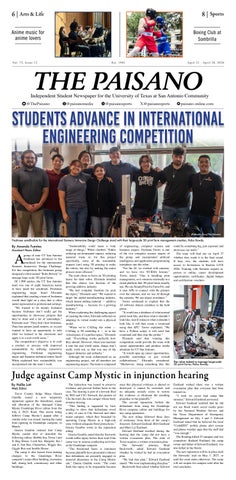
The robot tasked to manage large-scale 3D print farms, Robo Rowdy.
Freshmen semifnalists for the international Siemens Immersive Design Challenge stand with their large-scale 3D print farm management creation, Robo Rowdy.
Marisela Cruz/The Paisano

Fiesta upgrades safety measures folwlowing

Centro CEO continues to encourage security enforcment with SAPD: bag checks, fencing

Fiesta San Antonio continues to upgrade safety and security measures, which were implemented after the 2023 and 2024 shootings. Centro San Antonio, a nonproft organization that works toward the improvement and upkeep of the city, will be working at Fiesta to ensure the safety of all attendees.

The Paisano spoke to Centro President and CEO Trish Deberry about the security measures that will continue at this year’s Fiesta celebrations.

Safeguards such as bag checks and fencing along the perimeter were put in place at Fiesta. Deberry went into detail about the security improvements made.

“Many of the participating member organizations are doing transparent bags, a lot more security regarding off duty police offcers,” Deberry noted. “It could be that they’re charging. They’re also doing bag checks. They’re winding people down.

“And then, of course, we have a heightened security presence with bike patrol all over downtown, and even our ambassador operation with Centro — we’re starting the shift later in the morning so that we can work later into the evening, as a result of safety and making people feel more comfortable with our presence even until 11 o’clock at night.”

Centro’s Crisis Response Team, a unit of former San Antonio Police Department offcers, will act as security at Fiesta this year. Centro coordinates with SAPD to organize their security efforts.

“We are in regular conversations with bike patrol about shifts regarding the Ambassador operation, the crossover coordination with San Antonio bike patrol,” Deberry explained.

According to Deberry, the upgraded security measures at Fiesta de los Reyes helps Fiesta attendees feel safe.

“Fiesta is a lot more family-friendly, so whatever precautions we can take in the safety arena to really promote that familyfriendly atmosphere, it’s all worth it,” Deberry stated.

Deberry described the importance of increased security at Fiesta.

“We no longer live in a world today where we can take safety for granted,” she stated. “We have stepped up. We have heightened precautions because we know it’s important to people.

“Fiesta is a part of our cultural fabric, and we don’t need to necessarily put a negative specter over one of the most important fundraisers. We’ve got to keep innovating, ideating as a space relative to, not only safety and security, but the entertainment factor. All of it.”

Deberry provided some safety tips for Fiesta-goers this year.

Gas prices rise across nation following Iran war

The U.S.’ direct confict with Iran has impacted the country’s supply chain. The war has resulted in widespread damage to Iranian refneries, oil felds, gas plants, ports and other energy infrastructure because of missile and drone strikes between the U.S. and Iran. The confict has increased domestic gas prices and caused economic strains.

Iran is the fourth-largest oil producer, according to the Organization of the Petroleum Exporting Countries. In a country analysis by the U.S. Energy Information Administration, it stated, “At the end of 2023, Iran accounted for 24% of oil reserves in the Middle East and 12% in the world.”

The war has posed a risk to the Strait of Hormuz — a vital waterway located between Iran and the Arabian Peninsula — where about 20% to 25% of the world’s most crucial oil passes through. Any threats or blockages in the Strait result in supply chain disruptions, which create shortages and increase consumer costs.

Iran blocked the Strait of Hormuz. Since then, Iran has stated that the Strait of Hormuz was open for commercial ships, and the U.S. came to a two-week ceasefre deal with Iran; however, neither side negotiated a full agreement. As reported by The Associated Press, Iran offcially closed the Strait of Hormuz again this past Saturday.

The U.S. cannot isolate itself from obtaining oil internationally because if it does, U.S. oil refneries pay more.

Trucking and shipping costs have increased due to the rising cost of gas. In March, spot rates for trucking reached a nationwide high at $3.09 per mile for a fatbed due to diesel costs. When the price of oil rises, businesses offset the

State of the City Week of 04/21

cost by raising prices. Prices of items such as food, consumer goods and travel continue to increase as a result of the U.S. and Iran war.

Gas prices remain high due to the ongoing confict, and the market remains unpredictable. Experts warn once the confict settles, it will take months to years for Middle Eastern oil infrastructure to fully recover and for gas prices to decrease, as they tend to drop slower than they rise.

“Be aware of your surroundings no matter where you are, and if you sense that there’s a problem, ‘See something, say something,’” she said. “Most importantly, remain vigilant about where you are and what you see, and if your gut instinct tells

you something is wrong, make sure you make a phone call.”

If in danger, Deberry emphasized that Fiesta-goers should call 911 for the police or Centro’s number, (210) 224-7747, for an escort.

Professor participates in clinical trials for aging

retirement, I’d see if I could serve as a subject in various medical clinical trials.”

To qualify for RESTOR study two, participants have to be male or female, aged 65-90, in good health, agree to adhere to lifestyle considerations throughout the study and have the willingness to take the study medication as directed. Norman is 75 years old and met the other criteria to participate in the study.

When contemplating how the idea came about for this study, Norman explained previous responses to the medications.

A clinical UT Health San Antonio study on repurposing medications for age related diseases has selected roughly three participants for Rapamycin and Everolimus Study Towards Older Rejuvenation study two. The RESTOR study investigates a family of drugs, mTOR inhibitors, specifcally rapamycin and everolimus. The two drugs are being tested for their role in slowing the aging process. In collaboration with Sam and Ann Barshop Institute for Longevity and Aging Studies, researchers collect data from RESTOR study two participants.

The study, called “Hemodynamic Resilience as a Target for Cardiometabolic Risk Stratifcation and Intervention in Older Adults,” aims to understand how type 2 diabetes and obesity contributes to aging and cardiovascular disease.

RESTOR study two participants partake in clinical trials through a routine schedule of interventions. These interventions may implement drugs, procedures or health practices.

Associate Professor Emeritus of Mathematics Sandy Norman is one of the subjects participating in RESTOR study two’s clinical trial. Norman is on a 42-day course of rapamycin, an immunosuppressant, to test its effectiveness and side effects. The trial is expected to last a year, and its objective is to fnd the optimal dosage of rapamycin.

From Norman’s experience conducting research as a mathematician, he knows it can be diffcult to fnd participants. This was one of the reasons that motivated him to participate in the RESTOR study two clinical trials.

“I can imagine [for] studies in which people are getting poked with needles or taking drugs that are potentially harmful, it’s got to be really diffcult to get people involved,” Norman said. “So after my

“It appears that certain drugs that were being used for other purposes seem to be effective in dealing with cardiologic and diabetes effects,” Norman explained. “I think the particular drugs that they’re looking at have sort of immune response applications, so it’s an approach that hasn’t been used before.”

Norman detailed his experience taking a daily dosage of rapamycin for the past three weeks. No side effects have been documented yet from his dosage amount. So far, Norman has participated in physical tests, mental tests and two blood tests a week for RESTOR study two’s data collection on rapamycin.

Norman outlined the ethical protocols that the researchers put in place for the clinical trial involving human participants.

“They are very clear on the benefts of the study, but also on possible damages,” Norman explained. “Anyone that gets involved in the study can withdraw at any time, no penalties or anything like that. So ethically, I suppose people that are involved in the study sort of have the most complete information they need to make a choice about whether to participate or not, and they have the ability to leave at any point if they feel uncomfortable about what’s going on.”

As long as tensions persist, gas prices are likely to remain high. Continue reading online at paisano-online.com

San Antonio

Not subscribed to local news but still want to stay up-to-date on the happenings around town? Look no further.

Highlighting notable stories from external San Antonio news sources, State of the City summarizes the most captivating news headlines of the week. This week’s topics range from a captured San Antonio fugitive, a new degree program at OLLU and a fatal shooting on a school campus.

Due to the actions of the Lone Star Fugitive Task Force, San Antonio fugitive Issac James Garcia is now back in custody after being captured in Piedras Negras, Mexico. He is on trial for aggravated sexual assault of a child and has evaded local law enforcement efforts in Bexar County for eight years. According to KENS5, Garcia previously attempted to escape detention facilities in 2024. Garcia is now expected to return to San Antonio and face his impending charges.

OLLU presents free master’s degree program

Our Lady of The Lake University has unveiled a new program that allows for students to earn a tuition-free master’s degree starting fall 2026. The program is available to up to 30 students interested in obtaining a master’s degree in cybersecurity, social work or business administration, among other subjects. In order to qualify, students must have an undergraduate degree from OLLU and possess a GPA of 3.0 or higher. Students who receive athletic scholarships are ineligible.

Man dead on school campus after gunshot wound

A 49-year-old man was found dead on Corner Stone Christian School’s campus. On April 12, The San Antonio Police Department responded to a call about a reported shooting in progress on the school’s campus during a weekend athletic event. When police investigated the scene, they found the man inside a vehicle with a self-inficted gunshot wound. The man was pronounced dead, and SAPD noted that the reason for the shooting remains unclear. The investigation is ongoing.

fugitive captured in Mexico
First weekend Fiesta de los Reyes attendees walking in Historic Market Square.
Cooper Bryant/The Paisano

OPINION

Admin fuels Roadrunner dropouts

Despite recent increases in the UT San Antonio graduation rate, bureaucracy

hinders degree attaiment

UT San Antonio has long been mocked for its deplorable graduation rates. In 2010, graduation rates stood at an abysmal 6%. Since then, it has risen to a still disappointing — but higher — 52.64%. UT San Antonio faunts that it dug itself out of the nightmare it endured in 2010 but ignores the work that still needs to be done. The job of increasing matriculation rates does not stop at the classroom; fxing the university requires a holistic review.

First of all, UT San Antonio needs to be an attractive place to work. The average employee salary in 2023 was $59,688, 20.2% lower than at other universities. Reports estimate a single adult would need to earn over $90,000 annually to live comfortably in San Antonio. Professors deserve a quality salary — punishing their pay disrespects academia. Prioritizing hiring quality professors will enhance students’ education and honor the university. Professors are already overworked, with UT San Antonio having a 24:1 student-professor ratio — which is above the national average’s 14:1 ratio. Treating faculty well would ultimately create a better experience for students and keep Roadrunners invested. Essentially, paying professors a rate they deserve and not overworking them

will reduce dropout rates.

The advisor system also desperately needs a redesign. Advisors are overworked and often take a week to respond. Students are meant to have someone to guide them through choosing courses and staying on track. Receiving belowstandard student-advisor communication undermines the process and destroys any chance of it being a productive or useful resource. Having a roadblock right before the

Trump’s ugly memorial horrifies

In honor of the nation’s 250th anniversary that looms ever near, President Donald Trump has called for the construction of a triumphal arch for construction in Washington, D.C., between the Lincoln Memorial and Arlington National Cemetery. Recently, the president released a model of this arch, letting Americans see this proposed memorial, and, boy, is it ugly.

The arch is, in a word, gaudy. The 250-foot monstrosity will be made of marble and gold. On the bottom is the arch itself, an uninspired copy of France’s “Arc de Triomphe.” Sitting atop this arch are two bald eagles, golden, with their wings spread wide, and a winged copy of the Statue of Liberty standing between them. These statues alone add almost 100 feet in height. At the bottom are four golden lions.

The design of the arch fts neatly into the rest of Trump’s architectural ethos of excess. In an executive order last August, he mandated “traditional” and neo-classical designs for all buildings in Washington D.C. previously tore down the East Wing of the White House to replace its historic ballroom with a bloated redesign that dwarfs the rest of building.

Trump appointee Rodney Mims Cook Jr. has called for the replacement of the White House’s traditional Ionic columns, chosen for their simplicity, with the more ornate Corinthian columns — the same style he uses at Mar-a-Lago.

The architecture of Washington D.C. is quite diverse,

Class awareness through fire

Commentary

In Ontario, California, warehouse employee Chamel Adbulkarim was arrested after setting fre to the facility where he worked. The fre caused over $600 million in damages. Adbulkarim posted a video to his social media, showing himself igniting several stacks of toilet paper, while voicing outrage about not being paid a living wage. The incident has been compared to the anti-capitalist celebrity Luigi Mangione. Acts of working-class violence like these are to be expected under late-stage capitalism and can only be quelled by systemic change.

Wealth disparity in America has skyrocketed for decades. President Donald Trump’s administration, at the behest of the ruling party, has gone to great lengths to further the class divide. Tax payer money is spent on

with an interesting collection of neo-classical, modernist, brutalist and even contemporary styles giving the city its particular favor. This arch is too outlandish. While the white marble calls back to the neo-classical style of the Capitol or Supreme Court Building, the gold details are overly bright when compared to the intentional simplicity of true neoclassical design. The gold is tacky and makes the design appear cheap. While the statues on top of the arch are based on famous American symbols, the lions counteract the attempted Americana style. The animal, especially when lounging on its stomach, is heavily associated with the British, such as, for example, the Landseer Lion Statues in London. If one were to see this project completely separated from all context, they might think that the arch would have a view of the Thames instead of the Potomac. dedicated to a nation’s anniversary should follow the tradition of the nation, and Trump’s plan does not. As it stands now, this arch seems less a monument to America and more a monument to Trump. Besides going against good design principles, this arch also disrupts important, established traditions.

The arch’s placement blocks the Lincoln Memorial’s view of Arlington, which historically has always had an unobstructed view of the cemetery and its 16,000 Union soldiers. This arch is disrupting American tradition and taxpayer money. Hopefully, this arch will never be built, and the U.S. will be spared from this golden eyesore claiming to “honor” this country.

losing inhumane wars, while Americans are priced out of gas. Extreme politicization has long kept Americans divided. Citizens are slowly waking to the realization that the system at hand is not only failing but was doomed from the start.

The public has not shown the outrage that media outlets expect of them, similar to the response to Mangione. Out of touch articles from billionaire-funded outlets sob at the loss of shareholder value; meanwhile, the working class cheers. Even during a time of extreme political divide, workers can unite over the joy of watching the system decay.

Americans have been witnessing cracks in American capitalism for the past 20 years. Since the 2008 recession, voters have been seeking change. Whether that change was neoliberal war hawk former President Barack Obama or fascist want-to-be President Donald Trump, the country demands change. Unfortunately, these attempts at change generated no tangible benefts.

The No Kings rallies have seen millions of activists from varied demographics coming together, helping to build an infrastructure of solidarity amongst the general public. Unfortunately, the ruling class could not care less about the opinions of the average worker as long as that worker can still produce value. If voting

fnish line is all but guaranteed to stop ‘Runners from earning their degree.

UT San Antonio continues to shoot itself in the foot by keeping the Coordinated Admissions Program alive. This program is dedicated to admitting students, knowing they are not interested in being a Roadrunner. This system keeps Roadrunners down — it ruins campus culture. Campus culture bruises the UT San Antonio experience like a bad bed sore, a painful caretaker oversight. UT San Antonio needs to promote a unifed campus and enable a culture that does not split after class. CAP harms UT San Antonio’s matriculation rates; there are fewer students attending with the intention of earning a degree. Instead, they are treating this school as a stepping stone. Furthermore, a better campus culture will give students a sense of belonging and will make them less likely to dip before they get their degree. Instead of considering the campus a dropout factory, UT San Antonio should consider dropping CAP.

If UT San Antonio is serious about fxing graduation rates, administrators might actually give a reason as to why they have a job and do some real work to improve the campus.

Rock ‘n Roll snubs once again

Every since 1986, the Rock and Roll Hall of Fame has inducted the most infuential music acts at the cost of snubbing equally impactful artists.

The ragebait this causes is simply a marketing scheme to have more eyes on the award.

The class this year includes the long-awaited inductions of Billy Idol, Iron Maiden and Phil Collins.

the fans, most of the winners of the Fan Vote, which include New Edition, Jeff Buckley, Lauryn Hill and the often-overlooked, yet wildly successful, INXS, did not make the cut.

The rage of comments that the Rock Hall receives every year for ignoring the people’s favorites are not only well deserved, but they are exactly what the Rock Hall wants. The so-called induction committee olympically ignores what the people want. They induct whoever they feel like for the sake of gaining attention and keeping the Cleveland-based award museum alive.

To appease audiences this year, the Rock Hall inducted previous snubs like Afrobeat pioneer Fela Kuti and Latin pop legend Celia Cruz in a “Musical Infuence” category. Having more snubs in other categories creates a broader selection of disregarded talent that go beyond performance and further loses the plot and the original purpose of the Hall — the preservation of Rock & Roll.

The Rock and Roll Hall of Fame desperately needs constant attention from audiophile audiences, but it has to change their rage-based marketing strategy if they want the people to take the award institution seriously. For all the people who are irritated because their favorites got trashed again — wait until next year, they may or may not get snubbed again, depending on how many hate comments the Hall receives.

and protesting do nothing, the voiceless majority has no choice but to act out to infict damage. A system stacked against the average person, ignoring every cry for help, breeds working class violence.

Since the Ontario fre, online discourse has arisen over the ethics of the act. These conversations never arise when companies slash wages, bust unions and lobby against worker rights. There is nothing ethical about the current capitalist system, a system that dehumanizes in mass to

Commentary
Alejandra Garcia/ The Paisano
Sarah Campos/ The Paisano
Sarah Quintanilla/ The Paisano

OPINION

Students themselves paying for Iran war

The ear-shattering sounds of missile strikes and gunboats have bombarded Iran and other Middle Eastern countries for the past two months as the Iran war rages on, with no clear end in sight. Families have been displaced, and many university students in the region have been forced to pause their education, cancel study abroad programs and face other major disruptions. Although most American college students safely sit in their dorm rooms as the confict drags onward overseas, sounds of the Iran war can still be heard in the states: the click of a gas pump and the swipe of a credit card.

The Iran war offcially began on Feb. 28, when President Donald Trump and the Department of Defense ordered large-scale attacks on Iranian military and nuclear assets, including a strike killing the then supreme leader of Iran, Ayatollah Ali Khamenei. After Iran retaliated through attacks on U.S. military assets in the region, the confict eventually culminated in the partial closure of the Strait of Hormuz, a critical passage for about 20% of the world’s oil and natural gas. The confict and closure have led gasoline prices to rocket by

30%, with a trickling effect on the price of nearly every consumer good due to increased transportation and shipping costs. These higher prices are making life more expensive for everyday Americans, driving already out of control infation even higher. An administration’s goal should be making life better and more affordable for its citizens, not sinking taxpayer dollars by waging proxy wars overseas.

Although these price increases affect every American, college students may fnd themselves hit especially hard. A signifcant portion of college students are living on their own for the frst time, some with no monetary support from parents and working part-time to afford necessities, all in addition to going to class. Increased gas prices mean higher costs for commutes, increased grocery prices and less opportunity to drive long distances to visit friends and family. College students already struggle with mental health. Anxiety spurred by a potential recession and international confict is not benefting the next generation of adults. It does not beneft anyone other than politicians trying to mask a struggling administration through political theatre.

Americans, both old and young, are unfairly footing the bill for a war they

did not ask for, conducted by a president who ran on an anti-war platform. Young Americans and their parents’ tax dollars are being spent on a confict with no set end goal. These funds should be going towards building a better future for the next generation through infrastructure, education, job creation and reform programs. The confict over the Strait of Hormuz must end, for the safety of Middle Eastern citizens and the economic welfare of American ones.

Mayor’s letter to DHS does nothing

THE PAISANO

Staff Commentary

Editorial Board

Jasmine Williams | Editor-in-Chief Editor@paisano-online.com

Cruz Delgado | Managing Editor Manager@paisano-online.com

Marisela Cruz | News Editor News@paisano-online.com

Henry Holmes | Opinion Editor Opinion@paisano-online.com

Audrey Villar | Arts & Life Editor Arts@paisano-online.com

Rylan Renteria | Sports & Photo Editor Sports@paisano-online.com Photo@paisano-online.com

Hallie Lott | Web Editor Web@paisano-online.com

Sarah Quintanilla | Graphic Editor Graphic@paisano-online.com

Regan Williams | Multimedia Editor Multimedia@paisano-online.com

Valentina Quintanilla | Magazine Editor Magazine@paisano-online.com

Karis Vickers | Social Media Editor Socialmedia@paisano-online.com

Jaclyn Banda | Business Manager Business@paisano-online.com

Emma Cavanaugh | Distribution Manager Distribution@paisano-online.com

Johnpaul Buwule | Marketing Manager Marketing@paisano-online.com

Cameron Carter | Copyediting Coordinator Copyediting@paisano-online.com

Mayor of San Antonio Gina Ortiz Jones sent a letter to the Department of Homeland Security about U.S. Immigration and Customs Enforcement’s

new northeast-side deportation warehouse. To date, the last notice indicates that no reply has been received. San Antonio is a city built by immigrants, known for its cultural diversity and Hispanic heritage. This makes it ironic that San Antonio has been chosen for the development of a warehouse to hold DHS detainees before they are deported to mostly Latin countries. The city should be doing more to prevent the mistreatment of the various populations that give San Antonio its storied history.

Other cities on the frontline of the immigration crackdown have successfully stopped the ICE deportation centers by utilizing zoning, city ordinances and lawsuits. ICE warehouses have been under nationwide scrutiny for their poor conditions and lack of proper food and medical care available to detainees.

Keeping human beings in a warehouse like objects is not ethical, yet Jones sent only a single letter to the DHS secretary. Public outcry against the detention

center in San Antonio has become so great that city politicians must take notice or risk losing constituent faith. On April 16, the City Council voted to create a new city ordinance preventing the development of deportation warehouses within city limits. The new ordinance does not affect the warehouse that has already been bought by DHS on the northeast-side of San Antonio. Not only should new deportation holding sites be stopped, but so should the development of the existing warehouse. Unless San Antonio citizens continue to vocalize their complaints and concerns to the mayor, the apathy of the city will open doors for the DHS to continue their inhumane practices. Jones is in offce by the consent of the people and should take the concerns of San Antonionians seriously. Without further action, San Antonio will become known not for its diversity or culture but as a deportation site. Citizens should continue to appear at city council meetings, join demonstrations and make their voices heard.

Texas gov’t breeds tyrannical oversight

The Texas State Board of Education on April 3 gave preliminary approval to a mandatory book list that all public schools will teach starting in 2030. The list includes the Bible and prohibits books by minority authors such as Frederick Douglass. While Republicans licking the boots of lobbyists and singing their hatred for diversity is hardly news, this blatant attack on religious freedom coincides with several other laws and actions meant to dismantle public education and instill Christian supremacy.

With Project 2025 — an extremist, far-right, Christian nationalist political initiative — as the playbook, Texas Republicans have preached their oh-sovalid concerns about public education in favor of privatized charter schools. They have passed frivolous laws like Senate Bill 11, which requires schools to have designated, albeit voluntary,

prayer periods. Not only are these bills and arguments unpopular, but they fy in the face of founding American values. It should come as no surprise that organizations like the American Civil Liberty Union are suing.

In fervor, it can be easy to forget that the legal precedent is extremely matter-offact: a resounding rejection. Beyond the Establishment Clause, the Supreme Court and lower circuits have sided with secular education for decades. In the 1963 case Abington School District v. Schempp, the Supreme Court ruled that schoolsponsored Bible reading before class was unconstitutional. Justice Tom Clark wrote the majority opinion of the Court.

“This Court has rejected unequivocally the contention that the Establishment Clause forbids only governmental preference of one religion over another,” Clark summarized.

Past precedent, these agendas are an affront to public education itself. Americans are vastly in favor of public education and services like libraries,

and Republicans have done nothing but disrespect that will. Project 2025 is explicit in saying that “ultimately, the federal Department of Education should be eliminated,” and that librarians and public educators should be imprisoned for distributing “diversity, equity and inclusion” material. Republicans, either out of fear, cowardice or genuine support, continue to play along. America was built on the ideal of equality for all, and by vilifying institutions meant to exemplify this tenet, Republicans show exactly how little they care about America.

The common good and founding ideals like religious freedom are not disposable, not a stomped-out cigarette butt on the sidewalk; they are invaluable and cornerstones of a happy, healthy society. If Americans want the rule of law to be more than a bygone relic, now is the time to act. Vote, hold demonstrations and support those who value not only the Constitution but public institutions and interests. Texas children deserve an agnostic education.

Te Paisano is published by the Paisano Educational Trust, a non-proft, tax exempt, educational organization. Te Paisano is operated by members of the Student Newspaper Association, a registered student organization. Te Paisano is NOT sponsored, fnanced or endorsed by UT San Antonio. New issues are published every

during the

and spring semesters, excluding holidays and exam periods. Te Paisano is distributed on the UT San Antonio Main Campus. Additionally, Paisano publications are distributed at a variety of of-campus locations, including Tri-point and a variety of apartment complexes near the UT San Antonio Main Campus. All revenues are generated through advertising and donations. Advertising inquiries

Cruz Delgado/ The Paisano

ARTS & LIFE

As UT San Antonio students and San Antonians walked onto the Sombrilla on April 17, they were greeted by sights of confetti, fower crowns and the dances and cheers of people celebrating the 48th annual Día en la Sombrilla, the school’s celebration to kick-off Fiesta.

Walking down the steps by the formidable Rowdy statue, Fiesta-goers were greeted by the swaying and swishing dresses and rhythmic movement of members of UT San Antonio’s Ballet Folklórico. The dancers joined arm-in-arm with attendees of all experience levels as they spun across the Sombrilla. Further into the festival, booths galore lined the plaza, creating a maze of edible delights for students to devour. Club representatives paraded the rows holding signs advertising their organizations’ delectables, while attendees lined up to be the frst to try the tostadas, fajita quesadillas and more being served by student organizations.

The Pre-Physician Assistant Society sold loaded chips to fundraise for their organization. Senior kinesiology major and Fundraising Coordinator Ashley Garcia ran the

Letters

Salve, studenti di UT San Antonio!

This week, the College of Liberal and Fine Arts’ students abroad visited the enchanting hillside city of Assisi. This is where Saint Francis, the patron saint of ecology, began his mission of divine peace. People from all over the world fock here to visit the former home of Saint Francis and his devout follower, Saint Clare. When people are not visiting one of the saints, they are likely exploring the natural beauty within Assisi by wandering through one of the several natural reserves in the city.

Edmond Cartagena and Sofa Cabada led a tour of Assisi during this trip. Cartagena began by discussing the importance of Saint Francis in the city of Assisi and his journey to renowned sainthood. He noted that after Francis had a prophetic vision, the saint started restoring a church in Assisi known as San Damiano. This mission of his led Francis into a life guided by Christ-like humility. This humble attitude is what allowed Francis to be so connected to the world of ecology. The Assisiano saint became so connected to nature throughout time that he referred to the elements of nature as “brothers” and “sisters.” He is also known to have preached to lambs, fsh and birds, all of which were interested in hearing his message. Cabada focused on Saint Clare for her part of the presentation. Clare was taught by Francis, and

booth and discussed the gratifying experience.

“I honestly really like how UTSA allows us to run this because we are in a very Hispanic serving community, and being able to celebrate that culture — the Hispanic side, the Mexican side, any type of culture in the Latin American community — is just really great,” Garcia said.

The Texas heat plagued Día en la Sombrilla, but one could not notice it from looking at the attendees. Students danced to their heart’s desire, performing the “Payaso de rodeo” line dance and grooving to Bad Bunny, while those in need of a chill purchased aguas frescas and Jarritos from the booths.

Food and refreshments were not the only goods being sold at the colorful booths. One handed out cascarones, traditional Mexican eggshells flled with confetti, for Fiesta-goers to smash on each other’s heads. Proof of the activity was evident everywhere one looked, with small but vibrant circles of confetti scattered across the Sombrilla.

Attendees could adorn their heads with fower crowns made of UT San Antonio’s colors that could be purchased from a booth, while the American Society for Microbiology’s booth across the plaza offered a mini basketball trial with prizes of varying values coinciding

ultimately followed in his footsteps. She founded the second Franciscan order, which is known widely as the “Poor Clares.” These women were known for their widespread benevolence, which was based on poverty. The Poor Clares built a community, which was quite different for the period, as it was uncommon for women to hold important societal roles. Clare’s order also lived in humility because they wanted to connect to groups who were closer to poverty, as they believed that this was the way they were meant to live if they were going to serve a divine purpose. is known for the presence of these two very important saints and remains an important religious center to this day. Its beautiful medieval streets blend well with landmarks such as the 14th century castle Rocca Maggiore and the wildlife trail called Bosco di San Francesco. At Rocca Maggiore, visitors can see the rolling hills from the top of Assisi, and they can envelop themselves in the spirit of the patron saint at Bosco di San Francesco. The spirit of Assisi creates a warming and pleasant environment for visitors of week, the class of COLFA students will say goodbye to Urbino. It has been a beautiful voyage; however, all good things must come to an end! Read the fnal article next Tuesday, and do not forget to keep up with academics abroad by following @lettersfromurbino on Alla prossima, Studenti. Ciao!

f i e s ta a f i n d s h o m e

with the number of baskets scored.

The DJ sat in his makeshift stage, hosting contests for the duration of the event. In the “Guess that song” game, he had volunteers try to name the artist of songs such as “Bidi Bidi Bom Bom” by Selena.

Later on, eager contestants lined the stage to compete in a mystery contest: a grito competition. An anticipatory aura settled over the crowd as the frst contestant went up, giving a polite grito into the microphone. The remaining gritos ranged from meek to boisterous, nervous contestants still giving it their all. As each potential winner was offered up to a test of applause, two girls tied and won UT San Antonio Fiesta medals.

Freshman chemical engineering major Monique Nnate, one of the winners, descended the stairs to the cheers of her friends. She described how she did not expect to win the contest at her frst ever Fiesta at UT San Antonio.

“I just came out here to support all the organizations,” Nnate said. “I loved watching the Ballet Folklorico dance, and I just love seeing all the Mexican culture.”

Students left Día en la Sombrilla with UT San Antonio Fiesta medals, shirts, full bellies and appreciation for Mexican culture, ready for a siesta after hours of dance and celebration.

Finals, AI ‘Love Island,’ festivals

Bird On The Street Week of 4/21

As April slips into the fnal stretch of the semester, students fnd themselves caught between the stress of rapidly-approaching fnals and spring festivities. From Coachella discourse to questions about artifcial intelligence, students are moving through real-world events and internet noise.

This week on Bird on the Street, The Paisano interviewed freshman artifcial intelligence major Cris Vasquez, freshman kinesiology major Emmanuel Carrillo, sophomore hospitality and event management major Sienna Jackson and freshman English and sociology major Zoey Yackel.

If you had a booth at Día en la Sombrilla, what would you sell?

Día en la Sombrilla brings out creativity. Vasquez kept it practical, sharing, “I would sell food, and then whatever is left, I would just eat it.” Carrillo leaned toward style, saying he would resell clothes. Jackson and Yackel considered a more handmade approach. “I’d probably make a bunch of crafts whether it’s like coloring or like gluing stuff together,” Jackson explained. Yackel said she would sell university-themed crochet.

ARTS & LIFE

Carpenter commits heinous ‘House Tour’ heist

The Pretty Girl Clean-Up Crew continues Sabrina Carpenter’s alter ego, Bambi, who is on the run following the “Tears” music video. Making a pit stop at a Malibu-esque, 70s, million-dollar mansion ft for a bachelor, Carpenter, Margaret Qualley and Madelyn Cline star in the “House Tour” music video. Four days before Coachella weekend one, Carpenter set the tone for her Hollywood headline dreamscape. Carpenter’s music video was intoxicating in feminine energy and inviting to women who want to explore sexual liberation.

The three sexually-charged women raid the house of all its knick-knacks and girly delights, treating it as a candy store to rob. Inspired by “The Bling Ring,” Carpenter’s love for the flm industry is seamlessly sewn through her album tropes of temptress women with a cinematic plot style. The women have the time of their lives, feeling uninhibited in the crime that they commit. Anyone watching the “House Tour” music video can not help but think, “How can something so bad look so good.”

Although Carpenter’s 2025 album is called “Man’s Best Friend,” female friendships have been a core theme

Longevity in Tejano music

Oyster Bake at St. Mary’s University is one of the oldest Fiesta traditions in San Antonio. The event started in 1916 as an alumni gathering and has now grown to a large event with three headliners of different genres. One of this year’s Tejano stage headliners was David Farias y La Tropa F, who took the stage on Friday. La Tropa F is a Grammy nominated Tejano band that originated in San Antonio. The Paisano spoke to David Farias about his music career.

Q: What does Tejano music mean to you?

DF: It’s a variety of music. When I started, I started in a conjunto. A conjunto is a four-person band. There’s a lot you could say about Tejano music. It means a lot to me. There are a lot of questions where we could be here all night talking about Tejano music.

Q: Do you feel a responsibility to preserve Tejano traditions in music?

DF: Yes, for me, I have to do what I have to do 100% as far as playing the music and making sure I am playing it right for the people. It’s a variety of music that I grew up with, and it’s so important to me that I honor it right.

Q: You all have been in the industry for a long time, so how does it feel to continue performing at Fiesta in 2026?

DF: I haven’t been here, [Oyster Bake], in nine years. That was the last time I performed here. We have been contacted a few times, but our schedules didn’t work. I thank god that I am booked all the way up to December. It’s a blessing. I’ve been in business for 50 years. I try to give 300% for the people.

Q: Since you all have been able to continue performing and remain popular for so long, what do you think differs from your band to other Tejano artists?

DF: Our style became unique. I started off inspired by a lot of musicians like Tony De La Rosa, all the older artists that were in the area when I was young. I tell the younger generation it’s good to do that, but somewhere in the middle, you have to create your style so they can identify you. Back in 2010, I won the American Grammy. I toured with Los Texmaniacs. We toured to China, Argentina, Germany, Austria. We did four tours overseas. The music can take you around the world to play it for everybody. I’ve tasted a bit of the world, but nobody beats San Antonio. It’s the heart of Tejano.

Tejano music has remained a crucial role in San Antonio’s culture. David Farias y La Tropa F are one of the San Antonio Tejano legends who help keep the culture and Fiesta alive. It’s important to preserve the tradition and sound of Tejano music.

throughout her music videos. These relationships can be sexually suggestive but are full of thrills and frills nonetheless. Women watching Carpenter take control of sexual suggestions in an unrestricted way, vile and resentful reactions are justifed; however, in the end, girls just want to have fun. Carpenter sends out an invitation to all women who enjoy her music and aesthetic to join the fun of tapping into their sensual nuances.

Sweet pheromones, frilly lingerie and erotic foreplay are abundant in Carpenter’s tour, featuring strip tease shots going along with her lyrics describing the frst, second and third foor of her house. Carpenter does have controversial faults throughout her consistent portrayal of attractive women’s intelligence. When Qualley, Cline and Carpenter see Leonardo Da Vinci’s “Mona Lisa,” their faces squirm with perplexity, but they shriek and dance when they fnd shiny metallic panties in the drawers to steal instead. The gorgeous looks but ditzy personality is Carpenter’s trademark, and it is not leaving anytime soon.

Nonetheless, Carpenter has created a world of her own: custom in traditional old Hollywood glamor and unconventional archetypes of women. Following Bambi’s frst arrest on a beach in the summer of

Live music for anime lovers

Anime — a style of animation and production that looks into Asian culture — had an overlooked component put on full display by the UT San Antonio University Band: its music. From the action-packed “Attack on Titan” to the homely soul of “Spirited Away,” the band’s vitality honored childhood classics and keystone anime. The band’s methodological play followed the unravelling story projected onto the screen above the band, magnifying the emotion and momentum building — even if no words were spoken.

The University Band performed “Anime Music,” celebrating the art and music-driven storytelling of anime. The band played medley songs from staple anime, such as Studio Ghibli’s “Princess Mononoke,” “KPop Demon Hunters” and the surprise “Pokémon” theme song.

Before beginning their masterfully curated selection, the band erupted in a disjointed and asymmetrical burst of sound, warming up their instruments. The frst piece from “Attack on Titan” began with the iconic cry of a choir, followed by the band’s melodic intensity, refecting the ferce expressions and chaos ensuing on the big screen.

The dynamic mixture between the band’s careful instrumentation of each piece and their ability to accurately portray the anime’s feelings and characterization highlighted the performance, giving each song its own distinctive identity. For instance, the crescendos and light thumps of the tuba mimicked the Studio Ghibli anime “March Medley.”

The band continues encapsulating emotion along the unravelling plot of the anime. In Ghibli’s “Princess Mononoke,” the song begins with a tune riddled with caution and warmth, warning the audience to stay vigilant. The anime progresses into characters standing on the plateau, while looking at the beautiful, vegetated hills under the shimmering and gleaming sky. In this moment, the melody switches tone from cautionary to rosy. The band’s melodic rhythm captures the anime’s emotive atmosphere: a gust of optimism. The sweet warmth of the sun in the cold of winter.

The band’s versatility is illuminated during “Golden” from “KPop Demon Hunters” and the theme song from

the cyberpunk and neo-noir series “Cowboy

For the cowboy anime, the band’s excitement shone through, playing with intensifying power and a loose manner that encircled jazz, reminiscent of the show’s dark animation. The fast pace and individual solos created a thrilling spectacle. The alto, tenor and baritone saxophone solo, along with the trombone, gave the audience a pleasant surprise.

Fiesta captures festival spirit

Orange, teal and pink streamers with confetti broke up the gloomy skies downtown on April 19 as local artists congregated at the UT San Antonio Southwest campus to display their works at the annual Fiesta Art Fair.

Walking through puddles into the fair, visitors were welcomed by a wide array of paintings, ceramics, photography and more set against the backdrop of the limestone UT San Antonio School of Art.

Christine Sisco is a woodworker with a distinct style of embedding turquoise and other beautiful rocks into furniture. She stated, “I love the fair and the way it brings all these talented, beautiful people together.” She has enjoyed the arts fair for the last 40 years.

The fair was also surrounded by the aromas of tantalizing snacks for any taste; juicy chicken on a stick, cheesy street corn and refreshing mango lemonade were all fan favorites, with crowds lined up for each despite the relatively meager attendance.

Painter Mitch Oviatt remarked that this was his second art show displaying his pieces, and he was excited to have the opportunity to progress as an artist and learn from the community.

“Yeah, I’ve had more free time lately with my real job, so I use art to really make sense of the world around me and hopefully bring people together,” Oviatt refected.

Oviatt’s layered paintings depicted nature and

wildlife in the south in an impressionistic and “psychedelic” inspired style; he used specialized techniques to manipulate the way light bounces off his paintings to provide a more photorealistic result.

The relaxing frequencies of steel pans could be heard throughout the venue, originating from musician Johnathan Neumann’s booth.

“Ever since I was a kid I’ve been making music and my dad was a metalworker so I put two and two together and now I make these drums,” he explained. Neumann repurposes old and trashed gas tanks, turning them into drums with a serene timbre.

At the end of the line, UT San Antonio art student Arnaldo Deane could be found. The young artist explained how the school helped him develop his signature style and evolve artistically.

“I’m grateful for this environment where I can learn from so many great artists and learn so much that I wouldn’t know a thing about otherwise,” he noted.

Deane’s paintings drew from Latin culture — specifcally Puerto Rican culture — to create intricate images that refect the world today.

Despite the clouds, the artists of this event made their passions shine. Each one of them had creative works that displayed a great sense of resilience and overcoming adversity. Whether it be Sisco’s furniture showing that imperfections can hold a being’s true beauty or Neumann’s drums displaying that the world’s beauty can come from the most unusual places, this art show, much like the city that hosts it, is all about resilience.

Amie Schneider/ The Paisano
Bebop.”
Catherine Salonga/ The Paisano
Aidan Moreno/The Paisano
Nalani Cox/The Paisano

Gunnar Brown, Connor Kelley lead UTSA to game 1 victory

SAN ANTONIO — After giving up fve runs in the top of the second inning, UTSA baseball went on to score nine unanswered, handing the University of North Carolina at Charlotte an 11-5 loss on Friday at Roadrunner Field.

The Roadrunners (26-12, 9-4 American) led by two after the opening inning but quickly fell behind after a second-inning fve-spot from the 49ers (18-19, 3-10 American). Rather than bowing out after a rough top half of the second, UTSA responded with four runs of its own to retake the lead. Senior starting pitcher Gunnar Brown eventually settled in on the mound, and when Charlotte started getting to him in the ffth, junior pitcher Connor Kelley checked in and tossed 4.1 scoreless. Junior outfelder Lane Haworth put a bow on the win with a two-run blast in the bottom of the eighth.

Full recap at paisano-online.com

Roadrunners outlast 49ers, secure series win

SAN ANTONIO — Sophomore infelder Jordan Ballin and sophomore utility Caden Miller combined for four RBIs as UTSA baseball locked up its series against the University of North Carolina at Charlotte with an 8-3 win on Saturday at Roadrunner Field. UTSA (27-12, 10-4 American) led by four through fve innings. Graduate pitcher Conor Myles

SAN ANTONIO — UTSA soccer’s offense struggled to fnish during its match against St. Mary’s University, while its steady defense could only hold the Rattlers at bay for so long. St. Mary’s forward Elena Kossler drilled a second-half goal that led to the Roadrunners losing 1-0 on Sunday at Park West Athletics Complex.

The Roadrunners looked sluggish, often making easy mistakes and failing to connect passes. Possession between the two teams was even throughout the game, but both neglected to capitalize on the chances they created. The Roadrunners’ defense continually served balls to the front line, but forwards were not successful in converting from the passes they were given. Similarly, St. Mary’s chances were mostly offtarget or easily scooped up by redshirt freshman goalkeeper Jaelyn Bracamonte.

“We typically are a very gritty, tough team [and] competitive. Some of our mentality today from some of the players was a bit frustrating,” coach Derek Pittman said. “Losing 50/50 balls, typical balls that we are pouncing onto and making a difference of and trying to play some quality soccer out of that, we weren’t even getting to those balls because St. Mary’s was outworking us.”

The frst half ended in a stalemate between the two teams. A hope for a break in the tie came in the 10th minute, when sophomore midfelder Emelie Eckman fred a shot from the top of the box, hitting the crossbar and bouncing down near the goal-line before it was scooped up by the Rattlers goalkeeper Quetza Garza.

At the start of the second half, it seemed for a

started for the Roadrunners and held the 49ers (18-20, 3-11 American) scoreless throughout the duration of his appearance. Charlotte made the game interesting after cutting its defcit down to one run in the seventh, but Ballin, Miller and senior outfelder Drew Detlefsen put the 49ers’ hopes of a comeback to rest with some late-inning insurance runs.

Full recap at paisano-online.com

moment that the Roadrunners might have found their footing. A fruitful 60th minute chance off a corner taken by redshirt freshman midfelder Leah Varela into a crowd of players showed promise, but Garza ultimately cleared out the ball.

The Rattlers’ goal, which came in the 68th minute of the game, defned the second half. Kossler drove her way through the Roadrunners’ defense and lobbed the ball over Bracamonte for the fnish.

After the Rattlers’ goal, UTSA’s pace dropped, and its possessions became sloppy. The Roadrunners’ defense held strong, but the offense failed to fnd an equalizer. They struggled to put together meaningful plays, going back-and-forth with St. Mary’s in possession. The team seemed to regain its energy in the last few minutes, but ultimately, it was too late to make a difference.

“Our goal today was to fnish this spring on a high note and actually show that we can put into place all the things that we’ve been working on. Unfortunately, we didn’t do that,” Pittman said. “I look at the spring as a bit of a race. How you fnish it matters, and we didn’t fnish it well. We limped across the fnish line today. We got punched in the mouth for it.”

UTSA soccer will return in August for the 2026-27 season.

SAN ANTONIO — UTSA baseball left 10 runners on base in its 7-5 loss to the University of North Carolina at Charlotte on Sunday at Roadrunner Field.

The Roadrunners (27-13, 10-5 American) had plenty of chances to secure their frst American Conference sweep of the season in their fnale against the freefalling 49ers (19-20, 4-11 American) who entered Sunday on a 10-game skid. In the frst inning, UTSA loaded the bags with zero outs but left the inning with just one run. The Roadrunners stalled offensively until the later innings which they cut into their defcit with four runs across the sixth, seventh and eighth. UTSA could not muster up the tying run in its fnal opportunities at the plate, resulting in its ffth American defeat.

Full recap at paisano-online.com

SAN ANTONIO — Spurs center Victor Wembanyama scored a franchise-record 35 points in his playoff debut, leading San Antonio to a 111-98 game one victory over the Portland Trailblazers Sunday at Frost Bank Center.

The MVP candidate shone bright in his frst playoff game, breaking former Spur Tim Duncan’s scoring record for points in a playoff debut. Wembanyama, along with his fellow teammates, dominated the Blazers in every facet of the game. Five Spurs scored in double fgures, including guard Stephon Castle, who made his playoff debut with 17 points. Defensively, San Antonio terrorized Portland. With Wembanyama anchoring the paint, the Blazers’ offense was nonexistent outside of guard Deni Avdija who scored 24 points. Every Portland scoring run was quickly cut off by a timely score or crucial defensive stop. With dominance on both sides of the ball, San Antonio developed and held a near 20-point lead for the entirety of the contest. Portland attempted a brief scoring run late, but Wembanyama answered nearly every Blazer point with a score of his own.

A 21-point frst-half explosion from the Spurs’ center propelled his team to an early double-digit lead. Though the Trailblazers managed to slightly shorten the defcit, San Antonio held the advantage. Wembanyama continuously scored with every trip down the court, creating offense at the rim, midrange and beyond the arc. The center showed no signs of nervousness, scoring nine of his 21 in the frst quarter.

Led by Wembanyama, the rest of the Spurs quickly settled in. The team took advantage of size matchups and punished Portland’s defensive switches. Guard De’Aaron Fox scored 10 of his 17 points in the opening half, and six Spurs scored. Defensively, San Antonio forced Avdija to carry the scoring load. Avdija scored 19 in the half, but none of his teammates broke doubledigit scoring. San Antonio headed into the half with a 59-49 lead, after forward Keldon Johnson knocked down a three at the halftime buzzer.

Full recap at paisano-online.com

Outfelder Lane Haworth slides in game 1 v. Charlotte on Friday at Roadrunner Field.
Outfelder Christian Hallmark points at a teammate in game 2 of UTSA versus Charlotte on Saturday at Roadrunner Field.
Sophomore forward Ava Jackson (left) and sophomore midfelder Bri Carrigan (right) battle St. Mary’s defenders.
Infelder Jordan Ballin swings his bat in UTSA’s series fnale on Sunday against Charlotte.
Ana Sofa Corral/The Paisano

SPORTS

float like a butterfly, sting like a . . . roadrunner?

Boxing Club takes center stage at Sombrilla

BOOM. After exchanging heavy jabs and crosses, a fghter takes a knee, his glove presses the ground to hold him steady. While his eyes look down at the ring’s blue foor, an eager crowd of spectators erupts in cheer, displacing the silence following the blow. It was bout one, round one of the UT San Antonio Boxing Show in the Sombrilla, and anticipation flled the air. The referee began counting: “One, two, three, four.”

The Boxing Club was hosting 10 fghters to face off in fve three-round bouts on April 15. Every competitor carried their own aspirations, some heavier than others.

“I’m fghting on behalf of the entire Black community. Black women, especially, we are constantly overlooked,” senior Jasmine Williams expressed. “I will prevail for them.”

Williams, The Paisano’s Editor-inChief, faced off against junior Emma Cavanaugh, the publication’s Distribution Manager, in the third bout.

Others emphasized self-growth.

“It’s not really a matter of going to war with this guy. I love this guy,” freshman Andrew Cox professed about his opponent. “I’m just trying to beat me.”

“Five, six, seven, eight,” the ref continued. Ramos Boxing Club fghter Devin Rodriguez rose to his feet, locking eyes with Cox, his opponent. In round two, Rodriguez cautiously advanced. Cox took the offensive and scored key shots to the face. Rodriguez attempted to recover ground in the third round, forcing Cox to continuously retreat. After a frenzied fnal 10 seconds — both fghters abandoning defense — Cox emerged victorious in a split decision.

The crowd swelled during bouts one and two, but it came to life in bout three.

Round one began, and Cavanaugh rushed forward, but Williams responded with cross-jabs to the face. After 20 seconds, the pair entered a war of attrition, trading a high-velocity stream of punches. When they split, the crowd’s voluminous applause and encouragement pushed them back together. Trades were even, but Williams took advantage of breaks in action to slip in additional hooks. By the third round, though, Williams was exhausted, and Cavanaugh pushed her into a corner. Despite Cavanaugh’s comeback, Williams walked away with the win.

If bout four between freshman Anthony Vasquez and junior Adam Farra was heavyweight power-lifting, bout fve, featuring senior Angel Figueroa and junior Joshua Bamisebi, was a dance. Long, patient pauses broke up otherwise rapid-paced matches. Figueroa continuously evaded Bamisebi’s reach advantage, waiting to close distance. Only

in round three was Bamisebi able to trap Figueroa, pinning him tucked against the ropes, beginning a 10-count for Figueroa. Despite this short-fall, Figueroa’s superior movement crowned him bout fve’s winner.

Between triumph and defeat, every fghter appeared satisfed with their performance.

The club’s founder, senior Cameron Rankin, also discussed the organization. According to Rankin, the club is seeking university support and funding. He hopes, eventually, it can be an offcial university club sport.

“Imagine the birds on the uniforms. That would be really cool,” Rankin dreamt.

For now, the Boxing Club meets Tuesdays, Thursdays and Fridays from 3:30-5:30 p.m. in the feld between the John Peace Library and the Arts Building.

Soccer hosts former players in annual alumni game

SAN ANTONIO — UTSA soccer

alumni returned to the Park West Athletics Complex to play against the 2026 roster on Saturday for a scrimmage. Current players came into the game with ambition to show the alumni how skilled they are after winning the American Conference in November. The 2026 roster narrowly defeated the alumni 2-1.

According to coach Derek Pittman, the alumni scrimmage has become an annual tradition set to honor those who played before the current team at UTSA.

“One of the big things we talk about in our program is leaving the jersey in a better place,” Pittman emphasized. “So,

regardless of what jersey number these alums wore during their time here, we talk about all the time that it is more than just themselves. It’s about our program, our university and it’s about our athletic department moving the needle forward in a positive direction.”

Inviting the alumni back out to play every year has become an opportunity for current players to see how far the program has come.

For Saturday’s game, the alums had something to prove to the current team, according to Pittman, but, sadly, that proof did not come in the form of a win.

Starting at 1 p.m. sharp on a blistering cold Saturday, family and friends watched a neck-and-neck game that left the alumni gasping for air against the current team’s

energetic presence on the feld. In the end, the current team’s two goals during the frst half helped them defeat the alumni team who scored one goal during the second half.

Junior midfelder Addi O’Kelley and sophomore midfelder Bri Carrigan have played against the alumni in years before. The pair understood their team was approaching this game as a regular season game.

“We wanted to show the alumni how hard we’ve been working and how we’ve left their legacy in a better place,” O’Kelley said.

“[Coach Pittman] said let’s play like we always do and show them what we have been doing this school year,” Carrigan said.

Although the alumni lost, Saturday felt

like a win as they played an intense game against their former teammates. Former UTSA midfelder Michelle Pollo and 2022 graduate defender Kendall Kloza were content playing against the 2026 roster team.

“I was just happy to be playing with people that I know and just wanted to have fun,” Pollo exclaimed. “It’s a different kind of game. You just play without any expectations.”

Kendall Kloza was excited to play against her sister, graduate defender Kameron Kloza.

“I wanted to make sure we put up a few good goals and talk some smack a little bit, but mostly just having fun,” Kendall Kloza said. “Like, we’re never supposed to win these games. It’s really just about getting back out and being with the team.”

Alumna Kim Line (left) attempts a shot against sophomore Brooklyn Bailey (right).
Alumna Kim Line (left) fghts with sophomore midfelder Emelie Ekman (right).
Freshman Andrew “Drew” Cox (left) punches Devin Rodriguez (right) in the mouth during UT San Antonio Boxing Show on Wednesday, April 15, at the Sombrilla.
Blue Mize/The Paisano

Turn static files into dynamic content formats.

Create a flipbook