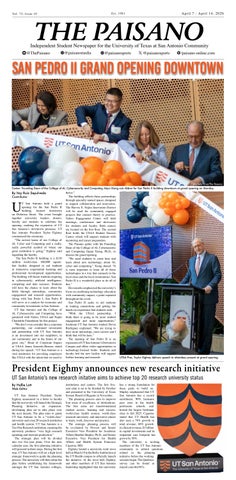
San pedro II grand opening downtown

UT San Antonio held a grand opening for the San Pedro II building located downtown on Dolorosa Street. The event brought together university leaders, donors, faculty and students to celebrate the opening, marking the expansion of UT San Antonio’s downtown presence. UT San Antonio President Taylor Eighmy commenced the ceremony.
“The newest home of our College of AI, Cyber and Computing and a really, really powerful symbol of where our great institution is going,” Eighmy said regarding the facility.
The San Pedro II building is a $130 million world-class 180,000 squarefeet facility designed to aid students in immersive experiential learning and professional development opportunities. The building will house students majoring in cybersecurity, artifcial intelligence, computing and data sciences. Students will have the chance to learn about the felds through internships, community engagement and research opportunities. Along with San Pedro I, San Pedro II will serve as a catalyst for economic and community investments in San Antonio.
UT San Antonio and the College of AI, Cybersecurity and Computing have partnered with Valero, USAA and Najim Charitable Foundation for this project.
“We don’t even consider this a corporate partnership, our continued investment and partnership with UT San Antonio is an investment into our neighbors, in our community and in the future of our great city,” Head of Corporate Impact at USAA Jenna Saucedo-Herrera stated during her speech. “UT San Antonio is a vital institution for providing employers like USAA with the talent that we need to
The building refects these partnerships through specially-named spaces, designed to support collaboration and innovation.
The Harvey E. Najim Innovation District will be used for community engaged projects that connect theory to practice. Valero Engagement Center will hold meetings, conferences and showcases for students and faculty. Both centers are located on the frst foor. The second foor holds the USAA Student Success Center, which will support students with mentoring and career preparation.
The Paisano spoke with the Founding Dean of the College of AI, Cybersecurity and Computing Jinjun Xiong, Ph.D., to discuss the grand opening.
“We need students to come here and learn about new technology, about AI, cyber and computing,” Xiong shared. “It is most important to learn all of those technologies in a way that connects to the local cities and the local communities. San Pedro II is a wonderful place to do all of this.”
His remarks emphasized the university’s focus on combining technology education with community impact, a point repeated throughout the event.
San Pedro II seeks to aid students in making connections and getting the hands-on experience that students seek.
“With the USAA partnership, I think there is going to be more student engagement and more opportunities,” freshman UT San Antonio student Devin Rodriguez explained. “We are trying to have more internships, more careers and I think that will be here.”
The opening of San Pedro II is an expansion of UT San Antonio’s Downtown Campus and offers wider opportunities in technology-focused felds. Students and faculty feel the new facility will support further learning and research.

President Eighmy announces new research initiative
UT San Antonio’s new research initative aims to achieve top 20 research university status
By Hallie Lott Web Editor
UT San Antonio President Taylor Eighmy announced in a letter to faculty that the university will launch the Strategic Planning Initiative, an expansiondeveloping plan set to take place over the next decade. The plan aims to guide UT San Antonio to be a “world-class” university and a top 20 research institution and health system. UT San Antonio is a Tier One Research institution, meaning the university produces “very high research spending and doctoral production.”
The strategic plan will be divided into two fve-year plans. Over the next calendar year, the frst planning initiative will proceed in three steps. During the frst step, UT San Antonio will set a high-level strategic framework to guide the planning process. The university will then refne the plan before establishing the framework amongst the UT San Antonio colleges,
institutions and centers. The frst fveyear plan is set to be fnished by October and presented to the University of Texas System Board of Regents in November.
The planning process aims to improve four areas of excellence, or destinations. The four areas are transformational student access, learning and success; world-class health system; world-class research university; and innovative places to learn, work, discover and practice.
The strategic planning process will be co-chaired by Provost and Senior Executive Vice President for Academic Affairs Heather Shipley, Ph.D., and Senior Executive Vice President for Health Affairs and Health System Francisco Cigarroa, MD.
Eighmy hosted a university-wide town hall on March 19 in the Holly Auditorium at the UT Health campus to offcially launch the initiative. At the town hall, Eighmy and other members of UT San Antonio leadership highlighted that the university
has a strong foundation for these goals to build on.
Shipley emphasized that UT San Antonio has a record enrollment, 90% licensure pass rates in the health profession schools and hosted the largest freshman class in fall 2025. Cigarroa stated that UT Health has also seen a 76% growth in total revenue, 68% growth in clinical revenue, $1 billion in capital investments and its outpatient care footprint has grown by 50%.
The university is inviting members of the UT San Antonio community to submit questions related to the planning initiative before the working sessions begin. The Qualtrics survey can be found at tinyurl.com/4ttr567z.

US Supreme Court revisits birthright citizenship
By Yaretzi Medina Staff Writer
The U.S. Supreme Court revisited President Donald Trump’s executive order on birthright citizenship. Trump signed and issued an executive order on Jan. 20 called “Protecting the Meaning and Value of American Citizenship.” The order prohibited federal agencies from issuing or accepting citizenship documents for children of asylum seekers born 30 days after the order’s effective date. The 14th Amendment, which grants equal protection and due process, resulted from the Dred Scott v. Sanford case. Trump argued that this case was misinterpreted, stating that the amendment’s sole purpose was to grant citizenship to the once enslaved African Americans and that it does not protect the children of immigrants.
“The 14th Amendment has always excluded from birthright citizenship persons who were born in the United States but not ‘subject to the jurisdiction
thereof,’” the executive order read.
San Antonio Attorney and member of the District of Columbia Bar Association Joe Cohen provided clarifcation about birthright citizenship and considered who the revision could affect.
“The immediate effect is, what happens to all the people who have been granted citizenship in the areas in which the executive order would say you’re not a citizen,” Cohen said.
The federal government is clear that the executive order would apply prospectively and would not affect the citizenship status of a person who previously qualifed for birthright citizenship.
“About 250,000 people born in the United States are citizens, currently, who would not be citizens if the executive order was in place,” Cohen added.
The executive order aims to address alleged misinterpretations of the 14th Amendment. The court documents state the misunderstandings as automatic citizenship, unqualifed birthright citizenship, near-automatic citizenship
DHS shutdown ends
By Elisabed Babuadze Contributor
President Donald Trump signed an executive order for a payout to the Department of Homeland Security employees on April 3, instructing DHS to use available funds appropriately. According to CNN, the money will come from the One Big Beautiful Bill by repurposing existing funds.
The DHS’ ongoing shutdown since Feb. 14 became the longest government shutdown in U.S. history, lasting over 50 days. Congressional disagreement regarding U.S. Immigration and Customs Enforcement and Customs and Border Protection funding caused the delay. Congress has initiated a DHS payout plan through a bipartisan deal.
The shutdown affected crucial government service employees — including Cybersecurity and Infrastructure Security Agents, the U.S. Coast Guard and Transportation Security Agency agents, who did not receive pay for almost two months. Nearly 500 TSA agents quit and
thousands more called out sick, causing severe understaffng in airports around the country. Many workers reported working overtime without compensation.
The Democrats’ flibuster, a procedure that can block legislation in the Senate, helped prevent voting on funding bills without ICE reforms. President Donald Trump and other Republicans called for the elimination of the flibuster altogether through a “Nuclear option” plan, but they were not supported by the caucus.
According to NBC, the two-track plan proposed by Speaker of the House Mike Johnson and Senate Majority Leader John Thune is meant to end the DHS shutdown, avoid the flibuster altogether and pass without the Democratic vote.
The plan includes two steps: a bill to fund most DHS employees excluding ICE and CBP and a separate party-line to launch a reconciliation process to fund the rest of DHS for the next three years. Separate party lines only need a majority vote within the party.
Full return of the chambers is scheduled for April 14.

and birthright citizenship, claiming disregard for the meaning and value of American citizenship.
Within hours of the executive order being signed, groups of affected individuals, along with their parents, fled a class-action lawsuit against Trump.
When a lawyer for Trump suggested that the 14th Amendment needs modernization, George W. Bush appointee Chief Justice John G. Roberts Jr. stated, “It’s a new world. It’s the same Constitution.”
A key component of the U.S. government’s oral argument was the meaning of “domicile,” a term used by Solicitor General John Sauer and acknowledged by justices on the bench.
“Domicile is where a person intends to make their home,” Cohen defned.
“Certainly, if you’re domiciled somewhere, you’re also a resident. But if you’re a resident somewhere, it doesn’t necessarily mean you’re domiciled there.”
United States v. Wong Kim Ark was used to defne the term domicile. In 1895, the collector of customs at the port of
San Francisco denied Wong Kim Ark reentry into the U.S., stating that he was not a citizen despite being born in San Francisco’s Chinatown. The Supreme Court affrmed his constitutional guarantee of automatic birthright citizenship.
The Trump administration argues that Ark’s parents, while not citizens, were domiciled in the U.S., and that because of this domicile, Ark is different from other children of asylum seekers.
“Much of what the argument centered on was that phrase, ‘persons who were born and subject to the jurisdiction of the United States,’ and the administration wants to portray that phrase to mean domicile or allegiance,” Cohen clarifed.
“Whereas the other side, who wants to stop the executive order, their meaning of that term ‘jurisdiction’ means subject to the authority of the United States, doesn’t have anything to do with domicile or allegiance.”
The U.S. Supreme Court is expected to decide the birthright citizenship case in late summer.
President Trump signals no end to US, Iran war
By Johnpaul Buwule Marketing Manager
President Donald Trump held an address to discuss the future of Operation Epic Fury — U.S. and Israel’s ongoing confict with Iran. In his speech, Trump did not offer a defnite date for the war’s end but threatened escalation. He went on to signal a departure from the U.S.’ role in securing the Strait of Hormuz, a critical trade passage under threat due to the war.
Trump began his address by stating that Iran posed a threat to U.S. national security.
“Operation Epic Fury is necessary for the safety of America and the security of the free world,” Trump stated. “For these terrorists to have nuclear weapons would be an intolerable threat.”
Iran has previously maintained that its nuclear program is a civilian nuclear energy program, using nuclear energy for peaceful purposes, such as electricity generation. The U.S. has remained skeptical of Iran’s nuclear capabilities because of the country’s uranium volume. Iran has not acquired the technology to create nuclear weapons, but it has the resources needed to create a nuclear arsenal. The volume at which Iran has procured uranium has exceeded its civilian capacity and has inched it closer to nuclear levels.
Trump celebrated the U.S.’ role in bombing Iran’s nuclear facilities but did not signal an end to Iran’s nuclear ambition.
“They were also rapidly building a vast stockpile of conventional ballistic missiles, and would soon have had missiles that could reach the American homeland, Europe and virtually any other place on Earth,” Trump said. “We took them out. We took them all out so that no one would really dare stop them and their race for a nuclear bomb.”
Trump did not offer any plans for what is to come after the war; instead, he threatened escalation if no deal is reached with the new regime.
After the assassination of Iran’s supreme leader, Ayatollah Ali Khamenei, his son, Mojtaba Khamenei, took power. Analysts view this move as defant and a potential escalation of the war, as Trump disapproved of the succession and Iran’s pick of Mojtaba Khamenei as a symbolic gesture of defance to Western infuence.
Since Mojtaba Khamenei’s appointment, Trump has expressed optimism that the new regime could reach a deal; however, he continued to warn in his address that if no deal is reached, then the war will only escalate.
“The new group is less radical, and they’re much more reasonable. And if no deal is made, then we have our eyes on key targets,” Trump stated. “If there is no deal, we are going to hit each and every one of their electric generating plants.”
The price of oil has been a contentious issue throughout this war. Iran has targeted cargo coming through the Strait of Hormuz, restricting the fow of 3,000 vessels through the sea passage. The Strait produced 20 million barrels of oil per day in 2025. With Iran’s restriction on the Strait and no end in sight of the war, oil prices have risen. During Trump’s address, oil prices rose to $109 per barrel. Trump’s handling of the war and wartime declarations is impacting the oil market, leaving the oil industry and investors uncertain.
When it came to protecting trade through the Strait of Hormuz, Trump urged countries to take the lead, signaling that the U.S. is downscaling its involvement in the region.

“And the countries of the world that do receive oil through the Hormuz Straight must take care of that passage,” Trump said. “[The U.S.] will be helpful, but they should take the lead in protecting the oil.”
Since the address, Trump has stated that he plans on destroying more of Iran’s bridges and power plants on April 8 after being dissatisfed with Iran’s proposal. The war has spilled over to neighboring countries, with Israel invading Lebanon, displacing over one million people and killing over 1,400 people.

By Cameron Carter
Copyediting
Coordinator
State of the City Week of 04/07 Not
of the City summarizes the most captivating news headlines of the week. This week’s topics range from the 2027 city budget survey to Waymo expanding through San Antonio and the James Beard Award fnalists.
Fiscal Year 2027 Budget priorities survey open
The City of San Antonio released an online survey to ask residents their top four priorities for the 2027 Fiscal Year, which is set to be adopted on Sept. 18. The survey is available in English and Spanish and will close May 1 at 5 p.m. CST. Budget survey cards are also available to be picked up and dropped off at city facilities, including council district offces, libraries, senior centers and community centers. The survey can be taken on the city’s website: saspeakup.com. A “budget goal setting session” is set for May 22.
Waymo expands coverage at SA International Airport
After expanding to San Antonio in February, the fully-autonomous vehicle company Waymo will now include rides to and from the San Antonio International Airport. Dropoffs are expected to be available at the terminals, with pickups at the rideshare areas. According to a Waymo spokesperson, the company is Texas’ frst provider of fully autonomous airport transportation. The vehicles serve more than 60 square miles across downtown, the Arena District, Terrell Hills and Dellview.
James Beard Award Finalists in San Antonio
Two San Antonio based fnalists are nominated for the 2026 James Beard Restaurant and Chef Awards. Michelin-star Mexican restaurant Mixtli has been nominated for the Outstanding Restaurant award. Tavel Bristol-Joseph of Micosi Dessert Bar is nominated for the Outstanding Pastry Chef or Baker award. The two fnalists are among six San Antonian semifnalists who advanced earlier this year. Winners will be announced June 15 at the James Beard Restaurant and Chef Awards Ceremony.
OPINION
University disables accessibility
UT San Antonio roadblocks accommodations for students with disabilities
Editorial
When admitted to a university, any student would hope their college is accepting more than just tuition money; they hope their disability would not burden their education. Unfortunately, for those attending UT San Antonio, their university is more interested in flling class rosters than ensuring students can physically attend class. UT San Antonio fails disabled students by placing unnecessary hurdles for accommodations and ignoring hindrances to campus navigation.
Universities require applicants to send their grade-point averages through their current institution and their testing scores through College Board or ACT Inc. However, when it comes to transferring disability accommodations, students are weighed down by an additional application. Rather than seamlessly transfer disability statuses — like every other college application element — a separate standard applies for this underserved community.
The Paisano sat down with a representative from DREAM UTSA, an advocacy-based student organization for students with disabilities. According to the representative, the procedures behind accommodations are often too complicated or costly for students.
Public schools are required to seek out and evaluate children who may have disabilities. These disability
evaluations are free, and the burden to complete them is on the school. However, at the university level, different regulations apply, and colleges have more jurisdiction to decide how much they want to disadvantage their disabled students.
At UT San Antonio, students must pry their necessary accommodations from the university. Students are often unsure what accommodations are available for them, and the university provides little guidance for those combing through its outdated website. Receiving a diagnosis from the university also has an additional cost. With so much callous disregard, receiving accommodations at all is nothing short of a miracle.
After a student is fnally granted their accommodations, UT San Antonio’s bureaucracy

America, let them speak
By Emma Cavanaugh Distribution Manager
America runs on freedom. Any act that prohibits or discourages the ability for a group to exercise their freedom of speech should be strongly condemned.
The Internal Revenue Service has fnally discarded the enforcement of the dated Johnson Amendment, put in place in 1954 — a tax code provision that prohibits 501(c)(3) organizations, including charities and churches from engaging in any political campaign activity. This scorns the First Amendment.
“Congress shall make no law respecting an establishment of religion, or prohibiting the free exercise thereof; or abridging the freedom of speech, or of the press; or the right of the people peaceably to assemble, and to petition the Government for a redress of grievances,” the First Amendment reads.
The Johnson Amendment directly contradicts the First Amendment by impeding on religious establishments exercising their freedom of speech. This attacks 501(c)(3) taxexempt nonproft employees, specifcally religious leaders.
Religion is a sacred entity aside from government, but that does not take away the citizenship rights of pastors, priests, imams and rabbis alike. They deserve the same liberties as any American. Just because someone has devoted their life to religion does not mean they can only speak nonpartisanly.
Religious leaders should not fear exercising their First Amendment rights.
This regulation has forced
organizations to choose between fullscope political speech and tax exemption, unfairly putting them in a position where they would have to make their organization suffer to express the rights granted by the U.S. government.
While religious organizations being a front for partisan groups and candidates is a concern, there is always going to be an infuence guiding people one way or another. It is the responsibility and right of Americans to choose how and if they vote. This change merely allows religious institutions to be more open and upfront with their constituents.
At the end of the day, it is the American people who decide who they will vote for.
A person’s beliefs bleed into every facet of their life. While there is a separation between religion and state, a person’s values infuence their affnity to certain political parties and houses of worship. For those ideas to overlap is not a sin; it is natural. A person cannot compartmentalize their vote and their soul. Furthermore, religion is a place to build community. Silencing institutions only further isolates Americans. Having the ability to freely speak on politics anywhere will help bridge the polarization that the U.S. so deeply suffers from.
— again — blocks the path forward. Students who require notetakers often do not receive assistance until after several class periods have passed, and problematic infrastructure issues require reporting, rather than the university working proactively.
Discriminatory bureaucratic walls likely explain why 72% of students with disability status in high school do not report it in college, leaving many disadvantaged throughout college. Systemic constraints inevitably contribute to only 16% of high school-graduates with disabilities receiving a bachelor’s degree.
Those contending with mobility issues are forced to navigate around an inaccessible campus, as stairs dominate the Main Campus. Students in wheelchairs are hindered by too few elevators and steep ramps as well as frequent issues with automatic door buttons. Infrastructure issues likely account for many physically impaired students not visiting campus unless required to.
While these problems are plentiful, solutions are rather straightforward. Partnering with high schools for managing classroom accommodations would likely even reduce strain on the university. Other fxes require administration to treat impaired students as people, instead of inconveniences: eagerly fx campus accessibility, alleviate procedural strain and fully administer requested accommodations.
Democracy has no God
Point vs Counterpoint
By Cooper Bryant Staff Photographer
As the rise of Christian nationalism charges forward like a runaway train, and fgures within the movement continue to grow in power, the question of religious political endorsement makes its answer obvious: Church and state should remain separate, especially locally.
— something the government supposedly “enforces.” The 1954 Johnson Amendment plainly forbids churches from political endorsements. However, only one church has lost its tax exempt status over politics, despite the uncountable violations spanning decades. Churches, apparently unaware of irony, spent millions challenging the provision and largely succeeded with help from President Donald Trump.


The IRS will now allow houses of worship to endorse candidates for political offce without losing their tax-exempt status. The Johnson Amendment is unconstitutional and a massive overreach into religious institutions. This move towards a less abrasive government is what America needs.
Religion, a fundamentally in-group versus out-group system, is decidedly at odds with democracy. Democracy relies on inclusivity to function, while religious institutions and their ideal candidates rely on presumed selfrighteousness. Churches across the country justify their endorsement with the same logic: a baseline of deserved, unquestioned authority and the will to impose it. Even more directly, many believe that outsiders — often minority groups — are evil, “woke” or some other thought-terminating clichè that further incapacitates their already small-minded world.

This lack of perspective leaves local councils and positions flled with unchallenged, unqualifed politicians willing to act in the interest of fellow believers and ignore other constituents.
Last November, ProPublica broke a story about an online Evangelical training camp for would-be candidates — yet another overreach attempt by Christian nationalists. Key to their strategy is a blatant, near-malicious misreading of the Constitution, “spirit-led candidates” and domination in local political races.
As ProPublica notes, all churches in the U.S., regardless of their size, are tax exempt and should, by virtue, hold themselves to nonpartisanship
For a sense of how religious political poisoning utterly fails to uphold core American values, look no further than Trump’s cabinet. The next time Secretary of Defense Pete Hegseth babbles a prayer in his idiosyncratic stupor to the country’s servicemembers — something rightfully being fought in court — listen carefully, and former U.S. President Thomas Jefferson just might be heard rolling over in his grave.
Despite what many sycophants would like American citizens to forget, the Constitution is clear on its stance for the separation of church and state. The First Amendment states, “Congress shall make no law respecting an establishment of religion.” Former U.S. President and Father of the Constitution James Madison wrote in 1823 that “Religion is essentially distinct from Civil Government, and exempt from its cognizance.” The Founding Fathers keenly recognized the innate incompatibility between religion and democracy; America was established on no single faith, and it should not come as a surprise that 77% of U.S. adults oppose endorsements from the pulpit. Keep the Constitution legitimized and pastors out of politics.

SNAP restrictions leave impoverished with less
By Sam Rencher Staff Writer
Earlier this year, President Donald Trump’s administration changed the Supplemental Nutrition Assistance Program by adding new restrictive work requirements. This change resulted in over 2 million Americans being kicked from the program. Trump bragged about this during his State of the Union address, acting like he had done those people a great favor. Now, he is coming back to attack the program again by approving SNAP Food Restriction Waivers in 22 states, including Texas. Texas’ waiver restricts the purchase of candy items and sweetened beverages, which only further stigmatizes SNAP recipients and leaves those in food deserts — areas lacking reliable access to affordable, nutritious food — in the dust. These SNAP restrictions are ineffective
at best and harmful at worst. The website states that the waivers are a “key step in ensuring that taxpayer dollars provide nutritious options.” First and foremost, feigning care about taxpayer dollars is a pathetic joke since Trump’s war in Iran is costing taxpayers over a billion dollars a day. Second, food is expensive, and taking candy away from kids does not make food any cheaper; rather, it makes it seem like pleasantries ought to be restricted to more fortunate people. This change does not provide anyone with better meals; it only leaves them with fewer options.
If Trump’s administration really wanted to promote healthier eating, it could fnd a way to make healthy food more obtainable. Instead, all that has been accomplished is poor families feeling even poorer since the items they “should” be buying are still expensive, and the items they were buying before are no longer on the table. Healthier choices should be made, but taking away
sweet treats does not make healthy food any more available.
That statement is especially true for people who live in food deserts. People in these areas are taken advantage of by convenience stores that primarily sell cheap, hyper-processed food, and when they do sell healthier food, it is sold with a markup for the “convenience.” This reform does not help families in food deserts even a little bit. They still only have access to cheap food, and the healthy food Trump wants them to buy is still either sold at a markup or an hour away.
The apparent initiative by Trump’s administration to promote healthier eating has somehow ignored over a quarter of San Antonio’s population. Just about 28% of the city’s population lives in food deserts, and so about 28% of the city’s population has been completely disregarded, introducing absolutely no positive changes to their situation.
These restrictions are useless and unfair.
First, millions are taken off of SNAP, then millions more are told they cannot have treats and even more are entirely ignored. The idea of putting restrictions on the most needy is already absurd, but acting like they have failed in some sense by treating themselves, and telling them they

OPINION
SCOTUS backs birthrights over Trump
Commentary
By Emma Cavanaugh Distribution Manager
The U.S. Supreme Court held an oral argument to challenge President Donald Trump’s executive order to dismantle the fundamentals of American citizenship. His order aimed to end citizenship that is awarded at birth to children of undocumented individuals or those in the U.S. by a temporary visa. Trump v Barbara challenges Trump’s capricious prejudice labeled as denying birthright citizenship.
Birthright citizenship has been a longstanding legal principle. It has supported Americans since 1868, when the 14th Amendment was passed — granting citizenship to all persons born in the U.S.
The line of the 14th Amendment that U.S. Solicitor General D. John Sauer specifcally pounded into the Supreme Court foor was, “subject to the jurisdiction thereof.” Chief Justice John Roberts pointed out Sauer’s shallow reasoning.
“You obviously put a lot of weight on ‘subject to the jurisdiction thereof,’ but the examples you give to support that strike me as very quirky, children of ambassadors, children of enemies during a hostile invasion, children on warships and then you expand it to a whole class of illegal aliens,” Roberts said. “I’m not quite sure how you can get to that big group from such tiny and sort of idiosyncratic examples.”
Roberts clearly lays out Sauer’s poor logical reasoning, this is all Sauer’s argument is — weak and thrown together. This executive order’s reasoning is
equivalent to fnding a tails up penny on the ground and deciding that that is the only way a penny can lay.
As Justice Elena Kagan noted, the government’s reasoning uses obscure sources.
Justice Sonia Sotomayor pointed out that his logic would allow for the government to retroactively unnaturalize people who were born here from illegal residents. Sauer was unable to grapple with this truth, failing to represent the U.S. and himself.
Sauer’s out-of-place analysis did not play well for him. It is unclear if he assumed during a SCOTUS hearing no one would actually question him or if he is truly this dense.
Sauer alluded to the 1884 Elk v. Wilkins decision, where tribal Indian members were denied birthright citizenship, attempting to support his argument that U.S. citizenship requires an allegiance to the country. He set up an already fawed premise: That case has been ousted by the 1924 Indian Citizenship Act. Justice Neil Gorsuch later questioned Sauer’s opinion on Native American citizenship. Sauer was unable to give a straightforward answer.
“I’m not sure — I have to think through that, but – but –” Sauer struggled, unable to answer a simple question. Gorsuch eventually pressed a half yes out of him. Sauer should try to actually give thought to the cases he references.
Sauer fumbled through the hearing, regurgitating the same “domicile” chatter. Sauer argues that those living in
the U.S. undocumented or with temporary visas cannot legally become domiciled because their long-term presence is restricted, therefore their children should not be granted birthright citizenship.
Additionally, Saure foolishly and repeatedly attempted to use U.S. v. Wong Kim Ark, which enforced granting citizenship to children born in the U.S. to foreign-born parents. Gorsuch even warned him to calm down on the Ark references. Riding on a precedent that destroys the case he is fghting for is ridiculous.
Sauer kept his defnitions vague, passed dubious reasoning and was unable to back any of it. The court will not make a ruling until late June. For now, Sauer will have
THE PAISANO
Editorial Board
Jasmine Williams | Editor-in-Chief Editor@paisano-online.com
Cruz Delgado | Managing Editor Manager@paisano-online.com
Marisela Cruz | News Editor News@paisano-online.com
Henry Holmes | Opinion Editor Opinion@paisano-online.com
Audrey Villar | Arts & Life Editor Arts@paisano-online.com
Rylan Renteria | Sports & Photo Editor Sports@paisano-online.com Photo@paisano-online.com
Hallie Lott | Web Editor Web@paisano-online.com
Sarah Quintanilla | Graphic Editor Graphic@paisano-online.com
Regan Williams | Multimedia Editor Multimedia@paisano-online.com

Air Force threatens military families
Commentary
By Cameron Carter
Copyediting Coordinator
“Service before self” is one of the Air Force’s core values, an ask to airmen to put duty above personal comfort, but that should not extend to their families. Yet, a recent lawsuit fled by three families at the San Antonio Randolph Air Force Base shows exactly how far the burden has gone and how poorly the system cares for the armed forces.
The complaint describes unacceptable living conditions for a family — military or not — forced upon them by the base’s privatized housing system. Sewage seepage, mold, asbestos, lead-based paint and “repulsive rodent and insect infestations” were all left untreated by the defendants AETC II Privatized Housing and AETC II Property Managers.
Across the country, families have fled similar lawsuits with near identical, grotesque allegations. In North Carolina, military families at Fort Bragg and Camp Lejeune fled class-action suits in
2021 alleging that the private housing companies allowed mold and unsafe conditions. At Fort Meade in Maryland, tenants fled another class-action suit, alleging their residence contained black mold directly resulting from the private housing company’s improper maintenance. Sheppard Air Force Base, Lackland Air Force Base and Fort Bliss families in Texas have sued over mold, asbestos, sewage leaks and rodent infestations.
As of Fiscal Year 2026, the Air Force’s total budgetary resources exceeded $364 billion. Yet somehow, across all that funding, it cannot ensure the people who risk their lives for every citizen have clean air. It is a glaringly negligent contradiction. If Secretary of Defense
Pete Hegseth can blow $93 billion in a month on meaningless luxury goods and shellfsh, the Department of Defense can afford inspections of every on-base home.
If this can happen to a retired master sergeant, a retired staff sergeant and a senior master sergeant, imagine what happens to the wandering young families
who arrive at Randolph looking for the stability that recruiters boast of. They come looking for a new life and instead crash-land into a domestic hell: foors that buckle, rotting walls, vents that ooze mold and maintenance workers who wipe away “visible mold growth” with a rag and call it nothing.
This is the predictable outcome of the Military Housing Privatization Initiative, launched in 1996 with the promise of modernizing military housing. Instead, it created a system where families sign over their entire housing allowance to private landlords with no leverage when conditions deteriorate. The companies receive guaranteed cash fow while families receive illness, stress and years of unresolved maintenance requests.
If “service before self” is truly an Air Force tenet, then the institutions that rely on that service must prioritize military families. The DOD must stop hiding behind patriotic slogans and confront the rot it feeds. Safe, healthy housing should be the baseline — not a privilege won through litigation.
Celebrity parasitism: One-way fixation
Commentary
By Hayden Rosenow Contributor
Social media has brought about many changes to how people across the world connect. A useful tool that has allowed many to make friends, learn new skills or get their news. However, the collision of fame and social media reshapes fan and celebrity culture into its own noxious witch’s brew — an evolution from the standard paparazzi format of asking invasive, uncomfortable questions. Well, with the advancement of social media, parasocialism develops into parasitism. Fans want to know everything, every bit of hot
mation, spoon-fed to the average viewer.
The internet has been ideal for cultivating a celebrity’s perfect image for a crowd of oh-so-hungry viewers to latch onto like starved leeches, creating a base for obsession. This mania encourages fans even further — surpassing the already-creepy behaviors, under the guise of meaningful connection with big name celebrities. These are no longer the elusive singersongwriters one could only dream of shaking hands with, instead treated as close companions. This warped perception of connection has led fans to overstep the line of what is appropriate, such as the deluded stranger who proposed to Keke Palmer, in front of thousands, and made a
complete fool of himself.
A celebrity’s loyal devotees do not require an in-person interaction to fall under a spell. Even the smallest affront to a beloved internet darling is enough to set forth the hounds from hell. It is no longer a matter of disagreement; it is a warzone across forums. For both an impressive — and intimidating — fanbase, look no further than the Barbz. Lurking on Twitter, these superfans come forth in droves at the smallest slight against their ruler, Nicki Minaj. Mercy upon any opinionated user who falls under their scrutiny — doxxing is certain to follow. Despite the harmful nature of this relationship, it seems it is doomed to persist

Valentina Quintanilla | Magazine Editor Magazine@paisano-online.com
Karis Vickers | Social Media Editor Socialmedia@paisano-online.com
Jaclyn Banda | Business Manager Business@paisano-online.com
Emma Cavanaugh | Distribution Manager Distribution@paisano-online.com
Johnpaul Buwule | Marketing Manager Marketing@paisano-online.com
Cameron Carter | Copyediting Coordinator Copyediting@paisano-online.com
Staff
Te Paisano
ARTS & LIFE
T e x a s to theaters
By Regan Williams Multimedia Editor
Meredith Alloway, a flmmaker based in New York, recently worked as the director of “Forbidden Fruits,” a horror, witchy, femme movie touching on the complexities of female relationships. Before she became the talented director she is today, she was born and raised in Dallas, Texas, and got her Bachelor of Fine Arts in theatre studies at Southern Methodist University. The Paisano had the opportunity to interview Alloway about her flms and career.
Alloway worked hard and saved up for a few years, so she could move to Los Angeles a month after graduating college.
“I just kind of wanted a new experience,” Alloway said. “I kind of want to go to the place where movies are getting made and sort of jump in the deep end.”
She stayed in Los Angeles for over three years before moving to New York City where she has worked since. However, she clarifed residing in these cities is not necessary for success.
“It’s more like fnding the people that you want to collaborate with, rather than feeling like you have to be in New York or LA to make movies,” Alloway explained. “I don’t think that’s true anymore, everything’s way more accessible.
“You can really take whatever path you want to take. You just need people to help you, and you need to keep going because it’s not easy to do any of this. So, it’s people that support you along the way.”
She started her career in journalism working freelance for publications such as Vanity Fair, Playboy and Indiewire, detailing how it set the stage for her flm endeavors.
“In a way [it] was a flm school education. I think that I really had a lot of editors at various publications, because I was freelance, really encouraged me to ask people the questions that I wanted to know as a young flmmaker and a young writer.”
Through working in journalism, she got to interview flmmakers who went on to inspire her own career. As a journalist, Alloway found a passion for telling other
Ye’s ‘BULLY’ is disgraced artist’s last gasp
By Rylan Renteria Sports & Photo Editor
It has been fve years since Kanye West dropped “Donda,” West’s last album of substance dedicated to its namesake, his mother, who passed away in 2007. West returns to the spotlight with a “new” studio project, “BULLY,” to a mixed response from fans and critics.
Sonically, the album is on the higher end of Ye’s discography this decade, but with efforts like “VULTURES 1,” “VULTURES 2” and “CUCK” — an unreleased project featuring the viral track “Heil Hitler” — that is not saying much. Still, controversies aside, “BULLY” is a step in the right direction for Ye. Out of the gate, West displays that his ear for sampling has not faded alongside his ability to think before he speaks. “KING” and “FATHER” possess beautifullyintegrated soul samples that contrast well with Ye’s harsh vocals and industrial production. In both of Ye’s songs featuring Andre Troutman, West utilizes Troutman’s talk-box skills and provides the two best singing performances on the album in “ALL THE LOVE” and “WHITE LINES.”
“WHITE LINES” samples Stevie Wonder’s iconic cover of “Close to You” by Carpenters, which was famously interpolated by Frank Ocean on 2016’s “Blonde.” “WHITE LINES” has been on “BULLY” since its initial release in March 2025.

Uncharacteristically, Ye does not take any large swings on this project. Keeping within the baseball terminology, West feels like a star player who has been in a slump, reverting to the basics with the hopes of regaining his critically-acclaimed status. Ye’s famous “Chipmunk soul” style, that trademarked his earlier classics like “Late Registration” and “Graduation,” returned to blend with his early-2010s brash production and lyricism he developed on projects like “Yeezus.”
The sound makes for an album experience that provides fans with cautious optimism for potential new releases. “BULLY” shows that, at the very least, West is still capable of making serviceable music that his core audience can enjoy with familiar sounds and lyrics. That being said, there is no artist evolution happening here — and that is okay. Ye’s main focus should be winning back all the supporters he lost making bizarre, antisemetic comments and songs. Once that happens, then he can tackle the challenge of improving upon a catalog that most fans would consider to have upwards of eight classic albums.
now, “BULLY” nurtures the poor, poor faithful West disciples who have lived in the shadows of r/Kanye, waiting for their G.O.A.T to give them something worth celebrating.
people’s stories.
While others may have doubted her transition from journalism to flm, Alloway was confdent in her abilities.
“I mean, I think that I had a lot of people who would say, ‘How are you going to do that? And I kind of went, ‘Would you ask a man that?’ You look at someone like Donald Glover that I think is awesome and he kind of does a little bit of everything.
“Well, why not? You know, like they’re all in the same ballpark,” Alloway thought in respect to the
at SXSW, her experiences with each were entirely different. With “Forbidden Fruits,” Alloway had a whole crew’s assistance.
“It was really amazing to have that help, and to have a whole team of people believing in your project.” Alloway explained. “When you have a feature, it’s just, it’s different, there’s more of a schedule.”
This being a full circle moment shows how far taking short flms to festivals can take someone.


Alloway gets inspiration from flmmakers that are paving a way for wacky, female-centered genre movies. just think there’s certain female flmmakers in particular that are really fearless, that really make something that’s unafraid to examine the multitudes and the faws in women, and the beauty of women and really just put it out there and tell and demand people see it,” Alloway refected. “In a way, because the work is bold, had advice for Texas flm students.
“Get yourself to flm festivals,” she proclaimed, noting that flmmakers need to invest in themselves. frst festival was [American Film Institute] in LA, and I showed up as a journalist. I had never interviewed anyone. I didn’t know anyone, and I just remember being at a party being like, ‘Well, I guess I could go up and talk to people, or I’m gonna stand in a corner.’ And you fex that muscle, and it gets easier and easier to talk to people, and then you start to know people.”
“Forbidden Fruits” is defnitely worth the watch. It is a movie meant to be discussed and unpacked. Alloway hopes “people have conversations” about the movie and female dynamics. It was released in theaters March 27. Students can watch this movie at
and
Huebner Oaks.


ARTS & LIFE
Students of East Africa bring culture to campus
By Eric Balderas Contributor
Last August, another addition to UT San Antonio’s over 400 student organizations was founded: Students of East Africa. The organization represents students from the eastern region of Africa, including the countries of Somalia, Ethiopia, Eritrea, Sudan, South Sudan, Tanzania and Djibouti.
Sophomore politics and law major Olitt Sedeta serves as the president and founder of SEA. Sedeta claimed that her motivation to create this organization stemmed from her wish to see more East African representation on campus and to offer the large number of students of East African descent at UT San Antonio a place to connect.
“I wanted to make a club for students of East Africa because it’s a distinct culture,” Sedeta explained. “To have a separate space for people to view [East African] culture separately [is very] important for our representation.”
Sedeta also mentioned how the possibility of similar individuals who come from the same cultural background being able to gather together is vital for community building.
“To have a community of like-minded people that share the same culture, the same interests and the same upbringing and background is something very important to me,” says Sedeta.
Freshman marketing major Suaad Abdillahi, the social media offcer for SEA, expressed a similar sentiment.
“In a place [like San Antonio], where we are minorities,
it is amazing for [East African students] to be able to have a space where we can come together,” Abdillahi declared.
Both Sedeta and Abdillahi emphasized that even though their organization was founded with the goal of offering students of East African descent community, all students, regardless of their background, are welcome to join and satisfy their curiosity about East African Culture.
Additionally, SEA does not require members to pay any dues to obtain membership.
“We want [SEA] to be very open, so we won’t charge anyone if they want to join,” Sedeta asserted.

Letters from Urbino: Ravenna
By Edmond Cartagena Staff Writer
Ciao, studenti di UT San Antonio!
Ravenna was this week’s destination for UT San Antonio’s College of Liberal and Fine Arts students abroad. Within this quaint, country town, there are many remnants of different leadership eras. The western Romans, Ostrogoths and Byzantines all left marks of
the Neonian Baptistry. English masters students Elise Trumbull and Kennedy Huizar presented how there is visible infuence left by the Ostrogoths and Byzantines within the building. They also noted how the same structure was used for different purposes throughout time, which is common for most sacred Roman buildings. The United Nations Educational, Scientifc and Cultural Organization site was originally a Roman bath and was later transformed into a baptistery under

Accept-ional autism associations
By Cruz Delgado Managing Editor
Autism Acceptance Month, formerly known as Autism Awareness Month, honors and celebrates autistic people. Throughout April, events and programs underscore the nuance of autism as being an identity marker and community that encompasses triumphs and tribulations. Here are three associations that Roadrunners can get involved in to show their support for folks with autism.
NeuroDivergent Runners
UT San Antonio offers a peer-support group for autistic and neurodivergent students through its wellbeing services. The space is held every Thursday from 11

a.m. to 12 p.m. The group is meant to create an area for students where they can discuss their day, celebrate each other and unwind amid the stresses faced on a college campus. The meeting is facilitated by a mental health peer specialist; however, the topics are peer led, so discussion typically focuses on subjects such as transitioning to college and managing workloads. To attend, students can register on RowdyLink. Meetings are held at the H-E-B Student Union’s second foor in room 207 — otherwise known as the Nest.
NeuroDivergent Society
The student-led NeuroDivergent Society meets every Thursday from 5:30 to 7 p.m. in Student Union 2.01.30 — also known as the Magnolia Room. The organization, founded in fall 2023, closes a gap for representation on campus. The NeuroDivergent Society is open to those with a diagnosis, students seeking a diagnosis and Roadrunners who suspect they may be neurodivergent. To stay informed on the latest that the NeuroDivergent Society has to offer, give their instagram a follow @nds. utsa.
The Mermaid Cafe
Founded by Leah Meyer who has down syndrome, The Mermaid Cafe creates a coffee shop designed for people with disabilities looking to work. The café uses adapted equipment and training methods to meet the abilities of their workers. The café, which opened in February 2025, offers a 100% gluten free menu alongside its classic coffee beverages. Patrons can sit at its 33 seating options, and the café is wheelchair accessible. Customers can shop for merchandise online and in store. The proceeds from the merchandise go towards the purchasing of adapted tools. Located at 14415 Blanco Rd Suite 110, The Mermaid Cafe is open Tuesday through Saturday from 8 a.m. to 4 p.m. Take
camaraderie and coffee.
Students looking to join the organization can expect to participate in a wide variety of activities that highlight East African culture and traditions. Sedeta added that two weeks ago, on March 19, SEA hosted an event in which its members sipped on steaming hot black tea and snacked on a popular East African street food: Mandazi, a fried, doughy pastry that is typically sweetened with coconut milk and cardamom.
Members can look forward to the end of this semester for SEA’s “Cultural Kickback.” Abdillahi noted that members who attend the event will be able to dress in attire that represents their respective culture, while dining on dishes from every East African country.
“We’re really excited for it to be a blend of everybody’s [country],” Abdillahi exclaimed.
Furthermore, Sedeta has a fondness for social events because of the way they help strengthen a sense of community within her organization.
“[Social events] break the ice and allow people to get to know one another,” Sedeta explained.
SEA hopes to build a vibrant community where the cultural practices and traditions of East Africa are not only brought to the forefront at UT San Antonio but allowed to be better understood by students who might not have knowledge of the regions’ rich cultural heritage.
Super Mario, gas prices, clothing
Bird On The Street Week of 4/7
By Marisela Cruz News Editor
There are a little over fve weeks until UT San Antonio students are free for the summer. For now, students trudge on through the unpredictable spring weather. Students contemplate how to manage rising gas prices, what to wear for spring and “The Super Mario Galaxy Movie.”
This week on Bird on the Street, The Paisano interviewed junior flm and media major Erick Henriquez Camargo, freshman biology pre-med major Saphira Orozco, junior mechanical engineer major Jeremiah Sheppard-Rubio and freshman biology major Prisha Narang.
What do you think of gas prices?
Henriquez Camargo could not even fathom a deliberate response to the question about gas prices, responding with a disappointed sound of despair. Other students were able to critique the gas prices more directly.
“They’re too high, too expensive and I can’t afford them,” Orozco exclaimed. Sheppard-Rubio said something similar and explained that gas prices are “atrocious.” Agreeing with everyone else, Narang explained that gas prices are “way higher than they should be.”
Who is your favorite Super Mario Galaxy character?
The latest Universal Pictures flm, “The Super Mario Galaxy Movie,” features fan-favorite Nintendo characters such as Mario, Rosalina, Yoshi and so many different Toads. Narang and Orozco gleefully picked Princess Peach as their favorite from the movie based on the 2007 Nintendo game. Henriquez Camargo mentioned a more niche rival character featured in Super Mario Galaxy: Guppy the Shark. Sheppard-Rubio chose the iconic main character of the movie, Mario.

Victor
Wembanyama
owns Shai Gilgeous-Alexander in MVP race
By Nalani Cox Staff Writer
The 2026 NBA season is coming to a close, and debates over this season’s MVP have ramped up. This season’s MVP race is one of the most intense in a while. The list of contenders includes last year’s winner Oklahoma City Thunder guard Shai Gilgeous-Alexander, Denver Nuggets center Nikola Jokić, Los Angeles Lakers forward Luka Dončić and most deservingly, San Antonio Spurs center Victor Wembanyama. After Dončić’s seasonending injury, the debate is narrowed down to Shai Gilgeous-Alexander and Victor Wembanyama. In reality, there should be no debate. Victor Wembanyama deserves the 2026 MVP award. Wembanyama has proven to be impactful on both ends of the foor, while Gilgeous-Alexander’s defensive impact is incomparable. Wembanyama was asked to give reasons why he deserves MVP.
“Defense is 50% of the game, and that it is undervalued so far in the MVP race because I believe I’m the most impactful player defensively in the league, ” Wembanyama reasoned.
In recent years, the MVP award has leaned toward offensive production. Wembanyama’s impressive defensive work will break this trend, as he is infuencing the league on both ends of the court more than any other player.
This season, the Thunder and Spurs have played each other fve times, with the Spurs having won four of those games. Gilgeous-Alexander was out for the most recent game on Feb. 4, but he played in the other four. It is important to note that Wembanyama had a left calf strain that caused him to miss time. He returned Dec. 13 for the Semi Cup Final against the Thunder, helping the team win 111-109. Since this injury, Wembanyama was put on a minutes restriction to protect his health. He has only played 35 minutes three times since Dec. 13, but he will be used more during the playoffs.
Despite the minutes restriction, Wembanyama is producing numbers that only six
other players in NBA history have achieved. He is averaging 24.3 points, 11.2 rebounds, three assists and three blocks. Wembanyama has more than 4000 points and 600 blocks in his frst 175 career games, a mark only fellow Spurs legend David Robinson has reached. Wembanyama is the third player in NBA history to block at least one shot in 100 straight games. On March 30, the Spurs played the Chicago Bulls, where Wembanyama recorded the third-fastest double-double in the play-by-play era at eight minutes and 31 seconds. As Wembanyama’s minutes increase, he keeps breaking new records for offense and defense.
In a recent post-game press conference, Wembanyama was asked if he had thought about MVP at all.
“I have thought about it. I think right now there is a debate; there should be. Even though I think I should lead the race, and I will try to make sure that until the end of the season, there is no debate anymore,” Wembanyama said.
When Gilgeous-Alexander was asked if he wanted to weigh in on the conversation about the award he stated, “No, I’m good. Thanks for asking though. I let my game do the talking.”
Gilgeous-Alexander is not the only person criticizing Wembanyama’s decision to state his case. There have been numerous unnecessary hate comments, videos and posts denouncing his “arrogance.” Wembanyama is a passionate and confdent player and has the decency to fully answer interviewers’ questions. He is bringing a much-needed competitive energy back into the league.
Play-in teams prepare for battle against Spurs
By Adrix Tankersly Contributor
Going into the 2025-26 NBA season, the San Antonio Spurs were projected to be a middle of the pack team, barely surviving over .500. With a week left in the regular season, the Spurs have a 59-19 overall record, winning 27 of their last 30 games. Led by MVP frontrunner Victor Wembanyama and former Rookie of the Year Stephon Castle, the Spurs are winning more than most deemed plausible.
The Spurs’ unprecedented success is driven by the team’s young core, elite defense and unselfsh style of basketball. For the frst time since 2019, San Antonio will make the postseason. While the team continues to dominate in the regular season, critics argue that lack of playoff experience will hurt the Spurs in any matchup. Despite the criticism, San Antonio remains unfazed. Wembanyama said last week, “We don’t have experience, right? Screw it.”
The Spurs sit as the second seed in a stacked Western Conference. Their frst round matchups will be against whichever team emerges from the play-in tournament. Currently, the Phoenix Suns, Portland Trailblazers, Los Angeles Clippers and Golden State Warriors will face off to earn the last two spots in the playoffs. All of these teams are no strangers to the trials and tribulations of the postseason. Each team has a case to upset the young Spurs squad and send shockwaves throughout the basketball world.

Wembanyama has proven to be a valuable player, not only for the Spurs but for the league. He has broken records on both sides of the court like no other player this season, including Gilgeous-Alexander. He deserves to be this season’s MVP.

Tiger Woods’ tragically subpar driving record
By Yaretzi Medina Staff Writer
If Tiger Woods showed the same discipline off the course as he does on it, his legal troubles might look very different. The American professional golfer and entrepreneur was arrested on March 27 for driving under the infuence.
Woods is the face of golf. At the age of three, Woods began his monumental career playing 48 for nine holes and later getting his frst hole in one at the age of six. Fast forward to his beginning years of adolescence, at 14, he became the youngest to win the Insurance Youth Golf Classic and later became Player of the Year for Southern California. At 15, Woods set another record as the youngest golfer to win a U.S. Junior Amateur Championship, later winning again at age 17.
In his time at Stanford University, Woods gained the NCAA title, three Junior Amateur United States Golf Association national championships and 18 consecutive match-play victories. Needless to say, Woods’ pristine golf record is impressive.
However, Woods’ success on the course strongly contrasts his personal life.
The beginning of Woods’ troubling scandals began in November 2009 when the National Enquirer published an article displaying his frst affair with former New York City hostess, Rachel Uchitel. At the time, Woods was married to former Swedish model Elin Nordegren, who he had two children with. A few days before Thanksgiving, Nordegren had a sense that Woods was cheating on her; so, Woods decided to call Uchitel and have her talk with Nordegren to ease her mind. Nordegren was unsatisfed with the phone call and later discovered that her instincts were right — Woods had been cheating for months.
After an intense confrontation, Woods ran out of their house as Nordegren chased him down with a golf club. Woods, still unsteady from the Ambien he had taken for his insomnia, hopped in his 2009 Escalade and crashed into a fre hydrant and a tree.
One would hope Woods would have taken this incident as a lesson, but he tirelessly continued his affairs.
Woods frst got arrested in 2017 when police found him asleep behind the wheel. At the time of his arrest, Woods began relying on his prescription medication for his injuries. He blamed his exhaustion on the medication, but a toxicology report found multiple substances in his system. Ultimately, Woods pleaded guilty to reckless driving.
Woods lost control of his SUV and crashed in 2021. Woods almost suffered amputation because he fractured his tibia and fbula. While no charges were fled and the wreck was ruled an accident, people were concerned the wreck was the result of his emotional and physical state.
The lingering effects of the wreck took a toll on Woods as he underwent multiple procedures. Once again, speculation of reliance on pain medication arose.
Woods was involved in another crash in April. He tested negative for alcohol but refused a drug test. Woods was charged for refusing a drug test which is a misdemeanor in Florida. Woods was later released on bail.
Woods has been involved in three separate accidents. The golfer needs to face reality and come to terms with the fact that he needs help. Woods’ attorney, Douglas Duncan, issued a motion request to travel outside the U.S. and enter a comprehensive inpatient treatment facility. This is the frst of many steps Woods needs to take to recover his image.
The Suns are an older, more mature team compared to the Spurs. Superstar Devin Booker has led the franchise into the postseason several times and to a Finals appearance in 2021. During the regular season, the Suns went 2-2 against the Spurs, the best of any team in the play-in. A few Spurs’ pitfalls this season are turnovers and a stagnant offense when teams can protect the paint; the Suns excel in both. While a Spurs-Suns series would be competitive, the Suns do not have an answer for Wembanyama, and Castle’s defense could limit Booker’s heroism.
Few teams had a rougher start to the season than the Clippers. Riddled with scandal and injuries, the Clippers started the season with a record of 5-15. The Clippers have vastly improved since the beginning of the season. Kawhi Leonard, despite being under league investigation, has been playing some of the best basketball of his career. Outside of Leonard, the Clippers’ roster is stacked with veteran experience, which could prove fatal to the Spurs. How the Spurs will hold their own against an experienced team led by a multiple-time fnals MVP will be a true litmus test of their playoff ability. It is rare to see a team led by Steph Curry be seeded so low; the future Hall of Fame point guard has been a postseason mainstay for nearly a decade. There is no doubt the Warriors would be ranked much higher if not for a devastating ACL tear that ended Jimmy Butler’s season in January. Curry also suffered a knee injury, which sidelined him for 26 games. While the Warriors are currently on the outside looking in, few teams have spent as much time in the postseason as Curry and head coach Steve Kerr.
Continue reading at paisano-online.com


UTSA baseball takes series against Rice on final day
By Brad Millwater Staff Writer
UTSA baseball won its series against Rice University 2-1, culminating with two shutout victories in a row over the weekend at Reckling Park.
Rice (19-14, 4-5 AC) walked off UTSA (22-10, 6-3 AC) in extra innings to win 3-2 in game one, bringing home the fnal run on a bases-loaded walk in the 10th inning. In game two, graduate student pitcher Conor Myles allowed two hits and zero runs over 6.1 innings, and UTSA scored seven runs in the fnal three innings to take the game 8-0 and tie the series. In the fnal game, the Roadrunners recorded 14 hits and scored 13 runs by the seventh inning to end the contest 13-0 and take the series in run-rule fashion.
The victory gives UTSA a 3-0 record in conference series this season, with all three decided by rubber-match victories.
Game One
Senior pitcher Gunnar Brown did the lion’s share of the work on the mound for UTSA, throwing six innings and allowing four hits, one run and two walks. The teams exchanged one-run scores early, and the game remained tied at 2-2 from the fourth inning on. Senior stopper Sam Simmons replaced Brown at the start of the eighth inning and commanded the ‘Runners into extras. After Rice recorded two singles with one out in the 10th, and frst base open, coach Pat Hallmark intentionally walked the next Owls batter to load the bags. UTSA recorded the second out with a force-out play at home, but Simmons walked the next batter on a full count to give Rice the game one victory. Graduate catcher Andrew Stucky scored the ‘Runners’ only RBI of the game with a solo home run in the second inning.
Game Two
Behind Myles’ dominance on the mound, UTSA maintained a slim 1-0 lead through six innings after scoring on an error in the second. The ‘Runners loaded the bases in the seventh, and senior outfelder Drew Detlefsen recorded the ‘Runners’ frst RBI of the game with a single. Junior outfelder Lane Haworth followed with a felder’s choice RBI, and sophomore utility Caden Miller scored from second base on an error on the play to give UTSA a 4-0 lead. Freshman pitcher Christopher Gutierrez and junior pitcher Connor Kelley fnished the job that Myles started, earning UTSA’s second shutout victory of the season. Detlefsen batted 3-for-5 in the game with three RBIs.
Game Three
With the series tied 1-1, senior pitcher Christian Okerholm started the game strong for UTSA, throwing two hitless innings. On offense, the ‘Runners were getting on base early, but stranded seven baserunners over the frst three frames. UTSA opened the scoring in the fourth, bringing home two runs with an RBI ground-rule double from Miller and a sacrifce fy from Detlefsen. The ‘Runners broke the game open in the ffth, scoring fve runs on three hits, including home runs from Detlefsen and sophomore outfelder Christian Hallmark. Four more runs in the sixth inning and two in the seventh secured the run-rule victory for UTSA, as Gutierrez and junior pitcher Kendall Dove kept the Owls scoreless. Miller scored fve RBIs in the game with the ground-rule double and a pair of two-RBI singles, as UTSA outhit the Owls in the fnal game 14-2.
UTSA will play its next game against Tarleton State University on April 7 at 4 p.m. at Tarleton State Baseball Complex.


who’s up next?
By Aramis Santiago Assistant Sports Editor
UTSA heads into 2026 in a spot that should feel encouraging on paper. The Roadrunners are coming off another 7-6 season, another bowl win and another offseason where coach Jeff Traylor kept the program from drifting after portal losses that would have hurt a lot of other teams. Senior quarterback Owen McCown returning for one last year is another major reason for that optimism. For all the frustration he has caused at times, he has still been the quarterback who kept the ‘Runners winning after Frank Harris left, helping guide back-to-back winning seasons, back-to-back bowl victories and 55 touchdown passes over the last two years. That is why the real question around this program is not about 2026 alone. It is about what UTSA looks like once one of the few constants on the roster is gone.
McCown has been good for UTSA in ways that are easy to miss if the conversation starts and ends with what he cannot do. He keeps the offense organized, gets the ball out quickly and is at his best when the playbook leans into his timing, rhythm and accuracy. That showed up across two seasons where the Roadrunners remained one of the better offenses in the American Conference, fnishing fourth in scoring offense and second in total offense in 2024 before placing third in scoring offense in 2025. UTSA was second in passing offense in 2024, then fourth in passing effciency in 2025, and those numbers ft what the offense looked like on Saturdays. When McCown was in control, the underneath game stayed alive and UTSA could stack drives, especially when paired with Robert Henry Jr. leading the charge in the run game.
Still, there is a reason that the fan base kept circling back to the quarterback spot. McCown has had games where the deep ball fades on him, especially outside the numbers. There were stretches in both seasons where UTSA needed him to push the offense forward and instead got
The team has gone 7-6 in consecutive seasons, which says a lot about both his value and his limits. He has been reliable enough to stabilize the room but not always dangerous enough to lift the Roadrunners past the same tier it has occupied since Harris left. What he did do, and what deserves credit, is hold onto the job through every week of noise around him. UTSA dipped under .500 in both years; both times, McCown settled back in and helped lead the push that got the Roadrunners to bowl seasons.
That history is part of what makes the next quarterback decision so uncomfortable. Redshirt junior quarterback Brandon Tennison is the backup fans know best, and his appeal makes sense. He throws a better vertical ball than McCown and looks more natural attacking downfeld, which matters because that was an area where UTSA left yards on the feld last season. Senior quarterback Kannon Williams at least brings college game experience, even if it came against a lower level of competition — that gives him some value in the room. Then there are the freshmen, Max Gerlich and Maguire Gasperson, both of whom arrive with strong prep production and upside. What none of them have yet is what McCown has already provided, which is experience, mobility, accuracy and the weekly stability that lets a coaching staff build around one voice at the position. That puts a lot on Traylor and the staff over the next year. As long as he is at San Antonio, UTSA should never be viewed as a program on the brink of falling apart. At the same time, Traylor’s trust in McCown has been both a blessing and a curse. It helped UTSA fnish strong in back-to-back years, but it also left the rest of the room largely untested. That is why 2026 matters beyond the win total. UTSA has to fgure out who will take the baton from McCown without falling fat. If that answer is not already on campus, Traylor will have to fnd it in the portal. McCown has done enough to leave a mark on the program, and when he leaves, he will be missed. What happens after that will come down to whether Traylor
