Vol. 70, Issue 13
Est. 1981
April 29 - May 6, 2025
THE PAISANO
Independent Student Newspaper for the University of Texas at San Antonio Community /PaisanoOnline
/ThePaisano
@paisanomedia
@ThePaisano
/paisano-online.com
Fiesta 2025 strengthens Security With AI
By Kara Lee Graphic Editor
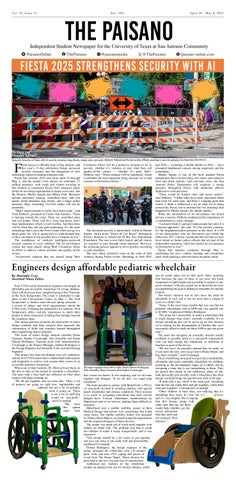
Miles Jones/The Paisano downtown. festivities for presence security in assisting officers police former and Retired (Below): exits. and entry single checks, bag cameras, security AI with (Above): Security at Fiesta
F
iesta season is officially here in San Antonio, and this year’s 11-day celebration brings increased security measures and the integration of new technology aimed at keeping attendees safe. Fiesta San Antonio 2025 runs from April 24 through May 4, and the annual event attracts an estimated 2.5 million attendees, with locals and visitors traveling to San Antonio to experience Fiesta. New enhanced safety protocols are being implemented at major event sites, like the Historic Market Square and Milam Park. Measures include perimeter fencing, controlled entry and exit points, metal detectors, bag checks, and a larger police presence. Bags exceeding 12x12x6 inches will not be permitted. “Major improvements to safety have been made,” said Trish DeBerry, president of Centro San Antonio. “There is fencing around the event. There are controlled entry and exit points. There will be a clear bag policy that’s been implemented, which is well overdue. And then there will be what they call one-gate technology. It’s the same technology that’s out at the Frost Center when you go to a Spurs game. So, you’re gonna have to walk through that, so they can detect if you possibly have a weapon on you.” The installation of artificial intelligence-powered security cameras is a new addition. The AI surveillance system has been placed along West Commerce Street in efforts to address violent incidents and quality-of-life crimes. “AI-powered cameras that are placed along West
Commerce Street will be a proactive measure to try to prevent, whether it’s violence or just what they call quality-of-life crimes — whether it’s petty theft,” DeBerry said. “Those cameras will be monitored, which is probably the most important thing, because we’ve had cameras in Downtown before.”
The increased security is particularly visible at Market Square, which hosts “Fiesta de Los Reyes” throughout Fiesta’s duration to benefit the El Rey Feo Scholarship Foundation. The area is now fully fenced, and all visitors are required to pass through metal detectors. However, the screening process appears to move quickly, according to early attendees. The new safety protocols come in the wake of past violence during Fiesta events. Shootings in both 2023
and 2024 — including a double fatality in 2024 — have prompted heightened concern among organizers and the community. Market Square is one of the most popular Fiesta destinations due to its free entry, live music and extensive food and drink options. Like previous years, the San Antonio Police Department will maintain a strong presence throughout Fiesta, with additional officers deployed to crowded areas. “There would be limited entry and access points,” said DeBerry. “I think folks have been concerned about that event for some time, and there’s a tipping point that comes. I think it influenced a lot of what we’re doing around this Fiesta, not to mention the two shootings that happened in Market Square, the double fatality.” While the introduction of AI surveillance has raised privacy concerns, DeBerry emphasized the importance of a comprehensive safety strategy. “I certainly think it’s going to make people feel safer. It’s a layered approach,” she said. “It’s the security cameras. It’s the heightened police presence on the street. It’s 130 of our ambassadors who are Downtown and within the urban core 24/7. I haven’t mentioned the fact that we now have retired or former police officers that are part of the ambassador operation, which has beefed up our presence in Downtown as well.” Fiesta San Antonio continues through May 4, celebrating the city’s culture, heritage and community spirit while placing a renewed focus on public safety.
Engineers design affordable pediatric wheelchair By Marisela Cruz Assistant News Editor
Four UTSA senior biomedical engineers developed an affordable and accessible wheelchair for young children. They will showcase their completed project this Thursday at the Tech Symposium. The event is scheduled to take place at the Convocation Center on May 1. The Tech Symposium is hosted each fall and spring semester — a crowd of judges and local organizations attend the UTSA event. Granting the opportunity for students, Tech Symposium offers real-life experience to pitch their project to those interested in taking their designs beyond the academic stage. This spring semester promotes the innovation of senior design students and their projects that represent the culmination of skills and concepts learned throughout their engineering degree program. This team of senior design students includes Diana Guzman, Sophia Cavanaugh, Ada Jaramillo and Dante Deluna Rodriguez. Guzman deals with Administration, Cavanaugh is the Project Manager, Deluna Rodriguez is the Design Engineer and Jaramillo is the Assistant Design Engineer. This project has been developing over two semesters, and the four UTSA seniors have collaborated with mentors and nonprofits to achieve and execute their vision of an accessible pediatric wheelchair. When one of their mentors, Dr. Hood advised them on the idea to take on the project to assemble a wheelchair. The team took a step back and reflected on what other seniors will begin working on. “We all got together, and we were like, ‘Okay, a lot of projects are going on right now, implantables and catheters but not a lot of pediatric work is going on.’ There is not a lot of stuff that would be non-profit,” said Cavanaugh. “We have this option right here
Diego Cisneros/The Paisano
The team members from left to right: Dante Deluna Rodriguez, Ada Jaramillo, Diana Guzman and Sophia Cavanaugh.
that warms our hearts. It was inspiring, and we all came together and thought, ‘If we do this, we could help somebody.’” The team decided to partner with MakeGood, a 501(c) (3) non-profit devoted to assisting children with special needs, disabilities and chronic conditions. Their mission is to assist in navigating limitations that their current designs have. Current wheelchairs manufactured by MakeGood tend to be heavier, making them difficult to transport. MakeGood sent a toddler mobility trainer to their Medical Design Innovations Lab, mentioning that it had some issues. The toddler mobility trainer was designed by Tikkun Olam Makers, an Israeli nonprofit organization and the original designers of these devices. The trainer was made out of wood stuck together with wheels on either side. The problem was that it could not collapse to make it easily transportable, and it was expensive. “Our design should be a lot easier to put together and give out, since it can easily fold and disassemble,” explained Cavanaugh. Deluna Rodriguez, the design engineer of the group, designed the wheelchair with 3-D printed parts, bolts and nuts, PVC piping and pieces of wood from The Home Depot. These choices for parts lead to the low cost and ease of manufacture. Additional key features of the wheelchair include an optional foot rest for shorter children, which
can be easily taken out as they grow older, assisting kids between the ages of three to ten years old. Each component is lightweight and accessible to replace at any given moment, with just a quick run to the hardware store accomplishing the goal of making it attainable for anyone in need. The team’s mission was to also have the chair be affordable as well, and to last for more than a couple of years in a child’s life. “Some of the most basic models that you can find for pediatric wheelchairs start at $300 and very quickly rise to $3,000,” emphasized Deluna Rodriguez. “The point isn’t necessarily to make a wheelchair that is much cheaper than what’s currently available. It’s to design something that can be given up for free because we’re aiming for the demographic of families that can’t necessarily afford to shell out those $300 at any one given time.” The team has designed an assembly manual readily available to possibly pitch to a non-profit organization who can help design the wheelchair or distribute to families in need of the device. “We also have an assembly manual that we made, so if you have the tool, you can go out to Home Depot, and buy them yourself,” said Cavanaugh. Their overall long-term goal is to provide a comfortable, affordable and easily attainable wheelchair for children, assisting in the development stages of a child’s life by designing a chair that is not intimidating to them. They all agreed that aiding in the adolescent phase of life, both physically and socially, with a wheelchair like their design can help bridge the gap between kids of all ages “It looks like a toy, which is the main goal, something that the kid can watch their dad put together, watch their mom put together,” Commented Cavanaugh. “Other children in their class, not realizing that it’s something they need. It’s fun, but it’s serious, and it’s very helpful. We’re hoping that this design, along with other ones that are out there, would help children get the social interaction that they need and not progress their diseases.”