UTSA launches Hispanic Heritage Month with Jovita Idár Quarter Release
UTSA hosted the Jovita Idár Quarter Release Thursday at the downtown Buena Vista Theater in collaboration with the United States Mint and the National Women’s History Museum. The event commemorated the achievements of Mexican-American journalist, suffragist and activist Jovita Idár with the creation of her dedicated quarter. It also served to launch Hispanic Heritage Month, which takes place Sept. 15 through Oct. 15.
The quarter is the ninth and most recent in the national American Women Quarters Program, which features prominent American women and began dedications with Maya Angelou and Dr. Sally Ride. The design is printed on the reverse, or the tail side, of a regular quarter. On it, there is a portrait of Idár with her hands clasped, and on her dress are miniature inscriptions of her accomplishments, careers and the newspapers she wrote for. The art was designed by John P. Mc Graw.

Laredo, Texas. After resign ing from a short ca
reer in teaching, she began her career in journalism by writing for her father’s newspaper, “La Crónica,” which discussed current events concerning the civil rights of Tejanos. As a result, Idár developed a strong sense of justice, leading her to organize the First Mexican Congress with her family to help fight racism and the increasing lynching of Tejanos, promote the teaching of Spanish and bilingualism in schools and support the Mexican Revolution.
Along with her friend Leanor Villegas de Magnoń, Idár supported La Cruz Blanca by assembling Mexican-American women to be nurses in the Revolution. She founded and served as the first President of “La Liga Femenil Mexicanista” (The League of Mexican Women), which successfully drew women’s participation into public spheres and matters.
Idár eventually became a staff member at “El Progreso,” where she published an article criticizing President Woodrow Wilson’s order to send military troops to the border during the Mexican Revolution. The Texas Rangers were sent to shut “El Progreso” down forcibly. Idár refused to shut it down, blocked their entry by standing at the door and defended her First Amendment right to the freedom of the press. The Rangers returned the following day in Idár’s absence and physically destroyed the press with sledgehammers.
After her father’s death, she took over “La Crónica” and established her newspaper, “Evolución.” She later moved to San Antonio, where she started a free nursery school and co-edited for “El Heraldo Christia-
no.” Idár passed away in 1946.
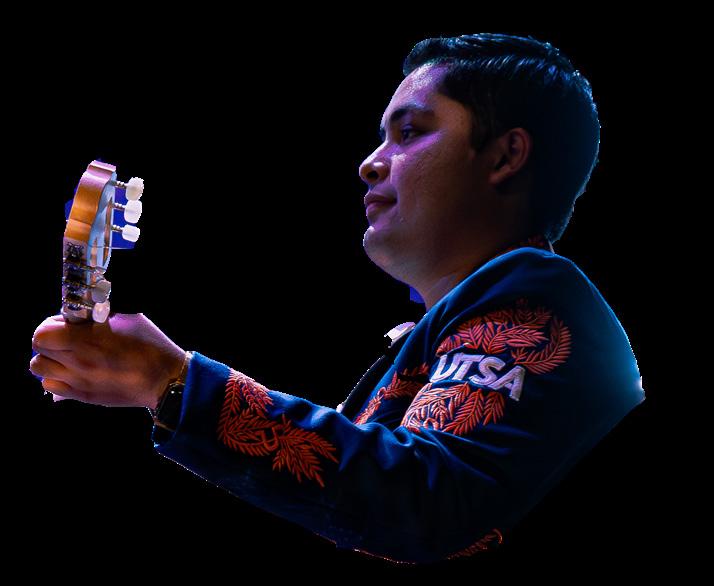
The Quarter Release event began with a short documentary about Idár’s life and a perfor mance by UTSA’s Mariachi Los Paisanos. UTSA Presi dent Taylor Eighmy spoke a few words at the introduction: “Jovita was a powerful force with ideas far ahead of her time. She believed education was the foundation for a better future and fought tirelessly to bring equal opportunities for all.”
Amongst the honored guests were the descendents and family of Idár. Deputy Director of the U.S. Mint, Kristie McNally, then followed to talk about Idár and the creation of the American Women Quarters Program.
The keynote speaker for the event was Mexican-American and multi-award-winning journalist, Maria Hinojosa. Hinojosa spoke about her experience as one of the foremost Mexican-American journalists today and what Idár’s legacy means to her.

“I’m ashamed, but I’m not surprised that I didn’t know about Jovita. For me, it was Frederick Douglass and Ida B. Wells that I understood were like my godmother and my godfather of journalism. And then, I discovered Jovita. So now, I not only have Ida and Frederick, I have ‘mi angelita Jovita,’ Hinoja said. “In this work, there is light, but there is [also] a lot of darkness. Jovita knew that light, and she knew that darkness. But there’s this thing about Jovita, that we all feel, that she had this duty, this total sense of civic duty.”
McNally presented Idár’s great-niece, Reverend Dr. Elizabeth Lopez, and President Eighmy each with two American Woman Quarters. All speakers, Reverend Dr. Elizabeth Lopez and Jennifer Herrera, the Vice President of External Affairs for the National Women’s History Museum,
poured 2000 Jovita Idár quarters into a display of Mexican mosaic tiles.
The Mariachi Los Paisanos and Ballet Folklorico concluded the night with a traditional dance. All guests in attendance received a Jovita Idár quarter.

“Jovita was a powerful force with ideas far ahead of her time. She believed education was the foundation for a better future and fought tirelessly to bring equal opportunities for all.”
The Buena Vista theater was full of attendees excited by the representation of Idár in the quarter. Alansa, a history student at Texas A&M San Antonio, says: “I always tell my friends that Hispanic history is just so overlooked, especially in Texas. I have my friend asking me who Cesar Chavez is when we’re driving down the street. She’s like, ‘who is that?’ I’m like, ‘you should know who this is.’” Alansa’s grandmother Elsa, who immigrated to Laredo, added: “We should be proud and also try to learn, and if we don’t learn, try to encourage people to learn about the heritage we’re bringing into this country.”
The full Jovita Idár Quarter Release Celebration video is available on the Buena Vista Theater YouTube channel.

HCAP merges demography and sociology departments
By Misty Olawunmi Staff Writer
The Departments of Demography and Sociology in the College for Health, Community and Policy recently merged into one department. Now known as the Department of Sociology and Demography, the program aims to increase collaboration between similar interests in health disparities, immigration, racial and ethnic inequalities and more.
According to department chair Ray Swisher, the merger was an easy decision based on the benefits and the strong foundation between the two disciplines.
“All but one of the demography faculty have PhDs in sociology. More importantly, they do research that’s very comparable,” Swisher said. “The faculties met separately last year. We talked about the pros and cons of bringing these two departments together. It was sort of an overwhelming sense that this was a winwin for students.”
The department consists of five degree programs: a Bachelor of Arts in Sociology, a Bachelor of Science in Health, Aging and Society, a Master of Science in Applied Demography, a Master of Science in Sociology and a doctorate in Applied Demography.
Current sociology and demography students will not be affected in the immediate short term as the existing programs remain the same. Instead, the merger will provide more opportunities for students to explore the curriculum and classes they can take and link the two programs together.
“One thing we want to explore is within the undergraduate sociology program [where] we could create a couple of different concentrations. We’re hoping that we’ll kind of have different routes [so] that students can [access] different
connections between the classroom and careers,” Swisher said. “I think it’s going to both appeal to students’ interests [and] also provide all students with an expanded toolkit of skills.”
In addition to the skills undergraduates can learn, there is also a keen interest in increasing the collaboration between students and faculty within all programs in research. For example, Professor Melinda Denton and Professor Kara Joyner are collaborating on the San Antonio Generating Opportunities for Achieving Lasting Success Initiative. The project is a basic income program for lower income families in San Antonio that aims to promote long-term growth by providing families income and mentoring them in their finances.
“The goal is to promote financial solvency and selfsufficiency for families. It’s kind of a departure from the way we used to view welfare payments [like] concerns about families misusing the
money and spending it on cigarettes and different things that social policy makers don’t think the family should do,” Swisher said.
“It’s really [about] trusting families to make the best decisions for themselves.”


For more information about the programs the Department of Sociology and Demography provides, visit the department’s website or contact the department chair at raymond.swisher@ utsa.edu.
Vol. 66, Issue 4 THE
September 19 - September 26, 2023 Est. 1981 /PaisanoOnline /ThePaisano @ThePaisano @paisanomedia paisano-online.com Independent Student Newspaper for the University of Texas at San Antonio Community
PAISANO
By Faith Kouadio Staff Writer
Dustin Vickers/The Paisano
“We talked about the pros and cons of bringing these two departments together. It was sort of an overwhelming sense that this was a win-win for students.”
Mexican-American and multi-award-winning journalist Maria Hinojosa was the keynote speaker for the event.
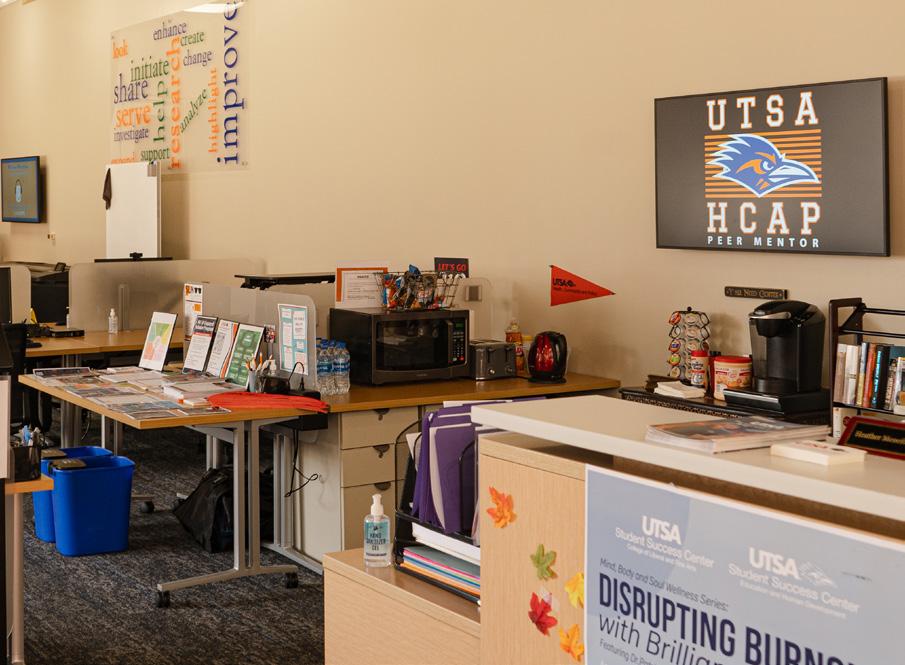
The HCAP Student Success Center (MS 2.02.36) offers tutoring, peer mentorship and workshops to support student success.
Dustin Vickers/The Paisano
Dustin Vickers/The Paisano
DustinVickers/The Paisano
Campus resources that promote student success and wellbeing
By Amber Serio Staff Writer
UTSA offers a wide range of resources that help to ensure students are reaching their academic goals in a healthy and beneficial manner. Whether students are interested in tutoring services, need help finding an internship or simply need to talk to someone, UTSA most likely has a resource that can fulfill each student’s needs.
Whataburger Resource Room and Roadrunner Pantry
If UTSA students ever find themselves unable to prioritize buying food because of financial distress, the Whataburger Resource Room or Roadrunner Pantry is there to help. Created in 2017, the Roadrunner Pantry’s mission is to ensure that students who are experiencing limited food access or insecurity have the ability to receive nutritious food for free.
According to Launch UTSA, “the Roadrunner Pantry is open to all students in need with a valid UTSA ID. Food and non-food items are limited to 5 items per day.”

There are locations at both the Main and Downtown Campuses for student convenience. The Whataburger Resource Room operates on the Main Campus at SU 1.04.06 and is open from 12 to 5 p.m. Monday through Thursday and Saturday. The Roadrunner Pantry is located at the Downtown Campus at DB 1.306 and is open Monday through Thursday during the same hours.
University Career Center
UTSA’s University Career Center has an abundance of services that students can utilize. The Career Center’s services are meant to enhance student’s professional identities. According to their website, their mission is to “assist all Roadrunners in discovering, pursuing and achieving their unique career goals.” The Career Center website includes resume samples and builders, guides to gaining experience as an undergraduate and tips on how to prepare for and attend a job interview. Their services are not limited to their website, as
According to their website, “[their] experienced tutors provide assistance to current undergraduates, graduate students, and faculty/staff members with each step of the writing process: brainstorming, establishing a thesis, achieving coherence and unity, documenting, and revising.” The tutors are meant to not only help edit and proofread a student’s writing but also teach students how to become better at doing this on their own.
Students have two locations to choose from: one at the Main Campus in the JPL building at 2.01.12 and another at the Downtown Campus in the Frio Street building at FS 4.432. Their services are available inperson during the building hours of operation and online seven days a week through a live chat with a tutor.
Wellness 360 Healthcare
Wellness 360 is an on-campus healthcare service provided by UTSA’s Wellbeing Services and UT Health San Antonio. Their website states that “Wellness 360 is a nurse-led clinic operated by UT Health San Antonio. [Their] health care team is led by Advanced Practice Registered Nurses who hold the highest-level degrees for nursing practice, master’s and doctoral degrees.”
Located at the Recreation and Wellness Center on the Main Campus, Wellness 360 has a vast number of services ranging from primary care needs for instances like colds and headaches, LGBTQ+ health care services, access to prescriptions, STI testing and treatment and more. Students can call (210) 458-4142 to schedule an appointment and be directed to the appropriate location depending on the services they need.
Wellness 360 Mental Health and Counseling Services
State of the City
Week of 9/19/23
By Amber Serio Staff Writer
Not subscribed to local news but still want to stay upto-date on the happenings around town? Look no further.
Highlighting notable stories from external San Antonio news sources, State of the City summarizes the most captivating news headlines of the week. This week’s topics range from an earthquake outside of San Antonio to the start of Hispanic Heritage Month.
Civilian workforce in San Antonio will see 4% raise
After the economy faced a period of stagnation during the COVID-19 Pandemic, the city of San Antonio struggled to uphold job positions for individuals seeking higher wages. A year ago, city leaders reacted by increasing pay scales and providing municipal workers with a 7% raise.
Today, the city still wants to attract job seekers and prevent existing employees from seeking employment elsewhere. Therefore, the City Council adopted a $3.7 billion annual budget Thursday. The budget includes a 4 percent raise for city workers with the exception of police and firefighters. The increase will be implemented Oct. 1, at the start of the new fiscal year.
Earthquake recorded southeast of San Antonio
A 4.0 magnitude earthquake was recorded southeast of San Antonio in Karnes County. The earthquake shook the county Thursday, making this the largest of the year within 50 miles of San Antonio.
Hispanic Heritage Month celebrations begin
The City of San Antonio began its annual celebrations for Hispanic Heritage Month on Saturday. The festivities will run from Sept. 15 through Oct. 15 and will include events such as parades, musical performances, film screenings, cooking demonstrations, crafts and health and wellness activities. The celebration is to honor the culture of the Hispanic and Latino communities as well as pay tribute to the contributions they have made to San Antonio.
San Antonio teen shot in the knee
Early Saturday, a 14-year-old boy was hospitalized after being shot in the knee. He gave police minimal information, making it unclear who shot him or why. The teen believed he was on South Navidad Street on the West Side. After being shot, he began knocking on doors asking for help before a woman took him to the hospital. The woman has not been identified, as the teen claims he did not know who the woman was or remember where she lived.
Students get sick from Kool-Aid mistakenly thought to be contaminated
Three students from the IDEA Walzem charter school reported feeling nauseous after drinking Kool-Aid on Wednesday afternoon. The Bexar County Sheriff’s Office responded to the concerns where they were met with the initial consensus that the Kool-Aid had been contaminated by another student. Two of the students were hospitalized but tested negative for narcotics. The sheriff’s office stated that their initial claims were a mistake as a result of a false-positive field test used on the substance. They said that the students simply ingested the Kool-Aid too rapidly, resulting in them feeling sick.
Meet UTSA’s latest researchers
By Kylar Royer Assistant Photo Editor
Among the nation’s top 4% of research universities and a designated R1 institution, UTSA holds $140 million in research expenditures and $3 billion in direct economic impact. As a Tier One university, UTSA fosters accelerating transdisciplinary research and innovation.
Just in the past month, UTSA researchers have been progressing within their fields, from receiving awards to fuel their latest projects to publishing their latest findings. Catch up with the latest updates in Roadrunner research with The Paisano’s monthly recap.


The medicinal power of plants against brain cancer
In one of UTSA’s biology laboratories, run by Valerie Sponsel, grows a plant named Artemisia annua, commonly known as Sweet Annie.
Sponsel works with UTSA chemistry professor Francis Yoshimoto, “who is extracting the plant’s leaves for medicinal compounds. Soon, the researchers will meet with UTSA researcher Annie Lin, who will test the extracted compounds on cancer cells.”
The team is working to understand how the leaves extracted compounds work and were “the first to demonstrate the mechanism of one of these molecules.”
Glioblastoma (GBM) cells provided by Mitchel S. Berger, the director of the University of California San Francisco Brain Tumor Center, have allowed the researchers to test different fractional portions of the leaf extracts for cytotoxic
activity. GBM “is a fast-growing and aggressive brain tumor,” and testing these fractions for toxicity against GBM cells has the potential for finding an effective medication to target tumors directly.
An interactive art installation that heals
UTSA music professor Steven Parker’s latest project emphasizes the combination of using a marching band as an expressive tool and the practice of deep listening.
Initially developed by Pauline Oliveros, deep listening is a form of sonic meditation that involves “exploring the relationships among any and all sounds whether natural or technological, intended or unintended, real, remembered or imaginary. Thought is included.”
Parker’s “inventive work draws from the historical connections between the marching band and the military.” Working with the Spirit of San Antonio band, Parker “examines themes of healing, injury and labor in football.”
Parker’s art project, Sonic Meditation for Solo Performer, takes the form of an interactive sculpture, working as an “immersive musical composition featuring an ecosystem of automated sonic sculptures made from salvaged marching band instruments.” While wearing an EEG headset, the viewer reads a silent meditation and the data is translated into a composition played by the suspended brass instruments.
“When the public is meaningfully involved in a piece, the performance is
infused with a palpable electricity: the viewers contribute a layer of unpredictability and chance, the physical space of the performance shifts and participants discover new expressive skills they did not know they had,” Parker said.
Owl research brings awareness to anthropogenic risks
Owls play a crucial role in our ecosystem by helping control rodent populations. Research suggests that “owls in Texas have high rates of anticoagulant rodenticides (AR) - blood thinning rat poisons - in their systems.”
UTSA integrative biology professor
Jennifer Smith and her team researched a variety of anthropogenic risks that pose threats to owls in Texas.
Smith measured AR levels present in liver samples of deceased owls with the help of data from rehabilitation centers and Texas A&M’s Biodiversity Research and Teaching Collections, finding a high incidence of AR exposure, as “51% of the owls in their study [tested] positive.”
The research team promotes using alternative and nontoxic methods for rodent removal and education programs to bring “awareness of the effects of ARs or non-target wildlife such as owls.”
Nearly $2 million granted to three UTSA researchers
Meet UTSA researchers Itamar Lerner, David Restrepo and Christopher Combs, recipients of one of the National Science Foundation’s most distinguished programs, the Faculty Early Career Development Program award.
“The awards, totaling $1,984,339 in new research funding, are granted to earlycareer faculty who have the potential to serve as academic role models in research and education.”
Lerner’s award will assist in his research studying emergency responders to comprehend the association of stressful real-life events to sleep and performance. Lerner’s goal is to understand “which individuals are prone to develop posttraumatic stress symptoms.”
Continue reading at paisano-online.com
2 | news@paisano-online.com September 19 - September 26, 2023 NEWS
Dustin Vickers/The Paisano
Kayla McCutcheon/The Paisano
Kara Lee/The Paisano
OPINION
Retake the right to abortion
San Antonio City Council votes to establish Reproductive Justice Fund
San Antonio City Council has encountered friction concerning the new 2024 budget proposal. While the bill allocated record funding for new police officers, as well as more funding for the clearing of homeless encampments, the controversy surrounding the new proposal derives from the establishment of the Reproductive Justice Fund.
According to KSAT 12, while the report does allocate $500,000 for the fund, it does not decide what the scope of the fund will be. Normally, funds of this nature are “used for services as contraceptives or reproductive health education”; however, abortion rights activists are calling on the city council to use the allocated money to help assist with travel expenses incurred to travel out of state for a legal abortion.
Regardless of the final purpose of these funds, the mission they are set to accomplish is an important one.
Muzzle McCarthy; Stop the impeachment
Commentary
By Abraham Roman Staff Writer
Last week, Speaker of the House Kevin McCarthy launched an impeachment inquiry against President Biden. According to AP, McCarthy’s inquiry is vastly based on an allegation against Biden during his time in office as vice president. Biden allegedly pressured the Ukrainian government into firing its top prosecutor to stop an investigation into Burisma, an oil and gas company that Hunter Biden — the president’s son — was on the board of. This allegation has been disproven for a multitude of reasons.
Firstly, there are direct claims going against the narrative put forth by McCarthy.
According to RFERL, Daria Kaleniuk, the executive director of the Kyivbased Anti-Corruption Action Center, stated that “Ironically, Joe Biden asked Shokin to leave because the prosecutor failed [to pursue] the Burisma investigation, not because Shokin was tough and active with this case.” Secondly, the claims that Biden enacted bribes to receive direct funds from Burisma are equally contested. McCarthy is calling non-incriminating dinners and phone calls between President Biden and Hunter Biden’s client’s grounds to impeach when insufficient evidence has been put forth.
Hypocrisy is also the name of the game for the announcement of this impeachment. The inquiry was made without a vote from the house, a motion that McCarthy had been vocally against before. Just two weeks ago, McCarthy told
Commentary
Breitbart that the inquiry would not be made without a house vote, a statement he has clearly gone against. These actions go against an argument McCarthy made back in 2019 when former speaker Nancy Pelosi
states with tend to see mortality
out against the inquiry. Because of the lack of evidence presented by McCarthy, Republican representatives like David Joyce, Dusty Johnson, Don Bacon, Ken Buck and Matt Gaetz have openly challenged the grounds for the impeachment inquiry.
The basis of this inquiry is shaky at best, and the whole situation is riddled with the scent of petty revenge and helpless retaliation. The impeachment of President Biden seems to be a game of hot potato for the Republican Party, who wants to toss the potato back at the Democratic Party for the impeachment of former President Trump.
rates. This increase disproportionately affects women of color, and its effects are already being seen statewide.
According to the Texas Tribune, the “restrictive abortion law [has] delayed treating pregnancy complications until patients’ lives were in danger.” Pregnant women across the state are being put in danger as a direct cause of the abortion ban which may be the beginning of a new health crisis for Texas.
While there are still movements to re-establish access to abortion in Texas, the reality is that lawmakers have to act within the parameters they are given. Abortion access may be a long way away from becoming a reality, but this step is a meaningful one to address the adverse effects of a complete abortion ban in the state. As citizens, we must insist that funds are allocated to expand access to reproductive healthcare in San Antonio and assist those who wish to get an abortion out of state.

Pushing the pink
Commentary
By Allana Llabres Staff Writer

launched an impeachment against former President Trump without a house vote. While a vote was eventually held, McCarthy called the action “completely devoid of any merit or legitimacy.”
McCarthy has not said anything against holding his vote at a later time, but there are also speculations that the vote has not happened because it would not be passed, even with the house’s current Republican majority.
This speculation comes from the number of Republican representatives who have spoken
McCarthy has had three committees investigate the situation for nine months prior to his recent impeachment announcement. Throughout those nine months, time and time again the committees have come up empty handed.
All that the inquiry is now is an unsupported hail mary to try and claw back at President Biden for a situation that he has nothing to do with, an action that is needlessly wasting taxpayer dollars and committee effort. In the end, the controversy might even prove beneficial for President Biden, who can use any news to steer away from the clear lack of enthusiasm for his run for a second term due to the perception around him being “too old” for office.
End the uranium delirium
By Oscar Acevedo Contributor
Recently, the U.S. has announced that they are sending depleted uranium anti-tank rounds to support Ukraine in its ongoing war with Russia. Depleted uranium has had a long history of controversy since its conception, and it is not the first time the U.S. has used uranium rounds.
Depleted uranium rounds were first used in 1991 during the Persian Gulf War. Since then, they have continuously been used in
multiple wars, as it was shown that depleted-uranium-armored tanks were successful in combat.
Although it has been proven to be effective in combat, many veterans and scientists throughout the years have raised concerns on how exposure to the material could be hazardous to humans and the environment. According to the U.S. Department of Veteran Affairs, service members are not in danger of exposure to radiation if they are simply near weapons or vehicles armored with depleted uranium, but service members are still at risk
of exposure in many other ways — especially when in combat — as this can happen by inhalation or wound contamination. Many organizations have researched how depleted uranium affected veterans of wars that used it, and many have found that it does not have many significant effects on veterans. Despite many veterans raising concerns about the radiation of the depleted uranium giving them cancer, most of these cases are negligible.
On Sept. 1, Senate Bill 379 went into effect in Texas, removing all taxes on menstrual products, including tampons, sanitary pads and menstrual cups, and some baby supplies like diapers, baby wipes, bottles and maternity clothing. Texas is the 24th state to remove taxes on menstrual products and the 18th to remove taxes on diapers. While this is a win for Texas, this still leaves just over half of our country having to pay taxes on products that are essential to people who menstruate. The tampon tax is just a small part of the discriminatory pricing that increases the cost of goods and merchandise that are advertised to women, also known as the pink tax. Unfair gender pricing is not a new thing for our society. In fact, the term “pink tax” can be traced back to the 1990s, when a research report found that in most large cities, the cost to wash and dryclean a woman’s blouse was higher than that of a man’s button-up shirt. Most often, the pink tax refers to the sales tax on menstrual products. While these goods are necessities for menstruating people, many states to this day still tax menstrual products as luxury goods, but exempt taxes on other necessitous items like medicine and groceries.
Today, the pink tax can be seen all over the shelf, with women’s razors costing up to 47% more than men’s razors, women’s hair care products costing an average of 56% more than men’s, body wash costing 24% more for women than for men — the list goes on.

The pink tax can even be seen on products that are not related to hygiene, like clothing.
Sure, the extra dollar or quarter here and there due to the pink tax may not seem like a lot, but it adds up. In a study by The California Senate Committee on Judiciary and Senate Select Committee on Women, Work & Families, it was found that on average a California woman pays $2,381 more per year than a man, for the same goods and services. This inflates to about $188,000 paid in pink tax throughout a woman’s life. When you factor in the fact that women make $0.82 for every $1 a man makes, you can really see the gap of gender inequality in matters of money.
Eliminating the pink tax is one step forward to eliminating gender inequality. As a consumer, you can fight the pink tax by avoiding products that are marketed to one gender, switching to products by brands that do not overprice products based on gender, or consider subscriptions for things like razors or shampoo, as most products tend to cost less with a subscription purchase. You can also do some research and support brands like Billie, that offer a pink tax rebate, or any other brands that are in the fight against the pink tax. Let us take a step back to reconsider how we spend money as consumers and fight together against unfair pricing schemes.
3 | opinion@paisano-online.com September 19 - September 26, 2023
Editorial
FOR MORE COMMENTARIES, VISIT PAISANO-ONLINE.COM
Continue reading at paisano-online.com
Storm Goodman/The Paisano
“Eliminating the pink tax is one step forward to eliminatinginequality.”gender
KaraLee/The Paisano
Calli Recore/The Paisano
OPINION
Empower women in the workplace
Commentary
By Luna Infante Staff Writer
Has a man at your job ever made you feel incompetent or like you could not perform as well as your male colleagues? Has he ever assigned you an easy task, told you that “You should smile more” or asked you “Is it that time of the month?” There is a good chance you have heard one of these phrases before, in and out of work. Even now, it is very common for women to face discrimination in the workplace. This is something many women face day-today, but like any issue, it is something society can work on, and it starts with our generation.
A large number of industries are maledominated, including finance, architecture and television. Alongside the gender wage gap that women are already conformed to, which says that women make 82 cents for every dollar a man makes, women continue to face other forms of gender discrimination at their jobs. According to the Pew Research Center, women are four times more likely to say they have been treated as incompetent because of their gender, and they are nearly three times more likely to report “repeated small slights at work because of their gender.”

Commentary
By Carley Martin Staff Writer
On Aug. 26, 2023, three Black people were killed in Jacksonville, Florida, in what is being considered a racially motivated attack. The Jacksonville Police Department has since reported that Ryan Palmeter, a White man, was the perpetrator. Palmeter, armed with an AR15 and a handgun, opened fire at a Dollar General, shooting and killing Angela Michelle Carr, A.J. Laguerre and Jerrald Gallion before killing himself. Before the deadly attack, the shooter was seen on the campus of Edward Waters University, a historically Black college. A police officer working for the school was alerted by
The Paisano
Editorial Board
Because gender-based discrimination is mostly seen in a male-dominated workplace, many believe the issue can be easily solved by hiring an equal number of women. However, this does not change the societal pressures and biases women have faced for years. According to research done by the Harvard Business Review, women in femaledominated occupations also report experiencing gender bias in the workplace. The study was done on four female-dominated industries, including healthcare, law, higher education and faith-based nonprofits. These women continued to experience constrained communication, a lack of acknowledgement for their work, being interrupted by men when speaking, a lack of mentors and sponsors and being forced to limit aspirations due to personal obligations.
How do we push for change?
As the youngest generation entering the workforce, it is our responsibility to advocate for equality; this can be done by starting with the recruitment process. Research shows that when applying for jobs, women feel they need to meet 100% of the criteria, while men apply after only meeting about 60% of the criteria. To
encourage more women to apply for jobs, it is important to make job posts more inclusive and focus on “musthaves” under requirements rather than “want-to-haves.”
Another way to balance the recruitment process is to remove questions regarding gender, as this will help prevent subconscious bias.
It is also crucial to highlight women when promoting companies. It is no secret that people like to see themselves represented, as it helps them envision themselves in those positions. Seeing someone in a position of power who has a similar background as you will allow you to easily imagine being in those shoes. A woman of color does not feel represented if all the promotional material for a company is purely White men. If the company highlights women in leadership, it will inspire more women to apply. Another way we can begin to encourage women in the workforce is by extending more support when it comes to maintaining a work-life balance. This can be done by offering remote or hybrid work when necessary for mothers or women who request menstrual leave. It is also important to stop placing penalties on women taking menstrual, caretaker or maternal leave. Everyone deserves the right to prioritize their health and personal life,
Anti-woke, pro-hate
students about Palmeter. He immediately jumped into action, chasing him off campus before calling the police. In Sheriff T.K. Waters’ playback of the event, it was reported that Palmeter texted his father after the shooting, telling him to go check his room. There, Palmeter’s father found a suicide note and a will. His father then called the police when he learned what his son was planning, but he was too late. Not only did Palmeter leave behind racist writings, but his AR-15 had swastikas drawn on it. The shooting is currently being investigated as a hate crime by the FBI.
The Black residents of Jacksonville are outraged by these vicious killings, and many Black church leaders
have come forward to condemn the actions of Governor Ron DeSantis. The Black church leaders along with members of the community marched on Jacksonville City Hall to let their voices be heard and to call an end to the policies enacted against them.
Many of DeSantis’ policies have directly targeted Black people, making Florida an environment where discrimination is common.
Some of these policies include his anti-protest law, the redrawing of congressional maps and the Stop WOKE Act. It is not a stretch to say that these policies emboldened Palmeter and reinforced his beliefs. If his own governor is comfortable displaying prejudice so blatantly, why
and this should not fall short for women.
Ensuring that women feel they have equal resources and opportunities is key to empowering women in the workforce. Other ways this can be done are by making women mentors available, ensuring women have a voice in their projects, guaranteeing they receive proper credit and enforcing anti-harassment rules. Change can be made, and we have already started. Little by little, woman by woman, we have begun to make an impact. With the resources being provided to women in the workforce, we are beginning to see more women in leadership positions. Let us keep pushing and change these numbers even more.
As the generation that is just now growing into their career, whether it be applying to a first job or starting a business, it is our responsibility to eliminate gender inequality in the job industry. It is in our hands to empower women in all workplaces and allow room for fair treatment and equal opportunity. Let us learn to embrace femininity, as it is not a bad thing. Being feminine does not make a woman less competent, resourceful or powerful. Women are just as capable as men, and it is long overdue that women are treated as such.
would he do any differently?
The rise of anti-queer and anti-Black rhetoric as well as laws and policies made against these groups have directly contributed to the resurgence of Nazism in the United States, especially in DeSantis’ Florida. The attack in Jacksonville is devastating, but it is not the first and it will not be the last. Not until politicians stop demonizing and punishing those who are different from them can things start to change. Without people like DeSantis lighting the way for those like Palmeter, fewer people will be led to the violent extremism demonstrated in the tragic shooting in Jacksonville.
We need to be Swift about climate change
Commentary
By Malaki Lingg Web Editor

Over the past few months, Taylor Swift has been touring the globe on her coveted “The Eras Tour.” Hundreds of thousands of fans are flocking to the nearest stadium to catch her set, with her tour being expected to earn an estimated $2.2 billion just from domestic North American ticket sales. While fans are loving her performances, there is an environmental impact that is being overlooked.
In 2022, Yard shared findings on the negative carbon impact of celebrity private jets and listed the worst offenders — Swift was on the top of that list. During 2022, Swift took more than 170 flights and amassed 22,923 minutes of airtime, the equivalent of 15.9 days on board her jet. According to Yard, the carbon emissions from her jet came
to around 8,293.54 tons of CO2e, resulting in nearly 1,200 times the carbon footprint of the average American. These numbers have remained high since the start of The Eras Tour.
According to Insider, Swift owns two multimillion-dollar private jets — the first being a Dassault Falcon 7X, registered as N621MM with Island Jet Inc., and a Dassault Falcon 900, registered as N898TS with SATA LLC. Since the start of The Eras Tour in March, Swift has spent approximately 166 hours onboard; the equivalent of almost seven days flying. The current reported hours of flight time for her jets do not even account for the entire year, they start in March and run until now — just over three months until the end of the year. With the amount of airtime Swift is accruing, it would be no wonder if she doubles her flight emissions from last year. With criticism of her jet
usage, a spokesperson for Swift told Insider “Before the tour kicked off in March of 2023, Taylor purchased more than double the carbon credits needed to offset all tour travel.” With that being said, what are carbon credits? Carbon credits are purchased to attempt to offset emissions released by a company or entity. So, according to Swift’s team, they purchased more than they would need to “offset all tour travel.” But with the sheer amount of emissions that would be released not just from her jet, but for trucks traveling to each venue and other related movements, it does not seem possible. According to The Washington Post, these carbon offsets are likely too good to be true. Experts have been releasing warnings on the efficiency of these carbon offset programs, and according to The Guardian, 90% of rainforest carbon offsets were
Laynie Clark | Editor-in-Chief Editor@paisano-online.com
Chloe Williams | Managing Editor Manager@paisano-online.com
Jessica McLaren | News Editor News@paisano-online.com
Jake Mireles | Opinion Editor Opinion@paisano-online.com
Riley Carroll | Arts & Life Editor Arts@paisano-online.com
Luke Lawhorn | Sports Editor Sports@paisano-online.com
Malaki Lingg | Web Editor Web@paisano-online.com
Dustin Vickers | Photo Editor Photo@paisano-online.com
Kara Lee | Graphic Editor Graphic@paisano-online.com
Marcela Montufar Soria | Multimedia Editor William Barnes | Multimedia Editor Multimedia@paisano-online.com
Jenna Taylor | Magazine Editor Magazine@paisano-online.com
Sofia Mejia | Distribution Manager Distribution@paisano-online.com
Zach Geocaris | Buisness Manager Buisness@paisano-online.com
The Editorial is the official opinion of The Paisano editorial board. Commentaries are the opinion of the individual writer.
meaningless. Previously, Delta pledged $1 billion to offset their global carbon emissions, which resulted in them purchasing $137 million worth of carbon offsets, though Delta’s chief sustainability officer now opposes their purchase.
Private jet use is up to 14 times more polluting than normal commercial airliners are, and the rich are abusing them. Swift, Kylie Jenner, Jay Z and more abuse their ability to use these personal planes. Artists like Swift need to take accountability for their actions. As summer grows hotter every year due to global warming, they exacerbate the problem and brush past it or make excuses as to why they are allowed to. The general populous is always making sacrifices to decrease their carbon footprint: Is Taylor Swift too good to take a business-class flight?
The Paisano is published by the Paisano Educational Trust, a non-profit, tax exempt, educational organization.The Paisano is operated by members of the Student Newspaper Association, a registered student organization. The Paisano is NOT sponsored, financed or endorsed by UTSA. New issues are published every Tuesday during the fall and spring semesters, excluding holidays and exam periods.The Paisano is distributed on the UTSA Main Campus. Additionally, Paisano publications are distributed at a variety of off-campus locations, including Tripoint and a variety of apartment complexes near the UTSA Main Campus. All revenues are generated through advertising and donations. Advertising inquiries and donations should be directed to: 14526 Roadrunner Way Suite 101 San Antonio, TX 78249
Phone: (210) 690-9301
© 2023 The Paisano
The University of Texas at San Antonio’s Handbook of Operating Procedures states in 5.03 that:
The University of Texas at San Antonio (UTSA) will not exercise control over the format or content of Student Publications, but will regulate distribution on campus. Student Publications will be free of censorship and advance approval of copy, and their editors and managers are solely responsible for editorial and content policies and decisions. Editors and managers of Student Publications will not be subject to arbitrary suspension/expulsion or removal from their positions within a Registered or Sponsored Student Organization (Student Organization) by the University because of student, faculty, administrative, or public disapproval of editorial policy or content. Student Organizations that distribute Student Publications are afforded the same rights and privileges as Student Organizations that do not distribute Student Publications.
4 | opinion@paisano-online.com September 19 - September 26, 2023
Hayley Aguayo | Staff Writer Naydine De La Fuente | Staff Writer Andrew Dotson | Staff Writer Kaitlyn Grace | Staff Writer Luna Infante | Staff Writer Nicholas Kingsman | Staff Writer Faith Kouadio | Staff Writer Allana Llabres | Staff Writer Carley Martin | Staff Writer Logan Martinez | Staff Writer Misty Olawumni | Staff Writer Rylan Renteria | Staff Writer Abraham Roman | Staff Writer Amber Serio | Staff Writer Connor Suehs | Staff Writer Jada Thomas | Staff Writer Samantha Ysaguirre | Staff Writer Storm Goodman | Graphic Artist Calli Recore | Graphic Artist Caroline Puckett | Graphic Artist Jonathan Porter | Photograher Eric Trevino | Photographer Stephen Saenz | Photographer Genevieve Vega | Photographer Lauren Hernandez | Assistant Arts & Life Editor Kylar Royer | Assistant Photo Editor Assistant Editors Diane Abdo | Advisor Steven Kellman | Advisor Jack Himelblau | Advisor Stefanie Arias | Advisor Sandy Norman | Advisor Mason Hickok | Advisor John Helton | Advisor Corey Franco | Advisor Imelda Robles | Advisor Advisory Board Read more online now
Staff
WANT TO WRITE A LETTER TO THE EDITOR AND BE FEATURED IN THE PAISANO? EMAIL EDITOR@PAISANO-ONLINE.COM OR OPINION@PAISANO-ONLINE.COM
arts & life
Olivia Rodrigo’s ‘GUTS’ marks massive career advance
By Sarah Lemos Contributor
From the release of her acclaimed single “drivers license,” followed by her debut album “SOUR,” Olivia Rodrigo has become a prominent name amongst pop’s elite. Rodrigo’s talent and sound have made room for her extremely anticipated sophomore album “GUTS.” Collaborating once again with producer Daniel Nigro, the pair create a dynamic story of development, womanhood and love, held together by a mixture of modern poppunk and profound ballads.
The opening track, “all american b—h,” has a captivating duality lyrically and rhythmically. The song draws us in with wispy, feathery vocals that paint images of Coca-Cola hair curlers, perfect vintage smiles and Euro-centric beauty standards that feel disingenuous. As it progresses, there is a sense that Rodrigo has taken a step to reveal her genuine feelings, singing with more speed and forte and unleashing her truth. This vocal feature is recurring in other tracks, such as “ballad of a homeschool girl” and “get him back!” The honesty, intimacy and vulnerability she shares with her listeners exhibit why Rodrigo described the record as nothing other than “gutsy.”
In regards to love, “GUTS” provides us with an exposed history of Rodrigo’s recent experiences. She covers her self-awareness in the spoken word “bad idea right,” her romantic frustration in “vampire,” and the often coveted effects that relationships have on young people in “the grudge.” She is fearless in speaking about the painful and often embarrassing truths of being a young person in love, thus comes the inclusion of the tracks “love is embarrassing” and “logical.” As these reveal Rodrigo’s expansion in her personal life and relationships, they simultaneously present the most vocal and sonic evolution we have heard from her yet. In guitar riffs that manage to turn the concept of overcompensation into a sound, and in
euphonious belts charged with passion, it is obvious that the young singer has produced her best work up to this point.
In contrast to the growth in the aforementioned tracks, “lacy” and “pretty isn’t pretty” display a message reminiscent of earlier work, such as “jealousy, jealousy” and “happier.” The commonalities of these pieces include vocals that mimic bouts of anger, offsetting additional hushed sounds and detailed descriptions of Rodrigo’s experience with a lack of self-confidence. It is fitting that these tracks share a similar sound to those from her previous album, as they reveal a lack of growth in Rodrigo’s mindset. To give credit where credit is due, “making the bed” confronts the sources of her insecurity, which she traces back to expectations in her career and treatment from society, but mainly herself. This recurring self-awareness in the record makes it easier for listeners to feel a relation to these messages, and a connection to Rodrigo herself.
Put simply, this album is a full swing, a full stride forward and a full view. It is the story of a former teenage girl transitioning into what she feels is now adulthood. It is a showcase of development. For 39 minutes, listeners experience what it is like to be a young woman blossoming in the spotlight, and accredited to immense talent, it is somehow crafted into an enjoyable and relatable experience. In very Rodrigo fashion, the last song of the record, “teenage dream,” leaves us with a poetic question: “They all say that it gets better, but what if I don’t?”
This question captures every sentiment that this album gifts us with, and one we know the answer to.
As of Sept. 8, 2023, “GUTS” is available for streaming on every major music platform.
Caroline Puckett/The Paisano
things to keep in your car for the houseless
10
By Izabella Ali Bocas Contributor
The number of people currently unhoused has increased through the years. There are ways that we can lessen the burden for these individuals by keeping useful items in our cars. All of these items are small and easily stored within a car to be handed to the unhoused. Items on this list can cost as low as $1 and can be found at many grocery or dollar stores.
1. Socks
People who are unsheltered may not take their shoes off often because of the amount of walking that happens daily. Having a fresh and clean pair of socks to put on after a long day is always nice.
2. Reusable water bottles
Having access to clean and fresh water is not always possible for some people. Being able to reuse a water bottle multiple times reduces the cost of buying plastic bottles, as well as reducing the amount of trash that one is producing.
Spare Change

 By Chloe Williams Managing Editor
Food that can be eaten over multiple days can take away some of the stress of trying to find food for every meal. Food items that can help create a balanced meal while also being resealable are extremely important since there is no fridge or a pantry to store these items. Non-perishable foods can include tuna, crackers, peanut butter, beef jerky, oatmeal, granola bars and mixed nuts. While fruits and veggies are great additions to a diet, they have a shorter shelf life.
4. Medical supplies
Having even a small first aid kit that has band-aids, alcohol wipes and gauze can help clean cuts and scrapes that occur day to day. Making sure that these cuts and scrapes are properly cleaned is essential to ensure that no future infection occurs.

5. Dental hygiene products
Having proper dental hygiene is not at the top of someone’s mind when they do not have somewhere warm to sleep. Unhoused people are 12 times more likely than people who have stable housing to have dental problems.
5 free ways to prepare for the workforce RubyCoker/ThePaisano
Whether you are a freshman or a senior, it is never too early to start preparing for your future. Despite popular belief, building up your resume and planning for the future does not have to be an expensive or time-consuming task. Follow along as we highlight five free ways you can advance your experience and career.
1. Build up your LinkedIn
LinkedIn is not just for business students; it is an essential part of building and maintaining your brand after graduation. It allows you to effectively communicate with your potential employers, apply for jobs and learn more about your desired industry. LinkedIn is home to over 400 industries and your next employer is probably on there. The biggest ways to build up your LinkedIn include consistently updating volunteering, work and school information. Another way to improve your LinkedIn is to have a professional headshot — which you can take for free on campus at the Iris Booth. Even if you do not have the experience to back up your profile, having one is still important. Stay active and express your desire to learn and grow.
2. Get online certifications
UTSA provides LinkedIn Learning free for students, faculty and staff. Normally $20 to $30 a month, this tool will help you learn more about your desired industry and work to build up your profile as well. There are certification opportunities in business, creativity and technology fields. The platform also offers code challenges to help perfect your coding skills. Other resources offered include academic credits, certification preparation, continuing education and professional certifications. This website is an amazing resource that provides thousands of hours to build your skills and make yourself more marketable.
3. Non-perishable foods
Continue reading at paisano-online.com
Another UTSA resource you should consider taking advantage of is the resume builder and assistance service. VMock is a platform where you can upload your resume and it will grade based on recruiter criteria. It will give you direct areas to improve to ensure your success. If you do not have a resume at all, UTSA’s career center provides all the tips and tricks you need as well as sample resumes to get this process started. Wherever you are in your resume creation process, UTSA has tools to help you.
4. Gain experience
Gaining experience is definitely easier said than done, but with campus resources like Handshake and career fairs, it is easier than ever to get experience in your major. Handshake is an online job site for students and alums to use to look for jobs or internships, attend virtual recruiting or networking events and meet with career consultants. This resource is extremely helpful in finding experience, and it also allows for explicit criteria setting — like wanting your position to be remote only. Another helpful UTSA Career Center tool is their Career Expos. These events allow you to meet with different recruiters across various industries and learn more about a career that might interest you. There is a Fall 2023 all-major career expo coming up from 2 to 6 p.m. on Sept. 21 in the H-E-B Ballrooms and a virtual career expo from 1 to 6 p.m. on Oct. 12.
5. Career Counseling UTSA’s Career Center has endless opportunities and resources to aid in your career discovery. Aside from the

resources listed above the center also offers meeting dropins, “What Can I do With This Major”, career assessment, interview assistance and guides, a job scam alert, salary negotiation, microinternships and a “Texas
Reality
Check” to predict your future lifestyle expenses.
Growing up and moving into the workforce is scary but preparation early on will help relieve this stress and struggle. Above all, remember that you are more than the money you make or the job you have. Strive to be happy and do what you love and everything else will fall into place.

5 | arts@paisano-online.com September 19 - September 26, 2023
3. Perfect
your resume
Reviews
Top 5 hiking trails in San Antonio
By Laynie Clark Editor-in-Chief
It is no secret that San Antonio is one of the best hiking-friendly cities in Texas. According to a LawnMaker study, San Antonio ranked as the thirdbest city in Texas to hike, but where are these hiking gems? As the summer months come to a close and fall peaks over the horizon, now is the best time to get outdoors to see what San Antonio has to offer.
Devil’s Den - 3215 Northwestern Drive
Located in Leon Creek, Devil’s Den offers a creepy but captivating outdoor experience. While many locals may associate Devil’s Den with satan worshippers and partying, this land has been repurposed as an eerie outdoor hiking and biking hotspot. Gone is the trash, replaced with trails leading to exciting views for everyone’s pleasure.
Government Canyon - 12861 Galm Rd
From sunrise to sundown, Government Canyon is the best place to spend your day exploring the outdoors. With trails leading to an old windmill, a historic house and dinosaur tracks, there is no room for boredom while walking along the designated routes. In search of these abandoned figures, it is inevitable to run into some breathtaking views and beautiful scenery.
OP Schnabel - 9606 Bandera Rd
Looking for something plain and simple? OP Schnabel, while lacking exciting views, offers endless trails made for a peaceful outdoor walk. Though the trails are simple, they are not short. Coming in at 8.22 miles, this park is perfect for getting those steps in without breaking an ankle on rough terrain.
Friedrich Wilderness - 21395 Milsa Dr
To continue with the longer hikes, Friedrich provides visitors with 10 miles worth of paved and unpaved paths. Ranging in difficulty, the trails here offer a good sweat while being surrounded by stunning sights and occasional seating areas ideal for water breaks.
Phil Hardberger Park - 1021 Voelcker Lane #4
Phil Hardberger Park is a must-visit in San Antonio, as it is much more than a place for hiking and biking. From playgrounds, basketball courts and dog parks, it is clear that this park has something for everyone. Lined with park benches, the hiking trails are accessible to those who need frequent breaks in the shade.
Although it is technically time to transition to fall, Texas is still undergoing a massive heat wave. With that being said, it is important to stay safe and hydrated when conquering these trails. It is recommended to go early in the morning to beat the heat and avoid dehydration, but still, be sure to bring a backpack equipped with water and snacks. Good luck and happy hiking.
Arts & Life
Mitski releases emotional new project
Reviews
By Malaki Lingg Web Editor

In 2012, Mitski broke out with her debut album “Lush,” featuring emotionally heavy lyricism and a wide vocal range. With each subsequent release, Mitski has become increasingly known for tragic love songs and themes dealing with her raw emotions. Mitski’s newest project, “The Land Is Inhospitable and So Are We,” goes just as deep but calms down compared to the intense ballads from albums such as “Be the Cowboy” and “Laurel Hell.”
“The Land Is Inhospitable and So Are We” has a runtime of 32 minutes 21 seconds spanning across 11 tracks — starting on “Bug Like an Angel,” “Buffalo Replaced,” “Heaven,” “I Don’t Like My Mind,” “The Deal,” “When Memories Snow,” “My Love Mine All Mine,” “The Frost,” “Star,” “I’m Your Man” and closing with “I Love Me After You.”
As the album starts, “Bug Like an Angel” features lightly strummed acoustics accompanied by Mitski’s iconic voice. As the song progresses, a choir slowly fades in and out to further emphasize the ends of Mitski’s words and fill the gaps in between verses. The lyrics “As I got older, I learned I’m a drinker. Sometimes a drink feels like family,” discuss her relationship with alcohol and showcase a country and folk music theme that is prevalent across the project. With sounds similar to artists such as Faron Young’s country sound and Faye Webster’s indie folk roots. The track serves as a perfect introduction to her new LP.
Each song has its intense moments, but the project has an overall mellowed-out sound compared to her
 By Marcela Montufar Soria Multimedia Editor Calli Recore/The Paisano
Find out past events from the days of this week; births, deaths and important moments from all corners of the globe and all eras of history.

Sept. 19, 1985: An earthquake devastated Mexico City.
The epicenter of the magnitude 8.1 earthquake originated in the state of Michoacan to the west of Mexico City. The earthquake’s destruction reached its heights in the capital city, which has soft soil foundations built on the dry bed of the drained Lake Texcoco. An aftershock of a 7.5 magnitude struck the area the following day, adding to the destruction. Over ten thousand people were killed as a result of the earthquake, with thousands more injured and around 250,000 left homeless. Over 400 buildings collapsed, including part of the Hospital Juarez de Mexico, killing over a thousand patients and hospital workers. In the aftermath, people blamed the lax building safety codes and the president’s inadequate response to
Cultura
By Naydine De La Fuente Staff Writer
previous works. The highs and lows of her voice are more settled, and for the most part, the instrumentals are less complex, both having been toned down. Tracks like “Heaven” and “The Frost” are great examples of this. While they are great, they are less sonically complex and modern compared to her most popular songs like “Washing Machine Heart” and “Nobody.” Most songs have a lack of synth, which is something that has been prevalent across her most popular albums. In its place there is the orchestra heard in “Heaven” or the aforementioned choir in “Bug Like an Angel,” which further cements the country-esque sound.
To close the album we have the track “I Love Me After You.” This track strays from the style during the album and returns to the embodiment of what Mitski is known for. Her voice is on point, and the background is loud and overwhelming. The track serves somewhat as an end to her journey, settling back into what she is comfortable with. It serves as a great, intense end to the record.
Overall, Mitski delivered with “The Land Is Inhospitable and So Are We.” Every track is full of complex emotions with the instrumental holding a new sound compared to what Mitski typically delivers. Standout tracks include “Bug Like an Angel,” with its smooth acoustic and accompanying choir, “Buffalo Replaced” with its spaghetti western vibe and “My Love Mine All Mine” with its somber tone. If you are a fan of Mitski, this album will not disappoint.
Mitski released “The Land Is Inhospitable and So Are We” on Sept. 15. It is available on streaming services like Spotify and Apple Music.
Calli Recore/The Paisano
the disaster for the scale of the devastation.
Sept. 20, 2011: The “Don’t Ask, Don’t Tell” policy was repealed.
During World War II, a ban was established that forbade homosexuals from serving in the armed forces. DADT was signed into law by the Clinton Administration in 1993, allowing homosexual Americans to serve in the armed forces as long as their sexual orientation remained private, or else they would be discharged. The policy was repealed by both the House of Representatives and the U.S. Senate in Dec. 2010, with former President Obama signing the legislation in Dec. 2010. The policy remained in place until Sept. 2011 and the statutory ban on queer servicemen was lifted, drastically reducing the number of military discharges.
Sept. 21, 19 B.C.E.: The Roman poet, Virgil, died.
Born Publius Vergilius Maro, Virgil is considered Rome’s greatest poet and his best-known work is the “Aeneid,” which tells the story of the birth of Rome and was left unfinished at the time of his death. He was born in modern-day Mantua, Italy on Oct. 15, 70 B.C.E. during the time of the Roman Republic, although his career reached its peak during the time of Augustus, the first emperor of Rome. He was educated in various cities, including Rome, and managed to become a Roman citizen as his fame grew. Always having a sickly disposition, he died of a fever in modern-day Brindisi, Italy at age 50.
Continue
Vive tu cultura

Sept. 15 kicks off the start of Hispanic Heritage Month, a nationwide celebration that properly recognizes and honors the contributions of Hispanics and Latin Americans. With San Antonio having such a deep history rooted in Hispanic culture, this holiday is proudly commemorated throughout the city with countless fun and exciting events. This year, you can join in the celebration while also embracing Hispanic culture as we list some exciting events around San Antonio and UTSA that you can participate in.
1. Calle UTSA
Starting off, we have the Calle UTSA event, UTSA’s very own Hispanic-centered street fair. This event is scheduled to take place from 11 a.m. to 1 p.m. on Sept. 20 at the Student Union Paseo. There will be countless activities, performances, food and music for everyone to enjoy. This event is open to all UTSA students, faculty and staff, free of charge. If you are available this upcoming Wednesday, make sure to RSVP through RowdyLink and stop by UTSA’s street fair and experience a taste of the Hispanic culture that the university has to offer.
2. Outdoor Family Film Series: Selena
From 7 to 10 p.m. on Sept. 21, join friends and family at the Mission Marquee Plaza for an unforgettable outdoor screening of the film “Selena.” This free, family and petfriendly event includes entertainment and on-site food trucks and snack vendors. All visitors are encouraged to bring their own lawn chairs, blankets and snacks that they may enjoy while watching the film. Since Selena Quintanilla paved the way for Tejano music and was a huge part of Latin culture, this event is the perfect way to celebrate the holiday. With free admission and on-site parking, you will not want to miss out.
3. La Casita del Barrio 1K/5K Run
Up next, we have the La Casita del Barrio 1K/5K, an event that strives to bring awareness to the growing necessities of San Antonio’s Westside community while
also embracing the city’s Hispanic heritage. This event is set to take place at 8 a.m. on Sept. 23 at Our Lady of The Lake University. There is a $40 entry fee for the 5K event and the senior 1K walk. Early packet pick-up is from 4 to 7 p.m. on Sept. 22 at the Alamo Beer Company, while the regular pick-up schedule is set on the morning of the race, starting at 7 a.m. This event is perfect for anyone who has a love for running and wants to support San Antonio’s Hispanic communities. If interested, feel free to register or get more information at the athleteguilde.com.
4. UTSA Orchestra - Rapsodia Mexicana
From 7:30 to 8:30 p.m. on Sept. 27, the UTSA Orchestra will perform a captivating Mexican music concert at the UTSA Recital Hall called Rapsodia Mexicana. They will be joined by Colin Campbell, a Texas A&M International University organist and UTSA’s Mariachi band, Los Paisanos. Not only will this event be filled with pieces done by Mexican composers, but it will also signify a celebration of Texas’s proud Latin origins. Do not miss your chance to witness the magical experience of live Mexican music as the UTSA orchestra brings the spirit of Hispanic culture through their passionate performance.
5. Spanish Club Gathering: Pintemos nuestra historia


Lastly, join UTSA’s Spanish club from 2 to 3 p.m. on Oct. 4 in the Student Union room 2.02.12 on Main Campus and participate in countless games, watch videos and other language and culture-related activities. This event will allow students to practice their Spanish in a friendly and engaging environment while also learning about Hispanic cultures in a fun way. Make sure to reserve a spot for yourself through RowdyLink and meet the friendly faces of UTSA’s Spanish club during this cultural celebration.
For more information, visit the utsa.edu page for a more detailed list of events and to see how you can show off your Hispanic pride during this Hispanic Heritage Month.
6 | arts@paisano-online.com September 19 - September 26, 2023
Slamming into San Antonio Scowl stops at Paper Tiger on their ‘Psychic Dance Routine’ tour Read at paisano-online.com
reading at paisano-online.com
Top 5 local events to celebrate His panic Heritage Month
Lauren Hernandez/The Paisano
Frank Harris watches on sideline as UTSA falls 1-2 for the second-straight year
Marburger throws for 239 yards and three touchdowns in loss to Army
By Rylan Renteria
Staff Writer
SAN ANTONIO – UTSA football was unable to add to the win column as the Roadrunners fell to Army 37-29 on Friday evening in the Alamodome.
After getting banged up in last week’s win over I-35 rival Texas State, seventh year quarterback Frank Harris was ruled out for Friday night’s game, forcing backup Eddie Lee Marburger to make his first career start for the Roadrunners. Despite the loss, Marburger completed 17 of 25 passes for 239 yards and three touchdowns.
Army took an early 14-0 lead before the Roadrunners could score. UTSA responded with a 19-yard rushing touchdown from newcomer running back Rocko Griffin. Army added two field goals to lead 20-7. With enough time for one play, Marburger threw up a 46-yard hail mary and was brought down by Tykee Ogle-Kelogg in the end zone to cut the lead to six.
The Roadrunners carried their momentum into the third quarter with a screen pass to receiver Joshua Cephus who took the ball 44 yards for the touchdown. On the ensuing kickoff, head coach Jeff Traylor called for an onside kick which was recovered by UTSA, though was forced to redo the kick due to an illegal touching call on the ‘Runners.
Army finished off the wire-to-wire victory as the UTSA defense could do nothing to stop the Knights rushing attack. Army totalled 257 rushing yards, 100 of which came from quarterback Bryson Daily.
By Haley Aguayo Staff Writer
“We’re not a great football team right now,” said Traylor after the game.
The ‘Runners scored a late fourth quarter touchdown from Marburger to receiver Devin McCuin and made a successful two point conversion, though still short of pulling off the comeback.
Army played a disciplined football game, having finished with zero turnovers and zero penalties in Friday’s 37-29 win. Traylor credits Army coach Jeff Monken for his team’s level of preparedness while also taking full blame for the Roadrunners’ second loss.
“His team was very well prepared to play. Ours was not,” Traylor said. “And that’s on nobody but me.”
This is not unfamiliar territory for UTSA. The Roadrunners began last season with a 1-2 record, having fallen to Houston and Texas within the first three weeks. Unfortunately for the ‘Runners, their toughest opponent comes next Saturday against the No. 11 Tennessee Volunteers.

UTSA will hope to recoup and get healthy in the eight days between Friday’s loss and next Saturday’s game. The Roadrunners will travel to Knoxville and take on Tennessee, with kickoff set for 3 p.m. Saturday, at Neyland Stadium.

UTSA dominates in Cardinal Classic
Katelyn Krienke and Mia
Soerensen soared through the Cardinal Classic as top attackers for the UTSA volleyball team to claim not one win, but twostraight wins over fellow birds, the UIW Cardinals and the ORU Golden Eagles.
The tournament took place at UIW’s McDermott Convocation Center. The Roadrunners defeated both teams in three sets each.
Soerensen landed 13 kills in the first match and Krienke did not trail too far behind with ten kills. With 34 stellar assists from freshman setter Makenna Wiepert, the ‘Runners took every opportunity that flew their way.
Soerensen was a set-endingfigure during this first match as a spike from her ended both the first and third set. Any time the ball was set to her, she would get a kill, yet she credited the coaching staff for her being able to do this.
“I think the coaches are really good at scouting where we can be successful on the court,” Soerensen said. “Also being able to get set that many times just goes out to my team because they are the ones that are doing all the hard work to get us there.”
Long volleys made up for most of the time accounted for in the first two sets, and each set was won by a bigger lead throughout the match. The team highly credited communication for that.
“Communication is a huge thing. We talked about that all
week in practice,” Wiepert said. “Communication, and just doing your job and doing it diligently.”
Despite her freshman status, Wiepert was an ever present force for the team and was able to pick up nearly every ball that came her way and turn it into a playable moment.
“We all have different roles on the team so just doing it to the best of your abilities and trusting your teammates, it all falls into place,” Wiepert said.
The third set against the Cardinals had the biggest lead for the ‘Runners as the final score was 25-17. This was also the quickest set and the set where many sideouts were made. Nonetheless, the team persevered to gain their first win in three games. It certainly did not stop Krienke from maintaining a positive outlook to focus on an even more positive outcome.
Krienke would spike a ball while mustering the most serious face. You would see her present all night and then turn around, jump into her teammates’ arms and cheer along with them with the biggest smile on her face.
“Honestly for me, it’s just a next ball mentality. If you make a mistake, it’s okay,” Krienke said. “It’s about going out and just having that fire because when you’re positive, when you obviously have a lot of energy, everybody feeds off of it. I just keep a big smile on my face and I channel my inner cheerleader.”
The ‘Runners certainly maintained that positive
Spurs update: Cam Payne,
By Marissa Silvas Contributor
mentality as they went in for their second match of the weekend against the Golden Eagles. Soerensen and Krienke maintained their positions as top attackers for the team.
Soerensen brought in another 13 kills and Krienke followed with 12 kills herself along with 39 assists from Wiepert. The team quickly went two for two in this classic. The ‘Runners second match was won in three sets as well.
The three women largely credited their coaching staff to these wins and head coach Carol Price-Torok felt no different about her staff. “I think it’s Ryan [Vorderer], Casey [Shingler] and Audrey [Smith]. They do a lot of work in film and are really, really well prepared for this opportunity,” Price-Torok said.
“I think our players do a great job watching film and we just try to keep things really simple. We know ‘this is what we need to do to slow them down and not let their best players have a game.’ We try to execute on our side of the ball and try to keep that routine all the time,” PriceTorok said. “I thought they did a really great job defensively.”
All in all, these two matches won made for a great success for head coach Price-Torok as she received her 100th career win.
UTSA’s next match will be played in Charlotte, North Carolina at 5 p.m. Wednesday against Charlotte, followed by two home matches against SMU at 6 p.m. Saturday and at 1 p.m. Sunday.
The San Antonio Spurs have many exciting events and news coming up before they officially begin the 2023-24 season. From waiving guard Cameron Payne and tickets for the I-35 series going on sale to unveiling their newly renovated basketball court in the Garrison Park District.
On Sept. 11, the Spurs waived Cameron Payne — a veteran point guard who the Spurs acquired from the Phoenix Suns. Payne was exchanged for a second-round pick in the 2024 draft for the Suns. In return, the Spurs received a second-round pick in the 2025 draft and cash considerations.
Following this news, the Spurs will return to Austin for the annual I-35 series. Tickets went on sale to the public Friday, Sept. 15. Spurs season ticket holders were able to purchase Tuesday, Sept. 12 and official fan club members received access on Wednesday, Sept. 13. The series will begin on March 15 against the league’s defending NBA champions, the Denver Nuggets. Shortly after, the Silver and Black will go head-to-head with the Brooklyn Nets on March 17. Last year in the 2022-23 season, the Spurs set a Moody Center attendance record against the Minnesota Timberwolves with 16,148 fans in attendance. The I-35 series will be held in the Moody Center, presented by Alienware and Netspend. More information on tickets can be found by texting SPURSGAMES to (210) 444-5050.
On Sunday, Sept. 17, Spurs Give and the Austin Parks Foundation unveiled the basketball court renovations that have been underway at James A. Garrison District Park. Along with the ribbon-cutting ceremony, a basketball clinic with 50 youth athletes also took place. The clinic was led by Austin Spurs head coach Will Voigt and Spurs player and former Texas Longhorn Sir’ Jabari Rice. Director of the Austin Parks Foundation, Kimberly McNeely, shares her excitement about the unveiling at Garrison.
“We are excited to unveil the newly upgraded James A. Garrison District Park basketball court thanks to the Spurs Give and Austin Parks Foundation partnership,” McNeely said. “This project reflects our commitment to enhancing community spaces, promoting active lifestyles and creating lasting memories for Austinites.”
In addition to the ribbon-cutting ceremony, Hunger Action Month was recognized by the Central Texas Food Bank, by launching their new Mobile FARMacy unit, part of their “Food is Medicine” program. 50 participating families were able to get groceries from the mobile unit. While offering health tips and recipes to promote healthier lifestyles throughout the community, a benefits counselor was also available to help families with applying for federal assistance programs, such as Supplemental Nutrition Assistance Program and Special Supplemental Nutrition Program for Women, Infants and Children.
7 | sports@paisano-online.com September 19 - September 26, 2023 sports
Stephen Saenz/The Paisano
Stephen Saenz/The Paisano
I-35 series, Spurs give