Vol. 71, Issue 5
Se p te mb e r 3 0 - O c to b e r 7 , 2 0 2 5
Est. 1981
THE PAISANO
Independent Student Newspaper for the University of Texas at San Antonio Community
/PaisanoOnline
/ThePaisano
@paisanomedia
@ThePaisano
/paisano-online.com
San antonio ranks third in poverty Alamo city ranks highest in poverty for Texas among 25 metropolitan cities across US
By Lori Zaragoza Contributor
S
an Antonio has ranked third among metropolitan cities for highest percentage of people in poverty, out of 25 of the nation’s largest cities between 2023-2024, falling below Houston and Detroit according to the U.S. Census Bureau. Of San Antonio residents, 13% live below the poverty line, placing the city above the average of other states. With poverty comes the demand for assistance programs, such as Haven For Hope and the San Antonio Food Bank. Many people within San Antonio use these programs to support themselves and their families. The San Antonio Food Bank has existed since 1980, serving the diverse area of Southwest Texas. The Paisano spoke with the President and CEO of the San Antonio Food Bank Eric Cooper, who stated that the 29 counties in Texas see over 105,000 people a week. “We are working as hard as we can to collect donated food from farmers and growers, food manufacturers, wholesalers [and] great grocery retailers. We have the world’s best here at HEB, restaurants, hotels, caterers, hosting food drives,” Cooper said. HEB is a significant supporter of the San Antonio Food Bank, donating to many events throughout the year as well as helping with their own assistance programs. “Hunger isn’t necessarily a food issue, that America doesn’t produce enough food to feed people,” he stated. “Hunger is more of an income issue, and that is that the wages don’t cover household expenses and leave money left over for food. Rent eats first.” He also explained the sizable percentage of people who come to the food bank are mostly Hispanic women. Single mothers who are Hispanic were described to visit most frequently when unexpected life circumstances arose. “Statistically, it’s four to five times a year,” Cooper revealed. “It’s when the car breaks down, it’s when a child gets sick. Holidays are happening or back to school, those high utility bills of the summer, those are some of the causes that kind of disrupt the household budget and so food banks are this big food subsidy that’s just trying to keep families moving forward.” People who ask for assistance are those who use it when necessary in their lives; only a percentage of the people who use resources, such as the Food Bank, are homeless. “When we’re feeding 105,000 people a week, it’s a very small amount that are homeless; most of who we feed are housed. They’re paying rent, they’re working, they’re just not making enough,” he shared. Haven For Hope is an organization dedicated to helping individuals strive for self-sufficiency and shelter assistance. The Paisano interviewed the Director of Communications, Terri Behling, to discuss how Haven for Hope is mitigating the city’s poverty issue. “We are the largest
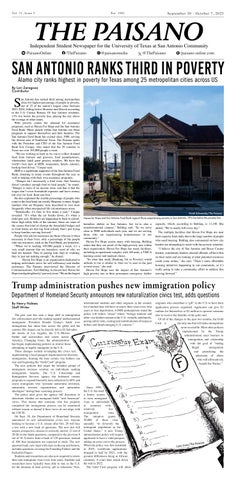
Noah Schwencke/The Paisano
Haven for Hope and San Antonio Food Bank support those experiencing poverty in San Antonio, 13% live below the poverty line
homeless shelter in San Antonio, but we’re also a transformational campus,” Behling said. “So we serve close to 9000 individuals each year, and we are serving those who are experiencing homelessness in our community.” Haven For Hope assists many with housing. Behling states that they see proof of the high poverty rate within their organization. Haven For Hope has many facilities, including an apartment complex with 140 units, a YMCA learning center and medical clinics. “So what that study [Ranking 3rd in Poverty] would indicate to me is similar to what we’ve seen in the past several years,” she said. Haven For Hope sees the impact of San Antonio’s high poverty rate in their permanent emergency shelter
capacity, which, according to Behling, is 13,140. She added, “We’re nearly full every day.” The multiple facilities that Haven For Hope are near their capacity limit daily due to the large number of people who need housing. Behling also commented on how city leaders are attempting to assist with the poverty situation. “I believe the city of San Antonio and Bexar County leaders, community leaders, elected officials, all have this on their radar and are looking at what potential resources could come online,” she said. “There’s more affordable housing initiatives happening in our community, so it’s really going to take a community effort to address this moving forward.”
Trump administration pushes new immigration policy
Department of Homeland Security announces new naturalization civics test, adds questions By Henry Holmes Staff Writer The past year has seen a large shift in immigration law enforcement and rule-making against undocumented immigrants. President Donald Trump’s battle over immigration has taken him across the globe and the country. His impact can be directly felt in El Salvador, the streets of Los Angeles, the U.S.-Mexico border and universities and courts across America. Changing focus, the administration has begun implementing policies to restrict those attempting to legally immigrate to the U.S. These changes include revamping the civics test, implementing a local passport requirement for diversity immigration, limiting the time certain visa holders can stay and beginning the “Gold Card” program. The new policies that target the broadest groups of immigrants increase scrutiny on individuals seeking immigration benefits. The U.S. Citizenship and Immigration Services agency has bolstered various programs to expand biometric data collection by 60% and assess immigrants who “promote antisemitic terrorism, antisemitic terrorist organizations and antisemitic ideologies” during their screening process. The policy alert gives the agency full discretion to determine whether an immigrant holds “anti-American” views. This means that someone who has properly completed the immigration process can be monitored without reason or denied if their views do not align with the USCIS. On Sept. 18, the Department of Homeland Security announced its new naturalization civics test. Anyone looking to become a U.S. citizen after Oct. 20 will face a test with a new bank of questions. The new test will require prospective citizens to correctly answer 12 out of 20 fill-in-the-blank questions, compared to the previous 6 out of 10. It draws from a bank of 128 questions, instead of 100, that immigrants are expected to study. The new question bank, now lined with stars on the top and bottom, includes questions covering the Founding Fathers and the Federalist Papers. Students and researchers are also now required to renew their non-immigrant visas every four years. Students and researchers have typically been able to stay in the U.S. for the duration of their activity, job or education. Now,
international students and other migrants in the country for a limited time will have to renew their visas every four years or face deportation. A DHS spokesperson stated the policy will reduce “abuse” where “foreign students and other visa holders remain in the U.S. virtually indefinitely, posing safety risks, costing [an] untold amount of taxpayer dollars and disadvantaging U.S. citizens.”
Since 1995, the U.S. has used a lottery system to issue immigrant visas to individuals in countries with relatively low immigration rates. The initiative grants 50,000 of these visas annually “to diversify the immigrant population in the United States.” A new Trump administration policy will require applicants to have a valid passport, adding an extra cost to the process. When the policy was first instituted in 2019, worldwide applications dropped to half by 2021, with the greatest differences being in African countries. A court later struck down the rule in 2022. The Gold Card program will allow
migrants who contribute a “gift” to the U.S. to have their application process expedited. Applicants can give $1 million for themselves or $2 million to sponsor someone else to receive the benefits of the gold card. Of all of the changes in the past two months, the Gold Card is the only one that will make immigration more accessible. Most other policies implemented by the Trump administration erect barriers to immigration and citizenship with the goal of “ending illegal immigration and prioritizing the admission of aliens who will affirmatively benefit the Nation.”
isano s/The Pa
Liam Line