Vol. 71, Issue 13
N o v e mb e r 2 5 - D e c e mb e r 2 , 2 0 2 5
Est. 1981
THE PAISANO
Independent Student Newspaper for the University of Texas at San Antonio Community
@ThePaisano
@paisanomedia
@paisanosports
@paisanosports
/paisano-online.com
Student, faculty veterans counter THC ban Erick Henriquez Camargo/The Paisano
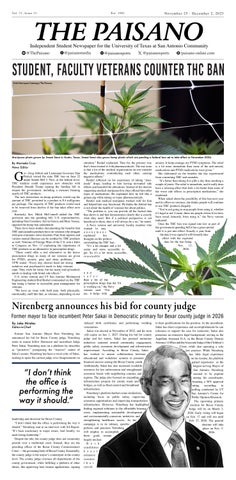
Marijuana plants grown by Sweet Sensi in Austin, Texas. Sweet Sensi also grows hemp plants which are pending a federal ban set to take effect in November 2026.
By Marisela Cruz News Editor
G
ov. Greg Abbott and Lieutenant Governor Dan Patrick vetoed the state THC ban on June 22 under Senate Bill 3. Now, at the federal level, THC retailers could experience new obstacles with President Donald Trump signing the funding bill to reopen the government, including a measure banning nearly all THC products. The new restrictions on hemp products would cap the amount of THC permitted in a product to 0.4 milligrams per package. The majority of THC products would need to be removed from shelves if the ban takes effect next year. Kentucky Sen. Mitch McConnell added the THC provision into the spending bill. U.S. representatives, including Dan Crenshaw, Sylvia Garcia and Marc Veasey, opposed the hemp ban amendment. There have been studies documenting the benefits that THC and cannabis products have on veterans who struggle with post-traumatic stress disorder. Pain from injuries and various mental illnesses can be soothed by THC products as well. Veterans of Foreign Wars of the U.S. sent a letter to Congress on Nov. 13 explaining the importance of THC products as an alternative to prescription drugs. “These could offer a real alternative to the heavy prescription drugs so many of our veterans are given for PTSD, anxiety, pain and sleep problems,” VFW stated. “Every day, doctors hand out strong sedatives and psychoactive meds to help veterans cope. They work for some, but too many end up hooked, numb or dealing with brutal side effects.” U.S. Army veteran and UT San Antonio Mechanical Engineering student Rod Reshel commented on the THC ban being a barrier to accessible pain management for veterans. “We have an issue with both pain, both physically, emotionally, stuff like that, as veterans, depending on our
situation,” Reshel explained. Thus far, the primary way that’s been treated is with pharmaceuticals. The one issue is that a lot of the medical organizations do not consider the medications contradicting each other, causing negative effects.” Reshel reflected on his experience of taking “manmade” drugs, leading to him having unwanted side effects and harmful life alterations. Instead of his doctors suggesting medical marijuana first, they offered him other types of medications. He explained how he felt like a guinea pig while taking so many pharmaceuticals. Reshel said medical marijuana worked well for him and helped him stay functional. He thinks the federal ban is not about the health of veterans but about politics. “The problem is, you can provide all the factual data that shows it and that demonstrates clearly this is exactly what they need. But if a political perspective is not beneficial to them, then it will always be a no,” he noted. A Navy veteran and university faculty member who wished to stay anonymous explained her thoughts on the politics surrounding the THC ban. “It’s a lot cheaper and a lot easier and more accessible to get. So it’s a lot more accessible, reasonable
anxiety. It helps manage my PTSD symptoms. The relief is a lot more immediate than some of the anti-anxiety medications and PTSD medications were given.” She elaborated on the benefits she has experienced from consuming THC and cannabis. “It’s better than taking five pills a day than smoking a couple of joints. The relief is immediate, and it really does have a relaxing effect that feels a lot better than some of the worst side effects in prescription medications,” she explained. When asked about the possibility of this ban next year and its effect on veterans, she thinks people will continue to use THC products illegally. “You’re not going to stop people from using it, whether it’s legal or not. I mean, there are people whose lives have been saved, honestly, from using it,” the Navy veteran indicated. Once the THC ban was signed into law as part of the government spending bill it has a grace period until it is put into effect. Exactly a year from the date it was signed it will formally take effect with the expected date for the ban being Nov. 13, 2026.
a n d s a f e r than a lot of the prescription drugs that the VA is working on,” the Navy veteran said. “For me, it helps with
Nirenberg announces his bid for county judge
Former mayor to face incumbent Peter Sakai in Democratic primary for Bexar county judge in 2026 By Jake Mireles Editor-in-Chief
Former San Antonio Mayor Ron Nirenberg has announced his bid for Bexar County judge. Nirenberg seeks to unseat fellow Democrat and incumbent Judge Peter Sakai. Nirenberg runs on a platform he describes as “proactive,” juxtaposing the “reactive” nature of Sakai’s tenure. Nirenberg has been a vocal critic of Sakai, seeking to upset the current judge over disagreements on
“I don’t think the office is performing the way it should.” leadership and direction for Bexar County. “I don’t think that the office is performing the way it should,” Nirenberg said in an interview with SA Report. “It’s been reactionary to major issues. And frankly, we need strong leadership.” Despite the title, the county judge does not commonly preside over a traditional court. Instead, they are the presiding officer of the Bexar County Commissioners Court — the governing body of Bexar County. Essentially, the county judge is the mayor’s counterpart at the county level. The county judge oversees all departments of the county government, while fulfilling a plethora of other duties, like approving beer license applications, signing
delayed birth certificates and performing wedding ceremonies. Sakai was elected in November of 2022, and his term will expire on Jan. 1, 2027. During his bid for county judge and his tenure, Sakai has pursued numerous initiatives centered around community engagement, public safety, economic development and infrastructure improvement. According to Bexar County, Sakai has worked to ensure collaboration between educational and workforce systems to promote financial success among the Bexar County youth. Additionally, Sakai has also increased available resources for law enforcement and strengthened economic bonds with neighboring counties and regions. The judge also focused on expanding infrastructure projects for county roads and bridges, as well as flood control and broadband infrastructure. Nirenberg’s platform harbors some similarities, including focus on public safety, improving economic opportunities and improving transportation infrastructure. However, Nirenberg has highlighted finding regional solutions to the affordable housing crisis, implementing sustainable development and environmentally-conscious initiatives and strengthening healthcare access. As his campaign is in its infancy, specific policies and practices Nirenberg will employ to accomplish these goals remain largely unclear. B o t h candidates b o a s t extensive resumes t h a t speak
to their qualifications for the position. As the incumbent, Sakai has direct experience and accomplishments he can reference to support his case for reelection. Sakai also possesses an extensive legal background, serving as the Appellate Assistant D.A. in the Bexar County District Attorney’s Office and the Associate Judge of the Children’s Court, while also operating a solo law practice. While Nirenberg has little legal experience on his resume, his platform gained experience as the longest-serving Mayor of San Antonio. Nirenberg seemed to be popular among his constituents, boasting a 56% approval rating according to polling conducted by UT San Antonio’s Center for Public Opinion Research. The upcoming primary election for Bexar County Judge will be on March 3, 2026. Early voting will begin on Feb. 17 and will run until Feb. 27, 2026. The general election will take place on Nov. 5, 2026.